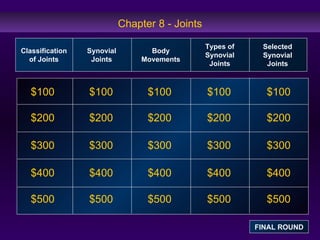
Chapter 8 - Joints $100 $200 $300 $400 $500 $100 $ 100 $100 $100 $200 $200 $200 $200 $300 $300 $300 $300 $400 $400 $400 $400 $500 $500 $500 $500 Classification of Joints Synovial Joints Body Movements Types of Synovial Joints Selected Synovial Joints FINAL ROUND
Classification of Joints:  $100 Question The two main types of joint classification are: a. size and structure. b. size and shape. c. structure and function. d. shape and function. BACK TO GAME ANSWER
Classification of Joints:  $100 Answer The two main types of joint classification are: a. size and structure. b. size and shape. c. structure and function. d. shape and function. BACK TO GAME
Classification of Joints:  $200 Question The hip joint is an example of a(n) ______. a. synchondrosis b. synarthrosis c. amphiarthrosis d. diarthrosis BACK TO GAME ANSWER
Classification of Joints:  $200 Answer The hip joint is an example of a(n) ______. a. synchondrosis b. synarthrosis c. amphiarthrosis d. diarthrosis BACK TO GAME
Classification of Joints:  $300 Question A fibrous joint connected by ligaments is classified as a ________. a. suture b. syndesmosis c. gomphosis d. symphysis BACK TO GAME ANSWER
Classification of Joints:  $300 Answer A fibrous joint connected by ligaments is classified as a ________. a. suture b. syndesmosis c. gomphosis d. symphysis BACK TO GAME
Classification of Joints:  $400 Question Which of the following is a cartilaginous joint? a. Suture b. Synarthrosis c. Gomphosis d. Symphysis BACK TO GAME ANSWER
Classification of Joints:  $400 Answer Which of the following is a cartilaginous joint? a. Suture b. Synarthrosis c. Gomphosis d. Symphysis BACK TO GAME
Classification of Joints:  $500 Question Which of the following is an example of a synarthrosis? a. Diarthrosis b. Suture c. Symphysis d. Syndesmosis BACK TO GAME ANSWER
Classification of Joints:  $500 Answer Which of the following is an example of a synarthrosis? a. Diarthrosis b. Suture c. Symphysis d. Syndesmosis BACK TO GAME
Synovial Joints:  $100 Question Synovial joints are examples of __________. a. amphiarthroses b. diarthroses c. synarthroses d. synchondroses BACK TO GAME ANSWER
Synovial Joints:  $100 Answer Synovial joints are examples of __________. a. amphiarthroses b. diarthroses c. synarthroses d. synchondroses BACK TO GAME
Synovial Joints:  $200 Question A unique feature of synovial joints is __________. a. a joint cavity b. cartilage c. ligaments d. All of the above are unique  to synovial joints. BACK TO GAME ANSWER
Synovial Joints:  $200 Answer A unique feature of synovial joints is __________. a. a joint cavity b. cartilage c. ligaments d. All of the above are unique  to synovial joints. BACK TO GAME
Synovial Joints:  $300 Question The fibrous capsule of a synovial joint is composed of ________. a. cartilage b. synovial fluid c. connective tissue d. synovial membrane BACK TO GAME ANSWER
Synovial Joints:  $300 Answer The fibrous capsule of a synovial joint is composed of ________. a. cartilage b. synovial fluid c. connective tissue d. synovial membrane BACK TO GAME
Synovial Joints:  $400 Question All of the following are synovial joints  except: a. temporomandibular. b. interphalangeal. c. intervertebral. d. elbow. BACK TO GAME ANSWER
Synovial Joints:  $400 Answer All of the following are synovial joints  except: a. temporomandibular. b. interphalangeal. c. intervertebral. d. elbow. BACK TO GAME
Synovial Joints:  $500 Question All of the following are part of a synovial joint  except: a. bursae. b. ligaments. c. articular cartilage. d. synovial fluid. BACK TO GAME ANSWER
Synovial Joints:  $500 Answer All of the following are part of a synovial joint  except: a. bursae. b. ligaments. c. articular cartilage. d. synovial fluid. BACK TO GAME
Body Movements:  $100 Question What movement has occurred when you bend your fingers to make a fist? a. Adduction b. Extension c. Flexion d. Rotation BACK TO GAME ANSWER
Body Movements:  $100 Answer What movement has occurred when you bend your fingers to make a fist? a. Adduction b. Extension c. Flexion d. Rotation BACK TO GAME
Body Movements:  $200 Question The opposite movement of supination is ________. a. abduction b. protraction c. opposition d. pronation BACK TO GAME ANSWER
Body Movements:  $200 Answer The opposite movement of supination is ________. a. abduction b. protraction c. opposition d. pronation BACK TO GAME
Body Movements:  $300 Question This movement is a combination of several movements. a. Inversion b. Rotation c. Circumduction d. Hyperextension BACK TO GAME ANSWER
Body Movements:  $300 Answer This movement is a combination of several movements. a. Inversion b. Rotation c. Circumduction d. Hyperextension BACK TO GAME
Body Movements:  $400 Question When the sole of your foot is turned medially, _______ has occurred. a. eversion b. inversion c. dorsiflexion d. plantar flexion BACK TO GAME ANSWER
Body Movements:  $400 Answer When the sole of your foot is turned medially, _______ has occurred. a. eversion b. inversion c. dorsiflexion d. plantar flexion BACK TO GAME
Body Movements:  $500 Question Protraction of the jaw would be classified as which type of movement? a. Angular b. Gliding c. Rotation d. Opposition BACK TO GAME ANSWER
Body Movements:  $500 Answer Protraction of the jaw would be classified as which type of movement? a. Angular b. Gliding c. Rotation d. Opposition BACK TO GAME
Types of Synovial Joints: $100 Question All of the following are types of synovial joints  except: a. condyloid. b. plane. c. saddle. d. suture. BACK TO GAME ANSWER
Types of Synovial Joints:  $100 Answer All of the following are types of synovial joints  except: a. condyloid. b. plane. c. saddle. d. suture. BACK TO GAME
Types of Synovial Joints:  $200 Question These are the most freely movable type of synovial joint. a. Ball and socket b. Condyloid c. Hinge d. Pivot BACK TO GAME ANSWER
Types of Synovial Joints:  $200 Answer These are the most freely movable type of synovial joint. a. Ball and socket b. Condyloid c. Hinge d. Pivot BACK TO GAME
Types of Synovial Joints:  $300 Question The carpals form this type of joint with each other. a. Condyloid b. Hinge c. Pivot d. Plane BACK TO GAME ANSWER
Types of Synovial Joints:   $300 Answer The carpals form this type of joint with each other. a. Condyloid b. Hinge c. Pivot d. Plane BACK TO GAME
Types of Synovial Joints:  $400 Question Hinge joints are classified as ________. a. nonaxial b. uniaxial c. biaxial d. multiaxial BACK TO GAME ANSWER
Types of Synovial Joints:  $400 Answer Hinge joints are classified as ________. a. nonaxial b. uniaxial c. biaxial d. multiaxial BACK TO GAME
Types of Synovial Joints:   $500 Question The proximal ends of the radius and ulna form which type of joint? a. Condyloid b. Hinge c. Pivot d. Plane BACK TO GAME ANSWER
Types of Synovial Joints:   $500 Answer The proximal ends of the radius and ulna form which type of joint? a. Condyloid b. Hinge c. Pivot d. Plane BACK TO GAME
Selected Synovial Joints: $100 Question According to your book, which joint is the most complex joint in your body? a. Elbow b. Knee c. Hip d. Shoulder BACK TO GAME ANSWER
Selected Synovial Joints:  $100 Answer According to your book, which joint is the most complex joint in your body? a. Elbow b. Knee c. Hip d. Shoulder BACK TO GAME
Selected Synovial Joints:  $200 Question Which joint in your body is the most easily dislocated? a. Knee b. Hip c. Shoulder d. Temporomandibular BACK TO GAME ANSWER
Selected Synovial Joints:   $200 Answer Which joint in your body is the most easily dislocated? a. Knee b. Hip c. Shoulder d. Temporomandibular BACK TO GAME
Selected Synovial Joints:  $300 Question The trochlear notch helps to stabilize which joint? a. Elbow b. Hip c. Shoulder d. Temporomandibular BACK TO GAME ANSWER
Selected Synovial Joints:   $300 Answer The trochlear notch helps to stabilize which joint? a. Elbow b. Hip c. Shoulder d. Temporomandibular BACK TO GAME
Selected Synovial Joints:  $400 Question Which joint is the most freely movable joint in our body? a. Knee b. Hip c. Shoulder d. Temporomandibular BACK TO GAME ANSWER
Selected Synovial Joints:  $400 Answer Which joint is the most freely movable joint in our body? a. Knee b. Hip c. Shoulder d. Temporomandibular BACK TO GAME
Selected Synovial Joints:  $500 Question Which body joint is the most susceptible to sports injuries? a. Elbow b. Knee c. Hip d. Shoulder BACK TO GAME ANSWER
Selected Synovial Joints:  $500 Answer Which body joint is the most susceptible to sports injuries? a. Elbow b. Knee c. Hip d. Shoulder BACK TO GAME
FINAL ROUND  Question Which synovial joint in your body is only partially enclosed in a joint capsule? a. Elbow b. Knee  c. Hip d. Shoulder BACK TO GAME ANSWER
FINAL ROUND  Answer Which synovial joint in your body is only partially enclosed in a joint capsule? a. Elbow b. Knee   c. Hip d. Shoulder BACK TO GAME

Ch 08 quiz_show_game

  • 1.
    Chapter 8 -Joints $100 $200 $300 $400 $500 $100 $ 100 $100 $100 $200 $200 $200 $200 $300 $300 $300 $300 $400 $400 $400 $400 $500 $500 $500 $500 Classification of Joints Synovial Joints Body Movements Types of Synovial Joints Selected Synovial Joints FINAL ROUND
  • 2.
    Classification of Joints: $100 Question The two main types of joint classification are: a. size and structure. b. size and shape. c. structure and function. d. shape and function. BACK TO GAME ANSWER
  • 3.
    Classification of Joints: $100 Answer The two main types of joint classification are: a. size and structure. b. size and shape. c. structure and function. d. shape and function. BACK TO GAME
  • 4.
    Classification of Joints: $200 Question The hip joint is an example of a(n) ______. a. synchondrosis b. synarthrosis c. amphiarthrosis d. diarthrosis BACK TO GAME ANSWER
  • 5.
    Classification of Joints: $200 Answer The hip joint is an example of a(n) ______. a. synchondrosis b. synarthrosis c. amphiarthrosis d. diarthrosis BACK TO GAME
  • 6.
    Classification of Joints: $300 Question A fibrous joint connected by ligaments is classified as a ________. a. suture b. syndesmosis c. gomphosis d. symphysis BACK TO GAME ANSWER
  • 7.
    Classification of Joints: $300 Answer A fibrous joint connected by ligaments is classified as a ________. a. suture b. syndesmosis c. gomphosis d. symphysis BACK TO GAME
  • 8.
    Classification of Joints: $400 Question Which of the following is a cartilaginous joint? a. Suture b. Synarthrosis c. Gomphosis d. Symphysis BACK TO GAME ANSWER
  • 9.
    Classification of Joints: $400 Answer Which of the following is a cartilaginous joint? a. Suture b. Synarthrosis c. Gomphosis d. Symphysis BACK TO GAME
  • 10.
    Classification of Joints: $500 Question Which of the following is an example of a synarthrosis? a. Diarthrosis b. Suture c. Symphysis d. Syndesmosis BACK TO GAME ANSWER
  • 11.
    Classification of Joints: $500 Answer Which of the following is an example of a synarthrosis? a. Diarthrosis b. Suture c. Symphysis d. Syndesmosis BACK TO GAME
  • 12.
    Synovial Joints: $100 Question Synovial joints are examples of __________. a. amphiarthroses b. diarthroses c. synarthroses d. synchondroses BACK TO GAME ANSWER
  • 13.
    Synovial Joints: $100 Answer Synovial joints are examples of __________. a. amphiarthroses b. diarthroses c. synarthroses d. synchondroses BACK TO GAME
  • 14.
    Synovial Joints: $200 Question A unique feature of synovial joints is __________. a. a joint cavity b. cartilage c. ligaments d. All of the above are unique to synovial joints. BACK TO GAME ANSWER
  • 15.
    Synovial Joints: $200 Answer A unique feature of synovial joints is __________. a. a joint cavity b. cartilage c. ligaments d. All of the above are unique to synovial joints. BACK TO GAME
  • 16.
    Synovial Joints: $300 Question The fibrous capsule of a synovial joint is composed of ________. a. cartilage b. synovial fluid c. connective tissue d. synovial membrane BACK TO GAME ANSWER
  • 17.
    Synovial Joints: $300 Answer The fibrous capsule of a synovial joint is composed of ________. a. cartilage b. synovial fluid c. connective tissue d. synovial membrane BACK TO GAME
  • 18.
    Synovial Joints: $400 Question All of the following are synovial joints except: a. temporomandibular. b. interphalangeal. c. intervertebral. d. elbow. BACK TO GAME ANSWER
  • 19.
    Synovial Joints: $400 Answer All of the following are synovial joints except: a. temporomandibular. b. interphalangeal. c. intervertebral. d. elbow. BACK TO GAME
  • 20.
    Synovial Joints: $500 Question All of the following are part of a synovial joint except: a. bursae. b. ligaments. c. articular cartilage. d. synovial fluid. BACK TO GAME ANSWER
  • 21.
    Synovial Joints: $500 Answer All of the following are part of a synovial joint except: a. bursae. b. ligaments. c. articular cartilage. d. synovial fluid. BACK TO GAME
  • 22.
    Body Movements: $100 Question What movement has occurred when you bend your fingers to make a fist? a. Adduction b. Extension c. Flexion d. Rotation BACK TO GAME ANSWER
  • 23.
    Body Movements: $100 Answer What movement has occurred when you bend your fingers to make a fist? a. Adduction b. Extension c. Flexion d. Rotation BACK TO GAME
  • 24.
    Body Movements: $200 Question The opposite movement of supination is ________. a. abduction b. protraction c. opposition d. pronation BACK TO GAME ANSWER
  • 25.
    Body Movements: $200 Answer The opposite movement of supination is ________. a. abduction b. protraction c. opposition d. pronation BACK TO GAME
  • 26.
    Body Movements: $300 Question This movement is a combination of several movements. a. Inversion b. Rotation c. Circumduction d. Hyperextension BACK TO GAME ANSWER
  • 27.
    Body Movements: $300 Answer This movement is a combination of several movements. a. Inversion b. Rotation c. Circumduction d. Hyperextension BACK TO GAME
  • 28.
    Body Movements: $400 Question When the sole of your foot is turned medially, _______ has occurred. a. eversion b. inversion c. dorsiflexion d. plantar flexion BACK TO GAME ANSWER
  • 29.
    Body Movements: $400 Answer When the sole of your foot is turned medially, _______ has occurred. a. eversion b. inversion c. dorsiflexion d. plantar flexion BACK TO GAME
  • 30.
    Body Movements: $500 Question Protraction of the jaw would be classified as which type of movement? a. Angular b. Gliding c. Rotation d. Opposition BACK TO GAME ANSWER
  • 31.
    Body Movements: $500 Answer Protraction of the jaw would be classified as which type of movement? a. Angular b. Gliding c. Rotation d. Opposition BACK TO GAME
  • 32.
    Types of SynovialJoints: $100 Question All of the following are types of synovial joints except: a. condyloid. b. plane. c. saddle. d. suture. BACK TO GAME ANSWER
  • 33.
    Types of SynovialJoints: $100 Answer All of the following are types of synovial joints except: a. condyloid. b. plane. c. saddle. d. suture. BACK TO GAME
  • 34.
    Types of SynovialJoints: $200 Question These are the most freely movable type of synovial joint. a. Ball and socket b. Condyloid c. Hinge d. Pivot BACK TO GAME ANSWER
  • 35.
    Types of SynovialJoints: $200 Answer These are the most freely movable type of synovial joint. a. Ball and socket b. Condyloid c. Hinge d. Pivot BACK TO GAME
  • 36.
    Types of SynovialJoints: $300 Question The carpals form this type of joint with each other. a. Condyloid b. Hinge c. Pivot d. Plane BACK TO GAME ANSWER
  • 37.
    Types of SynovialJoints: $300 Answer The carpals form this type of joint with each other. a. Condyloid b. Hinge c. Pivot d. Plane BACK TO GAME
  • 38.
    Types of SynovialJoints: $400 Question Hinge joints are classified as ________. a. nonaxial b. uniaxial c. biaxial d. multiaxial BACK TO GAME ANSWER
  • 39.
    Types of SynovialJoints: $400 Answer Hinge joints are classified as ________. a. nonaxial b. uniaxial c. biaxial d. multiaxial BACK TO GAME
  • 40.
    Types of SynovialJoints: $500 Question The proximal ends of the radius and ulna form which type of joint? a. Condyloid b. Hinge c. Pivot d. Plane BACK TO GAME ANSWER
  • 41.
    Types of SynovialJoints: $500 Answer The proximal ends of the radius and ulna form which type of joint? a. Condyloid b. Hinge c. Pivot d. Plane BACK TO GAME
  • 42.
    Selected Synovial Joints:$100 Question According to your book, which joint is the most complex joint in your body? a. Elbow b. Knee c. Hip d. Shoulder BACK TO GAME ANSWER
  • 43.
    Selected Synovial Joints: $100 Answer According to your book, which joint is the most complex joint in your body? a. Elbow b. Knee c. Hip d. Shoulder BACK TO GAME
  • 44.
    Selected Synovial Joints: $200 Question Which joint in your body is the most easily dislocated? a. Knee b. Hip c. Shoulder d. Temporomandibular BACK TO GAME ANSWER
  • 45.
    Selected Synovial Joints: $200 Answer Which joint in your body is the most easily dislocated? a. Knee b. Hip c. Shoulder d. Temporomandibular BACK TO GAME
  • 46.
    Selected Synovial Joints: $300 Question The trochlear notch helps to stabilize which joint? a. Elbow b. Hip c. Shoulder d. Temporomandibular BACK TO GAME ANSWER
  • 47.
    Selected Synovial Joints: $300 Answer The trochlear notch helps to stabilize which joint? a. Elbow b. Hip c. Shoulder d. Temporomandibular BACK TO GAME
  • 48.
    Selected Synovial Joints: $400 Question Which joint is the most freely movable joint in our body? a. Knee b. Hip c. Shoulder d. Temporomandibular BACK TO GAME ANSWER
  • 49.
    Selected Synovial Joints: $400 Answer Which joint is the most freely movable joint in our body? a. Knee b. Hip c. Shoulder d. Temporomandibular BACK TO GAME
  • 50.
    Selected Synovial Joints: $500 Question Which body joint is the most susceptible to sports injuries? a. Elbow b. Knee c. Hip d. Shoulder BACK TO GAME ANSWER
  • 51.
    Selected Synovial Joints: $500 Answer Which body joint is the most susceptible to sports injuries? a. Elbow b. Knee c. Hip d. Shoulder BACK TO GAME
  • 52.
    FINAL ROUND Question Which synovial joint in your body is only partially enclosed in a joint capsule? a. Elbow b. Knee c. Hip d. Shoulder BACK TO GAME ANSWER
  • 53.
    FINAL ROUND Answer Which synovial joint in your body is only partially enclosed in a joint capsule? a. Elbow b. Knee c. Hip d. Shoulder BACK TO GAME