WELCOME TO THE PRESENTATION ON
TARA COAL BLOCK
OF
CHHATTISGARH MINERAL DEVELOPMENT CORPORATION
BY
RAVINDRA NATH SAXENA
OFFICIAL CONSULTANT
Heartiest
Welcome to
the
presentation
on
FCA
application
of C.M.D.C.
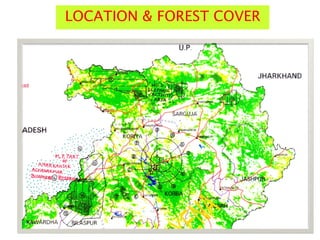
LOCATION & FOREST COVER
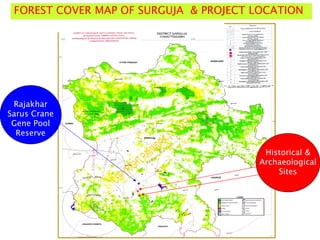
FOREST COVER MAP OF SURGUJA & PROJECT LOCATION
Historical &
Archaeological
Sites
Rajakhar
Sarus Crane
Gene Pool
Reserve
STATUS OF WILD FAUNA & FLORA
 The proposed diversion area is not a
habitat of any species specified in
Schedule-I or Schedule-II, Part-II or
Schedule-VI of Wildlife (Protection) Act,
1972;
 Red Data Book of International Union for
Conservation of Nature & Natural
resources (IUCN) and
 Red Data Book of Botanical Survey of
India.
 It is well evident from the facts that the
project is not posing any threat to
wildlife or biodiversity of the area.
Threatened species - Red data book of IUCN
and Appendix-I & II of CITES
• Fauna in the core zone and buffer zone is enclosed in
Annexure-XXVIII providing species of mammals, birds
and reptiles.
• No National Park and Sanctuary in the South Surguja
Forest Division. Low density of wild fauna.
• The proposed diversion area is not the habitat of any
species specified in the Schedule-I and Schedule-II
Part-II of Wildlife (Protection) Act, 1972.
• Any species protected under “Red Data Book” of the
International Union for Conservation of Nature &
Natural resources (IUCN) is not reported.
• Tigers (Panthera tigris), Panther (Panthera pardus),
wild dog (Cuon alpinus) are rarely reported in the
region. Since density of herbivore population is quite
low, carnivore cannot sustain in such a scenario.
• The “Red Data Book” and “Flora of Madhya
Pradesh” Volume-I and II have been consulted to
determine the status of threatened species of
flora in the area. But none of the species
specified in these documents have been
encountered in the area.
• No significant species of Gymnosperm,
Pteridophyta or Bryophyta have been reported in
the area.
• The Shannon-Weiner Biodiversity Index, Margalef
Index, Berger Species Richness index, Brillouin
Index, Brillouin Eveness Index, Simpson Index
and Mclintosh's Measure of Diversity provides
low assessment of biodiversity, the area is not
having significant diversity, except presence of
Sal.
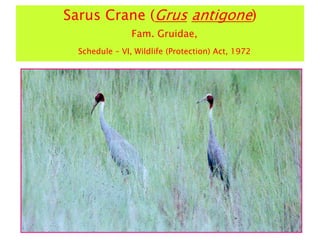
Sarus Crane (Grus antigone)
Fam. Gruidae,
Schedule – VI, Wildlife (Protection) Act, 1972
• The area in question is also not a part of any
proposed protected area as well. The Rajakhar
Sarus Crane (Grus antigone) Genepool Site near
Lakhanpur is situated about 35 kms. from Tara
Coal Project.
• The Sarus Crane is specified as Entry-16, Family
Gruidae (Cranes), Schedule-IV of Wildlife
(Protection) Act, 1972. Few individuals reported in
agricultural fields in proximity to Lakhanpur,
especially around village ponds and wetlands.
• No threat is observed to Sarus Crane habitat since
Tara Coal Project is about 35 kms. away from the
project.
• Since this species is confined to wetlands near
cultivation fields, the Tara Coal Project is not likely
to create any adverse impact on the site.
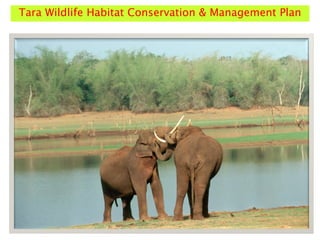
Tara Wildlife Habitat Conservation & Management Plan
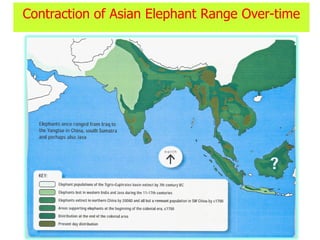
Contraction of Asian Elephant Range Over-time
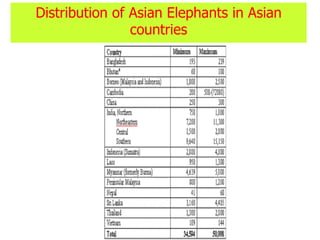
Distribution of Asian Elephants in Asian
countries
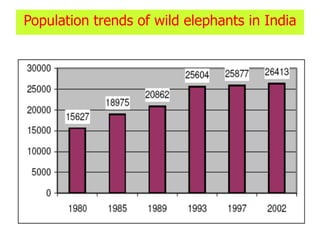
Population trends of wild elephants in India
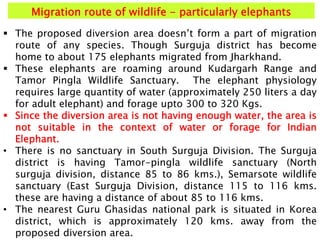
Migration route of wildlife - particularly elephants
 The proposed diversion area doesn’t form a part of migration
route of any species. Though Surguja district has become
home to about 175 elephants migrated from Jharkhand.
 These elephants are roaming around Kudargarh Range and
Tamor Pingla Wildlife Sanctuary. The elephant physiology
requires large quantity of water (approximately 250 liters a day
for adult elephant) and forage upto 300 to 320 Kgs.
 Since the diversion area is not having enough water, the area is
not suitable in the context of water or forage for Indian
Elephant.
• There is no sanctuary in South Surguja Division. The Surguja
district is having Tamor-pingla wildlife sanctuary (North
surguja division, distance 85 to 86 kms.), Semarsote wildlife
sanctuary (East Surguja Division, distance 115 to 116 kms.
these are having a distance of about 85 to 116 kms.
• The nearest Guru Ghasidas national park is situated in Korea
district, which is approximately 120 kms. away from the
proposed diversion area.
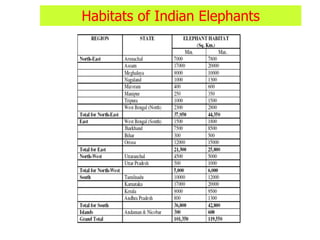
Habitats of Indian Elephants
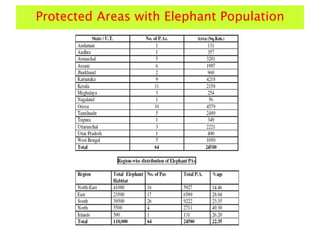
Protected Areas with Elephant Population
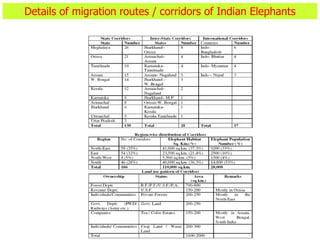
Details of migration routes / corridors of Indian Elephants
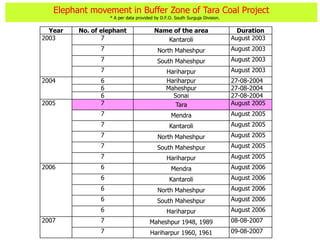
Year No. of elephant Name of the area Duration
2003 7 Kantaroli August 2003
7 North Maheshpur August 2003
7 South Maheshpur August 2003
7 Hariharpur August 2003
2004 6 Hariharpur 27-08-2004
6 Maheshpur 27-08-2004
6 Sonai 27-08-2004
2005 7 Tara August 2005
7 Mendra August 2005
7 Kantaroli August 2005
7 North Maheshpur August 2005
7 South Maheshpur August 2005
7 Hariharpur August 2005
2006 6 Mendra August 2006
6 Kantaroli August 2006
6 North Maheshpur August 2006
6 South Maheshpur August 2006
6 Hariharpur August 2006
2007 7 Maheshpur 1948, 1989 08-08-2007
7 Hariharpur 1960, 1961 09-08-2007
Elephant movement in Buffer Zone of Tara Coal Project
* A per data provided by D.F.O. South Surguja Division.
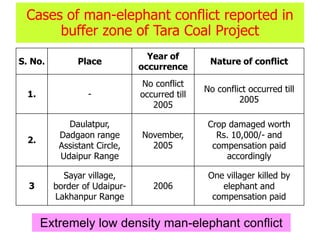
Cases of man-elephant conflict reported in
buffer zone of Tara Coal Project
S. No. Place
Year of
occurrence
Nature of conflict
1. -
No conflict
occurred till
2005
No conflict occurred till
2005
2.
Daulatpur,
Dadgaon range
Assistant Circle,
Udaipur Range
November,
2005
Crop damaged worth
Rs. 10,000/- and
compensation paid
accordingly
3
Sayar village,
border of Udaipur-
Lakhanpur Range
2006
One villager killed by
elephant and
compensation paid
Extremely low density man-elephant conflict
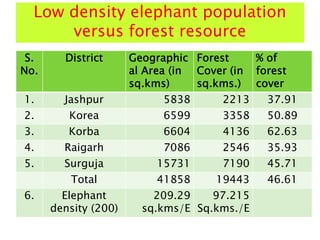
Low density elephant population
versus forest resource
S.
No.
District Geographic
al Area (in
sq.kms)
Forest
Cover (in
sq.kms.)
% of
forest
cover
1. Jashpur 5838 2213 37.91
2. Korea 6599 3358 50.89
3. Korba 6604 4136 62.63
4. Raigarh 7086 2546 35.93
5. Surguja 15731 7190 45.71
Total 41858 19443 46.61
6. Elephant
density (200)
209.29
sq.kms/E
97.215
Sq.kms./E
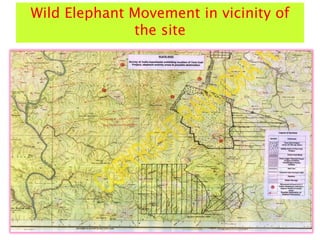
Wild Elephant Movement in vicinity of
the site
Status of Tigers, Co-predators and Prey in
India – published by Wildlife Institute of India
Tara Coal
Project of
C.M.D.C.
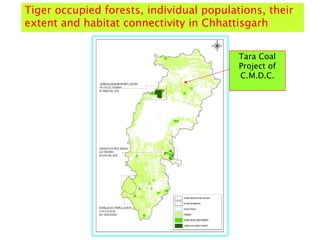
Tiger occupied forests, individual populations, their
extent and habitat connectivity in Chhattisgarh
Tara Coal
Project of
C.M.D.C.
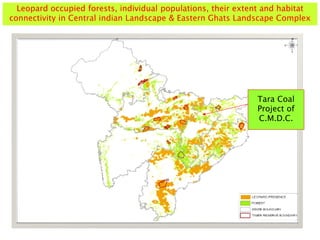
Leopard occupied forests, individual populations, their extent and habitat
connectivity in Central indian Landscape & Eastern Ghats Landscape Complex
Tara Coal
Project of
C.M.D.C.
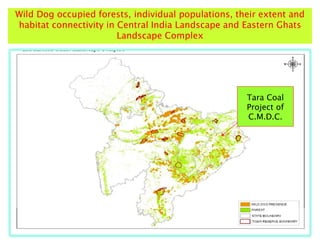
Wild Dog occupied forests, individual populations, their extent and
habitat connectivity in Central India Landscape and Eastern Ghats
Landscape Complex
Tara Coal
Project of
C.M.D.C.
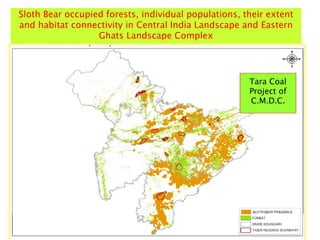
Sloth Bear occupied forests, individual populations, their extent
and habitat connectivity in Central India Landscape and Eastern
Ghats Landscape Complex
Tara Coal
Project of
C.M.D.C.
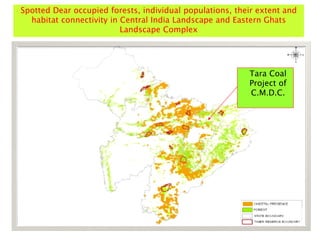
Spotted Dear occupied forests, individual populations, their extent and
habitat connectivity in Central India Landscape and Eastern Ghats
Landscape Complex
Tara Coal
Project of
C.M.D.C.
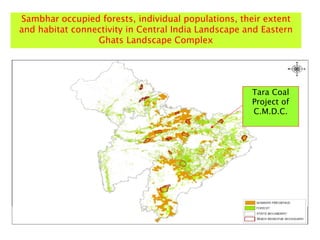
Sambhar occupied forests, individual populations, their extent
and habitat connectivity in Central India Landscape and Eastern
Ghats Landscape Complex
Tara Coal
Project of
C.M.D.C.
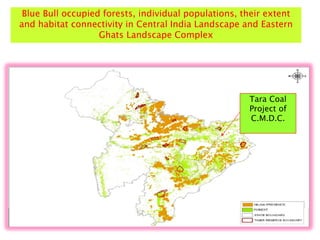
Blue Bull occupied forests, individual populations, their extent
and habitat connectivity in Central India Landscape and Eastern
Ghats Landscape Complex
Tara Wildlife Habitat Conservation &
Management Plan
(with Indian Elephant Conservation Initiative)
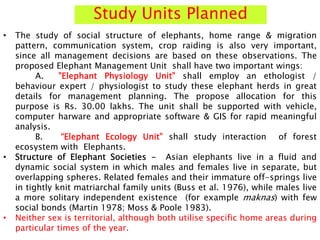
 Project Area – Entire Udaipur Range.
 Project Period – 10 Years.
 Outlay - Rs. 12.26 crores.
 Executive Agency - CG Forest Department
Study Units Planned
• The study of social structure of elephants, home range & migration
pattern, communication system, crop raiding is also very important,
since all management decisions are based on these observations. The
proposed Elephant Management Unit shall have two important wings:
A. "Elephant Physiology Unit" shall employ an ethologist /
behaviour expert / physiologist to study these elephant herds in great
details for management planning. The propose allocation for this
purpose is Rs. 30.00 lakhs. The unit shall be supported with vehicle,
computer harware and appropriate software & GIS for rapid meaningful
analysis.
B. “Elephant Ecology Unit” shall study interaction of forest
ecosystem with Elephants.
• Structure of Elephant Societies - Asian elephants live in a fluid and
dynamic social system in which males and females live in separate, but
overlapping spheres. Related females and their immature off-springs live
in tightly knit matriarchal family units (Buss et al. 1976), while males live
a more solitary independent existence (for example maknas) with few
social bonds (Martin 1978; Moss & Poole 1983).
• Neither sex is territorial, although both utilise specific home areas during
particular times of the year.
Vegetation Dynamics
• Though forest stock maps (scale 1:15,000) and forest
management maps (scale 1:50,000) are available. But at
the outset of any programme of elephant-habitat
research, it is essential to have some form of map of the
geographical distribution of the main vegetation
communities and cover levels. Such a map is useful for
two reasons:
(a) to determine the relative area and location of
specific vegetation communities of concern, such as
riparian woodland or hilltop thickets,
(b) to provide a basis for the stratification of
sampling effort
• Vegetation mapping in its most ideal form may be
performed by reference to satellite images supported by
numerous measurements of plant species composition on
the ground.
• Computer-aided classification and multivariate
statistical techniques (Longman et al. 1987)
allow the classification of site measurements of
vegetation composition into habitat types or
communities and refine the interpretation of
satellite images. Mapping at a more modest
level is accomplished by visual examination of
aerial photos and delineation of apparent
community types, again with checking and
correction on the ground.
• However, even this level of technical
sophistication is not always available. In the
absence of a detailed vegetation map, even a
rough estimate of the distribution of vegetation
types would be preferable to none at all.
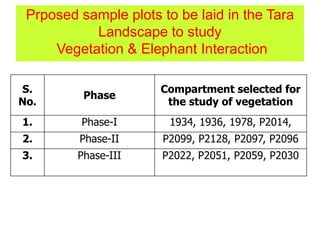
Prposed sample plots to be laid in the Tara
Landscape to study
Vegetation & Elephant Interaction
S.
No.
Phase
Compartment selected for
the study of vegetation
1. Phase-I 1934, 1936, 1978, P2014,
2. Phase-II P2099, P2128, P2097, P2096
3. Phase-III P2022, P2051, P2059, P2030
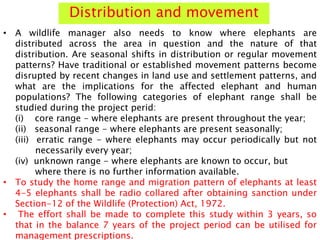
Distribution and movement
• A wildlife manager also needs to know where elephants are
distributed across the area in question and the nature of that
distribution. Are seasonal shifts in distribution or regular movement
patterns? Have traditional or established movement patterns become
disrupted by recent changes in land use and settlement patterns, and
what are the implications for the affected elephant and human
populations? The following categories of elephant range shall be
studied during the project perid:
(i) core range - where elephants are present throughout the year;
(ii) seasonal range - where elephants are present seasonally;
(iii) erratic range - where elephants may occur periodically but not
necessarily every year;
(iv) unknown range - where elephants are known to occur, but
where there is no further information available.
• To study the home range and migration pattern of elephants at least
4-5 elephants shall be radio collared after obtaining sanction under
Section-12 of the Wildlife (Protection) Act, 1972.
• The effort shall be made to complete this study within 3 years, so
that in the balance 7 years of the project period can be utilised for
management prescriptions.
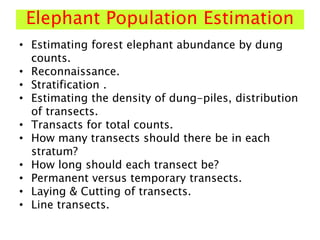
Elephant Population Estimation
• Estimating forest elephant abundance by dung
counts.
• Reconnaissance.
• Stratification .
• Estimating the density of dung-piles, distribution
of transects.
• Transacts for total counts.
• How many transects should there be in each
stratum?
• How long should each transect be?
• Permanent versus temporary transects.
• Laying & Cutting of transects.
• Line transects.
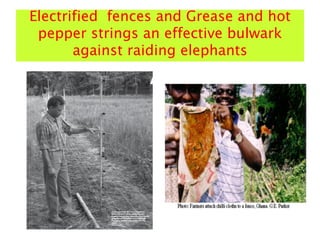
Electrified fences and Grease and hot
pepper strings an effective bulwark
against raiding elephants
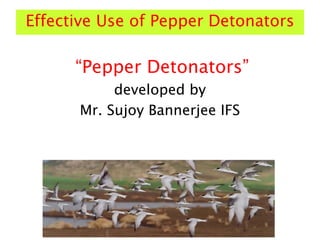
Effective Use of Pepper Detonators
“Pepper Detonators”
developed by
Mr. Sujoy Bannerjee IFS
Elephant Protection Units
• Active methods :
These units shall employ active elephant
protection devices to protect their crops and to
keep elephants in the dense forest areas. The
active protection batteries have been proposed
at the following places:
Dadgaon. Salbha. Parsa. Ghatbarra. Maheshpur.
Hariharpur. Korasama. Ramgarh. Saskalo. Jajga.
Parhapara
• Burning fires : Fires are kept burning all night
in areas where elephants are regular visitors. In
some areas firewood is difficult to obtain, so
any material that will smoulder can be used.
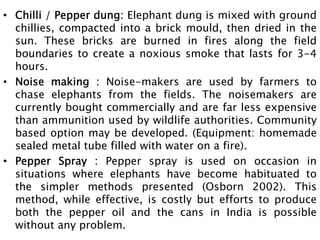
• Chilli / Pepper dung: Elephant dung is mixed with ground
chillies, compacted into a brick mould, then dried in the
sun. These bricks are burned in fires along the field
boundaries to create a noxious smoke that lasts for 3-4
hours.
• Noise making : Noise-makers are used by farmers to
chase elephants from the fields. The noisemakers are
currently bought commercially and are far less expensive
than ammunition used by wildlife authorities. Community
based option may be developed. (Equipment: homemade
sealed metal tube filled with water on a fire).
• Pepper Spray : Pepper spray is used on occasion in
situations where elephants have become habituated to
the simpler methods presented (Osborn 2002). This
method, while effective, is costly but efforts to produce
both the pepper oil and the cans in India is possible
without any problem.
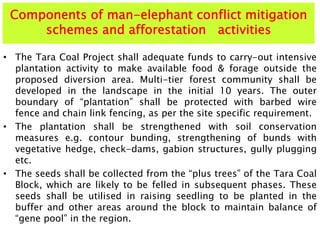
Components of man-elephant conflict mitigation
schemes and afforestation activities
• The Tara Coal Project shall adequate funds to carry-out intensive
plantation activity to make available food & forage outside the
proposed diversion area. Multi-tier forest community shall be
developed in the landscape in the initial 10 years. The outer
boundary of “plantation” shall be protected with barbed wire
fence and chain link fencing, as per the site specific requirement.
• The plantation shall be strengthened with soil conservation
measures e.g. contour bunding, strengthening of bunds with
vegetative hedge, check-dams, gabion structures, gully plugging
etc.
• The seeds shall be collected from the “plus trees” of the Tara Coal
Block, which are likely to be felled in subsequent phases. These
seeds shall be utilised in raising seedling to be planted in the
buffer and other areas around the block to maintain balance of
“gene pool” in the region.
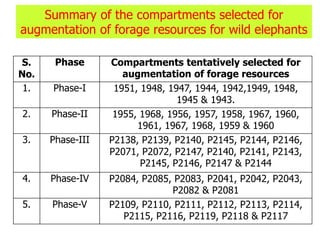
S.
No.
Phase Compartments tentatively selected for
augmentation of forage resources
1. Phase-I 1951, 1948, 1947, 1944, 1942,1949, 1948,
1945 & 1943.
2. Phase-II 1955, 1968, 1956, 1957, 1958, 1967, 1960,
1961, 1967, 1968, 1959 & 1960
3. Phase-III P2138, P2139, P2140, P2145, P2144, P2146,
P2071, P2072, P2147, P2140, P2141, P2143,
P2145, P2146, P2147 & P2144
4. Phase-IV P2084, P2085, P2083, P2041, P2042, P2043,
P2082 & P2081
5. Phase-V P2109, P2110, P2111, P2112, P2113, P2114,
P2115, P2116, P2119, P2118 & P2117
Summary of the compartments selected for
augmentation of forage resources for wild elephants
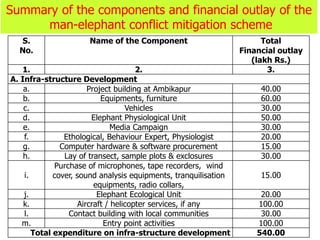
S.
No.
Name of the Component Total
Financial outlay
(lakh Rs.)
1. 2. 3.
A. Infra-structure Development
a. Project building at Ambikapur 40.00
b. Equipments, furniture 60.00
c. Vehicles 30.00
d. Elephant Physiological Unit 50.00
e. Media Campaign 30.00
f. Ethological, Behaviour Expert, Physiologist 20.00
g. Computer hardware & software procurement 15.00
h. Lay of transect, sample plots & exclosures 30.00
i.
Purchase of microphones, tape recorders, wind
cover, sound analysis equipments, tranquilisation
equipments, radio collars,
15.00
j. Elephant Ecological Unit 20.00
k. Aircraft / helicopter services, if any 100.00
l. Contact building with local communities 30.00
m. Entry point activities 100.00
Total expenditure on infra-structure development 540.00
Summary of the components and financial outlay of the
man-elephant conflict mitigation scheme
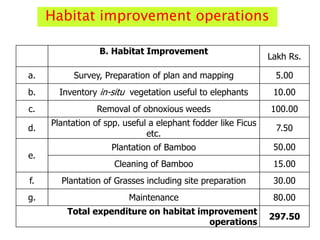
Habitat improvement operations
B. Habitat Improvement
Lakh Rs.
a. Survey, Preparation of plan and mapping 5.00
b. Inventory in-situ vegetation useful to elephants 10.00
c. Removal of obnoxious weeds 100.00
d.
Plantation of spp. useful a elephant fodder like Ficus
etc.
7.50
e.
Plantation of Bamboo 50.00
Cleaning of Bamboo 15.00
f. Plantation of Grasses including site preparation 30.00
g. Maintenance 80.00
Total expenditure on habitat improvement
operations
297.50
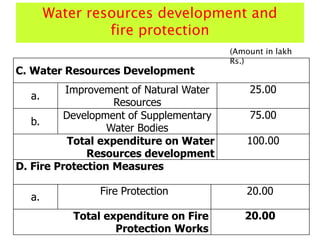
Water resources development and
fire protection
C. Water Resources Development
a.
Improvement of Natural Water
Resources
25.00
b.
Development of Supplementary
Water Bodies
75.00
Total expenditure on Water
Resources development
100.00
D. Fire Protection Measures
a.
Fire Protection 20.00
Total expenditure on Fire
Protection Works
20.00
(Amount in lakh
Rs.)
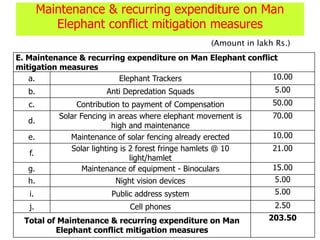
Maintenance & recurring expenditure on Man
Elephant conflict mitigation measures
E. Maintenance & recurring expenditure on Man Elephant conflict
mitigation measures
a. Elephant Trackers 10.00
b. Anti Depredation Squads 5.00
c. Contribution to payment of Compensation 50.00
d.
Solar Fencing in areas where elephant movement is
high and maintenance
70.00
e. Maintenance of solar fencing already erected 10.00
f.
Solar lighting is 2 forest fringe hamlets @ 10
light/hamlet
21.00
g. Maintenance of equipment - Binoculars 15.00
h. Night vision devices 5.00
i. Public address system 5.00
j. Cell phones 2.50
Total of Maintenance & recurring expenditure on Man
Elephant conflict mitigation measures
203.50
(Amount in lakh Rs.)
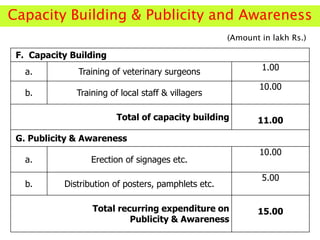
Capacity Building & Publicity and Awareness
F. Capacity Building
a. Training of veterinary surgeons 1.00
b. Training of local staff & villagers
10.00
Total of capacity building 11.00
G. Publicity & Awareness
a. Erection of signages etc.
10.00
b. Distribution of posters, pamphlets etc.
5.00
Total recurring expenditure on
Publicity & Awareness
15.00
(Amount in lakh Rs.)
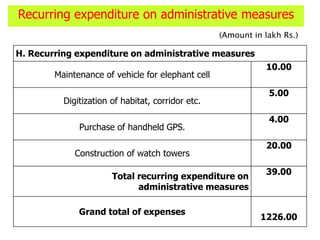
Recurring expenditure on administrative measures
H. Recurring expenditure on administrative measures
Maintenance of vehicle for elephant cell
10.00
Digitization of habitat, corridor etc.
5.00
Purchase of handheld GPS.
4.00
Construction of watch towers
20.00
Total recurring expenditure on
administrative measures
39.00
Grand total of expenses
1226.00
(Amount in lakh Rs.)
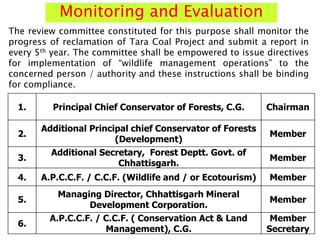
Monitoring and Evaluation
1. Principal Chief Conservator of Forests, C.G. Chairman
2.
Additional Principal chief Conservator of Forests
(Development)
Member
3.
Additional Secretary, Forest Deptt. Govt. of
Chhattisgarh.
Member
4. A.P.C.C.F. / C.C.F. (Wildlife and / or Ecotourism) Member
5.
Managing Director, Chhattisgarh Mineral
Development Corporation.
Member
6.
A.P.C.C.F. / C.C.F. ( Conservation Act & Land
Management), C.G.
Member
Secretary
The review committee constituted for this purpose shall monitor the
progress of reclamation of Tara Coal Project and submit a report in
every 5th year. The committee shall be empowered to issue directives
for implementation of “wildlife management operations” to the
concerned person / authority and these instructions shall be binding
for compliance.
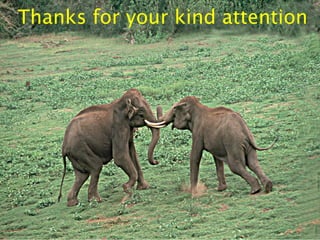
Thanks for your kind attention

Cgmdc tara fac_wildlife_presentation_10.03.2011

  • 1.
    WELCOME TO THEPRESENTATION ON TARA COAL BLOCK OF CHHATTISGARH MINERAL DEVELOPMENT CORPORATION BY RAVINDRA NATH SAXENA OFFICIAL CONSULTANT
  • 2.
  • 3.
  • 4.
    FOREST COVER MAPOF SURGUJA & PROJECT LOCATION Historical & Archaeological Sites Rajakhar Sarus Crane Gene Pool Reserve
  • 5.
    STATUS OF WILDFAUNA & FLORA  The proposed diversion area is not a habitat of any species specified in Schedule-I or Schedule-II, Part-II or Schedule-VI of Wildlife (Protection) Act, 1972;  Red Data Book of International Union for Conservation of Nature & Natural resources (IUCN) and  Red Data Book of Botanical Survey of India.  It is well evident from the facts that the project is not posing any threat to wildlife or biodiversity of the area.
  • 6.
    Threatened species -Red data book of IUCN and Appendix-I & II of CITES • Fauna in the core zone and buffer zone is enclosed in Annexure-XXVIII providing species of mammals, birds and reptiles. • No National Park and Sanctuary in the South Surguja Forest Division. Low density of wild fauna. • The proposed diversion area is not the habitat of any species specified in the Schedule-I and Schedule-II Part-II of Wildlife (Protection) Act, 1972. • Any species protected under “Red Data Book” of the International Union for Conservation of Nature & Natural resources (IUCN) is not reported. • Tigers (Panthera tigris), Panther (Panthera pardus), wild dog (Cuon alpinus) are rarely reported in the region. Since density of herbivore population is quite low, carnivore cannot sustain in such a scenario.
  • 7.
    • The “RedData Book” and “Flora of Madhya Pradesh” Volume-I and II have been consulted to determine the status of threatened species of flora in the area. But none of the species specified in these documents have been encountered in the area. • No significant species of Gymnosperm, Pteridophyta or Bryophyta have been reported in the area. • The Shannon-Weiner Biodiversity Index, Margalef Index, Berger Species Richness index, Brillouin Index, Brillouin Eveness Index, Simpson Index and Mclintosh's Measure of Diversity provides low assessment of biodiversity, the area is not having significant diversity, except presence of Sal.
  • 8.
    Sarus Crane (Grusantigone) Fam. Gruidae, Schedule – VI, Wildlife (Protection) Act, 1972
  • 9.
    • The areain question is also not a part of any proposed protected area as well. The Rajakhar Sarus Crane (Grus antigone) Genepool Site near Lakhanpur is situated about 35 kms. from Tara Coal Project. • The Sarus Crane is specified as Entry-16, Family Gruidae (Cranes), Schedule-IV of Wildlife (Protection) Act, 1972. Few individuals reported in agricultural fields in proximity to Lakhanpur, especially around village ponds and wetlands. • No threat is observed to Sarus Crane habitat since Tara Coal Project is about 35 kms. away from the project. • Since this species is confined to wetlands near cultivation fields, the Tara Coal Project is not likely to create any adverse impact on the site.
  • 10.
    Tara Wildlife HabitatConservation & Management Plan
  • 11.
    Contraction of AsianElephant Range Over-time
  • 12.
    Distribution of AsianElephants in Asian countries
  • 13.
    Population trends ofwild elephants in India
  • 14.
    Migration route ofwildlife - particularly elephants  The proposed diversion area doesn’t form a part of migration route of any species. Though Surguja district has become home to about 175 elephants migrated from Jharkhand.  These elephants are roaming around Kudargarh Range and Tamor Pingla Wildlife Sanctuary. The elephant physiology requires large quantity of water (approximately 250 liters a day for adult elephant) and forage upto 300 to 320 Kgs.  Since the diversion area is not having enough water, the area is not suitable in the context of water or forage for Indian Elephant. • There is no sanctuary in South Surguja Division. The Surguja district is having Tamor-pingla wildlife sanctuary (North surguja division, distance 85 to 86 kms.), Semarsote wildlife sanctuary (East Surguja Division, distance 115 to 116 kms. these are having a distance of about 85 to 116 kms. • The nearest Guru Ghasidas national park is situated in Korea district, which is approximately 120 kms. away from the proposed diversion area.
  • 15.
  • 16.
    Protected Areas withElephant Population
  • 17.
    Details of migrationroutes / corridors of Indian Elephants
  • 18.
    Year No. ofelephant Name of the area Duration 2003 7 Kantaroli August 2003 7 North Maheshpur August 2003 7 South Maheshpur August 2003 7 Hariharpur August 2003 2004 6 Hariharpur 27-08-2004 6 Maheshpur 27-08-2004 6 Sonai 27-08-2004 2005 7 Tara August 2005 7 Mendra August 2005 7 Kantaroli August 2005 7 North Maheshpur August 2005 7 South Maheshpur August 2005 7 Hariharpur August 2005 2006 6 Mendra August 2006 6 Kantaroli August 2006 6 North Maheshpur August 2006 6 South Maheshpur August 2006 6 Hariharpur August 2006 2007 7 Maheshpur 1948, 1989 08-08-2007 7 Hariharpur 1960, 1961 09-08-2007 Elephant movement in Buffer Zone of Tara Coal Project * A per data provided by D.F.O. South Surguja Division.
  • 19.
    Cases of man-elephantconflict reported in buffer zone of Tara Coal Project S. No. Place Year of occurrence Nature of conflict 1. - No conflict occurred till 2005 No conflict occurred till 2005 2. Daulatpur, Dadgaon range Assistant Circle, Udaipur Range November, 2005 Crop damaged worth Rs. 10,000/- and compensation paid accordingly 3 Sayar village, border of Udaipur- Lakhanpur Range 2006 One villager killed by elephant and compensation paid Extremely low density man-elephant conflict
  • 20.
    Low density elephantpopulation versus forest resource S. No. District Geographic al Area (in sq.kms) Forest Cover (in sq.kms.) % of forest cover 1. Jashpur 5838 2213 37.91 2. Korea 6599 3358 50.89 3. Korba 6604 4136 62.63 4. Raigarh 7086 2546 35.93 5. Surguja 15731 7190 45.71 Total 41858 19443 46.61 6. Elephant density (200) 209.29 sq.kms/E 97.215 Sq.kms./E
  • 21.
    Wild Elephant Movementin vicinity of the site
  • 22.
    Status of Tigers,Co-predators and Prey in India – published by Wildlife Institute of India
  • 23.
    Tara Coal Project of C.M.D.C. Tigeroccupied forests, individual populations, their extent and habitat connectivity in Chhattisgarh
  • 24.
    Tara Coal Project of C.M.D.C. Leopardoccupied forests, individual populations, their extent and habitat connectivity in Central indian Landscape & Eastern Ghats Landscape Complex
  • 25.
    Tara Coal Project of C.M.D.C. WildDog occupied forests, individual populations, their extent and habitat connectivity in Central India Landscape and Eastern Ghats Landscape Complex
  • 26.
    Tara Coal Project of C.M.D.C. SlothBear occupied forests, individual populations, their extent and habitat connectivity in Central India Landscape and Eastern Ghats Landscape Complex
  • 27.
    Tara Coal Project of C.M.D.C. SpottedDear occupied forests, individual populations, their extent and habitat connectivity in Central India Landscape and Eastern Ghats Landscape Complex
  • 28.
    Tara Coal Project of C.M.D.C. Sambharoccupied forests, individual populations, their extent and habitat connectivity in Central India Landscape and Eastern Ghats Landscape Complex
  • 29.
    Tara Coal Project of C.M.D.C. BlueBull occupied forests, individual populations, their extent and habitat connectivity in Central India Landscape and Eastern Ghats Landscape Complex
  • 30.
    Tara Wildlife HabitatConservation & Management Plan (with Indian Elephant Conservation Initiative)  Project Area – Entire Udaipur Range.  Project Period – 10 Years.  Outlay - Rs. 12.26 crores.  Executive Agency - CG Forest Department
  • 31.
    Study Units Planned •The study of social structure of elephants, home range & migration pattern, communication system, crop raiding is also very important, since all management decisions are based on these observations. The proposed Elephant Management Unit shall have two important wings: A. "Elephant Physiology Unit" shall employ an ethologist / behaviour expert / physiologist to study these elephant herds in great details for management planning. The propose allocation for this purpose is Rs. 30.00 lakhs. The unit shall be supported with vehicle, computer harware and appropriate software & GIS for rapid meaningful analysis. B. “Elephant Ecology Unit” shall study interaction of forest ecosystem with Elephants. • Structure of Elephant Societies - Asian elephants live in a fluid and dynamic social system in which males and females live in separate, but overlapping spheres. Related females and their immature off-springs live in tightly knit matriarchal family units (Buss et al. 1976), while males live a more solitary independent existence (for example maknas) with few social bonds (Martin 1978; Moss & Poole 1983). • Neither sex is territorial, although both utilise specific home areas during particular times of the year.
  • 32.
    Vegetation Dynamics • Thoughforest stock maps (scale 1:15,000) and forest management maps (scale 1:50,000) are available. But at the outset of any programme of elephant-habitat research, it is essential to have some form of map of the geographical distribution of the main vegetation communities and cover levels. Such a map is useful for two reasons: (a) to determine the relative area and location of specific vegetation communities of concern, such as riparian woodland or hilltop thickets, (b) to provide a basis for the stratification of sampling effort • Vegetation mapping in its most ideal form may be performed by reference to satellite images supported by numerous measurements of plant species composition on the ground.
  • 33.
    • Computer-aided classificationand multivariate statistical techniques (Longman et al. 1987) allow the classification of site measurements of vegetation composition into habitat types or communities and refine the interpretation of satellite images. Mapping at a more modest level is accomplished by visual examination of aerial photos and delineation of apparent community types, again with checking and correction on the ground. • However, even this level of technical sophistication is not always available. In the absence of a detailed vegetation map, even a rough estimate of the distribution of vegetation types would be preferable to none at all.
  • 34.
    Prposed sample plotsto be laid in the Tara Landscape to study Vegetation & Elephant Interaction S. No. Phase Compartment selected for the study of vegetation 1. Phase-I 1934, 1936, 1978, P2014, 2. Phase-II P2099, P2128, P2097, P2096 3. Phase-III P2022, P2051, P2059, P2030
  • 35.
    Distribution and movement •A wildlife manager also needs to know where elephants are distributed across the area in question and the nature of that distribution. Are seasonal shifts in distribution or regular movement patterns? Have traditional or established movement patterns become disrupted by recent changes in land use and settlement patterns, and what are the implications for the affected elephant and human populations? The following categories of elephant range shall be studied during the project perid: (i) core range - where elephants are present throughout the year; (ii) seasonal range - where elephants are present seasonally; (iii) erratic range - where elephants may occur periodically but not necessarily every year; (iv) unknown range - where elephants are known to occur, but where there is no further information available. • To study the home range and migration pattern of elephants at least 4-5 elephants shall be radio collared after obtaining sanction under Section-12 of the Wildlife (Protection) Act, 1972. • The effort shall be made to complete this study within 3 years, so that in the balance 7 years of the project period can be utilised for management prescriptions.
  • 36.
    Elephant Population Estimation •Estimating forest elephant abundance by dung counts. • Reconnaissance. • Stratification . • Estimating the density of dung-piles, distribution of transects. • Transacts for total counts. • How many transects should there be in each stratum? • How long should each transect be? • Permanent versus temporary transects. • Laying & Cutting of transects. • Line transects.
  • 37.
    Electrified fences andGrease and hot pepper strings an effective bulwark against raiding elephants
  • 38.
    Effective Use ofPepper Detonators “Pepper Detonators” developed by Mr. Sujoy Bannerjee IFS
  • 39.
    Elephant Protection Units •Active methods : These units shall employ active elephant protection devices to protect their crops and to keep elephants in the dense forest areas. The active protection batteries have been proposed at the following places: Dadgaon. Salbha. Parsa. Ghatbarra. Maheshpur. Hariharpur. Korasama. Ramgarh. Saskalo. Jajga. Parhapara • Burning fires : Fires are kept burning all night in areas where elephants are regular visitors. In some areas firewood is difficult to obtain, so any material that will smoulder can be used.
  • 40.
    • Chilli /Pepper dung: Elephant dung is mixed with ground chillies, compacted into a brick mould, then dried in the sun. These bricks are burned in fires along the field boundaries to create a noxious smoke that lasts for 3-4 hours. • Noise making : Noise-makers are used by farmers to chase elephants from the fields. The noisemakers are currently bought commercially and are far less expensive than ammunition used by wildlife authorities. Community based option may be developed. (Equipment: homemade sealed metal tube filled with water on a fire). • Pepper Spray : Pepper spray is used on occasion in situations where elephants have become habituated to the simpler methods presented (Osborn 2002). This method, while effective, is costly but efforts to produce both the pepper oil and the cans in India is possible without any problem.
  • 41.
    Components of man-elephantconflict mitigation schemes and afforestation activities • The Tara Coal Project shall adequate funds to carry-out intensive plantation activity to make available food & forage outside the proposed diversion area. Multi-tier forest community shall be developed in the landscape in the initial 10 years. The outer boundary of “plantation” shall be protected with barbed wire fence and chain link fencing, as per the site specific requirement. • The plantation shall be strengthened with soil conservation measures e.g. contour bunding, strengthening of bunds with vegetative hedge, check-dams, gabion structures, gully plugging etc. • The seeds shall be collected from the “plus trees” of the Tara Coal Block, which are likely to be felled in subsequent phases. These seeds shall be utilised in raising seedling to be planted in the buffer and other areas around the block to maintain balance of “gene pool” in the region.
  • 42.
    S. No. Phase Compartments tentativelyselected for augmentation of forage resources 1. Phase-I 1951, 1948, 1947, 1944, 1942,1949, 1948, 1945 & 1943. 2. Phase-II 1955, 1968, 1956, 1957, 1958, 1967, 1960, 1961, 1967, 1968, 1959 & 1960 3. Phase-III P2138, P2139, P2140, P2145, P2144, P2146, P2071, P2072, P2147, P2140, P2141, P2143, P2145, P2146, P2147 & P2144 4. Phase-IV P2084, P2085, P2083, P2041, P2042, P2043, P2082 & P2081 5. Phase-V P2109, P2110, P2111, P2112, P2113, P2114, P2115, P2116, P2119, P2118 & P2117 Summary of the compartments selected for augmentation of forage resources for wild elephants
  • 43.
    S. No. Name of theComponent Total Financial outlay (lakh Rs.) 1. 2. 3. A. Infra-structure Development a. Project building at Ambikapur 40.00 b. Equipments, furniture 60.00 c. Vehicles 30.00 d. Elephant Physiological Unit 50.00 e. Media Campaign 30.00 f. Ethological, Behaviour Expert, Physiologist 20.00 g. Computer hardware & software procurement 15.00 h. Lay of transect, sample plots & exclosures 30.00 i. Purchase of microphones, tape recorders, wind cover, sound analysis equipments, tranquilisation equipments, radio collars, 15.00 j. Elephant Ecological Unit 20.00 k. Aircraft / helicopter services, if any 100.00 l. Contact building with local communities 30.00 m. Entry point activities 100.00 Total expenditure on infra-structure development 540.00 Summary of the components and financial outlay of the man-elephant conflict mitigation scheme
  • 44.
    Habitat improvement operations B.Habitat Improvement Lakh Rs. a. Survey, Preparation of plan and mapping 5.00 b. Inventory in-situ vegetation useful to elephants 10.00 c. Removal of obnoxious weeds 100.00 d. Plantation of spp. useful a elephant fodder like Ficus etc. 7.50 e. Plantation of Bamboo 50.00 Cleaning of Bamboo 15.00 f. Plantation of Grasses including site preparation 30.00 g. Maintenance 80.00 Total expenditure on habitat improvement operations 297.50
  • 45.
    Water resources developmentand fire protection C. Water Resources Development a. Improvement of Natural Water Resources 25.00 b. Development of Supplementary Water Bodies 75.00 Total expenditure on Water Resources development 100.00 D. Fire Protection Measures a. Fire Protection 20.00 Total expenditure on Fire Protection Works 20.00 (Amount in lakh Rs.)
  • 46.
    Maintenance & recurringexpenditure on Man Elephant conflict mitigation measures E. Maintenance & recurring expenditure on Man Elephant conflict mitigation measures a. Elephant Trackers 10.00 b. Anti Depredation Squads 5.00 c. Contribution to payment of Compensation 50.00 d. Solar Fencing in areas where elephant movement is high and maintenance 70.00 e. Maintenance of solar fencing already erected 10.00 f. Solar lighting is 2 forest fringe hamlets @ 10 light/hamlet 21.00 g. Maintenance of equipment - Binoculars 15.00 h. Night vision devices 5.00 i. Public address system 5.00 j. Cell phones 2.50 Total of Maintenance & recurring expenditure on Man Elephant conflict mitigation measures 203.50 (Amount in lakh Rs.)
  • 47.
    Capacity Building &Publicity and Awareness F. Capacity Building a. Training of veterinary surgeons 1.00 b. Training of local staff & villagers 10.00 Total of capacity building 11.00 G. Publicity & Awareness a. Erection of signages etc. 10.00 b. Distribution of posters, pamphlets etc. 5.00 Total recurring expenditure on Publicity & Awareness 15.00 (Amount in lakh Rs.)
  • 48.
    Recurring expenditure onadministrative measures H. Recurring expenditure on administrative measures Maintenance of vehicle for elephant cell 10.00 Digitization of habitat, corridor etc. 5.00 Purchase of handheld GPS. 4.00 Construction of watch towers 20.00 Total recurring expenditure on administrative measures 39.00 Grand total of expenses 1226.00 (Amount in lakh Rs.)
  • 49.
    Monitoring and Evaluation 1.Principal Chief Conservator of Forests, C.G. Chairman 2. Additional Principal chief Conservator of Forests (Development) Member 3. Additional Secretary, Forest Deptt. Govt. of Chhattisgarh. Member 4. A.P.C.C.F. / C.C.F. (Wildlife and / or Ecotourism) Member 5. Managing Director, Chhattisgarh Mineral Development Corporation. Member 6. A.P.C.C.F. / C.C.F. ( Conservation Act & Land Management), C.G. Member Secretary The review committee constituted for this purpose shall monitor the progress of reclamation of Tara Coal Project and submit a report in every 5th year. The committee shall be empowered to issue directives for implementation of “wildlife management operations” to the concerned person / authority and these instructions shall be binding for compliance.
  • 50.
    Thanks for yourkind attention