October 4, 2012
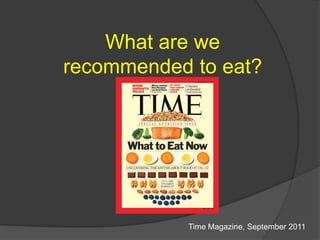
What are we
recommended to eat?


           Time Magazine, September 2011
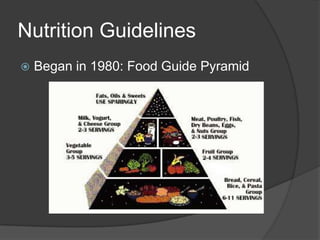
Nutrition Guidelines
   Began in 1980: Food Guide Pyramid
Nutrition Guidelines
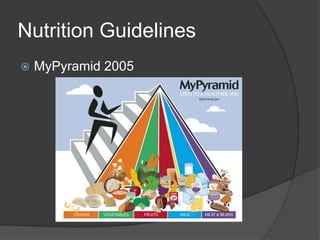
   MyPyramid 2005
Nutrition Guidelines
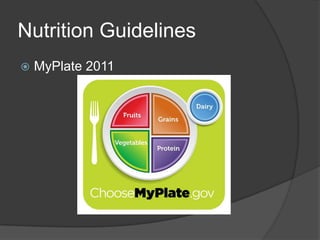
   MyPlate 2011
Do we see huge changes in
nutrition recommendations over
        the last 30 years?

     What do you think?
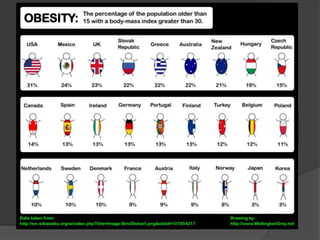
Are we a healthy nation?
―F‖ as in Fat Report 2012
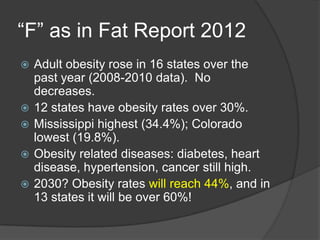
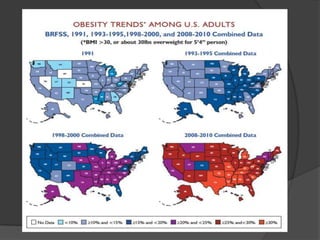
   Adult obesity rose in 16 states over the
    past year (2008-2010 data). No
    decreases.
   12 states have obesity rates over 30%.
   Mississippi highest (34.4%); Colorado
    lowest (19.8%).
   Obesity related diseases: diabetes, heart
    disease, hypertension, cancer still high.
   2030? Obesity rates will reach 44%, and in
    13 states it will be over 60%!
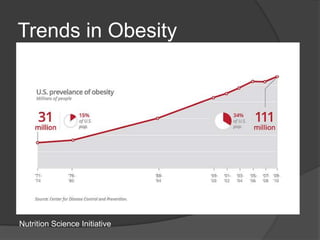
Trends in Obesity


Nutrition Science Initiative
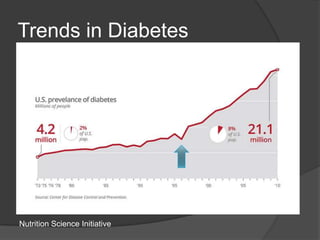
Trends in Diabetes


Nutrition Science Initiative
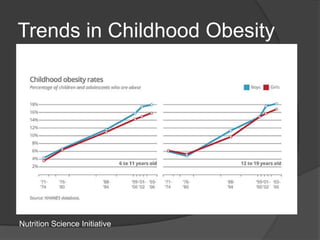
Trends in Childhood Obesity


Nutrition Science Initiative
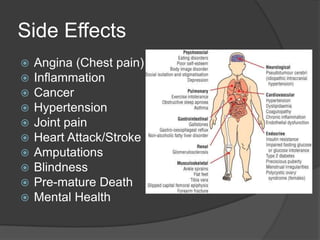
Side Effects
   Angina (Chest pain)
   Inflammation
   Cancer
   Hypertension
   Joint pain
   Heart Attack/Stroke
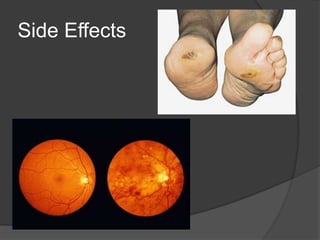
   Amputations
   Blindness
   Pre-mature Death
   Mental Health
Side Effects
But…
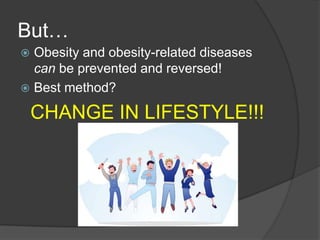
 Obesity and obesity-related diseases
  can be prevented and reversed!
 Best method?

    CHANGE IN LIFESTYLE!!!
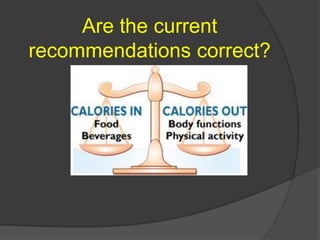
Are the current
recommendations correct?
Evidence Report NIH 1998
   In 1995, the NIH convened the first
    Expert Panel on the Identification,
    Evaluation, and Treatment of
    Overweight and Obesity in Adults to
    develop clinical practice guidelines for
    primary care practitioners.

   What do they recommend?
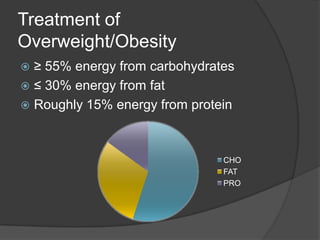
Treatment of
Overweight/Obesity
 ≥ 55% energy from carbohydrates
 ≤ 30% energy from fat
 Roughly 15% energy from protein


                               CHO
                               FAT
                               PRO
What are we currently told?
   CDC: ―you must use up more calories
    than you take in… since one pound [of
    fat] equals 3,500 calories reduce 500-
    1000 calories per day to lose 1 to 2
    pounds per week.‖

   Mayo Clinic: ―when it comes to weight
    loss, it’s calories that count.‖
What are we currently told?
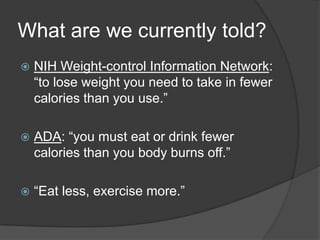
   NIH Weight-control Information Network:
    ―to lose weight you need to take in fewer
    calories than you use.‖

   ADA: ―you must eat or drink fewer
    calories than you body burns off.‖

   ―Eat less, exercise more.‖
The issue?
 Recommendations are for general
  population.
 Calories, calories, calories.
 Eat less, and exercise more!
 Too general!
 If it’s that simple why are we continuing
  to gain weight? Why do people struggle
  with weight loss? Why are we sick?
What do clinical studies show?
 Low-Carb, High Fat (LCHF) vs. Low-Fat,
  high Carb (LFHC) diets.
 Randomized, controlled—not
  observational.
 Challenging conventional wisdom


   Just because it’s popular belief does not
    mean it’s true.
Low-carb Diets
   Yancy et al., 2004: 7-8 months LC
    (<20% CHO/day) lost 20.7 lb. LF group
    lost 10.58 lb.
     LC group:  serum Triglycerides,  HDL
 Krauss et al., 2006: in absence of weight
  loss LC improve antherogenic lipid
  status.
 Brehm et al., 2009: 4-6 months eating
  LC (<20% CHO/day) lost 13.16 lb. LF
  group lost 7.12 lb.
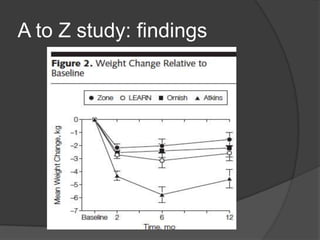
A to Z study: Weight loss
 4 ―fad‖ diets
 Atkins: low carb + high fat/protein
 Zone: 40/30/30
 Ornish: low fat; at high carbs- as much
  as you want
 LEARN: health-professional diet- low-fat
A to Z study: findings
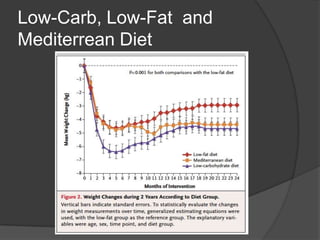
Low-Carb, Low-Fat and
Mediterrean Diet
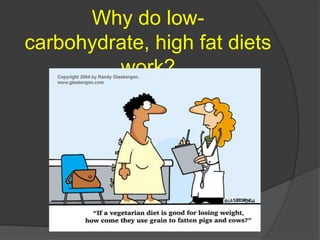
Why do low-
carbohydrate, high fat diets
         work?
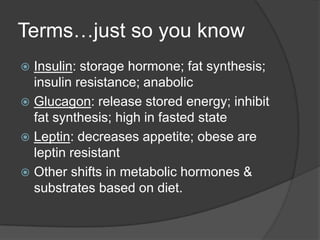
Terms…just so you know
 Insulin: storage hormone; fat synthesis;
  insulin resistance; anabolic
 Glucagon: release stored energy; inhibit
  fat synthesis; high in fasted state
 Leptin: decreases appetite; obese are
  leptin resistant
 Other shifts in metabolic hormones &
  substrates based on diet.
Reasons for Low Carb
 Low insulin response
 High glucagon
 Increase satiety (leptin)
 Lower GI/GL
 Increase MUFA/PUFA
 Increase weight loss + fat loss
 Structuring our body’s energy production
  around ―fat burning‖ rather than ―sugar
  burning.‖
Why fat is better?
 Stores more energy
 Efficient fuel
 Preferred fuel in every day situations
 Quick to mobilize
 Need machinery to use it
Becoming Keto Adaptive on Low
Carb
 Ketone bodies: byproducts of fat
  metabolism
 Keto adaptive vs ketosis vs ketoacidosis
 What are the benefits?
     Brain fuel,  ROS,  insulin sensitivity,
     protein sparing, better recovery, improve
     body composition
   Any side effects?
     Initial: fatigue, headache, alcohol breathe
Conclusion
 Short-term (4-8 months): LCHF diets are
  effective and safe for weight loss.
 Long-term(>12 months): Effective but
  weight regain occurs over the long-term.
 Keto adaptive is beneficial.
Now…time for the good
       stuff!
Steps for change
 Step 1: Evaluate Lifestyle
 Step 2: Strengths + Weaknesses
 Step 3: Implement change
 Step 4: Success + Evaluate what works
  (and doesn’t work)
 Step 5: Continue Awesomeness
Lifestyle Checklist for weight
loss
   Look at 5 things:
       Nutrition
       Sleep
       Exercise
       Family/work/social
       Psychology/Emotional

    Weight loss is a team effort–
    trainers, family, friends, doctors and
    therapists, etc. Just find the right ones!
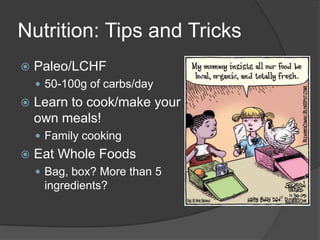
Nutrition: Tips and Tricks
   Paleo/LCHF
     50-100g of carbs/day
   Learn to cook/make your
    own meals!
     Family cooking
   Eat Whole Foods
     Bag, box? More than 5
     ingredients?
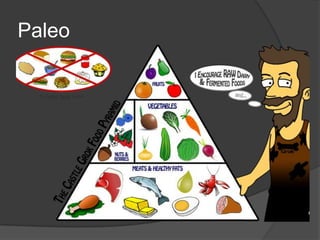
Paleo
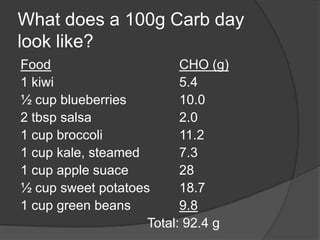
What does a 100g Carb day
look like?
Food                      CHO (g)
1 kiwi                    5.4
½ cup blueberries         10.0
2 tbsp salsa              2.0
1 cup broccoli            11.2
1 cup kale, steamed       7.3
1 cup apple suace         28
½ cup sweet potatoes      18.7
1 cup green beans         9.8
                    Total: 92.4 g
Nutrition: Tips and Tricks
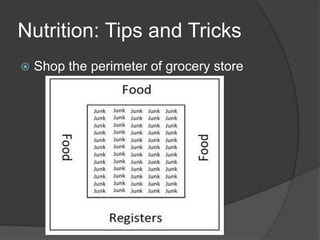
   Shop the perimeter of grocery store
Nutrition: Tips and Tricks
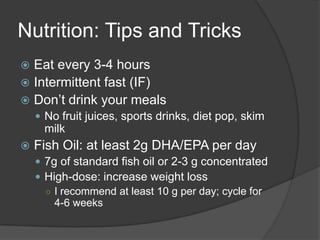
 Eat every 3-4 hours
 Intermittent fast (IF)
 Don’t drink your meals
     No fruit juices, sports drinks, diet pop, skim
      milk
   Fish Oil: at least 2g DHA/EPA per day
     7g of standard fish oil or 2-3 g concentrated
     High-dose: increase weight loss
      ○ I recommend at least 10 g per day; cycle for
        4-6 weeks
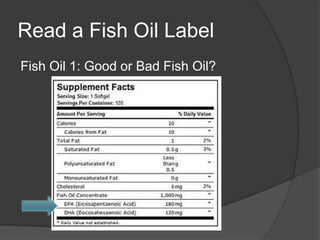
Read a Fish Oil Label
Fish Oil 1: Good or Bad Fish Oil?
Read a Fish Oil Label
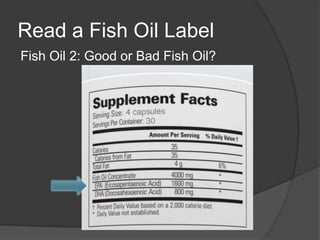
Fish Oil 2: Good or Bad Fish Oil?
Read a Fish Oil Label
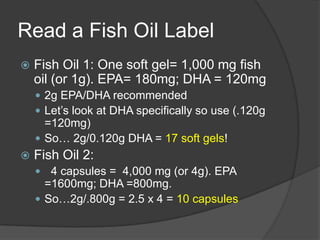
   Fish Oil 1: One soft gel= 1,000 mg fish
    oil (or 1g). EPA= 180mg; DHA = 120mg
     2g EPA/DHA recommended
     Let’s look at DHA specifically so use (.120g
      =120mg)
     So… 2g/0.120g DHA = 17 soft gels!
   Fish Oil 2:
     4 capsules = 4,000 mg (or 4g). EPA
      =1600mg; DHA =800mg.
     So…2g/.800g = 2.5 x 4 = 10 capsules
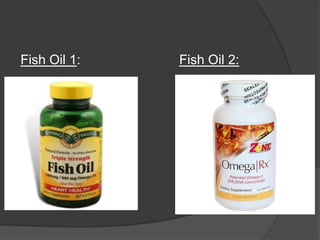
Fish Oil 1:   Fish Oil 2:
Nutrition: Tips & Tricks
   Eat slowly and stop at 80% full
   Include protein dense foods with each meal
   Consume 1- 2 vegetables with each meal
   Eat diary if you tolerate it—if so, go full-fat.
   Fat: eat it!
     Avocados, olive oil, nuts (once/day), animal fats,
      bacon (mmmm), cheese, grass-fed butter, ghee.
Put into Practice
   Time course:
     Today: evaluate lifestyle
     Next 2-3 weeks:
      ○ Educate yourself: books, blogs, websites
      ○ See doctor- blood work: fasting insulin,
        Hba1c, Lipid panel (esp. apoB and small-
        dense LDL), CRP, kidney & liver, Vitamin D,
        calcium
      ○ % body fat + Lean Body Mass- get checked
         See me!
      ○ Paleo + LCHF: 4-6 Months
Nutrition: Things to Avoid
   Do not consume the following:
     Sugar, brown sugar, sugar
        cane, HFCS, honey, maple syrup, etc.
       Anything label ―enriched,‖ ―low-fat‖ or ―reduced.‖
       Eating out
       Artificial Sweeteners: Splenda, Sweet n
        Low, Equal (Aspartame)
       Grains: whole grains, cereals
        breads, muffins, scones, cookies, baked
        goods, even gluten-free
       Legumes: beans, peanuts, soy
       Alcohol: all forms (except wine & 100% agave
        tequila)
       Vegetable Oils: canola oil, rapeseed oil.
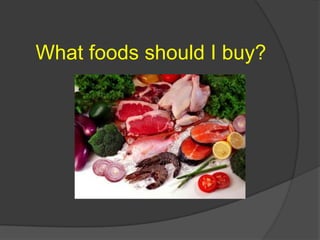
What foods should I buy?
Proteins
 Grass-Fed red meat
 Wild Game: bison, elk, deer, bear
 Salmon (wild)
 Eggs (cage-free, free-range)
 Chicken, duck, wild turkey
 Plain Greek yogurt, cottage cheese (full
  fat), coconut milk yogurt
Vegetables
 Spinach, Kale (all kinds), mustard
  greens, collards
 Tomatoes, peppers, cucumber
 Cruciferous vegetables
  (Broccoli, cabbage, cauliflower)
 Brussel Sprouts, mushrooms
 Tubes/Root Vegetables*:
  parsnips, turnips, sweet
  potatoes, beets, carrots
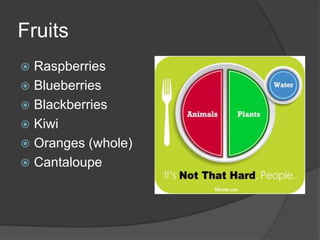
Fruits
 Raspberries
 Blueberries
 Blackberries
 Kiwi
 Oranges (whole)
 Cantaloupe
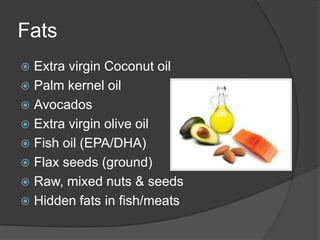
Fats
 Extra virgin Coconut oil
 Palm kernel oil
 Avocados
 Extra virgin olive oil
 Fish oil (EPA/DHA)
 Flax seeds (ground)
 Raw, mixed nuts & seeds
 Hidden fats in fish/meats
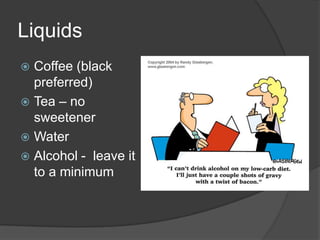
Liquids
 Coffee (black
  preferred)
 Tea – no
  sweetener
 Water
 Alcohol - leave it
  to a minimum
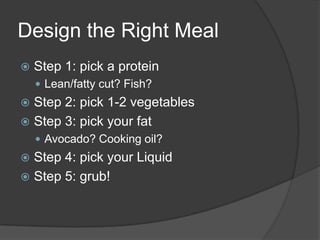
Design the Right Meal
   Step 1: pick a protein
     Lean/fatty cut? Fish?
 Step 2: pick 1-2 vegetables
 Step 3: pick your fat
     Avocado? Cooking oil?
 Step 4: pick your Liquid
 Step 5: grub!
Lifestyle Checklist for weight
loss
   Look at 5 things:
     Nutrition
     Sleep
     Exercise
     Family/work/social
     Psychology
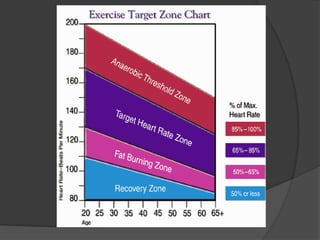
Exercise: Fuel to Perform
 Idea ―Burn Fat during Exercise‖ – needs
  to be forgotten (one exception)
 Fuel to perform—body prefers CHO at
  high intensities (no oxygen around)
 ―Anaerobic state‖
 Eat CHOs around your workout.
     Fruits + Vegetables
     Pre-WOD honey/applesauce
Exercise as a Tool
 Wellness and weight loss tool.
 Functional, constantly varied
  movements.
 CF + nutrition = (fast) results
 ―Cherry-picking‖ workouts
     If you suck at something, continue to do it.
m
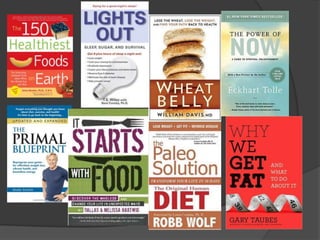
Websites to Visit…
Mark’s Daily Apple – Mark Sisson
Livin’ La Vida Low Carb – Jimmy Moore
Wellness Fx
Mother Nature Obeyed – Chris Masterjohn
Paleo Solution- Robb Wolf
Chris Kresser – Chris Kresser
Whole 9 Life- Dallas & Mellissa Hartwig
Paleo Physicians Network
Ground Up Health – Collin Popp
Overall: Weight Loss Keys
 Evaluate lifestyle
 Paleo + LCHF
 Keto adaptive
 Avoid sugar, grains, legumes, processed
  crap
 Exercise as a tool
 Constantly varied, functional diet!

   If you eat crap, your body will turn into
    crap. Don’t turn into crap!
Questions???
Worksal.Cited
Yancy et ―A low-carbohydrate, Ketogenic Diet versus a
    low-fat diet to treat obesity and hyperlipidemia.‖ Ann Inter
    Med. 2004, 140: 769-777
   Krauss et al. ―Separate effects of reduced carbohydrate
    intake and weight loss on atherogenic dyslipidemia.‖ Am
    J Clin Nutr 2006, 83(5):1025-1031
   Brehm et al. ―A randomized trial comparing a very low
    carbohydrate diet and a calorie-restricted low fat diet on
    bdoy weight and cardiovascular risk factors in healthy
    women.‖ J Clin Endocrinol Metab. 2003;88:1617-1623
   Gardner et al. ―Comparison of the Atkins, Zone, Ornish
    and LEARN diets for change in weight and related risk
    factors among overweight premenopausal women.‖
    JAMA 2007; 297:969-977.
   Shai et al. ―Weight loss with a low-
    carbohydrate, mediterranean or low-fat diet.‖ N Engl J
    Med 2008;359: 229-241.

CFL Nutrition - Weight Loss Seminar

  • 1.
  • 2.
    What are we recommendedto eat? Time Magazine, September 2011
  • 3.
    Nutrition Guidelines  Began in 1980: Food Guide Pyramid
  • 4.
  • 5.
  • 6.
    Do we seehuge changes in nutrition recommendations over the last 30 years? What do you think?
  • 7.
    Are we ahealthy nation?
  • 9.
    ―F‖ as inFat Report 2012  Adult obesity rose in 16 states over the past year (2008-2010 data). No decreases.  12 states have obesity rates over 30%.  Mississippi highest (34.4%); Colorado lowest (19.8%).  Obesity related diseases: diabetes, heart disease, hypertension, cancer still high.  2030? Obesity rates will reach 44%, and in 13 states it will be over 60%!
  • 11.
    Trends in Obesity NutritionScience Initiative
  • 12.
    Trends in Diabetes NutritionScience Initiative
  • 13.
    Trends in ChildhoodObesity Nutrition Science Initiative
  • 14.
    Side Effects  Angina (Chest pain)  Inflammation  Cancer  Hypertension  Joint pain  Heart Attack/Stroke  Amputations  Blindness  Pre-mature Death  Mental Health
  • 15.
  • 16.
    But…  Obesity andobesity-related diseases can be prevented and reversed!  Best method? CHANGE IN LIFESTYLE!!!
  • 17.
  • 18.
    Evidence Report NIH1998  In 1995, the NIH convened the first Expert Panel on the Identification, Evaluation, and Treatment of Overweight and Obesity in Adults to develop clinical practice guidelines for primary care practitioners.  What do they recommend?
  • 19.
    Treatment of Overweight/Obesity  ≥55% energy from carbohydrates  ≤ 30% energy from fat  Roughly 15% energy from protein CHO FAT PRO
  • 20.
    What are wecurrently told?  CDC: ―you must use up more calories than you take in… since one pound [of fat] equals 3,500 calories reduce 500- 1000 calories per day to lose 1 to 2 pounds per week.‖  Mayo Clinic: ―when it comes to weight loss, it’s calories that count.‖
  • 21.
    What are wecurrently told?  NIH Weight-control Information Network: ―to lose weight you need to take in fewer calories than you use.‖  ADA: ―you must eat or drink fewer calories than you body burns off.‖  ―Eat less, exercise more.‖
  • 22.
    The issue?  Recommendationsare for general population.  Calories, calories, calories.  Eat less, and exercise more!  Too general!  If it’s that simple why are we continuing to gain weight? Why do people struggle with weight loss? Why are we sick?
  • 24.
    What do clinicalstudies show?  Low-Carb, High Fat (LCHF) vs. Low-Fat, high Carb (LFHC) diets.  Randomized, controlled—not observational.  Challenging conventional wisdom  Just because it’s popular belief does not mean it’s true.
  • 25.
    Low-carb Diets  Yancy et al., 2004: 7-8 months LC (<20% CHO/day) lost 20.7 lb. LF group lost 10.58 lb.  LC group:  serum Triglycerides,  HDL  Krauss et al., 2006: in absence of weight loss LC improve antherogenic lipid status.  Brehm et al., 2009: 4-6 months eating LC (<20% CHO/day) lost 13.16 lb. LF group lost 7.12 lb.
  • 26.
    A to Zstudy: Weight loss  4 ―fad‖ diets  Atkins: low carb + high fat/protein  Zone: 40/30/30  Ornish: low fat; at high carbs- as much as you want  LEARN: health-professional diet- low-fat
  • 27.
    A to Zstudy: findings
  • 28.
  • 29.
    Why do low- carbohydrate,high fat diets work?
  • 30.
    Terms…just so youknow  Insulin: storage hormone; fat synthesis; insulin resistance; anabolic  Glucagon: release stored energy; inhibit fat synthesis; high in fasted state  Leptin: decreases appetite; obese are leptin resistant  Other shifts in metabolic hormones & substrates based on diet.
  • 31.
    Reasons for LowCarb  Low insulin response  High glucagon  Increase satiety (leptin)  Lower GI/GL  Increase MUFA/PUFA  Increase weight loss + fat loss  Structuring our body’s energy production around ―fat burning‖ rather than ―sugar burning.‖
  • 32.
    Why fat isbetter?  Stores more energy  Efficient fuel  Preferred fuel in every day situations  Quick to mobilize  Need machinery to use it
  • 33.
    Becoming Keto Adaptiveon Low Carb  Ketone bodies: byproducts of fat metabolism  Keto adaptive vs ketosis vs ketoacidosis  What are the benefits?  Brain fuel,  ROS,  insulin sensitivity, protein sparing, better recovery, improve body composition  Any side effects?  Initial: fatigue, headache, alcohol breathe
  • 34.
    Conclusion  Short-term (4-8months): LCHF diets are effective and safe for weight loss.  Long-term(>12 months): Effective but weight regain occurs over the long-term.  Keto adaptive is beneficial.
  • 35.
    Now…time for thegood stuff!
  • 36.
    Steps for change Step 1: Evaluate Lifestyle  Step 2: Strengths + Weaknesses  Step 3: Implement change  Step 4: Success + Evaluate what works (and doesn’t work)  Step 5: Continue Awesomeness
  • 37.
    Lifestyle Checklist forweight loss  Look at 5 things:  Nutrition  Sleep  Exercise  Family/work/social  Psychology/Emotional Weight loss is a team effort– trainers, family, friends, doctors and therapists, etc. Just find the right ones!
  • 38.
    Nutrition: Tips andTricks  Paleo/LCHF  50-100g of carbs/day  Learn to cook/make your own meals!  Family cooking  Eat Whole Foods  Bag, box? More than 5 ingredients?
  • 39.
  • 40.
    What does a100g Carb day look like? Food CHO (g) 1 kiwi 5.4 ½ cup blueberries 10.0 2 tbsp salsa 2.0 1 cup broccoli 11.2 1 cup kale, steamed 7.3 1 cup apple suace 28 ½ cup sweet potatoes 18.7 1 cup green beans 9.8 Total: 92.4 g
  • 41.
    Nutrition: Tips andTricks  Shop the perimeter of grocery store
  • 42.
    Nutrition: Tips andTricks  Eat every 3-4 hours  Intermittent fast (IF)  Don’t drink your meals  No fruit juices, sports drinks, diet pop, skim milk  Fish Oil: at least 2g DHA/EPA per day  7g of standard fish oil or 2-3 g concentrated  High-dose: increase weight loss ○ I recommend at least 10 g per day; cycle for 4-6 weeks
  • 43.
    Read a FishOil Label Fish Oil 1: Good or Bad Fish Oil?
  • 44.
    Read a FishOil Label Fish Oil 2: Good or Bad Fish Oil?
  • 45.
    Read a FishOil Label  Fish Oil 1: One soft gel= 1,000 mg fish oil (or 1g). EPA= 180mg; DHA = 120mg  2g EPA/DHA recommended  Let’s look at DHA specifically so use (.120g =120mg)  So… 2g/0.120g DHA = 17 soft gels!  Fish Oil 2:  4 capsules = 4,000 mg (or 4g). EPA =1600mg; DHA =800mg.  So…2g/.800g = 2.5 x 4 = 10 capsules
  • 46.
    Fish Oil 1: Fish Oil 2:
  • 47.
    Nutrition: Tips &Tricks  Eat slowly and stop at 80% full  Include protein dense foods with each meal  Consume 1- 2 vegetables with each meal  Eat diary if you tolerate it—if so, go full-fat.  Fat: eat it!  Avocados, olive oil, nuts (once/day), animal fats, bacon (mmmm), cheese, grass-fed butter, ghee.
  • 48.
    Put into Practice  Time course:  Today: evaluate lifestyle  Next 2-3 weeks: ○ Educate yourself: books, blogs, websites ○ See doctor- blood work: fasting insulin, Hba1c, Lipid panel (esp. apoB and small- dense LDL), CRP, kidney & liver, Vitamin D, calcium ○ % body fat + Lean Body Mass- get checked  See me! ○ Paleo + LCHF: 4-6 Months
  • 49.
    Nutrition: Things toAvoid  Do not consume the following:  Sugar, brown sugar, sugar cane, HFCS, honey, maple syrup, etc.  Anything label ―enriched,‖ ―low-fat‖ or ―reduced.‖  Eating out  Artificial Sweeteners: Splenda, Sweet n Low, Equal (Aspartame)  Grains: whole grains, cereals breads, muffins, scones, cookies, baked goods, even gluten-free  Legumes: beans, peanuts, soy  Alcohol: all forms (except wine & 100% agave tequila)  Vegetable Oils: canola oil, rapeseed oil.
  • 50.
  • 51.
    Proteins  Grass-Fed redmeat  Wild Game: bison, elk, deer, bear  Salmon (wild)  Eggs (cage-free, free-range)  Chicken, duck, wild turkey  Plain Greek yogurt, cottage cheese (full fat), coconut milk yogurt
  • 52.
    Vegetables  Spinach, Kale(all kinds), mustard greens, collards  Tomatoes, peppers, cucumber  Cruciferous vegetables (Broccoli, cabbage, cauliflower)  Brussel Sprouts, mushrooms  Tubes/Root Vegetables*: parsnips, turnips, sweet potatoes, beets, carrots
  • 53.
    Fruits  Raspberries  Blueberries Blackberries  Kiwi  Oranges (whole)  Cantaloupe
  • 54.
    Fats  Extra virginCoconut oil  Palm kernel oil  Avocados  Extra virgin olive oil  Fish oil (EPA/DHA)  Flax seeds (ground)  Raw, mixed nuts & seeds  Hidden fats in fish/meats
  • 55.
    Liquids  Coffee (black preferred)  Tea – no sweetener  Water  Alcohol - leave it to a minimum
  • 56.
    Design the RightMeal  Step 1: pick a protein  Lean/fatty cut? Fish?  Step 2: pick 1-2 vegetables  Step 3: pick your fat  Avocado? Cooking oil?  Step 4: pick your Liquid  Step 5: grub!
  • 57.
    Lifestyle Checklist forweight loss  Look at 5 things:  Nutrition  Sleep  Exercise  Family/work/social  Psychology
  • 59.
    Exercise: Fuel toPerform  Idea ―Burn Fat during Exercise‖ – needs to be forgotten (one exception)  Fuel to perform—body prefers CHO at high intensities (no oxygen around)  ―Anaerobic state‖  Eat CHOs around your workout.  Fruits + Vegetables  Pre-WOD honey/applesauce
  • 60.
    Exercise as aTool  Wellness and weight loss tool.  Functional, constantly varied movements.  CF + nutrition = (fast) results  ―Cherry-picking‖ workouts  If you suck at something, continue to do it.
  • 61.
  • 62.
    Websites to Visit… Mark’sDaily Apple – Mark Sisson Livin’ La Vida Low Carb – Jimmy Moore Wellness Fx Mother Nature Obeyed – Chris Masterjohn Paleo Solution- Robb Wolf Chris Kresser – Chris Kresser Whole 9 Life- Dallas & Mellissa Hartwig Paleo Physicians Network Ground Up Health – Collin Popp
  • 63.
    Overall: Weight LossKeys  Evaluate lifestyle  Paleo + LCHF  Keto adaptive  Avoid sugar, grains, legumes, processed crap  Exercise as a tool  Constantly varied, functional diet!  If you eat crap, your body will turn into crap. Don’t turn into crap!
  • 64.
  • 65.
    Worksal.Cited Yancy et ―Alow-carbohydrate, Ketogenic Diet versus a low-fat diet to treat obesity and hyperlipidemia.‖ Ann Inter Med. 2004, 140: 769-777  Krauss et al. ―Separate effects of reduced carbohydrate intake and weight loss on atherogenic dyslipidemia.‖ Am J Clin Nutr 2006, 83(5):1025-1031  Brehm et al. ―A randomized trial comparing a very low carbohydrate diet and a calorie-restricted low fat diet on bdoy weight and cardiovascular risk factors in healthy women.‖ J Clin Endocrinol Metab. 2003;88:1617-1623  Gardner et al. ―Comparison of the Atkins, Zone, Ornish and LEARN diets for change in weight and related risk factors among overweight premenopausal women.‖ JAMA 2007; 297:969-977.  Shai et al. ―Weight loss with a low- carbohydrate, mediterranean or low-fat diet.‖ N Engl J Med 2008;359: 229-241.

Editor's Notes

  • #9 BMI- easy to obtain, faster than skin fold etc.
  • #10 Levi et al., 2012
  • #11 Levi et al., 2012 F as in Fat Report
  • #12 Correctly for increase in population size
  • #20 Low-protein low-fat; high carb meals
  • #22 Nothing specific—we cannot focus on calories alone. There is more to this than just caloires
  • #26 Antherogenic lipid states: HDL, apoB/apoA-1, TAG levels
  • #27 Take about significance of the study.Ornish, LEARN, Zone, AtkinsAlso mention the other study on micronutrient intake—later publish*retention rate
  • #28 Atkins also had better metabolic improvements: BP, weight, cholesterol, TC, HDL, LDL, insulin and glucose.Interstingly, the LEARN diet was the diet they recommend in 1998 after the first expert panel on obesity/overweight.
  • #29 Over 2-yr span 84.6% retention rateLC: Atkins group
  • #32 Talk mainly about insulin improvement and weight loss improvingEvolutionary roots
  • #34 Keto adaptive: utilizing ketone bodies for energy; this is okayKetosis: people think that when they hit ketosis is the same asEndurance athletesWestern States 100—Tim Olsen won on lowcarbketogenic diet
  • #35 Constantly varied, see results4-6 months: LCHF5-7 months: re-indroduce CHO, but centered around workouts and only from fruits, rice, “clean” grainsMark out on your calender—planReintroduced something new!
  • #37 Lifestyle: nutrition, sleep, exercise, work/family/social, psycologyStrenghts: what are you good at? What sucks Example: consistent with workouts, but I binge eat immediately after.Implement change: my advice + othersSuccess + evaluate what works &amp; doesn’t: after you make change do you stick with it? If you make a change, do you see results? What kind of result?Coninute bing you—small changes.
  • #38 Need to evaluate each of these—ask yourself some questions
  • #47 Some final nutrition tips
  • #49 Evalualte lifestyle: who, what, when, whereKidney liver: AST, ALT, BUNFine tunePaleo; monitor weight, percent body fat!
  • #53 *great on exercise days-include after/before a workout