International Research Journal of Engineering and Technology (IRJET) e-ISSN: 2395 -0056
Volume: 03 Issue: 02 | Feb-2016 www.irjet.net p-ISSN: 2395-0072
© 2016, IRJET | Impact Factor value: 4.45 | ISO 9001:2008 Certified Journal | Page 206
CFD Modeling of FCC Riser Reactor
RashmiPahwa and Raj Kumar Gupta
Department of Chemical Engineering, Thapar University, Patiala-147004, India
ABSTRACT- In the present work a two phase flow FCC
riser model incorporating a four lump kinetic scheme is
presented. The two-phase flow (gas-solid) in the riser is
modeled using the Eulerian- Eulerian multiphase flow
model. The model simulation studies are presented using
two cases: gas-solid flow without reaction, and gas-solid
flow with reaction. The results for the two phase flow
without reaction show that the gas phase velocity
decreases along the riser height as the gas loses
momentum. The catalyst velocity increases as the catalyst
gains momentum. The temperature of the gas phase
increases as it gains heat from the hot catalyst; and the
catalyst temperature decreases. The results for gas-solid
flow with reaction predict the gas phase velocity increase
from 4.7 to 14.7 from riser inlet to outlet due to cracking of
heavy gas oil to lighter products. The model predicted gas
oil conversion 62%, gasoline yield 39%, light gases yield
20%, and coke yield 3%.
Keywords: Fluid catalytic cracking, riser model, CFD
model, Riser temperature, Gas phase velocity
1. INTRODUCTION
FCC units are used widely in refineries to produce higher
value gasoline from gas oil.FCC units mainly consists of
two basic units, a reactor in which the hot catalyst is
brought in contact with the feed (gas oil), and a
regenerator in which the coke deposited on the catalyst is
burned off for regenerating the catalyst. Riser is most
important part of FCC unit from modeling viewpoint.
The conversion of heavy petroleum fractions to the
products takes place in the riser reactor, which is a long
tube of length (30-40m) with a proportionally smaller
diameter (0.8-1.2m). After complete vaporization of
hydrocarbon feed, two phases solid phase(catalyst), gas
phase (hydrocarbon vapor and steam) are left in the riser.
Catalytic reactions occur in the vapor phase. The
expanding volumes of the vapors that are generated are
the main driving force to carry the catalyst up the riser.
Catalyst and products are quickly separated in the reactor.
The various aspects of the FCC riser modeling are reaction
kinetics, hydrodynamics, heat and mass transfer and
catalyst deactivation. Gupta et al. (2005, 2010) have
reviewed the FCC riser modeling efforts of various authors.
CFD is emerging as a powerful tool for modeling the FCC
riser. In recent decades, with the advancement of
computational techniques and computer hardware, CFD is
being increasingly used to simulate gas–solid fluidized
beds. The majority of the research groups have used
Eulerian–Eulerian approach, where the dispersed solid
particles are treated as an interpenetrating continuum.
The kinetic theory of the granular flow is used to simulate
gas–solid flow in the riser. Most of the works on the FCC
riser reactor have focused on either reactor
hydrodynamics or catalytic cracking kinetics. Many
theoretical and experimental studies are carried out to
better understand the complex hydrodynamics of gas–
solid turbulent flow in the reactor (Gao et al., 1999; Huilin
et al., 2003; Jiradilok et al., 2006; Wang et al., 2008; Wang
et al., 2010). Huilin et al. (2005) used a cluster-based
approach and predicted the hydrodynamics of cluster flow
in circulating fluidized beds. Authors showed a
considerable improvement in the model predictions using
cluster-based approach as compared to the model based
on original kinetic theory of granular flow. Jiradilok et al.
(2006) proposed the turbulent fluidization of FCC particles
in a riser.
Shuyan (2008) proposed a mathematical model for
predicting gas and gasoline distributions in the cluster by
coupling a hydrodynamics model with four-lump catalyst
cracking reactions. Lu et al. (2008) presented a gas-solid
multi-fluid model with two granular temperatures of the
dispersed particles and the clusters in risers, to predict the
hydrodynamics of dispersed particles and clusters flow in
CFBs. In addition to the basic governing equations
developed from the universal laws, it is necessary to
develop relevant constitutive equations and equations of
state for the fluids under consideration to close the system
of equations. Several closure models have been proposed
to define the appropriate constitutive equations for binary
or multi-phase flows based on the kinetic theory of
granular flow. The constitutive equations are needed to
close the solid phase momentum.
International Research Journal of Engineering and Technology (IRJET) e-ISSN: 2395 -0056
Volume: 03 Issue: 02 | Feb-2016 www.irjet.net p-ISSN: 2395-0072
Behjat et al. (2010) proposed a 3-D FCC riser reactor
model, which takes into account the hydrodynamics, heat
transfer and evaporation of the liquid gas oil injected into
the gas–solid fluidized bed. Lopez et al. (2011) developed a
model of three-dimensional and two-phase flow model to
predict the dynamic behavior of a fluid catalytic cracking
(FCC) industrial reactor.
In the present work, FCC riser is simulated using Eulerian-
Eulerian approach. The vaporization of feed is assumed to
be instantaneous. The heat transfer mechanism is
described using Ranz-Marshal correlation. Widely used
four lump kinetic scheme is used to predict the product’s
yields. This four lump kinetic scheme, is used by several
investigators (Ali and Rohani, 1997; Blasetti et al., 1997;
Gupta and SubbaRao, 2001; Nayak et al., 2005; Lopez et al.,
2011).
2. FCC RISER MODEL
The two-phase flow model uses Eulerian description of
both phases, so the gases and the dispersed solid particles
are treated as interpenetrating continuum. In the present
work, Syamlal-O’Brien drag model (1989) is used.The heat
transfer between phases plays an important role in the
catalytic cracking of the hydrocarbons. The gas and solid
energy equations are used with Ranz–Marshall correlation
for single particle for the estimation of Nusselt number. A
four lump kinetic scheme is used due to its simplicity.The
general rate equation for reaction r(kmol/m3.s)is given by:
where, kr is rate constant for rth cracking reaction, Ci is
concentration of ith species (kmol/m3).The values of
kinetic parameters used in the model are reported in
Table1.
Plant data reported in Table 2 is used for the simulation.
The gas oil feed is assumed to vaporize instantaneously at
the riser inlet. The temperature of vaporized feed at the
inlet is taken as 700 K and temperature of the catalyst is
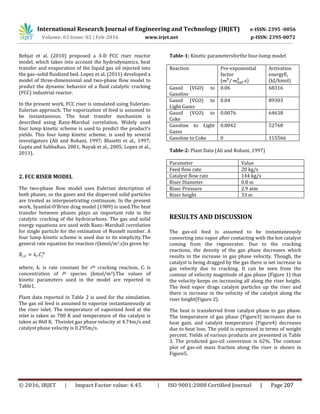
taken as 860 K. Theinlet gas phase velocity at 4.74m/s and
catalyst phase velocity is 0.295m/s.
Table-1: Kinetic parametersforthe four-lump model
Reaction Pre-exponential
factor
( / .s)
Activation
energyE,
(kJ/kmol)
Gasoil (VGO) to
Gasoline
0.06 68316
Gasoil (VGO) to
Light Gases
0.04 89303
Gasoil (VGO) to
Coke
0.0076 64638
Gasoline to Light
Gases
0.0042 52768
Gasoline to Coke 0 115566
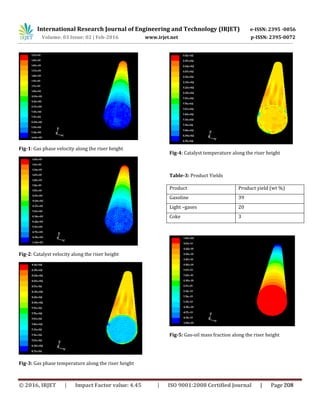
Table-2: Plant Data (Ali and Rohani, 1997)
Parameter Value
Feed flow rate 20 kg/s
Catalyst flow rate 144 kg/s
Riser Diameter 0.8 m
Riser Pressure 2.9 atm
Riser height 33 m
RESULTS AND DISCUSSION
The gas-oil feed is assumed to be instantaneously
converting into vapor after contacting with the hot catalyst
coming from the regenerator. Due to the cracking
reactions, the density of the gas phase decreases which
results in the increase in gas phase velocity. Though, the
catalyst is being dragged by the gas there is net increase in
gas velocity due to cracking. It can be seen from the
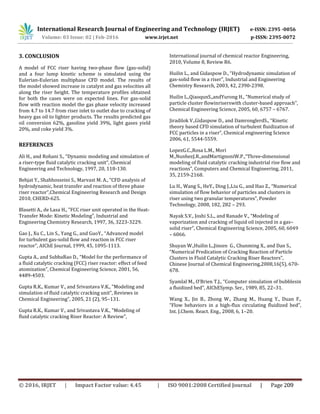
contour of velocity magnitude of gas phase (Figure 1) that
the velocity keeps on increasing all along the riser height.
The feed vapor drags catalyst particles up the riser and
there is increase in the velocity of the catalyst along the
riser height(Figure 2).
The heat is transferred from catalyst phase to gas phase.
The temperature of gas phase (Figure3) increases due to
heat gain, and catalyst temperature (Figure4) decreases
due to heat loss. The yield is expressed in terms of weight
percent. Yields of various products are presented in Table
3. The predicted gas-oil conversion is 62%. The contour
plot of gas-oil mass fraction along the riser is shown in
Figure5.
© 2016, IRJET | Impact Factor value: 4.45 | ISO 9001:2008 Certified Journal | Page 207
International Research Journal of Engineering and Technology (IRJET) e-ISSN: 2395 -0056
Volume: 03 Issue: 02 | Feb-2016 www.irjet.net p-ISSN: 2395-0072
Fig-1: Gas phase velocity along the riser height
Fig-2: Catalyst velocity along the riser height
Fig-3: Gas phase temperature along the riser height
Fig-4: Catalyst temperature along the riser height
Table-3: Product Yields
Product Product yield (wt %)
Gasoline 39
Light –gases 20
Coke 3
Fig-5: Gas-oil mass fraction along the riser height
© 2016, IRJET | Impact Factor value: 4.45 | ISO 9001:2008 Certified Journal | Page 208
International Research Journal of Engineering and Technology (IRJET) e-ISSN: 2395 -0056
Volume: 03 Issue: 02 | Feb-2016 www.irjet.net p-ISSN: 2395-0072
3. CONCLUSION
A model of FCC riser having two-phase flow (gas-solid)
and a four lump kinetic scheme is simulated using the
Eulerian-Eulerian multiphase CFD model. The results of
the model showed increase in catalyst and gas velocities all
along the riser height. The temperature profiles obtained
for both the cases were on expected lines. For gas-solid
flow with reaction model the gas phase velocity increased
from 4.7 to 14.7 from riser inlet to outlet due to cracking of
heavy gas oil to lighter products. The results predicted gas
oil conversion 62%, gasoline yield 39%, light gases yield
20%, and coke yield 3%.
REFERENCES
Ali H., and Rohani S., “Dynamic modeling and simulation of
a riser-type fluid catalytic cracking unit”, Chemical
Engineering and Technology, 1997, 20, 118-130.
Behjat Y., Shahhosseini S., Marvast M. A., “CFD analysis of
hydrodynamic, heat transfer and reaction of three phase
riser reactor”,Chemical Engineering Research and Design
2010, CHERD-625.
Blasetti A., de Lasa H., "FCC riser unit operated in the Heat-
Transfer Mode: Kinetic Modeling", Industrial and
Engineering Chemistry Research, 1997, 36, 3223-3229.
Gao J., Xu C., Lin S., Yang G., and GuoY., “Advanced model
for turbulent gas-solid flow and reaction in FCC riser
reactor”, AIChE Journal, 1999, 45, 1095-1113.
Gupta A., and SubbaRao D., “Model for the performance of
a fluid catalytic cracking (FCC) riser reactor: effect of feed
atomization”, Chemical Engineering Science, 2001, 56,
4489-4503.
Gupta R.K., Kumar V., and Srivastava V.K., "Modeling and
simulation of fluid catalytic cracking unit”, Reviews in
Chemical Engineering", 2005, 21 (2), 95–131.
Gupta R.K., Kumar V., and Srivastava V.K., "Modeling of
fluid catalytic cracking Riser Reactor: A Review",
International journal of chemical reactor Engineering,
2010, Volume 8, Review R6.
Huilin L., and Gidaspow D., “Hydrodynamic simulation of
gas-solid flow in a riser”, Industrial and Engineering
Chemistry Research, 2003, 42, 2390-2398.
Huilin L.,QiaoqunS.,andYurong H., “Numerical study of
particle cluster flowinriserswith cluster-based approach”,
Chemical Engineering Science, 2005, 60, 6757 – 6767.
Jiradilok V.,Gidaspow D., and DamronglerdS., “Kinetic
theory based CFD simulation of turbulent fluidization of
FCC particles in a riser”, Chemical engineering Science
2006, 61, 5544-5559.
LopezG.C.,Rosa L.M., Mori
M.,NunhezJ.R.,andMartignoniW.P.,“Three-dimensional
modeling of fluid catalytic cracking industrial rise flow and
reactions”, Computers and Chemical Engineering, 2011,
35, 2159-2168.
Lu H., Wang S., HeY., Ding J.,Liu G., and Hao Z., “Numerical
simulation of flow behavior of particles and clusters in
riser using two granular temperatures”, Powder
Technology, 2008, 182, 282 – 293.
Nayak S.V., Joshi S.L., and Ranade V., “Modeling of
vaporization and cracking of liquid oil injected in a gas–
solid riser”, Chemical Engineering Science, 2005, 60, 6049
– 6066.
Shuyan W.,Huilin L.,Jinsen G., Chunming X., and Dan S.,
“Numerical Predication of Cracking Reaction of Particle
Clusters in Fluid Catalytic Cracking Riser Reactors”,
Chinese Journal of Chemical Engineering,2008,16(5), 670-
678.
Syamlal M., O’Brien T.J., “Computer simulation of bubblesin
a fluidized bed”, AIChESymp. Ser., 1989, 85, 22–31.
Wang X., Jin B., Zhong W., Zhang M., Huang Y., Duan F.,
“Flow behaviors in a high-flux circulating fluidized bed”,
Int. J.Chem. React. Eng., 2008, 6, 1–20.
© 2016, IRJET | Impact Factor value: 4.45 | ISO 9001:2008 Certified Journal | Page 209

CFD Modeling of FCC Riser Reactor

  • 1.
    International Research Journalof Engineering and Technology (IRJET) e-ISSN: 2395 -0056 Volume: 03 Issue: 02 | Feb-2016 www.irjet.net p-ISSN: 2395-0072 © 2016, IRJET | Impact Factor value: 4.45 | ISO 9001:2008 Certified Journal | Page 206 CFD Modeling of FCC Riser Reactor RashmiPahwa and Raj Kumar Gupta Department of Chemical Engineering, Thapar University, Patiala-147004, India ABSTRACT- In the present work a two phase flow FCC riser model incorporating a four lump kinetic scheme is presented. The two-phase flow (gas-solid) in the riser is modeled using the Eulerian- Eulerian multiphase flow model. The model simulation studies are presented using two cases: gas-solid flow without reaction, and gas-solid flow with reaction. The results for the two phase flow without reaction show that the gas phase velocity decreases along the riser height as the gas loses momentum. The catalyst velocity increases as the catalyst gains momentum. The temperature of the gas phase increases as it gains heat from the hot catalyst; and the catalyst temperature decreases. The results for gas-solid flow with reaction predict the gas phase velocity increase from 4.7 to 14.7 from riser inlet to outlet due to cracking of heavy gas oil to lighter products. The model predicted gas oil conversion 62%, gasoline yield 39%, light gases yield 20%, and coke yield 3%. Keywords: Fluid catalytic cracking, riser model, CFD model, Riser temperature, Gas phase velocity 1. INTRODUCTION FCC units are used widely in refineries to produce higher value gasoline from gas oil.FCC units mainly consists of two basic units, a reactor in which the hot catalyst is brought in contact with the feed (gas oil), and a regenerator in which the coke deposited on the catalyst is burned off for regenerating the catalyst. Riser is most important part of FCC unit from modeling viewpoint. The conversion of heavy petroleum fractions to the products takes place in the riser reactor, which is a long tube of length (30-40m) with a proportionally smaller diameter (0.8-1.2m). After complete vaporization of hydrocarbon feed, two phases solid phase(catalyst), gas phase (hydrocarbon vapor and steam) are left in the riser. Catalytic reactions occur in the vapor phase. The expanding volumes of the vapors that are generated are the main driving force to carry the catalyst up the riser. Catalyst and products are quickly separated in the reactor. The various aspects of the FCC riser modeling are reaction kinetics, hydrodynamics, heat and mass transfer and catalyst deactivation. Gupta et al. (2005, 2010) have reviewed the FCC riser modeling efforts of various authors. CFD is emerging as a powerful tool for modeling the FCC riser. In recent decades, with the advancement of computational techniques and computer hardware, CFD is being increasingly used to simulate gas–solid fluidized beds. The majority of the research groups have used Eulerian–Eulerian approach, where the dispersed solid particles are treated as an interpenetrating continuum. The kinetic theory of the granular flow is used to simulate gas–solid flow in the riser. Most of the works on the FCC riser reactor have focused on either reactor hydrodynamics or catalytic cracking kinetics. Many theoretical and experimental studies are carried out to better understand the complex hydrodynamics of gas– solid turbulent flow in the reactor (Gao et al., 1999; Huilin et al., 2003; Jiradilok et al., 2006; Wang et al., 2008; Wang et al., 2010). Huilin et al. (2005) used a cluster-based approach and predicted the hydrodynamics of cluster flow in circulating fluidized beds. Authors showed a considerable improvement in the model predictions using cluster-based approach as compared to the model based on original kinetic theory of granular flow. Jiradilok et al. (2006) proposed the turbulent fluidization of FCC particles in a riser. Shuyan (2008) proposed a mathematical model for predicting gas and gasoline distributions in the cluster by coupling a hydrodynamics model with four-lump catalyst cracking reactions. Lu et al. (2008) presented a gas-solid multi-fluid model with two granular temperatures of the dispersed particles and the clusters in risers, to predict the hydrodynamics of dispersed particles and clusters flow in CFBs. In addition to the basic governing equations developed from the universal laws, it is necessary to develop relevant constitutive equations and equations of state for the fluids under consideration to close the system of equations. Several closure models have been proposed to define the appropriate constitutive equations for binary or multi-phase flows based on the kinetic theory of granular flow. The constitutive equations are needed to close the solid phase momentum.
  • 2.
    International Research Journalof Engineering and Technology (IRJET) e-ISSN: 2395 -0056 Volume: 03 Issue: 02 | Feb-2016 www.irjet.net p-ISSN: 2395-0072 Behjat et al. (2010) proposed a 3-D FCC riser reactor model, which takes into account the hydrodynamics, heat transfer and evaporation of the liquid gas oil injected into the gas–solid fluidized bed. Lopez et al. (2011) developed a model of three-dimensional and two-phase flow model to predict the dynamic behavior of a fluid catalytic cracking (FCC) industrial reactor. In the present work, FCC riser is simulated using Eulerian- Eulerian approach. The vaporization of feed is assumed to be instantaneous. The heat transfer mechanism is described using Ranz-Marshal correlation. Widely used four lump kinetic scheme is used to predict the product’s yields. This four lump kinetic scheme, is used by several investigators (Ali and Rohani, 1997; Blasetti et al., 1997; Gupta and SubbaRao, 2001; Nayak et al., 2005; Lopez et al., 2011). 2. FCC RISER MODEL The two-phase flow model uses Eulerian description of both phases, so the gases and the dispersed solid particles are treated as interpenetrating continuum. In the present work, Syamlal-O’Brien drag model (1989) is used.The heat transfer between phases plays an important role in the catalytic cracking of the hydrocarbons. The gas and solid energy equations are used with Ranz–Marshall correlation for single particle for the estimation of Nusselt number. A four lump kinetic scheme is used due to its simplicity.The general rate equation for reaction r(kmol/m3.s)is given by: where, kr is rate constant for rth cracking reaction, Ci is concentration of ith species (kmol/m3).The values of kinetic parameters used in the model are reported in Table1. Plant data reported in Table 2 is used for the simulation. The gas oil feed is assumed to vaporize instantaneously at the riser inlet. The temperature of vaporized feed at the inlet is taken as 700 K and temperature of the catalyst is taken as 860 K. Theinlet gas phase velocity at 4.74m/s and catalyst phase velocity is 0.295m/s. Table-1: Kinetic parametersforthe four-lump model Reaction Pre-exponential factor ( / .s) Activation energyE, (kJ/kmol) Gasoil (VGO) to Gasoline 0.06 68316 Gasoil (VGO) to Light Gases 0.04 89303 Gasoil (VGO) to Coke 0.0076 64638 Gasoline to Light Gases 0.0042 52768 Gasoline to Coke 0 115566 Table-2: Plant Data (Ali and Rohani, 1997) Parameter Value Feed flow rate 20 kg/s Catalyst flow rate 144 kg/s Riser Diameter 0.8 m Riser Pressure 2.9 atm Riser height 33 m RESULTS AND DISCUSSION The gas-oil feed is assumed to be instantaneously converting into vapor after contacting with the hot catalyst coming from the regenerator. Due to the cracking reactions, the density of the gas phase decreases which results in the increase in gas phase velocity. Though, the catalyst is being dragged by the gas there is net increase in gas velocity due to cracking. It can be seen from the contour of velocity magnitude of gas phase (Figure 1) that the velocity keeps on increasing all along the riser height. The feed vapor drags catalyst particles up the riser and there is increase in the velocity of the catalyst along the riser height(Figure 2). The heat is transferred from catalyst phase to gas phase. The temperature of gas phase (Figure3) increases due to heat gain, and catalyst temperature (Figure4) decreases due to heat loss. The yield is expressed in terms of weight percent. Yields of various products are presented in Table 3. The predicted gas-oil conversion is 62%. The contour plot of gas-oil mass fraction along the riser is shown in Figure5. © 2016, IRJET | Impact Factor value: 4.45 | ISO 9001:2008 Certified Journal | Page 207
  • 3.
    International Research Journalof Engineering and Technology (IRJET) e-ISSN: 2395 -0056 Volume: 03 Issue: 02 | Feb-2016 www.irjet.net p-ISSN: 2395-0072 Fig-1: Gas phase velocity along the riser height Fig-2: Catalyst velocity along the riser height Fig-3: Gas phase temperature along the riser height Fig-4: Catalyst temperature along the riser height Table-3: Product Yields Product Product yield (wt %) Gasoline 39 Light –gases 20 Coke 3 Fig-5: Gas-oil mass fraction along the riser height © 2016, IRJET | Impact Factor value: 4.45 | ISO 9001:2008 Certified Journal | Page 208
  • 4.
    International Research Journalof Engineering and Technology (IRJET) e-ISSN: 2395 -0056 Volume: 03 Issue: 02 | Feb-2016 www.irjet.net p-ISSN: 2395-0072 3. CONCLUSION A model of FCC riser having two-phase flow (gas-solid) and a four lump kinetic scheme is simulated using the Eulerian-Eulerian multiphase CFD model. The results of the model showed increase in catalyst and gas velocities all along the riser height. The temperature profiles obtained for both the cases were on expected lines. For gas-solid flow with reaction model the gas phase velocity increased from 4.7 to 14.7 from riser inlet to outlet due to cracking of heavy gas oil to lighter products. The results predicted gas oil conversion 62%, gasoline yield 39%, light gases yield 20%, and coke yield 3%. REFERENCES Ali H., and Rohani S., “Dynamic modeling and simulation of a riser-type fluid catalytic cracking unit”, Chemical Engineering and Technology, 1997, 20, 118-130. Behjat Y., Shahhosseini S., Marvast M. A., “CFD analysis of hydrodynamic, heat transfer and reaction of three phase riser reactor”,Chemical Engineering Research and Design 2010, CHERD-625. Blasetti A., de Lasa H., "FCC riser unit operated in the Heat- Transfer Mode: Kinetic Modeling", Industrial and Engineering Chemistry Research, 1997, 36, 3223-3229. Gao J., Xu C., Lin S., Yang G., and GuoY., “Advanced model for turbulent gas-solid flow and reaction in FCC riser reactor”, AIChE Journal, 1999, 45, 1095-1113. Gupta A., and SubbaRao D., “Model for the performance of a fluid catalytic cracking (FCC) riser reactor: effect of feed atomization”, Chemical Engineering Science, 2001, 56, 4489-4503. Gupta R.K., Kumar V., and Srivastava V.K., "Modeling and simulation of fluid catalytic cracking unit”, Reviews in Chemical Engineering", 2005, 21 (2), 95–131. Gupta R.K., Kumar V., and Srivastava V.K., "Modeling of fluid catalytic cracking Riser Reactor: A Review", International journal of chemical reactor Engineering, 2010, Volume 8, Review R6. Huilin L., and Gidaspow D., “Hydrodynamic simulation of gas-solid flow in a riser”, Industrial and Engineering Chemistry Research, 2003, 42, 2390-2398. Huilin L.,QiaoqunS.,andYurong H., “Numerical study of particle cluster flowinriserswith cluster-based approach”, Chemical Engineering Science, 2005, 60, 6757 – 6767. Jiradilok V.,Gidaspow D., and DamronglerdS., “Kinetic theory based CFD simulation of turbulent fluidization of FCC particles in a riser”, Chemical engineering Science 2006, 61, 5544-5559. LopezG.C.,Rosa L.M., Mori M.,NunhezJ.R.,andMartignoniW.P.,“Three-dimensional modeling of fluid catalytic cracking industrial rise flow and reactions”, Computers and Chemical Engineering, 2011, 35, 2159-2168. Lu H., Wang S., HeY., Ding J.,Liu G., and Hao Z., “Numerical simulation of flow behavior of particles and clusters in riser using two granular temperatures”, Powder Technology, 2008, 182, 282 – 293. Nayak S.V., Joshi S.L., and Ranade V., “Modeling of vaporization and cracking of liquid oil injected in a gas– solid riser”, Chemical Engineering Science, 2005, 60, 6049 – 6066. Shuyan W.,Huilin L.,Jinsen G., Chunming X., and Dan S., “Numerical Predication of Cracking Reaction of Particle Clusters in Fluid Catalytic Cracking Riser Reactors”, Chinese Journal of Chemical Engineering,2008,16(5), 670- 678. Syamlal M., O’Brien T.J., “Computer simulation of bubblesin a fluidized bed”, AIChESymp. Ser., 1989, 85, 22–31. Wang X., Jin B., Zhong W., Zhang M., Huang Y., Duan F., “Flow behaviors in a high-flux circulating fluidized bed”, Int. J.Chem. React. Eng., 2008, 6, 1–20. © 2016, IRJET | Impact Factor value: 4.45 | ISO 9001:2008 Certified Journal | Page 209