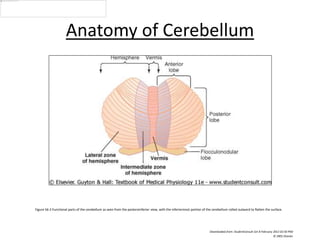
Figure 56-2 Functional parts of the cerebellum as seen from the posteroinferior view, with the inferiormost portion of the cerebellum rolled outward to flatten the surface.
Downloaded from: StudentConsult (on 8 February 2012 02:50 PM)
© 2005 Elsevier
Anatomy of Cerebellum
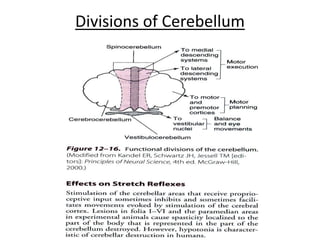
Divisions of Cerebellum
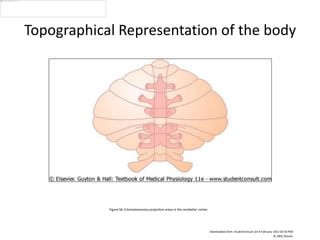
Figure 56-3 Somatosensory projection areas in the cerebellar cortex.
Downloaded from: StudentConsult (on 8 February 2012 02:50 PM)
© 2005 Elsevier
Topographical Representation of the body
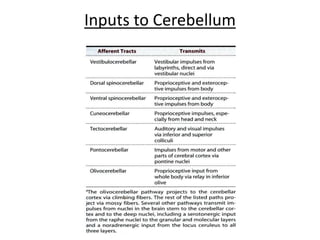
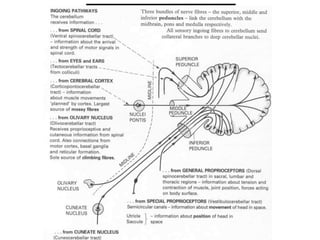
Inputs to Cerebellum
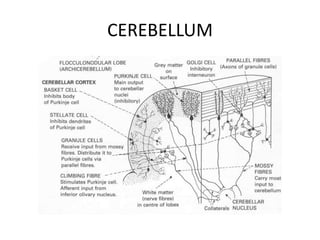
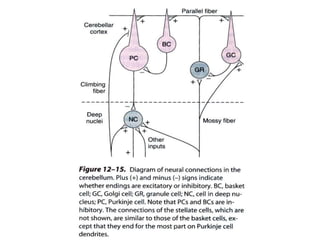
CEREBELLUM
Functions of Cerebellum
• Turn-On/Turn-Off and Turn-Off/Turn-On
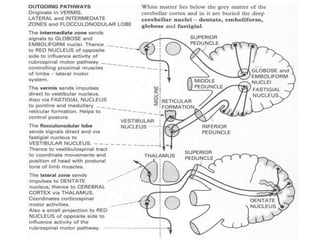
Output Signals from the Cerebellum
• The Purkinje Cells “Learn” to Correct Motor
Errors—Role of the Climbing Fibers
• Function of the Cerebellum in Overall Motor
Control
Function of the Cerebellum in Overall
Motor Control
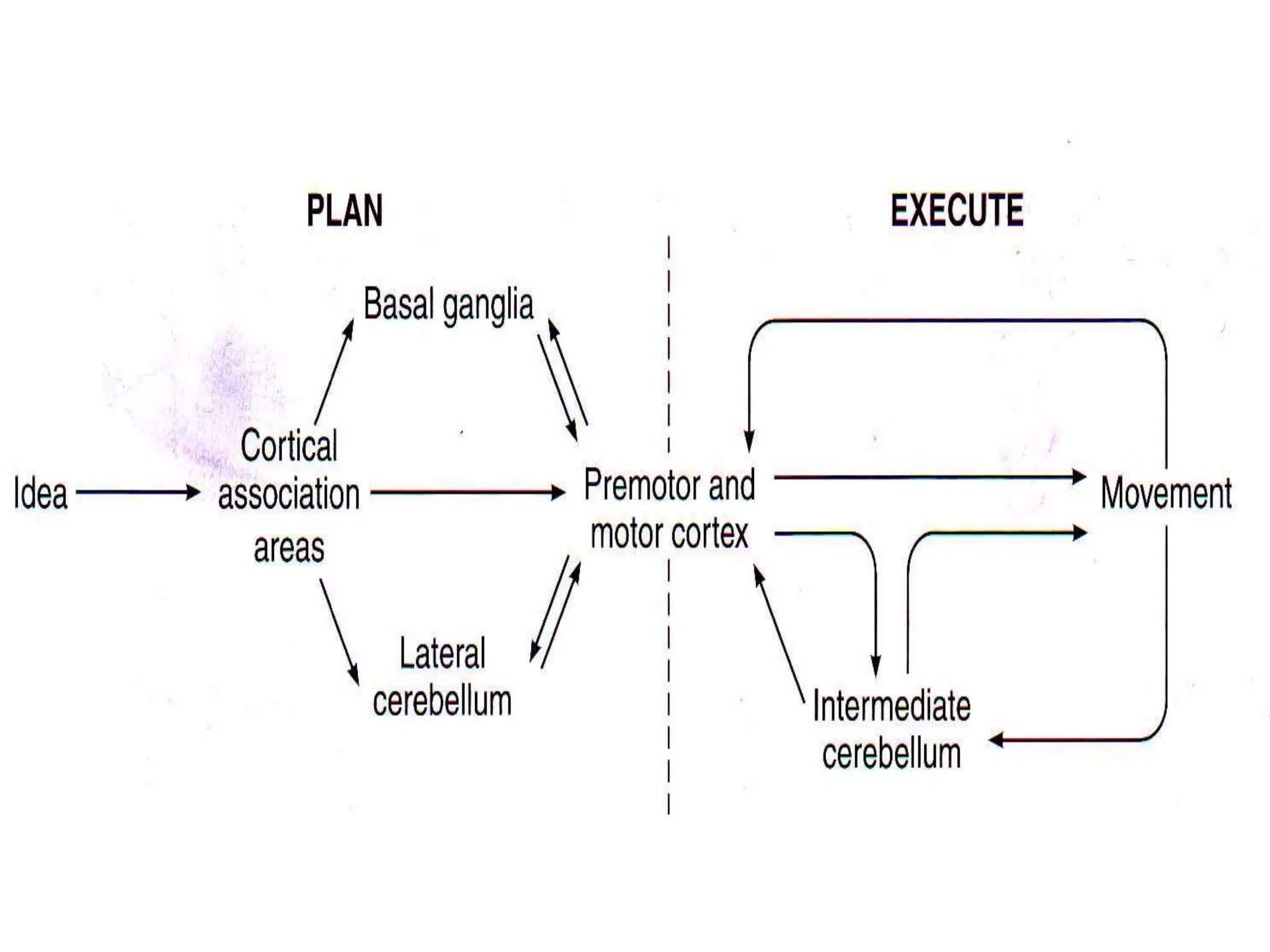
• Vestibulocerebellum—Its Function in Association with the Brain
Stem and Spinal Cord to Control Equilibrium and Postural
Movements
• Spinocerebellum—
- Feedback Control of Distal Limb Movements by Way of
the Intermediate Cerebellar Cortex and the Interposed Nucleus
- Function of the Cerebellum to Prevent Overshoot of
Movements and to “Damp” Movements.
- Cerebellar Control of Ballistic Movements.
• Cerebrocerebellum—
- Function of the Large Lateral Zone of the Cerebellar
Hemisphere to Plan, Sequence, and Time Complex Movements
- Extramotor Predictive Functions
Functions
• Comparator function
• Damping function
• Timing & Programming of movements
- Planning of sequential movements
- Timing function
- Predictive function
• Control of Ballistic movements
• Servomechanism
1) What would happen if an expanding mass (such as a tumor) is
pushing caudally on the cerebellum?
2) What would be the effects of a unilateral cerebellar hemisphere
lesion?
3) What would be the effects of a lesion of the cerebellar vermis (in the
midline of the cerebellum)?
1) What would happen if an expanding mass (such as a tumor) is
pushing caudally on the cerebellum?
If the cerebellum is pushed caudally by an expanding mass, the tonsils may be
jammed into the foramen magnum, thereby compressing the medulla or upper
cervical spinal cord (often fatal).
2) What would be the effects of a unilateral cerebellar
hemisphere lesion?
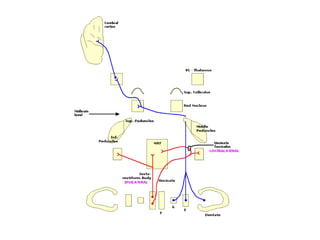
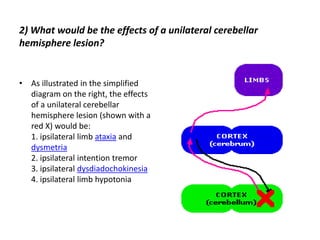
• As illustrated in the simplified
diagram on the right, the effects
of a unilateral cerebellar
hemisphere lesion (shown with a
red X) would be:
1. ipsilateral limb ataxia and
dysmetria
2. ipsilateral intention tremor
3. ipsilateral dysdiadochokinesia
4. ipsilateral limb hypotonia
3) What would be the effects of a lesion of the cerebellar vermis (in the midline of the
cerebellum)?
The effects of a lesion of the cerebellar vermis would be:
1.Gait ataxia
2.Trunk ataxia
3.Dysarthria
4.Nystagmus and other disturbances of eye movement
Note: A relatively common cause of progressive degeneration
of the cerebellar vermis (producing the effects listed above)
is chronic alcoholism.

CEREBELLUM.pptx

  • 3.
    Figure 56-2 Functionalparts of the cerebellum as seen from the posteroinferior view, with the inferiormost portion of the cerebellum rolled outward to flatten the surface. Downloaded from: StudentConsult (on 8 February 2012 02:50 PM) © 2005 Elsevier Anatomy of Cerebellum
  • 4.
  • 5.
    Figure 56-3 Somatosensoryprojection areas in the cerebellar cortex. Downloaded from: StudentConsult (on 8 February 2012 02:50 PM) © 2005 Elsevier Topographical Representation of the body
  • 6.
  • 9.
  • 12.
    Functions of Cerebellum •Turn-On/Turn-Off and Turn-Off/Turn-On Output Signals from the Cerebellum • The Purkinje Cells “Learn” to Correct Motor Errors—Role of the Climbing Fibers • Function of the Cerebellum in Overall Motor Control
  • 13.
    Function of theCerebellum in Overall Motor Control • Vestibulocerebellum—Its Function in Association with the Brain Stem and Spinal Cord to Control Equilibrium and Postural Movements • Spinocerebellum— - Feedback Control of Distal Limb Movements by Way of the Intermediate Cerebellar Cortex and the Interposed Nucleus - Function of the Cerebellum to Prevent Overshoot of Movements and to “Damp” Movements. - Cerebellar Control of Ballistic Movements. • Cerebrocerebellum— - Function of the Large Lateral Zone of the Cerebellar Hemisphere to Plan, Sequence, and Time Complex Movements - Extramotor Predictive Functions
  • 14.
    Functions • Comparator function •Damping function • Timing & Programming of movements - Planning of sequential movements - Timing function - Predictive function • Control of Ballistic movements • Servomechanism
  • 15.
    1) What wouldhappen if an expanding mass (such as a tumor) is pushing caudally on the cerebellum? 2) What would be the effects of a unilateral cerebellar hemisphere lesion? 3) What would be the effects of a lesion of the cerebellar vermis (in the midline of the cerebellum)?
  • 16.
    1) What wouldhappen if an expanding mass (such as a tumor) is pushing caudally on the cerebellum? If the cerebellum is pushed caudally by an expanding mass, the tonsils may be jammed into the foramen magnum, thereby compressing the medulla or upper cervical spinal cord (often fatal).
  • 17.
    2) What wouldbe the effects of a unilateral cerebellar hemisphere lesion? • As illustrated in the simplified diagram on the right, the effects of a unilateral cerebellar hemisphere lesion (shown with a red X) would be: 1. ipsilateral limb ataxia and dysmetria 2. ipsilateral intention tremor 3. ipsilateral dysdiadochokinesia 4. ipsilateral limb hypotonia
  • 18.
    3) What wouldbe the effects of a lesion of the cerebellar vermis (in the midline of the cerebellum)? The effects of a lesion of the cerebellar vermis would be: 1.Gait ataxia 2.Trunk ataxia 3.Dysarthria 4.Nystagmus and other disturbances of eye movement Note: A relatively common cause of progressive degeneration of the cerebellar vermis (producing the effects listed above) is chronic alcoholism.