Material Testing
An Initiated by
EE Engineering Construction Services
Hyderabad,Telangana
Powered by
Malla Reddy Engineering College
Hyderabad ,Telangana
Material Testing
Material testing is the process of evaluating the properties of materials to determine
their behavior under various conditions to ensure performance, reliability, and safety.
Importance
 Quality Assurance
 Quality Control
 Safety Assurance
 Cost Saving
 Efficiency and Performance
Types
• Soil Testing
• Concrete Testing
• Steel Testing
• Wood Testing
Agenda
 Hardness Testing Machines
 Brinell Hardness Testing Machine
 Rockwell Hardness Testing Machine
 Torsion Testing Machine
 Impact Strength Testing Machine
 Universal Testing Machine
 Strain Indicator
 Two Pin Arch Apparatus
 Unsymmetrical Bending Apparatus
 Curved Bending Apparatus
 Spring Testing Machine
 Pin Truss Apparatus
 Deflection Test on Beams
 Beam Deflection Test Apparatus
Hardness Testing Machine
A Hardness Testing Machine is a device used to measure the
hardness of materials by determining their resistance to
deformation under a specific load.
Hardness testing is critical in quality control, material selection,
and research and development across various industries, such
as manufacturing, metalworking, and construction.
Types
1) Brinell Hardness Testing Machine
2) Rockwell Hardness Testing Machine
3) Vickers Hardness Testing Machine
4) Knoop Hardness Testing Machine
Brinell & Rockwell Hardness Testing Machine
Brinell Hardness
A machine used to measure the hardness of materials by applying a
specific load (500-3000 kg) onto a 10 mm steel or carbide ball that
is pressed into the material's surface.
The size of the indentation created by the ball is measured, and the
Brinell Hardness Number (BHN) is calculated based on the load and
indentation size.
Rockwell Hardness
A machine that measures hardness by pressing a steel ball or
diamond cone into the material’s surface under a predefined load
(60-150 kg).
The depth of the indentation is measured and converted into a
Rockwell Hardness Number (e.g., HRB, HRC).
Torsion Testing Machine
Measures a material's resistance to twisting (torque) and
determines its torsional strength and shear modulus.
How It Works:
• Applies torque to a specimen (usually cylindrical).
• Measures the angle of twist and applied torque until material
failure.
Key Parameters:
Torsional Strength : Maximum torque before failure.
Shear Modulus (G) : Material’s resistance to twisting.
Elastic Limit : Maximum stress before permanent deformation.
Reduntant Apparatus
Redundant Joint Apparatus should consists of three
suspension members (spring balances) of different
stiffness which are jointed at a point to form the
redundant joint.
These joints are commonly found in frameworks where
additional supports or connections make the system
redundant, resulting in complex force distribution.
Impact Strength Testing Machine
Measures a material's ability to withstand sudden forces or
impacts, assessing toughness.
Types of Tests :
Charpy Impact Test: Measures energy absorbed by a notched
specimen hit by a pendulum.
Izod Impact Test: Similar to Charpy but with a vertically
positioned specimen.
Applications:
Material Toughness
Quality Control
Izod Impact Test
Test Procedure:
• A notched specimen is struck by a pendulum hammer.
•The energy absorbed by the material before breaking is
measured.
Components:
•Specimen : Rectangular bar with a V-shaped notch.
•Pendulum Hammer :
•Strikes the specimen with a known force.
•Anvil : Holds the specimen in place.
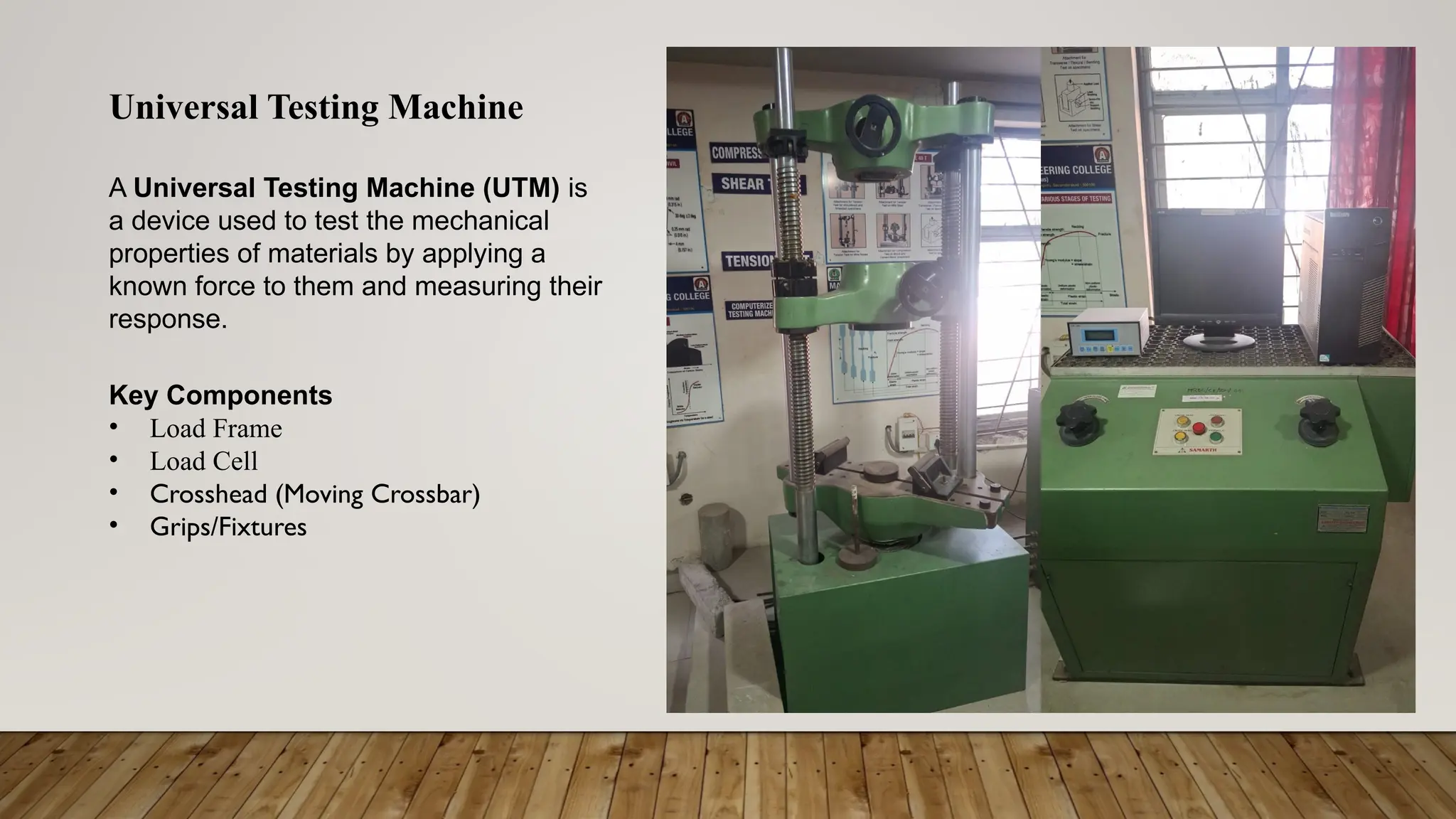
Universal Testing Machine
A Universal Testing Machine (UTM) is
a device used to test the mechanical
properties of materials by applying a
known force to them and measuring their
response.
Key Components
• Load Frame
• Load Cell
• Crosshead (Moving Crossbar)
• Grips/Fixtures
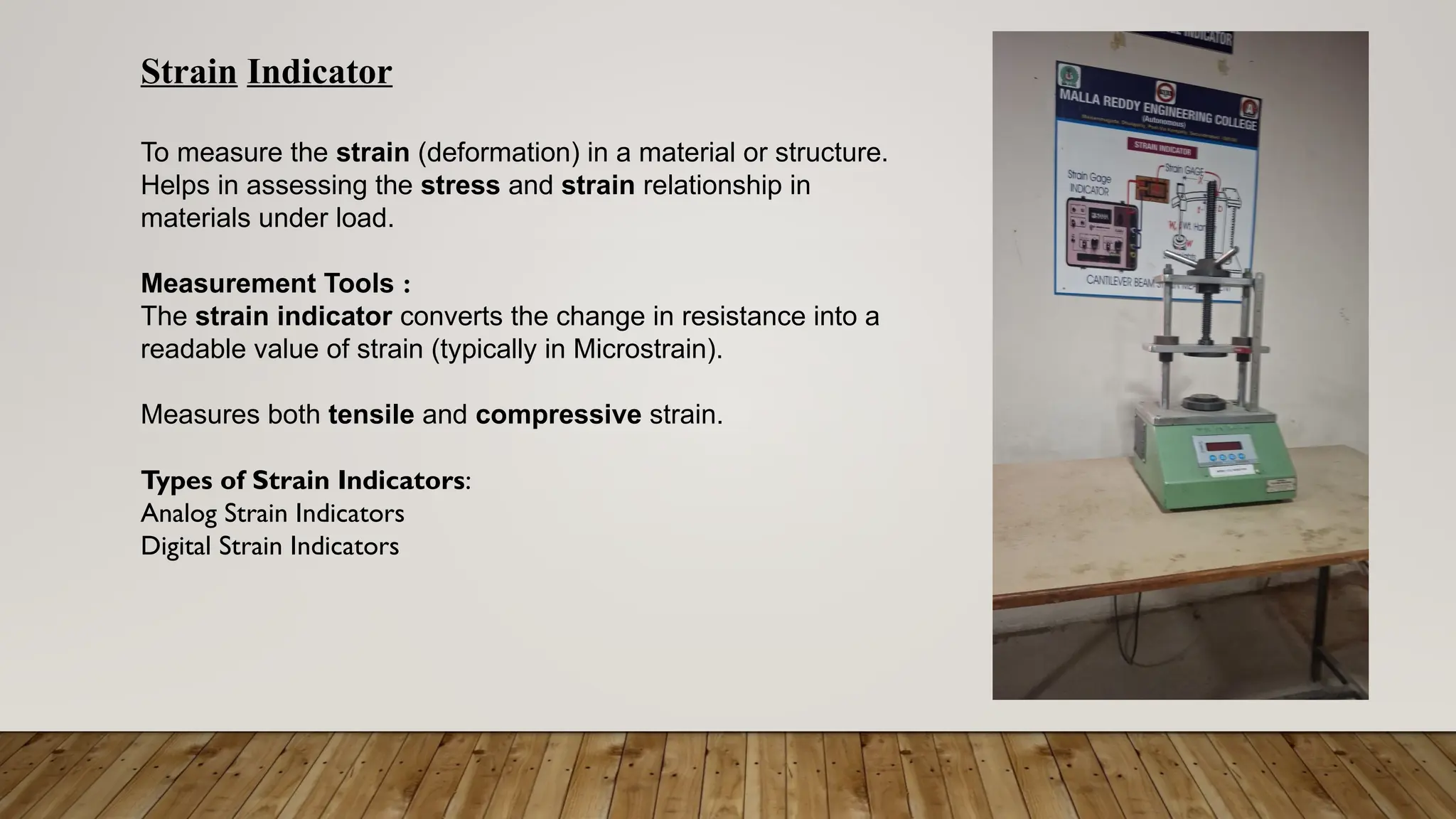
Strain Indicator
To measure the strain (deformation) in a material or structure.
Helps in assessing the stress and strain relationship in
materials under load.
Measurement Tools :
The strain indicator converts the change in resistance into a
readable value of strain (typically in Microstrain).
Measures both tensile and compressive strain.
Types of Strain Indicators:
Analog Strain Indicators
Digital Strain Indicators
Two Pin Arch Apparatus
• A Two Pin Arch Apparatus is a mechanical testing
device used to demonstrate and study the behavior
of an arch under load.
• Supports: Two pivotal pin supports at both ends
of the arch.
• Arch Shape: Made of flexible material to simulate
real arch structures.
• Load Application: Allows load to be applied at
different points along the arch.
Unsymmetrical Bending Apparatus
Bending of a beam with an unsymmetrical cross-
section.
Stress distribution is non-uniform due to irregular
cross-sections.
Point or distributed load applied off-center to induce
unsymmetrical bending.
Measurement Tools:
Strain gauges, displacement gauges, and torque
meters used to measure stress, deflection, and twist.
Twist/Torsion Effects:
Torsion induced by unsymmetrical bending, measured
by torsion gauge
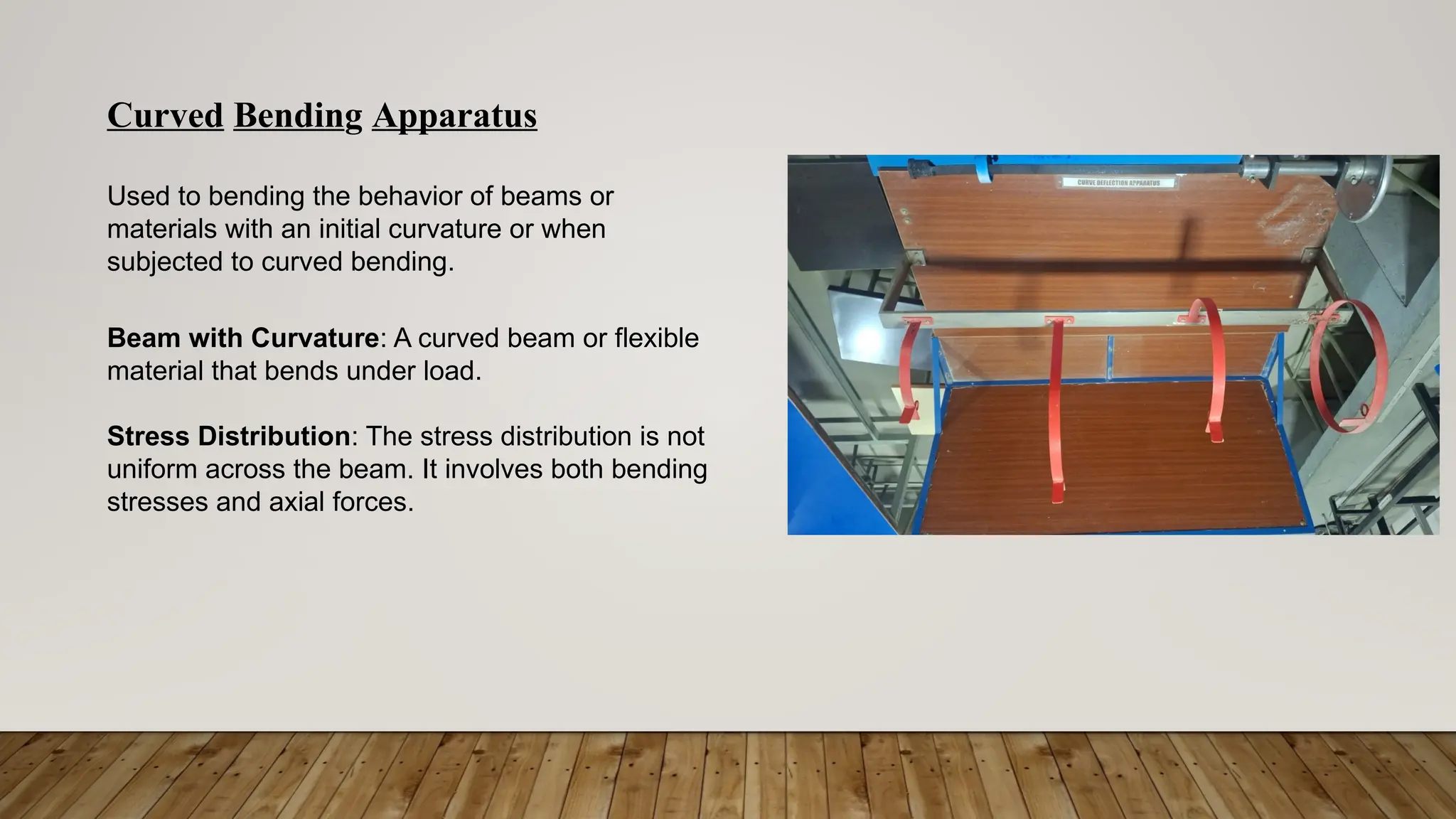
Curved Bending Apparatus
Used to bending the behavior of beams or
materials with an initial curvature or when
subjected to curved bending.
Beam with Curvature: A curved beam or flexible
material that bends under load.
Stress Distribution: The stress distribution is not
uniform across the beam. It involves both bending
stresses and axial forces.
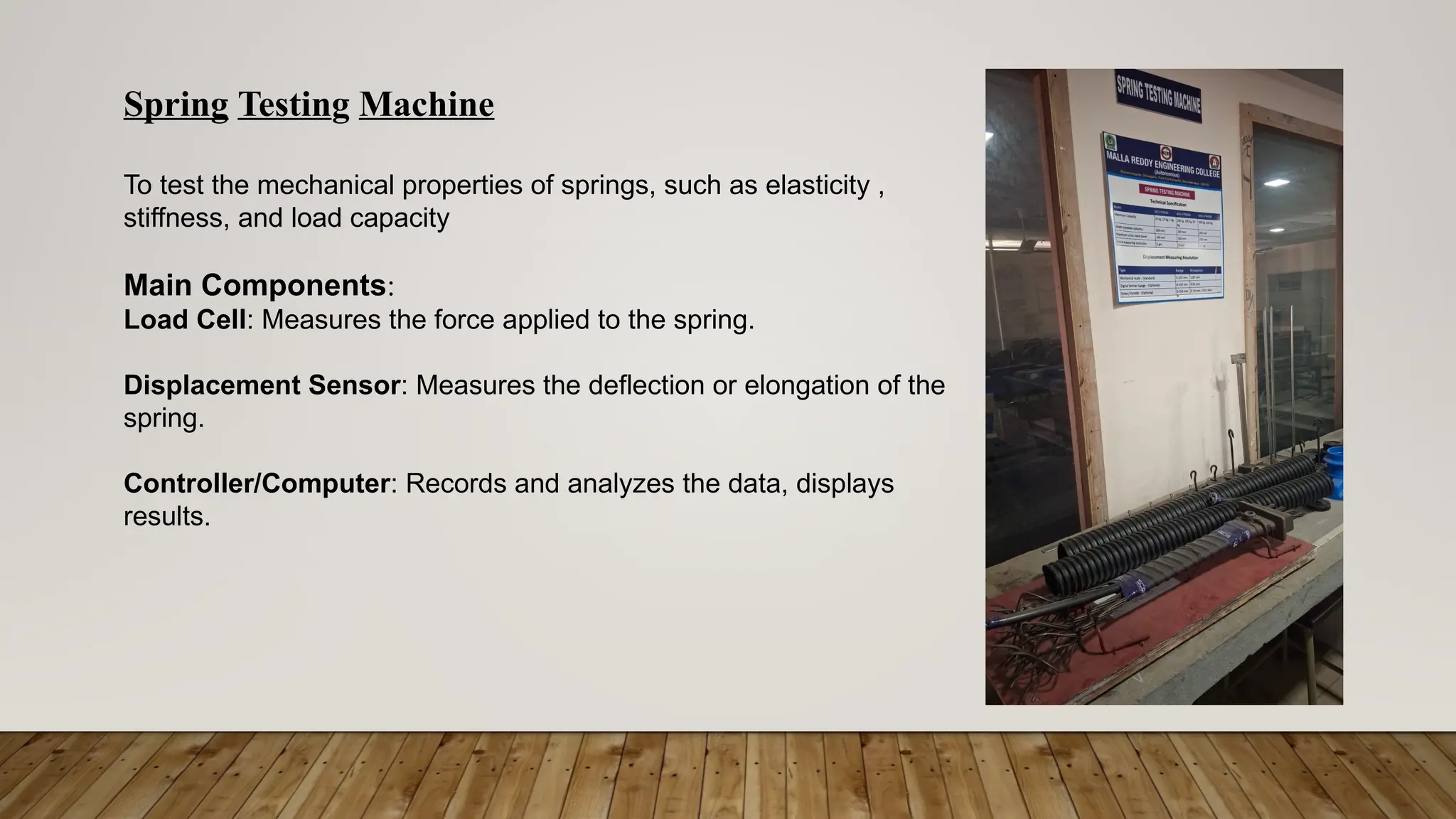
Spring Testing Machine
To test the mechanical properties of springs, such as elasticity ,
stiffness, and load capacity
Main Components:
Load Cell: Measures the force applied to the spring.
Displacement Sensor: Measures the deflection or elongation of the
spring.
Controller/Computer: Records and analyzes the data, displays
results.
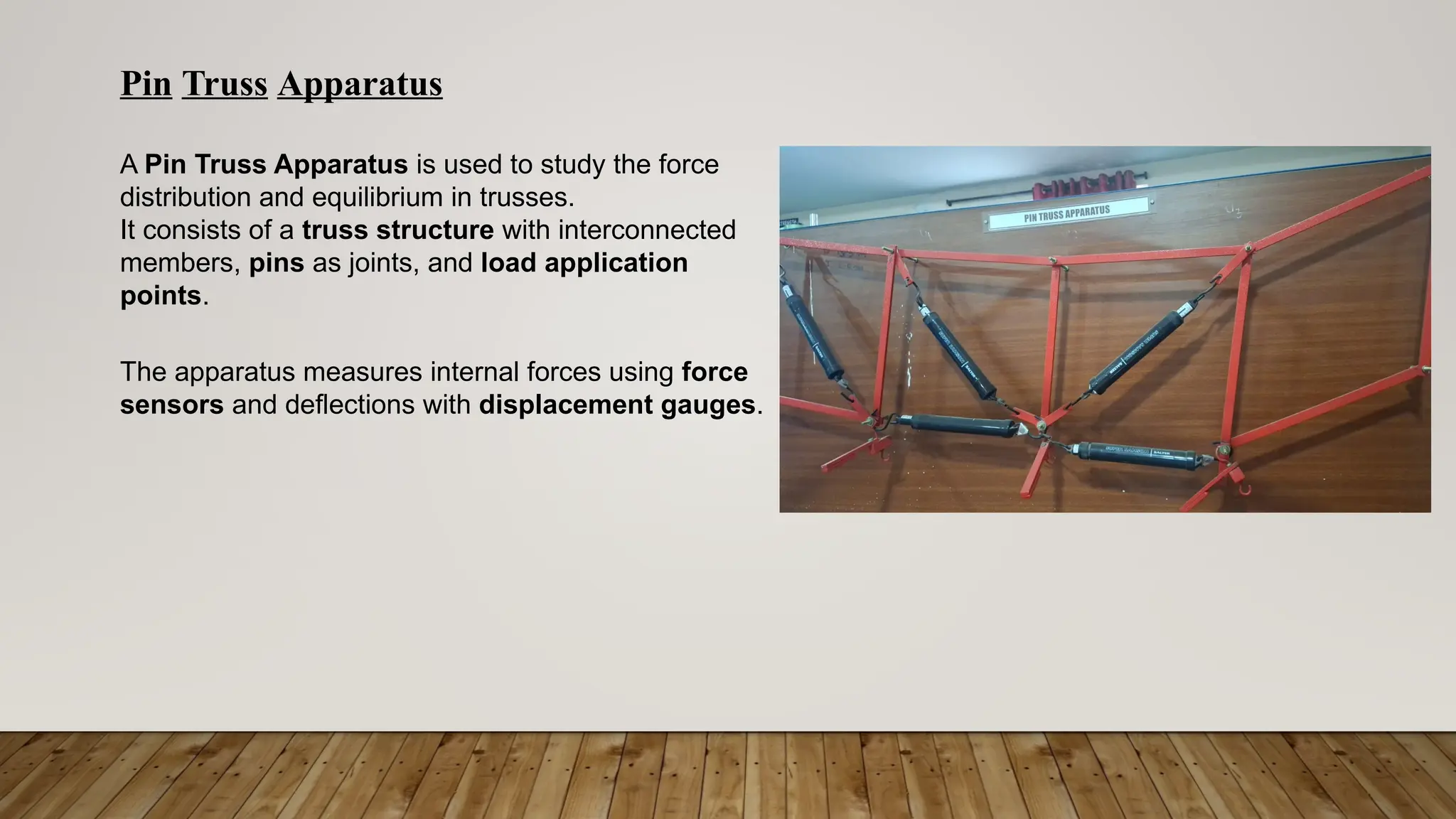
Pin Truss Apparatus
A Pin Truss Apparatus is used to study the force
distribution and equilibrium in trusses.
It consists of a truss structure with interconnected
members, pins as joints, and load application
points.
The apparatus measures internal forces using force
sensors and deflections with displacement gauges.
Deflection Test on Beams
Measures the beam’s displacement under applied loads to assess its
structural integrity and performance.
Using tools like dial gauges, strain gauges, and displacement
transducers, the test evaluates parameters. such as maximum
deflection, beam stiffness, and elastic deformation.
Types of Tests:
Static Test: A single load or a series of loads applied to measure
deflection.
Dynamic Test : Varying loads or cyclic loading to study the beam’s
response over time
Beam Deflection Test Apparatus
used to measure the deflection (displacement) of a
beam under applied loads to assess its performance
and structural integrity.
Key components include the beam, loading
mechanism (point or distributed loads), and
measurement devices like dial gauges, strain
gauges, and displacement transducers.
The test can be static or dynamic, and it is crucial for
structural testing, material testing, and quality
control to ensure beams meet design standards and
safety requirements.

Material Testing facilities of EE Engg Construction Services

  • 1.
    Material Testing An Initiatedby EE Engineering Construction Services Hyderabad,Telangana Powered by Malla Reddy Engineering College Hyderabad ,Telangana
  • 2.
    Material Testing Material testingis the process of evaluating the properties of materials to determine their behavior under various conditions to ensure performance, reliability, and safety. Importance  Quality Assurance  Quality Control  Safety Assurance  Cost Saving  Efficiency and Performance Types • Soil Testing • Concrete Testing • Steel Testing • Wood Testing
  • 3.
    Agenda  Hardness TestingMachines  Brinell Hardness Testing Machine  Rockwell Hardness Testing Machine  Torsion Testing Machine  Impact Strength Testing Machine  Universal Testing Machine  Strain Indicator  Two Pin Arch Apparatus  Unsymmetrical Bending Apparatus  Curved Bending Apparatus  Spring Testing Machine  Pin Truss Apparatus  Deflection Test on Beams  Beam Deflection Test Apparatus
  • 4.
    Hardness Testing Machine AHardness Testing Machine is a device used to measure the hardness of materials by determining their resistance to deformation under a specific load. Hardness testing is critical in quality control, material selection, and research and development across various industries, such as manufacturing, metalworking, and construction. Types 1) Brinell Hardness Testing Machine 2) Rockwell Hardness Testing Machine 3) Vickers Hardness Testing Machine 4) Knoop Hardness Testing Machine
  • 5.
    Brinell & RockwellHardness Testing Machine Brinell Hardness A machine used to measure the hardness of materials by applying a specific load (500-3000 kg) onto a 10 mm steel or carbide ball that is pressed into the material's surface. The size of the indentation created by the ball is measured, and the Brinell Hardness Number (BHN) is calculated based on the load and indentation size. Rockwell Hardness A machine that measures hardness by pressing a steel ball or diamond cone into the material’s surface under a predefined load (60-150 kg). The depth of the indentation is measured and converted into a Rockwell Hardness Number (e.g., HRB, HRC).
  • 6.
    Torsion Testing Machine Measuresa material's resistance to twisting (torque) and determines its torsional strength and shear modulus. How It Works: • Applies torque to a specimen (usually cylindrical). • Measures the angle of twist and applied torque until material failure. Key Parameters: Torsional Strength : Maximum torque before failure. Shear Modulus (G) : Material’s resistance to twisting. Elastic Limit : Maximum stress before permanent deformation.
  • 7.
    Reduntant Apparatus Redundant JointApparatus should consists of three suspension members (spring balances) of different stiffness which are jointed at a point to form the redundant joint. These joints are commonly found in frameworks where additional supports or connections make the system redundant, resulting in complex force distribution.
  • 8.
    Impact Strength TestingMachine Measures a material's ability to withstand sudden forces or impacts, assessing toughness. Types of Tests : Charpy Impact Test: Measures energy absorbed by a notched specimen hit by a pendulum. Izod Impact Test: Similar to Charpy but with a vertically positioned specimen. Applications: Material Toughness Quality Control
  • 9.
    Izod Impact Test TestProcedure: • A notched specimen is struck by a pendulum hammer. •The energy absorbed by the material before breaking is measured. Components: •Specimen : Rectangular bar with a V-shaped notch. •Pendulum Hammer : •Strikes the specimen with a known force. •Anvil : Holds the specimen in place.
  • 10.
    Universal Testing Machine AUniversal Testing Machine (UTM) is a device used to test the mechanical properties of materials by applying a known force to them and measuring their response. Key Components • Load Frame • Load Cell • Crosshead (Moving Crossbar) • Grips/Fixtures
  • 11.
    Strain Indicator To measurethe strain (deformation) in a material or structure. Helps in assessing the stress and strain relationship in materials under load. Measurement Tools : The strain indicator converts the change in resistance into a readable value of strain (typically in Microstrain). Measures both tensile and compressive strain. Types of Strain Indicators: Analog Strain Indicators Digital Strain Indicators
  • 12.
    Two Pin ArchApparatus • A Two Pin Arch Apparatus is a mechanical testing device used to demonstrate and study the behavior of an arch under load. • Supports: Two pivotal pin supports at both ends of the arch. • Arch Shape: Made of flexible material to simulate real arch structures. • Load Application: Allows load to be applied at different points along the arch.
  • 13.
    Unsymmetrical Bending Apparatus Bendingof a beam with an unsymmetrical cross- section. Stress distribution is non-uniform due to irregular cross-sections. Point or distributed load applied off-center to induce unsymmetrical bending. Measurement Tools: Strain gauges, displacement gauges, and torque meters used to measure stress, deflection, and twist. Twist/Torsion Effects: Torsion induced by unsymmetrical bending, measured by torsion gauge
  • 14.
    Curved Bending Apparatus Usedto bending the behavior of beams or materials with an initial curvature or when subjected to curved bending. Beam with Curvature: A curved beam or flexible material that bends under load. Stress Distribution: The stress distribution is not uniform across the beam. It involves both bending stresses and axial forces.
  • 15.
    Spring Testing Machine Totest the mechanical properties of springs, such as elasticity , stiffness, and load capacity Main Components: Load Cell: Measures the force applied to the spring. Displacement Sensor: Measures the deflection or elongation of the spring. Controller/Computer: Records and analyzes the data, displays results.
  • 16.
    Pin Truss Apparatus APin Truss Apparatus is used to study the force distribution and equilibrium in trusses. It consists of a truss structure with interconnected members, pins as joints, and load application points. The apparatus measures internal forces using force sensors and deflections with displacement gauges.
  • 17.
    Deflection Test onBeams Measures the beam’s displacement under applied loads to assess its structural integrity and performance. Using tools like dial gauges, strain gauges, and displacement transducers, the test evaluates parameters. such as maximum deflection, beam stiffness, and elastic deformation. Types of Tests: Static Test: A single load or a series of loads applied to measure deflection. Dynamic Test : Varying loads or cyclic loading to study the beam’s response over time
  • 18.
    Beam Deflection TestApparatus used to measure the deflection (displacement) of a beam under applied loads to assess its performance and structural integrity. Key components include the beam, loading mechanism (point or distributed loads), and measurement devices like dial gauges, strain gauges, and displacement transducers. The test can be static or dynamic, and it is crucial for structural testing, material testing, and quality control to ensure beams meet design standards and safety requirements.