E-Commerce Business Classification, Business
Revenue Models and Product Revenue Models
(BBA-509)
Course Instructor: M.Talha
Lecture no. 3 Date: 29/10/2019
You’ll need to familiarize yourself with each type of business model before you
start your ecommerce business:
 Major Ecommerce Business Classifications
 B2B Ecommerce
 B2C Ecommerce
 C2C Ecommerce
 C2B Ecommerce
 Government / Public Administration Ecommerce
 Types Of Ecommerce Business Revenue Models
 Drop Shipping
 Wholesaling and Warehousing
 Private Labeling and Manufacturing
 White Labeling
 Subscription Ecommerce
 Product Revenue Models
 What Counts For Ecommerce
 Single Product Model
 Single Category
 Multiple Category
 Affiliate
 Hybrid [Single Category + Affiliate]
 What Model Fits Your Idea Best?
You’ll also need to identify an ecommerce platform that suits your preferred
business model’s needs. In this post, I’ll walk you through the jargon.
ii
Major Ecommerce Business Classifications
Electronic commerce encompasses all online marketplaces that connect buyers and
sellers. The internet is used to process all electronic transactions.
The first thing to think about is the type of business transaction you’re going for.
When you think about the business you want to run, who do you see yourself selling
to? Is your business B2B, B2C, C2C, or C2B?
Do you have an idea for a type of ecommerce business that you’ve been thinking
about for a while? Do those acronyms make your head spin? Let’s take a look at the
most common ways online transactions occur.
B2B Ecommerce
A B2B model focuses on providing products from one business to another. While
many ecommerce businesses in this niche are service providers, you’ll find software
companies, office furniture and supply companies, document hosting companies, and
numerous other ecommerce business models under this heading.
B2B ecommerce examples you may be familiar with include the ExxonMobil
Corporation and the Chevron Corporation, Boeing, and Archer Daniel
Midlands. These businesses have custom, enterprise ecommerce platforms that work
directly with other businesses in a closed environment. A B2B ecommerce business
typically requires more startup cash.
iii
B2C Ecommerce
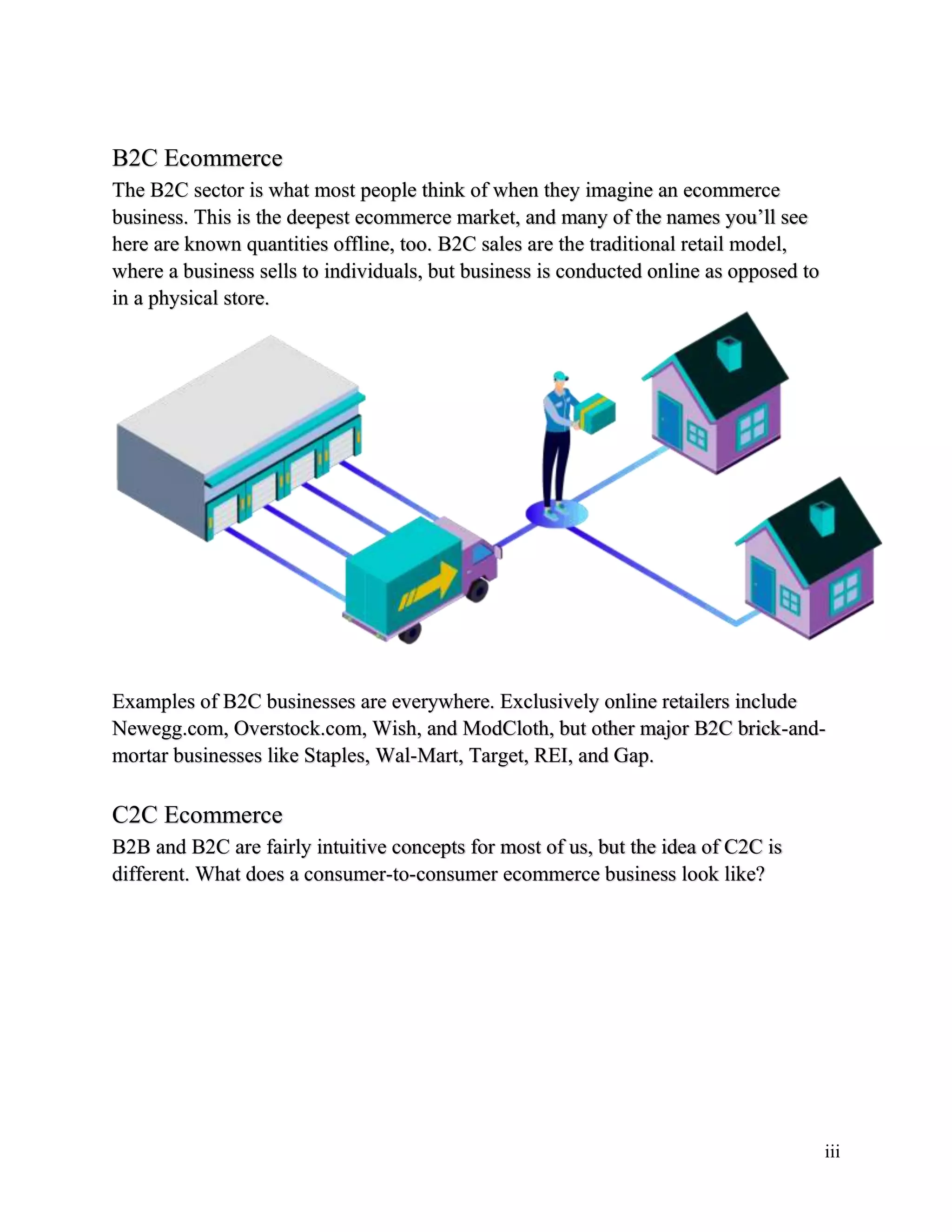
The B2C sector is what most people think of when they imagine an ecommerce
business. This is the deepest ecommerce market, and many of the names you’ll see
here are known quantities offline, too. B2C sales are the traditional retail model,
where a business sells to individuals, but business is conducted online as opposed to
in a physical store.
Examples of B2C businesses are everywhere. Exclusively online retailers include
Newegg.com, Overstock.com, Wish, and ModCloth, but other major B2C brick-and-
mortar businesses like Staples, Wal-Mart, Target, REI, and Gap.
C2C Ecommerce
B2B and B2C are fairly intuitive concepts for most of us, but the idea of C2C is
different. What does a consumer-to-consumer ecommerce business look like?
iv
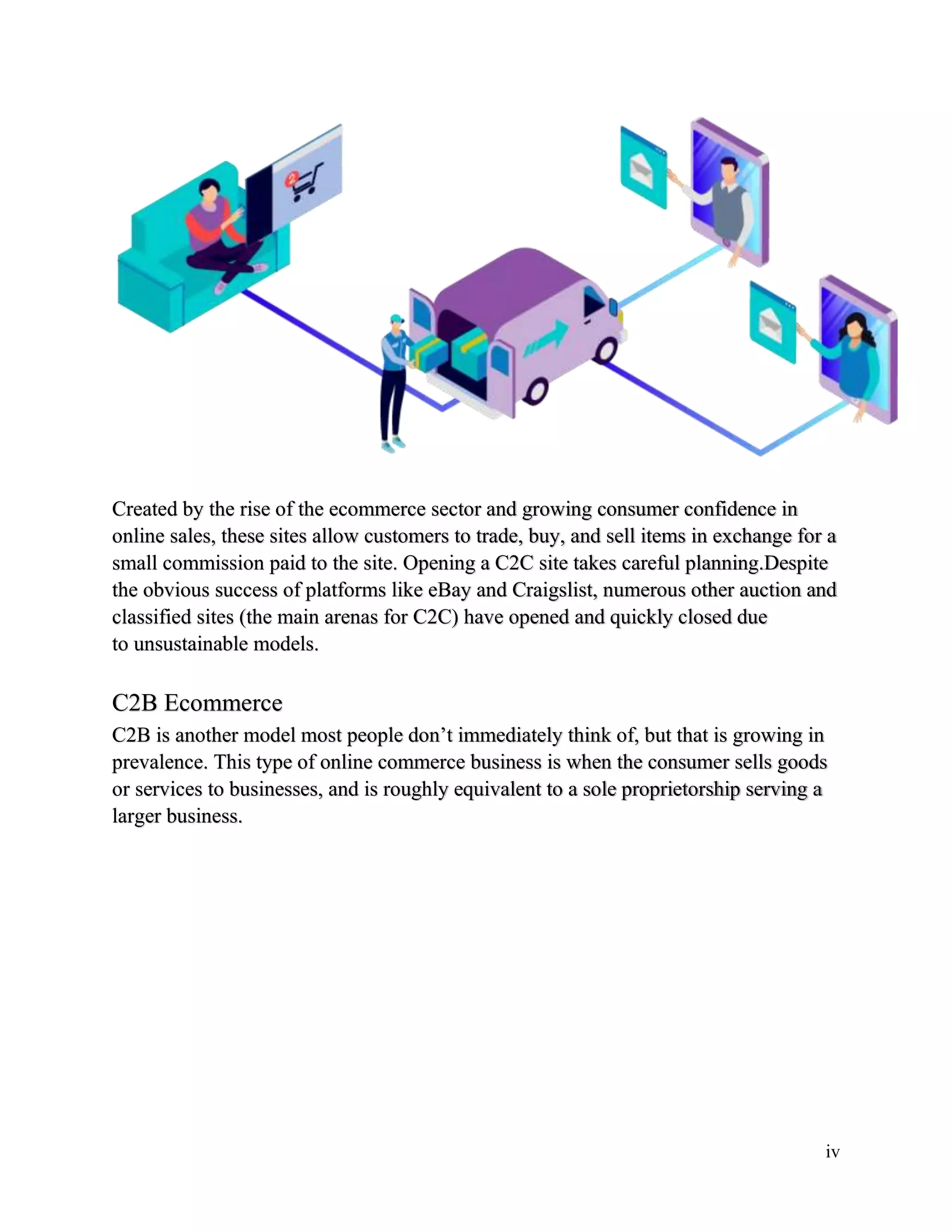
Created by the rise of the ecommerce sector and growing consumer confidence in
online sales, these sites allow customers to trade, buy, and sell items in exchange for a
small commission paid to the site. Opening a C2C site takes careful planning.Despite
the obvious success of platforms like eBay and Craigslist, numerous other auction and
classified sites (the main arenas for C2C) have opened and quickly closed due
to unsustainable models.
C2B Ecommerce
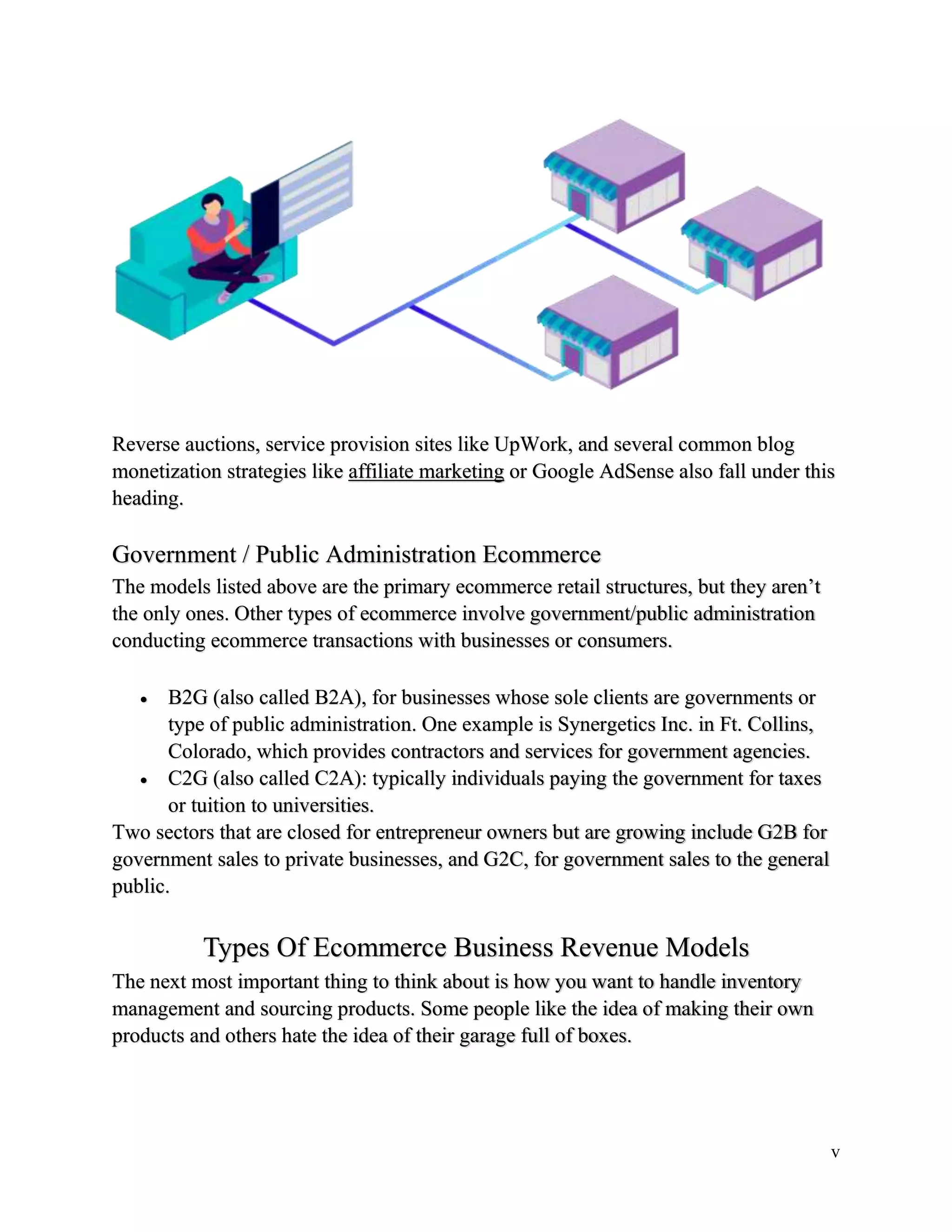
C2B is another model most people don’t immediately think of, but that is growing in
prevalence. This type of online commerce business is when the consumer sells goods
or services to businesses, and is roughly equivalent to a sole proprietorship serving a
larger business.
v
Reverse auctions, service provision sites like UpWork, and several common blog
monetization strategies like affiliate marketing or Google AdSense also fall under this
heading.
Government / Public Administration Ecommerce
The models listed above are the primary ecommerce retail structures, but they aren’t
the only ones. Other types of ecommerce involve government/public administration
conducting ecommerce transactions with businesses or consumers.
 B2G (also called B2A), for businesses whose sole clients are governments or
type of public administration. One example is Synergetics Inc. in Ft. Collins,
Colorado, which provides contractors and services for government agencies.
 C2G (also called C2A): typically individuals paying the government for taxes
or tuition to universities.
Two sectors that are closed for entrepreneur owners but are growing include G2B for
government sales to private businesses, and G2C, for government sales to the general
public.
Types Of Ecommerce Business Revenue Models
The next most important thing to think about is how you want to handle inventory
management and sourcing products. Some people like the idea of making their own
products and others hate the idea of their garage full of boxes.
vi
Drop Shipping
The simplest form of ecommerce, drop shipping lets you set up a storefront and take
the customers’ money. The rest is up to your supplier. This frees you from managing
inventory, warehousing stock, or dealing with packaging, but there’s a major caveat.
If your sellers are slow, product quality is lower than expected, or there are problems
with the order, it’s on your head (and in your reviews). Wacky Hippo is an example of
an ecommerce site using drop shipping. I wouldnt base my business on dropshipping
– and I totally agree with this article.
If you are dead set on dropshipping – print on demand is the way to go.
Dropshipping Ecommerce Software
Many dropshippers use Shopify and Oberlo. Its quick and inexpensive to set
up. A popular model is to set up a quick store and drive traffic with Facebook Ads.
Margins are thin and if you can squeeze out some profit here, more power to you. I’m
holding off on drop shipping for now.
vii
Wholesaling and Warehousing
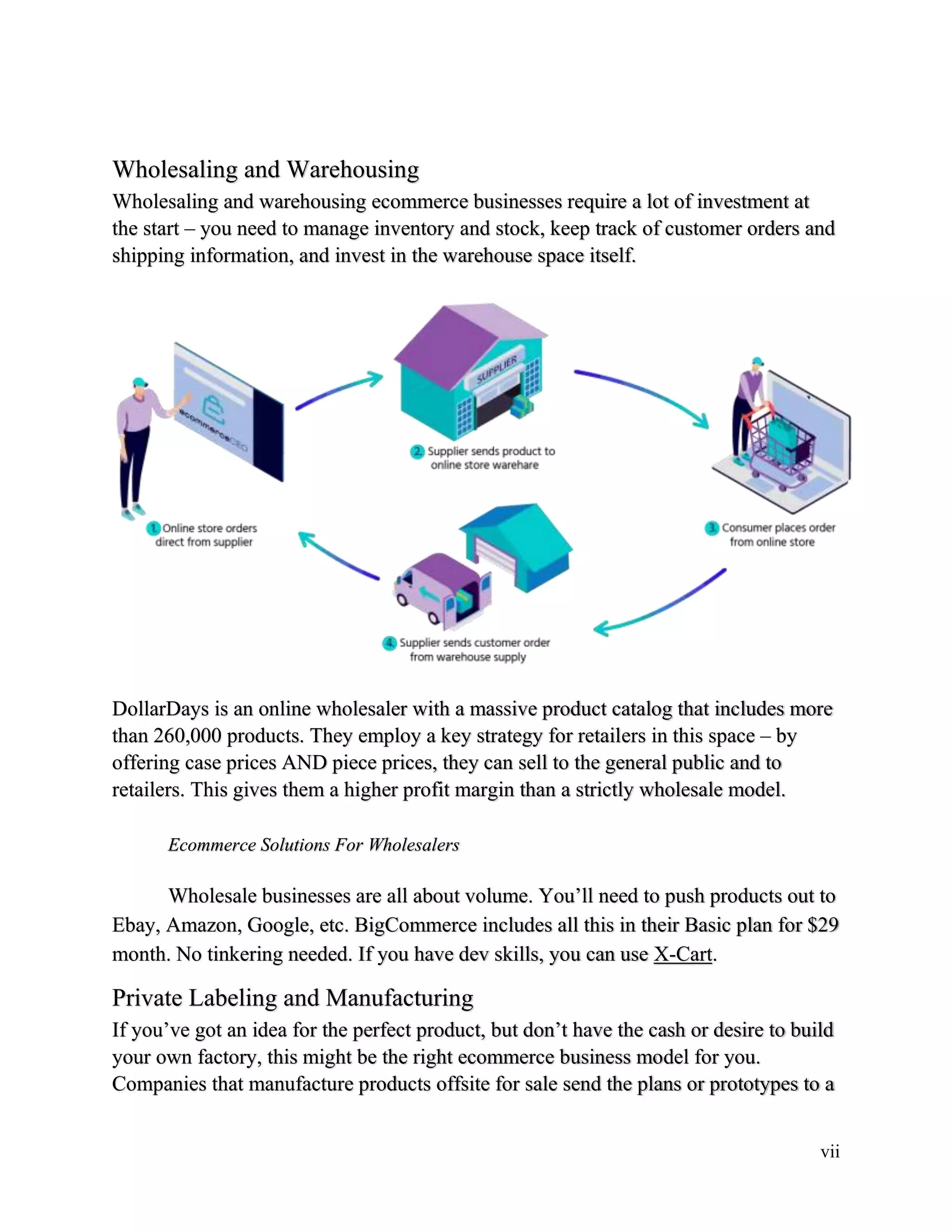
Wholesaling and warehousing ecommerce businesses require a lot of investment at
the start – you need to manage inventory and stock, keep track of customer orders and
shipping information, and invest in the warehouse space itself.
DollarDays is an online wholesaler with a massive product catalog that includes more
than 260,000 products. They employ a key strategy for retailers in this space – by
offering case prices AND piece prices, they can sell to the general public and to
retailers. This gives them a higher profit margin than a strictly wholesale model.
Ecommerce Solutions For Wholesalers
Wholesale businesses are all about volume. You’ll need to push products out to
Ebay, Amazon, Google, etc. BigCommerce includes all this in their Basic plan for $29
month. No tinkering needed. If you have dev skills, you can use X-Cart.
Private Labeling and Manufacturing
If you’ve got an idea for the perfect product, but don’t have the cash or desire to build
your own factory, this might be the right ecommerce business model for you.
Companies that manufacture products offsite for sale send the plans or prototypes to a
viii
contracted manufacturer who produces the product to meet customer specifications
and can either ship directly to the consumer, to a third party such as Amazon, or to the
company selling the final product.
On-demand manufacturing allows you to quickly change suppliers if you encounter
problems with product quality. The startup costs are minimal, and if you’re interested
in potentially opening your own production facilities later, this is a good way to test a
new product or concept.
If you have a product idea and need to find a manufacturer, Try Sourcify.
White Labeling
White labeling is similar. You choose a product that is already successfully sold by
another company, but offers white label options, design your package and label, and
sell the product. This is common in the beauty and wellness industries, but more
difficult to encounter in other niches.
One problem with white labeling is demand. You’re stuck with whatever you order,
and most of these companies set a minimum production quantity. If you can’t sell it,
you’ll have to live with it. Consider this option when you’re willing to work full time
on your business and know your product is in demand.
ix
If you have your own line of branded products and need to get traction, Big
Commerce is a good option to start. Their pricing model can get expensive when you
start to make significant sales ($150K+ per year).
Subscription Ecommerce
One of the most popular and successful pure ecommerce brands is the Dollar Shave
Club. Other examples of subscription services include Stitch Fix, Blue Apron, and
Nature Box. On the local level, community-supported agriculture boxes are popular.
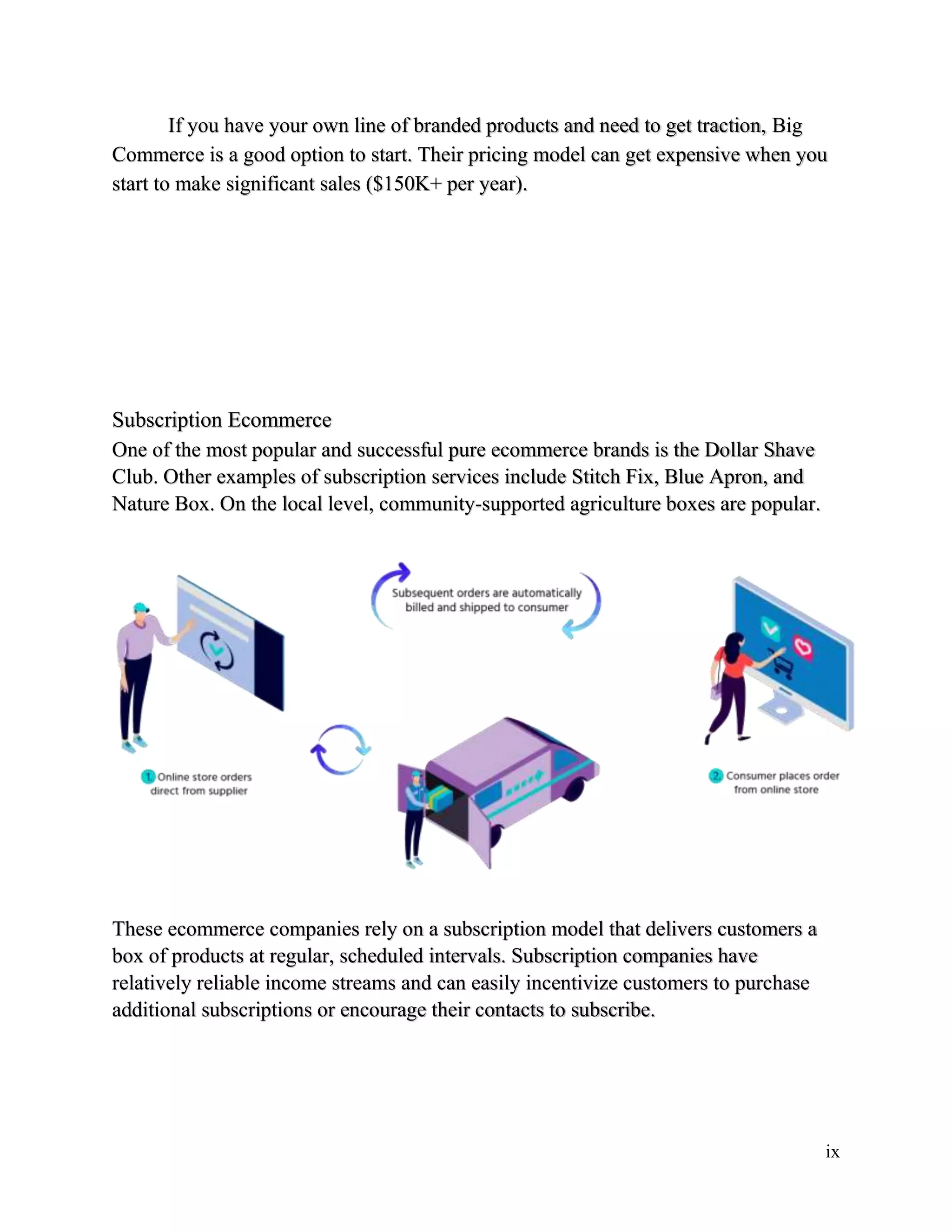
These ecommerce companies rely on a subscription model that delivers customers a
box of products at regular, scheduled intervals. Subscription companies have
relatively reliable income streams and can easily incentivize customers to purchase
additional subscriptions or encourage their contacts to subscribe.
x
Picking the right products and niches can be difficult. Successful subscription boxes
tend to fall into a small handful of product categories: health and grooming, beauty,
fashion, and food. Outside of these areas, few subscription companies thrive.
I love the idea of a subscription based ecommerce business. Both Shopify and
Big Commerce need additional, paid apps for subscription based ecommerce. So
you’ll need something like Woo Commerce Subscriptions (WordPress) or X-Cart to
handle this.
Product Revenue Models
Once you’ve identified who you are selling to and where, you need to think about
what you want to sell. Some businesses sell a single white-label product, while others
offer a full selection of niche-specific products. Yet another model depends on
affiliate programs across a wide swath of categories. Before opening your store, you
need to decide the type and number of products. Depending on your niche, you may
also need to evaluate production practices and regulations regarding what you can and
can’t say (organic, for instance). But first, what IS ecommerce?
What Counts For Ecommerce
Ecommerce is a broad term, but the simplest way to define it is the exchange of
services, and products online. Affiliate, physical, and digital products all fall under
this purview, as do services of all kinds that involve an exchange of funds online. Our
focus is on product-based businesses, so I’ll describe a few of the top models for you
here. I’ll provide a few examples, so you can see what they look like in use, too.
xi
Single Product Model
Single-product ecommerce businesses focus on a single product, potentially in
varying levels, offered to businesses or consumers. One example is Nvivo, a software
package made by QSR international. QSR’s only product is the Nvivo software
package, although the company also offers trainings and supplemental materials for
purchase by users.
This is a good model if you know you have a solid product with high demand and
limited competition. Otherwise, tread carefully. Remember the adage about putting all
your eggs in one basket…
Single Category
xii
When you want to test the waters in an ecommerce niche, a single category site can be
a smart choice. By offering a small selection of carefully chosen products, you can
build your reputation and credibility without overspending. Several retailers started
with a model like this, and many continue to use it today.
Keep in mind that you can always make subcategories – take books, for example. If
you open a bookstore, your category is books. But what kind? Textbooks? Ok. What
area? Defining single category ecommerce is challenging when you really start to
think about it. Avoid overdoing it, and stay focused. The key to success with a site
like this is to focus on a specific customer avatar and their interests, then pull a subset
of those interests that seems most likely to turn a profit.
Examples of ecommerce sites in this arena include Mangelsen Nature Photography,
Flowers.com, and The White T-Shirt Company.
This is a smart model for new business owners, and requires minimal effort and
investment to manage. The main drawback is that you’re only likely to catch the
interest of a very small portion of ecommerce shoppers.
xiii
Multiple Category
Multiple category ecommerce sites are a good choice for established brick and mortar
stores. Retailers who have tried a single category site successfully and are ready to
expand their offerings might be ready for multiple category sites, too.
Product selection is one of the most difficult parts of managing this type of site. One
bad product can ruin your reputation, and if you are sourcing from multiple suppliers,
the larger your store is, the more difficult logistics become. Examples of multiple
category ecommerce stores include Target, Cultures for Health, and REI.
Affiliate
Amazon.com, DoTerra Essential Oils, and dozens of other companies are boosting
their sales with the help of affiliates. Often through blogs, but sometimes through
dedicated ecommerce stores, affiliate sales benefit the original seller by providing
additional visibility and the affiliate by providing an opportunity to monetize product
reviews, a personal blog, or other site.
Most affiliate sites aren’t big money makers, but they can provide an additional
income stream for sites that predominantly rely on other income streams. If you’re
xiv
interested in affiliate sales and ecommerce, JVZoo is a good place to connect with
vendors and other affiliates.
Hybrid [Single Category + Affiliate]
For businesses that have outgrown the income stream or the product confines of a
single category store, becoming a single category and affiliate hybrid store can be
beneficial. You can test related product categories in your niche, risk-free, to see what
your customers like. This gives you the benefit of an additional product category
without requiring you to commit to marketing and managing additional products.
There are many ways to make this category of ecommerce stores work, from listing
affiliate links on your store’s blog to using widgets that allow affiliate products to
look like the products sold on your ecommerce store, with a seamless checkout
process that won’t disrupt the buyer’s journey.
Affiliate Marketing Ecommerce Website
Anytime we’re talking about affiliate marketing, we are talking about a content
driven website. WordPress is still the best for that. Once your branded product takes
off, you might want to move your site over to more of a true ecommerce platform. X-
Cart plays nicely with WordPress in terms of SEO and information architecture.
What Model Fits Your Idea Best?
Now that you know what types of ecommerce businesses, product options, platforms,
and business classifications exist, you’re ready to get started. Take a look at
your business plan.
E Commerce Business Classfication, Business Revenue Model

E Commerce Business Classfication, Business Revenue Model

  • 1.
    E-Commerce Business Classification,Business Revenue Models and Product Revenue Models (BBA-509) Course Instructor: M.Talha Lecture no. 3 Date: 29/10/2019 You’ll need to familiarize yourself with each type of business model before you start your ecommerce business:  Major Ecommerce Business Classifications  B2B Ecommerce  B2C Ecommerce  C2C Ecommerce  C2B Ecommerce  Government / Public Administration Ecommerce  Types Of Ecommerce Business Revenue Models  Drop Shipping  Wholesaling and Warehousing  Private Labeling and Manufacturing  White Labeling  Subscription Ecommerce  Product Revenue Models  What Counts For Ecommerce  Single Product Model  Single Category  Multiple Category  Affiliate  Hybrid [Single Category + Affiliate]  What Model Fits Your Idea Best? You’ll also need to identify an ecommerce platform that suits your preferred business model’s needs. In this post, I’ll walk you through the jargon.
  • 2.
    ii Major Ecommerce BusinessClassifications Electronic commerce encompasses all online marketplaces that connect buyers and sellers. The internet is used to process all electronic transactions. The first thing to think about is the type of business transaction you’re going for. When you think about the business you want to run, who do you see yourself selling to? Is your business B2B, B2C, C2C, or C2B? Do you have an idea for a type of ecommerce business that you’ve been thinking about for a while? Do those acronyms make your head spin? Let’s take a look at the most common ways online transactions occur. B2B Ecommerce A B2B model focuses on providing products from one business to another. While many ecommerce businesses in this niche are service providers, you’ll find software companies, office furniture and supply companies, document hosting companies, and numerous other ecommerce business models under this heading. B2B ecommerce examples you may be familiar with include the ExxonMobil Corporation and the Chevron Corporation, Boeing, and Archer Daniel Midlands. These businesses have custom, enterprise ecommerce platforms that work directly with other businesses in a closed environment. A B2B ecommerce business typically requires more startup cash.
  • 3.
    iii B2C Ecommerce The B2Csector is what most people think of when they imagine an ecommerce business. This is the deepest ecommerce market, and many of the names you’ll see here are known quantities offline, too. B2C sales are the traditional retail model, where a business sells to individuals, but business is conducted online as opposed to in a physical store. Examples of B2C businesses are everywhere. Exclusively online retailers include Newegg.com, Overstock.com, Wish, and ModCloth, but other major B2C brick-and- mortar businesses like Staples, Wal-Mart, Target, REI, and Gap. C2C Ecommerce B2B and B2C are fairly intuitive concepts for most of us, but the idea of C2C is different. What does a consumer-to-consumer ecommerce business look like?
  • 4.
    iv Created by therise of the ecommerce sector and growing consumer confidence in online sales, these sites allow customers to trade, buy, and sell items in exchange for a small commission paid to the site. Opening a C2C site takes careful planning.Despite the obvious success of platforms like eBay and Craigslist, numerous other auction and classified sites (the main arenas for C2C) have opened and quickly closed due to unsustainable models. C2B Ecommerce C2B is another model most people don’t immediately think of, but that is growing in prevalence. This type of online commerce business is when the consumer sells goods or services to businesses, and is roughly equivalent to a sole proprietorship serving a larger business.
  • 5.
    v Reverse auctions, serviceprovision sites like UpWork, and several common blog monetization strategies like affiliate marketing or Google AdSense also fall under this heading. Government / Public Administration Ecommerce The models listed above are the primary ecommerce retail structures, but they aren’t the only ones. Other types of ecommerce involve government/public administration conducting ecommerce transactions with businesses or consumers.  B2G (also called B2A), for businesses whose sole clients are governments or type of public administration. One example is Synergetics Inc. in Ft. Collins, Colorado, which provides contractors and services for government agencies.  C2G (also called C2A): typically individuals paying the government for taxes or tuition to universities. Two sectors that are closed for entrepreneur owners but are growing include G2B for government sales to private businesses, and G2C, for government sales to the general public. Types Of Ecommerce Business Revenue Models The next most important thing to think about is how you want to handle inventory management and sourcing products. Some people like the idea of making their own products and others hate the idea of their garage full of boxes.
  • 6.
    vi Drop Shipping The simplestform of ecommerce, drop shipping lets you set up a storefront and take the customers’ money. The rest is up to your supplier. This frees you from managing inventory, warehousing stock, or dealing with packaging, but there’s a major caveat. If your sellers are slow, product quality is lower than expected, or there are problems with the order, it’s on your head (and in your reviews). Wacky Hippo is an example of an ecommerce site using drop shipping. I wouldnt base my business on dropshipping – and I totally agree with this article. If you are dead set on dropshipping – print on demand is the way to go. Dropshipping Ecommerce Software Many dropshippers use Shopify and Oberlo. Its quick and inexpensive to set up. A popular model is to set up a quick store and drive traffic with Facebook Ads. Margins are thin and if you can squeeze out some profit here, more power to you. I’m holding off on drop shipping for now.
  • 7.
    vii Wholesaling and Warehousing Wholesalingand warehousing ecommerce businesses require a lot of investment at the start – you need to manage inventory and stock, keep track of customer orders and shipping information, and invest in the warehouse space itself. DollarDays is an online wholesaler with a massive product catalog that includes more than 260,000 products. They employ a key strategy for retailers in this space – by offering case prices AND piece prices, they can sell to the general public and to retailers. This gives them a higher profit margin than a strictly wholesale model. Ecommerce Solutions For Wholesalers Wholesale businesses are all about volume. You’ll need to push products out to Ebay, Amazon, Google, etc. BigCommerce includes all this in their Basic plan for $29 month. No tinkering needed. If you have dev skills, you can use X-Cart. Private Labeling and Manufacturing If you’ve got an idea for the perfect product, but don’t have the cash or desire to build your own factory, this might be the right ecommerce business model for you. Companies that manufacture products offsite for sale send the plans or prototypes to a
  • 8.
    viii contracted manufacturer whoproduces the product to meet customer specifications and can either ship directly to the consumer, to a third party such as Amazon, or to the company selling the final product. On-demand manufacturing allows you to quickly change suppliers if you encounter problems with product quality. The startup costs are minimal, and if you’re interested in potentially opening your own production facilities later, this is a good way to test a new product or concept. If you have a product idea and need to find a manufacturer, Try Sourcify. White Labeling White labeling is similar. You choose a product that is already successfully sold by another company, but offers white label options, design your package and label, and sell the product. This is common in the beauty and wellness industries, but more difficult to encounter in other niches. One problem with white labeling is demand. You’re stuck with whatever you order, and most of these companies set a minimum production quantity. If you can’t sell it, you’ll have to live with it. Consider this option when you’re willing to work full time on your business and know your product is in demand.
  • 9.
    ix If you haveyour own line of branded products and need to get traction, Big Commerce is a good option to start. Their pricing model can get expensive when you start to make significant sales ($150K+ per year). Subscription Ecommerce One of the most popular and successful pure ecommerce brands is the Dollar Shave Club. Other examples of subscription services include Stitch Fix, Blue Apron, and Nature Box. On the local level, community-supported agriculture boxes are popular. These ecommerce companies rely on a subscription model that delivers customers a box of products at regular, scheduled intervals. Subscription companies have relatively reliable income streams and can easily incentivize customers to purchase additional subscriptions or encourage their contacts to subscribe.
  • 10.
    x Picking the rightproducts and niches can be difficult. Successful subscription boxes tend to fall into a small handful of product categories: health and grooming, beauty, fashion, and food. Outside of these areas, few subscription companies thrive. I love the idea of a subscription based ecommerce business. Both Shopify and Big Commerce need additional, paid apps for subscription based ecommerce. So you’ll need something like Woo Commerce Subscriptions (WordPress) or X-Cart to handle this. Product Revenue Models Once you’ve identified who you are selling to and where, you need to think about what you want to sell. Some businesses sell a single white-label product, while others offer a full selection of niche-specific products. Yet another model depends on affiliate programs across a wide swath of categories. Before opening your store, you need to decide the type and number of products. Depending on your niche, you may also need to evaluate production practices and regulations regarding what you can and can’t say (organic, for instance). But first, what IS ecommerce? What Counts For Ecommerce Ecommerce is a broad term, but the simplest way to define it is the exchange of services, and products online. Affiliate, physical, and digital products all fall under this purview, as do services of all kinds that involve an exchange of funds online. Our focus is on product-based businesses, so I’ll describe a few of the top models for you here. I’ll provide a few examples, so you can see what they look like in use, too.
  • 11.
    xi Single Product Model Single-productecommerce businesses focus on a single product, potentially in varying levels, offered to businesses or consumers. One example is Nvivo, a software package made by QSR international. QSR’s only product is the Nvivo software package, although the company also offers trainings and supplemental materials for purchase by users. This is a good model if you know you have a solid product with high demand and limited competition. Otherwise, tread carefully. Remember the adage about putting all your eggs in one basket… Single Category
  • 12.
    xii When you wantto test the waters in an ecommerce niche, a single category site can be a smart choice. By offering a small selection of carefully chosen products, you can build your reputation and credibility without overspending. Several retailers started with a model like this, and many continue to use it today. Keep in mind that you can always make subcategories – take books, for example. If you open a bookstore, your category is books. But what kind? Textbooks? Ok. What area? Defining single category ecommerce is challenging when you really start to think about it. Avoid overdoing it, and stay focused. The key to success with a site like this is to focus on a specific customer avatar and their interests, then pull a subset of those interests that seems most likely to turn a profit. Examples of ecommerce sites in this arena include Mangelsen Nature Photography, Flowers.com, and The White T-Shirt Company. This is a smart model for new business owners, and requires minimal effort and investment to manage. The main drawback is that you’re only likely to catch the interest of a very small portion of ecommerce shoppers.
  • 13.
    xiii Multiple Category Multiple categoryecommerce sites are a good choice for established brick and mortar stores. Retailers who have tried a single category site successfully and are ready to expand their offerings might be ready for multiple category sites, too. Product selection is one of the most difficult parts of managing this type of site. One bad product can ruin your reputation, and if you are sourcing from multiple suppliers, the larger your store is, the more difficult logistics become. Examples of multiple category ecommerce stores include Target, Cultures for Health, and REI. Affiliate Amazon.com, DoTerra Essential Oils, and dozens of other companies are boosting their sales with the help of affiliates. Often through blogs, but sometimes through dedicated ecommerce stores, affiliate sales benefit the original seller by providing additional visibility and the affiliate by providing an opportunity to monetize product reviews, a personal blog, or other site. Most affiliate sites aren’t big money makers, but they can provide an additional income stream for sites that predominantly rely on other income streams. If you’re
  • 14.
    xiv interested in affiliatesales and ecommerce, JVZoo is a good place to connect with vendors and other affiliates. Hybrid [Single Category + Affiliate] For businesses that have outgrown the income stream or the product confines of a single category store, becoming a single category and affiliate hybrid store can be beneficial. You can test related product categories in your niche, risk-free, to see what your customers like. This gives you the benefit of an additional product category without requiring you to commit to marketing and managing additional products. There are many ways to make this category of ecommerce stores work, from listing affiliate links on your store’s blog to using widgets that allow affiliate products to look like the products sold on your ecommerce store, with a seamless checkout process that won’t disrupt the buyer’s journey. Affiliate Marketing Ecommerce Website Anytime we’re talking about affiliate marketing, we are talking about a content driven website. WordPress is still the best for that. Once your branded product takes off, you might want to move your site over to more of a true ecommerce platform. X- Cart plays nicely with WordPress in terms of SEO and information architecture. What Model Fits Your Idea Best? Now that you know what types of ecommerce businesses, product options, platforms, and business classifications exist, you’re ready to get started. Take a look at your business plan.