
 Aleena Khalid
 Century Insurance is a Lakson Group Company.
Operating since 1989, dealing in all areas of general
insurance business. Rated “A” with stable outlook
which signifies High Finance Capacity to meet
Policyholders and Contact obligations. Paid-up capital
of R.457 million, which is 52% higher than the
Government specified . Twice awarded ‘ Top 25
Companies Award’ by the Karachi Stock Exchange
 To be an Organization known for integrity and ethical
behaviour and fully dedicated to our Client, Business
Partners, Shareholders and Employees, Providing
Exceptional quality service and committed to achieve
excellence in all area of its operations.
 Fire
 Motor
 Marine
 Miscellaneous
 Engineering
 Travel insurance
 Home safe insurance
 Family shied plan
Fire:
 Century Insurance is known to provide one of the
best Fire and Allied Perils products in the industry.
We take pride in providing comprehensive
protection backed by sound financial capability.
 The policy protects from physical loss or damage as
a result of Fire and Lightening which is a basic cover
and it can be extended to cover “named perils” such
as explosion, natural calamities (like
storm, floods, landslides etc.), impact damage by
vehicles / animals / aircraft, riots, strikes, malicious
acts, bursting of pipes / water tanks, sprinkler
leakage and bush fires.
Fire insurance:
 The policy covers all risks / perils other than those which are
specifically excluded.The cover in its widest form, referred
to as “all risk”, includes the following perils / covers:
Section I (Material Damage)
 Fire and special perils.
 Burglary.
 Machinery Breakdown / Boiler Explosions / Electronic
Equipment Insurance.
Section II (Business Interruption)
 FLOP: Business interruption due to fire and all special
perils.
 MLOP: Business interruption due to machinery breakdown.
 MLOP is an optional cover.
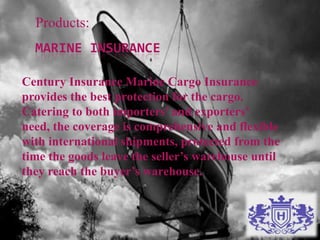
MARINE INSURANCE
Products:
Century Insurance Marine Cargo Insurance
provides the best protection for the cargo.
Catering to both importers’ and exporters’
need, the coverage is comprehensive and flexible
with international shipments, protected from the
time the goods leave the seller’s warehouse until
they reach the buyer’s warehouse.
Motor Ins:
• Car
• Truck
• Other MovingVehicles
Liabilities Covered:
• Loss toVehicle
• Third party claims
• Theft
• Accidental damage
• Third party liability
Miscellaneous Ins.
• Machinery Breakdown
• Boiler and pressureVessel Ins.
• Electronic Equipment Ins.
• Electronic all risk Ins.
• Travel Ins.
• Personal Accident Ins.
• Product liability Ins.
• Public Liability Ins.
• Employer’s Liability Ins.
• Workmen’s Compensation Ins.
• Money Ins.
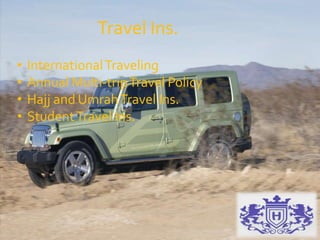
Travel Ins.
• InternationalTraveling
• Annual Multi-tripTravel Policy
• Hajj and UmrahTravel Ins.
• StudentTravel Ins.
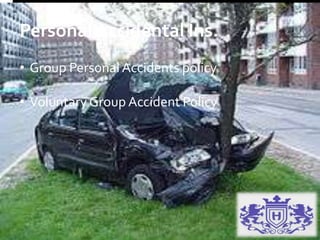
Personal Accidental Ins.
• Group Personal Accidents policy
• Voluntary Group Accident Policy
INSURANCE UNDERWRITING
Insurance underwriting is the process of
classification, rating, and selection of risks. In simpler
terms, it's a risk selection process. Underwriting involves
measuring risk exposure and determining the premium that
needs to be charged to insured that risk. It is done through
underwriters.
Each insurance company has its own underwriting
guidelines and standards for who they will and will not
insure. Steps include:
Evaluation of information
Classification of risk
Rating
Issuance of policy
How underwriting works at
century insurance
 Collecting of necessary information.This
includes :
Motor insurance application form.
VIN number(vehicle identification no. ) for any
vehicle to be insured.
MVRs(motor vehicle reports) for any drivers to
be insured.
Loss histories from previous insurers.
Other information related to the type of policy
being undertaken(RTA, comprehensive etc)
Analyzing of information
 Once the required information has been
collected, the underwriter begin to analyze
each piece of information.
 The main purpose of this analysis is to
determine how much risk a particular
customer will bring to the company. A client
with no losses, clean driving records, and
good to perfect credit is preferable to one
who has had several losses, driving violations
or issues of imperfect credit.
Once the analysis of the provided information is
complete, the underwriter basically has three options:
Accept the risk.
Reject the application or deny the coverage.
Approve the application with attached conditions.
Then the underwriter responds accordingly to the above
mentioned options.
When the risk is acceptable it is rated.
 Gender
 Geographical zone
 Driving history
 Age
 Type of vehicle
 Occupation
 Name
 Occupation
 Driving license no.
 CNIC #(required)
 Use of Car(either private or commercial)
 Condition of Vehicle
 (Either New ,Old ,Re-conditioned)
 Sum Insured(required)
 Type of cover required
 (Comprehensive ,TPO etc)
 Tracker Installed
 Accessories – AC
 Period of insurance from
 Underwriting Committee
 Mr. Tasleemuddin A. Batlay (Chairman)
 Mr. Mohammad Hussain Hirji
 Mr. Afzal-ur-Rahman
Claim’s Handling Procedure:
The Loss or damage should be reported to the
insurer immediately.
On receipt of claim intimation, the insurer will
forward a claim form.
Submit the completed claim form along with an
estimate of the loss to the insurer.
The insurer will arrange for inspection of the damaged
items to assess the loss. In case of major losses, a
specialist-licensed surveyor is deputed.
The insured has to provide the required documents to
substantiate the extent of loss.
In case the cause of loss is not established, it is for the
insured to prove that the loss or damage has occurred due
to an insured peril.
On agreement of claim amount between the insured and
the insurer, the claim is settled.
Machinery Breakdown
Immediate notification to the insurer
Notice of claim and estimated cost of repairs should
be filed with the insurers to arrange for inspection.
In case of partial losses, no depreciation is charged
but when the items are not insured for its present day
replacement value, the items are treated as under
insured and the claim amount is proportionately
reduced.
Depreciation is only applied for Total Loss
claims.
If an appliance is partially damaged, it
should be repaired (on approval from insurance
company) before it is put to use, as otherwise
further loss is not covered.
Electronic Equipments
Immediate notification to the insurer.
Notice of claim and estimated cost of repairs
should be filed with the insurers to arrange for
inspection.
In case of partial losses, no depreciation is
charged but when the items are not insured for
its present day replacement value, the items
are treated as under insured and the claim
amount is proportionately reduced.
Depreciation is only applied for Total Loss
claims.
If an appliance is partially damaged, it should
be repaired (on approval from insurance
company) before it is put to use, as otherwise
further loss is not covered.
Motor vehicle claims
Notice of an accident involving third parties
should be reported to the insurers.
The insured may be interested to pay
compensation without going into whether he is
liable to pay or not. It is therefore an express
condition of the policy that no claim should be
admitted or a compromise arrived at, without the
approval of the insurers.
Claims under Comprehensive
policies
Steps to be taken in case of an accident:
Notice of accident should be filed with the
insurers.
If damage is a major one, the accident may be
reported before the vehicle is removed from the
spot so that the insurers can arrange for spot
inspection of damage.
The vehicle may then be moved to a workshop,
preferably to authorized
workshop, for estimation of repair charges.
On receipt of completed claim form and
estimate of repairs the insurers will arrange
detailed inspection of damage and cost of
repairs will be ascertained.
The insurers will ensure that a person
duly licensed drove the vehicle at the time
of accident and that the vehicle is the one
insured in their books. To that end, they
will verify the Registration Certificate and
the Driving license of the driver who drove
at the time of the accident.
Upon completion of the above procedure, the
repairers will be authorized to carry out repairs.
The insurer may undertake to settle the repair
bills directly with the garage or reimburse the
insured.
Insurers would like to collect the damaged
parts for which replacements have been
allowed, as salvage. To ensure that replacements
with new parts, have in fact, been effected.
In case of theft of the car or its accessories, it
has to be reported to the police and final report
should be submitted.
Claim and Loss:
A claim is a request for an amount to be
reimbursed filed by insured and addressed to
the insurer.
Loss is the occurrence of an insured event,
such as a fire, which results in financial
disadvantage for the insured.
Claim parties:
The First party is the person/ company insured.
The Second party is the specific insurance
company.
The Third party refers to anyone else who is
involved in a loss event.
It may be vehicle owners, property owners or
persons such as passengers or pedestrians
Indemnity:
Indemnity means, to save from loss or harm.
Insurance policies are contracts of indemnity
which means that insurance companies intend to
provide financial compensation for a loss which
the insured has suffered and put them in the same
position after the loss as they enjoyed
immediately before it.
Insurable Interest:
Every person should have legal & financial
interest in the subject matter to be insured.
Any person insuring the property in which
he does not have insurable interest would
increase moral hazard.
Utmost good faith:
In simple terms it means that the insurer and the
insured have a duty to deal honestly and openly
with each other in the negotiations that lead up to
the formation of the insurance contract. Parties
have the duty:
Not to misrepresent any matter relating to
insurance i.e. to tell the truth
To disclose all material facts relating to
contract i.e. not to conceal anything.
Material facts:
Every circumstance is material which would the
judgment of a prudent insurer in fixing the
premium or determining whether he will take the
risk.
Burden of proof:
Burden of proving the loss remains with the
insured, he must establish two things:
That the loss was caused by the operation of
an insured peril
The amount of loss
Contribution will arise only when the following
conditions are satisfied:
Two or more policies of indemnity exist
Each insures the subject matter of the loss
Each insures the peril which brings about the
loss
Credibility:
Japan Credit Rating Agency Ltd. Has
reaffirmed Company ‘s A which signifies
a high Capacity to meet policyholders &
contractual obligations

Century insurance

  • 1.
  • 2.
     Century Insuranceis a Lakson Group Company. Operating since 1989, dealing in all areas of general insurance business. Rated “A” with stable outlook which signifies High Finance Capacity to meet Policyholders and Contact obligations. Paid-up capital of R.457 million, which is 52% higher than the Government specified . Twice awarded ‘ Top 25 Companies Award’ by the Karachi Stock Exchange
  • 3.
     To bean Organization known for integrity and ethical behaviour and fully dedicated to our Client, Business Partners, Shareholders and Employees, Providing Exceptional quality service and committed to achieve excellence in all area of its operations.
  • 4.
     Fire  Motor Marine  Miscellaneous  Engineering  Travel insurance  Home safe insurance  Family shied plan
  • 5.
    Fire:  Century Insuranceis known to provide one of the best Fire and Allied Perils products in the industry. We take pride in providing comprehensive protection backed by sound financial capability.  The policy protects from physical loss or damage as a result of Fire and Lightening which is a basic cover and it can be extended to cover “named perils” such as explosion, natural calamities (like storm, floods, landslides etc.), impact damage by vehicles / animals / aircraft, riots, strikes, malicious acts, bursting of pipes / water tanks, sprinkler leakage and bush fires.
  • 6.
    Fire insurance:  Thepolicy covers all risks / perils other than those which are specifically excluded.The cover in its widest form, referred to as “all risk”, includes the following perils / covers: Section I (Material Damage)  Fire and special perils.  Burglary.  Machinery Breakdown / Boiler Explosions / Electronic Equipment Insurance. Section II (Business Interruption)  FLOP: Business interruption due to fire and all special perils.  MLOP: Business interruption due to machinery breakdown.  MLOP is an optional cover.
  • 7.
    MARINE INSURANCE Products: Century InsuranceMarine Cargo Insurance provides the best protection for the cargo. Catering to both importers’ and exporters’ need, the coverage is comprehensive and flexible with international shipments, protected from the time the goods leave the seller’s warehouse until they reach the buyer’s warehouse.
  • 8.
    Motor Ins: • Car •Truck • Other MovingVehicles Liabilities Covered: • Loss toVehicle • Third party claims • Theft • Accidental damage • Third party liability
  • 9.
    Miscellaneous Ins. • MachineryBreakdown • Boiler and pressureVessel Ins. • Electronic Equipment Ins. • Electronic all risk Ins. • Travel Ins. • Personal Accident Ins. • Product liability Ins. • Public Liability Ins. • Employer’s Liability Ins. • Workmen’s Compensation Ins. • Money Ins.
  • 10.
    Travel Ins. • InternationalTraveling •Annual Multi-tripTravel Policy • Hajj and UmrahTravel Ins. • StudentTravel Ins.
  • 11.
    Personal Accidental Ins. •Group Personal Accidents policy • Voluntary Group Accident Policy
  • 12.
    INSURANCE UNDERWRITING Insurance underwritingis the process of classification, rating, and selection of risks. In simpler terms, it's a risk selection process. Underwriting involves measuring risk exposure and determining the premium that needs to be charged to insured that risk. It is done through underwriters.
  • 13.
    Each insurance companyhas its own underwriting guidelines and standards for who they will and will not insure. Steps include: Evaluation of information Classification of risk Rating Issuance of policy
  • 14.
    How underwriting worksat century insurance  Collecting of necessary information.This includes : Motor insurance application form. VIN number(vehicle identification no. ) for any vehicle to be insured. MVRs(motor vehicle reports) for any drivers to be insured. Loss histories from previous insurers. Other information related to the type of policy being undertaken(RTA, comprehensive etc)
  • 15.
    Analyzing of information Once the required information has been collected, the underwriter begin to analyze each piece of information.  The main purpose of this analysis is to determine how much risk a particular customer will bring to the company. A client with no losses, clean driving records, and good to perfect credit is preferable to one who has had several losses, driving violations or issues of imperfect credit.
  • 16.
    Once the analysisof the provided information is complete, the underwriter basically has three options: Accept the risk. Reject the application or deny the coverage. Approve the application with attached conditions. Then the underwriter responds accordingly to the above mentioned options.
  • 17.
    When the riskis acceptable it is rated.  Gender  Geographical zone  Driving history  Age  Type of vehicle  Occupation
  • 18.
     Name  Occupation Driving license no.  CNIC #(required)  Use of Car(either private or commercial)  Condition of Vehicle  (Either New ,Old ,Re-conditioned)  Sum Insured(required)  Type of cover required  (Comprehensive ,TPO etc)  Tracker Installed  Accessories – AC  Period of insurance from
  • 19.
     Underwriting Committee Mr. Tasleemuddin A. Batlay (Chairman)  Mr. Mohammad Hussain Hirji  Mr. Afzal-ur-Rahman
  • 20.
    Claim’s Handling Procedure: TheLoss or damage should be reported to the insurer immediately. On receipt of claim intimation, the insurer will forward a claim form. Submit the completed claim form along with an estimate of the loss to the insurer.
  • 21.
    The insurer willarrange for inspection of the damaged items to assess the loss. In case of major losses, a specialist-licensed surveyor is deputed. The insured has to provide the required documents to substantiate the extent of loss. In case the cause of loss is not established, it is for the insured to prove that the loss or damage has occurred due to an insured peril. On agreement of claim amount between the insured and the insurer, the claim is settled.
  • 22.
    Machinery Breakdown Immediate notificationto the insurer Notice of claim and estimated cost of repairs should be filed with the insurers to arrange for inspection. In case of partial losses, no depreciation is charged but when the items are not insured for its present day replacement value, the items are treated as under insured and the claim amount is proportionately reduced.
  • 23.
    Depreciation is onlyapplied for Total Loss claims. If an appliance is partially damaged, it should be repaired (on approval from insurance company) before it is put to use, as otherwise further loss is not covered.
  • 24.
    Electronic Equipments Immediate notificationto the insurer. Notice of claim and estimated cost of repairs should be filed with the insurers to arrange for inspection. In case of partial losses, no depreciation is charged but when the items are not insured for its present day replacement value, the items are treated as under insured and the claim amount is proportionately reduced.
  • 25.
    Depreciation is onlyapplied for Total Loss claims. If an appliance is partially damaged, it should be repaired (on approval from insurance company) before it is put to use, as otherwise further loss is not covered.
  • 26.
    Motor vehicle claims Noticeof an accident involving third parties should be reported to the insurers. The insured may be interested to pay compensation without going into whether he is liable to pay or not. It is therefore an express condition of the policy that no claim should be admitted or a compromise arrived at, without the approval of the insurers.
  • 27.
    Claims under Comprehensive policies Stepsto be taken in case of an accident: Notice of accident should be filed with the insurers. If damage is a major one, the accident may be reported before the vehicle is removed from the spot so that the insurers can arrange for spot inspection of damage. The vehicle may then be moved to a workshop, preferably to authorized
  • 28.
    workshop, for estimationof repair charges. On receipt of completed claim form and estimate of repairs the insurers will arrange detailed inspection of damage and cost of repairs will be ascertained. The insurers will ensure that a person duly licensed drove the vehicle at the time of accident and that the vehicle is the one insured in their books. To that end, they will verify the Registration Certificate and the Driving license of the driver who drove at the time of the accident.
  • 29.
    Upon completion ofthe above procedure, the repairers will be authorized to carry out repairs. The insurer may undertake to settle the repair bills directly with the garage or reimburse the insured. Insurers would like to collect the damaged parts for which replacements have been allowed, as salvage. To ensure that replacements with new parts, have in fact, been effected. In case of theft of the car or its accessories, it has to be reported to the police and final report should be submitted.
  • 30.
    Claim and Loss: Aclaim is a request for an amount to be reimbursed filed by insured and addressed to the insurer. Loss is the occurrence of an insured event, such as a fire, which results in financial disadvantage for the insured.
  • 31.
    Claim parties: The Firstparty is the person/ company insured. The Second party is the specific insurance company. The Third party refers to anyone else who is involved in a loss event. It may be vehicle owners, property owners or persons such as passengers or pedestrians
  • 32.
    Indemnity: Indemnity means, tosave from loss or harm. Insurance policies are contracts of indemnity which means that insurance companies intend to provide financial compensation for a loss which the insured has suffered and put them in the same position after the loss as they enjoyed immediately before it.
  • 33.
    Insurable Interest: Every personshould have legal & financial interest in the subject matter to be insured. Any person insuring the property in which he does not have insurable interest would increase moral hazard.
  • 34.
    Utmost good faith: Insimple terms it means that the insurer and the insured have a duty to deal honestly and openly with each other in the negotiations that lead up to the formation of the insurance contract. Parties have the duty: Not to misrepresent any matter relating to insurance i.e. to tell the truth To disclose all material facts relating to contract i.e. not to conceal anything.
  • 35.
    Material facts: Every circumstanceis material which would the judgment of a prudent insurer in fixing the premium or determining whether he will take the risk.
  • 36.
    Burden of proof: Burdenof proving the loss remains with the insured, he must establish two things: That the loss was caused by the operation of an insured peril The amount of loss
  • 37.
    Contribution will ariseonly when the following conditions are satisfied: Two or more policies of indemnity exist Each insures the subject matter of the loss Each insures the peril which brings about the loss
  • 38.
    Credibility: Japan Credit RatingAgency Ltd. Has reaffirmed Company ‘s A which signifies a high Capacity to meet policyholders & contractual obligations