Smart Solutions. Beyond Expectations.
Afni closed file reviews.
Utilizingadvancedanalyticsto increasesubrogationresults.
By Barry Gamage
Director of Advanced Analytics | Afni, Inc.
Copyright © 2012 Afni, Inc. Page 2
Introduction
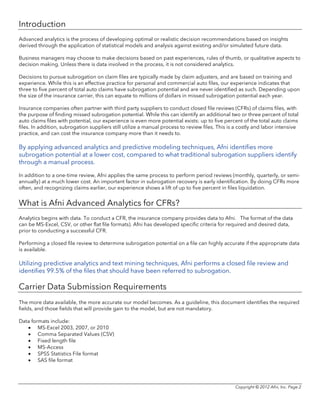
Advanced analytics is the process of developing optimal or realistic decision recommendations based on insights
derived through the application of statistical models and analysis against existing and/or simulated future data.
Business managers may choose to make decisions based on past experiences, rules of thumb, or qualitative aspects to
decision making. Unless there is data involved in the process, it is not considered analytics.
Decisions to pursue subrogation on claim files are typically made by claim adjusters, and are based on training and
experience. While this is an effective practice for personal and commercial auto files, our experience indicates that
three to five percent of total auto claims have subrogation potential and are never identified as such. Depending upon
the size of the insurance carrier, this can equate to millions of dollars in missed subrogation potential each year.
Insurance companies often partner with third party suppliers to conduct closed file reviews (CFRs) of claims files, with
the purpose of finding missed subrogation potential. While this can identify an additional two or three percent of total
auto claims files with potential, our experience is even more potential exists: up to five percent of the total auto claims
files. In addition, subrogation suppliers still utilize a manual process to review files. This is a costly and labor intensive
practice, and can cost the insurance company more than it needs to.
By applying advanced analytics and predictive modeling techniques, Afni identifies more
subrogation potential at a lower cost, compared to what traditional subrogation suppliers identify
through a manual process.
In addition to a one-time review, Afni applies the same process to perform period reviews (monthly, quarterly, or semi-
annually) at a much lower cost. An important factor in subrogation recovery is early identification. By doing CFRs more
often, and recognizing claims earlier, our experience shows a lift of up to five percent in files liquidation.
What is Afni Advanced Analytics for CFRs?
Analytics begins with data. To conduct a CFR, the insurance company provides data to Afni. The format of the data
can be MS-Excel, CSV, or other flat file formats). Afni has developed specific criteria for required and desired data,
prior to conducting a successful CFR.
Performing a closed file review to determine subrogation potential on a file can highly accurate if the appropriate data
is available.
Utilizing predictive analytics and text mining techniques, Afni performs a closed file review and
identifies 99.5% of the files that should have been referred to subrogation.
Carrier Data Submission Requirements
The more data available, the more accurate our model becomes. As a guideline, this document identifies the required
fields, and those fields that will provide gain to the model, but are not mandatory.
Data formats include:
• MS-Excel 2003, 2007, or 2010
• Comma Separated Values (CSV)
• Fixed length file
• MS-Access
• SPSS Statistics File format
• SAS file format
Copyright © 2012 Afni, Inc. Page 3
The file is formatted so the field names are in the first row of the records. The field names do not need to match the
field names of the requirements below, as long as each can be mapped to the database fields below.
All claim data for automobile losses be reported. There’s no need to pre-filter losses by peril, or cause of loss, or any
other type of filter. We often find that claims were miscoded resulting in lost subrogation opportunity. Our proprietary
algorithms can identify these miscoded losses and flag them for manual review.
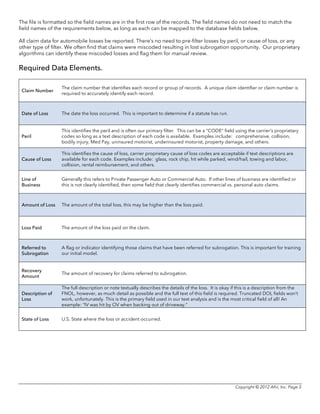
Required Data Elements.
Claim Number
The claim number that identifies each record or group of records. A unique claim identifier or claim number is
required to accurately identify each record.
Date of Loss The date the loss occurred. This is important to determine if a statute has run.
Peril
This identifies the peril and is often our primary filter. This can be a “CODE” field using the carrier’s proprietary
codes so long as a text description of each code is available. Examples include: comprehensive, collision,
bodily injury, Med Pay, uninsured motorist, underinsured motorist, property damage, and others.
Cause of Loss
This identifies the cause of loss, carrier proprietary cause of loss codes are acceptable if text descriptions are
available for each code. Examples include: glass, rock chip, hit while parked, wind/hail, towing and labor,
collision, rental reimbursement, and others.
Line of
Business
Generally this refers to Private Passenger Auto or Commercial Auto. If other lines of business are identified or
this is not clearly identified, then some field that clearly identifies commercial vs. personal auto claims.
Amount of Loss The amount of the total loss, this may be higher than the loss paid.
Loss Paid The amount of the loss paid on the claim.
Referred to
Subrogation
A flag or indicator identifying those claims that have been referred for subrogation. This is important for training
our initial model.
Recovery
Amount
The amount of recovery for claims referred to subrogation.
Description of
Loss
The full description or note textually describes the details of the loss. It is okay if this is a description from the
FNOL, however, as much detail as possible and the full text of this field is required. Truncated DOL fields won’t
work, unfortunately. This is the primary field used in our text analysis and is the most critical field of all! An
example: “IV was hit by OV when backing out of driveway.”
State of Loss U.S. State where the loss or accident occurred.
Copyright © 2012 Afni, Inc. Page 4
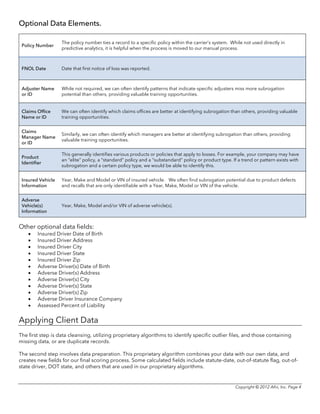
Optional Data Elements.
Policy Number
The policy number ties a record to a specific policy within the carrier’s system. While not used directly in
predictive analytics, it is helpful when the process is moved to our manual process.
FNOL Date Date that first notice of loss was reported.
Adjuster Name
or ID
While not required, we can often identify patterns that indicate specific adjusters miss more subrogation
potential than others, providing valuable training opportunities.
Claims Office
Name or ID
We can often identify which claims offices are better at identifying subrogation than others, providing valuable
training opportunities.
Claims
Manager Name
or ID
Similarly, we can often identify which managers are better at identifying subrogation than others, providing
valuable training opportunities.
Product
Identifier
This generally identifies various products or policies that apply to losses. For example, your company may have
an “elite” policy, a “standard” policy and a “substandard” policy or product type. If a trend or pattern exists with
subrogation and a certain policy type, we would be able to identify this.
Insured Vehicle
Information
Year, Make and Model or VIN of insured vehicle. We often find subrogation potential due to product defects
and recalls that are only identifiable with a Year, Make, Model or VIN of the vehicle.
Adverse
Vehicle(s)
Information
Year, Make, Model and/or VIN of adverse vehicle(s).
Other optional data fields:
• Insured Driver Date of Birth
• Insured Driver Address
• Insured Driver City
• Insured Driver State
• Insured Driver Zip
• Adverse Driver(s) Date of Birth
• Adverse Driver(s) Address
• Adverse Driver(s) City
• Adverse Driver(s) State
• Adverse Driver(s) Zip
• Adverse Driver Insurance Company
• Assessed Percent of Liability
Applying Client Data
The first step is data cleansing, utilizing proprietary algorithms to identify specific outlier files, and those containing
missing data, or are duplicate records.
The second step involves data preparation. This proprietary algorithm combines your data with our own data, and
creates new fields for our final scoring process. Some calculated fields include statute-date, out-of-statute flag, out-of-
state driver, DOT state, and others that are used in our proprietary algorithms.
Copyright © 2012 Afni, Inc. Page 5
The third step involves text mining with Afni’s exclusive text mining algorithms. This is an extensive process, and would
be inefficient with one insurance company’s data. However, we have leveraged our many partnerships with insurance
companies, and combine those data sets with our own to develop a text mining algorithm that electronically reads the
description of loss and interprets meaning and, to some degree of accuracy, which party is at fault.
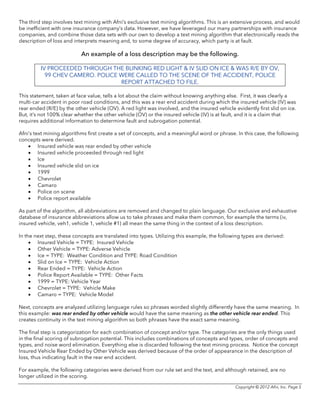
An example of a loss description may be the following.
IV PROCEEDED THROUGH THE BLINKING RED LIGHT & IV SLID ON ICE & WAS R/E BY OV,
99 CHEV CAMERO. POLICE WERE CALLED TO THE SCENE OF THE ACCIDENT, POLICE
REPORT ATTACHED TO FILE.
This statement, taken at face value, tells a lot about the claim without knowing anything else. First, it was clearly a
multi-car accident in poor road conditions, and this was a rear end accident during which the insured vehicle (IV) was
rear ended (R/E) by the other vehicle (OV). A red light was involved, and the insured vehicle evidently first slid on ice.
But, it’s not 100% clear whether the other vehicle (OV) or the insured vehicle (IV) is at fault, and it is a claim that
requires additional information to determine fault and subrogation potential.
Afni’s text mining algorithms first create a set of concepts, and a meaningful word or phrase. In this case, the following
concepts were derived.
• Insured vehicle was rear ended by other vehicle
• Insured vehicle proceeded through red light
• Ice
• Insured vehicle slid on ice
• 1999
• Chevrolet
• Camaro
• Police on scene
• Police report available
As part of the algorithm, all abbreviations are removed and changed to plain language. Our exclusive and exhaustive
database of insurance abbreviations allow us to take phrases and make them common, for example the terms (iv,
insured vehicle, veh1, vehicle 1, vehicle #1) all mean the same thing in the context of a loss description.
In the next step, these concepts are translated into types. Utilizing this example, the following types are derived:
• Insured Vehicle = TYPE: Insured Vehicle
• Other Vehicle = TYPE: Adverse Vehicle
• Ice = TYPE: Weather Condition and TYPE: Road Condition
• Slid on Ice = TYPE: Vehicle Action
• Rear Ended = TYPE: Vehicle Action
• Police Report Available = TYPE: Other Facts
• 1999 = TYPE: Vehicle Year
• Chevrolet = TYPE: Vehicle Make
• Camaro = TYPE: Vehicle Model
Next, concepts are analyzed utilizing language rules so phrases worded slightly differently have the same meaning. In
this example: was rear ended by other vehicle would have the same meaning as the other vehicle rear ended. This
creates continuity in the text mining algorithm so both phrases have the exact same meaning.
The final step is categorization for each combination of concept and/or type. The categories are the only things used
in the final scoring of subrogation potential. This includes combinations of concepts and types, order of concepts and
types, and noise word elimination. Everything else is discarded following the text mining process. Notice the concept
Insured Vehicle Rear Ended by Other Vehicle was derived because of the order of appearance in the description of
loss, thus indicating fault in the rear end accident.
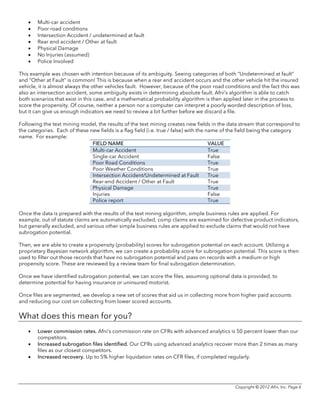
For example, the following categories were derived from our rule set and the text, and although retained, are no
longer utilized in the scoring.
Copyright © 2012 Afni, Inc. Page 6
• Multi-car accident
• Poor road conditions
• Intersection Accident / undetermined at fault
• Rear end accident / Other at fault
• Physical Damage
• No Injuries (assumed)
• Police Involved
This example was chosen with intention because of its ambiguity. Seeing categories of both “Undetermined at fault”
and “Other at Fault” is common! This is because when a rear end accident occurs and the other vehicle hit the insured
vehicle, it is almost always the other vehicles fault. However, because of the poor road conditions and the fact this was
also an intersection accident, some ambiguity exists in determining absolute fault. Afni’s algorithm is able to catch
both scenarios that exist in this case, and a mathematical probability algorithm is then applied later in the process to
score the propensity. Of course, neither a person nor a computer can interpret a poorly worded description of loss,
but it can give us enough indicators we need to review a bit further before we discard a file.
Following the text mining model, the results of the text mining creates new fields in the data stream that correspond to
the categories. Each of these new fields is a flag field (i.e. true / false) with the name of the field being the category
name. For example:
FIELD NAME VALUE
Multi-car Accident True
Single-car Accident False
Poor Road Conditions True
Poor Weather Conditions True
Intersection Accident/Undetermined at Fault True
Rear-end Accident / Other at Fault True
Physical Damage True
Injuries False
Police report True
Once the data is prepared with the results of the text mining algorithm, simple business rules are applied. For
example, out of statute claims are automatically excluded, comp claims are examined for defective product indicators,
but generally excluded, and various other simple business rules are applied to exclude claims that would not have
subrogation potential.
Then, we are able to create a propensity (probability) scores for subrogation potential on each account. Utilizing a
proprietary Bayesian network algorithm, we can create a probability score for subrogation potential. This score is then
used to filter out those records that have no subrogation potential and pass on records with a medium or high
propensity score. These are reviewed by a review team for final subrogation determination.
Once we have identified subrogation potential, we can score the files, assuming optional data is provided, to
determine potential for having insurance or uninsured motorist.
Once files are segmented, we develop a new set of scores that aid us in collecting more from higher paid accounts
and reducing our cost on collecting from lower scored accounts.
What does this mean for you?
• Lower commission rates. Afni’s commission rate on CFRs with advanced analytics is 50 percent lower than our
competitors.
• Increased subrogation files identified. Our CFRs using advanced analytics recover more than 2 times as many
files as our closest competitors.
• Increased recovery. Up to 5% higher liquidation rates on CFR files, if completed regularly.
Copyright © 2012 Afni, Inc. Page 7
These combined benefits can yield as much as a 2% lift to your overall automobile net recovery. For a company with
$2 billion in Direct Written Premiums, this impact may yield as much as $2 to $3 million additional recovery on an
annual basis.
Other Advanced Analytics Services
• Full claims analysis
• CFR
• Claim file analysis
• Subrogation referrals
• Liquidation rate
• Missed subrogation potential
• Overall subrogation potential
• UM vs. insurance
• Loss ratios
• Benchmark analysis (NASP Benchmarking Studies)
About the Author
Barry Gamage is a thought leader in the insurance industry and has more than 25 years of insurance
industry claims experience. He is Director of Advanced Analytics at Afni, focused exclusively on developing
smart solutions for the insurance industry. He can be reached at 309-831-3012 or barrygamage@afni.com.
About Afni
Afni helps companies get more from the relationships they have with their customers.
• BPO leader in care & collections
• Privately-owned company
• ~5,000 employees worldwide
• Unwavering focus on integrity
• Bilingual frontline support
• Global operations
• Headquarters in Bloomington, IL
• Technology-enabled solutions
• Security & compliance conscious
• 24x7 operations
• Multiple channel support
• Results driven & customer focused
Full Cycle Customer Contact Solutions
Our customer lifecycle solutions are delivered from global locations in the United States, Philippines, and Nicaragua.
Additionally, we have hundreds of home-based agents that expand the flexibility of our staffing solutions. With a
positive and results-driven performance culture, we deliver real results that contribute to our clients’ business success.
Customer Contact Channels: Phone | Chat | Email | Self Service | SMS | Social Media
Insurance
Cable/Satellite TV
Telecommunications
Financial Services
Healthcare
INDUSTRY SOLUTIONS
Sales &
Enrollment
Care &
Retention
Up-sell &
Cross-sell
Receivables &
Subrogation
Attract new
customers & get
relationships off to
a great start.
Delight customers
with exceptional care
& give them reasons
to stay.
Get more out of
existing relationships
& increase customer
wallet share.
When customer
accounts are
delinquent, we’re
there to wrap it up.
Copyright © 2012 Afni, Inc. Page 8
Connect with Afni.
Phone. 800-767-2364 | Website. www.afni.com | Email. solutions@afni.com | Twitter. https://twitter.com/afni

Afni Advanced Analytics for CFRs-Barry Gamage_08-2012

  • 1.
    Smart Solutions. BeyondExpectations. Afni closed file reviews. Utilizingadvancedanalyticsto increasesubrogationresults. By Barry Gamage Director of Advanced Analytics | Afni, Inc.
  • 2.
    Copyright © 2012Afni, Inc. Page 2 Introduction Advanced analytics is the process of developing optimal or realistic decision recommendations based on insights derived through the application of statistical models and analysis against existing and/or simulated future data. Business managers may choose to make decisions based on past experiences, rules of thumb, or qualitative aspects to decision making. Unless there is data involved in the process, it is not considered analytics. Decisions to pursue subrogation on claim files are typically made by claim adjusters, and are based on training and experience. While this is an effective practice for personal and commercial auto files, our experience indicates that three to five percent of total auto claims have subrogation potential and are never identified as such. Depending upon the size of the insurance carrier, this can equate to millions of dollars in missed subrogation potential each year. Insurance companies often partner with third party suppliers to conduct closed file reviews (CFRs) of claims files, with the purpose of finding missed subrogation potential. While this can identify an additional two or three percent of total auto claims files with potential, our experience is even more potential exists: up to five percent of the total auto claims files. In addition, subrogation suppliers still utilize a manual process to review files. This is a costly and labor intensive practice, and can cost the insurance company more than it needs to. By applying advanced analytics and predictive modeling techniques, Afni identifies more subrogation potential at a lower cost, compared to what traditional subrogation suppliers identify through a manual process. In addition to a one-time review, Afni applies the same process to perform period reviews (monthly, quarterly, or semi- annually) at a much lower cost. An important factor in subrogation recovery is early identification. By doing CFRs more often, and recognizing claims earlier, our experience shows a lift of up to five percent in files liquidation. What is Afni Advanced Analytics for CFRs? Analytics begins with data. To conduct a CFR, the insurance company provides data to Afni. The format of the data can be MS-Excel, CSV, or other flat file formats). Afni has developed specific criteria for required and desired data, prior to conducting a successful CFR. Performing a closed file review to determine subrogation potential on a file can highly accurate if the appropriate data is available. Utilizing predictive analytics and text mining techniques, Afni performs a closed file review and identifies 99.5% of the files that should have been referred to subrogation. Carrier Data Submission Requirements The more data available, the more accurate our model becomes. As a guideline, this document identifies the required fields, and those fields that will provide gain to the model, but are not mandatory. Data formats include: • MS-Excel 2003, 2007, or 2010 • Comma Separated Values (CSV) • Fixed length file • MS-Access • SPSS Statistics File format • SAS file format
  • 3.
    Copyright © 2012Afni, Inc. Page 3 The file is formatted so the field names are in the first row of the records. The field names do not need to match the field names of the requirements below, as long as each can be mapped to the database fields below. All claim data for automobile losses be reported. There’s no need to pre-filter losses by peril, or cause of loss, or any other type of filter. We often find that claims were miscoded resulting in lost subrogation opportunity. Our proprietary algorithms can identify these miscoded losses and flag them for manual review. Required Data Elements. Claim Number The claim number that identifies each record or group of records. A unique claim identifier or claim number is required to accurately identify each record. Date of Loss The date the loss occurred. This is important to determine if a statute has run. Peril This identifies the peril and is often our primary filter. This can be a “CODE” field using the carrier’s proprietary codes so long as a text description of each code is available. Examples include: comprehensive, collision, bodily injury, Med Pay, uninsured motorist, underinsured motorist, property damage, and others. Cause of Loss This identifies the cause of loss, carrier proprietary cause of loss codes are acceptable if text descriptions are available for each code. Examples include: glass, rock chip, hit while parked, wind/hail, towing and labor, collision, rental reimbursement, and others. Line of Business Generally this refers to Private Passenger Auto or Commercial Auto. If other lines of business are identified or this is not clearly identified, then some field that clearly identifies commercial vs. personal auto claims. Amount of Loss The amount of the total loss, this may be higher than the loss paid. Loss Paid The amount of the loss paid on the claim. Referred to Subrogation A flag or indicator identifying those claims that have been referred for subrogation. This is important for training our initial model. Recovery Amount The amount of recovery for claims referred to subrogation. Description of Loss The full description or note textually describes the details of the loss. It is okay if this is a description from the FNOL, however, as much detail as possible and the full text of this field is required. Truncated DOL fields won’t work, unfortunately. This is the primary field used in our text analysis and is the most critical field of all! An example: “IV was hit by OV when backing out of driveway.” State of Loss U.S. State where the loss or accident occurred.
  • 4.
    Copyright © 2012Afni, Inc. Page 4 Optional Data Elements. Policy Number The policy number ties a record to a specific policy within the carrier’s system. While not used directly in predictive analytics, it is helpful when the process is moved to our manual process. FNOL Date Date that first notice of loss was reported. Adjuster Name or ID While not required, we can often identify patterns that indicate specific adjusters miss more subrogation potential than others, providing valuable training opportunities. Claims Office Name or ID We can often identify which claims offices are better at identifying subrogation than others, providing valuable training opportunities. Claims Manager Name or ID Similarly, we can often identify which managers are better at identifying subrogation than others, providing valuable training opportunities. Product Identifier This generally identifies various products or policies that apply to losses. For example, your company may have an “elite” policy, a “standard” policy and a “substandard” policy or product type. If a trend or pattern exists with subrogation and a certain policy type, we would be able to identify this. Insured Vehicle Information Year, Make and Model or VIN of insured vehicle. We often find subrogation potential due to product defects and recalls that are only identifiable with a Year, Make, Model or VIN of the vehicle. Adverse Vehicle(s) Information Year, Make, Model and/or VIN of adverse vehicle(s). Other optional data fields: • Insured Driver Date of Birth • Insured Driver Address • Insured Driver City • Insured Driver State • Insured Driver Zip • Adverse Driver(s) Date of Birth • Adverse Driver(s) Address • Adverse Driver(s) City • Adverse Driver(s) State • Adverse Driver(s) Zip • Adverse Driver Insurance Company • Assessed Percent of Liability Applying Client Data The first step is data cleansing, utilizing proprietary algorithms to identify specific outlier files, and those containing missing data, or are duplicate records. The second step involves data preparation. This proprietary algorithm combines your data with our own data, and creates new fields for our final scoring process. Some calculated fields include statute-date, out-of-statute flag, out-of- state driver, DOT state, and others that are used in our proprietary algorithms.
  • 5.
    Copyright © 2012Afni, Inc. Page 5 The third step involves text mining with Afni’s exclusive text mining algorithms. This is an extensive process, and would be inefficient with one insurance company’s data. However, we have leveraged our many partnerships with insurance companies, and combine those data sets with our own to develop a text mining algorithm that electronically reads the description of loss and interprets meaning and, to some degree of accuracy, which party is at fault. An example of a loss description may be the following. IV PROCEEDED THROUGH THE BLINKING RED LIGHT & IV SLID ON ICE & WAS R/E BY OV, 99 CHEV CAMERO. POLICE WERE CALLED TO THE SCENE OF THE ACCIDENT, POLICE REPORT ATTACHED TO FILE. This statement, taken at face value, tells a lot about the claim without knowing anything else. First, it was clearly a multi-car accident in poor road conditions, and this was a rear end accident during which the insured vehicle (IV) was rear ended (R/E) by the other vehicle (OV). A red light was involved, and the insured vehicle evidently first slid on ice. But, it’s not 100% clear whether the other vehicle (OV) or the insured vehicle (IV) is at fault, and it is a claim that requires additional information to determine fault and subrogation potential. Afni’s text mining algorithms first create a set of concepts, and a meaningful word or phrase. In this case, the following concepts were derived. • Insured vehicle was rear ended by other vehicle • Insured vehicle proceeded through red light • Ice • Insured vehicle slid on ice • 1999 • Chevrolet • Camaro • Police on scene • Police report available As part of the algorithm, all abbreviations are removed and changed to plain language. Our exclusive and exhaustive database of insurance abbreviations allow us to take phrases and make them common, for example the terms (iv, insured vehicle, veh1, vehicle 1, vehicle #1) all mean the same thing in the context of a loss description. In the next step, these concepts are translated into types. Utilizing this example, the following types are derived: • Insured Vehicle = TYPE: Insured Vehicle • Other Vehicle = TYPE: Adverse Vehicle • Ice = TYPE: Weather Condition and TYPE: Road Condition • Slid on Ice = TYPE: Vehicle Action • Rear Ended = TYPE: Vehicle Action • Police Report Available = TYPE: Other Facts • 1999 = TYPE: Vehicle Year • Chevrolet = TYPE: Vehicle Make • Camaro = TYPE: Vehicle Model Next, concepts are analyzed utilizing language rules so phrases worded slightly differently have the same meaning. In this example: was rear ended by other vehicle would have the same meaning as the other vehicle rear ended. This creates continuity in the text mining algorithm so both phrases have the exact same meaning. The final step is categorization for each combination of concept and/or type. The categories are the only things used in the final scoring of subrogation potential. This includes combinations of concepts and types, order of concepts and types, and noise word elimination. Everything else is discarded following the text mining process. Notice the concept Insured Vehicle Rear Ended by Other Vehicle was derived because of the order of appearance in the description of loss, thus indicating fault in the rear end accident. For example, the following categories were derived from our rule set and the text, and although retained, are no longer utilized in the scoring.
  • 6.
    Copyright © 2012Afni, Inc. Page 6 • Multi-car accident • Poor road conditions • Intersection Accident / undetermined at fault • Rear end accident / Other at fault • Physical Damage • No Injuries (assumed) • Police Involved This example was chosen with intention because of its ambiguity. Seeing categories of both “Undetermined at fault” and “Other at Fault” is common! This is because when a rear end accident occurs and the other vehicle hit the insured vehicle, it is almost always the other vehicles fault. However, because of the poor road conditions and the fact this was also an intersection accident, some ambiguity exists in determining absolute fault. Afni’s algorithm is able to catch both scenarios that exist in this case, and a mathematical probability algorithm is then applied later in the process to score the propensity. Of course, neither a person nor a computer can interpret a poorly worded description of loss, but it can give us enough indicators we need to review a bit further before we discard a file. Following the text mining model, the results of the text mining creates new fields in the data stream that correspond to the categories. Each of these new fields is a flag field (i.e. true / false) with the name of the field being the category name. For example: FIELD NAME VALUE Multi-car Accident True Single-car Accident False Poor Road Conditions True Poor Weather Conditions True Intersection Accident/Undetermined at Fault True Rear-end Accident / Other at Fault True Physical Damage True Injuries False Police report True Once the data is prepared with the results of the text mining algorithm, simple business rules are applied. For example, out of statute claims are automatically excluded, comp claims are examined for defective product indicators, but generally excluded, and various other simple business rules are applied to exclude claims that would not have subrogation potential. Then, we are able to create a propensity (probability) scores for subrogation potential on each account. Utilizing a proprietary Bayesian network algorithm, we can create a probability score for subrogation potential. This score is then used to filter out those records that have no subrogation potential and pass on records with a medium or high propensity score. These are reviewed by a review team for final subrogation determination. Once we have identified subrogation potential, we can score the files, assuming optional data is provided, to determine potential for having insurance or uninsured motorist. Once files are segmented, we develop a new set of scores that aid us in collecting more from higher paid accounts and reducing our cost on collecting from lower scored accounts. What does this mean for you? • Lower commission rates. Afni’s commission rate on CFRs with advanced analytics is 50 percent lower than our competitors. • Increased subrogation files identified. Our CFRs using advanced analytics recover more than 2 times as many files as our closest competitors. • Increased recovery. Up to 5% higher liquidation rates on CFR files, if completed regularly.
  • 7.
    Copyright © 2012Afni, Inc. Page 7 These combined benefits can yield as much as a 2% lift to your overall automobile net recovery. For a company with $2 billion in Direct Written Premiums, this impact may yield as much as $2 to $3 million additional recovery on an annual basis. Other Advanced Analytics Services • Full claims analysis • CFR • Claim file analysis • Subrogation referrals • Liquidation rate • Missed subrogation potential • Overall subrogation potential • UM vs. insurance • Loss ratios • Benchmark analysis (NASP Benchmarking Studies) About the Author Barry Gamage is a thought leader in the insurance industry and has more than 25 years of insurance industry claims experience. He is Director of Advanced Analytics at Afni, focused exclusively on developing smart solutions for the insurance industry. He can be reached at 309-831-3012 or barrygamage@afni.com. About Afni Afni helps companies get more from the relationships they have with their customers. • BPO leader in care & collections • Privately-owned company • ~5,000 employees worldwide • Unwavering focus on integrity • Bilingual frontline support • Global operations • Headquarters in Bloomington, IL • Technology-enabled solutions • Security & compliance conscious • 24x7 operations • Multiple channel support • Results driven & customer focused Full Cycle Customer Contact Solutions Our customer lifecycle solutions are delivered from global locations in the United States, Philippines, and Nicaragua. Additionally, we have hundreds of home-based agents that expand the flexibility of our staffing solutions. With a positive and results-driven performance culture, we deliver real results that contribute to our clients’ business success. Customer Contact Channels: Phone | Chat | Email | Self Service | SMS | Social Media Insurance Cable/Satellite TV Telecommunications Financial Services Healthcare INDUSTRY SOLUTIONS Sales & Enrollment Care & Retention Up-sell & Cross-sell Receivables & Subrogation Attract new customers & get relationships off to a great start. Delight customers with exceptional care & give them reasons to stay. Get more out of existing relationships & increase customer wallet share. When customer accounts are delinquent, we’re there to wrap it up.
  • 8.
    Copyright © 2012Afni, Inc. Page 8 Connect with Afni. Phone. 800-767-2364 | Website. www.afni.com | Email. solutions@afni.com | Twitter. https://twitter.com/afni