
Presented by
Ifrah Ishaq
University Of The
Punjab,lahore.
“An increased responsiveness of nociceptive neurons in the CNS
to their normal afferent input”.
Explanation:
Nerve injury leads to an increase in the general excitability
of nociceptive and multi receptive spinal cord neurons
(multiple synaptic input from C-fibers as well as A fibers,
wide-dynamic range neurons). Process known as central
sensitization.
Increased responses to noxious stimulation of inflamed tissue.
 Lowering of threshold of nociceptive specific spinal cord
neurons (they change into wide dynamic range neurons).
Increased responses to stimuli applied to non-inflamed tissue
surrounding the inflamed site.
 Expansion of the receptive field.
During inflammation and neuropathy a large number of spinal
cord neurons express C-FOS, supporting the finding that a
large population of neurons is activated.
At least at some time points metabolism in the spinal cord is
enhanced during inflammation and neuropathy.
The mechanisms of central sensitization are complex.
It may be crucial whether central sensitization is induced by
increased inputs in sensitized but otherwise normal fibres
(such as in inflammation),or whether structural changes such
as neuronal loss contribute for neuropathic pain.
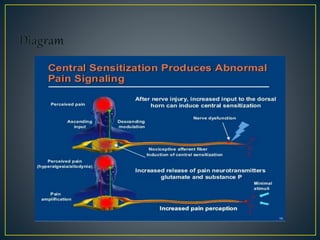
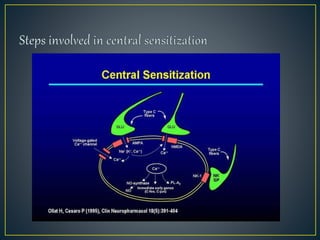
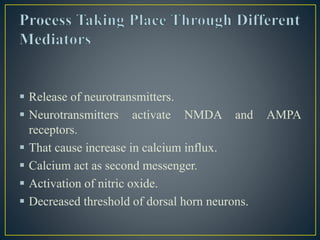
 Release of neurotransmitters.
 Neurotransmitters activate NMDA and AMPA
receptors.
 That cause increase in calcium influx.
 Calcium act as second messenger.
 Activation of nitric oxide.
 Decreased threshold of dorsal horn neurons.
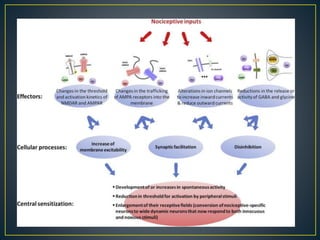
Increase of NMDA receptors.
Increase in glutamate.
Release of substance P.
Multiple signaling pathway.
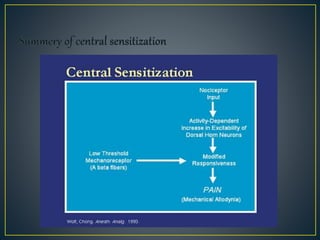
Central Sensitization

Central Sensitization

  • 1.
  • 2.
    “An increased responsivenessof nociceptive neurons in the CNS to their normal afferent input”. Explanation: Nerve injury leads to an increase in the general excitability of nociceptive and multi receptive spinal cord neurons (multiple synaptic input from C-fibers as well as A fibers, wide-dynamic range neurons). Process known as central sensitization.
  • 4.
    Increased responses tonoxious stimulation of inflamed tissue.  Lowering of threshold of nociceptive specific spinal cord neurons (they change into wide dynamic range neurons). Increased responses to stimuli applied to non-inflamed tissue surrounding the inflamed site.  Expansion of the receptive field.
  • 5.
    During inflammation andneuropathy a large number of spinal cord neurons express C-FOS, supporting the finding that a large population of neurons is activated. At least at some time points metabolism in the spinal cord is enhanced during inflammation and neuropathy.
  • 6.
    The mechanisms ofcentral sensitization are complex. It may be crucial whether central sensitization is induced by increased inputs in sensitized but otherwise normal fibres (such as in inflammation),or whether structural changes such as neuronal loss contribute for neuropathic pain.
  • 8.
     Release ofneurotransmitters.  Neurotransmitters activate NMDA and AMPA receptors.  That cause increase in calcium influx.  Calcium act as second messenger.  Activation of nitric oxide.  Decreased threshold of dorsal horn neurons.
  • 10.
    Increase of NMDAreceptors. Increase in glutamate. Release of substance P. Multiple signaling pathway.