CENTRAL NERVOUS
SYSTEM
Neuron: Nerve
Cell
Basic structural unit
nervous system
Consists of:
–nucleus
–nerve fibers /dentrites
–axon
Nerves
Sensory Nerves:
–carry messages to brain
and spinal cord from
body
Motor Nerves:
–carry messages from
Connecting or Mixed
Nerves:
–Carry both sensory and
motor messages
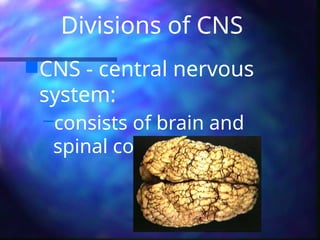
Divisions of CNS
CNS - central nervous
system:
–consists of brain and
spinal cord
Peripheral Nervous
System
–a. any nerves outside the
brain and spinal cord
–b. Autonomic nervous
system: controls
involuntary body functions
Central Nervous
System
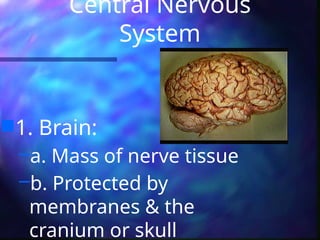
1. Brain:
–a. Mass of nerve tissue
–b. Protected by
membranes & the
cranium or skull
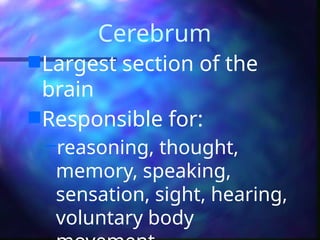
Cerebrum
Largest section of the
brain
Responsible for:
–reasoning, thought,
memory, speaking,
sensation, sight, hearing,
voluntary body
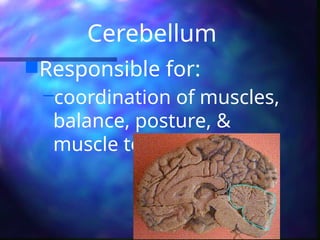
Cerebellum
Responsible for:
–coordination of muscles,
balance, posture, &
muscle tone
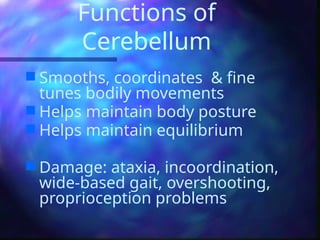
Functions of
Cerebellum
 Smooths, coordinates & fine
tunes bodily movements
 Helps maintain body posture
 Helps maintain equilibrium
 Damage: ataxia, incoordination,
wide-based gait, overshooting,
proprioception problems
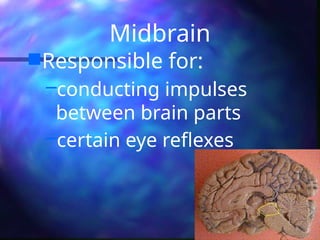
Midbrain
Responsible for:
–conducting impulses
between brain parts
–certain eye reflexes
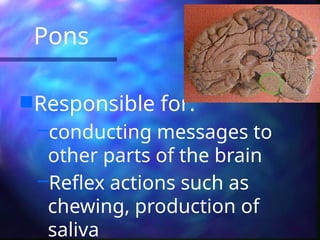
Pons
Responsible for:
–conducting messages to
other parts of the brain
–Reflex actions such as
chewing, production of
saliva
Medulla Oblongata
Lowest part of brain
stem
Connects to the spinal
cord
Responsible for:
–regulating heart beat,
respirations, swallowing,
2. Spinal Cord
Goes down back of body
from Medulla Oblongata
Surrounded and protected
by vertebrae
Responsible for reflex
actions
Carries sensory and motor
3. Meninges
Consists of 3 membranes
Covers and protects the
brain and spinal cord
Three Membranes
C. Dura mater
–thick, tough outer layer
D. Arachnoid membrane
–middle delicate weblike layer
E. Pia mater
–inner most layer with blood
vessels to nourish the nerves
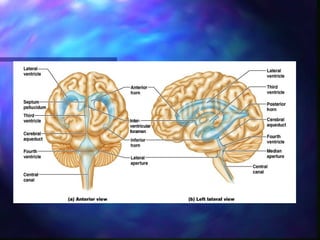
4. Ventricles
Four hallow spaces
located in the middle of
the brain.
Connected to each other
Filled with fluid called
cerebrospinal fluid
Cerebrospinal Fluid
Circulates continuously
Serves as shock absorber
to protect brain and
spinal cord
Carries nurients to parts
of brain and spinal cord
helps remove metabolic
products & wastes
after circulation,
absorbed into the blood
vessels of the dura mater.
Simplified …
 Back of brain: perception
 Top of brain: movement
 Front of brain: thinking
Peripheral Nervous
System
Made of all nerves
outside the brain and
spinal cord
Consists of cranial and
spinal nerves
A. Cranial Nerves
12 pairs & their branches
Some responsible for
special senses: sight,
hearing, taste, smell
Others receive sensations:
touch, pressure, pain,
temperature
B. Spinal Nerves
31 pairs & their branches
carries messages to &
from the spinal cord
Both sensory and motor
nerves
31 spinal nerves:
–8 cervical
–12 thoracic
–5 lumbar
–5 sacral
–1 coccygeal
3. Autonomic Nervous
System
Helps maintain a balance
in involuntary functions of
the body. But allows the
body to react in times of
emergency.
2 divisions of ANS
 Sympathetic
nervous
system
–acts in
emergency
 Parasympatheti
c
–counter acts
the
sympathetic ns
after the
emergency
 SNS
–increase heart
rate
–increase resp.
rate
–increase b/p
–decrease
digestive
system activity
 PNS
–decrease
heart rate
–decrease resp.
rate
–decrease b/p
–increase
digestive
system
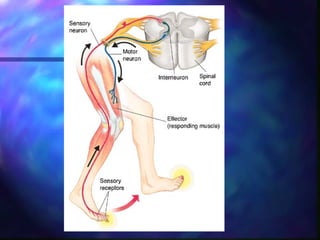
Reflex Arc
 A reflex arc is a neural pathway that controls
an action reflex. In human, most sensory
neurons do not pass directly into the brain,
but synapse in the spinal cord. This
characteristic allows reflex actions to occur
relatively quickly by activating spinal motor
neurons without the delay of routing signals
through the brain, although the brain will
receive sensory input while the reflex action
occurs.
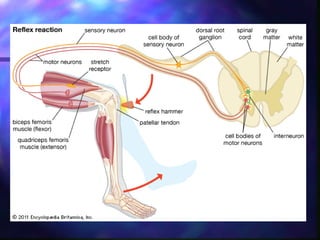
Knee Jerk
 When the patellar tendon is tapped just below the knee,
the patellar reflex is initiated and the lower leg kicks
forward (via contraction of the quadriceps). The tap
initiates an action potential in a specialized structure
known as a muscle spindle located within the quadriceps.
This action potential travels to the spinal cord, via a
sensory axon which chemically communicates by releasing
glutamate (see synapse) onto a motor nerve. The result of
this motor nerve activity is contraction of the quadriceps
muscle, leading to extension of the lower leg at the knee.
The sensory input from the quadriceps also activates local
interneurons that release the inhibitory neurotransmitter
glycine onto motor neurons, blocking the innervation of
the antagonistic (hamstring) muscle. The relaxation of the
opposing muscle facilitates extension of the lower leg.
The Effects of Exercise on the
Nervous System
 Although you are well aware that physical
exercise is essential to keep the body in
shape, what you may not know is that
physical exercise is also beneficial for the
brain and the nervous system.
Walking Benefits the Brain
According to The Franklin Institute, walking is
good for the brain and the nervous system.
This is because as you walk, your blood
circulation is increased and more glucose and
oxygen reach your brain. As walking is not a
very strenuous activity, your leg muscles do
not use extra oxygen and glucose as in other
forms of more strenuous exercise. Also, as
more blood flows to the brain it helps remove
toxins and to improve concentration, learning
ability and memory.
Sports Training
According to British sports coach Brian Mac, it
is possible to train the neurological system
by using repetitive exercises. This enables
athletes to develop quicker reactions,
balance and good coordination. The
repetitive exercises can gradually be built on
by adding new movements, allowing the
athlete to build up a system of learned
moves and skills.
The Neuromuscular System
 Neuro= Brain and nerves
 Muscular = Muscles, tendons and
ligaments
Exercises for the Neuromuscular
System
 Balance – prevention of falls
 Coordination – smoothness of movement
 Strength – moving body parts against
gravity or resistance
Falls
More than one-third of adults
ages 65 years and older fall
each year
(Hornbrook 1994; Hausdorff 2001).
Prevention of Falls
 Exercise is one of the most important
things to do to reduce your chances of
falling.
 Exercise increases:
 Balance
 Strength
 Coordination
Effects of Training on balance and sensory inputs
 Practice of specific functional movements and complex tasks =
  dynamic balance
  static balance
  righting reflexes
  proprioception
  vestibular function
  simple and complex reaction and movement times
  visual function
  body awareness
  posture and gait
Exercise therapy in spinal osteochondrosis.
 At the heart of spinal osteochondrosis is changing intervertebral
disc with subsequent involvement in the process of vertebral bodies
adjacent intervertebral joints and ligaments .
 Intervertebral discs play an important role in the stable position of
the vertebrae, provide mobility of the spine, act as biological shock
absorber.
 Factors that contribute to the emergence and development of
osteochondrosis is a sedentary lifestyle, prolonged exposure of the
body physiologically in an awkward position (many hours sitting at a
desk, driving car, standing next to the machine, behind the counter).
 This greatly impairs blood circulation and providing nutrients to the
vertebral bodies, intervertebral discs. There are cracks fibrous ring.
 Due to the progression of degenerative changes in the fibrous ring
fixing broken vertebrae together , there is abnormal mobility.
Intervertebral gap reduced, compressed neurovascular end, blood and
lymph vessels - amplified pain.
 In the 3rd stage of the disease there is a rupture of the annulus
fibrosus , intervertebral hernia formation . The final stage is
characterized by a painful thickening and displacement of the
vertebrae, the formation of abnormal bone growths .
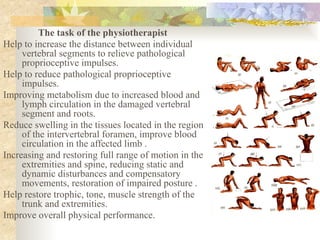
The task of the physiotherapist
Help to increase the distance between individual
vertebral segments to relieve pathological
proprioceptive impulses.
Help to reduce pathological proprioceptive
impulses.
Improving metabolism due to increased blood and
lymph circulation in the damaged vertebral
segment and roots.
Reduce swelling in the tissues located in the region
of the intervertebral foramen, improve blood
circulation in the affected limb .
Increasing and restoring full range of motion in the
extremities and spine, reducing static and
dynamic disturbances and compensatory
movements, restoration of impaired posture .
Help restore trophic, tone, muscle strength of the
trunk and extremities.
Improve overall physical performance.
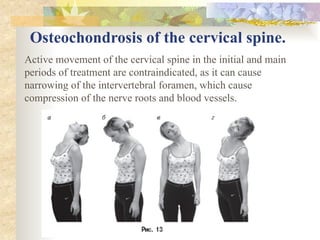
Osteochondrosis of the cervical spine.
Active movement of the cervical spine in the initial and main
periods of treatment are contraindicated, as it can cause
narrowing of the intervertebral foramen, which cause
compression of the nerve roots and blood vessels.
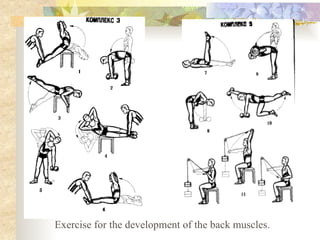
Exercise for the development of the back muscles.
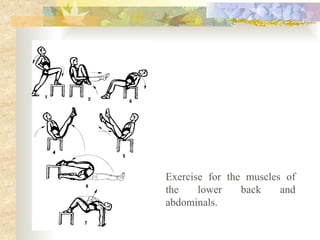
Exercise for the muscles of
the lower back and
abdominals.
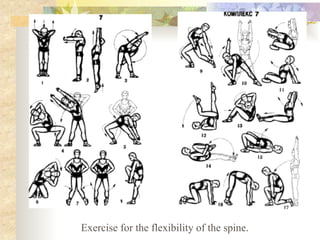
Exercise for the flexibility of the spine.
The End

Central Nervous System - CHAP 5.pptx PUL

  • 1.
  • 2.
    Neuron: Nerve Cell Basic structuralunit nervous system Consists of: –nucleus –nerve fibers /dentrites –axon
  • 3.
    Nerves Sensory Nerves: –carry messagesto brain and spinal cord from body Motor Nerves: –carry messages from
  • 4.
    Connecting or Mixed Nerves: –Carryboth sensory and motor messages
  • 5.
    Divisions of CNS CNS- central nervous system: –consists of brain and spinal cord
  • 6.
    Peripheral Nervous System –a. anynerves outside the brain and spinal cord –b. Autonomic nervous system: controls involuntary body functions
  • 7.
    Central Nervous System 1. Brain: –a.Mass of nerve tissue –b. Protected by membranes & the cranium or skull
  • 8.
    Cerebrum Largest section ofthe brain Responsible for: –reasoning, thought, memory, speaking, sensation, sight, hearing, voluntary body
  • 9.
    Cerebellum Responsible for: –coordination ofmuscles, balance, posture, & muscle tone
  • 10.
    Functions of Cerebellum  Smooths,coordinates & fine tunes bodily movements  Helps maintain body posture  Helps maintain equilibrium  Damage: ataxia, incoordination, wide-based gait, overshooting, proprioception problems
  • 11.
  • 12.
    Pons Responsible for: –conducting messagesto other parts of the brain –Reflex actions such as chewing, production of saliva
  • 13.
    Medulla Oblongata Lowest partof brain stem Connects to the spinal cord Responsible for: –regulating heart beat, respirations, swallowing,
  • 14.
    2. Spinal Cord Goesdown back of body from Medulla Oblongata Surrounded and protected by vertebrae Responsible for reflex actions Carries sensory and motor
  • 15.
    3. Meninges Consists of3 membranes Covers and protects the brain and spinal cord
  • 16.
    Three Membranes C. Duramater –thick, tough outer layer D. Arachnoid membrane –middle delicate weblike layer E. Pia mater –inner most layer with blood vessels to nourish the nerves
  • 17.
    4. Ventricles Four hallowspaces located in the middle of the brain. Connected to each other Filled with fluid called cerebrospinal fluid
  • 18.
    Cerebrospinal Fluid Circulates continuously Servesas shock absorber to protect brain and spinal cord
  • 19.
    Carries nurients toparts of brain and spinal cord helps remove metabolic products & wastes after circulation, absorbed into the blood vessels of the dura mater.
  • 21.
    Simplified …  Backof brain: perception  Top of brain: movement  Front of brain: thinking
  • 22.
    Peripheral Nervous System Made ofall nerves outside the brain and spinal cord Consists of cranial and spinal nerves
  • 23.
    A. Cranial Nerves 12pairs & their branches Some responsible for special senses: sight, hearing, taste, smell Others receive sensations: touch, pressure, pain, temperature
  • 24.
    B. Spinal Nerves 31pairs & their branches carries messages to & from the spinal cord Both sensory and motor nerves
  • 25.
    31 spinal nerves: –8cervical –12 thoracic –5 lumbar –5 sacral –1 coccygeal
  • 26.
    3. Autonomic Nervous System Helpsmaintain a balance in involuntary functions of the body. But allows the body to react in times of emergency.
  • 27.
    2 divisions ofANS  Sympathetic nervous system –acts in emergency  Parasympatheti c –counter acts the sympathetic ns after the emergency
  • 28.
     SNS –increase heart rate –increaseresp. rate –increase b/p –decrease digestive system activity  PNS –decrease heart rate –decrease resp. rate –decrease b/p –increase digestive system
  • 29.
    Reflex Arc  Areflex arc is a neural pathway that controls an action reflex. In human, most sensory neurons do not pass directly into the brain, but synapse in the spinal cord. This characteristic allows reflex actions to occur relatively quickly by activating spinal motor neurons without the delay of routing signals through the brain, although the brain will receive sensory input while the reflex action occurs.
  • 31.
    Knee Jerk  Whenthe patellar tendon is tapped just below the knee, the patellar reflex is initiated and the lower leg kicks forward (via contraction of the quadriceps). The tap initiates an action potential in a specialized structure known as a muscle spindle located within the quadriceps. This action potential travels to the spinal cord, via a sensory axon which chemically communicates by releasing glutamate (see synapse) onto a motor nerve. The result of this motor nerve activity is contraction of the quadriceps muscle, leading to extension of the lower leg at the knee. The sensory input from the quadriceps also activates local interneurons that release the inhibitory neurotransmitter glycine onto motor neurons, blocking the innervation of the antagonistic (hamstring) muscle. The relaxation of the opposing muscle facilitates extension of the lower leg.
  • 33.
    The Effects ofExercise on the Nervous System  Although you are well aware that physical exercise is essential to keep the body in shape, what you may not know is that physical exercise is also beneficial for the brain and the nervous system.
  • 34.
    Walking Benefits theBrain According to The Franklin Institute, walking is good for the brain and the nervous system. This is because as you walk, your blood circulation is increased and more glucose and oxygen reach your brain. As walking is not a very strenuous activity, your leg muscles do not use extra oxygen and glucose as in other forms of more strenuous exercise. Also, as more blood flows to the brain it helps remove toxins and to improve concentration, learning ability and memory.
  • 35.
    Sports Training According toBritish sports coach Brian Mac, it is possible to train the neurological system by using repetitive exercises. This enables athletes to develop quicker reactions, balance and good coordination. The repetitive exercises can gradually be built on by adding new movements, allowing the athlete to build up a system of learned moves and skills.
  • 36.
    The Neuromuscular System Neuro= Brain and nerves  Muscular = Muscles, tendons and ligaments
  • 37.
    Exercises for theNeuromuscular System  Balance – prevention of falls  Coordination – smoothness of movement  Strength – moving body parts against gravity or resistance
  • 38.
    Falls More than one-thirdof adults ages 65 years and older fall each year (Hornbrook 1994; Hausdorff 2001).
  • 39.
    Prevention of Falls Exercise is one of the most important things to do to reduce your chances of falling.  Exercise increases:  Balance  Strength  Coordination
  • 40.
    Effects of Trainingon balance and sensory inputs  Practice of specific functional movements and complex tasks =   dynamic balance   static balance   righting reflexes   proprioception   vestibular function   simple and complex reaction and movement times   visual function   body awareness   posture and gait
  • 41.
    Exercise therapy inspinal osteochondrosis.  At the heart of spinal osteochondrosis is changing intervertebral disc with subsequent involvement in the process of vertebral bodies adjacent intervertebral joints and ligaments .  Intervertebral discs play an important role in the stable position of the vertebrae, provide mobility of the spine, act as biological shock absorber.  Factors that contribute to the emergence and development of osteochondrosis is a sedentary lifestyle, prolonged exposure of the body physiologically in an awkward position (many hours sitting at a desk, driving car, standing next to the machine, behind the counter).  This greatly impairs blood circulation and providing nutrients to the vertebral bodies, intervertebral discs. There are cracks fibrous ring.  Due to the progression of degenerative changes in the fibrous ring fixing broken vertebrae together , there is abnormal mobility. Intervertebral gap reduced, compressed neurovascular end, blood and lymph vessels - amplified pain.  In the 3rd stage of the disease there is a rupture of the annulus fibrosus , intervertebral hernia formation . The final stage is characterized by a painful thickening and displacement of the vertebrae, the formation of abnormal bone growths .
  • 42.
    The task ofthe physiotherapist Help to increase the distance between individual vertebral segments to relieve pathological proprioceptive impulses. Help to reduce pathological proprioceptive impulses. Improving metabolism due to increased blood and lymph circulation in the damaged vertebral segment and roots. Reduce swelling in the tissues located in the region of the intervertebral foramen, improve blood circulation in the affected limb . Increasing and restoring full range of motion in the extremities and spine, reducing static and dynamic disturbances and compensatory movements, restoration of impaired posture . Help restore trophic, tone, muscle strength of the trunk and extremities. Improve overall physical performance.
  • 43.
    Osteochondrosis of thecervical spine. Active movement of the cervical spine in the initial and main periods of treatment are contraindicated, as it can cause narrowing of the intervertebral foramen, which cause compression of the nerve roots and blood vessels.
  • 44.
    Exercise for thedevelopment of the back muscles.
  • 45.
    Exercise for themuscles of the lower back and abdominals.
  • 46.
    Exercise for theflexibility of the spine.
  • 47.

Editor's Notes

  • #40 We know we can improve balance in those without progressive disease. This is done by practicing and challenging the system.