Rebuilding confidence
and commitments
Dr. Damien Helly
DEVE Committee
European
Parliament,
Brussels
3 March 2014
The implementation of
the Joint Africa-EU
Strategy
Page 2
Structure of the presentation
1. What has changed in Africa Europe relations?
2. The implementation of the JAES: lessons learned
3. Flexible implementation works
4. Institutional structure: heavy and only consultative
5. Paradoxes and dilemma
6. EU financing
7. Towards the April Africa-EU Summit
8. Priorities for the European Parliament
9. Way forward: mentalities and attitudes
1. JAES: What has changed in the
Africa-EU relationship?
Page 3
1. African “economic boom” but major
challenges of sustainable and inclusive
growth, unemployment and instability…
2. EU economic, financial & political
crisis: inward looking, difficulties to
reconcile values and interests
3. Emergence of new global players: more
competitive context
2. The implementation of the
JAES: lessons learned
Page 4
• Diverse implementation of 8 partnerships:
each at its own pace, various dialogues and
processes
• Flexible and imaginative stakeholders find a
supportive framework in the JAES
• Unwillingness blocks cooperation and
dialogue: EPAs, ICC, major security crises
2. The implementation of the
JAES: lessons learned
Page 5
3. Flexible and imaginative implementation
Page 6
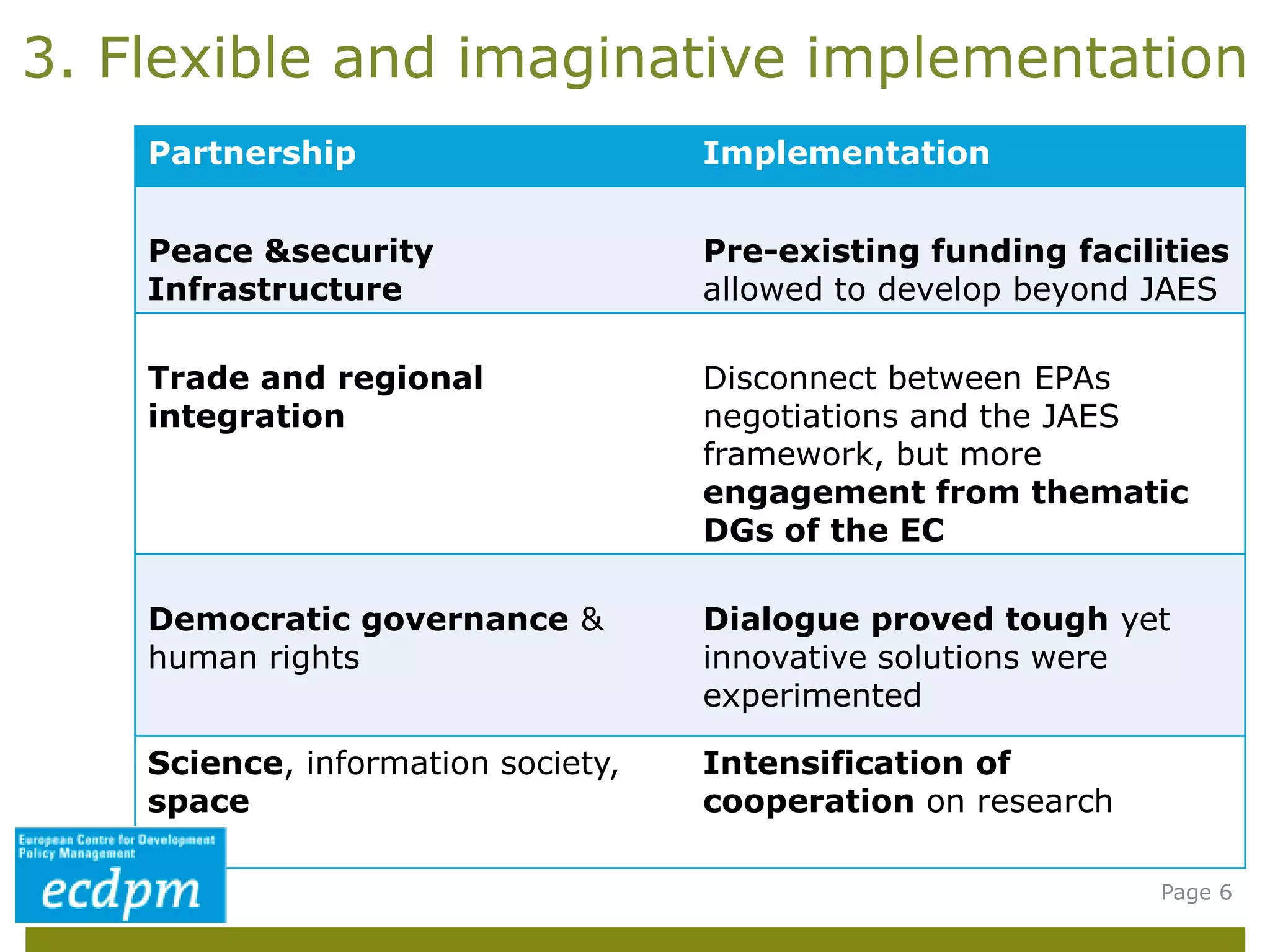
Partnership Implementation
Peace &security
Infrastructure
Pre-existing funding facilities
allowed to develop beyond JAES
Trade and regional
integration
Disconnect between EPAs
negotiations and the JAES
framework, but more
engagement from thematic
DGs of the EC
Democratic governance &
human rights
Dialogue proved tough yet
innovative solutions were
experimented
Science, information society,
space
Intensification of
cooperation on research
Page 7
4. Institutional
structure: heavy but
only consultative
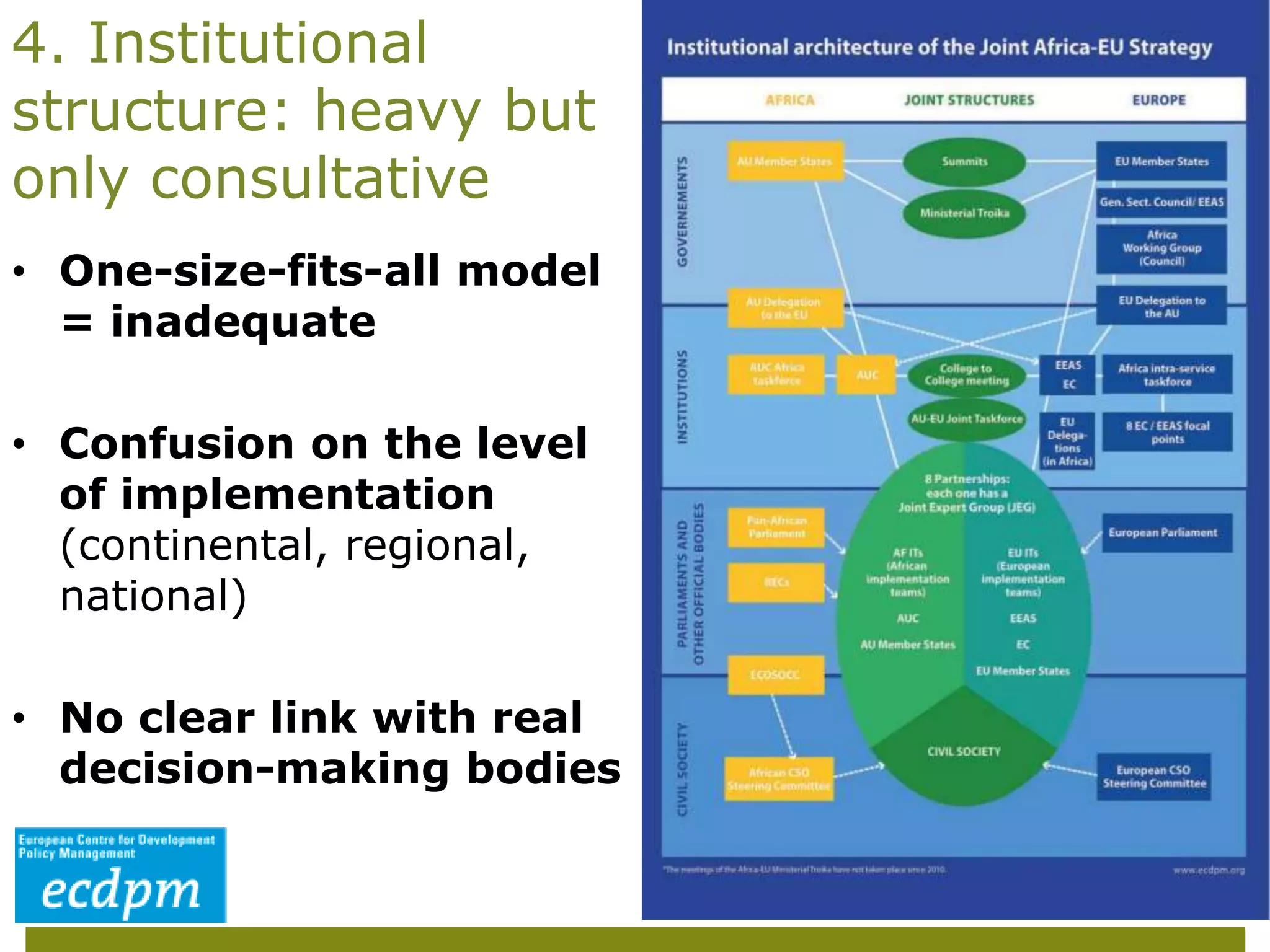
• One-size-fits-all model
= inadequate
• Confusion on the level
of implementation
(continental, regional,
national)
• No clear link with real
decision-making bodies
5. Paradoxes and dilemmas
Page 8
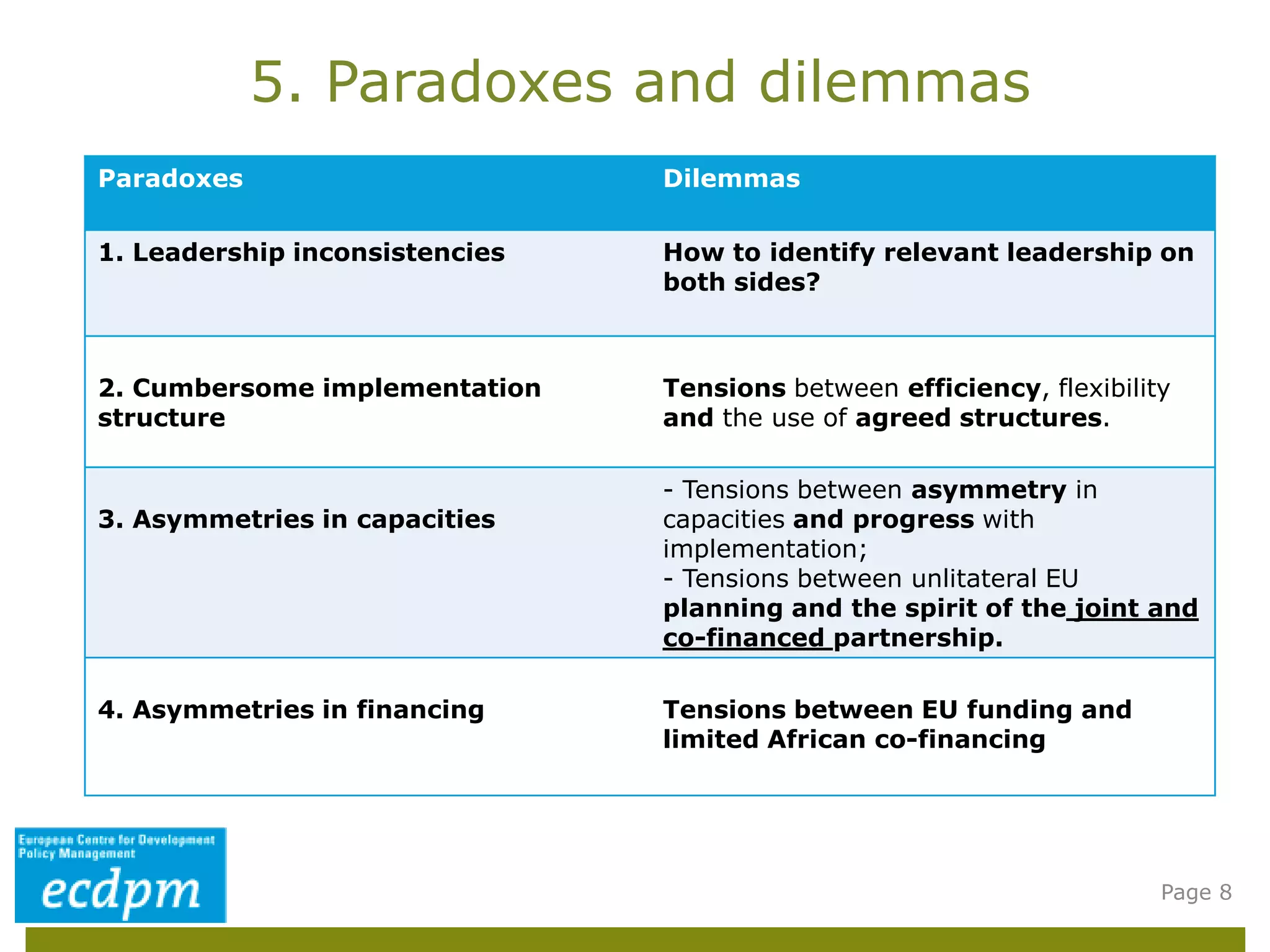
Paradoxes Dilemmas
1. Leadership inconsistencies How to identify relevant leadership on
both sides?
2. Cumbersome implementation
structure
Tensions between efficiency, flexibility
and the use of agreed structures.
3. Asymmetries in capacities
- Tensions between asymmetry in
capacities and progress with
implementation;
- Tensions between unlitateral EU
planning and the spirit of the joint and
co-financed partnership.
4. Asymmetries in financing Tensions between EU funding and
limited African co-financing
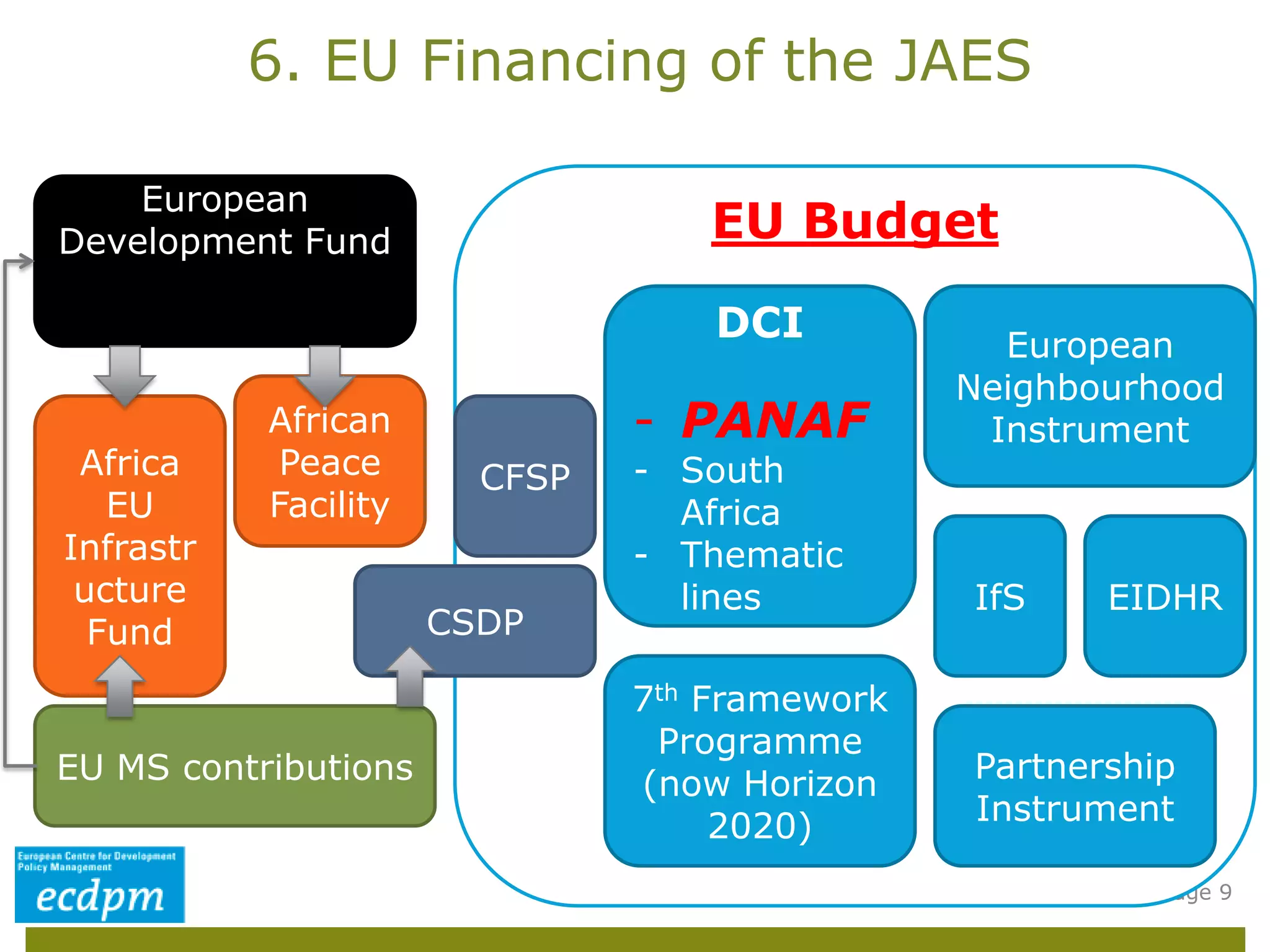
Page 9
EU Budget
EIDHR
CSDP
7th Framework
Programme
(now Horizon
2020)
IfS
EU MS contributions Partnership
Instrument
6. EU Financing of the JAES
European
Development Fund
European
Neighbourhood
Instrument
DCI
- PANAF
- South
Africa
- Thematic
lines
African
Peace
Facility
Africa
EU
Infrastr
ucture
Fund
CFSP
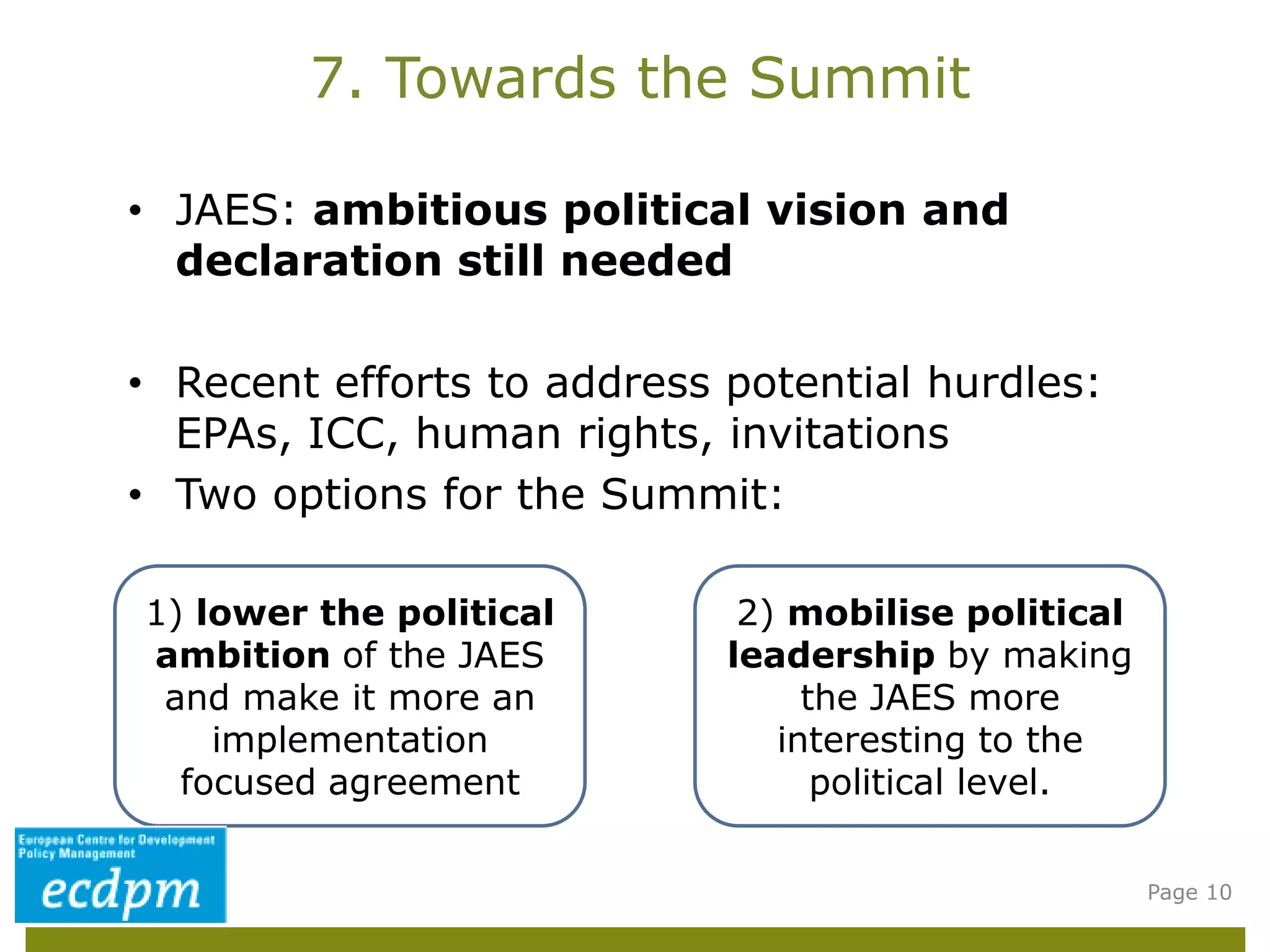
• JAES: ambitious political vision and
declaration still needed
• Recent efforts to address potential hurdles:
EPAs, ICC, human rights, invitations
• Two options for the Summit:
7. Towards the Summit
Page 10
1) lower the political
ambition of the JAES
and make it more an
implementation
focused agreement
2) mobilise political
leadership by making
the JAES more
interesting to the
political level.
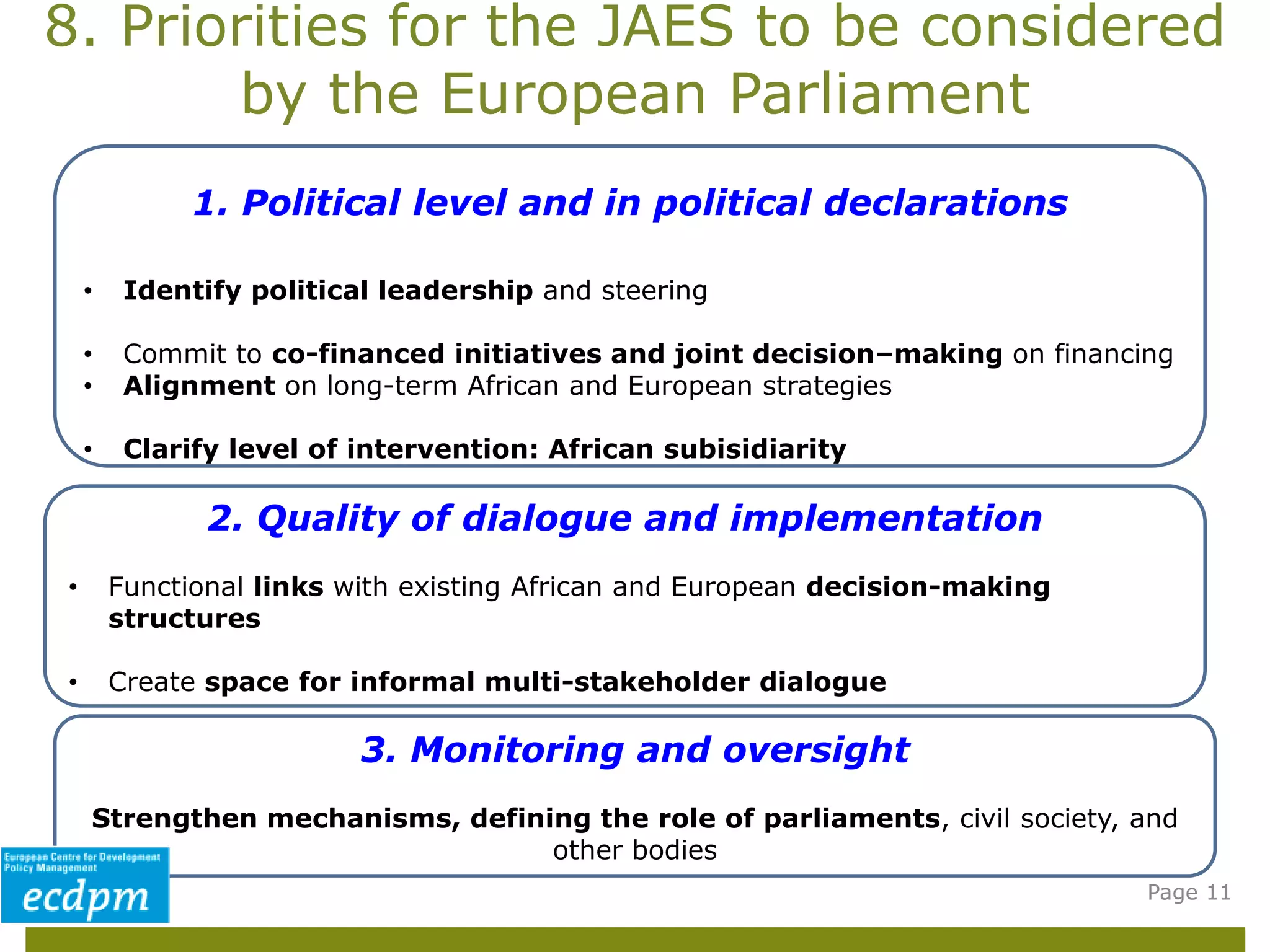
8. Priorities for the JAES to be considered
by the European Parliament
Page 11
1. Political level and in political declarations
• Identify political leadership and steering
• Commit to co-financed initiatives and joint decision–making on financing
• Alignment on long-term African and European strategies
• Clarify level of intervention: African subisidiarity
2. Quality of dialogue and implementation
• Functional links with existing African and European decision-making
structures
• Create space for informal multi-stakeholder dialogue
3. Monitoring and oversight
Strengthen mechanisms, defining the role of parliaments, civil society, and
other bodies
1. Where are mutual interests?
2. Africa also a land of opportunities
3. Which flagship initiatives should be singled out?
4. Is Europe clear about its strategic interests with
Africa?
5. Whom in Africa and Europe wants Africa to be
treated as one?
6. What after the end of Cotonou agreement in
2020?
9. Way forward: mentalities and attitudes
Page 12
Thank you!
www.ecdpm.org
www.slideshare.net/ecdpm
Page 13
Questions to:
Dr. Damien Helly, Policy Officer, ECDPM
dhe@ecdpm.org

The Implementation of the Joint Africa-EU Strategy: rebuilding confidence and commitments

  • 1.
    Rebuilding confidence and commitments Dr.Damien Helly DEVE Committee European Parliament, Brussels 3 March 2014 The implementation of the Joint Africa-EU Strategy
  • 2.
    Page 2 Structure ofthe presentation 1. What has changed in Africa Europe relations? 2. The implementation of the JAES: lessons learned 3. Flexible implementation works 4. Institutional structure: heavy and only consultative 5. Paradoxes and dilemma 6. EU financing 7. Towards the April Africa-EU Summit 8. Priorities for the European Parliament 9. Way forward: mentalities and attitudes
  • 3.
    1. JAES: Whathas changed in the Africa-EU relationship? Page 3 1. African “economic boom” but major challenges of sustainable and inclusive growth, unemployment and instability… 2. EU economic, financial & political crisis: inward looking, difficulties to reconcile values and interests 3. Emergence of new global players: more competitive context
  • 4.
    2. The implementationof the JAES: lessons learned Page 4
  • 5.
    • Diverse implementationof 8 partnerships: each at its own pace, various dialogues and processes • Flexible and imaginative stakeholders find a supportive framework in the JAES • Unwillingness blocks cooperation and dialogue: EPAs, ICC, major security crises 2. The implementation of the JAES: lessons learned Page 5
  • 6.
    3. Flexible andimaginative implementation Page 6 Partnership Implementation Peace &security Infrastructure Pre-existing funding facilities allowed to develop beyond JAES Trade and regional integration Disconnect between EPAs negotiations and the JAES framework, but more engagement from thematic DGs of the EC Democratic governance & human rights Dialogue proved tough yet innovative solutions were experimented Science, information society, space Intensification of cooperation on research
  • 7.
    Page 7 4. Institutional structure:heavy but only consultative • One-size-fits-all model = inadequate • Confusion on the level of implementation (continental, regional, national) • No clear link with real decision-making bodies
  • 8.
    5. Paradoxes anddilemmas Page 8 Paradoxes Dilemmas 1. Leadership inconsistencies How to identify relevant leadership on both sides? 2. Cumbersome implementation structure Tensions between efficiency, flexibility and the use of agreed structures. 3. Asymmetries in capacities - Tensions between asymmetry in capacities and progress with implementation; - Tensions between unlitateral EU planning and the spirit of the joint and co-financed partnership. 4. Asymmetries in financing Tensions between EU funding and limited African co-financing
  • 9.
    Page 9 EU Budget EIDHR CSDP 7thFramework Programme (now Horizon 2020) IfS EU MS contributions Partnership Instrument 6. EU Financing of the JAES European Development Fund European Neighbourhood Instrument DCI - PANAF - South Africa - Thematic lines African Peace Facility Africa EU Infrastr ucture Fund CFSP
  • 10.
    • JAES: ambitiouspolitical vision and declaration still needed • Recent efforts to address potential hurdles: EPAs, ICC, human rights, invitations • Two options for the Summit: 7. Towards the Summit Page 10 1) lower the political ambition of the JAES and make it more an implementation focused agreement 2) mobilise political leadership by making the JAES more interesting to the political level.
  • 11.
    8. Priorities forthe JAES to be considered by the European Parliament Page 11 1. Political level and in political declarations • Identify political leadership and steering • Commit to co-financed initiatives and joint decision–making on financing • Alignment on long-term African and European strategies • Clarify level of intervention: African subisidiarity 2. Quality of dialogue and implementation • Functional links with existing African and European decision-making structures • Create space for informal multi-stakeholder dialogue 3. Monitoring and oversight Strengthen mechanisms, defining the role of parliaments, civil society, and other bodies
  • 12.
    1. Where aremutual interests? 2. Africa also a land of opportunities 3. Which flagship initiatives should be singled out? 4. Is Europe clear about its strategic interests with Africa? 5. Whom in Africa and Europe wants Africa to be treated as one? 6. What after the end of Cotonou agreement in 2020? 9. Way forward: mentalities and attitudes Page 12
  • 13.
    Thank you! www.ecdpm.org www.slideshare.net/ecdpm Page 13 Questionsto: Dr. Damien Helly, Policy Officer, ECDPM dhe@ecdpm.org

Editor's Notes

  • #10 European Development Fund: 30.5 billion Euro (2014-2020)Development Cooperation Instrument: 19.7 Euro (2014-2020)European Neighbourhood Instrument: 15.4 billion Euro (2014-2020)EIDHR: 2.3 billion Euro (2014-2020)CSFP / CSDPInstrument for Stability and Peace7th Framework Programme (now Horizon 2020)EU member states’ contributions