Welcome To Our
Presentation
Submitted to:
Bibi Hafsa
Assistant Professor
Geography and Environment
Jahangirnagar University
Submitted by:
Group B
 Group Members:
 Gargi Mitra (460)
 Faria Kabir (473)
 Mastora Tabassum (483)
 Md Tamjid Al Noor Pobon (493)
 Md Mosarof Hossen (507)
 Tanvir Ahmed (518)
 Rajia Akter (1951)
 Debashish Sarker (2161)
Topic: Central Asia
Landforms and Landscapes
Climate
Population
Economy
Resources
Culture and Society
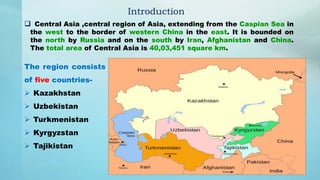
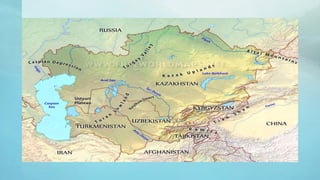
 Central Asia ,central region of Asia, extending from the Caspian Sea in
the west to the border of western China in the east. It is bounded on
the north by Russia and on the south by Iran, Afghanistan and China.
The total area of Central Asia is 40,03,451 square km.
Introduction
The region consists
of five countries-
 Kazakhstan
 Uzbekistan
 Turkmenistan
 Kyrgyzstan
 Tajikistan
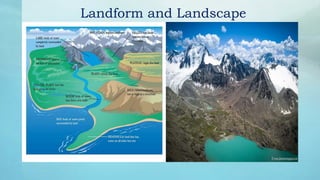
Landform and Landscape
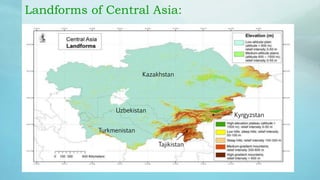
Landforms of Central Asia:
Kazakhstan
Uzbekistan
Turkmenistan
Kyrgyzstan
Tajikistan
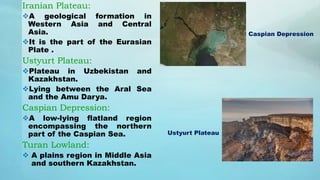
Iranian Plateau:
A geological formation in
Western Asia and Central
Asia.
It is the part of the Eurasian
Plate .
Ustyurt Plateau:
Plateau in Uzbekistan and
Kazakhstan.
Lying between the Aral Sea
and the Amu Darya.
Caspian Depression:
A low-lying flatland region
encompassing the northern
part of the Caspian Sea.
Turan Lowland:
 A plains region in Middle Asia
and southern Kazakhstan.
Caspian Depression
Ustyurt Plateau
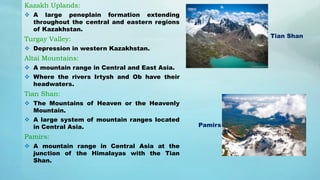
Kazakh Uplands:
 A large peneplain formation extending
throughout the central and eastern regions
of Kazakhstan.
Turgay Valley:
 Depression in western Kazakhstan.
Altai Mountains:
 A mountain range in Central and East Asia.
 Where the rivers Irtysh and Ob have their
headwaters.
Tian Shan:
 The Mountains of Heaven or the Heavenly
Mountain.
 A large system of mountain ranges located
in Central Asia.
Pamirs:
 A mountain range in Central Asia at the
junction of the Himalayas with the Tian
Shan.
Tian Shan
Pamirs
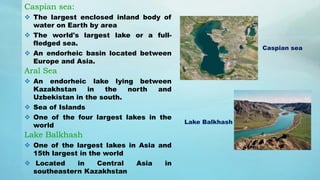
Caspian sea:
 The largest enclosed inland body of
water on Earth by area
 The world's largest lake or a full-
fledged sea.
 An endorheic basin located between
Europe and Asia.
Aral Sea
 An endorheic lake lying between
Kazakhstan in the north and
Uzbekistan in the south.
 Sea of Islands
 One of the four largest lakes in the
world
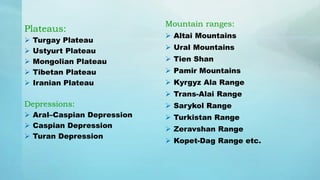
Lake Balkhash
 One of the largest lakes in Asia and
15th largest in the world
 Located in Central Asia in
southeastern Kazakhstan
Caspian sea
Lake Balkhash
Plateaus:
 Turgay Plateau
 Ustyurt Plateau
 Mongolian Plateau
 Tibetan Plateau
 Iranian Plateau
Depressions:
 Aral–Caspian Depression
 Caspian Depression
 Turan Depression
Mountain ranges:
 Altai Mountains
 Ural Mountains
 Tien Shan
 Pamir Mountains
 Kyrgyz Ala Range
 Trans-Alai Range
 Sarykol Range
 Turkistan Range
 Zeravshan Range
 Kopet-Dag Range etc.
Mountains:
 Khan Tengri
 Lenin Peak
 Jengish Chokusu
 Ismoil Somoni Peak
 Gora Alagordy
Bodies of water:
 Lake Balkhash
 Lake Aike
 Aral Sea
 Amu Darya
 Syr Darya
 Kara Darya
 Chu River
 Lake Alakol
 Arys River
 Kurumdy Mountain
 Concord Peak
 Mount Garmo
 Mount Adelung
 Mount Beshtor etc.
 Ayat River
 Karakum Canal
 Irtysh River
 Irtysh–Karaganda Canal
 Ural River
 Ishim River
 Talas River
 Chatkal River
 Zeravshan River etc.
Canyons and gorges:
 Aksu Canyon
 Sharyn Canyon
Peninsulas:
 Buzachi Peninsula
 Mangyshlak Peninsula
Valleys:
 Turgay Valley
 Chuy Valley
 Emin Valley
 Alay Valley
Glaciers:
 Engilchek Glacier
 Sarychat Glacier
 Diakhandara Glacier
 Fedchenko Glacier
 Medvezhiy Glacier
 Boom Gorge
 Cheleken Peninsula
 Krasnovodsk Peninsula
 Fergana Valley
 Gissar Valley
 Khatlon Valley etc.
Deserts:
 Gobi Desert
 Kyzylkum Desert
 Karakum Desert
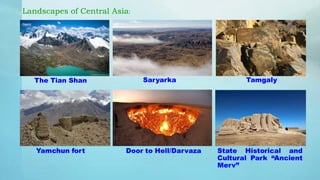
The Tian Shan Saryarka Tamgaly
Landscapes of Central Asia:
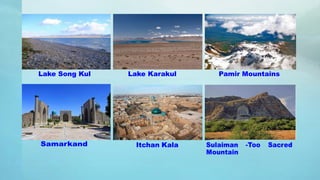
Lake Song Kul Lake Karakul Pamir Mountains
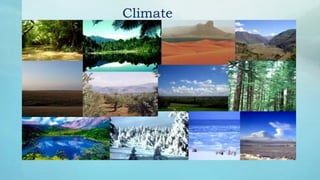
Climate
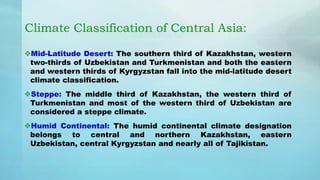
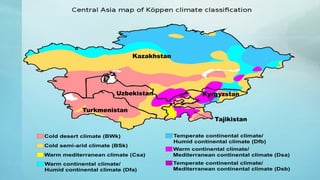
Climate Classification of Central Asia:
Mid-Latitude Desert: The southern third of Kazakhstan, western
two-thirds of Uzbekistan and Turkmenistan and both the eastern
and western thirds of Kyrgyzstan fall into the mid-latitude desert
climate classification.
Steppe: The middle third of Kazakhstan, the western third of
Turkmenistan and most of the western third of Uzbekistan are
considered a steppe climate.
Humid Continental: The humid continental climate designation
belongs to central and northern Kazakhstan, eastern
Uzbekistan, central Kyrgyzstan and nearly all of Tajikistan.
Kazakhstan
Uzbekistan
Turkmenistan
Kyrgyzstan
Tajikistan
Some Information
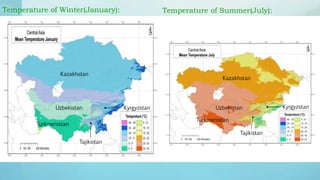
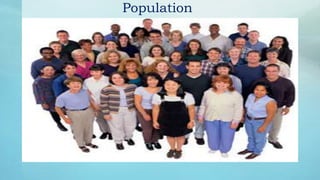
 Central Asia is typically very harsh with dry summer and a snow falling
winter along with a very fluctuating temperature.
 In high-elevation areas, the climate is mostly semi-arid to arid. In lower
elevations, summers are hot with blazing sunshine, winters feature
occasional rain and/or snow.
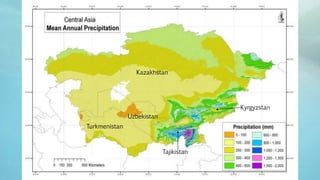
 Average monthly precipitation is extremely low from July to
September, rises in autumn (October and November) and is highest in
March or April.
 Winds can be strong, producing dust storms sometimes, especially
toward the end of the dry season in September and October.
 Central Asia is part of the Palearctic Eco zone.
 The largest biomes in Central Asia are the temperate grasslands,
savannas, and shrub lands biome.
 Central Asia also contains the montane grasslands and shrub lands,
deserts and xeric shrub lands as well as temperate coniferous forests
biomes.
Kazakhstan
Turkmenistan
Uzbekistan
Kyrgyzstan
Tajikistan
Temperature of Winter(January): Temperature of Summer(July):
Kazakhstan
Turkmenistan
Uzbekistan Kyrgyzstan
Tajikistan
Kazakhstan
Uzbekistan
Turkmenistan
Kyrgyzstan
Tajikistan
Population
The population of Central Asia is
about 7,18,47,646.
 Central Asia population is
equivalent to 0.94% of the total
world population.
 Central Asia ranks number 5 in
Asia among sub regions ranked
by Population.
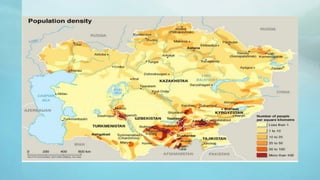
 The population density in
Central Asia is 18 P/Km².39 % of
the population is urban
(28,030,299 people in 2018).
 The median age in Central Asia
is 26.7 years.
 In Central Asia there are more
emigrants than immigrants.
Country Population
Uzbekistan 3,23,64,996
Kazakhstan 1,84,03,860
Tajikistan 91,07,211
Kyrgyzstan 61,32,932
Turkmenistan 58,51,466
Population of Central Asian countries:
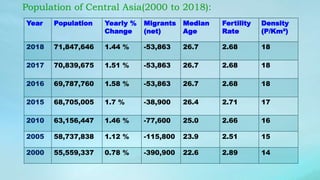
Population of Central Asia(2000 to 2018):
Year Population Yearly %
Change
Migrants
(net)
Median
Age
Fertility
Rate
Density
(P/Km²)
2018 71,847,646 1.44 % -53,863 26.7 2.68 18
2017 70,839,675 1.51 % -53,863 26.7 2.68 18
2016 69,787,760 1.58 % -53,863 26.7 2.68 18
2015 68,705,005 1.7 % -38,900 26.4 2.71 17
2010 63,156,447 1.46 % -77,600 25.0 2.66 16
2005 58,737,838 1.12 % -115,800 23.9 2.51 15
2000 55,559,337 0.78 % -390,900 22.6 2.89 14
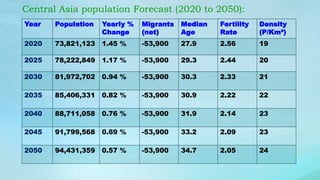
Central Asia population Forecast (2020 to 2050):
Year Population Yearly %
Change
Migrants
(net)
Median
Age
Fertility
Rate
Density
(P/Km²)
2020 73,821,123 1.45 % -53,900 27.9 2.56 19
2025 78,222,849 1.17 % -53,900 29.3 2.44 20
2030 81,972,702 0.94 % -53,900 30.3 2.33 21
2035 85,406,331 0.82 % -53,900 30.9 2.22 22
2040 88,711,058 0.76 % -53,900 31.9 2.14 23
2045 91,799,568 0.69 % -53,900 33.2 2.09 23
2050 94,431,359 0.57 % -53,900 34.7 2.05 24
Economy
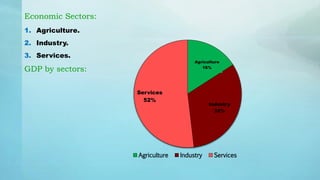
Economic Sectors:
1. Agriculture.
2. Industry.
3. Services.
GDP by sectors:
Agriculture
16%
Industry
32%
Services
52%
Agriculture Industry Services
Some Information:
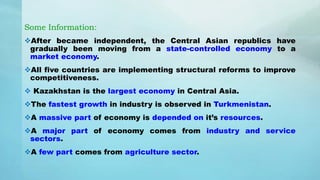
After became independent, the Central Asian republics have
gradually been moving from a state-controlled economy to a
market economy.
All five countries are implementing structural reforms to improve
competitiveness.
 Kazakhstan is the largest economy in Central Asia.
The fastest growth in industry is observed in Turkmenistan.
A massive part of economy is depended on it’s resources.
A major part of economy comes from industry and service
sectors.
A few part comes from agriculture sector.
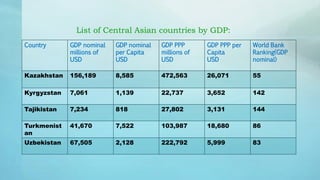
List of Central Asian countries by GDP:
Country GDP nominal
millions of
USD
GDP nominal
per Capita
USD
GDP PPP
millions of
USD
GDP PPP per
Capita
USD
World Bank
Ranking(GDP
nominal)
Kazakhstan 156,189 8,585 472,563 26,071 55
Kyrgyzstan 7,061 1,139 22,737 3,652 142
Tajikistan 7,234 818 27,802 3,131 144
Turkmenist
an
41,670 7,522 103,987 18,680 86
Uzbekistan 67,505 2,128 222,792 5,999 83
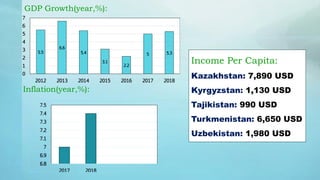
GDP Growth(year,%):
5.5
6.6
5.4
3.1
2.2
5 5.3
0
1
2
3
4
5
6
7
2012 2013 2014 2015 2016 2017 2018
Inflation(year,%):
6.8
6.9
7
7.1
7.2
7.3
7.4
7.5
2017 2018
Income Per Capita:
Kazakhstan: 7,890 USD
Kyrgyzstan: 1,130 USD
Tajikistan: 990 USD
Turkmenistan: 6,650 USD
Uzbekistan: 1,980 USD
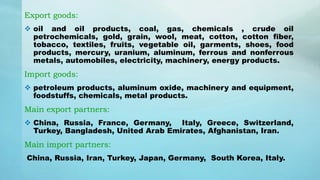
Export goods:
 oil and oil products, coal, gas, chemicals , crude oil
petrochemicals, gold, grain, wool, meat, cotton, cotton fiber,
tobacco, textiles, fruits, vegetable oil, garments, shoes, food
products, mercury, uranium, aluminum, ferrous and nonferrous
metals, automobiles, electricity, machinery, energy products.
Import goods:
 petroleum products, aluminum oxide, machinery and equipment,
foodstuffs, chemicals, metal products.
Main export partners:
 China, Russia, France, Germany, Italy, Greece, Switzerland,
Turkey, Bangladesh, United Arab Emirates, Afghanistan, Iran.
Main import partners:
China, Russia, Iran, Turkey, Japan, Germany, South Korea, Italy.
Resources
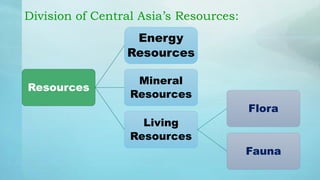
Division of Central Asia’s Resources:
Resources
Energy
Resources
Mineral
Resources
Living
Resources
Flora
Fauna
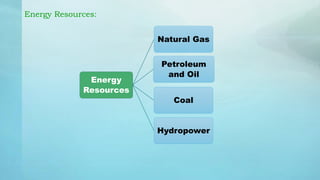
Energy Resources:
Energy
Resources
Natural Gas
Petroleum
and Oil
Coal
Hydropower
Some Information:
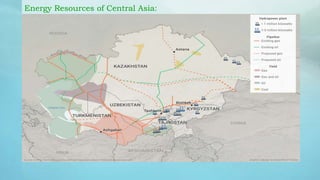
 Central Asia is rich in natural resources.
 It’s main resources are oil and gas.
 Kazakhstan, Turkmenistan and Uzbekistan have larger oil and
gas reserves.
 Kyrgyzstan and Tajikistan have large hydropower resources.
 Kazakhstan has 3% of world’s oil,4% of world’s coal.
 Kazakhstan is a world leader in coal production.
 Kazakhstan also currently has the 11th largest proven reserves
of both petroleum and natural gas.
 Uzbekistan has 171 discovered natural gas and oil fields.
 Kyrgyzstan has small reserves of oil and natural gas.
 Turkmenistan has some of the world largest natural gas
reserves.
 Turkmenistan also has some of the world’s largest gas fields.
Energy Resources of Central Asia:
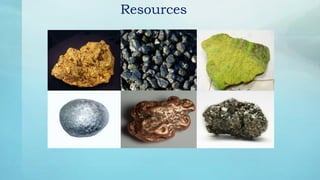
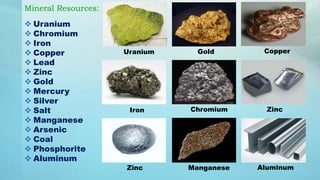
Mineral Resources:
 Uranium
 Chromium
 Iron
 Copper
 Lead
 Zinc
 Gold
 Mercury
 Silver
 Salt
 Manganese
 Arsenic
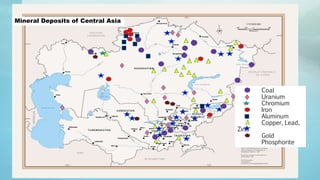
 Coal
 Phosphorite
 Aluminum
Zinc
Uranium Gold Copper
Iron Chromium Zinc
Manganese Aluminum
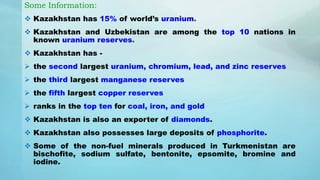
Some Information:
 Kazakhstan has 15% of world’s uranium.
 Kazakhstan and Uzbekistan are among the top 10 nations in
known uranium reserves.
 Kazakhstan has -
 the second largest uranium, chromium, lead, and zinc reserves
 the third largest manganese reserves
 the fifth largest copper reserves
 ranks in the top ten for coal, iron, and gold
 Kazakhstan is also an exporter of diamonds.
 Kazakhstan also possesses large deposits of phosphorite.
 Some of the non-fuel minerals produced in Turkmenistan are
bischofite, sodium sulfate, bentonite, epsomite, bromine and
iodine.
Coal
Uranium
Chromium
Iron
Aluminum
Copper, Lead,
Zinc
Gold
Phosphorite
Mineral Deposits of Central Asia
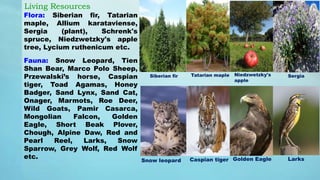
Living Resources
Flora: Siberian fir, Tatarian
maple, Allium karataviense,
Sergia (plant), Schrenk's
spruce, Niedzwetzky's apple
tree, Lycium ruthenicum etc.
Fauna: Snow Leopard, Tien
Shan Bear, Marco Polo Sheep,
Przewalski’s horse, Caspian
tiger, Toad Agamas, Honey
Badger, Sand Lynx, Sand Cat,
Onager, Marmots, Roe Deer,
Wild Goats, Pamir Casarca,
Mongolian Falcon, Golden
Eagle, Short Beak Plover,
Chough, Alpine Daw, Red and
Pearl Reel, Larks, Snow
Sparrow, Grey Wolf, Red Wolf
etc.
Siberian fir Tatarian maple Niedzwetzky's
apple
Sergia
Snow leopard Caspian tiger Golden Eagle Larks
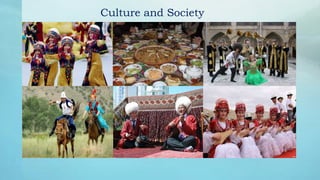
Culture and Society
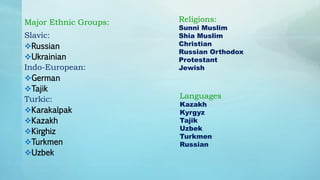
Major Ethnic Groups:
Slavic:
Russian
Ukrainian
Indo-European:
German
Tajik
Turkic:
Karakalpak
Kazakh
Kirghiz
Turkmen
Uzbek
Religions:
Sunni Muslim
Shia Muslim
Christian
Russian Orthodox
Protestant
Jewish
Languages
Kazakh
Kyrgyz
Tajik
Uzbek
Turkmen
Russian
Some Information:
 The culture of Central Asia influenced by Chinese, South Asian,
Persian, Arabian, Turkish, Russian, Sarmantian and Mongolian culture.
 The predominant religion in Central Asia is Islam.
 For centuries, Central Asian have made a living by raising horses,
cattle sheep and goats. Many herders live as nomads.
 The nomadic lifestyle is common in Kyrgyzstan.
 The ancient literature of central Asia is linked with Persian literature.
 It has an indigenous from of improvisational oral poetry(1000 years
old).
 Lyrical Battle is very famous in Central Asia.
 Some people of Central Asia learn to sing Manas, Kyrgyzstan’s epic
poem.
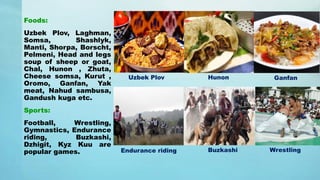
Foods:
Uzbek Plov, Laghman,
Somsa, Shashlyk,
Manti, Shorpa, Borscht,
Pelmeni, Head and legs
soup of sheep or goat,
Chal, Hunon , Zhuta,
Cheese somsa, Kurut ,
Oromo, Ganfan, Yak
meat, Nahud sambusa,
Gandush kuga etc.
Sports:
Football, Wrestling,
Gymnastics, Endurance
riding, Buzkashi,
Dzhigit, Kyz Kuu are
popular games.
Uzbek Plov Hunon Ganfan
Endurance riding Buzkashi Wrestling
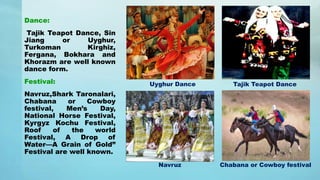
Dance:
Tajik Teapot Dance, Sin
Jiang or Uyghur,
Turkoman Kirghiz,
Fergana, Bokhara and
Khorazm are well known
dance form.
Festival:
Navruz,Shark Taronalari,
Chabana or Cowboy
festival, Men’s Day,
National Horse Festival,
Kyrgyz Kochu Festival,
Roof of the world
Festival, A Drop of
Water—A Grain of Gold”
Festival are well known.
Uyghur Dance Tajik Teapot Dance
Navruz Chabana or Cowboy festival
Thank You
Any Question?

Central Asia

  • 1.
  • 2.
    Submitted to: Bibi Hafsa AssistantProfessor Geography and Environment Jahangirnagar University Submitted by: Group B
  • 3.
     Group Members: Gargi Mitra (460)  Faria Kabir (473)  Mastora Tabassum (483)  Md Tamjid Al Noor Pobon (493)  Md Mosarof Hossen (507)  Tanvir Ahmed (518)  Rajia Akter (1951)  Debashish Sarker (2161)
  • 4.
    Topic: Central Asia Landformsand Landscapes Climate Population Economy Resources Culture and Society
  • 5.
     Central Asia,central region of Asia, extending from the Caspian Sea in the west to the border of western China in the east. It is bounded on the north by Russia and on the south by Iran, Afghanistan and China. The total area of Central Asia is 40,03,451 square km. Introduction The region consists of five countries-  Kazakhstan  Uzbekistan  Turkmenistan  Kyrgyzstan  Tajikistan
  • 6.
  • 7.
    Landforms of CentralAsia: Kazakhstan Uzbekistan Turkmenistan Kyrgyzstan Tajikistan
  • 8.
    Iranian Plateau: A geologicalformation in Western Asia and Central Asia. It is the part of the Eurasian Plate . Ustyurt Plateau: Plateau in Uzbekistan and Kazakhstan. Lying between the Aral Sea and the Amu Darya. Caspian Depression: A low-lying flatland region encompassing the northern part of the Caspian Sea. Turan Lowland:  A plains region in Middle Asia and southern Kazakhstan. Caspian Depression Ustyurt Plateau
  • 9.
    Kazakh Uplands:  Alarge peneplain formation extending throughout the central and eastern regions of Kazakhstan. Turgay Valley:  Depression in western Kazakhstan. Altai Mountains:  A mountain range in Central and East Asia.  Where the rivers Irtysh and Ob have their headwaters. Tian Shan:  The Mountains of Heaven or the Heavenly Mountain.  A large system of mountain ranges located in Central Asia. Pamirs:  A mountain range in Central Asia at the junction of the Himalayas with the Tian Shan. Tian Shan Pamirs
  • 10.
    Caspian sea:  Thelargest enclosed inland body of water on Earth by area  The world's largest lake or a full- fledged sea.  An endorheic basin located between Europe and Asia. Aral Sea  An endorheic lake lying between Kazakhstan in the north and Uzbekistan in the south.  Sea of Islands  One of the four largest lakes in the world Lake Balkhash  One of the largest lakes in Asia and 15th largest in the world  Located in Central Asia in southeastern Kazakhstan Caspian sea Lake Balkhash
  • 11.
    Plateaus:  Turgay Plateau Ustyurt Plateau  Mongolian Plateau  Tibetan Plateau  Iranian Plateau Depressions:  Aral–Caspian Depression  Caspian Depression  Turan Depression Mountain ranges:  Altai Mountains  Ural Mountains  Tien Shan  Pamir Mountains  Kyrgyz Ala Range  Trans-Alai Range  Sarykol Range  Turkistan Range  Zeravshan Range  Kopet-Dag Range etc.
  • 12.
    Mountains:  Khan Tengri Lenin Peak  Jengish Chokusu  Ismoil Somoni Peak  Gora Alagordy Bodies of water:  Lake Balkhash  Lake Aike  Aral Sea  Amu Darya  Syr Darya  Kara Darya  Chu River  Lake Alakol  Arys River  Kurumdy Mountain  Concord Peak  Mount Garmo  Mount Adelung  Mount Beshtor etc.  Ayat River  Karakum Canal  Irtysh River  Irtysh–Karaganda Canal  Ural River  Ishim River  Talas River  Chatkal River  Zeravshan River etc.
  • 13.
    Canyons and gorges: Aksu Canyon  Sharyn Canyon Peninsulas:  Buzachi Peninsula  Mangyshlak Peninsula Valleys:  Turgay Valley  Chuy Valley  Emin Valley  Alay Valley Glaciers:  Engilchek Glacier  Sarychat Glacier  Diakhandara Glacier  Fedchenko Glacier  Medvezhiy Glacier  Boom Gorge  Cheleken Peninsula  Krasnovodsk Peninsula  Fergana Valley  Gissar Valley  Khatlon Valley etc. Deserts:  Gobi Desert  Kyzylkum Desert  Karakum Desert
  • 15.
    The Tian ShanSaryarka Tamgaly Landscapes of Central Asia:
  • 16.
    Lake Song KulLake Karakul Pamir Mountains
  • 17.
  • 18.
    Climate Classification ofCentral Asia: Mid-Latitude Desert: The southern third of Kazakhstan, western two-thirds of Uzbekistan and Turkmenistan and both the eastern and western thirds of Kyrgyzstan fall into the mid-latitude desert climate classification. Steppe: The middle third of Kazakhstan, the western third of Turkmenistan and most of the western third of Uzbekistan are considered a steppe climate. Humid Continental: The humid continental climate designation belongs to central and northern Kazakhstan, eastern Uzbekistan, central Kyrgyzstan and nearly all of Tajikistan.
  • 19.
  • 20.
    Some Information  CentralAsia is typically very harsh with dry summer and a snow falling winter along with a very fluctuating temperature.  In high-elevation areas, the climate is mostly semi-arid to arid. In lower elevations, summers are hot with blazing sunshine, winters feature occasional rain and/or snow.  Average monthly precipitation is extremely low from July to September, rises in autumn (October and November) and is highest in March or April.  Winds can be strong, producing dust storms sometimes, especially toward the end of the dry season in September and October.  Central Asia is part of the Palearctic Eco zone.  The largest biomes in Central Asia are the temperate grasslands, savannas, and shrub lands biome.  Central Asia also contains the montane grasslands and shrub lands, deserts and xeric shrub lands as well as temperate coniferous forests biomes.
  • 21.
  • 22.
    Temperature of Winter(January):Temperature of Summer(July): Kazakhstan Turkmenistan Uzbekistan Kyrgyzstan Tajikistan Kazakhstan Uzbekistan Turkmenistan Kyrgyzstan Tajikistan
  • 23.
  • 24.
    The population ofCentral Asia is about 7,18,47,646.  Central Asia population is equivalent to 0.94% of the total world population.  Central Asia ranks number 5 in Asia among sub regions ranked by Population.  The population density in Central Asia is 18 P/Km².39 % of the population is urban (28,030,299 people in 2018).  The median age in Central Asia is 26.7 years.  In Central Asia there are more emigrants than immigrants. Country Population Uzbekistan 3,23,64,996 Kazakhstan 1,84,03,860 Tajikistan 91,07,211 Kyrgyzstan 61,32,932 Turkmenistan 58,51,466 Population of Central Asian countries:
  • 25.
    Population of CentralAsia(2000 to 2018): Year Population Yearly % Change Migrants (net) Median Age Fertility Rate Density (P/Km²) 2018 71,847,646 1.44 % -53,863 26.7 2.68 18 2017 70,839,675 1.51 % -53,863 26.7 2.68 18 2016 69,787,760 1.58 % -53,863 26.7 2.68 18 2015 68,705,005 1.7 % -38,900 26.4 2.71 17 2010 63,156,447 1.46 % -77,600 25.0 2.66 16 2005 58,737,838 1.12 % -115,800 23.9 2.51 15 2000 55,559,337 0.78 % -390,900 22.6 2.89 14
  • 26.
    Central Asia populationForecast (2020 to 2050): Year Population Yearly % Change Migrants (net) Median Age Fertility Rate Density (P/Km²) 2020 73,821,123 1.45 % -53,900 27.9 2.56 19 2025 78,222,849 1.17 % -53,900 29.3 2.44 20 2030 81,972,702 0.94 % -53,900 30.3 2.33 21 2035 85,406,331 0.82 % -53,900 30.9 2.22 22 2040 88,711,058 0.76 % -53,900 31.9 2.14 23 2045 91,799,568 0.69 % -53,900 33.2 2.09 23 2050 94,431,359 0.57 % -53,900 34.7 2.05 24
  • 28.
  • 29.
    Economic Sectors: 1. Agriculture. 2.Industry. 3. Services. GDP by sectors: Agriculture 16% Industry 32% Services 52% Agriculture Industry Services
  • 30.
    Some Information: After becameindependent, the Central Asian republics have gradually been moving from a state-controlled economy to a market economy. All five countries are implementing structural reforms to improve competitiveness.  Kazakhstan is the largest economy in Central Asia. The fastest growth in industry is observed in Turkmenistan. A massive part of economy is depended on it’s resources. A major part of economy comes from industry and service sectors. A few part comes from agriculture sector.
  • 31.
    List of CentralAsian countries by GDP: Country GDP nominal millions of USD GDP nominal per Capita USD GDP PPP millions of USD GDP PPP per Capita USD World Bank Ranking(GDP nominal) Kazakhstan 156,189 8,585 472,563 26,071 55 Kyrgyzstan 7,061 1,139 22,737 3,652 142 Tajikistan 7,234 818 27,802 3,131 144 Turkmenist an 41,670 7,522 103,987 18,680 86 Uzbekistan 67,505 2,128 222,792 5,999 83
  • 32.
    GDP Growth(year,%): 5.5 6.6 5.4 3.1 2.2 5 5.3 0 1 2 3 4 5 6 7 20122013 2014 2015 2016 2017 2018 Inflation(year,%): 6.8 6.9 7 7.1 7.2 7.3 7.4 7.5 2017 2018 Income Per Capita: Kazakhstan: 7,890 USD Kyrgyzstan: 1,130 USD Tajikistan: 990 USD Turkmenistan: 6,650 USD Uzbekistan: 1,980 USD
  • 33.
    Export goods:  oiland oil products, coal, gas, chemicals , crude oil petrochemicals, gold, grain, wool, meat, cotton, cotton fiber, tobacco, textiles, fruits, vegetable oil, garments, shoes, food products, mercury, uranium, aluminum, ferrous and nonferrous metals, automobiles, electricity, machinery, energy products. Import goods:  petroleum products, aluminum oxide, machinery and equipment, foodstuffs, chemicals, metal products. Main export partners:  China, Russia, France, Germany, Italy, Greece, Switzerland, Turkey, Bangladesh, United Arab Emirates, Afghanistan, Iran. Main import partners: China, Russia, Iran, Turkey, Japan, Germany, South Korea, Italy.
  • 34.
  • 35.
    Division of CentralAsia’s Resources: Resources Energy Resources Mineral Resources Living Resources Flora Fauna
  • 36.
  • 37.
    Some Information:  CentralAsia is rich in natural resources.  It’s main resources are oil and gas.  Kazakhstan, Turkmenistan and Uzbekistan have larger oil and gas reserves.  Kyrgyzstan and Tajikistan have large hydropower resources.  Kazakhstan has 3% of world’s oil,4% of world’s coal.  Kazakhstan is a world leader in coal production.  Kazakhstan also currently has the 11th largest proven reserves of both petroleum and natural gas.  Uzbekistan has 171 discovered natural gas and oil fields.  Kyrgyzstan has small reserves of oil and natural gas.  Turkmenistan has some of the world largest natural gas reserves.  Turkmenistan also has some of the world’s largest gas fields.
  • 38.
    Energy Resources ofCentral Asia:
  • 39.
    Mineral Resources:  Uranium Chromium  Iron  Copper  Lead  Zinc  Gold  Mercury  Silver  Salt  Manganese  Arsenic  Coal  Phosphorite  Aluminum Zinc Uranium Gold Copper Iron Chromium Zinc Manganese Aluminum
  • 40.
    Some Information:  Kazakhstanhas 15% of world’s uranium.  Kazakhstan and Uzbekistan are among the top 10 nations in known uranium reserves.  Kazakhstan has -  the second largest uranium, chromium, lead, and zinc reserves  the third largest manganese reserves  the fifth largest copper reserves  ranks in the top ten for coal, iron, and gold  Kazakhstan is also an exporter of diamonds.  Kazakhstan also possesses large deposits of phosphorite.  Some of the non-fuel minerals produced in Turkmenistan are bischofite, sodium sulfate, bentonite, epsomite, bromine and iodine.
  • 41.
  • 42.
    Living Resources Flora: Siberianfir, Tatarian maple, Allium karataviense, Sergia (plant), Schrenk's spruce, Niedzwetzky's apple tree, Lycium ruthenicum etc. Fauna: Snow Leopard, Tien Shan Bear, Marco Polo Sheep, Przewalski’s horse, Caspian tiger, Toad Agamas, Honey Badger, Sand Lynx, Sand Cat, Onager, Marmots, Roe Deer, Wild Goats, Pamir Casarca, Mongolian Falcon, Golden Eagle, Short Beak Plover, Chough, Alpine Daw, Red and Pearl Reel, Larks, Snow Sparrow, Grey Wolf, Red Wolf etc. Siberian fir Tatarian maple Niedzwetzky's apple Sergia Snow leopard Caspian tiger Golden Eagle Larks
  • 43.
  • 44.
    Major Ethnic Groups: Slavic: Russian Ukrainian Indo-European: German Tajik Turkic: Karakalpak Kazakh Kirghiz Turkmen Uzbek Religions: SunniMuslim Shia Muslim Christian Russian Orthodox Protestant Jewish Languages Kazakh Kyrgyz Tajik Uzbek Turkmen Russian
  • 45.
    Some Information:  Theculture of Central Asia influenced by Chinese, South Asian, Persian, Arabian, Turkish, Russian, Sarmantian and Mongolian culture.  The predominant religion in Central Asia is Islam.  For centuries, Central Asian have made a living by raising horses, cattle sheep and goats. Many herders live as nomads.  The nomadic lifestyle is common in Kyrgyzstan.  The ancient literature of central Asia is linked with Persian literature.  It has an indigenous from of improvisational oral poetry(1000 years old).  Lyrical Battle is very famous in Central Asia.  Some people of Central Asia learn to sing Manas, Kyrgyzstan’s epic poem.
  • 46.
    Foods: Uzbek Plov, Laghman, Somsa,Shashlyk, Manti, Shorpa, Borscht, Pelmeni, Head and legs soup of sheep or goat, Chal, Hunon , Zhuta, Cheese somsa, Kurut , Oromo, Ganfan, Yak meat, Nahud sambusa, Gandush kuga etc. Sports: Football, Wrestling, Gymnastics, Endurance riding, Buzkashi, Dzhigit, Kyz Kuu are popular games. Uzbek Plov Hunon Ganfan Endurance riding Buzkashi Wrestling
  • 47.
    Dance: Tajik Teapot Dance,Sin Jiang or Uyghur, Turkoman Kirghiz, Fergana, Bokhara and Khorazm are well known dance form. Festival: Navruz,Shark Taronalari, Chabana or Cowboy festival, Men’s Day, National Horse Festival, Kyrgyz Kochu Festival, Roof of the world Festival, A Drop of Water—A Grain of Gold” Festival are well known. Uyghur Dance Tajik Teapot Dance Navruz Chabana or Cowboy festival
  • 48.
  • 49.