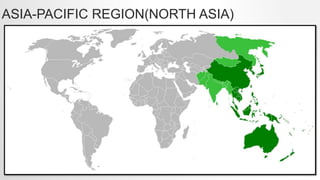
ASIA-PACIFIC REGION(NORTH ASIA)
RUSSIA(EAST OF THE URAL
MOUNTAINS)
History
• Kazakhstan was originally inhabited by nomadic tribes. In the 13th
century the land was invaded by the Mongol Empire and became
territories of the Kazakh Khanate. During this time the cities of
Taraz and Turkestan were established as trade cities along the
Great Silk Road. When the Kazakh Khanate began to break up in
the 1700s, the area began to be colonized by the Russian Empire.
After the fall of the Russian Empire, the Kazakhs experienced a
brief time of independence, but soon became part of the Soviet
Union. In 1953, Soviet leader Nikita Khrushchev started the Virgin
Lands program. This was an effort to take Kasakhstan's agricultural
based economy and industrialize it.
In 1991 with the fall of the Soviet Union, Kazakhstan became an
independent nation. The country has since made great strides in
developing a market economy and has had strong economic
growth since 2000.
KAZAKHSTAN
KAZAKHSTAN (DECEMBER 16, 1991)
Location;
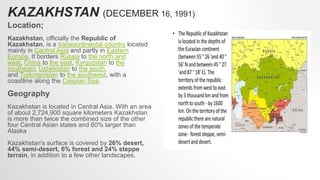
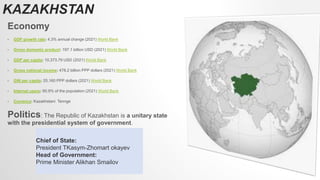
Kazakhstan, officially the Republic of
Kazakhstan, is a transcontinental country located
mainly in Central Asia and partly in Eastern
Europe. It borders Russia to the north and
west, China to the east, Kyrgyzstan to the
southeast, Uzbekistan to the south,
and Turkmenistan to the southwest, with a
coastline along the Caspian Sea.
Geography
Kazakhstan is located in Central Asia. With an area
of about 2,724,900 square kilometers Kazakhstan
is more than twice the combined size of the other
four Central Asian states and 60% larger than
Alaska
Kazakhstan's surface is covered by 26% desert,
44% semi-desert, 6% forest and 24% steppe
terrain, in addition to a few other landscapes.
KAZAKHSTAN
Natural Resources:
• Kazakhstan has an abundant supply of accessible mineral and
fossil fuel resources. Development of petroleum, natural gas, and
mineral extractions has attracted most of the over $40 billion in
foreign investment in Kazakhstan since 1993 According to some
estimates , Kazakhstan has the second largest uranium, chromium,
lead, and zinc reserves; the third largest manganese reserves; the
fifth largest copper reserves; and ranks in the top ten for coal, iron,
and gold.
Population:
The current population of Kazakhstan is 19,370,447 as of Saturday,
February 25, 2023, based on Worldometer elaboration of the latest
United Nations data.
Capital:
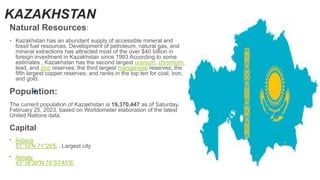
• Astana
51°10′N 71°26′E , Largest city
• Almaty
43°16′39″N 76°53′45″E
KAZAKHSTAN
Economy
• GDP growth rate: 4.3% annual change (2021) World Bank
• Gross domestic product: 197.1 billion USD (2021) World Bank
• GDP per capita: 10,373.79 USD (2021) World Bank
• Gross national income: 478.2 billion PPP dollars (2021) World Bank
• GNI per capita: 25,160 PPP dollars (2021) World Bank
• Internet users: 90.9% of the population (2021) World Bank
• Currency: Kazakhstani Tennge
Politics: The Republic of Kazakhstan is a unitary state
with the presidential system of government.
Chief of State:
President TKasym-Zhomart okayev
Head of Government:
Prime Minister Alikhan Smailov
MONGOLIA
History
The Mongols constitute one of the principal ethnographic divisions of Asian
peoples. Their traditional homeland is centred in Mongolia—a vast plateau
in Central Asia now divided politically into an autonomous region of China (Inner
Mongolia) and the independent country Mongolia (historically called Outer
Mongolia)—which lies at the eastern end of what was throughout history a great
corridor of migration between northeastern China (historically called Manchuria)
and Hungary. Physical anthropologists in the 19th century introduced the
terms Mongol and Mongolian as descriptive of “racial type” even though the
Mongols exhibited a wide range of physical characteristics. Today the Mongols
are recognized as a group of peoples bound together by a common language and a
common nomadic tradition.
MONGOLIA
Location
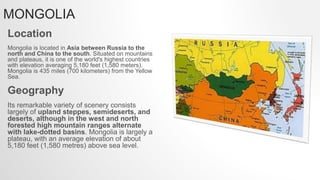
Mongolia is located in Asia between Russia to the
north and China to the south. Situated on mountains
and plateaus, it is one of the world's highest countries
with elevation averaging 5,180 feet (1,580 meters).
Mongolia is 435 miles (700 kilometers) from the Yellow
Sea.
Geography
Its remarkable variety of scenery consists
largely of upland steppes, semideserts, and
deserts, although in the west and north
forested high mountain ranges alternate
with lake-dotted basins. Mongolia is largely a
plateau, with an average elevation of about
5,180 feet (1,580 metres) above sea level.
MONGOLIA
Natural Resources
Mongolia's economy, traditionally based on herding and
agriculture, has transformed into an economy focused more on
extractive industries, spurred on by significant investment in
Mongolia by foreign enterprises. Mongolia has extensive deposits
of copper, gold, coal, molybdenum, fluorsparr, uranium, tin,
and tungsten
Population
The current population of Mongolia is 3,417,743 as of Friday,
February 24, 2023, based on Worldometer elaboration of the latest
United Nations data. Mongolia 2020 population is estimated at
3,278,290 people at mid year according to UN data.
Capital
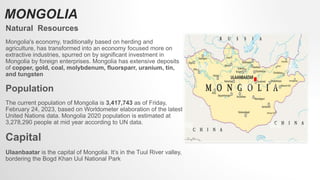
Ulaanbaatar is the capital of Mongolia. It’s in the Tuul River valley,
bordering the Bogd Khan Uul National Park
MONGOLIA
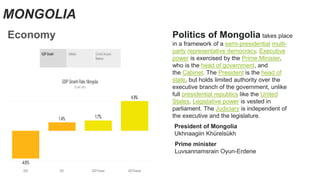
Economy Politics of Mongolia takes place
in a framework of a semi-presidential multi-
party representative democracy. Executive
power is exercised by the Prime Minister,
who is the head of government, and
the Cabinet. The President is the head of
state, but holds limited authority over the
executive branch of the government, unlike
full presidential republics like the United
States. Legislative power is vested in
parliament. The Judiciary is independent of
the executive and the legislature.
President of Mongolia
Ukhnaagiin Khürelsükh
Prime minister
Luvsannamsrain Oyun-Erdene
asia pacific.pptx

asia pacific.pptx

  • 2.
  • 3.
    RUSSIA(EAST OF THEURAL MOUNTAINS)
  • 4.
    History • Kazakhstan wasoriginally inhabited by nomadic tribes. In the 13th century the land was invaded by the Mongol Empire and became territories of the Kazakh Khanate. During this time the cities of Taraz and Turkestan were established as trade cities along the Great Silk Road. When the Kazakh Khanate began to break up in the 1700s, the area began to be colonized by the Russian Empire. After the fall of the Russian Empire, the Kazakhs experienced a brief time of independence, but soon became part of the Soviet Union. In 1953, Soviet leader Nikita Khrushchev started the Virgin Lands program. This was an effort to take Kasakhstan's agricultural based economy and industrialize it. In 1991 with the fall of the Soviet Union, Kazakhstan became an independent nation. The country has since made great strides in developing a market economy and has had strong economic growth since 2000. KAZAKHSTAN
  • 5.
    KAZAKHSTAN (DECEMBER 16,1991) Location; Kazakhstan, officially the Republic of Kazakhstan, is a transcontinental country located mainly in Central Asia and partly in Eastern Europe. It borders Russia to the north and west, China to the east, Kyrgyzstan to the southeast, Uzbekistan to the south, and Turkmenistan to the southwest, with a coastline along the Caspian Sea. Geography Kazakhstan is located in Central Asia. With an area of about 2,724,900 square kilometers Kazakhstan is more than twice the combined size of the other four Central Asian states and 60% larger than Alaska Kazakhstan's surface is covered by 26% desert, 44% semi-desert, 6% forest and 24% steppe terrain, in addition to a few other landscapes.
  • 6.
    KAZAKHSTAN Natural Resources: • Kazakhstanhas an abundant supply of accessible mineral and fossil fuel resources. Development of petroleum, natural gas, and mineral extractions has attracted most of the over $40 billion in foreign investment in Kazakhstan since 1993 According to some estimates , Kazakhstan has the second largest uranium, chromium, lead, and zinc reserves; the third largest manganese reserves; the fifth largest copper reserves; and ranks in the top ten for coal, iron, and gold. Population: The current population of Kazakhstan is 19,370,447 as of Saturday, February 25, 2023, based on Worldometer elaboration of the latest United Nations data. Capital: • Astana 51°10′N 71°26′E , Largest city • Almaty 43°16′39″N 76°53′45″E
  • 7.
    KAZAKHSTAN Economy • GDP growthrate: 4.3% annual change (2021) World Bank • Gross domestic product: 197.1 billion USD (2021) World Bank • GDP per capita: 10,373.79 USD (2021) World Bank • Gross national income: 478.2 billion PPP dollars (2021) World Bank • GNI per capita: 25,160 PPP dollars (2021) World Bank • Internet users: 90.9% of the population (2021) World Bank • Currency: Kazakhstani Tennge Politics: The Republic of Kazakhstan is a unitary state with the presidential system of government. Chief of State: President TKasym-Zhomart okayev Head of Government: Prime Minister Alikhan Smailov
  • 8.
    MONGOLIA History The Mongols constituteone of the principal ethnographic divisions of Asian peoples. Their traditional homeland is centred in Mongolia—a vast plateau in Central Asia now divided politically into an autonomous region of China (Inner Mongolia) and the independent country Mongolia (historically called Outer Mongolia)—which lies at the eastern end of what was throughout history a great corridor of migration between northeastern China (historically called Manchuria) and Hungary. Physical anthropologists in the 19th century introduced the terms Mongol and Mongolian as descriptive of “racial type” even though the Mongols exhibited a wide range of physical characteristics. Today the Mongols are recognized as a group of peoples bound together by a common language and a common nomadic tradition.
  • 9.
    MONGOLIA Location Mongolia is locatedin Asia between Russia to the north and China to the south. Situated on mountains and plateaus, it is one of the world's highest countries with elevation averaging 5,180 feet (1,580 meters). Mongolia is 435 miles (700 kilometers) from the Yellow Sea. Geography Its remarkable variety of scenery consists largely of upland steppes, semideserts, and deserts, although in the west and north forested high mountain ranges alternate with lake-dotted basins. Mongolia is largely a plateau, with an average elevation of about 5,180 feet (1,580 metres) above sea level.
  • 10.
    MONGOLIA Natural Resources Mongolia's economy,traditionally based on herding and agriculture, has transformed into an economy focused more on extractive industries, spurred on by significant investment in Mongolia by foreign enterprises. Mongolia has extensive deposits of copper, gold, coal, molybdenum, fluorsparr, uranium, tin, and tungsten Population The current population of Mongolia is 3,417,743 as of Friday, February 24, 2023, based on Worldometer elaboration of the latest United Nations data. Mongolia 2020 population is estimated at 3,278,290 people at mid year according to UN data. Capital Ulaanbaatar is the capital of Mongolia. It’s in the Tuul River valley, bordering the Bogd Khan Uul National Park
  • 11.
    MONGOLIA Economy Politics ofMongolia takes place in a framework of a semi-presidential multi- party representative democracy. Executive power is exercised by the Prime Minister, who is the head of government, and the Cabinet. The President is the head of state, but holds limited authority over the executive branch of the government, unlike full presidential republics like the United States. Legislative power is vested in parliament. The Judiciary is independent of the executive and the legislature. President of Mongolia Ukhnaagiin Khürelsükh Prime minister Luvsannamsrain Oyun-Erdene