Census 2022: Transforming
Small Area Socio-Economic
Indicators through ‘Big Data’
An ESRC Transformative Research Project
Andy Newing and Ben Anderson
a.newing@soton.ac.uk
Sustainable Energy Research Group (SERG)
University of Southampton
Outline
2
Who are we?
3
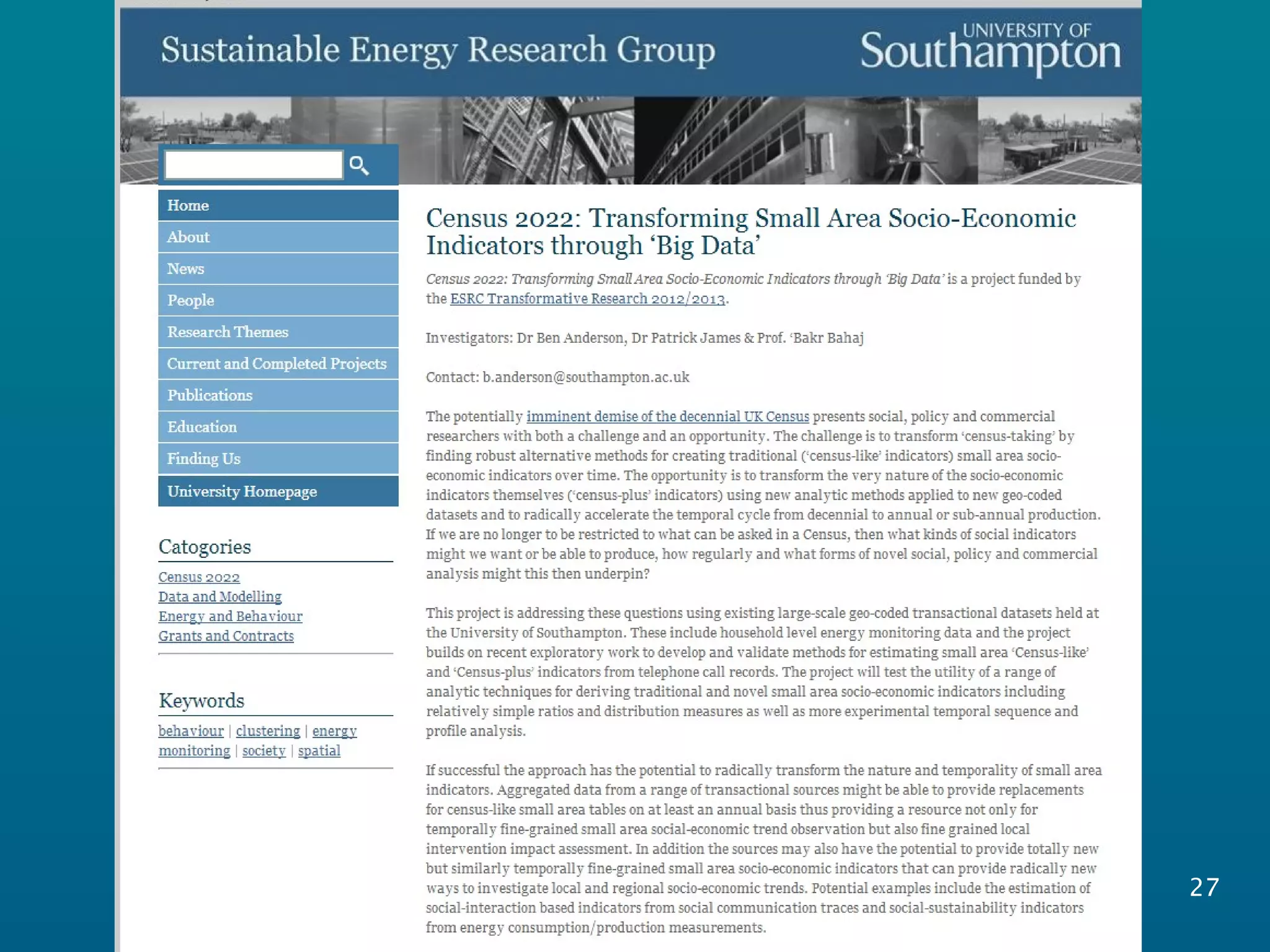
Transforming Small Area Socio-
Economic Indicators through ‘Big Data’
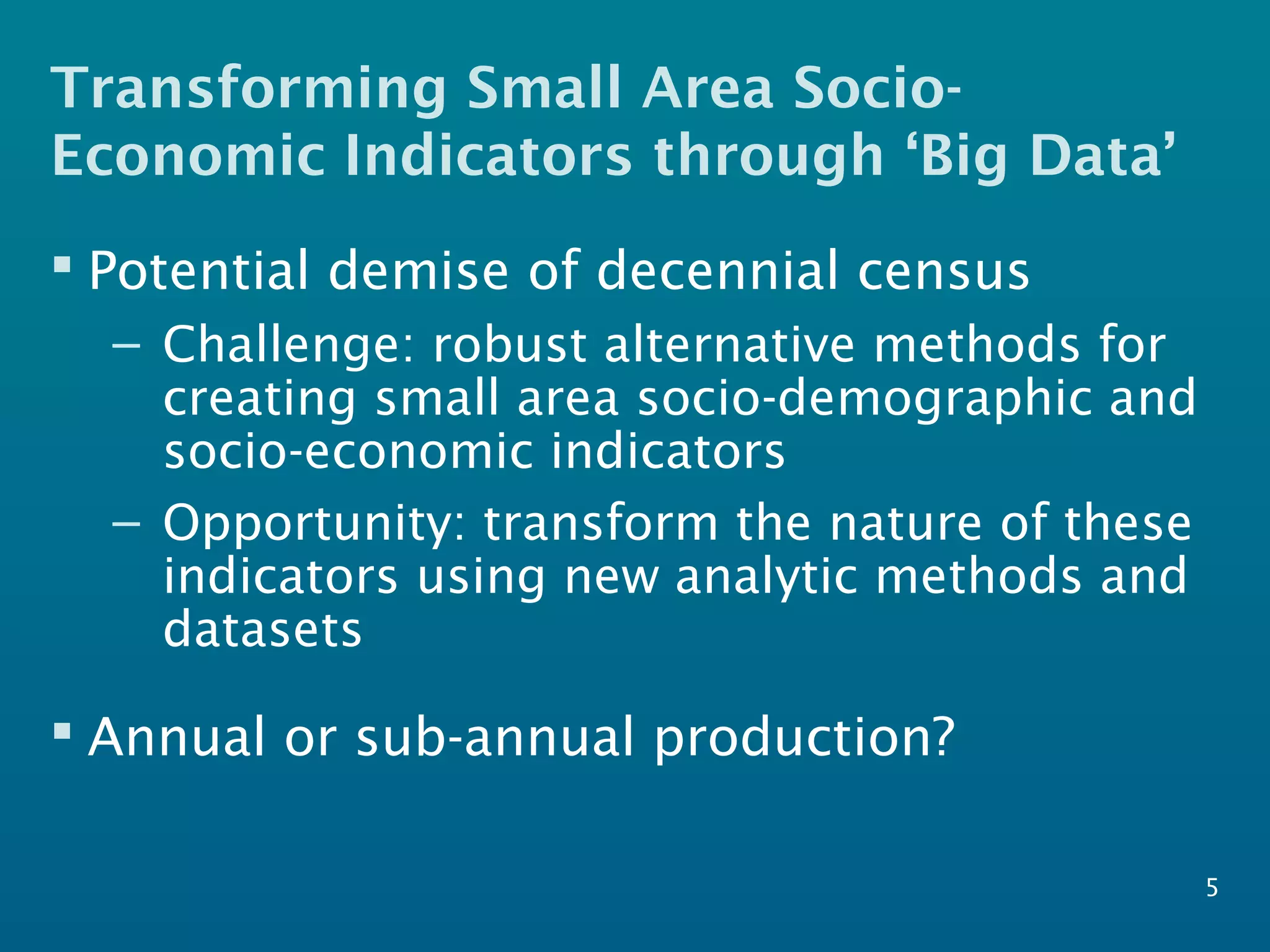
4
Transforming Small Area Socio-
Economic Indicators through ‘Big Data’
5
 Potential demise of decennial census
– Challenge: robust alternative methods for
creating small area socio-demographic and
socio-economic indicators
– Opportunity: transform the nature of these
indicators using new analytic methods and
datasets
 Annual or sub-annual production?
Commercial transactional data
 Geo-coded household data from utility
service providers - collected as part of
routine service provision
 Can we derive traditional and novel small
area population estimates and social
indicators
 Census-like and Census-plus
6
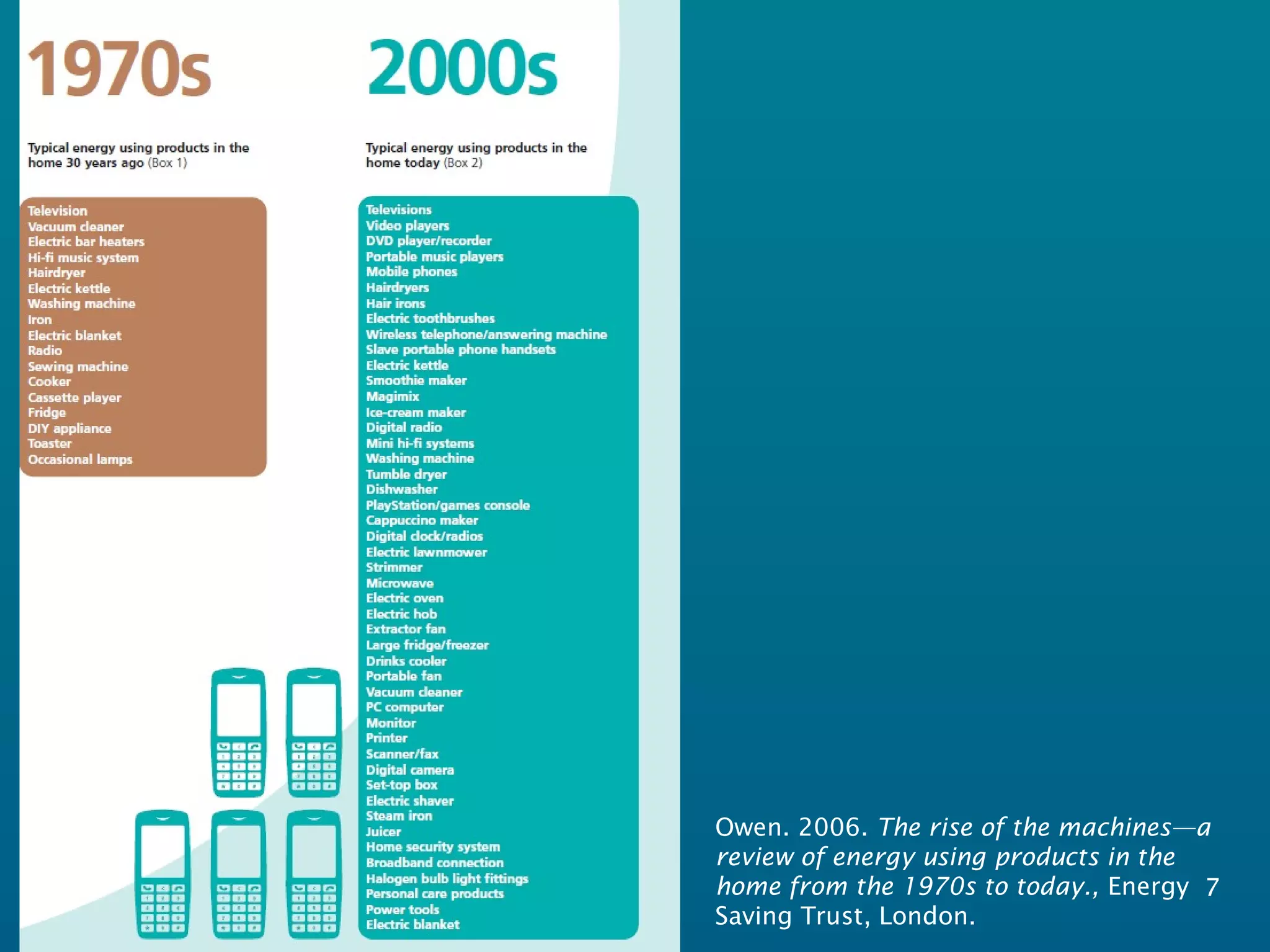
Owen. 2006. The rise of the machines—a
review of energy using products in the
home from the 1970s to today., Energy
Saving Trust, London.
7
What can utilities data reveal about
household characteristics?
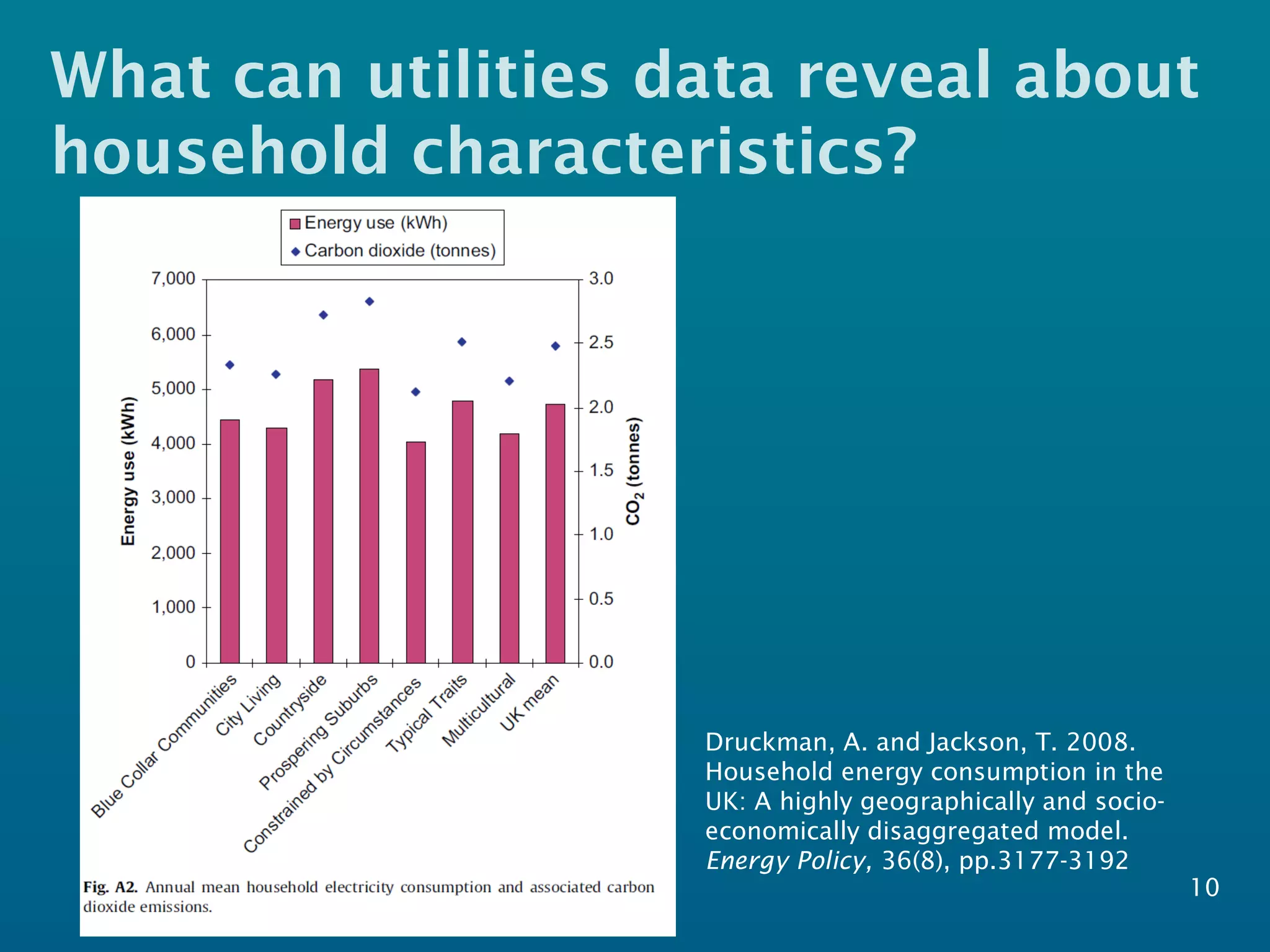
 Established links between household and
householder characteristics and energy
consumption (e.g. see AECOM 2011,
Druckman and Jackson, 2008)
 Based on understanding relationship
between end use and end users
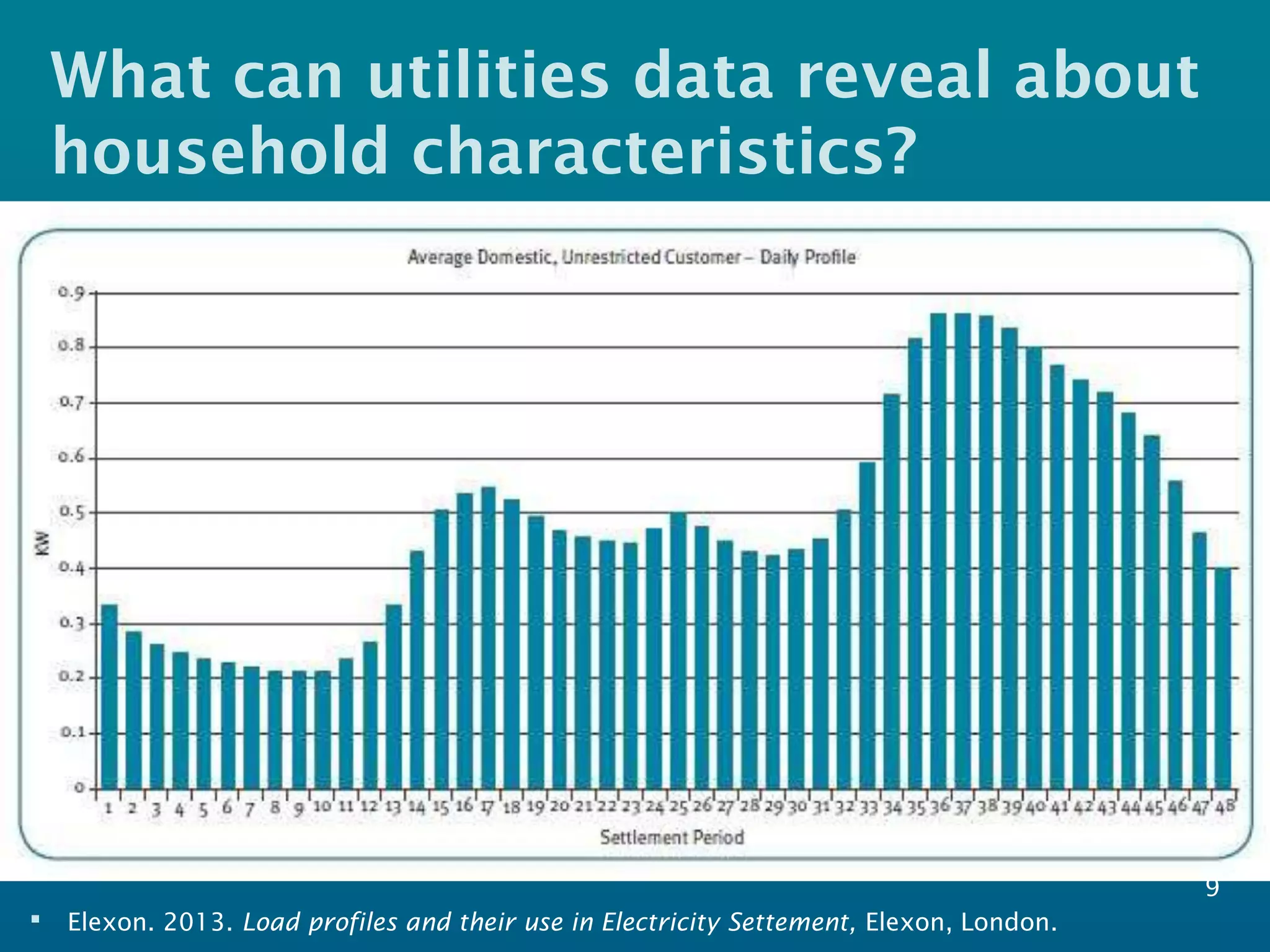
 Consumption profiles reflect ownership and
use of appliances, household size and
characteristics and routines 8
What can utilities data reveal about
household characteristics?
 Elexon. 2013. Load profiles and their use in Electricity Settement, Elexon, London.
9
What can utilities data reveal about
household characteristics?
10
Druckman, A. and Jackson, T. 2008.
Household energy consumption in the
UK: A highly geographically and socio-
economically disaggregated model.
Energy Policy, 36(8), pp.3177-3192
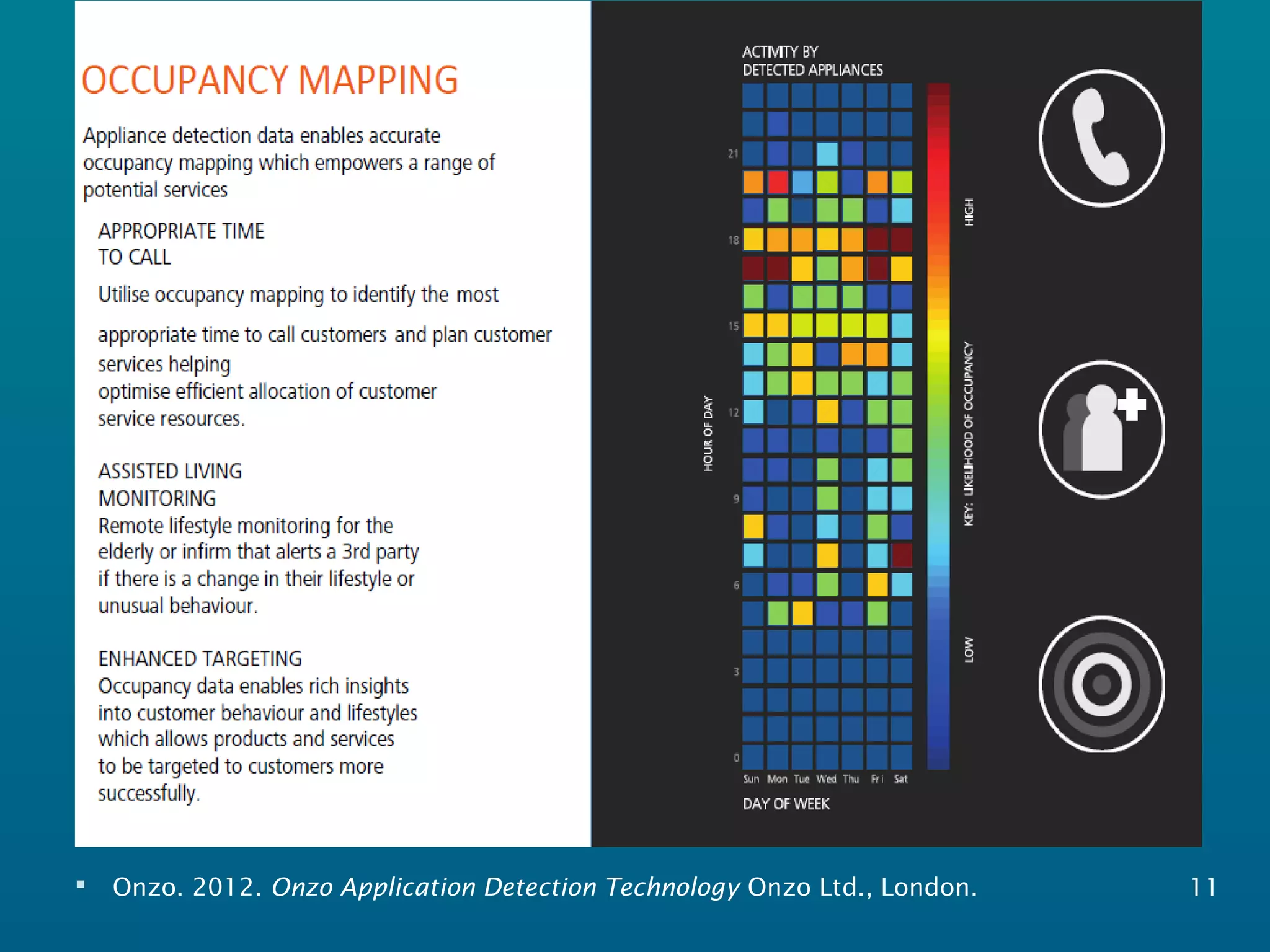
 Onzo. 2012. Onzo Application Detection Technology Onzo Ltd., London. 11
One-Minute Resolution Domestic
Electricity Use Data (2008-2009)
 Household study
 Sample of 22 households
 1 minute resolution mean power import
 Linked to (limited) survey data on
household characteristics
 This dataset alone produces over 17m
recorded observations
12
13Original dataset: Richardson, I. and Thomson, M., One-Minute Resolution Domestic Electricity Use Data, 2008-
2009 [computer file]. Colchester, Essex: UK Data Archive [distributor], October 2010. SN: 6583,
http://dx.doi.org/10.5255/UKDA-SN-6583-1.
14Original dataset: Richardson, I. and Thomson, M., One-Minute Resolution Domestic Electricity Use Data,
2008-2009 [computer file]. Colchester, Essex: UK Data Archive [distributor], October 2010. SN: 6583,
http://dx.doi.org/10.5255/UKDA-SN-6583-1.
15Original dataset: Richardson, I. and Thomson, M., One-Minute Resolution Domestic Electricity Use Data,
2008-2009 [computer file]. Colchester, Essex: UK Data Archive [distributor], October 2010. SN: 6583,
http://dx.doi.org/10.5255/UKDA-SN-6583-1.
16
Original dataset: Richardson, I. and Thomson,
M., One-Minute Resolution Domestic Electricity Use
Data, 2008-2009 [computer file]. Colchester, Essex:
UK Data Archive [distributor], October 2010. SN:
6583, http://dx.doi.org/10.5255/UKDA-SN-6583-1.
UoS ‘Smart Meter’ Data
 Household study in two areas (case and
control)
 Up to 180 households over extended
period
 Detailed survey of household
characteristics, behaviors and attitudes
 Energy use (and other attributes) at one
second resolution 17
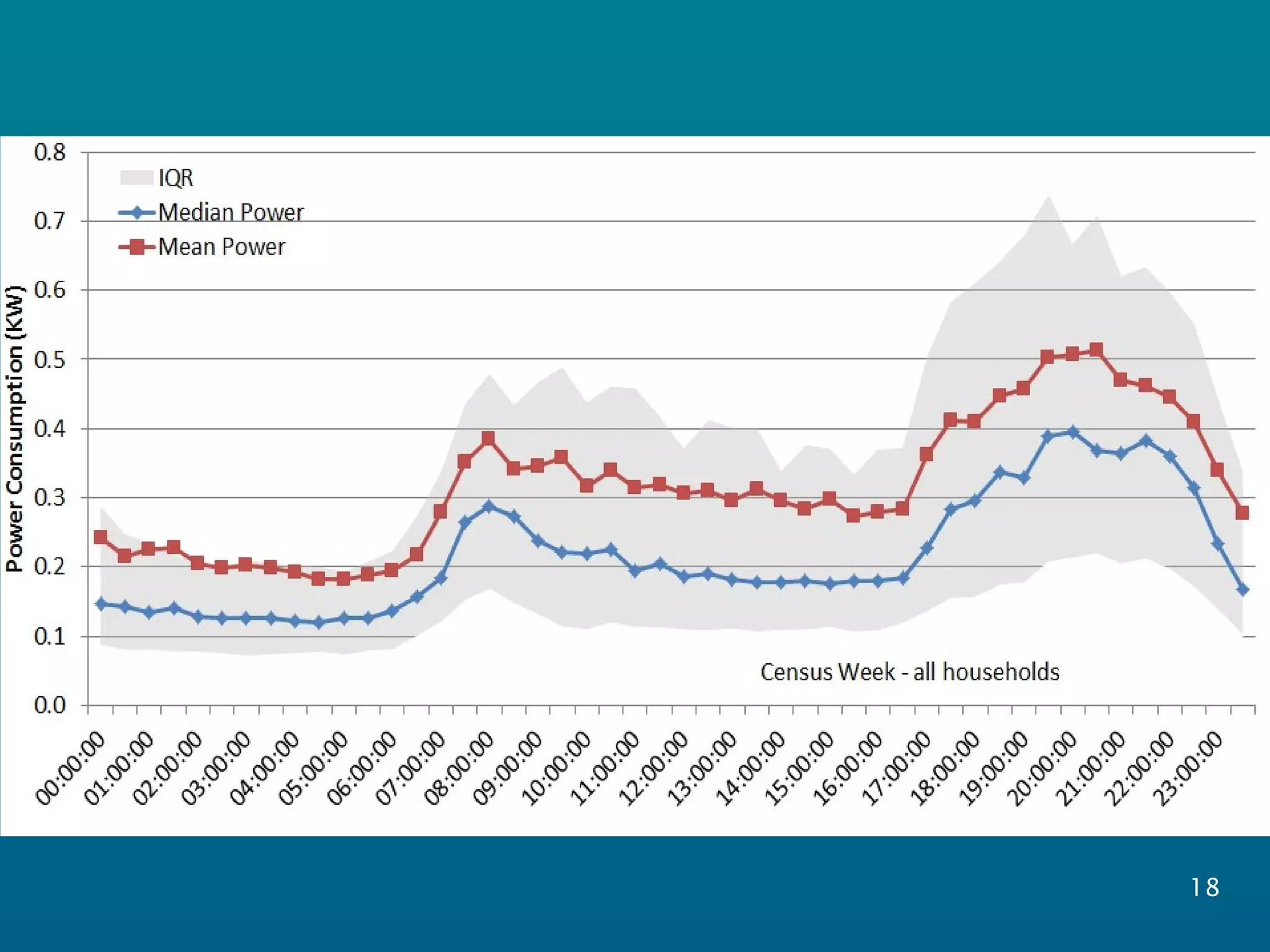
18
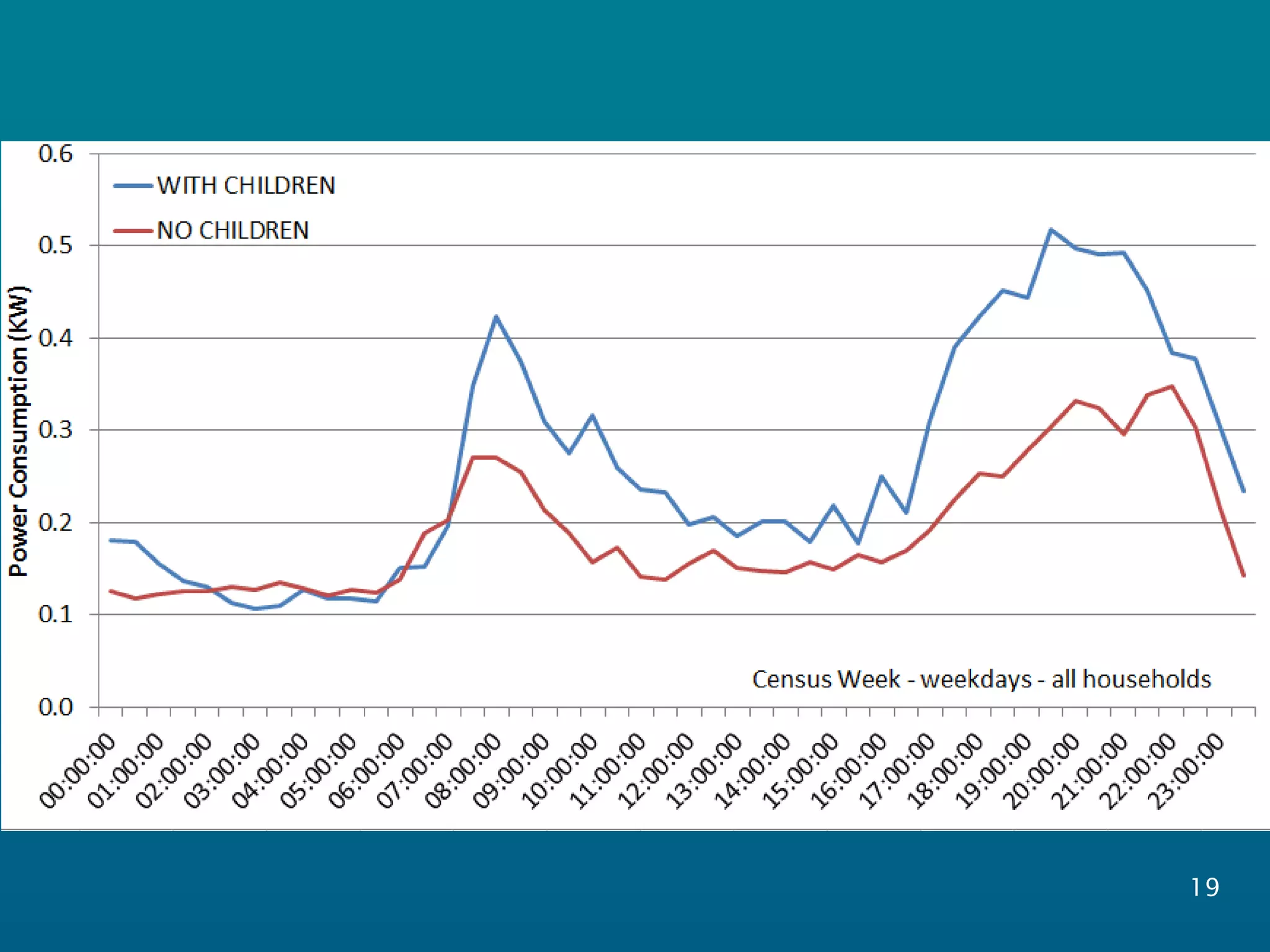
19
‘Big Data’
 Huge datasets
– UoS one second data produces over 500m
records per month!
– Aggregate and summarise but need to
understand missing data
– Nationally at 30 minute resolution – 94bn
readings per month
 Need to sample
– Spatially representative and/or temporal
– New ways of thinking about census data 20
Scope
 Not seeking to produce robust nationally
representative small area indicators ……
 Identify available datasets
 Focused exploratory work to demonstrate
the potential of these datasets
 Develop methodologies and algorithms
 Build up an interested expert stakeholder
group 21
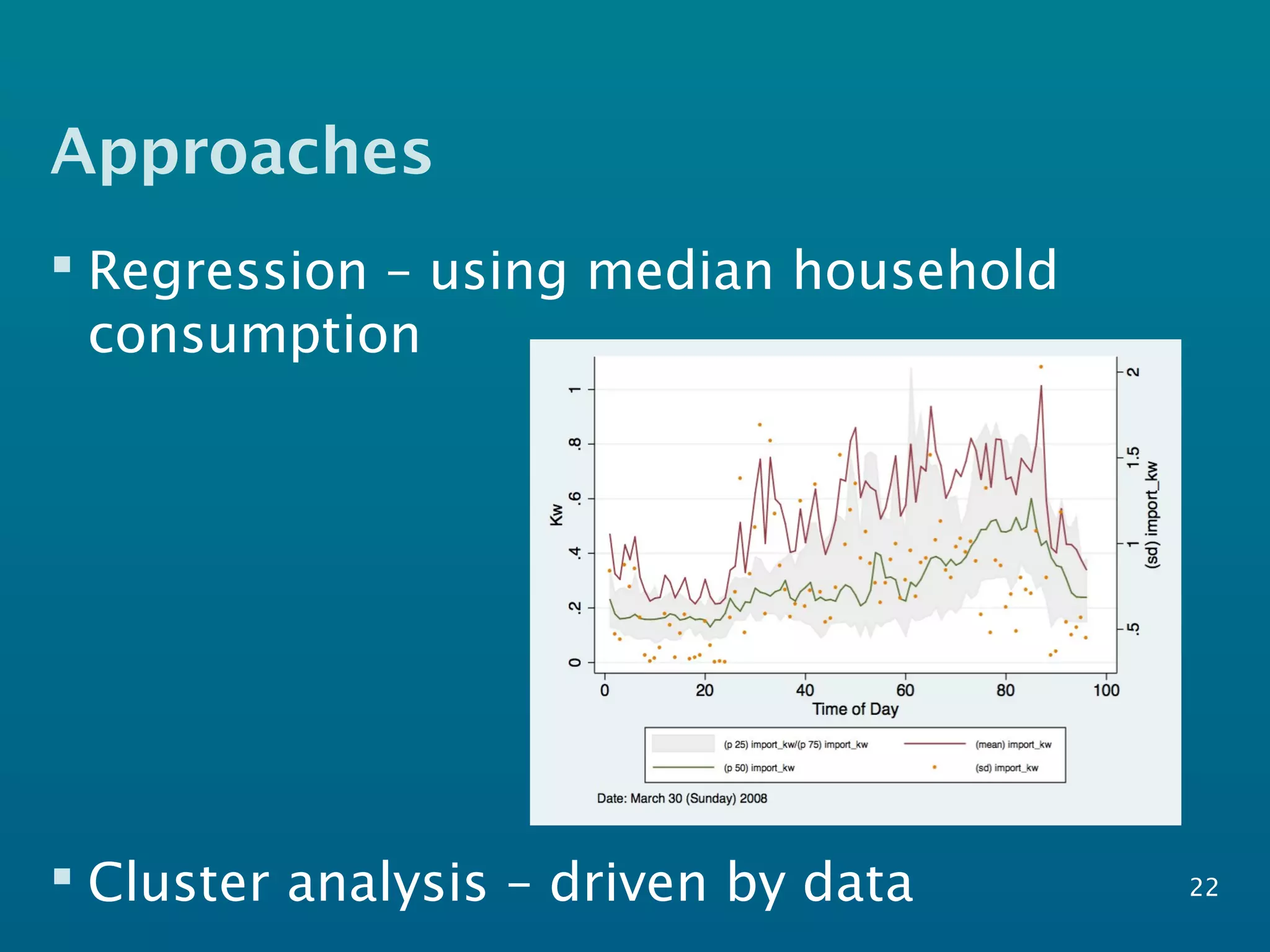
Approaches
 Regression – using median household
consumption
 Cluster analysis – driven by data 22
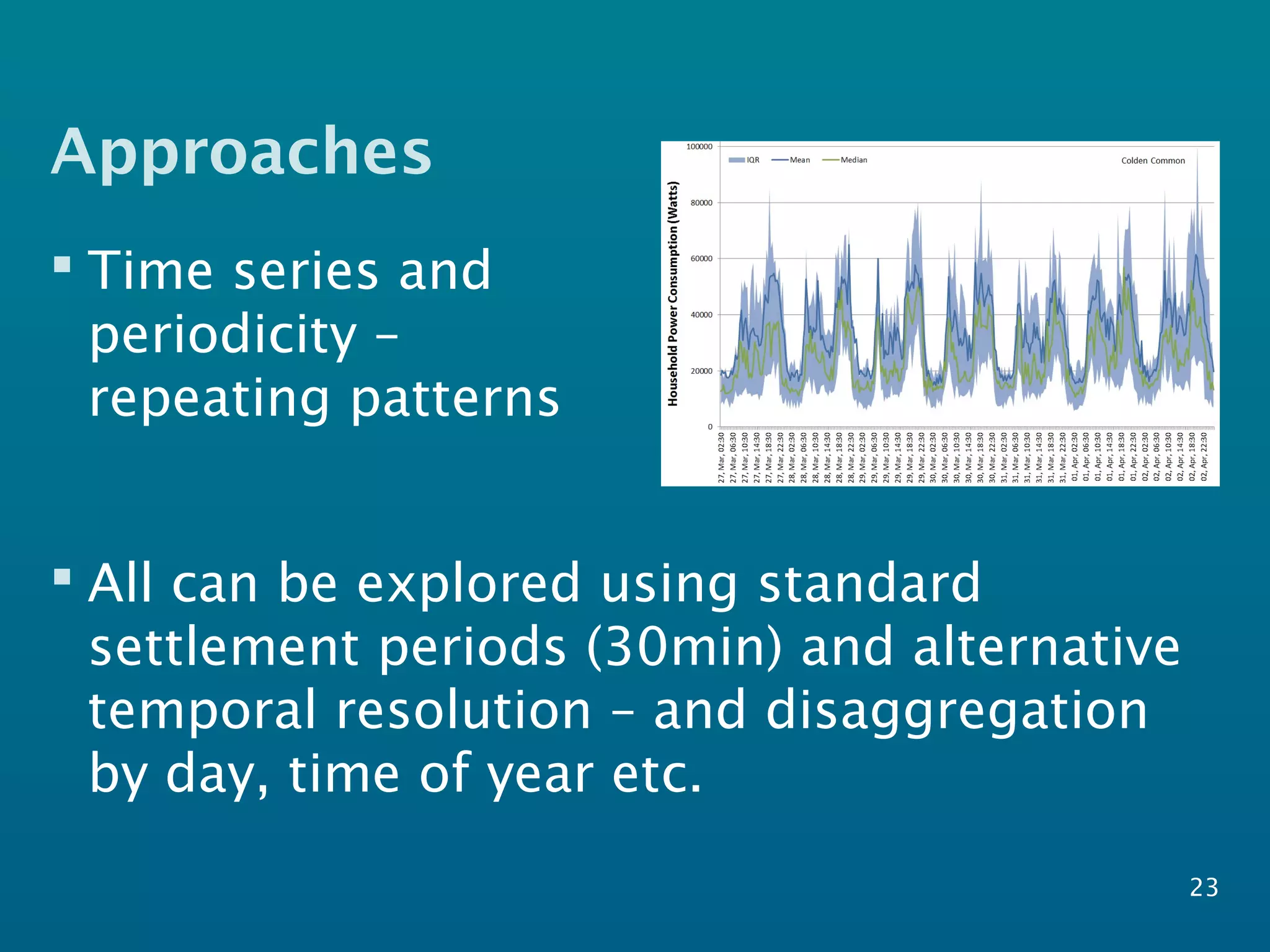
Approaches
 Time series and
periodicity –
repeating patterns
23
 All can be explored using standard
settlement periods (30min) and alternative
temporal resolution – and disaggregation
by day, time of year etc.
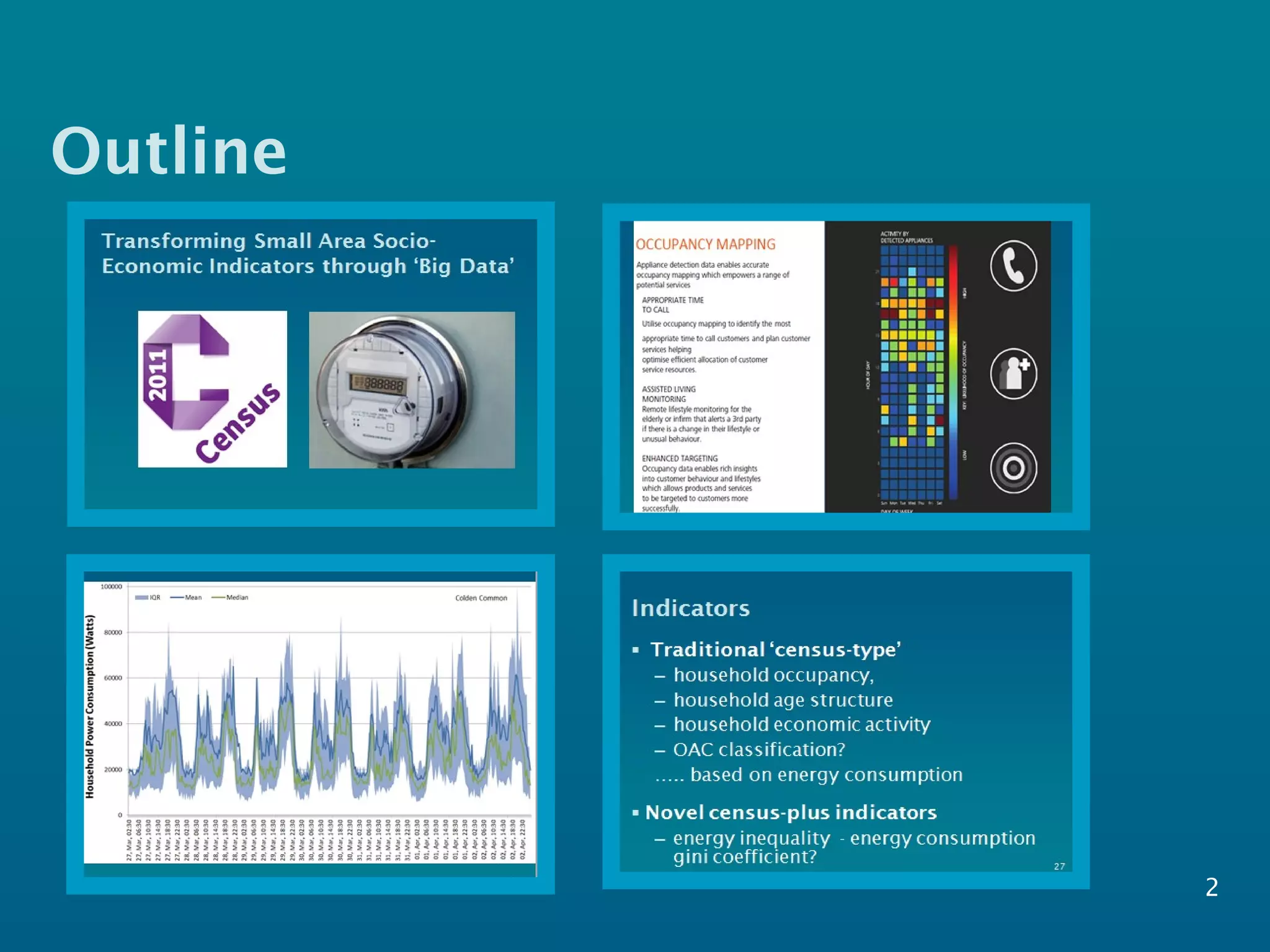
Indicators
 Traditional ‘census-type’
– household occupancy,
– household age structure
– household economic activity
– OAC classification?
….. based on energy consumption
 Novel census-plus indicators
– energy inequality - energy consumption
gini coefficient? 24
Commercial Value
25
 Almost all households consume electricity
 New source of geo-coded address point
data with household attributes
 Commercial transaction-driven ‘big data’
from utilities providers
 Cannot mask consumption – reveals actual
habits and routines!
Impacts
 Commercial data owners
 Commercial data aggregators
 Local and national authorities and similar
organisations
 Future collaborations
26
27
Questions and discussion
 To what extent is this type of thinking
already part of your business or
organisation?
 What datasets of this nature do you have
access to or might be able to share?
 What is your specific interest in work of this
nature?
 Would you be interested in contributing
further?
28
Census 2022: Transforming
Small Area Socio-Economic
Indicators through ‘Big Data’
www.energy.soton.ac.uk
/category/research/energy-behaviour/census-
/
Andy Newing
a.newing@soton.ac.uk
Sustainable Energy Research Group (SERG)

Census 2022: An overview

  • 1.
    Census 2022: Transforming SmallArea Socio-Economic Indicators through ‘Big Data’ An ESRC Transformative Research Project Andy Newing and Ben Anderson a.newing@soton.ac.uk Sustainable Energy Research Group (SERG) University of Southampton
  • 2.
  • 3.
  • 4.
    Transforming Small AreaSocio- Economic Indicators through ‘Big Data’ 4
  • 5.
    Transforming Small AreaSocio- Economic Indicators through ‘Big Data’ 5  Potential demise of decennial census – Challenge: robust alternative methods for creating small area socio-demographic and socio-economic indicators – Opportunity: transform the nature of these indicators using new analytic methods and datasets  Annual or sub-annual production?
  • 6.
    Commercial transactional data Geo-coded household data from utility service providers - collected as part of routine service provision  Can we derive traditional and novel small area population estimates and social indicators  Census-like and Census-plus 6
  • 7.
    Owen. 2006. Therise of the machines—a review of energy using products in the home from the 1970s to today., Energy Saving Trust, London. 7
  • 8.
    What can utilitiesdata reveal about household characteristics?  Established links between household and householder characteristics and energy consumption (e.g. see AECOM 2011, Druckman and Jackson, 2008)  Based on understanding relationship between end use and end users  Consumption profiles reflect ownership and use of appliances, household size and characteristics and routines 8
  • 9.
    What can utilitiesdata reveal about household characteristics?  Elexon. 2013. Load profiles and their use in Electricity Settement, Elexon, London. 9
  • 10.
    What can utilitiesdata reveal about household characteristics? 10 Druckman, A. and Jackson, T. 2008. Household energy consumption in the UK: A highly geographically and socio- economically disaggregated model. Energy Policy, 36(8), pp.3177-3192
  • 11.
     Onzo. 2012.Onzo Application Detection Technology Onzo Ltd., London. 11
  • 12.
    One-Minute Resolution Domestic ElectricityUse Data (2008-2009)  Household study  Sample of 22 households  1 minute resolution mean power import  Linked to (limited) survey data on household characteristics  This dataset alone produces over 17m recorded observations 12
  • 13.
    13Original dataset: Richardson,I. and Thomson, M., One-Minute Resolution Domestic Electricity Use Data, 2008- 2009 [computer file]. Colchester, Essex: UK Data Archive [distributor], October 2010. SN: 6583, http://dx.doi.org/10.5255/UKDA-SN-6583-1.
  • 14.
    14Original dataset: Richardson,I. and Thomson, M., One-Minute Resolution Domestic Electricity Use Data, 2008-2009 [computer file]. Colchester, Essex: UK Data Archive [distributor], October 2010. SN: 6583, http://dx.doi.org/10.5255/UKDA-SN-6583-1.
  • 15.
    15Original dataset: Richardson,I. and Thomson, M., One-Minute Resolution Domestic Electricity Use Data, 2008-2009 [computer file]. Colchester, Essex: UK Data Archive [distributor], October 2010. SN: 6583, http://dx.doi.org/10.5255/UKDA-SN-6583-1.
  • 16.
    16 Original dataset: Richardson,I. and Thomson, M., One-Minute Resolution Domestic Electricity Use Data, 2008-2009 [computer file]. Colchester, Essex: UK Data Archive [distributor], October 2010. SN: 6583, http://dx.doi.org/10.5255/UKDA-SN-6583-1.
  • 17.
    UoS ‘Smart Meter’Data  Household study in two areas (case and control)  Up to 180 households over extended period  Detailed survey of household characteristics, behaviors and attitudes  Energy use (and other attributes) at one second resolution 17
  • 18.
  • 19.
  • 20.
    ‘Big Data’  Hugedatasets – UoS one second data produces over 500m records per month! – Aggregate and summarise but need to understand missing data – Nationally at 30 minute resolution – 94bn readings per month  Need to sample – Spatially representative and/or temporal – New ways of thinking about census data 20
  • 21.
    Scope  Not seekingto produce robust nationally representative small area indicators ……  Identify available datasets  Focused exploratory work to demonstrate the potential of these datasets  Develop methodologies and algorithms  Build up an interested expert stakeholder group 21
  • 22.
    Approaches  Regression –using median household consumption  Cluster analysis – driven by data 22
  • 23.
    Approaches  Time seriesand periodicity – repeating patterns 23  All can be explored using standard settlement periods (30min) and alternative temporal resolution – and disaggregation by day, time of year etc.
  • 24.
    Indicators  Traditional ‘census-type’ –household occupancy, – household age structure – household economic activity – OAC classification? ….. based on energy consumption  Novel census-plus indicators – energy inequality - energy consumption gini coefficient? 24
  • 25.
    Commercial Value 25  Almostall households consume electricity  New source of geo-coded address point data with household attributes  Commercial transaction-driven ‘big data’ from utilities providers  Cannot mask consumption – reveals actual habits and routines!
  • 26.
    Impacts  Commercial dataowners  Commercial data aggregators  Local and national authorities and similar organisations  Future collaborations 26
  • 27.
  • 28.
    Questions and discussion To what extent is this type of thinking already part of your business or organisation?  What datasets of this nature do you have access to or might be able to share?  What is your specific interest in work of this nature?  Would you be interested in contributing further? 28
  • 29.
    Census 2022: Transforming SmallArea Socio-Economic Indicators through ‘Big Data’ www.energy.soton.ac.uk /category/research/energy-behaviour/census- / Andy Newing a.newing@soton.ac.uk Sustainable Energy Research Group (SERG)