CENSORSHIP IN CHILDREN’S
LITERATURE
Real Time Reactions from Children and Teens on the Most
Challenged Children’s Literature
DECEMBER 15, 2015
KIMBERLY HUFFORD
Advisor: Cathy Fennel
Hufford 1
TABLE OF CONTENTS
Introduction…………………………………………………………………………………………………………………………….2
History and Laws……………………………………………………………………………………………………………………..6
Challenged Picture Books…………………………………………………………………………………………………………8
In the Night Kitchen by Maurice Sendak……………………………………………………………………….8
Where Did I Come From? by Peter Mayle……………………………………………………………………..12
It’s Perfectly Normal by Robie Harris…………………………………………………………………………….15
Daddy’s Roomate by Michael Willhoite………………………………………………………………………18
And Tango Makes Three by Justin Richardson and Peter Parnell………………………………….22
Little Black Sambo by Helen Bannerman………………………………………………………………………25
Challenged Teen Chapter Books………………………………………………………………………………………………30
The Chocolate War by Robert Cormier…………………………………………………………………………30
Forever…by Judy Blume……………………………………………………………………………………………….34
The Perks of Being a Wallflower by Stephen Chbosky………………………………………………….39
The Earth, My Butt, and Other Big Round Things by Carolyn Mackler………………………….44
The Absolutely True Diary of a Part-Time Indian by Sherman Alexie…………………………….52
Julie of the Wolves by Jean Craighead George………………………………………………………………56
Voices of the Censored…………………………………………………………………………………………………………….61
Conclusion……………………………………………………………………………………………………………………………….79
Appendix………………………………………………………………………………………………………………………………….81
Bibliography…………………………………………………………………………………………………………………………….83
Hufford 2
INTRODUCTION
“Congress shall make no law respecting an establishment of religion, or prohibiting the
free exercise thereof; or abridging the freedom of speech, or of the press; or the right of the
people peaceable to assemble, and to petition the Government for a redress of grievances.1”
The first Amendment of the United States Constitution: What does it mean? It means
that the government is prohibited from making any laws limiting what its citizens can publish
and/or talk about. As anything else in the world, though, there are exceptions. In this case, the
exceptions include obscenity, child pornography, and threats. Everything else is fair game.
That doesn’t mean, however, that other people won’t try to prevent the general public
from seeing things they don’t like. Book banning has been around since the beginning of the
written word. There has never been a shortage of people who are offended by what someone
else has to say. It is difficult to believe that in the year 2015, people all over the world are still
trying to dictate what other people should and should not be allowed to read.
Each year, the American Library Association publishes a list of frequently challenged
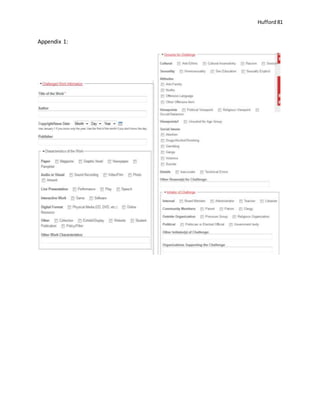
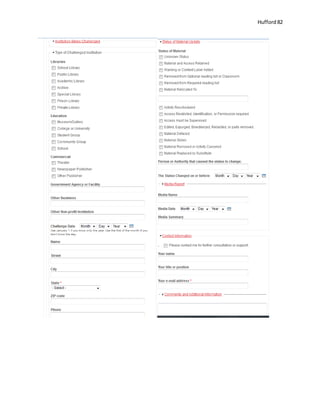
books. Even though they have an easy-to-use tab for reporting censorship cases (Appendix 1), it
is estimated that nearly 85% of cases are never reported, making it difficult to determine
exactly how often it happens2. When it comes to adults, it’s easy enough to make our own
decisions about what we read, but what about the kids who aren’t old enough to make those
decisions yet?
1 "U.S. Constitution-Amendment 1." Usconstitution.net. 2010. Accessed July 6, 2015.
http://www.usconstitution.net/xconst_Am1.html.
2 "Frequently Challenged Books." American Library Association.Accessed July 20,2015.
http://www.ala.org/bbooks/frequentlychallengedbooks.
Hufford 3
All parents want to do the best they can for their children. Parents raise their children to
hold certain beliefs and moral standards. And censoring what your own child has access to is
one thing, but telling other people what their children should not be allowed to read is no
better than someone telling you what your child should read.
What makes for the most common reasons that someone would want a book banned?
What are some of the effects the successful banning of certain books could have on society?
And do children really understand what it is that is so controversial about the books they’re
reading? Banning books has a long, sordid history. There is no shortage of reasons or excuses as
to why a book is not appropriate for a particular age group. And though our freedom of speech
allows us to publish just about anything, it does not prevent others from challenging our
motives. This study will look into the history of book banning and how censorship laws have
evolved, paying particular attention to children’s literature and how this hinders the creative
process and ultimately shelters our youth from tough but necessary topics. With opinions from
parents and children themselves, ranging in age from five to sixteen, we will dive deeper into
these issues. Do the younger ones get it? Do they know why other people are upset about the
pictures in their books? And do the older ones see anything harmful about the words they are
reading?
In a society where diversity is becoming more and more accepted, there are dangers to
restricting what our children have access to – not just to them, but to others as well. What are
the advantages – if any – to sheltering our children from the real world?
How do we decide if something should be banned or not? How do we justify the
publication of something that contains controversial material? In the first Amendment Case,
Hufford 4
Roth v United States in 1957, Samuel Roth was accused of sending obscene material in the mail.
From this case, it was determined that obscene material was not protected under the First
Amendment3. Stemming from that ruling, and the case of Miller v California in 1972, we
acquired the Three-Prong Obscenity Test, commonly called the Roth Test, in an effort to define
what obscenity really is. The three points that must be considered when deciding whether a
work is obscene or not are as follows:
1) Whether “the average person, applying contemporary community standards” would
find that the work, taken as a whole, appeals to the prurient interest
2) Whether the work depicts or describes, in a patently offensive way, sexual conduct
specifically defined by the applicable state law, and
3) Whether the work, taken as a whole, lacks serious literary, artistic, political, or
scientific value. If a state obscenity law is thus limited, First Amendment values are
adequately protected by ultimate independent appellate review of constitutional
claims when necessary4.
While the books I am focusing on don’t necessarily fall into the obscene category, I
believe the phrasing in the first and third prong, “the work, taken as a whole,” can be applied to
any censorship case. It’s easy to take selected passages fromanything and find offense. Taken
out of context, almost anything can be twisted and construed to mean what you want it to
mean. When it comes to art, and literature, and other forms of entertainment and knowledge,
3 "Roth v. United States." Legal Information Institute. Accessed August 31,2015.
https://www.law.cornell.edu/supremecourt/text/354/476.
4 "Thee Prong Obscenity Test." July 21, 1997.Accessed August 31, 2015.
http://courses.cs.vt.edu/cs3604/lib/Censorship/3-prong-test.html.
Hufford 5
we must consider the whole work. We must look at all aspects of the work, and find the moral
lessons or the societal importance in the work. And most importantly, we must be realistic.
A quick internet search brings up many articles on why books are banned:
5
5 https://www.google.com/?gws_rd=ssl#q=why+are+books+banned. Accessed August 30,2015.
Hufford 6
For purposes of time and space, I am focusing on four of those reasons: sex and nudity,
homosexuality, and racism. It is my goal to illustrate why it is important not to let the censors
dictate what children can read.
HISTORY AND LAWS
Although the first printing press was created by Johannes Gutenberg in 1436, it is
believed that book printing existed long before that. Movable clay type (as opposed to
Gutenberg’s movable wooden or metal type) was invented in China in 1041. Prior to that, the
earliest known printed book was in 868 BCE6. In 1559, the Index of Prohibited Books was
released by the Catholic Church, but was not published until 19097. The list featured titles that
Catholics were prohibited from reading or owning. Some of the reasons for books appearing on
this list included: expressing ideas contrary to Catholic morals; contrary to Catholic teachings;
theological errors; or posing a threat to the Roman Catholic hierarchy. The Index was regularly
updated through 1948, before finally being abolished in 1966 by Pope Paul VI8.
The first reported case of a book banning in America was Thomas Morton’s New English
Canaan in 1637. The reason for the banning was because Morton presented a sympathetic view
towards Native Americans after the Puritans’ attack on the colonies9. The Bill of Rights, which
includes the First Amendment, went into effect in America on December 15, 1791, nearly 160
6 Bellis,Mary."Johannes Gutenberg and the PrintingPress."About Money. 2015.Accessed August 31,2015.
7 "Index of Prohibited Books." Catholic Online.2015.Accessed August 31, 2015.
http://www.catholic.org/encyclopedia/view.php?id=6083.
8 Cline,Austin. "Index of Forbidden Books (Index of Prohibited Books)." About.com. 2015. Accessed August 31,
2015.http://atheism.about.com/library/glossary/western/bldef_indexbooks.htm
9 Miller,Jim. "America’s FirstBanned Book and the Battle for the Soul of the Country." San Diego Free Press.
September 22, 2014.Accessed August 31,2015. http://sandiegofreepress.org/2014/09/americas -first-banned-
book-and-the-battle-for-the-soul-of-the-country/
Hufford 7
years after Morton’s book was banned. It was put in place to guarantee the country’s citizens
the freedom to practice their own religion and to rally for social change. It also gave the media
the right to write about what they chose, which included criticisms of the United States
government10. Throughout the nineteenth-century, various political figures rallied to change
the laws. Despite this, less than twelve First Amendment cases were brought before the
Supreme Court until 1889. At that time, one lobbyist, Anthony Comstock, persuaded Congress
to pass the Comstock Law. The Comstock Law targeted those publishing and circulating
obscenity through the mail. This included anything related to contraception or abortion, or
anything considered “obscene, lewd, or lascivious”11.
In 1919, the case of Schenck v U.S., brought our first real exception to the First
Amendment. During this case, Charles Schenck was accused of encouraging World War I
draftees to dodge the draft. From this, U.S. Supreme Court Justice Holmes determined that if
“words used are used in such circumstances and are of such a nature as to create a clear and
present danger that they will bring about the substantive evils that Congress has the right to
prevent.” What this means is that if someone challenges the government, or interferes with
official government business, his right to free speech is not upheld.12
Nearly 40 years later, in 1957, we got the second exception to the First Amendment –
the obscenity law that was discussed previously that brought us the Roth test. And finally, in
10 "About the FirstAmendment." FirstAmendment Center. Accessed July 1, 2015.
http://www.firstamendmentcenter.org/about-the-first-amendment.
11 “FirstAmendment Timeline.” FirstAmendment Center. Accessed July 1, 2015.
http://www.firstamendmentcenter.org/about-the-first-amendment
12 Ibid.
Hufford 8
1982, the third exception was added – child pornography13. One could argue that these
exceptions went against the very thing the First Amendment was put forth to protect. Little by
little, free speech was being challenged and stripped away. But, what’s changed since then?
What kinds of publications are still being challenged today?
CHALLENGED PICTURE BOOKS
This thesis will concentrate specifically on children’s literature, therefore, I will start
with picture books. The books I examined are In the Night Kitchen by Maurice Sendak, Where
Did I Come From? by Peter Mayle, It’s Perfectly Normal by Robie Harris, Daddy’s Roommate by
Michael Willhoite, And Tango Makes Three by Justin Richardson, and The Story of Little Black
Sambo by Helen Bannerman. Although not considered a traditional picture book, I have
included It’s Perfectly Normal, because it does use pictures as an aid to the text.
In the Night Kitchen by Maurice Sendak
In the Night Kitchen was originally published in 1970. It was written and illustrated by
Maurice Sendak and received several awards, including
Outstanding Children’s Books of 1970, and a Caldecott
Honor in 1971. Barnes and Noble has the age range for
this book listed at 3-614. It’s a pretty harmless picture
book about a young boy named Mickey who dreams
about being baked into a cake. It’s funny, and childish,
13 “FirstAmendment Timeline." FirstAmendment Center. Accessed July 1, 2015.
http://www.firstamendmentcenter.org/about-the-first-amendment.).
14 “In the Night Kitchen." Barnes & Noble. 1997.Accessed September 1, 2015.
http://www.barnesandnoble.com/w/in-the-night-kitchen-maurice-sendak/1100417977?ean=9780064434362
Hufford 9
but charming. So, why was it challenged? It
depicts nudity. Some believe that the pictures15
teach children that molestation is okay and that
it desensitizes children to nudity16. Librarians
censored their versions of the book by painting
diapers or pants over young Mickey’s genitals,
like in the picture shown below. In the copy of
the book I borrowed from the library, it was
obvious that there was an attempt to cover the little boy’s private area, with a white mark close
to his genitals, assumedly left from whatever was placed there as a cover. In some
extreme cases, the book was even burned17.
In a letter to one of those librarians, Sendak’s editor, Ursula Nordstrom wrote:
“…At first, the thought of librarians painting diapers or pants on the
naked hero of Sendak’s book seems amusing, merely a harmless eccentricity on
the part of a prim few. On reconsideration, however, the behavior should be
recognized for what it is: an act of censorship by mutilation rather than by
obvious suppression18.”
She also mentions that it is, in fact, the adults who take issue with the pictures, and
not at all the children, saying “I think young children will always react with delight to such a
15 Sendak, Maurice.1970.In the Night Kitchen. New York, New York: Harper & Row Publishers.
16 "MauriceSendak's In the Night Kitchen Is a Banned Book?" 7x7.September 11, 2009.Accessed August 13, 2015.
http://www.7x7.com/arts/maurice-sendaks-night-kitchen-banned-book
17 "Case Study: In the Night Kitchen." Comic Book Legal Defense Fund. June 23, 2015. Accessed July 7, 2015.
18 Ibid.
Hufford 10
book as In the Night Kitchen, and that they will react creatively and wholesomely. It is only
adults who ever feel threatened by Sendak’s work19.
In an effort to test that theory, I read this book to four children, between the ages of
five and six. During my first visit with Alice (age five), she decided she wanted to read it to me
instead of me reading it to her, which consisted of her turning the pages and making up her
own story to match. I thought that was an excellent idea, as it obviously drew most of her
attention to the pictures and not the words. The wonderful thing about Alice was that she did
giggle at the pictures of Mickey being naked – but, she giggled at his behind, not at his penis.
The pictures were a wonderful way for Alice to let her own imagination take hold, and relate
them to her own experiences. When I asked her if she liked the book, her response was, “yeah,
he’s got his boobies out!” Saying this, it was evident that she noticed his nudity, but she’s
obviously not attributing them to anything, since he clearly doesn’t have “boobies.” Kids like
toilet humor and they think nudity is funny, but I did not see any adverse reaction from her
when she saw his penis. She didn’t even notice it20.
Next, I read to and spoke with Walter and Leigh (ages six and five, respectively). These
two, unfortunately, were so distracted by Mickey’s nudity that we were unable to finish the
book. Twice, they asked me to go back to the page where he was naked so they could see it
again. After the first time, I refused to do so, because I knew what they wanted to see. This
reading proved that this particular book wasn’t for them, which was fine. However, the reaction
I got from these children I read to was not as I expected. I imagine that some child somewhere
19 "Case Study: In the Night Kitchen." Comic Book Legal Defense Fund. June 23, 2015. Accessed July 7, 2015.
20 Strain,Alice. Interview by author. July 17, 2015
Hufford 11
must have had the same reaction as Walter and Leigh in order for parents to be troubled by it,
possibly challenging it. So, thank you to Walter and Leigh for showing me the other side of the
argument21.
After Walter and Leigh, I read to and spoke with five-year-old Jasper or Jazz. Jazz’s
reaction was the complete opposite of Walter and Leigh’s, which proves that reactions don’t
often justify censoring. From the very beginning, Jazz was incredibly excited to have me read to
him. He talked my ear off when I arrived about his favorite video game, and interrupted me
throughout some other books we read to tell me stories or random facts about the pictures.
He’s an incredibly smart and well-spoken child. When we read In the Night Kitchen, his only
reactions were “uh oh” and “what happens next?” He never commented on, noticed, or even
registered the fact that Mickey was naked – he was simply interested in the story. And when I
asked him after the book was finished what he thought of the pictures, his response was “they
were pretty sill” (which, according to him, is short for “silly”). And then, he immediately asked
me to read the next book in our pile22.
The conclusion is that every child is different. All four children had different reactions to
Little Mickey, but all of the parents agreed that the book was harmless, even if some of them
thought it was a little weird. This proves the theory that most children will react creatively and
wholesomely when presented with this book and being exposed to it does not desensitize
them, or give them inappropriate thoughts about molestation. The nudity is viewed as a funny
addition to the story by the children and nothing more.
21 Hauk, Walter and Leigh Hauk. Interview by author. July 30, 2015.
22 Raichle,Jasper.Interview by author. August 6, 2015.
Hufford 12
Where Did I Come From? by Peter Mayle
Originally published in 1977, Peter Mayle’s picture book about sex has been the center
of controversy for some time. It most recently appeared on the American Library Association’s
Banned Books list for 1990-1999 at number 7923 for its sexual content. When most people see a
picture book, they assume it’s for small children, roughly three through seven years old. But,
that’s not always the case, as there are picture books written on themes that are meant for
older children. Sometimes pictures are added simply to illustrate a point and make something
clearer, rather than add to a story, which is the case with Where Did I Come From?. Even
though this book is actually intended for a young audience, Barnes and Noble has the age range
listed as 6-924.
This is the only picture book I used for my research that I never read to the children.
When I went to read to Walter and Leigh, I immediately handed the book to their mother, Lisa.
I wanted her opinion before I read it to them. I told her that because of the subject matter, I
was uncomfortable being the one to have the where babies come from conversation with her
children. But if she thought it was okay after reading the book, then we would discuss that and
the book. She immediately chuckled at the title and asked Walter, “where did you come from?”
His answer was simple – and accurate: “you.” While I read the children other books on our list,
Lisa reviewed Where Did I Come From? When she finished, she handed it back and said, “Yeah,
I’m not sure about this one. Mostly because of the pictures. And it doesn’t seem age
23 “100 Most Frequently Challenged Books: 1990-1999.”ala.org.2015.Accessed November 7, 2015.
http://www.ala.org/bbooks/100-most-frequently-challenged-books-1990%E2%80%931999.
24 "Where Did I Come From?" Barnes & Noble. 2105. Accessed September 1, 2015.
http://www.barnesandnoble.com/w/where-did-i-come-from-peter-mayle/1107916914?ean=9780818402531
Hufford 13
appropriate.”25 Until that point, I considered it a book written for young children, under the age
of eight. But, her response made me think. Just because it has pictures, doesn’t mean it’s for
children that young. My own sex education did not begin in school until the fourth grade, so
maybe she was right. Although I decided not to read this book to her children (or anyone
else’s), I did analyze it.
The first time I read Where Did I Come From?, I was also surprised, but not by the
illustrations. I thought the pictures were acceptable, because I believe it’s important for kids to
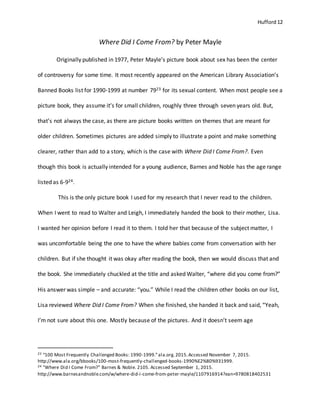
know about anatomy and the differences between a boy and a girl. So, these pictures didn’t
bother me:
What I did have a problem with was the way sex was described. After explaining the facts, Peter
Mayle mentions this:
“Now you may be thinking: if it’s so nice, why don’t people do it all the time?
There are two reasons.
First, it’s very tiring. More than playing football, or running, or skipping, or
climbing trees, or almost anything. Good as it is, you just don’t do it all day long.”26
25 Hauk, Walter and Leigh Hauk. Interview by author. July 30, 2015.
26 Mayle, Peter. 1977. Where Did I Come From? New York, New York: Kensington PublishingCorp.
Hufford 14
I, personally, found it odd to describe sex as nice when explaining it to a child. The rest of the
page seemed to be a bit more child-friendly to me:
“And the second reason is that something really wonderful happens which puts
an end to the tickly feeling, and at the same time starts the making of the baby.
When the man and the woman have been wriggling so hard you think they’re
both going to pop, they nearly do just that. All the rubbing up and down that’s been
going on ends in a tremendous big lovely shiver for both of them.”27
From there, Mayle explains the process of the sperm meeting the egg and the development of
the baby, which is great. But, I’m questioning his way of explaining how wonderful sex is. After
taking into consideration the suggested age range, that changed my opinion a bit. I believe an
eight- or nine-year-old of a certain maturity would be able to comprehend the facts in this
book. Even though some reviewers have said:
“My parents gave me this book when I was six years old and I still appreciate
how clearly it explained sex in an age appropriate manner. Every kid on my block
benefited from this book, which meant we had the appropriate relevant facts without
ever falling prey to misinformation,”28
I still wanted to respect the parent’s wishes when it came to such a sensitive subject. I am
satisfied with my decision not to read it, because all of the children I interviewed were below
the suggested age range. It was not my decision what books those children could be exposed
to, and while Lisa did think it was a bit too mature for her children, she made no other
comments about it. She was not upset about it existing, and she did not say that it was
inappropriate for all children – just for hers. I did choose not to read it to the rest of the
27 Ibid.
28 Rawson, Diane.2014. powells.com. September 21. Accessed November 7, 2015.
http://www.powells.com/book/where-did-i-come-from-9780818402531.
Hufford 15
children, since Walter and Leigh were the oldest ones I spoke to, but based on the experiences I
had with the other parents, I think their reactions would have been the same. The review above
does show that some young children have gotten great information from the book, and as
adults, are able to appreciate the fact that it was presented to them in an age-appropriate and
factual way.
It’s Perfectly Normal by Robie Harris
Although this book is not technically considered a picture book, I’m including it in this
section because of its use of pictures to illustrate important themes or lessons. Originally
published in 1995, It’s Perfectly Normal: Changing Bodies, Growing Up, Sex & Sexual Health has
consistently been banned due to the nudity portrayed in the book. Nearly 20 years ago, in 1996,
the book was challenged in Washington, because it was believed to be “an act of
encouragement for children to begin desiring sexual gratification…and is a clear example of
child pornography.”29 More recently, in 2002, it was reclassified as an adult book in a Texas
school district because of its content. It was argued that the book tried to “minimize or even
negate that homosexuality is a problem.”30 A book about puberty, it lists on the front cover that
it is intended for children ages ten and up, and it covers everything from puberty to sex to
adoption. It presents relationships from all angles, and all varieties, which is where the
29 Crispin,Jessa.2012. kirkusreviews.com. September 25. Accessed November 7, 2015.
https://www.kirkusreviews.com/features/robie-h-harris-challenges-banned-books/.
30 Ibid.
Hufford 16
homosexual theme comes in.31 It defines homosexuality and transgender in a short section
during the fifth chapter, which it follows up with a lesson on acceptance and tolerance:
“No matter what some people may think, it’s always important for every
person to remember to treat all people with respect. And it’s important to know
that a person’s daily life – making a home, having friends and fun, working, being
in love, being single, being a partner, being married, raising children – is mostly
the same whether he or she is straight, gay, bisexual, or transgender.”32
When I first flipped through it, I thought this is going to be hard to defend
because of the first picture that caught my eye which was this one:
However, after reading the book, I realized I
made the same mistake that censors
everywhere make. I took the picture out of
context. Taken out of context, it is a bit
jarring, and I can completely understand why
parents would be troubled by it. But, it’s
accompanied by some really great facts – and an explanation for the picture:
“In all, from front to back, there are three openings between a female’s legs: the
opening to her urethra, the opening to her vagina, and her anus. If a girl or a woman is
curious about what these openings look like, she can hold a mirror between her legs and
take a look33.”
31 Harris,RobieH. It's Perfectly Normal: Changing Bodies, Growing Up, Sex, and Sexual Health. 20th Anniversary
Edition ed. Somerville, Massachusetts:Candlewick Press,2014.
32 Ibid,page 11.
33 Ibid,page 17.
Hufford 17
Considering the intended audience for this book, this was an appropriate way to explain the
illustration.
While I wasn’t able to talk to any children very thoroughly about this particular book,
twelve-year-old Maya told me that in sixth grade (age eleven for her), they began studying their
bodies and “how everything works.” And while they hadn’t begun studying how to keep
themselves safe during sex yet, her brother, Kevin (age sixteen) let me know that she would be
studying it the next year. Even though Kevin had already had sex education, both of them are
still in the targeted age range for this particular book. I did show it to their dad before
discussing the book with them, since I wasn’t sure what they already knew. He flipped through
it and asked Kevin if Maya had started studying some of it yet, but was generally unconcerned. I
mentioned the book to the kids and Kevin immediately said it was probably banned because of
the pictures, saying “it probably doesn’t need that.” They both let me know that during their
sex education, they were shown a lot of charts, but not really any graphic pictures. When I
mentioned to them that I thought many of the pictures enhanced the text, I then asked if they
thought that was helpful. Referring to the full-page spread featuring pictures of many different
body types, I asked if that was something that helped them understand their bodies, and that
they are normal. Maya responded by saying that it depends on the person. She used the
comparison of a visual learner versus a verbal learner, saying “like in math, sometimes you have
to write it out and other times you can just do it in your head.” Kevin seemed a bit more
disturbed by the pictures stating quietly, “we didn’t have pictures. I passed all the tests.”34
34 Porrecca,Kevin and Maya Porrecca.Interview by author. October 10, 2015.
Hufford 18
So, even though the pictures are a bit jarring at first sight, the context and the content
of this book are handled in a sensitive and age-appropriate way. As far as the claimthat it’s
child pornography, that is simply not true. Referring back to the Roth test presented earlier in
this study, we must look at the work as a whole. For starters, every single picture in the book is
a drawing or a cartoon. There are no real pictures or photos of children or anyone else. And,
the book is not intended to be pornographic. Taken as a whole, the book is about bodies, and
puberty, and sex, and teaches kids how to protect themselves. It is an in-depth look at sexual
education and health, and answers questions that many kids are afraid to ask. When presenting
any controversial material, it presents it from both sides, explaining why some people are
against that view, and sometimes includes the history of the laws surrounding it. As I was
reading it, I couldn’t help thinking that I’d wished my own sex education was as thorough as this
book. Even though it does obviously talk about sex, it also reiterates repeatedly that it’s
important to wait and that the only way to guarantee safety and avoid pregnancy is abstinence.
The material is all presented in a realistic and non-judgmental way and sheltering kids from it
may prevent them from getting the education they need, and result in them making poor
decisions.
Daddy’s Roommate by Michael Willhoite
Daddy’s Roommate was published in 1990 and has been a fixture on the American
Library Association’s frequently challenged books lists ever since. In just 161 words, Daddy’s
Roommate manages to offend those who still believe in traditional family values. A harmless
story about a boy’s father who now lives with his boyfriend, Daddy’s Roommate found itself
being challenged as recently as 2005. That year, an Indiana school board removed the book
Hufford 19
from its shelves after deciding that they needed to “protect its students from exposure and
access to controversial materials35.” A New Jersey man was successful at getting the book
moved from the children’s section to the parenting section. Similarly, in 1995, Alaskan politician
(and eventual Vice-Presidential hopeful), Sarah Palin objected to the book being on shelves.
When it was suggested by a member of her campaign that she read the book before deciding to
remove it from shelves, Palin’s response was that she “didn’t need to read that stuff.” This
same campaign member said, “It was disturbing that someone would be willing to remove a
book from the library that she didn’t even read36.” It is definitely disturbing and supports my
theory that by banning, we are sheltering our youth from a tough topic which happens all too
frequently. This is why we need to start considering books as a whole before deciding on
banning them.
Besides the overall subject matter of the book, some people also had a problem with
the fact that the boy’s parents were divorced. The very first sentence in the book says, “My
Mommy and Daddy got a divorce last year.”37 And there is also a mention of Daddy and his
roommate, Frank, sleeping together. That’s the perfect example of how our adult minds
interfere with the learning of children. The picture that goes along with the mention of them
sleeping together shows both men in bed. Frank is lying down, with his eyes closed, obviously
asleep. Daddy is still awake, turning off the bedside lamp. They are literally sleeping. One has to
be careful not to read more into it than is actually there.
35 Baldassarro,R.Wolf. "Banned Books Awareness: "Daddy's Roommate" by Michael Willhoite."Banned Books
Awareness. 2011. Accessed July 7, 2015.http://bannedbooks.world.edu/2011/02/20/banned-book-awareness-
daddys-roommate-michael-willhoite/.
36 Ibid.
37 Willhoite,Michael.1990. Daddy’s Roommate. Boston, Massachusetts:Alyson Publications.
Hufford 20
As with my other books, I read Daddy’s Roommate to several children. I began with five-
year-old Alice. While we did actually read this one, she did also make up some of her own
stories to go along with some of the pictures. She was enjoying turning the pages and looking at
the pictures. After the first sentence, I asked her if she knew what divorce was. She said “yes,”
but when I asked her to explain, all she said was “say goodbye.” Her mom and I got a good
chuckle out of the basically-correct answer and I continued to read. One picture depicts the
family at the beach, and when we arrived at that page, Alice’s mom asked her, “what do you do
at the beach?” She replied, “Build sand castles,” so there was obviously an opportunity for
some word association for her, which was great. When we finally reached the end of the book
where it explains that Daddy is gay, I asked Alice if she knew what that meant. She said she did,
but wasn’t able to explain. But, she didn’t have a reaction or response either way. She didn’t
ask any questions, she didn’t seemconfused, and she certainly didn’t suddenly express her
desire to also be gay. Her mother explained to me that she has a cousin who is a lesbian, so the
information isn’t new or surprising to her.38
When I read it to Walter and Leigh, their reactions were yet again different from Alice’s.
I asked Walter what divorce was and he said, “They’re not married anymore. That’s what
happened to Mom-Mom,” so they were already familiar with the term. At the beach scene,
Walter said, “I think he’s in his underwear,” which was interesting, because that picture was
never mentioned in any of the challenge situations. I explained to him that it was just a bathing
suit, albeit a very small one. I didn’t even have to ask him if he knew what gay meant. He
38 Strain,Alice. Interview by author. July 17, 2015.
Hufford 21
immediately said, “That means his dad likes another guy.” I explained that it also means a girl
can like another girl. I was able to finish the book without incident, but unfortunately, Walter
had a lot to say about it afterwards. He found the idea of two boys liking each other to be
hilarious and proceeded to tell me a story from camp about a boy showing another boy his
underwear. He somehow related that scene to this book, which was interesting. His mom and I
took this as an opportunity to talk to him about it. I asked him what was wrong with the boy at
camp being gay (assuming that he is), and he timidly said, “I don’t know…” From there, both
kids began making gagging noises, which his mother told me they do after any mention of
romance, including when their own parents kiss. So, although Walter thought the subject
matter was funny, he wasn’t able to tell me why.39
The ever excitable Jazz didn’t even know what divorce was. Upon trying to explain it to
him, he repeatedly told me that his parents were married and lived in the same house. It was
clearly not a subject that he understood, but he didn’t really need to, because, like he said, his
parents were still married. He also didn’t know what gay meant. When I told him it meant that
Daddy and Frank loved each other just like his mommy and daddy loved each other, he simply
said, “oh!” And when I asked if that was okay, he replied with “yeah.” Once again, Jazz was
unfazed by the controversial material I was putting in front of him. He was curious, and excited,
but not deeply effected in any way.40
These reactions show several things. Once again, their reactions were all different. Alice
and Jazz were able to enjoy the story for what it was, but Alice was perhaps a bit more
39 Hauk, Walter and Leigh Hauk. Interview by author. July 30, 2015.
40 Raichle,Jasper.Interview by author. August 6, 2015.
Hufford 22
understanding because of her cousin. For her, the subject matter was important, because she’s
already familiar with it, and it’s important for her to accept members of her own family. For
Jazz, he seemed to learn something new from it. While he didn’t quite get the concept of
divorce, the homosexual relationship was something he was also unfamiliar with. In both
instances, he was shown a world different than his own. That being said, none of that seemed
to affect the way he read or understood the story. He wasn’t confused by any of it.
For Walter and Leigh, the message was perhaps a little more important. Walter found
the homosexual subject matter to be funny, and since he knew a boy at camp who he assumed
was also gay, it was important for him to understand that lifestyle and be accepting of it.
Perhaps this was the first time he’d read a story with a homosexual character, which is why that
boy’s behavior at camp seemed odd to him. One could argue that the more he is exposed to it,
the less strange it will seem. And whether the censors see that as a good thing or a bad thing, it
is still important to be kind to other people, which is what acceptance teaches all of us. In terms
of the divorce aspect, Walter was already familiar with it, because of his grandmother. So, for
some people, while that might not be appropriate or acceptable, Walter shows that kids his age
are still exposed to it. Keeping one’s own child from that information is fine, but removing it
from shelves for all children does a disservice to those who need to see it to understand it.
And Tango Makes Three by Justin Richardson and Peter Parnell
The most recently published book on my list is And Tango Makes Three by Justin
Richardson and Peter Parnell. It was published in 2005, and immediately rose to the top of
banned books’ lists. In the afterword to the 10th anniversary edition (published in 2015), the
authors had this to say:
Hufford 23
“…Becoming the most banned book in the country was memorable, but not
more so than meeting the irrepressible Judith Krug, the late leader of the American
Library Association’s Office for Intellectual Freedom, who for years fiercely defended the
freedom to read. So many generous people stood up for our book over these years,
from small-town librarians and kindergarten teachers, to stringers on local newspapers,
school board members, activists, and authors. We are indebted to them all.”41
Some of the reasons for the challenges against Tango are homosexuality, religious viewpoint,
and unsuitable for age group (which is, according to the book’s own jacket cover, 4-8). Of the
challenge, Justin Richardson said:
“People only challenge a book when they fear it has the power to influence thought and
create change. The fact that our little book has been seen as transformative by so many for so
long makes us very proud.”42
As with the other picture books, I got a child’s opinion on the matter. Since the book was added
to the study late, Jazz’s response was the only one I was able to obtain. And Tango Makes Three
is a true story about two male penguins from the Central Park Zoo who raise a baby together.
Obviously unable to have a baby themselves, the zookeeper gives them one that was neglected
by its real parents and they instinctively know what to do. It’s a beautiful story about love and
adoption, and it’s made so much more memorable because it’s true. Jazz immediately looked at
the picture on the front cover and asked me who Tango was. I pointed to the baby and told him
that was Tango, and then he asked who the other two penguins were. I told him they were
Tango’s parents and that’s who we were going to read about. Once we established that,
though, he wanted to know which one was Tango’s mommy. I simply told him we were going to
41Richardson,Justin and Peter Parnell.2015. And Tango Makes Three. New York, New Nork: Simon & Schuster
Books for Young Readers.
42 Staff, SLJ. "'And Tango Makes Three' Tops Most Challenged List, Again." SLJ. April 1,2011. Accessed August 13,
2015.slj.com/2011/04/collection-development/and-tango-makes-three-tops-most-challenged-list-again/.
Hufford 24
find out in the book. I was most impressed by Jazz’s ability to point out the red pandas in the
picture on the second page. He excitedly exclaimed, “I love red pandas!” and then told me how
they were his dad’s favorite. This set him off on explaining what his favorite animals were at
two different zoos (“The Philly-delphia Zoo” and “The Little Zoo”), and then telling me about a
book he has called Elmo’s A to Zoo. He was obviously more interested in the animals than the
story at this point. Once the two boy penguins, Roy and Silo, began building their nest, Jazz
became invested in the story. He clearly couldn’t wait for Tango to make an appearance. When
the book ended, I asked him if he found out who Tango’s mommy was. He nodded yes, but
seemed confused. When I finally said, “Tango didn’t have a mommy, though, right?” he said,
“yeah!” I prompted him further by saying, “she had two daddies, right?” He said, “yeah, that
one and that one” as he pointed to their pictures on the cover, and then asked me their names.
That was the end of the discussion. While he did initially seemconfused about the parent
situation, he didn’t ask any questions afterwards and didn’t seemto find it unusual. He simply
enjoyed the story.43
Unfortunately, this is another book that was moved to the parenting section, instead of
remaining in the children’s section. That is, in fact, where I found it in the bookstore where I
work. In 2008, the book was challenged in a Maryland library by a parent who thought the book
presented ideas to children who were too young to understand them44. But, at that age, the
parents are the ones buying books for their children. And if the children can’t understand the
subject matter, then their parents won’t buy or borrow the book and no harm can be done. As
43 Raichle,Jasper.Interview by author. August 6, 2015.
44 "Banned Books Awareness: "And Tango Makes Three" by Justin Richardson."Banned Books Awareness. February
13, 2011.Accessed August 13, 2015.
Hufford 25
Jazz showed us, it’s the story they care about. Even when prompted, he didn’t seem concerned
about the details. He wanted to know about Tango, and he enjoyed the story for what it was –
two animals raising a baby. Additionally, the pictures gave him a great opportunity to look at
and practice recognizing animals from the zoo. Sheltering kids from this story is sheltering them
from reality. Regardless of ones beliefs about homosexual people, the story of Roy and Silo
proves that it’s a natural phenomenon, and occurs through more than one species. It further
bridges that gap to truth and acceptance.
Little Black Sambo by Helen Bannerman
Even though The Story of Little Black Sambo was published in 1899, the earliest of the
books I researched, I’m including it because it continues to be on the challenged lists. The ALA
has it listed on its “100 Most Frequently Challenged Books: 1990-1999” list at number 9045.
Even though it’s far down on the list, it’s telling that it was still appearing on the list that
recently. The inside flap copy on the version I have reads:
“The jolly and exciting tale of the little boy who lost his red coat and his blue
trousers and his purple shoes but who was saved from the tigers to eat 169 pancakes for
his supper, has been universally loved by generations of children. First written in 1899,
the story has become a childhood classic and the authorized American edition with the
original drawings by the author has sold hundreds of thousands of copies.”46
One of the early censorship cases with Little Black Sambo was in the 1950s by the father of a
six-year-old boy. Citing that the book portrayed African Americans “as a people with little
dignity or culture,” the boy’s father believed that “continued acceptance of Sambo in the school
45 “100 Most Frequently Challenged Books: 1990-1999.”Ala.org. Accessed August 13,2015.
46 Bannerman, Helen. 1899. The Story of Little Black Sambo. New York, New York: HarperCollinsPublishers.
Hufford 26
environment would encourage further discriminatory attitudes among pupils”47. The reason for
these views is because of pictures like this:
48
You will notice that Sambo’s mother looks very ape-like, with a protruding mouth and nose. She
is dressed in stereotypical African clothing with a head-wrap. On the right, the features on
Sambo’s father’s face can barely be seen, because he is portrayed in such a dark shade of
brown. He is, in fact, nearly black. Sambo’s father is also dressed in bright African colors.
I read this story to Walter and Leigh. The first comment Walter made was that he
thought Sambo was a girl, because he was wearing a skirt. His next comment mentioned Sambo
being in his underwear after he had forfeited his trousers to the second tiger, and that the tiger
wearing Sambo’s shoes on his ears looked like a goblin. When the story was over, all Walter
commented on was the fact that Sambo ate 169 pancakes. I asked him if he had any friends
that looked like Sambo and he said, “No. He’s creepy.” When asked what was creepy about
47 Plummer, Kevin. "Historicist:BanningLittleBlack Sambo." Torontoist.com. January 25, 2014.Accessed July 6,
2015.http://torontoist.com/2014/01/historicist-banning-little-black-sambo/.
48 Bannerman, Helen. 1899. The Story of Little Black Sambo. New York, New York: HarperCollinsPublishers.
Hufford 27
him, Walter said, “his lips,” and then followed it up with, “his whole face! Even his hair!” At this
point, his mom prompted him about the color of Sambo’s skin, asking if he had any friends with
skin that color. Walter and Leigh both said they had friends with that skin color, but none that
“looked like that.” I then showed them a picture of Sambo’s mother, Mambo, and asked if they
had any friends that looked like her. Leigh giggled and said “no.” When I asked what she looked
like, Leigh simply said, “a grandmother.” It was obvious by their reactions that they were not
really associating the people in the pictures with anyone they knew in real life. They recognized
the skin color, but only after prompting, and pointed out that they didn’t know anyone that
looked like that.49
During further research, I discovered an article titled “I Learned About Racial
Stereotypes in a Banned Children’s Book”. The author of the article discusses a time in her
childhood when her mother picked up the book at a yard sale, thinking it would be worth
money someday, since it was increasingly difficult to find. After reading the book, the author
asked her mother what was wrong with the story, and her mother explained that it wasn’t the
story, but the pictures that people were offended by, saying “many people think this story
makes fun of Negro people.” As a child with no knowledge of the civil rights struggles
throughout the country, the author replied, “I don’t think it makes fun of them. Sambo was a
really smart boy. Look how he made those tigers chase each other and turn into butter.” It was
at that point that the author’s mom tried to explain racial stereotypes to her, including the fact
that the word sambo was the nineteenth-century equivalent to today’s n-word. What’s
important here and supports this thesis, is that the author points out that “reading Little Black
49 Hauk, Walter and Leigh Hauk. Interview by author. July 30, 2015.
Hufford 28
Sambo didn’t teach me anything about racial stereotypes. The discussion with my mother after
we read it did.”50 Much like Walter and Leigh, as a child, the author didn’t see anything wrong
with Little Black Sambo. Maybe there’s something wrong with the fact that kids don’t see
anything offensive about the pictures, but I looked at it as a positive sign. They weren’t relating
the characters in this book to anyone from real life, because to them that’s not what African
Americans look like. The connection was not even there for them, which means that’s not how
they view them, and demonstrates that children today don’t see the stereotypes that people
were concerned about in the 1960s.
I don’t believe an analysis of this book would be complete without an African American
perspective. I spoke to 36-year-old expectant father, Cecil, to get his views on the racial
stereotyping in the book and how he would feel about showing this book to his future child.
Cecil admitted that he hadn’t been aware of this book’s existence until he was twelve or
thirteen years old when he was assigned to write a book report on it for a Black History Month
project. After re-reading it for this project, he stated that he was “slightly offended, but not as
offended as he was the first time he read it”. He said the “drawings of racial stereotypes from
minstrel shows” were offensive, but he didn’t think that kids today would make the connection.
When I asked him why he was less offended now than he was the first time he read it, he said
that it wasn’t that he was less offended, it was that he was “more understanding that it was the
norm to talk about, draw, and stereotype black people like that. I’ve grown to deal with racism
as something to not get personally upset about.” He agreed that it’s a good story, though, and
50 Bass,Carolyn."I Learned About Racial Sterotypes in a Banned Children's Book." Huffingtonpost.com. November
24, 2013.Accessed July 6, 2015.
Hufford 29
without the negative depiction of African Americans, there’s nothing wrong with it; however,
he does believe that sambo should be removed from the title, since it’s a racist term. Even
though it’s not used in everyday speech anymore, and he’s never personally been called that,
he said that “black people and really racist people are aware [of what it means]”. I was
intrigued by his comments that the title and the pictures should be changed, but the story
could remain the same, because that’s the very definition of censorship. When I asked him to
elaborate, he said, “I don’t think it should be mass published, but to erase it because it’s
offensive is doing a disservice to the discussion on why it’s offensive, and why it should be kept
as history. Most black history has been erased, good or bad. To ban it would mean it didn’t
happen.” Despite its racial undertones, Cecil said that he would let his future child read it,
because he “expect[s] to educate my kid in the ways of the world and how the world will look
at [him or her],” and that from a historical standpoint, there is significant educational value in
it51. Cecil’s opinion was an important one, because it showed the opinion of the effected
demographic. Since it would not have been possible to speak to someone who was affected
directly by the original publication, getting a more recent opinion also matters, because it
shows how it’s still affecting people and what we can learn from keeping it in circulation.
From these various interviews and opinions it became obvious that what a child can
handle from reading any of these books is up to each child. While some of the kids were
disturbed by the content, most were not. While some of the children reacted to the content,
many of them did not. The younger children didn’t have much of a reaction to the controversial
51 Rudd, Cecil.Onlineinterviewby author. August 6, 2015.
Hufford 30
sections of their picture books, and even though some of them were too young to understand
the subject matter, they were still interested in the story. The fact that Walter’s grandmother
was divorced, and Alice had a gay cousin proves that these children are already familiar with
these banned subjects, and that it’s important for them to understand them. It also confirms
that their parents were more open to books considered banned in the interest of not protecting
their children from difficult and controversial issues.
CHALLENGED TEEN CHAPTER BOOKS
Books for older children tend to make the challenged lists more frequently, presumably
because teens have more access to the books than younger children, and parents tend to
monitor teen’s reading more, especially in this age of “helicopter parenting”52. The reasons for
these challenges, although roughly the same as for picture books, are a little more intricate. As
witnessed by the interviews with the younger children, it’s difficult to find much fault with a
picture book. Parents may find offense, but the kids don’t necessarily understand what they’re
looking at while, for the most part, teens do understand. So, now I’m going to examine
challenged chapter books marketed towards teens, including The Chocolate War by Robert
Cormier, Forever… by Judy Blume, The Perks of Being a Wallflower by Stephen Chbosky, The
Earth, My Butt, and Other Big Round Things by Carolyn Mackler, The Absolutely True Diary of a
Part-Time Indian by Sherman Alexie, and Julie of the Wolves by Jean Craighead George.
The Chocolate War by Robert Cormier
52 Helicopter parentingis a term firstcoined in 1969 by Dr. HaimGinott, which refers to “a style of parents who are
over focused on their children.”
Hufford 31
Written for young adults (ages 12-17, according to Barnes & Noble53), Robert Cormier’s
The Chocolate War was published in 1974 and has been consistently challenged ever since.
Some of the reasons for this include blasphemy, profanity, graphic sexual passages, sexual
innuendo, disrespect for women, and masturbation, with one censor even saying, “I don’t have
to dig down into a trash can to know it’s garbage54.” But, how can a book that was previously
called “an example of the best of modern realism for young adults” by Literature for Today’s
Young Adults55 upset so many people? They have given many reasons, but I’ll focus on sex and
masturbation.
Maybe it was this passage that upset some individuals:
“The exhilaration of the moment vanished and he sought it in vain, like seeking
ecstasy’s memory an instant after jacking off and encountering only shame and guilt56.”
Masturbation is mentioned, but it is also stated that you experience shame and guilt
afterwards, which doesn’t paint it in a very positive light. There’s also this passage, which may
have struck a chord with some people:
“Like how he sometimes felt actually horny when he roughhoused a kid or
tackled a guy viciously in football and gave him an extra jab when he had him on the
ground57.”
53 "The ChocolateWar." Barnes & Noble. 2015.Accessed September 1, 2015.
http://www.barnesandnoble.com/w/chocolate-war-robert-cormier/1002054101?ean=9780375829871
54 Foerstel, Herbert N. "The Most Frequently Banned or Challenged Books, 1996-2000."In Banned in the U.S.A.: A
Reference Guide to Book Censorship in Schools and Public Libraries, 203. Westport, Connecticut: Greenwood Press,
2002.
55 Ibid.
56 Cormier, Robert. The Chocolate War. New York, New York: Dell Laurel-Leaf, 1974. 5.
57 Ibid,page 51.
Hufford 32
In addition to these, there are a few other references to jacking off, although we never actually
read about the act taking place in the book. It is only mentioned, usually as a frame of
reference, or in dialogue by the boys. Taken out of context, it’s easy to see why these passages
would be upsetting; however, these few instances of masturbation should not take away from
the many wonderful messages in this book, such as how to deal with a parent’s death,
struggling with your true self and the person people think you are, the ability of sports to build
confidence, dealing with depression and anxiety, love, responsibility, failing a test, etc.
I unfortunately did not have the opportunity to speak with any teens who read this
book, but I was quite intrigued by the variety of reviews on “Goodreads”58. One review in
particular, by a reader named Ashley received one star, and more than sixty comments from
other readers. Ashley expressed the same concerns as many of the censors, stating:
“…this book portrays women as nothing but sex-objects (only briefly bringing
women or girls into the picture for this purpose), and depicts self-pleasure as normal for
teen-age boys, as if they couldn't possibly resist sexual urges. I would say that at least a
contrast between those that have self-control and those that don't would have made it
more realistic to me. If I had read this as a teenage girl, I probably would have felt very
degraded and offended (I felt some of that as an adult female reading it actually).”59
Her points are valid. There really aren’t that many females in the book. And, as shown from the
examples above, masturbation is mentioned in the book (more than once). What I found most
interesting, though, were the rebuttals, and the ensuing debate that followed Ashley’s original
post. One reviewer, using the name Imsocool123, argued against Ashley’s point by saying:
“This is ridiculous. Trinity is an all-boys Catholic school. What did you
expect?...Self-pleasure *is* normal for teenage boys. If you don't believe me, google it.
58 Goodreads is a website, launched in 2007,to providereaders with recommendations and reviews. Along with
accessingthesereviews, readers can write their own, and create “shelves” for books they’re read, want to read, or
are currently reading.
59 "Goodreads: The ChocolateWar." Goodreads.November 13,2008. Accessed October 15, 2015.
Hufford 33
Any study you may find will tell you that the overwhelming majority of boys that age
engage in masturbation. It has no negative effects on you, physically or mentally60.”
Ashley defended her arguments, stating her religious views and own life experience in an effort
to prove Imsocool123 and others who disagreed with her wrong:
“What a shame that society is trying to 'prove' that it is normal for teenage boys
to masturbate, but I disagree with the idea that it is normal because I come from a
religious culture where we strongly believe against any sexual perversion. I know of
plenty of men and young men that do not participate in that practice, and plenty of
people who have waited until marriage to have sex61.”
As things tend to do on the internet, the arguments got ugly, with people attacking her religious
beliefs and belittling her for her opinions. After all, her only crime was writing a review for a
book she didn’t like, and explaining her reasons why she didn’t like the book, which is exactly
what every other book reviewer on Goodreads does. I suppose for some, this could be viewed
as a form of censorship, since this reviewer was focusing on the negative aspects of the book,
but Goodreads provides reviews from all sides and opinions. For every bad review, there is a
good review, which talks about the positive messages in the book, or how it affected the
reviewer personally.
On the flipside, someone named jzhunagev gave the book a five-star review (the highest
allowed rating). Unlike Ashley, this reviewer was deeply touched by the book in a very profound
way. The written review is several paragraphs long, and discusses deep plot points and
characters. Discussing how they could not get the book out of their mind, this particular
reviewer had this to say:
60 "Goodreads: The ChocolateWar." Goodreads.November 9, 2009.Accessed October 15, 2015.
61 Ibid.
Hufford 34
“Most of all I think of Jerry. How he profoundly affected me, how his story has
become a part of me; the one who taught me that to resist is to assist; the one who
dared me to disturb my universe. And right now I’m still uncertain how will I do so, for
the fear of the consequences of my action haunts me. What will I gain if I do defy the
status quo?
Only when we make a choice and stood firm on our conviction do we gain hold
of our humanity in spite of inexorable defeat. But if humans have the courage to stand
together with the aid of self-transcending strength and love perhaps good can win.”62
It’s clear from jzhunagev’s review that The Chocolate War deeply affected the way he or she
thinks about life. They were able to see through the controversial material, such as
masturbation and sex, and get to the deeper meaning of the book. In fact, none of the
controversy is mentioned in this particular review at all, which brings us back to what my teen,
Maya, said – it depends on the person. Ashley, who mentions her religious upbringing, was
offended by many of the themes in the book, but many other reviewers, such as imsocool123
and jzhunagev were not. The difference between a book review and full-on censorship is that a
book review merely states the opinion of one person. Ashley stated her opinion, but did not say
that it should be banned or tell other people not to read it. She gave her opinion and backed it
up with examples from the book, which for me, is fine. Not everyone is going to enjoy every
book. Some people are going to be offended by certain things, and that’s okay. As long as we all
respect everyone else’s right to read and write what they want.
Forever…by Judy Blume
Judy Blume’s books make the banned books lists quite frequently. She’s not afraid to go
where other authors won’t. She’s not afraid to touch on those difficult subjects, like
menstruation (as in her book Are You There God? It’s Me, Margaret), puberty (as in her book,
62 "Goodreads: The ChocolateWar." Goodreads.July 15, 2010.Accessed October 15, 2015.
Hufford 35
It’s Not the End of the World), and sex (like Forever…). Forever…, published in 1975, is the story
of two teenagers who are exploring their sexual relationship, so the controversy surrounding it
did not surprise me. From someone who is very liberal, especially in terms of literature, I was
honestly astonished by the content of this book, but like the other books on this list, it’s an
important one, as it is difficult to defend. Blume herself has said that the book was written after
a request from her daughter, saying: “She was reading all these books, where a girl succumbed
[to sex], she would be punished, sometimes she would die. And Randy said, ‘Couldn’t there
ever be a book where two nice kids do it and nobody has to die?’ And I thought, ‘Yes, I need to
write this.’”63 When it comes to sex, this book covers all of it. Both Katherine and Michael are in
high school, and their relationship becomes very serious, very quickly. And it’s not so much the
fact that they have sex that’s shocking, it’s the detail in which it’s described that’s shocking:
“We got into his bed and fell asleep for an hour and when we woke up [he] was
hard again. This time Michael made it last much, much longer and I got so carried away I
grabbed his backside with both hands, trying to push him deeper and deeper into me –
and I spread my legs as far apart as I could – and I raised my hips off the bed – and I
moved with him, again and again and again – and at last, I came. I came right before
Michael and as I did I made noises, just like my mother. Michael did too.”64
This passage made me uncomfortable. To me, it’s almost borderline pornographic, and that
makes me feel no better than the censors. Also, I can’t picture myself reading this in high
school. My parents didn’t censor what I read, but I wasn’t allowed to watch movies with that
kind of content. I think, as a teenager, this passage would have made me uncomfortable, and
might have turned me off from sex. But, I know that everyone’s high school experience was
63Flood, Alison.2014. theguardian.com. July 11. Accessed November 7, 2015.
http://www.theguardian.com/books/2014/jul/11/judy-blume-interview-forever-writer-children-young-adults.
64 Blume, Judy. Forever... Scarsdale,New York: Bradbury Press,1975.135.
Hufford 36
different, and there are obviously teens who would not have been surprised by the content,
such as Blume’s own daughter. And it’s not so much the fact that the sex is described in detail
that’s shocking to me, it’s the mention of them both coming that shocked me. That seems a
little too-much-information for teenagers, and didn’t seemnecessary for me, but as Blume
herself states, “The 70s was a much more open decade in America. Forever was used in several
school programs then, helping to spur discussions of sexual responsibility. This would never
happen today. How are young people supposed to make thoughtful decisions if they don’t have
information and no one is willing to talk to them?”65 Despite all of this, this book has many
great lessons in it, so that by removing this book from library shelves, teens are not able to
learn these lessons and grow responsibly. Katherine will not have sex with Michael until she has
birth control. She goes to Planned Parenthood by herself to talk to a doctor and get an exam,
and chooses the birth control that’s right for her. Frequently throughout the book, her parents
and her grandparents have open conversations with her about sex, including providing her with
reading materials, which she actually reads. Having sex is not a choice that Katherine makes
lightly, and I think that is the over-all message here. Yes, sex is enjoyable. Yes, everyone does it.
But, it also comes with consequences and should be something that you are mature enough to
decide on.
Another lesson is the consequences of unprotected sex. Katherine’s friend, Sybil gets
pregnant in the book, and chooses to go through with the pregnancy and give the child up for
65 n.d. yalcensorship.wordpress.com. Accessed November 7, 2015.
https://yalcensorship.wordpress.com/2013/12/02/forever-judy-blume/.
Hufford 37
adoption. She talks about wanting to experience child birth, and it’s noted that it’s a difficult
decision for her:
“’…the baby leaves on Friday with her adoptive parents…I hope she has a good
life…,” Sybil reached for a tissue and blew her nose. I hoped she wouldn’t cry. I already
had a lump in my throat.
‘I figured two people who really want a kid will take good care of her…don’t you
think?’
‘Sure,’ Erica said, ‘it’s the best way.’
‘It’s not like I could keep her…that wouldn’t be fair…’
‘You’re doing the right thing,’ I told her, wondering why she hadn’t thought
about all that before…
‘I could have had an abortion, but I wanted the experience of giving birth.’
‘Could have…should have…’ Erica said, ‘it doesn’t matter now…what’s done is
done.’
‘I’ve asked to see the baby one more time,’ Sybil told us, brightening. ‘The doctor
said I can give her a bottle tonight…I hope they name her Jennifer…’.”66
It’s obvious that Sybil is struggling with her decision, even though she knows it’s the right one
to make. It is mentioned later in the book that Sybil doesn’t like to talk about it, further showing
how hard it was for her to give up her baby. It paints adoption in a realistic light and shows
teens that it’s not an easy fix.
My teens, Kevin and Maya admitted to not having read this book, but we did try to
discuss the censorship issues that arose from it at its time of publication. I gave them a brief
summary of the book and explained to them that it was banned because of the sexual scenes in
the book. When I asked them if they thought banning a book like this would do more harm than
good, their answers were simple and intelligent. I asked them, “if you read this, would you think
sex is cool?” Kevin said simply, “I would think it’s a book,” meaning he wouldn’t put much
thought into the content at all. He continued by saying, “there’s no guarantee that a kid’s even
66 Blume, Judy. Forever... Scarsdale,New York: Bradbury Press,1975.162
Hufford 38
going to pick it up, so I don’t even really see the point of banning it.” Maya pointed out that, in
her opinion, “I think if someone picked it up in the library and someone read that, they’d
probably just be like ‘never mind.’” Maya did admit that the sex scenes in one of her favorite
books, The Fault in Our Stars by John Green, were a bit “awkward,” but followed it up by saying
that she read it when she was only ten years old, and “I think if I read that in a few years, I
would be okay with it.”67
Interestingly enough, The Fault in Our Stars has also made its way onto the Banned
Books List. In 2014, it was removed from a California school district’s middle school because of
its theme of mortality, sexual content, and vulgar language. Published more than thirty years
after Forever… in 2012, The Fault in Our Stars is about a relationship between two cancer-
stricken teenagers who fight their way through sickness, life, love, and eventually death. But,
the sex scene in which Maya was referring is presented as such:
“We crawled into the bed, my freedom circumscribed some by the
oxygen, but even so I could get on top of him and take his shirt off and taste the
sweat on the skin below his collarbone as I whispered into his skin, ‘I love you,
Augustus Waters,’ his body relaxing beneath mine as he heard me say it. He
reached down and tried to pull my shirt off, but it got tangled in the tube. I
laughed.
‘How do you do this every day?’ he asked as I disentangled my shirt from
the tubes. Idiotically, it occurred to me that my pink underwear didn’t match my
purple bra, as if boys even notice such things. I crawled under the covers and
kicked out of my jeans and socks and then watched the comforter dance as
beneath it, Augustus removed first his jeans and then his leg.
We were lying on our backs next to each other, everything hidden by the
covers, and after a second I reached over for his thigh and let my hand trail
downward to the stump, the thick scarred skin. I held the stump for a second. He
flinched. ‘It hurts?’ I asked.
‘No,’ he said.
He flipped himself onto his side and kissed me. ‘You’re so hot,’ I said, my
hand still on his leg.
67 Porrecca,Kevin and Maya Porrecca.Interview by author. October 10, 2015.
Hufford 39
‘I’m starting to think you have an amputee fetish,’ he answered, still
kissing me. I laughed.
‘I have an Augustus Waters fetish,’ I explained.
The whole affair was the precise opposite of what I figured it would be:
slow and patient and quiet and neither particularly painful nor particularly
ecstatic. There were a lot of condomy problems that I did not get a particularly
good look at. No headboards were broken. No screaming. Honestly, it was
probably the longest time we’d ever spent together without talking.”68
There is a very large difference between how the scenes are presented. Judy Blume
shows the reader exactly what’s happening, in graphic detail. John Green only shows the
implication of what happened, and adds a touch of humor while doing it. It’s clear that sex has
happened in both instances, but we only see the full graphic nature of it in Blume’s writing. We
are seeing that books are being banned and challenged for the same reasons they were more
than thirty years ago, but the content is different, which leads me to believe that the censors
are winning. Or, perhaps Green simply didn’t see the need to go into much more detail. The
point of the scene in Green’s book was to show both of their insecurities and how they felt
comfortable enough to shed those insecurities around each other.
Maya knew she was too young for that book, but she loved it anyway. She was able to
read past the parts that made her uncomfortable and get what she wanted out of the story.
Perhaps that is more difficult with Forever…. I believe it can teach teenagers important lessons
about keeping themselves safe, and the emotional implications of sex and serious relationships,
but the scenes were graphic enough that it was difficult to look past those to any deeper
meaning. Along with Maya, I think I would have simply put the book down if I was reading it as
a teen, and the only reason I was uncomfortable with it now was because I was reading about
68 Green, John. The Fault in Our Stars. New York, New York: Penguin Group, 2012.206-208.
Hufford 40
teens having sex, which made me feel creepy. But, for kids of the right age and right maturity, I
think there can be valuable lessons gained.
The Perks of Being a Wallflower by Stephen Chbosky
Stephen Chbosky’s The Perks of Being a Wallflower was published in 1999 and is full of
high school drama. It centers on 15-year-old Charlie, who is a bit of an emotional wreck.
Written in a diary format, we discover who Charlie is through his confessions and discoveries to
his anonymous pen pal. While the overall theme of the book is not homosexuality, there is an
important relationship between two of Charlie’s friends that gets a lot of attention. The most
popular banning of this book to date was in the Wallingford school district in Connecticut just
this year. After being removed from the freshman English curriculum, a months-long legal
battle ensued. The ban came after a complaint from just one parent, and other parents rallied
to defend the credibility of the book. A parent in support of Perks stated:
“When I found out the book came off the list, I thought ‘Oh my gosh, what’s
going on?’ I was more concerned that it was one parent and one complaint…I feel like
the opt-out option for me and my daughter was determined by an individual other than
ourselves. Another individual shouldn’t determine my opt out.”
She continued by saying:
“Appropriateness is not determined by another individual when it comes to my
child. I and my husband decide what is appropriate or not…I saw my child’s reading list
and didn’t realize there was an option to opt out of reading any of the books. I think that
is great if you truly feel that your child should not read a certain book. To assume that
others feel the same way and then to go about asking that a book be removed because
of the subject material is supercilious and arrogant.”69
69 Vo, Eric."PressureMounting to Reinstate 'Perks of Being a Wallflower' to the Curriculum."
Myrecordjournal.com.March 20,2015. Accessed July 27, 2015.
Hufford 41
As the First Amendment states, it’s not up to someone else to decide what is appropriate for
someone else’s child to read. Even government officials aren’t legally allowed to interfere with
what gets published and put into someone’s hands, so why should one parent be allowed to
decide that for everyone else? No one knows a child better than their parent, and those
parents alone should make the choice. The one voice no one is listening to, though, is the
teenager’s voice: the voice of the person who is reading the book. In a letter to the Wallingford
Board of Education, one teen writes:
“There’s no arguing that there are controversial moments in the novel…As a
teenager, these issues are not new. As a parent, whether you’d like to admit it or not,
your daughter or son has heard of date rape. They know people who are sexually active
and drink and use drugs, and any high school student in the country is surrounded by
issues brought up in this book…The negative impact of removing this book is obvious. To
begin with, it’s a novel that teens can relate to easily, it’s a novel that teens want to
read…While some parents don’t see the use for the book for their children, it’s not a
blanket application. Many students do not have the complete support that young
students should have. Most importantly, Perks serves as an unparalleled aid for students
dealing with depression, mental illness, or suicidal thoughts…This is not simply a
glorification of everything taboo. It’s a relatable piece of literature for high schoolers.”70
As adults, we often forget what it was like to be a teenager. We forget that their feelings are
real. We forget how difficult it is with puberty, and school, and trying to fit in, and working, and
making friends, etc. High school is not easy for anyone, regardless of how easy some make it
look. We forget that teens have their own voices, and their own issues, and their own thoughts.
It is incredibly important to let them make their own choices too. And that includes what they
read. Trying to shield teens from controversial issues could ensure that they will enter into the
world unprepared. Just as shielding them from sex may lead them to making unhealthy
decisions, shielding them from LGBT issues may instill in them a need to hide who they are. The
70 Reed, Connor. "Consider ReinstatingPerks of Being a Wallflower."Change.org. 2015.Accessed July 27, 2015.
Hufford 42
Perks of Being a Wallflower paints a great picture of what it’s like for gay teens to feel ashamed
of who they are. Charlie’s friends Brad and Patrick are in a relationship, but no one’s supposed
to know, except for those who are closest to them:
“Patrick told me the story about him and Brad, and now I understand why
Patrick didn’t get angry at Brad at the homecoming dance for dancing with a girl. When
they were both juniors, Patrick and Brad were at a party together with the rest of the
popular kids. Patrick actually used to be popular before Sam bought him some good
music.
Patrick and Brad both got pretty drunk at this party. Actually, Patrick said that
Brad was pretending to be a lot drunker than he really was. They were sitting in the
basement with some girl named Heather, and when she left to go to the bathroom, Brad
and Patrick were left alone. Patrick said it was uncomfortable and exciting for both of
them.
‘You’re in Mr. Brosnahan’s class, right?’
‘Have you ever gone to a Pink Floyd Laser Light Show?’
‘Beer before liquor. Never sicker.’
When they ran out of small talk, they just looked at each other. And they ended
up fooling around right there in the basement. Patrick said it was like the weight of the
whole world left both their shoulders.
But Monday in school, Brad kept saying the same thing.
‘Man, I was so wasted. I don’t remember a thing.’
He said it to everyone who was at the party. He said it a few times to the same
people. He even said it to Patrick. Nobody saw Patrick and Brad fool around, but Brad
kept saying it anyway. That Friday, there was another party. And this time, Patrick and
Brad got stoned although Patrick said that Brad was pretending to be a lot more stoned
than he really was. And they ended up fooling around again. And Monday in school,
Brad did the same thing.
‘Man, I was so wasted. I don’t remember a thing.’
This went on for seven months.
It got to a point where Brad was getting stoned and drunk before school. It’s not
like he and Patrick were fooling around in school. They only fooled around at parties on
Fridays, but Patrick said Brad couldn’t even look at him in the hall, let alone speak with
him. And it was hard, too, because Patrick really liked Brad71.”
From there, it goes on to discuss how Brad fell deeper into drugs and drinking, because it was
the only way he could have the relationship with Brad that he wanted. It’s a clear example
71 Chbosky, Stephen. The Perks of Being a Wallflower. New York, New York: Gallery Books,1999. 43-44.
Hufford 43
(even though it is fiction) of what gay teens go through to figure out who they are. They must
be allowed to experiment and discover themselves without feeling ashamed. The stigma must
be erased.
I didn’t get to discuss this book with Kevin and Maya either, as they hadn’t read it, but
Maya stated that her parents had not let her see the movie when it came out, since it was rated
PG-13, and she was only nine at the time. Both the teens told me that they’ve witnessed drug
problems in their schools, but as far as they know, none of their friends were into drinking or
drugs.72 So, it’s clear that they are aware of the issues, and not completely sheltered from it,
and that none of the content in this book would be shocking.
One of the most eloquent reviews on Goodreads was written by a reviewer named
Karolina. Copying the style of the book, Karolina wrote a letter to Charlie expressing how much
his words meant to her:
“Dear Charlie,
I am writing to you because I feel like you're the only one that would listen to me right
now. From all the friends that I have made you are the one that's the most
understanding. I guess what I'm trying to do is thank you for being there for me these
last couple of days. I didn't expect to learn from you as much as I have. My mom always
says that you can never really understand a person until you walk in their shoes, but I
guess getting to know you and reading your story did just that. I have to say you have
stripped me from any prejudice I might have had. And I am truly sorry if I had any. You
showed me that no matter what happens, what we experience, we always have a right
to feel the way we feel, just because. You showed me the purity of feelings, beauty of
thoughts, generosity of love and warmth of friendship. You made me appreciate books
and poetry more, and see the impact they have on people's lives. For that you will
always hold a special place in my heart. I'd like to think that you get better, I hope one
day you can be honest with people you love, be who you really are and do what you
want to do. Most importantly I hope that you will love the real Sam and not just the idea
of her and be ready for her to love you back. I hope we can see each other some day, I'll
make sure to come back and remind myself of everything that is you, tho I hope to
72 Porrecca,Kevin and Maya Porrecca.Interview by author. October 10, 2015.
Hufford 44
never forget.
Love always
Karolina73”
Karolina’s review shows the power of words, and how they can effect someone in a positive
way. She apologizes for any inaccurate prejudices she may have had in her life, which shows a
level of growth and maturity she may not have gotten elsewhere. Keeping this book from
Karolina would have done a great disservice to her. It gave her the opportunity to walk in
someone else’s shoes and strip away her judgments of other people. The style in which her
review is written shows how books can inspire creativity. Karolina was so inspired by the book
that she took it upon herself to write a response to the narrator using the same style that was
used throughout the book, and showing how the book helped her be able to understand
another person’s feelings.
Another reviewer, going by the name of Emily May gave the book a one-star review, but
that was not because of any of the controversial material in it. She simply did not like the style,
and couldn’t relate to the main character, but she did say “One of my favourite parts of reading
is getting to see the world through the eyes of someone whose perspective I might not have
fully considered before.”74 For me, that sentence sums up the problems with censorship
perfectly. Everyone is different. People learn differently, think differently, worship differently,
eat differently, feel differently, grieve differently, etc., and by taking away books like this, that
show the world from another perspective, we are leaving teens at a disadvantage. Reading
73 "Goodreads: The Perks of Being a Wallflower."Goodreads. February 25, 2013.Accessed November 3, 2015.
74 "Goodreads: The Perks of Being a Wallflower."Goodreads. June 2, 2014.Accessed November 3, 2015.
Hufford 45
stories about a different way of life helps us all experience things we normally wouldn’t be able
to.
There are so many good things in this book, such as anxiety about starting high school,
first love, family, how music can influence someone, depression, dating, teen pregnancy, etc.
This book touches on so many important factors in a teen’s life that censoring it for its
references to homosexuality would only perpetuate the cycle of gay teens feeling shunned.
Censors then take away an important voice for other teens who can relate to this issue.
The Earth, My Butt, and Other Big Round Things by Carolyn Mackler
Carolyn Mackler’s The Earth, My Butt, and Other Big Round Things was published in
2003, and was in the top ten of the Most Frequently Challenged Books in 200975. Some of the
reasons for these challenges are offensive language, sexually explicit content and unsuitable for
age group. The book centers on fifteen-year-old Ginny, who suffers from serious self-esteem
issues stemming from her weight. Her mother is an adolescent psychiatrist who used to be
overweight, and her father is always complimenting skinny women. Ginny’s older sister, Anais is
a true feminist while her brother, who Ginny idolizes, finds himself in a lot of trouble when he
date rapes a girl at school. The family is devastated by his behavior, and Ginny feels sorry for his
victim. But, it’s not the main focus of the book. The main focus of the book is Ginny’s weight
problems and how they affect her relationship with her boyfriend, Froggy Welsh the Fourth.
The very first sentences in the book begin with:
“Froggy Welsh the Fourth is trying to get up my shirt.
This is the third Monday that he’s come over to my apartment after school.
75 "Banned Books #2: The Earth, My Butt and Other BigRound Things." Chrissi Reads.August25, 2014. Accessed
October 28, 2015.
Hufford 46
Every week we go a little further, and today, on September twenty-third at 3:17 P.M.,
he’s begun inching his fingers across my stomach and toward my bra.”76
Right off the bat, we know what we’re in for. And in 2006, it was challenged in a school district
in Maryland for passages just like that. 350 students signed a petition to keep the book in
circulation, and were victorious for their high school, but not their middle school.77 The back of
the book has the age range listed as 14 and up, so perhaps their decision was based on that.
Carolyn Mackler herself believes that book challenges and complaints are “just adults
talking down to adolescents, who flock to books like hers and their messages.” She continues
her statement by saying:
“The one thing in this whole banning fiasco is I have been so incredibly moved by
the students’ efforts and the petition. The students are asking for access to my novel.
They’re asking for the right to read as widely as possible. There’s been so much
support.”78
While there are many mentions of sex throughout the book, they all stemfrom the
same place: Ginny’s body issues. Ginny’s view of her body and constant pressure from her
parents are negatively affecting her ability to have a relationship with someone of the opposite
sex. It’s constantly on her mind every time she’s with Froggy. She does not want him to see her
naked, and it’s a great way to show that aspect of her life. She covers up her body with loose
clothing and sweatshirts, but as the book continues on, she learns to love herself. She begins
rebelling against her parents, and seeing the flaws in their parenting. She notices the double
standards between her and her brother, and fights against them. They lead to a wonderful
76 Mackler,Carolyn. The Earth, My Butt, and Other Big Round Things. Somerville, Massachusetts:Candlewick Press,
2003.1.
77 Baldassarro,R.Wolf. "Banned Books Awareness: The Earth, My Butt, and Other Big, Round Things." Banned
Books Awareness. May 29, 2011.Accessed October 31, 2015.
78 Ibid.
Hufford 47
mother-daughter moment towards the end of the book, where we see her mom accepting the
new Ginny and even admiring her. To only focus on the few sexual passages in this book would
take away the value within the rest of it.
One Goodreads reviewer, named Christina says:
“I LOVED this book in high school. I remember reading it repetitively because I
just adored the main character, Virginia Shreves. I remember relating to her so, so well
and supporting her over and over, always urging her on. I was her biggest fan. More
often than not, I found myself wishing for what she wished for, dreaming of what she
dreamt, and hoping and believing in her, because if everything could turn out okay for
Virginia, it could turn out for me, too.
Mostly, I remember thinking that we were so alike, and yet so different, because
whereas she overcame her insecurities, I was still waiting for my miracle. But she gave
me hope that it could - and would - happen.
This is definitely one of those books that can make you laugh and cry all at once.
It's awkward, funny, embarrassing, depressing. Just about any teenager can relate to
this at some point.
To be honest, I can't believe I forgot about this book until now. This book was
like my bible in high school. I'd recommend it to anyone who has ever felt like an
outsider. Even if it was just for a few seconds.”79
It is followed up with a comment from a reviewer named Abigail, saying:
“…I’ve read this book [seven] times and it always feels like I'mreading it for the
first! It's so amazing!! I'm not much of a reader, as a matter of fact I hate reading, but
this thing had me hooked!”80
It is comments like this that should make us all think before trying to remove a book from
circulation. If a girl who self-admittedly hates reading can find a character that she relates to,
and a book that she can’t put down, that’s a good thing.
79 "Goodreads: The Earth, My Butt, and Other Big Round Things." Goodreads.July 1, 2008.Accessed October 31,
2015.
80 "Goodreads: The Earth, My Butt, and Other Big Round Things." Goodreads.March 30,2012. Accessed October
31, 2015.
Hufford 48
On the opposite side of the argument, are comments like this one, from a reviewer
named Snorkle:
“While this book had a positive message, it was kind of hard to find underneath
all the sleaziness and profanity. I just don't see why people can't write uplifting,
inspirational books without tossing in so much filth. And what's more is that we
applaud these books and give them awards. This book is a Printz Honor and I
thought that it had the potential to be good, but it chose not to. There were
several questionable scenes and content that make it something I wouldn't
recommend.
I was disappointed that the author felt she had to put so much language
in the book. The f-word was used several times. When reading this book I didn't
love the main character, I really thought that she was messed up, and seeing her
family I didn't have to wonder why. While she did finally work things out in the
end I didn't like her methods of "finding" herself and thought that they were a
little extreme and sometimes down right irresponsible. I was very disappointed
that this book was given the Printz Honor - sure it had a nice story line, with a girl
who finally grew up. But when you had to wallow through such filth and grime to
get there, it wasn't really worth it.”81
which was quickly followed by this comment, from Stacy:
“This is the same criticismoften leveled at Robert Cormier's "The Chocolate
War," a YA classic. I always wonder if the people criticizing it actually think teens have
never heard/used four-letter words. And teens do irresponsible things all the time --
their brains are still developing! I love that YA authors are willing to be genuine and
show adolescence as it really is.”82
The negative reviews show how easy it is to pick out the negative aspects of a book. And every
book is definitely not intended for every person. Some authors write with a certain audience in
mind, and that was perhaps Carolyn Mackler’s mindset when she wrote this book. It’s okay for
people to be offended by something they read, but after skimming through comments on
websites such as Goodreads, it’s difficult to justify keeping them out of the hands of every child
81 "Goodreads: The Earth, My Butt, and Other Big Round Things." Goodreads.November 25, 2008.Accessed
October 31, 2015.
82 "Goodreads: The Earth, My Butt, and Other Big Round Things." Goodreads.January 22, 2014.Accessed October
31, 2015.
Hufford 49
or teen. There is too much good to be drawn from books like these that touch on sensitive
subjects. Reviewer Imani shows that with wonderful enthusiasm in her review:
“I just loved it so much and I finished it in one day. This book was so authentic,
genuine. There was actual substance to it. The character, Virginia Shreves, grew leaps
and bounds and it was believable. It was perfect in how it portrayed the very
imperfectness of life. The struggles teens, families, and people face.
…I wasn't prepared for the emotional roller coaster of emotions that I went
through. Elated, sympathetic, disappointed, angry, hopeful. The impact it left on me was
so strong.
…Virginia was a breath of fresh air. She knew what was right and wrong with her
family. Instead of pretending like it never happened, she tries to cope. By coping, she
realizes the truth about herself and she grows so much.
It has those kooky teachers we all had in high school (whether it's the biased and
vindictive French teacher, the old geometry teacher who can barely teach, but knows
how to embarrass you with a song, or whatever.) This book's got heart. Lots of it.
It made me reflect on my own high school experience. I wasn't really fat or
anything, but boy was I self-conscious. I wanted to be railing thin. So many girls at my
school were like poles, and I was so embarrassed trying to get through the freaking
claustrophobic desk aisles. I was nervous my butt and hips would knock over papers or
move a desk…Point is, I could really feel for Virginia.”83
By drawing from her own experience, Imani points out that this book relates to teens with self-
esteem issues, not just weight issues. Reading this book as an adult, I could also relate to Ginny
on a certain level. I was fortunate enough to be relatively thin my whole life, but that doesn’t
mean I didn’t feel pressure in other areas. The relationship Ginny had with her parents reminded
me so much of the relationship I had with my own. Those subtle comments that seemingly don’t
mean much, but that are taken to heart by the person they’re directed at, such as: “You’ve got a
great face, Ginny. Think how much prettier you could be if you lost twenty or thirty pounds,”
spoken by Ginny’s father.84 It reminded me of all the times I was told how much prettier I would
83 "Goodreads: The Earth, My Butt, and Other Big Round Things." Goodreads.July 13, 2015.Accessed October 31,
2015.
84 Mackler,Carolyn. The Earth, My Butt, and Other Big Round Things. Somerville, Massachusetts:Candlewick Press,
2003.65.
Hufford 50
be if I would only wear makeup. It wasn’t the same image issue that Ginny had, but it was still an
issue with my own self-image, and how a seemingly helpful comment can be incredibly painful.
In that sense, Ginny is relatable and
important.
A quick scroll down the list of
reviews show that they are mostly
positive, or at least fall somewhere in the
middle, in terms of their star rating.85
These reviews are important, because
they show the voices of those who are
being affected positively by the book and
would be affected negatively if the book
was removed from the library or book
store shelf.
One book review blog, titled “Chrissi
Reads,” focused on banned books, and
reviewed The Earth, My Butt and Other
Big Round Things in August 2014. Three
women named Beth, Chrissi, and Luna shared their thoughts on the book, and whether it should
be read in schools. Beth believed that it should be left out of school curriculum, because she
85 "Goodreads: The Earth, My Butt, and Other Big Round Things." Goodreads.July 13, 2015.Accessed October 31,
2015.
Hufford 51
believed it could potentially lead to eating disorders if read by “one slightly more naïve or less
worldy” teenager. But, Luna and Chrissi both pointed out that teens are already being taught a
lot of this stuff in school. The story of Romeo and Juliet is mentioned, which is still being taught
in schools today, and focuses on two teens going against their parents’ wishes to see each other,
which ultimately leads to a double suicide. Romeo and Juliet has been challenged in schools for
centuries, but it was still being taught when I went to high school in the early Naughts. Even
though stories like that are challenged, it doesn’t seem to be quite as often as the ones with a
wonderful message, where the characters find peace and strength in the end. Chrissi points out
that the problem is probably that, while the classicsdealwithsimilarissues,they somehow “don’t
seem as relevant to teenagers as contemporary reads do.”86 In my opinion, making teens read
books that they can’t relate to defeats the whole purpose of reading. Yes, many people read for
pure entertainment value, but in a world where there are so many distractions from reading, we
should be encouraging teens to read about things that interest them and that they can relate to
instead of sticking with the classics.As Kevin Porrecca stated during our interview, “basicallywhat
happened was that all the books that are controversial that are still in schools are boring.”87 That
shouldn’t be how we want kids to view reading. By censoring what they read and leaving all the
boring books for them, they aren’t able to experience some of the great things we’ve seen some
other readers express.They’re not finding themselves relating to the characters in the books they
read and are unable to derive any greater meaning from them, leaving some teens still feeling
like they have no one to relate to and nowhere to turn.
86 "Banned Books #2: The Earth, My Butt and Other BigRound Things." Chrissi Reads.August25, 2014. Accessed
October 28, 2015.
87 Porrecca,Kevin and Maya Porrecca.Interview by author. October 10, 2015.
Hufford 52
The Absolutely True Diary of a Part-Time Indian by Sherman Alexie
The Absolutely True Diary of a Part-Time Indian was published in 2007 and has been
challenged for reasons such as being anti-family, cultural insensitivity, drugs/alcohol/smoking,
gambling, offensive language, sex education, sexually explicit, unsuited for age group, violence,
and depictions of bullying. The book focuses on the life of fifteen-year-old Junior, who leaves
his life on the Indian reservation where he was raised to attend an all-white school in a nearby
town.88
In 2009, parents petitioned for the book to be removed from an assigned summer
reading list for incoming ninth graders, with one parent stating, “I can’t imagine anyone finding
this book appropriate for a 13- or 14-year old. I have not met a single parent who is not shocked
by this. This is not appropriate for our community.”89
Despite the fact that there was an
alternate reading assignment offered, parents still felt the book should be taken off the list. In
defense of the book, a school spokesperson explained that after a survey done by the school’s
English department showing that boys that age don’t like to read, this book was chosen
because it was believed that the boys would be able to relate to the main character. He
explained:
“While there is graphic language, keep in mind that [Junior] uses this language to
express his own feelings to himself or to exchange taunts with his best friend. He never
88 "Rebellious Reading: The Most Challenged Books Of 2014."Yumasun.com. 2015. Accessed October 3, 2015.
89 Fuller,Ruth. "Some Parents Seek to Ban 'The Absolutely True Diary of a Part-Time Indian'"Chicagotribune.com.
June 22, 2009.Accessed July 23, 2015.
Hufford 53
uses this language in front of girls, to his family or to other adults, and he doesn’t act on
such thoughts. He is consistently polite.”90
He further mentions that the book has a strong anti-alcohol message, despite the fact that the
book contains incidences caused by alcoholism which in turn led to terrible tragedies. Junior’s
grandmother and sister were both killed in alcohol-related accidents.
“Yep, my grandmother was powwow-famous.
Everybody loved her; she loved everybody.
In fact, last week, she was walking back home from a mini powwow at the Spokane
Tribal Community Center, when she was struck and killed by a drunk driver.
Yeah, you read that right.
She didn’t die right away. The reservation paramedics kept her alive long enough
to get to the hospital in Spokane but she died during emergency surgery.
Massive internal injuries.
At the hospital, my mother wept and wailed. She’d lost her mother. When
anybody, no matter how old they are, loses a parent, I think it hurts the same as if you
were only five years old, you know? I think all of us are always five years old in the
presence and absence of our parents.”91
Junior’s birth defect is a relatable storyline for many children. He explains that he was
born with water on the brain and what that meant for him, which includes some of the bullying
censors were protesting:
“My brain damage left me nearsighted in one eye and farsighted in the other, so
my ugly glasses were all lopsided because my eyes were so lopsided.
And I started wearing glasses when I was three, soI ran around the rez looking like
a three-year-old Indian grandpa.
And, oh, I was skinny. I’d turn sideways and disappear.
But my hands and feet were huge. My feet were a size eleven in third
grade! With my big feet and pencil body, I looked like a capital L walking down the road.
And my skull was enormous.
Epic.
90 Fuller,Ruth. "Some Parents Seek to Ban 'The Absolutely True Diary of a Part-Time Indian'"Chicagotribune.com.
June 22, 2009.Accessed July 23, 2015.
91 Alexie, Sherman. The Absolutely True Diary of a Part-Time Indian. New York, New York: Little, Brown and
Company, 2009.156-157.
Hufford 54
My head was so big that little Indian skulls orbited around it. Some of the kids
called me Orbit. And other kids just called me Globe. The bullies would pick me up, spin
me in circles, put their finger down on my skull and say, ‘I want to go there.’”92
A good example of the language being objected to is when Junior explains his plight as a
poor kid on an Indian reservation:
“…no matter how good I am, my cartoons will never take the place of food or
money. I wish I could draw a peanut butter and jelly sandwich, or a fist full of twenty
dollar bills, and perform some magic trick and make it real. But I can’t do that. Nobody
can do that, not even the hungriest magician in the world.
I wish I were magical, but I am really just a poor-ass reservation kid living with his
poor-ass family on the poor-ass Spokane Indian Reservation.”93
It shows his frustration with his way of living, but it it’s not directed at anyone in particular. He
mentions his family, but the cursing is referring to the poor, not to the family.
The anti-family part comes in when a teacher at Junior’s school encourages him to leave
the reservation to attend the nearby white school. This happens after Junior throws a textbook
at the teacher, because he realizes the flaw in his education. After he’s given the same textbook
his mother used thirty years before, he becomes frustrated. He is suspended from the school,
but the teacher understands where the frustration is coming from and tells him:
“you’ve been fighting since you were born. You fought off that brain surgery. You
fought off those seizures. You fought off all the drunks and drug addicts. You kept your
hope. And now, you have to take your hope and go somewhere where other people have
hope….you’re going to find more and more hope the farther you walk away from this sad,
sad, sad reservation.”94
It’s easy to take that passage as a way of telling Junior to leave his family, but it’s actually a very
positive message. Junior is not actually leaving his family. He is still living with them on the
92 Alexie, Sherman. The Absolutely True Diary of a Part-Time Indian. New York, New York: Little, Brown and
Company, 2009.3.
93 Ibid,page 7.
94 Ibid,page 43.
Hufford 55
reservation, but he is going against their traditions. Many of them see it as abandonment, but
Junior is trying to improve his own situation. His family supports him, even though many of the
other reservation occupants do not.
Perhaps one of the most famous challenges against The Absolutely True Diary of a Part-
TimeIndian was the casefrom a Stockton, Missouri school board in 2010. The school board voted
7-0 to remove the book from the school’s curriculum and voted against returning it to the school
library with restrictions. One board member said that his main concern was the language in the
book, and that the over-use of profanity took away the value of the book. He denied the
argument that most kids are familiar with the languageand useit themselves regularly. A teacher
of Communication Arts in the district disagreed with the ban saying that “we thought it would be
a great community read. Ironically, this has become a community read because of the book
ban,”95 which is exactly the opposite of what the ban was intended for. By banning the book and
drawing attention to it, curious readers set out to read it on their own, therefore making its way
into the hands of more people than it would have otherwise. Another parent in support of the
ban disagreed with the frequent mention of masturbation throughout the book saying, “I am
proud of you guys for saying no. Here’s the limit. We’re not going to take it.” He continued by
saying “it’s an insult to my son and daughter to say we have to have stuff like this in our schools
to make them read.” But, supporters say it’s about the freedom to read. Teachers were not
consulted before the ban, removing the opportunity for them to defend their decisions for
including it in the curriculum. But, perhaps one of the most important statements came from a
95 Penprase, Mike. "Stockton Book Ban Upheld 7-0 in Packed Public Forum." News-leader.com. September 9, 2010.
Accessed July 23, 2015.
Hufford 56
student herself: “This book in a nutshell is my hope. It’s not about giving up. It’s about not letting
people tell you you’re not worth it.”96
In another case from 2015, in which the request to ban the book was denied, the school
board Superintendent defended his decision by saying the book “helps the teen reader to
understand his/her own environment and provides coping skills and hope for dealing with these
tough times in their own lives.”97
Once more, it’s important to look at the positive messages presented in the book, instead
of the negative. The fact that this book is based on Alexie’s own personal experience makes the
messages of support that much more valid, because it is real. Even though it is a fictionalized
version of Alexie’s experience, the reactions and behaviors of the characters are based on reality.
It would appear that teens who read it understand that, even though some adults might not.
Julie of the Wolves by Jean Craighead George
Jean Craighead George’s Julie of the Wolves was originally published in 1972, and was
making the ALA’s Most Frequently Challenged Books List well into the 2000s, coming in at
number 32 for the 1990-1999 list, and at number 91 on the 2000-2009 list.98 The story centers
around a thirteen-year-old Eskimo girl named Miyax (Julie is the American translation), who
runs away from her family after being forced into a marriage to a boy she didn’t know. The
book chronicles her journey through the North Slope of Alaska as she befriends the wild wolves
96 Penprase, Mike. "Stockton Book Ban Upheld 7-0 in Packed Public Forum." News-leader.com. September 9, 2010.
Accessed July 23, 2015.
97 Hoffman, Sarah."Challengeto Absolutely True Diary Shut Down in Brunswick,NC." National Coalition Against
Censorship.April 30,2015.Accessed July 27, 2015.
98 Aasi,Rummanah. "Books in the Spotlight: Challenged: Julieof the Wolves."Books in the Spotlight. January 9,
2013.Accessed August 27, 2015.
Hufford 57
to survive. During her journey, she questions whether or not she wants to leave her Eskimo
roots behind and start over somewhere new. Julie of the Wolves is challenged because of the
books’ references to alcoholism, divorce, abuse (anti-family), sexual content, offensive
language, violence, and being unsuitable for age group. Barnes and Noble has the age range
listed as 10-1499, and that seemed appropriate to me.
The scene that many people refer to when challenging the book is a scene where Miyax
is assaulted by her husband, Daniel. Daniel is described as being mentally slow and Miyax has a
difficult time relating to him. The scene in question is presented as such:
“’They’re laughing at me. That’s what’s wrong. They say, ‘Ha, ha. Dumb Daniel.
He’s got a wife and he can’t mate her. Ha.’’
He pulled her to her feet and pressed his lips against her mouth. She pulled
away.
‘We don’t have to,’ she cried.
‘They’re laughin’,’ he repeated, and tore her dress from her shoulder. She
clutched it and pulled away. Daniel grew angry. He tripped her and followed her to the
floor. His lips curled back and his tongue touched her mouth. Crushing her with his
body, he twisted her down onto the floor. He was as frightened as she.
The room spun, and grew blurry. Daniel cursed, kicked violently, and lay still.
Suddenly he got to his feet and ran out of the house. ‘Tomorrow, tomorrow I can, I can,
I can, can, can, ha, ha,’ he bleated piteously.” 100
In regards to this scene (and her presence on the banned books list), the author has said:
“I am delighted to be on the list of Banned Books. To think that I am in the
company of Mark Twain, the Bible, and other giants of literature is mind blowing. What
an esteemed group.
I don’t know why Julie of the Wolves was banned, but the critics seemto be
fussing about Daniel’s pushing his wife, Julie, to the floor and tearing her dress. They call
it ‘rape’ because they didn’t read it correctly. Daniel ran outdoors saying, “I can,”
(surprise) – that is, he is able another day to claimJulie as his wife – so Julie, who is
afraid of him, leaves. I had to have an urgent reason to have an Eskimo girl run away, as
99 "Julieof the Wolves."Barnes & Noble. 2015. Accessed October 1, 2015
100 George, Jean Craighead. Julie of the Wolves. New York, New York: Harper & Row, 1972. 102.
Hufford 58
the Eskimos are very home and family oriented. Since [another of my books] was
criticized for not motivating [the character], I motivated Julie.
And thereafter lies her tale of revealing the intelligence and behavioral traits of
wolves.”101
The author of the blog A Reader’s Ramblings gave her opinion on the book, stating that
as a child it was one of her favorite books. She is unclear what age she read the book, but says
that:
“I do know that I read it enough times that the book looks like it was run over by
a truck. Never once did I think to myself that the book was over my head or
inappropriate (kids never do). I admit that when I thought back on the book I only
remembered the very basic points of the book. ‘Young girl runs away and lives with
wolves.’ In reading it again recently, I remembered why I liked it – the wolves…I thought
the way Julie lived with them was magical, the way they communicated and built
relationships was what really held my attention as a kid.”102
As an adult, she states that the scene in question is “bordering on abuse,”103 but doesn’t read it
as being a rape scene. Besides that scene, there are instances of domestic violence involving
other Eskimos, which were sometimes induced by alcohol, and cases of hunting for sport, which
doesn’t seem to be one of the reasons for any challenges, but it definitely upset me when I read
it.
On the positive side, the book gives readers an opportunity to delve into a culture that
is not generally written about or discussed. We are also shown realistic behavior of wolves in
the wild and how to communicate with them. Julie observes the wolves during her time with
them and learns ways to communicate and ask for food to survive. Because of her observations,
the wolves become like a family to her and they are always protecting her (and she them).
101 "Banned Book Week: Julieof the Wolves by Jean Craighead George." A Reader's Ramblings.September 27,
2010.Accessed August 27, 2015.
102 Ibid.
103 Ibid.
Hufford 59
One Goodreads reviewer named Jenna, after stating that she grew up in Alaska, where
the book takes place, says, in defense of the book:
“Perhaps it is too much for some people to imagine this as plausible but for them
I am sorry they live in a place where the fantastical is illogical and dreams and the
natural world no longer seem magical. Perhaps you need to have grown up somewhere
in Alaska to understand.”104
Another reviewer named Sarah, mentions rereading the book as an adult and being
surprised by some of the mature themes in the book, such as “marriage, abuse, alcoholism, and
death” but does say that “I believe they were covered age-appropriately.” She also concludes
that “it was a bit surprising to me to imagine my younger self reading and comprehending the
depth and implications of these matters,” but that it’s a “good story, dealing with, in a nut shell:
independence, survival, growing up, and accepting change.”105
This particular reviewer was
able to see through the controversial material to what the book was really about. She never
mentions how any of that affected her as a child, but says that she doesn’t remember if she
ever finished the book. That leads me to believe that it did not have a deep, long-lasting impact
on her, which is what some censors fear when challenging a book.
Aaron, a Goodreads reviewer who read the book when his daughter was assigned it as a
high school read, says,
“…I thought of this book as a possible bridge experience that I could share with
my daughter…When I actually read the book…I was amazed and shocked by the impact
of this story upon me. It was nothing like the usual teenage book fare that I was familiar
with.”
104 "Goodreads: Julieof the Woves." Goodreads. September 7, 2012.Accessed October 31, 2015.
105 "Goodreads: Julieof the Woves." Goodreads. January 18, 2011.Accessed October 31, 2015.
Hufford 60
He gives the book four out of five stars, and finishes his review with “the story is told
with grit and realism. Much of it is shocking to our senses. But this is the sort of experience that
I prize in fiction—it transports me into worlds not of my own making.” 106
From a young person’s standpoint, reviewer Joan says:
“As a 7th grader, I gained much from the reading of this censored book. Of
course, probably to me, the best attribute of this book was the strength of character of
a young relatable female, Julie. There were not many books of female characters of such
admirable qualities that were the heroe(ine) of the story. It gave me a boost of
confidence as a young girl that I could make wise independent decisions.”
And about some of the graphic content, she says
“the book becomes [too] graphic for some readers with such things as the regurgitated
food from wolves, which is common to wolves just as it is to birds. The author was being
authentic to the subject matter.”107
I found it quite difficult to find any negative reviews about the controversial subject
matter. Most of the negative opinions stemmed from their own believe-ability of the book and
the slow pace in which it was written. Some people didn’t like the way it ended (perhaps not
realizing that it is part of a series), and others didn’t like the way it was laid out, with Miyax’s
history being told in the middle of the book instead of at the beginning. Some reviewers also
mentioned that the book was a bit depressing, as one of the wolves dies at the end, and Miyax
deals with some devastating occurrences with her family, but I could not find, in the first four
pages of reviews (approximately 120 reviews) on Goodreads, one person who was upset about
the challenged materials. Perhaps that is a testament to the changing times. Perhaps in the 70s,
106 "Goodreads: Julieof the Woves." Goodreads. March 11, 2014.Accessed October 31, 2015.
107
"Goodreads: Julieof the Woves." Goodreads. November 24,2010. Accessed October 31, 2015.
Hufford 61
assault scenes were much more jarring to the general public. I’m not sure what that says about
today’s society, but it could be a reflection of how much news is available to us now. With the
internet and numerous news outlets, graphic material is everywhere. It appears that it’s no
longer shocking for modern readers to come across violent scenes in literature.
VOICES OF THE CENSORED
It’s understandable for parents to want to protect their children from material they
believe to be harmful, or against their beliefs. Often they don’t think about how that affects
other children as they are denying them the right to read this censored material. And, most
importantly, they don’t realize how it affects the author. They aren’t concerned with the writing
process and how censoring prevents the author from telling the most realistic story they can.
They don’t think about the fact that doing that prevents their children from finding a neutral
voice they can relate to. In a letter to the staff at Common Sense Media, a website designed to
review and rate books, members of the National Coalition Against Censorship explained their
reasons for protesting their rating system, and supporting the freedom to read. Made up of
members from the Authors Guild, American Booksellers Foundation for Free Expression,
American Library Association for Intellectual Freedom, the Society of Children’s Book Writers
and Illustrators, and other literary groups, the letter states that their three main concerns with
the rating system are:
“1) the implication that certain kinds of content are inherently problematic, 2) the
negative attitude towards books, and 3) the potential that the ratings will be used to remove
Hufford 62
valuable literature from schools and libraries.”108 The rating system on Common Sense Media’s
website gives a review of the book in question and judges it based on “What to Watch out For,”
such as “messages,” “role models,” “violence,” “sex,” “language,” “consumerism,” and
“drinking, drugs and smoking.”109 Each of these categories is rated from one through five and
given a disclaimer about the content in the book that fits into these categories. While this is a
useful tool for parents who want to understand what their children are reading, it is also leaving
the door wide open for censors. By focusing on so many negative aspects of the book, they are
losing the overall message and instilling right from the beginning that there are controversial
issues with the book. Why not focus on the positive instead? From there they give their own
suggestions for the age range they believe the book is appropriate for. The letter from NCAC,
continues its argument, saying that:
“by focusing on these categories, the ratings imply that young people need to be
‘protected’ from such material, and they encourage parents and students alike to avoid
literature containing this kind of content, regardless of its merit. By quantifying content
using a few emoticons that focus on only a small part of the content of the book, the
ratings take material out of context and deny the message, intent, and value of the book
as a whole…we urge a focus on the positive things books bring into the lives of young
people. Reading enriches, educates, and entertains readers, and challenging literature
can play an important role in a child’s learning and development. People select books
based on their own values, needs, and interests…Kids read not only to learn, but also to
have fun.”110
When talking with Kevin and Maya about their views on censorship, Maya stated that
books “shouldn’t have [ages] blank and up…they should just put them on shelves, and
see…because I read The Hunger Games and I was in, like, fifth grade. But, they were like marked
108 "Parental Warning:Books Are Dangerous. Here's How to Protect Your Kids from SubversiveIdeas."National
Coalition AgainstCensorship.June 22, 2010.Accessed July 27, 2015.
109 Ibid.
110 Ibid.
Hufford 63
as sixth grade reading level.”111 The three books in the Hunger Games series are full of violence.
The entire premise of the trilogy revolves around kids killing each other to survive, and the
series has seen its fair share of censorship. The first book in the trilogy was published in 2008,
and in 2010, the mother of a seventh-grader attempted to have the book banned from the
school, because her daughter was having nightmares. She argued that the children in the book
were being exploited, and the daughter was removed from the class. Calling the book “filth,”
the mother continued to fight to remove the book from the school, but ultimately failed.112 And
yet, Maya, as a ten-year-old, who admits that she doesn’t like to read, devoured them.
Meanwhile, her older brother, who read them when he was in seventh grade, found them to be
depressing, saying “…after the first couple chapters, I put it down, and didn’t touch it for a
week, because I thought it was disturbing. The first chapter, they talk about how they’re
starving, and they want to, like, kill a rat to eat food and I thought it was depressing.” Maya
disagreed, saying she found that to be interesting, and that she liked the books because she
related to the main character, Katniss, who she viewed as someone who “doesn’t care what
other people are doing. She’ll just do stuff because why not?...She just kinda [will] do it to help
other people. She won’t do it because she thinks that it’ll make her seem like the head of the
rebellion. She doesn’t want to be.”113 Maya clarified by saying that she related to Katniss in the
sense that that’s the kind of person she wanted to be, not the kind of person she was currently.
111 Porrecca,Kevin and Maya Porrecca.Interview by author. October 10, 2015.
112 Baldassarro,R.Wolf. 2011. Banned Books Awareness. December 24.Accessed November 11, 2015.
http://bannedbooks.world.edu/2011/12/24/banned-books-awareness-hunger-games/.
113 Porrecca,Kevin and Maya Porrecca.Interview by author. October 10, 2015.
Hufford 64
Even though Kevin found the Hunger Games series to be depressing, he talked a lot
about his love for the Game of Thrones series, which is not even intended for children. Being
only familiar with the show, which he did say he’s not allowed to watch because of the amount
of sexual content, I asked him what drew him to the books. He said that the books don’t focus
as much on sex as the show does, and that it’s more about the battles and executions. When I
asked him how he felt about the amount of violence in the books, he said, “I don’t know, it’s a
great plot. I kinda just look past the violence part. It’s a good book.”114
The NCAC letter continues by saying that:
“The idea that a book might not be worthwhile reading because it contains
disturbing material would disqualify a vast quantity of great literature, including
Shakespeare, the Greek tragedies, and the Bible…book censorship is a major problem in
schools and libraries all over the country. Books are challenged because they contain
something that someone – a parent, religious leader or elected official – considers
“objectionable” or “age-inappropriate.” Challenges run the gamut, from objections to
books that contain profanity, violence, sexual content, racial language, and religious
references, to those depicting “bad” role models, non-traditional families, unhappiness,
or death…Unlike requests for alternative assignments, which most schools offer to
parents who object to a particular reading assignment, most book challenges seek to
have a book removed from the curriculum, library, or reading list, limiting access by all
students. When they succeed, these challenges impose one set of views and values on
everyone, including parents who don’t want to have the book removed. More
important, the students are deprived of the opportunity to read important literature
under the guidance of a teacher.”115
When discussing specificbooks that have been banned over the years, Kevin and I
discussed The Adventures of Huckleberry Finn by Mark Twain, which was originally published in
1885 and was immediately banned from the Concord Public Library in Massachusetts for its
language and the use of dialect. One of the more recent cases was in in the year 2000, when it
114 Porrecca,Kevin and Maya Porrecca. Interview by author. October 10, 2015.
115 "Parental Warning:Books Are Dangerous. Here's How to Protect Your Kids from SubversiveIdeas."National
Coalition AgainstCensorship.June 22, 2010.Accessed July 27, 2015.
Hufford 65
was challenged in an Oklahoma school board for its use of the word nigger. It was argued that
the language was offensive to African American students and suggested that it should be
limited to advanced literature classes. An African American Harvard scholar encouraged the
school board to keep the book in its curriculum and to use the book to teach the students
about the book’s history and background. It was maintained in the district and teachers were
required to be trained in the book’s use.116
Kevin told me that during the lesson, the teacher asked his friend, Kyle if he was
comfortable with the reading material, since he was the only African American student in the
class. Kevin said that Kyle read the book as it was, and that the class was even presented with a
video discussing the idea of republishing the book without the use of the n-word. He said his
friend Kyle was fine with it and “it’s not like we walked around saying the N-word.” I asked if he
thought it would have been okay to republish the book replacing it with the word slave, as was
suggested. His response was, “No. Read it as the author intended to write it,” and went on to
explain the significance of the word’s usage:
“Because you have to really see, like the entire story, he talked about how, Huck
looked at Jim as a slave, and then as a friend by the end of the story. And, like, if he
didn’t use that word, it would take away how his mind was at the beginning of the story.
Like, at the beginning of the story, he really, like, when he uses the N-word, it shows just
how people think of it, and like Jim didn’t like slap him…but the end of the story, if he
says it, he’s [using a] totally different tone.”117
This points out that the n-word is used for historical significance and character development.
The use of the word shows Huck’s changing understanding towards Jim, who he originally knew
116 Forestel, Herbert N. 2002.Banned in the U.S.A.: A Reference Guide to Book Censorship in School and Public
Libraries. Westport, CT: Greenwood Press.
117 Porrecca,Kevin and Maya Porrecca.Interview by author. October 10, 2015.
Hufford 66
as a slave, but then comes to see him as his friend. Kevin picked up on that, and I would
imagine that many other kids his age would as well. He understood the usage, knew why
someone would be offended, but thought it was still necessary to tell the story.
When we discussed the Harry Potter series, which often makes its way onto challenged
lists, he was confused, and a little bit angry. Kevin and Maya are both big fans of the series,
though Kevin likes the books better, where Maya prefers the movies. When I mentioned that it
made the banned books list, Kevin asked simply, “how is that banned?” and then quickly
objected further with “it’s a kid’s book!” Reading from my copy of Banned in the U.S.A., I told
Kevin that Harry Potter was the first one on their list of 50 selected cases between 1996-2000
and that there were eight pages of reasons for the challenges. Some of the reasons listed were
“violent, anti-family, had a religious theme, and lacked educational value.”118
Kevin and Maya
were both dumbfounded at the religious theme, and questioned where that was in the story.
Kevin suggested it was an underlying theme, but he didn’t know where that was. We discussed
the inclusion of witch craft and how some religions considered that worshipping the devil, and
Kevin was at a total loss for words. He kept repeating, “it’s a kid’s book. It’s a story!” and then
finally continued with “I just don’t see Harry Potter having any content that would make it
controversial. Like, what, do they think we’re all gonna make a cult of witch worshippers?”
Reading further from the book, I told him that “the books are based on sorcery, which is an
abomination to the Lord.” At this point, Maya chimed in with, “just because people are reading
it, doesn’t mean they’re going to turn into a wizard…like yeah, we have wands, but that doesn’t
118 "Parental Warning:Books Are Dangerous. Here's How to Protect Your Kids from SubversiveIdeas."National
Coalition AgainstCensorship.June 22, 2010.Accessed July 27, 2015.
Hufford 67
mean we’re gonna walk around going up to people we hate and [casting spells].” This was
perhaps the most rewarding part of our conversation; as Kevin went on to say “that’s just one
point of view. There’s plenty of people that aren’t going to find that offensive.” He agreed that
it’s okay for an individual parent to tell their child what they can and can’t read, but it’s not
okay for them to tell everyone’s kids. After trying to move on to another book, Kevin continued
about Harry Potter, saying “I completely disagree with the whole witchcraft….it’s so fake,
though, like how can you be objecting to something that’s fantasy?” I explained to him that to
very religious groups, wizardry was essentially on par with Satan, and he wanted to know how
that connection was even made. He related this connection to the Salem Witch Trials, which he
was currently learning about in school, and how silly he thought it was that people could
actually believe another human being was a witch. I was excited to see him relating his
teachings to the books he read.119
After referencing several more books that neither of them had read, Kevin wanted to
know “why are they getting these super small-minded people to ban books?” I explained that it
wasn’t their job to ban it, but they were the ones bringing the issues to the school board for
removal. This still didn’t sit well with him, as he exclaimed, “because one person’s offended,
you’re gonna ban it for everyone? Like, because this family believes that witchcraft is the devil’s
work that doesn’t mean that 90% of the other families believe it…just don’t pick up the book if
you don’t believe in it. If it offends you, why would you pick up the book?” Here I asked him
119 Porrecca,Kevin and Maya Porrecca.Interview by author. October 10, 2015.
Hufford 68
how to get around that problem in a classroom. As a teacher, how do you know who is going to
be offended by what? He originally suggested checking with the parents, but then thought that
would be “a bit extensive” for every book throughout the school year. Maya thought it should
be obvious from the child’s behavior what they can or can’t handle, and Kevin thought that the
alternative reading assignment, such as the one his friend was offered, was a good way around
the issue.120
In a different letter written by NCAC to Common Sense Media, they state:
“Ratings create a barrier to understanding the complex interplay of words, ideas
and images that form the fabric of a novel. The alternative universe that fiction creates
is destroyed when viewed in such a fragmented fashion: taking words and scenes out of
context distorts their meaning and the story the author is telling. Rather than informing
parents, ratings actually misinform them about what a book is about and what it may
offer the reader. The fact that you single out content involving sex, violence, profanity,
etc. compounds the problem, by adding value-laden criteria to the mix…the kind of
information you post on your site is routinely used by parents to guide their children
away from certain kinds of content, by school and library personnel who want to steer
clear of controversy, by religious figures who preach about the evils of books containing
certain content or messages, and by those who seek to remove books from schools and
libraries because they are not “age appropriate” or because they contain profanity,
sexual content, violence, or depict “bad” role models…Children cannot and should not
be protected from reality or fantasy. They need to be allowed to escape into fictional
worlds and have vicarious experiences through them. Books afford children
opportunities to safely explore things we hope they will never have to experience in real
life. Children who grow up without the freedom to explore the world that literature
offers are truly impoverished.”121
Kevin, again, offered his opinion on banning books. We discussed The Giver, since that
made its way onto the list we were reading from. Lois Lowry’s The Giver was published in 1993,
and has frequently been challenged for graphic descriptions and topics such as suicide,
120 Porrecca,Kevin and Maya Porrecca.Interview by author. October 10, 2015.
121 "Parental Warning:Books Are Dangerous. Here's How to Protect Your Kids from SubversiveIdeas."National
Coalition AgainstCensorship.June 22, 2010.Accessed July 27, 2015.
Hufford 69
sexuality, and euthanasia, successfully being removed from a Florida school district in 1999
before being reinstated after teacher complaints.122
We discussed the scenes in question as we
both remembered them (which was surprisingly different), and that led us back to our earlier
discussion about banning books for religious reasons. Kevin’s thoughts on the matter were
“they shouldn’t be talking about God’s law. Schools shouldn’t be able to ban stuff religiously;
for religious reasons,” which Maya agreed with, saying “because then just go to a Catholic
school.” Kevin further explained his point by saying, “Catholic schools should be able to ban
whatever they want, because they’re a specific religious school, but public schools shouldn’t be
allowed to ban something for specific religion, because there’s gotta be other people with
different religions in the school that it doesn’t bother.”123 In my opinion, he hit the nail on the
head. Everyone is different, with different views and different opinions, and it should be up to
the individual to make decisions for themselves and their children, and not to a larger
organization, or one angry parent, or religious leader, or faculty member to dictate what is right
for every child.
In further support of this censorship thesis, I was fortunate enough to speak to young
adult author, Pat Hughes, on her thoughts on censorship and how it affects her creativity and
her writing process. After reading her book, Open Ice, we discussed her use of profanity,
drinking, marijuana, and some sexual content. Published in 2005, the book focuses on high-
school hockey superstar, Nick Taglio, and his struggle to accept his fate when a life-changing
122 Foerstel, Herbert N. "The Most Frequently Banned or Challenged Books, 1996-2000."In Banned in the U.S.A.: A
Reference Guide to Book Censorship in Schools and Public Libraries, 249-250.Westport, Connecticut: Greenwood
Press,2002.
123 Porrecca,Kevin and Maya Porrecca.Interview by author. October 10, 2015.
Hufford 70
concussion forces him to give up the game. The book uses a lot of profanity, and some racial
slurs throughout it to emphasize Nick’s struggle. Much of it is used in context during
conversations with his friends, but there are several instances where Nick lashes out at his
parents and doctors. For me, this painted the picture of how difficult the brain injury was for
Nick. It was difficult for him to express himself otherwise, and it was frustrating for him that he
couldn’t remember things the way he used to. Pat told me that she gleaned a lot of the
experiences in the book from the lives of her nephew and his friends, who themselves were
teen hockey players. Upon receiving the manuscript for review, her nephew, who was not an
avid reader, told her that he could not put it down and that it was exactly like him and his
friends. She admitted that she wasn’t able to draw much from her own life experiences as a
teen, since she was a bit sheltered at her all-girls Catholic school, but her nephew’s reaction put
her mind at ease. However, her editor did suggest that she pare down the number of f-words
present in the manuscript, telling her that too much of it would prevent the book from being
read by kids. She laments that she should have gone farther in her removal of profanity, as she
overheard a librarian at a banned books panel telling her colleagues that she had thrown the
book in the trash rather than display it for children to read. By doing this, that librarian took this
book away from kids who could benefit from reading it. In one letter from a fan, Pat was told
how much her book had helped this person understand her own condition and feel like she
wasn’t so alone:
“…the physical/mental/emotional components of brain injuries are spot on…it
hit close to home and I would like to share my personal experience with you.
I am 17 years old and have suffered [five] concussions, [four] of them from
playing soccer. In October 2012 I received my [fourth] one which would end up being
my career ending concussion, and also the beginning of my journey with Post
Hufford 71
Concussion Syndrome. I am now an advocate for concussion awareness, and am a
member of the Board of Director for The Knockout Project…
…When I was around 11, I found [Open Ice] randomly in my mailbox and read it. I
didn’t quite understand the storyline because of my age and just breezed through it, not
even processing Post Concussion Syndrome. However, [six] years later, I decided to find
something to read, chose your book, and my mouth dropped…I couldn’t believe it. Who
would’ve thought that my innocent concussion-free 11 year-old self had read a book
that foreshadowed my future? I have never related to any type of story in my life before
Open Ice. While reading it, I saw so many similarities with Nick and how he handled his
injuries, especially when he was told he could no longer play hockey. For example,
packing his trophies away, avoiding the ice rink, and removing himself from all social
events. On page 270, there is the line ‘You don’t know what it’s like…to lose the thing
you’ve beek working at since you were five. The thing you love most. And having your
head screwed up and not knowing if you’ll ever be totally right again.’ As bittersweet as
those words are, it was somewhat comforting to read them because of how true they
are now how they represent my life for the last [two] years. To say the least, reading
Open Ice was an emotional roller coaster, but also another step towards my healing
process…And for that I cannot thank you enough.”124
It’s obvious that not every book ever written is going to change someone’s life. And not
everyone who reads the same book is going to get the same thing from it, but this is a
wonderful example of how books can help. This girl was going through a tough time in her life
that most of the people in her life probably didn’t understand. Even if the only comfort she got
during that time was through the words of a book, they helped her in ways she didn’t expect.
Had this book been unavailable to her, she would not have had that experience, and could have
gone the rest of her life without feeling like her voice was being heard, and that her issues
mattered.
Pat followed up with an email thanking the reader and asking her opinions on certain
aspects of the book:
“I was so gratified to get your wonderful email. When I hear from kids like you,
personally affected by PCS, who feel so strongly about Open Ice, it really means the
world to me. It’s great to know that my book can be a help to kids who have had to go
124 Hughes, Pat. E-mail interview by author. October 22, 2015.
Hufford 72
through that experience, but it does seemthat you’ve seen the light at the end of the
tunnel. I feel so honored to be a part of your healing process, and I think it’s awesome
that you’re advocating for other kids with concussion!...
…I’ve often wondered if the book would have reached a larger, and more
receptive, audience – especially among teachers, coaches, and librarians – if the content
hadn’t been quite so, er, raw…So the question I’ve been asking, in advance of a possible
new edition, is: Should there be less drinking, marijuana, sex, and swearing in the book?
Or are those things essential to the book’s authenticity?.”125
The reader responded that when she first read the book at age 11, she didn’t quite understand
the parts about sex and marijuana, but after reading it several years later, it made more sense,
saying that:
“as a senior in high school now and even as a sophomore like Nick, drugs and
alcohol are always present, especially in the environment amongst athletes after big
wins. Even the swearing, as simple of a detail as it may be, made Nick’s character more
relatable as a teenager, as well as helped me realize his frustration towards life as he
dealt with his injuries. I agree that it is not meant for younger ages, but for readers my
age the ‘raw’ content makes Open Ice more realistic.”126
The response shows that, even though she didn’t understand the content when she read it
when she was younger, she still liked it enough to read it again later. And reading it again later
is what changed her life. She simply ignored the parts she didn’t understand when she was
younger and enjoyed the story for what it was, which my research has shown, is what most kids
do when they read.
Pat believes that if she had self-censored more, her book would have reached a larger
audience, but that it would have been less realistic. Her goal was to “present things as they
really are,” and believes the book would not have been as honest without the controversial
scenes. Her own personal observations of teenagers at that age is that “the f-word is pretty
125 Hughes, Pat. E-mail interview by author. October 22, 2015
126 Ibid.
Hufford 73
much every other word, and they do not care who hears it.” She expressed frustration that
many authors accept the restrictions because they know it will boost sales, and that other
(more popular) authors know they can get away with it, because “they’re famous for being
edgy.” She concluded that if she had known then what she knows now she “would definitely
restrain reality a lot more”.127
Lauren Myracle, whose young adult books are frequently challenged, spoke up about
book banning by saying:
“Teen lit takes on everything – sexuality, gender identity, oppression, violence,
and every other topic under the sun – so it makes some people uncomfortable.
Extremely.
Adults who would like to police the thoughts of others might very well be acting
from a place of love, [but] teenagers are smart. The world is huge. Reading engenders
critical thinking, not to mention empathy, so don’t take a book out of a kid’s hands. Put
book after book after book into a kid’s hands. Any book, any kid. That’s an act of
love.”128
Since YA literature strives to present life realistically, the characters often use profanity,
express their sexuality and challenge the status quo, which some adults believe children should
be sheltered from. “In particular, works that portray persons of colour or who are gay or trans
often become targets of challenges,” said Deborah Caldwell-Stone, the deputy director of the
ALA Office for Intellectual Freedom.129
Chair of the Banned Books Week national committee, Judy Platt states that although
parents are well-intentioned when they challenge a book, “well-intentioned efforts eventually
become counter-productive, depriving young adults of the opportunity to begin to understand
127 Hughes, Pat. E-mail interview by author. October 22, 2015.
128 Flood, Allison."Author Lauren MyracleCallson Overprotective Parents to Stop BanningBooks." The Guardian.
September 25, 2015.Accessed October 3, 2015.
129 Ibid.
Hufford 74
the difficult realities that are a part of our world and theirs…[books] provide a non-threatening
framework within which these issues can be safely explored and discussed.”130
Laurie Halse Anderson, whose 1999 novel Speak, which deals with a high school
freshman’s rape at a party, has been banned for being considered child pornography131, has
said, “I understand the adults who are terrified of YA books. I feel compassion for them because
it’s not the books they’re afraid of. They are afraid of their inability to talk to their kids about
the scary, awful, real-world stuff that is out there…They know they should be talking about this
stuff but don’t know where to start.”132
Alex Sanchez’s book, Rainbow Boys, which was published in 2003, has also been the
subject of censoring. Listed at number 48 on ALA’s Banned Books list for 2000-2009 for its
sexual content, offensive language, and homosexual theme,133 it focuses on several gay teens
coming to terms with their sexual orientation. Furthering the argument against censorship,
Sanchez shared some anecdotes from letters he got from fans after reading Rainbow Boys:
“I’m proud to say that reading your books and others like them, as well as
getting help and talking to people, I have gone from being mad at myself for who I was,
cutting and hurting myself and being suicidal, to a happy, expressive, fun kid that I feel
great to be.”
“I thought about suicide multiple times but could not go through with it. Your
books gave me the inspiration to go on living and to never give up.”
“I was going through a very rough part in my life…suffering from depression, on
the verge of suicide, and then I read your books and was moved…I don’t want to sound
130 Flood, Allison."Author Lauren MyracleCallson Overprotective Parents to Stop BanningBooks." The Guardian.
September 25, 2015.Accessed October 3, 2015.
131 2013.Litstack.com. September 23. Accessed November 11, 2015.http://litstack.com/banned-book-week-
review-speak-laurie-halse-anderson/.
132 Flood, Allison."Author Lauren MyracleCallson Overprotective Parents to Stop BanningBooks." The Guardian.
September 25, 2015.Accessed October 3, 2015.
133 2008.ghauptman.wordpress.com. December 7. Accessed November 11, 2015.
https://ghauptman.wordpress.com/2008/12/07/10-banned-books-rainbow-boys/.
Hufford 75
corny and say that you saved my life, but I can say you played a role in it. I am so happy
with my life today, which is something I never thought I’d be able to say. Thank you,
again.”134
Laurie Halse Anderson also shared some anecdotes that she compiled into a list of the
top reasons her readers say they are drawn to her books:
“1. They are dealing with the same issues that the characters in the book are.
2. Even if they don’t have the same life circumstances as the characters, they
share the same feelings.
3. They read books in search of information; either about things they’ve
experienced (Am I alone? How do I get help? Is this normal?) or about things that make
them curious. I have gotten SO MANY letters and emails from readers who say things
like “I never understood why my mom doesn’t want me to go to these parties, but after
reading SPEAK, I do. Thanks.” Or “I’ve kind of been thinking that it would be awesome to
develop anorexia, but after reading WINTERGIRLS, I know how awful it is.”
4. They read books for the same reasons that adults read books: for fun. To dip
into another world and then to return to the real world.
5. Teens are drawn to YA books then they don’t have loving, trustworthy adults
in their lives who will listen to them. Kids who have been raped, harassed, neglected,
abused, ignored, misunderstood – the list seems endless sometimes – open these books
in search of answers. I cannot count the number of letters and emails I’ve had from
readers who say ‘Your books saved my life.’ Because they read my book and found a
character who was struggling like they were. By reading the character’s story, they
found a way to reach out, speak up, get help. They tell me that books are the reason
they choose not to commit suicide.”135
These are the voices that aren’t being heard. These are the people who aren’t being
asked every time a book is challenged. The decision is left up to librarians, and school board
members, and parents who believe they are doing the right thing, but no one is asking the
children. It’s time we start listening to what they have to say. It’s time we start considering the
implications of sheltering kids from the real world. In my own personal experience, I have seen
things far more disturbing on the internet than I could ever read about in a book. Do we ban
134 Sanchez, Alex. "You Too Can Save Lives." Makeitsafeproject.org.May 6, 2015. Accessed October 3, 2015.
135 Anderson, LaurieHalse."Stuck between Rage and Compassion."Madwomanintheforest.com. June 6, 2011.
Accessed October 3, 2015.
Hufford 76
them from the internet too? Where does it end? How can we look at examples like the ones in
this thesis and still feel okay keeping books from the hands of children? How do we justify that?
Authors are the ones who hear from the teens who are being affected by their work.
They are the ones who know the truth of how powerful their own words are. I remember being
a teenager and feeling afraid to open up to adults for fear of being judged, ridiculed, and
lectured. YA novels give teens that outlet. They help teens feel normal and see that things
change and hard times pass. Maybe we should start asking the authors before we make a
decision based on whether or not to ban something. They are the ones who know the true
impact of their words. And we can see that too in the poem titled Listen, which was compiled of
snippets from letters received by Laurie Halse Anderson by fans:
Listen
You write to us
From Houston, Brooklyn, Peoria,
Rye, NY,
LA, DC, Everyanywhere USA to
My mailbox, My
Space Face
Book
A livejournal of bffs whispering
Onehundredthousand whispers to
Melinda and
Me.
You:
I was raped, too
Sexually assaulted in seventh
Grade,
Tenth grade, the summer after
Graduation,
At a party
I was 16
I was 14
I was 5 and he did it for three
Hufford 77
Years
I loved him
I didn’t even know him.
He was my best friend’s brother,
My grandfather, father, mommy’s
Boyfriend,
My date
My cousin
My coach
I met him for the first time that
Night and –
Four guys took turns, and –
I’m a boy and this happened to me, and –
…I got pregnant I gave up my
Daughter for adoption…
Did it happen to you, too?
U 2?
…my 5-year-old cousin was raped –
He’s beginning to act out now…
Do you have suicidal thoughts?
Do you want to kill him?
You:
Melinda is a lot like this girl I
Know
No she’s a lot like
(me)
I am MelindaSarah
I am MelindaRogelio I am
MelindaMegan,
MelindaAmberMelindaStephenTori
PhillipNavdiaTiaraMateoKristinaBeth
It keeps hurting, but
But
But
But
This book cracked my shell
It keeps hurting I hurt, but
But your book cracked my shell.
You:
I cried when I read it.
I laughed when you read it
Hufford 78
Is that dumb?
I sat with the girl –
You know, that girl –
I sat with her because nobody
Sits with
Her at lunch
And I’m a cheerleader, so there.
Speak changed my life
Cracked my shell
Made me think
About parties
Gave me
Wings this book
You:
I wasn’t raped, but
My dad drinks, but
I hate talking, but
My brother was shot, but
I am outcast, but
My parents split up, but
I am clanless, but
We lost our house, but
I have secrets – seven years of secrets
And I cut
Myself my friends cut
We all cut cut cut
To let out the pain
Opening my mouth
I whispered, cried
Rolled up my sleeves I
Hate talking but
I am trying.
You made me remember who I
Am.
Thanks.
P.S. Our class is gonna analyze this thing to death.
Me:
Me:
Hufford 79
Me: weeping136
It’s time to start listening to these voices.
CONCLUSION
After reading and listening to the opinions of children, it’s more obvious to me than ever
that society needs to stop censoring what they may or may not read. Considering the fact that
most information in the world is available on the internet, it seems ridiculous to me to assume
that books have any influence on children, other than a good one. Sheltering them from all
things horrible and keeping them from viewpoints that are different from their own is
impossible. The youngest children in my study knew of some of the issues, such as divorce and
homosexuality. If children that young are aware of it, and have experiences with it, then how is
it possible to keep them from it? They are seeing it somewhere, whether it’s in their own home
or not. If the censors had successfully removed books such as And Tango Makes Three and
Daddy’s Roommate from shelves, Alice may not have had a valuable tool to help her accept her
lesbian cousin. If there weren’t books such as Julie of the Wolves and The Absolutely True Diary
of a Part-Time Indian, children may not have ever learned about other cultures, and the way
minorities are treated in their own country. Sometimes, reading passed-down stories from
history isn’t enough. Even through fictionalized stories, children can learn something. And we
saw from many of the reviews and the opinions of the children that they take from it what they
need.
If the First Amendment prohibits the government itself from banning published content,
then what right does a parent have to do so? I don’t believe there is anything wrong with
136 Anderson, LaurieHalse.Speak. New York, New York: R. R. Donnelley & Sons Company, 1999.
Hufford 80
censoring your own child, although, I do believe that they will get the information somewhere
else if they really want it. I also don’t think there is anything wrong with suggesting other
reading material for your child to read if the assigned work is offensive. But, as is evident in this
thesis, it is not acceptable to tell all children and teens what is okay and not okay for them to
read. We live in a diverse world and that’s a wonderful thing. We are a people of many colored
skins, with various religious beliefs and different lifestyles. It is essential for all of us to have
access to literature that speaks to us.
Hufford 81
Appendix 1:
Hufford 82
Hufford 83
BIBLIOGRAPHY
“100 Most Frequently Challenged Books: 1990-1999.” ala.org. 2015. Accessed
November 7, 2015. http://www.ala.org/bbooks/100-most-frequently-
challenged-books-1990%E2%80%931999.
Aasi, Rummanah. "Books in the Spotlight: Challenged: Julie of the Wolves." Books in the
Spotlight. January 9, 2013. Accessed August 27, 2015.
"About the First Amendment." First Amendment Center. Accessed July 1, 2015.
http://www.firstamendmentcenter.org/about-the-first-amendment.
Alexie, Sherman. The Absolutely True Diary of a Part-Time Indian. New York, New York:
Little, Brown and Company, 2009.
Anderson, Laurie Halse. Speak. New York, New York: R. R. Donnelley & Sons Company,
1999.
Anderson, Laurie Halse. "Stuck between Rage and Compassion."
Madwomanintheforest.com. June 6, 2011. Accessed October 3, 2015.
Baldassarro, R. Wolf. "Banned Books Awareness: "Daddy's Roommate" by Michael
Willhoite." Banned Books Awareness. 2011. Accessed July 7, 2015.
Baldassarro, R. Wolf. "Banned Books Awareness: The Earth, My Butt, and Other Big,
Round Things." Banned Books Awareness. May 29, 2011. Accessed October 31,
2015.
Baldassarro, R. Wolf. 2011. Banned Books Awareness. December 24. Accessed
November 11, 2015. http://bannedbooks.world.edu/2011/12/24/banned-books-
awareness-hunger-games/.
"Banned Books Awareness: "And Tango Makes Three" by Justin Richardson." Banned
Books Awareness. February 13, 2011. Accessed August 13, 2015.
"Banned Books #2: The Earth, My Butt and Other Big Round Things." Chrissi Reads.
August 25, 2014. Accessed October 28, 2015.
"Banned Book Week: Julie of the Wolves by Jean Craighead George." A Reader's
Ramblings. September 27, 2010. Accessed August 27, 2015.
Bannerman, Helen. 1899. The Story of Little Black Sambo. New York, New York:
HarperCollins Publishers.
Hufford 84
Bass, Carolyn. "I Learned About Racial Stereotypes in a Banned Children's Book."
Huffingtonpost.com. November 24, 2013. Accessed July 6, 2015.
Bellis, Mary. "Johannes Gutenberg and the Printing Press." About Money. 2015.
Accessed August 31, 2015.
Blume, Judy. Forever... Scarsdale, New York: Bradbury Press, 1975.
"Case Study: In the Night Kitchen." Comic Book Legal Defense Fund. June 23, 2015.
Accessed July 7, 2015.
Chbosky, Stephen. The Perks of Being a Wallflower. New York, New York: Gallery Books,
1999.
Cline, Austin. "Index of Forbidden Books (Index of Prohibited Books)." About.com. 2015.
Accessed August 31, 2015.
http://atheism.about.com/library/glossary/western/bldef_indexbooks.htm
Cormier, Robert. The Chocolate War. New York, New York: Dell Laurel-Leaf, 1974.
Crispin, Jessa. 2012. kirkusreviews.com. September 25. Accessed November 7, 2015.
https://www.kirkusreviews.com/features/robie-h-harris-challenges-banned-
books/.
“First Amendment Timeline.” First Amendment Center. Accessed July 1, 2015.
http://www.firstamendmentcenter.org/about-the-first-amendment.
Flood, Alison. 2014. theguardian.com. July 11. Accessed November 7, 2015.
http://www.theguardian.com/books/2014/jul/11/judy-blume-interview-forever-
writer-children-young-adults.
Flood, Allison. "Author Lauren Myracle Calls on Overprotective Parents to Stop Banning
Books." The Guardian. September 25, 2015. Accessed October 3, 2015.
Foerstel, Herbert N. "The Most Frequently Banned or Challenged Books, 1996-2000." In
Banned in the U.S.A.: A Reference Guide to Book Censorship in Schools and Public
Libraries, 203. Westport, Connecticut: Greenwood Press, 2002.
"Frequently Challenged Books." American Library Association. Accessed July 20, 2015.
http://www.ala.org/bbooks/frequentlychallengedbooks.
Fuller, Ruth. "Some Parents Seek to Ban 'The Absolutely True Diary of a Part-Time
Hufford 85
Indian'" Chicagotribune.com. June 22, 2009. Accessed July 23, 2015.
George, Jean Craighead. Julie of the Wolves. New York, New York: Harper & Row, 1972.
2008. ghauptman.wordpress.com. December 7. Accessed November 11, 2015.
https://ghauptman.wordpress.com/2008/12/07/10-banned-books-rainbow-
boys/.
"Goodreads: Julie of the Wolves." Goodreads. Accessed October 31, 2015.
"Goodreads: The Chocolate War." Goodreads. Accessed October 15, 2015.
"Goodreads: The Earth, My Butt, and Other Big Round Things." Goodreads. Accessed
October 31, 2015
"Goodreads: The Perks of Being a Wallflower." Goodreads. Accessed November 3, 2015.
Green, John. The Fault in Our Stars. New York, New York: Penguin Group, 2012.
Harris, Robie H. It's Perfectly Normal: Changing Bodies, Growing Up, Sex, and Sexual
Health. 20th Anniversary Edition ed. Somerville, Massachusetts: Candlewick
Press, 2014.
Hauk, Walter and Leigh Hauk. Interview by author. July 30, 2015.
Hoffman, Sarah. "Challenge to Absolutely True Diary Shut Down in Brunswick, NC."
National Coalition Against Censorship. April 30, 2015. Accessed July 27, 2015.
Hughes, Pat. E-mail interview by author. October 22, 2015.
“In the Night Kitchen." Barnes & Noble. 1997. Accessed September 1, 2015.
http://www.barnesandnoble.com/w/in-the-night-kitchen-maurice-
sendak/1100417977?ean=9780064434362
"Index of Prohibited Books." Catholic Online. 2015. Accessed August 31, 2015.
http://www.catholic.org/encyclopedia/view.php?id=6083.
"Julie of the Wolves." Barnes & Noble. 2015. Accessed October 1, 2015.
2013. Litstack.com. September 23. Accessed November 11, 2015.
http://litstack.com/banned-book-week-review-speak-laurie-halse-anderson/.
Mackler, Carolyn. The Earth, My Butt, and Other Big Round Things. Somerville,
Massachusetts: Candlewick Press, 2003.
Hufford 86
"Maurice Sendak's In the Night Kitchen Is a Banned Book?" 7x7. September 11, 2009.
Accessed August 13, 2015. http://www.7x7.com/arts/maurice-sendaks-night-
kitchen-banned-book.
Mayle, Peter. 1977. Where Did I Come From? New York, New York: Kensington
Publishing Corp.
Miller, Jim. "America’s First Banned Book and the Battle for the Soul of the Country."
San Diego Free Press. September 22, 2014. Accessed August 31, 2015.
http://sandiegofreepress.org/2014/09/americas-first-banned-book-and-the-
battle-for-the-soul-of-the-country/
n.d. yalcensorship.wordpress.com. Accessed November 7, 2015.
https://yalcensorship.wordpress.com/2013/12/02/forever-judy-blume/.
"Parental Warning: Books Are Dangerous. Here's How to Protect Your Kids from
Subversive Ideas." National Coalition Against Censorship. June 22, 2010.
Accessed July 27, 2015.
Penprase, Mike. "Stockton Book Ban Upheld 7-0 in Packed Public Forum." News-
leader.com. September 9, 2010. Accessed July 23, 2015.
Plummer, Kevin. "Historicist: Banning Little Black Sambo." Torontoist.com. January 25,
2014. Accessed July 6, 2015. http://torontoist.com/2014/01/historicist-banning-
little-black-sambo/.
Porrecca, Kevin and Maya Porrecca. Interview by author. October 10, 2015.
Raichle, Jasper. Interview by author. August 6, 2015.
Rawson, Diane. 2014. powells.com. September 21. Accessed November 7, 2015.
http://www.powells.com/book/where-did-i-come-from-9780818402531.
"Rebellious Reading: The Most Challenged Books Of 2014." Yumasun.com. 2015.
Accessed October 3, 2015.
Reed, Connor. "Consider Reinstating Perks of Being a Wallflower." Change.org. 2015.
Accessed July 27, 2015.
Richardson, Justin and Peter Parnell. 2015. And Tango Makes Three. New York, New
York: Simon & Schuster Books for Young Readers.
"Roth v. United States." Legal Information Institute. Accessed August 31, 2015.
Hufford 87
https://www.law.cornell.edu/supremecourt/text/354/476.
Rudd, Cecil. Online interview by author. August 6, 2015.
Sanchez, Alex. "You Too Can Save Lives." Makeitsafeproject.org. May 6, 2015. Accessed
October 3, 2015
Staff, SLJ. "'And Tango Makes Three' Tops Most Challenged List, Again." SLJ. April 1,
2011. Accessed August 13, 2015. slj.com/2011/04/collection-development/and-
tango-makes-three-tops-most-challenged-list-again/.
Strain, Alice. Interview by author. July 17, 2015
"The Chocolate War." Barnes & Noble. 2015. Accessed September 1, 2015.
http://www.barnesandnoble.com/w/chocolate-war-robert-
cormier/1002054101?ean=9780375829871
"Three Prong Obscenity Test." July 21, 1997. Accessed August 31, 2015.
http://courses.cs.vt.edu/cs3604/lib/Censorship/3-prong-test.html.
"U.S. Constitution-Amendment 1." Usconstitution.net. 2010. Accessed July 6, 2015.
http://www.usconstitution.net/xconst_Am1.html.
Vo, Eric. "Pressure Mounting to Reinstate 'Perks of Being a Wallflower' to the
Curriculum." Myrecordjournal.com. March 20, 2015. Accessed July 27, 2015.
"Where Did I Come From?" Barnes & Noble. 2105. Accessed September 1, 2015.
http://www.barnesandnoble.com/w/where-did-i-come-from-peter-
mayle/1107916914?ean=9780818402531
Willhoite, Michael. 1990. Daddy’s Roommate. Boston, Massachusetts: Alyson
Publications.

THESIS

  • 1.
    CENSORSHIP IN CHILDREN’S LITERATURE RealTime Reactions from Children and Teens on the Most Challenged Children’s Literature DECEMBER 15, 2015 KIMBERLY HUFFORD Advisor: Cathy Fennel
  • 2.
    Hufford 1 TABLE OFCONTENTS Introduction…………………………………………………………………………………………………………………………….2 History and Laws……………………………………………………………………………………………………………………..6 Challenged Picture Books…………………………………………………………………………………………………………8 In the Night Kitchen by Maurice Sendak……………………………………………………………………….8 Where Did I Come From? by Peter Mayle……………………………………………………………………..12 It’s Perfectly Normal by Robie Harris…………………………………………………………………………….15 Daddy’s Roomate by Michael Willhoite………………………………………………………………………18 And Tango Makes Three by Justin Richardson and Peter Parnell………………………………….22 Little Black Sambo by Helen Bannerman………………………………………………………………………25 Challenged Teen Chapter Books………………………………………………………………………………………………30 The Chocolate War by Robert Cormier…………………………………………………………………………30 Forever…by Judy Blume……………………………………………………………………………………………….34 The Perks of Being a Wallflower by Stephen Chbosky………………………………………………….39 The Earth, My Butt, and Other Big Round Things by Carolyn Mackler………………………….44 The Absolutely True Diary of a Part-Time Indian by Sherman Alexie…………………………….52 Julie of the Wolves by Jean Craighead George………………………………………………………………56 Voices of the Censored…………………………………………………………………………………………………………….61 Conclusion……………………………………………………………………………………………………………………………….79 Appendix………………………………………………………………………………………………………………………………….81 Bibliography…………………………………………………………………………………………………………………………….83
  • 3.
    Hufford 2 INTRODUCTION “Congress shallmake no law respecting an establishment of religion, or prohibiting the free exercise thereof; or abridging the freedom of speech, or of the press; or the right of the people peaceable to assemble, and to petition the Government for a redress of grievances.1” The first Amendment of the United States Constitution: What does it mean? It means that the government is prohibited from making any laws limiting what its citizens can publish and/or talk about. As anything else in the world, though, there are exceptions. In this case, the exceptions include obscenity, child pornography, and threats. Everything else is fair game. That doesn’t mean, however, that other people won’t try to prevent the general public from seeing things they don’t like. Book banning has been around since the beginning of the written word. There has never been a shortage of people who are offended by what someone else has to say. It is difficult to believe that in the year 2015, people all over the world are still trying to dictate what other people should and should not be allowed to read. Each year, the American Library Association publishes a list of frequently challenged books. Even though they have an easy-to-use tab for reporting censorship cases (Appendix 1), it is estimated that nearly 85% of cases are never reported, making it difficult to determine exactly how often it happens2. When it comes to adults, it’s easy enough to make our own decisions about what we read, but what about the kids who aren’t old enough to make those decisions yet? 1 "U.S. Constitution-Amendment 1." Usconstitution.net. 2010. Accessed July 6, 2015. http://www.usconstitution.net/xconst_Am1.html. 2 "Frequently Challenged Books." American Library Association.Accessed July 20,2015. http://www.ala.org/bbooks/frequentlychallengedbooks.
  • 4.
    Hufford 3 All parentswant to do the best they can for their children. Parents raise their children to hold certain beliefs and moral standards. And censoring what your own child has access to is one thing, but telling other people what their children should not be allowed to read is no better than someone telling you what your child should read. What makes for the most common reasons that someone would want a book banned? What are some of the effects the successful banning of certain books could have on society? And do children really understand what it is that is so controversial about the books they’re reading? Banning books has a long, sordid history. There is no shortage of reasons or excuses as to why a book is not appropriate for a particular age group. And though our freedom of speech allows us to publish just about anything, it does not prevent others from challenging our motives. This study will look into the history of book banning and how censorship laws have evolved, paying particular attention to children’s literature and how this hinders the creative process and ultimately shelters our youth from tough but necessary topics. With opinions from parents and children themselves, ranging in age from five to sixteen, we will dive deeper into these issues. Do the younger ones get it? Do they know why other people are upset about the pictures in their books? And do the older ones see anything harmful about the words they are reading? In a society where diversity is becoming more and more accepted, there are dangers to restricting what our children have access to – not just to them, but to others as well. What are the advantages – if any – to sheltering our children from the real world? How do we decide if something should be banned or not? How do we justify the publication of something that contains controversial material? In the first Amendment Case,
  • 5.
    Hufford 4 Roth vUnited States in 1957, Samuel Roth was accused of sending obscene material in the mail. From this case, it was determined that obscene material was not protected under the First Amendment3. Stemming from that ruling, and the case of Miller v California in 1972, we acquired the Three-Prong Obscenity Test, commonly called the Roth Test, in an effort to define what obscenity really is. The three points that must be considered when deciding whether a work is obscene or not are as follows: 1) Whether “the average person, applying contemporary community standards” would find that the work, taken as a whole, appeals to the prurient interest 2) Whether the work depicts or describes, in a patently offensive way, sexual conduct specifically defined by the applicable state law, and 3) Whether the work, taken as a whole, lacks serious literary, artistic, political, or scientific value. If a state obscenity law is thus limited, First Amendment values are adequately protected by ultimate independent appellate review of constitutional claims when necessary4. While the books I am focusing on don’t necessarily fall into the obscene category, I believe the phrasing in the first and third prong, “the work, taken as a whole,” can be applied to any censorship case. It’s easy to take selected passages fromanything and find offense. Taken out of context, almost anything can be twisted and construed to mean what you want it to mean. When it comes to art, and literature, and other forms of entertainment and knowledge, 3 "Roth v. United States." Legal Information Institute. Accessed August 31,2015. https://www.law.cornell.edu/supremecourt/text/354/476. 4 "Thee Prong Obscenity Test." July 21, 1997.Accessed August 31, 2015. http://courses.cs.vt.edu/cs3604/lib/Censorship/3-prong-test.html.
  • 6.
    Hufford 5 we mustconsider the whole work. We must look at all aspects of the work, and find the moral lessons or the societal importance in the work. And most importantly, we must be realistic. A quick internet search brings up many articles on why books are banned: 5 5 https://www.google.com/?gws_rd=ssl#q=why+are+books+banned. Accessed August 30,2015.
  • 7.
    Hufford 6 For purposesof time and space, I am focusing on four of those reasons: sex and nudity, homosexuality, and racism. It is my goal to illustrate why it is important not to let the censors dictate what children can read. HISTORY AND LAWS Although the first printing press was created by Johannes Gutenberg in 1436, it is believed that book printing existed long before that. Movable clay type (as opposed to Gutenberg’s movable wooden or metal type) was invented in China in 1041. Prior to that, the earliest known printed book was in 868 BCE6. In 1559, the Index of Prohibited Books was released by the Catholic Church, but was not published until 19097. The list featured titles that Catholics were prohibited from reading or owning. Some of the reasons for books appearing on this list included: expressing ideas contrary to Catholic morals; contrary to Catholic teachings; theological errors; or posing a threat to the Roman Catholic hierarchy. The Index was regularly updated through 1948, before finally being abolished in 1966 by Pope Paul VI8. The first reported case of a book banning in America was Thomas Morton’s New English Canaan in 1637. The reason for the banning was because Morton presented a sympathetic view towards Native Americans after the Puritans’ attack on the colonies9. The Bill of Rights, which includes the First Amendment, went into effect in America on December 15, 1791, nearly 160 6 Bellis,Mary."Johannes Gutenberg and the PrintingPress."About Money. 2015.Accessed August 31,2015. 7 "Index of Prohibited Books." Catholic Online.2015.Accessed August 31, 2015. http://www.catholic.org/encyclopedia/view.php?id=6083. 8 Cline,Austin. "Index of Forbidden Books (Index of Prohibited Books)." About.com. 2015. Accessed August 31, 2015.http://atheism.about.com/library/glossary/western/bldef_indexbooks.htm 9 Miller,Jim. "America’s FirstBanned Book and the Battle for the Soul of the Country." San Diego Free Press. September 22, 2014.Accessed August 31,2015. http://sandiegofreepress.org/2014/09/americas -first-banned- book-and-the-battle-for-the-soul-of-the-country/
  • 8.
    Hufford 7 years afterMorton’s book was banned. It was put in place to guarantee the country’s citizens the freedom to practice their own religion and to rally for social change. It also gave the media the right to write about what they chose, which included criticisms of the United States government10. Throughout the nineteenth-century, various political figures rallied to change the laws. Despite this, less than twelve First Amendment cases were brought before the Supreme Court until 1889. At that time, one lobbyist, Anthony Comstock, persuaded Congress to pass the Comstock Law. The Comstock Law targeted those publishing and circulating obscenity through the mail. This included anything related to contraception or abortion, or anything considered “obscene, lewd, or lascivious”11. In 1919, the case of Schenck v U.S., brought our first real exception to the First Amendment. During this case, Charles Schenck was accused of encouraging World War I draftees to dodge the draft. From this, U.S. Supreme Court Justice Holmes determined that if “words used are used in such circumstances and are of such a nature as to create a clear and present danger that they will bring about the substantive evils that Congress has the right to prevent.” What this means is that if someone challenges the government, or interferes with official government business, his right to free speech is not upheld.12 Nearly 40 years later, in 1957, we got the second exception to the First Amendment – the obscenity law that was discussed previously that brought us the Roth test. And finally, in 10 "About the FirstAmendment." FirstAmendment Center. Accessed July 1, 2015. http://www.firstamendmentcenter.org/about-the-first-amendment. 11 “FirstAmendment Timeline.” FirstAmendment Center. Accessed July 1, 2015. http://www.firstamendmentcenter.org/about-the-first-amendment 12 Ibid.
  • 9.
    Hufford 8 1982, thethird exception was added – child pornography13. One could argue that these exceptions went against the very thing the First Amendment was put forth to protect. Little by little, free speech was being challenged and stripped away. But, what’s changed since then? What kinds of publications are still being challenged today? CHALLENGED PICTURE BOOKS This thesis will concentrate specifically on children’s literature, therefore, I will start with picture books. The books I examined are In the Night Kitchen by Maurice Sendak, Where Did I Come From? by Peter Mayle, It’s Perfectly Normal by Robie Harris, Daddy’s Roommate by Michael Willhoite, And Tango Makes Three by Justin Richardson, and The Story of Little Black Sambo by Helen Bannerman. Although not considered a traditional picture book, I have included It’s Perfectly Normal, because it does use pictures as an aid to the text. In the Night Kitchen by Maurice Sendak In the Night Kitchen was originally published in 1970. It was written and illustrated by Maurice Sendak and received several awards, including Outstanding Children’s Books of 1970, and a Caldecott Honor in 1971. Barnes and Noble has the age range for this book listed at 3-614. It’s a pretty harmless picture book about a young boy named Mickey who dreams about being baked into a cake. It’s funny, and childish, 13 “FirstAmendment Timeline." FirstAmendment Center. Accessed July 1, 2015. http://www.firstamendmentcenter.org/about-the-first-amendment.). 14 “In the Night Kitchen." Barnes & Noble. 1997.Accessed September 1, 2015. http://www.barnesandnoble.com/w/in-the-night-kitchen-maurice-sendak/1100417977?ean=9780064434362
  • 10.
    Hufford 9 but charming.So, why was it challenged? It depicts nudity. Some believe that the pictures15 teach children that molestation is okay and that it desensitizes children to nudity16. Librarians censored their versions of the book by painting diapers or pants over young Mickey’s genitals, like in the picture shown below. In the copy of the book I borrowed from the library, it was obvious that there was an attempt to cover the little boy’s private area, with a white mark close to his genitals, assumedly left from whatever was placed there as a cover. In some extreme cases, the book was even burned17. In a letter to one of those librarians, Sendak’s editor, Ursula Nordstrom wrote: “…At first, the thought of librarians painting diapers or pants on the naked hero of Sendak’s book seems amusing, merely a harmless eccentricity on the part of a prim few. On reconsideration, however, the behavior should be recognized for what it is: an act of censorship by mutilation rather than by obvious suppression18.” She also mentions that it is, in fact, the adults who take issue with the pictures, and not at all the children, saying “I think young children will always react with delight to such a 15 Sendak, Maurice.1970.In the Night Kitchen. New York, New York: Harper & Row Publishers. 16 "MauriceSendak's In the Night Kitchen Is a Banned Book?" 7x7.September 11, 2009.Accessed August 13, 2015. http://www.7x7.com/arts/maurice-sendaks-night-kitchen-banned-book 17 "Case Study: In the Night Kitchen." Comic Book Legal Defense Fund. June 23, 2015. Accessed July 7, 2015. 18 Ibid.
  • 11.
    Hufford 10 book asIn the Night Kitchen, and that they will react creatively and wholesomely. It is only adults who ever feel threatened by Sendak’s work19. In an effort to test that theory, I read this book to four children, between the ages of five and six. During my first visit with Alice (age five), she decided she wanted to read it to me instead of me reading it to her, which consisted of her turning the pages and making up her own story to match. I thought that was an excellent idea, as it obviously drew most of her attention to the pictures and not the words. The wonderful thing about Alice was that she did giggle at the pictures of Mickey being naked – but, she giggled at his behind, not at his penis. The pictures were a wonderful way for Alice to let her own imagination take hold, and relate them to her own experiences. When I asked her if she liked the book, her response was, “yeah, he’s got his boobies out!” Saying this, it was evident that she noticed his nudity, but she’s obviously not attributing them to anything, since he clearly doesn’t have “boobies.” Kids like toilet humor and they think nudity is funny, but I did not see any adverse reaction from her when she saw his penis. She didn’t even notice it20. Next, I read to and spoke with Walter and Leigh (ages six and five, respectively). These two, unfortunately, were so distracted by Mickey’s nudity that we were unable to finish the book. Twice, they asked me to go back to the page where he was naked so they could see it again. After the first time, I refused to do so, because I knew what they wanted to see. This reading proved that this particular book wasn’t for them, which was fine. However, the reaction I got from these children I read to was not as I expected. I imagine that some child somewhere 19 "Case Study: In the Night Kitchen." Comic Book Legal Defense Fund. June 23, 2015. Accessed July 7, 2015. 20 Strain,Alice. Interview by author. July 17, 2015
  • 12.
    Hufford 11 must havehad the same reaction as Walter and Leigh in order for parents to be troubled by it, possibly challenging it. So, thank you to Walter and Leigh for showing me the other side of the argument21. After Walter and Leigh, I read to and spoke with five-year-old Jasper or Jazz. Jazz’s reaction was the complete opposite of Walter and Leigh’s, which proves that reactions don’t often justify censoring. From the very beginning, Jazz was incredibly excited to have me read to him. He talked my ear off when I arrived about his favorite video game, and interrupted me throughout some other books we read to tell me stories or random facts about the pictures. He’s an incredibly smart and well-spoken child. When we read In the Night Kitchen, his only reactions were “uh oh” and “what happens next?” He never commented on, noticed, or even registered the fact that Mickey was naked – he was simply interested in the story. And when I asked him after the book was finished what he thought of the pictures, his response was “they were pretty sill” (which, according to him, is short for “silly”). And then, he immediately asked me to read the next book in our pile22. The conclusion is that every child is different. All four children had different reactions to Little Mickey, but all of the parents agreed that the book was harmless, even if some of them thought it was a little weird. This proves the theory that most children will react creatively and wholesomely when presented with this book and being exposed to it does not desensitize them, or give them inappropriate thoughts about molestation. The nudity is viewed as a funny addition to the story by the children and nothing more. 21 Hauk, Walter and Leigh Hauk. Interview by author. July 30, 2015. 22 Raichle,Jasper.Interview by author. August 6, 2015.
  • 13.
    Hufford 12 Where DidI Come From? by Peter Mayle Originally published in 1977, Peter Mayle’s picture book about sex has been the center of controversy for some time. It most recently appeared on the American Library Association’s Banned Books list for 1990-1999 at number 7923 for its sexual content. When most people see a picture book, they assume it’s for small children, roughly three through seven years old. But, that’s not always the case, as there are picture books written on themes that are meant for older children. Sometimes pictures are added simply to illustrate a point and make something clearer, rather than add to a story, which is the case with Where Did I Come From?. Even though this book is actually intended for a young audience, Barnes and Noble has the age range listed as 6-924. This is the only picture book I used for my research that I never read to the children. When I went to read to Walter and Leigh, I immediately handed the book to their mother, Lisa. I wanted her opinion before I read it to them. I told her that because of the subject matter, I was uncomfortable being the one to have the where babies come from conversation with her children. But if she thought it was okay after reading the book, then we would discuss that and the book. She immediately chuckled at the title and asked Walter, “where did you come from?” His answer was simple – and accurate: “you.” While I read the children other books on our list, Lisa reviewed Where Did I Come From? When she finished, she handed it back and said, “Yeah, I’m not sure about this one. Mostly because of the pictures. And it doesn’t seem age 23 “100 Most Frequently Challenged Books: 1990-1999.”ala.org.2015.Accessed November 7, 2015. http://www.ala.org/bbooks/100-most-frequently-challenged-books-1990%E2%80%931999. 24 "Where Did I Come From?" Barnes & Noble. 2105. Accessed September 1, 2015. http://www.barnesandnoble.com/w/where-did-i-come-from-peter-mayle/1107916914?ean=9780818402531
  • 14.
    Hufford 13 appropriate.”25 Untilthat point, I considered it a book written for young children, under the age of eight. But, her response made me think. Just because it has pictures, doesn’t mean it’s for children that young. My own sex education did not begin in school until the fourth grade, so maybe she was right. Although I decided not to read this book to her children (or anyone else’s), I did analyze it. The first time I read Where Did I Come From?, I was also surprised, but not by the illustrations. I thought the pictures were acceptable, because I believe it’s important for kids to know about anatomy and the differences between a boy and a girl. So, these pictures didn’t bother me: What I did have a problem with was the way sex was described. After explaining the facts, Peter Mayle mentions this: “Now you may be thinking: if it’s so nice, why don’t people do it all the time? There are two reasons. First, it’s very tiring. More than playing football, or running, or skipping, or climbing trees, or almost anything. Good as it is, you just don’t do it all day long.”26 25 Hauk, Walter and Leigh Hauk. Interview by author. July 30, 2015. 26 Mayle, Peter. 1977. Where Did I Come From? New York, New York: Kensington PublishingCorp.
  • 15.
    Hufford 14 I, personally,found it odd to describe sex as nice when explaining it to a child. The rest of the page seemed to be a bit more child-friendly to me: “And the second reason is that something really wonderful happens which puts an end to the tickly feeling, and at the same time starts the making of the baby. When the man and the woman have been wriggling so hard you think they’re both going to pop, they nearly do just that. All the rubbing up and down that’s been going on ends in a tremendous big lovely shiver for both of them.”27 From there, Mayle explains the process of the sperm meeting the egg and the development of the baby, which is great. But, I’m questioning his way of explaining how wonderful sex is. After taking into consideration the suggested age range, that changed my opinion a bit. I believe an eight- or nine-year-old of a certain maturity would be able to comprehend the facts in this book. Even though some reviewers have said: “My parents gave me this book when I was six years old and I still appreciate how clearly it explained sex in an age appropriate manner. Every kid on my block benefited from this book, which meant we had the appropriate relevant facts without ever falling prey to misinformation,”28 I still wanted to respect the parent’s wishes when it came to such a sensitive subject. I am satisfied with my decision not to read it, because all of the children I interviewed were below the suggested age range. It was not my decision what books those children could be exposed to, and while Lisa did think it was a bit too mature for her children, she made no other comments about it. She was not upset about it existing, and she did not say that it was inappropriate for all children – just for hers. I did choose not to read it to the rest of the 27 Ibid. 28 Rawson, Diane.2014. powells.com. September 21. Accessed November 7, 2015. http://www.powells.com/book/where-did-i-come-from-9780818402531.
  • 16.
    Hufford 15 children, sinceWalter and Leigh were the oldest ones I spoke to, but based on the experiences I had with the other parents, I think their reactions would have been the same. The review above does show that some young children have gotten great information from the book, and as adults, are able to appreciate the fact that it was presented to them in an age-appropriate and factual way. It’s Perfectly Normal by Robie Harris Although this book is not technically considered a picture book, I’m including it in this section because of its use of pictures to illustrate important themes or lessons. Originally published in 1995, It’s Perfectly Normal: Changing Bodies, Growing Up, Sex & Sexual Health has consistently been banned due to the nudity portrayed in the book. Nearly 20 years ago, in 1996, the book was challenged in Washington, because it was believed to be “an act of encouragement for children to begin desiring sexual gratification…and is a clear example of child pornography.”29 More recently, in 2002, it was reclassified as an adult book in a Texas school district because of its content. It was argued that the book tried to “minimize or even negate that homosexuality is a problem.”30 A book about puberty, it lists on the front cover that it is intended for children ages ten and up, and it covers everything from puberty to sex to adoption. It presents relationships from all angles, and all varieties, which is where the 29 Crispin,Jessa.2012. kirkusreviews.com. September 25. Accessed November 7, 2015. https://www.kirkusreviews.com/features/robie-h-harris-challenges-banned-books/. 30 Ibid.
  • 17.
    Hufford 16 homosexual themecomes in.31 It defines homosexuality and transgender in a short section during the fifth chapter, which it follows up with a lesson on acceptance and tolerance: “No matter what some people may think, it’s always important for every person to remember to treat all people with respect. And it’s important to know that a person’s daily life – making a home, having friends and fun, working, being in love, being single, being a partner, being married, raising children – is mostly the same whether he or she is straight, gay, bisexual, or transgender.”32 When I first flipped through it, I thought this is going to be hard to defend because of the first picture that caught my eye which was this one: However, after reading the book, I realized I made the same mistake that censors everywhere make. I took the picture out of context. Taken out of context, it is a bit jarring, and I can completely understand why parents would be troubled by it. But, it’s accompanied by some really great facts – and an explanation for the picture: “In all, from front to back, there are three openings between a female’s legs: the opening to her urethra, the opening to her vagina, and her anus. If a girl or a woman is curious about what these openings look like, she can hold a mirror between her legs and take a look33.” 31 Harris,RobieH. It's Perfectly Normal: Changing Bodies, Growing Up, Sex, and Sexual Health. 20th Anniversary Edition ed. Somerville, Massachusetts:Candlewick Press,2014. 32 Ibid,page 11. 33 Ibid,page 17.
  • 18.
    Hufford 17 Considering theintended audience for this book, this was an appropriate way to explain the illustration. While I wasn’t able to talk to any children very thoroughly about this particular book, twelve-year-old Maya told me that in sixth grade (age eleven for her), they began studying their bodies and “how everything works.” And while they hadn’t begun studying how to keep themselves safe during sex yet, her brother, Kevin (age sixteen) let me know that she would be studying it the next year. Even though Kevin had already had sex education, both of them are still in the targeted age range for this particular book. I did show it to their dad before discussing the book with them, since I wasn’t sure what they already knew. He flipped through it and asked Kevin if Maya had started studying some of it yet, but was generally unconcerned. I mentioned the book to the kids and Kevin immediately said it was probably banned because of the pictures, saying “it probably doesn’t need that.” They both let me know that during their sex education, they were shown a lot of charts, but not really any graphic pictures. When I mentioned to them that I thought many of the pictures enhanced the text, I then asked if they thought that was helpful. Referring to the full-page spread featuring pictures of many different body types, I asked if that was something that helped them understand their bodies, and that they are normal. Maya responded by saying that it depends on the person. She used the comparison of a visual learner versus a verbal learner, saying “like in math, sometimes you have to write it out and other times you can just do it in your head.” Kevin seemed a bit more disturbed by the pictures stating quietly, “we didn’t have pictures. I passed all the tests.”34 34 Porrecca,Kevin and Maya Porrecca.Interview by author. October 10, 2015.
  • 19.
    Hufford 18 So, eventhough the pictures are a bit jarring at first sight, the context and the content of this book are handled in a sensitive and age-appropriate way. As far as the claimthat it’s child pornography, that is simply not true. Referring back to the Roth test presented earlier in this study, we must look at the work as a whole. For starters, every single picture in the book is a drawing or a cartoon. There are no real pictures or photos of children or anyone else. And, the book is not intended to be pornographic. Taken as a whole, the book is about bodies, and puberty, and sex, and teaches kids how to protect themselves. It is an in-depth look at sexual education and health, and answers questions that many kids are afraid to ask. When presenting any controversial material, it presents it from both sides, explaining why some people are against that view, and sometimes includes the history of the laws surrounding it. As I was reading it, I couldn’t help thinking that I’d wished my own sex education was as thorough as this book. Even though it does obviously talk about sex, it also reiterates repeatedly that it’s important to wait and that the only way to guarantee safety and avoid pregnancy is abstinence. The material is all presented in a realistic and non-judgmental way and sheltering kids from it may prevent them from getting the education they need, and result in them making poor decisions. Daddy’s Roommate by Michael Willhoite Daddy’s Roommate was published in 1990 and has been a fixture on the American Library Association’s frequently challenged books lists ever since. In just 161 words, Daddy’s Roommate manages to offend those who still believe in traditional family values. A harmless story about a boy’s father who now lives with his boyfriend, Daddy’s Roommate found itself being challenged as recently as 2005. That year, an Indiana school board removed the book
  • 20.
    Hufford 19 from itsshelves after deciding that they needed to “protect its students from exposure and access to controversial materials35.” A New Jersey man was successful at getting the book moved from the children’s section to the parenting section. Similarly, in 1995, Alaskan politician (and eventual Vice-Presidential hopeful), Sarah Palin objected to the book being on shelves. When it was suggested by a member of her campaign that she read the book before deciding to remove it from shelves, Palin’s response was that she “didn’t need to read that stuff.” This same campaign member said, “It was disturbing that someone would be willing to remove a book from the library that she didn’t even read36.” It is definitely disturbing and supports my theory that by banning, we are sheltering our youth from a tough topic which happens all too frequently. This is why we need to start considering books as a whole before deciding on banning them. Besides the overall subject matter of the book, some people also had a problem with the fact that the boy’s parents were divorced. The very first sentence in the book says, “My Mommy and Daddy got a divorce last year.”37 And there is also a mention of Daddy and his roommate, Frank, sleeping together. That’s the perfect example of how our adult minds interfere with the learning of children. The picture that goes along with the mention of them sleeping together shows both men in bed. Frank is lying down, with his eyes closed, obviously asleep. Daddy is still awake, turning off the bedside lamp. They are literally sleeping. One has to be careful not to read more into it than is actually there. 35 Baldassarro,R.Wolf. "Banned Books Awareness: "Daddy's Roommate" by Michael Willhoite."Banned Books Awareness. 2011. Accessed July 7, 2015.http://bannedbooks.world.edu/2011/02/20/banned-book-awareness- daddys-roommate-michael-willhoite/. 36 Ibid. 37 Willhoite,Michael.1990. Daddy’s Roommate. Boston, Massachusetts:Alyson Publications.
  • 21.
    Hufford 20 As withmy other books, I read Daddy’s Roommate to several children. I began with five- year-old Alice. While we did actually read this one, she did also make up some of her own stories to go along with some of the pictures. She was enjoying turning the pages and looking at the pictures. After the first sentence, I asked her if she knew what divorce was. She said “yes,” but when I asked her to explain, all she said was “say goodbye.” Her mom and I got a good chuckle out of the basically-correct answer and I continued to read. One picture depicts the family at the beach, and when we arrived at that page, Alice’s mom asked her, “what do you do at the beach?” She replied, “Build sand castles,” so there was obviously an opportunity for some word association for her, which was great. When we finally reached the end of the book where it explains that Daddy is gay, I asked Alice if she knew what that meant. She said she did, but wasn’t able to explain. But, she didn’t have a reaction or response either way. She didn’t ask any questions, she didn’t seemconfused, and she certainly didn’t suddenly express her desire to also be gay. Her mother explained to me that she has a cousin who is a lesbian, so the information isn’t new or surprising to her.38 When I read it to Walter and Leigh, their reactions were yet again different from Alice’s. I asked Walter what divorce was and he said, “They’re not married anymore. That’s what happened to Mom-Mom,” so they were already familiar with the term. At the beach scene, Walter said, “I think he’s in his underwear,” which was interesting, because that picture was never mentioned in any of the challenge situations. I explained to him that it was just a bathing suit, albeit a very small one. I didn’t even have to ask him if he knew what gay meant. He 38 Strain,Alice. Interview by author. July 17, 2015.
  • 22.
    Hufford 21 immediately said,“That means his dad likes another guy.” I explained that it also means a girl can like another girl. I was able to finish the book without incident, but unfortunately, Walter had a lot to say about it afterwards. He found the idea of two boys liking each other to be hilarious and proceeded to tell me a story from camp about a boy showing another boy his underwear. He somehow related that scene to this book, which was interesting. His mom and I took this as an opportunity to talk to him about it. I asked him what was wrong with the boy at camp being gay (assuming that he is), and he timidly said, “I don’t know…” From there, both kids began making gagging noises, which his mother told me they do after any mention of romance, including when their own parents kiss. So, although Walter thought the subject matter was funny, he wasn’t able to tell me why.39 The ever excitable Jazz didn’t even know what divorce was. Upon trying to explain it to him, he repeatedly told me that his parents were married and lived in the same house. It was clearly not a subject that he understood, but he didn’t really need to, because, like he said, his parents were still married. He also didn’t know what gay meant. When I told him it meant that Daddy and Frank loved each other just like his mommy and daddy loved each other, he simply said, “oh!” And when I asked if that was okay, he replied with “yeah.” Once again, Jazz was unfazed by the controversial material I was putting in front of him. He was curious, and excited, but not deeply effected in any way.40 These reactions show several things. Once again, their reactions were all different. Alice and Jazz were able to enjoy the story for what it was, but Alice was perhaps a bit more 39 Hauk, Walter and Leigh Hauk. Interview by author. July 30, 2015. 40 Raichle,Jasper.Interview by author. August 6, 2015.
  • 23.
    Hufford 22 understanding becauseof her cousin. For her, the subject matter was important, because she’s already familiar with it, and it’s important for her to accept members of her own family. For Jazz, he seemed to learn something new from it. While he didn’t quite get the concept of divorce, the homosexual relationship was something he was also unfamiliar with. In both instances, he was shown a world different than his own. That being said, none of that seemed to affect the way he read or understood the story. He wasn’t confused by any of it. For Walter and Leigh, the message was perhaps a little more important. Walter found the homosexual subject matter to be funny, and since he knew a boy at camp who he assumed was also gay, it was important for him to understand that lifestyle and be accepting of it. Perhaps this was the first time he’d read a story with a homosexual character, which is why that boy’s behavior at camp seemed odd to him. One could argue that the more he is exposed to it, the less strange it will seem. And whether the censors see that as a good thing or a bad thing, it is still important to be kind to other people, which is what acceptance teaches all of us. In terms of the divorce aspect, Walter was already familiar with it, because of his grandmother. So, for some people, while that might not be appropriate or acceptable, Walter shows that kids his age are still exposed to it. Keeping one’s own child from that information is fine, but removing it from shelves for all children does a disservice to those who need to see it to understand it. And Tango Makes Three by Justin Richardson and Peter Parnell The most recently published book on my list is And Tango Makes Three by Justin Richardson and Peter Parnell. It was published in 2005, and immediately rose to the top of banned books’ lists. In the afterword to the 10th anniversary edition (published in 2015), the authors had this to say:
  • 24.
    Hufford 23 “…Becoming themost banned book in the country was memorable, but not more so than meeting the irrepressible Judith Krug, the late leader of the American Library Association’s Office for Intellectual Freedom, who for years fiercely defended the freedom to read. So many generous people stood up for our book over these years, from small-town librarians and kindergarten teachers, to stringers on local newspapers, school board members, activists, and authors. We are indebted to them all.”41 Some of the reasons for the challenges against Tango are homosexuality, religious viewpoint, and unsuitable for age group (which is, according to the book’s own jacket cover, 4-8). Of the challenge, Justin Richardson said: “People only challenge a book when they fear it has the power to influence thought and create change. The fact that our little book has been seen as transformative by so many for so long makes us very proud.”42 As with the other picture books, I got a child’s opinion on the matter. Since the book was added to the study late, Jazz’s response was the only one I was able to obtain. And Tango Makes Three is a true story about two male penguins from the Central Park Zoo who raise a baby together. Obviously unable to have a baby themselves, the zookeeper gives them one that was neglected by its real parents and they instinctively know what to do. It’s a beautiful story about love and adoption, and it’s made so much more memorable because it’s true. Jazz immediately looked at the picture on the front cover and asked me who Tango was. I pointed to the baby and told him that was Tango, and then he asked who the other two penguins were. I told him they were Tango’s parents and that’s who we were going to read about. Once we established that, though, he wanted to know which one was Tango’s mommy. I simply told him we were going to 41Richardson,Justin and Peter Parnell.2015. And Tango Makes Three. New York, New Nork: Simon & Schuster Books for Young Readers. 42 Staff, SLJ. "'And Tango Makes Three' Tops Most Challenged List, Again." SLJ. April 1,2011. Accessed August 13, 2015.slj.com/2011/04/collection-development/and-tango-makes-three-tops-most-challenged-list-again/.
  • 25.
    Hufford 24 find outin the book. I was most impressed by Jazz’s ability to point out the red pandas in the picture on the second page. He excitedly exclaimed, “I love red pandas!” and then told me how they were his dad’s favorite. This set him off on explaining what his favorite animals were at two different zoos (“The Philly-delphia Zoo” and “The Little Zoo”), and then telling me about a book he has called Elmo’s A to Zoo. He was obviously more interested in the animals than the story at this point. Once the two boy penguins, Roy and Silo, began building their nest, Jazz became invested in the story. He clearly couldn’t wait for Tango to make an appearance. When the book ended, I asked him if he found out who Tango’s mommy was. He nodded yes, but seemed confused. When I finally said, “Tango didn’t have a mommy, though, right?” he said, “yeah!” I prompted him further by saying, “she had two daddies, right?” He said, “yeah, that one and that one” as he pointed to their pictures on the cover, and then asked me their names. That was the end of the discussion. While he did initially seemconfused about the parent situation, he didn’t ask any questions afterwards and didn’t seemto find it unusual. He simply enjoyed the story.43 Unfortunately, this is another book that was moved to the parenting section, instead of remaining in the children’s section. That is, in fact, where I found it in the bookstore where I work. In 2008, the book was challenged in a Maryland library by a parent who thought the book presented ideas to children who were too young to understand them44. But, at that age, the parents are the ones buying books for their children. And if the children can’t understand the subject matter, then their parents won’t buy or borrow the book and no harm can be done. As 43 Raichle,Jasper.Interview by author. August 6, 2015. 44 "Banned Books Awareness: "And Tango Makes Three" by Justin Richardson."Banned Books Awareness. February 13, 2011.Accessed August 13, 2015.
  • 26.
    Hufford 25 Jazz showedus, it’s the story they care about. Even when prompted, he didn’t seem concerned about the details. He wanted to know about Tango, and he enjoyed the story for what it was – two animals raising a baby. Additionally, the pictures gave him a great opportunity to look at and practice recognizing animals from the zoo. Sheltering kids from this story is sheltering them from reality. Regardless of ones beliefs about homosexual people, the story of Roy and Silo proves that it’s a natural phenomenon, and occurs through more than one species. It further bridges that gap to truth and acceptance. Little Black Sambo by Helen Bannerman Even though The Story of Little Black Sambo was published in 1899, the earliest of the books I researched, I’m including it because it continues to be on the challenged lists. The ALA has it listed on its “100 Most Frequently Challenged Books: 1990-1999” list at number 9045. Even though it’s far down on the list, it’s telling that it was still appearing on the list that recently. The inside flap copy on the version I have reads: “The jolly and exciting tale of the little boy who lost his red coat and his blue trousers and his purple shoes but who was saved from the tigers to eat 169 pancakes for his supper, has been universally loved by generations of children. First written in 1899, the story has become a childhood classic and the authorized American edition with the original drawings by the author has sold hundreds of thousands of copies.”46 One of the early censorship cases with Little Black Sambo was in the 1950s by the father of a six-year-old boy. Citing that the book portrayed African Americans “as a people with little dignity or culture,” the boy’s father believed that “continued acceptance of Sambo in the school 45 “100 Most Frequently Challenged Books: 1990-1999.”Ala.org. Accessed August 13,2015. 46 Bannerman, Helen. 1899. The Story of Little Black Sambo. New York, New York: HarperCollinsPublishers.
  • 27.
    Hufford 26 environment wouldencourage further discriminatory attitudes among pupils”47. The reason for these views is because of pictures like this: 48 You will notice that Sambo’s mother looks very ape-like, with a protruding mouth and nose. She is dressed in stereotypical African clothing with a head-wrap. On the right, the features on Sambo’s father’s face can barely be seen, because he is portrayed in such a dark shade of brown. He is, in fact, nearly black. Sambo’s father is also dressed in bright African colors. I read this story to Walter and Leigh. The first comment Walter made was that he thought Sambo was a girl, because he was wearing a skirt. His next comment mentioned Sambo being in his underwear after he had forfeited his trousers to the second tiger, and that the tiger wearing Sambo’s shoes on his ears looked like a goblin. When the story was over, all Walter commented on was the fact that Sambo ate 169 pancakes. I asked him if he had any friends that looked like Sambo and he said, “No. He’s creepy.” When asked what was creepy about 47 Plummer, Kevin. "Historicist:BanningLittleBlack Sambo." Torontoist.com. January 25, 2014.Accessed July 6, 2015.http://torontoist.com/2014/01/historicist-banning-little-black-sambo/. 48 Bannerman, Helen. 1899. The Story of Little Black Sambo. New York, New York: HarperCollinsPublishers.
  • 28.
    Hufford 27 him, Waltersaid, “his lips,” and then followed it up with, “his whole face! Even his hair!” At this point, his mom prompted him about the color of Sambo’s skin, asking if he had any friends with skin that color. Walter and Leigh both said they had friends with that skin color, but none that “looked like that.” I then showed them a picture of Sambo’s mother, Mambo, and asked if they had any friends that looked like her. Leigh giggled and said “no.” When I asked what she looked like, Leigh simply said, “a grandmother.” It was obvious by their reactions that they were not really associating the people in the pictures with anyone they knew in real life. They recognized the skin color, but only after prompting, and pointed out that they didn’t know anyone that looked like that.49 During further research, I discovered an article titled “I Learned About Racial Stereotypes in a Banned Children’s Book”. The author of the article discusses a time in her childhood when her mother picked up the book at a yard sale, thinking it would be worth money someday, since it was increasingly difficult to find. After reading the book, the author asked her mother what was wrong with the story, and her mother explained that it wasn’t the story, but the pictures that people were offended by, saying “many people think this story makes fun of Negro people.” As a child with no knowledge of the civil rights struggles throughout the country, the author replied, “I don’t think it makes fun of them. Sambo was a really smart boy. Look how he made those tigers chase each other and turn into butter.” It was at that point that the author’s mom tried to explain racial stereotypes to her, including the fact that the word sambo was the nineteenth-century equivalent to today’s n-word. What’s important here and supports this thesis, is that the author points out that “reading Little Black 49 Hauk, Walter and Leigh Hauk. Interview by author. July 30, 2015.
  • 29.
    Hufford 28 Sambo didn’tteach me anything about racial stereotypes. The discussion with my mother after we read it did.”50 Much like Walter and Leigh, as a child, the author didn’t see anything wrong with Little Black Sambo. Maybe there’s something wrong with the fact that kids don’t see anything offensive about the pictures, but I looked at it as a positive sign. They weren’t relating the characters in this book to anyone from real life, because to them that’s not what African Americans look like. The connection was not even there for them, which means that’s not how they view them, and demonstrates that children today don’t see the stereotypes that people were concerned about in the 1960s. I don’t believe an analysis of this book would be complete without an African American perspective. I spoke to 36-year-old expectant father, Cecil, to get his views on the racial stereotyping in the book and how he would feel about showing this book to his future child. Cecil admitted that he hadn’t been aware of this book’s existence until he was twelve or thirteen years old when he was assigned to write a book report on it for a Black History Month project. After re-reading it for this project, he stated that he was “slightly offended, but not as offended as he was the first time he read it”. He said the “drawings of racial stereotypes from minstrel shows” were offensive, but he didn’t think that kids today would make the connection. When I asked him why he was less offended now than he was the first time he read it, he said that it wasn’t that he was less offended, it was that he was “more understanding that it was the norm to talk about, draw, and stereotype black people like that. I’ve grown to deal with racism as something to not get personally upset about.” He agreed that it’s a good story, though, and 50 Bass,Carolyn."I Learned About Racial Sterotypes in a Banned Children's Book." Huffingtonpost.com. November 24, 2013.Accessed July 6, 2015.
  • 30.
    Hufford 29 without thenegative depiction of African Americans, there’s nothing wrong with it; however, he does believe that sambo should be removed from the title, since it’s a racist term. Even though it’s not used in everyday speech anymore, and he’s never personally been called that, he said that “black people and really racist people are aware [of what it means]”. I was intrigued by his comments that the title and the pictures should be changed, but the story could remain the same, because that’s the very definition of censorship. When I asked him to elaborate, he said, “I don’t think it should be mass published, but to erase it because it’s offensive is doing a disservice to the discussion on why it’s offensive, and why it should be kept as history. Most black history has been erased, good or bad. To ban it would mean it didn’t happen.” Despite its racial undertones, Cecil said that he would let his future child read it, because he “expect[s] to educate my kid in the ways of the world and how the world will look at [him or her],” and that from a historical standpoint, there is significant educational value in it51. Cecil’s opinion was an important one, because it showed the opinion of the effected demographic. Since it would not have been possible to speak to someone who was affected directly by the original publication, getting a more recent opinion also matters, because it shows how it’s still affecting people and what we can learn from keeping it in circulation. From these various interviews and opinions it became obvious that what a child can handle from reading any of these books is up to each child. While some of the kids were disturbed by the content, most were not. While some of the children reacted to the content, many of them did not. The younger children didn’t have much of a reaction to the controversial 51 Rudd, Cecil.Onlineinterviewby author. August 6, 2015.
  • 31.
    Hufford 30 sections oftheir picture books, and even though some of them were too young to understand the subject matter, they were still interested in the story. The fact that Walter’s grandmother was divorced, and Alice had a gay cousin proves that these children are already familiar with these banned subjects, and that it’s important for them to understand them. It also confirms that their parents were more open to books considered banned in the interest of not protecting their children from difficult and controversial issues. CHALLENGED TEEN CHAPTER BOOKS Books for older children tend to make the challenged lists more frequently, presumably because teens have more access to the books than younger children, and parents tend to monitor teen’s reading more, especially in this age of “helicopter parenting”52. The reasons for these challenges, although roughly the same as for picture books, are a little more intricate. As witnessed by the interviews with the younger children, it’s difficult to find much fault with a picture book. Parents may find offense, but the kids don’t necessarily understand what they’re looking at while, for the most part, teens do understand. So, now I’m going to examine challenged chapter books marketed towards teens, including The Chocolate War by Robert Cormier, Forever… by Judy Blume, The Perks of Being a Wallflower by Stephen Chbosky, The Earth, My Butt, and Other Big Round Things by Carolyn Mackler, The Absolutely True Diary of a Part-Time Indian by Sherman Alexie, and Julie of the Wolves by Jean Craighead George. The Chocolate War by Robert Cormier 52 Helicopter parentingis a term firstcoined in 1969 by Dr. HaimGinott, which refers to “a style of parents who are over focused on their children.”
  • 32.
    Hufford 31 Written foryoung adults (ages 12-17, according to Barnes & Noble53), Robert Cormier’s The Chocolate War was published in 1974 and has been consistently challenged ever since. Some of the reasons for this include blasphemy, profanity, graphic sexual passages, sexual innuendo, disrespect for women, and masturbation, with one censor even saying, “I don’t have to dig down into a trash can to know it’s garbage54.” But, how can a book that was previously called “an example of the best of modern realism for young adults” by Literature for Today’s Young Adults55 upset so many people? They have given many reasons, but I’ll focus on sex and masturbation. Maybe it was this passage that upset some individuals: “The exhilaration of the moment vanished and he sought it in vain, like seeking ecstasy’s memory an instant after jacking off and encountering only shame and guilt56.” Masturbation is mentioned, but it is also stated that you experience shame and guilt afterwards, which doesn’t paint it in a very positive light. There’s also this passage, which may have struck a chord with some people: “Like how he sometimes felt actually horny when he roughhoused a kid or tackled a guy viciously in football and gave him an extra jab when he had him on the ground57.” 53 "The ChocolateWar." Barnes & Noble. 2015.Accessed September 1, 2015. http://www.barnesandnoble.com/w/chocolate-war-robert-cormier/1002054101?ean=9780375829871 54 Foerstel, Herbert N. "The Most Frequently Banned or Challenged Books, 1996-2000."In Banned in the U.S.A.: A Reference Guide to Book Censorship in Schools and Public Libraries, 203. Westport, Connecticut: Greenwood Press, 2002. 55 Ibid. 56 Cormier, Robert. The Chocolate War. New York, New York: Dell Laurel-Leaf, 1974. 5. 57 Ibid,page 51.
  • 33.
    Hufford 32 In additionto these, there are a few other references to jacking off, although we never actually read about the act taking place in the book. It is only mentioned, usually as a frame of reference, or in dialogue by the boys. Taken out of context, it’s easy to see why these passages would be upsetting; however, these few instances of masturbation should not take away from the many wonderful messages in this book, such as how to deal with a parent’s death, struggling with your true self and the person people think you are, the ability of sports to build confidence, dealing with depression and anxiety, love, responsibility, failing a test, etc. I unfortunately did not have the opportunity to speak with any teens who read this book, but I was quite intrigued by the variety of reviews on “Goodreads”58. One review in particular, by a reader named Ashley received one star, and more than sixty comments from other readers. Ashley expressed the same concerns as many of the censors, stating: “…this book portrays women as nothing but sex-objects (only briefly bringing women or girls into the picture for this purpose), and depicts self-pleasure as normal for teen-age boys, as if they couldn't possibly resist sexual urges. I would say that at least a contrast between those that have self-control and those that don't would have made it more realistic to me. If I had read this as a teenage girl, I probably would have felt very degraded and offended (I felt some of that as an adult female reading it actually).”59 Her points are valid. There really aren’t that many females in the book. And, as shown from the examples above, masturbation is mentioned in the book (more than once). What I found most interesting, though, were the rebuttals, and the ensuing debate that followed Ashley’s original post. One reviewer, using the name Imsocool123, argued against Ashley’s point by saying: “This is ridiculous. Trinity is an all-boys Catholic school. What did you expect?...Self-pleasure *is* normal for teenage boys. If you don't believe me, google it. 58 Goodreads is a website, launched in 2007,to providereaders with recommendations and reviews. Along with accessingthesereviews, readers can write their own, and create “shelves” for books they’re read, want to read, or are currently reading. 59 "Goodreads: The ChocolateWar." Goodreads.November 13,2008. Accessed October 15, 2015.
  • 34.
    Hufford 33 Any studyyou may find will tell you that the overwhelming majority of boys that age engage in masturbation. It has no negative effects on you, physically or mentally60.” Ashley defended her arguments, stating her religious views and own life experience in an effort to prove Imsocool123 and others who disagreed with her wrong: “What a shame that society is trying to 'prove' that it is normal for teenage boys to masturbate, but I disagree with the idea that it is normal because I come from a religious culture where we strongly believe against any sexual perversion. I know of plenty of men and young men that do not participate in that practice, and plenty of people who have waited until marriage to have sex61.” As things tend to do on the internet, the arguments got ugly, with people attacking her religious beliefs and belittling her for her opinions. After all, her only crime was writing a review for a book she didn’t like, and explaining her reasons why she didn’t like the book, which is exactly what every other book reviewer on Goodreads does. I suppose for some, this could be viewed as a form of censorship, since this reviewer was focusing on the negative aspects of the book, but Goodreads provides reviews from all sides and opinions. For every bad review, there is a good review, which talks about the positive messages in the book, or how it affected the reviewer personally. On the flipside, someone named jzhunagev gave the book a five-star review (the highest allowed rating). Unlike Ashley, this reviewer was deeply touched by the book in a very profound way. The written review is several paragraphs long, and discusses deep plot points and characters. Discussing how they could not get the book out of their mind, this particular reviewer had this to say: 60 "Goodreads: The ChocolateWar." Goodreads.November 9, 2009.Accessed October 15, 2015. 61 Ibid.
  • 35.
    Hufford 34 “Most ofall I think of Jerry. How he profoundly affected me, how his story has become a part of me; the one who taught me that to resist is to assist; the one who dared me to disturb my universe. And right now I’m still uncertain how will I do so, for the fear of the consequences of my action haunts me. What will I gain if I do defy the status quo? Only when we make a choice and stood firm on our conviction do we gain hold of our humanity in spite of inexorable defeat. But if humans have the courage to stand together with the aid of self-transcending strength and love perhaps good can win.”62 It’s clear from jzhunagev’s review that The Chocolate War deeply affected the way he or she thinks about life. They were able to see through the controversial material, such as masturbation and sex, and get to the deeper meaning of the book. In fact, none of the controversy is mentioned in this particular review at all, which brings us back to what my teen, Maya, said – it depends on the person. Ashley, who mentions her religious upbringing, was offended by many of the themes in the book, but many other reviewers, such as imsocool123 and jzhunagev were not. The difference between a book review and full-on censorship is that a book review merely states the opinion of one person. Ashley stated her opinion, but did not say that it should be banned or tell other people not to read it. She gave her opinion and backed it up with examples from the book, which for me, is fine. Not everyone is going to enjoy every book. Some people are going to be offended by certain things, and that’s okay. As long as we all respect everyone else’s right to read and write what they want. Forever…by Judy Blume Judy Blume’s books make the banned books lists quite frequently. She’s not afraid to go where other authors won’t. She’s not afraid to touch on those difficult subjects, like menstruation (as in her book Are You There God? It’s Me, Margaret), puberty (as in her book, 62 "Goodreads: The ChocolateWar." Goodreads.July 15, 2010.Accessed October 15, 2015.
  • 36.
    Hufford 35 It’s Notthe End of the World), and sex (like Forever…). Forever…, published in 1975, is the story of two teenagers who are exploring their sexual relationship, so the controversy surrounding it did not surprise me. From someone who is very liberal, especially in terms of literature, I was honestly astonished by the content of this book, but like the other books on this list, it’s an important one, as it is difficult to defend. Blume herself has said that the book was written after a request from her daughter, saying: “She was reading all these books, where a girl succumbed [to sex], she would be punished, sometimes she would die. And Randy said, ‘Couldn’t there ever be a book where two nice kids do it and nobody has to die?’ And I thought, ‘Yes, I need to write this.’”63 When it comes to sex, this book covers all of it. Both Katherine and Michael are in high school, and their relationship becomes very serious, very quickly. And it’s not so much the fact that they have sex that’s shocking, it’s the detail in which it’s described that’s shocking: “We got into his bed and fell asleep for an hour and when we woke up [he] was hard again. This time Michael made it last much, much longer and I got so carried away I grabbed his backside with both hands, trying to push him deeper and deeper into me – and I spread my legs as far apart as I could – and I raised my hips off the bed – and I moved with him, again and again and again – and at last, I came. I came right before Michael and as I did I made noises, just like my mother. Michael did too.”64 This passage made me uncomfortable. To me, it’s almost borderline pornographic, and that makes me feel no better than the censors. Also, I can’t picture myself reading this in high school. My parents didn’t censor what I read, but I wasn’t allowed to watch movies with that kind of content. I think, as a teenager, this passage would have made me uncomfortable, and might have turned me off from sex. But, I know that everyone’s high school experience was 63Flood, Alison.2014. theguardian.com. July 11. Accessed November 7, 2015. http://www.theguardian.com/books/2014/jul/11/judy-blume-interview-forever-writer-children-young-adults. 64 Blume, Judy. Forever... Scarsdale,New York: Bradbury Press,1975.135.
  • 37.
    Hufford 36 different, andthere are obviously teens who would not have been surprised by the content, such as Blume’s own daughter. And it’s not so much the fact that the sex is described in detail that’s shocking to me, it’s the mention of them both coming that shocked me. That seems a little too-much-information for teenagers, and didn’t seemnecessary for me, but as Blume herself states, “The 70s was a much more open decade in America. Forever was used in several school programs then, helping to spur discussions of sexual responsibility. This would never happen today. How are young people supposed to make thoughtful decisions if they don’t have information and no one is willing to talk to them?”65 Despite all of this, this book has many great lessons in it, so that by removing this book from library shelves, teens are not able to learn these lessons and grow responsibly. Katherine will not have sex with Michael until she has birth control. She goes to Planned Parenthood by herself to talk to a doctor and get an exam, and chooses the birth control that’s right for her. Frequently throughout the book, her parents and her grandparents have open conversations with her about sex, including providing her with reading materials, which she actually reads. Having sex is not a choice that Katherine makes lightly, and I think that is the over-all message here. Yes, sex is enjoyable. Yes, everyone does it. But, it also comes with consequences and should be something that you are mature enough to decide on. Another lesson is the consequences of unprotected sex. Katherine’s friend, Sybil gets pregnant in the book, and chooses to go through with the pregnancy and give the child up for 65 n.d. yalcensorship.wordpress.com. Accessed November 7, 2015. https://yalcensorship.wordpress.com/2013/12/02/forever-judy-blume/.
  • 38.
    Hufford 37 adoption. Shetalks about wanting to experience child birth, and it’s noted that it’s a difficult decision for her: “’…the baby leaves on Friday with her adoptive parents…I hope she has a good life…,” Sybil reached for a tissue and blew her nose. I hoped she wouldn’t cry. I already had a lump in my throat. ‘I figured two people who really want a kid will take good care of her…don’t you think?’ ‘Sure,’ Erica said, ‘it’s the best way.’ ‘It’s not like I could keep her…that wouldn’t be fair…’ ‘You’re doing the right thing,’ I told her, wondering why she hadn’t thought about all that before… ‘I could have had an abortion, but I wanted the experience of giving birth.’ ‘Could have…should have…’ Erica said, ‘it doesn’t matter now…what’s done is done.’ ‘I’ve asked to see the baby one more time,’ Sybil told us, brightening. ‘The doctor said I can give her a bottle tonight…I hope they name her Jennifer…’.”66 It’s obvious that Sybil is struggling with her decision, even though she knows it’s the right one to make. It is mentioned later in the book that Sybil doesn’t like to talk about it, further showing how hard it was for her to give up her baby. It paints adoption in a realistic light and shows teens that it’s not an easy fix. My teens, Kevin and Maya admitted to not having read this book, but we did try to discuss the censorship issues that arose from it at its time of publication. I gave them a brief summary of the book and explained to them that it was banned because of the sexual scenes in the book. When I asked them if they thought banning a book like this would do more harm than good, their answers were simple and intelligent. I asked them, “if you read this, would you think sex is cool?” Kevin said simply, “I would think it’s a book,” meaning he wouldn’t put much thought into the content at all. He continued by saying, “there’s no guarantee that a kid’s even 66 Blume, Judy. Forever... Scarsdale,New York: Bradbury Press,1975.162
  • 39.
    Hufford 38 going topick it up, so I don’t even really see the point of banning it.” Maya pointed out that, in her opinion, “I think if someone picked it up in the library and someone read that, they’d probably just be like ‘never mind.’” Maya did admit that the sex scenes in one of her favorite books, The Fault in Our Stars by John Green, were a bit “awkward,” but followed it up by saying that she read it when she was only ten years old, and “I think if I read that in a few years, I would be okay with it.”67 Interestingly enough, The Fault in Our Stars has also made its way onto the Banned Books List. In 2014, it was removed from a California school district’s middle school because of its theme of mortality, sexual content, and vulgar language. Published more than thirty years after Forever… in 2012, The Fault in Our Stars is about a relationship between two cancer- stricken teenagers who fight their way through sickness, life, love, and eventually death. But, the sex scene in which Maya was referring is presented as such: “We crawled into the bed, my freedom circumscribed some by the oxygen, but even so I could get on top of him and take his shirt off and taste the sweat on the skin below his collarbone as I whispered into his skin, ‘I love you, Augustus Waters,’ his body relaxing beneath mine as he heard me say it. He reached down and tried to pull my shirt off, but it got tangled in the tube. I laughed. ‘How do you do this every day?’ he asked as I disentangled my shirt from the tubes. Idiotically, it occurred to me that my pink underwear didn’t match my purple bra, as if boys even notice such things. I crawled under the covers and kicked out of my jeans and socks and then watched the comforter dance as beneath it, Augustus removed first his jeans and then his leg. We were lying on our backs next to each other, everything hidden by the covers, and after a second I reached over for his thigh and let my hand trail downward to the stump, the thick scarred skin. I held the stump for a second. He flinched. ‘It hurts?’ I asked. ‘No,’ he said. He flipped himself onto his side and kissed me. ‘You’re so hot,’ I said, my hand still on his leg. 67 Porrecca,Kevin and Maya Porrecca.Interview by author. October 10, 2015.
  • 40.
    Hufford 39 ‘I’m startingto think you have an amputee fetish,’ he answered, still kissing me. I laughed. ‘I have an Augustus Waters fetish,’ I explained. The whole affair was the precise opposite of what I figured it would be: slow and patient and quiet and neither particularly painful nor particularly ecstatic. There were a lot of condomy problems that I did not get a particularly good look at. No headboards were broken. No screaming. Honestly, it was probably the longest time we’d ever spent together without talking.”68 There is a very large difference between how the scenes are presented. Judy Blume shows the reader exactly what’s happening, in graphic detail. John Green only shows the implication of what happened, and adds a touch of humor while doing it. It’s clear that sex has happened in both instances, but we only see the full graphic nature of it in Blume’s writing. We are seeing that books are being banned and challenged for the same reasons they were more than thirty years ago, but the content is different, which leads me to believe that the censors are winning. Or, perhaps Green simply didn’t see the need to go into much more detail. The point of the scene in Green’s book was to show both of their insecurities and how they felt comfortable enough to shed those insecurities around each other. Maya knew she was too young for that book, but she loved it anyway. She was able to read past the parts that made her uncomfortable and get what she wanted out of the story. Perhaps that is more difficult with Forever…. I believe it can teach teenagers important lessons about keeping themselves safe, and the emotional implications of sex and serious relationships, but the scenes were graphic enough that it was difficult to look past those to any deeper meaning. Along with Maya, I think I would have simply put the book down if I was reading it as a teen, and the only reason I was uncomfortable with it now was because I was reading about 68 Green, John. The Fault in Our Stars. New York, New York: Penguin Group, 2012.206-208.
  • 41.
    Hufford 40 teens havingsex, which made me feel creepy. But, for kids of the right age and right maturity, I think there can be valuable lessons gained. The Perks of Being a Wallflower by Stephen Chbosky Stephen Chbosky’s The Perks of Being a Wallflower was published in 1999 and is full of high school drama. It centers on 15-year-old Charlie, who is a bit of an emotional wreck. Written in a diary format, we discover who Charlie is through his confessions and discoveries to his anonymous pen pal. While the overall theme of the book is not homosexuality, there is an important relationship between two of Charlie’s friends that gets a lot of attention. The most popular banning of this book to date was in the Wallingford school district in Connecticut just this year. After being removed from the freshman English curriculum, a months-long legal battle ensued. The ban came after a complaint from just one parent, and other parents rallied to defend the credibility of the book. A parent in support of Perks stated: “When I found out the book came off the list, I thought ‘Oh my gosh, what’s going on?’ I was more concerned that it was one parent and one complaint…I feel like the opt-out option for me and my daughter was determined by an individual other than ourselves. Another individual shouldn’t determine my opt out.” She continued by saying: “Appropriateness is not determined by another individual when it comes to my child. I and my husband decide what is appropriate or not…I saw my child’s reading list and didn’t realize there was an option to opt out of reading any of the books. I think that is great if you truly feel that your child should not read a certain book. To assume that others feel the same way and then to go about asking that a book be removed because of the subject material is supercilious and arrogant.”69 69 Vo, Eric."PressureMounting to Reinstate 'Perks of Being a Wallflower' to the Curriculum." Myrecordjournal.com.March 20,2015. Accessed July 27, 2015.
  • 42.
    Hufford 41 As theFirst Amendment states, it’s not up to someone else to decide what is appropriate for someone else’s child to read. Even government officials aren’t legally allowed to interfere with what gets published and put into someone’s hands, so why should one parent be allowed to decide that for everyone else? No one knows a child better than their parent, and those parents alone should make the choice. The one voice no one is listening to, though, is the teenager’s voice: the voice of the person who is reading the book. In a letter to the Wallingford Board of Education, one teen writes: “There’s no arguing that there are controversial moments in the novel…As a teenager, these issues are not new. As a parent, whether you’d like to admit it or not, your daughter or son has heard of date rape. They know people who are sexually active and drink and use drugs, and any high school student in the country is surrounded by issues brought up in this book…The negative impact of removing this book is obvious. To begin with, it’s a novel that teens can relate to easily, it’s a novel that teens want to read…While some parents don’t see the use for the book for their children, it’s not a blanket application. Many students do not have the complete support that young students should have. Most importantly, Perks serves as an unparalleled aid for students dealing with depression, mental illness, or suicidal thoughts…This is not simply a glorification of everything taboo. It’s a relatable piece of literature for high schoolers.”70 As adults, we often forget what it was like to be a teenager. We forget that their feelings are real. We forget how difficult it is with puberty, and school, and trying to fit in, and working, and making friends, etc. High school is not easy for anyone, regardless of how easy some make it look. We forget that teens have their own voices, and their own issues, and their own thoughts. It is incredibly important to let them make their own choices too. And that includes what they read. Trying to shield teens from controversial issues could ensure that they will enter into the world unprepared. Just as shielding them from sex may lead them to making unhealthy decisions, shielding them from LGBT issues may instill in them a need to hide who they are. The 70 Reed, Connor. "Consider ReinstatingPerks of Being a Wallflower."Change.org. 2015.Accessed July 27, 2015.
  • 43.
    Hufford 42 Perks ofBeing a Wallflower paints a great picture of what it’s like for gay teens to feel ashamed of who they are. Charlie’s friends Brad and Patrick are in a relationship, but no one’s supposed to know, except for those who are closest to them: “Patrick told me the story about him and Brad, and now I understand why Patrick didn’t get angry at Brad at the homecoming dance for dancing with a girl. When they were both juniors, Patrick and Brad were at a party together with the rest of the popular kids. Patrick actually used to be popular before Sam bought him some good music. Patrick and Brad both got pretty drunk at this party. Actually, Patrick said that Brad was pretending to be a lot drunker than he really was. They were sitting in the basement with some girl named Heather, and when she left to go to the bathroom, Brad and Patrick were left alone. Patrick said it was uncomfortable and exciting for both of them. ‘You’re in Mr. Brosnahan’s class, right?’ ‘Have you ever gone to a Pink Floyd Laser Light Show?’ ‘Beer before liquor. Never sicker.’ When they ran out of small talk, they just looked at each other. And they ended up fooling around right there in the basement. Patrick said it was like the weight of the whole world left both their shoulders. But Monday in school, Brad kept saying the same thing. ‘Man, I was so wasted. I don’t remember a thing.’ He said it to everyone who was at the party. He said it a few times to the same people. He even said it to Patrick. Nobody saw Patrick and Brad fool around, but Brad kept saying it anyway. That Friday, there was another party. And this time, Patrick and Brad got stoned although Patrick said that Brad was pretending to be a lot more stoned than he really was. And they ended up fooling around again. And Monday in school, Brad did the same thing. ‘Man, I was so wasted. I don’t remember a thing.’ This went on for seven months. It got to a point where Brad was getting stoned and drunk before school. It’s not like he and Patrick were fooling around in school. They only fooled around at parties on Fridays, but Patrick said Brad couldn’t even look at him in the hall, let alone speak with him. And it was hard, too, because Patrick really liked Brad71.” From there, it goes on to discuss how Brad fell deeper into drugs and drinking, because it was the only way he could have the relationship with Brad that he wanted. It’s a clear example 71 Chbosky, Stephen. The Perks of Being a Wallflower. New York, New York: Gallery Books,1999. 43-44.
  • 44.
    Hufford 43 (even thoughit is fiction) of what gay teens go through to figure out who they are. They must be allowed to experiment and discover themselves without feeling ashamed. The stigma must be erased. I didn’t get to discuss this book with Kevin and Maya either, as they hadn’t read it, but Maya stated that her parents had not let her see the movie when it came out, since it was rated PG-13, and she was only nine at the time. Both the teens told me that they’ve witnessed drug problems in their schools, but as far as they know, none of their friends were into drinking or drugs.72 So, it’s clear that they are aware of the issues, and not completely sheltered from it, and that none of the content in this book would be shocking. One of the most eloquent reviews on Goodreads was written by a reviewer named Karolina. Copying the style of the book, Karolina wrote a letter to Charlie expressing how much his words meant to her: “Dear Charlie, I am writing to you because I feel like you're the only one that would listen to me right now. From all the friends that I have made you are the one that's the most understanding. I guess what I'm trying to do is thank you for being there for me these last couple of days. I didn't expect to learn from you as much as I have. My mom always says that you can never really understand a person until you walk in their shoes, but I guess getting to know you and reading your story did just that. I have to say you have stripped me from any prejudice I might have had. And I am truly sorry if I had any. You showed me that no matter what happens, what we experience, we always have a right to feel the way we feel, just because. You showed me the purity of feelings, beauty of thoughts, generosity of love and warmth of friendship. You made me appreciate books and poetry more, and see the impact they have on people's lives. For that you will always hold a special place in my heart. I'd like to think that you get better, I hope one day you can be honest with people you love, be who you really are and do what you want to do. Most importantly I hope that you will love the real Sam and not just the idea of her and be ready for her to love you back. I hope we can see each other some day, I'll make sure to come back and remind myself of everything that is you, tho I hope to 72 Porrecca,Kevin and Maya Porrecca.Interview by author. October 10, 2015.
  • 45.
    Hufford 44 never forget. Lovealways Karolina73” Karolina’s review shows the power of words, and how they can effect someone in a positive way. She apologizes for any inaccurate prejudices she may have had in her life, which shows a level of growth and maturity she may not have gotten elsewhere. Keeping this book from Karolina would have done a great disservice to her. It gave her the opportunity to walk in someone else’s shoes and strip away her judgments of other people. The style in which her review is written shows how books can inspire creativity. Karolina was so inspired by the book that she took it upon herself to write a response to the narrator using the same style that was used throughout the book, and showing how the book helped her be able to understand another person’s feelings. Another reviewer, going by the name of Emily May gave the book a one-star review, but that was not because of any of the controversial material in it. She simply did not like the style, and couldn’t relate to the main character, but she did say “One of my favourite parts of reading is getting to see the world through the eyes of someone whose perspective I might not have fully considered before.”74 For me, that sentence sums up the problems with censorship perfectly. Everyone is different. People learn differently, think differently, worship differently, eat differently, feel differently, grieve differently, etc., and by taking away books like this, that show the world from another perspective, we are leaving teens at a disadvantage. Reading 73 "Goodreads: The Perks of Being a Wallflower."Goodreads. February 25, 2013.Accessed November 3, 2015. 74 "Goodreads: The Perks of Being a Wallflower."Goodreads. June 2, 2014.Accessed November 3, 2015.
  • 46.
    Hufford 45 stories abouta different way of life helps us all experience things we normally wouldn’t be able to. There are so many good things in this book, such as anxiety about starting high school, first love, family, how music can influence someone, depression, dating, teen pregnancy, etc. This book touches on so many important factors in a teen’s life that censoring it for its references to homosexuality would only perpetuate the cycle of gay teens feeling shunned. Censors then take away an important voice for other teens who can relate to this issue. The Earth, My Butt, and Other Big Round Things by Carolyn Mackler Carolyn Mackler’s The Earth, My Butt, and Other Big Round Things was published in 2003, and was in the top ten of the Most Frequently Challenged Books in 200975. Some of the reasons for these challenges are offensive language, sexually explicit content and unsuitable for age group. The book centers on fifteen-year-old Ginny, who suffers from serious self-esteem issues stemming from her weight. Her mother is an adolescent psychiatrist who used to be overweight, and her father is always complimenting skinny women. Ginny’s older sister, Anais is a true feminist while her brother, who Ginny idolizes, finds himself in a lot of trouble when he date rapes a girl at school. The family is devastated by his behavior, and Ginny feels sorry for his victim. But, it’s not the main focus of the book. The main focus of the book is Ginny’s weight problems and how they affect her relationship with her boyfriend, Froggy Welsh the Fourth. The very first sentences in the book begin with: “Froggy Welsh the Fourth is trying to get up my shirt. This is the third Monday that he’s come over to my apartment after school. 75 "Banned Books #2: The Earth, My Butt and Other BigRound Things." Chrissi Reads.August25, 2014. Accessed October 28, 2015.
  • 47.
    Hufford 46 Every weekwe go a little further, and today, on September twenty-third at 3:17 P.M., he’s begun inching his fingers across my stomach and toward my bra.”76 Right off the bat, we know what we’re in for. And in 2006, it was challenged in a school district in Maryland for passages just like that. 350 students signed a petition to keep the book in circulation, and were victorious for their high school, but not their middle school.77 The back of the book has the age range listed as 14 and up, so perhaps their decision was based on that. Carolyn Mackler herself believes that book challenges and complaints are “just adults talking down to adolescents, who flock to books like hers and their messages.” She continues her statement by saying: “The one thing in this whole banning fiasco is I have been so incredibly moved by the students’ efforts and the petition. The students are asking for access to my novel. They’re asking for the right to read as widely as possible. There’s been so much support.”78 While there are many mentions of sex throughout the book, they all stemfrom the same place: Ginny’s body issues. Ginny’s view of her body and constant pressure from her parents are negatively affecting her ability to have a relationship with someone of the opposite sex. It’s constantly on her mind every time she’s with Froggy. She does not want him to see her naked, and it’s a great way to show that aspect of her life. She covers up her body with loose clothing and sweatshirts, but as the book continues on, she learns to love herself. She begins rebelling against her parents, and seeing the flaws in their parenting. She notices the double standards between her and her brother, and fights against them. They lead to a wonderful 76 Mackler,Carolyn. The Earth, My Butt, and Other Big Round Things. Somerville, Massachusetts:Candlewick Press, 2003.1. 77 Baldassarro,R.Wolf. "Banned Books Awareness: The Earth, My Butt, and Other Big, Round Things." Banned Books Awareness. May 29, 2011.Accessed October 31, 2015. 78 Ibid.
  • 48.
    Hufford 47 mother-daughter momenttowards the end of the book, where we see her mom accepting the new Ginny and even admiring her. To only focus on the few sexual passages in this book would take away the value within the rest of it. One Goodreads reviewer, named Christina says: “I LOVED this book in high school. I remember reading it repetitively because I just adored the main character, Virginia Shreves. I remember relating to her so, so well and supporting her over and over, always urging her on. I was her biggest fan. More often than not, I found myself wishing for what she wished for, dreaming of what she dreamt, and hoping and believing in her, because if everything could turn out okay for Virginia, it could turn out for me, too. Mostly, I remember thinking that we were so alike, and yet so different, because whereas she overcame her insecurities, I was still waiting for my miracle. But she gave me hope that it could - and would - happen. This is definitely one of those books that can make you laugh and cry all at once. It's awkward, funny, embarrassing, depressing. Just about any teenager can relate to this at some point. To be honest, I can't believe I forgot about this book until now. This book was like my bible in high school. I'd recommend it to anyone who has ever felt like an outsider. Even if it was just for a few seconds.”79 It is followed up with a comment from a reviewer named Abigail, saying: “…I’ve read this book [seven] times and it always feels like I'mreading it for the first! It's so amazing!! I'm not much of a reader, as a matter of fact I hate reading, but this thing had me hooked!”80 It is comments like this that should make us all think before trying to remove a book from circulation. If a girl who self-admittedly hates reading can find a character that she relates to, and a book that she can’t put down, that’s a good thing. 79 "Goodreads: The Earth, My Butt, and Other Big Round Things." Goodreads.July 1, 2008.Accessed October 31, 2015. 80 "Goodreads: The Earth, My Butt, and Other Big Round Things." Goodreads.March 30,2012. Accessed October 31, 2015.
  • 49.
    Hufford 48 On theopposite side of the argument, are comments like this one, from a reviewer named Snorkle: “While this book had a positive message, it was kind of hard to find underneath all the sleaziness and profanity. I just don't see why people can't write uplifting, inspirational books without tossing in so much filth. And what's more is that we applaud these books and give them awards. This book is a Printz Honor and I thought that it had the potential to be good, but it chose not to. There were several questionable scenes and content that make it something I wouldn't recommend. I was disappointed that the author felt she had to put so much language in the book. The f-word was used several times. When reading this book I didn't love the main character, I really thought that she was messed up, and seeing her family I didn't have to wonder why. While she did finally work things out in the end I didn't like her methods of "finding" herself and thought that they were a little extreme and sometimes down right irresponsible. I was very disappointed that this book was given the Printz Honor - sure it had a nice story line, with a girl who finally grew up. But when you had to wallow through such filth and grime to get there, it wasn't really worth it.”81 which was quickly followed by this comment, from Stacy: “This is the same criticismoften leveled at Robert Cormier's "The Chocolate War," a YA classic. I always wonder if the people criticizing it actually think teens have never heard/used four-letter words. And teens do irresponsible things all the time -- their brains are still developing! I love that YA authors are willing to be genuine and show adolescence as it really is.”82 The negative reviews show how easy it is to pick out the negative aspects of a book. And every book is definitely not intended for every person. Some authors write with a certain audience in mind, and that was perhaps Carolyn Mackler’s mindset when she wrote this book. It’s okay for people to be offended by something they read, but after skimming through comments on websites such as Goodreads, it’s difficult to justify keeping them out of the hands of every child 81 "Goodreads: The Earth, My Butt, and Other Big Round Things." Goodreads.November 25, 2008.Accessed October 31, 2015. 82 "Goodreads: The Earth, My Butt, and Other Big Round Things." Goodreads.January 22, 2014.Accessed October 31, 2015.
  • 50.
    Hufford 49 or teen.There is too much good to be drawn from books like these that touch on sensitive subjects. Reviewer Imani shows that with wonderful enthusiasm in her review: “I just loved it so much and I finished it in one day. This book was so authentic, genuine. There was actual substance to it. The character, Virginia Shreves, grew leaps and bounds and it was believable. It was perfect in how it portrayed the very imperfectness of life. The struggles teens, families, and people face. …I wasn't prepared for the emotional roller coaster of emotions that I went through. Elated, sympathetic, disappointed, angry, hopeful. The impact it left on me was so strong. …Virginia was a breath of fresh air. She knew what was right and wrong with her family. Instead of pretending like it never happened, she tries to cope. By coping, she realizes the truth about herself and she grows so much. It has those kooky teachers we all had in high school (whether it's the biased and vindictive French teacher, the old geometry teacher who can barely teach, but knows how to embarrass you with a song, or whatever.) This book's got heart. Lots of it. It made me reflect on my own high school experience. I wasn't really fat or anything, but boy was I self-conscious. I wanted to be railing thin. So many girls at my school were like poles, and I was so embarrassed trying to get through the freaking claustrophobic desk aisles. I was nervous my butt and hips would knock over papers or move a desk…Point is, I could really feel for Virginia.”83 By drawing from her own experience, Imani points out that this book relates to teens with self- esteem issues, not just weight issues. Reading this book as an adult, I could also relate to Ginny on a certain level. I was fortunate enough to be relatively thin my whole life, but that doesn’t mean I didn’t feel pressure in other areas. The relationship Ginny had with her parents reminded me so much of the relationship I had with my own. Those subtle comments that seemingly don’t mean much, but that are taken to heart by the person they’re directed at, such as: “You’ve got a great face, Ginny. Think how much prettier you could be if you lost twenty or thirty pounds,” spoken by Ginny’s father.84 It reminded me of all the times I was told how much prettier I would 83 "Goodreads: The Earth, My Butt, and Other Big Round Things." Goodreads.July 13, 2015.Accessed October 31, 2015. 84 Mackler,Carolyn. The Earth, My Butt, and Other Big Round Things. Somerville, Massachusetts:Candlewick Press, 2003.65.
  • 51.
    Hufford 50 be ifI would only wear makeup. It wasn’t the same image issue that Ginny had, but it was still an issue with my own self-image, and how a seemingly helpful comment can be incredibly painful. In that sense, Ginny is relatable and important. A quick scroll down the list of reviews show that they are mostly positive, or at least fall somewhere in the middle, in terms of their star rating.85 These reviews are important, because they show the voices of those who are being affected positively by the book and would be affected negatively if the book was removed from the library or book store shelf. One book review blog, titled “Chrissi Reads,” focused on banned books, and reviewed The Earth, My Butt and Other Big Round Things in August 2014. Three women named Beth, Chrissi, and Luna shared their thoughts on the book, and whether it should be read in schools. Beth believed that it should be left out of school curriculum, because she 85 "Goodreads: The Earth, My Butt, and Other Big Round Things." Goodreads.July 13, 2015.Accessed October 31, 2015.
  • 52.
    Hufford 51 believed itcould potentially lead to eating disorders if read by “one slightly more naïve or less worldy” teenager. But, Luna and Chrissi both pointed out that teens are already being taught a lot of this stuff in school. The story of Romeo and Juliet is mentioned, which is still being taught in schools today, and focuses on two teens going against their parents’ wishes to see each other, which ultimately leads to a double suicide. Romeo and Juliet has been challenged in schools for centuries, but it was still being taught when I went to high school in the early Naughts. Even though stories like that are challenged, it doesn’t seem to be quite as often as the ones with a wonderful message, where the characters find peace and strength in the end. Chrissi points out that the problem is probably that, while the classicsdealwithsimilarissues,they somehow “don’t seem as relevant to teenagers as contemporary reads do.”86 In my opinion, making teens read books that they can’t relate to defeats the whole purpose of reading. Yes, many people read for pure entertainment value, but in a world where there are so many distractions from reading, we should be encouraging teens to read about things that interest them and that they can relate to instead of sticking with the classics.As Kevin Porrecca stated during our interview, “basicallywhat happened was that all the books that are controversial that are still in schools are boring.”87 That shouldn’t be how we want kids to view reading. By censoring what they read and leaving all the boring books for them, they aren’t able to experience some of the great things we’ve seen some other readers express.They’re not finding themselves relating to the characters in the books they read and are unable to derive any greater meaning from them, leaving some teens still feeling like they have no one to relate to and nowhere to turn. 86 "Banned Books #2: The Earth, My Butt and Other BigRound Things." Chrissi Reads.August25, 2014. Accessed October 28, 2015. 87 Porrecca,Kevin and Maya Porrecca.Interview by author. October 10, 2015.
  • 53.
    Hufford 52 The AbsolutelyTrue Diary of a Part-Time Indian by Sherman Alexie The Absolutely True Diary of a Part-Time Indian was published in 2007 and has been challenged for reasons such as being anti-family, cultural insensitivity, drugs/alcohol/smoking, gambling, offensive language, sex education, sexually explicit, unsuited for age group, violence, and depictions of bullying. The book focuses on the life of fifteen-year-old Junior, who leaves his life on the Indian reservation where he was raised to attend an all-white school in a nearby town.88 In 2009, parents petitioned for the book to be removed from an assigned summer reading list for incoming ninth graders, with one parent stating, “I can’t imagine anyone finding this book appropriate for a 13- or 14-year old. I have not met a single parent who is not shocked by this. This is not appropriate for our community.”89 Despite the fact that there was an alternate reading assignment offered, parents still felt the book should be taken off the list. In defense of the book, a school spokesperson explained that after a survey done by the school’s English department showing that boys that age don’t like to read, this book was chosen because it was believed that the boys would be able to relate to the main character. He explained: “While there is graphic language, keep in mind that [Junior] uses this language to express his own feelings to himself or to exchange taunts with his best friend. He never 88 "Rebellious Reading: The Most Challenged Books Of 2014."Yumasun.com. 2015. Accessed October 3, 2015. 89 Fuller,Ruth. "Some Parents Seek to Ban 'The Absolutely True Diary of a Part-Time Indian'"Chicagotribune.com. June 22, 2009.Accessed July 23, 2015.
  • 54.
    Hufford 53 uses thislanguage in front of girls, to his family or to other adults, and he doesn’t act on such thoughts. He is consistently polite.”90 He further mentions that the book has a strong anti-alcohol message, despite the fact that the book contains incidences caused by alcoholism which in turn led to terrible tragedies. Junior’s grandmother and sister were both killed in alcohol-related accidents. “Yep, my grandmother was powwow-famous. Everybody loved her; she loved everybody. In fact, last week, she was walking back home from a mini powwow at the Spokane Tribal Community Center, when she was struck and killed by a drunk driver. Yeah, you read that right. She didn’t die right away. The reservation paramedics kept her alive long enough to get to the hospital in Spokane but she died during emergency surgery. Massive internal injuries. At the hospital, my mother wept and wailed. She’d lost her mother. When anybody, no matter how old they are, loses a parent, I think it hurts the same as if you were only five years old, you know? I think all of us are always five years old in the presence and absence of our parents.”91 Junior’s birth defect is a relatable storyline for many children. He explains that he was born with water on the brain and what that meant for him, which includes some of the bullying censors were protesting: “My brain damage left me nearsighted in one eye and farsighted in the other, so my ugly glasses were all lopsided because my eyes were so lopsided. And I started wearing glasses when I was three, soI ran around the rez looking like a three-year-old Indian grandpa. And, oh, I was skinny. I’d turn sideways and disappear. But my hands and feet were huge. My feet were a size eleven in third grade! With my big feet and pencil body, I looked like a capital L walking down the road. And my skull was enormous. Epic. 90 Fuller,Ruth. "Some Parents Seek to Ban 'The Absolutely True Diary of a Part-Time Indian'"Chicagotribune.com. June 22, 2009.Accessed July 23, 2015. 91 Alexie, Sherman. The Absolutely True Diary of a Part-Time Indian. New York, New York: Little, Brown and Company, 2009.156-157.
  • 55.
    Hufford 54 My headwas so big that little Indian skulls orbited around it. Some of the kids called me Orbit. And other kids just called me Globe. The bullies would pick me up, spin me in circles, put their finger down on my skull and say, ‘I want to go there.’”92 A good example of the language being objected to is when Junior explains his plight as a poor kid on an Indian reservation: “…no matter how good I am, my cartoons will never take the place of food or money. I wish I could draw a peanut butter and jelly sandwich, or a fist full of twenty dollar bills, and perform some magic trick and make it real. But I can’t do that. Nobody can do that, not even the hungriest magician in the world. I wish I were magical, but I am really just a poor-ass reservation kid living with his poor-ass family on the poor-ass Spokane Indian Reservation.”93 It shows his frustration with his way of living, but it it’s not directed at anyone in particular. He mentions his family, but the cursing is referring to the poor, not to the family. The anti-family part comes in when a teacher at Junior’s school encourages him to leave the reservation to attend the nearby white school. This happens after Junior throws a textbook at the teacher, because he realizes the flaw in his education. After he’s given the same textbook his mother used thirty years before, he becomes frustrated. He is suspended from the school, but the teacher understands where the frustration is coming from and tells him: “you’ve been fighting since you were born. You fought off that brain surgery. You fought off those seizures. You fought off all the drunks and drug addicts. You kept your hope. And now, you have to take your hope and go somewhere where other people have hope….you’re going to find more and more hope the farther you walk away from this sad, sad, sad reservation.”94 It’s easy to take that passage as a way of telling Junior to leave his family, but it’s actually a very positive message. Junior is not actually leaving his family. He is still living with them on the 92 Alexie, Sherman. The Absolutely True Diary of a Part-Time Indian. New York, New York: Little, Brown and Company, 2009.3. 93 Ibid,page 7. 94 Ibid,page 43.
  • 56.
    Hufford 55 reservation, buthe is going against their traditions. Many of them see it as abandonment, but Junior is trying to improve his own situation. His family supports him, even though many of the other reservation occupants do not. Perhaps one of the most famous challenges against The Absolutely True Diary of a Part- TimeIndian was the casefrom a Stockton, Missouri school board in 2010. The school board voted 7-0 to remove the book from the school’s curriculum and voted against returning it to the school library with restrictions. One board member said that his main concern was the language in the book, and that the over-use of profanity took away the value of the book. He denied the argument that most kids are familiar with the languageand useit themselves regularly. A teacher of Communication Arts in the district disagreed with the ban saying that “we thought it would be a great community read. Ironically, this has become a community read because of the book ban,”95 which is exactly the opposite of what the ban was intended for. By banning the book and drawing attention to it, curious readers set out to read it on their own, therefore making its way into the hands of more people than it would have otherwise. Another parent in support of the ban disagreed with the frequent mention of masturbation throughout the book saying, “I am proud of you guys for saying no. Here’s the limit. We’re not going to take it.” He continued by saying “it’s an insult to my son and daughter to say we have to have stuff like this in our schools to make them read.” But, supporters say it’s about the freedom to read. Teachers were not consulted before the ban, removing the opportunity for them to defend their decisions for including it in the curriculum. But, perhaps one of the most important statements came from a 95 Penprase, Mike. "Stockton Book Ban Upheld 7-0 in Packed Public Forum." News-leader.com. September 9, 2010. Accessed July 23, 2015.
  • 57.
    Hufford 56 student herself:“This book in a nutshell is my hope. It’s not about giving up. It’s about not letting people tell you you’re not worth it.”96 In another case from 2015, in which the request to ban the book was denied, the school board Superintendent defended his decision by saying the book “helps the teen reader to understand his/her own environment and provides coping skills and hope for dealing with these tough times in their own lives.”97 Once more, it’s important to look at the positive messages presented in the book, instead of the negative. The fact that this book is based on Alexie’s own personal experience makes the messages of support that much more valid, because it is real. Even though it is a fictionalized version of Alexie’s experience, the reactions and behaviors of the characters are based on reality. It would appear that teens who read it understand that, even though some adults might not. Julie of the Wolves by Jean Craighead George Jean Craighead George’s Julie of the Wolves was originally published in 1972, and was making the ALA’s Most Frequently Challenged Books List well into the 2000s, coming in at number 32 for the 1990-1999 list, and at number 91 on the 2000-2009 list.98 The story centers around a thirteen-year-old Eskimo girl named Miyax (Julie is the American translation), who runs away from her family after being forced into a marriage to a boy she didn’t know. The book chronicles her journey through the North Slope of Alaska as she befriends the wild wolves 96 Penprase, Mike. "Stockton Book Ban Upheld 7-0 in Packed Public Forum." News-leader.com. September 9, 2010. Accessed July 23, 2015. 97 Hoffman, Sarah."Challengeto Absolutely True Diary Shut Down in Brunswick,NC." National Coalition Against Censorship.April 30,2015.Accessed July 27, 2015. 98 Aasi,Rummanah. "Books in the Spotlight: Challenged: Julieof the Wolves."Books in the Spotlight. January 9, 2013.Accessed August 27, 2015.
  • 58.
    Hufford 57 to survive.During her journey, she questions whether or not she wants to leave her Eskimo roots behind and start over somewhere new. Julie of the Wolves is challenged because of the books’ references to alcoholism, divorce, abuse (anti-family), sexual content, offensive language, violence, and being unsuitable for age group. Barnes and Noble has the age range listed as 10-1499, and that seemed appropriate to me. The scene that many people refer to when challenging the book is a scene where Miyax is assaulted by her husband, Daniel. Daniel is described as being mentally slow and Miyax has a difficult time relating to him. The scene in question is presented as such: “’They’re laughing at me. That’s what’s wrong. They say, ‘Ha, ha. Dumb Daniel. He’s got a wife and he can’t mate her. Ha.’’ He pulled her to her feet and pressed his lips against her mouth. She pulled away. ‘We don’t have to,’ she cried. ‘They’re laughin’,’ he repeated, and tore her dress from her shoulder. She clutched it and pulled away. Daniel grew angry. He tripped her and followed her to the floor. His lips curled back and his tongue touched her mouth. Crushing her with his body, he twisted her down onto the floor. He was as frightened as she. The room spun, and grew blurry. Daniel cursed, kicked violently, and lay still. Suddenly he got to his feet and ran out of the house. ‘Tomorrow, tomorrow I can, I can, I can, can, can, ha, ha,’ he bleated piteously.” 100 In regards to this scene (and her presence on the banned books list), the author has said: “I am delighted to be on the list of Banned Books. To think that I am in the company of Mark Twain, the Bible, and other giants of literature is mind blowing. What an esteemed group. I don’t know why Julie of the Wolves was banned, but the critics seemto be fussing about Daniel’s pushing his wife, Julie, to the floor and tearing her dress. They call it ‘rape’ because they didn’t read it correctly. Daniel ran outdoors saying, “I can,” (surprise) – that is, he is able another day to claimJulie as his wife – so Julie, who is afraid of him, leaves. I had to have an urgent reason to have an Eskimo girl run away, as 99 "Julieof the Wolves."Barnes & Noble. 2015. Accessed October 1, 2015 100 George, Jean Craighead. Julie of the Wolves. New York, New York: Harper & Row, 1972. 102.
  • 59.
    Hufford 58 the Eskimosare very home and family oriented. Since [another of my books] was criticized for not motivating [the character], I motivated Julie. And thereafter lies her tale of revealing the intelligence and behavioral traits of wolves.”101 The author of the blog A Reader’s Ramblings gave her opinion on the book, stating that as a child it was one of her favorite books. She is unclear what age she read the book, but says that: “I do know that I read it enough times that the book looks like it was run over by a truck. Never once did I think to myself that the book was over my head or inappropriate (kids never do). I admit that when I thought back on the book I only remembered the very basic points of the book. ‘Young girl runs away and lives with wolves.’ In reading it again recently, I remembered why I liked it – the wolves…I thought the way Julie lived with them was magical, the way they communicated and built relationships was what really held my attention as a kid.”102 As an adult, she states that the scene in question is “bordering on abuse,”103 but doesn’t read it as being a rape scene. Besides that scene, there are instances of domestic violence involving other Eskimos, which were sometimes induced by alcohol, and cases of hunting for sport, which doesn’t seem to be one of the reasons for any challenges, but it definitely upset me when I read it. On the positive side, the book gives readers an opportunity to delve into a culture that is not generally written about or discussed. We are also shown realistic behavior of wolves in the wild and how to communicate with them. Julie observes the wolves during her time with them and learns ways to communicate and ask for food to survive. Because of her observations, the wolves become like a family to her and they are always protecting her (and she them). 101 "Banned Book Week: Julieof the Wolves by Jean Craighead George." A Reader's Ramblings.September 27, 2010.Accessed August 27, 2015. 102 Ibid. 103 Ibid.
  • 60.
    Hufford 59 One Goodreadsreviewer named Jenna, after stating that she grew up in Alaska, where the book takes place, says, in defense of the book: “Perhaps it is too much for some people to imagine this as plausible but for them I am sorry they live in a place where the fantastical is illogical and dreams and the natural world no longer seem magical. Perhaps you need to have grown up somewhere in Alaska to understand.”104 Another reviewer named Sarah, mentions rereading the book as an adult and being surprised by some of the mature themes in the book, such as “marriage, abuse, alcoholism, and death” but does say that “I believe they were covered age-appropriately.” She also concludes that “it was a bit surprising to me to imagine my younger self reading and comprehending the depth and implications of these matters,” but that it’s a “good story, dealing with, in a nut shell: independence, survival, growing up, and accepting change.”105 This particular reviewer was able to see through the controversial material to what the book was really about. She never mentions how any of that affected her as a child, but says that she doesn’t remember if she ever finished the book. That leads me to believe that it did not have a deep, long-lasting impact on her, which is what some censors fear when challenging a book. Aaron, a Goodreads reviewer who read the book when his daughter was assigned it as a high school read, says, “…I thought of this book as a possible bridge experience that I could share with my daughter…When I actually read the book…I was amazed and shocked by the impact of this story upon me. It was nothing like the usual teenage book fare that I was familiar with.” 104 "Goodreads: Julieof the Woves." Goodreads. September 7, 2012.Accessed October 31, 2015. 105 "Goodreads: Julieof the Woves." Goodreads. January 18, 2011.Accessed October 31, 2015.
  • 61.
    Hufford 60 He givesthe book four out of five stars, and finishes his review with “the story is told with grit and realism. Much of it is shocking to our senses. But this is the sort of experience that I prize in fiction—it transports me into worlds not of my own making.” 106 From a young person’s standpoint, reviewer Joan says: “As a 7th grader, I gained much from the reading of this censored book. Of course, probably to me, the best attribute of this book was the strength of character of a young relatable female, Julie. There were not many books of female characters of such admirable qualities that were the heroe(ine) of the story. It gave me a boost of confidence as a young girl that I could make wise independent decisions.” And about some of the graphic content, she says “the book becomes [too] graphic for some readers with such things as the regurgitated food from wolves, which is common to wolves just as it is to birds. The author was being authentic to the subject matter.”107 I found it quite difficult to find any negative reviews about the controversial subject matter. Most of the negative opinions stemmed from their own believe-ability of the book and the slow pace in which it was written. Some people didn’t like the way it ended (perhaps not realizing that it is part of a series), and others didn’t like the way it was laid out, with Miyax’s history being told in the middle of the book instead of at the beginning. Some reviewers also mentioned that the book was a bit depressing, as one of the wolves dies at the end, and Miyax deals with some devastating occurrences with her family, but I could not find, in the first four pages of reviews (approximately 120 reviews) on Goodreads, one person who was upset about the challenged materials. Perhaps that is a testament to the changing times. Perhaps in the 70s, 106 "Goodreads: Julieof the Woves." Goodreads. March 11, 2014.Accessed October 31, 2015. 107 "Goodreads: Julieof the Woves." Goodreads. November 24,2010. Accessed October 31, 2015.
  • 62.
    Hufford 61 assault sceneswere much more jarring to the general public. I’m not sure what that says about today’s society, but it could be a reflection of how much news is available to us now. With the internet and numerous news outlets, graphic material is everywhere. It appears that it’s no longer shocking for modern readers to come across violent scenes in literature. VOICES OF THE CENSORED It’s understandable for parents to want to protect their children from material they believe to be harmful, or against their beliefs. Often they don’t think about how that affects other children as they are denying them the right to read this censored material. And, most importantly, they don’t realize how it affects the author. They aren’t concerned with the writing process and how censoring prevents the author from telling the most realistic story they can. They don’t think about the fact that doing that prevents their children from finding a neutral voice they can relate to. In a letter to the staff at Common Sense Media, a website designed to review and rate books, members of the National Coalition Against Censorship explained their reasons for protesting their rating system, and supporting the freedom to read. Made up of members from the Authors Guild, American Booksellers Foundation for Free Expression, American Library Association for Intellectual Freedom, the Society of Children’s Book Writers and Illustrators, and other literary groups, the letter states that their three main concerns with the rating system are: “1) the implication that certain kinds of content are inherently problematic, 2) the negative attitude towards books, and 3) the potential that the ratings will be used to remove
  • 63.
    Hufford 62 valuable literaturefrom schools and libraries.”108 The rating system on Common Sense Media’s website gives a review of the book in question and judges it based on “What to Watch out For,” such as “messages,” “role models,” “violence,” “sex,” “language,” “consumerism,” and “drinking, drugs and smoking.”109 Each of these categories is rated from one through five and given a disclaimer about the content in the book that fits into these categories. While this is a useful tool for parents who want to understand what their children are reading, it is also leaving the door wide open for censors. By focusing on so many negative aspects of the book, they are losing the overall message and instilling right from the beginning that there are controversial issues with the book. Why not focus on the positive instead? From there they give their own suggestions for the age range they believe the book is appropriate for. The letter from NCAC, continues its argument, saying that: “by focusing on these categories, the ratings imply that young people need to be ‘protected’ from such material, and they encourage parents and students alike to avoid literature containing this kind of content, regardless of its merit. By quantifying content using a few emoticons that focus on only a small part of the content of the book, the ratings take material out of context and deny the message, intent, and value of the book as a whole…we urge a focus on the positive things books bring into the lives of young people. Reading enriches, educates, and entertains readers, and challenging literature can play an important role in a child’s learning and development. People select books based on their own values, needs, and interests…Kids read not only to learn, but also to have fun.”110 When talking with Kevin and Maya about their views on censorship, Maya stated that books “shouldn’t have [ages] blank and up…they should just put them on shelves, and see…because I read The Hunger Games and I was in, like, fifth grade. But, they were like marked 108 "Parental Warning:Books Are Dangerous. Here's How to Protect Your Kids from SubversiveIdeas."National Coalition AgainstCensorship.June 22, 2010.Accessed July 27, 2015. 109 Ibid. 110 Ibid.
  • 64.
    Hufford 63 as sixthgrade reading level.”111 The three books in the Hunger Games series are full of violence. The entire premise of the trilogy revolves around kids killing each other to survive, and the series has seen its fair share of censorship. The first book in the trilogy was published in 2008, and in 2010, the mother of a seventh-grader attempted to have the book banned from the school, because her daughter was having nightmares. She argued that the children in the book were being exploited, and the daughter was removed from the class. Calling the book “filth,” the mother continued to fight to remove the book from the school, but ultimately failed.112 And yet, Maya, as a ten-year-old, who admits that she doesn’t like to read, devoured them. Meanwhile, her older brother, who read them when he was in seventh grade, found them to be depressing, saying “…after the first couple chapters, I put it down, and didn’t touch it for a week, because I thought it was disturbing. The first chapter, they talk about how they’re starving, and they want to, like, kill a rat to eat food and I thought it was depressing.” Maya disagreed, saying she found that to be interesting, and that she liked the books because she related to the main character, Katniss, who she viewed as someone who “doesn’t care what other people are doing. She’ll just do stuff because why not?...She just kinda [will] do it to help other people. She won’t do it because she thinks that it’ll make her seem like the head of the rebellion. She doesn’t want to be.”113 Maya clarified by saying that she related to Katniss in the sense that that’s the kind of person she wanted to be, not the kind of person she was currently. 111 Porrecca,Kevin and Maya Porrecca.Interview by author. October 10, 2015. 112 Baldassarro,R.Wolf. 2011. Banned Books Awareness. December 24.Accessed November 11, 2015. http://bannedbooks.world.edu/2011/12/24/banned-books-awareness-hunger-games/. 113 Porrecca,Kevin and Maya Porrecca.Interview by author. October 10, 2015.
  • 65.
    Hufford 64 Even thoughKevin found the Hunger Games series to be depressing, he talked a lot about his love for the Game of Thrones series, which is not even intended for children. Being only familiar with the show, which he did say he’s not allowed to watch because of the amount of sexual content, I asked him what drew him to the books. He said that the books don’t focus as much on sex as the show does, and that it’s more about the battles and executions. When I asked him how he felt about the amount of violence in the books, he said, “I don’t know, it’s a great plot. I kinda just look past the violence part. It’s a good book.”114 The NCAC letter continues by saying that: “The idea that a book might not be worthwhile reading because it contains disturbing material would disqualify a vast quantity of great literature, including Shakespeare, the Greek tragedies, and the Bible…book censorship is a major problem in schools and libraries all over the country. Books are challenged because they contain something that someone – a parent, religious leader or elected official – considers “objectionable” or “age-inappropriate.” Challenges run the gamut, from objections to books that contain profanity, violence, sexual content, racial language, and religious references, to those depicting “bad” role models, non-traditional families, unhappiness, or death…Unlike requests for alternative assignments, which most schools offer to parents who object to a particular reading assignment, most book challenges seek to have a book removed from the curriculum, library, or reading list, limiting access by all students. When they succeed, these challenges impose one set of views and values on everyone, including parents who don’t want to have the book removed. More important, the students are deprived of the opportunity to read important literature under the guidance of a teacher.”115 When discussing specificbooks that have been banned over the years, Kevin and I discussed The Adventures of Huckleberry Finn by Mark Twain, which was originally published in 1885 and was immediately banned from the Concord Public Library in Massachusetts for its language and the use of dialect. One of the more recent cases was in in the year 2000, when it 114 Porrecca,Kevin and Maya Porrecca. Interview by author. October 10, 2015. 115 "Parental Warning:Books Are Dangerous. Here's How to Protect Your Kids from SubversiveIdeas."National Coalition AgainstCensorship.June 22, 2010.Accessed July 27, 2015.
  • 66.
    Hufford 65 was challengedin an Oklahoma school board for its use of the word nigger. It was argued that the language was offensive to African American students and suggested that it should be limited to advanced literature classes. An African American Harvard scholar encouraged the school board to keep the book in its curriculum and to use the book to teach the students about the book’s history and background. It was maintained in the district and teachers were required to be trained in the book’s use.116 Kevin told me that during the lesson, the teacher asked his friend, Kyle if he was comfortable with the reading material, since he was the only African American student in the class. Kevin said that Kyle read the book as it was, and that the class was even presented with a video discussing the idea of republishing the book without the use of the n-word. He said his friend Kyle was fine with it and “it’s not like we walked around saying the N-word.” I asked if he thought it would have been okay to republish the book replacing it with the word slave, as was suggested. His response was, “No. Read it as the author intended to write it,” and went on to explain the significance of the word’s usage: “Because you have to really see, like the entire story, he talked about how, Huck looked at Jim as a slave, and then as a friend by the end of the story. And, like, if he didn’t use that word, it would take away how his mind was at the beginning of the story. Like, at the beginning of the story, he really, like, when he uses the N-word, it shows just how people think of it, and like Jim didn’t like slap him…but the end of the story, if he says it, he’s [using a] totally different tone.”117 This points out that the n-word is used for historical significance and character development. The use of the word shows Huck’s changing understanding towards Jim, who he originally knew 116 Forestel, Herbert N. 2002.Banned in the U.S.A.: A Reference Guide to Book Censorship in School and Public Libraries. Westport, CT: Greenwood Press. 117 Porrecca,Kevin and Maya Porrecca.Interview by author. October 10, 2015.
  • 67.
    Hufford 66 as aslave, but then comes to see him as his friend. Kevin picked up on that, and I would imagine that many other kids his age would as well. He understood the usage, knew why someone would be offended, but thought it was still necessary to tell the story. When we discussed the Harry Potter series, which often makes its way onto challenged lists, he was confused, and a little bit angry. Kevin and Maya are both big fans of the series, though Kevin likes the books better, where Maya prefers the movies. When I mentioned that it made the banned books list, Kevin asked simply, “how is that banned?” and then quickly objected further with “it’s a kid’s book!” Reading from my copy of Banned in the U.S.A., I told Kevin that Harry Potter was the first one on their list of 50 selected cases between 1996-2000 and that there were eight pages of reasons for the challenges. Some of the reasons listed were “violent, anti-family, had a religious theme, and lacked educational value.”118 Kevin and Maya were both dumbfounded at the religious theme, and questioned where that was in the story. Kevin suggested it was an underlying theme, but he didn’t know where that was. We discussed the inclusion of witch craft and how some religions considered that worshipping the devil, and Kevin was at a total loss for words. He kept repeating, “it’s a kid’s book. It’s a story!” and then finally continued with “I just don’t see Harry Potter having any content that would make it controversial. Like, what, do they think we’re all gonna make a cult of witch worshippers?” Reading further from the book, I told him that “the books are based on sorcery, which is an abomination to the Lord.” At this point, Maya chimed in with, “just because people are reading it, doesn’t mean they’re going to turn into a wizard…like yeah, we have wands, but that doesn’t 118 "Parental Warning:Books Are Dangerous. Here's How to Protect Your Kids from SubversiveIdeas."National Coalition AgainstCensorship.June 22, 2010.Accessed July 27, 2015.
  • 68.
    Hufford 67 mean we’regonna walk around going up to people we hate and [casting spells].” This was perhaps the most rewarding part of our conversation; as Kevin went on to say “that’s just one point of view. There’s plenty of people that aren’t going to find that offensive.” He agreed that it’s okay for an individual parent to tell their child what they can and can’t read, but it’s not okay for them to tell everyone’s kids. After trying to move on to another book, Kevin continued about Harry Potter, saying “I completely disagree with the whole witchcraft….it’s so fake, though, like how can you be objecting to something that’s fantasy?” I explained to him that to very religious groups, wizardry was essentially on par with Satan, and he wanted to know how that connection was even made. He related this connection to the Salem Witch Trials, which he was currently learning about in school, and how silly he thought it was that people could actually believe another human being was a witch. I was excited to see him relating his teachings to the books he read.119 After referencing several more books that neither of them had read, Kevin wanted to know “why are they getting these super small-minded people to ban books?” I explained that it wasn’t their job to ban it, but they were the ones bringing the issues to the school board for removal. This still didn’t sit well with him, as he exclaimed, “because one person’s offended, you’re gonna ban it for everyone? Like, because this family believes that witchcraft is the devil’s work that doesn’t mean that 90% of the other families believe it…just don’t pick up the book if you don’t believe in it. If it offends you, why would you pick up the book?” Here I asked him 119 Porrecca,Kevin and Maya Porrecca.Interview by author. October 10, 2015.
  • 69.
    Hufford 68 how toget around that problem in a classroom. As a teacher, how do you know who is going to be offended by what? He originally suggested checking with the parents, but then thought that would be “a bit extensive” for every book throughout the school year. Maya thought it should be obvious from the child’s behavior what they can or can’t handle, and Kevin thought that the alternative reading assignment, such as the one his friend was offered, was a good way around the issue.120 In a different letter written by NCAC to Common Sense Media, they state: “Ratings create a barrier to understanding the complex interplay of words, ideas and images that form the fabric of a novel. The alternative universe that fiction creates is destroyed when viewed in such a fragmented fashion: taking words and scenes out of context distorts their meaning and the story the author is telling. Rather than informing parents, ratings actually misinform them about what a book is about and what it may offer the reader. The fact that you single out content involving sex, violence, profanity, etc. compounds the problem, by adding value-laden criteria to the mix…the kind of information you post on your site is routinely used by parents to guide their children away from certain kinds of content, by school and library personnel who want to steer clear of controversy, by religious figures who preach about the evils of books containing certain content or messages, and by those who seek to remove books from schools and libraries because they are not “age appropriate” or because they contain profanity, sexual content, violence, or depict “bad” role models…Children cannot and should not be protected from reality or fantasy. They need to be allowed to escape into fictional worlds and have vicarious experiences through them. Books afford children opportunities to safely explore things we hope they will never have to experience in real life. Children who grow up without the freedom to explore the world that literature offers are truly impoverished.”121 Kevin, again, offered his opinion on banning books. We discussed The Giver, since that made its way onto the list we were reading from. Lois Lowry’s The Giver was published in 1993, and has frequently been challenged for graphic descriptions and topics such as suicide, 120 Porrecca,Kevin and Maya Porrecca.Interview by author. October 10, 2015. 121 "Parental Warning:Books Are Dangerous. Here's How to Protect Your Kids from SubversiveIdeas."National Coalition AgainstCensorship.June 22, 2010.Accessed July 27, 2015.
  • 70.
    Hufford 69 sexuality, andeuthanasia, successfully being removed from a Florida school district in 1999 before being reinstated after teacher complaints.122 We discussed the scenes in question as we both remembered them (which was surprisingly different), and that led us back to our earlier discussion about banning books for religious reasons. Kevin’s thoughts on the matter were “they shouldn’t be talking about God’s law. Schools shouldn’t be able to ban stuff religiously; for religious reasons,” which Maya agreed with, saying “because then just go to a Catholic school.” Kevin further explained his point by saying, “Catholic schools should be able to ban whatever they want, because they’re a specific religious school, but public schools shouldn’t be allowed to ban something for specific religion, because there’s gotta be other people with different religions in the school that it doesn’t bother.”123 In my opinion, he hit the nail on the head. Everyone is different, with different views and different opinions, and it should be up to the individual to make decisions for themselves and their children, and not to a larger organization, or one angry parent, or religious leader, or faculty member to dictate what is right for every child. In further support of this censorship thesis, I was fortunate enough to speak to young adult author, Pat Hughes, on her thoughts on censorship and how it affects her creativity and her writing process. After reading her book, Open Ice, we discussed her use of profanity, drinking, marijuana, and some sexual content. Published in 2005, the book focuses on high- school hockey superstar, Nick Taglio, and his struggle to accept his fate when a life-changing 122 Foerstel, Herbert N. "The Most Frequently Banned or Challenged Books, 1996-2000."In Banned in the U.S.A.: A Reference Guide to Book Censorship in Schools and Public Libraries, 249-250.Westport, Connecticut: Greenwood Press,2002. 123 Porrecca,Kevin and Maya Porrecca.Interview by author. October 10, 2015.
  • 71.
    Hufford 70 concussion forceshim to give up the game. The book uses a lot of profanity, and some racial slurs throughout it to emphasize Nick’s struggle. Much of it is used in context during conversations with his friends, but there are several instances where Nick lashes out at his parents and doctors. For me, this painted the picture of how difficult the brain injury was for Nick. It was difficult for him to express himself otherwise, and it was frustrating for him that he couldn’t remember things the way he used to. Pat told me that she gleaned a lot of the experiences in the book from the lives of her nephew and his friends, who themselves were teen hockey players. Upon receiving the manuscript for review, her nephew, who was not an avid reader, told her that he could not put it down and that it was exactly like him and his friends. She admitted that she wasn’t able to draw much from her own life experiences as a teen, since she was a bit sheltered at her all-girls Catholic school, but her nephew’s reaction put her mind at ease. However, her editor did suggest that she pare down the number of f-words present in the manuscript, telling her that too much of it would prevent the book from being read by kids. She laments that she should have gone farther in her removal of profanity, as she overheard a librarian at a banned books panel telling her colleagues that she had thrown the book in the trash rather than display it for children to read. By doing this, that librarian took this book away from kids who could benefit from reading it. In one letter from a fan, Pat was told how much her book had helped this person understand her own condition and feel like she wasn’t so alone: “…the physical/mental/emotional components of brain injuries are spot on…it hit close to home and I would like to share my personal experience with you. I am 17 years old and have suffered [five] concussions, [four] of them from playing soccer. In October 2012 I received my [fourth] one which would end up being my career ending concussion, and also the beginning of my journey with Post
  • 72.
    Hufford 71 Concussion Syndrome.I am now an advocate for concussion awareness, and am a member of the Board of Director for The Knockout Project… …When I was around 11, I found [Open Ice] randomly in my mailbox and read it. I didn’t quite understand the storyline because of my age and just breezed through it, not even processing Post Concussion Syndrome. However, [six] years later, I decided to find something to read, chose your book, and my mouth dropped…I couldn’t believe it. Who would’ve thought that my innocent concussion-free 11 year-old self had read a book that foreshadowed my future? I have never related to any type of story in my life before Open Ice. While reading it, I saw so many similarities with Nick and how he handled his injuries, especially when he was told he could no longer play hockey. For example, packing his trophies away, avoiding the ice rink, and removing himself from all social events. On page 270, there is the line ‘You don’t know what it’s like…to lose the thing you’ve beek working at since you were five. The thing you love most. And having your head screwed up and not knowing if you’ll ever be totally right again.’ As bittersweet as those words are, it was somewhat comforting to read them because of how true they are now how they represent my life for the last [two] years. To say the least, reading Open Ice was an emotional roller coaster, but also another step towards my healing process…And for that I cannot thank you enough.”124 It’s obvious that not every book ever written is going to change someone’s life. And not everyone who reads the same book is going to get the same thing from it, but this is a wonderful example of how books can help. This girl was going through a tough time in her life that most of the people in her life probably didn’t understand. Even if the only comfort she got during that time was through the words of a book, they helped her in ways she didn’t expect. Had this book been unavailable to her, she would not have had that experience, and could have gone the rest of her life without feeling like her voice was being heard, and that her issues mattered. Pat followed up with an email thanking the reader and asking her opinions on certain aspects of the book: “I was so gratified to get your wonderful email. When I hear from kids like you, personally affected by PCS, who feel so strongly about Open Ice, it really means the world to me. It’s great to know that my book can be a help to kids who have had to go 124 Hughes, Pat. E-mail interview by author. October 22, 2015.
  • 73.
    Hufford 72 through thatexperience, but it does seemthat you’ve seen the light at the end of the tunnel. I feel so honored to be a part of your healing process, and I think it’s awesome that you’re advocating for other kids with concussion!... …I’ve often wondered if the book would have reached a larger, and more receptive, audience – especially among teachers, coaches, and librarians – if the content hadn’t been quite so, er, raw…So the question I’ve been asking, in advance of a possible new edition, is: Should there be less drinking, marijuana, sex, and swearing in the book? Or are those things essential to the book’s authenticity?.”125 The reader responded that when she first read the book at age 11, she didn’t quite understand the parts about sex and marijuana, but after reading it several years later, it made more sense, saying that: “as a senior in high school now and even as a sophomore like Nick, drugs and alcohol are always present, especially in the environment amongst athletes after big wins. Even the swearing, as simple of a detail as it may be, made Nick’s character more relatable as a teenager, as well as helped me realize his frustration towards life as he dealt with his injuries. I agree that it is not meant for younger ages, but for readers my age the ‘raw’ content makes Open Ice more realistic.”126 The response shows that, even though she didn’t understand the content when she read it when she was younger, she still liked it enough to read it again later. And reading it again later is what changed her life. She simply ignored the parts she didn’t understand when she was younger and enjoyed the story for what it was, which my research has shown, is what most kids do when they read. Pat believes that if she had self-censored more, her book would have reached a larger audience, but that it would have been less realistic. Her goal was to “present things as they really are,” and believes the book would not have been as honest without the controversial scenes. Her own personal observations of teenagers at that age is that “the f-word is pretty 125 Hughes, Pat. E-mail interview by author. October 22, 2015 126 Ibid.
  • 74.
    Hufford 73 much everyother word, and they do not care who hears it.” She expressed frustration that many authors accept the restrictions because they know it will boost sales, and that other (more popular) authors know they can get away with it, because “they’re famous for being edgy.” She concluded that if she had known then what she knows now she “would definitely restrain reality a lot more”.127 Lauren Myracle, whose young adult books are frequently challenged, spoke up about book banning by saying: “Teen lit takes on everything – sexuality, gender identity, oppression, violence, and every other topic under the sun – so it makes some people uncomfortable. Extremely. Adults who would like to police the thoughts of others might very well be acting from a place of love, [but] teenagers are smart. The world is huge. Reading engenders critical thinking, not to mention empathy, so don’t take a book out of a kid’s hands. Put book after book after book into a kid’s hands. Any book, any kid. That’s an act of love.”128 Since YA literature strives to present life realistically, the characters often use profanity, express their sexuality and challenge the status quo, which some adults believe children should be sheltered from. “In particular, works that portray persons of colour or who are gay or trans often become targets of challenges,” said Deborah Caldwell-Stone, the deputy director of the ALA Office for Intellectual Freedom.129 Chair of the Banned Books Week national committee, Judy Platt states that although parents are well-intentioned when they challenge a book, “well-intentioned efforts eventually become counter-productive, depriving young adults of the opportunity to begin to understand 127 Hughes, Pat. E-mail interview by author. October 22, 2015. 128 Flood, Allison."Author Lauren MyracleCallson Overprotective Parents to Stop BanningBooks." The Guardian. September 25, 2015.Accessed October 3, 2015. 129 Ibid.
  • 75.
    Hufford 74 the difficultrealities that are a part of our world and theirs…[books] provide a non-threatening framework within which these issues can be safely explored and discussed.”130 Laurie Halse Anderson, whose 1999 novel Speak, which deals with a high school freshman’s rape at a party, has been banned for being considered child pornography131, has said, “I understand the adults who are terrified of YA books. I feel compassion for them because it’s not the books they’re afraid of. They are afraid of their inability to talk to their kids about the scary, awful, real-world stuff that is out there…They know they should be talking about this stuff but don’t know where to start.”132 Alex Sanchez’s book, Rainbow Boys, which was published in 2003, has also been the subject of censoring. Listed at number 48 on ALA’s Banned Books list for 2000-2009 for its sexual content, offensive language, and homosexual theme,133 it focuses on several gay teens coming to terms with their sexual orientation. Furthering the argument against censorship, Sanchez shared some anecdotes from letters he got from fans after reading Rainbow Boys: “I’m proud to say that reading your books and others like them, as well as getting help and talking to people, I have gone from being mad at myself for who I was, cutting and hurting myself and being suicidal, to a happy, expressive, fun kid that I feel great to be.” “I thought about suicide multiple times but could not go through with it. Your books gave me the inspiration to go on living and to never give up.” “I was going through a very rough part in my life…suffering from depression, on the verge of suicide, and then I read your books and was moved…I don’t want to sound 130 Flood, Allison."Author Lauren MyracleCallson Overprotective Parents to Stop BanningBooks." The Guardian. September 25, 2015.Accessed October 3, 2015. 131 2013.Litstack.com. September 23. Accessed November 11, 2015.http://litstack.com/banned-book-week- review-speak-laurie-halse-anderson/. 132 Flood, Allison."Author Lauren MyracleCallson Overprotective Parents to Stop BanningBooks." The Guardian. September 25, 2015.Accessed October 3, 2015. 133 2008.ghauptman.wordpress.com. December 7. Accessed November 11, 2015. https://ghauptman.wordpress.com/2008/12/07/10-banned-books-rainbow-boys/.
  • 76.
    Hufford 75 corny andsay that you saved my life, but I can say you played a role in it. I am so happy with my life today, which is something I never thought I’d be able to say. Thank you, again.”134 Laurie Halse Anderson also shared some anecdotes that she compiled into a list of the top reasons her readers say they are drawn to her books: “1. They are dealing with the same issues that the characters in the book are. 2. Even if they don’t have the same life circumstances as the characters, they share the same feelings. 3. They read books in search of information; either about things they’ve experienced (Am I alone? How do I get help? Is this normal?) or about things that make them curious. I have gotten SO MANY letters and emails from readers who say things like “I never understood why my mom doesn’t want me to go to these parties, but after reading SPEAK, I do. Thanks.” Or “I’ve kind of been thinking that it would be awesome to develop anorexia, but after reading WINTERGIRLS, I know how awful it is.” 4. They read books for the same reasons that adults read books: for fun. To dip into another world and then to return to the real world. 5. Teens are drawn to YA books then they don’t have loving, trustworthy adults in their lives who will listen to them. Kids who have been raped, harassed, neglected, abused, ignored, misunderstood – the list seems endless sometimes – open these books in search of answers. I cannot count the number of letters and emails I’ve had from readers who say ‘Your books saved my life.’ Because they read my book and found a character who was struggling like they were. By reading the character’s story, they found a way to reach out, speak up, get help. They tell me that books are the reason they choose not to commit suicide.”135 These are the voices that aren’t being heard. These are the people who aren’t being asked every time a book is challenged. The decision is left up to librarians, and school board members, and parents who believe they are doing the right thing, but no one is asking the children. It’s time we start listening to what they have to say. It’s time we start considering the implications of sheltering kids from the real world. In my own personal experience, I have seen things far more disturbing on the internet than I could ever read about in a book. Do we ban 134 Sanchez, Alex. "You Too Can Save Lives." Makeitsafeproject.org.May 6, 2015. Accessed October 3, 2015. 135 Anderson, LaurieHalse."Stuck between Rage and Compassion."Madwomanintheforest.com. June 6, 2011. Accessed October 3, 2015.
  • 77.
    Hufford 76 them fromthe internet too? Where does it end? How can we look at examples like the ones in this thesis and still feel okay keeping books from the hands of children? How do we justify that? Authors are the ones who hear from the teens who are being affected by their work. They are the ones who know the truth of how powerful their own words are. I remember being a teenager and feeling afraid to open up to adults for fear of being judged, ridiculed, and lectured. YA novels give teens that outlet. They help teens feel normal and see that things change and hard times pass. Maybe we should start asking the authors before we make a decision based on whether or not to ban something. They are the ones who know the true impact of their words. And we can see that too in the poem titled Listen, which was compiled of snippets from letters received by Laurie Halse Anderson by fans: Listen You write to us From Houston, Brooklyn, Peoria, Rye, NY, LA, DC, Everyanywhere USA to My mailbox, My Space Face Book A livejournal of bffs whispering Onehundredthousand whispers to Melinda and Me. You: I was raped, too Sexually assaulted in seventh Grade, Tenth grade, the summer after Graduation, At a party I was 16 I was 14 I was 5 and he did it for three
  • 78.
    Hufford 77 Years I lovedhim I didn’t even know him. He was my best friend’s brother, My grandfather, father, mommy’s Boyfriend, My date My cousin My coach I met him for the first time that Night and – Four guys took turns, and – I’m a boy and this happened to me, and – …I got pregnant I gave up my Daughter for adoption… Did it happen to you, too? U 2? …my 5-year-old cousin was raped – He’s beginning to act out now… Do you have suicidal thoughts? Do you want to kill him? You: Melinda is a lot like this girl I Know No she’s a lot like (me) I am MelindaSarah I am MelindaRogelio I am MelindaMegan, MelindaAmberMelindaStephenTori PhillipNavdiaTiaraMateoKristinaBeth It keeps hurting, but But But But This book cracked my shell It keeps hurting I hurt, but But your book cracked my shell. You: I cried when I read it. I laughed when you read it
  • 79.
    Hufford 78 Is thatdumb? I sat with the girl – You know, that girl – I sat with her because nobody Sits with Her at lunch And I’m a cheerleader, so there. Speak changed my life Cracked my shell Made me think About parties Gave me Wings this book You: I wasn’t raped, but My dad drinks, but I hate talking, but My brother was shot, but I am outcast, but My parents split up, but I am clanless, but We lost our house, but I have secrets – seven years of secrets And I cut Myself my friends cut We all cut cut cut To let out the pain Opening my mouth I whispered, cried Rolled up my sleeves I Hate talking but I am trying. You made me remember who I Am. Thanks. P.S. Our class is gonna analyze this thing to death. Me: Me:
  • 80.
    Hufford 79 Me: weeping136 It’stime to start listening to these voices. CONCLUSION After reading and listening to the opinions of children, it’s more obvious to me than ever that society needs to stop censoring what they may or may not read. Considering the fact that most information in the world is available on the internet, it seems ridiculous to me to assume that books have any influence on children, other than a good one. Sheltering them from all things horrible and keeping them from viewpoints that are different from their own is impossible. The youngest children in my study knew of some of the issues, such as divorce and homosexuality. If children that young are aware of it, and have experiences with it, then how is it possible to keep them from it? They are seeing it somewhere, whether it’s in their own home or not. If the censors had successfully removed books such as And Tango Makes Three and Daddy’s Roommate from shelves, Alice may not have had a valuable tool to help her accept her lesbian cousin. If there weren’t books such as Julie of the Wolves and The Absolutely True Diary of a Part-Time Indian, children may not have ever learned about other cultures, and the way minorities are treated in their own country. Sometimes, reading passed-down stories from history isn’t enough. Even through fictionalized stories, children can learn something. And we saw from many of the reviews and the opinions of the children that they take from it what they need. If the First Amendment prohibits the government itself from banning published content, then what right does a parent have to do so? I don’t believe there is anything wrong with 136 Anderson, LaurieHalse.Speak. New York, New York: R. R. Donnelley & Sons Company, 1999.
  • 81.
    Hufford 80 censoring yourown child, although, I do believe that they will get the information somewhere else if they really want it. I also don’t think there is anything wrong with suggesting other reading material for your child to read if the assigned work is offensive. But, as is evident in this thesis, it is not acceptable to tell all children and teens what is okay and not okay for them to read. We live in a diverse world and that’s a wonderful thing. We are a people of many colored skins, with various religious beliefs and different lifestyles. It is essential for all of us to have access to literature that speaks to us.
  • 82.
  • 83.
  • 84.
    Hufford 83 BIBLIOGRAPHY “100 MostFrequently Challenged Books: 1990-1999.” ala.org. 2015. Accessed November 7, 2015. http://www.ala.org/bbooks/100-most-frequently- challenged-books-1990%E2%80%931999. Aasi, Rummanah. "Books in the Spotlight: Challenged: Julie of the Wolves." Books in the Spotlight. January 9, 2013. Accessed August 27, 2015. "About the First Amendment." First Amendment Center. Accessed July 1, 2015. http://www.firstamendmentcenter.org/about-the-first-amendment. Alexie, Sherman. The Absolutely True Diary of a Part-Time Indian. New York, New York: Little, Brown and Company, 2009. Anderson, Laurie Halse. Speak. New York, New York: R. R. Donnelley & Sons Company, 1999. Anderson, Laurie Halse. "Stuck between Rage and Compassion." Madwomanintheforest.com. June 6, 2011. Accessed October 3, 2015. Baldassarro, R. Wolf. "Banned Books Awareness: "Daddy's Roommate" by Michael Willhoite." Banned Books Awareness. 2011. Accessed July 7, 2015. Baldassarro, R. Wolf. "Banned Books Awareness: The Earth, My Butt, and Other Big, Round Things." Banned Books Awareness. May 29, 2011. Accessed October 31, 2015. Baldassarro, R. Wolf. 2011. Banned Books Awareness. December 24. Accessed November 11, 2015. http://bannedbooks.world.edu/2011/12/24/banned-books- awareness-hunger-games/. "Banned Books Awareness: "And Tango Makes Three" by Justin Richardson." Banned Books Awareness. February 13, 2011. Accessed August 13, 2015. "Banned Books #2: The Earth, My Butt and Other Big Round Things." Chrissi Reads. August 25, 2014. Accessed October 28, 2015. "Banned Book Week: Julie of the Wolves by Jean Craighead George." A Reader's Ramblings. September 27, 2010. Accessed August 27, 2015. Bannerman, Helen. 1899. The Story of Little Black Sambo. New York, New York: HarperCollins Publishers.
  • 85.
    Hufford 84 Bass, Carolyn."I Learned About Racial Stereotypes in a Banned Children's Book." Huffingtonpost.com. November 24, 2013. Accessed July 6, 2015. Bellis, Mary. "Johannes Gutenberg and the Printing Press." About Money. 2015. Accessed August 31, 2015. Blume, Judy. Forever... Scarsdale, New York: Bradbury Press, 1975. "Case Study: In the Night Kitchen." Comic Book Legal Defense Fund. June 23, 2015. Accessed July 7, 2015. Chbosky, Stephen. The Perks of Being a Wallflower. New York, New York: Gallery Books, 1999. Cline, Austin. "Index of Forbidden Books (Index of Prohibited Books)." About.com. 2015. Accessed August 31, 2015. http://atheism.about.com/library/glossary/western/bldef_indexbooks.htm Cormier, Robert. The Chocolate War. New York, New York: Dell Laurel-Leaf, 1974. Crispin, Jessa. 2012. kirkusreviews.com. September 25. Accessed November 7, 2015. https://www.kirkusreviews.com/features/robie-h-harris-challenges-banned- books/. “First Amendment Timeline.” First Amendment Center. Accessed July 1, 2015. http://www.firstamendmentcenter.org/about-the-first-amendment. Flood, Alison. 2014. theguardian.com. July 11. Accessed November 7, 2015. http://www.theguardian.com/books/2014/jul/11/judy-blume-interview-forever- writer-children-young-adults. Flood, Allison. "Author Lauren Myracle Calls on Overprotective Parents to Stop Banning Books." The Guardian. September 25, 2015. Accessed October 3, 2015. Foerstel, Herbert N. "The Most Frequently Banned or Challenged Books, 1996-2000." In Banned in the U.S.A.: A Reference Guide to Book Censorship in Schools and Public Libraries, 203. Westport, Connecticut: Greenwood Press, 2002. "Frequently Challenged Books." American Library Association. Accessed July 20, 2015. http://www.ala.org/bbooks/frequentlychallengedbooks. Fuller, Ruth. "Some Parents Seek to Ban 'The Absolutely True Diary of a Part-Time
  • 86.
    Hufford 85 Indian'" Chicagotribune.com.June 22, 2009. Accessed July 23, 2015. George, Jean Craighead. Julie of the Wolves. New York, New York: Harper & Row, 1972. 2008. ghauptman.wordpress.com. December 7. Accessed November 11, 2015. https://ghauptman.wordpress.com/2008/12/07/10-banned-books-rainbow- boys/. "Goodreads: Julie of the Wolves." Goodreads. Accessed October 31, 2015. "Goodreads: The Chocolate War." Goodreads. Accessed October 15, 2015. "Goodreads: The Earth, My Butt, and Other Big Round Things." Goodreads. Accessed October 31, 2015 "Goodreads: The Perks of Being a Wallflower." Goodreads. Accessed November 3, 2015. Green, John. The Fault in Our Stars. New York, New York: Penguin Group, 2012. Harris, Robie H. It's Perfectly Normal: Changing Bodies, Growing Up, Sex, and Sexual Health. 20th Anniversary Edition ed. Somerville, Massachusetts: Candlewick Press, 2014. Hauk, Walter and Leigh Hauk. Interview by author. July 30, 2015. Hoffman, Sarah. "Challenge to Absolutely True Diary Shut Down in Brunswick, NC." National Coalition Against Censorship. April 30, 2015. Accessed July 27, 2015. Hughes, Pat. E-mail interview by author. October 22, 2015. “In the Night Kitchen." Barnes & Noble. 1997. Accessed September 1, 2015. http://www.barnesandnoble.com/w/in-the-night-kitchen-maurice- sendak/1100417977?ean=9780064434362 "Index of Prohibited Books." Catholic Online. 2015. Accessed August 31, 2015. http://www.catholic.org/encyclopedia/view.php?id=6083. "Julie of the Wolves." Barnes & Noble. 2015. Accessed October 1, 2015. 2013. Litstack.com. September 23. Accessed November 11, 2015. http://litstack.com/banned-book-week-review-speak-laurie-halse-anderson/. Mackler, Carolyn. The Earth, My Butt, and Other Big Round Things. Somerville, Massachusetts: Candlewick Press, 2003.
  • 87.
    Hufford 86 "Maurice Sendak'sIn the Night Kitchen Is a Banned Book?" 7x7. September 11, 2009. Accessed August 13, 2015. http://www.7x7.com/arts/maurice-sendaks-night- kitchen-banned-book. Mayle, Peter. 1977. Where Did I Come From? New York, New York: Kensington Publishing Corp. Miller, Jim. "America’s First Banned Book and the Battle for the Soul of the Country." San Diego Free Press. September 22, 2014. Accessed August 31, 2015. http://sandiegofreepress.org/2014/09/americas-first-banned-book-and-the- battle-for-the-soul-of-the-country/ n.d. yalcensorship.wordpress.com. Accessed November 7, 2015. https://yalcensorship.wordpress.com/2013/12/02/forever-judy-blume/. "Parental Warning: Books Are Dangerous. Here's How to Protect Your Kids from Subversive Ideas." National Coalition Against Censorship. June 22, 2010. Accessed July 27, 2015. Penprase, Mike. "Stockton Book Ban Upheld 7-0 in Packed Public Forum." News- leader.com. September 9, 2010. Accessed July 23, 2015. Plummer, Kevin. "Historicist: Banning Little Black Sambo." Torontoist.com. January 25, 2014. Accessed July 6, 2015. http://torontoist.com/2014/01/historicist-banning- little-black-sambo/. Porrecca, Kevin and Maya Porrecca. Interview by author. October 10, 2015. Raichle, Jasper. Interview by author. August 6, 2015. Rawson, Diane. 2014. powells.com. September 21. Accessed November 7, 2015. http://www.powells.com/book/where-did-i-come-from-9780818402531. "Rebellious Reading: The Most Challenged Books Of 2014." Yumasun.com. 2015. Accessed October 3, 2015. Reed, Connor. "Consider Reinstating Perks of Being a Wallflower." Change.org. 2015. Accessed July 27, 2015. Richardson, Justin and Peter Parnell. 2015. And Tango Makes Three. New York, New York: Simon & Schuster Books for Young Readers. "Roth v. United States." Legal Information Institute. Accessed August 31, 2015.
  • 88.
    Hufford 87 https://www.law.cornell.edu/supremecourt/text/354/476. Rudd, Cecil.Online interview by author. August 6, 2015. Sanchez, Alex. "You Too Can Save Lives." Makeitsafeproject.org. May 6, 2015. Accessed October 3, 2015 Staff, SLJ. "'And Tango Makes Three' Tops Most Challenged List, Again." SLJ. April 1, 2011. Accessed August 13, 2015. slj.com/2011/04/collection-development/and- tango-makes-three-tops-most-challenged-list-again/. Strain, Alice. Interview by author. July 17, 2015 "The Chocolate War." Barnes & Noble. 2015. Accessed September 1, 2015. http://www.barnesandnoble.com/w/chocolate-war-robert- cormier/1002054101?ean=9780375829871 "Three Prong Obscenity Test." July 21, 1997. Accessed August 31, 2015. http://courses.cs.vt.edu/cs3604/lib/Censorship/3-prong-test.html. "U.S. Constitution-Amendment 1." Usconstitution.net. 2010. Accessed July 6, 2015. http://www.usconstitution.net/xconst_Am1.html. Vo, Eric. "Pressure Mounting to Reinstate 'Perks of Being a Wallflower' to the Curriculum." Myrecordjournal.com. March 20, 2015. Accessed July 27, 2015. "Where Did I Come From?" Barnes & Noble. 2105. Accessed September 1, 2015. http://www.barnesandnoble.com/w/where-did-i-come-from-peter- mayle/1107916914?ean=9780818402531 Willhoite, Michael. 1990. Daddy’s Roommate. Boston, Massachusetts: Alyson Publications.