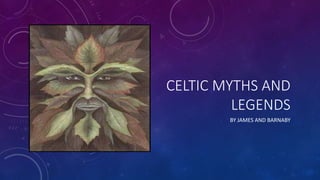
CELTIC MYTHS AND
LEGENDS
BY JAMES AND BARNABY
OVERVIEW
• Prior to Roman or Christian influence the Celts preferred to pass on their
sacred teachings and myths orally. After the coming of Christianity in the fifth
century onwards, the monks recorded the myths. It is thanks to them that so
many survive today.
DEITIES
• Some of the myths have been Christianized, especially those recorded in
Wales. However, a particular feature of Celtic myths may have prevented this
from happening more often: namely, the way in which deities have been
anthropomorphized (given human form), so that, unlike the Greek myths,
they are not obviously religious in nature.
SOURCES OF MYTHS
• The surviving Celtic myths come from Scotland and Ireland, which were at
one time closely related, from Wales (though many of these originated orally
further east), and from Brittany. No myths survive from Romanized areas,
such as Gaul on the Continent. They do not appear to have been written
down in Latin.
• The greatest body of myth comes from Ireland, which was untouched by the
Romans, although much of its mythic material was destroyed by Viking
marauders. An Irish myth, ‘The Harp of the Dagda’ is given below.
GODDESS’
• Powerful though these gods were, the Celtic goddesses were perhaps even more
so. They were closely associated with the land, and in this identification they
sometimes seem to be aspects of a single all-embracing Goddess. Their link to
the seasonal cycles, to fertility and death, may partly account for the fact that a
single goddess often takes three forms, or aspects – usually maiden, mother and
crone.
• Celtic goddesses could be life-giving and sustaining, but were also, in their dark
aspect, associated with sex and death, which in Celtic terms are part of the round
of life. The most powerful Irish example is the red-haired shape-shifting
Morrigan, said to have coupled with the Dagda.

Celtic myths and legends

  • 1.
    CELTIC MYTHS AND LEGENDS BYJAMES AND BARNABY
  • 2.
    OVERVIEW • Prior toRoman or Christian influence the Celts preferred to pass on their sacred teachings and myths orally. After the coming of Christianity in the fifth century onwards, the monks recorded the myths. It is thanks to them that so many survive today.
  • 3.
    DEITIES • Some ofthe myths have been Christianized, especially those recorded in Wales. However, a particular feature of Celtic myths may have prevented this from happening more often: namely, the way in which deities have been anthropomorphized (given human form), so that, unlike the Greek myths, they are not obviously religious in nature.
  • 4.
    SOURCES OF MYTHS •The surviving Celtic myths come from Scotland and Ireland, which were at one time closely related, from Wales (though many of these originated orally further east), and from Brittany. No myths survive from Romanized areas, such as Gaul on the Continent. They do not appear to have been written down in Latin. • The greatest body of myth comes from Ireland, which was untouched by the Romans, although much of its mythic material was destroyed by Viking marauders. An Irish myth, ‘The Harp of the Dagda’ is given below.
  • 5.
    GODDESS’ • Powerful thoughthese gods were, the Celtic goddesses were perhaps even more so. They were closely associated with the land, and in this identification they sometimes seem to be aspects of a single all-embracing Goddess. Their link to the seasonal cycles, to fertility and death, may partly account for the fact that a single goddess often takes three forms, or aspects – usually maiden, mother and crone. • Celtic goddesses could be life-giving and sustaining, but were also, in their dark aspect, associated with sex and death, which in Celtic terms are part of the round of life. The most powerful Irish example is the red-haired shape-shifting Morrigan, said to have coupled with the Dagda.