Norse Mythology
Who were the Norse?
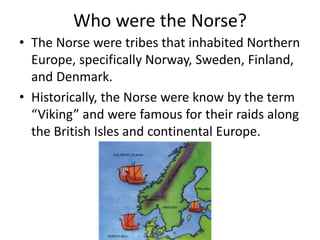
• The Norse were tribes that inhabited Northern
Europe, specifically Norway, Sweden, Finland,
and Denmark.
• Historically, the Norse were know by the term
“Viking” and were famous for their raids along
the British Isles and continental Europe.
How Do We Know What We Know?
• Norse myths existed only in oral form while they were
central to religious belief. They were written down
after Northern Europe had become Christian.
• However this presents a few problems:
– There is no coherent body of literature showing the myths
and legends
– There could possibly be alterations due to the influence of
Christianity
– The “fictionalization” of stories which originally had
religious importance
– Therewas a wide time span, wide geographical range, and
many different sub-cultures.
Recorded Sources
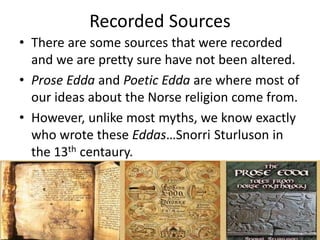
• There are some sources that were recorded
and we are pretty sure have not been altered.
• Prose Edda and Poetic Edda are where most of
our ideas about the Norse religion come from.
• However, unlike most myths, we know exactly
who wrote these Eddas…Snorri Sturluson in
the 13th centaury.
Norse Creation Myth
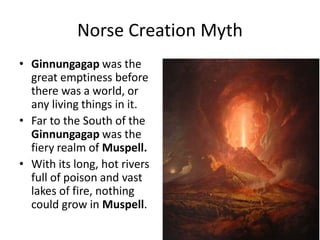
• Ginnungagap was the
great emptiness before
there was a world, or
any living things in it.
• Far to the South of the
Ginnungagap was the
fiery realm of Muspell.
• With its long, hot rivers
full of poison and vast
lakes of fire, nothing
could grow in Muspell.
Norse Creation Myth
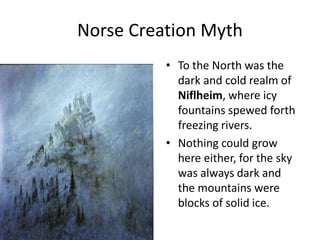
• To the North was the
dark and cold realm of
Niflheim, where icy
fountains spewed forth
freezing rivers.
• Nothing could grow
here either, for the sky
was always dark and
the mountains were
blocks of solid ice.
Norse Creation Myth
• Slowly, over years and
years and years, the
fiery blasts from
Muspell began to melt
the icy mountains of
Niflheim.
• Out of the melting ice,
the giant Ymir emerged,
the first being of the
vast Ginnungagap.
Norse Creation Myth
• Next to him there emerged a
cow from the ice.
• The cow licked the salt from
the ice mountains and Ymir
drank the cow’s milk.
• The cow licked away entire
mountains of ice. Slowly she
licked the ice from two more
beings, this time the god Buri
and his goddess wife.
• They had a son named Bor,
and his son was named Odin,
who became the king of all
the gods.
Norse Creation Myth
• Ymir was cruel and brutal.
• Odin and the other gods
could no longer abide by his
evil acts and together the
gods slew him.
• Ymir’s huge body formed the
earth. His blood became the
sea, his flesh became the
land, his bones the
mountains and his hair the
trees.
• Odin and the other gods
formed the sky with his skull,
held up by four towering
pillars.
Norse Creation Myth
• Odin gathered sparks from the fiery depths of
Muspell and created the sun and moon and
set them in the sky.
• As the sun and moon shone over the new
world in the Ginnungagap, the ice began to
melt and plants and trees began to grow.
Norse Creation Myth
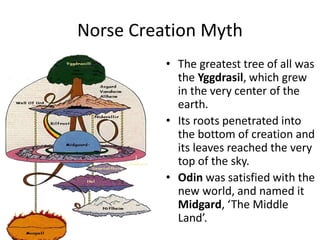
• The greatest tree of all was
the Yggdrasil, which grew
in the very center of the
earth.
• Its roots penetrated into
the bottom of creation and
its leaves reached the very
top of the sky.
• Odin was satisfied with the
new world, and named it
Midgard, ‘The Middle
Land’.
Norse Creation Myth
• On one of his walks, Odin found
two fallen trees, an ash and an
elm.
• He lifted them from the mud
and formed the first man and
woman from them.
• Odin breathed life into the
beings, gave them reason and
feelings, hearing and sight.
• He named the man Ask and the
woman Embla. From these two
sprang the entire human race.
• The humans had the task of
looking after Midgard, while the
gods ascended to Asgard (their
realm in heaven).
Norse Creation Myth
• Ymir’s giant sisters were still mourning his death and were
looking for a way to take their revenge on the gods who
killed him.
• They gathered at the foot of Yggdrasil and began carving
lines into it.
• Each line was a human life, filled with twists and turns,
beginning with a man’s birth, and ending with his death.
• At the end of each line they made a deep cut to ensure that
humans would never be as powerful as the gods.
• These spells were so powerful that not even Odin could do
anything to change them.
• Thus Yggdrasil became known as ‘The Tree of Life’ and
humans knew death and suffering in their world.
Different Deities
• There were actually two distinct division
among the gods of Norse mythology.
• The Aesir make up the principle gods of the
pantheon and were connected to power and
war.
• The Vanir appear to mainly be connected to
cultivation and fertility.
• Over time both groups would merge with the
Aesir gods being the dominate.
Nine Worlds
• There were nine separate worlds to the Norse
that made up the cosmos.
• Midgard (where the humans dwelt)
• Asgard (this is the capitol of the Norse Gods
and where most of the myths take place).
• Hel (the underworld)
• The other six worlds are referred to, but play
no big part in the major myths.
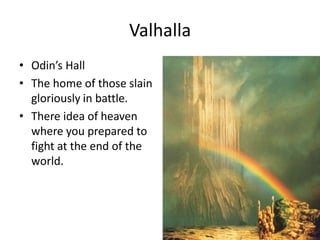
Valhalla
• Odin’s Hall
• The home of those slain
gloriously in battle.
• There idea of heaven
where you prepared to
fight at the end of the
world.
Gods and Goddess
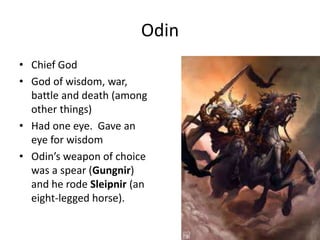
Odin
• Chief God
• God of wisdom, war,
battle and death (among
other things)
• Had one eye. Gave an
eye for wisdom
• Odin’s weapon of choice
was a spear (Gungnir)
and he rode Sleipnir (an
eight-legged horse).
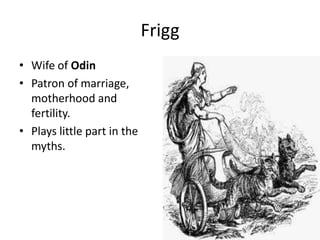
Frigg
• Wife of Odin
• Patron of marriage,
motherhood and
fertility.
• Plays little part in the
myths.
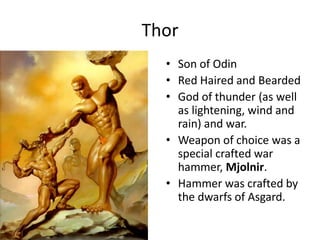
Thor
• Son of Odin
• Red Haired and Bearded
• God of thunder (as well
as lightening, wind and
rain) and war.
• Weapon of choice was a
special crafted war
hammer, Mjolnir.
• Hammer was crafted by
the dwarfs of Asgard.
Sif
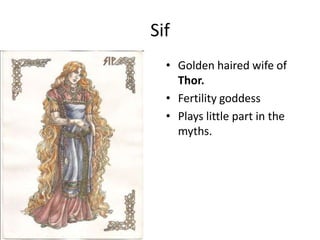
• Golden haired wife of
Thor.
• Fertility goddess
• Plays little part in the
myths.
Tyr
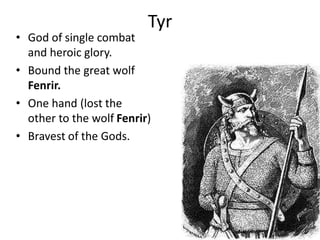
• God of single combat
and heroic glory.
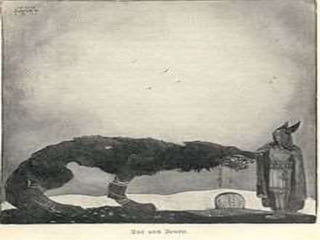
• Bound the great wolf
Fenrir.
• One hand (lost the
other to the wolf Fenrir)
• Bravest of the Gods.
Heimdall
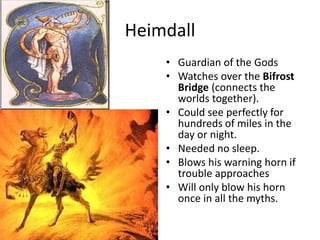
• Guardian of the Gods
• Watches over the Bifrost
Bridge (connects the
worlds together).
• Could see perfectly for
hundreds of miles in the
day or night.
• Needed no sleep.
• Blows his warning horn if
trouble approaches
• Will only blow his horn
once in all the myths.
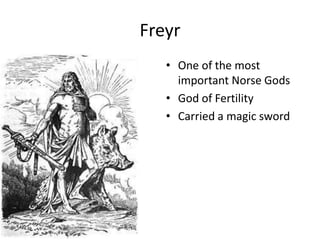
Freyr
• One of the most
important Norse Gods
• God of Fertility
• Carried a magic sword
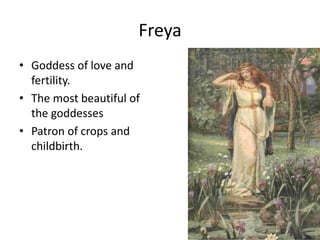
Freya
• Goddess of love and
fertility.
• The most beautiful of
the goddesses
• Patron of crops and
childbirth.
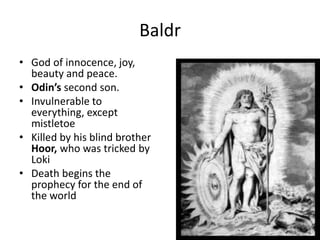
Baldr
• God of innocence, joy,
beauty and peace.
• Odin’s second son.
• Invulnerable to
everything, except
mistletoe
• Killed by his blind brother
Hoor, who was tricked by
Loki
• Death begins the
prophecy for the end of
the world
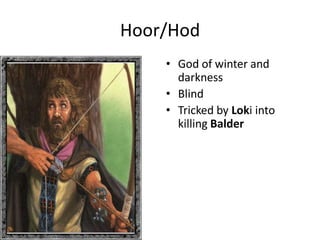
Hoor/Hod
• God of winter and
darkness
• Blind
• Tricked by Loki into
killing Balder
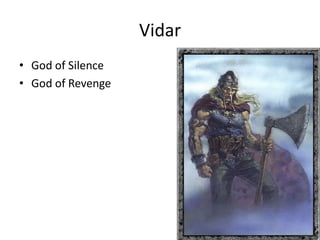
Vidar
• God of Silence
• God of Revenge
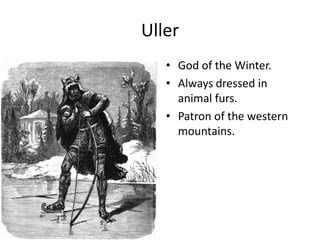
Uller
• God of the Winter.
• Always dressed in
animal furs.
• Patron of the western
mountains.
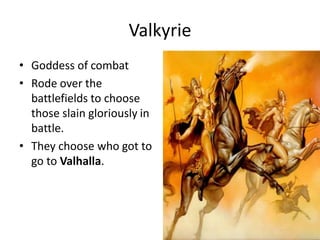
Valkyrie
• Goddess of combat
• Rode over the
battlefields to choose
those slain gloriously in
battle.
• They choose who got to
go to Valhalla.
Forces of Chaos
• There are several forces that are constantly
fighting the gods but among them only six are
prominent.
– Frost Giants
– Fire Giants
– Loki
– Loki’s three children
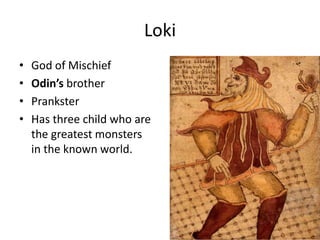
Loki
• God of Mischief
• Odin’s brother
• Prankster
• Has three child who are
the greatest monsters
in the known world.
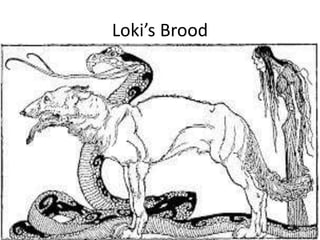
Loki’s Brood
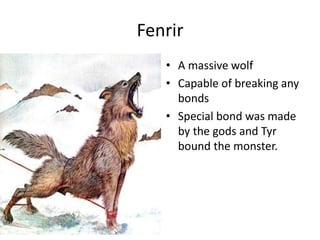
Fenrir
• A massive wolf
• Capable of breaking any
bonds
• Special bond was made
by the gods and Tyr
bound the monster.
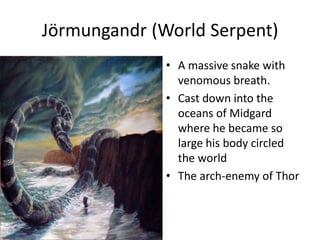
Jörmungandr (World Serpent)
• A massive snake with
venomous breath.
• Cast down into the
oceans of Midgard
where he became so
large his body circled
the world
• The arch-enemy of Thor
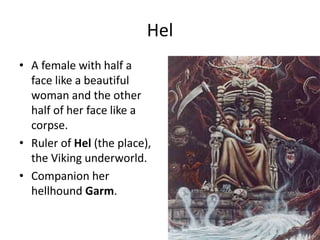
Hel
• A female with half a
face like a beautiful
woman and the other
half of her face like a
corpse.
• Ruler of Hel (the place),
the Viking underworld.
• Companion her
hellhound Garm.
Ragnarok
• The Viking Armageddon
• Introduced by the birth of Loki’s three
children.
• Triggered by the death of Baldr.
• Fought during three consecutive winters.
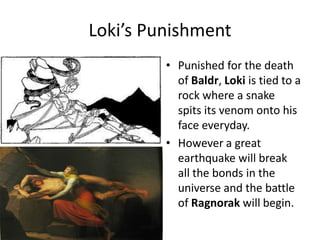
Loki’s Punishment
• Punished for the death
of Baldr, Loki is tied to a
rock where a snake
spits its venom onto his
face everyday.
• However a great
earthquake will break
all the bonds in the
universe and the battle
of Ragnorak will begin.
Final Battle
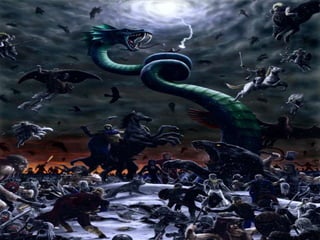
• At Ragnarok, the sons of Muspell (fire giants)
shatter the Bifrost Bridge.
• Loki leads the rest of the giants toward
Valhalla for the final battle of the world.
Final Battle
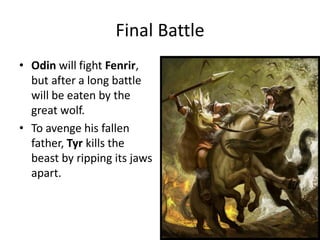
• Odin will fight Fenrir,
but after a long battle
will be eaten by the
great wolf.
• To avenge his fallen
father, Tyr kills the
beast by ripping its jaws
apart.
Final Battle
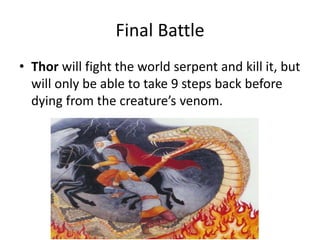
• Thor will fight the world serpent and kill it, but
will only be able to take 9 steps back before
dying from the creature’s venom.
Final Battle
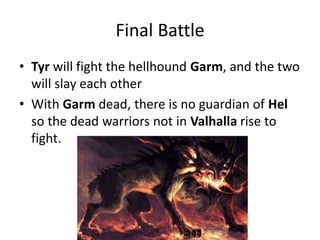
• Tyr will fight the hellhound Garm, and the two
will slay each other
• With Garm dead, there is no guardian of Hel
so the dead warriors not in Valhalla rise to
fight.
Final Battle
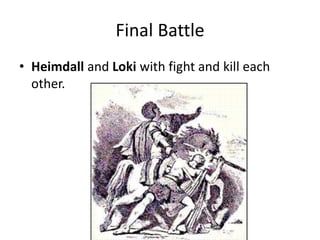
• Heimdall and Loki with fight and kill each
other.
Final Battle
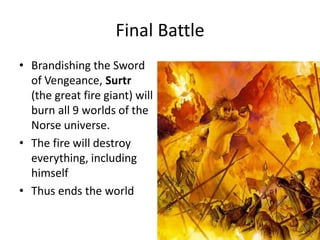
• Brandishing the Sword
of Vengeance, Surtr
(the great fire giant) will
burn all 9 worlds of the
Norse universe.
• The fire will destroy
everything, including
himself
• Thus ends the world
The End?
• Although Surtr destroys the world, this is not
the end.
• The earth reemerges and the sons of the gods
as well as two humans (a male and female)
emerge from Yggdrasil and begin to
repopulate the world.
• A newer and a fairer sun will arise symbolizing
the completion of a perfect world.
Heroes
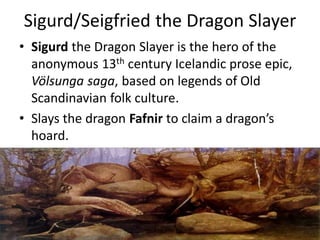
Sigurd/Seigfried the Dragon Slayer
• Sigurd the Dragon Slayer is the hero of the
anonymous 13th century Icelandic prose epic,
Völsunga saga, based on legends of Old
Scandinavian folk culture.
• Slays the dragon Fafnir to claim a dragon’s
hoard.
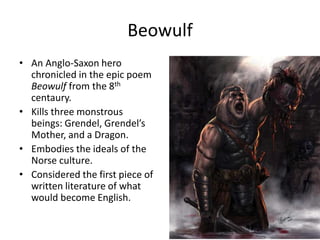
Beowulf
• An Anglo-Saxon hero
chronicled in the epic poem
Beowulf from the 8th
centaury.
• Kills three monstrous
beings: Grendel, Grendel’s
Mother, and a Dragon.
• Embodies the ideals of the
Norse culture.
• Considered the first piece of
written literature of what
would become English.

Norse_Mythology.pdf

  • 1.
  • 2.
    Who were theNorse? • The Norse were tribes that inhabited Northern Europe, specifically Norway, Sweden, Finland, and Denmark. • Historically, the Norse were know by the term “Viking” and were famous for their raids along the British Isles and continental Europe.
  • 3.
    How Do WeKnow What We Know? • Norse myths existed only in oral form while they were central to religious belief. They were written down after Northern Europe had become Christian. • However this presents a few problems: – There is no coherent body of literature showing the myths and legends – There could possibly be alterations due to the influence of Christianity – The “fictionalization” of stories which originally had religious importance – Therewas a wide time span, wide geographical range, and many different sub-cultures.
  • 4.
    Recorded Sources • Thereare some sources that were recorded and we are pretty sure have not been altered. • Prose Edda and Poetic Edda are where most of our ideas about the Norse religion come from. • However, unlike most myths, we know exactly who wrote these Eddas…Snorri Sturluson in the 13th centaury.
  • 5.
    Norse Creation Myth •Ginnungagap was the great emptiness before there was a world, or any living things in it. • Far to the South of the Ginnungagap was the fiery realm of Muspell. • With its long, hot rivers full of poison and vast lakes of fire, nothing could grow in Muspell.
  • 6.
    Norse Creation Myth •To the North was the dark and cold realm of Niflheim, where icy fountains spewed forth freezing rivers. • Nothing could grow here either, for the sky was always dark and the mountains were blocks of solid ice.
  • 7.
    Norse Creation Myth •Slowly, over years and years and years, the fiery blasts from Muspell began to melt the icy mountains of Niflheim. • Out of the melting ice, the giant Ymir emerged, the first being of the vast Ginnungagap.
  • 8.
    Norse Creation Myth •Next to him there emerged a cow from the ice. • The cow licked the salt from the ice mountains and Ymir drank the cow’s milk. • The cow licked away entire mountains of ice. Slowly she licked the ice from two more beings, this time the god Buri and his goddess wife. • They had a son named Bor, and his son was named Odin, who became the king of all the gods.
  • 9.
    Norse Creation Myth •Ymir was cruel and brutal. • Odin and the other gods could no longer abide by his evil acts and together the gods slew him. • Ymir’s huge body formed the earth. His blood became the sea, his flesh became the land, his bones the mountains and his hair the trees. • Odin and the other gods formed the sky with his skull, held up by four towering pillars.
  • 10.
    Norse Creation Myth •Odin gathered sparks from the fiery depths of Muspell and created the sun and moon and set them in the sky. • As the sun and moon shone over the new world in the Ginnungagap, the ice began to melt and plants and trees began to grow.
  • 11.
    Norse Creation Myth •The greatest tree of all was the Yggdrasil, which grew in the very center of the earth. • Its roots penetrated into the bottom of creation and its leaves reached the very top of the sky. • Odin was satisfied with the new world, and named it Midgard, ‘The Middle Land’.
  • 12.
    Norse Creation Myth •On one of his walks, Odin found two fallen trees, an ash and an elm. • He lifted them from the mud and formed the first man and woman from them. • Odin breathed life into the beings, gave them reason and feelings, hearing and sight. • He named the man Ask and the woman Embla. From these two sprang the entire human race. • The humans had the task of looking after Midgard, while the gods ascended to Asgard (their realm in heaven).
  • 13.
    Norse Creation Myth •Ymir’s giant sisters were still mourning his death and were looking for a way to take their revenge on the gods who killed him. • They gathered at the foot of Yggdrasil and began carving lines into it. • Each line was a human life, filled with twists and turns, beginning with a man’s birth, and ending with his death. • At the end of each line they made a deep cut to ensure that humans would never be as powerful as the gods. • These spells were so powerful that not even Odin could do anything to change them. • Thus Yggdrasil became known as ‘The Tree of Life’ and humans knew death and suffering in their world.
  • 14.
    Different Deities • Therewere actually two distinct division among the gods of Norse mythology. • The Aesir make up the principle gods of the pantheon and were connected to power and war. • The Vanir appear to mainly be connected to cultivation and fertility. • Over time both groups would merge with the Aesir gods being the dominate.
  • 15.
    Nine Worlds • Therewere nine separate worlds to the Norse that made up the cosmos. • Midgard (where the humans dwelt) • Asgard (this is the capitol of the Norse Gods and where most of the myths take place). • Hel (the underworld) • The other six worlds are referred to, but play no big part in the major myths.
  • 16.
    Valhalla • Odin’s Hall •The home of those slain gloriously in battle. • There idea of heaven where you prepared to fight at the end of the world.
  • 17.
  • 18.
    Odin • Chief God •God of wisdom, war, battle and death (among other things) • Had one eye. Gave an eye for wisdom • Odin’s weapon of choice was a spear (Gungnir) and he rode Sleipnir (an eight-legged horse).
  • 19.
    Frigg • Wife ofOdin • Patron of marriage, motherhood and fertility. • Plays little part in the myths.
  • 20.
    Thor • Son ofOdin • Red Haired and Bearded • God of thunder (as well as lightening, wind and rain) and war. • Weapon of choice was a special crafted war hammer, Mjolnir. • Hammer was crafted by the dwarfs of Asgard.
  • 21.
    Sif • Golden hairedwife of Thor. • Fertility goddess • Plays little part in the myths.
  • 22.
    Tyr • God ofsingle combat and heroic glory. • Bound the great wolf Fenrir. • One hand (lost the other to the wolf Fenrir) • Bravest of the Gods.
  • 24.
    Heimdall • Guardian ofthe Gods • Watches over the Bifrost Bridge (connects the worlds together). • Could see perfectly for hundreds of miles in the day or night. • Needed no sleep. • Blows his warning horn if trouble approaches • Will only blow his horn once in all the myths.
  • 25.
    Freyr • One ofthe most important Norse Gods • God of Fertility • Carried a magic sword
  • 26.
    Freya • Goddess oflove and fertility. • The most beautiful of the goddesses • Patron of crops and childbirth.
  • 27.
    Baldr • God ofinnocence, joy, beauty and peace. • Odin’s second son. • Invulnerable to everything, except mistletoe • Killed by his blind brother Hoor, who was tricked by Loki • Death begins the prophecy for the end of the world
  • 28.
    Hoor/Hod • God ofwinter and darkness • Blind • Tricked by Loki into killing Balder
  • 29.
    Vidar • God ofSilence • God of Revenge
  • 30.
    Uller • God ofthe Winter. • Always dressed in animal furs. • Patron of the western mountains.
  • 31.
    Valkyrie • Goddess ofcombat • Rode over the battlefields to choose those slain gloriously in battle. • They choose who got to go to Valhalla.
  • 32.
    Forces of Chaos •There are several forces that are constantly fighting the gods but among them only six are prominent. – Frost Giants – Fire Giants – Loki – Loki’s three children
  • 33.
    Loki • God ofMischief • Odin’s brother • Prankster • Has three child who are the greatest monsters in the known world.
  • 34.
  • 35.
    Fenrir • A massivewolf • Capable of breaking any bonds • Special bond was made by the gods and Tyr bound the monster.
  • 36.
    Jörmungandr (World Serpent) •A massive snake with venomous breath. • Cast down into the oceans of Midgard where he became so large his body circled the world • The arch-enemy of Thor
  • 37.
    Hel • A femalewith half a face like a beautiful woman and the other half of her face like a corpse. • Ruler of Hel (the place), the Viking underworld. • Companion her hellhound Garm.
  • 38.
    Ragnarok • The VikingArmageddon • Introduced by the birth of Loki’s three children. • Triggered by the death of Baldr. • Fought during three consecutive winters.
  • 39.
    Loki’s Punishment • Punishedfor the death of Baldr, Loki is tied to a rock where a snake spits its venom onto his face everyday. • However a great earthquake will break all the bonds in the universe and the battle of Ragnorak will begin.
  • 41.
    Final Battle • AtRagnarok, the sons of Muspell (fire giants) shatter the Bifrost Bridge. • Loki leads the rest of the giants toward Valhalla for the final battle of the world.
  • 42.
    Final Battle • Odinwill fight Fenrir, but after a long battle will be eaten by the great wolf. • To avenge his fallen father, Tyr kills the beast by ripping its jaws apart.
  • 43.
    Final Battle • Thorwill fight the world serpent and kill it, but will only be able to take 9 steps back before dying from the creature’s venom.
  • 44.
    Final Battle • Tyrwill fight the hellhound Garm, and the two will slay each other • With Garm dead, there is no guardian of Hel so the dead warriors not in Valhalla rise to fight.
  • 45.
    Final Battle • Heimdalland Loki with fight and kill each other.
  • 46.
    Final Battle • Brandishingthe Sword of Vengeance, Surtr (the great fire giant) will burn all 9 worlds of the Norse universe. • The fire will destroy everything, including himself • Thus ends the world
  • 47.
    The End? • AlthoughSurtr destroys the world, this is not the end. • The earth reemerges and the sons of the gods as well as two humans (a male and female) emerge from Yggdrasil and begin to repopulate the world. • A newer and a fairer sun will arise symbolizing the completion of a perfect world.
  • 48.
  • 49.
    Sigurd/Seigfried the DragonSlayer • Sigurd the Dragon Slayer is the hero of the anonymous 13th century Icelandic prose epic, Völsunga saga, based on legends of Old Scandinavian folk culture. • Slays the dragon Fafnir to claim a dragon’s hoard.
  • 50.
    Beowulf • An Anglo-Saxonhero chronicled in the epic poem Beowulf from the 8th centaury. • Kills three monstrous beings: Grendel, Grendel’s Mother, and a Dragon. • Embodies the ideals of the Norse culture. • Considered the first piece of written literature of what would become English.