By:
Amjad Hassan Khan MK
Lecturer in Electronics
Kristu Jayanti College, Bengaluru
• Cellular communication-Concept of cellular, mobile
communication, cell and cell splitting.
• frequency bands used in cellular communication,
Absolute RF channel Numbers(ARFCN)
• frequency reuse, roaming and hand off
• Authentication of the SIM card of the subscribers
• IMEI number, concept of data encryption,
• Architecture (block diagram) of cellular mobile
communication network,
• qualitative study of GSM and CDMA systems,
• simplified block diagram of cellular phone hand set,
• comparative study of GSM and CDMA.
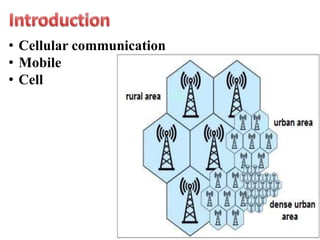
• Cellular communication
• Mobile
• Cell
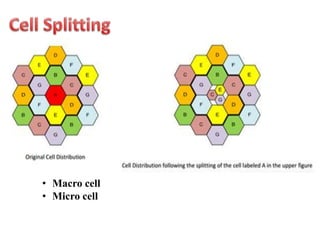
• Macro cell
• Micro cell
Cluster:
Cells with the same letter, use
the same set of frequencies.
A cell cluster is outlined
in bold, and replicated over
the coverage area.
In this example, the
cluster size, N, is equal to 7;
and the frequency reuse factor is 1/7,
since each cell contains 1/7 of the total number of
available channels.
Distance for frequency reuse D=R√3N
A
C
B
G
F D
G
E
D
B
B
F
F
E
E
C
A
A
G
C
D
Absolute Radio Frequency Number. It is a channel numbering
scheme. It is used to identify specific RF channels in GSM. ARFCN is
a code that specifies a pair of physical carriers and channels. These
are used for the transmission and reception one for uplink signal and
the other for the downlink signal. The ARFCN can be used to
calculate the exact frequency of the radio channel.
An IMEI is a serial number that uniquely identifies a GSM mobile
phone. Typically 15 digits long, the IMEI code is broken into sections
that provide information about a phone, such as its manufacturer, to the
mobile network that the phone is connected to. IMEI numbers of stolen
devices are blacklisted in some countries so that the phone cannot
easily be used by a thief. Also known as: "International Mobile
Equipment Identity"
A Subscriber Identity Module (SIM)
card is a portable memory chip used
mostly in cell phones that operate on
the Global System for Mobile
Communications (GSM) network.
1. Identification of a subscriber
2. Authentication of a subscriber
3. Storage
4. Applications
Features GSM CDMA
Operating Frequency 900 and 1800-MHz 800-MHz and 1900 MHz
Phone calls Easily tampered. More secured because of the
spread spectrum.
Technology TDMA and FDMA CDMA
Encoding Digital Digital
Roaming Worldwide, all countries
except Japan and South Korea
Limited
Signal quality/coverage area Good coverage indoors on
850/900 MHz
Repeaters possible. 35 km hard
limit.
Unlimited cell size, low transmitter
power permits large cells
Handoff Hard Soft
Power consumption Less More

Cellular communication

  • 1.
    By: Amjad Hassan KhanMK Lecturer in Electronics Kristu Jayanti College, Bengaluru
  • 2.
    • Cellular communication-Conceptof cellular, mobile communication, cell and cell splitting. • frequency bands used in cellular communication, Absolute RF channel Numbers(ARFCN) • frequency reuse, roaming and hand off • Authentication of the SIM card of the subscribers • IMEI number, concept of data encryption, • Architecture (block diagram) of cellular mobile communication network, • qualitative study of GSM and CDMA systems, • simplified block diagram of cellular phone hand set, • comparative study of GSM and CDMA.
  • 3.
  • 4.
  • 5.
    Cluster: Cells with thesame letter, use the same set of frequencies. A cell cluster is outlined in bold, and replicated over the coverage area. In this example, the cluster size, N, is equal to 7; and the frequency reuse factor is 1/7, since each cell contains 1/7 of the total number of available channels. Distance for frequency reuse D=R√3N A C B G F D G E D B B F F E E C A A G C D
  • 7.
    Absolute Radio FrequencyNumber. It is a channel numbering scheme. It is used to identify specific RF channels in GSM. ARFCN is a code that specifies a pair of physical carriers and channels. These are used for the transmission and reception one for uplink signal and the other for the downlink signal. The ARFCN can be used to calculate the exact frequency of the radio channel. An IMEI is a serial number that uniquely identifies a GSM mobile phone. Typically 15 digits long, the IMEI code is broken into sections that provide information about a phone, such as its manufacturer, to the mobile network that the phone is connected to. IMEI numbers of stolen devices are blacklisted in some countries so that the phone cannot easily be used by a thief. Also known as: "International Mobile Equipment Identity"
  • 10.
    A Subscriber IdentityModule (SIM) card is a portable memory chip used mostly in cell phones that operate on the Global System for Mobile Communications (GSM) network. 1. Identification of a subscriber 2. Authentication of a subscriber 3. Storage 4. Applications
  • 14.
    Features GSM CDMA OperatingFrequency 900 and 1800-MHz 800-MHz and 1900 MHz Phone calls Easily tampered. More secured because of the spread spectrum. Technology TDMA and FDMA CDMA Encoding Digital Digital Roaming Worldwide, all countries except Japan and South Korea Limited Signal quality/coverage area Good coverage indoors on 850/900 MHz Repeaters possible. 35 km hard limit. Unlimited cell size, low transmitter power permits large cells Handoff Hard Soft Power consumption Less More