Exploring the Microscopic
World of Cells
Exploring the Microscopic World of
Cells
CONTENT
Familiarity and proper use of a
compound microscope are essential to
observe cells.
LEARNING
STANDARD
Use proper techniques in observing and
identifying the parts of a cell with a
microscope such as the cell membrane,
nucleus, cytoplasm, mitochondria,
chloroplasts, and ribosomes;
LEARNING
COMPETENCY
By the end of the lesson, the 80 percent of
the learners will be able to:
1. Identify and describe the major organelles of a plant or
animal cell, including the cell membrane, nucleus,
cytoplasm, mitochondria, chloroplasts, and ribosomes.
2. Demonstrate proper microscope handling and slide
preparation techniques.
3. Appreciate the complexity and diversity of cellular
structures by answering the reflection of learning.
OBJECTIVES
I. Activating Prior Knowledge
Short Review
Complete the words below by filling in the missing letters.
I. Activating Prior Knowledge
_UCL_US
It controls all the activities of the cell.
I. Activating Prior Knowledge
Short Review
Complete the words below by filling in the missing letters.
I. Activating Prior Knowledge
CY_OPL_ _M
It is where all the organelle is located.
I. Activating Prior Knowledge
Short Review
Complete the words below by filling in the missing letters.
I. Activating Prior Knowledge
V_CUOL_
It holds water, food and waste materials.
I. Activating Prior Knowledge
Short Review
Complete the words below by filling in the missing letters.
I. Activating Prior Knowledge
CH_ORO_LAS_
It is the site of photosynthesis in plant cells.
I. Activating Prior Knowledge
Short Review
Complete the words below by filling in the missing letters.
I. Activating Prior Knowledge
CELL WA_ _
It provides support, protection, and
shape to the plant cell.
I. Activating Prior Knowledge
Short Review
Complete the words below by filling in the missing letters.
I. Activating Prior Knowledge
NUCLEUS
It controls all the activities of the cell.
I. Activating Prior Knowledge
Short Review
Complete the words below by filling in the missing letters.
I. Activating Prior Knowledge
CYTOPLASM
It is where all the organelle is located.
I. Activating Prior Knowledge
Short Review
Complete the words below by filling in the missing letters.
I. Activating Prior Knowledge
VACUOLE
It holds water, food and waste materials.
I. Activating Prior Knowledge
Short Review
Complete the words below by filling in the missing letters.
I. Activating Prior Knowledge
CHLOROPLAST
It is the site of photosynthesis in plant cells.
I. Activating Prior Knowledge
Short Review
Complete the words below by filling in the missing letters.
I. Activating Prior Knowledge
CELL WALL
It provides support, protection, and
shape to the plant cell.
1. Identify and describe the major organelles of a plant or
animal cell, including the cell membrane, nucleus,
cytoplasm, mitochondria, chloroplasts, and ribosomes.
2. Demonstrate proper microscope handling and slide
preparation techniques.
3. Appreciate the complexity and diversity of cellular
structures by answering the reflection of learning.
B. Establishing Purpose of the Lesson
1. LESSON PURPOSE
B. Establishing Purpose of the Lesson
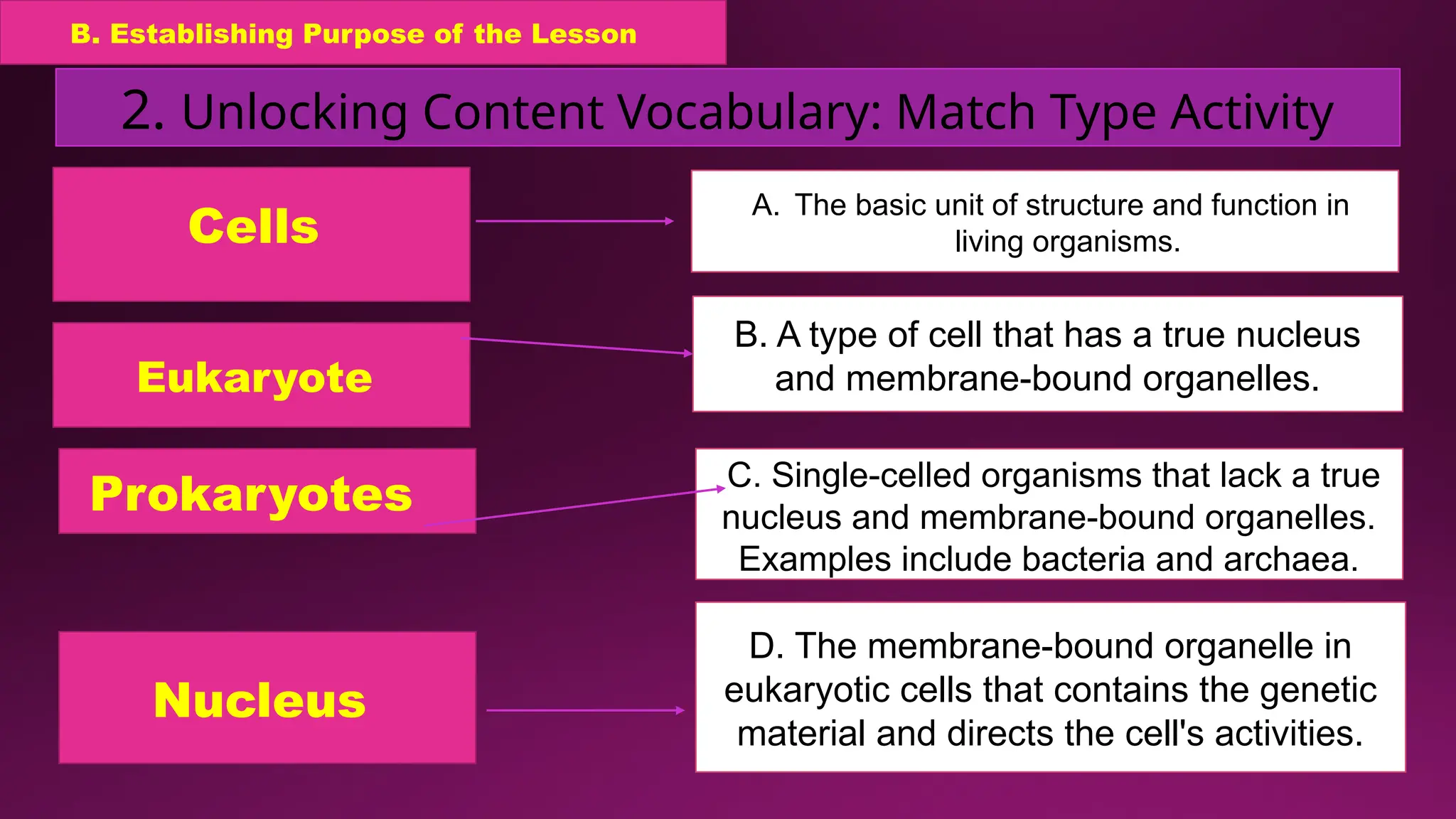
2. Unlocking Content Vocabulary: Match Type Activity
Prokaryotes
Eukaryote
Nucleus
C. Single-celled organisms that lack a true
nucleus and membrane-bound organelles.
Examples include bacteria and archaea.
B. A type of cell that has a true nucleus
and membrane-bound organelles.
D. The membrane-bound organelle in
eukaryotic cells that contains the genetic
material and directs the cell's activities.
Cells
A. The basic unit of structure and function in
living organisms.
B. Establishing Purpose of the Lesson
2. Unlocking Content Vocabulary: Match Type Activity
Prokaryotes
Eukaryote
Nucleus
C. Single-celled organisms that lack a true
nucleus and membrane-bound organelles.
Examples include bacteria and archaea.
B. A type of cell that has a true nucleus
and membrane-bound organelles.
D. The membrane-bound organelle in
eukaryotic cells that contains the genetic
material and directs the cell's activities.
Cells
A. The basic unit of structure and function in
living organisms.
C. Developing and Deepening Understanding
Organelles, their description, function, and classification.
Organelle Description Function Animal, Plant or Both
1. CELL
WALL
Rigid, tough,
made of
cellulose
Protects and
supports the cell
Plant
C. Developing and Deepening Understanding
Organelles, their description, function, and classification.
Organelle Description Function Animal, Plant or Both
2.
CYTOPLASM
Jelly like
substance that
contains
organelles
Pads and
supports
organelles inside
the cell.
Both
C. Developing and Deepening Understanding
Organelles, their description, function, and classification.
Organelle Description Function Animal, Plant or Both
3. NUCLEUS Dense, ball
shaped
structure,
contains DNA
Controls all of
the cell’s
activities
Both
C. Developing and Deepening Understanding
Organelles, their description, function, and classification.
Organelle Description Function Animal, Plant or Both
4. ENDOPLASMIC
RETICULUM
Clear, tubular
system of
tunnels
throughout the
cell
Transports
materials like
proteins around
the cell
Both
C. Developing and Deepening Understanding
Organelles, their description, function, and classification.
Organelle Description Function Animal, Plant or Both
5. RIBOSOME Small specks made
of RNA. Found in
cytoplasm or on the
endoplasmic
reticulum
Makes proteins Both
C. Developing and Deepening Understanding
Organelles, their description, function, and classification.
Organelle Description Function Animal, Plant or Both
6.
MITOCHONDRI
A
Location in the
cytoplasm, bean
shaped.
Supplies energy or
ATP for the cell
through cell
respiration using
glucose and
oxygen.
Both
C. Developing and Deepening Understanding
Organelles, their description, function, and classification.
Organelle Description Function Animal, Plant or Both
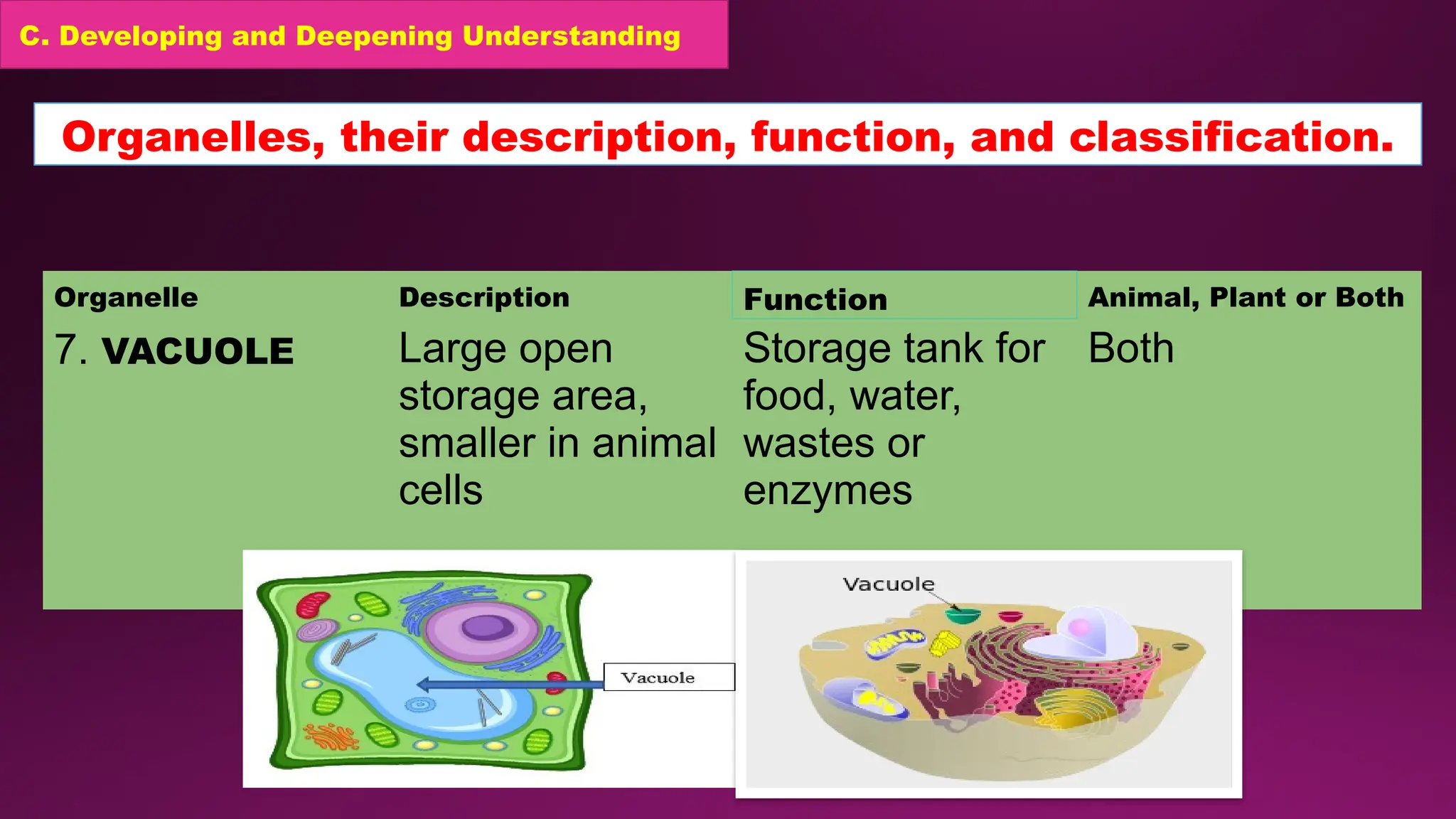
7. VACUOLE Large open
storage area,
smaller in animal
cells
Storage tank for
food, water,
wastes or
enzymes
Both
C. Developing and Deepening Understanding
Organelles, their description, function, and classification.
Organelle Description Function Animal, Plant or Both
8.
CHLORO
PLAST
Green structures
that contain
chlorophyll.
Captures sunlight
and uses it to
produce food
through
photosynthesis.
Plant
C. Developing and Deepening Understanding
Organelles, their description, function, and classification.
Organelle Description Function Animal, Plant or Both
9.
GOLGI BODY
Small bags with
tubes connecting
them.
Packages and
secrets proteins
for use in and
out of the cell.
Both
C. Developing and Deepening Understanding
1. Carrying the Microscope
▪ Grasp the microscope by the arm or
base, not the eyepiece.
▪ Hold the microscope close to your
body for stability.
▪ Avoid swinging or jerking the
microscope as you carry it.
▪ Set the microscope down gently on a
stable, level surface.
Demonstrating Microscope Handling:
C. Developing and Deepening Understanding
2. Adjusting the Microscope
▪ Start with the lowest power objective lens
(e.g., 4x or 10x).
▪ Use the coarse adjustment knob to quickly
bring the stage into focus.
▪ Switch to the fine adjustment knob to refine
the focus.
▪ Rotate the nosepiece to change objective
lenses, being careful not to hit the slide.
▪ Adjust the interpupillary distance of the
eyepieces to match your eyes.
Demonstrating Microscope Handling:
C. Developing and Deepening Understanding
3. Focusing the Microscope
▪ Place the prepared slide on the stage and
secure it with the stage clips.
▪ Start with the lowest power objective and bring
the specimen into view.
▪ Use the coarse adjustment knob to get a
rough focus.
▪ Switch to the fine adjustment knob to sharpen
the image.
▪ Make small, incremental turns of the fine
adjustment until the specimen is in clear
focus.
Demonstrating Microscope Handling:
C. Developing and Deepening Understanding
Worked Example
Picture Analysis: Plant and Animal Cells. The students
collaboratively List down the difference between plant
and animal cells.
C. Developing and Deepening Understanding
Lesson Activity
Laboratory Activity on the Observing Plant and Animal
Cell:
The students will perform the laboratory activity to view
plant and animal cells using the microscope.
Objectives:
▪ To prepare and observe slides of plant and animal cells.
▪ To identify the differences and similarities between
plant and animal cells.
▪ To understand the basic cell structures.
C. Developing and Deepening Understanding
Lesson Activity
Laboratory Activity on the Observing Plant and Animal
Cell:
Materials:
✔ Microscopes
✔ Prepared slides of plant cells (onion epidermis) and animal cells
(cheek cells)
✔ Glass slides
✔ Coverslips
✔ Iodine solution (for plant cells staining)
✔ Methylene blue solution (for animal cell staining)
✔ Toothpicks
✔ Dropper
✔ Tweezers
✔ Paper towels
C. Developing and Deepening Understanding
Lesson Activity
Laboratory Activity on the Observing Plant and Animal
Cell:
Procedure:
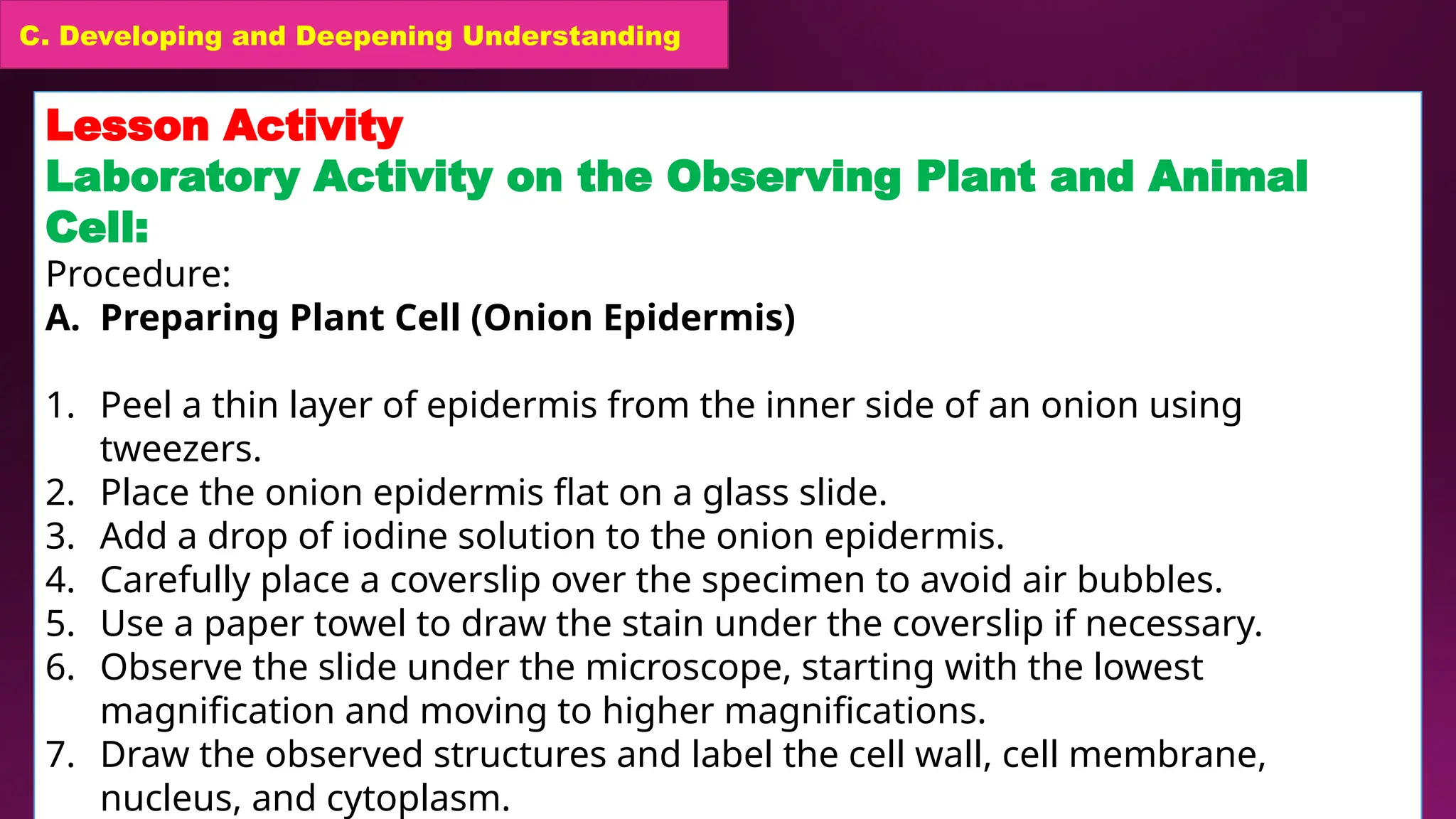
A. Preparing Plant Cell (Onion Epidermis)
1. Peel a thin layer of epidermis from the inner side of an onion using
tweezers.
2. Place the onion epidermis flat on a glass slide.
3. Add a drop of iodine solution to the onion epidermis.
4. Carefully place a coverslip over the specimen to avoid air bubbles.
5. Use a paper towel to draw the stain under the coverslip if necessary.
6. Observe the slide under the microscope, starting with the lowest
magnification and moving to higher magnifications.
7. Draw the observed structures and label the cell wall, cell membrane,
nucleus, and cytoplasm.
C. Developing and Deepening Understanding
Lesson Activity
Laboratory Activity on the Observing Plant and Animal
Cell:
Procedure:
B. Preparing Animal Cell (Cheek Cells)
1. Gently scrape the inside of your cheek with a clean toothpick.
2. Smear the collected cells onto a blank microscope slide.
3. Add a drop of methylene blue solution to the cells to spread them thinly on
the slide.
4. Carefully place a coverslip over the specimen.
5. Use a paper towel to draw the stain under the coverslip if necessary.
6. Observe the slide under the microscope, starting with the lowest
magnification and moving to higher magnifications.
7. Draw the observed structures and label the cell membrane, nucleus, and
cytoplasm.
C. Developing and Deepening Understanding
Lesson Activity
Laboratory Activity on the Observing Plant and Animal
Cell:
Discussion Questions:
1. What are the main structural differences between plant and animal cells
observed
under the microscope?
2. Why do plant cells have a cell wall, and what is its function?
3. What is the purpose of staining the cells with iodine solution and methylene
blue?
4. How does the shape of the cells differ between plant and animal cells, and
why?
C. Developing and Deepening Understanding
Lesson Activity
Venn Diagram: Students will use a Venn Diagram to
differentiate plant and animal cells.
D. MAKING GENERALIZATION
Reflection on Learning
One Minute Paper: Using
the graphic organizer,
reflect on your learning
by creating a
one-minute paper by
answering the questions.
E. EVALUATING LEARNING
_________ 1. Which of the following is the
control center of the cell?
a. Cytoplasm
b. Nucleus
c. Cell membrane
d. Mitochondria
E. EVALUATING LEARNING
_________ 2. The organelle responsible for
energy production in the cell is the:
a. Chloroplast
b. Ribosome
c. Mitochondria
d. Endoplasmic reticulum
E. EVALUATING LEARNING
_________ 3. Which of these structures is
found in both plant and animal cells?
a. Cell wall
b. Chloroplast
c. Nucleus
d. All of the above
E. EVALUATING LEARNING
_________ 4. The thin, selective barrier that
controls what enters and leaves the cell is
the:
a. Cell wall
b. Cell membrane
c. Cytoplasm
d. Nucleus
E. EVALUATING LEARNING
_________ 5. Structures that translate
genetic information into proteins are called:
a. Mitochondria
b. Ribosomes
c. Chloroplasts
d. Endoplasmic reticulum
E. EVALUATING LEARNING
_________ 6. Which organelle is
responsible for photosynthesis in plant
cells?
a. Nucleus
b. Chloroplast
c. Mitochondria
d. Endoplasmic reticulum
E. EVALUATING LEARNING
_________ 7. The jelly-like substance that
fills the cell and supports its structures is
called:
a. Cell wall
b. Cell membrane
c. Cytoplasm
d. Nucleus
E. EVALUATING LEARNING
_________ 8. Which of the following is the correct
order for focusing a microscope?
a. Coarse adjustment, fine adjustment, low power
objective
b. Low power objective, coarse adjustment, fine
adjustment
c. Fine adjustment, coarse adjustment, low
power objective
d. Low power objective, fine adjustment, coarse
adjustment
E. EVALUATING LEARNING
_________ 9. When preparing a wet mount slide,
the purpose of the coverslip is to:
a. Hold the specimen in place
b. Provide additional magnification
c. Prevent air bubbles from forming
d. All of the above
E. EVALUATING LEARNING
_________ 10. Which of these is an important step
in caring for a microscope?
a. Cleaning the lenses with water
b. Storing the microscope in direct sunlight
c. Gently wiping the lenses with a tissue
d. Touching the lenses with your fingers
E. EVALUATING LEARNING
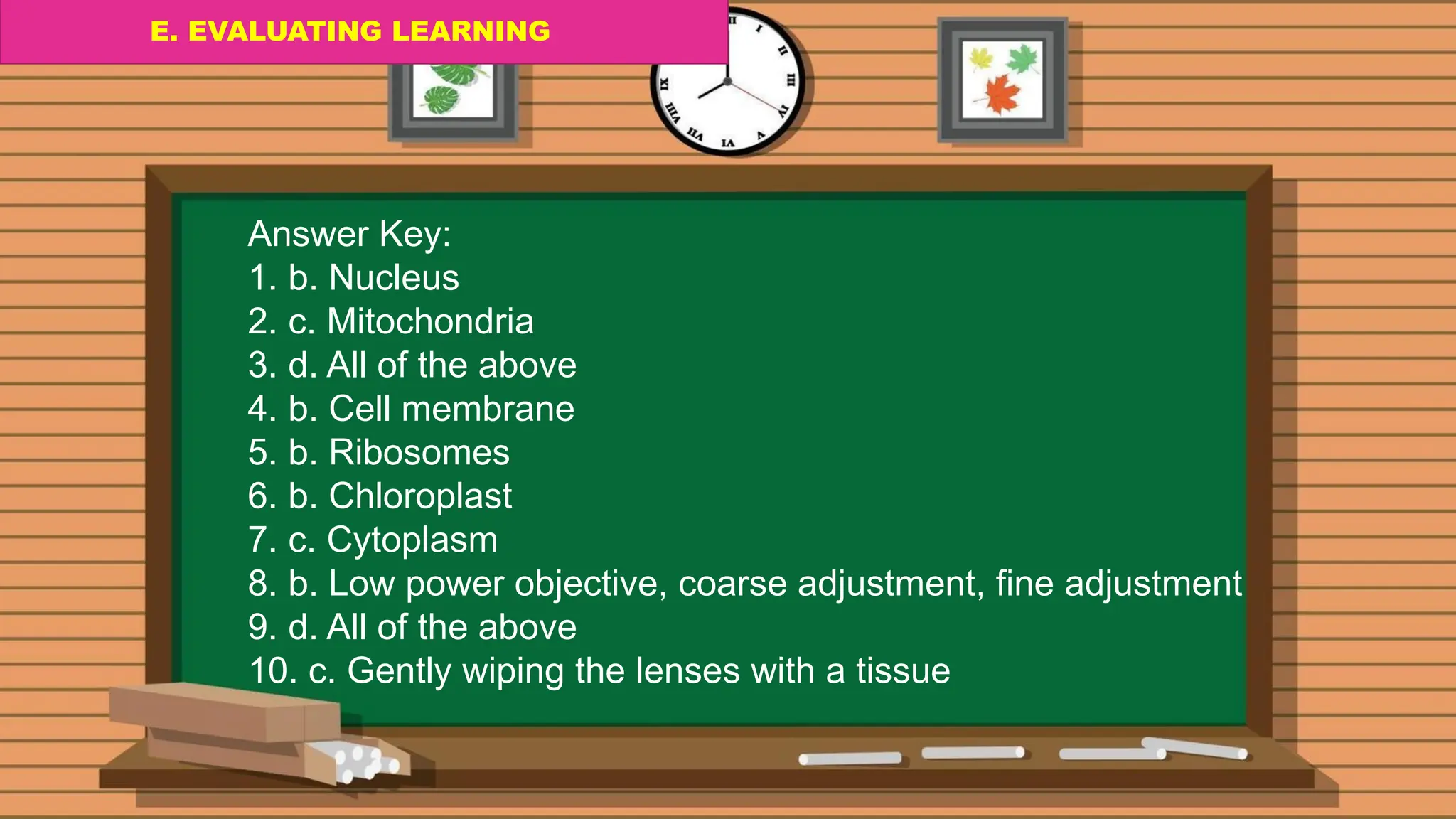
Answer Key:
1. b. Nucleus
2. c. Mitochondria
3. d. All of the above
4. b. Cell membrane
5. b. Ribosomes
6. b. Chloroplast
7. c. Cytoplasm
8. b. Low power objective, coarse adjustment, fine adjustment
9. d. All of the above
10. c. Gently wiping the lenses with a tissue
Reference :
•SCIENCE 7 LESSON EXEMPLAR
Textbooks:ience education websites (e.g., Khan Academy, Exploratorium, PBS Learning Media)
Microscope manufacturer websites (e.g., Leica, Nikon, Olympus)
University biology
"Biology" by Campbell and Reece
"Principles of Anatomy and Physiology" by Tortora and Derrickson
"Molecular Biology of the Cell" by Alberts et al.
Scientific Journals:
"The American Biology Teacher"
"Journal of Biological Education"
"CBE—Life Sciences Education"
Online Resources:
Scdepartment websites and course materials

cell matatag .pptx

  • 1.
  • 2.
    Exploring the MicroscopicWorld of Cells CONTENT Familiarity and proper use of a compound microscope are essential to observe cells. LEARNING STANDARD Use proper techniques in observing and identifying the parts of a cell with a microscope such as the cell membrane, nucleus, cytoplasm, mitochondria, chloroplasts, and ribosomes; LEARNING COMPETENCY
  • 3.
    By the endof the lesson, the 80 percent of the learners will be able to: 1. Identify and describe the major organelles of a plant or animal cell, including the cell membrane, nucleus, cytoplasm, mitochondria, chloroplasts, and ribosomes. 2. Demonstrate proper microscope handling and slide preparation techniques. 3. Appreciate the complexity and diversity of cellular structures by answering the reflection of learning. OBJECTIVES
  • 4.
    I. Activating PriorKnowledge Short Review Complete the words below by filling in the missing letters. I. Activating Prior Knowledge _UCL_US It controls all the activities of the cell.
  • 5.
    I. Activating PriorKnowledge Short Review Complete the words below by filling in the missing letters. I. Activating Prior Knowledge CY_OPL_ _M It is where all the organelle is located.
  • 6.
    I. Activating PriorKnowledge Short Review Complete the words below by filling in the missing letters. I. Activating Prior Knowledge V_CUOL_ It holds water, food and waste materials.
  • 7.
    I. Activating PriorKnowledge Short Review Complete the words below by filling in the missing letters. I. Activating Prior Knowledge CH_ORO_LAS_ It is the site of photosynthesis in plant cells.
  • 8.
    I. Activating PriorKnowledge Short Review Complete the words below by filling in the missing letters. I. Activating Prior Knowledge CELL WA_ _ It provides support, protection, and shape to the plant cell.
  • 9.
    I. Activating PriorKnowledge Short Review Complete the words below by filling in the missing letters. I. Activating Prior Knowledge NUCLEUS It controls all the activities of the cell.
  • 10.
    I. Activating PriorKnowledge Short Review Complete the words below by filling in the missing letters. I. Activating Prior Knowledge CYTOPLASM It is where all the organelle is located.
  • 11.
    I. Activating PriorKnowledge Short Review Complete the words below by filling in the missing letters. I. Activating Prior Knowledge VACUOLE It holds water, food and waste materials.
  • 12.
    I. Activating PriorKnowledge Short Review Complete the words below by filling in the missing letters. I. Activating Prior Knowledge CHLOROPLAST It is the site of photosynthesis in plant cells.
  • 13.
    I. Activating PriorKnowledge Short Review Complete the words below by filling in the missing letters. I. Activating Prior Knowledge CELL WALL It provides support, protection, and shape to the plant cell.
  • 14.
    1. Identify anddescribe the major organelles of a plant or animal cell, including the cell membrane, nucleus, cytoplasm, mitochondria, chloroplasts, and ribosomes. 2. Demonstrate proper microscope handling and slide preparation techniques. 3. Appreciate the complexity and diversity of cellular structures by answering the reflection of learning. B. Establishing Purpose of the Lesson 1. LESSON PURPOSE
  • 15.
    B. Establishing Purposeof the Lesson 2. Unlocking Content Vocabulary: Match Type Activity Prokaryotes Eukaryote Nucleus C. Single-celled organisms that lack a true nucleus and membrane-bound organelles. Examples include bacteria and archaea. B. A type of cell that has a true nucleus and membrane-bound organelles. D. The membrane-bound organelle in eukaryotic cells that contains the genetic material and directs the cell's activities. Cells A. The basic unit of structure and function in living organisms.
  • 16.
    B. Establishing Purposeof the Lesson 2. Unlocking Content Vocabulary: Match Type Activity Prokaryotes Eukaryote Nucleus C. Single-celled organisms that lack a true nucleus and membrane-bound organelles. Examples include bacteria and archaea. B. A type of cell that has a true nucleus and membrane-bound organelles. D. The membrane-bound organelle in eukaryotic cells that contains the genetic material and directs the cell's activities. Cells A. The basic unit of structure and function in living organisms.
  • 17.
    C. Developing andDeepening Understanding Organelles, their description, function, and classification. Organelle Description Function Animal, Plant or Both 1. CELL WALL Rigid, tough, made of cellulose Protects and supports the cell Plant
  • 18.
    C. Developing andDeepening Understanding Organelles, their description, function, and classification. Organelle Description Function Animal, Plant or Both 2. CYTOPLASM Jelly like substance that contains organelles Pads and supports organelles inside the cell. Both
  • 19.
    C. Developing andDeepening Understanding Organelles, their description, function, and classification. Organelle Description Function Animal, Plant or Both 3. NUCLEUS Dense, ball shaped structure, contains DNA Controls all of the cell’s activities Both
  • 20.
    C. Developing andDeepening Understanding Organelles, their description, function, and classification. Organelle Description Function Animal, Plant or Both 4. ENDOPLASMIC RETICULUM Clear, tubular system of tunnels throughout the cell Transports materials like proteins around the cell Both
  • 21.
    C. Developing andDeepening Understanding Organelles, their description, function, and classification. Organelle Description Function Animal, Plant or Both 5. RIBOSOME Small specks made of RNA. Found in cytoplasm or on the endoplasmic reticulum Makes proteins Both
  • 22.
    C. Developing andDeepening Understanding Organelles, their description, function, and classification. Organelle Description Function Animal, Plant or Both 6. MITOCHONDRI A Location in the cytoplasm, bean shaped. Supplies energy or ATP for the cell through cell respiration using glucose and oxygen. Both
  • 23.
    C. Developing andDeepening Understanding Organelles, their description, function, and classification. Organelle Description Function Animal, Plant or Both 7. VACUOLE Large open storage area, smaller in animal cells Storage tank for food, water, wastes or enzymes Both
  • 24.
    C. Developing andDeepening Understanding Organelles, their description, function, and classification. Organelle Description Function Animal, Plant or Both 8. CHLORO PLAST Green structures that contain chlorophyll. Captures sunlight and uses it to produce food through photosynthesis. Plant
  • 25.
    C. Developing andDeepening Understanding Organelles, their description, function, and classification. Organelle Description Function Animal, Plant or Both 9. GOLGI BODY Small bags with tubes connecting them. Packages and secrets proteins for use in and out of the cell. Both
  • 26.
    C. Developing andDeepening Understanding C. Developing and Deepening Understanding 1. Carrying the Microscope ▪ Grasp the microscope by the arm or base, not the eyepiece. ▪ Hold the microscope close to your body for stability. ▪ Avoid swinging or jerking the microscope as you carry it. ▪ Set the microscope down gently on a stable, level surface. Demonstrating Microscope Handling:
  • 27.
    C. Developing andDeepening Understanding C. Developing and Deepening Understanding 2. Adjusting the Microscope ▪ Start with the lowest power objective lens (e.g., 4x or 10x). ▪ Use the coarse adjustment knob to quickly bring the stage into focus. ▪ Switch to the fine adjustment knob to refine the focus. ▪ Rotate the nosepiece to change objective lenses, being careful not to hit the slide. ▪ Adjust the interpupillary distance of the eyepieces to match your eyes. Demonstrating Microscope Handling:
  • 28.
    C. Developing andDeepening Understanding C. Developing and Deepening Understanding 3. Focusing the Microscope ▪ Place the prepared slide on the stage and secure it with the stage clips. ▪ Start with the lowest power objective and bring the specimen into view. ▪ Use the coarse adjustment knob to get a rough focus. ▪ Switch to the fine adjustment knob to sharpen the image. ▪ Make small, incremental turns of the fine adjustment until the specimen is in clear focus. Demonstrating Microscope Handling:
  • 29.
    C. Developing andDeepening Understanding Worked Example Picture Analysis: Plant and Animal Cells. The students collaboratively List down the difference between plant and animal cells.
  • 30.
    C. Developing andDeepening Understanding Lesson Activity Laboratory Activity on the Observing Plant and Animal Cell: The students will perform the laboratory activity to view plant and animal cells using the microscope. Objectives: ▪ To prepare and observe slides of plant and animal cells. ▪ To identify the differences and similarities between plant and animal cells. ▪ To understand the basic cell structures.
  • 31.
    C. Developing andDeepening Understanding Lesson Activity Laboratory Activity on the Observing Plant and Animal Cell: Materials: ✔ Microscopes ✔ Prepared slides of plant cells (onion epidermis) and animal cells (cheek cells) ✔ Glass slides ✔ Coverslips ✔ Iodine solution (for plant cells staining) ✔ Methylene blue solution (for animal cell staining) ✔ Toothpicks ✔ Dropper ✔ Tweezers ✔ Paper towels
  • 32.
    C. Developing andDeepening Understanding Lesson Activity Laboratory Activity on the Observing Plant and Animal Cell: Procedure: A. Preparing Plant Cell (Onion Epidermis) 1. Peel a thin layer of epidermis from the inner side of an onion using tweezers. 2. Place the onion epidermis flat on a glass slide. 3. Add a drop of iodine solution to the onion epidermis. 4. Carefully place a coverslip over the specimen to avoid air bubbles. 5. Use a paper towel to draw the stain under the coverslip if necessary. 6. Observe the slide under the microscope, starting with the lowest magnification and moving to higher magnifications. 7. Draw the observed structures and label the cell wall, cell membrane, nucleus, and cytoplasm.
  • 33.
    C. Developing andDeepening Understanding Lesson Activity Laboratory Activity on the Observing Plant and Animal Cell: Procedure: B. Preparing Animal Cell (Cheek Cells) 1. Gently scrape the inside of your cheek with a clean toothpick. 2. Smear the collected cells onto a blank microscope slide. 3. Add a drop of methylene blue solution to the cells to spread them thinly on the slide. 4. Carefully place a coverslip over the specimen. 5. Use a paper towel to draw the stain under the coverslip if necessary. 6. Observe the slide under the microscope, starting with the lowest magnification and moving to higher magnifications. 7. Draw the observed structures and label the cell membrane, nucleus, and cytoplasm.
  • 34.
    C. Developing andDeepening Understanding Lesson Activity Laboratory Activity on the Observing Plant and Animal Cell: Discussion Questions: 1. What are the main structural differences between plant and animal cells observed under the microscope? 2. Why do plant cells have a cell wall, and what is its function? 3. What is the purpose of staining the cells with iodine solution and methylene blue? 4. How does the shape of the cells differ between plant and animal cells, and why?
  • 35.
    C. Developing andDeepening Understanding Lesson Activity Venn Diagram: Students will use a Venn Diagram to differentiate plant and animal cells.
  • 36.
    D. MAKING GENERALIZATION Reflectionon Learning One Minute Paper: Using the graphic organizer, reflect on your learning by creating a one-minute paper by answering the questions.
  • 37.
    E. EVALUATING LEARNING E.EVALUATING LEARNING E. EVALUATING LEARNING _________ 1. Which of the following is the control center of the cell? a. Cytoplasm b. Nucleus c. Cell membrane d. Mitochondria
  • 38.
    E. EVALUATING LEARNING E.EVALUATING LEARNING E. EVALUATING LEARNING _________ 2. The organelle responsible for energy production in the cell is the: a. Chloroplast b. Ribosome c. Mitochondria d. Endoplasmic reticulum
  • 39.
    E. EVALUATING LEARNING E.EVALUATING LEARNING E. EVALUATING LEARNING _________ 3. Which of these structures is found in both plant and animal cells? a. Cell wall b. Chloroplast c. Nucleus d. All of the above
  • 40.
    E. EVALUATING LEARNING E.EVALUATING LEARNING E. EVALUATING LEARNING _________ 4. The thin, selective barrier that controls what enters and leaves the cell is the: a. Cell wall b. Cell membrane c. Cytoplasm d. Nucleus
  • 41.
    E. EVALUATING LEARNING E.EVALUATING LEARNING E. EVALUATING LEARNING _________ 5. Structures that translate genetic information into proteins are called: a. Mitochondria b. Ribosomes c. Chloroplasts d. Endoplasmic reticulum
  • 42.
    E. EVALUATING LEARNING E.EVALUATING LEARNING E. EVALUATING LEARNING _________ 6. Which organelle is responsible for photosynthesis in plant cells? a. Nucleus b. Chloroplast c. Mitochondria d. Endoplasmic reticulum
  • 43.
    E. EVALUATING LEARNING E.EVALUATING LEARNING E. EVALUATING LEARNING _________ 7. The jelly-like substance that fills the cell and supports its structures is called: a. Cell wall b. Cell membrane c. Cytoplasm d. Nucleus
  • 44.
    E. EVALUATING LEARNING E.EVALUATING LEARNING E. EVALUATING LEARNING _________ 8. Which of the following is the correct order for focusing a microscope? a. Coarse adjustment, fine adjustment, low power objective b. Low power objective, coarse adjustment, fine adjustment c. Fine adjustment, coarse adjustment, low power objective d. Low power objective, fine adjustment, coarse adjustment
  • 45.
    E. EVALUATING LEARNING E.EVALUATING LEARNING E. EVALUATING LEARNING _________ 9. When preparing a wet mount slide, the purpose of the coverslip is to: a. Hold the specimen in place b. Provide additional magnification c. Prevent air bubbles from forming d. All of the above
  • 46.
    E. EVALUATING LEARNING E.EVALUATING LEARNING E. EVALUATING LEARNING _________ 10. Which of these is an important step in caring for a microscope? a. Cleaning the lenses with water b. Storing the microscope in direct sunlight c. Gently wiping the lenses with a tissue d. Touching the lenses with your fingers
  • 47.
    E. EVALUATING LEARNING E.EVALUATING LEARNING E. EVALUATING LEARNING Answer Key: 1. b. Nucleus 2. c. Mitochondria 3. d. All of the above 4. b. Cell membrane 5. b. Ribosomes 6. b. Chloroplast 7. c. Cytoplasm 8. b. Low power objective, coarse adjustment, fine adjustment 9. d. All of the above 10. c. Gently wiping the lenses with a tissue
  • 48.
    Reference : •SCIENCE 7LESSON EXEMPLAR Textbooks:ience education websites (e.g., Khan Academy, Exploratorium, PBS Learning Media) Microscope manufacturer websites (e.g., Leica, Nikon, Olympus) University biology "Biology" by Campbell and Reece "Principles of Anatomy and Physiology" by Tortora and Derrickson "Molecular Biology of the Cell" by Alberts et al. Scientific Journals: "The American Biology Teacher" "Journal of Biological Education" "CBE—Life Sciences Education" Online Resources: Scdepartment websites and course materials

Editor's Notes

  • #20 Protein is a vital macromolecule made up of amino acids, which are linked together in chains. It plays a crucial role in the structure, function, and regulation of the body’s cells, tissues, and organs.
  • #21 ribonucleic acid, is a crucial molecule in biology that plays several key roles in the cell.
  • #22 adenosine triphosphate, is a crucial molecule in cellular biology known as the "energy currency" of the cell.