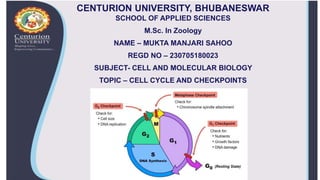
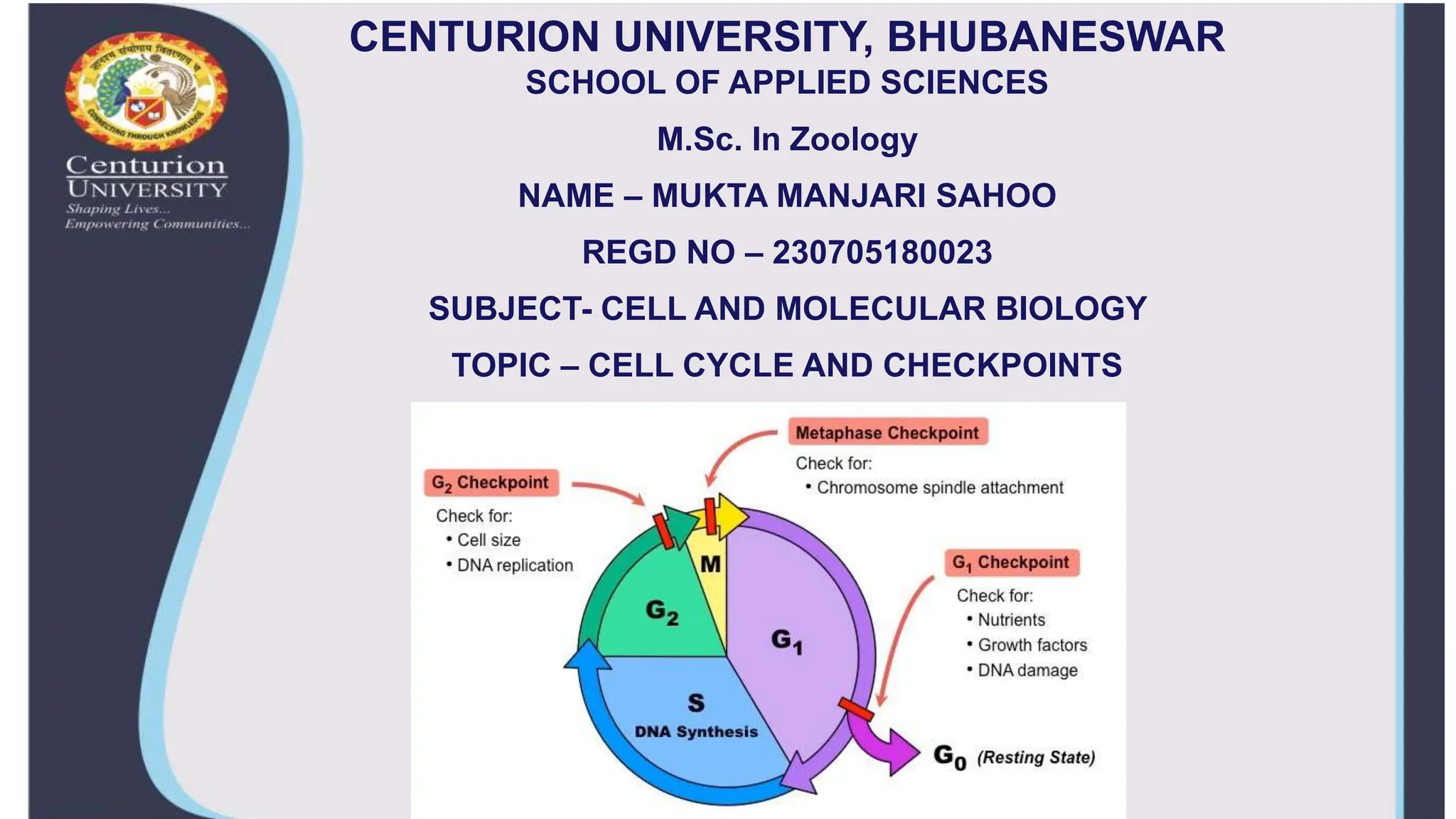
CENTURION UNIVERSITY, BHUBANESWAR
SCHOOL OF APPLIED SCIENCES
M.Sc. In Zoology
NAME – MUKTA MANJARI SAHOO
REGD NO – 230705180023
SUBJECT- CELL AND MOLECULAR BIOLOGY
TOPIC – CELL CYCLE AND CHECKPOINTS
INTERPHASE
• Cell prepares for division by undergoing
Cell growth
DNA replication
• More than 95 ٪of the duration of cell cycle
• Nerve cells remain in cell cycle
• Also called “Gap1 Phase”
• Interval between mitosis and initiation DNA replication
• Cell is metabolically active and grows continuously
• RNA, proteins, amino acids all energy rich compounds
are synthesized
• Organelles are replicates(Except centrosome)
G1 PHASE
S PHASE
• Also called “Synthesis phase”
• DNA synthesis of replication takes place
• DNA per cells double
DNA replication – nucleus
Centriole duplication – cytoplasm
G2 PHASE
• Also called Gap2 phase
• Proteins are synthesized to prepare for Mitosis
• Cell growth continues
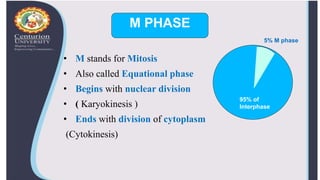
M PHASE
• M stands for Mitosis
• Also called Equational phase
• Begins with nuclear division
• ( Karyokinesis )
• Ends with division of cytoplasm
(Cytokinesis)
95% of
Interphase
5% M phase
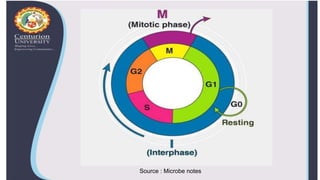
Source : Microbe notes
• In between the G, and S phase.
• It checks the damage of DNA and replication errors.
• At the G, checkpoint cell checks the external and
internal conditions for the division.
G1 checkpoint
• In between G, and M phase.
• This checkpoint make sure that cell division goes
smoothly and produces healthy daughter cell with
undamaged DNA.
• If any error or damaged detected cell will pause at G2
checkpoint and allows for repair.
G2 checkpoint
• It is known as spindle checkpoint.
• This checkpoint ensures that sister chromatids are
currently attached to the spindle microtubules.
• Cell cycle regulated by an enzyme called cyclin
dependent protein kinase.
• Cyclins are proteins that activate the protein kinase for
the regulation of eukaryotic cell cycle.
M checkpoint
CONCLUSION
As a cell moves through each phase, it also passes through
several checkpoints. These checkpoints ensure that mitosis
occurs only when environmental conditions are favorable
and the cellular genome has been precisely replicated
Cell cycle checkpoints are surveillance mechanisms that
monitor the order, integrity, and fidelity of the major events
of the cell cycle.
REFERENCES
1. Grana and Xavier, et al.(1995) Cell cycle control in mammalian cells: cell
cycle and check points, (11)2: 211-220.
2. Lim, Shuhui, and Philipp Kaldis.et al.(2013) “Cdks, cyclins and CKIs: roles
beyond cell cycle regulation.” Development (140)15: 3079-3093.
3. G. Prem Veer.(1994)Cell cycle: regulatory events in G1→ S transition of
mammalian cells. Journal of cellular biochemistry, (54)4: 379-386.
Cell cycle and it's checkpoints. Cell regulations

Cell cycle and it's checkpoints. Cell regulations

  • 1.
    CENTURION UNIVERSITY, BHUBANESWAR SCHOOLOF APPLIED SCIENCES M.Sc. In Zoology NAME – MUKTA MANJARI SAHOO REGD NO – 230705180023 SUBJECT- CELL AND MOLECULAR BIOLOGY TOPIC – CELL CYCLE AND CHECKPOINTS
  • 2.
    INTERPHASE • Cell preparesfor division by undergoing Cell growth DNA replication • More than 95 ٪of the duration of cell cycle • Nerve cells remain in cell cycle
  • 3.
    • Also called“Gap1 Phase” • Interval between mitosis and initiation DNA replication • Cell is metabolically active and grows continuously • RNA, proteins, amino acids all energy rich compounds are synthesized • Organelles are replicates(Except centrosome) G1 PHASE
  • 4.
    S PHASE • Alsocalled “Synthesis phase” • DNA synthesis of replication takes place • DNA per cells double DNA replication – nucleus Centriole duplication – cytoplasm
  • 5.
    G2 PHASE • Alsocalled Gap2 phase • Proteins are synthesized to prepare for Mitosis • Cell growth continues
  • 6.
    M PHASE • Mstands for Mitosis • Also called Equational phase • Begins with nuclear division • ( Karyokinesis ) • Ends with division of cytoplasm (Cytokinesis) 95% of Interphase 5% M phase
  • 7.
  • 8.
    • In betweenthe G, and S phase. • It checks the damage of DNA and replication errors. • At the G, checkpoint cell checks the external and internal conditions for the division. G1 checkpoint
  • 9.
    • In betweenG, and M phase. • This checkpoint make sure that cell division goes smoothly and produces healthy daughter cell with undamaged DNA. • If any error or damaged detected cell will pause at G2 checkpoint and allows for repair. G2 checkpoint
  • 10.
    • It isknown as spindle checkpoint. • This checkpoint ensures that sister chromatids are currently attached to the spindle microtubules. • Cell cycle regulated by an enzyme called cyclin dependent protein kinase. • Cyclins are proteins that activate the protein kinase for the regulation of eukaryotic cell cycle. M checkpoint
  • 11.
    CONCLUSION As a cellmoves through each phase, it also passes through several checkpoints. These checkpoints ensure that mitosis occurs only when environmental conditions are favorable and the cellular genome has been precisely replicated Cell cycle checkpoints are surveillance mechanisms that monitor the order, integrity, and fidelity of the major events of the cell cycle.
  • 12.
    REFERENCES 1. Grana andXavier, et al.(1995) Cell cycle control in mammalian cells: cell cycle and check points, (11)2: 211-220. 2. Lim, Shuhui, and Philipp Kaldis.et al.(2013) “Cdks, cyclins and CKIs: roles beyond cell cycle regulation.” Development (140)15: 3079-3093. 3. G. Prem Veer.(1994)Cell cycle: regulatory events in G1→ S transition of mammalian cells. Journal of cellular biochemistry, (54)4: 379-386.