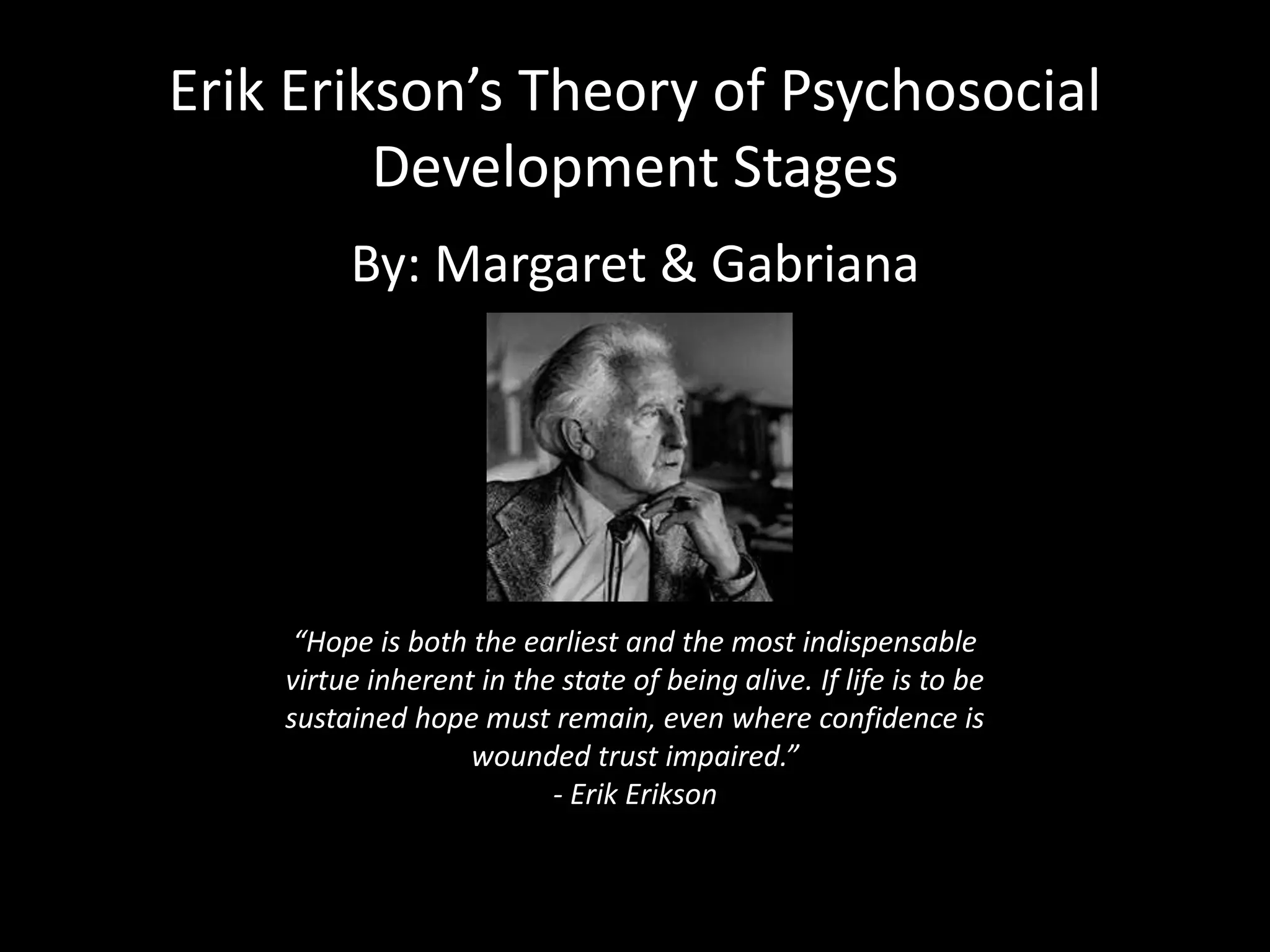
Erik Erikson’s Theory of Psychosocial 
Development Stages 
By: Margaret & Gabriana 
“Hope is both the earliest and the most indispensable 
virtue inherent in the state of being alive. If life is to be 
sustained hope must remain, even where confidence is 
wounded trust impaired.” 
- Erik Erikson
• Erik Erikson was born on June 15, 1902 
in Frankfurt-am-Main, Germany. He 
moved to Karlsruhe, Germany with his 
mother and stepfather. 
• Erikson died at the Rosewood Manor 
Nursing Home in Harwich, Mass. He 
was 91.
• Instead of going to college, he traveled around 
Europe. After a year he returned to Germany 
and enrolled at an art school. 
• After several years he was admitted into Vienna 
Psychoanalytic Institute.
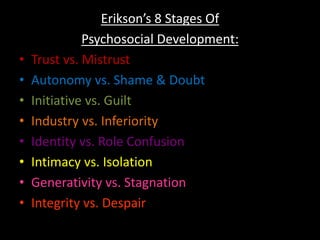
Erikson’s 8 Stages Of 
Psychosocial Development: 
• Trust vs. Mistrust 
• Autonomy vs. Shame & Doubt 
• Initiative vs. Guilt 
• Industry vs. Inferiority 
• Identity vs. Role Confusion 
• Intimacy vs. Isolation 
• Generativity vs. Stagnation 
• Integrity vs. Despair
• Trust vs. Mistrust: 
– Occurs between birth to 1 year of age. This is when 
an infant is utterly dependent, the development of 
trust is based on the dependability and quality of 
the child’s caregivers.
• Autonomy vs. Shame & Doubt: 
– The second stage takes places during early 
childhood. Erikson believes that learning to control 
one’s bodily functions leads to a feeling of control 
and a sense of independence. 
– Children who successfully complete this stage feel 
secure and confident, while those who don’t are 
inadequacy and self doubt.
• Initiative vs. Guilt: 
– The third stage happens in the preschool years. 
Children begin to assert their power and take 
control over their world through directing play and 
other social interactions. It helps the willingness to 
work with others. 
– Children who are successful at this stage feel 
capable and able to lead others. 
– Those who fail to acquire these skills are left with a 
sense of doubt and guilt.
How does this relate to us? 
• Gabriana: 
– “It was easy for that trust to be there because as 
soon as I had him I knew I’ll always be there when 
he needs me, even now I always have him with me. 
Throughout his life he has grown so much. He went 
from scooting to crawling to walking to running, and 
as he gets older its fun helping him understand new 
things.” 
• Margaret: 
– “My nurse always told me it’s better for Raiden’s 
development if he crawls before he walks so I helped 
him by showing him how to crawl around and soon 
after he started cruising.”

Cd ppt margaret

  • 1.
    Erik Erikson’s Theoryof Psychosocial Development Stages By: Margaret & Gabriana “Hope is both the earliest and the most indispensable virtue inherent in the state of being alive. If life is to be sustained hope must remain, even where confidence is wounded trust impaired.” - Erik Erikson
  • 2.
    • Erik Eriksonwas born on June 15, 1902 in Frankfurt-am-Main, Germany. He moved to Karlsruhe, Germany with his mother and stepfather. • Erikson died at the Rosewood Manor Nursing Home in Harwich, Mass. He was 91.
  • 3.
    • Instead ofgoing to college, he traveled around Europe. After a year he returned to Germany and enrolled at an art school. • After several years he was admitted into Vienna Psychoanalytic Institute.
  • 4.
    Erikson’s 8 StagesOf Psychosocial Development: • Trust vs. Mistrust • Autonomy vs. Shame & Doubt • Initiative vs. Guilt • Industry vs. Inferiority • Identity vs. Role Confusion • Intimacy vs. Isolation • Generativity vs. Stagnation • Integrity vs. Despair
  • 5.
    • Trust vs.Mistrust: – Occurs between birth to 1 year of age. This is when an infant is utterly dependent, the development of trust is based on the dependability and quality of the child’s caregivers.
  • 6.
    • Autonomy vs.Shame & Doubt: – The second stage takes places during early childhood. Erikson believes that learning to control one’s bodily functions leads to a feeling of control and a sense of independence. – Children who successfully complete this stage feel secure and confident, while those who don’t are inadequacy and self doubt.
  • 7.
    • Initiative vs.Guilt: – The third stage happens in the preschool years. Children begin to assert their power and take control over their world through directing play and other social interactions. It helps the willingness to work with others. – Children who are successful at this stage feel capable and able to lead others. – Those who fail to acquire these skills are left with a sense of doubt and guilt.
  • 8.
    How does thisrelate to us? • Gabriana: – “It was easy for that trust to be there because as soon as I had him I knew I’ll always be there when he needs me, even now I always have him with me. Throughout his life he has grown so much. He went from scooting to crawling to walking to running, and as he gets older its fun helping him understand new things.” • Margaret: – “My nurse always told me it’s better for Raiden’s development if he crawls before he walks so I helped him by showing him how to crawl around and soon after he started cruising.”