BRKCRT-1104
                               14381_04_2008_c1   © 2008 Cisco Systems, Inc. All rights reserved.   Cisco Public   1


                                        CCNA Security:
                                        A New Associate Level
                                        Career Path Option


                                        BRKCRT-1104


                               BRKCRT-1104
                               14381_04_2008_c1   © 2008 Cisco Systems, Inc. All rights reserved.   Cisco Public   2


© 2006, Cisco Systems, Inc. All rights reserved.                                                                       1
Presentation_ID.scr
Agenda
                                             Introduction
                                             Disclaimer
                                             Attack Methodologies
                                             Security Policy
                                             Cryptography Fundamentals
                                             Securing Administrative Access
                                             Firewall
                                             VPN
                                             IPS
                                             Layer 2 Security
                                             Sample Questions
                                             Answer Key
                               BRKCRT-1104
                               14381_04_2008_c1   © 2008 Cisco Systems, Inc. All rights reserved.   Cisco Public       3


                                        Goals of This Session

                                             What this session will not be:
                                                    A replacement to the 5 day IINS course
                                                    An exam cram session focusing on the content of the
                                                    IINS exam
                                                    An exact match to the content of the IINS course

                                             What this session will include:
                                                    A discussion of security issues and technology relevant to those
                                                    pursuing a career in Network Security at the associate level
                                                    A presentation based on, but not limited by, the concepts
                                                    covered in the IINS class
                                                    A demonstration of attack methodologies and mitigation of the
                                                    attack using Cisco security technology
                               BRKCRT-1104
                               14381_04_2008_c1   © 2008 Cisco Systems, Inc. All rights reserved.   Cisco Public       4


© 2006, Cisco Systems, Inc. All rights reserved.                                                                           2
Presentation_ID.scr
Agenda
                                             Introduction
                                             Disclaimer
                                             Attack Methodologies
                                             Security Policy
                                             Cryptography Fundamentals
                                             Securing Administrative Access
                                             Firewall
                                             VPN
                                             IPS
                                             Layer 2 Security
                                             Sample Questions
                                             Answer Key
                               BRKCRT-1104
                               14381_04_2008_c1   © 2008 Cisco Systems, Inc. All rights reserved.   Cisco Public                             5


                                        Disclaimer
                                                  Do not repeat the exercises demonstrated during this
                                                  presentation on any network for which you do not have complete
                                                  authorization to do so. The demonstrations are carried out on an
                                                  isolated network within the Global Knowledge remote labs
                                                  environment. Practicing similar exercises outside of this
                                                  environment requires many considerations including, but not
                                                  limited to:
                                                    1.       Many organizations have security policies explicitly forbidding the use of
                                                             these types of tools on the their networks. Job termination and/or criminal
                                                             prosecution may be the penalty.
                                                    2.       Often these types of tools are distributed with hidden malware. By installing
                                                             such tools you may unknowingly also be installing keystroke loggers, back
                                                             doors, or other types of malware.
                                                    3.       Use of these types of tools with targets that are owned by other entities
                                                             may violate local, state and/or federal laws.


                               BRKCRT-1104
                               14381_04_2008_c1   © 2008 Cisco Systems, Inc. All rights reserved.   Cisco Public                             6


© 2006, Cisco Systems, Inc. All rights reserved.                                                                                                 3
Presentation_ID.scr
Agenda
                                             Introduction
                                             Disclaimer
                                             Attack Methodologies
                                             Security Policy
                                             Cryptography Fundamentals
                                             Securing Administrative Access
                                             Firewall
                                             VPN
                                             IPS
                                             Layer 2 Security
                                             Sample Questions
                                             Answer Key
                               BRKCRT-1104
                               14381_04_2008_c1   © 2008 Cisco Systems, Inc. All rights reserved.   Cisco Public                           7


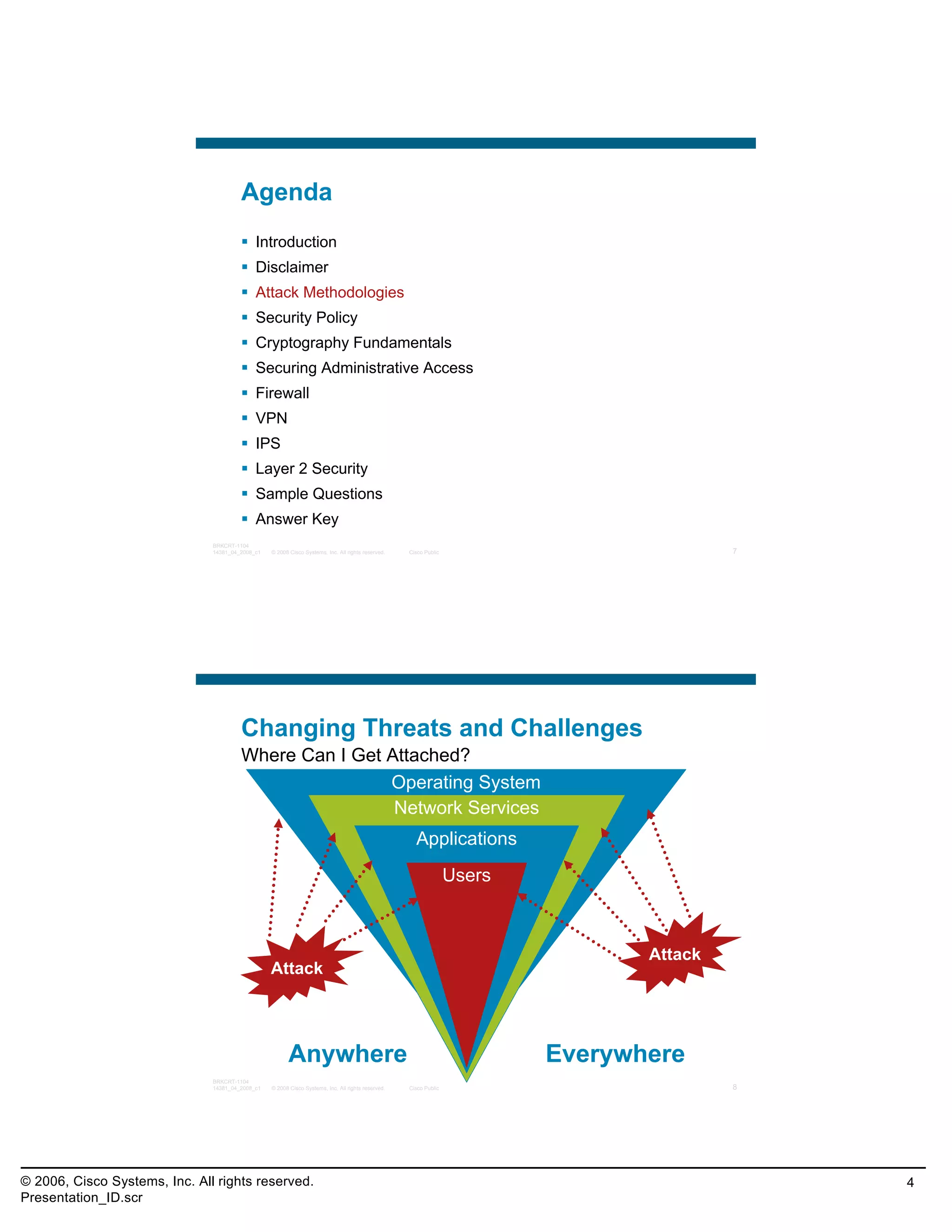
                                        Changing Threats and Challenges
                                        Where Can I Get Attached?
                                                        Operating System
                                                         Network Services
                                                                                                      Applications
                                                                                                                   Users


                                                                                                                                  Attack
                                                  Attack


                                                        Anywhere                                                           Everywhere
                               BRKCRT-1104
                               14381_04_2008_c1   © 2008 Cisco Systems, Inc. All rights reserved.   Cisco Public                           8


© 2006, Cisco Systems, Inc. All rights reserved.                                                                                               4
Presentation_ID.scr
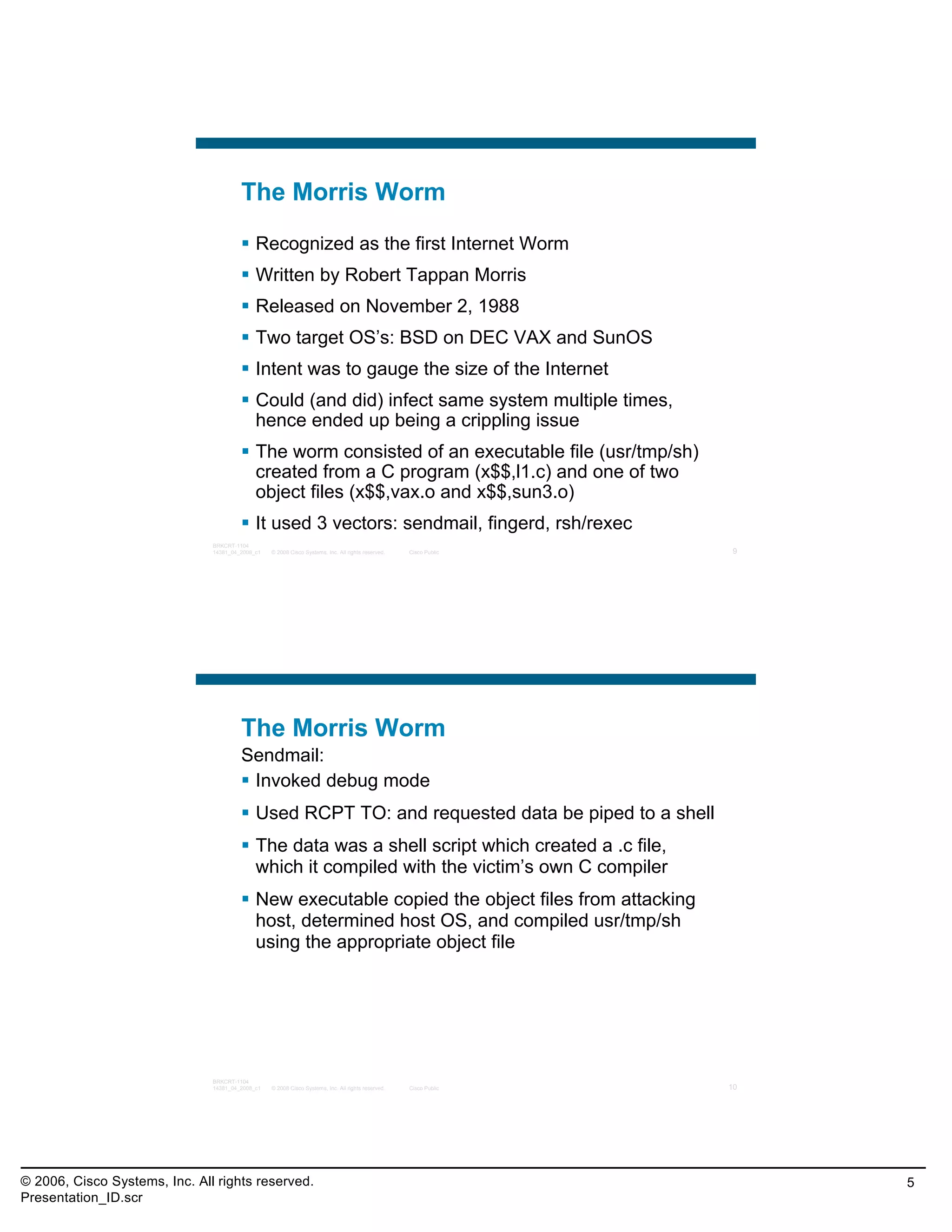
The Morris Worm
                                             Recognized as the first Internet Worm
                                             Written by Robert Tappan Morris
                                             Released on November 2, 1988
                                             Two target OS’s: BSD on DEC VAX and SunOS
                                             Intent was to gauge the size of the Internet
                                             Could (and did) infect same system multiple times,
                                             hence ended up being a crippling issue
                                             The worm consisted of an executable file (usr/tmp/sh)
                                             created from a C program (x$$,l1.c) and one of two
                                             object files (x$$,vax.o and x$$,sun3.o)
                                             It used 3 vectors: sendmail, fingerd, rsh/rexec
                               BRKCRT-1104
                               14381_04_2008_c1   © 2008 Cisco Systems, Inc. All rights reserved.   Cisco Public   9


                                        The Morris Worm
                                        Sendmail:
                                         Invoked debug mode
                                             Used RCPT TO: and requested data be piped to a shell
                                             The data was a shell script which created a .c file,
                                             which it compiled with the victim’s own C compiler
                                             New executable copied the object files from attacking
                                             host, determined host OS, and compiled usr/tmp/sh
                                             using the appropriate object file


                               BRKCRT-1104
                               14381_04_2008_c1   © 2008 Cisco Systems, Inc. All rights reserved.   Cisco Public   10


© 2006, Cisco Systems, Inc. All rights reserved.                                                                        5
Presentation_ID.scr
The Morris Worm
                                             fingerd & rsh/rexec
                                                    Differed from sendmail vector in method of transfering files

                                             fingerd
                                                    Buffer overflow–fingerd expected a max of 512 bytes of input, but didn’t verify
                                                    Vulnerability in both target OS, but exploit was only written to BSD on the
                                                    DEC VAX

                                             rsh/rexec
                                                    Checked the local .rhosts and /etc/hosts.equiv files for trust relationships
                                                    Needed to crack username/password
                                                    Tried common combinations for the password, such as username, first name,
                                                    last name and last name + firstname.
                                                    If those attempts failed, it used /usr/dict/words and tried every word in the
                                                    dictionary


                               BRKCRT-1104
                               14381_04_2008_c1   © 2008 Cisco Systems, Inc. All rights reserved.   Cisco Public                      11


                                        The Morris Worm

                                             Hiding itself:
                                                    Hid itself from the ps command
                                                    Unlinked its files so they wouldn’t show up with the ls command

                                             Scanning for other hosts:
                                                    Sequential addresses in local network
                                                    netstat –r –n
                                                    /etc/hosts
                                                    ypcat hosts


                               BRKCRT-1104
                               14381_04_2008_c1   © 2008 Cisco Systems, Inc. All rights reserved.   Cisco Public                      12


© 2006, Cisco Systems, Inc. All rights reserved.                                                                                           6
Presentation_ID.scr
The Morris Worm

                                             The Main Point: If the very first internet worm was this
                                             clever, imagine how clever the they’ve become over the
                                             last 20 years!
                                                    Multiple vectors
                                                    Dictionary cracking
                                                    Using local resources (C compiler, dictionary file)
                                                    Evasion of detection
                                                    Intelligent location of other networks

                                             Attackers think outside the box.


                               BRKCRT-1104
                               14381_04_2008_c1   © 2008 Cisco Systems, Inc. All rights reserved.    Cisco Public                                                      13


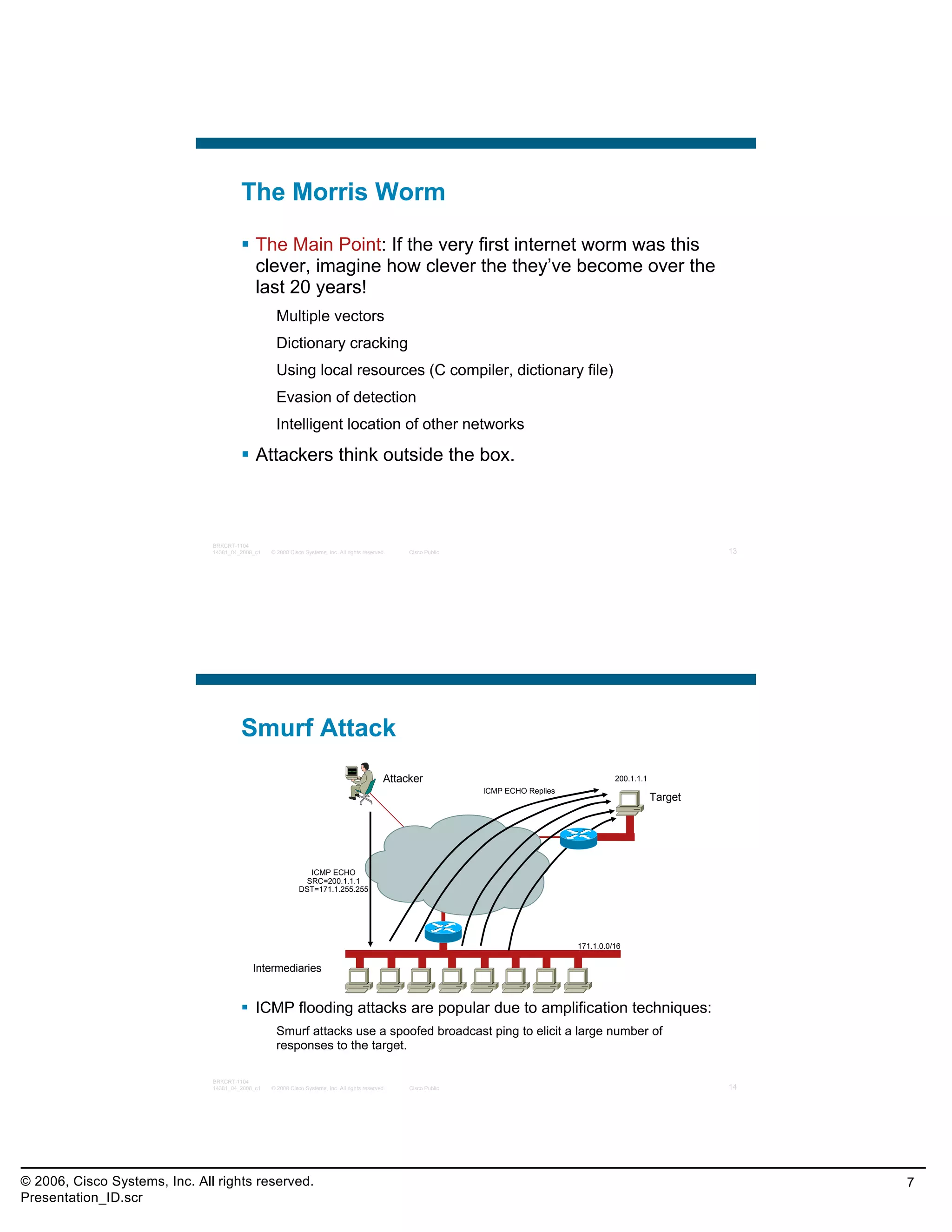
                                        Smurf Attack
                                                                                                Attacker                                          200.1.1.1
                                                                                                                    ICMP ECHO Replies
                                                                                                                                                              Target


                                                               ICMP ECHO
                                                              SRC=200.1.1.1
                                                             DST=171.1.255.255


                                                                                                                                        171.1.0.0/16

                                            Intermediaries


                                             ICMP flooding attacks are popular due to amplification techniques:
                                                    Smurf attacks use a spoofed broadcast ping to elicit a large number of
                                                    responses to the target.

                               BRKCRT-1104
                               14381_04_2008_c1   © 2008 Cisco Systems, Inc. All rights reserved.    Cisco Public                                                      14


© 2006, Cisco Systems, Inc. All rights reserved.                                                                                                                            7
Presentation_ID.scr
Ping Sweeps and Port Scans


                                             Ping sweeps and port scans can attempt to:
                                                     Identify all services on the network
                                                     Identify all hosts and devices on the network
                                                     Identify the operating systems on the network
                                                     Identify vulnerabilities on the network


                               BRKCRT-1104
                               14381_04_2008_c1    © 2008 Cisco Systems, Inc. All rights reserved.   Cisco Public                                                            15


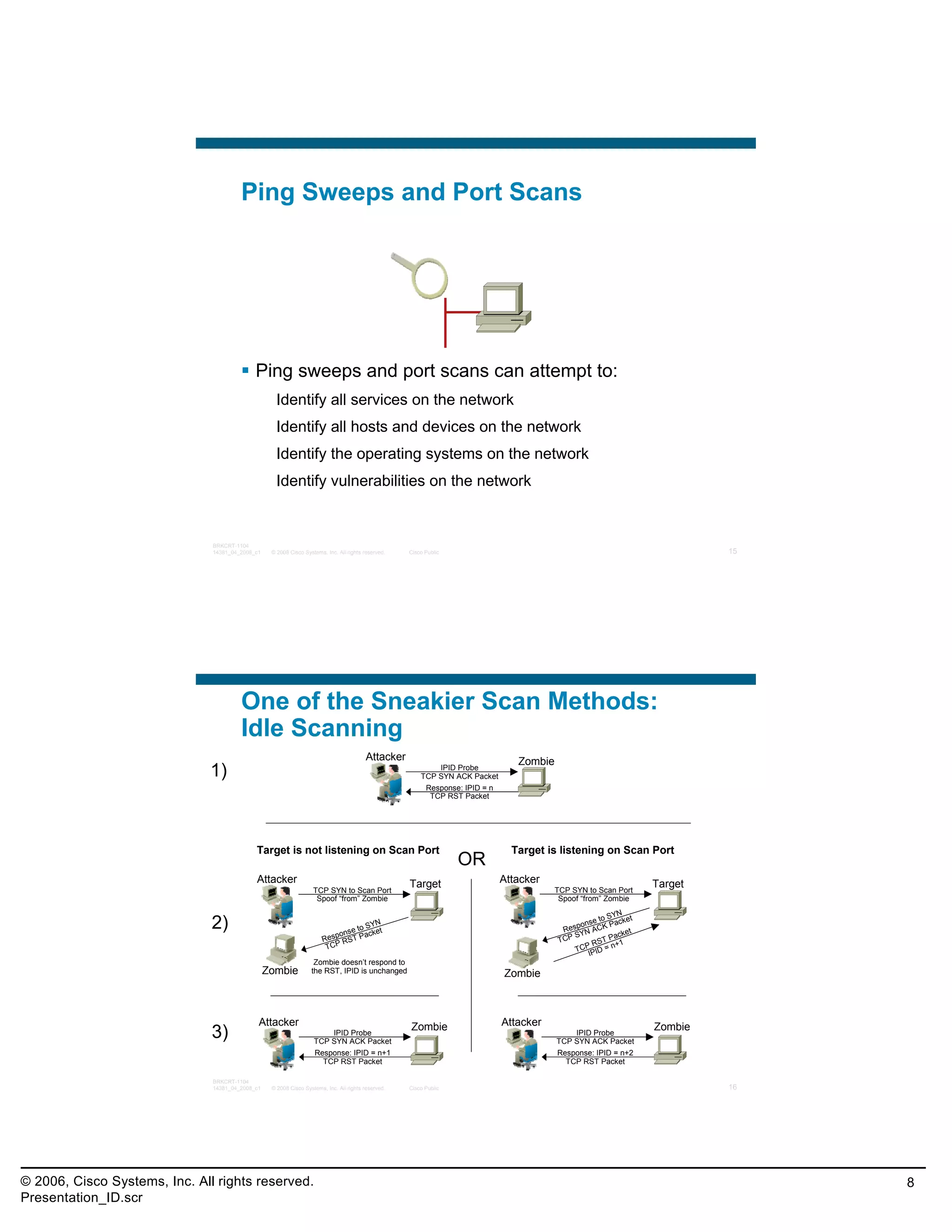
                                        One of the Sneakier Scan Methods:
                                        Idle Scanning
                                                                                         Attacker                                  Zombie
                               1)                                                                            IPID Probe
                                                                                                         TCP SYN ACK Packet
                                                                                                           Response: IPID = n
                                                                                                            TCP RST Packet


                                             Target is not listening on Scan Port                                                 Target is listening on Scan Port
                                                                                                                    OR
                                             Attacker                                                Target                     Attacker                            Target
                                                                    TCP SYN to Scan Port                                                    TCP SYN to Scan Port
                                                                     Spoof “from” Zombie                                                     Spoof “from” Zombie

                                                                                                                                                          SYN
                               2)                                                   SYN
                                                                                e to cket
                                                                                                                                                 pons
                                                                                                                                                      e to Packet
                                                                                                                                              Res YN ACK      ket
                                                                           pons     a                                                            S         Pac
                                                                        Res RST P                                                            TCP
                                                                         TCP                                                                         RST +1
                                                                                                                                                 TCP ID = n
                                                                                                                                                    IP
                                                                    Zombie doesn’t respond to
                                                  Zombie           the RST, IPID is unchanged                                   Zombie


                                              Attacker                                               Zombie                     Attacker                            Zombie
                               3)                                       IPID Probe
                                                                    TCP SYN ACK Packet
                                                                                                                                                IPID Probe
                                                                                                                                            TCP SYN ACK Packet
                                                                    Response: IPID = n+1                                                    Response: IPID = n+2
                                                                      TCP RST Packet                                                          TCP RST Packet

                               BRKCRT-1104
                               14381_04_2008_c1    © 2008 Cisco Systems, Inc. All rights reserved.   Cisco Public                                                            16


© 2006, Cisco Systems, Inc. All rights reserved.                                                                                                                                  8
Presentation_ID.scr
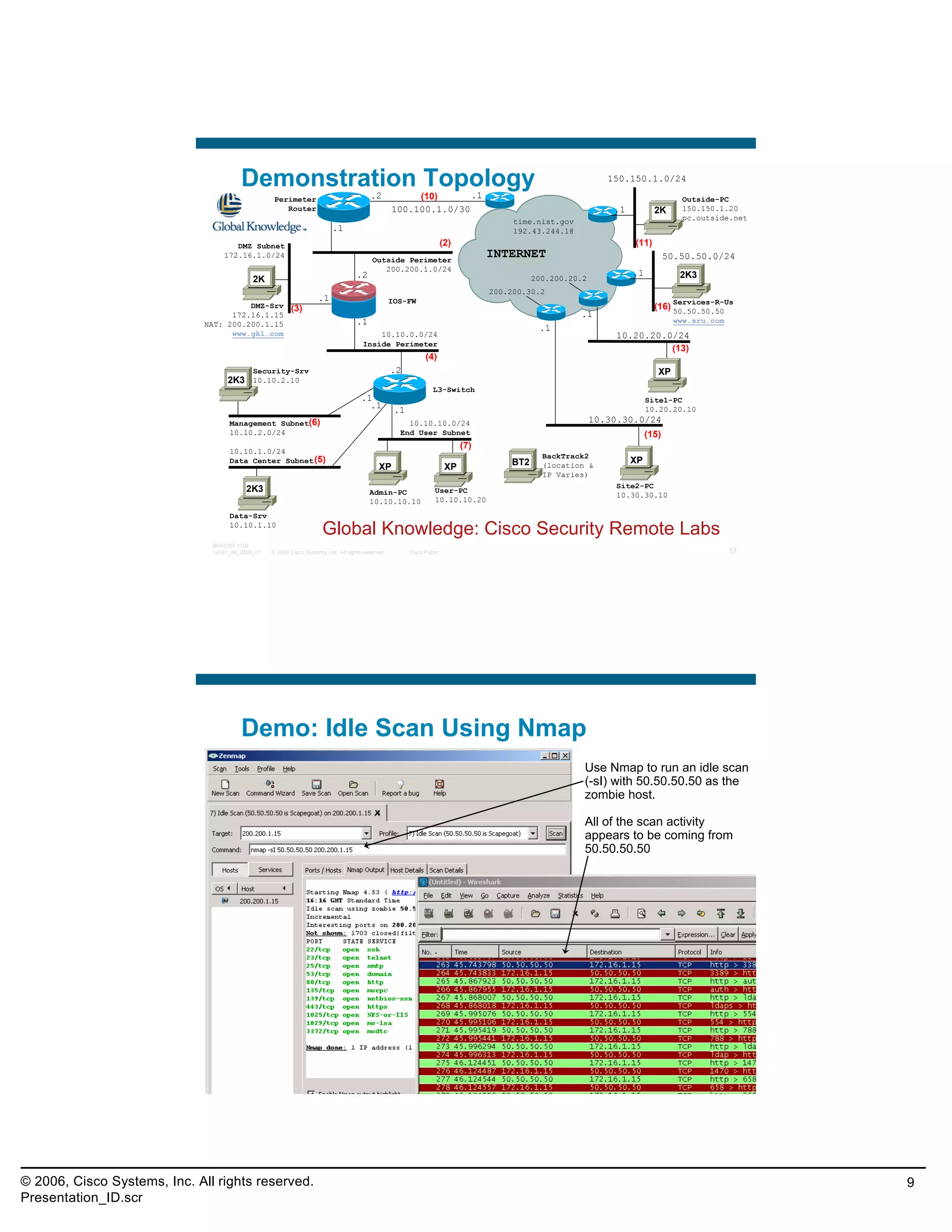
Demonstration Topology                            .2                       .1
                                                                                                                                                                 150.150.1.0/24

                                                   Perimeter                                             (10)                                                                         Outside-PC
                                                      Router                                        100.100.1.0/30                                                .1          2K      150.150.1.20
                                                                                                                                          time.nist.gov                               pc.outside.net
                                                                           .1                                                             192.43.244.18
                                     DMZ Subnet                                                                          (2)                                           (11)
                                  172.16.1.0/24
                                                                                           Outside Perimeter
                                                                                                                                     INTERNET                                      50.50.50.0/24
                                                                                              200.200.1.0/24
                                                                                     .2                                                                                .1             2K3
                                            2K                                                                                                 200.200.20.2
                                                                                                                                     200.200.30.2
                                                                     .1                             IOS-FW                                                                          Services-R-Us
                                        DMZ-Srv           (3)                                                                                                                 (16) 50.50.50.50
                                    172.16.1.15                                                                                                           .1
                              NAT: 200.200.1.15                                      .1                                                                                             www.sru.com
                                                                                                                                                .1
                                    www.gkl.com                                            10.10.0.0/24                                                           10.20.20.0/24
                                                                                       Inside Perimeter
                                                                                                                                                                            (13)
                                                                                                                (4)
                                            Security-Srv                                            .2                                                                         XP
                                   2K3      10.10.2.10
                                                                                                                   L3-Switch
                                                                                       .1                                                                                   Site1-PC
                                                                                         .1                                                                                 10.20.20.10
                                                                                                     .1
                                    Management Subnet(6)                                                10.10.10.0/24                                         10.30.30.0/24
                                    10.10.2.0/24                                                      End User Subnet                                                       (15)
                                                                                                                               (7)
                                    10.10.1.0/24
                                                                                                                                                 BackTrack2
                                    Data Center Subnet (5)                                                                               BT2                           XP
                                                                                              XP                          XP                     (location &
                                                                                                                                                 IP Varies)
                                          2K3                                                                                                                     Site2-PC
                                                                                          Admin-PC                  User-PC
                                                                                                                                                                  10.30.30.10
                                                                                          10.10.10.10               10.10.10.20

                                    Data-Srv
                                    10.10.1.10
                                                                       Global Knowledge: Cisco Security Remote Labs
                               BRKCRT-1104
                               14381_04_2008_c1   © 2008 Cisco Systems, Inc. All rights reserved.         Cisco Public                                                                            17


                                        Demo: Idle Scan Using Nmap
                                                                                                                                                          Use Nmap to run an idle scan
                                                                                                                                                          (-sI) with 50.50.50.50 as the
                                                                                                                                                          zombie host.

                                                                                                                                                          All of the scan activity
                                                                                                                                                          appears to be coming from
                                                                                                                                                          50.50.50.50


                               BRKCRT-1104
                               14381_04_2008_c1   © 2008 Cisco Systems, Inc. All rights reserved.         Cisco Public                                                                            18


© 2006, Cisco Systems, Inc. All rights reserved.                                                                                                                                                       9
Presentation_ID.scr
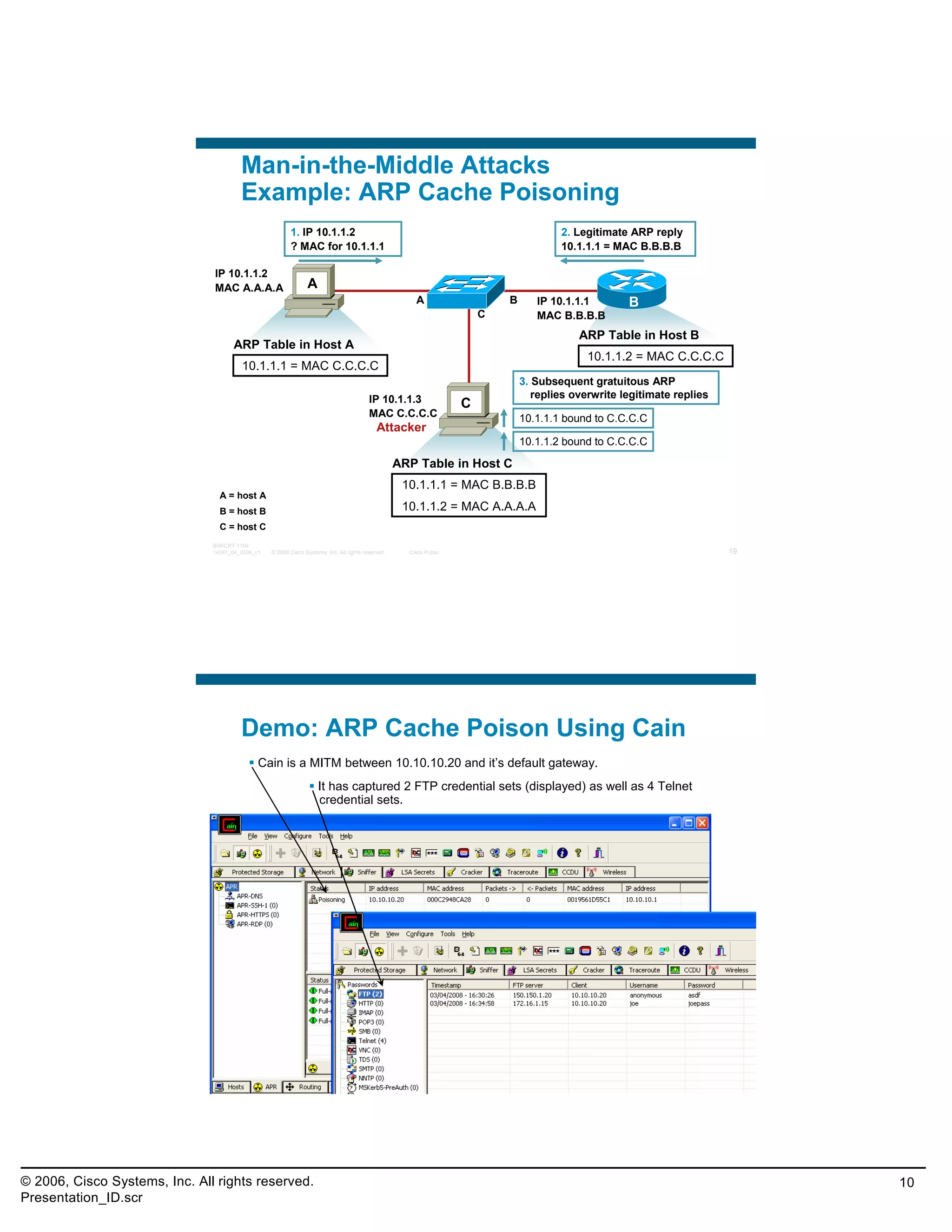
Man-in-the-Middle Attacks
                                        Example: ARP Cache Poisoning
                                                         1. IP 10.1.1.2                                                                  2. Legitimate ARP reply
                                                         ? MAC for 10.1.1.1                                                              10.1.1.1 = MAC B.B.B.B

                               IP 10.1.1.2
                               MAC A.A.A.A                      A
                                                                                                        A                    B      IP 10.1.1.1        B
                                                                                                                         C          MAC B.B.B.B
                                                                                                                                             ARP Table in Host B
                                     ARP Table in Host A
                                                                                                                                               10.1.1.2 = MAC C.C.C.C
                                        10.1.1.1 = MAC C.C.C.C
                                                                                                                                 3. Subsequent gratuitous ARP
                                                                                          IP 10.1.1.3                               replies overwrite legitimate replies
                                                                                                                     C
                                                                                          MAC C.C.C.C                            10.1.1.1 bound to C.C.C.C
                                                                                             Attacker
                                                                                                                                 10.1.1.2 bound to C.C.C.C

                                                                                                    ARP Table in Host C
                                                                                                     10.1.1.1 = MAC B.B.B.B
                                 A = host A
                                 B = host B                                                          10.1.1.2 = MAC A.A.A.A
                                 C = host C
                               BRKCRT-1104
                               14381_04_2008_c1   © 2008 Cisco Systems, Inc. All rights reserved.     Cisco Public                                                         19


                                        Demo: ARP Cache Poison Using Cain
                                              Cain is a MITM between 10.10.10.20 and it’s default gateway.
                                                                     It has captured 2 FTP credential sets (displayed) as well as 4 Telnet
                                                                     credential sets.


                               BRKCRT-1104
                               14381_04_2008_c1   © 2008 Cisco Systems, Inc. All rights reserved.     Cisco Public                                                         20


© 2006, Cisco Systems, Inc. All rights reserved.                                                                                                                                10
Presentation_ID.scr
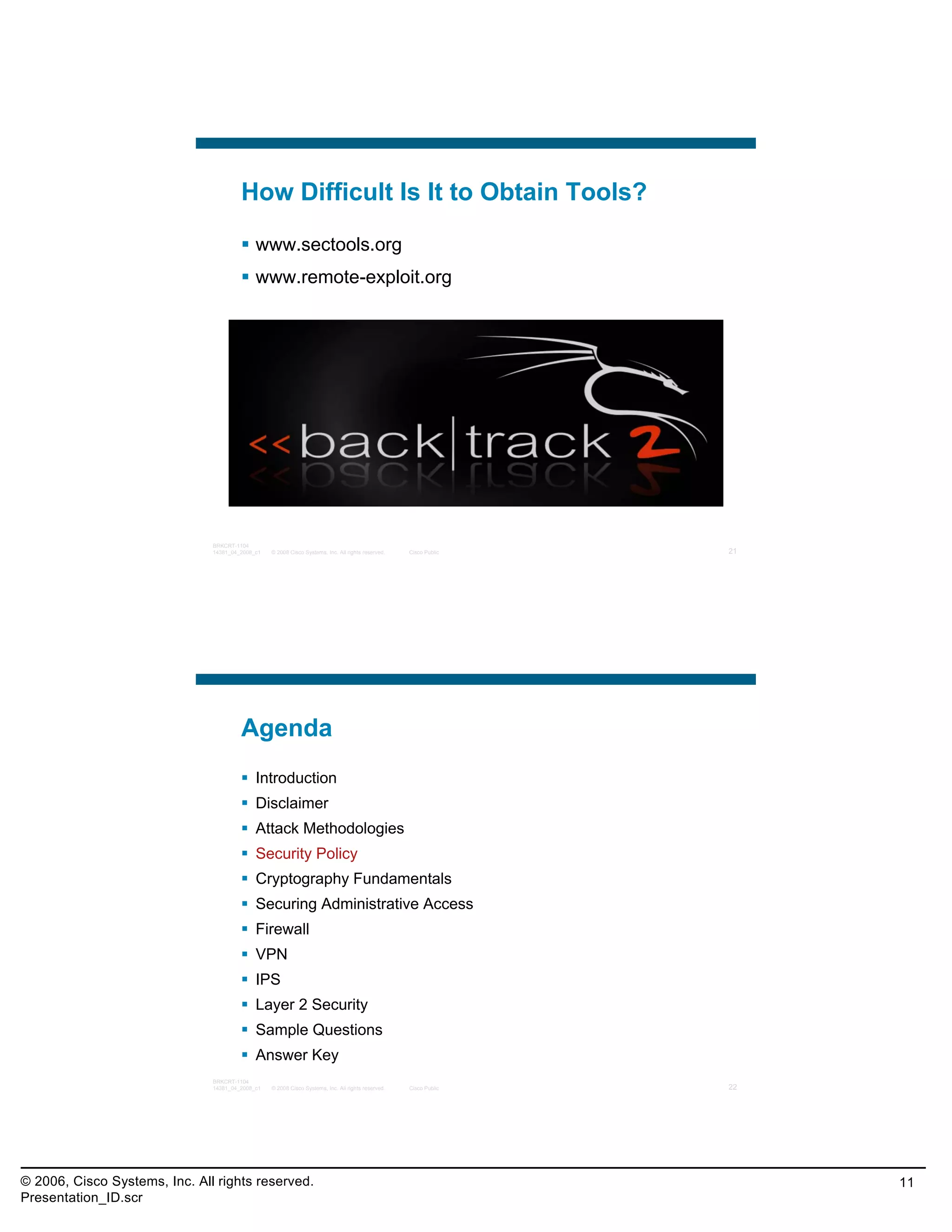
How Difficult Is It to Obtain Tools?

                                             www.sectools.org
                                             www.remote-exploit.org


                               BRKCRT-1104
                               14381_04_2008_c1   © 2008 Cisco Systems, Inc. All rights reserved.   Cisco Public   21


                                        Agenda
                                             Introduction
                                             Disclaimer
                                             Attack Methodologies
                                             Security Policy
                                             Cryptography Fundamentals
                                             Securing Administrative Access
                                             Firewall
                                             VPN
                                             IPS
                                             Layer 2 Security
                                             Sample Questions
                                             Answer Key
                               BRKCRT-1104
                               14381_04_2008_c1   © 2008 Cisco Systems, Inc. All rights reserved.   Cisco Public   22


© 2006, Cisco Systems, Inc. All rights reserved.                                                                        11
Presentation_ID.scr
Network Security Is a System

                                             Firewall + AV ≠ Network Security
                                             Network security is not something you can just buy
                                                    Technology will assist
                                                    Policy, Operations, and Design are more important

                                             Network security system:
                                                    A collection of network-connected devices, technologies, and
                                                    best practices that work in complementary ways to provide
                                                    security to information assets


                               BRKCRT-1104
                               14381_04_2008_c1   © 2008 Cisco Systems, Inc. All rights reserved.   Cisco Public                               23


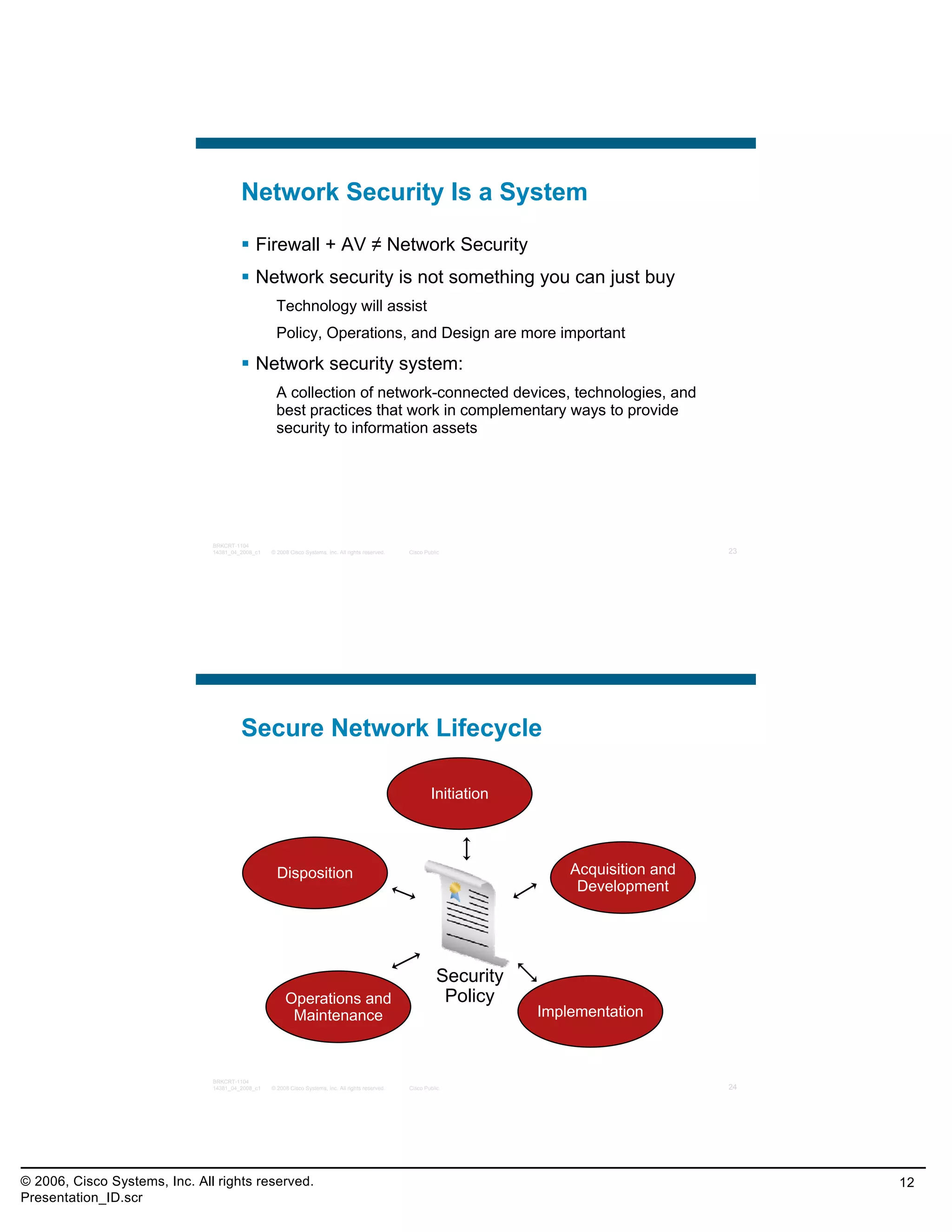
                                        Secure Network Lifecycle

                                                                                                            Initiation


                                                    Disposition                                                              Acquisition and
                                                                                                                              Development


                                                                                                              Security
                                                       Operations and                                          Policy
                                                        Maintenance                                                      Implementation


                               BRKCRT-1104
                               14381_04_2008_c1   © 2008 Cisco Systems, Inc. All rights reserved.   Cisco Public                               24


© 2006, Cisco Systems, Inc. All rights reserved.                                                                                                    12
Presentation_ID.scr
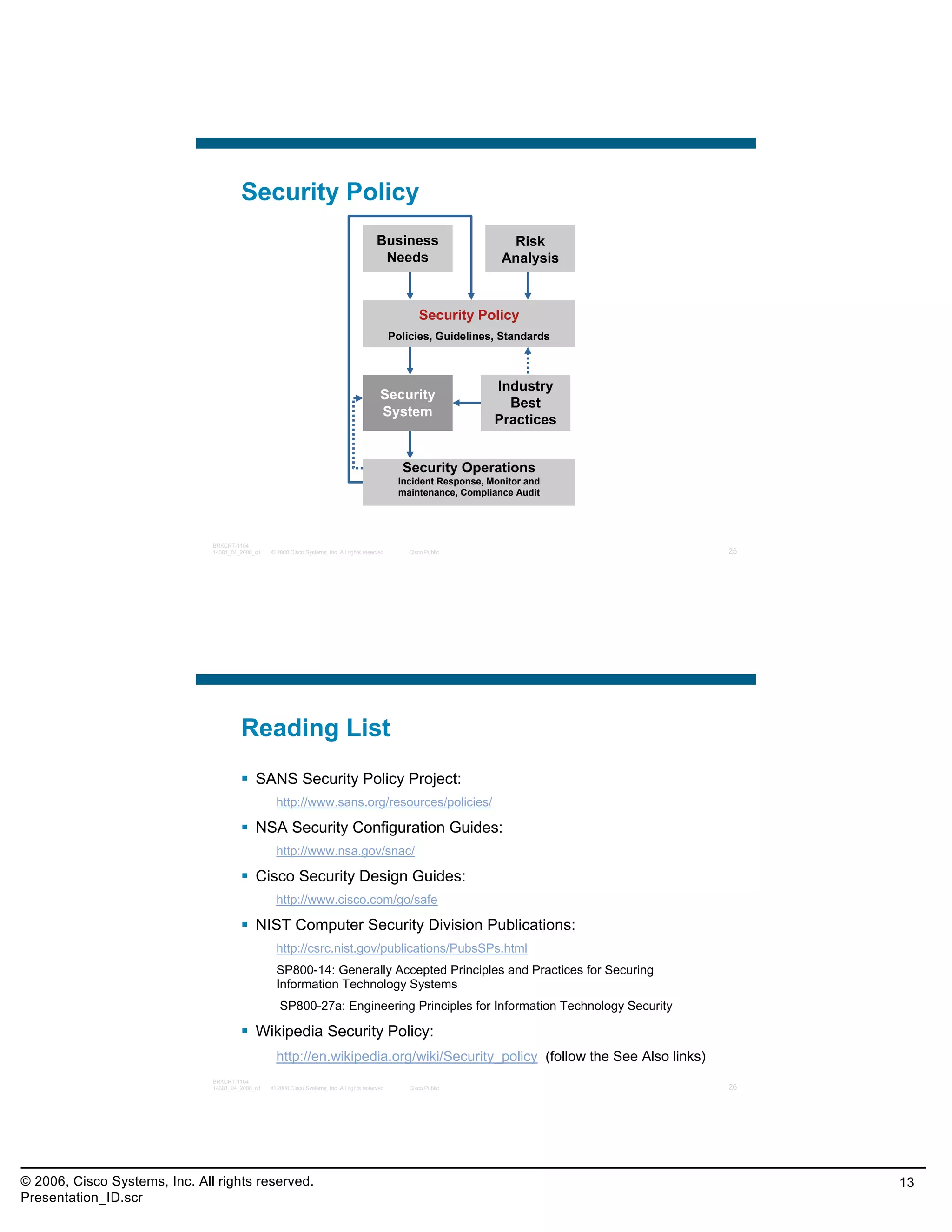
Security Policy
                                                                                             Business                      Risk
                                                                                              Needs                       Analysis


                                                                                                           Security Policy
                                                                                                    Policies, Guidelines, Standards


                                                                                                                         Industry
                                                                                              Security
                                                                                                                           Best
                                                                                              System
                                                                                                                         Practices


                                                                                                      Security Operations
                                                                                                     Incident Response, Monitor and
                                                                                                     maintenance, Compliance Audit


                               BRKCRT-1104
                               14381_04_2008_c1   © 2008 Cisco Systems, Inc. All rights reserved.       Cisco Public                  25


                                        Reading List
                                             SANS Security Policy Project:
                                                    http://www.sans.org/resources/policies/

                                             NSA Security Configuration Guides:
                                                    http://www.nsa.gov/snac/

                                             Cisco Security Design Guides:
                                                    http://www.cisco.com/go/safe

                                             NIST Computer Security Division Publications:
                                                    http://csrc.nist.gov/publications/PubsSPs.html
                                                    SP800-14: Generally Accepted Principles and Practices for Securing
                                                    Information Technology Systems
                                                     SP800-27a: Engineering Principles for Information Technology Security

                                             Wikipedia Security Policy:
                                                    http://en.wikipedia.org/wiki/Security_policy (follow the See Also links)
                               BRKCRT-1104
                               14381_04_2008_c1   © 2008 Cisco Systems, Inc. All rights reserved.       Cisco Public                  26


© 2006, Cisco Systems, Inc. All rights reserved.                                                                                           13
Presentation_ID.scr
Agenda
                                             Introduction
                                             Disclaimer
                                             Attack Methodologies
                                             Security Policy
                                             Cryptography Fundamentals
                                             Securing Administrative Access
                                             Firewall
                                             VPN
                                             IPS
                                             Layer 2 Security
                                             Sample Questions
                                             Answer Key
                               BRKCRT-1104
                               14381_04_2008_c1   © 2008 Cisco Systems, Inc. All rights reserved.   Cisco Public   27


                                        Cryptography: What and Why

                                             What:
                                                    Cryptography: From the greek kryptó (hidden) and gráfo
                                                    (to write)
                                                    Cryptology: From the Greek kryptó (hidden) and legein
                                                    (to speak)

                                             Why:
                                                    Confidentiality, privacy, encryption,
                                                    Origin Authentication
                                                    Data Integrity


                               BRKCRT-1104
                               14381_04_2008_c1   © 2008 Cisco Systems, Inc. All rights reserved.   Cisco Public   28


© 2006, Cisco Systems, Inc. All rights reserved.                                                                        14
Presentation_ID.scr
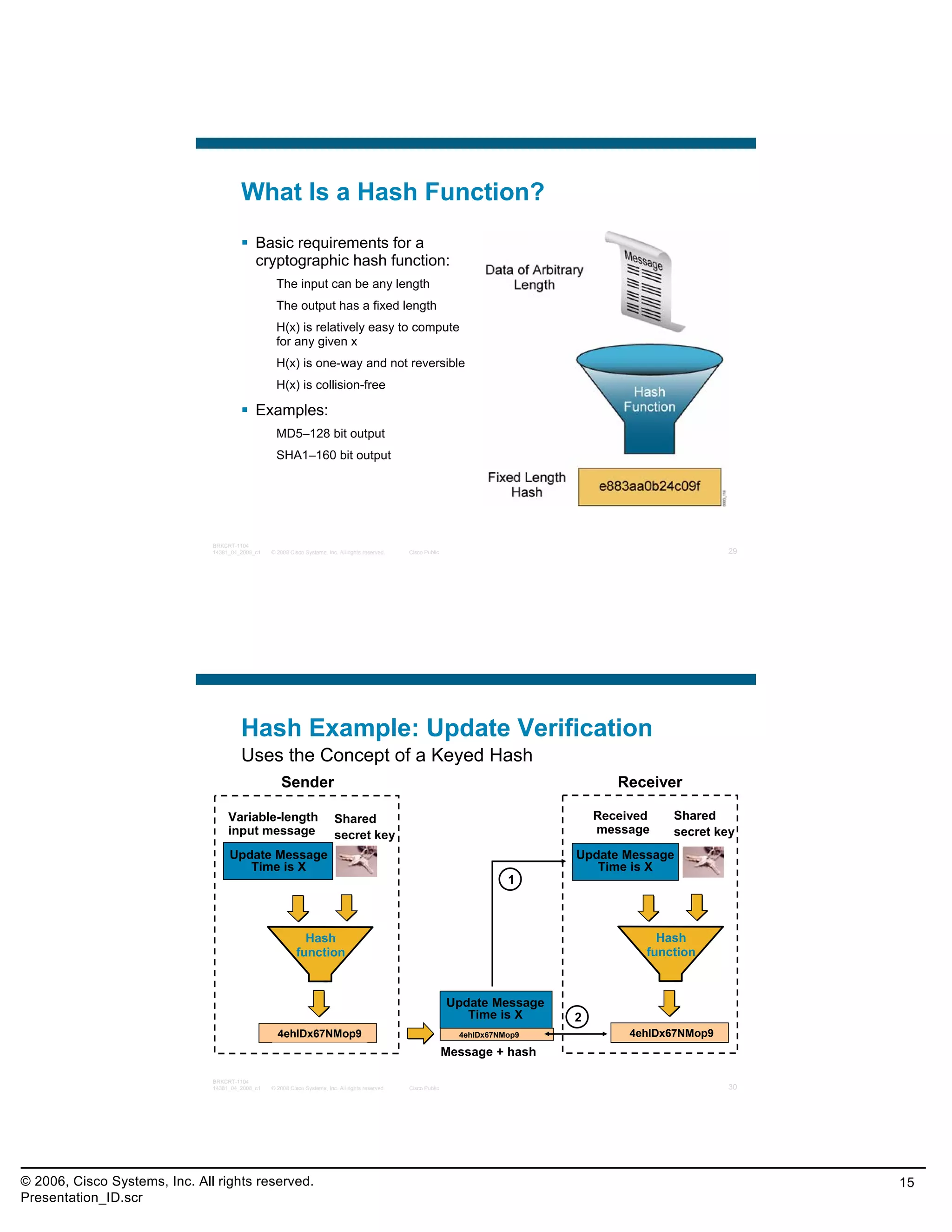
What Is a Hash Function?
                                             Basic requirements for a
                                             cryptographic hash function:
                                                    The input can be any length
                                                    The output has a fixed length
                                                    H(x) is relatively easy to compute
                                                    for any given x
                                                    H(x) is one-way and not reversible
                                                    H(x) is collision-free

                                             Examples:
                                                    MD5–128 bit output
                                                    SHA1–160 bit output


                               BRKCRT-1104
                               14381_04_2008_c1   © 2008 Cisco Systems, Inc. All rights reserved.   Cisco Public                                              29


                                        Hash Example: Update Verification
                                        Uses the Concept of a Keyed Hash
                                                      Sender                                                                                Receiver

                                    Variable-length                        Shared                                                        Received   Shared
                                    input message                          secret key                                                    message    secret key
                                    Update Message                                                                                   Update Message
                                       Time is X                                                                                        Time is X
                                                                                                                               1


                                                              Hash                                                                                Hash
                                                            function                                                                            function


                                                                                                                   Update Message
                                                                                                                      Time is X      2
                                                    4ehIDx67NMop9                                                    4ehIDx67NMop9            4ehIDx67NMop9
                                                                                                                   Message + hash

                               BRKCRT-1104
                               14381_04_2008_c1   © 2008 Cisco Systems, Inc. All rights reserved.   Cisco Public                                              30


© 2006, Cisco Systems, Inc. All rights reserved.                                                                                                                   15
Presentation_ID.scr
Hash Example: Enable Secret
                                            router(config)#

                                           enable secret password

                                                                 Hashes the password in the router configuration file
                                                                 Uses a strong hashing algorithm based on MD5


                                           Boston(config)# enable secret Curium2006

                                                       Boston# show running-config
                                                       !
                                                                           Salt         Hash
                                                       hostname Boston    Phrase        Value
                                                       !
                                                       no logging console
                                                       enable secret 5 $1$ptCj$vRErS/tehv53JjaqFMzBT/
                                                       !
                               BRKCRT-1104
                               14381_04_2008_c1   © 2008 Cisco Systems, Inc. All rights reserved.   Cisco Public        31


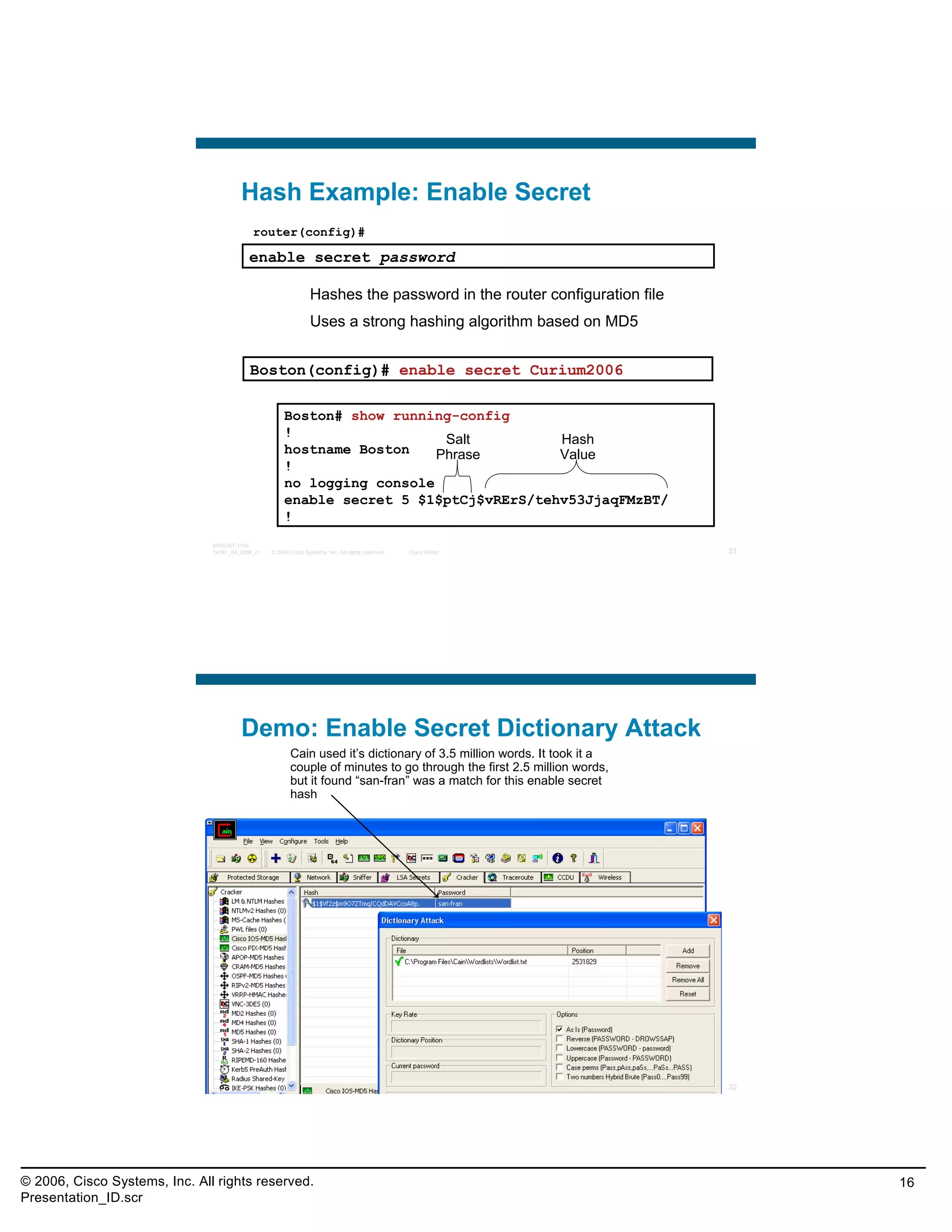
                                        Demo: Enable Secret Dictionary Attack
                                                         Cain used it’s dictionary of 3.5 million words. It took it a
                                                         couple of minutes to go through the first 2.5 million words,
                                                         but it found “san-fran” was a match for this enable secret
                                                         hash


                               BRKCRT-1104
                               14381_04_2008_c1   © 2008 Cisco Systems, Inc. All rights reserved.   Cisco Public        32


© 2006, Cisco Systems, Inc. All rights reserved.                                                                             16
Presentation_ID.scr
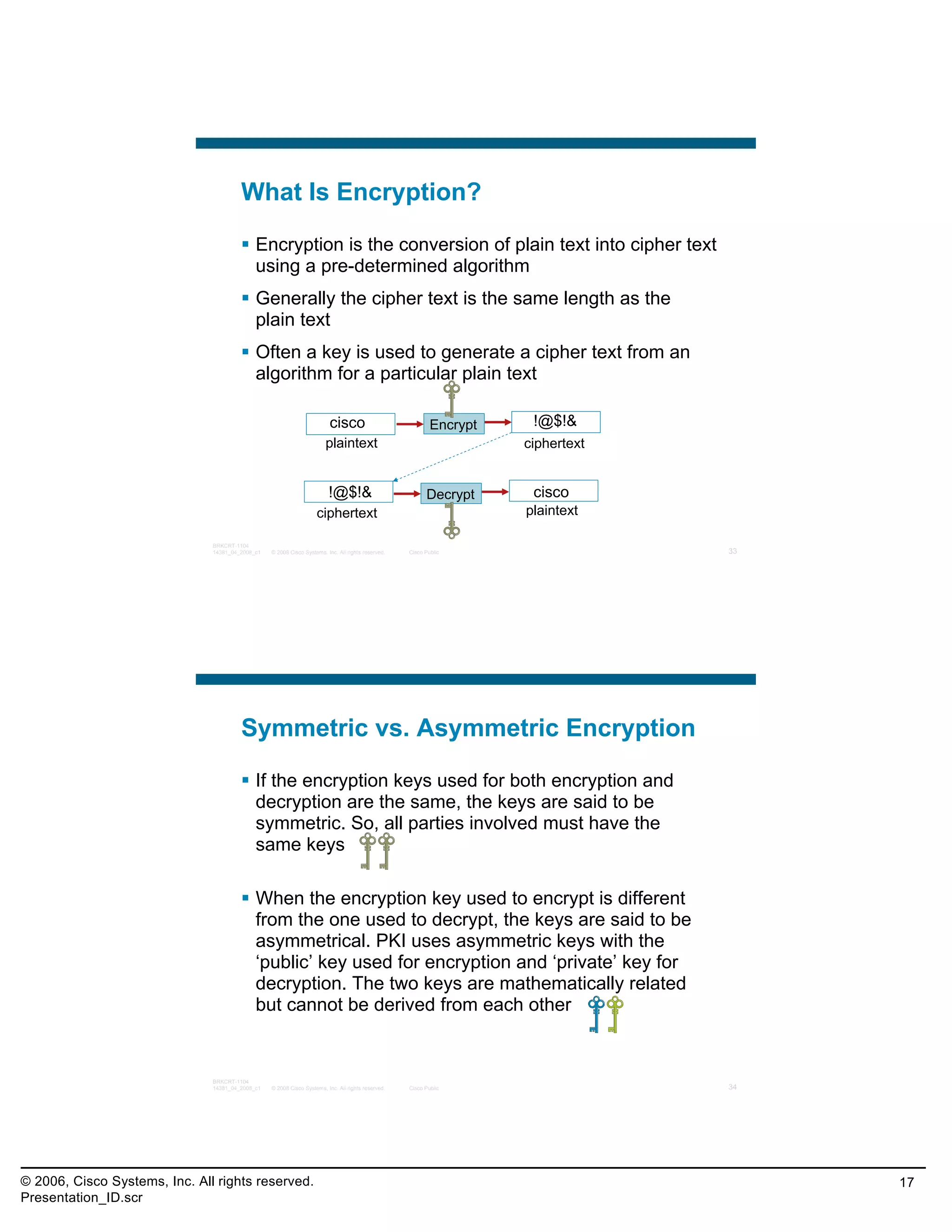
What Is Encryption?

                                             Encryption is the conversion of plain text into cipher text
                                             using a pre-determined algorithm
                                             Generally the cipher text is the same length as the
                                             plain text
                                             Often a key is used to generate a cipher text from an
                                             algorithm for a particular plain text

                                                                          cisco                             Encrypt    !@$!&
                                                                        plaintext                                     ciphertext


                                                                         !@$!&                            Decrypt      cisco
                                                                    ciphertext                                        plaintext

                               BRKCRT-1104
                               14381_04_2008_c1   © 2008 Cisco Systems, Inc. All rights reserved.   Cisco Public                   33


                                        Symmetric vs. Asymmetric Encryption

                                             If the encryption keys used for both encryption and
                                             decryption are the same, the keys are said to be
                                             symmetric. So, all parties involved must have the
                                             same keys

                                             When the encryption key used to encrypt is different
                                             from the one used to decrypt, the keys are said to be
                                             asymmetrical. PKI uses asymmetric keys with the
                                             ‘public’ key used for encryption and ‘private’ key for
                                             decryption. The two keys are mathematically related
                                             but cannot be derived from each other


                               BRKCRT-1104
                               14381_04_2008_c1   © 2008 Cisco Systems, Inc. All rights reserved.   Cisco Public                   34


© 2006, Cisco Systems, Inc. All rights reserved.                                                                                        17
Presentation_ID.scr
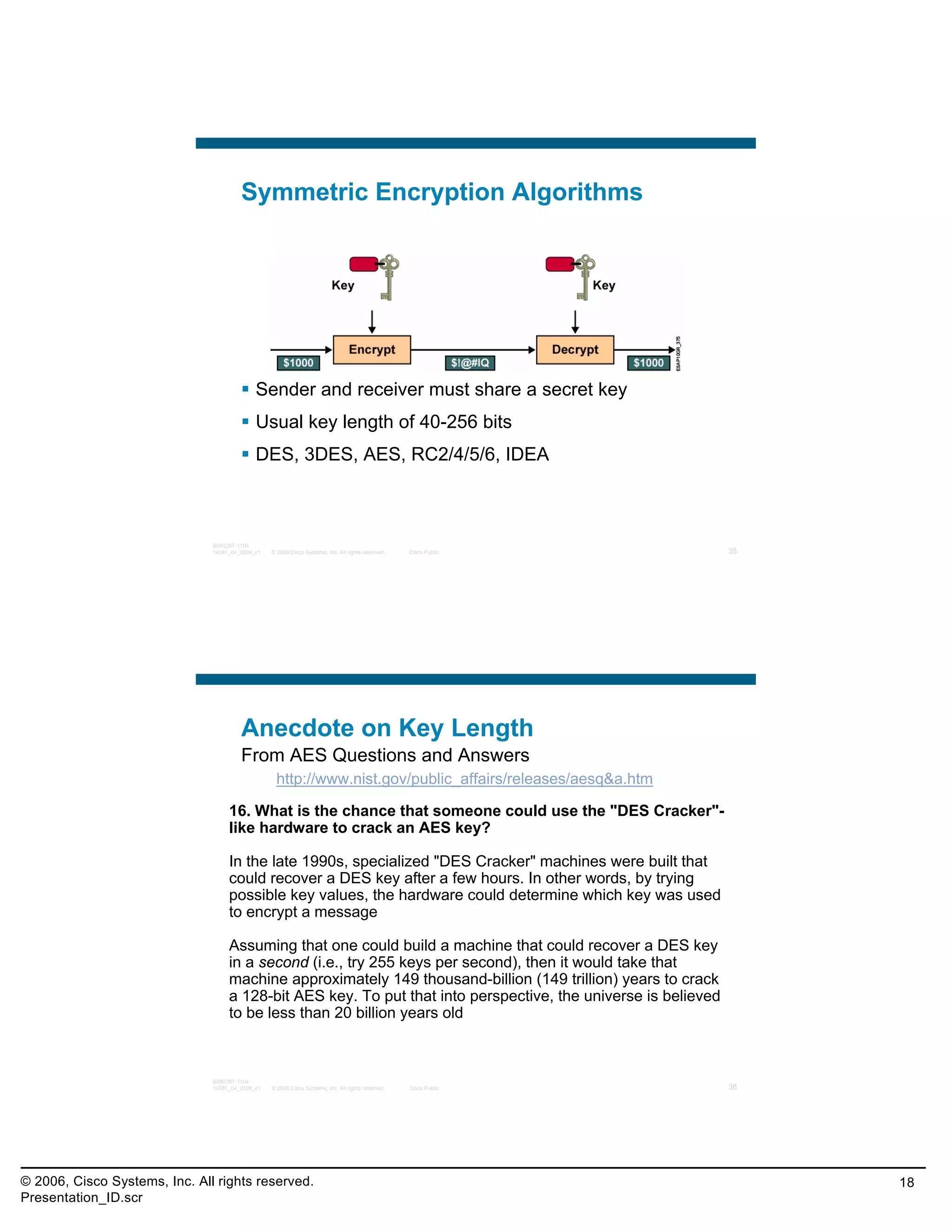
Symmetric Encryption Algorithms


                                             Sender and receiver must share a secret key
                                             Usual key length of 40-256 bits
                                             DES, 3DES, AES, RC2/4/5/6, IDEA


                               BRKCRT-1104
                               14381_04_2008_c1   © 2008 Cisco Systems, Inc. All rights reserved.   Cisco Public   35


                                        Anecdote on Key Length
                                        From AES Questions and Answers
                                                    http://www.nist.gov/public_affairs/releases/aesq&a.htm

                                    16. What is the chance that someone could use the "DES Cracker"-
                                    like hardware to crack an AES key?

                                    In the late 1990s, specialized "DES Cracker" machines were built that
                                    could recover a DES key after a few hours. In other words, by trying
                                    possible key values, the hardware could determine which key was used
                                    to encrypt a message

                                    Assuming that one could build a machine that could recover a DES key
                                    in a second (i.e., try 255 keys per second), then it would take that
                                    machine approximately 149 thousand-billion (149 trillion) years to crack
                                    a 128-bit AES key. To put that into perspective, the universe is believed
                                    to be less than 20 billion years old


                               BRKCRT-1104
                               14381_04_2008_c1   © 2008 Cisco Systems, Inc. All rights reserved.   Cisco Public   36


© 2006, Cisco Systems, Inc. All rights reserved.                                                                        18
Presentation_ID.scr
Asymmetric Encryption Algorithms

                                             Use Public/Private key pair:
                                                    A private key is a key which is only known to the individual who
                                                    owns it
                                                    Public key is known to everyone but still belongs to a unique
                                                    individual
                                                    Data encrypted using my public key can only be decrypted
                                                    using my private key (provides confidentiality)
                                                    Data encrypted using my private key can only be decrypted
                                                    using my public key (provides authenticity)

                                             Usual key length: 360 bit to 4096 bit
                                             RSA, DSA

                               BRKCRT-1104
                               14381_04_2008_c1   © 2008 Cisco Systems, Inc. All rights reserved.   Cisco Public       37


                                        Agenda
                                             Introduction
                                             Disclaimer
                                             Attack Methodologies
                                             Security Policy
                                             Cryptography Fundamentals
                                             Securing Administrative Access
                                             Firewall
                                             VPN
                                             IPS
                                             Layer 2 Security
                                             Sample Questions
                                             Answer Key
                               BRKCRT-1104
                               14381_04_2008_c1   © 2008 Cisco Systems, Inc. All rights reserved.   Cisco Public       38


© 2006, Cisco Systems, Inc. All rights reserved.                                                                            19
Presentation_ID.scr
What Is AAA ?
                                       AAA provides a method to control and configure these
                                              three independent security functions:


                                        Authentication—Provides the method of identifying users and
                                  who are allowed for access. It includes traditional username and
                                  password dialog and more secure methods (like CHAP and OTP)


                                                  Authorization—Provides a method for controlling
                                  which services or devices the authenticated user has access to.


                                                           Accounting—Provides the method for
                                  collecting and sending security server information used for billing,
                                  auditing, and reporting.
                               BRKCRT-1104
                               14381_04_2008_c1   © 2008 Cisco Systems, Inc. All rights reserved.   Cisco Public   39


                                        Implementing AAA

                                             Using the Local Database:
                                                    Usernames defined in the configuration
                                                    Privilege levels defined in the configuration
                                                    Role-Based CLI defined in the configuration

                                             Using an AAA Server:
                                                    RADIUS —Remote Authentication Dial In User Service
                                                    TACACS+—Terminal Access Controller Access Control System


                               BRKCRT-1104
                               14381_04_2008_c1   © 2008 Cisco Systems, Inc. All rights reserved.   Cisco Public   40


© 2006, Cisco Systems, Inc. All rights reserved.                                                                        20
Presentation_ID.scr
RADIUS vs. TACACS+
                                        RADIUS                                                                          TACACS+
                                             RADIUS uses UDP                                                                 TACACS+ uses TCP
                                             RADIUS encrypts only the password                                               TACACS+ encrypts the entire body of
                                             in the access-request packet                                                    the packet; more secure
                                             RADIUS combines authentication and                                              TACACS+ uses the AAA architecture,
                                             authorization; accounting is separate                                           which separates authentication,
                                             RADIUS is the industry standard                                                 authorization and accounting
                                             (created by Livingston)                                                         Cisco developed; submitted to IETF,
                                             RADIUS does not support ARA                                                     but declined
                                             access, NetBIOS Frame Protocol                                                  TACACS+ offers multiprotocol
                                             Control protocol, NASI and X.25 PAD                                             support.
                                             connections                                                                     TACACS+ provides authorization
                                             RADIUS does not allow users to                                                  control of router commands
                                             control which commands can be
                                             executed on a router. Requires use of
                                             privilege levels or CLI View

                                       RADIUS is recommended as the                                                      TACACS+ is recommended as the
                                       protocol suitable for controlling the                                             protocol suitable for controlling
                                       access of users/employees to the                                                  administrative access by IT staff to Cisco
                                       network.                                                                          devices themselves.
                               BRKCRT-1104
                               14381_04_2008_c1   © 2008 Cisco Systems, Inc. All rights reserved.   Cisco Public                                                      41


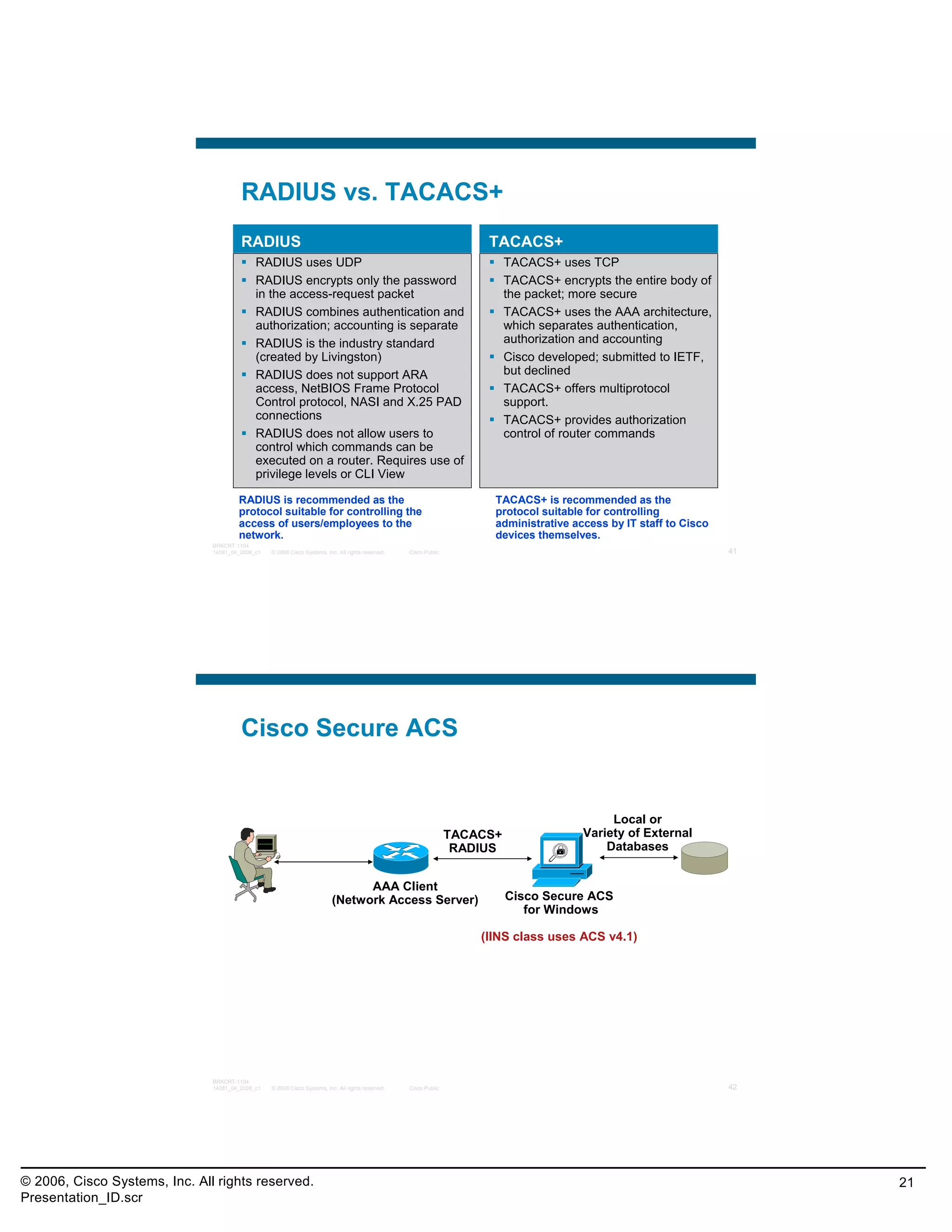
                                        Cisco Secure ACS


                                                                                                                                               Local or
                                                                                                                   TACACS+                Variety of External
                                                                                                                    RADIUS                    Databases


                                                                                AAA Client
                                                                          (Network Access Server)                            Cisco Secure ACS
                                                                                                                                for Windows

                                                                                                                       (IINS class uses ACS v4.1)


                               BRKCRT-1104
                               14381_04_2008_c1   © 2008 Cisco Systems, Inc. All rights reserved.   Cisco Public                                                      42


© 2006, Cisco Systems, Inc. All rights reserved.                                                                                                                           21
Presentation_ID.scr
AAA Router CLI Config Example

                                            aaa     new-model
                                            !
                                            aaa     authentication login default group tacacs+ local
                                            aaa     authentication login TACACS_ONLY group tacacs+
                                            aaa     authorization exec default group tacacs+ local
                                            aaa     authorization commands 1 default group tacacs+ local
                                            aaa     authorization commands 15 default group tacacs+ local
                                            aaa     accounting exec start-stop tacacs+
                                            aaa     accounting network start-stop tacacs+

                                            !
                                            tacacs-server host 10.0.1.11 key Secretf0rAcs
                                            !
                                            line vty 0 4
                                             login authentication TACACS_ONLY


                               BRKCRT-1104
                               14381_04_2008_c1   © 2008 Cisco Systems, Inc. All rights reserved.   Cisco Public   43


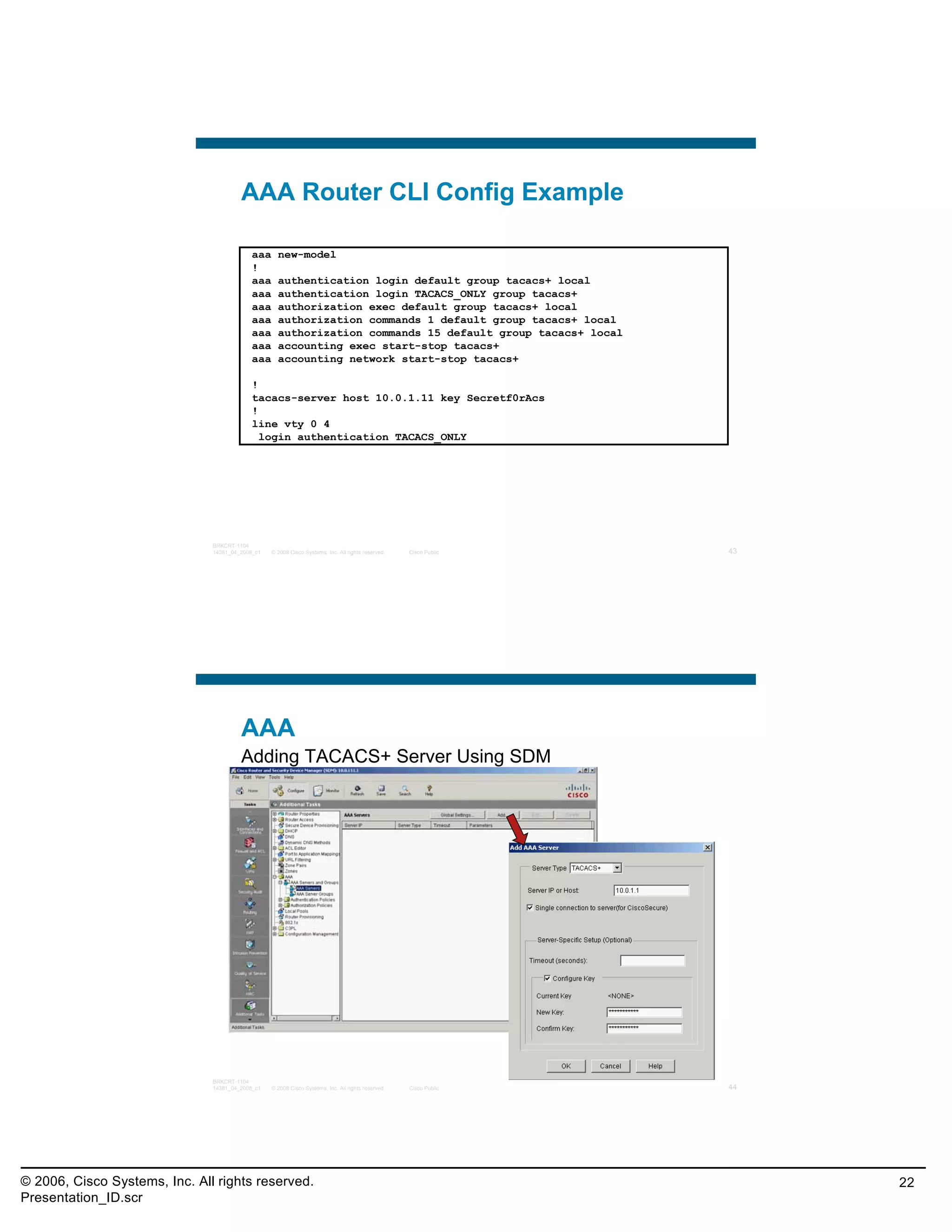
                                        AAA
                                        Adding TACACS+ Server Using SDM


                               BRKCRT-1104
                               14381_04_2008_c1   © 2008 Cisco Systems, Inc. All rights reserved.   Cisco Public   44


© 2006, Cisco Systems, Inc. All rights reserved.                                                                        22
Presentation_ID.scr
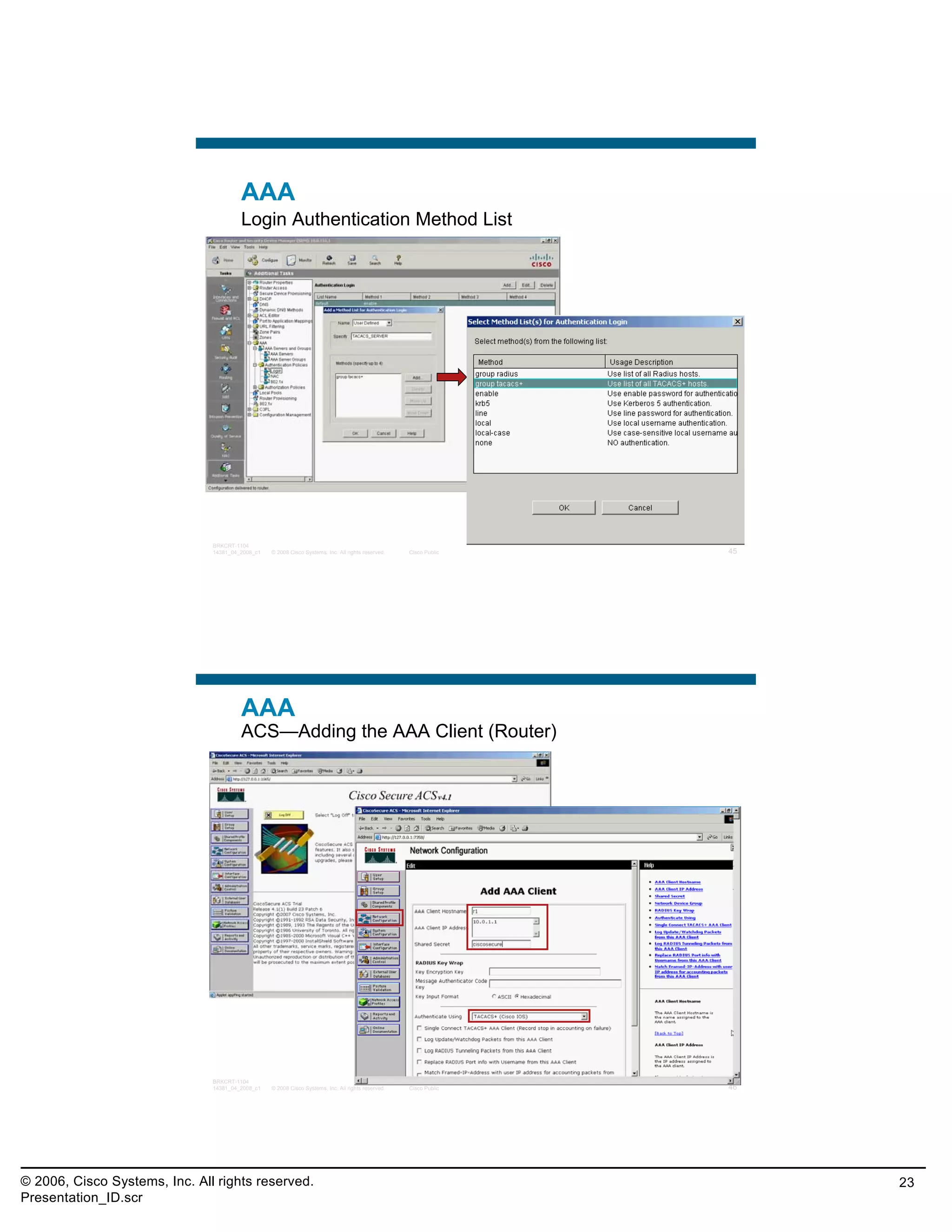
AAA
                                        Login Authentication Method List


                               BRKCRT-1104
                               14381_04_2008_c1   © 2008 Cisco Systems, Inc. All rights reserved.   Cisco Public   45


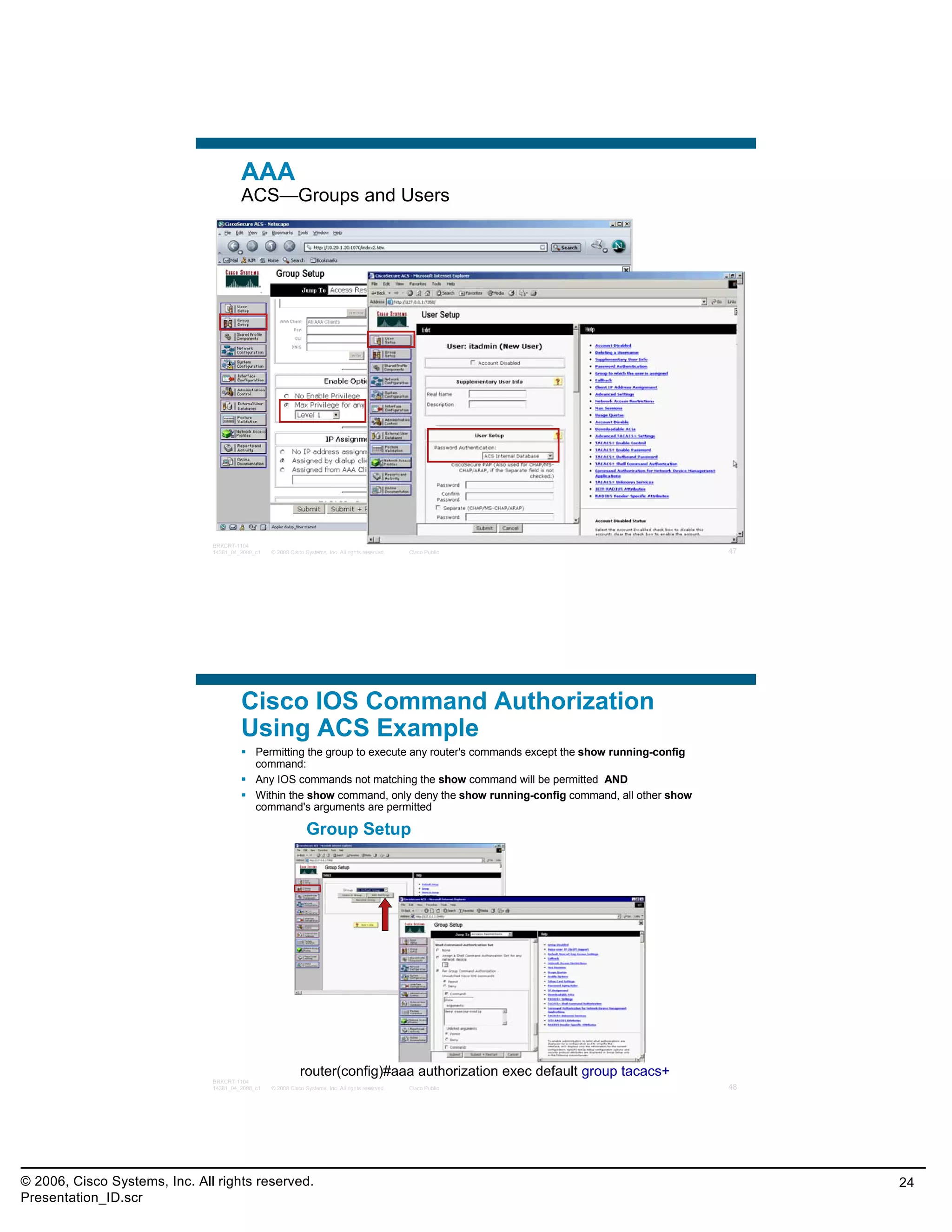
                                        AAA
                                        ACS—Adding the AAA Client (Router)


                               BRKCRT-1104
                               14381_04_2008_c1   © 2008 Cisco Systems, Inc. All rights reserved.   Cisco Public   46


© 2006, Cisco Systems, Inc. All rights reserved.                                                                        23
Presentation_ID.scr
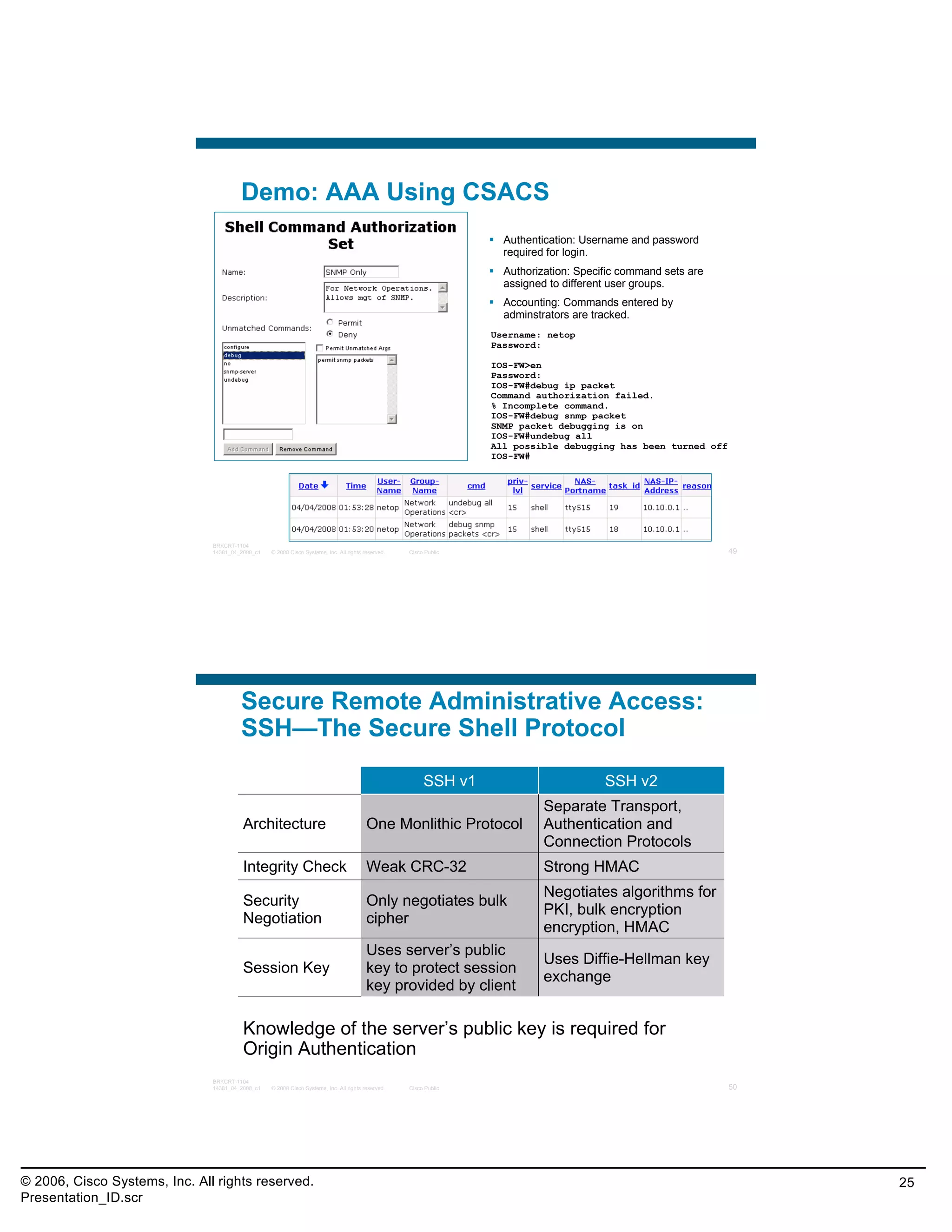
AAA
                                        ACS—Groups and Users


                               BRKCRT-1104
                               14381_04_2008_c1   © 2008 Cisco Systems, Inc. All rights reserved.   Cisco Public                    47


                                        Cisco IOS Command Authorization
                                        Using ACS Example
                                             Permitting the group to execute any router's commands except the show running-config
                                             command:
                                             Any IOS commands not matching the show command will be permitted AND
                                             Within the show command, only deny the show running-config command, all other show
                                             command's arguments are permitted

                                                                Group Setup


                                                             router(config)#aaa authorization exec default group tacacs+
                               BRKCRT-1104
                               14381_04_2008_c1   © 2008 Cisco Systems, Inc. All rights reserved.   Cisco Public                    48


© 2006, Cisco Systems, Inc. All rights reserved.                                                                                         24
Presentation_ID.scr
Demo: AAA Using CSACS
                                                                                                                     Authentication: Username and password
                                                                                                                     required for login.
                                                                                                                     Authorization: Specific command sets are
                                                                                                                     assigned to different user groups.
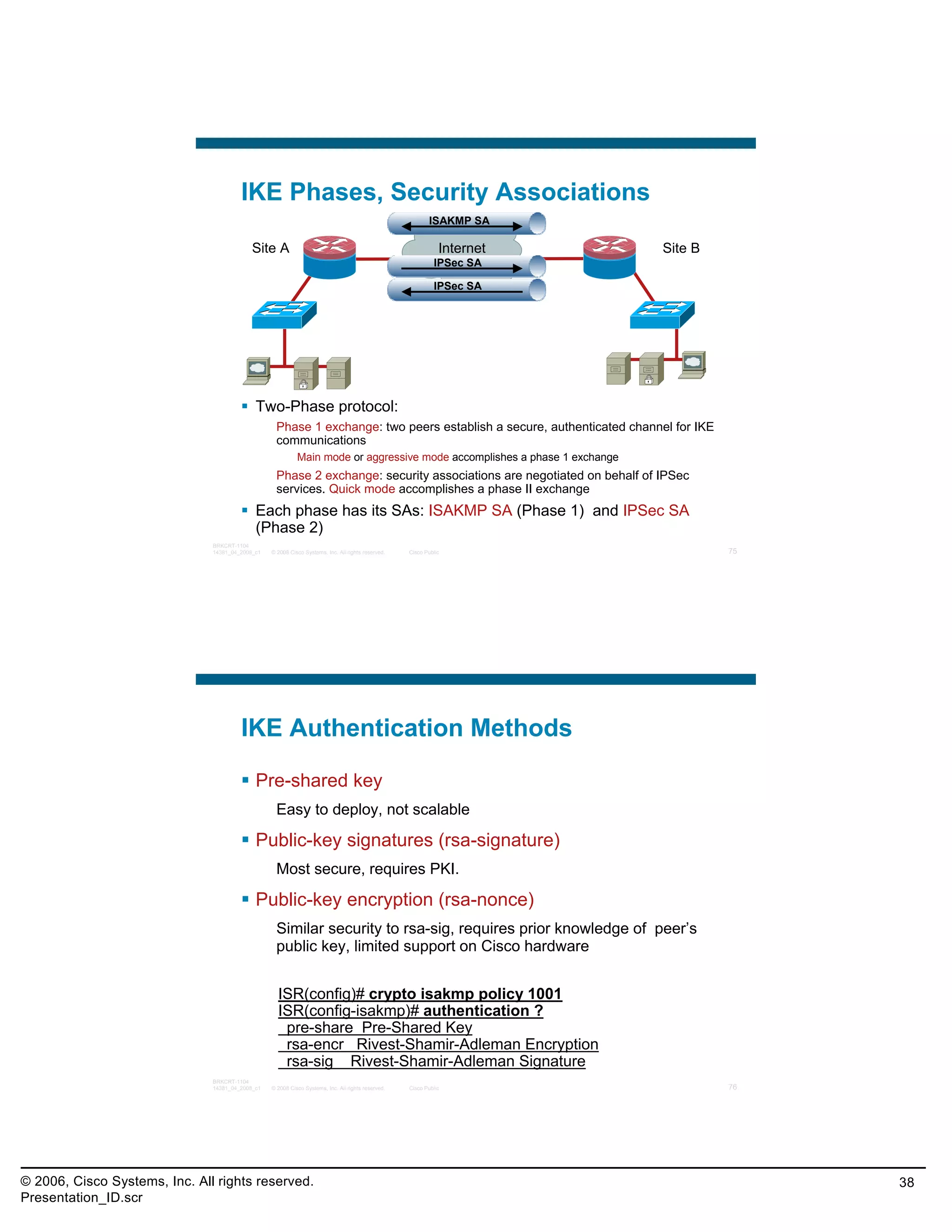
                                                                                                                     Accounting: Commands entered by
                                                                                                                     adminstrators are tracked.
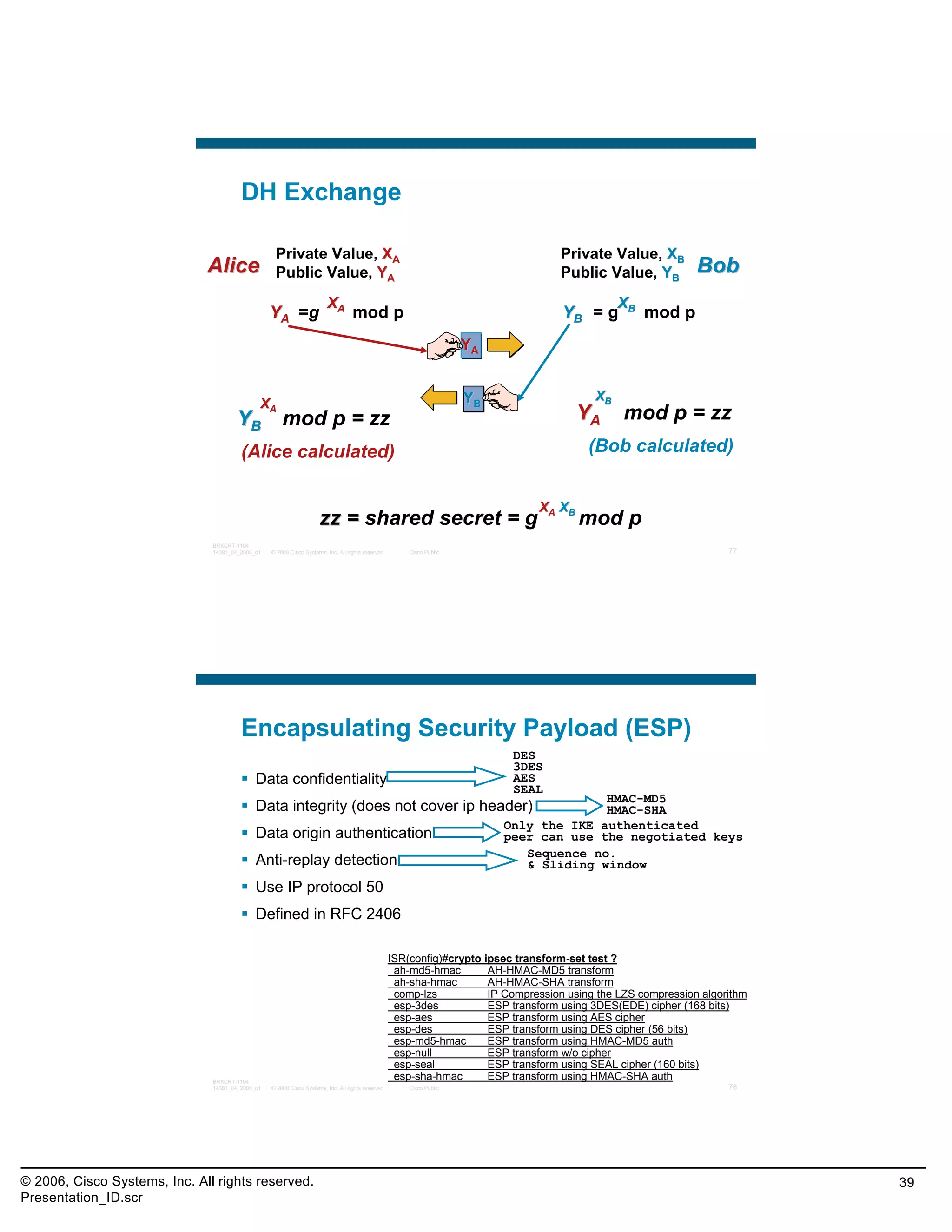
                                                                                                                   Username: netop
                                                                                                                   Password:

                                                                                                                   IOS-FW>en
                                                                                                                   Password:
                                                                                                                   IOS-FW#debug ip packet
                                                                                                                   Command authorization failed.
                                                                                                                   % Incomplete command.
                                                                                                                   IOS-FW#debug snmp packet
                                                                                                                   SNMP packet debugging is on
                                                                                                                   IOS-FW#undebug all
                                                                                                                   All possible debugging has been turned off
                                                                                                                   IOS-FW#


                               BRKCRT-1104
                               14381_04_2008_c1   © 2008 Cisco Systems, Inc. All rights reserved.   Cisco Public                                                49


                                        Secure Remote Administrative Access:
                                        SSH—The Secure Shell Protocol

                                                                                                         SSH v1                          SSH v2
                                                                                                                             Separate Transport,
                                         Architecture                                    One Monlithic Protocol              Authentication and
                                                                                                                             Connection Protocols
                                         Integrity Check                                 Weak CRC-32                         Strong HMAC
                                                                                                                             Negotiates algorithms for
                                         Security                                        Only negotiates bulk
                                                                                                                             PKI, bulk encryption
                                         Negotiation                                     cipher
                                                                                                                             encryption, HMAC
                                                                                         Uses server’s public
                                                                                                                             Uses Diffie-Hellman key
                                         Session Key                                     key to protect session
                                                                                                                             exchange
                                                                                         key provided by client

                                         Knowledge of the server’s public key is required for
                                         Origin Authentication
                               BRKCRT-1104
                               14381_04_2008_c1   © 2008 Cisco Systems, Inc. All rights reserved.   Cisco Public                                                50


© 2006, Cisco Systems, Inc. All rights reserved.                                                                                                                     25
Presentation_ID.scr
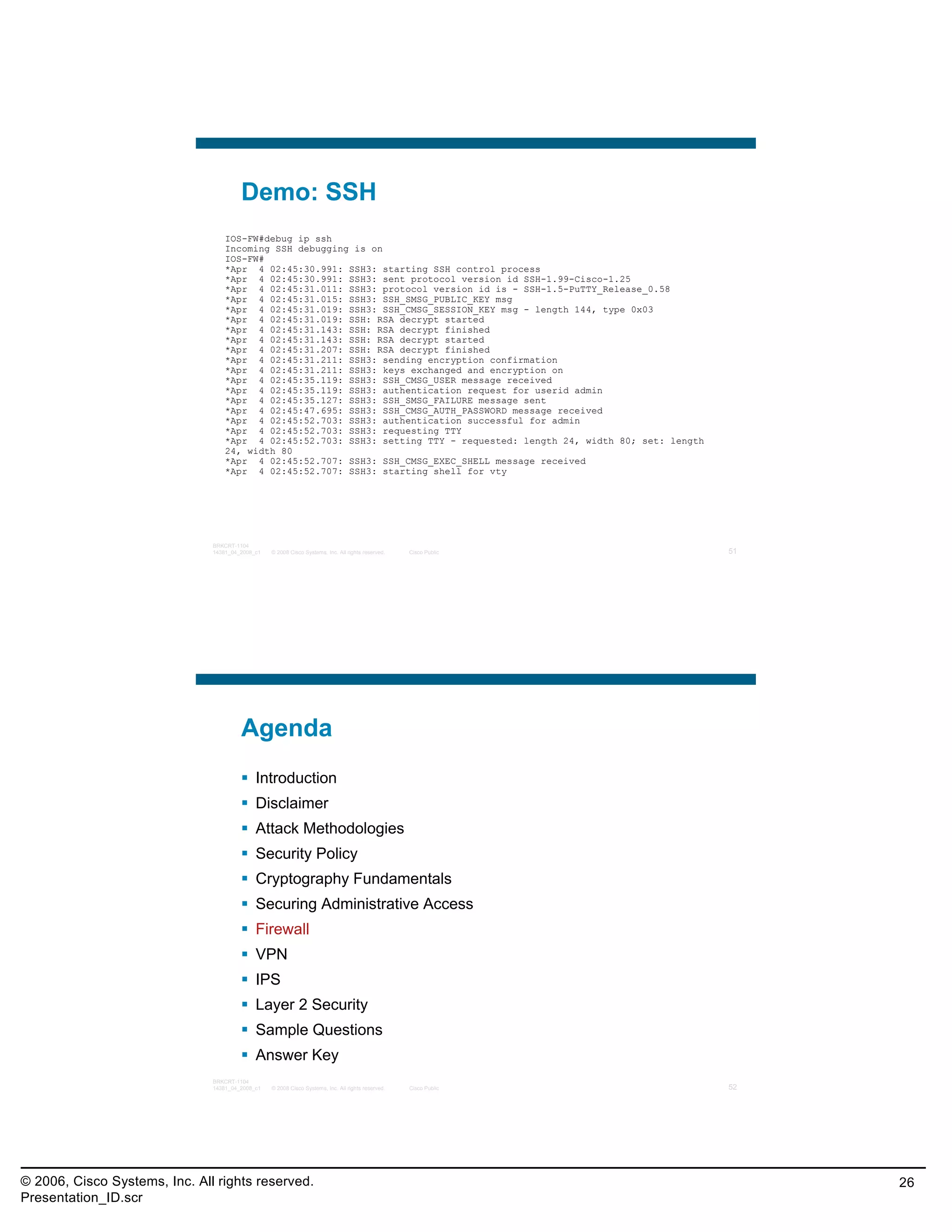
Demo: SSH
                                   IOS-FW#debug ip ssh
                                   Incoming SSH debugging is on
                                   IOS-FW#
                                   *Apr 4 02:45:30.991: SSH3: starting SSH control process
                                   *Apr 4 02:45:30.991: SSH3: sent protocol version id SSH-1.99-Cisco-1.25
                                   *Apr 4 02:45:31.011: SSH3: protocol version id is - SSH-1.5-PuTTY_Release_0.58
                                   *Apr 4 02:45:31.015: SSH3: SSH_SMSG_PUBLIC_KEY msg
                                   *Apr 4 02:45:31.019: SSH3: SSH_CMSG_SESSION_KEY msg - length 144, type 0x03
                                   *Apr 4 02:45:31.019: SSH: RSA decrypt started
                                   *Apr 4 02:45:31.143: SSH: RSA decrypt finished
                                   *Apr 4 02:45:31.143: SSH: RSA decrypt started
                                   *Apr 4 02:45:31.207: SSH: RSA decrypt finished
                                   *Apr 4 02:45:31.211: SSH3: sending encryption confirmation
                                   *Apr 4 02:45:31.211: SSH3: keys exchanged and encryption on
                                   *Apr 4 02:45:35.119: SSH3: SSH_CMSG_USER message received
                                   *Apr 4 02:45:35.119: SSH3: authentication request for userid admin
                                   *Apr 4 02:45:35.127: SSH3: SSH_SMSG_FAILURE message sent
                                   *Apr 4 02:45:47.695: SSH3: SSH_CMSG_AUTH_PASSWORD message received
                                   *Apr 4 02:45:52.703: SSH3: authentication successful for admin
                                   *Apr 4 02:45:52.703: SSH3: requesting TTY
                                   *Apr 4 02:45:52.703: SSH3: setting TTY - requested: length 24, width 80; set: length
                                   24, width 80
                                   *Apr 4 02:45:52.707: SSH3: SSH_CMSG_EXEC_SHELL message received
                                   *Apr 4 02:45:52.707: SSH3: starting shell for vty


                               BRKCRT-1104
                               14381_04_2008_c1   © 2008 Cisco Systems, Inc. All rights reserved.   Cisco Public          51


                                        Agenda
                                             Introduction
                                             Disclaimer
                                             Attack Methodologies
                                             Security Policy
                                             Cryptography Fundamentals
                                             Securing Administrative Access
                                             Firewall
                                             VPN
                                             IPS
                                             Layer 2 Security
                                             Sample Questions
                                             Answer Key
                               BRKCRT-1104
                               14381_04_2008_c1   © 2008 Cisco Systems, Inc. All rights reserved.   Cisco Public          52


© 2006, Cisco Systems, Inc. All rights reserved.                                                                               26
Presentation_ID.scr
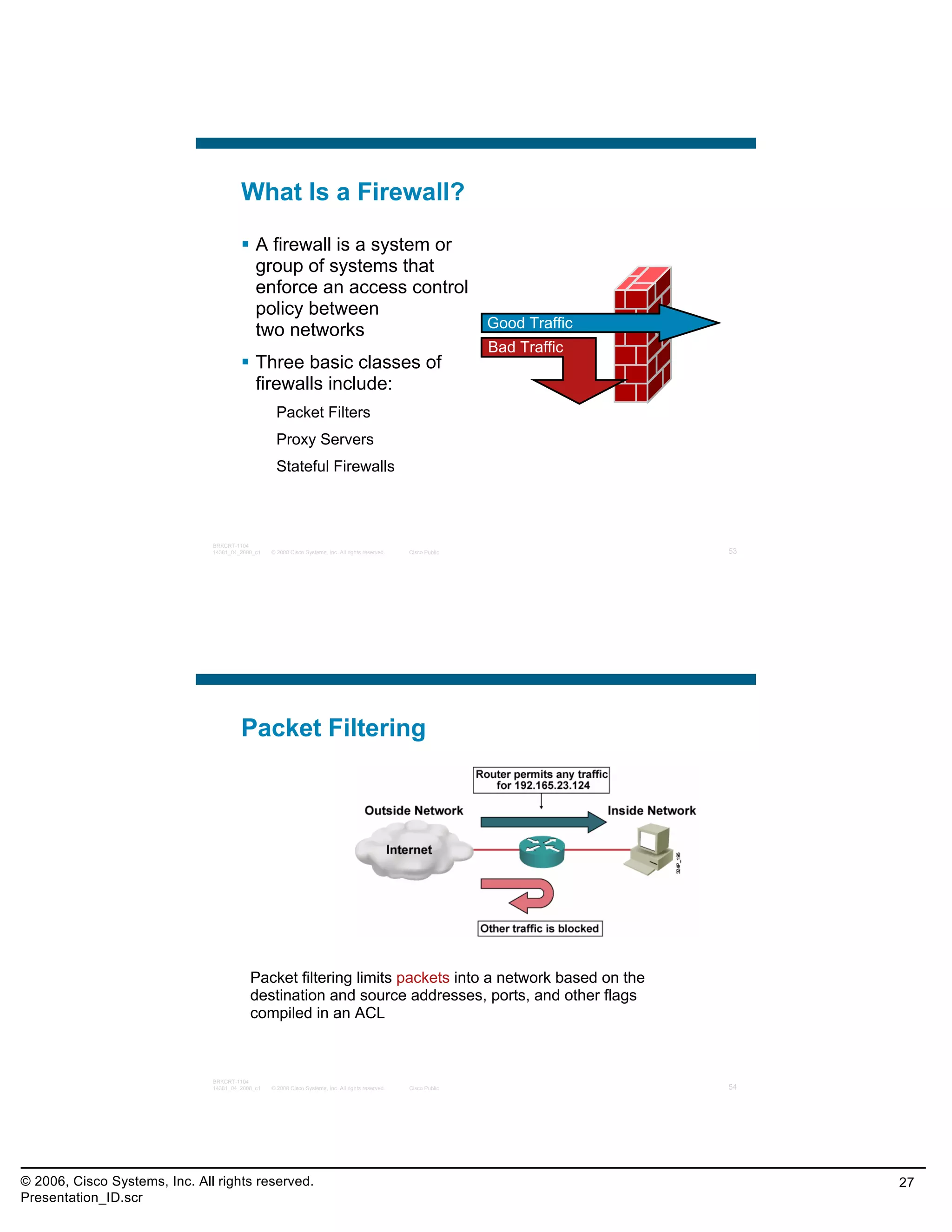
What Is a Firewall?

                                             A firewall is a system or
                                             group of systems that
                                             enforce an access control
                                             policy between
                                             two networks                                                          Good Traffic
                                                                                                                   Bad Traffic
                                             Three basic classes of
                                             firewalls include:
                                                    Packet Filters
                                                    Proxy Servers
                                                    Stateful Firewalls


                               BRKCRT-1104
                               14381_04_2008_c1   © 2008 Cisco Systems, Inc. All rights reserved.   Cisco Public                  53


                                        Packet Filtering


                                           Packet filtering limits packets into a network based on the
                                           destination and source addresses, ports, and other flags
                                           compiled in an ACL


                               BRKCRT-1104
                               14381_04_2008_c1   © 2008 Cisco Systems, Inc. All rights reserved.   Cisco Public                  54


© 2006, Cisco Systems, Inc. All rights reserved.                                                                                       27
Presentation_ID.scr
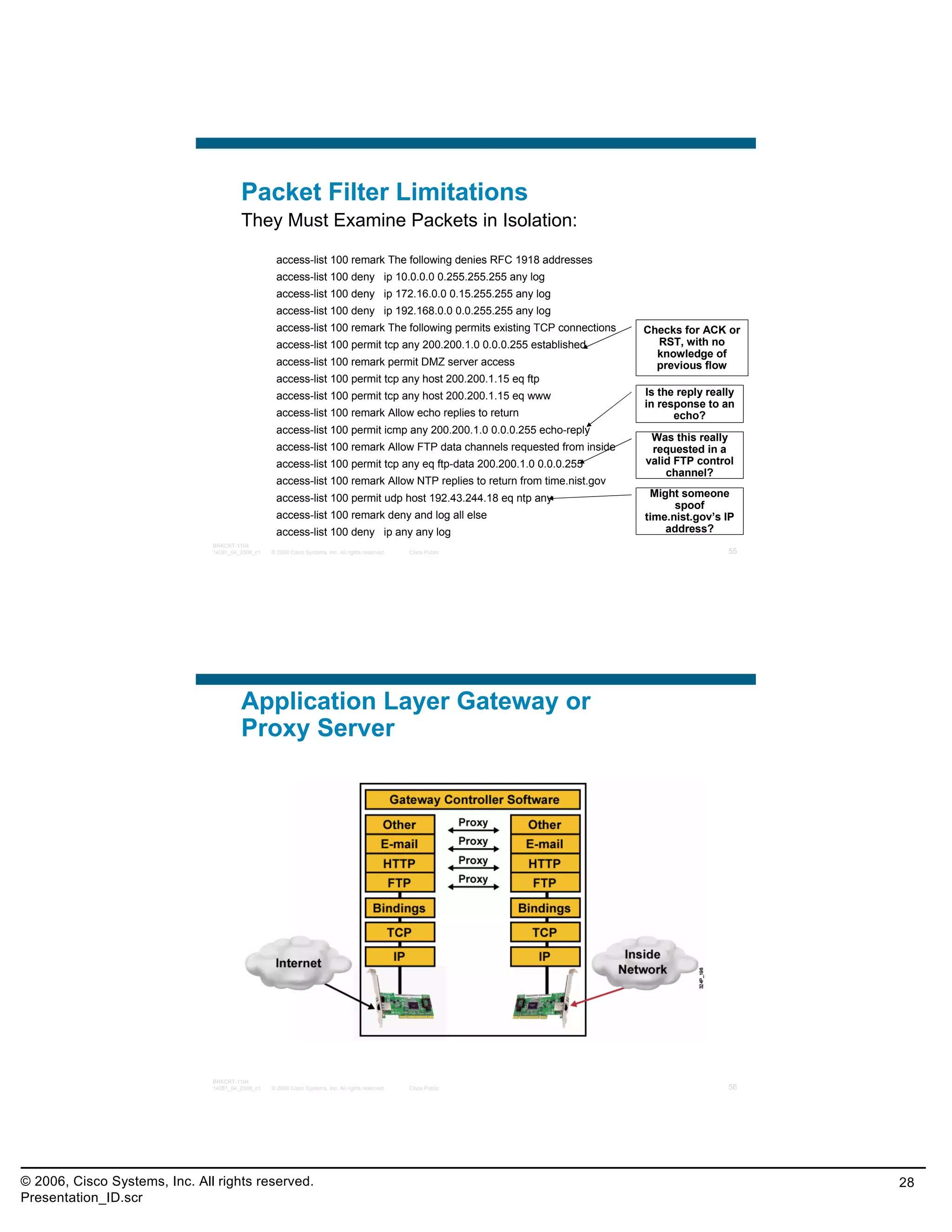
Packet Filter Limitations
                                        They Must Examine Packets in Isolation:
                                                    access-list 100 remark The following denies RFC 1918 addresses
                                                    access-list 100 deny ip 10.0.0.0 0.255.255.255 any log
                                                    access-list 100 deny ip 172.16.0.0 0.15.255.255 any log
                                                    access-list 100 deny ip 192.168.0.0 0.0.255.255 any log
                                                    access-list 100 remark The following permits existing TCP connections   Checks for ACK or
                                                    access-list 100 permit tcp any 200.200.1.0 0.0.0.255 established          RST, with no
                                                                                                                              knowledge of
                                                    access-list 100 remark permit DMZ server access                           previous flow
                                                    access-list 100 permit tcp any host 200.200.1.15 eq ftp
                                                    access-list 100 permit tcp any host 200.200.1.15 eq www                 Is the reply really
                                                                                                                            in response to an
                                                    access-list 100 remark Allow echo replies to return                           echo?
                                                    access-list 100 permit icmp any 200.200.1.0 0.0.0.255 echo-reply
                                                                                                                             Was this really
                                                    access-list 100 remark Allow FTP data channels requested from inside     requested in a
                                                    access-list 100 permit tcp any eq ftp-data 200.200.1.0 0.0.0.255        valid FTP control
                                                                                                                                channel?
                                                    access-list 100 remark Allow NTP replies to return from time.nist.gov
                                                    access-list 100 permit udp host 192.43.244.18 eq ntp any                 Might someone
                                                                                                                                  spoof
                                                    access-list 100 remark deny and log all else                            time.nist.gov’s IP
                                                    access-list 100 deny ip any any log                                         address?
                               BRKCRT-1104
                               14381_04_2008_c1   © 2008 Cisco Systems, Inc. All rights reserved.   Cisco Public                             55


                                        Application Layer Gateway or
                                        Proxy Server


                               BRKCRT-1104
                               14381_04_2008_c1   © 2008 Cisco Systems, Inc. All rights reserved.   Cisco Public                             56


© 2006, Cisco Systems, Inc. All rights reserved.                                                                                                  28
Presentation_ID.scr
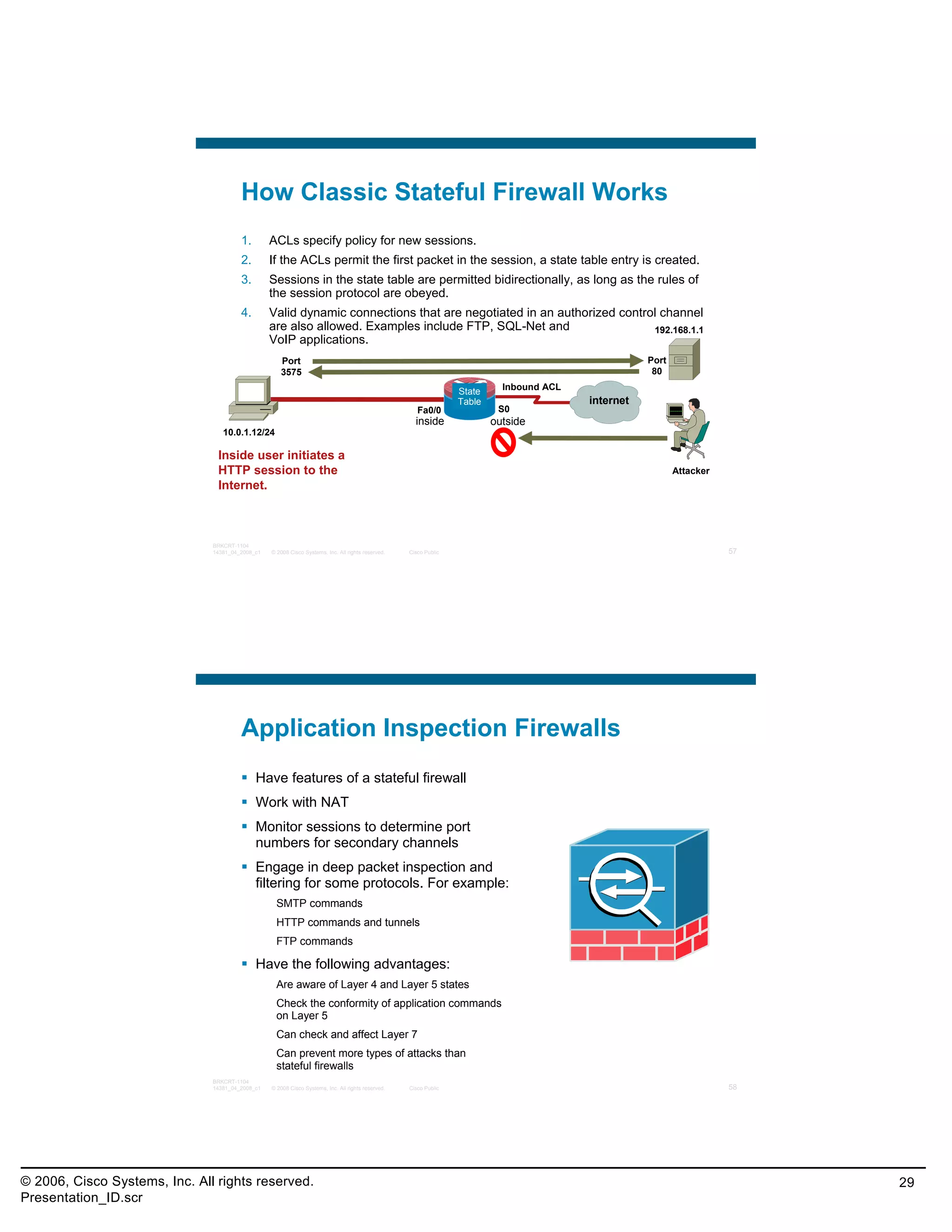
How Classic Stateful Firewall Works
                                        1.        ACLs specify policy for new sessions.
                                        2.        If the ACLs permit the first packet in the session, a state table entry is created.
                                        3.        Sessions in the state table are permitted bidirectionally, as long as the rules of
                                                  the session protocol are obeyed.
                                        4.        Valid dynamic connections that are negotiated in an authorized control channel
                                                  are also allowed. Examples include FTP, SQL-Net and                  192.168.1.1
                                                  VoIP applications.
                                                     Port                                                                                             Port
                                                     3575                                                                                              80

                                                                                                                   State     Inbound ACL
                                                                                                                   Table                   internet
                                                                                                       Fa0/0                S0
                                                                                                      inside               outside
                                  10.0.1.12/24

                                Inside user initiates a
                                HTTP session to the                                                                                                          Attacker
                                Internet.


                               BRKCRT-1104
                               14381_04_2008_c1   © 2008 Cisco Systems, Inc. All rights reserved.   Cisco Public                                                        57


                                        Application Inspection Firewalls
                                             Have features of a stateful firewall
                                             Work with NAT
                                             Monitor sessions to determine port
                                             numbers for secondary channels
                                             Engage in deep packet inspection and
                                             filtering for some protocols. For example:
                                                    SMTP commands
                                                    HTTP commands and tunnels
                                                    FTP commands

                                             Have the following advantages:
                                                    Are aware of Layer 4 and Layer 5 states
                                                    Check the conformity of application commands
                                                    on Layer 5
                                                    Can check and affect Layer 7
                                                    Can prevent more types of attacks than
                                                    stateful firewalls
                               BRKCRT-1104
                               14381_04_2008_c1   © 2008 Cisco Systems, Inc. All rights reserved.   Cisco Public                                                        58


© 2006, Cisco Systems, Inc. All rights reserved.                                                                                                                             29
Presentation_ID.scr
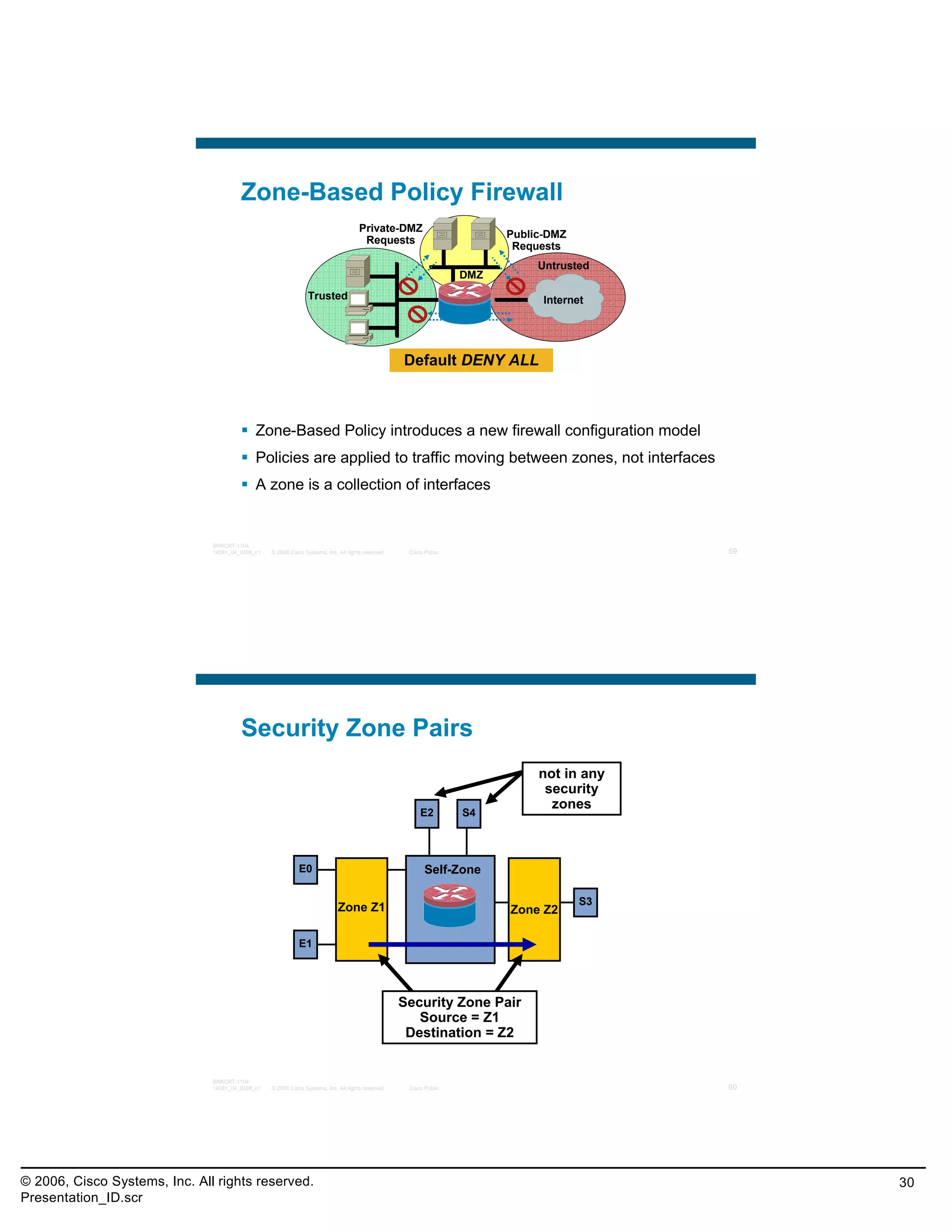
Zone-Based Policy Firewall
                                                                                      Private-DMZ
                                                                                                                          Public-DMZ
                                                                                       Requests
                                                                                                                           Requests
                                                                                                                               Untrusted
                                                                                                                    DMZ
                                                                 Trusted                                                        Internet


                                                                                                    Default DENY ALL


                                             Zone-Based Policy introduces a new firewall configuration model
                                             Policies are applied to traffic moving between zones, not interfaces
                                             A zone is a collection of interfaces


                               BRKCRT-1104
                               14381_04_2008_c1   © 2008 Cisco Systems, Inc. All rights reserved.    Cisco Public                           59


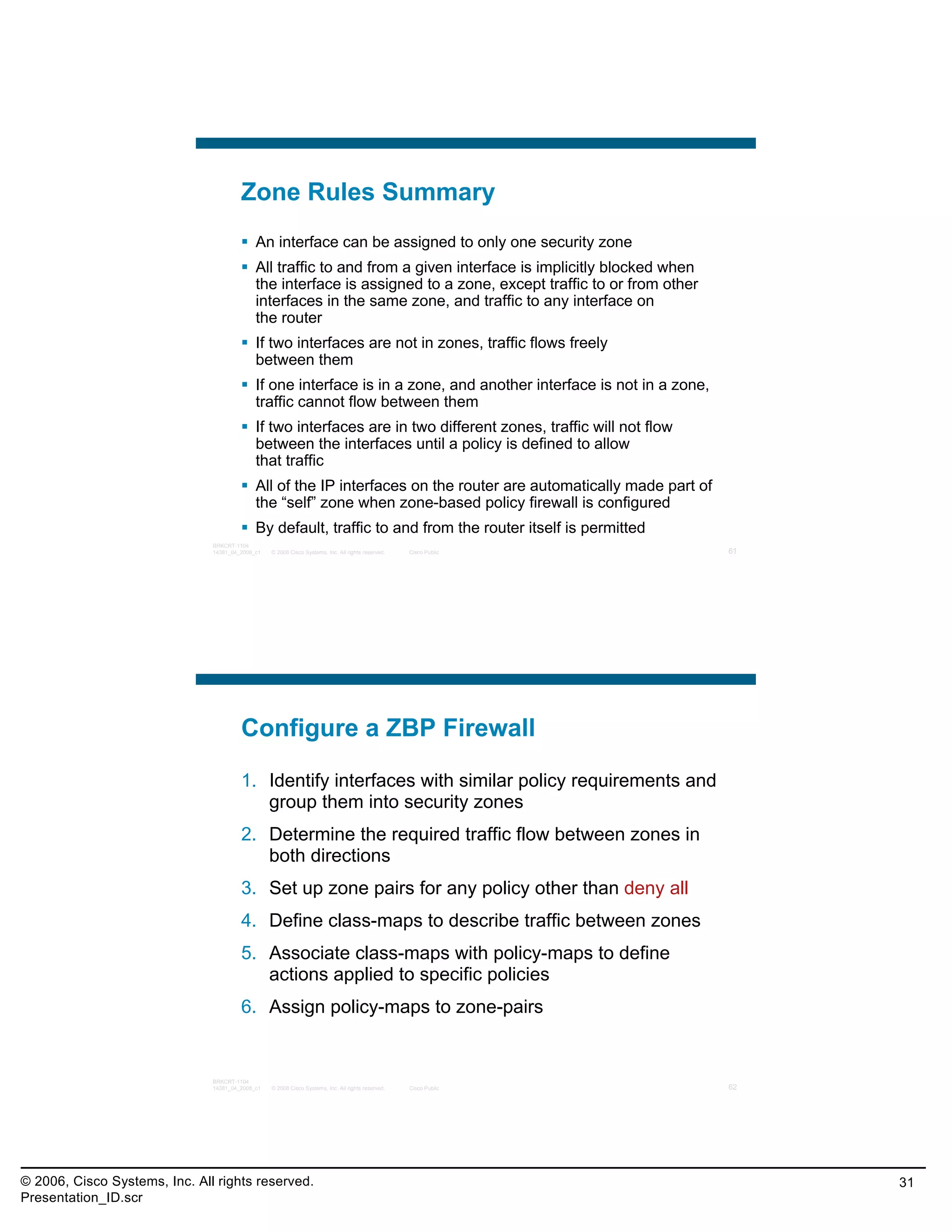
                                        Security Zone Pairs
                                                                                                                               not in any
                                                                                                                                security
                                                                                                                                 zones
                                                                                                         E2         S4


                                                             E0                                            Self-Zone

                                                                                                                                       S3
                                                                             Zone Z1                                      Zone Z2

                                                             E1


                                                                                                    Security Zone Pair
                                                                                                       Source = Z1
                                                                                                     Destination = Z2


                               BRKCRT-1104
                               14381_04_2008_c1   © 2008 Cisco Systems, Inc. All rights reserved.    Cisco Public                           60


© 2006, Cisco Systems, Inc. All rights reserved.                                                                                                 30
Presentation_ID.scr
Zone Rules Summary
                                             An interface can be assigned to only one security zone
                                             All traffic to and from a given interface is implicitly blocked when
                                             the interface is assigned to a zone, except traffic to or from other
                                             interfaces in the same zone, and traffic to any interface on
                                             the router
                                             If two interfaces are not in zones, traffic flows freely
                                             between them
                                             If one interface is in a zone, and another interface is not in a zone,
                                             traffic cannot flow between them
                                             If two interfaces are in two different zones, traffic will not flow
                                             between the interfaces until a policy is defined to allow
                                             that traffic
                                             All of the IP interfaces on the router are automatically made part of
                                             the “self” zone when zone-based policy firewall is configured
                                             By default, traffic to and from the router itself is permitted
                               BRKCRT-1104
                               14381_04_2008_c1   © 2008 Cisco Systems, Inc. All rights reserved.   Cisco Public      61


                                        Configure a ZBP Firewall

                                        1. Identify interfaces with similar policy requirements and
                                           group them into security zones
                                        2. Determine the required traffic flow between zones in
                                           both directions
                                        3. Set up zone pairs for any policy other than deny all
                                        4. Define class-maps to describe traffic between zones
                                        5. Associate class-maps with policy-maps to define
                                           actions applied to specific policies
                                        6. Assign policy-maps to zone-pairs


                               BRKCRT-1104
                               14381_04_2008_c1   © 2008 Cisco Systems, Inc. All rights reserved.   Cisco Public      62


© 2006, Cisco Systems, Inc. All rights reserved.                                                                           31
Presentation_ID.scr
Security Zone Firewall Configuration
                                        CPL–Cisco Policy Language (CPL)

                                             Class-Map (used to select traffic for inspection policies)
                                             Policy-Map (used to apply policy to traffic class)
                                                                               (e.g. inspect/pass/drop policy)
                                             Service-Policy - Apply policy-map to zone pair
                                                                                                    (used to activate the inspection policy)


                               BRKCRT-1104
                               14381_04_2008_c1   © 2008 Cisco Systems, Inc. All rights reserved.     Cisco Public                             63


                                        ZBP Policy Actions

                                             Inspect
                                                    Monitor outbound traffic according to permit/deny policy
                                                    Anticipate return traffic according to session table entries

                                             Drop
                                                    Analogous to deny

                                             Pass
                                                    Analogous to permit
                                                    No stateful capability


                               BRKCRT-1104
                               14381_04_2008_c1   © 2008 Cisco Systems, Inc. All rights reserved.     Cisco Public                             64


© 2006, Cisco Systems, Inc. All rights reserved.                                                                                                    32
Presentation_ID.scr
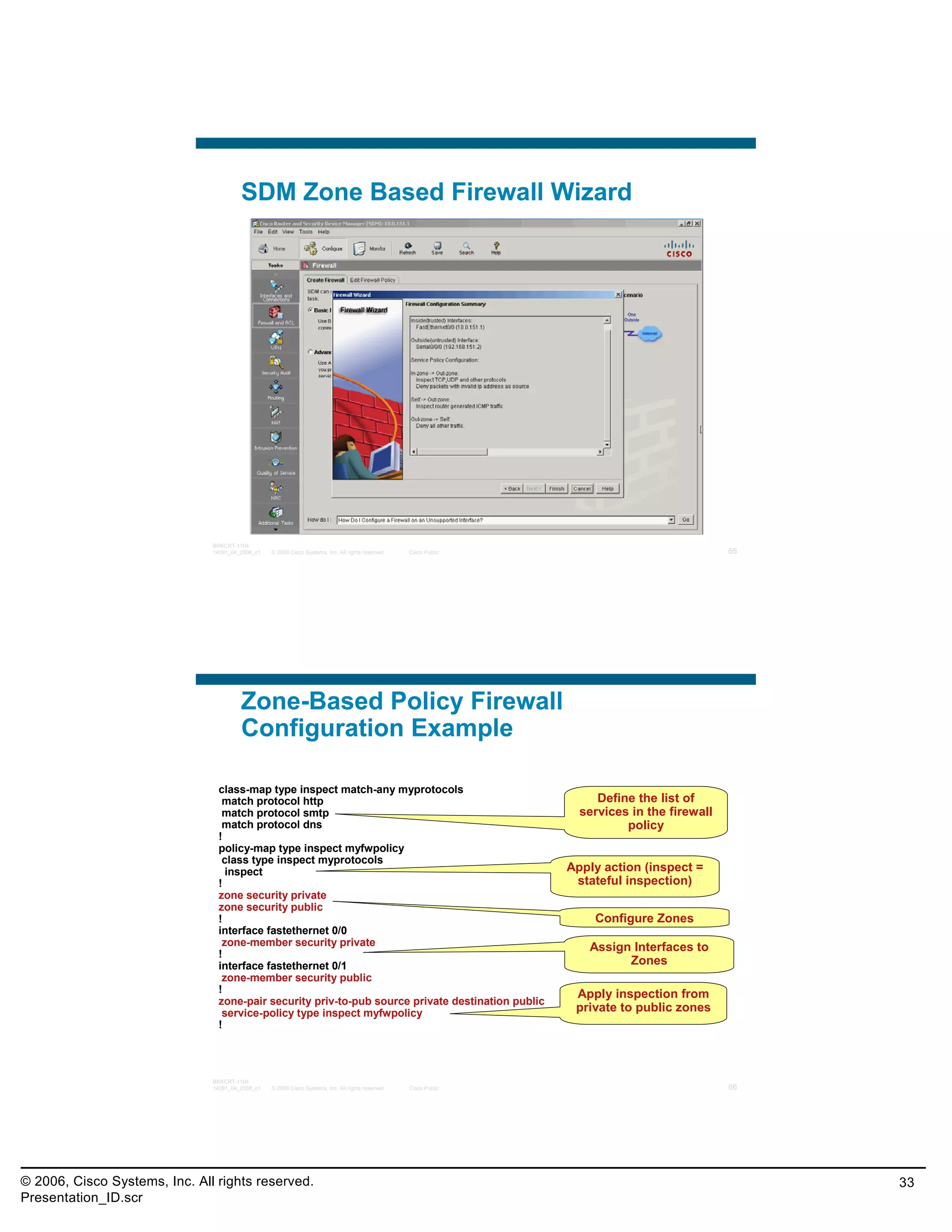
SDM Zone Based Firewall Wizard


                               BRKCRT-1104
                               14381_04_2008_c1   © 2008 Cisco Systems, Inc. All rights reserved.   Cisco Public                                65


                                        Zone-Based Policy Firewall
                                        Configuration Example

                                class-map type inspect match-any myprotocols
                                 match protocol http                                                                    Define the list of
                                 match protocol smtp                                                                 services in the firewall
                                 match protocol dns                                                                          policy
                                !
                                policy-map type inspect myfwpolicy
                                 class type inspect myprotocols
                                  inspect                                                                          Apply action (inspect =
                                !                                                                                   stateful inspection)
                                zone security private
                                zone security public
                                !                                                                                      Configure Zones
                                interface fastethernet 0/0
                                 zone-member security private                                                         Assign Interfaces to
                                !
                                interface fastethernet 0/1                                                                  Zones
                                 zone-member security public
                                !                                                                                   Apply inspection from
                                zone-pair security priv-to-pub source private destination public
                                 service-policy type inspect myfwpolicy                                             private to public zones
                                !


                               BRKCRT-1104
                               14381_04_2008_c1   © 2008 Cisco Systems, Inc. All rights reserved.   Cisco Public                                66


© 2006, Cisco Systems, Inc. All rights reserved.                                                                                                     33
Presentation_ID.scr
Demo–Packet Filter and Zone
                                        Based Firewall
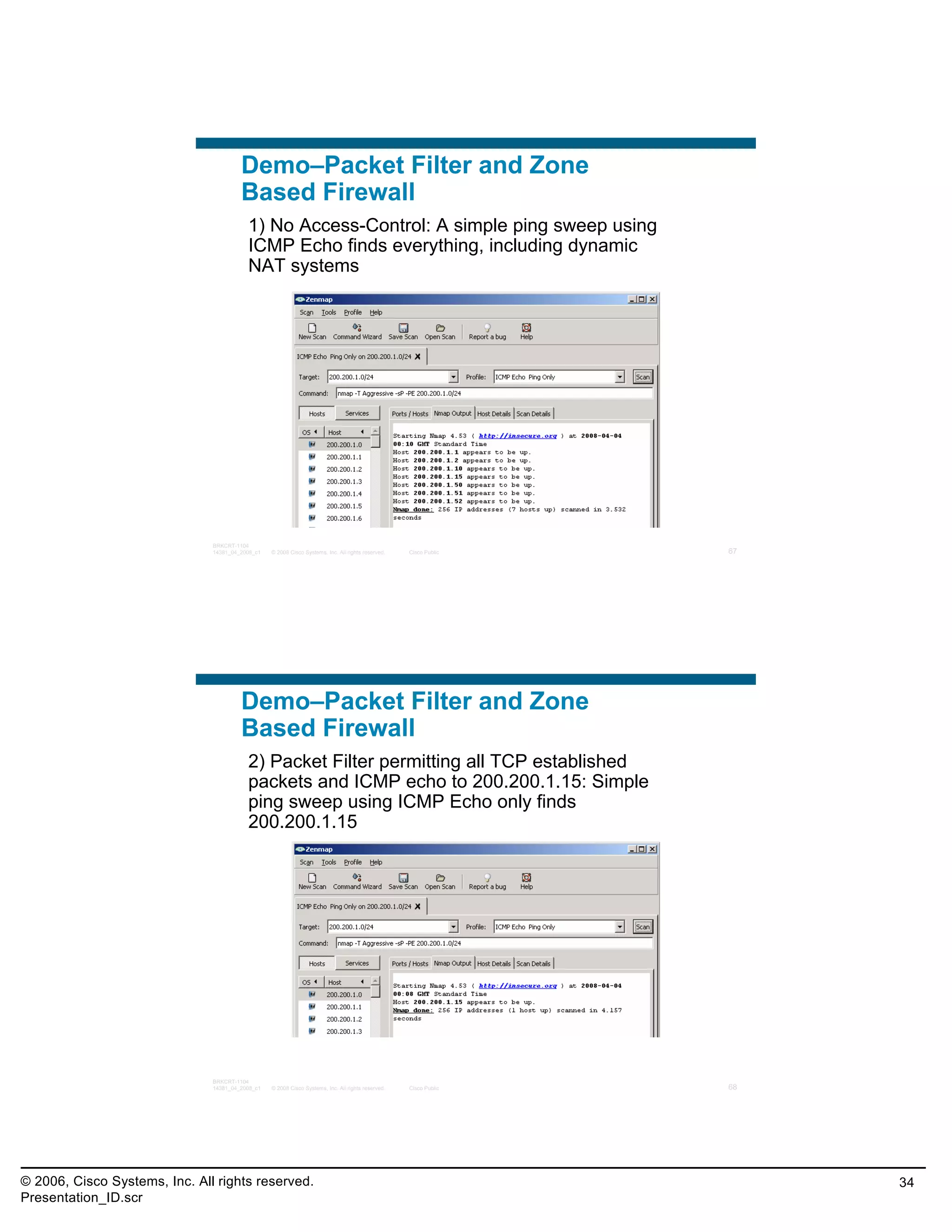
                                          1) No Access-Control: A simple ping sweep using
                                          ICMP Echo finds everything, including dynamic
                                          NAT systems


                               BRKCRT-1104
                               14381_04_2008_c1   © 2008 Cisco Systems, Inc. All rights reserved.   Cisco Public   67


                                        Demo–Packet Filter and Zone
                                        Based Firewall
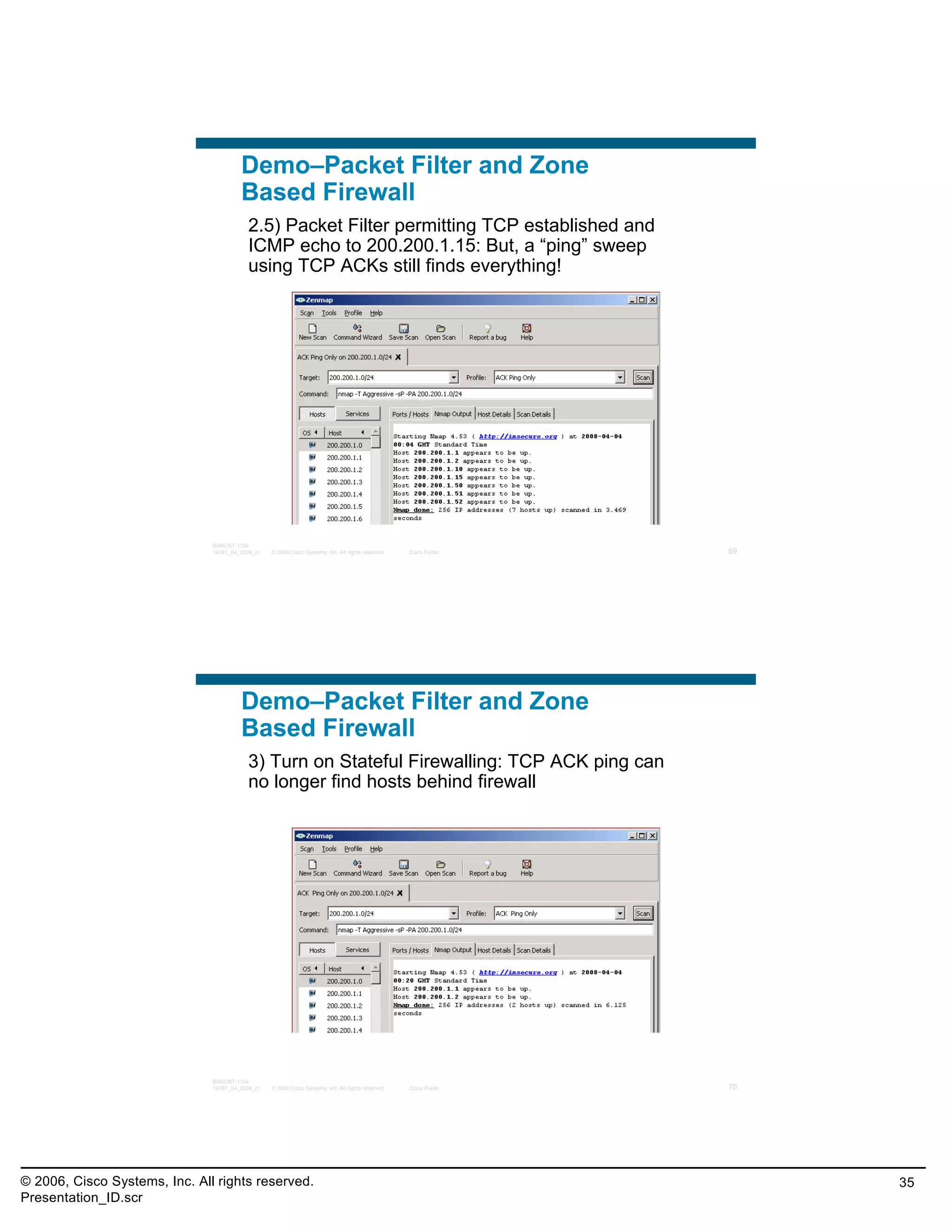
                                          2) Packet Filter permitting all TCP established
                                          packets and ICMP echo to 200.200.1.15: Simple
                                          ping sweep using ICMP Echo only finds
                                          200.200.1.15


                               BRKCRT-1104
                               14381_04_2008_c1   © 2008 Cisco Systems, Inc. All rights reserved.   Cisco Public   68


© 2006, Cisco Systems, Inc. All rights reserved.                                                                        34
Presentation_ID.scr
Demo–Packet Filter and Zone
                                        Based Firewall
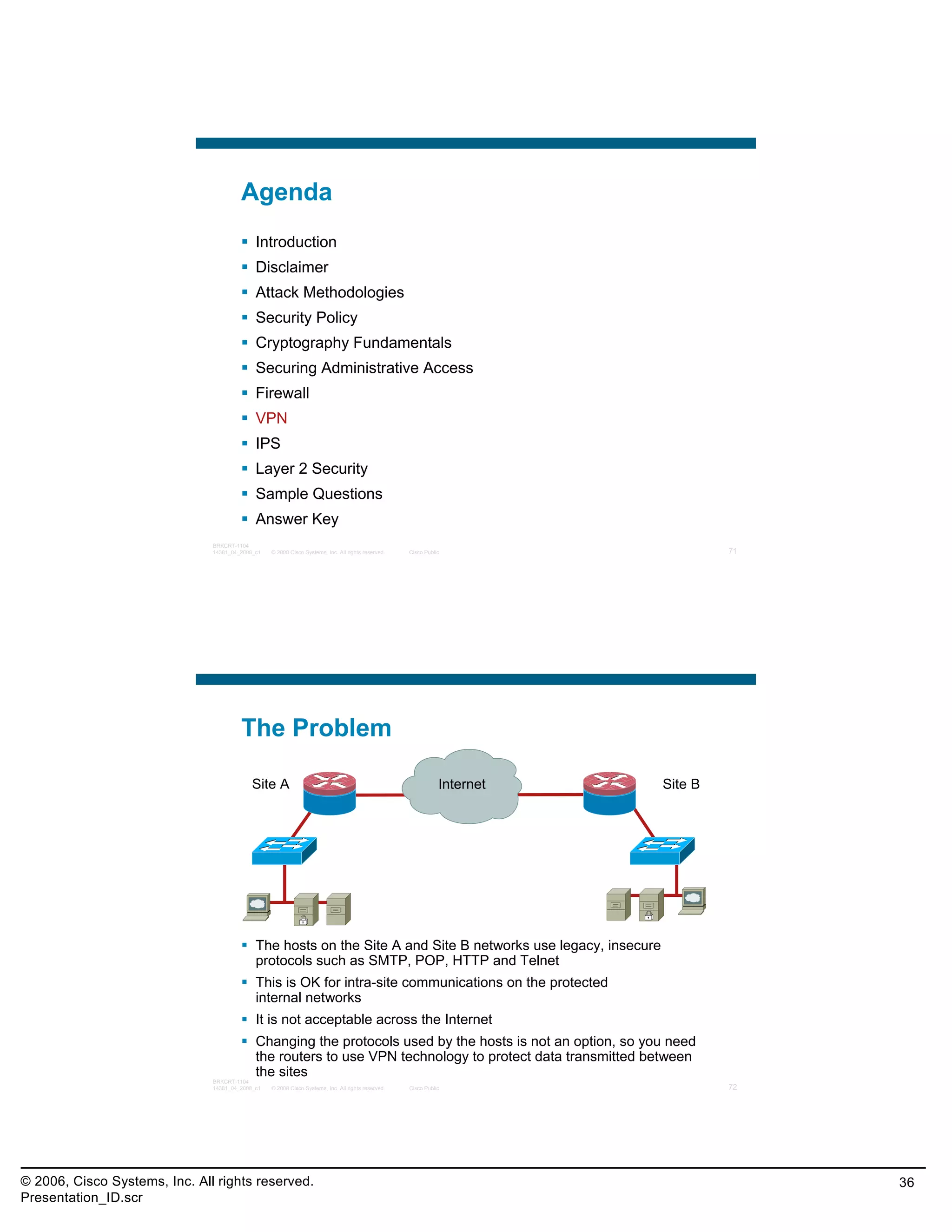
                                          2.5) Packet Filter permitting TCP established and
                                          ICMP echo to 200.200.1.15: But, a “ping” sweep
                                          using TCP ACKs still finds everything!


                               BRKCRT-1104
                               14381_04_2008_c1   © 2008 Cisco Systems, Inc. All rights reserved.   Cisco Public   69


                                        Demo–Packet Filter and Zone
                                        Based Firewall
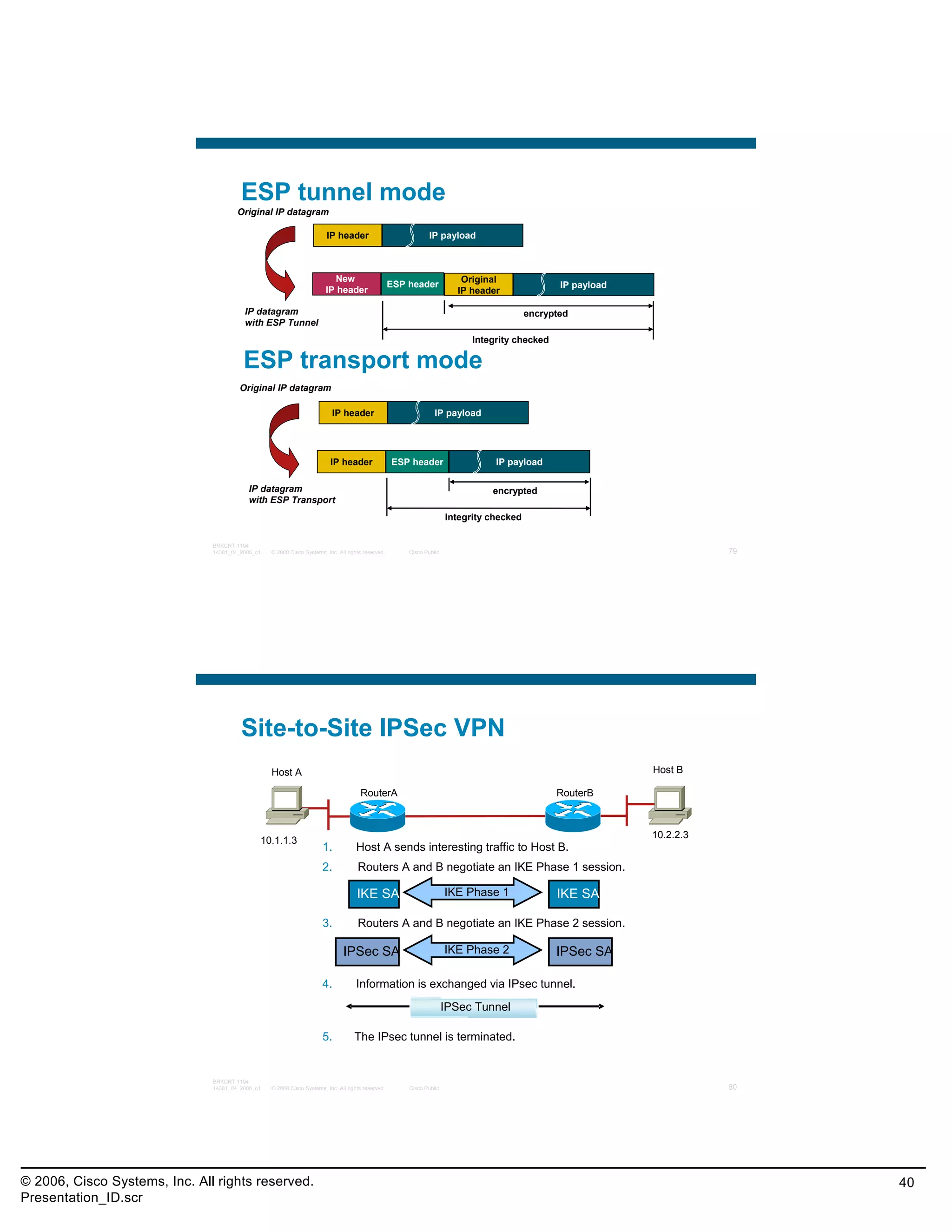
                                          3) Turn on Stateful Firewalling: TCP ACK ping can
                                          no longer find hosts behind firewall


                               BRKCRT-1104
                               14381_04_2008_c1   © 2008 Cisco Systems, Inc. All rights reserved.   Cisco Public   70


© 2006, Cisco Systems, Inc. All rights reserved.                                                                        35
Presentation_ID.scr
Agenda
                                             Introduction
                                             Disclaimer
                                             Attack Methodologies
                                             Security Policy
                                             Cryptography Fundamentals
                                             Securing Administrative Access
                                             Firewall
                                             VPN
                                             IPS
                                             Layer 2 Security
                                             Sample Questions
                                             Answer Key
                               BRKCRT-1104
                               14381_04_2008_c1   © 2008 Cisco Systems, Inc. All rights reserved.   Cisco Public                   71


                                        The Problem

                                            Site A                                                             Internet   Site B


                                             The hosts on the Site A and Site B networks use legacy, insecure
                                             protocols such as SMTP, POP, HTTP and Telnet
                                             This is OK for intra-site communications on the protected
                                             internal networks
                                             It is not acceptable across the Internet
                                             Changing the protocols used by the hosts is not an option, so you need
                                             the routers to use VPN technology to protect data transmitted between
                                             the sites
                               BRKCRT-1104
                               14381_04_2008_c1   © 2008 Cisco Systems, Inc. All rights reserved.   Cisco Public                   72


© 2006, Cisco Systems, Inc. All rights reserved.                                                                                        36
Presentation_ID.scr
IPSec Protocol Architecture
                                        IPSec Uses IKE for Key Maintenance and ESP
                                        and/or AH for Protection of Data
                                             Internet Key Exchange (IKE) provides a mechanism to
                                             derive keying material and negotiate security
                                             associations
                                             Encapsulating Security Payload (ESP) provides
                                             Confidentiality, Data Integrity and Origin Authentication
                                             AH provides Data Integrity and Origin Authentication


                               BRKCRT-1104
                               14381_04_2008_c1   © 2008 Cisco Systems, Inc. All rights reserved.   Cisco Public   73


                                        Break Down of IPSec: IKE
                                             Hybrid protocol: ISAKMP, Oakley Key exchange, SKEME
                                             Defines the mechanism to derive authenticated keying material
                                             and negotiate security associations (used for AH, ESP)
                                             Uses UDP port 500
                                             Defined in RFC 2409
                                             Internet Key Exchange protocol
                                                    Negotiates protocol parameters
                                                    Exchanges public keys (Diffie Hellman - DH)
                                                    Authenticates both sides
                                                    Manages keys after exchange


                               BRKCRT-1104
                               14381_04_2008_c1   © 2008 Cisco Systems, Inc. All rights reserved.   Cisco Public   74


© 2006, Cisco Systems, Inc. All rights reserved.                                                                        37
Presentation_ID.scr
IKE Phases, Security Associations
                                                                                                           ISAKMP SA

                                            Site A                                                             Internet    Site B
                                                                                                             IPSec SA

                                                                                                             IPSec SA


                                             Two-Phase protocol:
                                                    Phase 1 exchange: two peers establish a secure, authenticated channel for IKE
                                                    communications
                                                            Main mode or aggressive mode accomplishes a phase 1 exchange
                                                    Phase 2 exchange: security associations are negotiated on behalf of IPSec
                                                    services. Quick mode accomplishes a phase II exchange
                                             Each phase has its SAs: ISAKMP SA (Phase 1) and IPSec SA
                                             (Phase 2)
                               BRKCRT-1104
                               14381_04_2008_c1   © 2008 Cisco Systems, Inc. All rights reserved.   Cisco Public                    75


                                        IKE Authentication Methods

                                             Pre-shared key
                                                    Easy to deploy, not scalable

                                             Public-key signatures (rsa-signature)
                                                    Most secure, requires PKI.

                                             Public-key encryption (rsa-nonce)
                                                    Similar security to rsa-sig, requires prior knowledge of peer’s
                                                    public key, limited support on Cisco hardware


                                                    ISR(config)# crypto isakmp policy 1001
                                                    ISR(config-isakmp)# authentication ?
                                                     pre-share Pre-Shared Key
                                                     rsa-encr Rivest-Shamir-Adleman Encryption
                                                     rsa-sig Rivest-Shamir-Adleman Signature
                               BRKCRT-1104
                               14381_04_2008_c1   © 2008 Cisco Systems, Inc. All rights reserved.   Cisco Public                    76


© 2006, Cisco Systems, Inc. All rights reserved.                                                                                         38
Presentation_ID.scr
DH Exchange

                                                   Private Value, XA                                                                 Private Value, XB
                              Alice                Public Value, YA                                                                  Public Value, YB           Bob
                                                                        XA                                                                       XB
                                                  YA =g                            mod p                                             YB = g           mod p
                                                                                                                       YA


                                                                                                                       YB                   XB
                                              XA
                                      YB mod p = zz                                                                                      YA      mod p = zz
                                        (Alice calculated)                                                                                 (Bob calculated)


                                                                                                                                 XA XB
                                                                     zz = shared secret = g                                              mod p
                               BRKCRT-1104
                               14381_04_2008_c1   © 2008 Cisco Systems, Inc. All rights reserved.       Cisco Public                                                  77


                                        Encapsulating Security Payload (ESP)
                                                                                                                             DES
                                                                                                                             3DES
                                             Data confidentiality                                                            AES
                                                                                                                             SEAL
                                                                                                                                          HMAC-MD5
                                             Data integrity (does not cover ip header)                                                    HMAC-SHA
                                                                                                                            Only the IKE authenticated
                                             Data origin authentication                                                     peer can use the negotiated keys
                                                                                                                               Sequence no.
                                             Anti-replay detection                                                             & Sliding window
                                             Use IP protocol 50
                                             Defined in RFC 2406

                                                                                                    ISR(config)#crypto ipsec transform-set test ?
                                                                                                     ah-md5-hmac        AH-HMAC-MD5 transform
                                                                                                     ah-sha-hmac        AH-HMAC-SHA transform
                                                                                                     comp-lzs           IP Compression using the LZS compression algorithm
                                                                                                     esp-3des           ESP transform using 3DES(EDE) cipher (168 bits)
                                                                                                     esp-aes            ESP transform using AES cipher
                                                                                                     esp-des            ESP transform using DES cipher (56 bits)
                                                                                                     esp-md5-hmac       ESP transform using HMAC-MD5 auth
                                                                                                     esp-null           ESP transform w/o cipher
                                                                                                     esp-seal           ESP transform using SEAL cipher (160 bits)
                               BRKCRT-1104
                                                                                                     esp-sha-hmac       ESP transform using HMAC-SHA auth
                               14381_04_2008_c1   © 2008 Cisco Systems, Inc. All rights reserved.       Cisco Public                                                  78


© 2006, Cisco Systems, Inc. All rights reserved.                                                                                                                             39
Presentation_ID.scr
ESP tunnel mode
                                       Original IP datagram

                                                                        IP header                               IP payload


                                                                          New                                             Original
                                                                                                    ESP header                                    IP payload
                                                                        IP header                                        IP header

                                         IP datagram                                                                                       encrypted
                                         with ESP Tunnel
                                                                                                                             Integrity checked

                                         ESP transport mode
                                       Original IP datagram

                                                                           IP header                              IP payload


                                                                          IP header                 ESP header                    IP payload

                                           IP datagram                                                                           encrypted
                                           with ESP Transport
                                                                                                                       Integrity checked

                               BRKCRT-1104
                               14381_04_2008_c1   © 2008 Cisco Systems, Inc. All rights reserved.       Cisco Public                                                      79


                                        Site-to-Site IPSec VPN
                                                  Host A                                                                                                       Host B

                                                                                      RouterA                                                    RouterB


                                                                                                                                                               10.2.2.3
                                              10.1.1.3
                                                                       1.           Host A sends interesting traffic to Host B.
                                                                       2.            Routers A and B negotiate an IKE Phase 1 session.

                                                                                     IKE SA                            IKE Phase 1               IKE SA

                                                                       3.            Routers A and B negotiate an IKE Phase 2 session.

                                                                               IPSec SA                                IKE Phase 2               IPSec SA

                                                                       4.           Information is exchanged via IPsec tunnel.
                                                                                                                       IPSec Tunnel

                                                                       5.           The IPsec tunnel is terminated.


                               BRKCRT-1104
                               14381_04_2008_c1   © 2008 Cisco Systems, Inc. All rights reserved.       Cisco Public                                                      80


© 2006, Cisco Systems, Inc. All rights reserved.                                                                                                                               40
Presentation_ID.scr
Site-to-Site IPSec Configuration

                                             Step 1: Ensure that access lists are compatible
                                             with IPSec
                                             Step 2: ISAKMP (IKE) policy
                                             Step 3: IPSec transform set
                                             Step 4: Cryptographic access list
                                             Step 5: Create and apply the cryptographic map


                               BRKCRT-1104
                               14381_04_2008_c1   © 2008 Cisco Systems, Inc. All rights reserved.   Cisco Public                                                   81


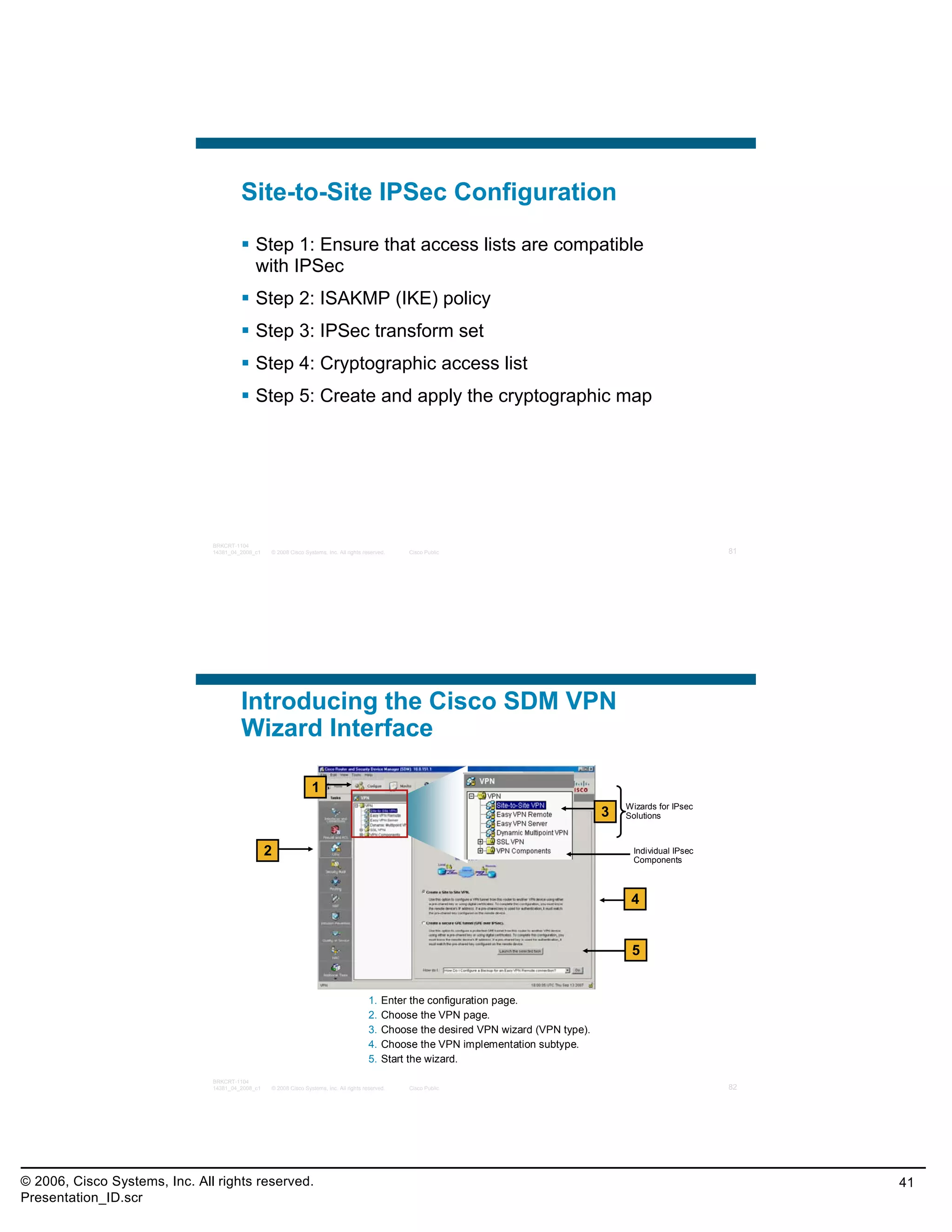
                                        Introducing the Cisco SDM VPN
                                        Wizard Interface

                                                                  1
                                                                                                                                               Wizards for IPsec
                                                                                                                                           3   Solutions


                                                  2                                                                                             Individual IPsec
                                                                                                                                                Components


                                                                                                                                                4


                                                                                                                                                5


                                                                                          1.   Enter the configuration page.
                                                                                          2.   Choose the VPN page.
                                                                                          3.   Choose the desired VPN wizard (VPN type).
                                                                                          4.   Choose the VPN implementation subtype.
                                                                                          5.   Start the wizard.

                               BRKCRT-1104
                               14381_04_2008_c1   © 2008 Cisco Systems, Inc. All rights reserved.   Cisco Public                                                   82


© 2006, Cisco Systems, Inc. All rights reserved.                                                                                                                        41
Presentation_ID.scr
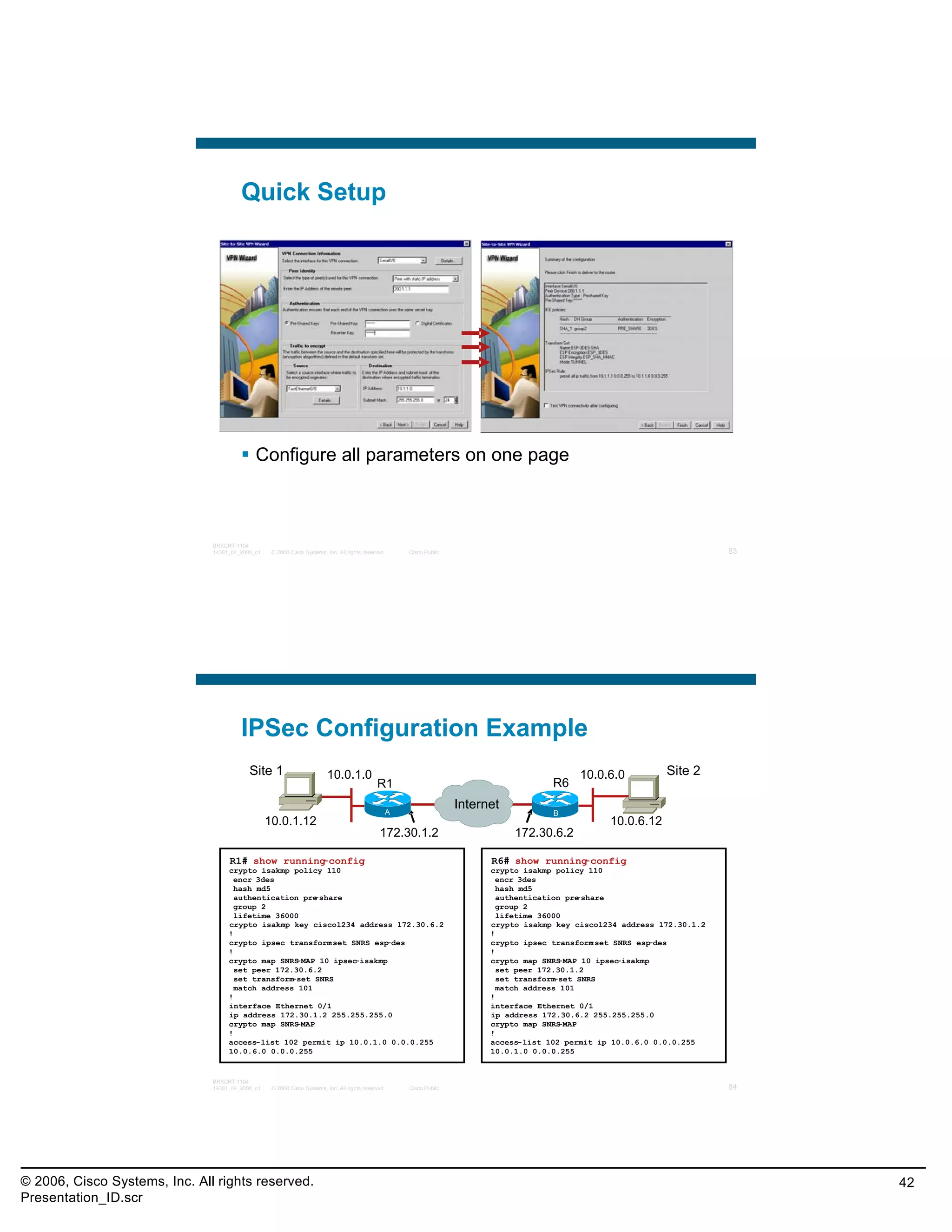
Quick Setup


                                             Configure all parameters on one page


                               BRKCRT-1104
                               14381_04_2008_c1    © 2008 Cisco Systems, Inc. All rights reserved.   Cisco Public                                                          83


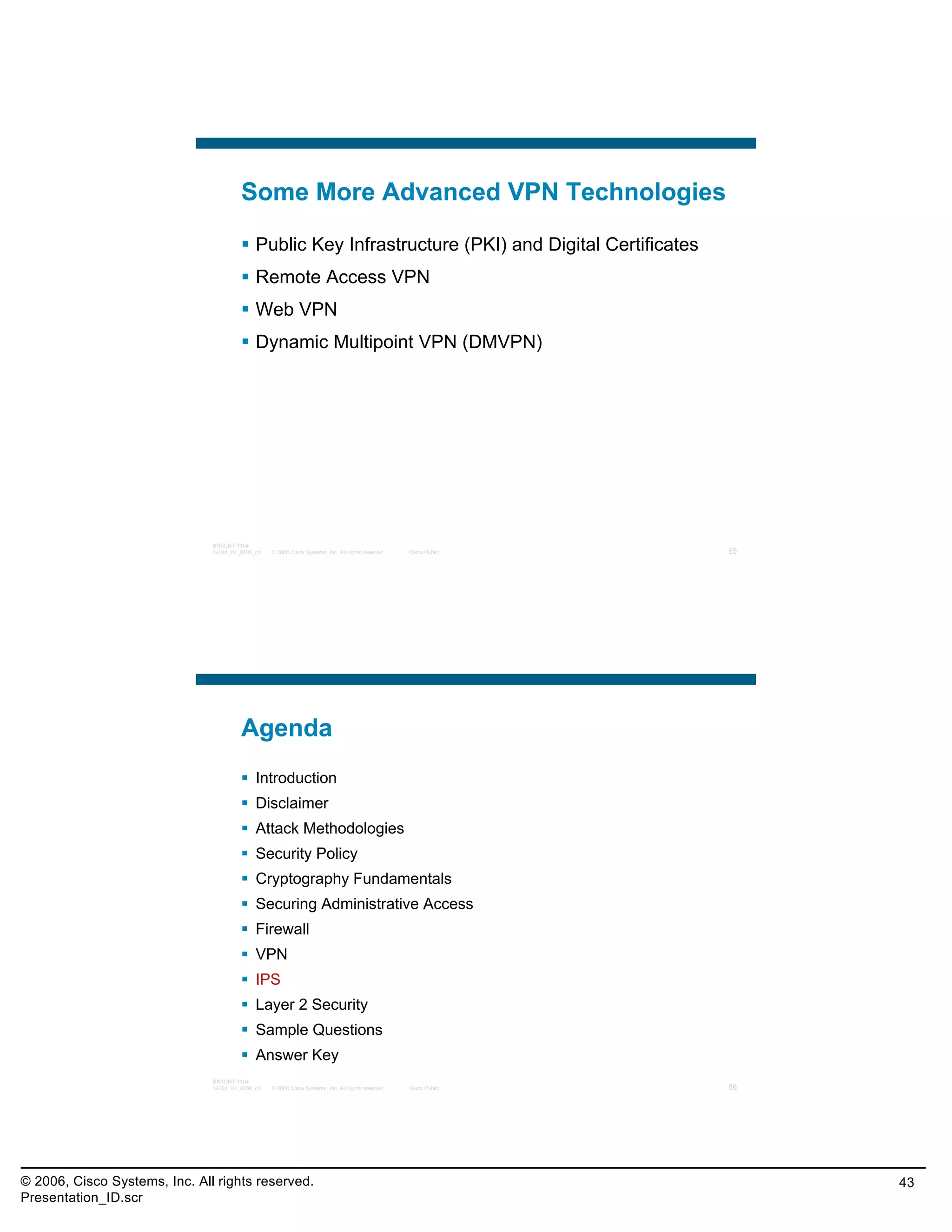
                                        IPSec Configuration Example
                                           Site 1                        10.0.1.0                                                            10.0.6.0          Site 2
                                                                                              R1                                       R6

                                                                                                 A
                                                                                                                    Internet
                                                                                                                                       B
                                                  10.0.1.12                                                                                        10.0.6.12
                                                                                               172.30.1.2                      172.30.6.2

                                    R1# show running-config                                                               R6# show running
                                                                                                                                         -config
                                    crypto isakmp policy 110                                                              crypto isakmp policy 110
                                     encr 3des                                                                             encr 3des
                                     hash md5                                                                              hash md5
                                      authentication pre-share                                                              authentication pre-share
                                     group 2                                                                               group 2
                                      lifetime 36000                                                                        lifetime 36000
                                    crypto isakmp key cisco1234 address 172.30.6.2                                        crypto isakmp key cisco1234 address 172.30.1.2
                                    !                                                                                     !
                                    crypto ipsec transform -set SNRS esp-des                                              crypto ipsec transform -set SNRS esp-des
                                    !                                                                                     !
                                    crypto map SNRS -MAP 10 ipsec-isakmp                                                  crypto map SNRS -MAP 10 ipsec-isakmp
                                      set peer 172.30.6.2                                                                   set peer 172.30.1.2
                                      set transform-set SNRS                                                                set transform-set SNRS
                                      match address 101                                                                     match address 101
                                    !                                                                                     !
                                    interface Ethernet 0/1                                                                interface Ethernet 0/1
                                    ip address 172.30.1.2 255.255.255.0                                                   ip address 172.30.6.2 255.255.255.0
                                    crypto map SNRS -MAP                                                                  crypto map SNRS -MAP
                                    !                                                                                     !
                                    access-list 102 permit ip 10.0.1.0 0.0.0.255                                          access-list 102 permit ip 10.0.6.0 0.0.0.255
                                    10.0.6.0 0.0.0.255                                                                    10.0.1.0 0.0.0.255


                               BRKCRT-1104
                               14381_04_2008_c1    © 2008 Cisco Systems, Inc. All rights reserved.   Cisco Public                                                          84


© 2006, Cisco Systems, Inc. All rights reserved.                                                                                                                                42
Presentation_ID.scr
Some More Advanced VPN Technologies

                                             Public Key Infrastructure (PKI) and Digital Certificates
                                             Remote Access VPN
                                             Web VPN
                                             Dynamic Multipoint VPN (DMVPN)


                               BRKCRT-1104
                               14381_04_2008_c1   © 2008 Cisco Systems, Inc. All rights reserved.   Cisco Public   85


                                        Agenda
                                             Introduction
                                             Disclaimer
                                             Attack Methodologies
                                             Security Policy
                                             Cryptography Fundamentals
                                             Securing Administrative Access
                                             Firewall
                                             VPN
                                             IPS
                                             Layer 2 Security
                                             Sample Questions
                                             Answer Key
                               BRKCRT-1104
                               14381_04_2008_c1   © 2008 Cisco Systems, Inc. All rights reserved.   Cisco Public   86


© 2006, Cisco Systems, Inc. All rights reserved.                                                                        43
Presentation_ID.scr
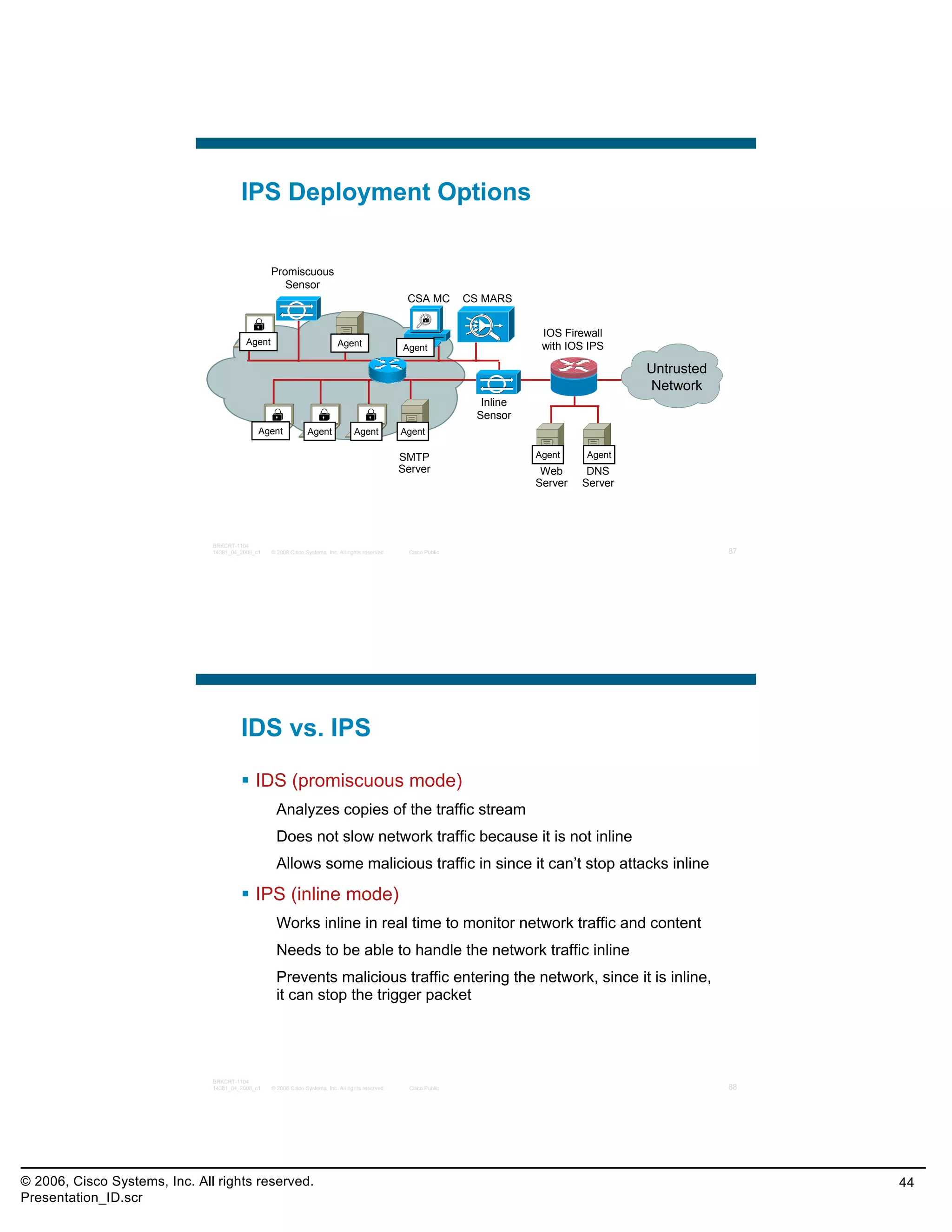
IPS Deployment Options


                                                  Promiscuous
                                                     Sensor
                                                                                                     CSA MC          CS MARS


                                                                                                                                 IOS Firewall
                                          Agent                              Agent                  Agent                        with IOS IPS

                                                                                                                                                  Untrusted
                                                                                                                                                  Network
                                                                                                                       Inline
                                                                                                                      Sensor
                                              Agent             Agent               Agent           Agent

                                                                                                    SMTP                        Agent    Agent
                                                                                                    Server                       Web      DNS
                                                                                                                                Server   Server


                               BRKCRT-1104
                               14381_04_2008_c1   © 2008 Cisco Systems, Inc. All rights reserved.     Cisco Public                                            87


                                        IDS vs. IPS

                                             IDS (promiscuous mode)
                                                    Analyzes copies of the traffic stream
                                                    Does not slow network traffic because it is not inline
                                                    Allows some malicious traffic in since it can’t stop attacks inline

                                             IPS (inline mode)
                                                    Works inline in real time to monitor network traffic and content
                                                    Needs to be able to handle the network traffic inline
                                                    Prevents malicious traffic entering the network, since it is inline,
                                                    it can stop the trigger packet


                               BRKCRT-1104
                               14381_04_2008_c1   © 2008 Cisco Systems, Inc. All rights reserved.     Cisco Public                                            88


© 2006, Cisco Systems, Inc. All rights reserved.                                                                                                                   44
Presentation_ID.scr
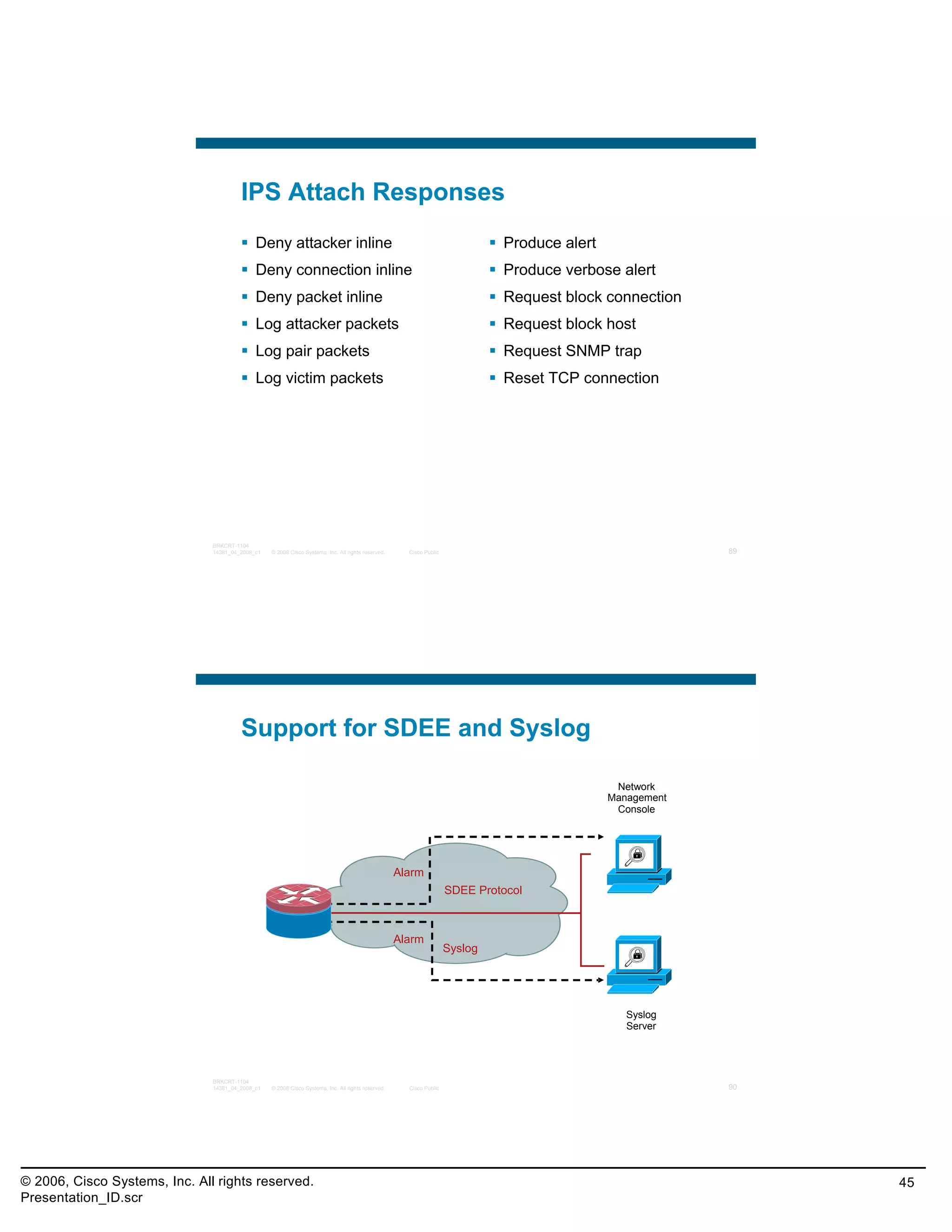
IPS Attach Responses
                                             Deny attacker inline                                                             Produce alert
                                             Deny connection inline                                                           Produce verbose alert
                                             Deny packet inline                                                               Request block connection
                                             Log attacker packets                                                             Request block host
                                             Log pair packets                                                                 Request SNMP trap
                                             Log victim packets                                                               Reset TCP connection


                               BRKCRT-1104
                               14381_04_2008_c1   © 2008 Cisco Systems, Inc. All rights reserved.     Cisco Public                                         89


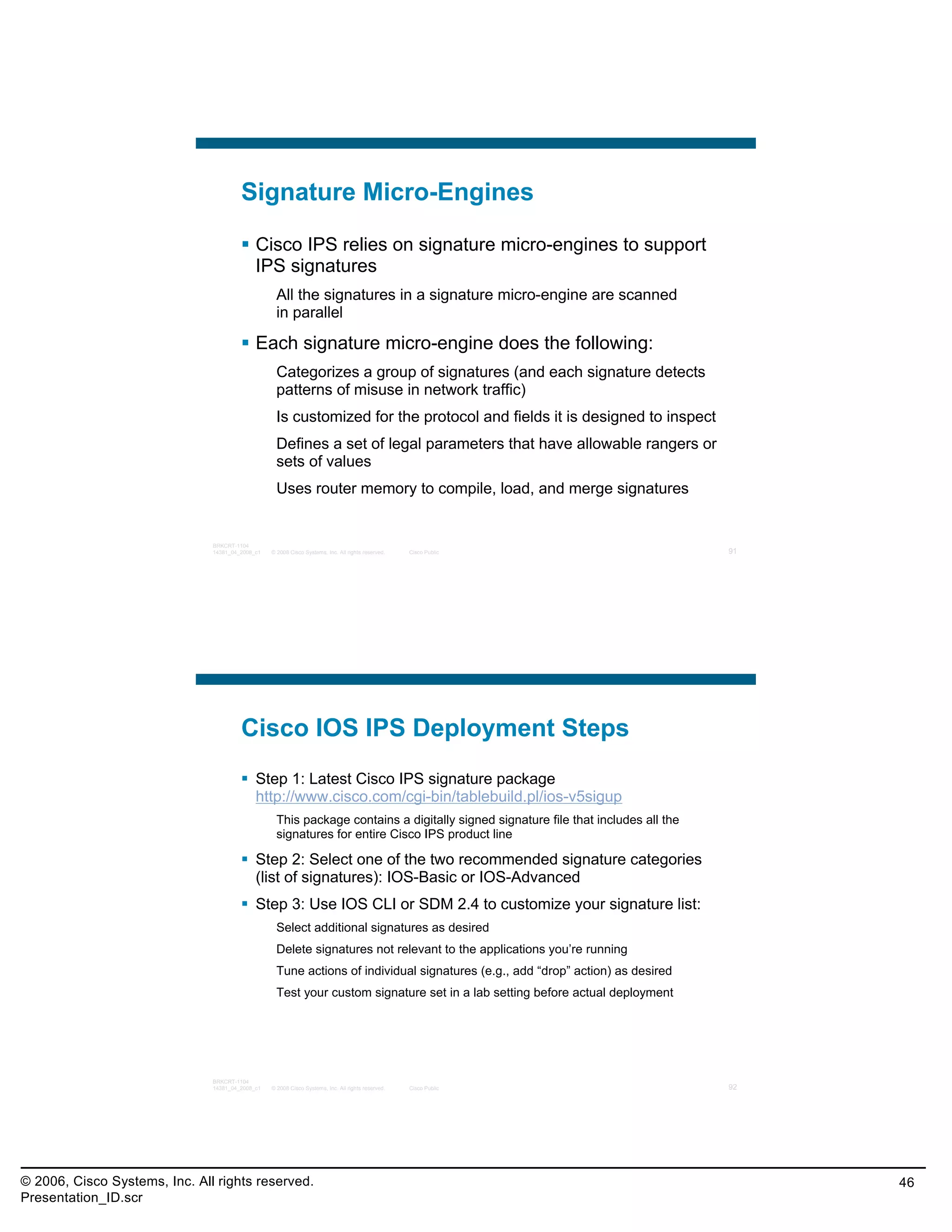
                                        Support for SDEE and Syslog

                                                                                                                                               Network
                                                                                                                                              Management
                                                                                                                                               Console


                                                                                                    Alarm
                                                                                                                     SDEE Protocol


                                                                                                    Alarm
                                                                                                                     Syslog


                                                                                                                                                 Syslog
                                                                                                                                                 Server


                               BRKCRT-1104
                               14381_04_2008_c1   © 2008 Cisco Systems, Inc. All rights reserved.     Cisco Public                                         90


© 2006, Cisco Systems, Inc. All rights reserved.                                                                                                                45
Presentation_ID.scr
Signature Micro-Engines

                                             Cisco IPS relies on signature micro-engines to support
                                             IPS signatures
                                                    All the signatures in a signature micro-engine are scanned
                                                    in parallel

                                             Each signature micro-engine does the following:
                                                    Categorizes a group of signatures (and each signature detects
                                                    patterns of misuse in network traffic)
                                                    Is customized for the protocol and fields it is designed to inspect
                                                    Defines a set of legal parameters that have allowable rangers or
                                                    sets of values
                                                    Uses router memory to compile, load, and merge signatures


                               BRKCRT-1104
                               14381_04_2008_c1   © 2008 Cisco Systems, Inc. All rights reserved.   Cisco Public                    91


                                        Cisco IOS IPS Deployment Steps
                                             Step 1: Latest Cisco IPS signature package
                                             http://www.cisco.com/cgi-bin/tablebuild.pl/ios-v5sigup
                                                    This package contains a digitally signed signature file that includes all the
                                                    signatures for entire Cisco IPS product line

                                             Step 2: Select one of the two recommended signature categories
                                             (list of signatures): IOS-Basic or IOS-Advanced
                                             Step 3: Use IOS CLI or SDM 2.4 to customize your signature list:
                                                    Select additional signatures as desired
                                                    Delete signatures not relevant to the applications you’re running
                                                    Tune actions of individual signatures (e.g., add “drop” action) as desired
                                                    Test your custom signature set in a lab setting before actual deployment


                               BRKCRT-1104
                               14381_04_2008_c1   © 2008 Cisco Systems, Inc. All rights reserved.   Cisco Public                    92


© 2006, Cisco Systems, Inc. All rights reserved.                                                                                         46
Presentation_ID.scr
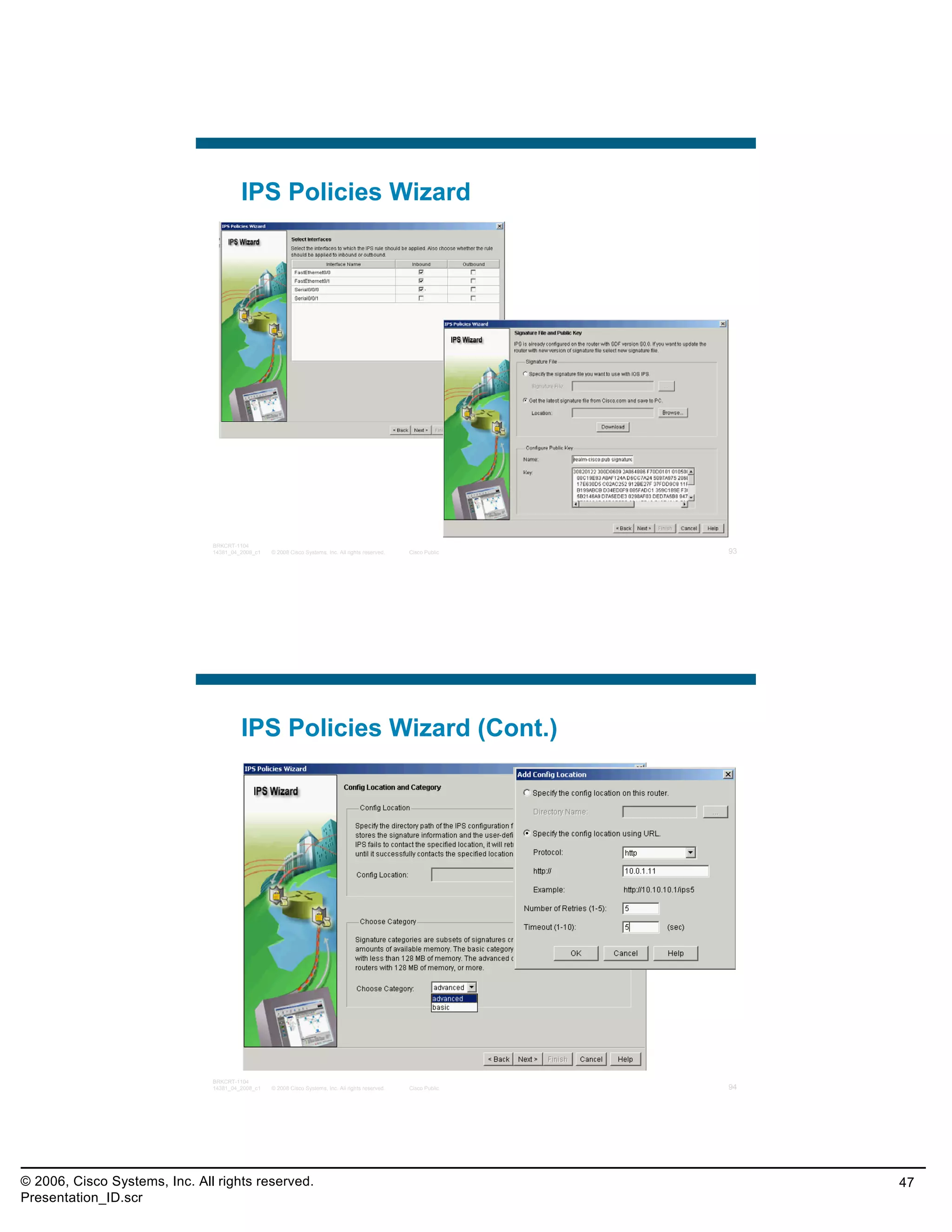
IPS Policies Wizard


                               BRKCRT-1104
                               14381_04_2008_c1   © 2008 Cisco Systems, Inc. All rights reserved.   Cisco Public   93


                                        IPS Policies Wizard (Cont.)


                               BRKCRT-1104
                               14381_04_2008_c1   © 2008 Cisco Systems, Inc. All rights reserved.   Cisco Public   94


© 2006, Cisco Systems, Inc. All rights reserved.                                                                        47
Presentation_ID.scr
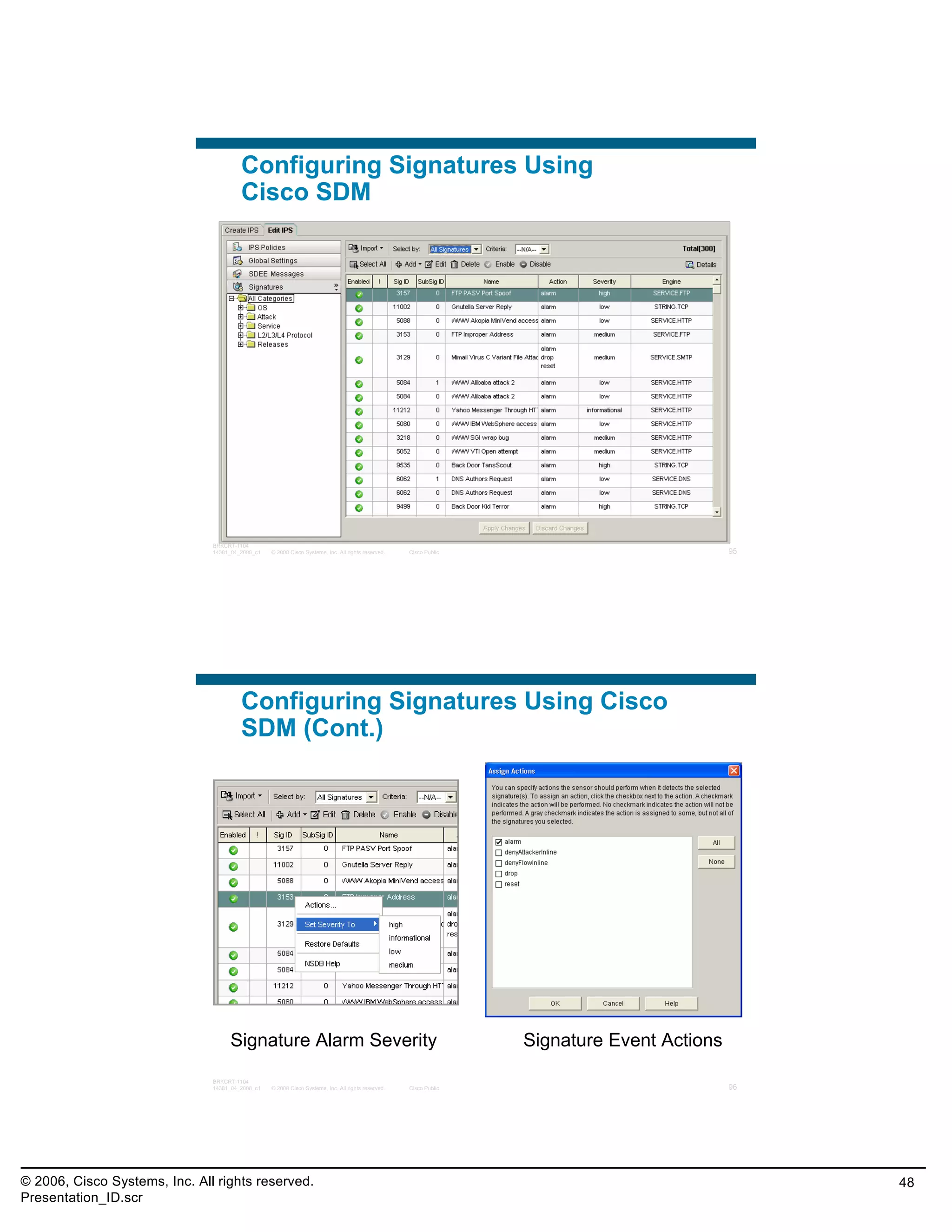
Configuring Signatures Using
                                        Cisco SDM


                               BRKCRT-1104
                               14381_04_2008_c1   © 2008 Cisco Systems, Inc. All rights reserved.   Cisco Public                             95


                                        Configuring Signatures Using Cisco
                                        SDM (Cont.)


                                    Signature Alarm Severity                                                       Signature Event Actions

                               BRKCRT-1104
                               14381_04_2008_c1   © 2008 Cisco Systems, Inc. All rights reserved.   Cisco Public                             96


© 2006, Cisco Systems, Inc. All rights reserved.                                                                                                  48
Presentation_ID.scr
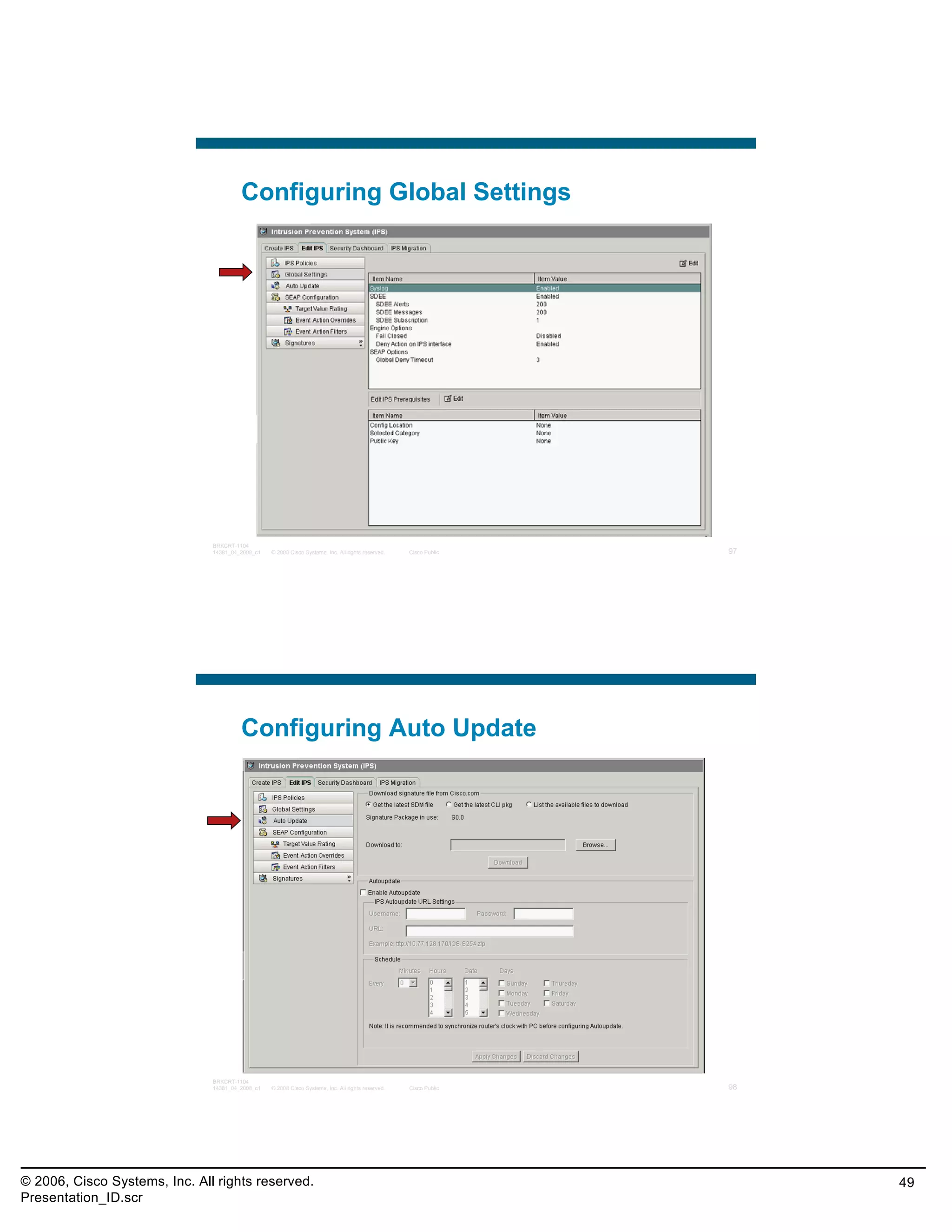
Configuring Global Settings


                               BRKCRT-1104
                               14381_04_2008_c1   © 2008 Cisco Systems, Inc. All rights reserved.   Cisco Public   97


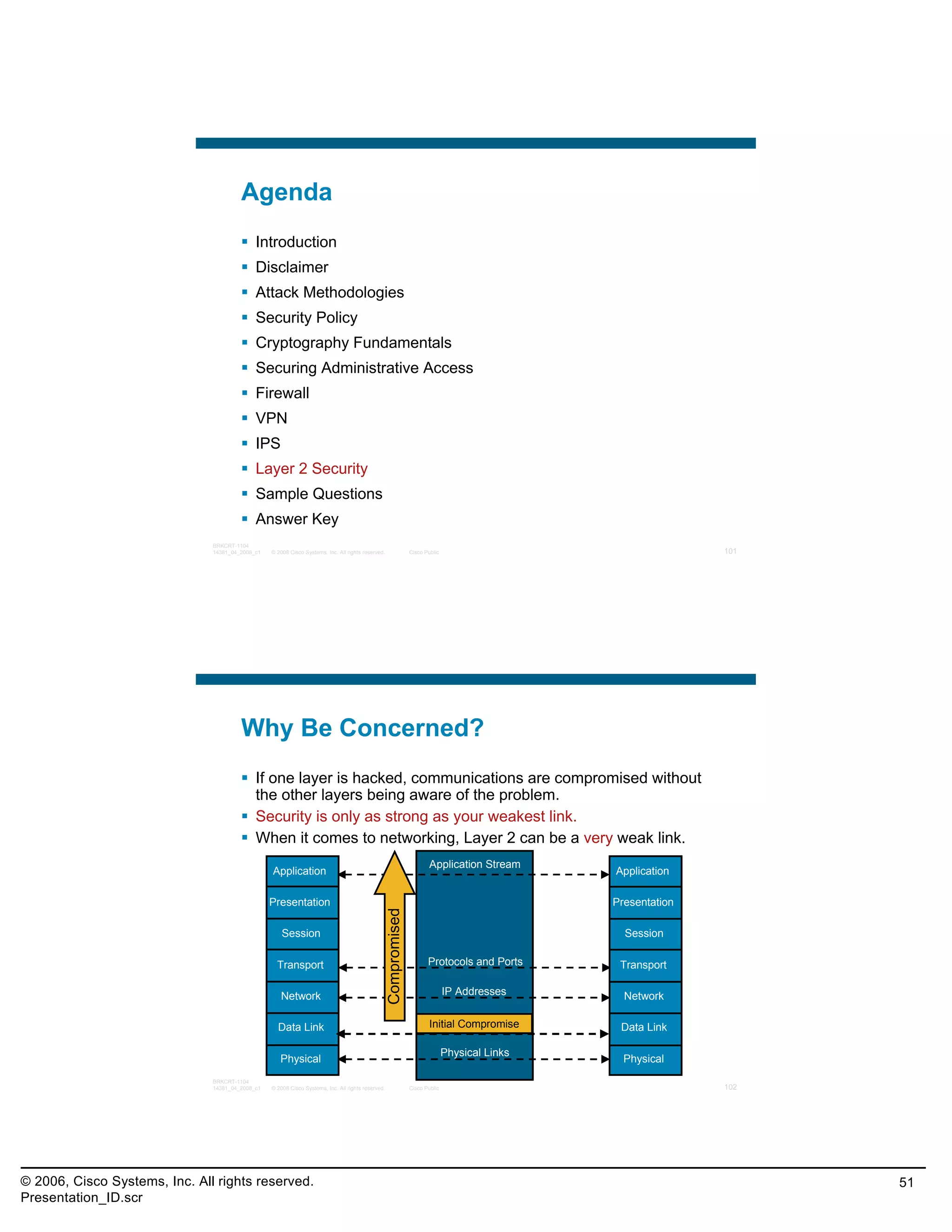
                                        Configuring Auto Update


                               BRKCRT-1104
                               14381_04_2008_c1   © 2008 Cisco Systems, Inc. All rights reserved.   Cisco Public   98


© 2006, Cisco Systems, Inc. All rights reserved.                                                                        49
Presentation_ID.scr
Demo–Cisco IOS IPS in Action

                                       Deobfuscation: The sensor decodes the URL as an HTTP daemon would. %6F
                                       represents the ASCII code for “o” in Hex. The sensor determines that R%6F%6FT.eXe
                                       is really an attempt to access root.exe.


                               BRKCRT-1104
                               14381_04_2008_c1   © 2008 Cisco Systems, Inc. All rights reserved.   Cisco Public           99


                                        Demo–Cisco IOS IPS in Action

                                 Metasploit successfully exploits a buffer overflow vulnerability to get a shell prompt
                                 on the remote server
                                 msf 3com_3cdaemon_ftp_overflow(win32_reverse) > exploit
                                 [*] Starting Reverse Handler.
                                 [*] Attempting to exploit Windows 2000 English
                                 [*] Got connection from 150.150.1.20:4321 <-> 200.200.1.15:1573
                                 Microsoft Windows 2000 [Version 5.00.2195]
                                 (C) Copyright 1985-2000 Microsoft Corp.
                                 C:Program Files3Com3CDaemon>


                                 With IOS IPS enabled, the router detects a suspiciously long user name field in the
                                 FTP control stream. The shell connection is not successful, and the event is logged.
                                 msf     3com_3cdaemon_ftp_overflow(win32_reverse) > exploit
                                 [*]     Starting Reverse Handler.
                                 [*]     Attempting to exploit Windows 2000 English
                                 [*]     Exiting Reverse Handler.
                                 msf     3com_3cdaemon_ftp_overflow(win32_reverse) >


                               BRKCRT-1104
                               14381_04_2008_c1   © 2008 Cisco Systems, Inc. All rights reserved.   Cisco Public           100


© 2006, Cisco Systems, Inc. All rights reserved.                                                                                 50
Presentation_ID.scr
Agenda
                                             Introduction
                                             Disclaimer
                                             Attack Methodologies
                                             Security Policy
                                             Cryptography Fundamentals
                                             Securing Administrative Access
                                             Firewall
                                             VPN
                                             IPS
                                             Layer 2 Security
                                             Sample Questions
                                             Answer Key
                               BRKCRT-1104
                               14381_04_2008_c1   © 2008 Cisco Systems, Inc. All rights reserved.             Cisco Public                                   101


                                        Why Be Concerned?
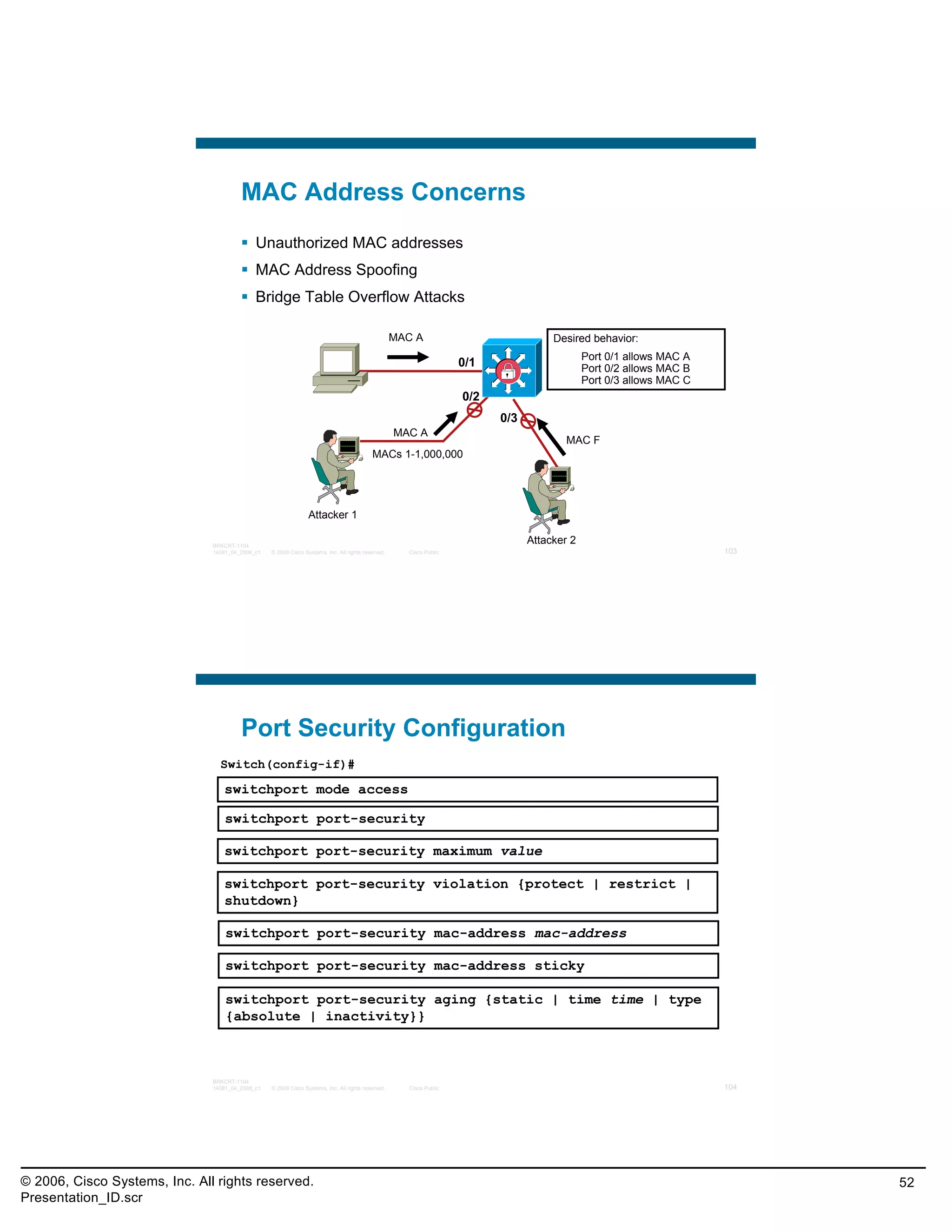
                                             If one layer is hacked, communications are compromised without
                                             the other layers being aware of the problem.
                                             Security is only as strong as your weakest link.
                                             When it comes to networking, Layer 2 can be a very weak link.
                                                                                                                      Application Stream
                                                  Application                                                                                 Application

                                                  Presentation                                                                                Presentation
                                                                                                Compromised


                                                      Session                                                                                   Session

                                                    Transport                                                        Protocols and Ports       Transport

                                                     Network                                                                 IP Addresses       Network

                                                    Data Link                                                         Initial Compromise
                                                                                                                       MAC Addresses           Data Link

                                                                                                                             Physical Links
                                                     Physical                                                                                   Physical
                               BRKCRT-1104
                               14381_04_2008_c1   © 2008 Cisco Systems, Inc. All rights reserved.             Cisco Public                                   102


© 2006, Cisco Systems, Inc. All rights reserved.                                                                                                                   51
Presentation_ID.scr
MAC Address Concerns
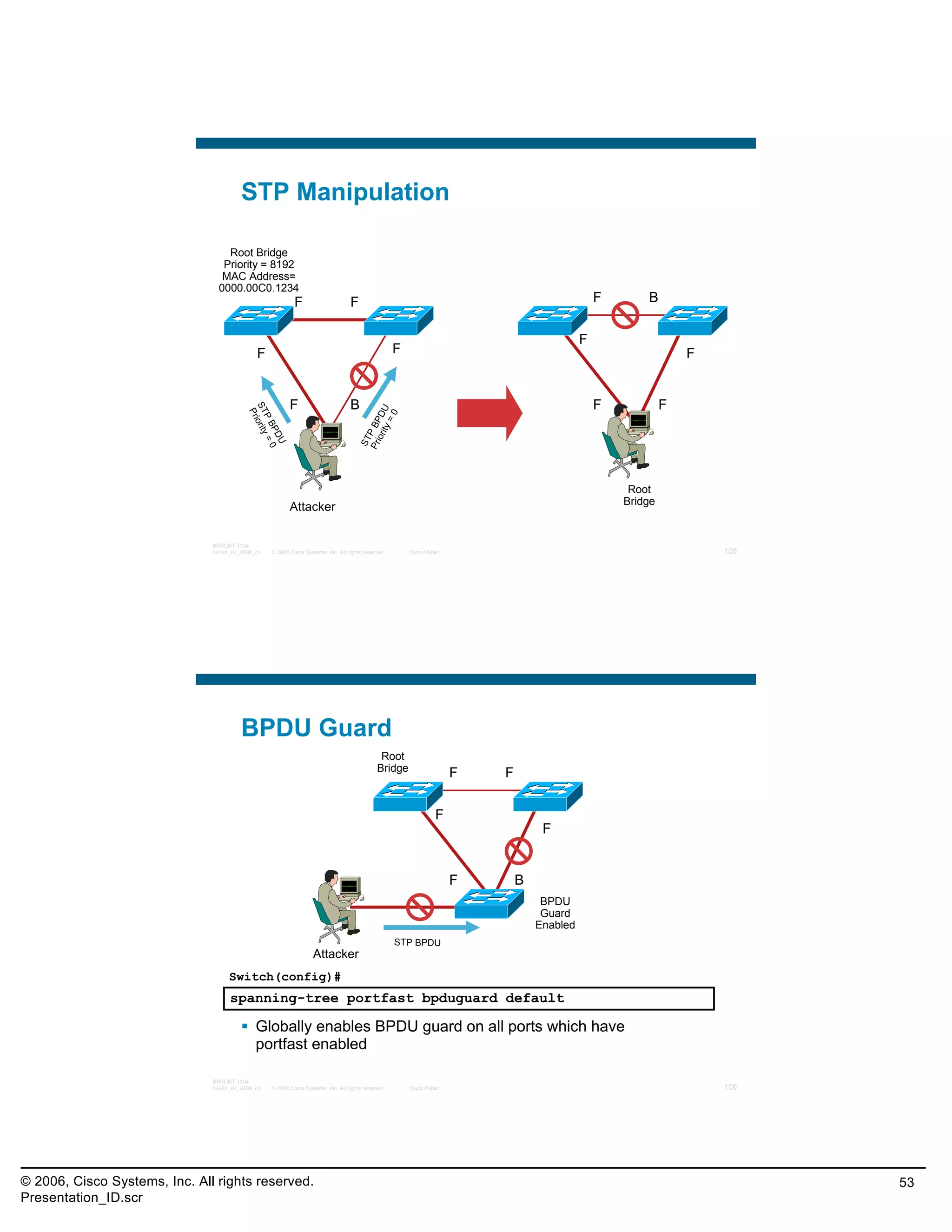
                                             Unauthorized MAC addresses
                                             MAC Address Spoofing
                                             Bridge Table Overflow Attacks

                                                                                                    MAC A                             Desired behavior:
                                                                                                                                              Port 0/1 allows MAC A
                                                                                                                     0/1                      Port 0/2 allows MAC B
                                                                                                                                              Port 0/3 allows MAC C
                                                                                                                     0/2
                                                                                                                           0/3
                                                                                                    MAC A
                                                                                                                                         MAC F
                                                                                           MACs 1-1,000,000


                                                                 Attacker 1

                               BRKCRT-1104
                                                                                                                                 Attacker 2
                               14381_04_2008_c1   © 2008 Cisco Systems, Inc. All rights reserved.     Cisco Public                                                    103


                                        Port Security Configuration
                                 Switch(config-if)#

                                  switchport mode access

                                  switchport port-security

                                  switchport port-security maximum value

                                  switchport port-security violation {protect | restrict |
                                  shutdown}

                                   switchport port-security mac-address mac-address

                                   switchport port-security mac-address sticky

                                   switchport port-security aging {static | time time | type
                                   {absolute | inactivity}}


                               BRKCRT-1104
                               14381_04_2008_c1   © 2008 Cisco Systems, Inc. All rights reserved.     Cisco Public                                                    104


© 2006, Cisco Systems, Inc. All rights reserved.                                                                                                                            52
Presentation_ID.scr
STP Manipulation

                                  Root Bridge
                                 Priority = 8192
                                 MAC Address=
                                0000.00C0.1234
                                                           F                      F                                                              F       B


                                                                                                                                             F
                                             F                                                      F                                                             F


                                                         F                        B                                                              F            F
                                          ST iority


                                                                                           ity DU
                                           Pr


                                                                                              =0
                                            PB =


                                                                                     Pr P BP
                                                PD 0


                                                                                       ior
                                                                                      ST
                                                    U


                                                                                                                                                      Root
                                                                                                                                                     Bridge
                                                         Attacker

                               BRKCRT-1104
                               14381_04_2008_c1   © 2008 Cisco Systems, Inc. All rights reserved.       Cisco Public                                                  105


                                        BPDU Guard
                                                                                              Root
                                                                                             Bridge
                                                                                                                       F   F


                                                                                                                  F
                                                                                                                                    F


                                                                                                                       F       B
                                                                                                                                    BPDU
                                                                                                                                    Guard
                                                                                                                                   Enabled
                                                                                                    STP BPDU
                                                                   Attacker
                                    Switch(config)#
                                    spanning-tree portfast bpduguard default

                                             Globally enables BPDU guard on all ports which have
                                             portfast enabled

                               BRKCRT-1104
                               14381_04_2008_c1   © 2008 Cisco Systems, Inc. All rights reserved.       Cisco Public                                                  106


© 2006, Cisco Systems, Inc. All rights reserved.                                                                                                                            53
Presentation_ID.scr
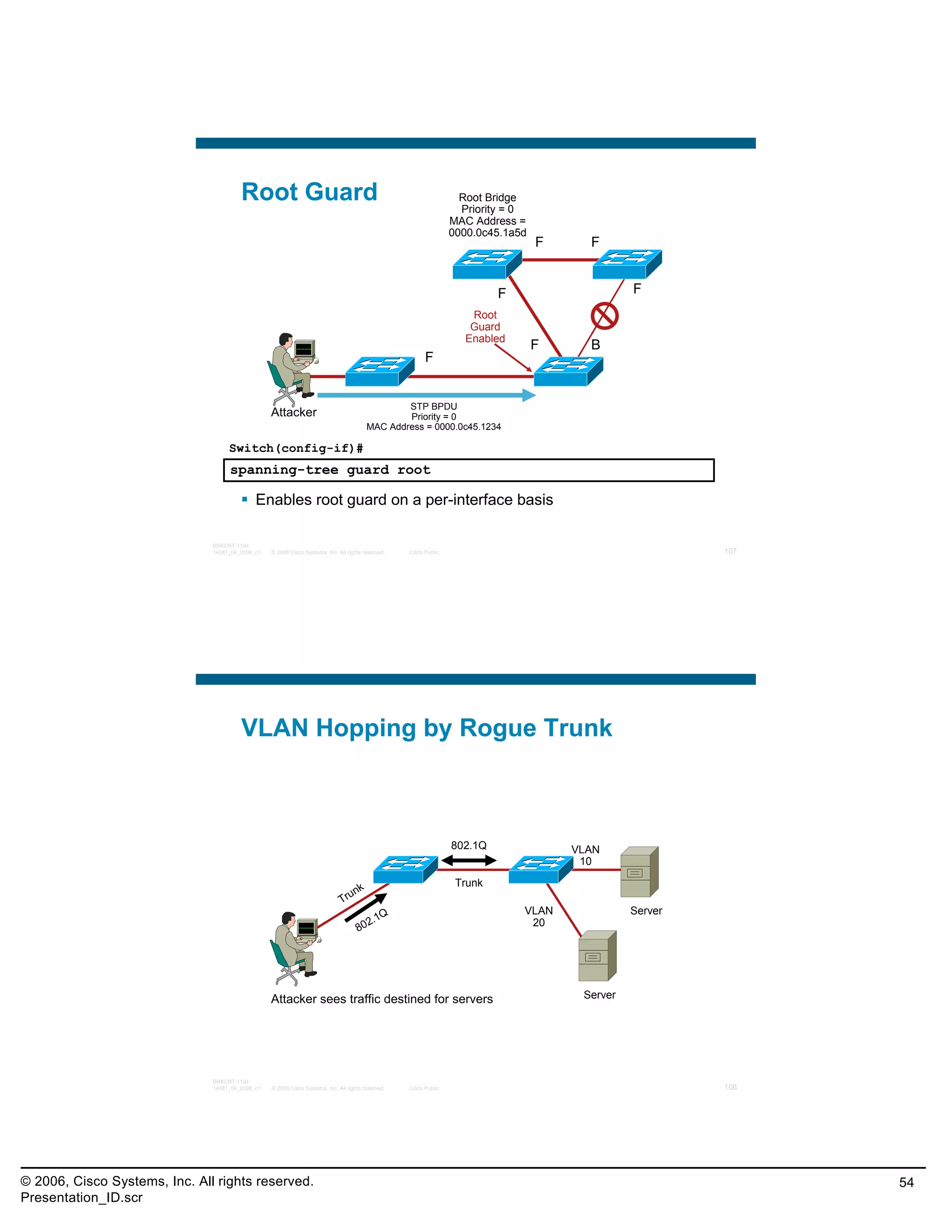
Root Guard                                                                   Root Bridge
                                                                                                                     Priority = 0
                                                                                                                   MAC Address =
                                                                                                                   0000.0c45.1a5d
                                                                                                                                    F     F


                                                                                                                            F                     F
                                                                                                                      Root
                                                                                                                      Guard
                                                                                                                     Enabled
                                                                                                                                    F     B
                                                                                                          F


                                                                                                 STP BPDU
                                                  Attacker                                       Priority = 0
                                                                                         MAC Address = 0000.0c45.1234

                                    Switch(config-if)#
                                    spanning-tree guard root

                                             Enables root guard on a per-interface basis

                               BRKCRT-1104
                               14381_04_2008_c1   © 2008 Cisco Systems, Inc. All rights reserved.   Cisco Public                                           107


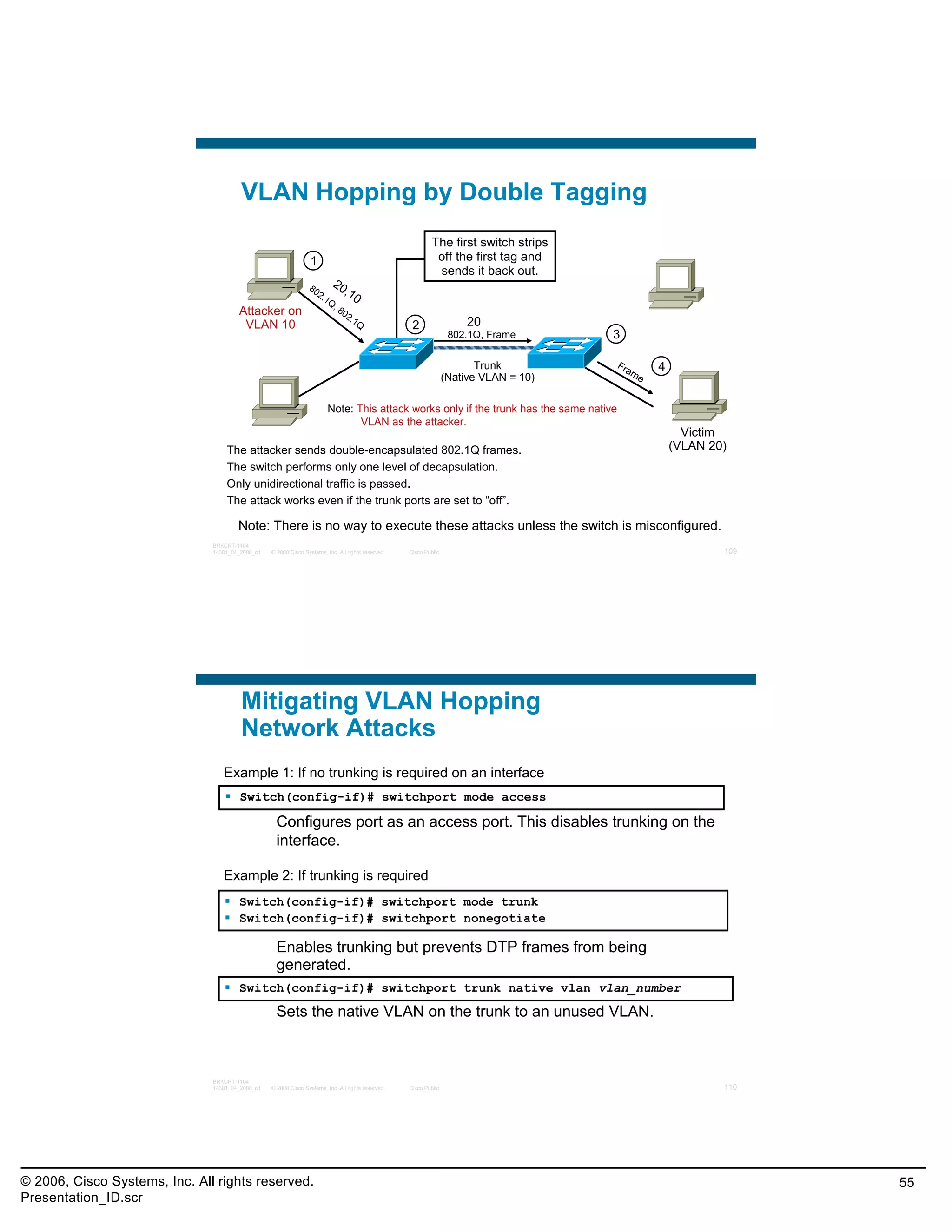
                                        VLAN Hopping by Rogue Trunk


                                                                                                                   802.1Q               VLAN
                                                                                                                                         10

                                                                                  k                                 Trunk
                                                                                un
                                                                              Tr
                                                                                           Q                                    VLAN              Server
                                                                                        2.1                                      20
                                                                                     80


                                                  Attacker sees traffic destined for servers                                             Server


                               BRKCRT-1104
                               14381_04_2008_c1   © 2008 Cisco Systems, Inc. All rights reserved.   Cisco Public                                           108


© 2006, Cisco Systems, Inc. All rights reserved.                                                                                                                 54
Presentation_ID.scr
VLAN Hopping by Double Tagging
                                                                                                             The first switch strips
                                                                  1                                           off the first tag and
                                                                                                              sends it back out.
                                                                 80    20
                                                                   2.      ,10
                                                                     1Q
                                                                        ,8
                                       Attacker on                        02
                                                                            .1                                          20
                                        VLAN 10                               Q                      2
                                                                                                                    802.1Q, Frame       3

                                                                                                                          Trunk         Fra        4
                                                                                                                                           m   e
                                                                                                                   (Native VLAN = 10)

                                                                         Note: This attack works only if the trunk has the same native
                                                                                VLAN as the attacker.
                                                                                                                                                         Victim
                                   The attacker sends double-encapsulated 802.1Q frames.                                                               (VLAN 20)
                                   The switch performs only one level of decapsulation.
                                   Only unidirectional traffic is passed.
                                   The attack works even if the trunk ports are set to “off”.

                                       Note: There is no way to execute these attacks unless the switch is misconfigured.
                               BRKCRT-1104
                               14381_04_2008_c1   © 2008 Cisco Systems, Inc. All rights reserved.   Cisco Public                                               109


                                        Mitigating VLAN Hopping
                                        Network Attacks
                                  Example 1: If no trunking is required on an interface
                                       Switch(config-if)# switchport mode access

                                                    Configures port as an access port. This disables trunking on the
                                                    interface.

                                  Example 2: If trunking is required
                                       Switch(config-if)# switchport mode trunk
                                       Switch(config-if)# switchport nonegotiate

                                                    Enables trunking but prevents DTP frames from being
                                                    generated.
                                       Switch(config-if)# switchport trunk native vlan vlan_number

                                                    Sets the native VLAN on the trunk to an unused VLAN.


                               BRKCRT-1104
                               14381_04_2008_c1   © 2008 Cisco Systems, Inc. All rights reserved.   Cisco Public                                               110


© 2006, Cisco Systems, Inc. All rights reserved.                                                                                                                     55
Presentation_ID.scr
ARP Spoofing:
                                        Man-in-the-Middle Attacks
                                                         1. IP 10.1.1.2                                                                  2. Legitimate ARP reply
                                                         ? MAC for 10.1.1.1                                                              10.1.1.1 = MAC B.B.B.B

                               IP 10.1.1.2
                               MAC A.A.A.A                      A
                                                                                                        A                    B      IP 10.1.1.1       B
                                                                                                                         C          MAC B.B.B.B
                                                                                                                                             ARP Table in Host B
                                     ARP Table in Host A
                                                                                                                                               10.1.1.2 = MAC C.C.C.C
                                        10.1.1.1 = MAC C.C.C.C
                                                                                                                                 3. Subsequent gratuitous ARP
                                                                                          IP 10.1.1.3                               replies overwrite legitimate replies
                                                                                                                     C
                                                                                          MAC C.C.C.C                            10.1.1.1 bound to C.C.C.C
                                                                                             Attacker
                                                                                                                                 10.1.1.2 bound to C.C.C.C

                                                                                                    ARP Table in Host C
                                                                                                     10.1.1.1 = MAC B.B.B.B
                                 A = host A
                                 B = host B                                                          10.1.1.2 = MAC A.A.A.A
                                 C = host C
                               BRKCRT-1104
                               14381_04_2008_c1   © 2008 Cisco Systems, Inc. All rights reserved.     Cisco Public                                                         111


                                        Private VLAN Edge

                                             Within a VLAN, layer 2 frames are only allowed
                                             between a pair of non-protected ports or a protected
                                             port and a non-protected port. Frames are not allowed
                                             between a pair of protected ports.

                                       L3-Sw#config t
                                       Enter configuration commands, one per line. End with CNTL/Z.
                                       L3-Sw(config)#interface range fa0/2 - 4
                                       L3-Sw(config-if-range)#switchport protected
                                       L3-Sw(config-if-range)#end


                               BRKCRT-1104
                               14381_04_2008_c1   © 2008 Cisco Systems, Inc. All rights reserved.     Cisco Public                                                         112


© 2006, Cisco Systems, Inc. All rights reserved.                                                                                                                                 56
Presentation_ID.scr
Some More Advanced Layer 2
                                        Security Technologies

                                             Full-fledged Private VLANs–uses the concept of
                                             promiscuous ports and isolated ports and adds the
                                             concept of community ports.
                                             DHCP Snooping
                                             Dynamic ARP Inspection


                               BRKCRT-1104
                               14381_04_2008_c1   © 2008 Cisco Systems, Inc. All rights reserved.   Cisco Public   113


                                        Agenda
                                             Introduction
                                             Disclaimer
                                             Attack Methodologies
                                             Security Policy
                                             Cryptography Fundamentals
                                             Securing Administrative Access
                                             Firewall
                                             VPN
                                             IPS
                                             Layer 2 Security
                                             Sample Questions
                                             Answer Key
                               BRKCRT-1104
                               14381_04_2008_c1   © 2008 Cisco Systems, Inc. All rights reserved.   Cisco Public   114


© 2006, Cisco Systems, Inc. All rights reserved.                                                                         57
Presentation_ID.scr
Practice Exam Item 1—SDM-Based Item


                               BRKCRT-1104
                               14381_04_2008_c1   © 2008 Cisco Systems, Inc. All rights reserved.   Cisco Public   115


                                        Practice Exam Item 1—(Cont.)


                               BRKCRT-1104
                               14381_04_2008_c1   © 2008 Cisco Systems, Inc. All rights reserved.   Cisco Public   116


© 2006, Cisco Systems, Inc. All rights reserved.                                                                         58
Presentation_ID.scr
Practice Exam Item 1—(Cont.)

                                                  Based on the zone base firewall SDM configuration
                                                  windows shown, which statement is correct?
                                                    A. The “sdm-inspect” policy applies to the bi-direction traffic
                                                       flow between the in-zone and the out-zone
                                                    B. All traffic sourced from the in-zone destined to the out-zone
                                                       to be denied (dropped)
                                                    C. All traffic sourced from out-zone and destined to the in-zone
                                                       will be inspected
                                                    D. The “sdm-inspect” policy classify traffic into four traffic
                                                       classes (including class-default)


                               BRKCRT-1104
                               14381_04_2008_c1   © 2008 Cisco Systems, Inc. All rights reserved.   Cisco Public       117


                                        Practice Exam Item 2—Theory
                                        Based Item

                                                  Encrypting the plaintext using the private key and
                                                  decrypting the ciphertext using the public key
                                                  provides which functionality?
                                                    A. Confidentiality
                                                    B. Authenticity
                                                    C. Integrity and Confidentiality
                                                    D. Confidentiality and Authenticity


                               BRKCRT-1104
                               14381_04_2008_c1   © 2008 Cisco Systems, Inc. All rights reserved.   Cisco Public       118


© 2006, Cisco Systems, Inc. All rights reserved.                                                                             59
Presentation_ID.scr
Practice Exam Item 3—CLI
                                        Configuration Item
                                        What additional configuration is required to enable the VTY users to be authenticated
                                        using the local database on the router if the ACS server is down?
                                                           !
                                                           username admin privilege 15 secret harDt0CrackPw
                                                           !
                                                           aaa new-model
                                                           !
                                                           aaa authentication login name tacacs+
                                                           !
                                                           tacacs-server host 10.0.1.1
                                                           tacacs-server key Secretf0rAcs
                                                           !
                                                           line vty 0 5
                                                           login authentication name
                                                           !


                                        A.        aaa authentication login default tacacs+ local
                                        B.        aaa authentication login default local
                                        C.        adding the “local’ option after “aaa authentication login name tacacs+”
                                        D.        adding the “default’ option after “login authentication name” in the vty
                                                  config mode
                               BRKCRT-1104
                               14381_04_2008_c1   © 2008 Cisco Systems, Inc. All rights reserved.   Cisco Public                119


                                        Practice Exam Item 4—Configuration
                                        Related Item

                                                  What are the two IOS IPS signatures categories
                                                  based on version 5.x signatures? (Choose two)
                                                    A. basic
                                                    B. advanced
                                                    C. 128MB.sdf
                                                    D. 256MB.sdf


                               BRKCRT-1104
                               14381_04_2008_c1   © 2008 Cisco Systems, Inc. All rights reserved.   Cisco Public                120


© 2006, Cisco Systems, Inc. All rights reserved.                                                                                      60
Presentation_ID.scr
Practice Exam Item 5—Theory
                                        Based Item

                                                  Which IKE authentication method is the least
                                                  scalable?
                                                    A. ACS
                                                    B. RSA signature
                                                    C. Pre-shared Key
                                                    D. AAA
                                                    E. SHA


                               BRKCRT-1104
                               14381_04_2008_c1   © 2008 Cisco Systems, Inc. All rights reserved.   Cisco Public   121


                                        Practice Exam Item 6—Theory
                                        Based Item

                                                  Stateful firewall uses which table to track the
                                                  connection status?
                                                    A. ACL table
                                                    B. Routing table
                                                    C. State table
                                                    D. Forwarding table (CEF)
                                                    E. ARP table


                               BRKCRT-1104
                               14381_04_2008_c1   © 2008 Cisco Systems, Inc. All rights reserved.   Cisco Public   122


© 2006, Cisco Systems, Inc. All rights reserved.                                                                         61
Presentation_ID.scr
Practice Exam Item
                                        7—SDM Based Item


                                                  Referring to the IPSec transform set configuration shown, which
                                                  encryption method is used to provide data confidentiality?
                                                    A. SHA
                                                    B. DES
                                                    C. HMAC
                                                    D. AES
                                                    E. ESP
                               BRKCRT-1104
                               14381_04_2008_c1   © 2008 Cisco Systems, Inc. All rights reserved.   Cisco Public    123


                                        Practice Exam Item 8—Configuration
                                        Related Item

                                                  When implementing Port Security on Cisco switches,
                                                  the “sticky MAC address” option will save the secure
                                                  MAC address to what location?
                                                    A. ARP table
                                                    B. MAC address table
                                                    C. startup configuration
                                                    D. running configuration
                                                    E. NVRAM


                               BRKCRT-1104
                               14381_04_2008_c1   © 2008 Cisco Systems, Inc. All rights reserved.   Cisco Public    124


© 2006, Cisco Systems, Inc. All rights reserved.                                                                          62
Presentation_ID.scr
Practice Exam Item 9—Show Output
                                        Related Item
                                                      ISR#sh policy-map type inspect zone-pair session
                                                       Zone-pair: in-to-out
                                                       Service-policy inspect : telnetpolicy
                                                        Class-map: telnetclass (match-all)
                                                         Match: protocol telnet
                                                         Inspect
                                                          Established Sessions
                                                           Session 44C831D8 (10.30.30.1:11009)=>(172.26.26.151:23) telnet SIS_OPEN
                                                            Created 00:01:32, Last heard 00:00:16
                                                            Bytes sent (initiator:responder) [52:108]
                                                        Class-map: class-default (match-any)
                                                         Match: any
                                                         Inspect
                                                           Established Sessions
                                                           Session 44C82C68 (10.30.30.1:8)=>(172.26.26.151:0) icmp SIS_OPEN
                                                            Created 00:00:02, Last heard 00:00:00
                                                            ECHO request
                                                            Bytes sent (initiator:responder) [98568:98568]

                                                  Based on the show output shown, which statement is correct?
                                                    A. Only telnet traffic will be inspected
                                                    B. There are two active outbound sessions
                                                    C. All non-telnet traffic will be dropped
                                                    D. Host 172.26.26.151 is initiating the telnet session to host 10.30.30.1
                               BRKCRT-1104
                               14381_04_2008_c1   © 2008 Cisco Systems, Inc. All rights reserved.     Cisco Public                                                    125


                                        Practice Exam Item 10—Configuration
                                        Related Item


                                                                                                aessha
                                                           esp-sha-hmac                                                           esp-sha-hmac

                                                                                               10.1.1.0 0.0.0.255                                10.1.2.0 0.0.0.255
                                         10.2.1.0 0.0.0.255                                                          10.0.0.0 0.255.255.255

                                                                                    20


                                                                               aessha


                                                  What is wrong regarding the partial S2S IPSec VPN configuration shown?
                                                    A.       The transform-set name does not match between the peers
                                                    B.       The transform-set is missing the AH option
                                                    C.       The transform-set is missing the “mode tunnel” option
                                                    D.       The crypto acl is not a mirror image of the crypto acl on the other peer
                                                    E.       The crypto acl is not matching the 172.16.172.10 and 172.16.171.20 IP address
                               BRKCRT-1104
                               14381_04_2008_c1   © 2008 Cisco Systems, Inc. All rights reserved.     Cisco Public                                                    126


© 2006, Cisco Systems, Inc. All rights reserved.                                                                                                                            63
Presentation_ID.scr
Agenda
                                             Introduction
                                             Disclaimer
                                             Attack Methodologies
                                             Security Policy
                                             Cryptography Fundamentals
                                             Securing Administrative Access
                                             Firewall
                                             VPN
                                             IPS
                                             Layer 2 Security
                                             Sample Questions
                                             Answer Key
                               BRKCRT-1104
                               14381_04_2008_c1    © 2008 Cisco Systems, Inc. All rights reserved.   Cisco Public       127


                                        Practice Exam Item 1

                                                   Based on the zone base firewall SDM configuration
                                                   windows shown, which statement is correct?
                                                     A. The “sdm-inspect” policy applies to the bi-direction traffic
                                                        flow between the in-zone and the out-zone
                                                     B. All traffic sourced from the in-zone destined to the out-zone
                                                        to be denied (dropped)
                                                     C. All traffic sourced from out-zone and destined to the in-zone
                                                        will be inspected
                                                     D. The “sdm-inspect” policy classify traffic into four traffic
                                                        classes (including class-default)

                                                  Correct Answer: D


                               BRKCRT-1104
                               14381_04_2008_c1    © 2008 Cisco Systems, Inc. All rights reserved.   Cisco Public       128


© 2006, Cisco Systems, Inc. All rights reserved.                                                                              64
Presentation_ID.scr
Practice Exam Item 2

                                                   Encrypting the plaintext using the private key and
                                                   decrypting the ciphertext using the public key
                                                   provides which functionality?
                                                     A. Confidentiality
                                                     B. Authenticity
                                                     C. Integrity and Confidentiality
                                                     D. Confidentiality and Authenticity


                                                  Correct Answer: B


                               BRKCRT-1104
                               14381_04_2008_c1    © 2008 Cisco Systems, Inc. All rights reserved.   Cisco Public                          129


                                        Practice Exam Item 3
                                        What additional configuration is required to enable the VTY users to be authenticated
                                        using the local database on the router if the ACS server is down?
                                                                                        !
                                                                                        username admin privilege 15 secret harDt0CrackPw
                                                                                        !
                                                                                        aaa new-model
                                                                                        !
                                                                                        aaa authentication login name tacacs+
                                                                                        !
                                                                                        tacacs-server host 10.0.1.1
                                                                                        tacacs-server key Secretf0rAcs
                                                                                        !
                                                                                        line vty 0 5
                                                                                        login authentication name
                               Correct Answer: C                                        !
                                         A.        aaa authentication login default tacacs+ local
                                         B.        aaa authentication login default local
                                         C.        adding the “local’ option after “aaa authentication login name tacacs+”
                                         D.        adding the “default’ option after “login authentication name” in the vty
                                                   config mode

                               BRKCRT-1104
                               14381_04_2008_c1    © 2008 Cisco Systems, Inc. All rights reserved.   Cisco Public                          130


© 2006, Cisco Systems, Inc. All rights reserved.                                                                                                 65
Presentation_ID.scr
Practice Exam Item 4

                                                   What are the two IOS IPS signatures categories
                                                   based on version 5.x signatures? (Choose two)
                                                     A. basic
                                                     B. advanced
                                                     C. 128MB.sdf
                                                     D. 256MB.sdf


                                                  Correct Answer: A and B


                               BRKCRT-1104
                               14381_04_2008_c1    © 2008 Cisco Systems, Inc. All rights reserved.   Cisco Public   131


                                        Practice Exam Item 5

                                                   Which IKE authentication method is the least
                                                   scalable?
                                                     A. ACS
                                                     B. RSA signature
                                                     C. Pre-shared Key
                                                     D. AAA
                                                     E. SHA


                                                  Correct Answer: C


                               BRKCRT-1104
                               14381_04_2008_c1    © 2008 Cisco Systems, Inc. All rights reserved.   Cisco Public   132


© 2006, Cisco Systems, Inc. All rights reserved.                                                                          66
Presentation_ID.scr
Practice Exam Item 6

                                                   Stateful firewall uses which table to track the
                                                   connection status?
                                                     A. ACL table
                                                     B. Routing table
                                                     C. State table
                                                     D. Forwarding table (CEF)
                                                     E. ARP table


                                                  Correct Answer: C


                               BRKCRT-1104
                               14381_04_2008_c1    © 2008 Cisco Systems, Inc. All rights reserved.   Cisco Public    133


                                        Practice Exam Item 7


                                                   Referring to the IPSec transform set configuration shown, which
                                                   encryption method is used to provide data confidentiality?
                                                     A. SHA
                                                     B. DES
                                                     C. HMAC
                                                     D. AES                                      Correct Answer: D
                                                     E. ESP
                               BRKCRT-1104
                               14381_04_2008_c1    © 2008 Cisco Systems, Inc. All rights reserved.   Cisco Public    134


© 2006, Cisco Systems, Inc. All rights reserved.                                                                           67
Presentation_ID.scr
Practice Exam Item 8

                                                   When implementing Port Security on Cisco switches,
                                                   the “sticky MAC address” option will save the secure
                                                   MAC address to what location?
                                                     A. ARP table
                                                     B. MAC address table
                                                     C. startup configuration
                                                     D. running configuration
                                                     E. NVRAM


                                                  Correct Answer: D


                               BRKCRT-1104
                               14381_04_2008_c1    © 2008 Cisco Systems, Inc. All rights reserved.   Cisco Public                       135


                                        Practice Exam Item 9—Show Output
                                        Related Item
                                                       ISR#sh policy-map type inspect zone-pair session
                                                        Zone-pair: in-to-out
                                                        Service-policy inspect : telnetpolicy
                                                         Class-map: telnetclass (match-all)
                                                          Match: protocol telnet
                                                          Inspect
                                                           Established Sessions
                                                            Session 44C831D8 (10.30.30.1:11009)=>(172.26.26.151:23) telnet SIS_OPEN
                                                             Created 00:01:32, Last heard 00:00:16
                                                             Bytes sent (initiator:responder) [52:108]
                                                         Class-map: class-default (match-any)
                                                          Match: any
                                                          Inspect
                                                            Established Sessions
                                                            Session 44C82C68 (10.30.30.1:8)=>(172.26.26.151:0) icmp SIS_OPEN
                                                             Created 00:00:02, Last heard 00:00:00
                                                             ECHO request
                                                             Bytes sent (initiator:responder) [98568:98568]

                                                   Based on the show output shown, which statement is correct?
                                                     A. Only telnet traffic will be inspected
                                                     B. There are two active outbound sessions                      Correct Answer: B
                                                     C. All non-telnet traffic will be dropped
                                                     D. Host 172.26.26.151 is initiating the telnet session to host 10.30.30.1
                               BRKCRT-1104
                               14381_04_2008_c1    © 2008 Cisco Systems, Inc. All rights reserved.   Cisco Public                       136


© 2006, Cisco Systems, Inc. All rights reserved.                                                                                              68
Presentation_ID.scr
Practice Exam Item 10—Configuration
                                        Related Item


                                                                                                aessha
                                                           esp-sha-hmac                                                           esp-sha-hmac

                                                                                               10.1.1.0 0.0.0.255                                 10.1.2.0 0.0.0.255
                                         10.2.1.0 0.0.0.255                                                          10.0.0.0 0.255.255.255

                                                                                    20


                                                                               aessha


                                                  What is wrong regarding the partial S2S IPSec VPN configuration shown?
                                                    A.       The transform-set name does not match between the peers
                                                    B.       The transform-set is missing the AH option
                                                                                                                                              Correct Answer: D
                                                    C.       The transform-set is missing the “mode tunnel” option
                                                    D.       The crypto acl is not a mirror image of the crypto acl on the other peer
                                                    E.       The crypto acl is not matching the 172.16.172.10 and 172.16.171.20 IP address
                               BRKCRT-1104
                               14381_04_2008_c1   © 2008 Cisco Systems, Inc. All rights reserved.     Cisco Public                                                     137


                                        Q and A


                               BRKCRT-1104
                               14381_04_2008_c1   © 2008 Cisco Systems, Inc. All rights reserved.     Cisco Public                                                     138


© 2006, Cisco Systems, Inc. All rights reserved.                                                                                                                             69
Presentation_ID.scr
Recommended Reading

                                             Continue your Cisco Live
                                             learning experience with further
                                             reading from Cisco Press
                                             Check the Recommended
                                             Reading flyer for suggested
                                             books


                                        Available Onsite at the Cisco Company Store
                               BRKCRT-1104
                               14381_04_2008_c1   © 2008 Cisco Systems, Inc. All rights reserved.   Cisco Public                        139


                                        Complete Your Online
                                        Session Evaluation
                                             Give us your feedback and you could win                               Don’t forget to activate
                                             fabulous prizes. Winners announced daily.                             your Cisco Live virtual
                                                                                                                   account for access to
                                             Receive 20 Passport points for each session                           all session material
                                             evaluation you complete.                                              on-demand and return
                                                                                                                   for our live virtual event
                                             Complete your session evaluation online now                           in October 2008.
                                             (open a browser through our wireless network                          Go to the Collaboration
                                             to access our portal) or visit one of the Internet                    Zone in World of
                                             stations throughout the Convention Center.                            Solutions or visit
                                                                                                                   www.cisco-live.com.


                               BRKCRT-1104
                               14381_04_2008_c1   © 2008 Cisco Systems, Inc. All rights reserved.   Cisco Public                        140


© 2006, Cisco Systems, Inc. All rights reserved.                                                                                                70
Presentation_ID.scr
BRKCRT-1104
                               14381_04_2008_c1   © 2008 Cisco Systems, Inc. All rights reserved.   Cisco Public   141


© 2006, Cisco Systems, Inc. All rights reserved.                                                                         71
Presentation_ID.scr

Ccna security prep from networkers

  • 1.
    BRKCRT-1104 14381_04_2008_c1 © 2008 Cisco Systems, Inc. All rights reserved. Cisco Public 1 CCNA Security: A New Associate Level Career Path Option BRKCRT-1104 BRKCRT-1104 14381_04_2008_c1 © 2008 Cisco Systems, Inc. All rights reserved. Cisco Public 2 © 2006, Cisco Systems, Inc. All rights reserved. 1 Presentation_ID.scr
  • 2.
    Agenda Introduction Disclaimer Attack Methodologies Security Policy Cryptography Fundamentals Securing Administrative Access Firewall VPN IPS Layer 2 Security Sample Questions Answer Key BRKCRT-1104 14381_04_2008_c1 © 2008 Cisco Systems, Inc. All rights reserved. Cisco Public 3 Goals of This Session What this session will not be: A replacement to the 5 day IINS course An exam cram session focusing on the content of the IINS exam An exact match to the content of the IINS course What this session will include: A discussion of security issues and technology relevant to those pursuing a career in Network Security at the associate level A presentation based on, but not limited by, the concepts covered in the IINS class A demonstration of attack methodologies and mitigation of the attack using Cisco security technology BRKCRT-1104 14381_04_2008_c1 © 2008 Cisco Systems, Inc. All rights reserved. Cisco Public 4 © 2006, Cisco Systems, Inc. All rights reserved. 2 Presentation_ID.scr
  • 3.
    Agenda Introduction Disclaimer Attack Methodologies Security Policy Cryptography Fundamentals Securing Administrative Access Firewall VPN IPS Layer 2 Security Sample Questions Answer Key BRKCRT-1104 14381_04_2008_c1 © 2008 Cisco Systems, Inc. All rights reserved. Cisco Public 5 Disclaimer Do not repeat the exercises demonstrated during this presentation on any network for which you do not have complete authorization to do so. The demonstrations are carried out on an isolated network within the Global Knowledge remote labs environment. Practicing similar exercises outside of this environment requires many considerations including, but not limited to: 1. Many organizations have security policies explicitly forbidding the use of these types of tools on the their networks. Job termination and/or criminal prosecution may be the penalty. 2. Often these types of tools are distributed with hidden malware. By installing such tools you may unknowingly also be installing keystroke loggers, back doors, or other types of malware. 3. Use of these types of tools with targets that are owned by other entities may violate local, state and/or federal laws. BRKCRT-1104 14381_04_2008_c1 © 2008 Cisco Systems, Inc. All rights reserved. Cisco Public 6 © 2006, Cisco Systems, Inc. All rights reserved. 3 Presentation_ID.scr
  • 4.
    Agenda Introduction Disclaimer Attack Methodologies Security Policy Cryptography Fundamentals Securing Administrative Access Firewall VPN IPS Layer 2 Security Sample Questions Answer Key BRKCRT-1104 14381_04_2008_c1 © 2008 Cisco Systems, Inc. All rights reserved. Cisco Public 7 Changing Threats and Challenges Where Can I Get Attached? Operating System Network Services Applications Users Attack Attack Anywhere Everywhere BRKCRT-1104 14381_04_2008_c1 © 2008 Cisco Systems, Inc. All rights reserved. Cisco Public 8 © 2006, Cisco Systems, Inc. All rights reserved. 4 Presentation_ID.scr
  • 5.
    The Morris Worm Recognized as the first Internet Worm Written by Robert Tappan Morris Released on November 2, 1988 Two target OS’s: BSD on DEC VAX and SunOS Intent was to gauge the size of the Internet Could (and did) infect same system multiple times, hence ended up being a crippling issue The worm consisted of an executable file (usr/tmp/sh) created from a C program (x$$,l1.c) and one of two object files (x$$,vax.o and x$$,sun3.o) It used 3 vectors: sendmail, fingerd, rsh/rexec BRKCRT-1104 14381_04_2008_c1 © 2008 Cisco Systems, Inc. All rights reserved. Cisco Public 9 The Morris Worm Sendmail: Invoked debug mode Used RCPT TO: and requested data be piped to a shell The data was a shell script which created a .c file, which it compiled with the victim’s own C compiler New executable copied the object files from attacking host, determined host OS, and compiled usr/tmp/sh using the appropriate object file BRKCRT-1104 14381_04_2008_c1 © 2008 Cisco Systems, Inc. All rights reserved. Cisco Public 10 © 2006, Cisco Systems, Inc. All rights reserved. 5 Presentation_ID.scr
  • 6.
    The Morris Worm fingerd & rsh/rexec Differed from sendmail vector in method of transfering files fingerd Buffer overflow–fingerd expected a max of 512 bytes of input, but didn’t verify Vulnerability in both target OS, but exploit was only written to BSD on the DEC VAX rsh/rexec Checked the local .rhosts and /etc/hosts.equiv files for trust relationships Needed to crack username/password Tried common combinations for the password, such as username, first name, last name and last name + firstname. If those attempts failed, it used /usr/dict/words and tried every word in the dictionary BRKCRT-1104 14381_04_2008_c1 © 2008 Cisco Systems, Inc. All rights reserved. Cisco Public 11 The Morris Worm Hiding itself: Hid itself from the ps command Unlinked its files so they wouldn’t show up with the ls command Scanning for other hosts: Sequential addresses in local network netstat –r –n /etc/hosts ypcat hosts BRKCRT-1104 14381_04_2008_c1 © 2008 Cisco Systems, Inc. All rights reserved. Cisco Public 12 © 2006, Cisco Systems, Inc. All rights reserved. 6 Presentation_ID.scr
  • 7.
    The Morris Worm The Main Point: If the very first internet worm was this clever, imagine how clever the they’ve become over the last 20 years! Multiple vectors Dictionary cracking Using local resources (C compiler, dictionary file) Evasion of detection Intelligent location of other networks Attackers think outside the box. BRKCRT-1104 14381_04_2008_c1 © 2008 Cisco Systems, Inc. All rights reserved. Cisco Public 13 Smurf Attack Attacker 200.1.1.1 ICMP ECHO Replies Target ICMP ECHO SRC=200.1.1.1 DST=171.1.255.255 171.1.0.0/16 Intermediaries ICMP flooding attacks are popular due to amplification techniques: Smurf attacks use a spoofed broadcast ping to elicit a large number of responses to the target. BRKCRT-1104 14381_04_2008_c1 © 2008 Cisco Systems, Inc. All rights reserved. Cisco Public 14 © 2006, Cisco Systems, Inc. All rights reserved. 7 Presentation_ID.scr
  • 8.
    Ping Sweeps andPort Scans Ping sweeps and port scans can attempt to: Identify all services on the network Identify all hosts and devices on the network Identify the operating systems on the network Identify vulnerabilities on the network BRKCRT-1104 14381_04_2008_c1 © 2008 Cisco Systems, Inc. All rights reserved. Cisco Public 15 One of the Sneakier Scan Methods: Idle Scanning Attacker Zombie 1) IPID Probe TCP SYN ACK Packet Response: IPID = n TCP RST Packet Target is not listening on Scan Port Target is listening on Scan Port OR Attacker Target Attacker Target TCP SYN to Scan Port TCP SYN to Scan Port Spoof “from” Zombie Spoof “from” Zombie SYN 2) SYN e to cket pons e to Packet Res YN ACK ket pons a S Pac Res RST P TCP TCP RST +1 TCP ID = n IP Zombie doesn’t respond to Zombie the RST, IPID is unchanged Zombie Attacker Zombie Attacker Zombie 3) IPID Probe TCP SYN ACK Packet IPID Probe TCP SYN ACK Packet Response: IPID = n+1 Response: IPID = n+2 TCP RST Packet TCP RST Packet BRKCRT-1104 14381_04_2008_c1 © 2008 Cisco Systems, Inc. All rights reserved. Cisco Public 16 © 2006, Cisco Systems, Inc. All rights reserved. 8 Presentation_ID.scr
  • 9.
    Demonstration Topology .2 .1 150.150.1.0/24 Perimeter (10) Outside-PC Router 100.100.1.0/30 .1 2K 150.150.1.20 time.nist.gov pc.outside.net .1 192.43.244.18 DMZ Subnet (2) (11) 172.16.1.0/24 Outside Perimeter INTERNET 50.50.50.0/24 200.200.1.0/24 .2 .1 2K3 2K 200.200.20.2 200.200.30.2 .1 IOS-FW Services-R-Us DMZ-Srv (3) (16) 50.50.50.50 172.16.1.15 .1 NAT: 200.200.1.15 .1 www.sru.com .1 www.gkl.com 10.10.0.0/24 10.20.20.0/24 Inside Perimeter (13) (4) Security-Srv .2 XP 2K3 10.10.2.10 L3-Switch .1 Site1-PC .1 10.20.20.10 .1 Management Subnet(6) 10.10.10.0/24 10.30.30.0/24 10.10.2.0/24 End User Subnet (15) (7) 10.10.1.0/24 BackTrack2 Data Center Subnet (5) BT2 XP XP XP (location & IP Varies) 2K3 Site2-PC Admin-PC User-PC 10.30.30.10 10.10.10.10 10.10.10.20 Data-Srv 10.10.1.10 Global Knowledge: Cisco Security Remote Labs BRKCRT-1104 14381_04_2008_c1 © 2008 Cisco Systems, Inc. All rights reserved. Cisco Public 17 Demo: Idle Scan Using Nmap Use Nmap to run an idle scan (-sI) with 50.50.50.50 as the zombie host. All of the scan activity appears to be coming from 50.50.50.50 BRKCRT-1104 14381_04_2008_c1 © 2008 Cisco Systems, Inc. All rights reserved. Cisco Public 18 © 2006, Cisco Systems, Inc. All rights reserved. 9 Presentation_ID.scr
  • 10.
    Man-in-the-Middle Attacks Example: ARP Cache Poisoning 1. IP 10.1.1.2 2. Legitimate ARP reply ? MAC for 10.1.1.1 10.1.1.1 = MAC B.B.B.B IP 10.1.1.2 MAC A.A.A.A A A B IP 10.1.1.1 B C MAC B.B.B.B ARP Table in Host B ARP Table in Host A 10.1.1.2 = MAC C.C.C.C 10.1.1.1 = MAC C.C.C.C 3. Subsequent gratuitous ARP IP 10.1.1.3 replies overwrite legitimate replies C MAC C.C.C.C 10.1.1.1 bound to C.C.C.C Attacker 10.1.1.2 bound to C.C.C.C ARP Table in Host C 10.1.1.1 = MAC B.B.B.B A = host A B = host B 10.1.1.2 = MAC A.A.A.A C = host C BRKCRT-1104 14381_04_2008_c1 © 2008 Cisco Systems, Inc. All rights reserved. Cisco Public 19 Demo: ARP Cache Poison Using Cain Cain is a MITM between 10.10.10.20 and it’s default gateway. It has captured 2 FTP credential sets (displayed) as well as 4 Telnet credential sets. BRKCRT-1104 14381_04_2008_c1 © 2008 Cisco Systems, Inc. All rights reserved. Cisco Public 20 © 2006, Cisco Systems, Inc. All rights reserved. 10 Presentation_ID.scr
  • 11.
    How Difficult IsIt to Obtain Tools? www.sectools.org www.remote-exploit.org BRKCRT-1104 14381_04_2008_c1 © 2008 Cisco Systems, Inc. All rights reserved. Cisco Public 21 Agenda Introduction Disclaimer Attack Methodologies Security Policy Cryptography Fundamentals Securing Administrative Access Firewall VPN IPS Layer 2 Security Sample Questions Answer Key BRKCRT-1104 14381_04_2008_c1 © 2008 Cisco Systems, Inc. All rights reserved. Cisco Public 22 © 2006, Cisco Systems, Inc. All rights reserved. 11 Presentation_ID.scr
  • 12.
    Network Security Isa System Firewall + AV ≠ Network Security Network security is not something you can just buy Technology will assist Policy, Operations, and Design are more important Network security system: A collection of network-connected devices, technologies, and best practices that work in complementary ways to provide security to information assets BRKCRT-1104 14381_04_2008_c1 © 2008 Cisco Systems, Inc. All rights reserved. Cisco Public 23 Secure Network Lifecycle Initiation Disposition Acquisition and Development Security Operations and Policy Maintenance Implementation BRKCRT-1104 14381_04_2008_c1 © 2008 Cisco Systems, Inc. All rights reserved. Cisco Public 24 © 2006, Cisco Systems, Inc. All rights reserved. 12 Presentation_ID.scr
  • 13.
    Security Policy Business Risk Needs Analysis Security Policy Policies, Guidelines, Standards Industry Security Best System Practices Security Operations Incident Response, Monitor and maintenance, Compliance Audit BRKCRT-1104 14381_04_2008_c1 © 2008 Cisco Systems, Inc. All rights reserved. Cisco Public 25 Reading List SANS Security Policy Project: http://www.sans.org/resources/policies/ NSA Security Configuration Guides: http://www.nsa.gov/snac/ Cisco Security Design Guides: http://www.cisco.com/go/safe NIST Computer Security Division Publications: http://csrc.nist.gov/publications/PubsSPs.html SP800-14: Generally Accepted Principles and Practices for Securing Information Technology Systems SP800-27a: Engineering Principles for Information Technology Security Wikipedia Security Policy: http://en.wikipedia.org/wiki/Security_policy (follow the See Also links) BRKCRT-1104 14381_04_2008_c1 © 2008 Cisco Systems, Inc. All rights reserved. Cisco Public 26 © 2006, Cisco Systems, Inc. All rights reserved. 13 Presentation_ID.scr
  • 14.
    Agenda Introduction Disclaimer Attack Methodologies Security Policy Cryptography Fundamentals Securing Administrative Access Firewall VPN IPS Layer 2 Security Sample Questions Answer Key BRKCRT-1104 14381_04_2008_c1 © 2008 Cisco Systems, Inc. All rights reserved. Cisco Public 27 Cryptography: What and Why What: Cryptography: From the greek kryptó (hidden) and gráfo (to write) Cryptology: From the Greek kryptó (hidden) and legein (to speak) Why: Confidentiality, privacy, encryption, Origin Authentication Data Integrity BRKCRT-1104 14381_04_2008_c1 © 2008 Cisco Systems, Inc. All rights reserved. Cisco Public 28 © 2006, Cisco Systems, Inc. All rights reserved. 14 Presentation_ID.scr
  • 15.
    What Is aHash Function? Basic requirements for a cryptographic hash function: The input can be any length The output has a fixed length H(x) is relatively easy to compute for any given x H(x) is one-way and not reversible H(x) is collision-free Examples: MD5–128 bit output SHA1–160 bit output BRKCRT-1104 14381_04_2008_c1 © 2008 Cisco Systems, Inc. All rights reserved. Cisco Public 29 Hash Example: Update Verification Uses the Concept of a Keyed Hash Sender Receiver Variable-length Shared Received Shared input message secret key message secret key Update Message Update Message Time is X Time is X 1 Hash Hash function function Update Message Time is X 2 4ehIDx67NMop9 4ehIDx67NMop9 4ehIDx67NMop9 Message + hash BRKCRT-1104 14381_04_2008_c1 © 2008 Cisco Systems, Inc. All rights reserved. Cisco Public 30 © 2006, Cisco Systems, Inc. All rights reserved. 15 Presentation_ID.scr
  • 16.
    Hash Example: EnableSecret router(config)# enable secret password Hashes the password in the router configuration file Uses a strong hashing algorithm based on MD5 Boston(config)# enable secret Curium2006 Boston# show running-config ! Salt Hash hostname Boston Phrase Value ! no logging console enable secret 5 $1$ptCj$vRErS/tehv53JjaqFMzBT/ ! BRKCRT-1104 14381_04_2008_c1 © 2008 Cisco Systems, Inc. All rights reserved. Cisco Public 31 Demo: Enable Secret Dictionary Attack Cain used it’s dictionary of 3.5 million words. It took it a couple of minutes to go through the first 2.5 million words, but it found “san-fran” was a match for this enable secret hash BRKCRT-1104 14381_04_2008_c1 © 2008 Cisco Systems, Inc. All rights reserved. Cisco Public 32 © 2006, Cisco Systems, Inc. All rights reserved. 16 Presentation_ID.scr
  • 17.
    What Is Encryption? Encryption is the conversion of plain text into cipher text using a pre-determined algorithm Generally the cipher text is the same length as the plain text Often a key is used to generate a cipher text from an algorithm for a particular plain text cisco Encrypt !@$!& plaintext ciphertext !@$!& Decrypt cisco ciphertext plaintext BRKCRT-1104 14381_04_2008_c1 © 2008 Cisco Systems, Inc. All rights reserved. Cisco Public 33 Symmetric vs. Asymmetric Encryption If the encryption keys used for both encryption and decryption are the same, the keys are said to be symmetric. So, all parties involved must have the same keys When the encryption key used to encrypt is different from the one used to decrypt, the keys are said to be asymmetrical. PKI uses asymmetric keys with the ‘public’ key used for encryption and ‘private’ key for decryption. The two keys are mathematically related but cannot be derived from each other BRKCRT-1104 14381_04_2008_c1 © 2008 Cisco Systems, Inc. All rights reserved. Cisco Public 34 © 2006, Cisco Systems, Inc. All rights reserved. 17 Presentation_ID.scr
  • 18.
    Symmetric Encryption Algorithms Sender and receiver must share a secret key Usual key length of 40-256 bits DES, 3DES, AES, RC2/4/5/6, IDEA BRKCRT-1104 14381_04_2008_c1 © 2008 Cisco Systems, Inc. All rights reserved. Cisco Public 35 Anecdote on Key Length From AES Questions and Answers http://www.nist.gov/public_affairs/releases/aesq&a.htm 16. What is the chance that someone could use the "DES Cracker"- like hardware to crack an AES key? In the late 1990s, specialized "DES Cracker" machines were built that could recover a DES key after a few hours. In other words, by trying possible key values, the hardware could determine which key was used to encrypt a message Assuming that one could build a machine that could recover a DES key in a second (i.e., try 255 keys per second), then it would take that machine approximately 149 thousand-billion (149 trillion) years to crack a 128-bit AES key. To put that into perspective, the universe is believed to be less than 20 billion years old BRKCRT-1104 14381_04_2008_c1 © 2008 Cisco Systems, Inc. All rights reserved. Cisco Public 36 © 2006, Cisco Systems, Inc. All rights reserved. 18 Presentation_ID.scr
  • 19.
    Asymmetric Encryption Algorithms Use Public/Private key pair: A private key is a key which is only known to the individual who owns it Public key is known to everyone but still belongs to a unique individual Data encrypted using my public key can only be decrypted using my private key (provides confidentiality) Data encrypted using my private key can only be decrypted using my public key (provides authenticity) Usual key length: 360 bit to 4096 bit RSA, DSA BRKCRT-1104 14381_04_2008_c1 © 2008 Cisco Systems, Inc. All rights reserved. Cisco Public 37 Agenda Introduction Disclaimer Attack Methodologies Security Policy Cryptography Fundamentals Securing Administrative Access Firewall VPN IPS Layer 2 Security Sample Questions Answer Key BRKCRT-1104 14381_04_2008_c1 © 2008 Cisco Systems, Inc. All rights reserved. Cisco Public 38 © 2006, Cisco Systems, Inc. All rights reserved. 19 Presentation_ID.scr
  • 20.
    What Is AAA? AAA provides a method to control and configure these three independent security functions: Authentication—Provides the method of identifying users and who are allowed for access. It includes traditional username and password dialog and more secure methods (like CHAP and OTP) Authorization—Provides a method for controlling which services or devices the authenticated user has access to. Accounting—Provides the method for collecting and sending security server information used for billing, auditing, and reporting. BRKCRT-1104 14381_04_2008_c1 © 2008 Cisco Systems, Inc. All rights reserved. Cisco Public 39 Implementing AAA Using the Local Database: Usernames defined in the configuration Privilege levels defined in the configuration Role-Based CLI defined in the configuration Using an AAA Server: RADIUS —Remote Authentication Dial In User Service TACACS+—Terminal Access Controller Access Control System BRKCRT-1104 14381_04_2008_c1 © 2008 Cisco Systems, Inc. All rights reserved. Cisco Public 40 © 2006, Cisco Systems, Inc. All rights reserved. 20 Presentation_ID.scr
  • 21.
    RADIUS vs. TACACS+ RADIUS TACACS+ RADIUS uses UDP TACACS+ uses TCP RADIUS encrypts only the password TACACS+ encrypts the entire body of in the access-request packet the packet; more secure RADIUS combines authentication and TACACS+ uses the AAA architecture, authorization; accounting is separate which separates authentication, RADIUS is the industry standard authorization and accounting (created by Livingston) Cisco developed; submitted to IETF, RADIUS does not support ARA but declined access, NetBIOS Frame Protocol TACACS+ offers multiprotocol Control protocol, NASI and X.25 PAD support. connections TACACS+ provides authorization RADIUS does not allow users to control of router commands control which commands can be executed on a router. Requires use of privilege levels or CLI View RADIUS is recommended as the TACACS+ is recommended as the protocol suitable for controlling the protocol suitable for controlling access of users/employees to the administrative access by IT staff to Cisco network. devices themselves. BRKCRT-1104 14381_04_2008_c1 © 2008 Cisco Systems, Inc. All rights reserved. Cisco Public 41 Cisco Secure ACS Local or TACACS+ Variety of External RADIUS Databases AAA Client (Network Access Server) Cisco Secure ACS for Windows (IINS class uses ACS v4.1) BRKCRT-1104 14381_04_2008_c1 © 2008 Cisco Systems, Inc. All rights reserved. Cisco Public 42 © 2006, Cisco Systems, Inc. All rights reserved. 21 Presentation_ID.scr
  • 22.
    AAA Router CLIConfig Example aaa new-model ! aaa authentication login default group tacacs+ local aaa authentication login TACACS_ONLY group tacacs+ aaa authorization exec default group tacacs+ local aaa authorization commands 1 default group tacacs+ local aaa authorization commands 15 default group tacacs+ local aaa accounting exec start-stop tacacs+ aaa accounting network start-stop tacacs+ ! tacacs-server host 10.0.1.11 key Secretf0rAcs ! line vty 0 4 login authentication TACACS_ONLY BRKCRT-1104 14381_04_2008_c1 © 2008 Cisco Systems, Inc. All rights reserved. Cisco Public 43 AAA Adding TACACS+ Server Using SDM BRKCRT-1104 14381_04_2008_c1 © 2008 Cisco Systems, Inc. All rights reserved. Cisco Public 44 © 2006, Cisco Systems, Inc. All rights reserved. 22 Presentation_ID.scr
  • 23.
    AAA Login Authentication Method List BRKCRT-1104 14381_04_2008_c1 © 2008 Cisco Systems, Inc. All rights reserved. Cisco Public 45 AAA ACS—Adding the AAA Client (Router) BRKCRT-1104 14381_04_2008_c1 © 2008 Cisco Systems, Inc. All rights reserved. Cisco Public 46 © 2006, Cisco Systems, Inc. All rights reserved. 23 Presentation_ID.scr
  • 24.
    AAA ACS—Groups and Users BRKCRT-1104 14381_04_2008_c1 © 2008 Cisco Systems, Inc. All rights reserved. Cisco Public 47 Cisco IOS Command Authorization Using ACS Example Permitting the group to execute any router's commands except the show running-config command: Any IOS commands not matching the show command will be permitted AND Within the show command, only deny the show running-config command, all other show command's arguments are permitted Group Setup router(config)#aaa authorization exec default group tacacs+ BRKCRT-1104 14381_04_2008_c1 © 2008 Cisco Systems, Inc. All rights reserved. Cisco Public 48 © 2006, Cisco Systems, Inc. All rights reserved. 24 Presentation_ID.scr
  • 25.
    Demo: AAA UsingCSACS Authentication: Username and password required for login. Authorization: Specific command sets are assigned to different user groups. Accounting: Commands entered by adminstrators are tracked. Username: netop Password: IOS-FW>en Password: IOS-FW#debug ip packet Command authorization failed. % Incomplete command. IOS-FW#debug snmp packet SNMP packet debugging is on IOS-FW#undebug all All possible debugging has been turned off IOS-FW# BRKCRT-1104 14381_04_2008_c1 © 2008 Cisco Systems, Inc. All rights reserved. Cisco Public 49 Secure Remote Administrative Access: SSH—The Secure Shell Protocol SSH v1 SSH v2 Separate Transport, Architecture One Monlithic Protocol Authentication and Connection Protocols Integrity Check Weak CRC-32 Strong HMAC Negotiates algorithms for Security Only negotiates bulk PKI, bulk encryption Negotiation cipher encryption, HMAC Uses server’s public Uses Diffie-Hellman key Session Key key to protect session exchange key provided by client Knowledge of the server’s public key is required for Origin Authentication BRKCRT-1104 14381_04_2008_c1 © 2008 Cisco Systems, Inc. All rights reserved. Cisco Public 50 © 2006, Cisco Systems, Inc. All rights reserved. 25 Presentation_ID.scr
  • 26.
    Demo: SSH IOS-FW#debug ip ssh Incoming SSH debugging is on IOS-FW# *Apr 4 02:45:30.991: SSH3: starting SSH control process *Apr 4 02:45:30.991: SSH3: sent protocol version id SSH-1.99-Cisco-1.25 *Apr 4 02:45:31.011: SSH3: protocol version id is - SSH-1.5-PuTTY_Release_0.58 *Apr 4 02:45:31.015: SSH3: SSH_SMSG_PUBLIC_KEY msg *Apr 4 02:45:31.019: SSH3: SSH_CMSG_SESSION_KEY msg - length 144, type 0x03 *Apr 4 02:45:31.019: SSH: RSA decrypt started *Apr 4 02:45:31.143: SSH: RSA decrypt finished *Apr 4 02:45:31.143: SSH: RSA decrypt started *Apr 4 02:45:31.207: SSH: RSA decrypt finished *Apr 4 02:45:31.211: SSH3: sending encryption confirmation *Apr 4 02:45:31.211: SSH3: keys exchanged and encryption on *Apr 4 02:45:35.119: SSH3: SSH_CMSG_USER message received *Apr 4 02:45:35.119: SSH3: authentication request for userid admin *Apr 4 02:45:35.127: SSH3: SSH_SMSG_FAILURE message sent *Apr 4 02:45:47.695: SSH3: SSH_CMSG_AUTH_PASSWORD message received *Apr 4 02:45:52.703: SSH3: authentication successful for admin *Apr 4 02:45:52.703: SSH3: requesting TTY *Apr 4 02:45:52.703: SSH3: setting TTY - requested: length 24, width 80; set: length 24, width 80 *Apr 4 02:45:52.707: SSH3: SSH_CMSG_EXEC_SHELL message received *Apr 4 02:45:52.707: SSH3: starting shell for vty BRKCRT-1104 14381_04_2008_c1 © 2008 Cisco Systems, Inc. All rights reserved. Cisco Public 51 Agenda Introduction Disclaimer Attack Methodologies Security Policy Cryptography Fundamentals Securing Administrative Access Firewall VPN IPS Layer 2 Security Sample Questions Answer Key BRKCRT-1104 14381_04_2008_c1 © 2008 Cisco Systems, Inc. All rights reserved. Cisco Public 52 © 2006, Cisco Systems, Inc. All rights reserved. 26 Presentation_ID.scr
  • 27.
    What Is aFirewall? A firewall is a system or group of systems that enforce an access control policy between two networks Good Traffic Bad Traffic Three basic classes of firewalls include: Packet Filters Proxy Servers Stateful Firewalls BRKCRT-1104 14381_04_2008_c1 © 2008 Cisco Systems, Inc. All rights reserved. Cisco Public 53 Packet Filtering Packet filtering limits packets into a network based on the destination and source addresses, ports, and other flags compiled in an ACL BRKCRT-1104 14381_04_2008_c1 © 2008 Cisco Systems, Inc. All rights reserved. Cisco Public 54 © 2006, Cisco Systems, Inc. All rights reserved. 27 Presentation_ID.scr
  • 28.
    Packet Filter Limitations They Must Examine Packets in Isolation: access-list 100 remark The following denies RFC 1918 addresses access-list 100 deny ip 10.0.0.0 0.255.255.255 any log access-list 100 deny ip 172.16.0.0 0.15.255.255 any log access-list 100 deny ip 192.168.0.0 0.0.255.255 any log access-list 100 remark The following permits existing TCP connections Checks for ACK or access-list 100 permit tcp any 200.200.1.0 0.0.0.255 established RST, with no knowledge of access-list 100 remark permit DMZ server access previous flow access-list 100 permit tcp any host 200.200.1.15 eq ftp access-list 100 permit tcp any host 200.200.1.15 eq www Is the reply really in response to an access-list 100 remark Allow echo replies to return echo? access-list 100 permit icmp any 200.200.1.0 0.0.0.255 echo-reply Was this really access-list 100 remark Allow FTP data channels requested from inside requested in a access-list 100 permit tcp any eq ftp-data 200.200.1.0 0.0.0.255 valid FTP control channel? access-list 100 remark Allow NTP replies to return from time.nist.gov access-list 100 permit udp host 192.43.244.18 eq ntp any Might someone spoof access-list 100 remark deny and log all else time.nist.gov’s IP access-list 100 deny ip any any log address? BRKCRT-1104 14381_04_2008_c1 © 2008 Cisco Systems, Inc. All rights reserved. Cisco Public 55 Application Layer Gateway or Proxy Server BRKCRT-1104 14381_04_2008_c1 © 2008 Cisco Systems, Inc. All rights reserved. Cisco Public 56 © 2006, Cisco Systems, Inc. All rights reserved. 28 Presentation_ID.scr
  • 29.
    How Classic StatefulFirewall Works 1. ACLs specify policy for new sessions. 2. If the ACLs permit the first packet in the session, a state table entry is created. 3. Sessions in the state table are permitted bidirectionally, as long as the rules of the session protocol are obeyed. 4. Valid dynamic connections that are negotiated in an authorized control channel are also allowed. Examples include FTP, SQL-Net and 192.168.1.1 VoIP applications. Port Port 3575 80 State Inbound ACL Table internet Fa0/0 S0 inside outside 10.0.1.12/24 Inside user initiates a HTTP session to the Attacker Internet. BRKCRT-1104 14381_04_2008_c1 © 2008 Cisco Systems, Inc. All rights reserved. Cisco Public 57 Application Inspection Firewalls Have features of a stateful firewall Work with NAT Monitor sessions to determine port numbers for secondary channels Engage in deep packet inspection and filtering for some protocols. For example: SMTP commands HTTP commands and tunnels FTP commands Have the following advantages: Are aware of Layer 4 and Layer 5 states Check the conformity of application commands on Layer 5 Can check and affect Layer 7 Can prevent more types of attacks than stateful firewalls BRKCRT-1104 14381_04_2008_c1 © 2008 Cisco Systems, Inc. All rights reserved. Cisco Public 58 © 2006, Cisco Systems, Inc. All rights reserved. 29 Presentation_ID.scr
  • 30.
    Zone-Based Policy Firewall Private-DMZ Public-DMZ Requests Requests Untrusted DMZ Trusted Internet Default DENY ALL Zone-Based Policy introduces a new firewall configuration model Policies are applied to traffic moving between zones, not interfaces A zone is a collection of interfaces BRKCRT-1104 14381_04_2008_c1 © 2008 Cisco Systems, Inc. All rights reserved. Cisco Public 59 Security Zone Pairs not in any security zones E2 S4 E0 Self-Zone S3 Zone Z1 Zone Z2 E1 Security Zone Pair Source = Z1 Destination = Z2 BRKCRT-1104 14381_04_2008_c1 © 2008 Cisco Systems, Inc. All rights reserved. Cisco Public 60 © 2006, Cisco Systems, Inc. All rights reserved. 30 Presentation_ID.scr
  • 31.
    Zone Rules Summary An interface can be assigned to only one security zone All traffic to and from a given interface is implicitly blocked when the interface is assigned to a zone, except traffic to or from other interfaces in the same zone, and traffic to any interface on the router If two interfaces are not in zones, traffic flows freely between them If one interface is in a zone, and another interface is not in a zone, traffic cannot flow between them If two interfaces are in two different zones, traffic will not flow between the interfaces until a policy is defined to allow that traffic All of the IP interfaces on the router are automatically made part of the “self” zone when zone-based policy firewall is configured By default, traffic to and from the router itself is permitted BRKCRT-1104 14381_04_2008_c1 © 2008 Cisco Systems, Inc. All rights reserved. Cisco Public 61 Configure a ZBP Firewall 1. Identify interfaces with similar policy requirements and group them into security zones 2. Determine the required traffic flow between zones in both directions 3. Set up zone pairs for any policy other than deny all 4. Define class-maps to describe traffic between zones 5. Associate class-maps with policy-maps to define actions applied to specific policies 6. Assign policy-maps to zone-pairs BRKCRT-1104 14381_04_2008_c1 © 2008 Cisco Systems, Inc. All rights reserved. Cisco Public 62 © 2006, Cisco Systems, Inc. All rights reserved. 31 Presentation_ID.scr
  • 32.
    Security Zone FirewallConfiguration CPL–Cisco Policy Language (CPL) Class-Map (used to select traffic for inspection policies) Policy-Map (used to apply policy to traffic class) (e.g. inspect/pass/drop policy) Service-Policy - Apply policy-map to zone pair (used to activate the inspection policy) BRKCRT-1104 14381_04_2008_c1 © 2008 Cisco Systems, Inc. All rights reserved. Cisco Public 63 ZBP Policy Actions Inspect Monitor outbound traffic according to permit/deny policy Anticipate return traffic according to session table entries Drop Analogous to deny Pass Analogous to permit No stateful capability BRKCRT-1104 14381_04_2008_c1 © 2008 Cisco Systems, Inc. All rights reserved. Cisco Public 64 © 2006, Cisco Systems, Inc. All rights reserved. 32 Presentation_ID.scr
  • 33.
    SDM Zone BasedFirewall Wizard BRKCRT-1104 14381_04_2008_c1 © 2008 Cisco Systems, Inc. All rights reserved. Cisco Public 65 Zone-Based Policy Firewall Configuration Example class-map type inspect match-any myprotocols match protocol http Define the list of match protocol smtp services in the firewall match protocol dns policy ! policy-map type inspect myfwpolicy class type inspect myprotocols inspect Apply action (inspect = ! stateful inspection) zone security private zone security public ! Configure Zones interface fastethernet 0/0 zone-member security private Assign Interfaces to ! interface fastethernet 0/1 Zones zone-member security public ! Apply inspection from zone-pair security priv-to-pub source private destination public service-policy type inspect myfwpolicy private to public zones ! BRKCRT-1104 14381_04_2008_c1 © 2008 Cisco Systems, Inc. All rights reserved. Cisco Public 66 © 2006, Cisco Systems, Inc. All rights reserved. 33 Presentation_ID.scr
  • 34.
    Demo–Packet Filter andZone Based Firewall 1) No Access-Control: A simple ping sweep using ICMP Echo finds everything, including dynamic NAT systems BRKCRT-1104 14381_04_2008_c1 © 2008 Cisco Systems, Inc. All rights reserved. Cisco Public 67 Demo–Packet Filter and Zone Based Firewall 2) Packet Filter permitting all TCP established packets and ICMP echo to 200.200.1.15: Simple ping sweep using ICMP Echo only finds 200.200.1.15 BRKCRT-1104 14381_04_2008_c1 © 2008 Cisco Systems, Inc. All rights reserved. Cisco Public 68 © 2006, Cisco Systems, Inc. All rights reserved. 34 Presentation_ID.scr
  • 35.
    Demo–Packet Filter andZone Based Firewall 2.5) Packet Filter permitting TCP established and ICMP echo to 200.200.1.15: But, a “ping” sweep using TCP ACKs still finds everything! BRKCRT-1104 14381_04_2008_c1 © 2008 Cisco Systems, Inc. All rights reserved. Cisco Public 69 Demo–Packet Filter and Zone Based Firewall 3) Turn on Stateful Firewalling: TCP ACK ping can no longer find hosts behind firewall BRKCRT-1104 14381_04_2008_c1 © 2008 Cisco Systems, Inc. All rights reserved. Cisco Public 70 © 2006, Cisco Systems, Inc. All rights reserved. 35 Presentation_ID.scr
  • 36.
    Agenda Introduction Disclaimer Attack Methodologies Security Policy Cryptography Fundamentals Securing Administrative Access Firewall VPN IPS Layer 2 Security Sample Questions Answer Key BRKCRT-1104 14381_04_2008_c1 © 2008 Cisco Systems, Inc. All rights reserved. Cisco Public 71 The Problem Site A Internet Site B The hosts on the Site A and Site B networks use legacy, insecure protocols such as SMTP, POP, HTTP and Telnet This is OK for intra-site communications on the protected internal networks It is not acceptable across the Internet Changing the protocols used by the hosts is not an option, so you need the routers to use VPN technology to protect data transmitted between the sites BRKCRT-1104 14381_04_2008_c1 © 2008 Cisco Systems, Inc. All rights reserved. Cisco Public 72 © 2006, Cisco Systems, Inc. All rights reserved. 36 Presentation_ID.scr
  • 37.
    IPSec Protocol Architecture IPSec Uses IKE for Key Maintenance and ESP and/or AH for Protection of Data Internet Key Exchange (IKE) provides a mechanism to derive keying material and negotiate security associations Encapsulating Security Payload (ESP) provides Confidentiality, Data Integrity and Origin Authentication AH provides Data Integrity and Origin Authentication BRKCRT-1104 14381_04_2008_c1 © 2008 Cisco Systems, Inc. All rights reserved. Cisco Public 73 Break Down of IPSec: IKE Hybrid protocol: ISAKMP, Oakley Key exchange, SKEME Defines the mechanism to derive authenticated keying material and negotiate security associations (used for AH, ESP) Uses UDP port 500 Defined in RFC 2409 Internet Key Exchange protocol Negotiates protocol parameters Exchanges public keys (Diffie Hellman - DH) Authenticates both sides Manages keys after exchange BRKCRT-1104 14381_04_2008_c1 © 2008 Cisco Systems, Inc. All rights reserved. Cisco Public 74 © 2006, Cisco Systems, Inc. All rights reserved. 37 Presentation_ID.scr
  • 38.
    IKE Phases, SecurityAssociations ISAKMP SA Site A Internet Site B IPSec SA IPSec SA Two-Phase protocol: Phase 1 exchange: two peers establish a secure, authenticated channel for IKE communications Main mode or aggressive mode accomplishes a phase 1 exchange Phase 2 exchange: security associations are negotiated on behalf of IPSec services. Quick mode accomplishes a phase II exchange Each phase has its SAs: ISAKMP SA (Phase 1) and IPSec SA (Phase 2) BRKCRT-1104 14381_04_2008_c1 © 2008 Cisco Systems, Inc. All rights reserved. Cisco Public 75 IKE Authentication Methods Pre-shared key Easy to deploy, not scalable Public-key signatures (rsa-signature) Most secure, requires PKI. Public-key encryption (rsa-nonce) Similar security to rsa-sig, requires prior knowledge of peer’s public key, limited support on Cisco hardware ISR(config)# crypto isakmp policy 1001 ISR(config-isakmp)# authentication ? pre-share Pre-Shared Key rsa-encr Rivest-Shamir-Adleman Encryption rsa-sig Rivest-Shamir-Adleman Signature BRKCRT-1104 14381_04_2008_c1 © 2008 Cisco Systems, Inc. All rights reserved. Cisco Public 76 © 2006, Cisco Systems, Inc. All rights reserved. 38 Presentation_ID.scr
  • 39.
    DH Exchange Private Value, XA Private Value, XB Alice Public Value, YA Public Value, YB Bob XA XB YA =g mod p YB = g mod p YA YB XB XA YB mod p = zz YA mod p = zz (Alice calculated) (Bob calculated) XA XB zz = shared secret = g mod p BRKCRT-1104 14381_04_2008_c1 © 2008 Cisco Systems, Inc. All rights reserved. Cisco Public 77 Encapsulating Security Payload (ESP) DES 3DES Data confidentiality AES SEAL HMAC-MD5 Data integrity (does not cover ip header) HMAC-SHA Only the IKE authenticated Data origin authentication peer can use the negotiated keys Sequence no. Anti-replay detection & Sliding window Use IP protocol 50 Defined in RFC 2406 ISR(config)#crypto ipsec transform-set test ? ah-md5-hmac AH-HMAC-MD5 transform ah-sha-hmac AH-HMAC-SHA transform comp-lzs IP Compression using the LZS compression algorithm esp-3des ESP transform using 3DES(EDE) cipher (168 bits) esp-aes ESP transform using AES cipher esp-des ESP transform using DES cipher (56 bits) esp-md5-hmac ESP transform using HMAC-MD5 auth esp-null ESP transform w/o cipher esp-seal ESP transform using SEAL cipher (160 bits) BRKCRT-1104 esp-sha-hmac ESP transform using HMAC-SHA auth 14381_04_2008_c1 © 2008 Cisco Systems, Inc. All rights reserved. Cisco Public 78 © 2006, Cisco Systems, Inc. All rights reserved. 39 Presentation_ID.scr
  • 40.
    ESP tunnel mode Original IP datagram IP header IP payload New Original ESP header IP payload IP header IP header IP datagram encrypted with ESP Tunnel Integrity checked ESP transport mode Original IP datagram IP header IP payload IP header ESP header IP payload IP datagram encrypted with ESP Transport Integrity checked BRKCRT-1104 14381_04_2008_c1 © 2008 Cisco Systems, Inc. All rights reserved. Cisco Public 79 Site-to-Site IPSec VPN Host A Host B RouterA RouterB 10.2.2.3 10.1.1.3 1. Host A sends interesting traffic to Host B. 2. Routers A and B negotiate an IKE Phase 1 session. IKE SA IKE Phase 1 IKE SA 3. Routers A and B negotiate an IKE Phase 2 session. IPSec SA IKE Phase 2 IPSec SA 4. Information is exchanged via IPsec tunnel. IPSec Tunnel 5. The IPsec tunnel is terminated. BRKCRT-1104 14381_04_2008_c1 © 2008 Cisco Systems, Inc. All rights reserved. Cisco Public 80 © 2006, Cisco Systems, Inc. All rights reserved. 40 Presentation_ID.scr
  • 41.
    Site-to-Site IPSec Configuration Step 1: Ensure that access lists are compatible with IPSec Step 2: ISAKMP (IKE) policy Step 3: IPSec transform set Step 4: Cryptographic access list Step 5: Create and apply the cryptographic map BRKCRT-1104 14381_04_2008_c1 © 2008 Cisco Systems, Inc. All rights reserved. Cisco Public 81 Introducing the Cisco SDM VPN Wizard Interface 1 Wizards for IPsec 3 Solutions 2 Individual IPsec Components 4 5 1. Enter the configuration page. 2. Choose the VPN page. 3. Choose the desired VPN wizard (VPN type). 4. Choose the VPN implementation subtype. 5. Start the wizard. BRKCRT-1104 14381_04_2008_c1 © 2008 Cisco Systems, Inc. All rights reserved. Cisco Public 82 © 2006, Cisco Systems, Inc. All rights reserved. 41 Presentation_ID.scr
  • 42.
    Quick Setup Configure all parameters on one page BRKCRT-1104 14381_04_2008_c1 © 2008 Cisco Systems, Inc. All rights reserved. Cisco Public 83 IPSec Configuration Example Site 1 10.0.1.0 10.0.6.0 Site 2 R1 R6 A Internet B 10.0.1.12 10.0.6.12 172.30.1.2 172.30.6.2 R1# show running-config R6# show running -config crypto isakmp policy 110 crypto isakmp policy 110 encr 3des encr 3des hash md5 hash md5 authentication pre-share authentication pre-share group 2 group 2 lifetime 36000 lifetime 36000 crypto isakmp key cisco1234 address 172.30.6.2 crypto isakmp key cisco1234 address 172.30.1.2 ! ! crypto ipsec transform -set SNRS esp-des crypto ipsec transform -set SNRS esp-des ! ! crypto map SNRS -MAP 10 ipsec-isakmp crypto map SNRS -MAP 10 ipsec-isakmp set peer 172.30.6.2 set peer 172.30.1.2 set transform-set SNRS set transform-set SNRS match address 101 match address 101 ! ! interface Ethernet 0/1 interface Ethernet 0/1 ip address 172.30.1.2 255.255.255.0 ip address 172.30.6.2 255.255.255.0 crypto map SNRS -MAP crypto map SNRS -MAP ! ! access-list 102 permit ip 10.0.1.0 0.0.0.255 access-list 102 permit ip 10.0.6.0 0.0.0.255 10.0.6.0 0.0.0.255 10.0.1.0 0.0.0.255 BRKCRT-1104 14381_04_2008_c1 © 2008 Cisco Systems, Inc. All rights reserved. Cisco Public 84 © 2006, Cisco Systems, Inc. All rights reserved. 42 Presentation_ID.scr
  • 43.
    Some More AdvancedVPN Technologies Public Key Infrastructure (PKI) and Digital Certificates Remote Access VPN Web VPN Dynamic Multipoint VPN (DMVPN) BRKCRT-1104 14381_04_2008_c1 © 2008 Cisco Systems, Inc. All rights reserved. Cisco Public 85 Agenda Introduction Disclaimer Attack Methodologies Security Policy Cryptography Fundamentals Securing Administrative Access Firewall VPN IPS Layer 2 Security Sample Questions Answer Key BRKCRT-1104 14381_04_2008_c1 © 2008 Cisco Systems, Inc. All rights reserved. Cisco Public 86 © 2006, Cisco Systems, Inc. All rights reserved. 43 Presentation_ID.scr
  • 44.
    IPS Deployment Options Promiscuous Sensor CSA MC CS MARS IOS Firewall Agent Agent Agent with IOS IPS Untrusted Network Inline Sensor Agent Agent Agent Agent SMTP Agent Agent Server Web DNS Server Server BRKCRT-1104 14381_04_2008_c1 © 2008 Cisco Systems, Inc. All rights reserved. Cisco Public 87 IDS vs. IPS IDS (promiscuous mode) Analyzes copies of the traffic stream Does not slow network traffic because it is not inline Allows some malicious traffic in since it can’t stop attacks inline IPS (inline mode) Works inline in real time to monitor network traffic and content Needs to be able to handle the network traffic inline Prevents malicious traffic entering the network, since it is inline, it can stop the trigger packet BRKCRT-1104 14381_04_2008_c1 © 2008 Cisco Systems, Inc. All rights reserved. Cisco Public 88 © 2006, Cisco Systems, Inc. All rights reserved. 44 Presentation_ID.scr
  • 45.
    IPS Attach Responses Deny attacker inline Produce alert Deny connection inline Produce verbose alert Deny packet inline Request block connection Log attacker packets Request block host Log pair packets Request SNMP trap Log victim packets Reset TCP connection BRKCRT-1104 14381_04_2008_c1 © 2008 Cisco Systems, Inc. All rights reserved. Cisco Public 89 Support for SDEE and Syslog Network Management Console Alarm SDEE Protocol Alarm Syslog Syslog Server BRKCRT-1104 14381_04_2008_c1 © 2008 Cisco Systems, Inc. All rights reserved. Cisco Public 90 © 2006, Cisco Systems, Inc. All rights reserved. 45 Presentation_ID.scr
  • 46.
    Signature Micro-Engines Cisco IPS relies on signature micro-engines to support IPS signatures All the signatures in a signature micro-engine are scanned in parallel Each signature micro-engine does the following: Categorizes a group of signatures (and each signature detects patterns of misuse in network traffic) Is customized for the protocol and fields it is designed to inspect Defines a set of legal parameters that have allowable rangers or sets of values Uses router memory to compile, load, and merge signatures BRKCRT-1104 14381_04_2008_c1 © 2008 Cisco Systems, Inc. All rights reserved. Cisco Public 91 Cisco IOS IPS Deployment Steps Step 1: Latest Cisco IPS signature package http://www.cisco.com/cgi-bin/tablebuild.pl/ios-v5sigup This package contains a digitally signed signature file that includes all the signatures for entire Cisco IPS product line Step 2: Select one of the two recommended signature categories (list of signatures): IOS-Basic or IOS-Advanced Step 3: Use IOS CLI or SDM 2.4 to customize your signature list: Select additional signatures as desired Delete signatures not relevant to the applications you’re running Tune actions of individual signatures (e.g., add “drop” action) as desired Test your custom signature set in a lab setting before actual deployment BRKCRT-1104 14381_04_2008_c1 © 2008 Cisco Systems, Inc. All rights reserved. Cisco Public 92 © 2006, Cisco Systems, Inc. All rights reserved. 46 Presentation_ID.scr
  • 47.
    IPS Policies Wizard BRKCRT-1104 14381_04_2008_c1 © 2008 Cisco Systems, Inc. All rights reserved. Cisco Public 93 IPS Policies Wizard (Cont.) BRKCRT-1104 14381_04_2008_c1 © 2008 Cisco Systems, Inc. All rights reserved. Cisco Public 94 © 2006, Cisco Systems, Inc. All rights reserved. 47 Presentation_ID.scr
  • 48.
    Configuring Signatures Using Cisco SDM BRKCRT-1104 14381_04_2008_c1 © 2008 Cisco Systems, Inc. All rights reserved. Cisco Public 95 Configuring Signatures Using Cisco SDM (Cont.) Signature Alarm Severity Signature Event Actions BRKCRT-1104 14381_04_2008_c1 © 2008 Cisco Systems, Inc. All rights reserved. Cisco Public 96 © 2006, Cisco Systems, Inc. All rights reserved. 48 Presentation_ID.scr
  • 49.
    Configuring Global Settings BRKCRT-1104 14381_04_2008_c1 © 2008 Cisco Systems, Inc. All rights reserved. Cisco Public 97 Configuring Auto Update BRKCRT-1104 14381_04_2008_c1 © 2008 Cisco Systems, Inc. All rights reserved. Cisco Public 98 © 2006, Cisco Systems, Inc. All rights reserved. 49 Presentation_ID.scr
  • 50.
    Demo–Cisco IOS IPSin Action Deobfuscation: The sensor decodes the URL as an HTTP daemon would. %6F represents the ASCII code for “o” in Hex. The sensor determines that R%6F%6FT.eXe is really an attempt to access root.exe. BRKCRT-1104 14381_04_2008_c1 © 2008 Cisco Systems, Inc. All rights reserved. Cisco Public 99 Demo–Cisco IOS IPS in Action Metasploit successfully exploits a buffer overflow vulnerability to get a shell prompt on the remote server msf 3com_3cdaemon_ftp_overflow(win32_reverse) > exploit [*] Starting Reverse Handler. [*] Attempting to exploit Windows 2000 English [*] Got connection from 150.150.1.20:4321 <-> 200.200.1.15:1573 Microsoft Windows 2000 [Version 5.00.2195] (C) Copyright 1985-2000 Microsoft Corp. C:Program Files3Com3CDaemon> With IOS IPS enabled, the router detects a suspiciously long user name field in the FTP control stream. The shell connection is not successful, and the event is logged. msf 3com_3cdaemon_ftp_overflow(win32_reverse) > exploit [*] Starting Reverse Handler. [*] Attempting to exploit Windows 2000 English [*] Exiting Reverse Handler. msf 3com_3cdaemon_ftp_overflow(win32_reverse) > BRKCRT-1104 14381_04_2008_c1 © 2008 Cisco Systems, Inc. All rights reserved. Cisco Public 100 © 2006, Cisco Systems, Inc. All rights reserved. 50 Presentation_ID.scr
  • 51.
    Agenda Introduction Disclaimer Attack Methodologies Security Policy Cryptography Fundamentals Securing Administrative Access Firewall VPN IPS Layer 2 Security Sample Questions Answer Key BRKCRT-1104 14381_04_2008_c1 © 2008 Cisco Systems, Inc. All rights reserved. Cisco Public 101 Why Be Concerned? If one layer is hacked, communications are compromised without the other layers being aware of the problem. Security is only as strong as your weakest link. When it comes to networking, Layer 2 can be a very weak link. Application Stream Application Application Presentation Presentation Compromised Session Session Transport Protocols and Ports Transport Network IP Addresses Network Data Link Initial Compromise MAC Addresses Data Link Physical Links Physical Physical BRKCRT-1104 14381_04_2008_c1 © 2008 Cisco Systems, Inc. All rights reserved. Cisco Public 102 © 2006, Cisco Systems, Inc. All rights reserved. 51 Presentation_ID.scr
  • 52.
    MAC Address Concerns Unauthorized MAC addresses MAC Address Spoofing Bridge Table Overflow Attacks MAC A Desired behavior: Port 0/1 allows MAC A 0/1 Port 0/2 allows MAC B Port 0/3 allows MAC C 0/2 0/3 MAC A MAC F MACs 1-1,000,000 Attacker 1 BRKCRT-1104 Attacker 2 14381_04_2008_c1 © 2008 Cisco Systems, Inc. All rights reserved. Cisco Public 103 Port Security Configuration Switch(config-if)# switchport mode access switchport port-security switchport port-security maximum value switchport port-security violation {protect | restrict | shutdown} switchport port-security mac-address mac-address switchport port-security mac-address sticky switchport port-security aging {static | time time | type {absolute | inactivity}} BRKCRT-1104 14381_04_2008_c1 © 2008 Cisco Systems, Inc. All rights reserved. Cisco Public 104 © 2006, Cisco Systems, Inc. All rights reserved. 52 Presentation_ID.scr
  • 53.
    STP Manipulation Root Bridge Priority = 8192 MAC Address= 0000.00C0.1234 F F F B F F F F F B F F ST iority ity DU Pr =0 PB = Pr P BP PD 0 ior ST U Root Bridge Attacker BRKCRT-1104 14381_04_2008_c1 © 2008 Cisco Systems, Inc. All rights reserved. Cisco Public 105 BPDU Guard Root Bridge F F F F F B BPDU Guard Enabled STP BPDU Attacker Switch(config)# spanning-tree portfast bpduguard default Globally enables BPDU guard on all ports which have portfast enabled BRKCRT-1104 14381_04_2008_c1 © 2008 Cisco Systems, Inc. All rights reserved. Cisco Public 106 © 2006, Cisco Systems, Inc. All rights reserved. 53 Presentation_ID.scr
  • 54.
    Root Guard Root Bridge Priority = 0 MAC Address = 0000.0c45.1a5d F F F F Root Guard Enabled F B F STP BPDU Attacker Priority = 0 MAC Address = 0000.0c45.1234 Switch(config-if)# spanning-tree guard root Enables root guard on a per-interface basis BRKCRT-1104 14381_04_2008_c1 © 2008 Cisco Systems, Inc. All rights reserved. Cisco Public 107 VLAN Hopping by Rogue Trunk 802.1Q VLAN 10 k Trunk un Tr Q VLAN Server 2.1 20 80 Attacker sees traffic destined for servers Server BRKCRT-1104 14381_04_2008_c1 © 2008 Cisco Systems, Inc. All rights reserved. Cisco Public 108 © 2006, Cisco Systems, Inc. All rights reserved. 54 Presentation_ID.scr
  • 55.
    VLAN Hopping byDouble Tagging The first switch strips 1 off the first tag and sends it back out. 80 20 2. ,10 1Q ,8 Attacker on 02 .1 20 VLAN 10 Q 2 802.1Q, Frame 3 Trunk Fra 4 m e (Native VLAN = 10) Note: This attack works only if the trunk has the same native VLAN as the attacker. Victim The attacker sends double-encapsulated 802.1Q frames. (VLAN 20) The switch performs only one level of decapsulation. Only unidirectional traffic is passed. The attack works even if the trunk ports are set to “off”. Note: There is no way to execute these attacks unless the switch is misconfigured. BRKCRT-1104 14381_04_2008_c1 © 2008 Cisco Systems, Inc. All rights reserved. Cisco Public 109 Mitigating VLAN Hopping Network Attacks Example 1: If no trunking is required on an interface Switch(config-if)# switchport mode access Configures port as an access port. This disables trunking on the interface. Example 2: If trunking is required Switch(config-if)# switchport mode trunk Switch(config-if)# switchport nonegotiate Enables trunking but prevents DTP frames from being generated. Switch(config-if)# switchport trunk native vlan vlan_number Sets the native VLAN on the trunk to an unused VLAN. BRKCRT-1104 14381_04_2008_c1 © 2008 Cisco Systems, Inc. All rights reserved. Cisco Public 110 © 2006, Cisco Systems, Inc. All rights reserved. 55 Presentation_ID.scr
  • 56.
    ARP Spoofing: Man-in-the-Middle Attacks 1. IP 10.1.1.2 2. Legitimate ARP reply ? MAC for 10.1.1.1 10.1.1.1 = MAC B.B.B.B IP 10.1.1.2 MAC A.A.A.A A A B IP 10.1.1.1 B C MAC B.B.B.B ARP Table in Host B ARP Table in Host A 10.1.1.2 = MAC C.C.C.C 10.1.1.1 = MAC C.C.C.C 3. Subsequent gratuitous ARP IP 10.1.1.3 replies overwrite legitimate replies C MAC C.C.C.C 10.1.1.1 bound to C.C.C.C Attacker 10.1.1.2 bound to C.C.C.C ARP Table in Host C 10.1.1.1 = MAC B.B.B.B A = host A B = host B 10.1.1.2 = MAC A.A.A.A C = host C BRKCRT-1104 14381_04_2008_c1 © 2008 Cisco Systems, Inc. All rights reserved. Cisco Public 111 Private VLAN Edge Within a VLAN, layer 2 frames are only allowed between a pair of non-protected ports or a protected port and a non-protected port. Frames are not allowed between a pair of protected ports. L3-Sw#config t Enter configuration commands, one per line. End with CNTL/Z. L3-Sw(config)#interface range fa0/2 - 4 L3-Sw(config-if-range)#switchport protected L3-Sw(config-if-range)#end BRKCRT-1104 14381_04_2008_c1 © 2008 Cisco Systems, Inc. All rights reserved. Cisco Public 112 © 2006, Cisco Systems, Inc. All rights reserved. 56 Presentation_ID.scr
  • 57.
    Some More AdvancedLayer 2 Security Technologies Full-fledged Private VLANs–uses the concept of promiscuous ports and isolated ports and adds the concept of community ports. DHCP Snooping Dynamic ARP Inspection BRKCRT-1104 14381_04_2008_c1 © 2008 Cisco Systems, Inc. All rights reserved. Cisco Public 113 Agenda Introduction Disclaimer Attack Methodologies Security Policy Cryptography Fundamentals Securing Administrative Access Firewall VPN IPS Layer 2 Security Sample Questions Answer Key BRKCRT-1104 14381_04_2008_c1 © 2008 Cisco Systems, Inc. All rights reserved. Cisco Public 114 © 2006, Cisco Systems, Inc. All rights reserved. 57 Presentation_ID.scr
  • 58.
    Practice Exam Item1—SDM-Based Item BRKCRT-1104 14381_04_2008_c1 © 2008 Cisco Systems, Inc. All rights reserved. Cisco Public 115 Practice Exam Item 1—(Cont.) BRKCRT-1104 14381_04_2008_c1 © 2008 Cisco Systems, Inc. All rights reserved. Cisco Public 116 © 2006, Cisco Systems, Inc. All rights reserved. 58 Presentation_ID.scr
  • 59.
    Practice Exam Item1—(Cont.) Based on the zone base firewall SDM configuration windows shown, which statement is correct? A. The “sdm-inspect” policy applies to the bi-direction traffic flow between the in-zone and the out-zone B. All traffic sourced from the in-zone destined to the out-zone to be denied (dropped) C. All traffic sourced from out-zone and destined to the in-zone will be inspected D. The “sdm-inspect” policy classify traffic into four traffic classes (including class-default) BRKCRT-1104 14381_04_2008_c1 © 2008 Cisco Systems, Inc. All rights reserved. Cisco Public 117 Practice Exam Item 2—Theory Based Item Encrypting the plaintext using the private key and decrypting the ciphertext using the public key provides which functionality? A. Confidentiality B. Authenticity C. Integrity and Confidentiality D. Confidentiality and Authenticity BRKCRT-1104 14381_04_2008_c1 © 2008 Cisco Systems, Inc. All rights reserved. Cisco Public 118 © 2006, Cisco Systems, Inc. All rights reserved. 59 Presentation_ID.scr
  • 60.
    Practice Exam Item3—CLI Configuration Item What additional configuration is required to enable the VTY users to be authenticated using the local database on the router if the ACS server is down? ! username admin privilege 15 secret harDt0CrackPw ! aaa new-model ! aaa authentication login name tacacs+ ! tacacs-server host 10.0.1.1 tacacs-server key Secretf0rAcs ! line vty 0 5 login authentication name ! A. aaa authentication login default tacacs+ local B. aaa authentication login default local C. adding the “local’ option after “aaa authentication login name tacacs+” D. adding the “default’ option after “login authentication name” in the vty config mode BRKCRT-1104 14381_04_2008_c1 © 2008 Cisco Systems, Inc. All rights reserved. Cisco Public 119 Practice Exam Item 4—Configuration Related Item What are the two IOS IPS signatures categories based on version 5.x signatures? (Choose two) A. basic B. advanced C. 128MB.sdf D. 256MB.sdf BRKCRT-1104 14381_04_2008_c1 © 2008 Cisco Systems, Inc. All rights reserved. Cisco Public 120 © 2006, Cisco Systems, Inc. All rights reserved. 60 Presentation_ID.scr
  • 61.
    Practice Exam Item5—Theory Based Item Which IKE authentication method is the least scalable? A. ACS B. RSA signature C. Pre-shared Key D. AAA E. SHA BRKCRT-1104 14381_04_2008_c1 © 2008 Cisco Systems, Inc. All rights reserved. Cisco Public 121 Practice Exam Item 6—Theory Based Item Stateful firewall uses which table to track the connection status? A. ACL table B. Routing table C. State table D. Forwarding table (CEF) E. ARP table BRKCRT-1104 14381_04_2008_c1 © 2008 Cisco Systems, Inc. All rights reserved. Cisco Public 122 © 2006, Cisco Systems, Inc. All rights reserved. 61 Presentation_ID.scr
  • 62.
    Practice Exam Item 7—SDM Based Item Referring to the IPSec transform set configuration shown, which encryption method is used to provide data confidentiality? A. SHA B. DES C. HMAC D. AES E. ESP BRKCRT-1104 14381_04_2008_c1 © 2008 Cisco Systems, Inc. All rights reserved. Cisco Public 123 Practice Exam Item 8—Configuration Related Item When implementing Port Security on Cisco switches, the “sticky MAC address” option will save the secure MAC address to what location? A. ARP table B. MAC address table C. startup configuration D. running configuration E. NVRAM BRKCRT-1104 14381_04_2008_c1 © 2008 Cisco Systems, Inc. All rights reserved. Cisco Public 124 © 2006, Cisco Systems, Inc. All rights reserved. 62 Presentation_ID.scr
  • 63.
    Practice Exam Item9—Show Output Related Item ISR#sh policy-map type inspect zone-pair session Zone-pair: in-to-out Service-policy inspect : telnetpolicy Class-map: telnetclass (match-all) Match: protocol telnet Inspect Established Sessions Session 44C831D8 (10.30.30.1:11009)=>(172.26.26.151:23) telnet SIS_OPEN Created 00:01:32, Last heard 00:00:16 Bytes sent (initiator:responder) [52:108] Class-map: class-default (match-any) Match: any Inspect Established Sessions Session 44C82C68 (10.30.30.1:8)=>(172.26.26.151:0) icmp SIS_OPEN Created 00:00:02, Last heard 00:00:00 ECHO request Bytes sent (initiator:responder) [98568:98568] Based on the show output shown, which statement is correct? A. Only telnet traffic will be inspected B. There are two active outbound sessions C. All non-telnet traffic will be dropped D. Host 172.26.26.151 is initiating the telnet session to host 10.30.30.1 BRKCRT-1104 14381_04_2008_c1 © 2008 Cisco Systems, Inc. All rights reserved. Cisco Public 125 Practice Exam Item 10—Configuration Related Item aessha esp-sha-hmac esp-sha-hmac 10.1.1.0 0.0.0.255 10.1.2.0 0.0.0.255 10.2.1.0 0.0.0.255 10.0.0.0 0.255.255.255 20 aessha What is wrong regarding the partial S2S IPSec VPN configuration shown? A. The transform-set name does not match between the peers B. The transform-set is missing the AH option C. The transform-set is missing the “mode tunnel” option D. The crypto acl is not a mirror image of the crypto acl on the other peer E. The crypto acl is not matching the 172.16.172.10 and 172.16.171.20 IP address BRKCRT-1104 14381_04_2008_c1 © 2008 Cisco Systems, Inc. All rights reserved. Cisco Public 126 © 2006, Cisco Systems, Inc. All rights reserved. 63 Presentation_ID.scr
  • 64.
    Agenda Introduction Disclaimer Attack Methodologies Security Policy Cryptography Fundamentals Securing Administrative Access Firewall VPN IPS Layer 2 Security Sample Questions Answer Key BRKCRT-1104 14381_04_2008_c1 © 2008 Cisco Systems, Inc. All rights reserved. Cisco Public 127 Practice Exam Item 1 Based on the zone base firewall SDM configuration windows shown, which statement is correct? A. The “sdm-inspect” policy applies to the bi-direction traffic flow between the in-zone and the out-zone B. All traffic sourced from the in-zone destined to the out-zone to be denied (dropped) C. All traffic sourced from out-zone and destined to the in-zone will be inspected D. The “sdm-inspect” policy classify traffic into four traffic classes (including class-default) Correct Answer: D BRKCRT-1104 14381_04_2008_c1 © 2008 Cisco Systems, Inc. All rights reserved. Cisco Public 128 © 2006, Cisco Systems, Inc. All rights reserved. 64 Presentation_ID.scr
  • 65.
    Practice Exam Item2 Encrypting the plaintext using the private key and decrypting the ciphertext using the public key provides which functionality? A. Confidentiality B. Authenticity C. Integrity and Confidentiality D. Confidentiality and Authenticity Correct Answer: B BRKCRT-1104 14381_04_2008_c1 © 2008 Cisco Systems, Inc. All rights reserved. Cisco Public 129 Practice Exam Item 3 What additional configuration is required to enable the VTY users to be authenticated using the local database on the router if the ACS server is down? ! username admin privilege 15 secret harDt0CrackPw ! aaa new-model ! aaa authentication login name tacacs+ ! tacacs-server host 10.0.1.1 tacacs-server key Secretf0rAcs ! line vty 0 5 login authentication name Correct Answer: C ! A. aaa authentication login default tacacs+ local B. aaa authentication login default local C. adding the “local’ option after “aaa authentication login name tacacs+” D. adding the “default’ option after “login authentication name” in the vty config mode BRKCRT-1104 14381_04_2008_c1 © 2008 Cisco Systems, Inc. All rights reserved. Cisco Public 130 © 2006, Cisco Systems, Inc. All rights reserved. 65 Presentation_ID.scr
  • 66.
    Practice Exam Item4 What are the two IOS IPS signatures categories based on version 5.x signatures? (Choose two) A. basic B. advanced C. 128MB.sdf D. 256MB.sdf Correct Answer: A and B BRKCRT-1104 14381_04_2008_c1 © 2008 Cisco Systems, Inc. All rights reserved. Cisco Public 131 Practice Exam Item 5 Which IKE authentication method is the least scalable? A. ACS B. RSA signature C. Pre-shared Key D. AAA E. SHA Correct Answer: C BRKCRT-1104 14381_04_2008_c1 © 2008 Cisco Systems, Inc. All rights reserved. Cisco Public 132 © 2006, Cisco Systems, Inc. All rights reserved. 66 Presentation_ID.scr
  • 67.
    Practice Exam Item6 Stateful firewall uses which table to track the connection status? A. ACL table B. Routing table C. State table D. Forwarding table (CEF) E. ARP table Correct Answer: C BRKCRT-1104 14381_04_2008_c1 © 2008 Cisco Systems, Inc. All rights reserved. Cisco Public 133 Practice Exam Item 7 Referring to the IPSec transform set configuration shown, which encryption method is used to provide data confidentiality? A. SHA B. DES C. HMAC D. AES Correct Answer: D E. ESP BRKCRT-1104 14381_04_2008_c1 © 2008 Cisco Systems, Inc. All rights reserved. Cisco Public 134 © 2006, Cisco Systems, Inc. All rights reserved. 67 Presentation_ID.scr
  • 68.
    Practice Exam Item8 When implementing Port Security on Cisco switches, the “sticky MAC address” option will save the secure MAC address to what location? A. ARP table B. MAC address table C. startup configuration D. running configuration E. NVRAM Correct Answer: D BRKCRT-1104 14381_04_2008_c1 © 2008 Cisco Systems, Inc. All rights reserved. Cisco Public 135 Practice Exam Item 9—Show Output Related Item ISR#sh policy-map type inspect zone-pair session Zone-pair: in-to-out Service-policy inspect : telnetpolicy Class-map: telnetclass (match-all) Match: protocol telnet Inspect Established Sessions Session 44C831D8 (10.30.30.1:11009)=>(172.26.26.151:23) telnet SIS_OPEN Created 00:01:32, Last heard 00:00:16 Bytes sent (initiator:responder) [52:108] Class-map: class-default (match-any) Match: any Inspect Established Sessions Session 44C82C68 (10.30.30.1:8)=>(172.26.26.151:0) icmp SIS_OPEN Created 00:00:02, Last heard 00:00:00 ECHO request Bytes sent (initiator:responder) [98568:98568] Based on the show output shown, which statement is correct? A. Only telnet traffic will be inspected B. There are two active outbound sessions Correct Answer: B C. All non-telnet traffic will be dropped D. Host 172.26.26.151 is initiating the telnet session to host 10.30.30.1 BRKCRT-1104 14381_04_2008_c1 © 2008 Cisco Systems, Inc. All rights reserved. Cisco Public 136 © 2006, Cisco Systems, Inc. All rights reserved. 68 Presentation_ID.scr
  • 69.
    Practice Exam Item10—Configuration Related Item aessha esp-sha-hmac esp-sha-hmac 10.1.1.0 0.0.0.255 10.1.2.0 0.0.0.255 10.2.1.0 0.0.0.255 10.0.0.0 0.255.255.255 20 aessha What is wrong regarding the partial S2S IPSec VPN configuration shown? A. The transform-set name does not match between the peers B. The transform-set is missing the AH option Correct Answer: D C. The transform-set is missing the “mode tunnel” option D. The crypto acl is not a mirror image of the crypto acl on the other peer E. The crypto acl is not matching the 172.16.172.10 and 172.16.171.20 IP address BRKCRT-1104 14381_04_2008_c1 © 2008 Cisco Systems, Inc. All rights reserved. Cisco Public 137 Q and A BRKCRT-1104 14381_04_2008_c1 © 2008 Cisco Systems, Inc. All rights reserved. Cisco Public 138 © 2006, Cisco Systems, Inc. All rights reserved. 69 Presentation_ID.scr
  • 70.
    Recommended Reading Continue your Cisco Live learning experience with further reading from Cisco Press Check the Recommended Reading flyer for suggested books Available Onsite at the Cisco Company Store BRKCRT-1104 14381_04_2008_c1 © 2008 Cisco Systems, Inc. All rights reserved. Cisco Public 139 Complete Your Online Session Evaluation Give us your feedback and you could win Don’t forget to activate fabulous prizes. Winners announced daily. your Cisco Live virtual account for access to Receive 20 Passport points for each session all session material evaluation you complete. on-demand and return for our live virtual event Complete your session evaluation online now in October 2008. (open a browser through our wireless network Go to the Collaboration to access our portal) or visit one of the Internet Zone in World of stations throughout the Convention Center. Solutions or visit www.cisco-live.com. BRKCRT-1104 14381_04_2008_c1 © 2008 Cisco Systems, Inc. All rights reserved. Cisco Public 140 © 2006, Cisco Systems, Inc. All rights reserved. 70 Presentation_ID.scr
  • 71.
    BRKCRT-1104 14381_04_2008_c1 © 2008 Cisco Systems, Inc. All rights reserved. Cisco Public 141 © 2006, Cisco Systems, Inc. All rights reserved. 71 Presentation_ID.scr