1.INTRODUCTION TO CLOUD COMPUTING
Nowadays, Cloud computing is adopted by every company, whether it is a MNC or a startup
and many are still migrating towards it because of the cost-cutting, lesser maintenance, and the
increased capacity of the data with the help of servers maintained by the cloud providers. One
more reason for this drastic change from the On-premises servers of the companies to the
Cloud providers is the ‘Pay as you go’ service provided by them i.e., you only have to pay for
the service which you are using. The disadvantage On-premises server holds is that if the
server is not in use the company still has to pay for it.
What is Cloud Computing?
Cloud computing means storing and accessing the data and programs on remote servers that
are hosted on the internet instead of the computer’s hard drive or local server.
Cloud computing is also referred to as Internet-based computing.
it is a technology where the resource is provided as a service through the Internet to the user.
The data which is stored can be files, images, documents, or any other storable document.
Some operations which can be performed with cloud computing are –
 Storage, backup, and recovery of data
 Delivery of software on demand
 Development of new applications and services
 Streaming videos and audio

Cloud Computing Architecture:
Cloud computing architecture refers to the components and sub-components required for cloud
computing. These components typically refer to:
1. Front end(fat client, thin client)
2. Back-end platforms(servers, storage)
3. Cloud-based delivery and a network(Internet, Intranet, Intercloud)
2. DIFFERENCE BETWEEN CLOUD COMPUTING AND FOG COMPUTING
Cloud Computing:
 The delivery of on-demand computing services is known as cloud computing.
 We can use applications to storage and processing power over the internet.
 It is a pay as you go service. Without owning any computing infrastructure or any data
centers, anyone can rent access to anything from applications to storage from a cloud
service provider.
 We can avoid the complexity of owning and maintaining infrastructure by using cloud
computing services and pay for what we use.
 cloud computing services providers can benefit from significant economies of scale by
delivering the same services to a wide range of customers.
Fog Computing:
 Fog computing is a decentralized computing infrastructure or process in which
computing resources are located between the data source and the cloud or any other
data center.
 Fog computing is a paradigm that provides services to user requests at the edge
networks.
 The devices at the fog layer usually perform operations related to networking such as
routers, gateways, bridges, and hubs.
 Researchers envision these devices to be capable of performing both computational
and networking operations, simultaneously.
 Although these devices are resource-constrained compared to the cloud servers, the
geological spread and the decentralized nature help in offering reliable services with
coverage over a wide area.
 Fog computing is the physical location of the devices, which are much closer to the
users than the cloud servers.
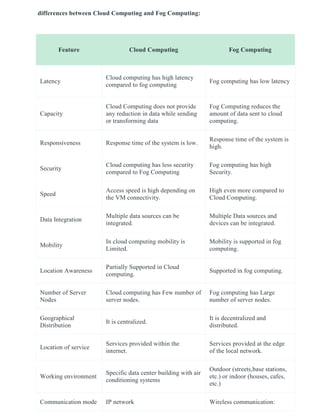
differences between Cloud Computing and Fog Computing:
Feature Cloud Computing Fog Computing
Latency
Cloud computing has high latency
compared to fog computing
Fog computing has low latency
Capacity
Cloud Computing does not provide
any reduction in data while sending
or transforming data
Fog Computing reduces the
amount of data sent to cloud
computing.
Responsiveness Response time of the system is low.
Response time of the system is
high.
Security
Cloud computing has less security
compared to Fog Computing
Fog computing has high
Security.
Speed
Access speed is high depending on
the VM connectivity.
High even more compared to
Cloud Computing.
Data Integration
Multiple data sources can be
integrated.
Multiple Data sources and
devices can be integrated.
Mobility
In cloud computing mobility is
Limited.
Mobility is supported in fog
computing.
Location Awareness
Partially Supported in Cloud
computing.
Supported in fog computing.
Number of Server
Nodes
Cloud computing has Few number of
server nodes.
Fog computing has Large
number of server nodes.
Geographical
Distribution
It is centralized.
It is decentralized and
distributed.
Location of service
Services provided within the
internet.
Services provided at the edge
of the local network.
Working environment
Specific data center building with air
conditioning systems
Outdoor (streets,base stations,
etc.) or indoor (houses, cafes,
etc.)
Communication mode IP network Wireless communication:
Feature Cloud Computing Fog Computing
WLAN, WiFi, 3G, 4G, ZigBee,
etc. or wired communication
(part of the IP networks)
Dependence on the
quality of core
network
Requires strong network core.
Can also work in Weak
network core.
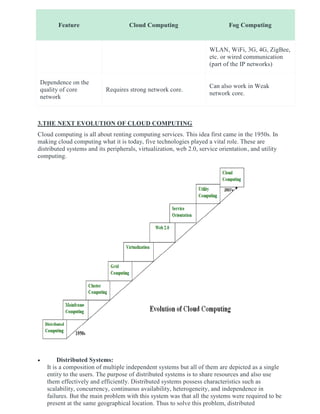
3.THE NEXT EVOLUTION OF CLOUD COMPUTING
Cloud computing is all about renting computing services. This idea first came in the 1950s. In
making cloud computing what it is today, five technologies played a vital role. These are
distributed systems and its peripherals, virtualization, web 2.0, service orientation, and utility
computing.
 Distributed Systems:
It is a composition of multiple independent systems but all of them are depicted as a single
entity to the users. The purpose of distributed systems is to share resources and also use
them effectively and efficiently. Distributed systems possess characteristics such as
scalability, concurrency, continuous availability, heterogeneity, and independence in
failures. But the main problem with this system was that all the systems were required to be
present at the same geographical location. Thus to solve this problem, distributed
computing led to three more types of computing and they were-Mainframe computing,
cluster computing, and grid computing.
 Mainframe computing:
Mainframes which first came into existence in 1951 are highly powerful and reliable
computing machines. These are responsible for handling large data such as massive input-
output operations. Even today these are used for bulk processing tasks such as online
transactions etc. These systems have almost no downtime with high fault tolerance. After
distributed computing, these increased the processing capabilities of the system. But these
were very expensive. To reduce this cost, cluster computing came as an alternative to
mainframe technology.
 Cluster computing:
In 1980s, cluster computing came as an alternative to mainframe computing. Each machine
in the cluster was connected to each other by a network with high bandwidth. These were
way cheaper than those mainframe systems. These were equally capable of high
computations. Also, new nodes could easily be added to the cluster if it was required. Thus,
the problem of the cost was solved to some extent but the problem related to geographical
restrictions still pertained. To solve this, the concept of grid computing was introduced.
 Grid computing:
In 1990s, the concept of grid computing was introduced. It means that different systems
were placed at entirely different geographical locations and these all were connected via
the internet. These systems belonged to different organizations and thus the grid consisted
of heterogeneous nodes. Although it solved some problems but new problems emerged as
the distance between the nodes increased. The main problem which was encountered was
the low availability of high bandwidth connectivity and with it other network associated
issues. Thus. cloud computing is often referred to as “Successor of grid computing”.
 Virtualization:
It was introduced nearly 40 years back. It refers to the process of creating a virtual layer
over the hardware which allows the user to run multiple instances simultaneously on the
hardware. It is a key technology used in cloud computing. It is the base on which major
cloud computing services such as Amazon EC2, VMware vCloud, etc work on. Hardware
virtualization is still one of the most common types of virtualization.
 Web 2.0:
It is the interface through which the cloud computing services interact with the clients. It is
because of Web 2.0 that we have interactive and dynamic web pages. It also increases
flexibility among web pages. Popular examples of web 2.0 include Google Maps,
Facebook, Twitter, etc. Needless to say, social media is possible because of this technology
only. It gained major popularity in 2004.
 Service orientation:
It acts as a reference model for cloud computing. It supports low-cost, flexible, and
evolvable applications. Two important concepts were introduced in this computing model.
These were Quality of Service (QoS) which also includes the SLA (Service Level
Agreement) and Software as a Service (SaaS).
 Utility computing:
It is a computing model that defines service provisioning techniques for services such as
compute services along with other major services such as storage, infrastructure, etc which
are provisioned on a pay-per-use basis.
4.ROLE OF CLOUD COMPUTING IN IOT
1. Unleashing the Potential of Remote Computing:
By integrating IoT with advanced cloud solutions, organizations can liberate themselves from the
constraints of on-site infrastructure. With ample storage capacity and seamless internet
connectivity, cloud-powered IoT solutions empower enterprises to effortlessly access remote
computing services at the click of a button or through simple commands.
2. Fortifying Security and Privacy:
The synergy of cloud technology and IoT offers a formidable defense against security threats.
Automated task handling and robust control mechanisms provided by cloud-enabled IoT
solutions significantly reduce the risk of breaches. With stringent authentication protocols,
encryption mechanisms, and even biometric authentication in IoT devices, user identities and
data remain safeguarded.
3. Harnessing the Power of Data Integration:
The seamless integration of IoT and cloud technologies enable real-time connectivity and
communication, facilitating the extraction of vital information about critical business processes.
Cloud-based solutions with robust data integration capabilities effortlessly handle vast amounts
of data from multiple sources while ensuring centralized storage, efficient processing, and
insightful analysis.
4. Embracing Agility with Minimal Hardware Dependency:
The convergence of cloud and IoT eliminates the need for extensive hardware infrastructure.
Plug-and-play hosting services offered by IoT solutions, empowered by cloud integration, enable
organizations to seamlessly implement large-scale IoT strategies without relying on dedicated
hardware or equipment. This fosters agility, scalability, and the ability to communicate across
multiple platforms.
5. Ensuring Business Continuity:
Cloud computing solutions, renowned for their reliability and agility, provide robust business
continuity measures. With data servers distributed across multiple geographical locations and
storing redundant copies of data backups, IoT-based operations continue to function seamlessly
in the face of emergencies, data loss, or disasters. Swift data recovery becomes a hassle-free
process.
6. Facilitating Communication Across Devices and Touchpoints:
To enable the execution of tasks, IoT devices and services require seamless communication and
coordination. Cloud and IoT integration, supported by robust APIs, facilitates seamless
interaction among connected devices, ensuring smooth and efficient operations.
7. Accelerating Response Time & Data Processing:
Combining IoT with edge computing and cloud solutions delivers lightning-fast response
times and accelerates data processing capabilities. This powerful trifecta ensures that data is
processed and acted upon in near-real time, enabling organizations to unlock the full potential of
IoT deployments.
5.CONNECTING IOT TO CLOUD
With the development of smart things, sensors and telecommunication, IoT (Internet of Things)
technology has greatly developed and become more and more standardized. But fragmented
device-side communication connection problems often impede the project implementation
process.
There are four best practices to connect different types of devices to the cloud:
 Directly integrate IoT SDK (Software Development Kit) for resource-rich devices
 Rely on a communication module for resource-constrained devices
 Use a local gateway for non-network devices
 Use a cloud gateway for private-protocol devices with network capabilities
First, we should introduce the IoT Device SDK.
IoT Device SDK is used to help us quickly connect hardware devices to the IoT platform. We
can download the IoT Device SDK from the corresponding cloud platform, e.g. AWS IoT
Device SDK.
There are 4 layers of the IoT SDK. From bottom to top:
1. The HAL (hardware abstraction layer) abstracts the support function interface of different
OS (operating systems) to the SDK. This enables the SDK to be ported to different hardware
environments, different OS, and even bare chip environments.
2. The core layer completes the function encapsulation of MQTT/CoAP communication
based on the HAL layer interface, including MQTT connection establishment, message sending
and receiving; CoAP connection establishment, message sending and receiving; shadow device
operation; OTA firmware status query, download and upgrade.
3. Interface layer, providing API and callback function definitions, isolating the core layer
and the application.
4. Provide sample programs so that developers can quickly learn how to use the SDK.
When developing applications on a device, we can always choose higher-level SDKs such as
Android IoT SDK on an Android device. That’s because the hardware environment porting work
has already been done by the SDK itself.
However, when developing applications for an MCU (Micro Controller Unit) which has Linux or
RTOS (Real Time Operating System), we should choose Embedded C SDK and port the code to
a specific hardware environment.
With the knowledge of IoT SDK, we can discuss how to connect an IoT device to the cloud.
1.Directly integrate IoT SDK for resource-rich devices
 With the development of high-performance hardware, many smart devices have complete
OS such as Linux, Android etc. These devices also have a Wi-Fi or cellular network.
 At the operating system level, network communication problems have already been
resolved. We only need to develop applications which integrate the IoT SDK of the cloud
platform and the communication link with the cloud will have been established.
 Examples of smart devices include smart phones, tablets, smart wearables, smart POS,
computers, industrial gateways and development boards like the Raspberry Pi and
ESP32.
2.Rely on a communication module for resource-constrained devices
 In the IoT scenario, a large number of devices are resource-constrained, with RTOS, or
even without an operating system, using MCU + communication modules to establish
their link to the cloud.
 There are many suppliers of cellular modules (NB-IoT/2G/3G/4G) on the market. The
AT commands of each company are different, which makes developing device-side
applications very difficult.
 When we need to connect MCU to an IoT Platform, we should always carefully select the
cellular modules and check whether they are suitable for a specific IoT platform.
Difference between DTU and industrial gateway:
DTU is a wireless terminal device used to convert serial data into IP data or IP data into serial
data and transmit it through a wireless communication network. It has fast and flexible
networking, a short construction period and low cost.
The industrial gateway has the functions of collecting data from field devices through serial port
or network port. Data collection, protocol analysis, data standardization and uploading to the IoT
platform through edge computing functions. Which is more flexible, powerful and customizable
than DTU, but it is more expensive and needs more resources to maintain.
Examples of sensors / devices which can be connected to DTU or industrial gateway include
sensors, industrial equipment PLCs (Programmable Logic Controller), Bluetooth bracelets
3.Use a cloud gateway for private-protocol devices with network capabilities
Devices that directly connect to the cloud gateway
 For some devices, they already have the ability to connect to the internet, but the
protocols vary according to device manufacturers.
 We don’t want the IoT platform layer to handle the parsing of these protocols directly;an
intermediate layer should satisfy the protocol conversion work to make the data meet the
unified format of the IoT platform.
 This intermediate layer is the cloud gateway. The cloud gateway is at the front of the
platform. It receives data from the device side, completes message parsing, and then
sends a message to the IoT platform with IoT device SDK.
 Examples of devices that connect to the internet through private protocol include vehicle
GPS.
Devices that connect to the cloud gateway indirectly
 Some device vendors already provide a mature system which manages the devices and
provides API. In this case, we can have another form of cloud gateway: Cloud to cloud
connection. Making full use of the existing system will make the overall system more
stable and give clear rights and responsibilities.
 Using a mature system will bring us higher development efficiency, but it’ll also
introduce another midware, which will increase communication time.
 Examples of devices with mature systems include cameras/NVR systems
6.CLOUD STORAGE FOR IOT CHALLENGE IN INTEGRATION OF IOT WITH CLOUD
There are a vast number of challenges faced by the integration of Cloud and IoT. Some of which
are listed below:
1.Devices and their capacity
Device’s security approaches normally depend on the encryption most of the security approaches
whenever we talk about it depends upon encryption but when going about IoT the entire
environment is all about constrained environments and the devices are also about constrained
devices which means they are not having sorts of luxury in terms of resource availability in terms
of memory in terms of processor speed in terms of many things they are constrained even
including power so when you go with encryption it is not a good fit for this constrained
environment are constrained devices and this complex encryption and decryption may take time
for this constrained devices it might not work well so these products with constrained resources
are most vulnerable to the side-channel attacks and reverse engineering of the algorithms is also
possible so it is not a great idea to go with encryption techniques towards the constrained
environment this is the first challenge that we normally face. Sensitive information leakage can
also occur due to multi-tenancy. Moreover, public-key cryptography cannot be applied to all
layers because of the processing power constraints imposed by IoT objects. New challenges also
require specific attention; for example, the distributed system is exposed to several possible
attacks, such as SQL injection, session riding, cross-site scripting, and side-channel. Moreover,
important vulnerabilities, including session hijacking and virtual machine escape are also
problematic.
2.Authorization and the Authentication
Although security and privacy are both critical research issues that have received a great deal of
attention, they are still open issues that require more effort. Indeed, adapting to different threats
from hackers is still an issue. The device authorization is not a separate work it also goes with
authentication the device authorization must go hand-in-hand with authentication and is pretty
critical when it comes to IoT products because you are not only authorized but also you need to
authenticate so the one who tries to access this must establish their identity before proceeding
further with the Gateway access and to other cloud resources so I would each platform with the
two-factor authentication and usage of strong passwords are the major ones that we are relying on
till so you need to think about this aspect of the security authentication and authorization both are
to be very good just the point that you need to remember.
3.Updates
The third aspect the device updates whenever you have a device it gets updates these states in
terms of member update or something security patches firmware or the software will have several
challenges means every day every second now and then we see that there are a lot of new security
threats are coming in and how do we address it we normally address it through the patches on the
security firmware updates so these updates are to be very good and this might not be feasible or
possible with every IoT device so how do we handle it do we have a chance to go ahead and
update the firmware of every IoT device concerning the newly incoming attacks in that case that
is fine but there are some cases where we really may not have an opportunity to go ahead and
update the firmware because of constrained environments and all those stuff so many a times the
device roller may not also show much interest in applying an update this very important point,
forgetting the importance of the security updates we postpone this security updates so that’s the
major problem that we are facing and that’s one of the biggest challenges.
4.Communication Channel
The communication channel needs to be much secured the encrypting messages before the
transfer is good but the better one is to use the transport encryption and to adapt the standards like
TLS(Transport Layer Security) see this point here in the communication channels when you are
about to send before that you encrypt and standard the first point that we said is the encryption
that is happening in the devices but now we are talking about the so there is a lot of difference
between these two points so understand the difference and when we talk about the vulnerabilities
it can cost constraints it can be expertise constraints it can be known operation of the software by
the customers it can be the market created the way the mandate for speedy deployment when it
has to be fast it cannot go for multiple checking that is that has to happen to make sure the system
is secure and operational constraints all these are the major security vulnerabilities that we are
facing when one deploys any IoT devices. Besides, when critical IoT applications move into the
Cloud, issues arise because of the lack of trust in the service provider, information regarding
service level agreements (SLAs), and the physical location of data.
5.Retain collected data
The sensor data should be stored and processed securely the sensor data may come from different
sensors it is attached to different equipment all the different equipment could be at different places
so it is a challenge we need to make sure that the data integrity has to be maintained including
some checksums or signatures that can be included to make sure that the original raw data is not
modified during the transfer what it means is that we have generated the data that should go to the
destination and in between the data should not be changed so what do we have checksums we
have other methods we can make sure that the data order is not changed and all those are to be
practised and most an important point the data that you think is not required anymore should be
removed retaining that data will increase the complexity and will cost us more in the maintenance
part of it.
6.Performance
The performance here is concerned with the network bandwidth which depends upon the type of
IoT sensors and applications for which they are used. If the application is not at an industrial level
then large bandwidth is not required else the transfer of heavy amounts of data from sensors to
cloud requires a large amount of bandwidth. This is because timeliness might be affected by
unpredictable matters and real-time applications are very sensitive to performance efficiency.
Cloud environments; indeed, this is because broadband growth is not keeping pace with storage
and computation evolution.

cc.doc

  • 1.
    1.INTRODUCTION TO CLOUDCOMPUTING Nowadays, Cloud computing is adopted by every company, whether it is a MNC or a startup and many are still migrating towards it because of the cost-cutting, lesser maintenance, and the increased capacity of the data with the help of servers maintained by the cloud providers. One more reason for this drastic change from the On-premises servers of the companies to the Cloud providers is the ‘Pay as you go’ service provided by them i.e., you only have to pay for the service which you are using. The disadvantage On-premises server holds is that if the server is not in use the company still has to pay for it. What is Cloud Computing? Cloud computing means storing and accessing the data and programs on remote servers that are hosted on the internet instead of the computer’s hard drive or local server. Cloud computing is also referred to as Internet-based computing. it is a technology where the resource is provided as a service through the Internet to the user. The data which is stored can be files, images, documents, or any other storable document. Some operations which can be performed with cloud computing are –  Storage, backup, and recovery of data  Delivery of software on demand  Development of new applications and services  Streaming videos and audio  Cloud Computing Architecture: Cloud computing architecture refers to the components and sub-components required for cloud computing. These components typically refer to: 1. Front end(fat client, thin client) 2. Back-end platforms(servers, storage) 3. Cloud-based delivery and a network(Internet, Intranet, Intercloud) 2. DIFFERENCE BETWEEN CLOUD COMPUTING AND FOG COMPUTING Cloud Computing:  The delivery of on-demand computing services is known as cloud computing.  We can use applications to storage and processing power over the internet.  It is a pay as you go service. Without owning any computing infrastructure or any data centers, anyone can rent access to anything from applications to storage from a cloud service provider.  We can avoid the complexity of owning and maintaining infrastructure by using cloud computing services and pay for what we use.  cloud computing services providers can benefit from significant economies of scale by delivering the same services to a wide range of customers. Fog Computing:  Fog computing is a decentralized computing infrastructure or process in which computing resources are located between the data source and the cloud or any other data center.  Fog computing is a paradigm that provides services to user requests at the edge networks.  The devices at the fog layer usually perform operations related to networking such as routers, gateways, bridges, and hubs.  Researchers envision these devices to be capable of performing both computational and networking operations, simultaneously.  Although these devices are resource-constrained compared to the cloud servers, the geological spread and the decentralized nature help in offering reliable services with coverage over a wide area.  Fog computing is the physical location of the devices, which are much closer to the users than the cloud servers.
  • 2.
    differences between CloudComputing and Fog Computing: Feature Cloud Computing Fog Computing Latency Cloud computing has high latency compared to fog computing Fog computing has low latency Capacity Cloud Computing does not provide any reduction in data while sending or transforming data Fog Computing reduces the amount of data sent to cloud computing. Responsiveness Response time of the system is low. Response time of the system is high. Security Cloud computing has less security compared to Fog Computing Fog computing has high Security. Speed Access speed is high depending on the VM connectivity. High even more compared to Cloud Computing. Data Integration Multiple data sources can be integrated. Multiple Data sources and devices can be integrated. Mobility In cloud computing mobility is Limited. Mobility is supported in fog computing. Location Awareness Partially Supported in Cloud computing. Supported in fog computing. Number of Server Nodes Cloud computing has Few number of server nodes. Fog computing has Large number of server nodes. Geographical Distribution It is centralized. It is decentralized and distributed. Location of service Services provided within the internet. Services provided at the edge of the local network. Working environment Specific data center building with air conditioning systems Outdoor (streets,base stations, etc.) or indoor (houses, cafes, etc.) Communication mode IP network Wireless communication:
  • 3.
    Feature Cloud ComputingFog Computing WLAN, WiFi, 3G, 4G, ZigBee, etc. or wired communication (part of the IP networks) Dependence on the quality of core network Requires strong network core. Can also work in Weak network core. 3.THE NEXT EVOLUTION OF CLOUD COMPUTING Cloud computing is all about renting computing services. This idea first came in the 1950s. In making cloud computing what it is today, five technologies played a vital role. These are distributed systems and its peripherals, virtualization, web 2.0, service orientation, and utility computing.  Distributed Systems: It is a composition of multiple independent systems but all of them are depicted as a single entity to the users. The purpose of distributed systems is to share resources and also use them effectively and efficiently. Distributed systems possess characteristics such as scalability, concurrency, continuous availability, heterogeneity, and independence in failures. But the main problem with this system was that all the systems were required to be present at the same geographical location. Thus to solve this problem, distributed
  • 4.
    computing led tothree more types of computing and they were-Mainframe computing, cluster computing, and grid computing.  Mainframe computing: Mainframes which first came into existence in 1951 are highly powerful and reliable computing machines. These are responsible for handling large data such as massive input- output operations. Even today these are used for bulk processing tasks such as online transactions etc. These systems have almost no downtime with high fault tolerance. After distributed computing, these increased the processing capabilities of the system. But these were very expensive. To reduce this cost, cluster computing came as an alternative to mainframe technology.  Cluster computing: In 1980s, cluster computing came as an alternative to mainframe computing. Each machine in the cluster was connected to each other by a network with high bandwidth. These were way cheaper than those mainframe systems. These were equally capable of high computations. Also, new nodes could easily be added to the cluster if it was required. Thus, the problem of the cost was solved to some extent but the problem related to geographical restrictions still pertained. To solve this, the concept of grid computing was introduced.  Grid computing: In 1990s, the concept of grid computing was introduced. It means that different systems were placed at entirely different geographical locations and these all were connected via the internet. These systems belonged to different organizations and thus the grid consisted of heterogeneous nodes. Although it solved some problems but new problems emerged as the distance between the nodes increased. The main problem which was encountered was the low availability of high bandwidth connectivity and with it other network associated issues. Thus. cloud computing is often referred to as “Successor of grid computing”.  Virtualization: It was introduced nearly 40 years back. It refers to the process of creating a virtual layer over the hardware which allows the user to run multiple instances simultaneously on the hardware. It is a key technology used in cloud computing. It is the base on which major cloud computing services such as Amazon EC2, VMware vCloud, etc work on. Hardware virtualization is still one of the most common types of virtualization.  Web 2.0: It is the interface through which the cloud computing services interact with the clients. It is because of Web 2.0 that we have interactive and dynamic web pages. It also increases flexibility among web pages. Popular examples of web 2.0 include Google Maps, Facebook, Twitter, etc. Needless to say, social media is possible because of this technology only. It gained major popularity in 2004.  Service orientation: It acts as a reference model for cloud computing. It supports low-cost, flexible, and evolvable applications. Two important concepts were introduced in this computing model. These were Quality of Service (QoS) which also includes the SLA (Service Level Agreement) and Software as a Service (SaaS).  Utility computing: It is a computing model that defines service provisioning techniques for services such as compute services along with other major services such as storage, infrastructure, etc which are provisioned on a pay-per-use basis.
  • 5.
    4.ROLE OF CLOUDCOMPUTING IN IOT 1. Unleashing the Potential of Remote Computing: By integrating IoT with advanced cloud solutions, organizations can liberate themselves from the constraints of on-site infrastructure. With ample storage capacity and seamless internet connectivity, cloud-powered IoT solutions empower enterprises to effortlessly access remote computing services at the click of a button or through simple commands. 2. Fortifying Security and Privacy: The synergy of cloud technology and IoT offers a formidable defense against security threats. Automated task handling and robust control mechanisms provided by cloud-enabled IoT solutions significantly reduce the risk of breaches. With stringent authentication protocols, encryption mechanisms, and even biometric authentication in IoT devices, user identities and data remain safeguarded. 3. Harnessing the Power of Data Integration: The seamless integration of IoT and cloud technologies enable real-time connectivity and communication, facilitating the extraction of vital information about critical business processes. Cloud-based solutions with robust data integration capabilities effortlessly handle vast amounts of data from multiple sources while ensuring centralized storage, efficient processing, and insightful analysis. 4. Embracing Agility with Minimal Hardware Dependency: The convergence of cloud and IoT eliminates the need for extensive hardware infrastructure. Plug-and-play hosting services offered by IoT solutions, empowered by cloud integration, enable organizations to seamlessly implement large-scale IoT strategies without relying on dedicated hardware or equipment. This fosters agility, scalability, and the ability to communicate across multiple platforms. 5. Ensuring Business Continuity: Cloud computing solutions, renowned for their reliability and agility, provide robust business continuity measures. With data servers distributed across multiple geographical locations and storing redundant copies of data backups, IoT-based operations continue to function seamlessly in the face of emergencies, data loss, or disasters. Swift data recovery becomes a hassle-free process. 6. Facilitating Communication Across Devices and Touchpoints: To enable the execution of tasks, IoT devices and services require seamless communication and coordination. Cloud and IoT integration, supported by robust APIs, facilitates seamless interaction among connected devices, ensuring smooth and efficient operations.
  • 6.
    7. Accelerating ResponseTime & Data Processing: Combining IoT with edge computing and cloud solutions delivers lightning-fast response times and accelerates data processing capabilities. This powerful trifecta ensures that data is processed and acted upon in near-real time, enabling organizations to unlock the full potential of IoT deployments. 5.CONNECTING IOT TO CLOUD With the development of smart things, sensors and telecommunication, IoT (Internet of Things) technology has greatly developed and become more and more standardized. But fragmented device-side communication connection problems often impede the project implementation process. There are four best practices to connect different types of devices to the cloud:  Directly integrate IoT SDK (Software Development Kit) for resource-rich devices  Rely on a communication module for resource-constrained devices  Use a local gateway for non-network devices  Use a cloud gateway for private-protocol devices with network capabilities First, we should introduce the IoT Device SDK. IoT Device SDK is used to help us quickly connect hardware devices to the IoT platform. We can download the IoT Device SDK from the corresponding cloud platform, e.g. AWS IoT Device SDK. There are 4 layers of the IoT SDK. From bottom to top: 1. The HAL (hardware abstraction layer) abstracts the support function interface of different OS (operating systems) to the SDK. This enables the SDK to be ported to different hardware environments, different OS, and even bare chip environments. 2. The core layer completes the function encapsulation of MQTT/CoAP communication based on the HAL layer interface, including MQTT connection establishment, message sending and receiving; CoAP connection establishment, message sending and receiving; shadow device operation; OTA firmware status query, download and upgrade. 3. Interface layer, providing API and callback function definitions, isolating the core layer and the application. 4. Provide sample programs so that developers can quickly learn how to use the SDK. When developing applications on a device, we can always choose higher-level SDKs such as Android IoT SDK on an Android device. That’s because the hardware environment porting work has already been done by the SDK itself. However, when developing applications for an MCU (Micro Controller Unit) which has Linux or RTOS (Real Time Operating System), we should choose Embedded C SDK and port the code to a specific hardware environment. With the knowledge of IoT SDK, we can discuss how to connect an IoT device to the cloud.
  • 7.
    1.Directly integrate IoTSDK for resource-rich devices  With the development of high-performance hardware, many smart devices have complete OS such as Linux, Android etc. These devices also have a Wi-Fi or cellular network.  At the operating system level, network communication problems have already been resolved. We only need to develop applications which integrate the IoT SDK of the cloud platform and the communication link with the cloud will have been established.  Examples of smart devices include smart phones, tablets, smart wearables, smart POS, computers, industrial gateways and development boards like the Raspberry Pi and ESP32. 2.Rely on a communication module for resource-constrained devices  In the IoT scenario, a large number of devices are resource-constrained, with RTOS, or even without an operating system, using MCU + communication modules to establish their link to the cloud.  There are many suppliers of cellular modules (NB-IoT/2G/3G/4G) on the market. The AT commands of each company are different, which makes developing device-side applications very difficult.  When we need to connect MCU to an IoT Platform, we should always carefully select the cellular modules and check whether they are suitable for a specific IoT platform. Difference between DTU and industrial gateway: DTU is a wireless terminal device used to convert serial data into IP data or IP data into serial data and transmit it through a wireless communication network. It has fast and flexible networking, a short construction period and low cost. The industrial gateway has the functions of collecting data from field devices through serial port or network port. Data collection, protocol analysis, data standardization and uploading to the IoT platform through edge computing functions. Which is more flexible, powerful and customizable than DTU, but it is more expensive and needs more resources to maintain. Examples of sensors / devices which can be connected to DTU or industrial gateway include sensors, industrial equipment PLCs (Programmable Logic Controller), Bluetooth bracelets 3.Use a cloud gateway for private-protocol devices with network capabilities Devices that directly connect to the cloud gateway  For some devices, they already have the ability to connect to the internet, but the protocols vary according to device manufacturers.
  • 8.
     We don’twant the IoT platform layer to handle the parsing of these protocols directly;an intermediate layer should satisfy the protocol conversion work to make the data meet the unified format of the IoT platform.  This intermediate layer is the cloud gateway. The cloud gateway is at the front of the platform. It receives data from the device side, completes message parsing, and then sends a message to the IoT platform with IoT device SDK.  Examples of devices that connect to the internet through private protocol include vehicle GPS. Devices that connect to the cloud gateway indirectly  Some device vendors already provide a mature system which manages the devices and provides API. In this case, we can have another form of cloud gateway: Cloud to cloud connection. Making full use of the existing system will make the overall system more stable and give clear rights and responsibilities.  Using a mature system will bring us higher development efficiency, but it’ll also introduce another midware, which will increase communication time.  Examples of devices with mature systems include cameras/NVR systems 6.CLOUD STORAGE FOR IOT CHALLENGE IN INTEGRATION OF IOT WITH CLOUD There are a vast number of challenges faced by the integration of Cloud and IoT. Some of which are listed below: 1.Devices and their capacity Device’s security approaches normally depend on the encryption most of the security approaches whenever we talk about it depends upon encryption but when going about IoT the entire environment is all about constrained environments and the devices are also about constrained devices which means they are not having sorts of luxury in terms of resource availability in terms of memory in terms of processor speed in terms of many things they are constrained even including power so when you go with encryption it is not a good fit for this constrained environment are constrained devices and this complex encryption and decryption may take time for this constrained devices it might not work well so these products with constrained resources are most vulnerable to the side-channel attacks and reverse engineering of the algorithms is also possible so it is not a great idea to go with encryption techniques towards the constrained
  • 9.
    environment this isthe first challenge that we normally face. Sensitive information leakage can also occur due to multi-tenancy. Moreover, public-key cryptography cannot be applied to all layers because of the processing power constraints imposed by IoT objects. New challenges also require specific attention; for example, the distributed system is exposed to several possible attacks, such as SQL injection, session riding, cross-site scripting, and side-channel. Moreover, important vulnerabilities, including session hijacking and virtual machine escape are also problematic. 2.Authorization and the Authentication Although security and privacy are both critical research issues that have received a great deal of attention, they are still open issues that require more effort. Indeed, adapting to different threats from hackers is still an issue. The device authorization is not a separate work it also goes with authentication the device authorization must go hand-in-hand with authentication and is pretty critical when it comes to IoT products because you are not only authorized but also you need to authenticate so the one who tries to access this must establish their identity before proceeding further with the Gateway access and to other cloud resources so I would each platform with the two-factor authentication and usage of strong passwords are the major ones that we are relying on till so you need to think about this aspect of the security authentication and authorization both are to be very good just the point that you need to remember. 3.Updates The third aspect the device updates whenever you have a device it gets updates these states in terms of member update or something security patches firmware or the software will have several challenges means every day every second now and then we see that there are a lot of new security threats are coming in and how do we address it we normally address it through the patches on the security firmware updates so these updates are to be very good and this might not be feasible or possible with every IoT device so how do we handle it do we have a chance to go ahead and update the firmware of every IoT device concerning the newly incoming attacks in that case that is fine but there are some cases where we really may not have an opportunity to go ahead and update the firmware because of constrained environments and all those stuff so many a times the device roller may not also show much interest in applying an update this very important point,
  • 10.
    forgetting the importanceof the security updates we postpone this security updates so that’s the major problem that we are facing and that’s one of the biggest challenges. 4.Communication Channel The communication channel needs to be much secured the encrypting messages before the transfer is good but the better one is to use the transport encryption and to adapt the standards like TLS(Transport Layer Security) see this point here in the communication channels when you are about to send before that you encrypt and standard the first point that we said is the encryption that is happening in the devices but now we are talking about the so there is a lot of difference between these two points so understand the difference and when we talk about the vulnerabilities it can cost constraints it can be expertise constraints it can be known operation of the software by the customers it can be the market created the way the mandate for speedy deployment when it has to be fast it cannot go for multiple checking that is that has to happen to make sure the system is secure and operational constraints all these are the major security vulnerabilities that we are facing when one deploys any IoT devices. Besides, when critical IoT applications move into the Cloud, issues arise because of the lack of trust in the service provider, information regarding service level agreements (SLAs), and the physical location of data. 5.Retain collected data The sensor data should be stored and processed securely the sensor data may come from different sensors it is attached to different equipment all the different equipment could be at different places so it is a challenge we need to make sure that the data integrity has to be maintained including some checksums or signatures that can be included to make sure that the original raw data is not modified during the transfer what it means is that we have generated the data that should go to the destination and in between the data should not be changed so what do we have checksums we have other methods we can make sure that the data order is not changed and all those are to be practised and most an important point the data that you think is not required anymore should be removed retaining that data will increase the complexity and will cost us more in the maintenance part of it. 6.Performance
  • 11.
    The performance hereis concerned with the network bandwidth which depends upon the type of IoT sensors and applications for which they are used. If the application is not at an industrial level then large bandwidth is not required else the transfer of heavy amounts of data from sensors to cloud requires a large amount of bandwidth. This is because timeliness might be affected by unpredictable matters and real-time applications are very sensitive to performance efficiency. Cloud environments; indeed, this is because broadband growth is not keeping pace with storage and computation evolution.