




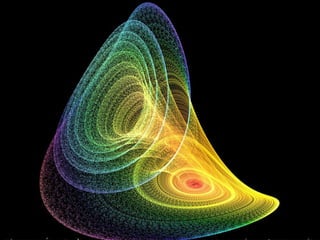
Discoveries and
Challenges in Chaos
      Theory


         Xiong Wang 王雄
Supervised by: Prof. Guanrong Chen
Centre for Chaos and Complex Networks
     City University of Hong Kong
Some basic questions?
 What’s  the fundamental mechanism in
  generating chaos?
 What kind of systems could generate
  chaos?
 Could a system with only one stable
  equilibrium also generate chaotic
  dynamics?
 Generally, what’s the relation between a
  chaotic system and the stability of its
  equilibria?                                2
Equilibria
 An equilibrium (or fixed point) of an
  autonomous system of ordinary differential
  equations (ODEs) is a solution that does not
  change with time.
 The ODE x = f ( x ) has an equilibrium
               &
  solution xe , if f ( xe ) = 0
 Finding such equilibria, by solving the f ( x) = 0
  equation analytically, is easy only in a few
  special cases.
                                                       3
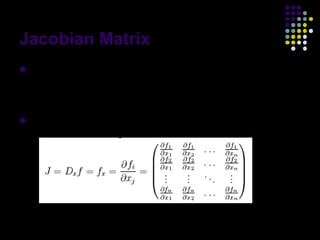
Jacobian Matrix
 The  stability of typical equilibria of smooth
  ODEs is determined by the sign of real parts
  of the system Jacobian eigenvalues.
 Jacobian matrix:


                                                   4
Hyperbolic Equilibria
 The  eigenvalues of J determine linear
  stability of the equilibria.
 An equilibrium is stable if all eigenvalues
  have negative real parts; it is unstable if at
  least one eigenvalue has positive real part.
 The equilibrium is said to be hyperbolic if all
  eigenvalues have non-zero real parts.


                                                    5
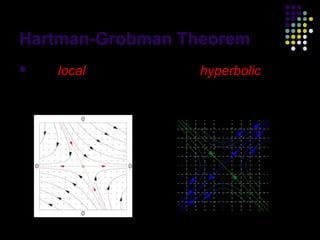
Hartman-Grobman Theorem
 The local phase portrait of a hyperbolic
 equilibrium of a nonlinear system is
 equivalent to that of its linearized system.


                                                6
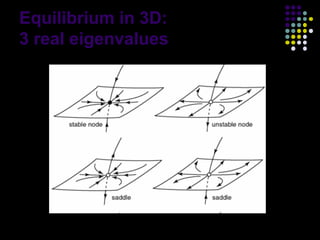
Equilibrium in 3D:
3 real eigenvalues


                     7
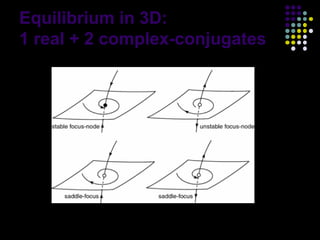
Equilibrium in 3D:
1 real + 2 complex-conjugates


                                8
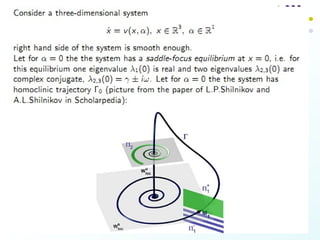
9
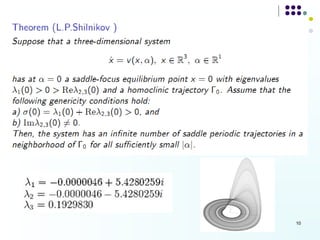
10
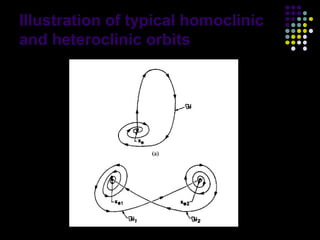
Illustration of typical homoclinic
and heteroclinic orbits


                                     11
Review of the two theorems
 Hartman-Grobman     theorem says nonlinear
  system is the ‘same’ as its linearized model
 Shilnikov theorem says if saddle-focus +

  Shilnikov inequalities + homoclinic or
  heteroclinic orbit, then chaos exists
 Most   classical 3D chaotic systems belong
  to this type
 Most chaotic systems have unstable
  equilibria
                                                 12
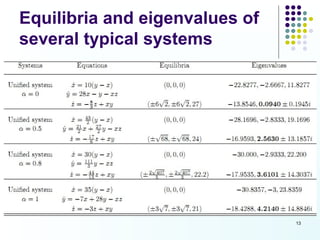
Equilibria and eigenvalues of
several typical systems


                                13
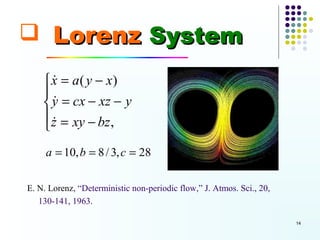
 Lorenz System
     x = a( y − x)
      &
    
     y = cx − xz − y
      &
     z = xy − bz ,
    &
     a = 10, b = 8 / 3, c = 28

E. N. Lorenz, “Deterministic non-periodic flow,” J. Atmos. Sci., 20,
   130-141, 1963.

                                                                       14
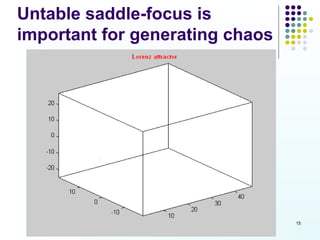
Untable saddle-focus is
important for generating chaos


                                 15
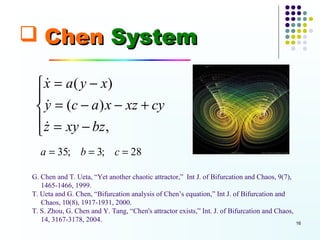
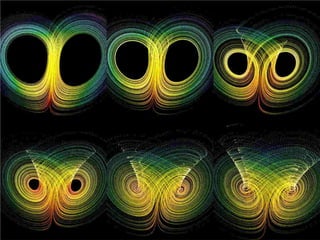
 Chen System

  x = a ( y − x)
   &
 
  y = (c − a ) x − xz + cy
   &
  z = xy − bz ,
 &
   a = 35; b = 3; c = 28

G. Chen and T. Ueta, “Yet another chaotic attractor,” Int J. of Bifurcation and Chaos, 9(7),
   1465-1466, 1999.
T. Ueta and G. Chen, “Bifurcation analysis of Chen’s equation,” Int J. of Bifurcation and
   Chaos, 10(8), 1917-1931, 2000.
T. S. Zhou, G. Chen and Y. Tang, “Chen's attractor exists,” Int. J. of Bifurcation and Chaos,
   14, 3167-3178, 2004.                                                                         16
17
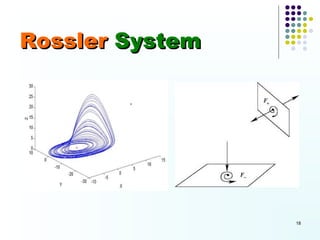
Rossler System


                 18
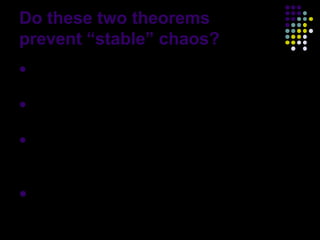
Do these two theorems
prevent “stable” chaos?
 Hartman-Grobman      theorem says nonlinear
  system is the same as its linearized model.
 But it holds only locally …not necessarily the
  same globally.
 Shilnikov theorem says if saddle-focus +

  Shilnikov inequalities + homoclinic or
  heteroclinic orbit, then chaos exists.
 But it is only a sufficient condition, not a
  necessary one.
                                                   19
Don’t be scarred by theorems
 So,  actually the
  theorems do not rule
  out the possibility of
  finding chaos in a
  system with a stable
  equilibrum.
 Just to grasp the
  loophole of the
  theorems …
                               20
Try to find a chaotic system
with a stable Equilibrium
 Some     criterions for the new system:
1.   Simple algebraic equations
2.   One stable equilibrium

To start with, let us first review some of the
  simple Sprott chaotic systems with only one
  equilibrium …


                                                 21
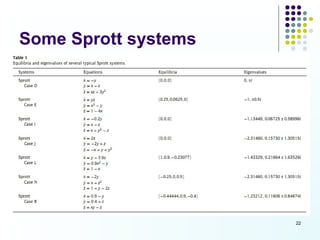
Some Sprott systems


                      22
Idea
1.   Sprott systems I, J, L, N and R all have only
     one saddle-focus equilibrium, while systems
     D and E are both degenerate.
2.   A tiny perturbation to the system may be
     able to change such a degenerate
     equilibrium to a stable one.
3.   Hope it will work …


                                                 23
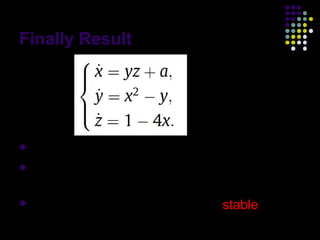
Finally Result


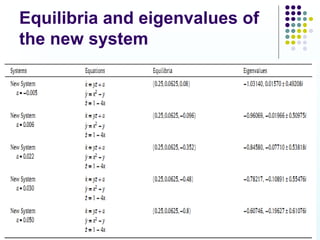
 When a = 0, it is the Sprott E system
 When a > 0, however, the stability of the

  single equilibrium is fundamentally different
 The single equilibrium becomes stable
                                                  24
Equilibria and eigenvalues of
the new system


                                25
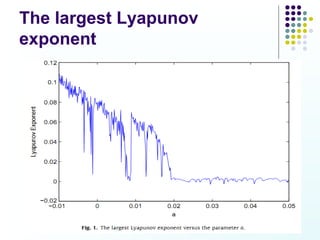
The largest Lyapunov
exponent


                       26
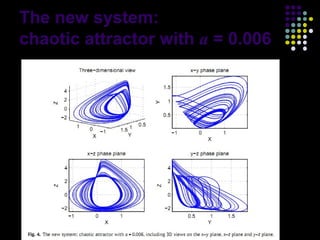
The new system:
chaotic attractor with a = 0.006


                                   27
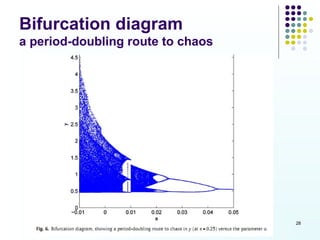
Bifurcation diagram
a period-doubling route to chaos


                                   28
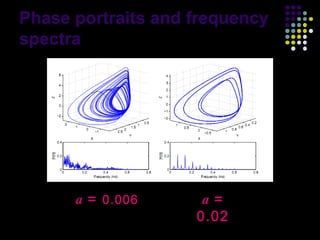
Phase portraits and frequency
spectra


      a = 0.006      a=
                    0.02        29
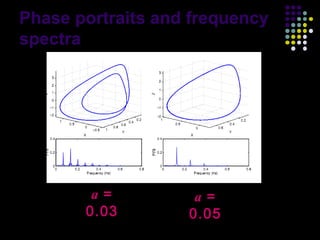
Phase portraits and frequency
spectra


        a=          a=
       0.03        0.05         30
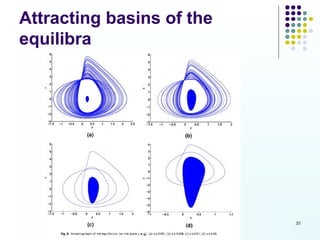
Attracting basins of the
equilibra


                           31
Conclusions
 We   have reported the finding of a simple
  3D autonomous chaotic system which, very
  surprisingly, has only one stable node-
  focus equilibrium.
 It has been verified to be chaotic in the
  sense of having a positive largest
  Lyapunov exponent, a fractional
  dimension, a continuous frequency
  spectrum, and a period-doubling route to
  chaos.                                       32
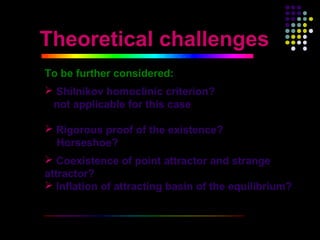
Theoretical challenges
To be further considered:
 Shilnikov homoclinic criterion?
 not applicable for this case

 Rigorous proof of the existence?
  Horseshoe?
 Coexistence of point attractor and strange
attractor?
 Inflation of attracting basin of the equilibrium?


                                                      33
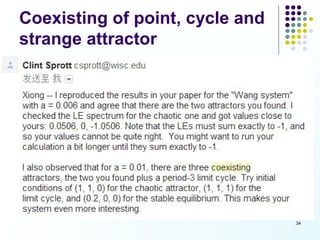
Coexisting of point, cycle and
strange attractor


                                 34
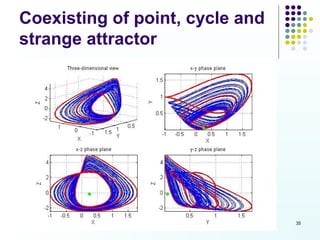
Coexisting of point, cycle and
strange attractor


                                 35
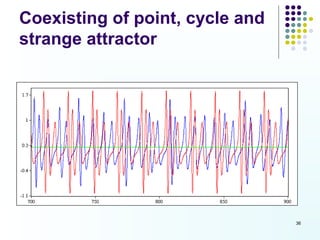
Coexisting of point, cycle and
strange attractor


                                 36
one question answered,
more questions come …
Chaotic system with one stable
            equilibrium
Chaotic system with:
 No equilibrium?

 Two stable equilibria?

 Three stable equilibria?

 Any number of equilibria?

 Tunable stability of equilibria?
            Xiong Wang: Chaotic system with only one   37
                      stable equilibrium
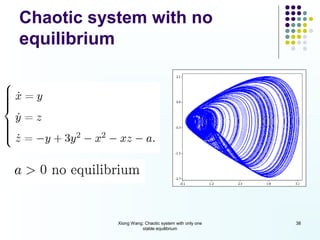
Chaotic system with no
equilibrium


           Xiong Wang: Chaotic system with only one   38
                     stable equilibrium
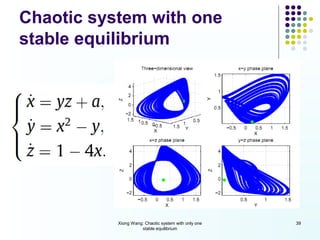
Chaotic system with one
stable equilibrium


           Xiong Wang: Chaotic system with only one   39
                     stable equilibrium
Idea
 Really hard to find a chaotic system with a
  given number of equilibria in the sea of all
  possibility ODE systems …
 Try another way…

 To add symmetry to this one stable system.

 We can adjust the stability of the equilibria
  very easily by adjusting one parameter


                 Xiong Wang: Chaotic system with only one   40
                           stable equilibrium
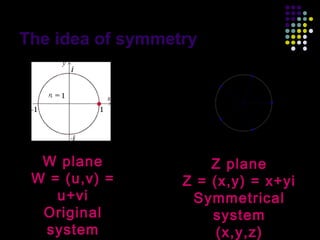
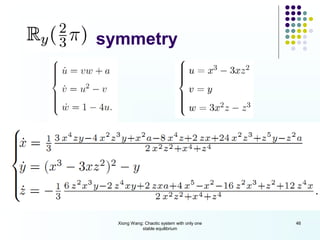
The idea of symmetry


                     W =Z                  n


  W plane                                        Z plane
 W = (u,v) =                                 Z = (x,y) = x+yi
    u+vi                                      Symmetrical
  Original                                       system
  system
               Xiong Wang: Chaotic system with only one         41
                         stable equilibrium
                                                  (x,y,z)
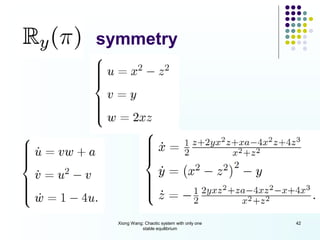
symmetry


  Xiong Wang: Chaotic system with only one   42
            stable equilibrium
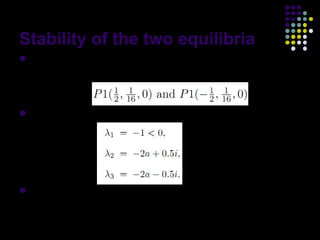
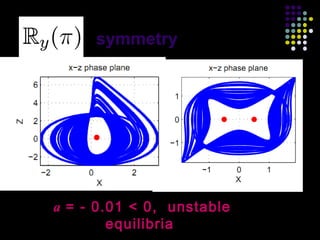
Stability of the two equilibria
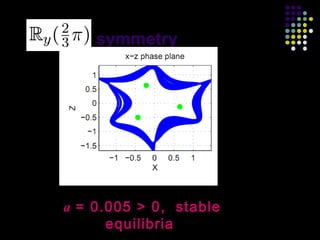
 There are two symmetrical equilibria which
 are independent of the parameter a

 The    eigenvalue of Jacobian


 So,   a > 0 stable; a < 0 unstable

                  Xiong Wang: Chaotic system with only one   43
                            stable equilibrium
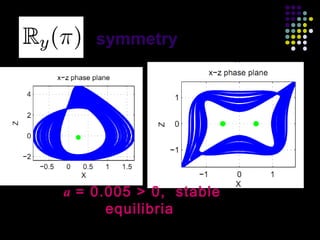
symmetry


a = 0.005 > 0, stable
      equilibria
       Xiong Wang: Chaotic system with only one   44
                 stable equilibrium
symmetry


a = - 0.01 < 0, unstable
        equilibria
        Xiong Wang: Chaotic system with only one
                  stable equilibrium
                                                   45
symmetry


  Xiong Wang: Chaotic system with only one   46
            stable equilibrium
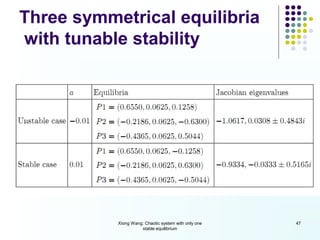
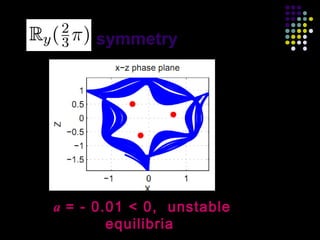
Three symmetrical equilibria
with tunable stability


           Xiong Wang: Chaotic system with only one   47
                     stable equilibrium
symmetry


a = - 0.01 < 0, unstable
        equilibria
        Xiong Wang: Chaotic system with only one
                  stable equilibrium
                                                   48
symmetry


a = 0.005 > 0, stable
      equilibria
       Xiong Wang: Chaotic system with only one
                 stable equilibrium
                                                  49
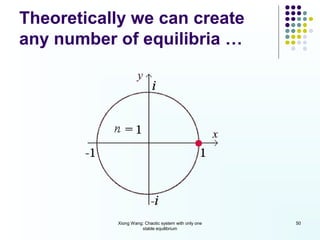
Theoretically we can create
any number of equilibria …


           Xiong Wang: Chaotic system with only one   50
                     stable equilibrium
Conclusions
 Chaotic system with:
  No equilibrium - found

  Two stable equilibria - found

  Three stable equilibria - found

  Theoretically, we can create any
   number of equilibria …
  We can control the stability of equilibria
   by adjusting one parameter
                Xiong Wang: Chaotic system with only one   51
                          stable equilibrium
Chaos is a global phenomenon
A   system can be locally stable near the
  equilibrium, but globally chaotic far from
  the equilibrium.
 This interesting phenomenon is worth
  further studying, both theoretically and
  experimentally, to further reveal the
  intrinsic relation between the local stability
  of an equilibrium and the global complex
  dynamical behaviors of a chaotic system
                                                   52
Xiong Wang 王雄
Centre for Chaos and Complex Networks
City University of Hong Kong
Email: wangxiong8686@gmail.com


                                 53
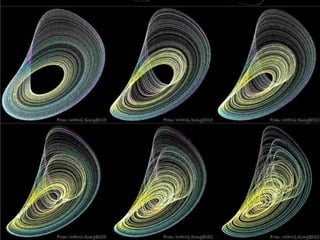
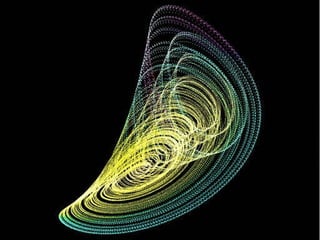
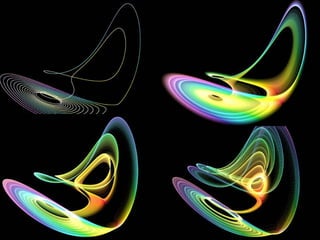
ADDITIONAL BONUS:
ATTRACTOR GALLERY
                    54
55
56
57
58
59
60
61

CCCN Talk on Stable Chaos

  • 1.
    Discoveries and Challenges inChaos Theory Xiong Wang 王雄 Supervised by: Prof. Guanrong Chen Centre for Chaos and Complex Networks City University of Hong Kong
  • 2.
    Some basic questions? What’s the fundamental mechanism in generating chaos?  What kind of systems could generate chaos?  Could a system with only one stable equilibrium also generate chaotic dynamics?  Generally, what’s the relation between a chaotic system and the stability of its equilibria? 2
  • 3.
    Equilibria  An equilibrium(or fixed point) of an autonomous system of ordinary differential equations (ODEs) is a solution that does not change with time.  The ODE x = f ( x ) has an equilibrium & solution xe , if f ( xe ) = 0  Finding such equilibria, by solving the f ( x) = 0 equation analytically, is easy only in a few special cases. 3
  • 4.
    Jacobian Matrix  The stability of typical equilibria of smooth ODEs is determined by the sign of real parts of the system Jacobian eigenvalues.  Jacobian matrix: 4
  • 5.
    Hyperbolic Equilibria  The eigenvalues of J determine linear stability of the equilibria.  An equilibrium is stable if all eigenvalues have negative real parts; it is unstable if at least one eigenvalue has positive real part.  The equilibrium is said to be hyperbolic if all eigenvalues have non-zero real parts. 5
  • 6.
    Hartman-Grobman Theorem  Thelocal phase portrait of a hyperbolic equilibrium of a nonlinear system is equivalent to that of its linearized system. 6
  • 7.
    Equilibrium in 3D: 3real eigenvalues 7
  • 8.
    Equilibrium in 3D: 1real + 2 complex-conjugates 8
  • 9.
  • 10.
  • 11.
    Illustration of typicalhomoclinic and heteroclinic orbits 11
  • 12.
    Review of thetwo theorems  Hartman-Grobman theorem says nonlinear system is the ‘same’ as its linearized model  Shilnikov theorem says if saddle-focus + Shilnikov inequalities + homoclinic or heteroclinic orbit, then chaos exists  Most classical 3D chaotic systems belong to this type  Most chaotic systems have unstable equilibria 12
  • 13.
    Equilibria and eigenvaluesof several typical systems 13
  • 14.
     Lorenz System  x = a( y − x) &   y = cx − xz − y &  z = xy − bz , & a = 10, b = 8 / 3, c = 28 E. N. Lorenz, “Deterministic non-periodic flow,” J. Atmos. Sci., 20, 130-141, 1963. 14
  • 15.
    Untable saddle-focus is importantfor generating chaos 15
  • 16.
     Chen System  x = a ( y − x) &   y = (c − a ) x − xz + cy &  z = xy − bz , & a = 35; b = 3; c = 28 G. Chen and T. Ueta, “Yet another chaotic attractor,” Int J. of Bifurcation and Chaos, 9(7), 1465-1466, 1999. T. Ueta and G. Chen, “Bifurcation analysis of Chen’s equation,” Int J. of Bifurcation and Chaos, 10(8), 1917-1931, 2000. T. S. Zhou, G. Chen and Y. Tang, “Chen's attractor exists,” Int. J. of Bifurcation and Chaos, 14, 3167-3178, 2004. 16
  • 17.
  • 18.
  • 19.
    Do these twotheorems prevent “stable” chaos?  Hartman-Grobman theorem says nonlinear system is the same as its linearized model.  But it holds only locally …not necessarily the same globally.  Shilnikov theorem says if saddle-focus + Shilnikov inequalities + homoclinic or heteroclinic orbit, then chaos exists.  But it is only a sufficient condition, not a necessary one. 19
  • 20.
    Don’t be scarredby theorems  So, actually the theorems do not rule out the possibility of finding chaos in a system with a stable equilibrum.  Just to grasp the loophole of the theorems … 20
  • 21.
    Try to finda chaotic system with a stable Equilibrium  Some criterions for the new system: 1. Simple algebraic equations 2. One stable equilibrium To start with, let us first review some of the simple Sprott chaotic systems with only one equilibrium … 21
  • 22.
  • 23.
    Idea 1. Sprott systems I, J, L, N and R all have only one saddle-focus equilibrium, while systems D and E are both degenerate. 2. A tiny perturbation to the system may be able to change such a degenerate equilibrium to a stable one. 3. Hope it will work … 23
  • 24.
    Finally Result  Whena = 0, it is the Sprott E system  When a > 0, however, the stability of the single equilibrium is fundamentally different  The single equilibrium becomes stable 24
  • 25.
    Equilibria and eigenvaluesof the new system 25
  • 26.
  • 27.
    The new system: chaoticattractor with a = 0.006 27
  • 28.
  • 29.
    Phase portraits andfrequency spectra a = 0.006 a= 0.02 29
  • 30.
    Phase portraits andfrequency spectra a= a= 0.03 0.05 30
  • 31.
    Attracting basins ofthe equilibra 31
  • 32.
    Conclusions  We have reported the finding of a simple 3D autonomous chaotic system which, very surprisingly, has only one stable node- focus equilibrium.  It has been verified to be chaotic in the sense of having a positive largest Lyapunov exponent, a fractional dimension, a continuous frequency spectrum, and a period-doubling route to chaos. 32
  • 33.
    Theoretical challenges To befurther considered:  Shilnikov homoclinic criterion? not applicable for this case  Rigorous proof of the existence? Horseshoe?  Coexistence of point attractor and strange attractor?  Inflation of attracting basin of the equilibrium? 33
  • 34.
    Coexisting of point,cycle and strange attractor 34
  • 35.
    Coexisting of point,cycle and strange attractor 35
  • 36.
    Coexisting of point,cycle and strange attractor 36
  • 37.
    one question answered, morequestions come … Chaotic system with one stable equilibrium Chaotic system with:  No equilibrium?  Two stable equilibria?  Three stable equilibria?  Any number of equilibria?  Tunable stability of equilibria? Xiong Wang: Chaotic system with only one 37 stable equilibrium
  • 38.
    Chaotic system withno equilibrium Xiong Wang: Chaotic system with only one 38 stable equilibrium
  • 39.
    Chaotic system withone stable equilibrium Xiong Wang: Chaotic system with only one 39 stable equilibrium
  • 40.
    Idea  Really hardto find a chaotic system with a given number of equilibria in the sea of all possibility ODE systems …  Try another way…  To add symmetry to this one stable system.  We can adjust the stability of the equilibria very easily by adjusting one parameter Xiong Wang: Chaotic system with only one 40 stable equilibrium
  • 41.
    The idea ofsymmetry W =Z n W plane Z plane W = (u,v) = Z = (x,y) = x+yi u+vi Symmetrical Original system system Xiong Wang: Chaotic system with only one 41 stable equilibrium (x,y,z)
  • 42.
    symmetry XiongWang: Chaotic system with only one 42 stable equilibrium
  • 43.
    Stability of thetwo equilibria  There are two symmetrical equilibria which are independent of the parameter a  The eigenvalue of Jacobian  So, a > 0 stable; a < 0 unstable Xiong Wang: Chaotic system with only one 43 stable equilibrium
  • 44.
    symmetry a = 0.005> 0, stable equilibria Xiong Wang: Chaotic system with only one 44 stable equilibrium
  • 45.
    symmetry a = -0.01 < 0, unstable equilibria Xiong Wang: Chaotic system with only one stable equilibrium 45
  • 46.
    symmetry XiongWang: Chaotic system with only one 46 stable equilibrium
  • 47.
    Three symmetrical equilibria withtunable stability Xiong Wang: Chaotic system with only one 47 stable equilibrium
  • 48.
    symmetry a = -0.01 < 0, unstable equilibria Xiong Wang: Chaotic system with only one stable equilibrium 48
  • 49.
    symmetry a = 0.005> 0, stable equilibria Xiong Wang: Chaotic system with only one stable equilibrium 49
  • 50.
    Theoretically we cancreate any number of equilibria … Xiong Wang: Chaotic system with only one 50 stable equilibrium
  • 51.
    Conclusions Chaotic systemwith:  No equilibrium - found  Two stable equilibria - found  Three stable equilibria - found  Theoretically, we can create any number of equilibria …  We can control the stability of equilibria by adjusting one parameter Xiong Wang: Chaotic system with only one 51 stable equilibrium
  • 52.
    Chaos is aglobal phenomenon A system can be locally stable near the equilibrium, but globally chaotic far from the equilibrium.  This interesting phenomenon is worth further studying, both theoretically and experimentally, to further reveal the intrinsic relation between the local stability of an equilibrium and the global complex dynamical behaviors of a chaotic system 52
  • 53.
    Xiong Wang 王雄 Centrefor Chaos and Complex Networks City University of Hong Kong Email: wangxiong8686@gmail.com 53
  • 54.
  • 55.
  • 56.
  • 57.
  • 58.
  • 59.
  • 60.
  • 61.