www.esource.com
Programs That Help
Customers Pay Regularly
and On-Time
Sarah Fiebiger
Senior Analyst, Market Research Services
@ESourceSarah
June 17-18, 2010
June 17-18, 2010
www.esource.com || © 2010 E SOURCE2
© E Source
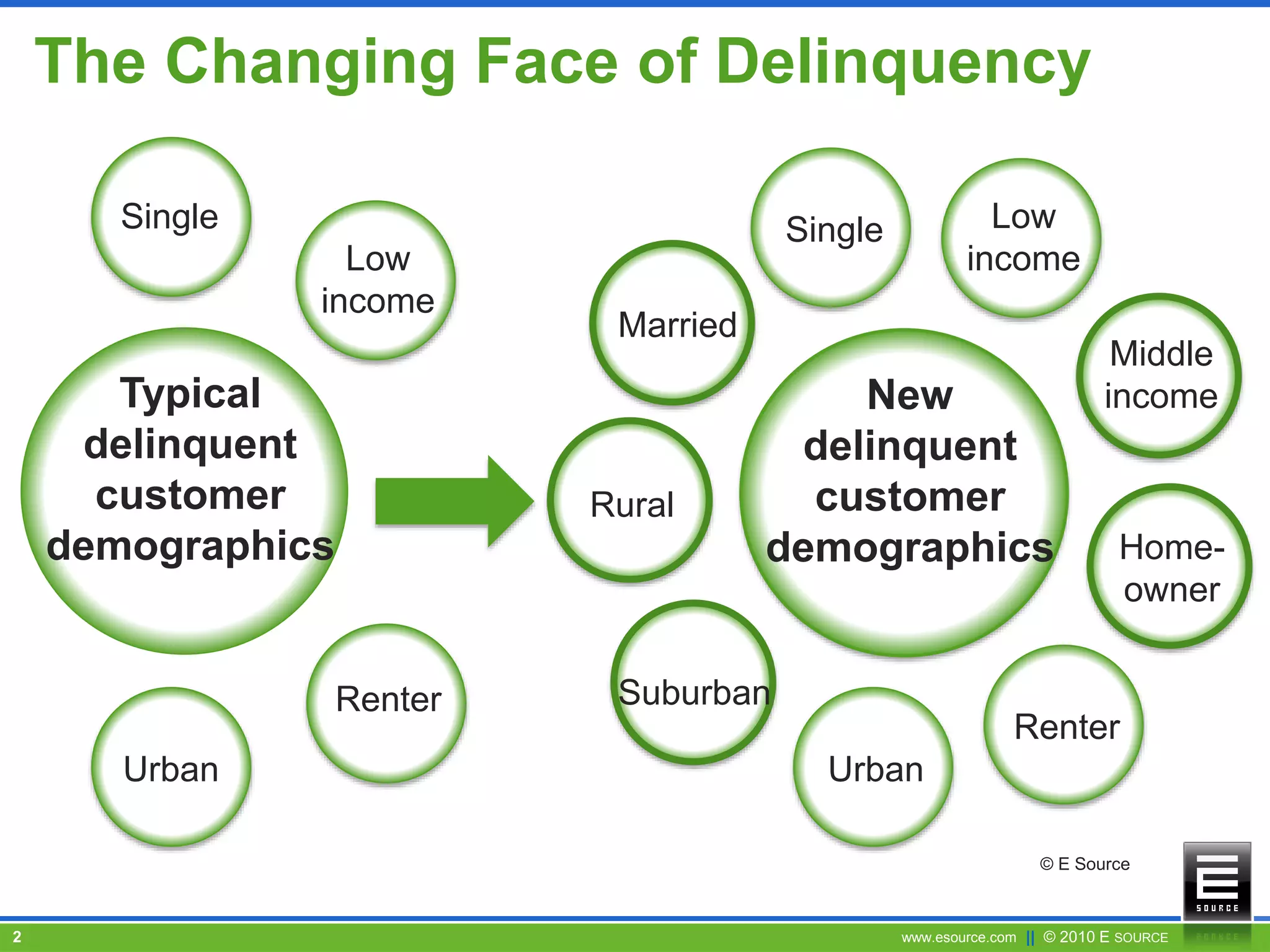
The Changing Face of Delinquency
Typical
delinquent
customer
demographics
Single
Low
income
Renter
Urban
New
delinquent
customer
demographics
Single
Married
Low
income
Middle
income
Renter
Home-
owner
Urban
Rural
Suburban
www.esource.com || © 2010 E SOURCE3
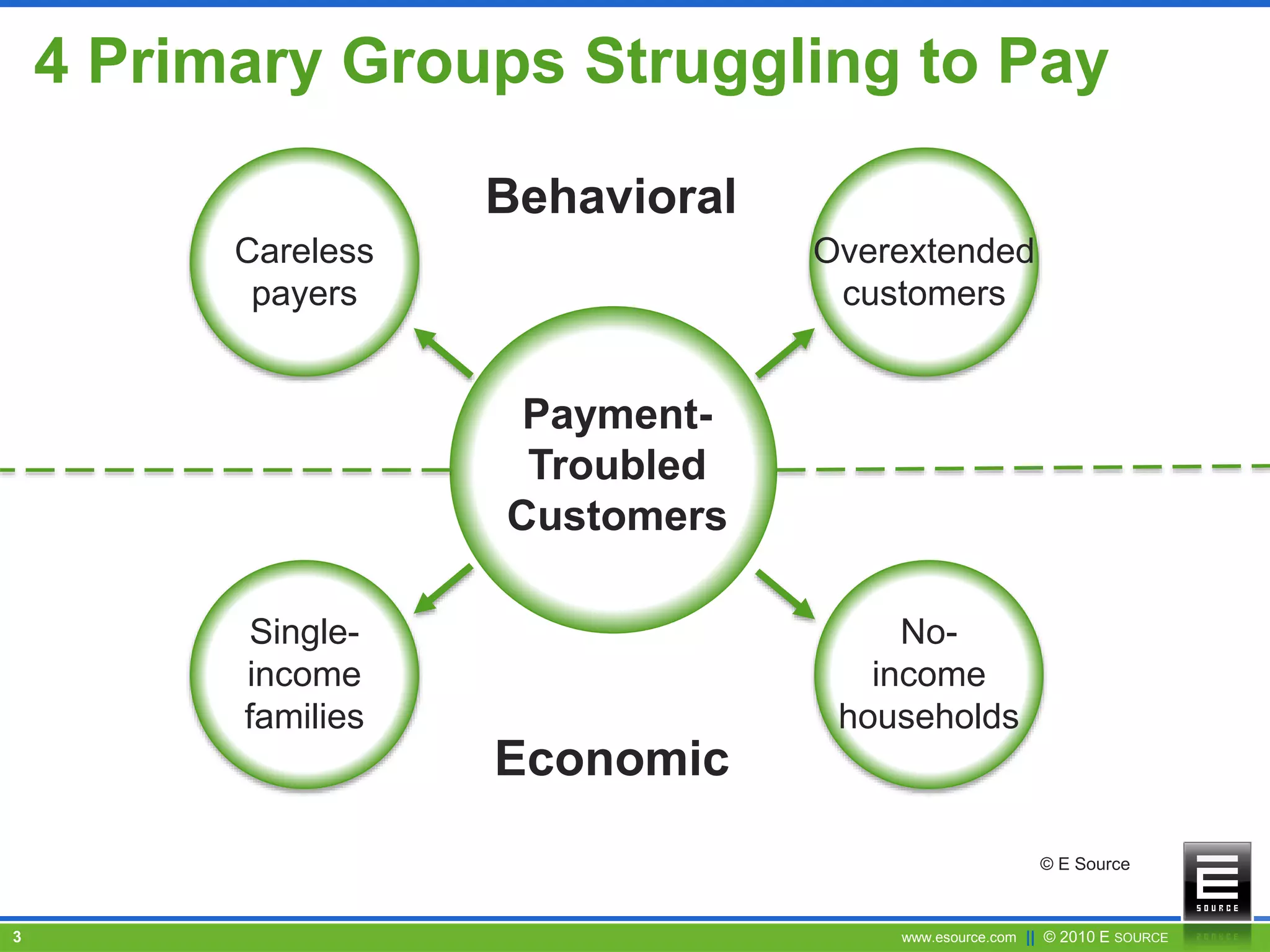
4 Primary Groups Struggling to Pay
Payment-
Troubled
Customers
Overextended
customers
Careless
payers
Single-
income
families
No-
income
households
Behavioral
Economic
© E Source
www.esource.com || © 2010 E SOURCE4
One-Time $ Assistance
Courtesy: stock.xchng
www.esource.com || © 2010 E SOURCE5
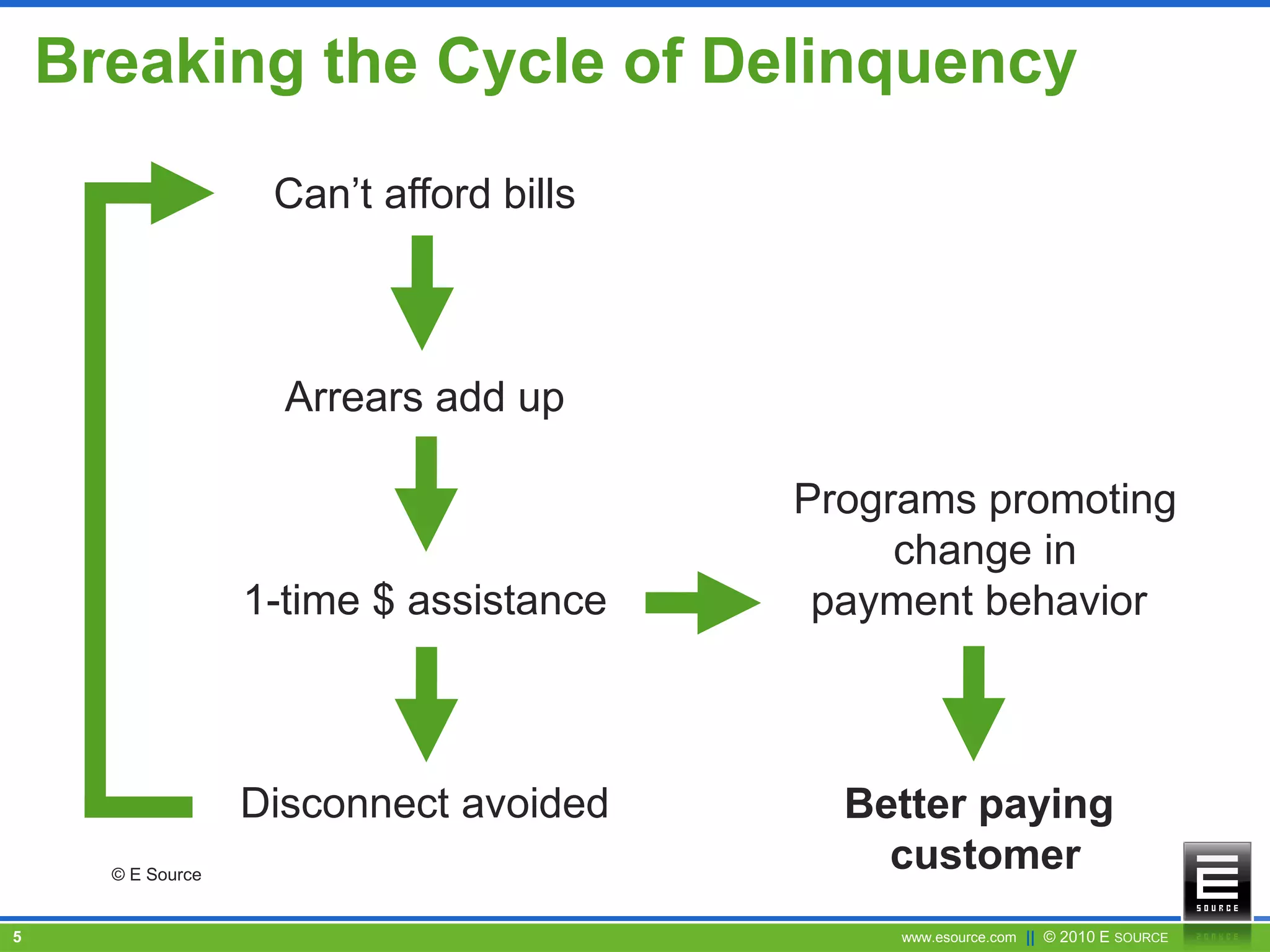
Breaking the Cycle of Delinquency
© E Source
Can’t afford bills
Arrears add up
1-time $ assistance
Disconnect avoided
Programs promoting
change in
payment behavior
Better paying
customer
www.esource.com || © 2010 E SOURCE6
Courtesy: iStock
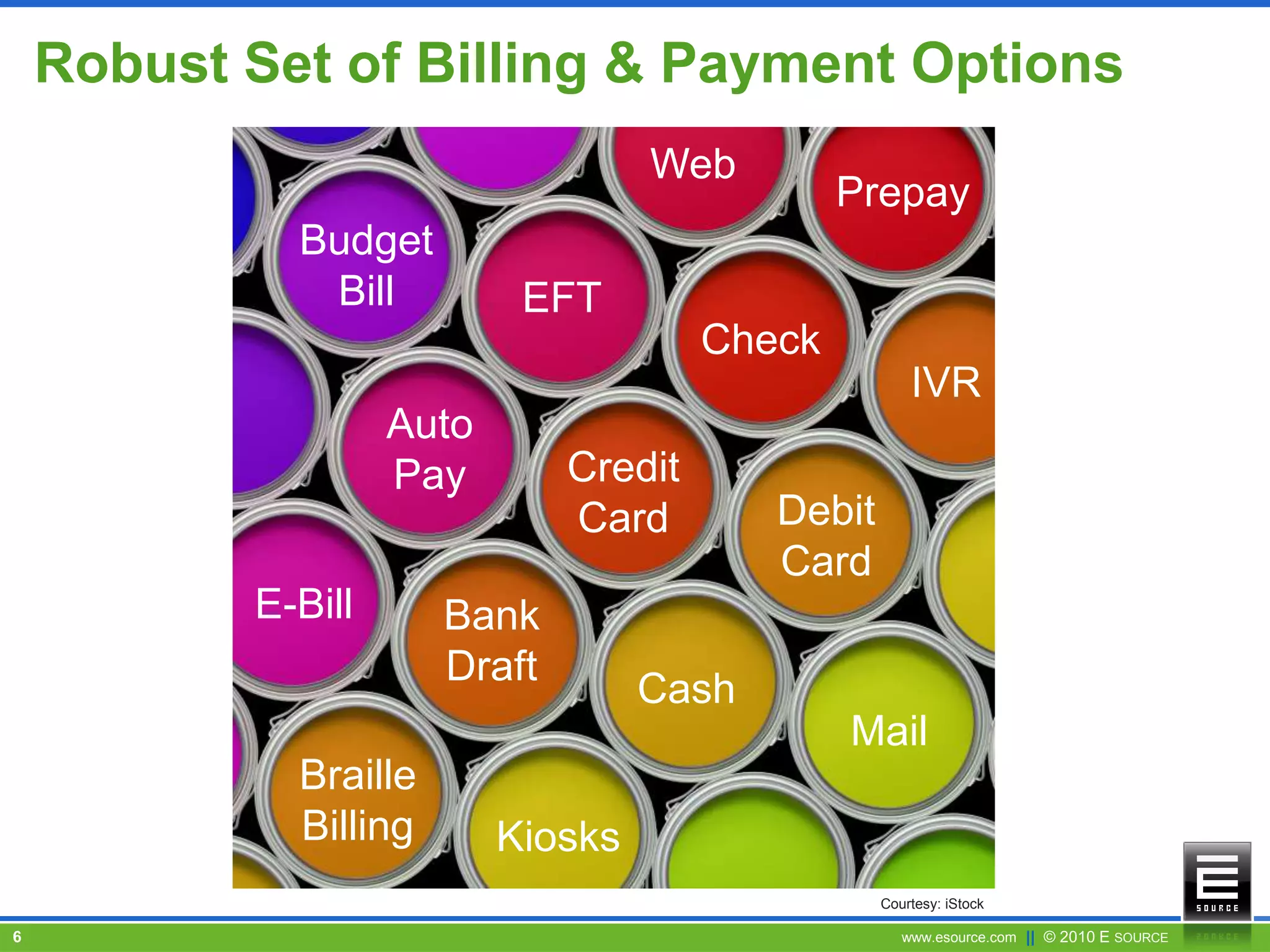
Auto
Pay
EFT
Bank
Draft
Braille
Billing
Credit
Card Debit
Card
Check
IVR
Web
Cash
Kiosks
Prepay
Budget
Bill
E-Bill
Mail
Robust Set of Billing & Payment Options
www.esource.com || © 2010 E SOURCE7
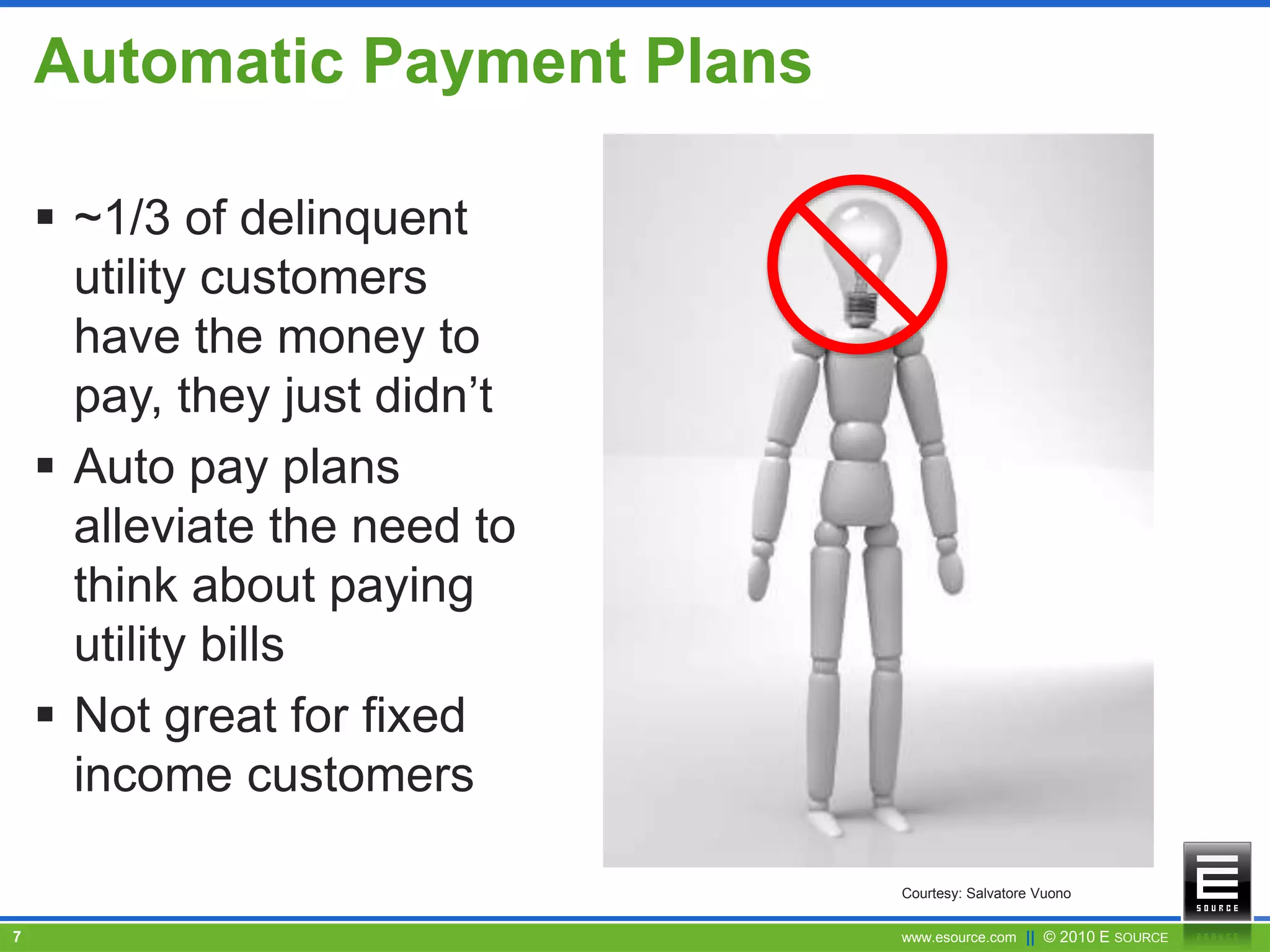
Automatic Payment Plans
 ~1/3 of delinquent
utility customers
have the money to
pay, they just didn’t
 Auto pay plans
alleviate the need to
think about paying
utility bills
 Not great for fixed
income customers
Courtesy: Salvatore Vuono
www.esource.com || © 2010 E SOURCE8
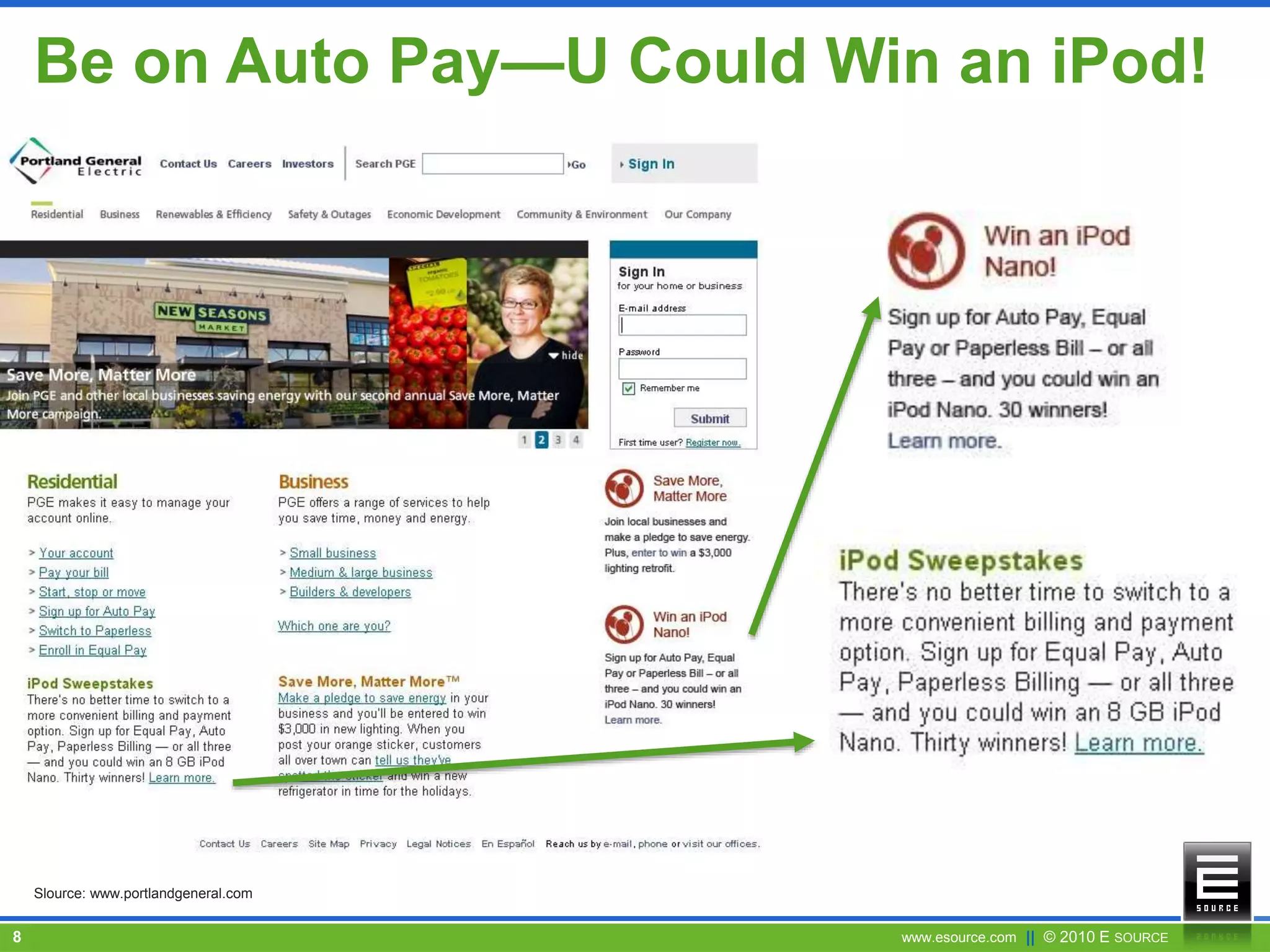
Be on Auto Pay—U Could Win an iPod!
Slource: www.portlandgeneral.com
www.esource.com || © 2010 E SOURCE9
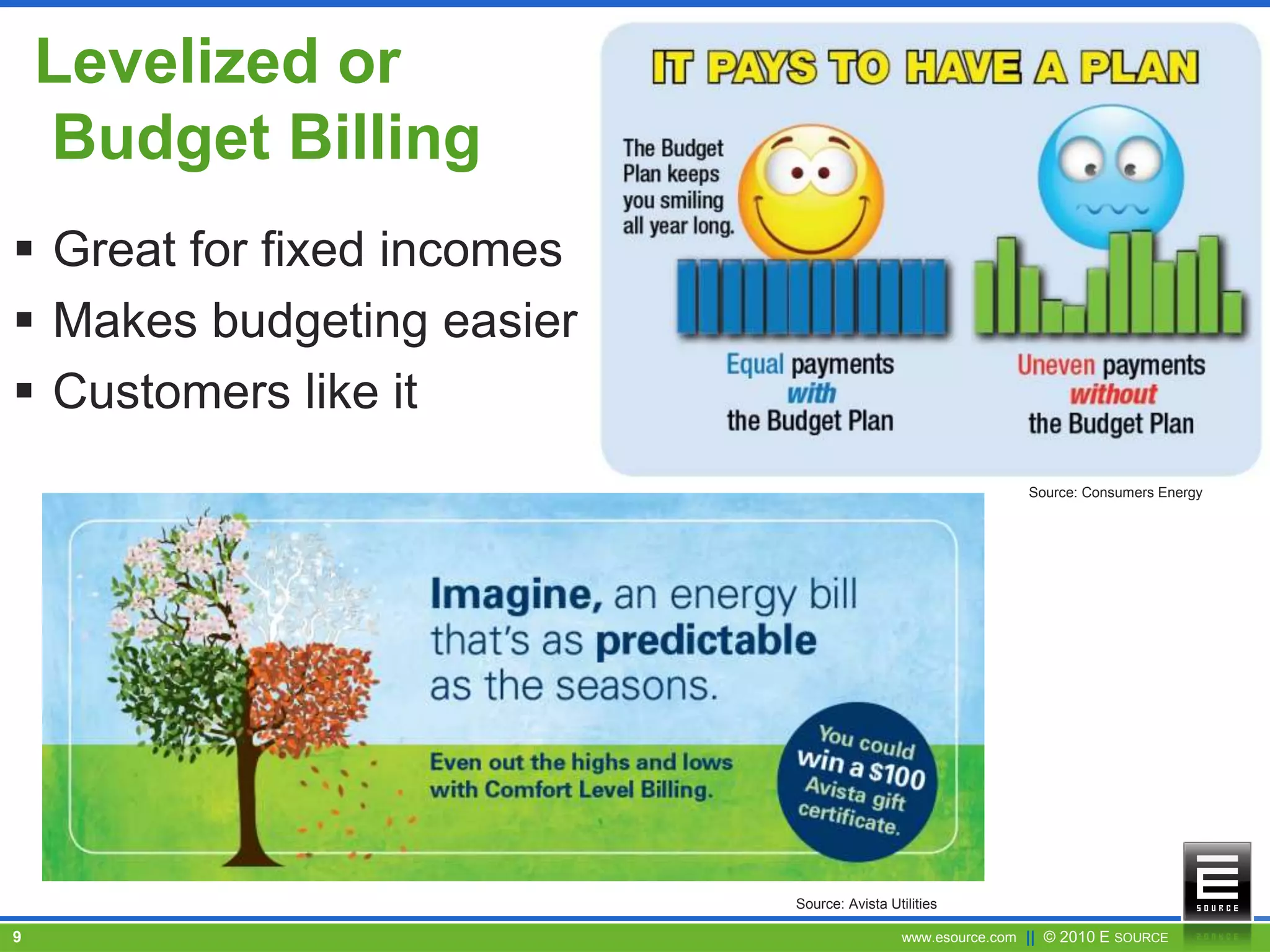
Levelized or
Budget Billing
 Great for fixed incomes
 Makes budgeting easier
 Customers like it
Source: Avista Utilities
Source: Consumers Energy
www.esource.com || © 2010 E SOURCE10
Budget Billing True-Ups
 Be careful with annual true-ups
 To help avoid large true-ups
 Account for current months’ rate
 Quarterly or 6 month reviews
 Rolling average
Image courtesy: stock.xchng
www.esource.com || © 2010 E SOURCE
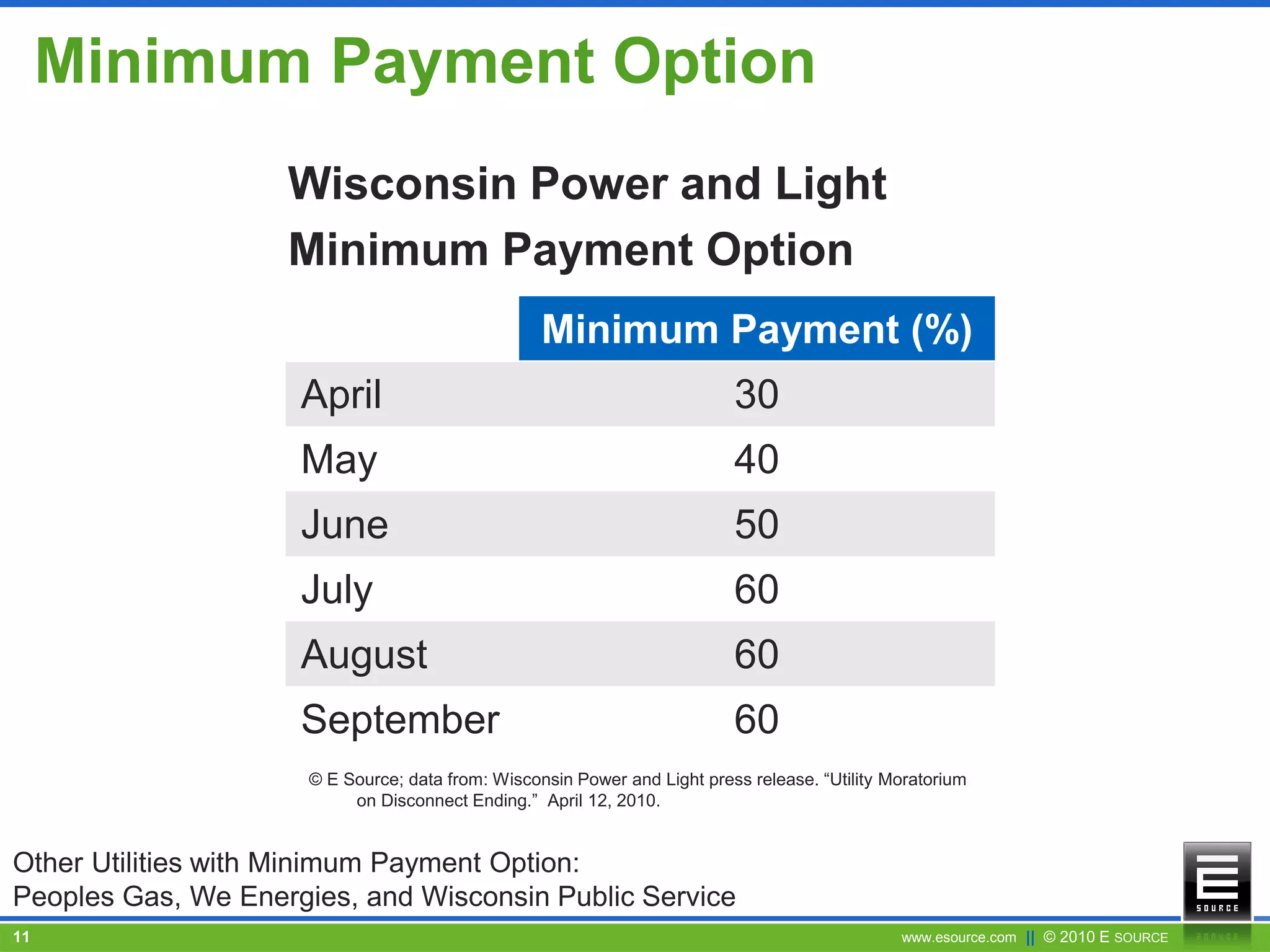
Wisconsin Power and Light
Minimum Payment Option
11
Minimum Payment Option
Minimum Payment (%)
April 30
May 40
June 50
July 60
August 60
September 60
© E Source; data from: Wisconsin Power and Light press release. “Utility Moratorium
on Disconnect Ending.” April 12, 2010.
Other Utilities with Minimum Payment Option:
Peoples Gas, We Energies, and Wisconsin Public Service
www.esource.com || © 2010 E SOURCE12
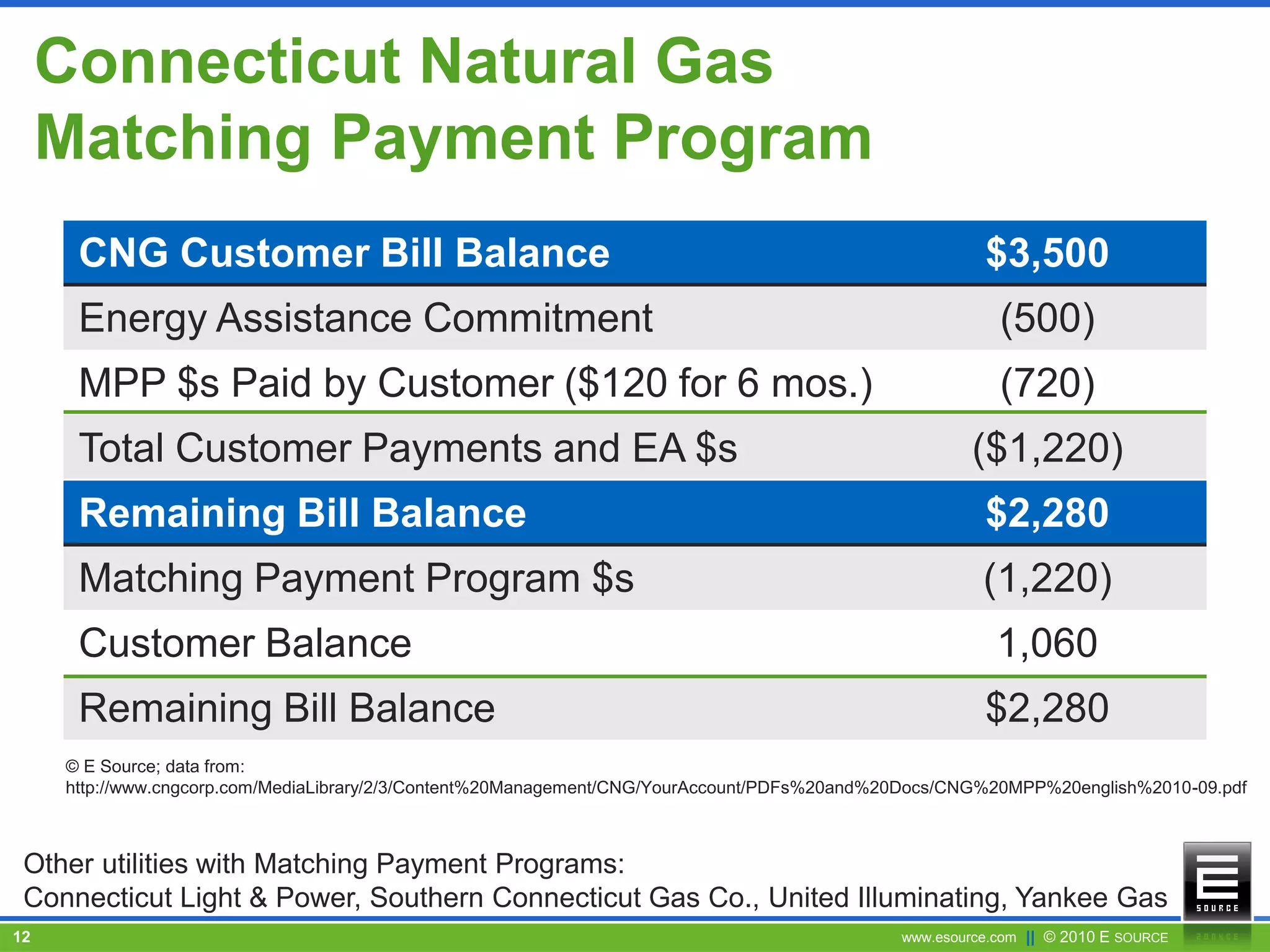
Connecticut Natural Gas
Matching Payment Program
Other utilities with Matching Payment Programs:
Connecticut Light & Power, Southern Connecticut Gas Co., United Illuminating, Yankee Gas
CNG Customer Bill Balance $3,500
Energy Assistance Commitment (500)
MPP $s Paid by Customer ($120 for 6 mos.) (720)
Total Customer Payments and EA $s ($1,220)
Remaining Bill Balance $2,280
Matching Payment Program $s (1,220)
Customer Balance 1,060
Remaining Bill Balance $2,280
© E Source; data from:
http://www.cngcorp.com/MediaLibrary/2/3/Content%20Management/CNG/YourAccount/PDFs%20and%20Docs/CNG%20MPP%20english%2010-09.pdf
www.esource.com || © 2010 E SOURCE13
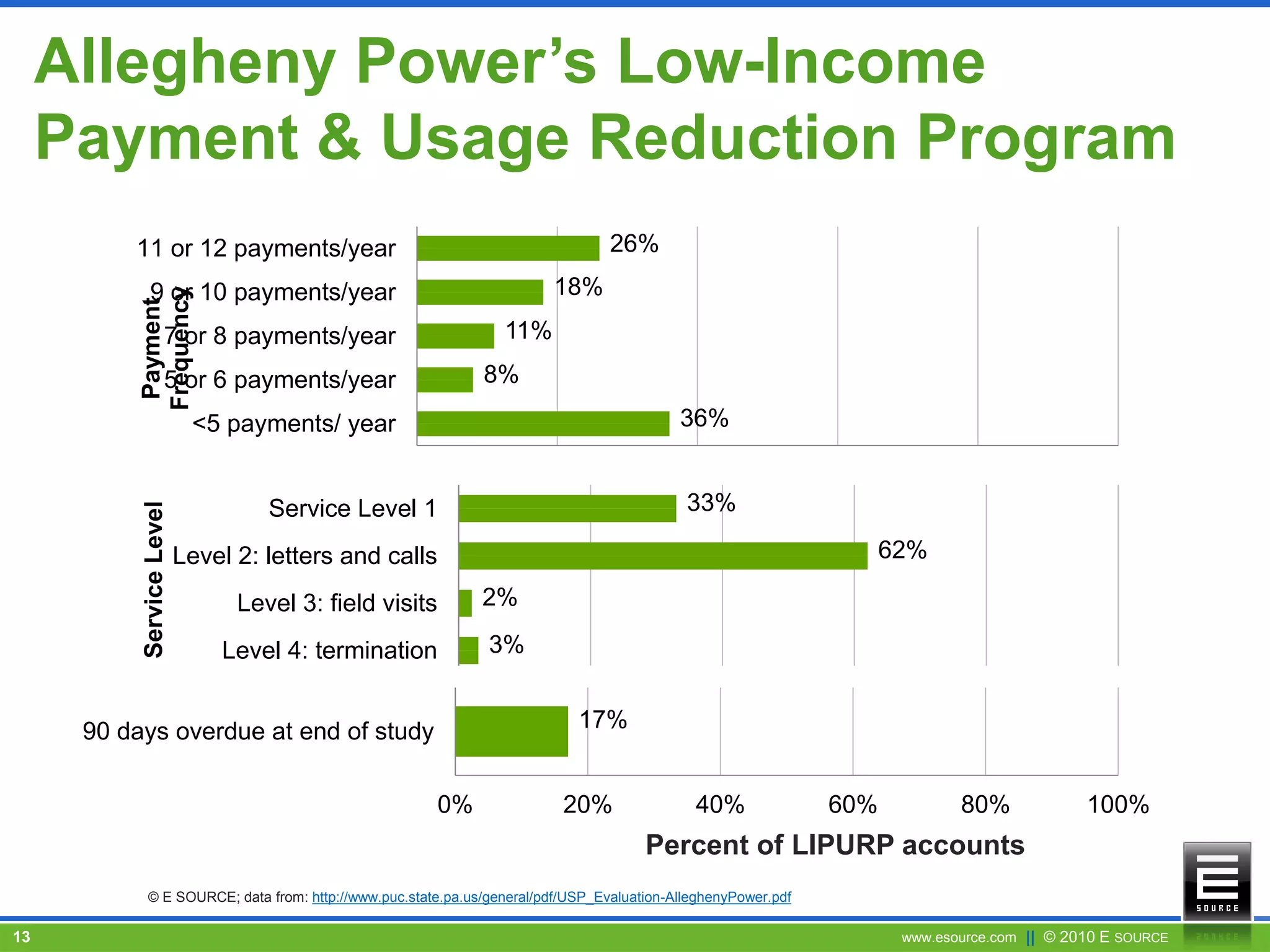
Allegheny Power’s Low-Income
Payment & Usage Reduction Program
36%
8%
11%
18%
26%
0% 20% 40% 60% 80% 100%
<5 payments/ year
5 or 6 payments/year
7 or 8 payments/year
9 or 10 payments/year
11 or 12 payments/year
Axis Title
Payment
Frequency
© E SOURCE; data from: http://www.puc.state.pa.us/general/pdf/USP_Evaluation-AlleghenyPower.pdf
Percent of LIPURP accounts
3%
2%
62%
33%
0% 20% 40% 60% 80% 100%
Level 4: termination
Level 3: field visits
Level 2: letters and calls
Service Level 1
ServiceLevel
17%
0% 20% 40% 60% 80% 100%
90 days overdue at end of study
www.esource.com || © 2010 E SOURCE14
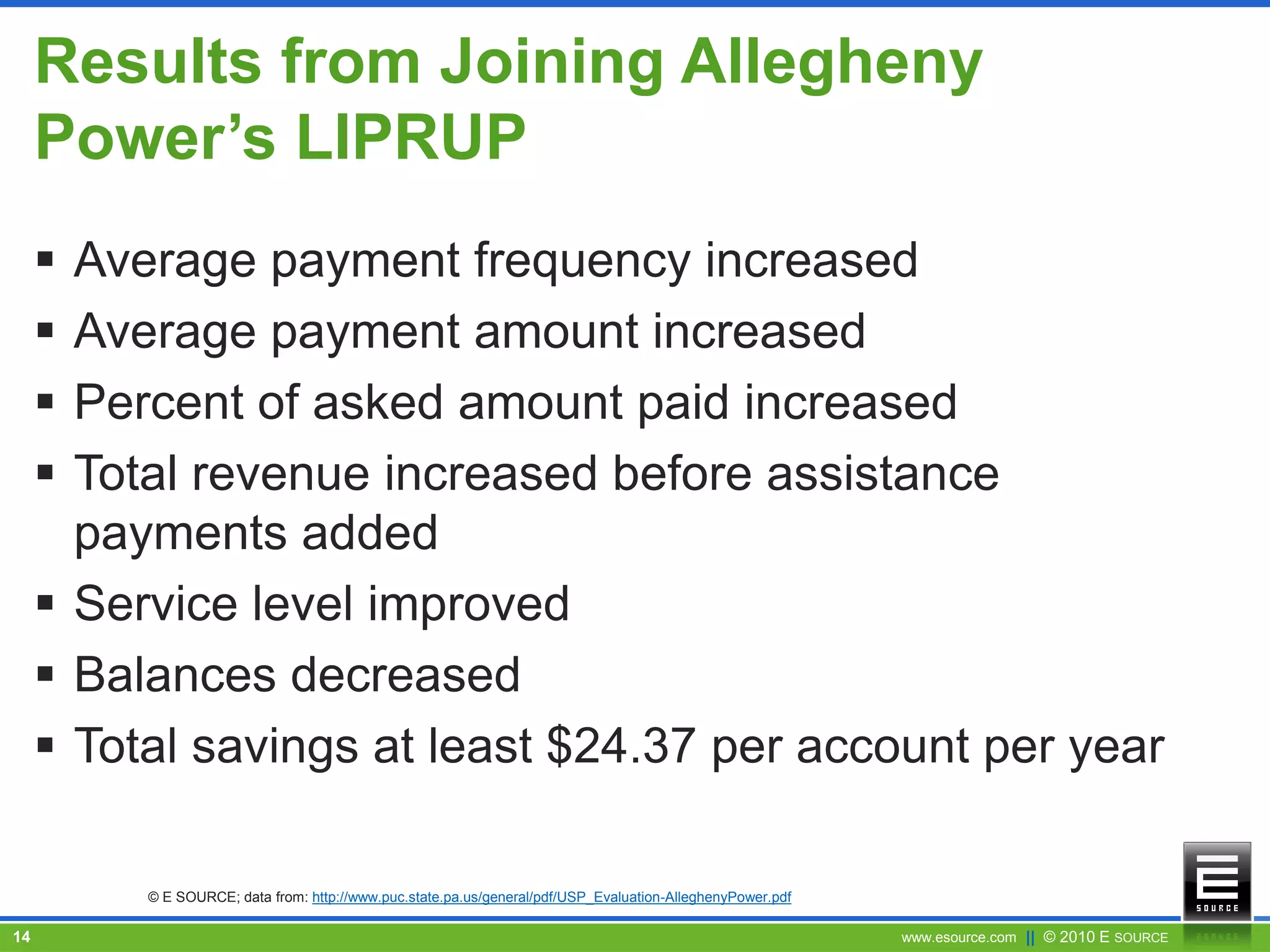
Results from Joining Allegheny
Power’s LIPRUP
 Average payment frequency increased
 Average payment amount increased
 Percent of asked amount paid increased
 Total revenue increased before assistance
payments added
 Service level improved
 Balances decreased
 Total savings at least $24.37 per account per year
© E SOURCE; data from: http://www.puc.state.pa.us/general/pdf/USP_Evaluation-AlleghenyPower.pdf
www.esource.com || © 2010 E SOURCE15
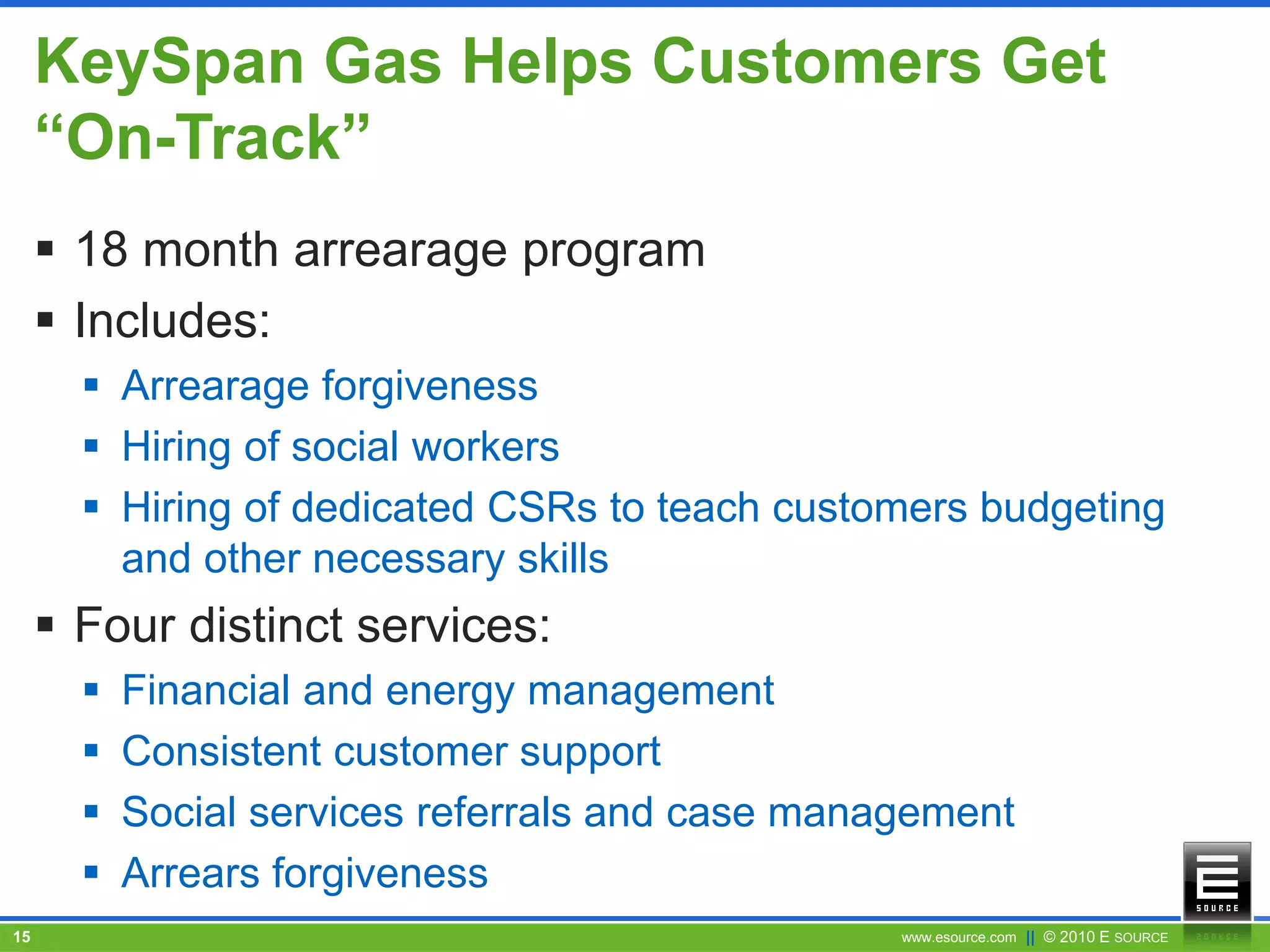
KeySpan Gas Helps Customers Get
“On-Track”
 18 month arrearage program
 Includes:
 Arrearage forgiveness
 Hiring of social workers
 Hiring of dedicated CSRs to teach customers budgeting
and other necessary skills
 Four distinct services:
 Financial and energy management
 Consistent customer support
 Social services referrals and case management
 Arrears forgiveness
www.esource.com || © 2010 E SOURCE16
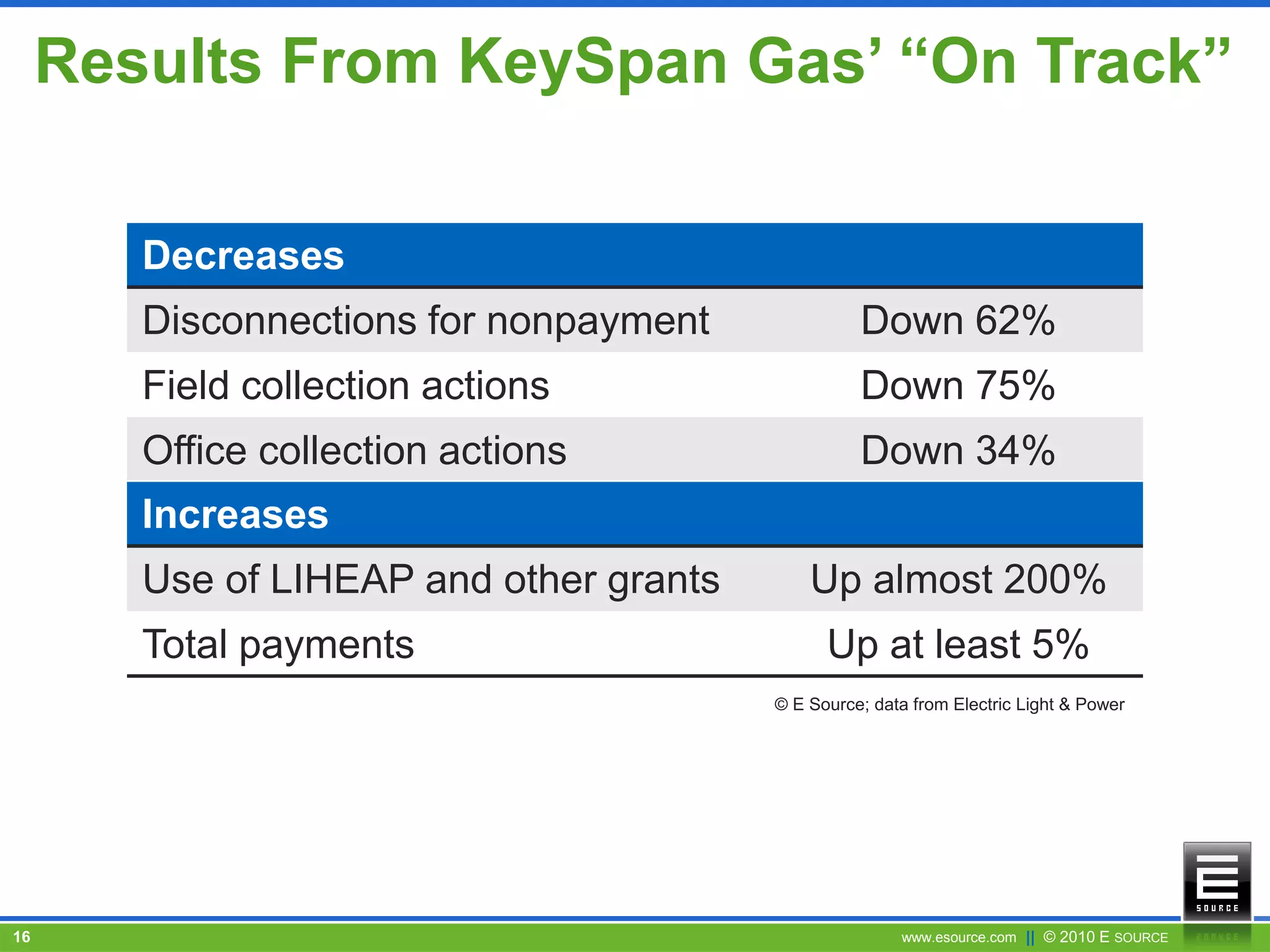
Results From KeySpan Gas’ “On Track”
Decreases
Disconnections for nonpayment Down 62%
Field collection actions Down 75%
Office collection actions Down 34%
Increases
Use of LIHEAP and other grants Up almost 200%
Total payments Up at least 5%
© E Source; data from Electric Light & Power
www.esource.com || © 2010 E SOURCE17
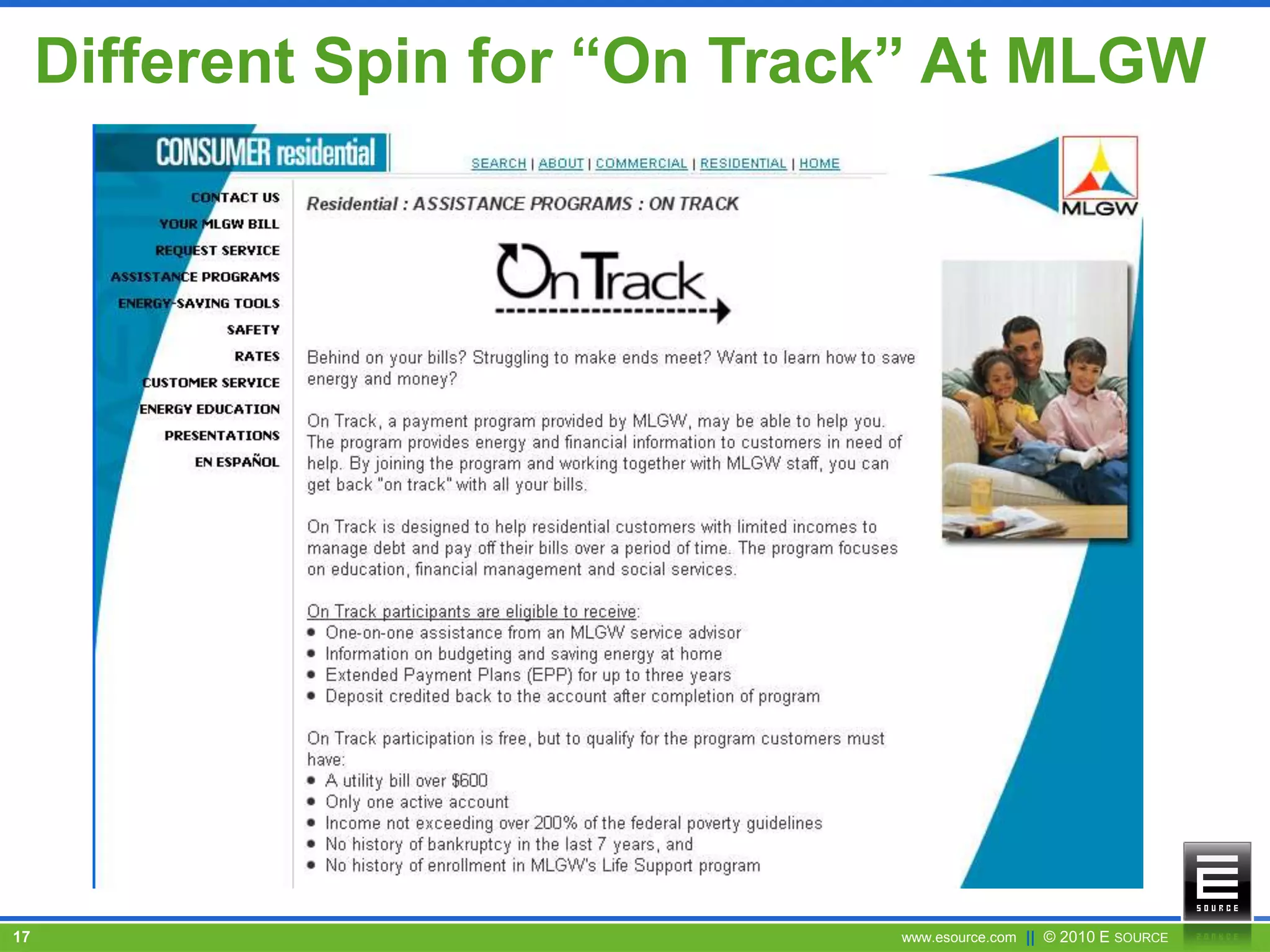
Different Spin for “On Track” At MLGW
www.esource.com || © 2010 E SOURCE
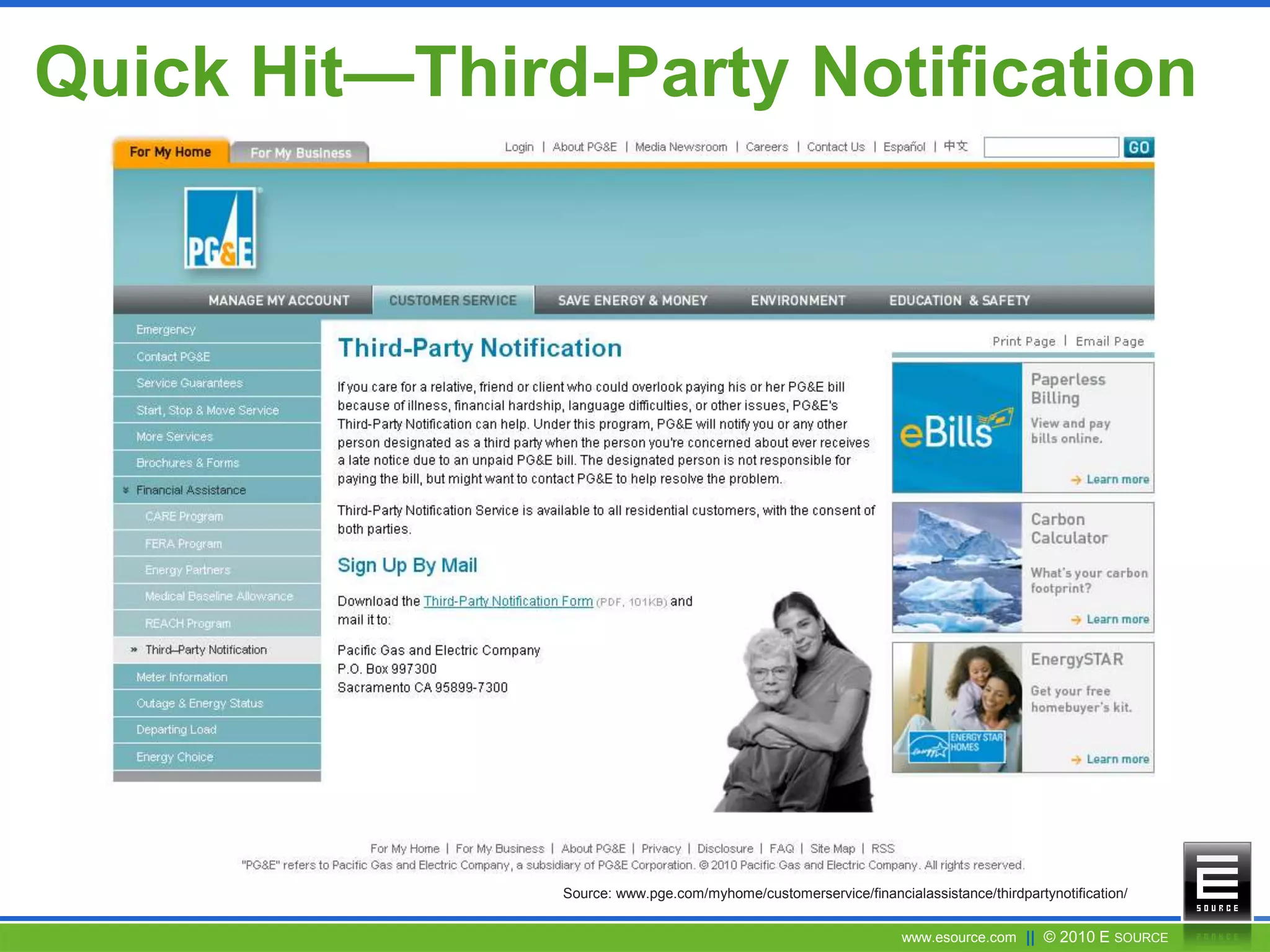
Quick Hit—Third-Party Notification
Source: www.pge.com/myhome/customerservice/financialassistance/thirdpartynotification/
www.esource.com || © 2010 E SOURCE19
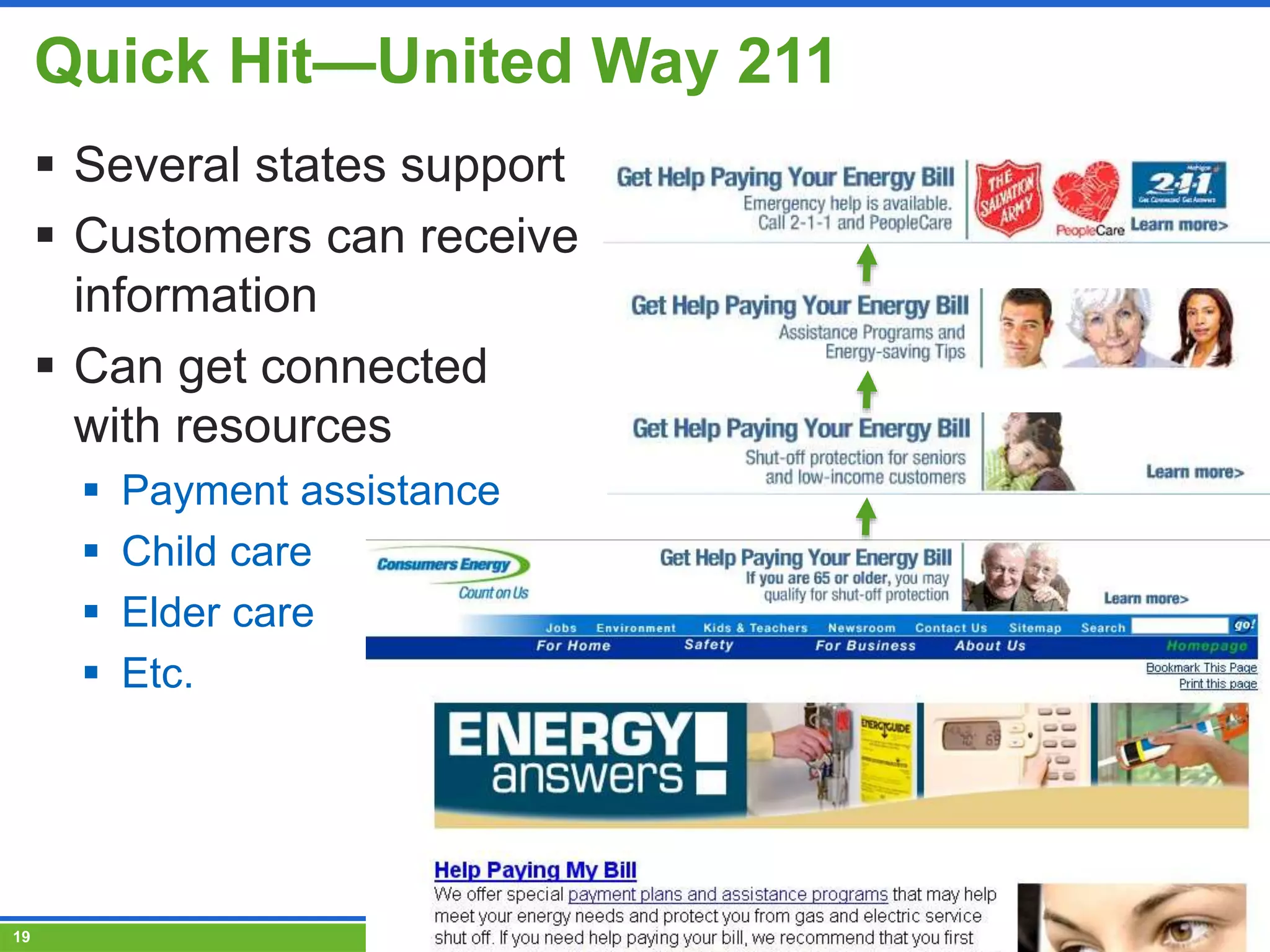
Quick Hit—United Way 211
 Several states support
 Customers can receive
information
 Can get connected
with resources
 Payment assistance
 Child care
 Elder care
 Etc.
www.esource.com || © 2010 E SOURCE20
Quick Hit—Direct Customers to Free
Credit Counseling Services
 DTE Energy works with Greenpath Debt Solutions
 Provides free counseling services to customers with over
$300 in arrears
 4 of AGL Resources’ 6 natural gas utilities direct
customers to the Consumer Credit Counseling
Service (a non-profit financial
counseling agency)
Courtesy: FreeDigitalPhotos.net
www.esource.com || © 2010 E SOURCE21
Getting Customers To Pay Regularly
and On Time
 Understand who your customers are
 Understand why customers struggle to pay
 Have a variety of billing and payment options and
assistance programs
 Match customers with the options and programs
that address the roots of their payment problem
 Offer combined programs that address several
needs of delinquent customers like the ones at
Allegheny Power and KeySpan Gas
 Try getting approval to open up the programs you
have to more customers
www.esource.com || © 2010 E SOURCE22
For More Information
Sarah Fiebiger
Senior Analyst, Market Research Services
303-345-9126 sarah_fiebiger@esource.com

Programs That Help Customers Pay Regularly and On-Time

  • 1.
    www.esource.com Programs That Help CustomersPay Regularly and On-Time Sarah Fiebiger Senior Analyst, Market Research Services @ESourceSarah June 17-18, 2010 June 17-18, 2010
  • 2.
    www.esource.com || ©2010 E SOURCE2 © E Source The Changing Face of Delinquency Typical delinquent customer demographics Single Low income Renter Urban New delinquent customer demographics Single Married Low income Middle income Renter Home- owner Urban Rural Suburban
  • 3.
    www.esource.com || ©2010 E SOURCE3 4 Primary Groups Struggling to Pay Payment- Troubled Customers Overextended customers Careless payers Single- income families No- income households Behavioral Economic © E Source
  • 4.
    www.esource.com || ©2010 E SOURCE4 One-Time $ Assistance Courtesy: stock.xchng
  • 5.
    www.esource.com || ©2010 E SOURCE5 Breaking the Cycle of Delinquency © E Source Can’t afford bills Arrears add up 1-time $ assistance Disconnect avoided Programs promoting change in payment behavior Better paying customer
  • 6.
    www.esource.com || ©2010 E SOURCE6 Courtesy: iStock Auto Pay EFT Bank Draft Braille Billing Credit Card Debit Card Check IVR Web Cash Kiosks Prepay Budget Bill E-Bill Mail Robust Set of Billing & Payment Options
  • 7.
    www.esource.com || ©2010 E SOURCE7 Automatic Payment Plans  ~1/3 of delinquent utility customers have the money to pay, they just didn’t  Auto pay plans alleviate the need to think about paying utility bills  Not great for fixed income customers Courtesy: Salvatore Vuono
  • 8.
    www.esource.com || ©2010 E SOURCE8 Be on Auto Pay—U Could Win an iPod! Slource: www.portlandgeneral.com
  • 9.
    www.esource.com || ©2010 E SOURCE9 Levelized or Budget Billing  Great for fixed incomes  Makes budgeting easier  Customers like it Source: Avista Utilities Source: Consumers Energy
  • 10.
    www.esource.com || ©2010 E SOURCE10 Budget Billing True-Ups  Be careful with annual true-ups  To help avoid large true-ups  Account for current months’ rate  Quarterly or 6 month reviews  Rolling average Image courtesy: stock.xchng
  • 11.
    www.esource.com || ©2010 E SOURCE Wisconsin Power and Light Minimum Payment Option 11 Minimum Payment Option Minimum Payment (%) April 30 May 40 June 50 July 60 August 60 September 60 © E Source; data from: Wisconsin Power and Light press release. “Utility Moratorium on Disconnect Ending.” April 12, 2010. Other Utilities with Minimum Payment Option: Peoples Gas, We Energies, and Wisconsin Public Service
  • 12.
    www.esource.com || ©2010 E SOURCE12 Connecticut Natural Gas Matching Payment Program Other utilities with Matching Payment Programs: Connecticut Light & Power, Southern Connecticut Gas Co., United Illuminating, Yankee Gas CNG Customer Bill Balance $3,500 Energy Assistance Commitment (500) MPP $s Paid by Customer ($120 for 6 mos.) (720) Total Customer Payments and EA $s ($1,220) Remaining Bill Balance $2,280 Matching Payment Program $s (1,220) Customer Balance 1,060 Remaining Bill Balance $2,280 © E Source; data from: http://www.cngcorp.com/MediaLibrary/2/3/Content%20Management/CNG/YourAccount/PDFs%20and%20Docs/CNG%20MPP%20english%2010-09.pdf
  • 13.
    www.esource.com || ©2010 E SOURCE13 Allegheny Power’s Low-Income Payment & Usage Reduction Program 36% 8% 11% 18% 26% 0% 20% 40% 60% 80% 100% <5 payments/ year 5 or 6 payments/year 7 or 8 payments/year 9 or 10 payments/year 11 or 12 payments/year Axis Title Payment Frequency © E SOURCE; data from: http://www.puc.state.pa.us/general/pdf/USP_Evaluation-AlleghenyPower.pdf Percent of LIPURP accounts 3% 2% 62% 33% 0% 20% 40% 60% 80% 100% Level 4: termination Level 3: field visits Level 2: letters and calls Service Level 1 ServiceLevel 17% 0% 20% 40% 60% 80% 100% 90 days overdue at end of study
  • 14.
    www.esource.com || ©2010 E SOURCE14 Results from Joining Allegheny Power’s LIPRUP  Average payment frequency increased  Average payment amount increased  Percent of asked amount paid increased  Total revenue increased before assistance payments added  Service level improved  Balances decreased  Total savings at least $24.37 per account per year © E SOURCE; data from: http://www.puc.state.pa.us/general/pdf/USP_Evaluation-AlleghenyPower.pdf
  • 15.
    www.esource.com || ©2010 E SOURCE15 KeySpan Gas Helps Customers Get “On-Track”  18 month arrearage program  Includes:  Arrearage forgiveness  Hiring of social workers  Hiring of dedicated CSRs to teach customers budgeting and other necessary skills  Four distinct services:  Financial and energy management  Consistent customer support  Social services referrals and case management  Arrears forgiveness
  • 16.
    www.esource.com || ©2010 E SOURCE16 Results From KeySpan Gas’ “On Track” Decreases Disconnections for nonpayment Down 62% Field collection actions Down 75% Office collection actions Down 34% Increases Use of LIHEAP and other grants Up almost 200% Total payments Up at least 5% © E Source; data from Electric Light & Power
  • 17.
    www.esource.com || ©2010 E SOURCE17 Different Spin for “On Track” At MLGW
  • 18.
    www.esource.com || ©2010 E SOURCE Quick Hit—Third-Party Notification Source: www.pge.com/myhome/customerservice/financialassistance/thirdpartynotification/
  • 19.
    www.esource.com || ©2010 E SOURCE19 Quick Hit—United Way 211  Several states support  Customers can receive information  Can get connected with resources  Payment assistance  Child care  Elder care  Etc.
  • 20.
    www.esource.com || ©2010 E SOURCE20 Quick Hit—Direct Customers to Free Credit Counseling Services  DTE Energy works with Greenpath Debt Solutions  Provides free counseling services to customers with over $300 in arrears  4 of AGL Resources’ 6 natural gas utilities direct customers to the Consumer Credit Counseling Service (a non-profit financial counseling agency) Courtesy: FreeDigitalPhotos.net
  • 21.
    www.esource.com || ©2010 E SOURCE21 Getting Customers To Pay Regularly and On Time  Understand who your customers are  Understand why customers struggle to pay  Have a variety of billing and payment options and assistance programs  Match customers with the options and programs that address the roots of their payment problem  Offer combined programs that address several needs of delinquent customers like the ones at Allegheny Power and KeySpan Gas  Try getting approval to open up the programs you have to more customers
  • 22.
    www.esource.com || ©2010 E SOURCE22 For More Information Sarah Fiebiger Senior Analyst, Market Research Services 303-345-9126 sarah_fiebiger@esource.com

Editor's Notes

  • #14 For the customers studied, RETEC found there were, in the electronic account management history: • 4 fewer letters sent • 3.1 fewer incoming calls received • 2 fewer outgoing calls • and .95 fewer field visits made APPRISE is working on an evaluation of Allegheny Power’s Universal Service Program, which includes LIPURP. The evaluation research will include interviews with Allegheny and agency program managers and staff, surveys with participating and nonparticipating customers, analysis of program databases, and analysis of the impacts of the payment assistance program on energy affordability, payment compliance, arrearages, and collections costs. http://www.appriseinc.org/projects_billpay.htm Totals for LIPURP, Jan 02-Aug 03 LIPURP Customer Bills $13,358,063.12 Payments Received $7,760,866.44 LIPURP Supplemental Grants $4,743,693.28 LIPURP Debt Foregiveness $252,086.28 Other grants $684,435.20 Total revenue, these 4 sources $13,441,081.20 Net impact on total balance - $83,018.08 Note: 36% made fewer than 5 payments, but only 17% are 90 days overdue in June, and only 5% received collections field visits. This suggests that many irregular payers are catching up to their obligations with prompting from collections department letters and calls. 80% of the full-year LIPURP participants paid at least 95% of the amount asked of them, even though fewer than 30% paid regularly. Even among those making fewer than 5 payments, 65% paid at least 95% of their asked amount. Only 8% of the full year group paid less than 5 times a year and paid less than 75% of the amount asked. The first graph shows that when customers are in LIPURP, the amount of their retail bills are, on average, higher than during months they are not or were not in LIPURP. The first shows that payments are more frequent during months customers are in LIPURP. The second graph shows that payments have often been of a lower amount during months that customers are in LIPURP. This is the usual result seen in CAPs: customers respond to lowered payment amounts (and stronger incentives to pay regularly) by paying smaller amounts on a more regular basis. They paid a higher and increasing portion of the asked amount when in LIPURP. The extra $5 a month and catch-up payments explain why there are some months with payments over 100% of the budget amount. Thus this study group of customers, during their months in LIPURP, pay more regularly, and pay a higher percentage of the amount they are asked to pay, than they do or did pay during the months they were not in LIPURP. The amount of dollars they pay may be slightly less, but in spring of 2003 this amount is “gaining” on the amounts paid during months out of LIPURP. Payment amounts are much higher in spring of 2003 than in earlier years. 2003 is the first spring collections season when LIPURP functioned as the low income budget plan, instead of an alternative that customers could leave to make another “normal” payment arrangement.
  • #15 Note: This was enough to offset the marginal per-participant administrative cost of LIPURP APPRISE is working on an evaluation of Allegheny Power’s Universal Service Program, which includes LIPURP. The evaluation research will include interviews with Allegheny and agency program managers and staff, surveys with participating and nonparticipating customers, analysis of program databases, and analysis of the impacts of the payment assistance program on energy affordability, payment compliance, arrearages, and collections costs. http://www.appriseinc.org/projects_billpay.htm Totals for LIPURP, Jan 02-Aug 03 LIPURP Customer Bills $13,358,063.12 Payments Received $7,760,866.44 LIPURP Supplemental Grants $4,743,693.28 LIPURP Debt Foregiveness $252,086.28 Other grants $684,435.20 Total revenue, these 4 sources $13,441,081.20 Net impact on total balance - $83,018.08 Note: 36% made fewer than 5 payments, but only 17% are 90 days overdue in June, and only 5% received collections field visits. This suggests that many irregular payers are catching up to their obligations with prompting from collections department letters and calls. 80% of the full-year LIPURP participants paid at least 95% of the amount asked of them, even though fewer than 30% paid regularly. Even among those making fewer than 5 payments, 65% paid at least 95% of their asked amount. Only 8% of the full year group paid less than 5 times a year and paid less than 75% of the amount asked. The first graph shows that when customers are in LIPURP, the amount of their retail bills are, on average, higher than during months they are not or were not in LIPURP. The first shows that payments are more frequent during months customers are in LIPURP. The second graph shows that payments have often been of a lower amount during months that customers are in LIPURP. This is the usual result seen in CAPs: customers respond to lowered payment amounts (and stronger incentives to pay regularly) by paying smaller amounts on a more regular basis. They paid a higher and increasing portion of the asked amount when in LIPURP. The extra $5 a month and catch-up payments explain why there are some months with payments over 100% of the budget amount. Thus this study group of customers, during their months in LIPURP, pay more regularly, and pay a higher percentage of the amount they are asked to pay, than they do or did pay during the months they were not in LIPURP. The amount of dollars they pay may be slightly less, but in spring of 2003 this amount is “gaining” on the amounts paid during months out of LIPURP. Payment amounts are much higher in spring of 2003 than in earlier years. 2003 is the first spring collections season when LIPURP functioned as the low income budget plan, instead of an alternative that customers could leave to make another “normal” payment arrangement. Several graphs show the impact of customers joining LIPURP for the first time. Average payment frequency typically increases, and there is a related slight improvement in service level. Average payments are initially lower than before customers joined the program, but slowly approach their former level. There is a gradual increase in the average balance which then levels off or begins to decline. RETEC then compared the February to June periods (2002 pre vs. 2003 post) for a larger group of 676 customers who joined the low-income budget plan between August 2002 and January 2003. Results show an increase in average payment frequency, the average payment amount, and the percent of asked amount paid. Total revenue in the period increased even before LIPURP shortfall-covering and reward grants were applied to the accounts. Service level improved. Balances decreased. Because this analysis is more recent, involves more customers, and its post period months all occurred after the July 2002 revisions to program design, RETEC believes this is the most reliable indicator of future program performance. This increase in the amounts customers paid is an important result that is rare among CAP programs, where sponsors often see a decrease in revenue from payments. RETEC has found in several evaluations of CAP type programs that (holding collections pressure at a constant level) most payment problem customers are willing and able to pay $100 to $120 more per year to obtain level one service (no collections calls or notices), or to obtain an improvement in service level. If customers are requested to stretch much more than $100 over their pre-program payment level, compliance begins to suffer and the percentage of “successful” customers drops. Thus this recent spring comparison shows LIPURP to be operating close to the maximum obtainable improvement in payment amount. 60% of these customers paid more frequently in spring of 2003, and another 15% paid regularly (4 or 5 payments) in both springs. 36% saw an improvement in service level, 53% had the same service level as before, and only 11% saw a deterioration in service. It appears that the longer a customer remains in LIPURP, and the more their payment amount is lowered, the more their average bill will increase. By their third or fourth plan year in LIPURP, most customer’s average monthly bills have increased about $10 per month over the amount estimated when they made the earliest LIPURP plan RETEC could find for them in the account history. Increases are smaller for customers asked to pay their full bill. The direction of this change is not surprising. If there is any price elasticity to demand, we would expect a subsidy to result increase consumption. The magnitude of the change is surprising, because electric consumption typically has low price elasticity. One explanation is that under LIPURP’s level payment plan, the amount customers pay is decoupled from the bill at least during the plan year. Those paying a below-budget bill do not pay for increased use even in the longer term. So most LIPURP customers are facing zero marginal cost for increased usage.
  • #16 The program combines arrearage forgiveness, the hiring of social workers, and the hiring of dedicated customer service representatives to help teach customers budgeting and other necessary skills. On Track offers four distinct services for eligible customers: financial and energy management, consistent customer support, social services referrals and case management, and arrears forgiveness.
  • #18 MLGW takes a different spin on the On Track program. Instead of arrears forgiveness, customers are put on an extended payment plan for up to three years and will get their deposit credited back to their account after completion of the program. Note that MLGW had to speak with KeySpan Gas and change up the details of the program in order to use the same “On Track” name.
  • #19 3 Quick Hits Some utilities let customers set up a third party, such as a friend or family member, who can be notified if the customer is about to miss a payment. The third party is not held responsible for paying the bill, but is notified of the situation by the utility so that person can try to contact the customer themselves to find out what is going on and make sure the customer is okay. Some utilities that offer third-party notifications include Pacific Gas and Electric, Orange and Rockland Utilities, Connecticut Light & Power, Modesto Irrigation District Water and Power, Duke Energy, Dominion, and Pepco.
  • #20 PECO has its own version of 211 Free referral and information service line Designed to help customers with temporary personal or financial hardships making it difficult to pay their bill Several states support the United Way’s 211 services, where customers can call 211 from a land line or a toll-free number from a cell phone to receive information on or get connected with resources ranging from payment assistance to child and elder care. Elizabethtown Gas  provides information on its web site about getting assistance using United Way 211, as does DTE Energy. Similarly, PECO  has a free referral and information service line its customers can call that’s designed to help those with temporary personal or financial hardship that makes it difficult to pay their bill.