© 2017 E Source
Using Segmentation to
Personalize Low-Income Program
Outreach and Increase Participation
© 2017 E Sourcewww.esource.com 1
Low-income programs target customers who are in need of
financial and energy assistance, but these programs often treat
this customer group as a homogenous entity with uniform needs
and behaviors. Utilities need to reexamine who these customers
are and tailor outreach to increase program participation across
the board.
E Source is diving into these issues across our service areas
through a segmented approach for each census region and is
establishing a program benchmark. Our first report focused on
New England’s low-income population—here’s a summary of our
findings and some suggested next steps.
Segmenting Program Participation:
New England
© 2017 E Sourcewww.esource.com 2
Using the Claritas PRIZM Premier segmentation schema, E Source identified the top three
segments that comprise the highest share of New England’s low-income population:
New Melting Pot (8.1 percent), American Classics (7.6 percent), and Country Strong (7.1 percent).
Like many low-income segments,
participation in demand-side
management (DSM) programs for
the New Melting Pot segment is
low. Keep in mind that for all
customer segments combined, the
national average shows that 73
percent of customers don’t
participate in any programs.
Weatherization and appliance
rebate programs attract the highest
levels of participation from the New
Melting Pot segment. Nationally, the
average utility customer
participates in appliance rebate
programs more than any other
offering, followed by HVAC
inspections and maintenance.
Of our American Classics
respondents, 4 percent report
participation in HVAC inspections
and maintenance programs, and 3
percent report participation in
weatherization, duct test and repair
service, and other programs.
National averages sit at 7 percent
for HVAC inspections, 4 percent for
weatherization, and 2 percent for
duct test and repair service.
In all but one DSM program—duct
test and repair service—American
Classics customers participate less
than average customers.
Mimicking the national average,
Country Strong customers
participate more in appliance
rebate programs than other utility
offerings. When it comes to
programs like weatherization,
lighting rebates, and duct test and
repair service, Country Strong
customers participate in numbers
equal to the national average.
New Melting Pot American Classics Country Strong
© 2017 E Sourcewww.esource.com 3
Roadblocks and Solutions
It’s clear that utilities have room to improve
on low-income program participation.
Customers under the larger low-income
umbrella have different program participation
rates, but their lifestyles and communication
preferences vary. By treating these
customers as unique populations with
different behavior patterns, we can start to
personalize program outreach. We need to
look to successful approaches within the
industry that take a broader approach to
addressing low-income roadblocks.
A number of utilities open up their
low-income programs beyond the 200
percent federal poverty threshold. This can
increase the number of program
participants, including the hard-to-reach
lower, middle-income customers who don’t
qualify for assistance but can’t afford to
participate in traditional DSM offerings.
Under the US Department of Energy (DOE)
Weatherization Assistance Program, each
state is responsible for setting its income
requirements. Massachusetts utilities
sponsor many of the low-income programs
with the largest program participation
numbers. In Massachusetts, income
eligibility requirements are broader than
federal guidelines, opening up programs to
households with an income less than or
equal to 60 percent of the state median
income level.
In keeping with the DOE priority system,
Massachusetts programs serve customers
based on priority points given to the elderly
or disabled, households with children ages
six years or younger, American Indians, or
those with high energy consumption. The
program also places customers with urgent
situations (such as a broken window or
door during cold temperatures) at the top of
the priority list.
© 2017 E Sourcewww.esource.com 4
Case Study: KCP&L
KCP&L surveyed income-eligible customers and found
that nearly 60 percent of its low-income customer base
weren’t aware of the utility’s low-income programs. To
address this deficit, KCP&L ramped up its outreach. And
to improve awareness around weatherization, KCP&L
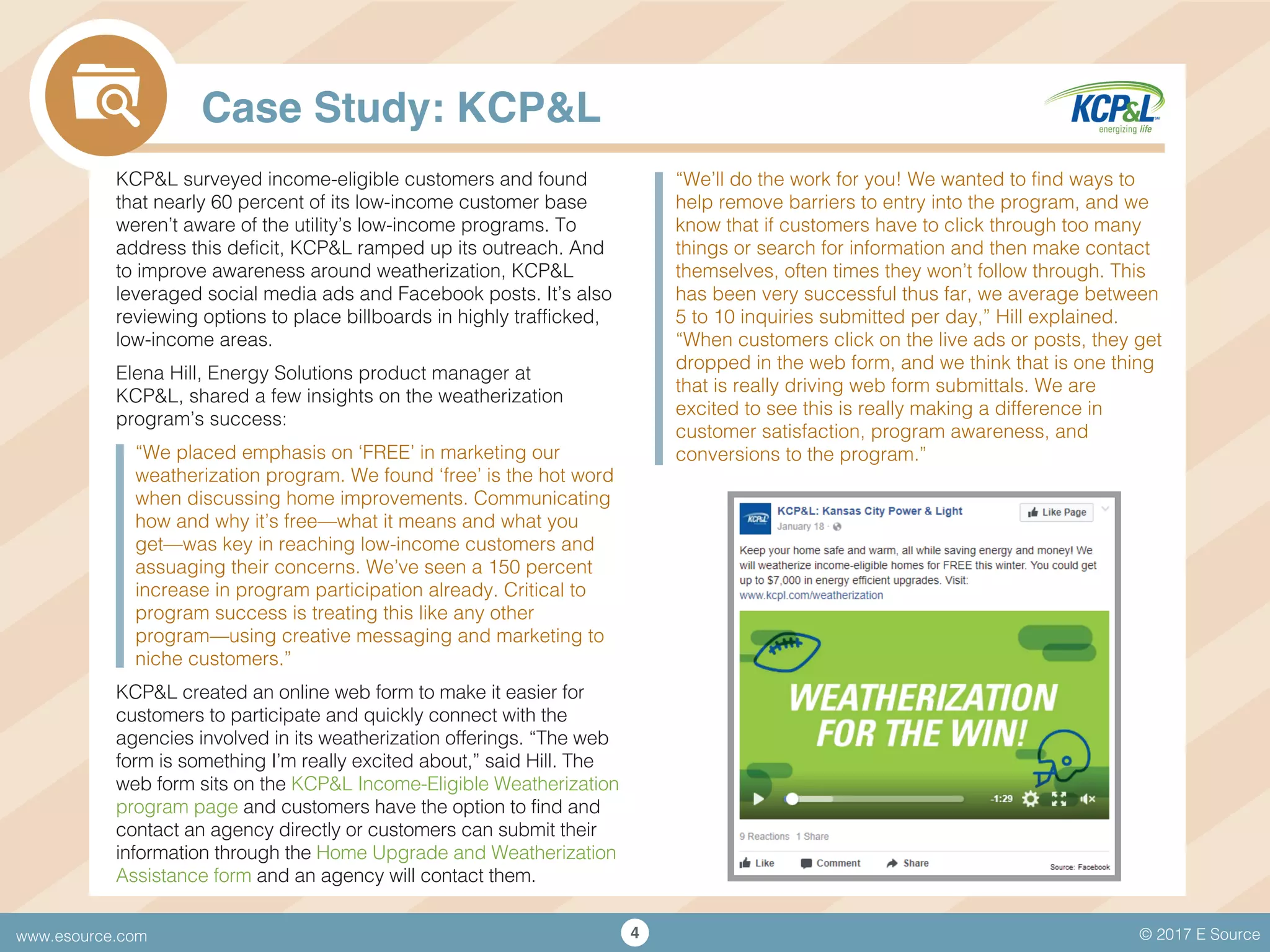
leveraged social media ads and Facebook posts. It’s also
reviewing options to place billboards in highly trafficked,
low-income areas.
Elena Hill, Energy Solutions product manager at
KCP&L, shared a few insights on the weatherization
program’s success:
“We placed emphasis on ‘FREE’ in marketing our
weatherization program. We found ‘free’ is the hot word
when discussing home improvements. Communicating
how and why it’s free—what it means and what you
get—was key in reaching low-income customers and
assuaging their concerns. We’ve seen a 150 percent
increase in program participation already. Critical to
program success is treating this like any other
program—using creative messaging and marketing to
niche customers.”
KCP&L created an online web form to make it easier for
customers to participate and quickly connect with the
agencies involved in its weatherization offerings. “The web
form is something I’m really excited about,” said Hill. The
web form sits on the KCP&L Income-Eligible Weatherization
program page and customers have the option to find and
contact an agency directly or customers can submit their
information through the Home Upgrade and Weatherization
Assistance form and an agency will contact them.
“We’ll do the work for you! We wanted to find ways to
help remove barriers to entry into the program, and we
know that if customers have to click through too many
things or search for information and then make contact
themselves, often times they won’t follow through. This
has been very successful thus far, we average between
5 to 10 inquiries submitted per day,” Hill explained.
“When customers click on the live ads or posts, they get
dropped in the web form, and we think that is one thing
that is really driving web form submittals. We are
excited to see this is really making a difference in
customer satisfaction, program awareness, and
conversions to the program.”
For 30 years, E Source has been providing
market research, data, and consulting services
to more than 300 utilities and their partners.
This guidance helps our customers advance
their efficiency programs, enhance customer
relationships, and use energy more efficiently.
For more information, visit www.esource.com,
email esource@esource.com, or call
1-800-ESOURCE.
ES-1700023-001

Using Segmentation to Personalize Low-Income Program Outreach and Increase Participation

  • 1.
    © 2017 ESource Using Segmentation to Personalize Low-Income Program Outreach and Increase Participation
  • 2.
    © 2017 ESourcewww.esource.com 1 Low-income programs target customers who are in need of financial and energy assistance, but these programs often treat this customer group as a homogenous entity with uniform needs and behaviors. Utilities need to reexamine who these customers are and tailor outreach to increase program participation across the board. E Source is diving into these issues across our service areas through a segmented approach for each census region and is establishing a program benchmark. Our first report focused on New England’s low-income population—here’s a summary of our findings and some suggested next steps.
  • 3.
    Segmenting Program Participation: NewEngland © 2017 E Sourcewww.esource.com 2 Using the Claritas PRIZM Premier segmentation schema, E Source identified the top three segments that comprise the highest share of New England’s low-income population: New Melting Pot (8.1 percent), American Classics (7.6 percent), and Country Strong (7.1 percent). Like many low-income segments, participation in demand-side management (DSM) programs for the New Melting Pot segment is low. Keep in mind that for all customer segments combined, the national average shows that 73 percent of customers don’t participate in any programs. Weatherization and appliance rebate programs attract the highest levels of participation from the New Melting Pot segment. Nationally, the average utility customer participates in appliance rebate programs more than any other offering, followed by HVAC inspections and maintenance. Of our American Classics respondents, 4 percent report participation in HVAC inspections and maintenance programs, and 3 percent report participation in weatherization, duct test and repair service, and other programs. National averages sit at 7 percent for HVAC inspections, 4 percent for weatherization, and 2 percent for duct test and repair service. In all but one DSM program—duct test and repair service—American Classics customers participate less than average customers. Mimicking the national average, Country Strong customers participate more in appliance rebate programs than other utility offerings. When it comes to programs like weatherization, lighting rebates, and duct test and repair service, Country Strong customers participate in numbers equal to the national average. New Melting Pot American Classics Country Strong
  • 4.
    © 2017 ESourcewww.esource.com 3 Roadblocks and Solutions It’s clear that utilities have room to improve on low-income program participation. Customers under the larger low-income umbrella have different program participation rates, but their lifestyles and communication preferences vary. By treating these customers as unique populations with different behavior patterns, we can start to personalize program outreach. We need to look to successful approaches within the industry that take a broader approach to addressing low-income roadblocks. A number of utilities open up their low-income programs beyond the 200 percent federal poverty threshold. This can increase the number of program participants, including the hard-to-reach lower, middle-income customers who don’t qualify for assistance but can’t afford to participate in traditional DSM offerings. Under the US Department of Energy (DOE) Weatherization Assistance Program, each state is responsible for setting its income requirements. Massachusetts utilities sponsor many of the low-income programs with the largest program participation numbers. In Massachusetts, income eligibility requirements are broader than federal guidelines, opening up programs to households with an income less than or equal to 60 percent of the state median income level. In keeping with the DOE priority system, Massachusetts programs serve customers based on priority points given to the elderly or disabled, households with children ages six years or younger, American Indians, or those with high energy consumption. The program also places customers with urgent situations (such as a broken window or door during cold temperatures) at the top of the priority list.
  • 5.
    © 2017 ESourcewww.esource.com 4 Case Study: KCP&L KCP&L surveyed income-eligible customers and found that nearly 60 percent of its low-income customer base weren’t aware of the utility’s low-income programs. To address this deficit, KCP&L ramped up its outreach. And to improve awareness around weatherization, KCP&L leveraged social media ads and Facebook posts. It’s also reviewing options to place billboards in highly trafficked, low-income areas. Elena Hill, Energy Solutions product manager at KCP&L, shared a few insights on the weatherization program’s success: “We placed emphasis on ‘FREE’ in marketing our weatherization program. We found ‘free’ is the hot word when discussing home improvements. Communicating how and why it’s free—what it means and what you get—was key in reaching low-income customers and assuaging their concerns. We’ve seen a 150 percent increase in program participation already. Critical to program success is treating this like any other program—using creative messaging and marketing to niche customers.” KCP&L created an online web form to make it easier for customers to participate and quickly connect with the agencies involved in its weatherization offerings. “The web form is something I’m really excited about,” said Hill. The web form sits on the KCP&L Income-Eligible Weatherization program page and customers have the option to find and contact an agency directly or customers can submit their information through the Home Upgrade and Weatherization Assistance form and an agency will contact them. “We’ll do the work for you! We wanted to find ways to help remove barriers to entry into the program, and we know that if customers have to click through too many things or search for information and then make contact themselves, often times they won’t follow through. This has been very successful thus far, we average between 5 to 10 inquiries submitted per day,” Hill explained. “When customers click on the live ads or posts, they get dropped in the web form, and we think that is one thing that is really driving web form submittals. We are excited to see this is really making a difference in customer satisfaction, program awareness, and conversions to the program.”
  • 6.
    For 30 years,E Source has been providing market research, data, and consulting services to more than 300 utilities and their partners. This guidance helps our customers advance their efficiency programs, enhance customer relationships, and use energy more efficiently. For more information, visit www.esource.com, email esource@esource.com, or call 1-800-ESOURCE. ES-1700023-001