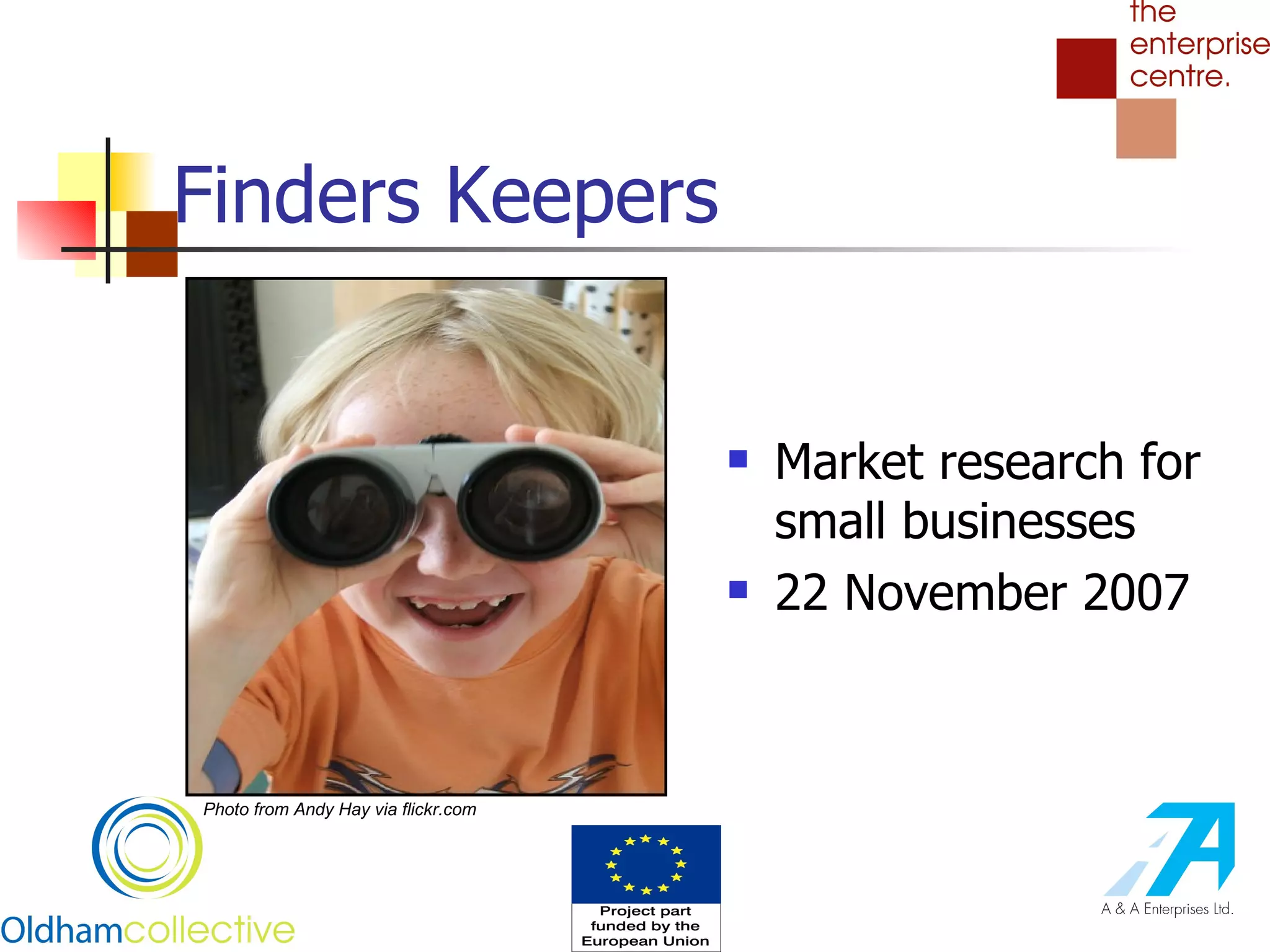
Finders Keepers Market research for small businesses 22 November 2007 Alison Hornsby &  Adrian Carridice-Davids Photo from Andy Hay via flickr.com
What we’ll do today Understand what market you’re in Work out how to research your market Do a practical market research exercise Look at how to analyse your research Explore how you might find your niche
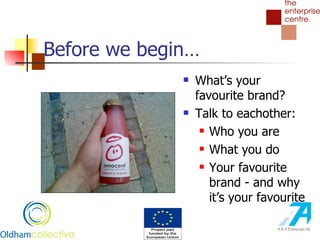
Before we begin… What’s your favourite brand? Talk to eachother: Who you are What you do Your favourite brand - and why it’s your favourite
Who am I and what have I done? Spanish and French Senda Juvenil Trade for Change Social Enterprise Leeds WYSE School SBC since 2005
What do I do? Training - market research, marketing, social business planning Consultancy - social enterprise Mentoring Photo from Ant Smallwood via flickr.com
Why bother with market research? Starting up can be a risky business If you find out about your market, you give yourself a better chance of keeping going You need to get a feel of whether there is sufficient  need  - and  demand  - for your product or service.
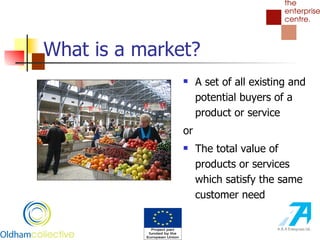
What is a market? A set of all existing and potential buyers of a product or service or The total value of products or services which satisfy the same customer need
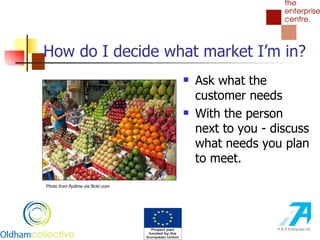
How do I decide what market I’m in? Ask what the customer needs With the person next to you - discuss what needs you plan to meet.  Photo from flydime via flickr.com
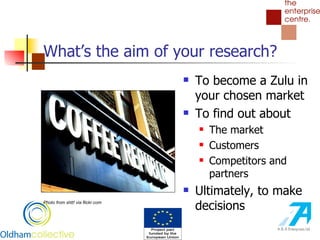
What’s the aim of your research? To become a Zulu in your chosen market To find out about The market Customers Competitors and partners Ultimately, to make decisions Photo from shtt! via flickr.com
What do you need to find out? You are planning to open “some kind of café or take-away” Decide what market you are in What do you need to find out about: The market you will be part of Customers Competitors Don’t worry about how you’ll find it out yet
How will you find things out? The  market  - think big and then home in For the product/service you’re selling, do some secondary (desk) research: Market research reports - from your local business library -  Mintel ,  Keynote  etc Trade magazines, books by successful entrepreneurs in that sector, “how-to” books Internet research - including other countries - can you learn from other markets?  Other ideas?
How will you find things out? The  market  - think big and then home in For the area you’ll be selling in: Information from the Local Authority - regeneration initiatives, business support agencies, local media Talk to people who work and live in the area Walk around - what kind of businesses are setting up? Can you learn from elsewhere - has a similar area changed recently, or are things happening in a neighbouring area? Any other ideas?
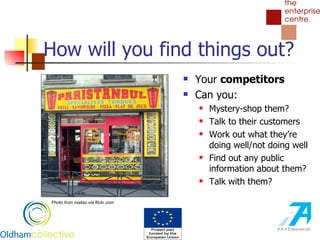
How will you find things out? Your  competitors Can you: Mystery-shop them? Talk to their customers Work out what they’re doing well/not doing well Find out any public information about them? Talk with them?  Photo from malias via flickr.com
Competition - good or bad or both? Is it a good thing that you have lots of competitors? Could it be a bad sign if you have no competitors? Is there any scope for co-operation with you competitors?
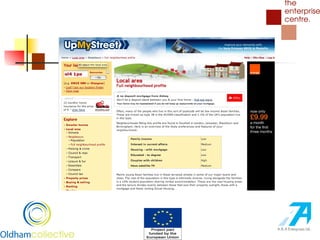
How will you find things out? Customers: Demographic data, from  www. neighbourhood .statistics. gov . uk Your local authority, eg: http://www. oldham . gov .uk/ward-profile-st-marys-2006. pdf Neighbourhood profile from http://www. upmystreet .com
 
How will you find things out? Customers: you could do some  primary research:   Talk to people! Run a focus group Do one-to-one interviews Telephone/postal surveys Email/internet survey Today we’ll look at developing a survey
Café customer questionnaire First of all, decide what you want to find out Then, design your questions: Start with a couple of easy questions Ask one thing at a time - and keep it simple Ask yourself - how will we analyse the response to this question? Vary the style of questions Trial the questionnaire - then review it
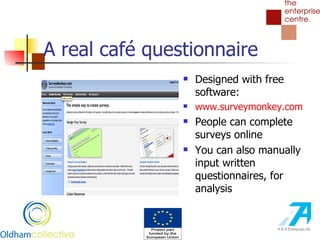
A real café questionnaire Designed with free software: www. surveymonkey .com People can complete surveys online You can also manually input written questionnaires, for analysis
Real café questionnaire - analysis What should we note from the responses? Can you see any opportunities for the café? Can you identify any issues which need addressing/risks that need managing? Any other issues?
What will you do with what you’ve found out? Turn your research into intelligence Think about: Opportunities and threats Risks, and how to manage them Is there a particular niche/market segment you can serve? Can you estimate the size of the opportunity?
Market segmentation Division of a market into different groups of customers who have things in common (particularly similar needs). Why is it important to do this?
Because customers are not all the same! Different customers have different needs If you understand that, you can tailor your services to meet their needs You might also find a niche where you can be the market leader
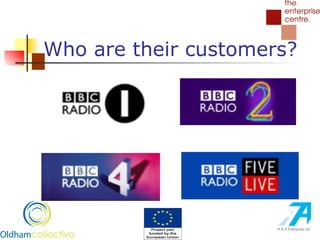
Who are their customers?
Who are your customers? Some ways you may group customers together include: Age, gender, employment status, family status, ethnic origin, income level etc How they may buy your product/service - eg Saturday shoppers, local office workers, breakfast buyers, etc Can you identify which segments to focus on?
Estimating the size of your market A fictitious example: an  organic veg box scheme : Our research suggests  5000  people in Leeds are in the market for organic veg boxes If each of these people were to buy a £10 monthly box, the  market is worth £600,000  (10 x 12months x 5000 people) Given the amount of competition, we think we could aim eventually for  20% of the  market  - approximately £120,000 Research suggests the market for organic veg is growing by 30% a year - so we are confident that we can get a share of an expanding market.  But will more competitors enter the market and reduce our share?
Over to you… Questions… comments? Photo from aymlis via flickr.com
To recap Decide what market you’re in Research the market, competitors and customers Do some primary research if you can Sit down and analyse what you’ve found out - then act upon it Try to identify your niche
For lots more information… www.socialbusinessconsulting.co.uk
And finally… Cultivate your instincts
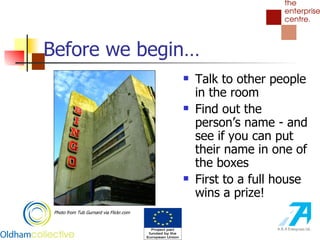
Before we begin… Talk to other people in the room Find out the person’s name - and see if you can put their name in one of the boxes First to a full house wins a prize! Photo from Tub Gurnard via Flickr.com

Finders Keepers Market Research training

  • 1.
    Finders Keepers Marketresearch for small businesses 22 November 2007 Alison Hornsby & Adrian Carridice-Davids Photo from Andy Hay via flickr.com
  • 2.
    What we’ll dotoday Understand what market you’re in Work out how to research your market Do a practical market research exercise Look at how to analyse your research Explore how you might find your niche
  • 3.
    Before we begin…What’s your favourite brand? Talk to eachother: Who you are What you do Your favourite brand - and why it’s your favourite
  • 4.
    Who am Iand what have I done? Spanish and French Senda Juvenil Trade for Change Social Enterprise Leeds WYSE School SBC since 2005
  • 5.
    What do Ido? Training - market research, marketing, social business planning Consultancy - social enterprise Mentoring Photo from Ant Smallwood via flickr.com
  • 6.
    Why bother withmarket research? Starting up can be a risky business If you find out about your market, you give yourself a better chance of keeping going You need to get a feel of whether there is sufficient need - and demand - for your product or service.
  • 7.
    What is amarket? A set of all existing and potential buyers of a product or service or The total value of products or services which satisfy the same customer need
  • 8.
    How do Idecide what market I’m in? Ask what the customer needs With the person next to you - discuss what needs you plan to meet. Photo from flydime via flickr.com
  • 9.
    What’s the aimof your research? To become a Zulu in your chosen market To find out about The market Customers Competitors and partners Ultimately, to make decisions Photo from shtt! via flickr.com
  • 10.
    What do youneed to find out? You are planning to open “some kind of café or take-away” Decide what market you are in What do you need to find out about: The market you will be part of Customers Competitors Don’t worry about how you’ll find it out yet
  • 11.
    How will youfind things out? The market - think big and then home in For the product/service you’re selling, do some secondary (desk) research: Market research reports - from your local business library - Mintel , Keynote etc Trade magazines, books by successful entrepreneurs in that sector, “how-to” books Internet research - including other countries - can you learn from other markets? Other ideas?
  • 12.
    How will youfind things out? The market - think big and then home in For the area you’ll be selling in: Information from the Local Authority - regeneration initiatives, business support agencies, local media Talk to people who work and live in the area Walk around - what kind of businesses are setting up? Can you learn from elsewhere - has a similar area changed recently, or are things happening in a neighbouring area? Any other ideas?
  • 13.
    How will youfind things out? Your competitors Can you: Mystery-shop them? Talk to their customers Work out what they’re doing well/not doing well Find out any public information about them? Talk with them? Photo from malias via flickr.com
  • 14.
    Competition - goodor bad or both? Is it a good thing that you have lots of competitors? Could it be a bad sign if you have no competitors? Is there any scope for co-operation with you competitors?
  • 15.
    How will youfind things out? Customers: Demographic data, from www. neighbourhood .statistics. gov . uk Your local authority, eg: http://www. oldham . gov .uk/ward-profile-st-marys-2006. pdf Neighbourhood profile from http://www. upmystreet .com
  • 16.
  • 17.
    How will youfind things out? Customers: you could do some primary research: Talk to people! Run a focus group Do one-to-one interviews Telephone/postal surveys Email/internet survey Today we’ll look at developing a survey
  • 18.
    Café customer questionnaireFirst of all, decide what you want to find out Then, design your questions: Start with a couple of easy questions Ask one thing at a time - and keep it simple Ask yourself - how will we analyse the response to this question? Vary the style of questions Trial the questionnaire - then review it
  • 19.
    A real caféquestionnaire Designed with free software: www. surveymonkey .com People can complete surveys online You can also manually input written questionnaires, for analysis
  • 20.
    Real café questionnaire- analysis What should we note from the responses? Can you see any opportunities for the café? Can you identify any issues which need addressing/risks that need managing? Any other issues?
  • 21.
    What will youdo with what you’ve found out? Turn your research into intelligence Think about: Opportunities and threats Risks, and how to manage them Is there a particular niche/market segment you can serve? Can you estimate the size of the opportunity?
  • 22.
    Market segmentation Divisionof a market into different groups of customers who have things in common (particularly similar needs). Why is it important to do this?
  • 23.
    Because customers arenot all the same! Different customers have different needs If you understand that, you can tailor your services to meet their needs You might also find a niche where you can be the market leader
  • 24.
    Who are theircustomers?
  • 25.
    Who are yourcustomers? Some ways you may group customers together include: Age, gender, employment status, family status, ethnic origin, income level etc How they may buy your product/service - eg Saturday shoppers, local office workers, breakfast buyers, etc Can you identify which segments to focus on?
  • 26.
    Estimating the sizeof your market A fictitious example: an organic veg box scheme : Our research suggests 5000 people in Leeds are in the market for organic veg boxes If each of these people were to buy a £10 monthly box, the market is worth £600,000 (10 x 12months x 5000 people) Given the amount of competition, we think we could aim eventually for 20% of the market - approximately £120,000 Research suggests the market for organic veg is growing by 30% a year - so we are confident that we can get a share of an expanding market. But will more competitors enter the market and reduce our share?
  • 27.
    Over to you…Questions… comments? Photo from aymlis via flickr.com
  • 28.
    To recap Decidewhat market you’re in Research the market, competitors and customers Do some primary research if you can Sit down and analyse what you’ve found out - then act upon it Try to identify your niche
  • 29.
    For lots moreinformation… www.socialbusinessconsulting.co.uk
  • 30.
  • 31.
    Before we begin…Talk to other people in the room Find out the person’s name - and see if you can put their name in one of the boxes First to a full house wins a prize! Photo from Tub Gurnard via Flickr.com