Deleted
Syllabus
CBSE Board
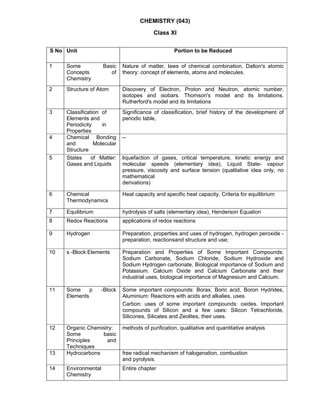
CHEMISTRY (043)
Class XI
S No Unit Portion to be Reduced
1 Some Basic
Concepts of
Chemistry
Nature of matter, laws of chemical combination, Dalton's atomic
theory: concept of elements, atoms and molecules.
2 Structure of Atom Discovery of Electron, Proton and Neutron, atomic number,
isotopes and isobars. Thomson's model and its limitations.
Rutherford's model and its limitations
3 Classification of
Elements and
Periodicity in
Properties
Significance of classification, brief history of the development of
periodic table,
4 Chemical Bonding
and Molecular
Structure
--
5 States of Matter:
Gases and Liquids
liquefaction of gases, critical temperature, kinetic energy and
molecular speeds (elementary idea), Liquid State- vapour
pressure, viscosity and surface tension (qualitative idea only, no
mathematical
derivations)
6 Chemical
Thermodynamics
Heat capacity and specific heat capacity, Criteria for equilibrium
7 Equilibrium hydrolysis of salts (elementary idea), Henderson Equation
8 Redox Reactions applications of redox reactions
9 Hydrogen Preparation, properties and uses of hydrogen, hydrogen peroxide -
preparation, reactionsand structure and use;
10 s -Block Elements Preparation and Properties of Some Important Compounds:
Sodium Carbonate, Sodium Chloride, Sodium Hydroxide and
Sodium Hydrogen carbonate, Biological importance of Sodium and
Potassium. Calcium Oxide and Calcium Carbonate and their
industrial uses, biological importance of Magnesium and Calcium.
11 Some p -Block
Elements
Some important compounds: Borax, Boric acid, Boron Hydrides,
Aluminium: Reactions with acids and alkalies, uses.
Carbon: uses of some important compounds: oxides. Important
compounds of Silicon and a few uses: Silicon Tetrachloride,
Silicones, Silicates and Zeolites, their uses.
12 Organic Chemistry:
Some basic
Principles and
Techniques
methods of purification, qualitative and quantitative analysis
13 Hydrocarbons free radical mechanism of halogenation, combustion
and pyrolysis.
14 Environmental
Chemistry
Entire chapter
Practical
The following portion to be deleted
C. Experiments based onpH
a) Any one of the following experiments:
● Determination of pH of some solutions obtained from fruit juices, solution of known and
varied concentrations of acids, bases and salts using pH paper or universal indicator.
● Comparing the pH of solutions of strong and weak acids of same concentration.
● Study the pH change in the titration of a strong base using universal indicator.
b) Study the pH change by common-ion in case of weak acids and weak bases.
D. Chemical Equilibrium
One of the following experiments:
a) Study the shift in equilibrium between ferric ions and thiocyanate ions by increasing/decreasing
the concentration of either of theions.
b) Study the shift in equilibrium between [Co(H2O)6]2+ and chloride ions by changing the
concentration of either of theions.
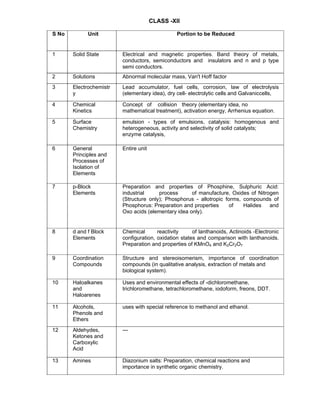
CLASS -XII
S No Unit Portion to be Reduced
1 Solid State Electrical and magnetic properties. Band theory of metals,
conductors, semiconductors and insulators and n and p type
semi conductors.
2 Solutions Abnormal molecular mass, Van't Hoff factor
3 Electrochemistr
y
Lead accumulator, fuel cells, corrosion, law of electrolysis
(elementary idea), dry cell- electrolytic cells and Galvaniccells,
4 Chemical
Kinetics
Concept of collision theory (elementary idea, no
mathematical treatment), activation energy, Arrhenius equation.
5 Surface
Chemistry
emulsion - types of emulsions, catalysis: homogenous and
heterogeneous, activity and selectivity of solid catalysts;
enzyme catalysis,
6 General
Principles and
Processes of
Isolation of
Elements
Entire unit
7 p-Block
Elements
Preparation and properties of Phosphine, Sulphuric Acid:
industrial process of manufacture, Oxides of Nitrogen
(Structure only); Phosphorus - allotropic forms, compounds of
Phosphorus: Preparation and properties of Halides and
Oxo acids (elementary idea only).
8 d and f Block
Elements
Chemical reactivity of lanthanoids, Actinoids -Electronic
configuration, oxidation states and comparison with lanthanoids.
Preparation and properties of KMnO4 and K2Cr2O7
9 Coordination
Compounds
Structure and stereoisomerism, importance of coordination
compounds (in qualitative analysis, extraction of metals and
biological system).
10 Haloalkanes
and
Haloarenes
Uses and environmental effects of -dichloromethane,
trichloromethane, tetrachloromethane, iodoform, freons, DDT.
11 Alcohols,
Phenols and
Ethers
uses with special reference to methanol and ethanol.
12 Aldehydes,
Ketones and
Carboxylic
Acid
---
13 Amines Diazonium salts: Preparation, chemical reactions and
importance in synthetic organic chemistry.
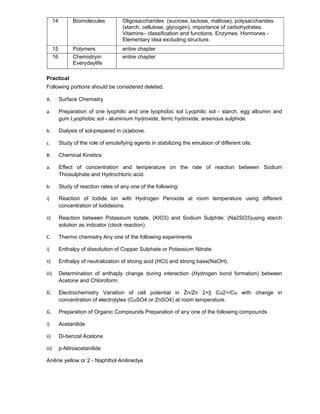
14 Biomolecules Oligosaccharides (sucrose, lactose, maltose), polysaccharides
(starch, cellulose, glycogen), importance of carbohydrates.
Vitamins– classification and functions. Enzymes. Hormones -
Elementary idea excluding structure.
15 Polymers entire chapter
16 Chemistryin
Everydaylife
entire chapter
Practical
Following portions should be considered deleted.
A. Surface Chemistry
a. Preparation of one lyophilic and one lyophobic sol Lyophilic sol - starch, egg albumin and
gum Lyophobic sol - aluminium hydroxide, ferric hydroxide, arsenous sulphide.
b. Dialysis of sol-prepared in (a)above.
c. Study of the role of emulsifying agents in stabilizing the emulsion of different oils.
B. Chemical Kinetics
a. Effect of concentration and temperature on the rate of reaction between Sodium
Thiosulphate and Hydrochloric acid.
b. Study of reaction rates of any one of the following:
i) Reaction of Iodide ion with Hydrogen Peroxide at room temperature using different
concentration of Iodideions.
ii) Reaction between Potassium Iodate, (KIO3) and Sodium Sulphite: (Na2SO3)using starch
solution as indicator (clock reaction).
C. Thermo chemistry Any one of the following experiments
i) Enthalpy of dissolution of Copper Sulphate or Potassium Nitrate.
ii) Enthalpy of neutralization of strong acid (HCI) and strong base(NaOH).
iii) Determination of enthaply change during interaction (Hydrogen bond formation) between
Acetone and Chloroform.
D. Electrochemistry Variation of cell potential in Zn/Zn 2+|| Cu2+/Cu with change in
concentration of electrolytes (CuSO4 or ZnSO4) at room temperature.
G. Preparation of Organic Compounds Preparation of any one of the following compounds
i) Acetanilide
ii) Di-benzal Acetone
iii) p-Nitroacetanilide
Aniline yellow or 2 - Naphthol Anilinedye
CBSE Board
Preparation
Sample Papers
Syllabus
Previous Year Question Papers
Notes
Mock Test
Study Material
Free
NCERT Books
NCERT Solutions
Practice Papers
Question Bank
More Resources
#1
#3
#2
#4
#5

CBSE Deleted Syllabus Class 11, 12 Chemistry 2020-21

  • 1.
  • 2.
    CHEMISTRY (043) Class XI SNo Unit Portion to be Reduced 1 Some Basic Concepts of Chemistry Nature of matter, laws of chemical combination, Dalton's atomic theory: concept of elements, atoms and molecules. 2 Structure of Atom Discovery of Electron, Proton and Neutron, atomic number, isotopes and isobars. Thomson's model and its limitations. Rutherford's model and its limitations 3 Classification of Elements and Periodicity in Properties Significance of classification, brief history of the development of periodic table, 4 Chemical Bonding and Molecular Structure -- 5 States of Matter: Gases and Liquids liquefaction of gases, critical temperature, kinetic energy and molecular speeds (elementary idea), Liquid State- vapour pressure, viscosity and surface tension (qualitative idea only, no mathematical derivations) 6 Chemical Thermodynamics Heat capacity and specific heat capacity, Criteria for equilibrium 7 Equilibrium hydrolysis of salts (elementary idea), Henderson Equation 8 Redox Reactions applications of redox reactions 9 Hydrogen Preparation, properties and uses of hydrogen, hydrogen peroxide - preparation, reactionsand structure and use; 10 s -Block Elements Preparation and Properties of Some Important Compounds: Sodium Carbonate, Sodium Chloride, Sodium Hydroxide and Sodium Hydrogen carbonate, Biological importance of Sodium and Potassium. Calcium Oxide and Calcium Carbonate and their industrial uses, biological importance of Magnesium and Calcium. 11 Some p -Block Elements Some important compounds: Borax, Boric acid, Boron Hydrides, Aluminium: Reactions with acids and alkalies, uses. Carbon: uses of some important compounds: oxides. Important compounds of Silicon and a few uses: Silicon Tetrachloride, Silicones, Silicates and Zeolites, their uses. 12 Organic Chemistry: Some basic Principles and Techniques methods of purification, qualitative and quantitative analysis 13 Hydrocarbons free radical mechanism of halogenation, combustion and pyrolysis. 14 Environmental Chemistry Entire chapter
  • 3.
    Practical The following portionto be deleted C. Experiments based onpH a) Any one of the following experiments: ● Determination of pH of some solutions obtained from fruit juices, solution of known and varied concentrations of acids, bases and salts using pH paper or universal indicator. ● Comparing the pH of solutions of strong and weak acids of same concentration. ● Study the pH change in the titration of a strong base using universal indicator. b) Study the pH change by common-ion in case of weak acids and weak bases. D. Chemical Equilibrium One of the following experiments: a) Study the shift in equilibrium between ferric ions and thiocyanate ions by increasing/decreasing the concentration of either of theions. b) Study the shift in equilibrium between [Co(H2O)6]2+ and chloride ions by changing the concentration of either of theions.
  • 4.
    CLASS -XII S NoUnit Portion to be Reduced 1 Solid State Electrical and magnetic properties. Band theory of metals, conductors, semiconductors and insulators and n and p type semi conductors. 2 Solutions Abnormal molecular mass, Van't Hoff factor 3 Electrochemistr y Lead accumulator, fuel cells, corrosion, law of electrolysis (elementary idea), dry cell- electrolytic cells and Galvaniccells, 4 Chemical Kinetics Concept of collision theory (elementary idea, no mathematical treatment), activation energy, Arrhenius equation. 5 Surface Chemistry emulsion - types of emulsions, catalysis: homogenous and heterogeneous, activity and selectivity of solid catalysts; enzyme catalysis, 6 General Principles and Processes of Isolation of Elements Entire unit 7 p-Block Elements Preparation and properties of Phosphine, Sulphuric Acid: industrial process of manufacture, Oxides of Nitrogen (Structure only); Phosphorus - allotropic forms, compounds of Phosphorus: Preparation and properties of Halides and Oxo acids (elementary idea only). 8 d and f Block Elements Chemical reactivity of lanthanoids, Actinoids -Electronic configuration, oxidation states and comparison with lanthanoids. Preparation and properties of KMnO4 and K2Cr2O7 9 Coordination Compounds Structure and stereoisomerism, importance of coordination compounds (in qualitative analysis, extraction of metals and biological system). 10 Haloalkanes and Haloarenes Uses and environmental effects of -dichloromethane, trichloromethane, tetrachloromethane, iodoform, freons, DDT. 11 Alcohols, Phenols and Ethers uses with special reference to methanol and ethanol. 12 Aldehydes, Ketones and Carboxylic Acid --- 13 Amines Diazonium salts: Preparation, chemical reactions and importance in synthetic organic chemistry.
  • 5.
    14 Biomolecules Oligosaccharides(sucrose, lactose, maltose), polysaccharides (starch, cellulose, glycogen), importance of carbohydrates. Vitamins– classification and functions. Enzymes. Hormones - Elementary idea excluding structure. 15 Polymers entire chapter 16 Chemistryin Everydaylife entire chapter Practical Following portions should be considered deleted. A. Surface Chemistry a. Preparation of one lyophilic and one lyophobic sol Lyophilic sol - starch, egg albumin and gum Lyophobic sol - aluminium hydroxide, ferric hydroxide, arsenous sulphide. b. Dialysis of sol-prepared in (a)above. c. Study of the role of emulsifying agents in stabilizing the emulsion of different oils. B. Chemical Kinetics a. Effect of concentration and temperature on the rate of reaction between Sodium Thiosulphate and Hydrochloric acid. b. Study of reaction rates of any one of the following: i) Reaction of Iodide ion with Hydrogen Peroxide at room temperature using different concentration of Iodideions. ii) Reaction between Potassium Iodate, (KIO3) and Sodium Sulphite: (Na2SO3)using starch solution as indicator (clock reaction). C. Thermo chemistry Any one of the following experiments i) Enthalpy of dissolution of Copper Sulphate or Potassium Nitrate. ii) Enthalpy of neutralization of strong acid (HCI) and strong base(NaOH). iii) Determination of enthaply change during interaction (Hydrogen bond formation) between Acetone and Chloroform. D. Electrochemistry Variation of cell potential in Zn/Zn 2+|| Cu2+/Cu with change in concentration of electrolytes (CuSO4 or ZnSO4) at room temperature. G. Preparation of Organic Compounds Preparation of any one of the following compounds i) Acetanilide ii) Di-benzal Acetone iii) p-Nitroacetanilide Aniline yellow or 2 - Naphthol Anilinedye
  • 6.
    CBSE Board Preparation Sample Papers Syllabus PreviousYear Question Papers Notes Mock Test
  • 7.
    Study Material Free NCERT Books NCERTSolutions Practice Papers Question Bank More Resources #1 #3 #2 #4 #5