The effect of mutual arrangement of B-
cations on electronic, optical and
piezoelectric properties of strained
PbZrxTi1-xO3 (PZT)
Alexander Bogdanov1,2, Anna Kimmel3,4
1. A.P. Vinogradov Institute of Geochemistry SB RAS, Irkutsk, RUSSIA
2. Irkutsk State Technical University, Irkutsk, RUSSIA
3. National Physical Laboratory, Teddington, TW11 0LW, UK
4. University College London, Gower St., WC1E 6BT, UK
INTRODUCTION
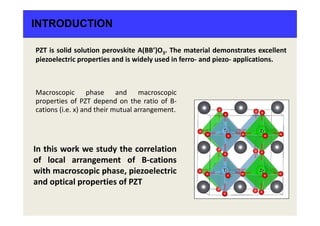
PZT is solid solution perovskite A(BB’)O3. The material demonstrates excellent
piezoelectric properties and is widely used in ferro- and piezo- applications.
Macroscopic phase and macroscopic
properties of PZT depend on the ratio of B-
cations (i.e. x) and their mutual arrangement.
In this work we study the correlation
of local arrangement of B-cations
with macroscopic phase, piezoelectric
and optical properties of PZT
METHODS
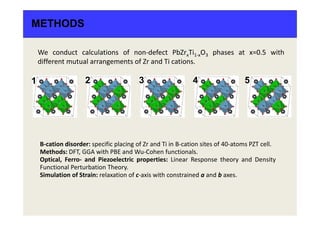
We conduct calculations of non-defect PbZrxTi1-xO3 phases at x=0.5 with
different mutual arrangements of Zr and Ti cations.
B-cation disorder: specific placing of Zr and Ti in B-cation sites of 40-atoms PZT cell.
Methods: DFT, GGA with PBE and Wu-Cohen functionals.
Optical, Ferro- and Piezoelectric properties: Linear Response theory and Density
Functional Perturbation Theory.
Simulation of Strain: relaxation of c-axis with constrained a and b axes.
21 43 5
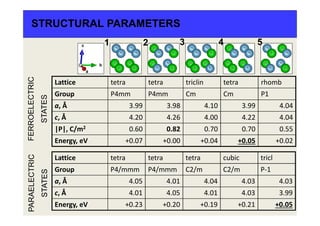
STRUCTURAL PARAMETERS
21 43 5
Lattice tetra tetra triclin tetra rhomb
Group P4mm P4mm Cm Cm P1
a, Å 3.99 3.98 4.10 3.99 4.04
c, Å 4.20 4.26 4.00 4.22 4.04
|P|, C/m2 0.60 0.82 0.70 0.70 0.55
Energy, eV +0.07 +0.00 +0.04 +0.05 +0.02
Lattice tetra tetra tetra cubic tricl
Group P4/mmm P4/mmm C2/m C2/m P-1
a, Å 4.05 4.01 4.04 4.03 4.03
c, Å 4.01 4.05 4.01 4.03 3.99
Energy, eV +0.23 +0.20 +0.19 +0.21 +0.05
FERROELECTRIC
STATES
PARAELECTRIC
STATES
OPTICAL AND ELECTRONIC STRUCTURE
PROPERTIES
We have found a strong intermixing of Zr
and Ti d-states in our structures which
can give optical applications while PZT is
doped by non-isovalent cations
Optical band gap Eg~3.5 eV (from
optical spectra) does not show
significant dependence on Zr/Ti
arrangement, in agreement with
experimental results for thin films[*]
* M.P. Moret, M.A.C. Devillers, K. Wörhoff, P.K. Larsen, Journal of Applied Physics 92, 468 (2002).
Top of VB: oxygen 2p-states
Bottom of CB: Ti, Zr d-states
HOMO, #5 (FE) LUMO, #5 (FE)
1 2 3 4 5
PIEZOELECTRIC PROPERTIES
e15 10.65 3.66 0.37 7.46 0.49
e31 0.27 0.37 -2.00 0.37 -0.35
e33 4.11 3.94 7.07 4.17 8.45
ε11 488.23 126.56 56.87 375.40 79.59
ε33 13.77 13.94 136.53 14.47 79.93
|P| 0.60 0.82 0.70 0.70 0.55
Pdirection [001] [001] [552] [001] [111]
tetra tetra triclin tetra rhomb
Piezoelectric coefficients, C/m2
Static dielectric permittivity
Spontaneous polarization, C/m2
Exp:
e33=11.9 Cm2
Low temperature,
pylycrystal Zr/Ti
50:50 *
Exp:
|P|=0.75 Cm2
single domain
crystal **
* Z. Q. Zhuang, M. J. Haun, S. J. Jang, and L. E. Cross, 6th IEEE International Symposium on
the Applications of Ferroelectrics, 1986, p. 394.
21 43 5
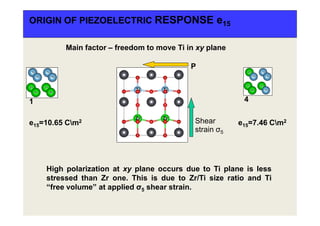
ORIGIN OF PIEZOELECTRIC RESPONSE e15
High polarization at xy plane occurs due to Ti plane is less
stressed than Zr one. This is due to Zr/Ti size ratio and Ti
“free volume” at applied σ5 shear strain.
1
Shear
strain σ5
P
e15=10.65 Cm2
Main factor – freedom to move Ti in xy plane
4
e15=7.46 Cm2
5/27/2014
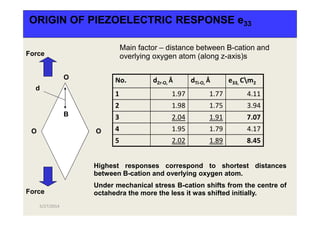
ORIGIN OF PIEZOELECTRIC RESPONSE e33
B
O
d
Force
Force
OO
No. dZr-O, Å dTi-O, Å e33, Cm2
1 1.97 1.77 4.11
2 1.98 1.75 3.94
3 2.04 1.91 7.07
4 1.95 1.79 4.17
5 2.02 1.89 8.45
Highest responses correspond to shortest distances
between B-cation and overlying oxygen atom.
Under mechanical stress B-cation shifts from the centre of
octahedra the more the less it was shifted initially.
Main factor – distance between B-cation and
overlying oxygen atom (along z-axis)s
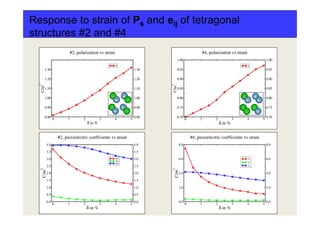
Response to strain of Ps and eij of tetragonal
structures #2 and #4
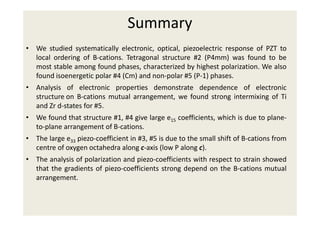
Summary
• We studied systematically electronic, optical, piezoelectric response of PZT to
local ordering of B-cations. Tetragonal structure #2 (P4mm) was found to be
most stable among found phases, characterized by highest polarization. We also
found isoenergetic polar #4 (Cm) and non-polar #5 (P-1) phases.
• Analysis of electronic properties demonstrate dependence of electronic
structure on B-cations mutual arrangement, we found strong intermixing of Ti
and Zr d-states for #5.
• We found that structure #1, #4 give large e15 coefficients, which is due to plane-
to-plane arrangement of B-cations.
• The large e33 piezo-coefficient in #3, #5 is due to the small shift of B-cations from
centre of oxygen octahedra along c-axis (low P along c).
• The analysis of polarization and piezo-coefficients with respect to strain showed
that the gradients of piezo-coefficients strong depend on the B-cations mutual
arrangement.
5/27/2014
Acknowledgements
We are thankful to Markus Gain (National Physical
Laboratory) and Andrew Mysovsky (Irkutsk State
Technical University) for important advices and quite
useful discussions.
The calculations were performed by HPC facilities of
Legion (UK), Fock (Irkutsk, RUSSIA).

cBodanov emrs2012

  • 1.
    The effect ofmutual arrangement of B- cations on electronic, optical and piezoelectric properties of strained PbZrxTi1-xO3 (PZT) Alexander Bogdanov1,2, Anna Kimmel3,4 1. A.P. Vinogradov Institute of Geochemistry SB RAS, Irkutsk, RUSSIA 2. Irkutsk State Technical University, Irkutsk, RUSSIA 3. National Physical Laboratory, Teddington, TW11 0LW, UK 4. University College London, Gower St., WC1E 6BT, UK
  • 2.
    INTRODUCTION PZT is solidsolution perovskite A(BB’)O3. The material demonstrates excellent piezoelectric properties and is widely used in ferro- and piezo- applications. Macroscopic phase and macroscopic properties of PZT depend on the ratio of B- cations (i.e. x) and their mutual arrangement. In this work we study the correlation of local arrangement of B-cations with macroscopic phase, piezoelectric and optical properties of PZT
  • 3.
    METHODS We conduct calculationsof non-defect PbZrxTi1-xO3 phases at x=0.5 with different mutual arrangements of Zr and Ti cations. B-cation disorder: specific placing of Zr and Ti in B-cation sites of 40-atoms PZT cell. Methods: DFT, GGA with PBE and Wu-Cohen functionals. Optical, Ferro- and Piezoelectric properties: Linear Response theory and Density Functional Perturbation Theory. Simulation of Strain: relaxation of c-axis with constrained a and b axes. 21 43 5
  • 4.
    STRUCTURAL PARAMETERS 21 435 Lattice tetra tetra triclin tetra rhomb Group P4mm P4mm Cm Cm P1 a, Å 3.99 3.98 4.10 3.99 4.04 c, Å 4.20 4.26 4.00 4.22 4.04 |P|, C/m2 0.60 0.82 0.70 0.70 0.55 Energy, eV +0.07 +0.00 +0.04 +0.05 +0.02 Lattice tetra tetra tetra cubic tricl Group P4/mmm P4/mmm C2/m C2/m P-1 a, Å 4.05 4.01 4.04 4.03 4.03 c, Å 4.01 4.05 4.01 4.03 3.99 Energy, eV +0.23 +0.20 +0.19 +0.21 +0.05 FERROELECTRIC STATES PARAELECTRIC STATES
  • 5.
    OPTICAL AND ELECTRONICSTRUCTURE PROPERTIES We have found a strong intermixing of Zr and Ti d-states in our structures which can give optical applications while PZT is doped by non-isovalent cations Optical band gap Eg~3.5 eV (from optical spectra) does not show significant dependence on Zr/Ti arrangement, in agreement with experimental results for thin films[*] * M.P. Moret, M.A.C. Devillers, K. Wörhoff, P.K. Larsen, Journal of Applied Physics 92, 468 (2002). Top of VB: oxygen 2p-states Bottom of CB: Ti, Zr d-states HOMO, #5 (FE) LUMO, #5 (FE)
  • 6.
    1 2 34 5 PIEZOELECTRIC PROPERTIES e15 10.65 3.66 0.37 7.46 0.49 e31 0.27 0.37 -2.00 0.37 -0.35 e33 4.11 3.94 7.07 4.17 8.45 ε11 488.23 126.56 56.87 375.40 79.59 ε33 13.77 13.94 136.53 14.47 79.93 |P| 0.60 0.82 0.70 0.70 0.55 Pdirection [001] [001] [552] [001] [111] tetra tetra triclin tetra rhomb Piezoelectric coefficients, C/m2 Static dielectric permittivity Spontaneous polarization, C/m2 Exp: e33=11.9 Cm2 Low temperature, pylycrystal Zr/Ti 50:50 * Exp: |P|=0.75 Cm2 single domain crystal ** * Z. Q. Zhuang, M. J. Haun, S. J. Jang, and L. E. Cross, 6th IEEE International Symposium on the Applications of Ferroelectrics, 1986, p. 394. 21 43 5
  • 7.
    ORIGIN OF PIEZOELECTRICRESPONSE e15 High polarization at xy plane occurs due to Ti plane is less stressed than Zr one. This is due to Zr/Ti size ratio and Ti “free volume” at applied σ5 shear strain. 1 Shear strain σ5 P e15=10.65 Cm2 Main factor – freedom to move Ti in xy plane 4 e15=7.46 Cm2
  • 8.
    5/27/2014 ORIGIN OF PIEZOELECTRICRESPONSE e33 B O d Force Force OO No. dZr-O, Å dTi-O, Å e33, Cm2 1 1.97 1.77 4.11 2 1.98 1.75 3.94 3 2.04 1.91 7.07 4 1.95 1.79 4.17 5 2.02 1.89 8.45 Highest responses correspond to shortest distances between B-cation and overlying oxygen atom. Under mechanical stress B-cation shifts from the centre of octahedra the more the less it was shifted initially. Main factor – distance between B-cation and overlying oxygen atom (along z-axis)s
  • 9.
    Response to strainof Ps and eij of tetragonal structures #2 and #4
  • 10.
    Summary • We studiedsystematically electronic, optical, piezoelectric response of PZT to local ordering of B-cations. Tetragonal structure #2 (P4mm) was found to be most stable among found phases, characterized by highest polarization. We also found isoenergetic polar #4 (Cm) and non-polar #5 (P-1) phases. • Analysis of electronic properties demonstrate dependence of electronic structure on B-cations mutual arrangement, we found strong intermixing of Ti and Zr d-states for #5. • We found that structure #1, #4 give large e15 coefficients, which is due to plane- to-plane arrangement of B-cations. • The large e33 piezo-coefficient in #3, #5 is due to the small shift of B-cations from centre of oxygen octahedra along c-axis (low P along c). • The analysis of polarization and piezo-coefficients with respect to strain showed that the gradients of piezo-coefficients strong depend on the B-cations mutual arrangement.
  • 11.
    5/27/2014 Acknowledgements We are thankfulto Markus Gain (National Physical Laboratory) and Andrew Mysovsky (Irkutsk State Technical University) for important advices and quite useful discussions. The calculations were performed by HPC facilities of Legion (UK), Fock (Irkutsk, RUSSIA).