CB 312
System Analysis for Construction
Engineers
Dr. Mohamed Saeid Eid
Fall ‐ 2018
Resume
Dr. Mohamed Saeid Eid
• BS and MS in construction Engineering, AAST (2008, and 2012,
respectively)
• PhD in Civil and Environmental Engineering, Construction focus,
University of Tennessee, Knoxville (2017)
Research Interest
• Multi‐objective optimization
• Repetitive Activities Scheduling
• Site layout
• Simulation
• Disaster Recovery and Community Vulnerability
• Traffic Behavior
• Construction performance
• Game Theory
• Traffic behavior
• Construction bidding
• Collaborative construction projects
Syllabus
• What do you expect to learn?
• Mathematical Model
• Optimization using Linear Programming
• Decision Analysis and Game Theory
• What do I expect from my students?
• Attention and participation
• Curiosity to learn
• Research and readings
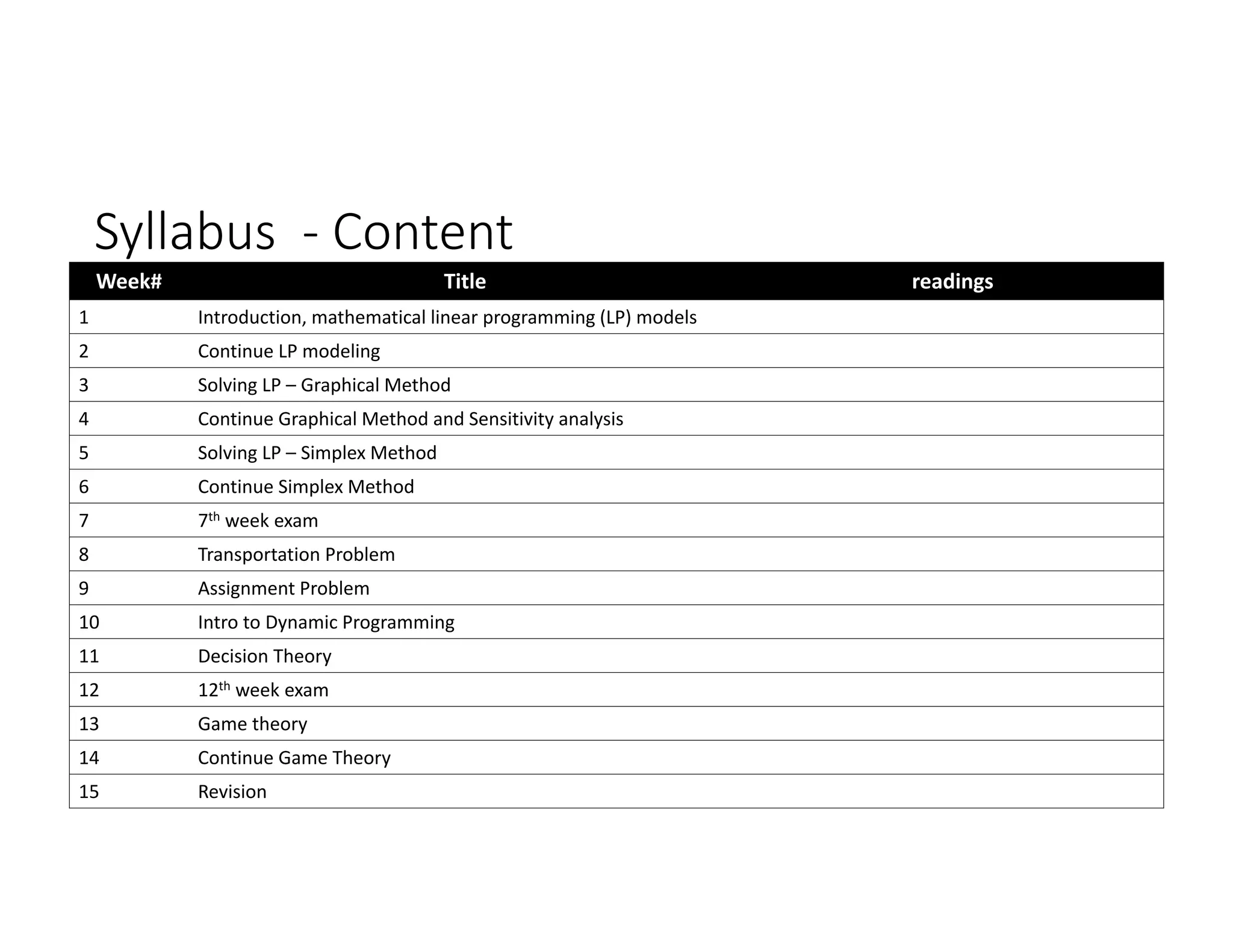
Syllabus ‐ Content
Week# Title readings
1 Introduction, mathematical linear programming (LP) models
2 Continue LP modeling
3 Solving LP – Graphical Method
4 Continue Graphical Method and Sensitivity analysis
5 Solving LP – Simplex Method
6 Continue Simplex Method
7 7th week exam
8 Transportation Problem
9 Assignment Problem
10 Intro to Dynamic Programming
11 Decision Theory
12 12th week exam
13 Game theory
14 Continue Game Theory
15 Revision
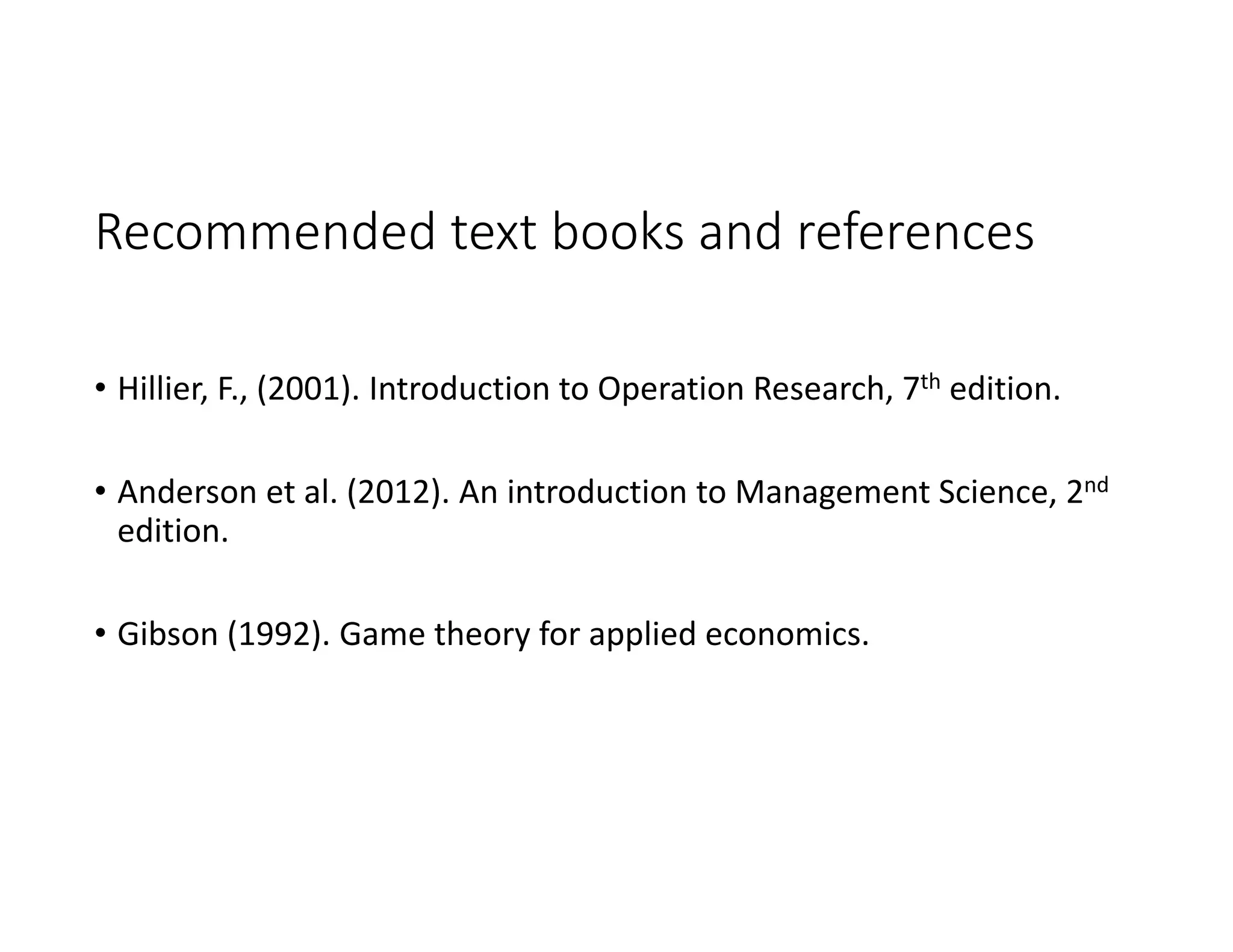
Recommended text books and references
• Hillier, F., (2001). Introduction to Operation Research, 7th edition.
• Anderson et al. (2012). An introduction to Management Science, 2nd
edition.
• Gibson (1992). Game theory for applied economics.
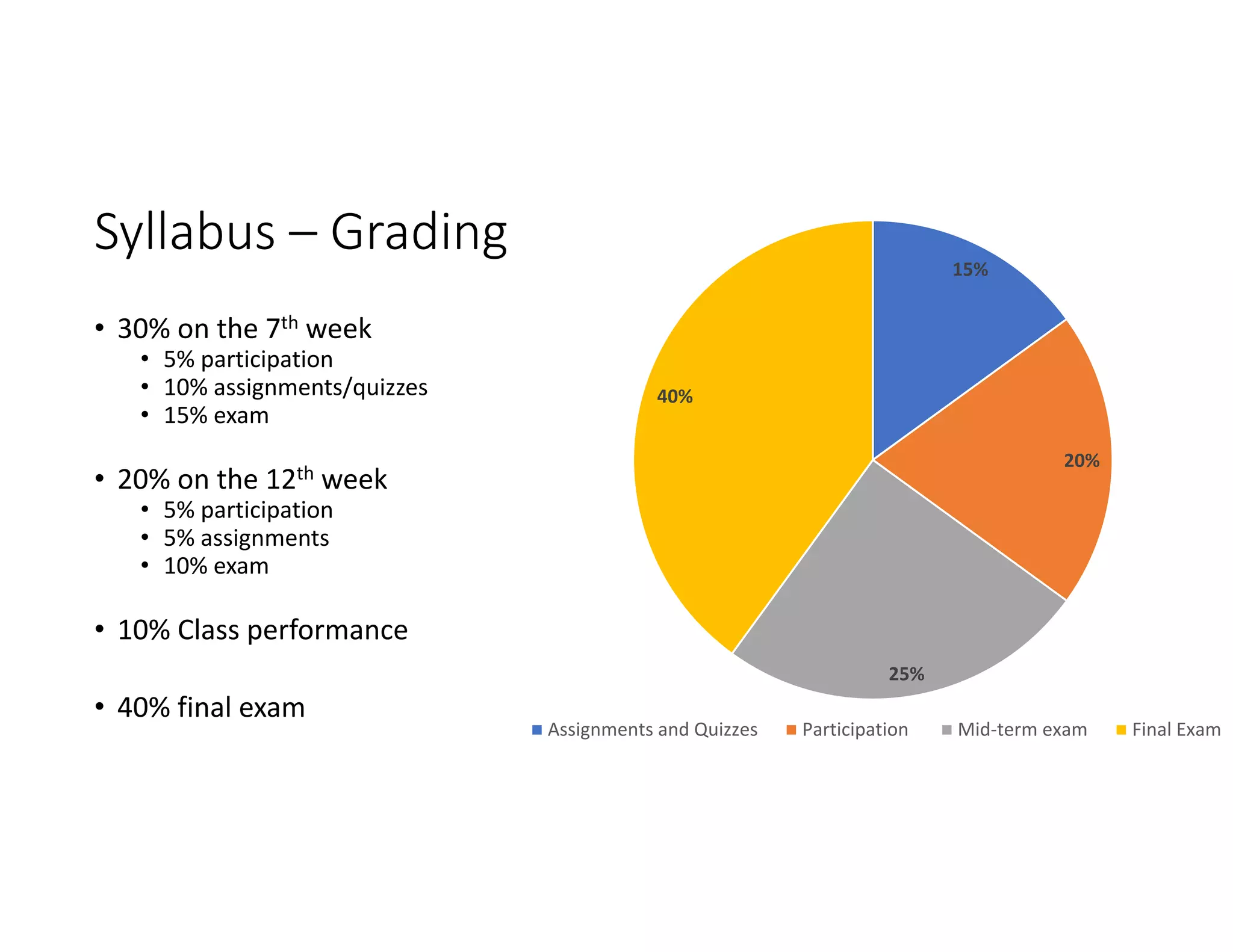
Syllabus – Grading
• 30% on the 7th week
• 5% participation
• 10% assignments/quizzes
• 15% exam
• 20% on the 12th week
• 5% participation
• 5% assignments
• 10% exam
• 10% Class performance
• 40% final exam
15%
20%
25%
40%
Assignments and Quizzes Participation Mid‐term exam Final Exam
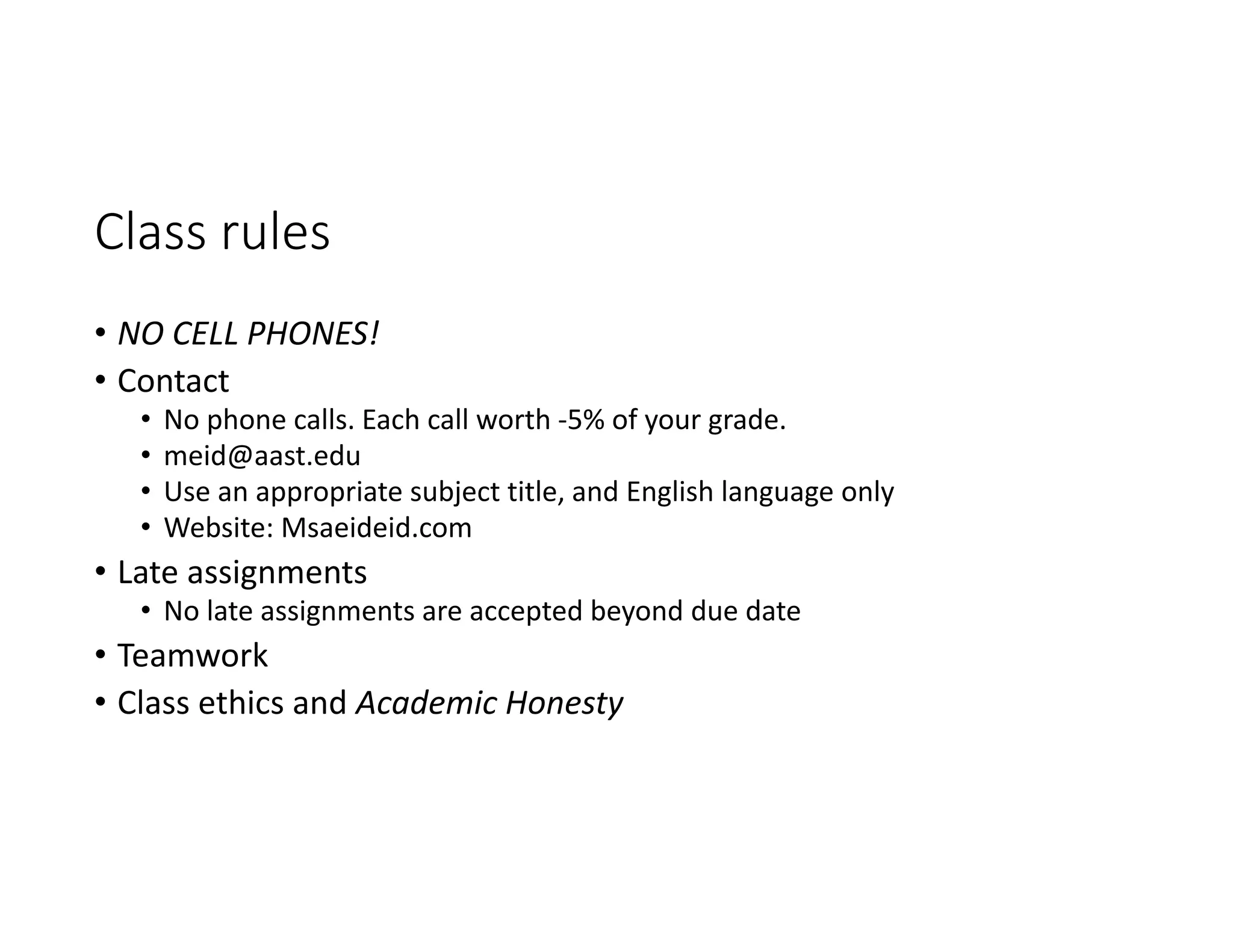
Class rules
• NO CELL PHONES!
• Contact
• No phone calls. Each call worth ‐5% of your grade.
• meid@aast.edu
• Use an appropriate subject title, and English language only
• Website: Msaeideid.com
• Late assignments
• No late assignments are accepted beyond due date
• Teamwork
• Class ethics and Academic Honesty
Class contacts and Internet Check
https://goo.gl/mo6xYs
History
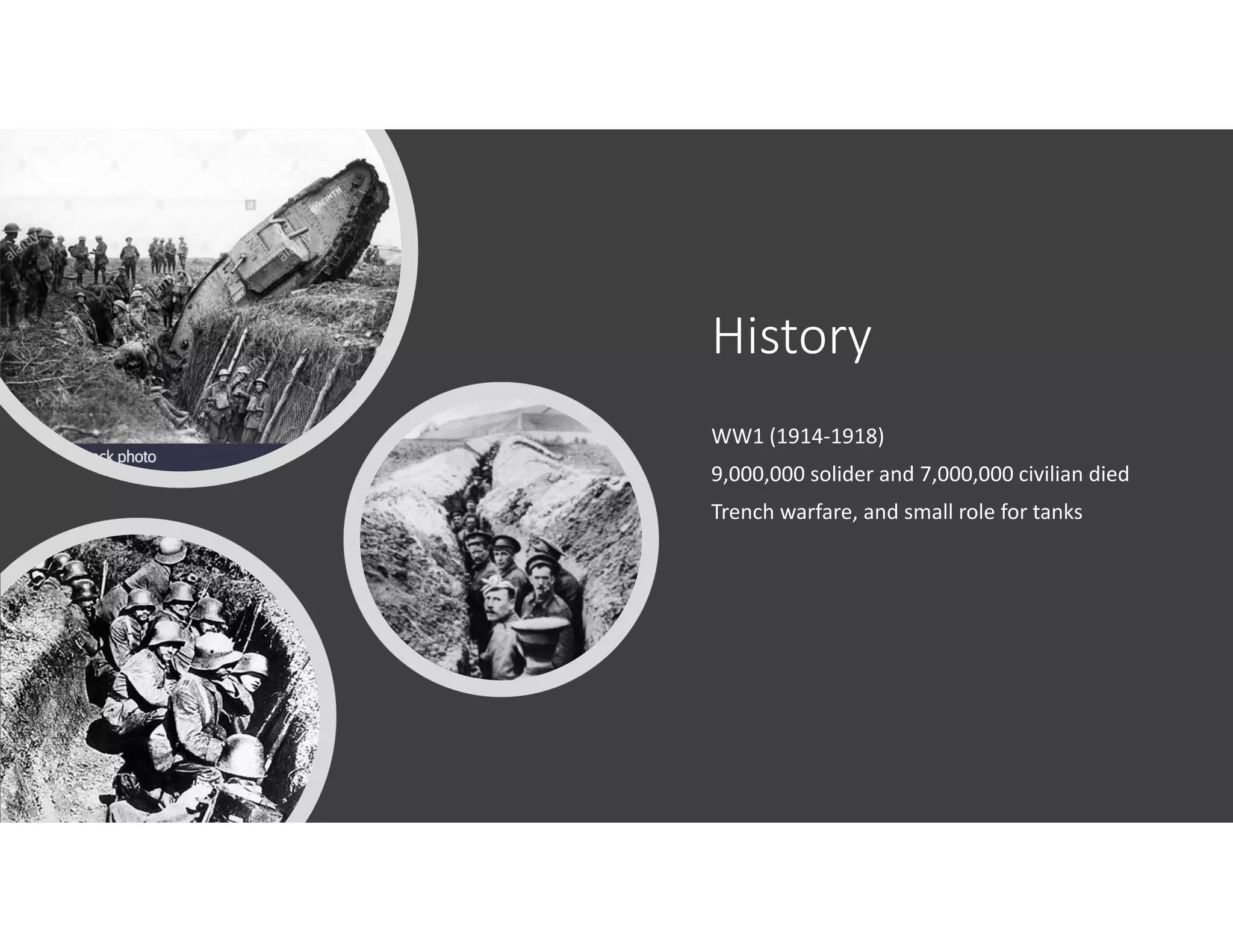
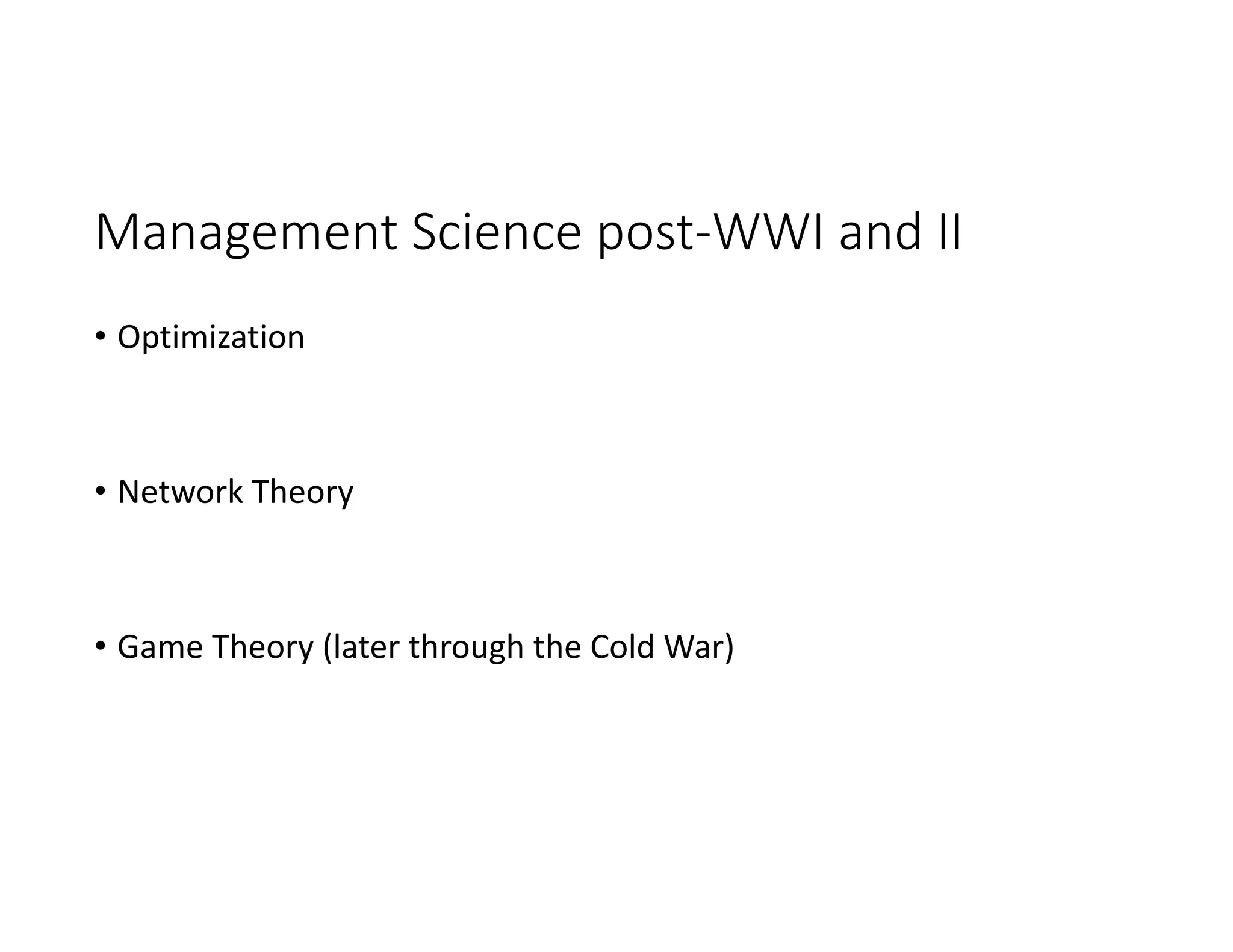
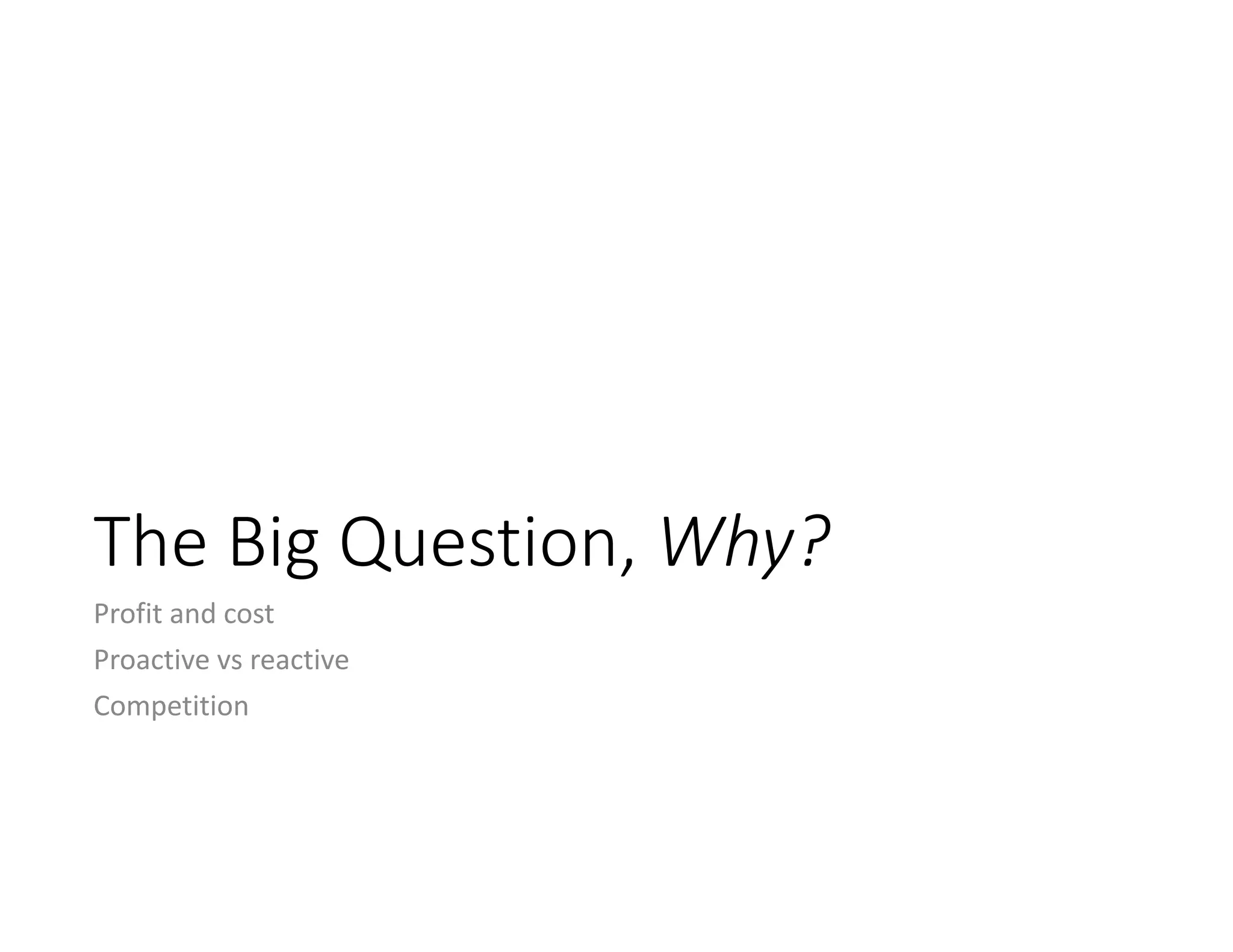
WW1 (1914‐1918)
9,000,000 solider and 7,000,000 civilian died
Trench warfare, and small role for tanks
History
WW2 (1939‐1945)
16,000,000 soldiers and 45,000,000 civilian
died
Bigger roles for tanks, airships, naval fleets and
advancements in technologies
Management Science post‐WWI and II
• Optimization
• Network Theory
• Game Theory (later through the Cold War)
The Big Question, Why?
Profit and cost
Proactive vs reactive
Competition
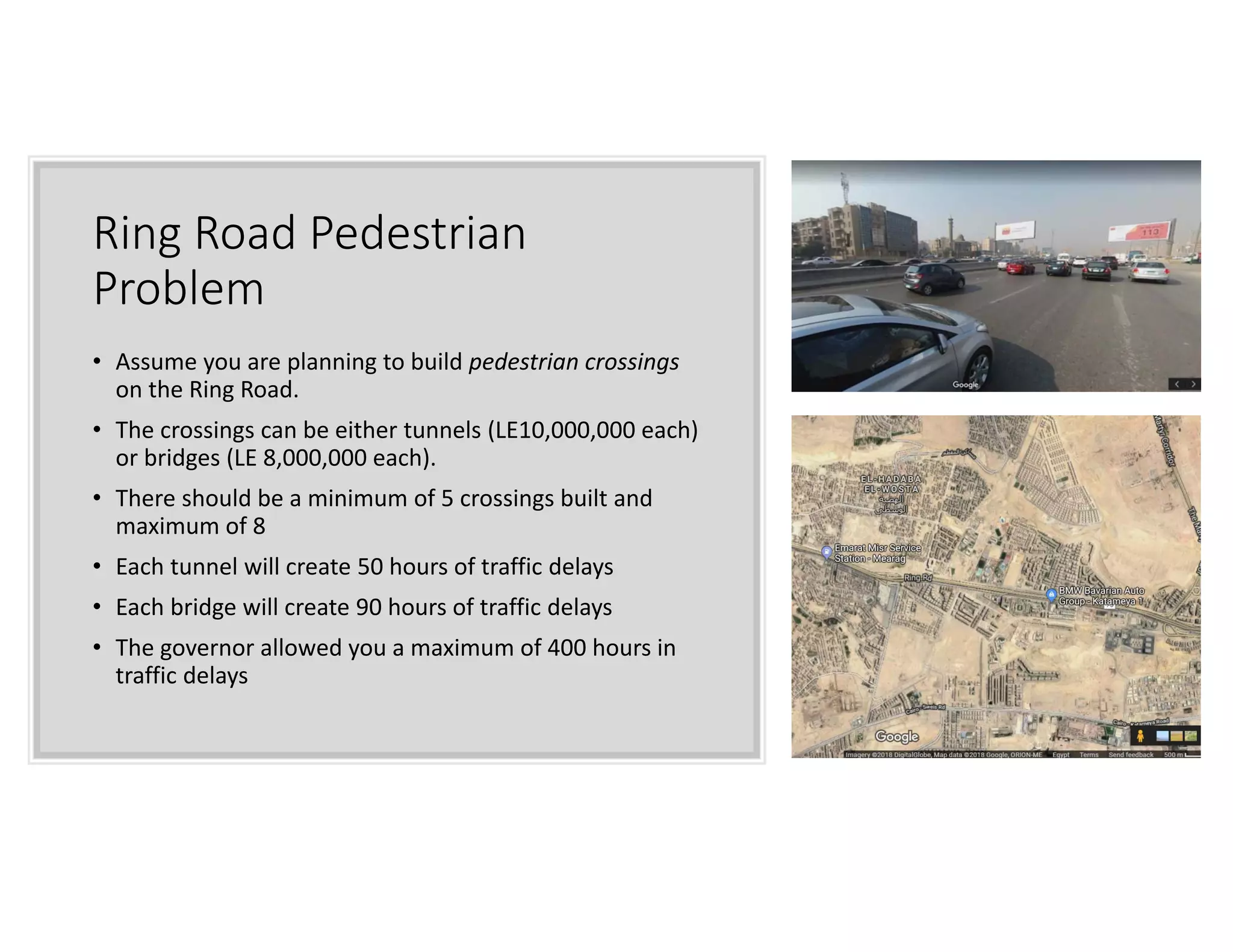
Ring Road Pedestrian
Problem
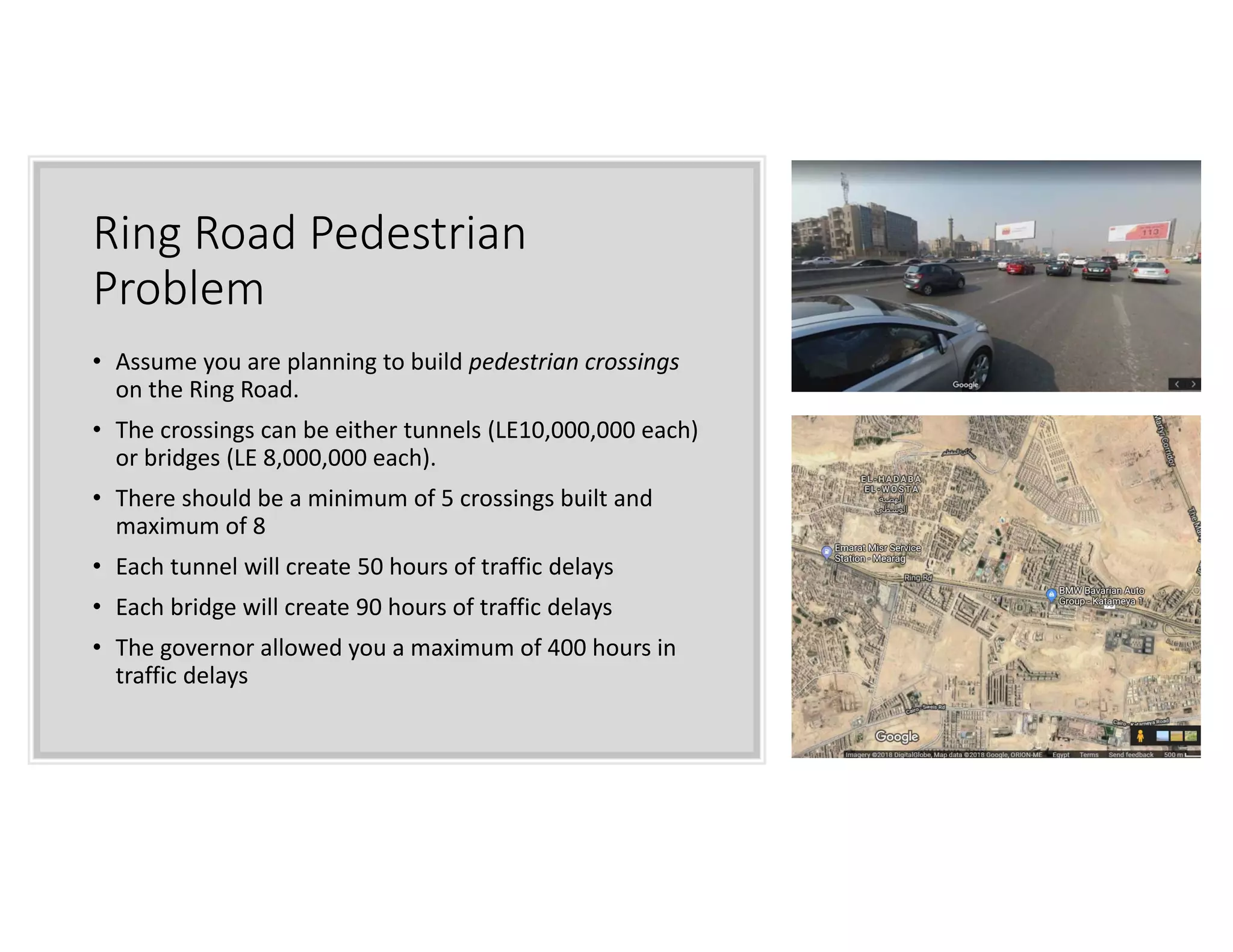
• Assume you are planning to build pedestrian crossings
on the Ring Road.
• The crossings can be either tunnels (LE10,000,000 each)
or bridges (LE 8,000,000 each).
• There should be a minimum of 5 crossings built and
maximum of 8
• Each tunnel will create 50 hours of traffic delays
• Each bridge will create 90 hours of traffic delays
• The governor allowed you a maximum of 400 hours in
traffic delays
How to solve it?
Mathematical models ‐ represent real world problems
through a system of mathematical formulas and
expressions based on key assumptions, estimates, or
statistical analyses
Modeling and Optimization
• Why Mathematical Modeling?
F = MA
E=mc2
• Modeling Approach:
• Define the problem of interest and collect the relevant data
• Formulate the problem mathematically to represent its main parameters
Ring Road Pedestrian
Problem
• Assume you are planning to build pedestrian crossings
on the Ring Road.
• The crossings can be either tunnels (LE10,000,000 each)
or bridges (LE 8,000,000 each).
• There should be a minimum of 5 crossings built and
maximum of 8
• Each tunnel will create 50 hours of traffic delays
• Each bridge will create 90 hours of traffic delays
• The governor allowed you a maximum of 400 hours in
traffic delays
General Factors in Mathematical Modeling
• Objectives
• What is the objective of the model, and how to measure it.
• Maximization vs minimization
• Variables
• Parameters (quantities) that can be changed as part of your decision making, that
impact the objective of the model.
• Stochastic vs deterministic
• Constraints
• Limits to the variables, either cannot be less, cannot exceed or need to be equal
Ring Road Pedestrian
Problem
• Assume you are planning to build pedestrian crossings
on the Ring Road.
• The crossings can be either tunnels (LE10,000,000 each)
or bridges (LE 8,000,000 each).
• There should be a minimum of 5 crossings built and
maximum of 8
• Each tunnel will create 50 hours of traffic delays
• Each bridge will create 90 hours of traffic delays
• The governor allowed you a maximum of 400 hours in
traffic delays
Objective
Variables
Constraints
Examples
• A brick manufacturer sells two types of bricks, Clay and Cement. The
bricks cost $8 and $14 for each 1,000 brick of Clay and Cement
respectively. Each 1000 brick of Clay yields a profit of $2 while
Cement yields a profit of $3. The store owner estimates that no more
than 2,000,000 bricks will be sold every month and he does not plan
to invest more than $20,000. How many units of each type of bricks
should be made in order to maximize his monthly total profit?
Examples
• A farmer plans to mix two types of food to make a mix of low cost
feed for the animals in his farm. A bag of food A costs $10 and
contains 40 units of proteins, 20 units of minerals and 10 units of
vitamins. A bag of food B costs $12 and contains 30 units of proteins,
20 units of minerals and 30 units of vitamins. How many bags of food
A and B should the consumed by the animals each day in order to
meet the minimum daily requirements of 150 units of proteins, 90
units of minerals and 60 units of vitamins at a minimum cost?
www.analyzemath.com
Examples
• John has $20,000 to invest in three funds F1, F2 and F3. Fund F1 is
offers a return of 2% and has a low risk. Fund F2 offers a return of 4%
and has a medium risk. Fund F3 offers a return of 5% but has a high
risk. To be on the safe side, John invests no more than $3000 in F3
and at least twice as much as in F1 than in F2. Assuming that the rates
hold till the end of the year, what amounts should he invest in each
fund in order to maximize the year end return?
www.analyzemath.com
Linear Programming
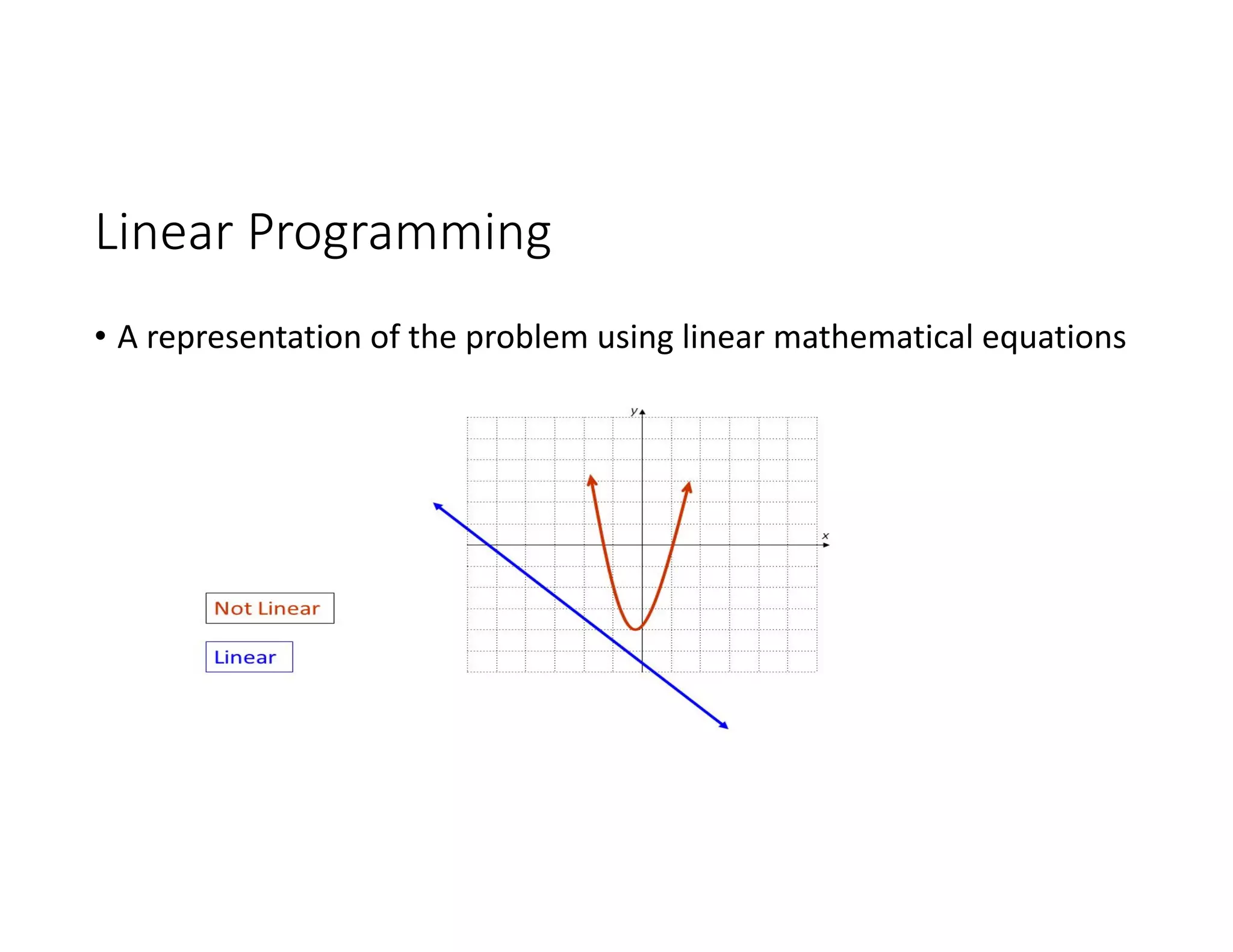
• A representation of the problem using linear mathematical equations
Linear Programming
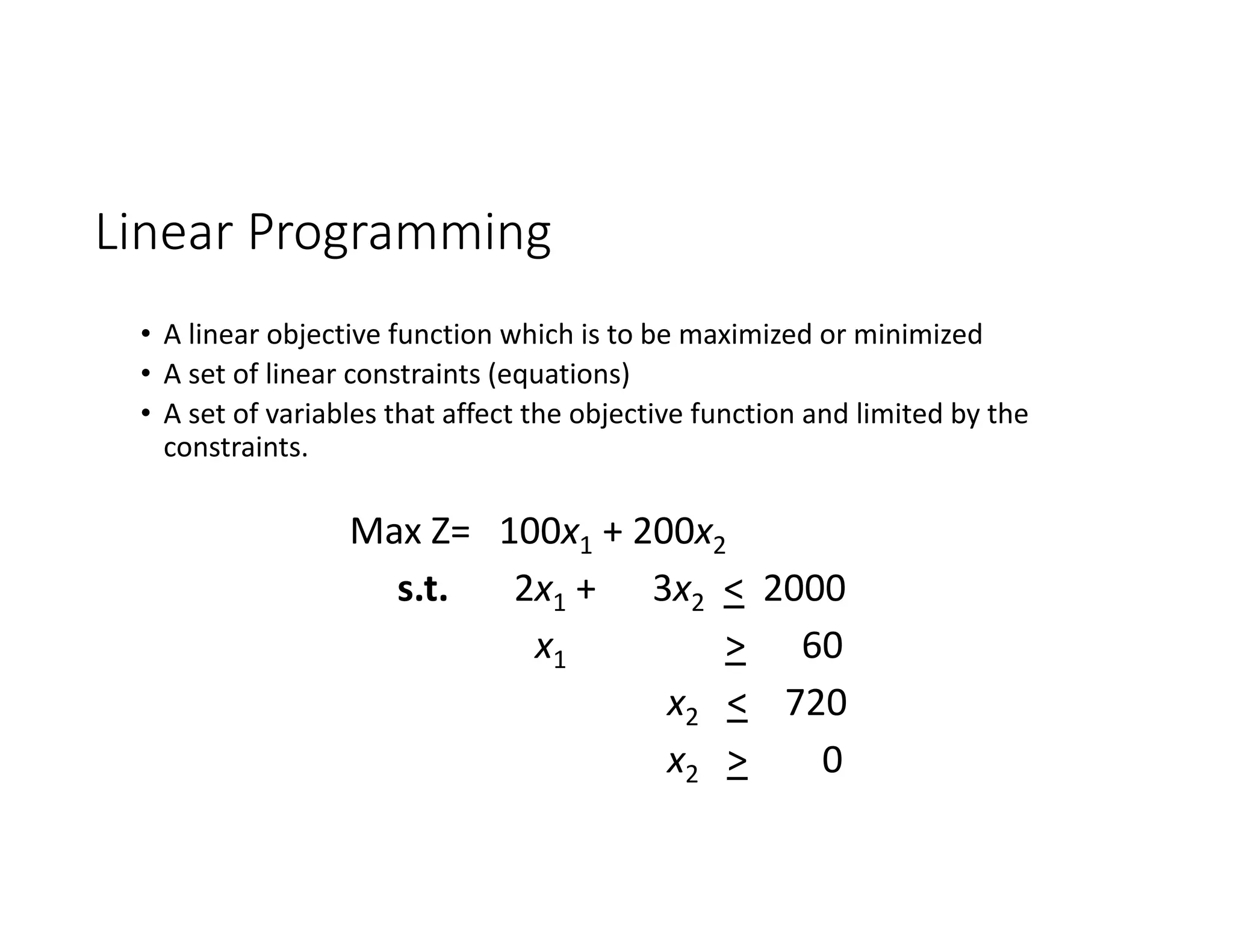
• A linear objective function which is to be maximized or minimized
• A set of linear constraints (equations)
• A set of variables that affect the objective function and limited by the
constraints.
Max Z= 100x1 + 200x2
s.t. 2x1 + 3x2 < 2000
x1 > 60
x2 < 720
x2 > 0
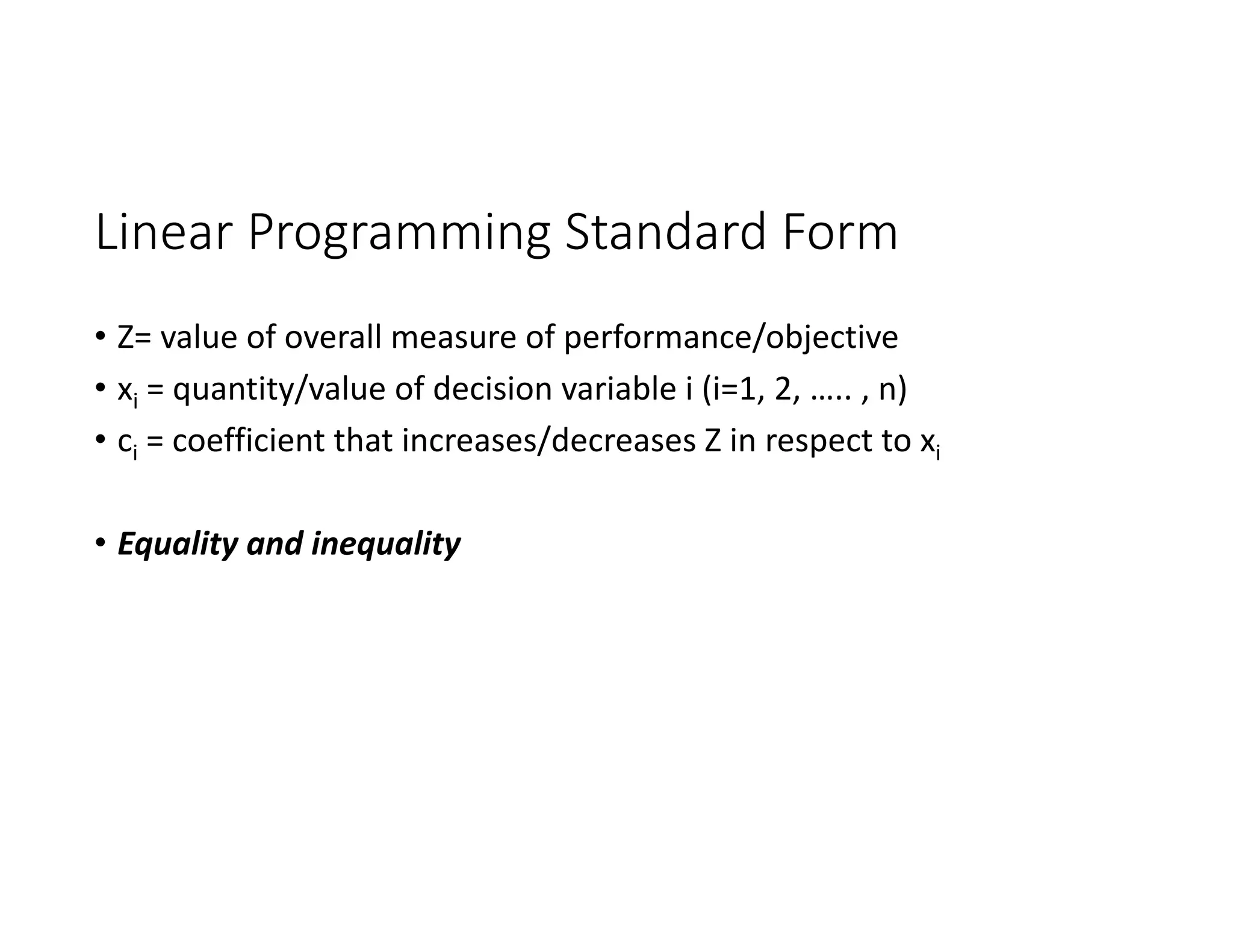
Linear Programming Standard Form
• Z= value of overall measure of performance/objective
• xi = quantity/value of decision variable i (i=1, 2, ….. , n)
• ci = coefficient that increases/decreases Z in respect to xi
• Equality and inequality
3
X
3
‐
2
X
5
+
1
X
3
Max
12
<
2
X
+
1
X
2
T.
S.
10
>
3
X
‐
2
X
3
X
3
‐
2
X
5
+
1
X
3
Max
12
<
2
X
+
1
X
2
T.
S.
10
>
3
X
1
X
‐
2
X
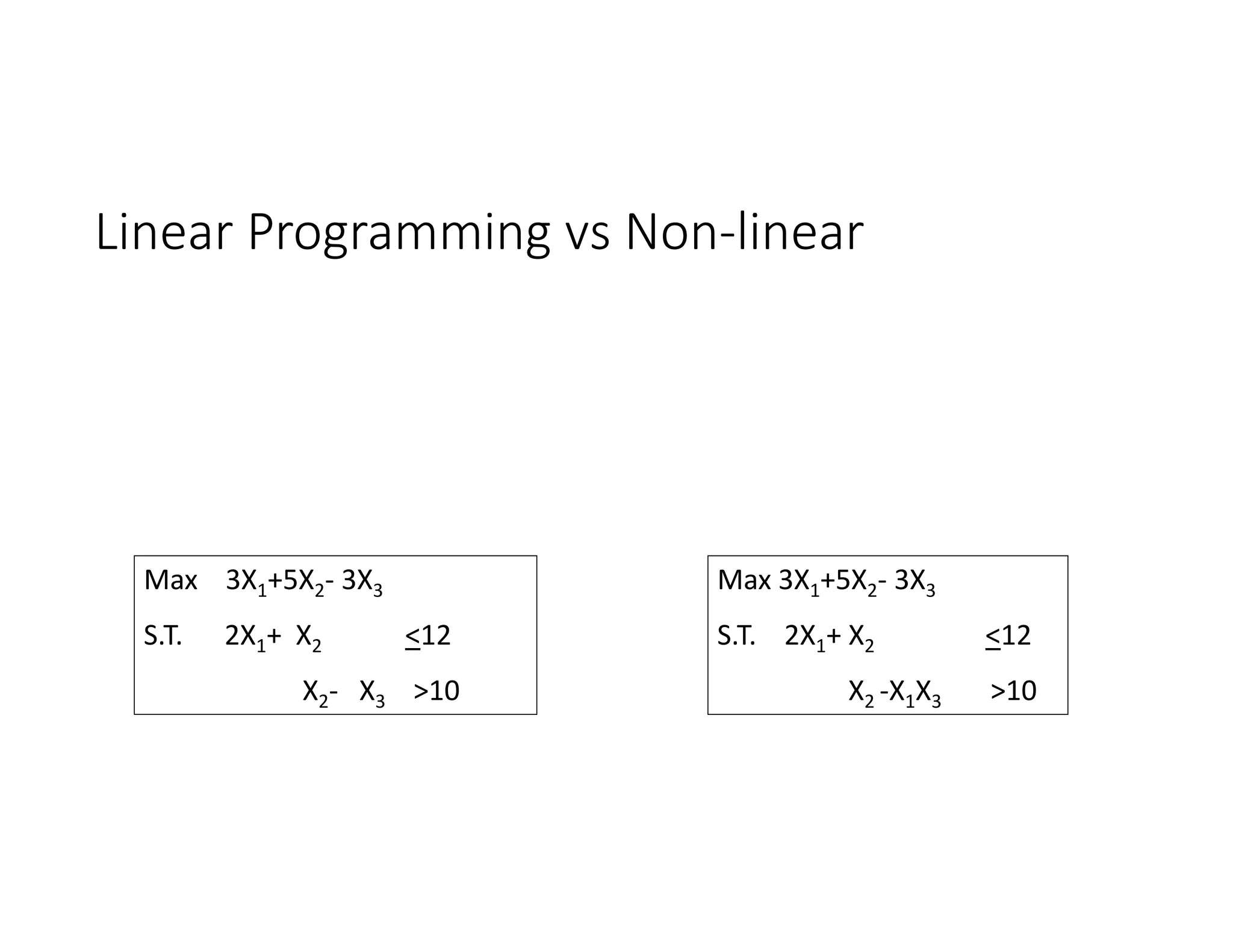
Linear Programming vs Non‐linear
Examples LP modeling
• As a site engineer, you want to procure the needed aggregates from
different gravel and sand pits around your site with minimum cost. If
each cubic meter of aggregates from the Pit A costs LE 300, while for
Pit B, costs LE 400.
• Pit A aggregates has a mix of 1/2 sand, 1/2 gravel.
• Pit B aggregates is 100% sand
• The design requires a minimum of 30% sand.
• You are required to procure a minimum of 1000 cubic meter of
aggregate.
• Formulate this problem using LP.
Examples LP Modeling
• A farmer plans to mix two types of food to make a mix of low cost
feed for the animals in his farm. A bag of food A costs $10 and
contains 40 units of proteins, 20 units of minerals and 10 units of
vitamins. A bag of food B costs $12 and contains 30 units of proteins,
20 units of minerals and 30 units of vitamins. How many bags of food
A and B should the consumed by the animals each day in order to
meet the minimum daily requirements of 150 units of proteins, 90
units of minerals and 60 units of vitamins at a minimum cost?
www.analyzemath.com
Examples LP Modeling
• John has $20,000 to invest in three funds F1, F2 and F3. Fund F1 is
offers a return of 2% and has a low risk. Fund F2 offers a return of 4%
and has a medium risk. Fund F3 offers a return of 5% but has a high
risk. To be on the safe side, John invests no more than $3000 in F3
and at least twice as much as in F1 than in F2. Assuming that the rates
hold till the end of the year, what amounts should he invest in each
fund in order to maximize the year end return?
www.analyzemath.com
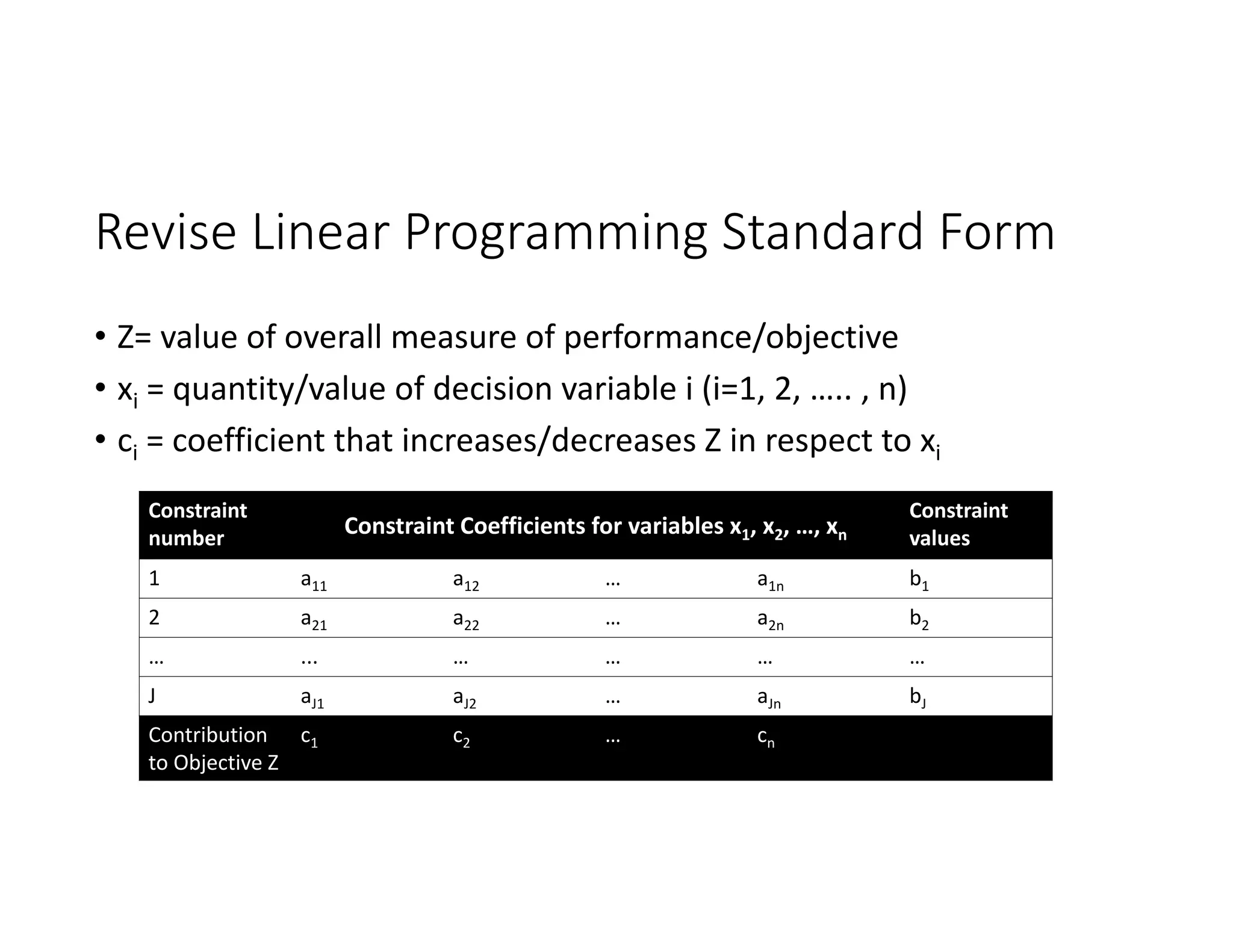
Revise Linear Programming Standard Form
• Z= value of overall measure of performance/objective
• xi = quantity/value of decision variable i (i=1, 2, ….. , n)
• ci = coefficient that increases/decreases Z in respect to xi
Constraint
number
Constraint Coefficients for variables x1, x2, …, xn
Constraint
values
1 a11 a12 … a1n b1
2 a21 a22 … a2n b2
… ... … … … …
J aJ1 aJ2 … aJn bJ
Contribution
to Objective Z
c1 c2 … cn
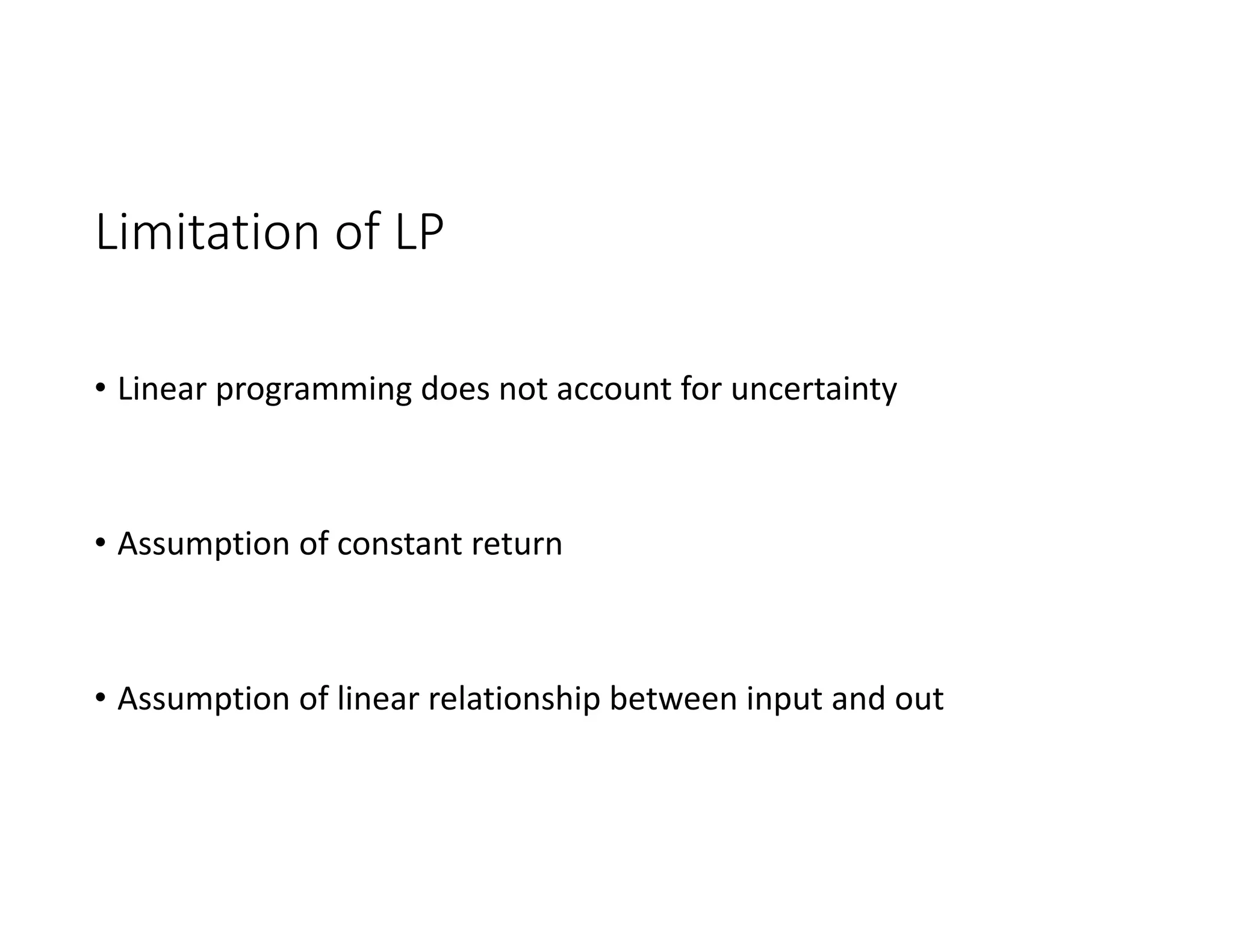
Limitation of LP
• Linear programming does not account for uncertainty
• Assumption of constant return
• Assumption of linear relationship between input and out
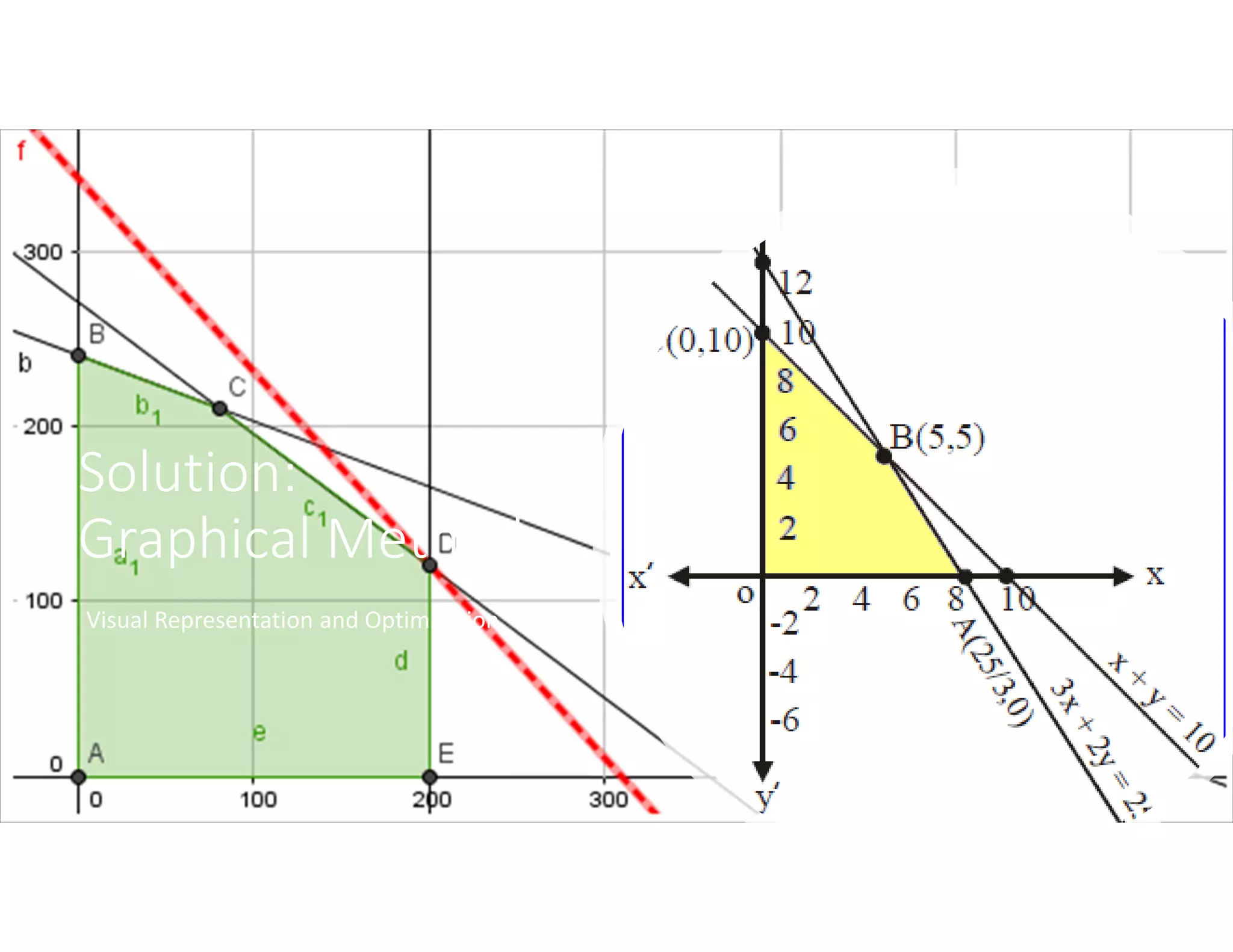
Solution:
Graphical Method
Visual Representation and Optimization
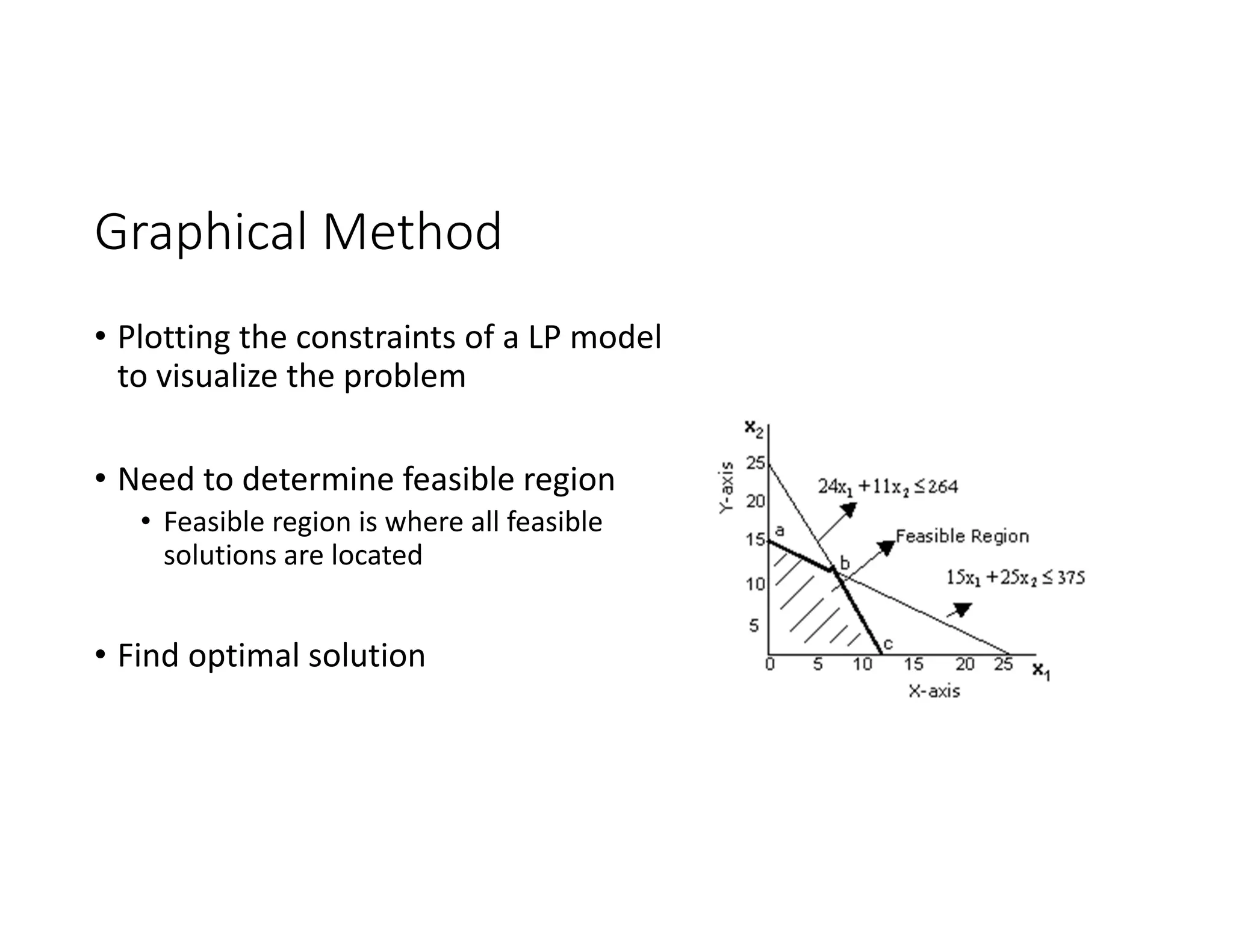
Graphical Method
• Plotting the constraints of a LP model
to visualize the problem
• Need to determine feasible region
• Feasible region is where all feasible
solutions are located
• Find optimal solution
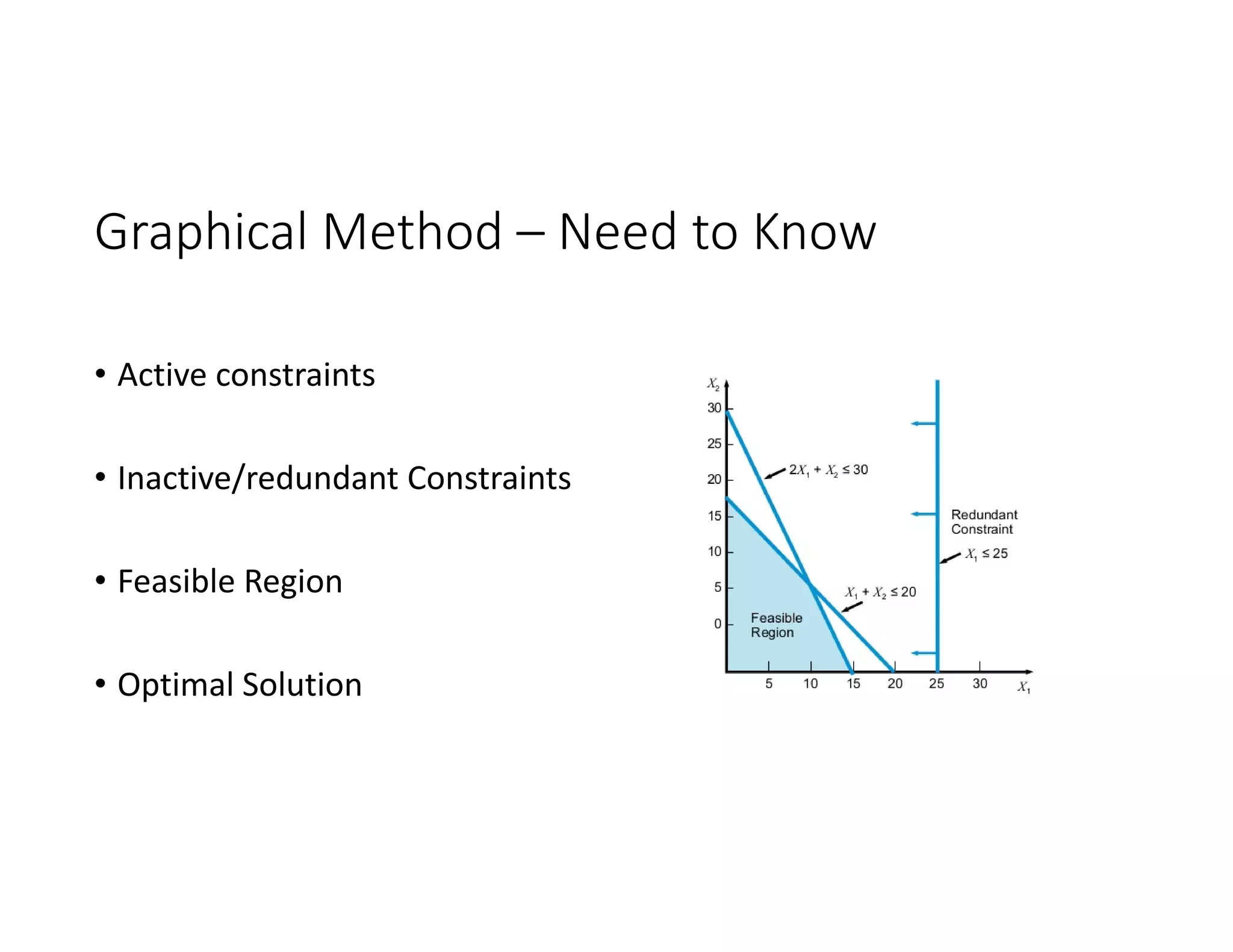
Graphical Method – Need to Know
• Active constraints
• Inactive/redundant Constraints
• Feasible Region
• Optimal Solution
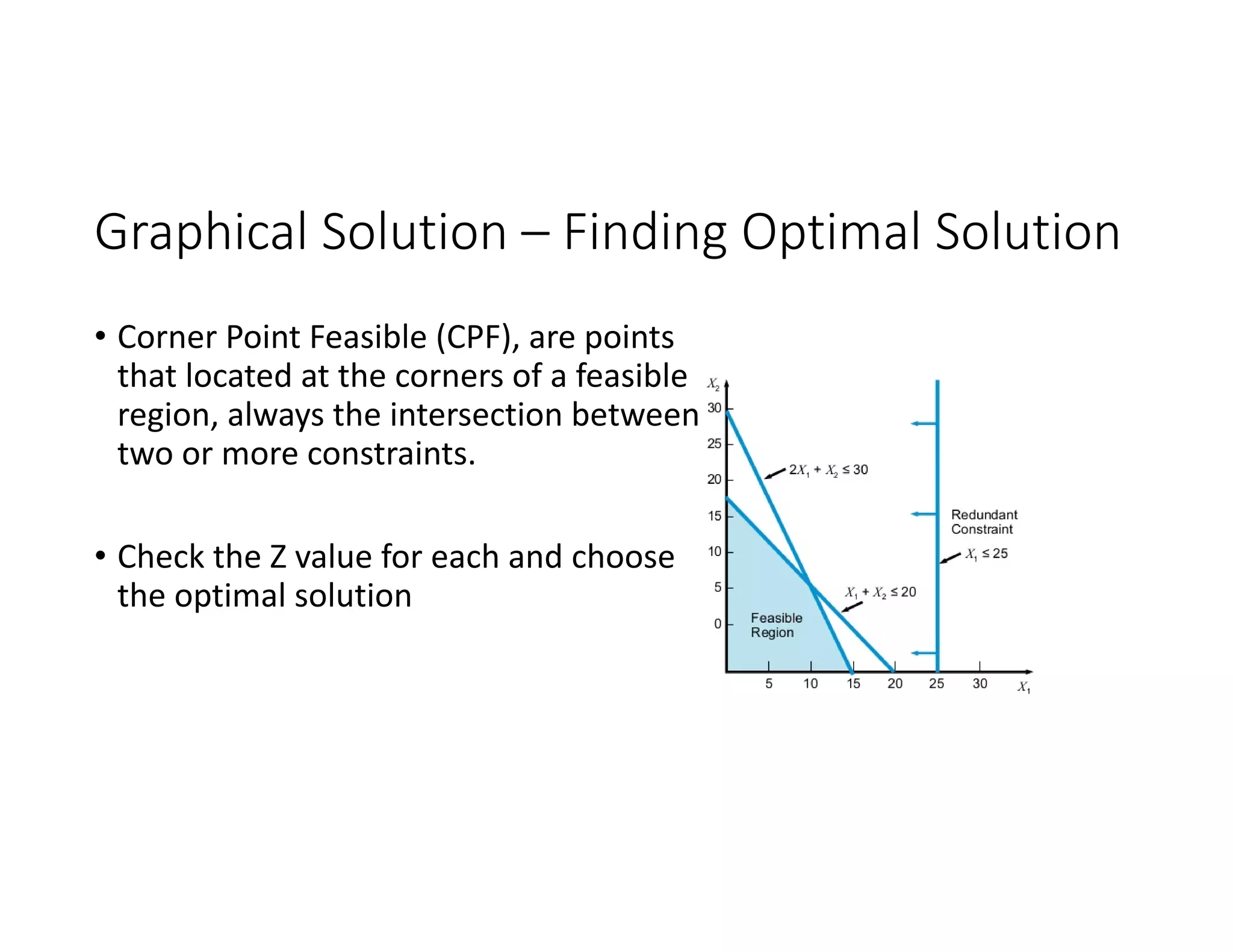
Graphical Solution – Finding Optimal Solution
• Corner Point Feasible (CPF), are points
that located at the corners of a feasible
region, always the intersection between
two or more constraints.
• Check the Z value for each and choose
the optimal solution
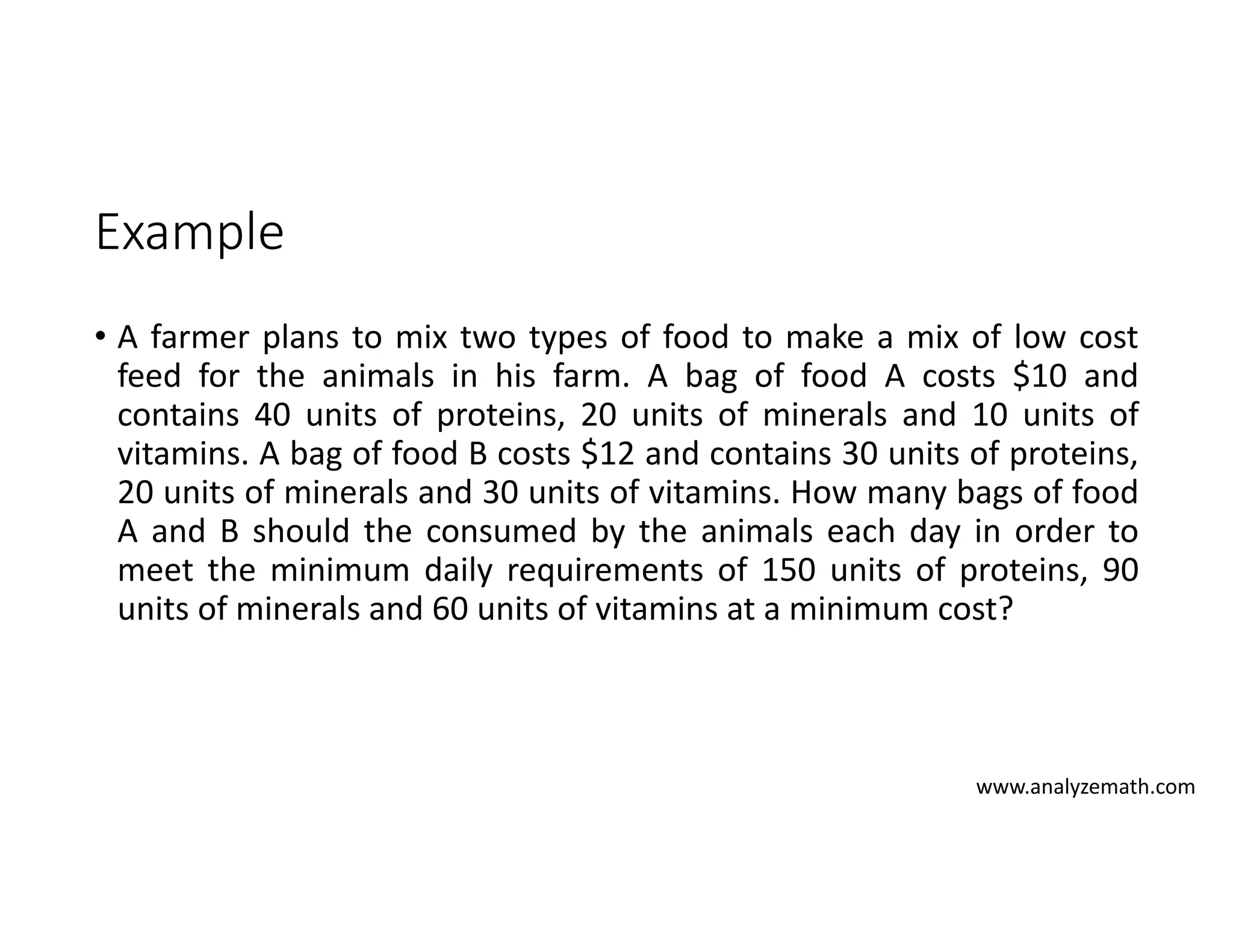
Example
• A farmer plans to mix two types of food to make a mix of low cost
feed for the animals in his farm. A bag of food A costs $10 and
contains 40 units of proteins, 20 units of minerals and 10 units of
vitamins. A bag of food B costs $12 and contains 30 units of proteins,
20 units of minerals and 30 units of vitamins. How many bags of food
A and B should the consumed by the animals each day in order to
meet the minimum daily requirements of 150 units of proteins, 90
units of minerals and 60 units of vitamins at a minimum cost?
www.analyzemath.com
Types of solutions
• Infeasible
• No solution can be found
• Unique Optimal Solution
• An optimal solution is found
• Multiple Optimal Solutions
• More than one solution provides the same optimal value
• Unbounded
• There is a solution, but there is no boundary for it
One more example
• John has $20,000 to invest in three funds F1, F2 and F3. Fund F1 is
offers a return of 2% and has a low risk. Fund F2 offers a return of 4%
and has a medium risk. Fund F3 offers a return of 5% but has a high
risk. To be on the safe side, John invests no more than $3000 in F3
and at least twice as much as in F1 than in F2. Assuming that the rates
hold till the end of the year, what amounts should he invest in each
fund in order to maximize the year end return?
www.analyzemath.com
Summary of LP and Graphical Method
• Form a linear mathematical model
• Variables
• Objectives
• Constraints
• Plot Constraints
• CFPs
• Find solution
Sensitivity Analysis
Understanding how sensitive is the optimal solution to variation
Sensitivity Analysis
• A post‐optimal solution analysis to understand if variations in the cost
coefficient will change the optimal solution.
• This will help managers understand the optimal solution properties in
case of variations and indeterministic/stochastic parameters.
Objective Function Coefficients
• Let us consider how changes in the objective function coefficients
might affect the optimal solution.
• The range of optimality for each coefficient provides the range of
values over which the current solution will remain optimal. Note that
even though the cost/price will change, the quantity (optimal
solution) won’t change
• Managers should focus on those objective coefficients that have a
narrow range of optimality and coefficients near the endpoints of the
range.
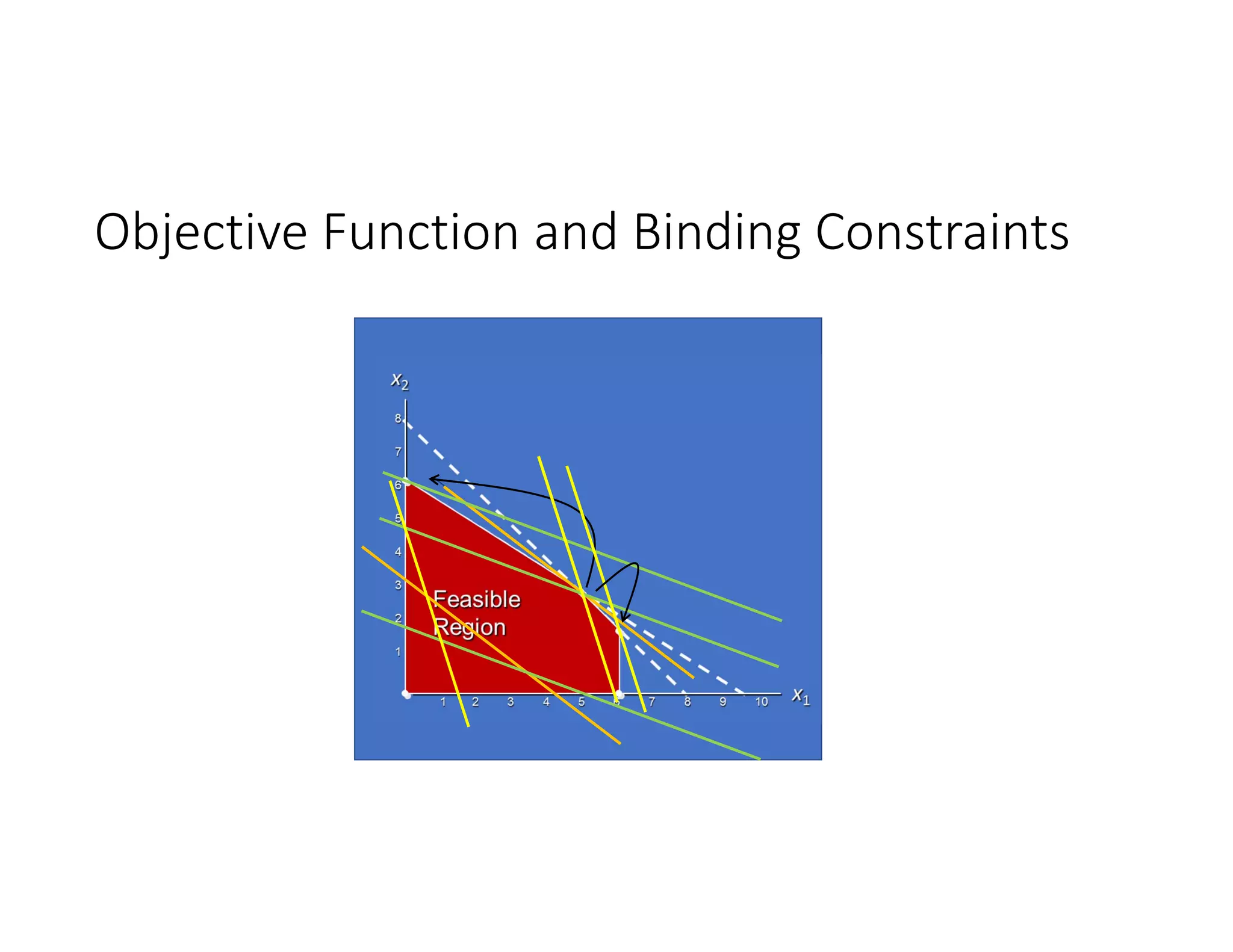
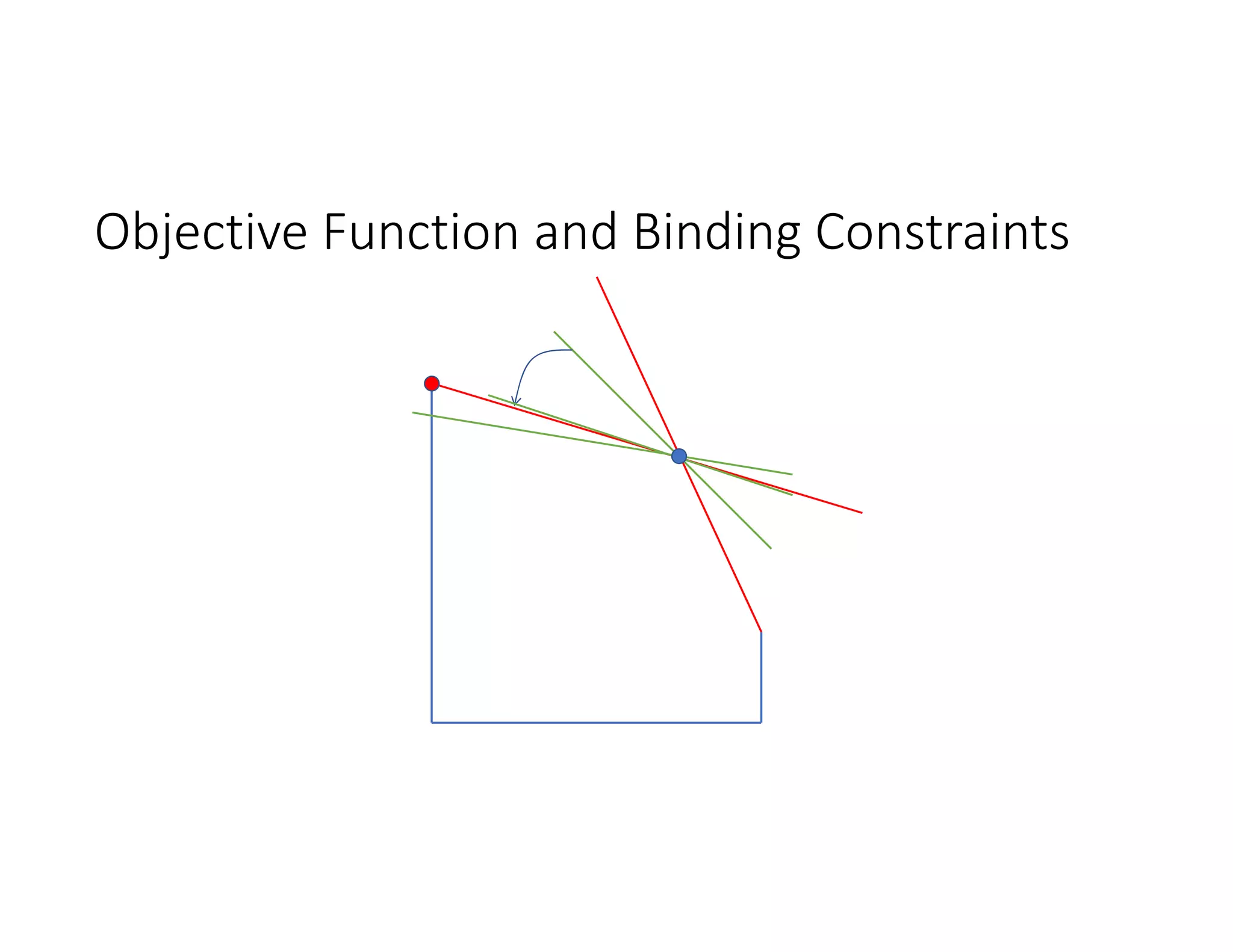
Objective Function and Binding Constraints
Range of Optimality
• Graphically, the limits of a range of optimality are found by changing
the slope of the objective function line within the limits of the slopes
of the binding constraint lines.
• The slope of an objective function line, Max c1x1 + c2x2, is ‐c1/c2, and
the slope of a constraint, a1x1 + a2x2 = b, is ‐a1/a2.
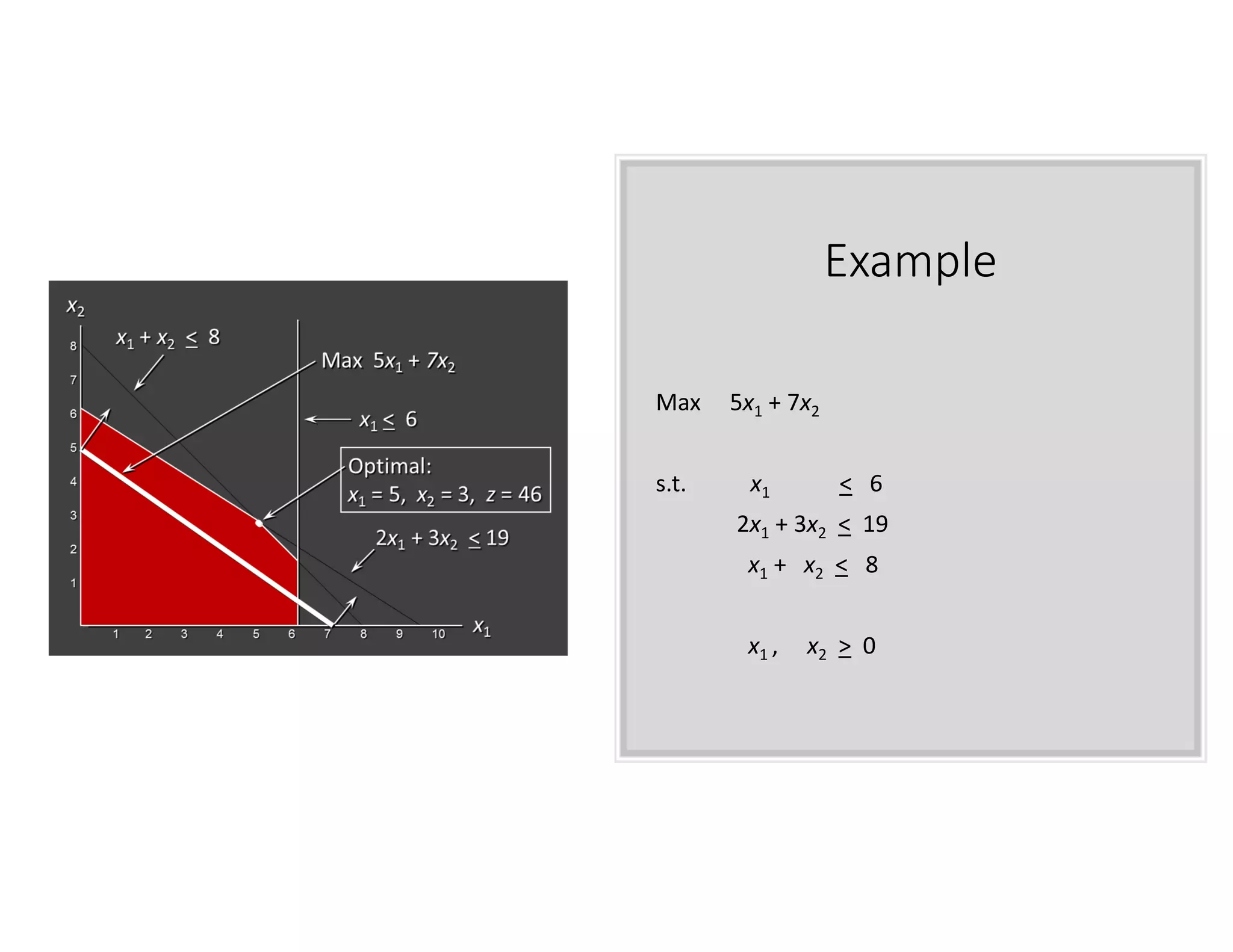
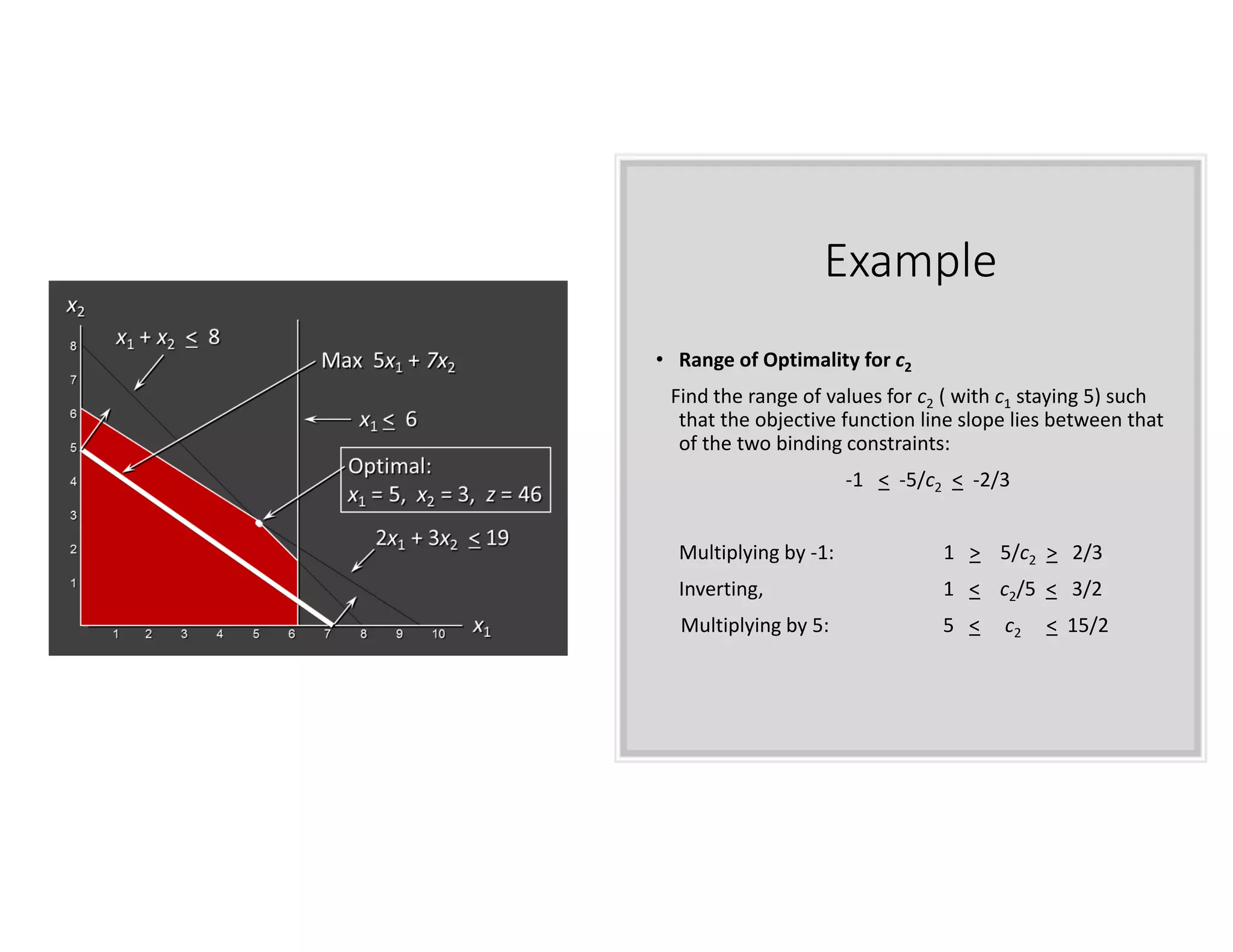
Example
Max 5x1 + 7x2
s.t. x1 < 6
2x1 + 3x2 < 19
x1 + x2 < 8
x1 , x2 > 0
Example
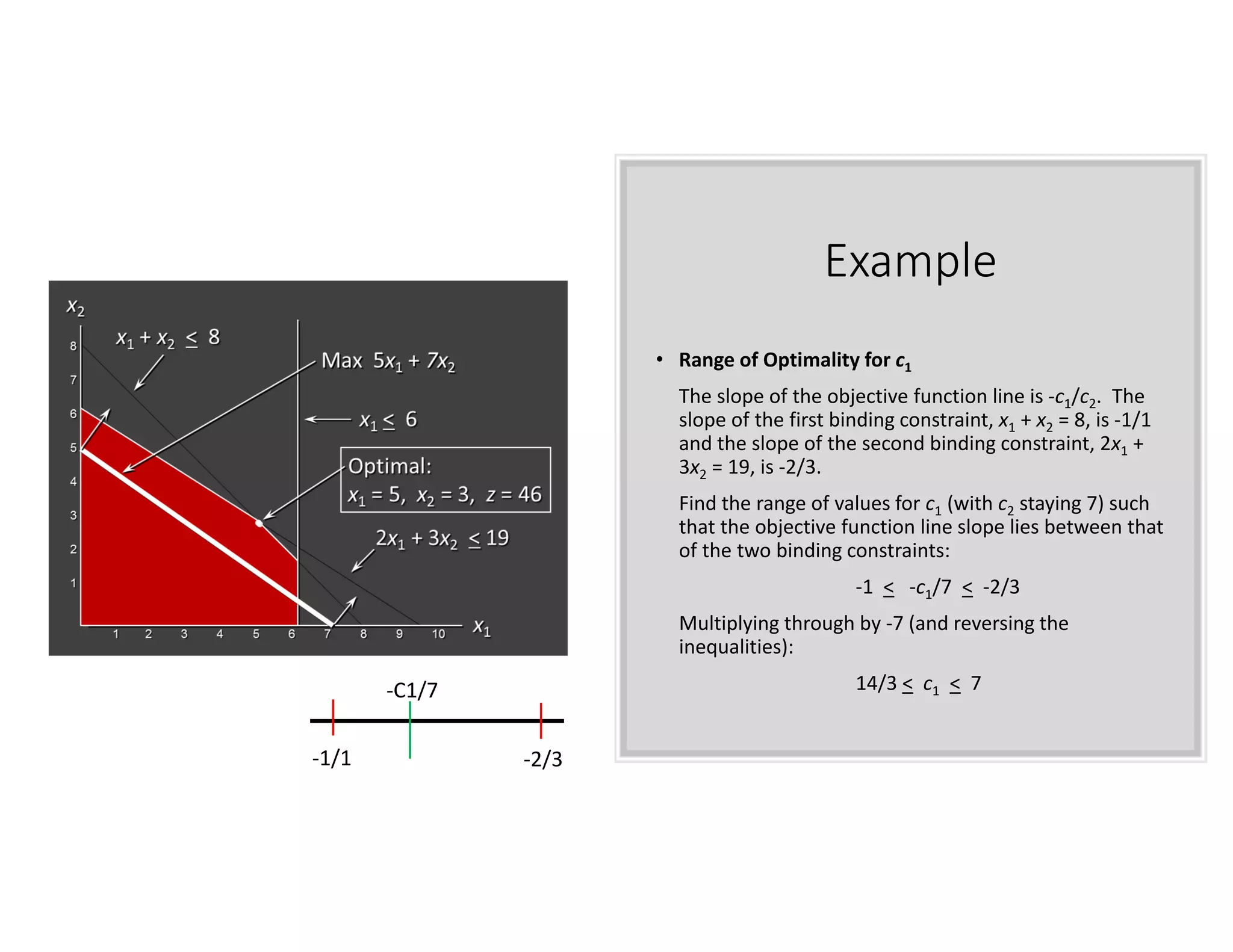
• Range of Optimality for c1
The slope of the objective function line is ‐c1/c2. The
slope of the first binding constraint, x1 + x2 = 8, is ‐1/1
and the slope of the second binding constraint, 2x1 +
3x2 = 19, is ‐2/3.
Find the range of values for c1 (with c2 staying 7) such
that the objective function line slope lies between that
of the two binding constraints:
‐1 < ‐c1/7 < ‐2/3
Multiplying through by ‐7 (and reversing the
inequalities):
14/3 < c1 < 7
‐2/3
‐1/1
‐C1/7
Example
• Range of Optimality for c2
Find the range of values for c2 ( with c1 staying 5) such
that the objective function line slope lies between that
of the two binding constraints:
‐1 < ‐5/c2 < ‐2/3
Multiplying by ‐1: 1 > 5/c2 > 2/3
Inverting, 1 < c2/5 < 3/2
Multiplying by 5: 5 < c2 < 15/2
Example
• A farmer plans to mix two types of food to make a mix of low cost
feed for the animals in his farm. A bag of food A costs $10 and
contains 40 units of proteins, 20 units of minerals and 10 units of
vitamins. A bag of food B costs $12 and contains 30 units of proteins,
20 units of minerals and 30 units of vitamins. How many bags of food
A and B should the consumed by the animals each day in order to
meet the minimum daily requirements of 150 units of proteins, 90
units of minerals and 60 units of vitamins at a minimum cost?

CB312+-+Part1.pdf

  • 1.
    CB 312 System Analysisfor Construction Engineers Dr. Mohamed Saeid Eid Fall ‐ 2018
  • 2.
    Resume Dr. Mohamed SaeidEid • BS and MS in construction Engineering, AAST (2008, and 2012, respectively) • PhD in Civil and Environmental Engineering, Construction focus, University of Tennessee, Knoxville (2017)
  • 3.
    Research Interest • Multi‐objectiveoptimization • Repetitive Activities Scheduling • Site layout • Simulation • Disaster Recovery and Community Vulnerability • Traffic Behavior • Construction performance • Game Theory • Traffic behavior • Construction bidding • Collaborative construction projects
  • 4.
    Syllabus • What doyou expect to learn? • Mathematical Model • Optimization using Linear Programming • Decision Analysis and Game Theory • What do I expect from my students? • Attention and participation • Curiosity to learn • Research and readings
  • 5.
    Syllabus ‐ Content Week#Title readings 1 Introduction, mathematical linear programming (LP) models 2 Continue LP modeling 3 Solving LP – Graphical Method 4 Continue Graphical Method and Sensitivity analysis 5 Solving LP – Simplex Method 6 Continue Simplex Method 7 7th week exam 8 Transportation Problem 9 Assignment Problem 10 Intro to Dynamic Programming 11 Decision Theory 12 12th week exam 13 Game theory 14 Continue Game Theory 15 Revision
  • 6.
    Recommended text booksand references • Hillier, F., (2001). Introduction to Operation Research, 7th edition. • Anderson et al. (2012). An introduction to Management Science, 2nd edition. • Gibson (1992). Game theory for applied economics.
  • 7.
    Syllabus – Grading •30% on the 7th week • 5% participation • 10% assignments/quizzes • 15% exam • 20% on the 12th week • 5% participation • 5% assignments • 10% exam • 10% Class performance • 40% final exam 15% 20% 25% 40% Assignments and Quizzes Participation Mid‐term exam Final Exam
  • 8.
    Class rules • NOCELL PHONES! • Contact • No phone calls. Each call worth ‐5% of your grade. • meid@aast.edu • Use an appropriate subject title, and English language only • Website: Msaeideid.com • Late assignments • No late assignments are accepted beyond due date • Teamwork • Class ethics and Academic Honesty
  • 9.
    Class contacts andInternet Check https://goo.gl/mo6xYs
  • 10.
    History WW1 (1914‐1918) 9,000,000 soliderand 7,000,000 civilian died Trench warfare, and small role for tanks
  • 11.
    History WW2 (1939‐1945) 16,000,000 soldiersand 45,000,000 civilian died Bigger roles for tanks, airships, naval fleets and advancements in technologies
  • 12.
    Management Science post‐WWIand II • Optimization • Network Theory • Game Theory (later through the Cold War)
  • 13.
    The Big Question,Why? Profit and cost Proactive vs reactive Competition
  • 14.
    Ring Road Pedestrian Problem •Assume you are planning to build pedestrian crossings on the Ring Road. • The crossings can be either tunnels (LE10,000,000 each) or bridges (LE 8,000,000 each). • There should be a minimum of 5 crossings built and maximum of 8 • Each tunnel will create 50 hours of traffic delays • Each bridge will create 90 hours of traffic delays • The governor allowed you a maximum of 400 hours in traffic delays
  • 15.
    How to solveit? Mathematical models ‐ represent real world problems through a system of mathematical formulas and expressions based on key assumptions, estimates, or statistical analyses
  • 16.
    Modeling and Optimization •Why Mathematical Modeling? F = MA E=mc2 • Modeling Approach: • Define the problem of interest and collect the relevant data • Formulate the problem mathematically to represent its main parameters
  • 17.
    Ring Road Pedestrian Problem •Assume you are planning to build pedestrian crossings on the Ring Road. • The crossings can be either tunnels (LE10,000,000 each) or bridges (LE 8,000,000 each). • There should be a minimum of 5 crossings built and maximum of 8 • Each tunnel will create 50 hours of traffic delays • Each bridge will create 90 hours of traffic delays • The governor allowed you a maximum of 400 hours in traffic delays
  • 18.
    General Factors inMathematical Modeling • Objectives • What is the objective of the model, and how to measure it. • Maximization vs minimization • Variables • Parameters (quantities) that can be changed as part of your decision making, that impact the objective of the model. • Stochastic vs deterministic • Constraints • Limits to the variables, either cannot be less, cannot exceed or need to be equal
  • 19.
    Ring Road Pedestrian Problem •Assume you are planning to build pedestrian crossings on the Ring Road. • The crossings can be either tunnels (LE10,000,000 each) or bridges (LE 8,000,000 each). • There should be a minimum of 5 crossings built and maximum of 8 • Each tunnel will create 50 hours of traffic delays • Each bridge will create 90 hours of traffic delays • The governor allowed you a maximum of 400 hours in traffic delays Objective Variables Constraints
  • 20.
    Examples • A brickmanufacturer sells two types of bricks, Clay and Cement. The bricks cost $8 and $14 for each 1,000 brick of Clay and Cement respectively. Each 1000 brick of Clay yields a profit of $2 while Cement yields a profit of $3. The store owner estimates that no more than 2,000,000 bricks will be sold every month and he does not plan to invest more than $20,000. How many units of each type of bricks should be made in order to maximize his monthly total profit?
  • 21.
    Examples • A farmerplans to mix two types of food to make a mix of low cost feed for the animals in his farm. A bag of food A costs $10 and contains 40 units of proteins, 20 units of minerals and 10 units of vitamins. A bag of food B costs $12 and contains 30 units of proteins, 20 units of minerals and 30 units of vitamins. How many bags of food A and B should the consumed by the animals each day in order to meet the minimum daily requirements of 150 units of proteins, 90 units of minerals and 60 units of vitamins at a minimum cost? www.analyzemath.com
  • 22.
    Examples • John has$20,000 to invest in three funds F1, F2 and F3. Fund F1 is offers a return of 2% and has a low risk. Fund F2 offers a return of 4% and has a medium risk. Fund F3 offers a return of 5% but has a high risk. To be on the safe side, John invests no more than $3000 in F3 and at least twice as much as in F1 than in F2. Assuming that the rates hold till the end of the year, what amounts should he invest in each fund in order to maximize the year end return? www.analyzemath.com
  • 23.
    Linear Programming • Arepresentation of the problem using linear mathematical equations
  • 24.
    Linear Programming • Alinear objective function which is to be maximized or minimized • A set of linear constraints (equations) • A set of variables that affect the objective function and limited by the constraints. Max Z= 100x1 + 200x2 s.t. 2x1 + 3x2 < 2000 x1 > 60 x2 < 720 x2 > 0
  • 25.
    Linear Programming StandardForm • Z= value of overall measure of performance/objective • xi = quantity/value of decision variable i (i=1, 2, ….. , n) • ci = coefficient that increases/decreases Z in respect to xi • Equality and inequality
  • 26.
  • 27.
    Examples LP modeling •As a site engineer, you want to procure the needed aggregates from different gravel and sand pits around your site with minimum cost. If each cubic meter of aggregates from the Pit A costs LE 300, while for Pit B, costs LE 400. • Pit A aggregates has a mix of 1/2 sand, 1/2 gravel. • Pit B aggregates is 100% sand • The design requires a minimum of 30% sand. • You are required to procure a minimum of 1000 cubic meter of aggregate. • Formulate this problem using LP.
  • 28.
    Examples LP Modeling •A farmer plans to mix two types of food to make a mix of low cost feed for the animals in his farm. A bag of food A costs $10 and contains 40 units of proteins, 20 units of minerals and 10 units of vitamins. A bag of food B costs $12 and contains 30 units of proteins, 20 units of minerals and 30 units of vitamins. How many bags of food A and B should the consumed by the animals each day in order to meet the minimum daily requirements of 150 units of proteins, 90 units of minerals and 60 units of vitamins at a minimum cost? www.analyzemath.com
  • 29.
    Examples LP Modeling •John has $20,000 to invest in three funds F1, F2 and F3. Fund F1 is offers a return of 2% and has a low risk. Fund F2 offers a return of 4% and has a medium risk. Fund F3 offers a return of 5% but has a high risk. To be on the safe side, John invests no more than $3000 in F3 and at least twice as much as in F1 than in F2. Assuming that the rates hold till the end of the year, what amounts should he invest in each fund in order to maximize the year end return? www.analyzemath.com
  • 30.
    Revise Linear ProgrammingStandard Form • Z= value of overall measure of performance/objective • xi = quantity/value of decision variable i (i=1, 2, ….. , n) • ci = coefficient that increases/decreases Z in respect to xi Constraint number Constraint Coefficients for variables x1, x2, …, xn Constraint values 1 a11 a12 … a1n b1 2 a21 a22 … a2n b2 … ... … … … … J aJ1 aJ2 … aJn bJ Contribution to Objective Z c1 c2 … cn
  • 31.
    Limitation of LP •Linear programming does not account for uncertainty • Assumption of constant return • Assumption of linear relationship between input and out
  • 32.
  • 33.
    Graphical Method • Plottingthe constraints of a LP model to visualize the problem • Need to determine feasible region • Feasible region is where all feasible solutions are located • Find optimal solution
  • 34.
    Graphical Method –Need to Know • Active constraints • Inactive/redundant Constraints • Feasible Region • Optimal Solution
  • 35.
    Graphical Solution –Finding Optimal Solution • Corner Point Feasible (CPF), are points that located at the corners of a feasible region, always the intersection between two or more constraints. • Check the Z value for each and choose the optimal solution
  • 36.
    Example • A farmerplans to mix two types of food to make a mix of low cost feed for the animals in his farm. A bag of food A costs $10 and contains 40 units of proteins, 20 units of minerals and 10 units of vitamins. A bag of food B costs $12 and contains 30 units of proteins, 20 units of minerals and 30 units of vitamins. How many bags of food A and B should the consumed by the animals each day in order to meet the minimum daily requirements of 150 units of proteins, 90 units of minerals and 60 units of vitamins at a minimum cost? www.analyzemath.com
  • 37.
    Types of solutions •Infeasible • No solution can be found • Unique Optimal Solution • An optimal solution is found • Multiple Optimal Solutions • More than one solution provides the same optimal value • Unbounded • There is a solution, but there is no boundary for it
  • 38.
    One more example •John has $20,000 to invest in three funds F1, F2 and F3. Fund F1 is offers a return of 2% and has a low risk. Fund F2 offers a return of 4% and has a medium risk. Fund F3 offers a return of 5% but has a high risk. To be on the safe side, John invests no more than $3000 in F3 and at least twice as much as in F1 than in F2. Assuming that the rates hold till the end of the year, what amounts should he invest in each fund in order to maximize the year end return? www.analyzemath.com
  • 39.
    Summary of LPand Graphical Method • Form a linear mathematical model • Variables • Objectives • Constraints • Plot Constraints • CFPs • Find solution
  • 40.
    Sensitivity Analysis Understanding howsensitive is the optimal solution to variation
  • 41.
    Sensitivity Analysis • Apost‐optimal solution analysis to understand if variations in the cost coefficient will change the optimal solution. • This will help managers understand the optimal solution properties in case of variations and indeterministic/stochastic parameters.
  • 42.
    Objective Function Coefficients •Let us consider how changes in the objective function coefficients might affect the optimal solution. • The range of optimality for each coefficient provides the range of values over which the current solution will remain optimal. Note that even though the cost/price will change, the quantity (optimal solution) won’t change • Managers should focus on those objective coefficients that have a narrow range of optimality and coefficients near the endpoints of the range.
  • 43.
    Objective Function andBinding Constraints
  • 44.
    Objective Function andBinding Constraints
  • 45.
    Range of Optimality •Graphically, the limits of a range of optimality are found by changing the slope of the objective function line within the limits of the slopes of the binding constraint lines. • The slope of an objective function line, Max c1x1 + c2x2, is ‐c1/c2, and the slope of a constraint, a1x1 + a2x2 = b, is ‐a1/a2.
  • 46.
    Example Max 5x1 +7x2 s.t. x1 < 6 2x1 + 3x2 < 19 x1 + x2 < 8 x1 , x2 > 0
  • 47.
    Example • Range ofOptimality for c1 The slope of the objective function line is ‐c1/c2. The slope of the first binding constraint, x1 + x2 = 8, is ‐1/1 and the slope of the second binding constraint, 2x1 + 3x2 = 19, is ‐2/3. Find the range of values for c1 (with c2 staying 7) such that the objective function line slope lies between that of the two binding constraints: ‐1 < ‐c1/7 < ‐2/3 Multiplying through by ‐7 (and reversing the inequalities): 14/3 < c1 < 7 ‐2/3 ‐1/1 ‐C1/7
  • 48.
    Example • Range ofOptimality for c2 Find the range of values for c2 ( with c1 staying 5) such that the objective function line slope lies between that of the two binding constraints: ‐1 < ‐5/c2 < ‐2/3 Multiplying by ‐1: 1 > 5/c2 > 2/3 Inverting, 1 < c2/5 < 3/2 Multiplying by 5: 5 < c2 < 15/2
  • 49.
    Example • A farmerplans to mix two types of food to make a mix of low cost feed for the animals in his farm. A bag of food A costs $10 and contains 40 units of proteins, 20 units of minerals and 10 units of vitamins. A bag of food B costs $12 and contains 30 units of proteins, 20 units of minerals and 30 units of vitamins. How many bags of food A and B should the consumed by the animals each day in order to meet the minimum daily requirements of 150 units of proteins, 90 units of minerals and 60 units of vitamins at a minimum cost?