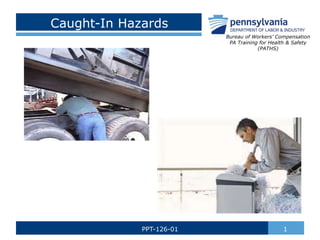
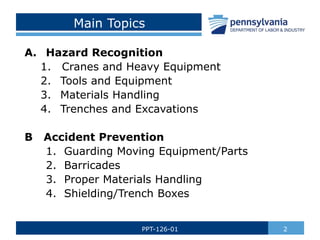
Caught-In Hazards
1
PPT-126-01
Bureau of Workers’ Compensation
PA Training for Health & Safety
(PATHS)
Main Topics
A. Hazard Recognition
1. Cranes and Heavy Equipment
2. Tools and Equipment
3. Materials Handling
4. Trenches and Excavations
B Accident Prevention
1. Guarding Moving Equipment/Parts
2. Barricades
3. Proper Materials Handling
4. Shielding/Trench Boxes
2
PPT-126-01
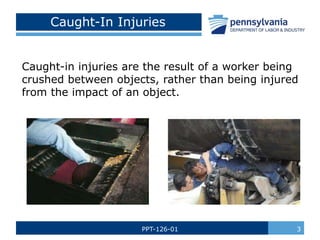
Caught-in injuries are the result of a worker being
crushed between objects, rather than being injured
from the impact of an object.
Caught-In Injuries
PPT-126-01 3
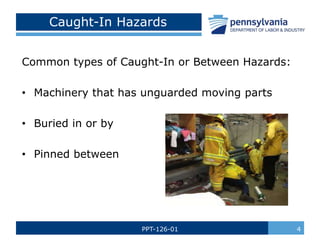
Common types of Caught-In or Between Hazards:
• Machinery that has unguarded moving parts
• Buried in or by
• Pinned between
Caught-In Hazards
PPT-126-01 4
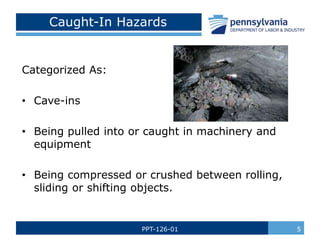
Categorized As:
• Cave-ins
• Being pulled into or caught in machinery and
equipment
• Being compressed or crushed between rolling,
sliding or shifting objects.
Caught-In Hazards
PPT-126-01 5
Caught-In Hazards
 Caught-in hazards are one
of the four most deadly
hazards found at
construction sites.
 This program will help you
recognize common caught-
in hazards.
 The symbol will tell you if
the situation in the picture
is either safe or not safe.
6
PPT-126-01
Safe
Not safe
Caught-In Statistics
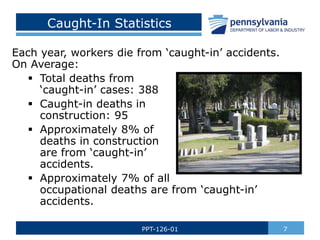
Each year, workers die from ‘caught-in’ accidents.
On Average:
 Total deaths from
‘caught-in’ cases: 388
 Caught-in deaths in
construction: 95
 Approximately 8% of
deaths in construction
are from ‘caught-in’
accidents.
 Approximately 7% of all
occupational deaths are from ‘caught-in’
accidents.
7
PPT-126-01
Hazard Recognition
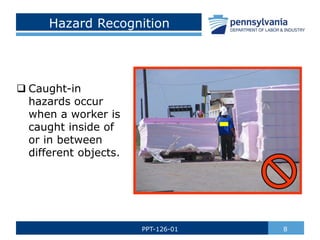
 Caught-in
hazards occur
when a worker is
caught inside of
or in between
different objects.
8
PPT-126-01
Cranes & Heavy Equipment
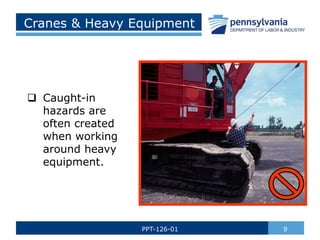
 Caught-in
hazards are
often created
when working
around heavy
equipment.
9
PPT-126-01
Cranes & Heavy Equipment
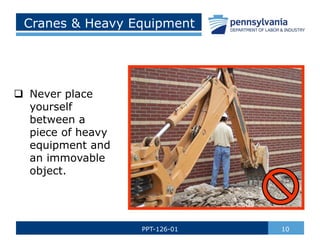
 Never place
yourself
between a
piece of heavy
equipment and
an immovable
object.
10
PPT-126-01
Cranes & Heavy Equipment
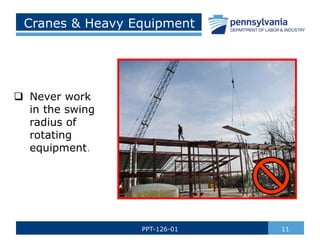
 Never work
in the swing
radius of
rotating
equipment.
11
PPT-126-01
Cranes & Heavy Equipment
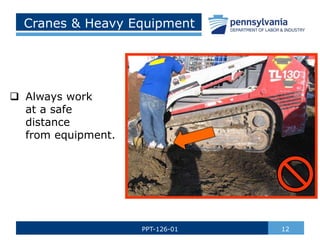
 Always work
at a safe
distance
from equipment.
12
PPT-126-01
Tools and Equipment
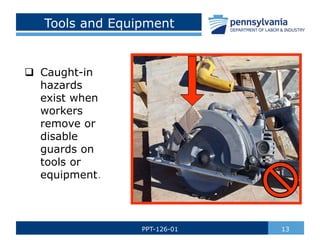
 Caught-in
hazards
exist when
workers
remove or
disable
guards on
tools or
equipment.
13
PPT-126-01
Tools and Equipment
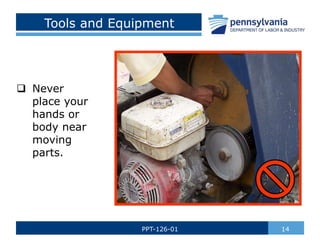
 Never
place your
hands or
body near
moving
parts.
14
PPT-126-01
Tools and Equipment
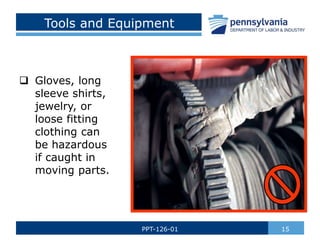
 Gloves, long
sleeve shirts,
jewelry, or
loose fitting
clothing can
be hazardous
if caught in
moving parts.
15
PPT-126-01
Tools and Equipment
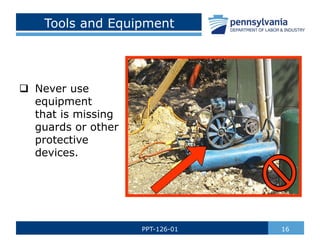
 Never use
equipment
that is missing
guards or other
protective
devices.
16
PPT-126-01
Material Handling
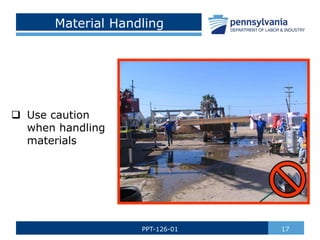
 Use caution
when handling
materials
17
PPT-126-01
Material Handling
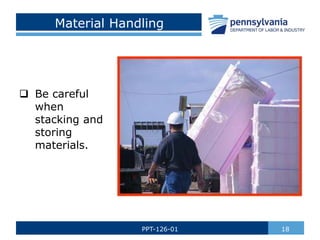
 Be careful
when
stacking and
storing
materials.
18
PPT-126-01
Material Handling
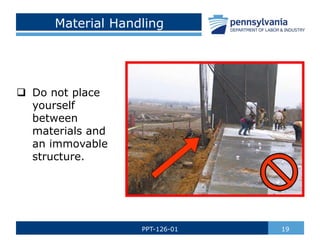
 Do not place
yourself
between
materials and
an immovable
structure.
19
PPT-126-01
Trenches & Excavations
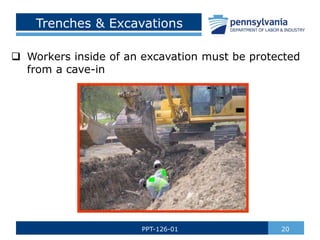
 Workers inside of an excavation must be protected
from a cave-in
20
PPT-126-01
Trenches & Excavations
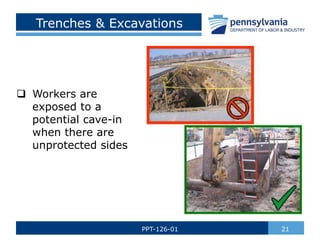
 Workers are
exposed to a
potential cave-in
when there are
unprotected sides
21
PPT-126-01
Trenches & Excavations
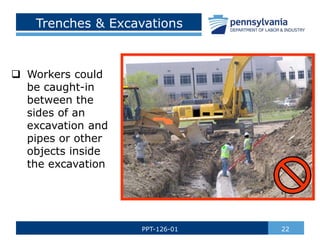
 Workers could
be caught-in
between the
sides of an
excavation and
pipes or other
objects inside
the excavation
22
PPT-126-01
Trenches & Excavations
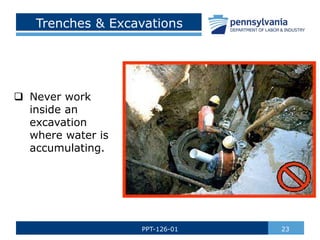
 Never work
inside an
excavation
where water is
accumulating.
23
PPT-126-01
Accident Prevention
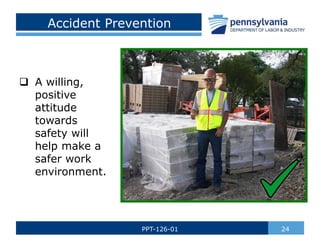
 A willing,
positive
attitude
towards
safety will
help make a
safer work
environment.
24
PPT-126-01
Accident Prevention
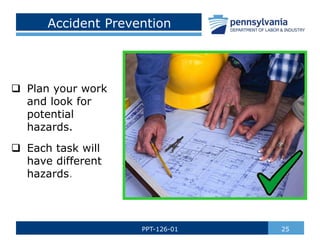
 Plan your work
and look for
potential
hazards.
 Each task will
have different
hazards.
25
PPT-126-01
Guarding Moving Parts
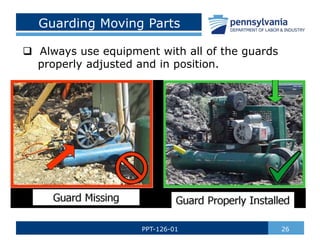
 Always use equipment with all of the guards
properly adjusted and in position.
26
PPT-126-01
Guarding Moving Parts
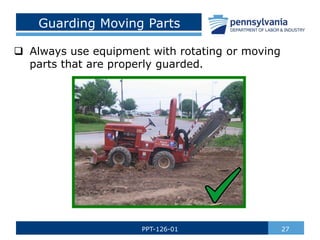
 Always use equipment with rotating or moving
parts that are properly guarded.
27
PPT-126-01
Guarding Moving Parts
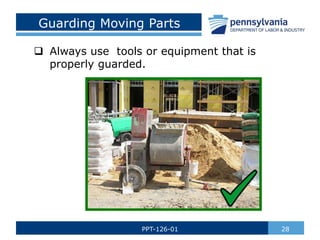
 Always use tools or equipment that is
properly guarded.
28
PPT-126-01
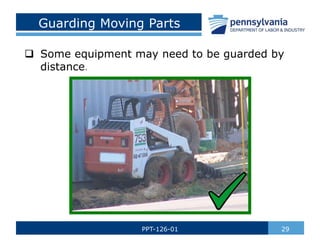
Guarding Moving Parts
 Some equipment may need to be guarded by
distance.
29
PPT-126-01
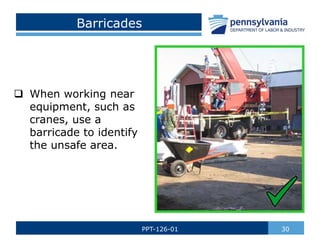
Barricades
 When working near
equipment, such as
cranes, use a
barricade to identify
the unsafe area.
30
PPT-126-01
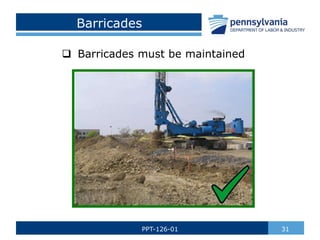
Barricades
 Barricades must be maintained
31
PPT-126-01
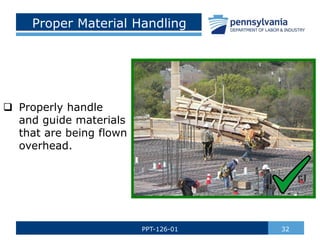
Proper Material Handling
 Properly handle
and guide materials
that are being flown
overhead.
32
PPT-126-01
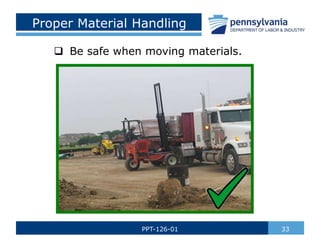
Proper Material Handling
 Be safe when moving materials.
33
PPT-126-01
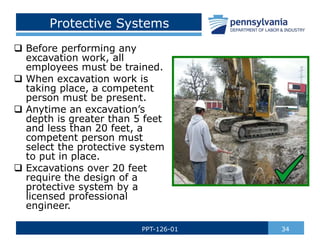
Protective Systems
 Before performing any
excavation work, all
employees must be trained.
 When excavation work is
taking place, a competent
person must be present.
 Anytime an excavation’s
depth is greater than 5 feet
and less than 20 feet, a
competent person must
select the protective system
to put in place.
 Excavations over 20 feet
require the design of a
protective system by a
licensed professional
engineer.
34
PPT-126-01
Shielding/Trench Boxes
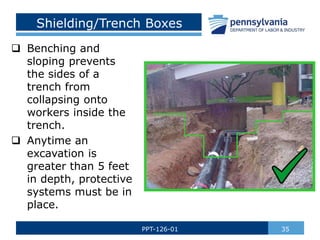
 Benching and
sloping prevents
the sides of a
trench from
collapsing onto
workers inside the
trench.
 Anytime an
excavation is
greater than 5 feet
in depth, protective
systems must be in
place.
35
PPT-126-01
Shielding/Trench Boxes
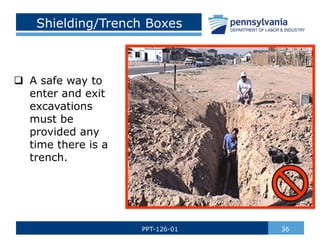
 A safe way to
enter and exit
excavations
must be
provided any
time there is a
trench.
36
PPT-126-01
Shielding/Trench Boxes
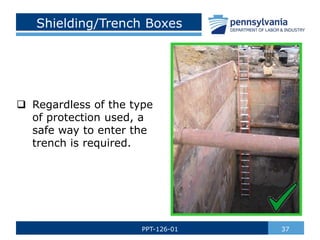
 Regardless of the type
of protection used, a
safe way to enter the
trench is required.
37
PPT-126-01
Protecting against Caught-In or –between hazards:
• Use machinery that is properly guarded
• Use other methods to ensure that machinery is
sufficiently supported, secured or otherwise
made safe.
• Protect yourself from being pinned between
equipment, materials or other objects.
• Protect yourself on excavation sites
• Conduct training
Caught-In Prevention
PPT-126-01 38
Questions
39
PPT-126-01
Contact Information
Health & Safety Training Specialists
1171 South Cameron Street, Room 324
Harrisburg, PA 17104-2501
(717) 772-1635
RA-LI-BWC-PATHS@pa.gov
40
PPT-126-01
Like us on Facebook! -
https://www.facebook.com/BWCPATHS
Working Team for this Presentation
UNIVERSITY OF PUERTO RICO
MEDICAL SCIENCES CAMPUS
Graduate School of Public Health,
Dep. of Environmental Health
Sergio Caporali, Ph.D., CSP – Principal
Investigator
Lida Orta-Anés, Ph.D., Field Trainer
Marcilyn Colón Colón, MSc., Training Coordinator
Harlyn Rivera, Administrative Assistant
41
PPT-126-01
Working Team for this Presentation
CONTRACTORS
Circe E. Niezen, ME, MBA, Training Evaluator,
PUPR
Mark Fullen, Ph.D. Candidate, Field Trainer and
Curriculum Developer, WVU
Carmen Vázquez, RN, Field Trainer
Migdalia Ruiz, MS, Field Trainer
Carlos Ortiz, Ph.D., Online Training Administrator,
UPR-CPRS-OIRE
Eliel Melón Ramos – Online Training Adm.
Assistant, UPR-CPRS-OIRE
42
PPT-126-01

Caught In-Between Hazards.pptx................

  • 1.
    Caught-In Hazards 1 PPT-126-01 Bureau ofWorkers’ Compensation PA Training for Health & Safety (PATHS)
  • 2.
    Main Topics A. HazardRecognition 1. Cranes and Heavy Equipment 2. Tools and Equipment 3. Materials Handling 4. Trenches and Excavations B Accident Prevention 1. Guarding Moving Equipment/Parts 2. Barricades 3. Proper Materials Handling 4. Shielding/Trench Boxes 2 PPT-126-01
  • 3.
    Caught-in injuries arethe result of a worker being crushed between objects, rather than being injured from the impact of an object. Caught-In Injuries PPT-126-01 3
  • 4.
    Common types ofCaught-In or Between Hazards: • Machinery that has unguarded moving parts • Buried in or by • Pinned between Caught-In Hazards PPT-126-01 4
  • 5.
    Categorized As: • Cave-ins •Being pulled into or caught in machinery and equipment • Being compressed or crushed between rolling, sliding or shifting objects. Caught-In Hazards PPT-126-01 5
  • 6.
    Caught-In Hazards  Caught-inhazards are one of the four most deadly hazards found at construction sites.  This program will help you recognize common caught- in hazards.  The symbol will tell you if the situation in the picture is either safe or not safe. 6 PPT-126-01 Safe Not safe
  • 7.
    Caught-In Statistics Each year,workers die from ‘caught-in’ accidents. On Average:  Total deaths from ‘caught-in’ cases: 388  Caught-in deaths in construction: 95  Approximately 8% of deaths in construction are from ‘caught-in’ accidents.  Approximately 7% of all occupational deaths are from ‘caught-in’ accidents. 7 PPT-126-01
  • 8.
    Hazard Recognition  Caught-in hazardsoccur when a worker is caught inside of or in between different objects. 8 PPT-126-01
  • 9.
    Cranes & HeavyEquipment  Caught-in hazards are often created when working around heavy equipment. 9 PPT-126-01
  • 10.
    Cranes & HeavyEquipment  Never place yourself between a piece of heavy equipment and an immovable object. 10 PPT-126-01
  • 11.
    Cranes & HeavyEquipment  Never work in the swing radius of rotating equipment. 11 PPT-126-01
  • 12.
    Cranes & HeavyEquipment  Always work at a safe distance from equipment. 12 PPT-126-01
  • 13.
    Tools and Equipment Caught-in hazards exist when workers remove or disable guards on tools or equipment. 13 PPT-126-01
  • 14.
    Tools and Equipment Never place your hands or body near moving parts. 14 PPT-126-01
  • 15.
    Tools and Equipment Gloves, long sleeve shirts, jewelry, or loose fitting clothing can be hazardous if caught in moving parts. 15 PPT-126-01
  • 16.
    Tools and Equipment Never use equipment that is missing guards or other protective devices. 16 PPT-126-01
  • 17.
    Material Handling  Usecaution when handling materials 17 PPT-126-01
  • 18.
    Material Handling  Becareful when stacking and storing materials. 18 PPT-126-01
  • 19.
    Material Handling  Donot place yourself between materials and an immovable structure. 19 PPT-126-01
  • 20.
    Trenches & Excavations Workers inside of an excavation must be protected from a cave-in 20 PPT-126-01
  • 21.
    Trenches & Excavations Workers are exposed to a potential cave-in when there are unprotected sides 21 PPT-126-01
  • 22.
    Trenches & Excavations Workers could be caught-in between the sides of an excavation and pipes or other objects inside the excavation 22 PPT-126-01
  • 23.
    Trenches & Excavations Never work inside an excavation where water is accumulating. 23 PPT-126-01
  • 24.
    Accident Prevention  Awilling, positive attitude towards safety will help make a safer work environment. 24 PPT-126-01
  • 25.
    Accident Prevention  Planyour work and look for potential hazards.  Each task will have different hazards. 25 PPT-126-01
  • 26.
    Guarding Moving Parts Always use equipment with all of the guards properly adjusted and in position. 26 PPT-126-01
  • 27.
    Guarding Moving Parts Always use equipment with rotating or moving parts that are properly guarded. 27 PPT-126-01
  • 28.
    Guarding Moving Parts Always use tools or equipment that is properly guarded. 28 PPT-126-01
  • 29.
    Guarding Moving Parts Some equipment may need to be guarded by distance. 29 PPT-126-01
  • 30.
    Barricades  When workingnear equipment, such as cranes, use a barricade to identify the unsafe area. 30 PPT-126-01
  • 31.
    Barricades  Barricades mustbe maintained 31 PPT-126-01
  • 32.
    Proper Material Handling Properly handle and guide materials that are being flown overhead. 32 PPT-126-01
  • 33.
    Proper Material Handling Be safe when moving materials. 33 PPT-126-01
  • 34.
    Protective Systems  Beforeperforming any excavation work, all employees must be trained.  When excavation work is taking place, a competent person must be present.  Anytime an excavation’s depth is greater than 5 feet and less than 20 feet, a competent person must select the protective system to put in place.  Excavations over 20 feet require the design of a protective system by a licensed professional engineer. 34 PPT-126-01
  • 35.
    Shielding/Trench Boxes  Benchingand sloping prevents the sides of a trench from collapsing onto workers inside the trench.  Anytime an excavation is greater than 5 feet in depth, protective systems must be in place. 35 PPT-126-01
  • 36.
    Shielding/Trench Boxes  Asafe way to enter and exit excavations must be provided any time there is a trench. 36 PPT-126-01
  • 37.
    Shielding/Trench Boxes  Regardlessof the type of protection used, a safe way to enter the trench is required. 37 PPT-126-01
  • 38.
    Protecting against Caught-Inor –between hazards: • Use machinery that is properly guarded • Use other methods to ensure that machinery is sufficiently supported, secured or otherwise made safe. • Protect yourself from being pinned between equipment, materials or other objects. • Protect yourself on excavation sites • Conduct training Caught-In Prevention PPT-126-01 38
  • 39.
  • 40.
    Contact Information Health &Safety Training Specialists 1171 South Cameron Street, Room 324 Harrisburg, PA 17104-2501 (717) 772-1635 RA-LI-BWC-PATHS@pa.gov 40 PPT-126-01 Like us on Facebook! - https://www.facebook.com/BWCPATHS
  • 41.
    Working Team forthis Presentation UNIVERSITY OF PUERTO RICO MEDICAL SCIENCES CAMPUS Graduate School of Public Health, Dep. of Environmental Health Sergio Caporali, Ph.D., CSP – Principal Investigator Lida Orta-Anés, Ph.D., Field Trainer Marcilyn Colón Colón, MSc., Training Coordinator Harlyn Rivera, Administrative Assistant 41 PPT-126-01
  • 42.
    Working Team forthis Presentation CONTRACTORS Circe E. Niezen, ME, MBA, Training Evaluator, PUPR Mark Fullen, Ph.D. Candidate, Field Trainer and Curriculum Developer, WVU Carmen Vázquez, RN, Field Trainer Migdalia Ruiz, MS, Field Trainer Carlos Ortiz, Ph.D., Online Training Administrator, UPR-CPRS-OIRE Eliel Melón Ramos – Online Training Adm. Assistant, UPR-CPRS-OIRE 42 PPT-126-01

Editor's Notes

  • #2 Caught-in hazards are one of the major four hazards on a construction site (the other three are falls, struck-by, and electrical). “Caught in-between” hazards kill workers in a variety of ways. These include: cave-ins and other hazards of excavation work; body parts pulled into unguarded machinery; standing within the swing radius of cranes and other construction equipment; caught between equipment & fixed objects.
  • #3 This presentation has been adapted from OSHA’s 10/30 hour Construction Safety Course and includes the following topics: Hazard Recognition Cranes and Heavy Equipment Tools and Equipment Materials Handling Trenches and Excavations Accident Prevention 1. Guarding Moving Equipment/Parts 2. Barricades 3. Proper Materials Handling 4. Shielding/Trench Boxes
  • #4 Injuries to workers from caught-in hazards are the result of a worker being crushed between two objects as opposed to being injured from the impact of an object.
  • #5 The most common types of caught-in or between hazards include: Machinery that has unguarded moving parts Buried in or by Pinned between
  • #6 In addition, the following situations are also caught-in hazards: Cave-ins Being pulled into or caught in machinery and equipment Being compressed or crushed between rolling, sliding or shifting objects.
  • #7 This presentation will focus on the hazard of being “caught-in” something. On a construction site, that “something” could be almost anything. You may be caught in a trench if you are working in it and it caves in. Your hand may be caught between materials. You may get your finger caught in a truck door. These are only a few examples of how you may be “caught-in” something that can cause great pain or even death. This presentation will help you recognize common caught-in hazards, and will show you ways to decrease those hazards at your job site. By the end of this program, you will be able to recognize and avoid these hazards. Throughout this program, you will be shown examples of safe and unsafe conditions. Two different symbols will be used to represent safe and unsafe conditions. The red “No” symbol is used to denote unsafe conditions, and the green “Yes” checkmark will be used to show safe conditions.
  • #8 Each year, a surprising number of workers die from being caught in between materials, trenches, and machinery. These seemingly simple accidents were responsible for 388 deaths in one year! Nearly 24.5% , or 95, of those fatalities happened in the construction industry. According to the Bureau of Labor Statistics, during that one year there were 5,703 occupational fatalities. This means that approximately 7% of all occupational deaths are a result of being caught in between materials, trenches or machinery.
  • #9 A caught-in hazard exists anytime a worker can get any part of his/her body caught in or in between objects. For example, a worker is in a hurry and not paying attention closing their truck door and trapping their finger. The worker’s finger is now caught in between the door and the doorframe of the truck. While this type of injury is painful, it should not be fatal. As seen on the previous slide, workers die from caught-in injuries each year. For example, a worker is operating a forklift and is not wearing a seatbelt. The worker tips the forklift and it rolls over. Since the worker doesn’t have a seatbelt on, he is thrown out and the forklift lands on top of him. The worker is caught between the forklift and the ground. This presentation will cover caught-in hazards that are commonly found on construction sites and the topics include: Cranes and heavy equipment Tools and equipment Material handling Trenches and excavations
  • #10 When working around heavy equipment and cranes you are exposed to serious caught-in hazards. The cranes and heavy equipment that have a rotating superstructure are especially hazardous. For instance, cranes have the ability to rotate 360 degrees. If you are standing near the crane while it rotates, it can trap you between a wall or other immovable object. If you are standing between the superstructure and the tracks, you can be caught between them if the crane rotates. In that sense, accessible areas within the crane’s swing radius should be barricaded. Tag lines should be used to prevent dangerous swing or spin of material when raised or lowered by a crane. Furthermore, illustrations of hand signals to crane operators should be posted on the job site. In this picture the worker on the ground is exposed to a serious hazard and could be severly injured or killed if the operator were to move the crane. Many fatalities have occurred when employees standing close to cranes were caught-in between the tracks and the body of the crane.
  • #11 Workers must always be aware of their surroundings when working on a construction site near heavy equipment. Never approach heavy equipment unless you know that the operator saw you and, you and the operator continue with eye contact. Do not work between a piece of heavy equipment, like this backhoe, and an immovable object, like the building. The arm of a backhoe or excavator can pin you between a building, stack of materials, trench wall, or any other immovable structure. This will cause serious caught-in injuries. You can see in this picture that the worker has his back turned to the backhoe and is exposed to a caught-in hazard.
  • #12 In addition to the hazards involved with moving materials by machines, the machines themselves can cause caught-in hazards. Cranes and excavators are particularly hazardous because their bodies rotate. When a crane or excavator is operating near a wall, structure or other immovable object, workers can be pinned between the machine and the object. The entire swing radius, or the area where the body of the machine can rotate, must be blocked from worker access. Never walk in this area. If you do, you are exposing yourself to a hazardous condition. The operator will not see you if you are out of his line of sight and he may move the machine, or the area where the body of the machine can rotate, trapping you.
  • #13 When approaching equipment be sure the operator can see you and be sure to signal to them that you are near by. The operator should turn off the equipment before allowing you to approach. Workers can also get caught-in machinery and tools. Belts, pulleys, gears, rollers, rotating shafts and other moving parts can be very hazardous. In this picture the operator still had the equipment turned on and the employee had placed his feet near the tracks of the truck. In addition, the employee is wearing tennis shoes, and not the appropriate steel toe work boots. Also, the weight and vibrations of a crane can make a hazardous condition. Workers must not work under the crane. cave-in hazard can be increased in an unprotected trench by heavy equipment that gets too close. The vibrations from continuous or heavy traffic may undermine the soil and cause a cave-in.

  • #14 Guards are placed on machinery and tools to prevent you from coming into contact with the moving parts. Never remove guards when using machinery or tools. If the guards are removed, replace them or replace the tool. In this picture you see a circular saw with the guard held in an open position. Although this is a very common practice, it is extremely unsafe and has resulted in numerous injuries to workers. Never remove the safety guards on tools. Leave guards on, and always wear the appropriate PPE.
  • #15 You can also find caught-in hazards when working near machinery. Never place your hands or body near moving machinery such as gears, pulleys, or other devices. Always turn off the equipment before servicing or cleaning, and ensure that the equipment cannot be restarted by someone else by de-energizing, locking and/or tagging the equipment before servicing or cleaning it (part of the lockout tag out program). As you can see in this picture, the worker’s hand could be caught-in the rotating belt and pulley. The equipment should be de-energized, locked and tagged out before servicing.
  • #16 Gloves, loose clothing and jewelry create serious caught in hazards. Gloves, loose clothing, jewelry and similar items can get caught in moving pieces of machines and tools. As the glove, clothing or jewelry is pulled into the machine, your body may be pulled in with it. For example, if you are wearing gloves as in the picture above and the finger of the glove gets caught between the gears, your fingers and hand will be pulled into the gears as well. Never allow gloves, loose clothing or dangling jewelry to get near moving parts. It is best not to wear jewelry or loose clothing when working near these pieces of equipment.
  • #17 Never use equipment that is missing guards or other protective devices. Always replace guards after servicing equipment or tools. Air compressors are used frequently on construction sites. Many times the guards have been removed exposing workers to caught-in hazards. If you get a finger or hand caught in between the belt and pulley, you will be injured. If you get clothing caught in the pulley, your clothing can draw other parts of your body into the belt and pulleys causing greater injuries. In this picture you can see an air compressor. A guard has been removed and the pulley is not covered, exposing a worker to a caught-in hazard.
  • #18 Workers are exposed to caught-in hazards while handling materials. On construction sites, massive amounts of materials, including lumber, steel, brick, and blocks, are moved on and off the site. Caught-in hazards exist when materials are moved by hand or by machines, such as forklifts and cranes. Anytime materials are moved, either by hand or by mechanical means, you need to use caution. Manual material handling may expose you to crushed fingers or toes when you place the materials on your hands or feet. These injuries can be minor such as bruising or major such as broken bones and amputation. When moving materials by machine, the injuries can be more severe. The materials being moved have a mechanical force behind them. For instance in the photo above, the workers are at risk of being caught between the materials being moved with the front-end loader and an immovable object. Be careful to never place yourself between a load of material and an immovable object. Finally, always use foot protection (steel toe working boots) whenever working close to Material Handling equipment, such as forklifts, cranes and front-end loaders.
  • #19 When stacking materials you may be caught between the materials themselves or between the materials and another object. Stacked objects can fall on you and trap you between them and an immovable object. Stored materials that have been stacked may shift and fall on you or other workers. Make sure all materials are properly stacked and stored to reduce the hazard of them falling on and trapping workers. Materials being moved by machines expose workers to greater hazards. Workers can be crushed between a pallet of materials and a wall or other structure; they can be caught under fallen loads, or they can be under loads that have been set down. Do not place yourself between a load of material and the ground, or any other structure. The result may be a fatal caught-in injury
  • #20 When moving materials, never place any part of your body between the materials and an immovable structure. Do not walk under loads or between a load and a structure. When placing pre-fabricated walls or forms in place, ensure that all panels or structures are properly braced and supported to keep the wall, or form from toppling over and causing severe injury or death to workers. Another “caught-in” hazard would be when placing these loads on new concrete, where workers feet or other body parts could be severely injured.
  • #21 A competent person identifies hazards, has the authority to correct/eliminate hazards immediately, makes daily inspections of excavations and surrounding area, and inspects the protective systems before work starts and as needed. The competent person determines the soil type by using tests he/she has been trained to perform, as well as determines if a protective system is appropriate for trenches that are less than 5 feet in hazardous soils conditions. The competent person in addition makes sure trenches are inspected prior to entry and after any hazard increasing event such as vibrations, excessive loads, rainstorms. He/she ensures that underground utilities have been located and properly marked to prevent severing of utility lines. Finally the competent person must have specific training in and be knowledgeable about soils and their classifications, the use of protective systems, and the requirements of the OSHA standards. A cave-in happens when dirt or rocks separate from the sides of the excavation and fall or slide into the excavation. Workers caught-in the cave-in may be injured, trapped, or buried. Another responsibility of the competent person is to identify and control any danger of drowning inside the work area. Employees working over or near water, where the danger of drowning exists, shall be provided with U.S. Coast Guard-approved life jacket or buoyant work vests. Cave-ins may be caused by different factors, but the results are the same. The worker is trapped or buried in the excavation and will be seriously injured or killed. Spoils piled too close to the edge adds extra weight and creates a hazard of a cave-in. Depending on the type of soil, some soil can weigh 2,000 to 3,000 lbs per cubic yard. If you are in the hole, you may be caught-in dirt (soil), and you most likely won’t have any time to get out and you will most probably be crushed and/or buried. Spoils must be at least 2 feet back from the edge of a trench, and this distance may be even greater if there are other hazardous conditions present.
  • #22 Workers are exposed to a potential cave-in: when there is no protection to prevent the soil from collapsing into the trench while they are working or when there is no safe area inside the excavation protecting the worker from a possible cave-in. Shield (Shield system) means a structure that is able to withstand the forces imposed on it by a cave-in and thereby protect employees within the structure. Shields can be permanent structures or can be designed to be portable and moved along as work progresses. Additionally, shields can be either pre-manufactured or job-built in accordance with 1926.652(c)(3) or (c)(4). Shields used in trenches are usually referred to as "trench boxes" or "trench shields.” The protection system must extend to the top of the excavation. If the trench box or shield does not reach the top, there is the possibility that dirt and rock materials could fall over the top and trap the worker. As work in the excavation or trench moves, the protection must move with the work. A trench box will offer you no protection if it is behind you. You must remain inside the protection system at all times.
  • #23 Workers can be caught-in between the sides of the excavation and pipes or other objects inside the excavation. Cave-ins are not the only caught-in hazards in a trench or excavation. The work going on in a trench may also create a hazard. For instance, when laying pipe in a trench, a caught-in hazard exists because workers can get caught between the pipe and the trench walls. Anything being placed into the trench or excavation may be a hazard, including the protection system. Workers must be careful while installing the protection system so they are not caught between the trench walls and the protection system. In this drawing you can see that the worker could be caught in between the wall of the excavation and the pipe.
  • #24 Trenches or excavations can be very dangerous when they have water inside. The water can soften the soil and cause it to collapse. Workers must never work inside an excavation where water has accumulated or is accumulating unless it is controlled by the use of pumps or other equipment. The equipment used to control water must also be inspected by a competent person. In this picture you can see the accumulated water at the bottom of the trench. This situation could be considered imminently dangerous-where the workers could be injured or killed at any moment.
  • #25 You must recognize potential hazards around you and make every effort to avoid and reduce these hazards. The previous slides showing various caught-in hazards were used to help you recognize hazards on the job. Hazard recognition is the first step in having a safe workplace. But you must do more. Once you recognize the hazard, you must do something about it. Remember that as work progresses, hazards may change. By controlling or eliminating the hazard, you have made the workplace safer. Remember, safety starts with you. You need to have a willing, positive attitude towards safety in the workplace. You have people depending on you everyday and they expect you to come home alive and well. Practicing safety on the job will allow you to go home to the ones you love. In the following section we will focus on the methods used to prevent caught-in accidents.
  • #26 Caught-in hazards can be found in many different areas of construction work. For this reason, it is important to plan your work and look at the possible hazards of each phase of work. Specific activities will have different hazards and you will have to deal with each hazard individually.
  • #27 Always use equipment with all of the guards properly adjusted and in position. If guards must be removed to perform maintenance or servicing on the equipment make certain equipment is de-energized, locked, tagged and in a safe position before working on it. After servicing, make sure to place all guards back on. The picture on the left has a guard that has been removed and there is an exposed pulley. The picture on the right shows a similar piece of equipment with the right guard installed and secured.
  • #28 This trencher has been guarded to protect workers from the rotating blades. Fingers, arms, legs, and loose clothing can get caught in moving parts such as these and pull you into the equipment. To protect yourself, make sure the guards are in place at all times. Never use or walk up to a piece of equipment with rotating or moving parts that are not guarded.
  • #29 Any tool or piece of equipment that has moving parts can be a caught-in hazard. Rotating shafts, gears, belts and pulleys, and other moving parts can catch your fingers, gloves, clothing or other body parts. When you get something caught in a moving part, it can cause crushing injuries, amputations, and even death. Always ensure that the tool or piece of equipment that you are using is properly guarded.
  • #30 Some pieces of equipment do not have guards to protect workers from moving parts. In these situations, you need to do something else to protect workers. You may need to guard those moving parts by distance. For instance, augers do not have guards, but you can protect yourself by not getting near it. If workers are working in an area where moving parts cannot be guarded, you need to place the equipment in a safe, remote location and possibly utilize a barricade around the equipment to keep the workers safe.
  • #31 When working near equipment, such as cranes, use the following to identify the unsafe area near the equipment: Caution or danger tape Physical barricades covering the crane’s swing radius Flagging personnel In this picture you can see that caution tape has been placed around the crane swing area to warn nearby workers. This is a good system if the crane is in a stationary position.
  • #32 Barricades that are used to protect workers must always be maintained in good conditions. The barricades are used as a visual deterrent to keep workers away from a hazardous area. These barriers cannot be crossed. These barriers must be visible from a distance and enclose the hazardous area. When a barrier falls, comes loose, or is damaged in any way, it must be repaired/replaced immediately. If the crane or other piece of heavy equipment moves, the barricade must be moved also. These barricades may be the only thing that prevents a worker from being harmed by a crane or other piece of heavy equipment.
  • #33 Many times materials are moved overhead from one location to another. When the materials are overhead, there are two types of hazards that occur – struck-by and caught-in. (The struck-by hazards are not covered in this module). Caught-in hazards occur when you are caught between the load and an immovable object. When a load is placed on a foot, it may be crushed or even amputated. Your whole body may also be caught between a load and a wall or other structure. Be very careful when moving materials so you do not come between the load and its final resting place. In this photo, the workers are properly placing the materials being moved from one location to another – they are utilizing a tag line on the load, they are working at a safe distance from the load, and they are properly guiding the load to be placed at a safe distance from the other workers on that same level. You may be struck down and load fall on your lower body. Before placing the load on concrete make sure concrete can withstand that capacity, by getting the competent person’s go-ahead.
  • #34 Mechanical material handling is used every day to move massive amounts of materials. Using mechanical means to move materials, is not a hazard in itself. The hazards arise when you place yourself between the load and something that does not move. That is when you get caught between the load and that immovable object. Be safe when moving materials either by hand or by mechanical means.
  • #35 Before performing any excavation work all employees must be trained: To recognize the potential hazards found when working in or around excavations and trenches, and To know how to protect themselves and eliminate those hazards by means of different protective systems. Protective systems are different methods of protecting employees from cave-ins, from material that could fall or roll from an excavation face or into an excavation (no greater than 20 feet), or from the collapse of an adjacent structure. Types of protective systems are: sloping, shoring, shielding, benching and a combination of these systems. "Sloping (Sloping system)" means a method of protecting employees from cave-ins by excavating to form sides of an excavation that are inclined away from the excavation so as to prevent cave-ins. The angle of incline required to prevent a cave-in varies with differences in such factors as the soil type, environmental conditions of exposure, and application of surcharge loads. However, using a cutback of 1 ½ feet to 1 foot height/depth ratio is an allowable slope angle for all soil types for excavations under 20 feet . "Shoring (Shoring system)" means a structure such as a metal hydraulic, mechanical or timber shoring system that supports the sides of an excavation and which is designed to prevent cave-ins.
  • #36 Benching and sloping prevents the sides of a trench from collapsing onto workers inside the trench. This is an example of a benched excavation. To protect workers from a cave-in, protective systems must be put in place anytime an excavation is greater than 5 feet deep. The protective system can be a manufactured trench box or shielding. Both shielding and trench boxes are designed to provide workers with a safe place to work by preventing the dirt and rocks from cave-ins to trap or bury them. There are many ways of protecting workers in excavations and trenches. Two examples include: Trench box or shield - a structure that is able to withstand the forces imposed on it by a cave-in and thereby protect employees within the structure. Shields can be permanent structures or can be designed to be portable and moved along as work progresses. Shoring system - a structure such as a metal hydraulic, mechanical or timber shoring system that supports the sides of an excavation and which is designed to prevent cave-ins.
  • #37 A safe way to enter and exit must be provided for workers any time there is a trench. When working in an excavation or trench, you must have a safe access to get in and out. Anytime an excavation is 4 foot or greater in depth, ladder, ramp, a stairway or other safe means of getting in and out must be provided. Access to the top must be placed where workers do not have to travel more than 25 feet to get to them. In this picture the employees are working inside of an unsafe trench. In addition, you will notice that the employees are not wearing hard hats to protect them from struck-by hazards. Never work in an unprotected trench and always have a ladder or other safe means of entry and exit.
  • #38 Regardless of the type of protection used you must remember that a safe way to enter the trench is required. Use a ladder when working in an excavation or trench four feet deep or more. When using a ladder you must still follow ladder safety procedures: Inspect the ladder before each use Position the ladder with 3’ extended over the edge, which means the 3 upper rungs above the trench height Secure the ladder so that it will not slip or tip The lower rung must be inside the trench In addition, you must ensure that a ladder is positioned within 25’ of the employees working in the trench. In this picture the workers have a “trench box” designed to provide a safe work area. In addition, you can see that a ladder has been provided to allow safe access into and out of the trench.
  • #39 To ensure the safety of all concerned, caught in/between hazards should be addressed before and during all jobs. To protect against caught-in/between hazards, use the following methods: Use machinery that is properly guarded Use other methods to ensure that machinery is sufficiently supported, secured or otherwise made safe. Protect yourself from being pinned between equipment, materials or other objects. Protect yourself on excavation sites Conduct training
  • #42 This presentation has been adapted from OSHA’s 10/30 hour Construction Safety Course.