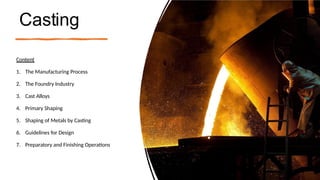
Casting
Content
1. The ManufacturingProcess
2. The Foundry Industry
3. Cast Alloys
4. Primary Shaping
5. Shaping of Metals by Casting
6. Guidelines for Design
7. Preparatory and Finishing Operations
3.
The
Manufacturing
Process
• Manufacturing isthe production of
workpieces of a geometrically defined
shape.
• Manufacturing technology produces
products distinguished by material and
geometric characteristics.
• According to DIN 8580 manufacturing
processes can be classified into six main
groups according to the criteria: changing
of material cohesion
• Casting is an important group of the main
group primary shaping
4.
Classification of manufacturingprocesses
• The products of casting are so-
called castings from metallic
materials, so- called cast alloys.
• The foundry industry produces
the castings.
5.
The Foundry Industry
The foundry industry produces castings from metallic
materials.
Castings in various shapes and materials are to be
found in all branches of engineering:
• Road and rail vehicles
• Machinery
• Aerospace industry
• Electric power engineering
• Shipbuilding
• Pumps and fittings
• Electrical engineering
• Fine mechanics
• Architecture
• Electronics
• Medicine and optics
• Office machines and cast art
Most technical products are not conceivable without
castings.
6.
Advantages of
Casting
Production
The followingoutlines the economical
advantages resulting from the use of
castings.
The advantages are the following:
• Exceptional freedom in the choice of shape
• Castability of all technically important metals
• Mechanical properties of cast materials that are no
longer governed by those of the formed materials
• Optimal components through the combination of
material properties and shape
• Near net shape castings, i. e. reduced machining
costs
• Integral castings, i. e. reduced assembly costs
• Tailored castings
• A high recycling rate, no down-cycling
• Material savings through the use of castings
• Ecological benefits
7.
Properties of Castings
Castingsare produced from the following
material groups:
• iron alloys (cast steel, cast iron)
• aluminum
• magnesium
• titanium
• copper
• zinc
• tin
• nickel
• cobalt alloys
All of these are cast alloys.
Independent of the type of production process, in the
manufacture of metallic components by casting differentiation is
always to be made between the material properties and the
properties of the casting itself. In order to achieve a prescribed
component characteristic the material and the geometry
determine and complement each other in the properties of the
component.
These properties depend on the following:
• The geometry of the part
• The chemical composition of the cast material
• The treatment of the melted material (inoculation,
modification, desulfurization, deoxidation, magnesium
treatment, grain refinement, etc.)
• The type of molding and casting process
• The rate of cooling from casting to the ambient temperature
• The subsequent heat treatment
• The subsequent treatment of the outer layer (chemical-
thermal process, surface deformation, surface alloying,
surface remelting, etc.)
• Changes in the surface layer through machining
• The type of coating (painting, galvanizing, enameling etc.)
8.
Cast
Alloys
Cast Iron Alloys
Castiron alloys can be classified
into seven groups:
• Gray cast iron
• Spheroidal graphite cast iron
• Ausferrite spheroidal graphite
cast iron
• Compacted graphite cast iron
• Malleable cast iron
• Austenitic cast iron
• Abrasion resisting alloyed cast
iron
Primar
y
shapin
g
In the processesof primary shaping, the technological
manufacturing process essentially comprises the
following steps:
• Supply or production of the raw material as an
amorphous substance
• Preparation of a material state ready for primary
shaping
• Filling of a primary shaping tool with the material in
a state ready for primary shaping
• Solidification of the material in the primary shaping
tool
• Removal of the product of primary shaping from the
primary shaping tool
Guidelines for Design
•A design appropriate for manufacturing, which contributes
decisively to the efficient production of a casting, can
generally be achieved only by close collaboration between
the design engineer and the founder.
• Forming by casting differs from other forming processes in that
the material only receives its shape, material structure, and
quality after cooling; with shrinkage – which may sometimes
be considerable – in the liquid state and during solidification,
and appreciable contraction in the solid state.
• The contraction in the solid state should be accounted for by
means of a suitable allowance (allowance for contraction).
• The alloying specifications often suffer considerable
deviations, owing to obstruction of contraction by ribs,
projections, more or less flexible cores, and mold parts.
Preparatory and Finishing
Operations
Meltingof Materials for Casting
• For transforming the metal to be cast and the additives into the molten state, a
wide variety of melting equipment – e.g. shaft (cupola), crucible, and
hearthtype furnaces – is available.
• These furnaces are heated with coke, gas, oil, or electricity.
• The most important types of melting equipment are:
for cast iron, including malleable cast iron:
cupola (shaft) furnaces
induction furnaces
rotary kilns (oil-fired)
cast steel:
electric arc furnaces
induction furnaces
nonferrous metal castings:
induction furnaces
Electrically
gas-heated or oil-heated crucible furnaces.
29.
Preparatory and Finishing
Operations
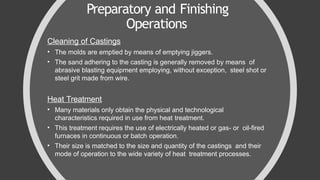
Cleaningof Castings
• The molds are emptied by means of emptying jiggers.
• The sand adhering to the casting is generally removed by means of
abrasive blasting equipment employing, without exception, steel shot or
steel grit made from wire.
Heat Treatment
• Many materials only obtain the physical and technological
characteristics required in use from heat treatment.
• This treatment requires the use of electrically heated or gas- or oil-fired
furnaces in continuous or batch operation.
• Their size is matched to the size and quantity of the castings and their
mode of operation to the wide variety of heat treatment processes.
30.
Preparatory and Finishing
Operations
Inspectionand Testing Methods
• Inspections of the process and the castings begin with checking of the
metallic and nonmetallic feedstocks and end with the final inspection of the
castings.
• Materials and workpieces are mainly tested by means of nondestructive
testing methods such as:
radiographic (EN 12681)
ultrasonic (EN 12680, part 1, 2 and 3)
magnetic powder (EN 1369)
liquid penetrant (EN 1371 part 1 and 2)
Destructive tests, e.g. tensile, notched-bar impact and bending, are
usually carried out with specimens cast either separately or as an
appendage to the casting; in exceptional cases, specimens taken
from the casting itself may be used.
Editor's Notes
#3 Manufacturing is the process of producing workpieces of a geometrically defined shape. It involves the use of machines, tools, and labor to transform raw materials into finished products. The manufacturing technology used in this process produces products distinguished by material and geometric characteristics.
According to DIN 8580, manufacturing processes can be classified into six main groups based on the criteria of changing material cohesion. These six main groups include primary shaping, deformation, machining, joining, surface treatment, and changing of material properties. Each group consists of various subgroups, making it a comprehensive classification system for manufacturing processes.
One important group of the primary shaping main group is casting. Casting involves pouring molten metal or liquid into a mold to create a specific shape. This process is widely used in the production of various metal products, such as automotive parts, household appliances, and industrial equipment.
Casting can be further classified into various subgroups based on the casting process used. For instance, sand casting involves creating a mold using sand, while investment casting involves creating a wax pattern that is then coated with a ceramic material to create a mold. Each casting process has its own advantages and disadvantages and is used in different applications based on the desired properties of the finished product.
#4 Manufacturing processes can be classified into six main groups according to the criteria of changing material cohesion, as per the DIN 8580 classification system. Let's take a closer look at each of these main groups:
1.Primary shaping: This main group includes manufacturing processes that produce a basic shape of a workpiece without any significant change in the material. Examples of primary shaping processes include casting, powder metallurgy, and injection molding.
2.Deformation: This main group involves manufacturing processes that produce a change in shape and size of a workpiece through plastic deformation. Examples of deformation processes include forging, rolling, and extrusion.
3.Machining: This main group includes manufacturing processes that produce a change in shape and size of a workpiece through removal of material by cutting, drilling, or grinding. Examples of machining processes include turning, milling, and drilling.
4.Joining: This main group includes manufacturing processes that join two or more workpieces together. Examples of joining processes include welding, brazing, and adhesive bonding.
5.Surface treatment: This main group involves manufacturing processes that modify the surface properties of a workpiece. Examples of surface treatment processes include coating, polishing, and etching.
6.Changing of material properties: This main group includes manufacturing processes that alter the physical, chemical, or mechanical properties of a material.
Examples of changing of material properties processes include heat treatment, thermochemical treatment, and surface hardening.
Each of these six main groups can be further divided into subgroups based on the specific manufacturing processes used. The DIN 8580 classification system is a useful tool for understanding the different types of manufacturing processes and their applications in industry.
#5 The foundry industry, which produces castings from metallic materials. Castings come in various shapes and materials and are essential in all branches of engineering. In fact, most technical products would not be conceivable without castings.
The foundry industry is an integral part of the manufacturing sector, and it is responsible for producing a wide range of products such as car parts, aircraft components, machinery parts, and construction materials. Castings can be made from a variety of materials, including iron, steel, aluminum, and copper.
One of the primary advantages of castings is their ability to be formed into complex shapes that would be difficult or impossible to manufacture by other methods. This makes them a popular choice for creating parts with intricate designs or unique shapes. Additionally, castings are generally stronger and more durable than similar parts that are made through other manufacturing processes.
In terms of engineering, castings are used in a variety of applications, including automotive, aerospace, marine, and construction industries. In the automotive industry, castings are used to create engine blocks, transmission cases, and suspension components. In the aerospace industry, castings are used to create turbine blades, engine casings, and other critical components. Castings are also used in the marine industry to create propellers and other underwater components. In construction, castings are used to create structural components such as columns, beams, and trusses.
It is important to note that the foundry industry is not without its challenges. The process of casting is complex and requires a high level of expertise and precision. Additionally, the materials used in casting can be expensive, which can increase the cost of manufacturing. However, despite these challenges, the foundry industry continues to thrive, and its products remain an integral part of modern manufacturing.
#6 The advantages of casting production are numerous and significant. Let's dive into them.
1, casting production allows exceptional freedom in the choice of shape. The casting process can produce complex shapes that would be difficult or impossible to produce using other methods. The casting mold can be designed to produce parts with intricate designs or unique shapes, which opens up many possibilities for product design and innovation.
2, castability of all technically important metals is another significant advantage. The casting process can be applied to all technically important metals such as iron, steel, aluminum, and copper, among others. This allows for a wide range of options and applications, making casting an indispensable manufacturing process in various industries.
3, the mechanical properties of cast materials are no longer governed by those of the formed materials. The casting process produces parts with improved mechanical properties, making them stronger and more durable than similar parts made through other manufacturing processes. Castings also have excellent resistance to wear and corrosion, which is essential in various applications.
4, casting allows for optimal components through the combination of material properties and shape. The casting process enables engineers to optimize component design by combining the desired material properties with the required shape, leading to high-quality and efficient products.
5, Near-net shape castings are produced with minimal machining, reducing the cost of producing the final product. This leads to a significant cost saving for the manufacturer, making casting an efficient and cost-effective manufacturing process.
6, integral castings reduce assembly costs. Casting can produce integral castings, which reduces the number of parts needed to assemble a product. This results in lower assembly costs, making casting an attractive manufacturing option.
7, tailored castings allow for customized solutions. Casting production allows for tailored solutions to specific applications, leading to better performance and efficiency. This customization ensures that the final product meets the specific requirements of the customer.
8, casting has a high recycling rate, with no down-cycling. The casting process produces minimal waste, and the waste produced can be easily recycled. This results in a high recycling rate, with no down-cycling, making casting an environmentally friendly manufacturing process.
9, material savings can be achieved through the use of castings. The casting process enables engineers to optimize component design, resulting in material savings, reducing the cost of manufacturing and making it an efficient and cost-effective process.
Lastly, casting production has ecological benefits. The reduced waste and high recycling rate, as well as the material savings, make casting an environmentally friendly manufacturing process, contributing to sustainable manufacturing.
#7 Properties of Castings
Castings are produced from the following material groups:
iron alloys (cast steel, cast iron)
aluminum
magnesium
titanium
copper
zinc
tin
nickel
cobalt alloys
All of these are cast alloys.
Independent of the type of production process, in the manufacture of metallic components by casting differentiation is always to be made between the material properties and the properties of the casting itself. In order to achieve a prescribed component characteristic the material and the geometry determine and complement each other in the properties of the component.
the factors that affect the properties of castings. Castings are important engineering components that are used in a wide range of industries such as automotive, aerospace, and construction. The properties of castings are influenced by a number of factors, including the geometry of the part, the chemical composition of the cast material, the treatment of the melted material, the type of molding and casting process, the rate of cooling, subsequent heat treatment, subsequent treatment of the outer layer, changes in the surface layer through machining, and the type of coating.
Firstly, let's discuss the geometry of the part. The geometry of the part can influence the properties of the casting, as more complex shapes can be more difficult to cast accurately. Parts with thin walls or intricate features may require special considerations during the casting process to ensure that they are produced to the required specifications.
Secondly, the chemical composition of the cast material is an important factor to consider. The chemical composition can affect the mechanical properties of the casting, such as its strength and hardness. The material's chemical composition can also impact the casting process itself, affecting aspects such as the flow of the molten metal and the temperature at which the casting solidifies.
The treatment of the melted material is also important in determining the properties of the casting. Treatments such as inoculation, modification, desulfurization, deoxidation, magnesium treatment, grain refinement, and others can affect the microstructure of the material and, in turn, its mechanical properties.
The type of molding and casting process used can also impact the properties of the casting. Different molding and casting processes may be better suited to certain materials or part geometries, and can affect aspects such as the rate of cooling and the formation of defects.
The rate of cooling from casting to ambient temperature is another important factor to consider. The rate of cooling can affect the microstructure of the material and its mechanical properties, as well as the formation of defects.
Subsequent heat treatment can also be used to modify the properties of the casting. Heat treatment can be used to increase the strength, toughness, or ductility of the material, depending on the specific treatment applied.
The subsequent treatment of the outer layer can also affect the properties of the casting. Treatments such as chemical-thermal processes, surface deformation, surface alloying, and surface remelting can improve the material's surface hardness, wear resistance, or corrosion resistance.
Changes in the surface layer through machining can also affect the properties of the casting. Machining can be used to remove surface defects or to modify the surface finish of the material.
Finally, the type of coating used can also impact the properties of the casting. Coatings such as painting, galvanizing, and enameling can improve the material's corrosion resistance or appearance, depending on the specific coating used.
#8 Cast iron is an important engineering material that is used in a wide range of applications due to its excellent casting properties, high wear resistance, and low cost. Cast iron alloys can be classified into seven groups, each with its own unique characteristics and properties.
The first group is gray cast iron. Gray cast iron is the most widely used cast iron alloy due to its good casting properties, excellent machinability, and low cost. It has a high carbon content and a graphite flake structure that gives it its characteristic gray color. Gray cast iron is commonly used in automotive and machine components such as engine blocks, cylinder heads, and brake rotors.
The second group is spheroidal graphite cast iron. This alloy has a similar composition to gray cast iron but with the addition of magnesium or cerium to form spherical graphite nodules. This gives it better mechanical properties than gray cast iron, such as higher strength, ductility, and toughness. Spheroidal graphite cast iron is commonly used in the automotive industry for components such as crankshafts, gears, and steering knuckles.
The third group is ausferrite spheroidal graphite cast iron. This alloy is a modification of spheroidal graphite cast iron, where the material is heat treated to produce an ausferritic microstructure. This gives it excellent wear resistance, high strength, and good fatigue properties, making it ideal for applications such as heavy machinery and equipment components.
The fourth group is compacted graphite cast iron. This alloy has a graphite structure that is intermediate between gray cast iron and spheroidal graphite cast iron, with graphite nodules that are more compact and rounded. This gives it improved mechanical properties over gray cast iron, such as higher strength and ductility. Compacted graphite cast iron is commonly used in engine blocks and cylinder heads.
The fifth group is malleable cast iron. This alloy is produced by heat treating white cast iron, which results in a material with a nodular graphite structure and higher ductility than gray cast iron. Malleable cast iron is commonly used in applications that require high toughness and ductility, such as pipe fittings, machinery components, and hand tools.
The sixth group is austenitic cast iron. This alloy has a high nickel and chromium content, which gives it excellent corrosion resistance and high temperature strength. Austenitic cast iron is commonly used in the chemical and food processing industries for applications such as pumps, valves, and heat exchangers.
The seventh group is abrasion-resisting alloyed cast iron. This alloy is produced by adding alloying elements such as chromium, nickel, and molybdenum to gray cast iron, which gives it improved wear resistance and high strength. Abrasion-resisting alloyed cast iron is commonly used in mining and construction equipment, as well as in agricultural machinery and other heavy-duty applications.
#11 Cast steel is a type of alloy that is primarily composed of iron and carbon, with additional alloying elements added to enhance its mechanical properties. Cast steels are widely used in various industries due to their high strength, toughness, and corrosion resistance. Cast steels can be classified into four groups, each with its own unique characteristics and properties.
The first group is cast carbon and cast low-alloy steel. Cast carbon and low-alloy steel are commonly used in applications where high strength, toughness, and wear resistance are required. They are also used in applications where good weldability and machinability are important factors. Cast carbon and low-alloy steel are commonly used in the automotive industry for components such as engine blocks, transmission cases, and steering knuckles.
The second group is cast high-alloy steel. Cast high-alloy steel is an alloy that contains a high percentage of alloying elements such as chromium, nickel, and molybdenum. This gives it excellent corrosion resistance, high temperature strength, and wear resistance. Cast high-alloy steel is commonly used in the chemical and petrochemical industries for applications such as pumps, valves, and heat exchangers.
The third group is cast stainless steel. Cast stainless steel is an alloy that contains at least 10.5% chromium, which gives it excellent corrosion resistance. It also has good strength and toughness, making it ideal for applications such as food processing equipment, medical instruments, and marine components.
The fourth group is cast heat-resisting steel. Cast heat-resisting steel is an alloy that is designed to withstand high temperatures and thermal stress. It has excellent strength, toughness, and oxidation resistance at elevated temperatures. Cast heat-resisting steel is commonly used in the aerospace, power generation, and petrochemical industries for applications such as turbine blades, exhaust manifolds, and furnace parts.
#14 Primary shaping is the process of forming a raw material into a desired shape and size using various manufacturing techniques. The primary shaping process is a crucial step in the manufacturing process, as it determines the final shape and size of the product.
The technological manufacturing process essentially comprises the following steps:
The first step is the supply or production of the raw material as an amorphous substance. Raw materials can be in the form of metals, plastics, ceramics, or composites, and they are usually supplied in a raw, unprocessed form.
The second step is the preparation of a material state ready for primary shaping. This step involves various processes such as melting, mixing, and refining of the raw material. This prepares the material in a state that is suitable for primary shaping.
The third step is the filling of a primary shaping tool with the material in a state ready for primary shaping. This involves the use of various tools such as molds, dies, and presses to shape the material into the desired form.
The fourth step is the solidification of the material in the primary shaping tool. This step involves cooling the material to allow it to take the desired shape and form.
The final step is the removal of the product of primary shaping from the primary shaping tool. This involves the use of various techniques such as trimming, cutting, or releasing the product from the tool.
#15 In the process of shaping metals by casting, one of the commonly used techniques is ingot casting. Ingot casting involves the pouring of molten metal into a mold to create a solid metal shape known as an ingot. There are 2 main methods of ingot casting, which are top pouring and bottom pouring.
Top pouring is a method of ingot casting where the molten metal is poured from the top of the mold. The mold is placed on a stand, and the molten metal is poured from a ladle or furnace directly onto the top of the mold. This method is commonly used for small and medium-sized ingots and is suitable for metals that solidify quickly.
Bottom pouring, on the other hand, is a method of ingot casting where the molten metal is poured from the bottom of the mold. The mold is placed on a tilting table, and the molten metal is poured into a vertical hole in the bottom of the mold. This method is commonly used for large-sized ingots and is suitable for metals that require controlled cooling.
Both top pouring and bottom pouring have their advantages and disadvantages. Top pouring is a faster method, and it requires less equipment and investment. However, it may result in uneven cooling and formation of air pockets. Bottom pouring, on the other hand, provides better control over cooling and reduces the formation of air pockets. However, it requires more equipment and investment.
_____________________
Another technique used in the shaping of metals by casting is continuous casting. Continuous casting is a process where molten metal is poured continuously into a mold to produce a continuous length of metal. The metal is solidified as it passes through the mold and is continuously drawn out at the other end of the mold. This process is used to produce a variety of metal shapes, including rods, tubes, and sheets.
There are two main types of continuous casting: vertical and horizontal continuous casting.
Vertical continuous casting involves pouring the molten metal into a vertical mold. The mold is typically water-cooled, and as the molten metal is poured in from the top, it solidifies and forms a continuous length of metal that is drawn out of the bottom of the mold. This process is commonly used for producing long rods or bars of metal.
Horizontal continuous casting, on the other hand, involves pouring the molten metal into a horizontal mold. The mold is typically water-cooled, and the molten metal solidifies as it passes through the mold. The solidified metal is then continuously drawn out from the end of the mold. This process is commonly used for producing sheets or tubes of metal.
Both vertical and horizontal continuous casting have their advantages and disadvantages. Vertical continuous casting is suitable for producing long rods or bars of metal and provides good control over the solidification process. However, it requires a significant amount of space and is not suitable for producing flat or wide metal shapes. Horizontal continuous casting, on the other hand, is suitable for producing sheets or tubes of metal and can produce a wide variety of shapes. However, it requires a complex mold and is more difficult to control the solidification process.
#16 Strip casting is another casting process used in the production of thin, flat metal shapes such as sheets or strips. It involves the continuous casting of metal into a thin strip, which is then further processed into the desired shape.
There are two main types of strip casting: vertically uphill and horizontally.
Vertically uphill strip casting involves the upward movement of the mold relative to the direction of casting. The molten metal is poured onto the top of the mold, and as the mold moves upward, the metal solidifies and forms a thin strip. The strip is then cooled and further processed into the desired shape. This method is commonly used for the production of copper, aluminum, and zinc strips.
Horizontal strip casting, on the other hand, involves the continuous casting of metal in a horizontal direction. The molten metal is poured into a water-cooled mold, and as it passes through the mold, it solidifies into a thin strip. The strip is then further processed into the desired shape. This method is commonly used for the production of steel and stainless steel strips.
____________
Strip casting machine (rotary process) is a continuous casting machine used for producing thin strips of metals such as steel, aluminum, and copper. In this process, a mold is rotated continuously while the molten metal is poured onto it. The rotation of the mold helps to create a thin strip of metal as the metal solidifies while being in contact with the mold. This process is suitable for producing thin strips of metals with a thickness ranging from 0.5mm to 6mm.
(b) Strip casting machine (Hezelett process) is another continuous casting machine used for producing thin strips of metals. In this process, the molten metal is poured onto a rapidly moving chill wheel which cools the metal and forms a solid strip. The metal strip is then peeled off from the chill wheel using a stripper wheel. The Hezelett process is suitable for producing thin strips of metals with a thickness ranging from 0.1mm to 3mm.
(c) Wire rod casting machine is a continuous casting machine used for producing wire rods from metals such as steel and aluminum. In this process, the molten metal is poured into a tundish, which acts as a reservoir, and then flows through a water-cooled copper mold. As the metal cools and solidifies, it is continuously pulled out from the mold by a set of rollers, forming a long wire rod. The wire rod is then coiled and cooled before being cut into smaller lengths. This process is suitable for producing wire rods with a diameter ranging from 5mm to 25mm.
#17 Hand molding is a traditional method of manufacturing cast parts that involves shaping a mold by hand. It is a manual process that has been used for centuries to produce various types of cast parts, such as engine blocks, pipes, and machine parts.
The process begins with the creation of a pattern, which is a replica of the final part. The pattern can be made from wood, plastic, or metal and is usually created using CNC machining or 3D printing. The pattern is then used to create a mold, which is made from sand, clay, or plaster.
In hand molding, the mold is created by packing sand or other molding material around the pattern. The sand is packed tightly to ensure that the mold is accurate and free from defects. Once the mold is complete, it is opened, and the pattern is removed.
The mold is then ready to be filled with molten metal. The metal is poured into the mold through a sprue, which is a channel that directs the metal into the mold cavity. As the metal cools, it solidifies, taking on the shape of the mold cavity. Once the metal has cooled, the mold is broken open, and the cast part is removed.
Hand molding is a labor-intensive process that requires a skilled operator to ensure that the mold is accurate and free from defects. However, it is a versatile process that can be used to produce a wide range of cast parts, from small, intricate parts to large, complex parts. It is still used today in some industries, particularly for low-volume or custom cast parts.
#18 Let's start with machine molding. Machine molding is a type of molding process that involves the use of machines to create molds. It is a highly automated process that can produce a large number of identical molds quickly and efficiently. In this process, a pattern is placed in a molding machine, and sand is then compacted around it to create the mold. The process is highly accurate and can produce very precise molds with a high degree of repeatability.
Moving on to suction molding. Suction molding is a type of molding process that uses a vacuum to draw the molding material into the mold. In this process, a pattern is placed in a flask, and a molding material, usually sand, is added to the flask. A vacuum is then applied to the flask, which draws the molding material into the mold cavity. The process is commonly used for casting small to medium-sized parts and is highly accurate and produces high-quality castings.
#19 Now let's discuss shell molding. Shell molding is a type of molding process that uses a heated metal pattern to create the mold. In this process, a pattern is heated to a high temperature and then coated with a thin layer of molding material, usually sand and resin. The coated pattern is then placed in a flask, and more sand is added to the flask. The pattern is then removed, leaving behind a shell mold. The shell mold is then used to cast the part. This process is known for producing high-quality, high-precision castings.
Finally, let's talk about ceramic molding. Ceramic molding is a type of molding process that uses ceramics to create the mold. In this process, a mixture of ceramic powder and binder is used to create a mold. The mixture is then molded around a pattern and then fired in a kiln. The pattern is then removed, leaving behind a ceramic mold. The mold is then used to cast the part. This process is known for producing very high-quality castings with intricate details.
#20 Vacuum molding is a type of sand casting process that involves the use of vacuum pressure to create a mold.
The process of vacuum molding involves several steps. Firstly, the plastic foil is softened by means of a foil-type heating element and drawn tightly against the pattern by vacuum through holes. This ensures that the plastic foil conforms to the shape of the pattern, creating a precise mold cavity.
Next, the mold box is placed on top of the pattern. The mold box is then filled with binderless sand and precompacted. Once the sand is in place, the top of the mold box is covered with plastic foil.
After this, vacuum is applied to the mold box, which compacts the sand around the pattern. The vacuum pressure helps to ensure that the sand is evenly distributed and compacted, resulting in a high-quality mold.
Once the sand has been compacted, the vacuum is switched off, and the mold box can easily be lifted off the pattern. The top and bottom halves of the mold box are then joined together.
Finally, the vacuum is maintained during pouring. This ensures that the molten metal is drawn into the mold cavity, resulting in a high-quality cast part.
Vacuum molding has several advantages over other types of sand casting processes. One of the main advantages is that it produces a high-quality surface finish on the cast part. This is due to the use of vacuum pressure, which helps to ensure that the sand is evenly distributed and compacted.
Another advantage of vacuum molding is that it is a relatively quick process. Once the mold has been created, it can be used to produce multiple cast parts quickly and efficiently.
______________________
Investment casting with compact mould and shell mould is two variation of the traditional investment casting process. The process involves the use of a compact mould or a shell mould instead of the traditional ceramic shell.
The manufacturing stages in investment casting with compact mould and shell mould can be broken down into several steps, as follows:
Step 1: Pattern Creation The first step in investment casting with compact mould and shell mould is the creation of a wax pattern. This is typically done by injecting wax into a mold or by carving the pattern out of a block of wax. The wax pattern is an exact replica of the final part that is to be cast.
Step 2: Assembly Once the wax pattern has been created, it is assembled onto a wax runner system. This runner system is used to feed the molten metal into the mold cavity during the casting process.
Step 3: Compact Mould or Shell Mould Creation The next step in investment casting with compact mould and shell mould is the creation of the compact mould or shell mould. A compact mould is typically made of a mixture of sand and resin that is compressed around the wax pattern. A shell mould is created by dipping the wax pattern into a ceramic slurry and then coating it with a layer of fine ceramic sand.
Step 4: De-Waxing Once the compact mould or shell mould has been created, the wax is melted out of the mold. This creates a hollow cavity that is an exact replica of the wax pattern.
Step 5: Preheating After the wax has been melted out of the mold, the compact mould or shell mould is preheated to a specific temperature. This helps to ensure that the mould can withstand the high temperatures of the molten metal during the casting process.
Step 6: Casting Once the compact mould or shell mould has been preheated, it is removed from the furnace and filled with molten metal. The molten metal is typically poured into the mold under vacuum or pressure to ensure that the metal fills the mold cavity completely.
Step 7: Cooling and Finishing After the molten metal has solidified, the compact mould or shell mould is broken away from the casting, and the casting is removed from the runner system. The casting is then cleaned and finished to remove any excess metal or mould material.
#21 The full mold casting process involves the use of an expandable polystyrene (EPS) foam pattern that is coated with a refractory material. The foam pattern is created using a mold that is filled with EPS beads and then expanded with steam to create the desired shape. Once the foam pattern is created, it is coated with a refractory material, such as ceramic or plaster.
The full mold casting process can be broken down into several steps, as follows:
Step 1: Pattern Creation The first step in full mold casting is the creation of the foam pattern. This is typically done by filling a mold with EPS beads and then expanding the beads with steam to create the desired shape.
Step 2: Coating Once the foam pattern is created, it is coated with a refractory material, such as ceramic or plaster. This coating provides the necessary support for the molten metal during the casting process.
Step 3: Assembly After the coating is applied, the foam pattern is assembled onto a gating system, which is used to feed the molten metal into the mold cavity during the casting process.
Step 4: Pouring Once the foam pattern is assembled onto the gating system, the mold is heated to a specific temperature to help ensure that the mold can withstand the high temperatures of the molten metal during the casting process. The molten metal is then poured into the mold under vacuum or pressure to ensure that the metal fills the mold cavity completely.
Step 5: Cooling and Finishing After the molten metal has solidified, the mold is allowed to cool. Once the mold has cooled, the coating material is broken away from the casting, and the casting is removed from the gating system. The casting is then cleaned and finished to remove any excess metal or mold material.
__________________________
Permanent mold casting, also known as gravity die casting, is a process where molten metal is poured into a reusable mold to create a solid metal part.
The composite mold used in permanent mold casting is made up of both metallic and sand cores. The metallic cores are used to form the main shape of the part, while the sand cores are used to create undercuts or other complex features.
The permanent mold casting process with composite molds can be broken down into several steps, as follows:
Step 1: Pattern Creation The first step in permanent mold casting with composite molds is the creation of a pattern or model of the desired part. This pattern is typically made of wood, plastic, or metal, and is used to create the mold.
Step 2: Mold Preparation Once the pattern is created, it is used to create a mold. The mold is typically made of steel or iron and is designed to be reused multiple times. The mold is then preheated to a specific temperature to help ensure that the molten metal will flow smoothly into the mold cavity.
Step 3: Core Creation After the mold is preheated, metallic and sand cores are created to form the main shape of the part and any undercuts or complex features, respectively. The metallic cores are placed into the mold, and the sand cores are then positioned around the metallic cores.
Step 4: Pouring Once the cores are in place, the mold is closed, and the molten metal is poured into the mold under gravity. The molten metal fills the mold cavity and solidifies around the metallic and sand cores.
Step 5: Cooling and Finishing After the molten metal has solidified, the mold is opened, and the casting is removed. The sand cores are then broken away from the casting, leaving any undercuts or complex features. The casting is then cleaned and finished to remove any excess metal or mold material.
In conclusion, permanent mold casting with composite molds is a highly effective process used in the manufacturing industry to produce high-quality metal parts. The use of both metallic and sand cores allows for the creation of complex features and undercuts, making it a versatile process for a wide range of applications.
#22 Low pressure permanent mold casting is a variation of the permanent mold casting process that uses low pressure to force molten metal into a reusable mold to create a solid metal part.
____________
High pressure die casting is a casting process that involves injecting molten metal into a reusable steel mold under high pressure to create a solid metal part.
There are two types of high pressure die casting processes: the hot chamber process and the cold chamber process. Let's take a closer look at each of these processes:
Hot Chamber Process: In the hot chamber process, the injection system of the die casting machine is immersed in a bath of molten metal. This bath is typically made up of a zinc alloy or magnesium alloy, which have low melting points. The molten metal is then injected into the die casting mold under high pressure.
Cold Chamber Process: In the cold chamber process, the molten metal is poured into a separate chamber or shot sleeve before being injected into the die casting mold. This process is typically used with metals that have higher melting points, such as aluminum and copper alloys. The molten metal is then fed into the die casting mold by a plunger.
The high pressure die casting process can be broken down into several steps, as follows:
Step 1: Mold Preparation The first step in high pressure die casting is the preparation of the mold. The mold is typically made of steel and is designed to be reused multiple times. The mold is preheated to a specific temperature to help ensure that the molten metal will flow smoothly into the mold cavity.
Step 2: Filling of Casting Chamber Once the mold is preheated, the molten metal is injected into the casting chamber under high pressure. In the hot chamber process, the injection system is immersed in the bath of molten metal, while in the cold chamber process, the molten metal is poured into a separate chamber before being injected into the casting chamber.
Step 3: Plunger for Molten Metal into Die After the molten metal has been injected into the casting chamber, a plunger is used to force the metal into the die. The plunger applies pressure to the metal, ensuring that it fills all of the cavities in the mold.
Step 4: Ejection of Casting Once the metal has cooled and solidified, the mold is opened, and the casting is ejected. The casting is then cleaned and finished to remove any excess metal or mold material.
#23 Centrifugal casting is a casting process in which a mold is rotated at high speeds while molten metal is poured into it. The centrifugal force generated by the rotating mold forces the metal to distribute itself evenly along the mold walls, resulting in a high-quality, void-free casting.
There are two types of centrifugal casting: true centrifugal casting and semi-centrifugal casting. True centrifugal casting involves rotating the mold around a vertical axis, while semi-centrifugal casting rotates the mold around a horizontal axis.
___________________
composite casting
As you can see in the figure, the process of composite casting involves the use of two or more different materials to produce a composite part. In this specific illustration, the process involves the use of sand casting with inserts.
The first step in the process is the creation of a pattern, which is used to create the mold. The pattern is made of a material such as wood or plastic, and it is designed to be the exact shape and size of the desired part.
Next, the pattern is used to create the mold. In sand casting, the mold is created by packing sand around the pattern. In this particular example, the mold includes an insert, which is made of a different material than the sand.
Once the mold is created, molten metal is poured into the mold, filling the space around the insert and the sand. As the metal cools and solidifies, it bonds with both the insert and the sand, creating a composite part.
After the metal has fully solidified, the sand is removed from the mold, revealing the composite part. The insert is now a permanent part of the part, providing additional strength and durability.
Composite casting is an effective process for producing complex parts that require the strength and durability of multiple materials. By combining different materials in a single part, composite casting allows for the creation of parts that are stronger, more durable, and more resistant to wear and tear.