Evolution of culture
 Cultural Evolution is the idea that human cultural change that
is, changes in socially transmitted beliefs, knowledge, customs,
skills, attitudes, languages, and so on––can be described as a
Darwinian evolutionary process that is similar in key respects
(but not identical) to biological/genetic evolution.
 Cultural evolution is an evolutionary theory of social change. It
follows from the definition of as "information capable of
affecting individuals' behavior that they acquire from other
members of their species through teaching, imitation and other
forms of social transmission".
Theories of Cultural Evolution
 Unilineal Theory
 Cyclical Theory
 Diffusionist Theory
 Conflict Theory
Unilineal theory
 They are based on the assumption that culture gradually evolves from
simple to complex in one direction through different stages.
 According to them cultural evolution progress towards a better
society. To them, culture evolves from simple to complex.
 They assume that it is universal and every culture goes through
the stages, though the speed of progress may differ.
 The also implies that the final stage is the end of the evolutionary
process.
Eg. August Comte: the law of three stages, Spenser’s different
stages of compound societies, Marx’s historical materialism etc.
Cyclical theories
 Spengler, Toynbee and Sorokin can be regarded as the
Champions of this theory
 “Cyclical theories of social change focus on the rise
and fall of civilisations attempting to discover and
account for these patterns of growth and decay”
 Each civilisation is like a biological organism and has
a similar life-cycle; birth, maturity old age and death.
Culture Conflict Theory
 Culture Conflict Theory, also known as Cultural Deviance Theory,
Culture Conflict is the term used to describe the conflict that arises
during the intersection of cultural values and beliefs between two or
more cultural groups living within the same society.
 Conflict theorists argue that society and culture are inherently
unequal. Power is unequally distributed between social groups
depending on factors such as class, gender, race, and age. A
society’s culture does not represent all social groups equally, and
the accepted value system privileges some people while hurting
others.
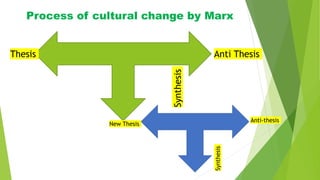
Thesis Anti Thesis
Synthesis
Process of cultural change by Marx
New Thesis
Anti-thesis
Synthesis
Diffusion Theory of Cultural Growth
 Cultural diffusion is the process by which cultural traits
discovered or invented at one place or society is spread
directly or indirectly to one other place or society.
 The following factors are influential in process of diffusion-
 Relation and Transportation
 Need for the desire for new traits
 Competition with old traits and their opposition
 Respect and recognition of those who bring new traits
Conditions related to cultural diffusion:
 1. Any cultural group will adopt cultural traits of another
cultural group only when it would be meaningful and
useful either economically or socially or both.
 2. In course of diffusion cultural traits may not remain in
their original form but changes in them can take place
due to different environmental situations.
 3. Process of diffusion of cultural traits always follow
from high culture to low culture or developed culture to
underdeveloped culture.
 4. Process of diffusion may create culture change in
groups adopting a culture of other groups. Sometimes
borrowed cultural traits get assimilated easily, but
sometimes, they are responsible for any changes.
Thank you

Cultural Evolution.pptx

  • 1.
  • 2.
    Evolution of culture Cultural Evolution is the idea that human cultural change that is, changes in socially transmitted beliefs, knowledge, customs, skills, attitudes, languages, and so on––can be described as a Darwinian evolutionary process that is similar in key respects (but not identical) to biological/genetic evolution.  Cultural evolution is an evolutionary theory of social change. It follows from the definition of as "information capable of affecting individuals' behavior that they acquire from other members of their species through teaching, imitation and other forms of social transmission".
  • 3.
    Theories of CulturalEvolution  Unilineal Theory  Cyclical Theory  Diffusionist Theory  Conflict Theory
  • 4.
    Unilineal theory  Theyare based on the assumption that culture gradually evolves from simple to complex in one direction through different stages.  According to them cultural evolution progress towards a better society. To them, culture evolves from simple to complex.  They assume that it is universal and every culture goes through the stages, though the speed of progress may differ.  The also implies that the final stage is the end of the evolutionary process. Eg. August Comte: the law of three stages, Spenser’s different stages of compound societies, Marx’s historical materialism etc.
  • 5.
    Cyclical theories  Spengler,Toynbee and Sorokin can be regarded as the Champions of this theory  “Cyclical theories of social change focus on the rise and fall of civilisations attempting to discover and account for these patterns of growth and decay”  Each civilisation is like a biological organism and has a similar life-cycle; birth, maturity old age and death.
  • 6.
    Culture Conflict Theory Culture Conflict Theory, also known as Cultural Deviance Theory, Culture Conflict is the term used to describe the conflict that arises during the intersection of cultural values and beliefs between two or more cultural groups living within the same society.  Conflict theorists argue that society and culture are inherently unequal. Power is unequally distributed between social groups depending on factors such as class, gender, race, and age. A society’s culture does not represent all social groups equally, and the accepted value system privileges some people while hurting others.
  • 7.
    Thesis Anti Thesis Synthesis Processof cultural change by Marx New Thesis Anti-thesis Synthesis
  • 8.
    Diffusion Theory ofCultural Growth  Cultural diffusion is the process by which cultural traits discovered or invented at one place or society is spread directly or indirectly to one other place or society.  The following factors are influential in process of diffusion-  Relation and Transportation  Need for the desire for new traits  Competition with old traits and their opposition  Respect and recognition of those who bring new traits
  • 9.
    Conditions related tocultural diffusion:  1. Any cultural group will adopt cultural traits of another cultural group only when it would be meaningful and useful either economically or socially or both.  2. In course of diffusion cultural traits may not remain in their original form but changes in them can take place due to different environmental situations.  3. Process of diffusion of cultural traits always follow from high culture to low culture or developed culture to underdeveloped culture.  4. Process of diffusion may create culture change in groups adopting a culture of other groups. Sometimes borrowed cultural traits get assimilated easily, but sometimes, they are responsible for any changes.
  • 10.