Accepted Manuscript
Synthesis and anti-mitotic activity of 6,7-dihydro-4H-isothiazolo[4,5-b]pyridin-5-ones:
In vivo and cell-based studies
Victor V. Semenov, Boris V. Lichitsky, Andrey N. Komogortsev, Arkady A. Dudinov,
Mikhail M. Krayushkin, Leonid D. Konyushkin, Olga P. Atamanenko, Irina B.
Karmanova, Yuri A. Strelenko, Boris Shor, Marina N. Semenova, Alex S. Kiselyov
PII: S0223-5234(16)30811-X
DOI: 10.1016/j.ejmech.2016.09.075
Reference: EJMECH 8941
To appear in: European Journal of Medicinal Chemistry
Received Date: 7 May 2016
Revised Date: 26 June 2016
Accepted Date: 23 September 2016
Please cite this article as: V.V. Semenov, B.V. Lichitsky, A.N. Komogortsev, A.A. Dudinov,
M.M. Krayushkin, L.D. Konyushkin, O.P. Atamanenko, I.B. Karmanova, Y.A. Strelenko, B.
Shor, M.N. Semenova, A.S. Kiselyov, Synthesis and anti-mitotic activity of 6,7-dihydro-4H-
isothiazolo[4,5-b]pyridin-5-ones: In vivo and cell-based studies, European Journal of Medicinal
Chemistry (2016), doi: 10.1016/j.ejmech.2016.09.075.
This is a PDF file of an unedited manuscript that has been accepted for publication. As a service to
our customers we are providing this early version of the manuscript. The manuscript will undergo
copyediting, typesetting, and review of the resulting proof before it is published in its final form. Please
note that during the production process errors may be discovered which could affect the content, and all
legal disclaimers that apply to the journal pertain.
M
ANUSCRIPT
ACCEPTED
ACCEPTED MANUSCRIPT
M
ANUSCRIPT
ACCEPTED
ACCEPTED MANUSCRIPT
1
Synthesis and anti-mitotic activity of 6,7-dihydro-4H-isothiazolo[4,5-b]pyridin-5-ones:
in vivo and cell-based studies
Victor V. Semenov a,
*, Boris V. Lichitsky a
, Andrey N. Komogortsev a
, Arkady A. Dudinov a
,
Mikhail M. Krayushkin a
, Leonid D. Konyushkin a
, Olga P. Atamanenko a
, Irina B. Karmanova a
,
Yuri A. Strelenko a
, Boris Shor b
, Marina N. Semenova c,d
, Alex S. Kiselyov e
a
N. D. Zelinsky Institute of Organic Chemistry, RAS, Leninsky Prospect, 47, 119991, Moscow,
Russian Federation
b
Immune Pharmaceuticals LLC, 430 East 29th Street, Suite 940, New York, NY, 10016, USA
c
N. K. Kol’tsov Institute of Developmental Biology, RAS, Vavilov Street, 26, 119334, Moscow,
Russian Federation
d
Chemical Block Ltd., 3 Kyriacou Matsi, 3723, Limassol, Cyprus
e
Life Sciences Center, Moscow Institute of Physics and Technology, Institutsky Per., 9,
Dolgoprudny, Moscow Region, 141700, Russian Federation
Corresponding author: Victor V. Semenov
Address: N. D. Zelinsky Institute of Organic Chemistry, RAS, Leninsky Prospect, 47, 119991,
Moscow, Russian Federation. Tel.: +7 916 620 9584; fax: +7 499 137 2966.
E-mail: vs@zelinsky.ru
E-mail addresses:
Victor V. Semenov vs@zelinsky.ru
Boris V. Lichitsky blich2006@mail.ru
Andrey N. Komogortsev dna5@mail.ru
Arkady A. Dudinov 1944ark@mail.ru
Mikhail M. Krayushkin mkray@ioc.ac.ru
Leonid D Konyushkin LeonidK@chemical-block.com
Olga P. Atamanenko info@chemblock.com
Irina B. Karmanova vs@chemblock.ru
Yuri A. Strelenko strel@ioc.ac.ru
Shor Boris boris.shor@immunepharma.com
Marina N. Semenova ms@chemical-block.com
Alex S. Kiselyov nikizalp@aol.com
M
ANUSCRIPT
ACCEPTED
ACCEPTED MANUSCRIPT
2
ABSTRACT
A series of 3,7-diaryl-6,7-dihydroisothiazolo [4,5-b]pyridin-5(4H)-ones 8 and 9 was synthesized by
multicomponent condensation of 3-aryl-5-isothiazolecarboxylic acid esters 4a–f with aromatic (or
thienyl) aldehydes 7 and Meldrum's acid in an acidic medium. The targeted compounds were
evaluated for their antimitotic microtubule destabilizing activity using in vivo phenotypic sea urchin
embryo model and in vitro human cancer cell-based assays. Selected dihydroisothiazolopyridinones
altered sea urchin egg cleavage in 2–10 nM concentrations together with significant cytotoxicity
against cancer cells including chemoresistant cell lines (IC50 in submicromolar – low nanomolar
concentration range). Both approaches confirmed antimitotic microtubule destabilizing mechanism
of action of the izothiazole derivatives. Structure-activity relationship study determined the
importance of p-methoxybenzene A-ring for the antiproliferative effect. The most potent compound
9b containing p-methoxybenzene A-ring and thiophene B-ring caused mitotic arrest and
disintegration of cell microtubules.
Keywords:
Isothiazoles
Dihydroisothiazolopyridinones
Microtubule destabilization
Sea urchin embryo
Cytotoxicity
Abbreviations:
CA4P, combretastatin A-4 disodium phosphate
DIP, 6,7-dihydro-4H-isothiazolo[4,5-b]pyridin-5-ones
MDR, multi-drug resistance
Pgp, P-glycoprotein
SAR, structure-activity relationship
M
ANUSCRIPT
ACCEPTED
ACCEPTED MANUSCRIPT
3
1. Introduction
Derivatives of 4-aminoisothiazole exhibit a diverse range of pharmacological and biological
activities. In a few representative examples, 3-(hetero)aryl-4-aminothiazoles were described as
potent ATP-competitive inhibitors of kinases including vascular endothelial growth factor receptors
I and II [1] and cyclin-dependent kinases [2]. Lysophosphatic acid receptor antagonists based on this
chemotype has been reported [3]. Heterobiaryl compounds containing 4-aminoisothiazole moiety
(Fig. 1, I) showed potent antimitotic microtubule destabilizing activity [4]. Related derivatives
containing cyclic amide group were introduced recently (Fig. 1, II) [5], however their biological
activity was not described. It is reasonable to assume that proper substitution of rings A and B in II
may yield novel potent tubulin/microtubule targeting agents [4]. In this work an optimized path
towards 4-aminoisothiazole derivatives II has been devised. The targeted compounds were
evaluated as microtubule destabilizing agents using in vivo phenotypic sea urchin embryo assay and
in vitro cell-based approaches.
N
H
N
S
O
II
R1
R2
R1= H, Cl
R2= H, OMe, Hal
NH N
N
O
NH
N
S
Py
(OCH3)n
I B
A
Fig. 1. Structures of 4-aminoisothiazole derivatives.
2. Results and discussion
2.1. Chemistry
In order to develop a general approach to synthesis of the targeted 3,7-diaryl-6,7-
dihydroisothiazolo [4,5-b]pyridin-5(4H)-ones (II), we turned our attention to the expedited
preparation of the key 4-aminoisothiazoles 6a–f from the easily available benzonitriles 1a–f via the
described reaction sequence [6]. It involved generation of oximes 2a–f from 1 followed by their
interaction with TsCl and subsequent cyclization of tosylates 3a–f with thioacetic ester to arrive at
3-aryl-5-isothiazolecarboxylic acid esters 4a–f [6]. Reflux of 4a–f in concentrated HCl afforded
intermediate acids 5a–f followed by their subsequent decarboxylation to result in 4-
aminoisothiazoles 6a–f, generated in quantitative yields as respective HCl salts and used without
further separation in the next step. A multicomponent condensation of 6a–f with aromatic aldehydes
7 and Meldrum's acid in a glacial AcOH/AcONa system afforded the desired 6,7-dihydro-4H-
M
ANUSCRIPT
ACCEPTED
ACCEPTED MANUSCRIPT
4
isothiazolo[4,5-b]pyridin-5-ones (DIP) 8, 9 (35–65% overall yield starting from 4). Aldehydes 7k,
7l, 7m (myristicin-, dillapiol-, apiol-derivatives, respectively), and 7n were prepared using the
essential oils isolated from dill and parsley seeds, as per conversion routes described earlier [7,8].
a
1a-f 4a-f2a-f
N
AX AX
3a-f
N
N
OTs
AX
5a-f
N
S
NH2
O
OH
AX
N
S
NH2
O
H3CO
AX
HSCH2CO2CH3
b c
X
a: Í
b: 4-OCH3
c: 3,4-(OCH3)2
d: 4-Cl
e: 3-F
f: 4-F
d
OO
O O
S
O
6a-f
47-62 %
9b,d-f
N
S
N
H
O
R1
R2R3
R4
X A
B
7g-r
R1
R2
R3
R4
O
B
N
S
N
H
O
S
AX
ff
R1 R2, R3 R4
g: Í H OCH3 H
h: H OCH3 H H
i: H -OCH2O- H
j: H -OCH2CH2O- H
k: H OCH3 -OCH2O-
l: OCH3 OCH3 -OCH2O-
m: OCH3 -OCH2O- OCH3
n: OCH3 OH OH OCH3
o: H Cl H H
p: H H Cl H
q: H F H H
r: H H F H
8a(k,m,n), 8b(h-r), 8co,
8d(k,m), 8e(g-i,k,m,o-r),
8f(g-i,k,m,o,r)
e
35-65 %
Na
+
N
N
O
-
N
S
NH3
+
X A
Cl
-
Scheme 1. Reagents and conditions: (a) NaOMe–i-AmylONO, abs. MeOH, 5 °C, 1 h [9]; (b) TsCl,
DMF, 75 °C, 15 min [10]; (c) HSCH2CO2Me, MeOH, Et3N, r.t., 4 h [6]; (d) and (e) conc. HCl,
reflux, 6 h; (f) NaOAc–AcOH, reflux, 2 h.
M
ANUSCRIPT
ACCEPTED
ACCEPTED MANUSCRIPT
5
2.2. Biological evaluation
2.2.1. Antimitotic activity in the sea urchin embryo model
The resulting DIP 8 and 9 were evaluated in a phenotypic sea urchin embryo assay for their
antimitotic microtubule destabilizing activity [11]. This assay system has been introduced and
extensively validated by our team to identify compounds that selectively affect tubulin dynamics.
We have consistently demonstrated excellent correlation between data generated using the in vivo
sea urchin embryo assay, in vitro tubulin polymerization, and human tumor cell experiments for
diverse chemical series [4,12,13]. Specifically, the assay includes monitoring of: i) cleavage
alteration and/or arrest of fertilized eggs to assess antimitotic activity, and ii) motility of free-
swimming blastulae exposed to a compound. Distinct swimming alterations, namely, settlement to
the bottom of a well accompanied by a rapid spinning around animal-vegetal axis, suggest
microtubule destabilizing mode of action of a tested molecule (video illustrations are available at
http://www.chemblock.com). The results are presented in Table 1, with combretastatin A-4
disodium phosphate (CA4P) as a positive control.
Table 1
Effects of 6,7-dihydro-4H-isothiazolo[4,5-b]pyridin-5-ones (DIP) on the sea urchin embryos and
human cancer cell lines [14] (NCI60 anticancer drug screen).
N
S
N
H
O
R1
R2
3
7 6
Compd R1 R2 Sea urchin embryo effects, EC
(µM)a NCI60 screen
Cleavage
alteration
Cleavage
arrest
Embryo
spinning
Mean GI50,
µMb Mean GI, %c
CA4P 0.005 0.01 0.05 0.00171
8ak 4 >4 >4 4.6
8am >4 >4 >4 NDd
NDd
8an >4 >4 >4 NDd
NDd
8bh 0.01 0.05 0.1 1.549
O
O
OCH 3
O
O
OCH 3
OCH 3
OH
OH
OCH 3
OCH 3
OCH 3
OCH 3
M
ANUSCRIPT
ACCEPTED
ACCEPTED MANUSCRIPT
6
8bi 0.01 0.1 0.2 1.549
8bj 0.01 0.05 0.5 0.933
8bk > ≈ 4e
> ≈ 4e
> ≈ 4e
NDd
NDd
8bl 0.2 2 (TEf
) >5 26.9
8bm 0.05 0.2 1 NDd
NDd
8bn 1 2 (reverse) >5 NDd
NDd
8bo 0.01 0.1 0.1 1.738
8bp 0.1 0.2 1 15.7
8bq 0.01 0.05 0.2 4.898
8br 0.01 0.05 0.1 3.02
8co 2 >4 >4 14
8dk 2 >4 >4 17.8
8dm >4 >4 >4 7.66
8eg 2 >4 >4 5.3
8eh 0.5 1–4 (reverse) >4 9.4
8ei 1 4 >4 5.2
8ek 4 >4 >4 4.4
8em >4 >4 >4 NDd
NDd
OCH 3
O
O
OCH 3
O
O
OCH 3
OCH 3
O
O
OCH 3
O
O
OCH 3
H3CO
OCH 3
OCH 3
OCH 3
O
O
OCH 3
OCH 3
OH
OH
OCH 3
OCH 3
Cl
OCH 3 Cl
OCH 3
F
OCH 3 F
Cl
OCH 3
OCH 3
Cl
Cl
O
O
OCH 3
O
O
OCH 3
OCH 3
F
F
F
F
OCH 3
OCH 3
O
O
O
O
OCH 3
F
O
O
OCH 3
OCH 3
M
ANUSCRIPT
ACCEPTED
ACCEPTED MANUSCRIPT
7
8eo 1 4 >4 NDd
NDd
8ep >4 >4 >4 16.5
8eq 1 >4 >4 6.4
8er 1
4 (reverse,
TEf
)
>4 NDd
NDd
8fg 2 >4 >4 6.2
8fh 1
4 (reverse,
TEf
)
>4 15.1
8fi 1 >4 >4 11.7
8fk >4 >4 >4 10.1
8fm >4 >4 >4 NDd
NDd
8fo 1 4 >4 15.6
8fr 1 4 (reverse) >4 4.2
9b 0.002 0.005 0.1 0.302
9d 0.01 0.1 0.2 1.514
9e 0.05 0.5 2 7.8
9f 0.05 0.2 4 NDd
NDd
a
The sea urchin embryo assay was conducted as described previously [11]. Fertilized eggs and
hatched blastulae were exposed to 2-fold decreasing concentrations of compounds. Duplicate
measurements showed no differences in effective threshold concentration (EC) values.
b
GI50: concentration required for 50% cell growth inhibition.
c
GI %: single dose inhibition of cell growth at 10 µM concentration of a compound.
d
ND: not determined.
e
Due to incomplete solubility of compound 8bk in DMSO, approximate EC values are presented.
f
TE: tuberculate eggs typical of microtubule destabilizing agents.
F
F
Cl
F
F
OCH 3
F
F
F
F
F
F
OCH 3
O
O
O
O
OCH 3
O
O
OCH 3
OCH 3
Cl
F
S
S
S
SF
F
Cl
OCH 3
F Cl
F
F
M
ANUSCRIPT
ACCEPTED
ACCEPTED MANUSCRIPT
8
As shown in Table 1, compounds 8bh, 8bi, 8bj, 8bm, 8bo, 8bp, 8bq, 8br, 9b, 9d, 9e, and 9f
potently inhibited cell division, resulting in cleavage alteration, cleavage arrest and embryo spinning
suggestive of their specific tubulin targeting and microtubule destabilizing activities [11]. Whereas
DIP 8bl, 8er, and 8fh failed to induce embryo spinning, these molecules did trigger the formation of
tuberculate-shaped arrested eggs specific for microtubule destabilizers [11]. We reasoned that
compounds 8bl, 8er, and 8fh could be considered as less active microtubule destabilizing agents in
the sea urchin embryo assay. Notably, compounds 8bn, 8co, 8dk, 8eh, 8ei, 8eo, 8fg, 8fi, and 8fo
exhibited non-tubulin antiproliferative activity with morphogenetic abnormalities at post-hatching
stages. These included developmental delay and inhibition of skeletal spicule growth resulting in the
formation of aberrant pluteus larvae. Compounds 8fk and 8fm failed to affect cleavage up to 4 µM
concentration. Both molecules did inhibit growth of skeletal spicules at the early pluteus stage (1
µM concentration). It should be noted that several molecules exhibited limited solubility in the
seawater. Specifically, formation of microcrystals was observed using light microscope for
compounds 8bi (at 1 µM), 8bh (at 2 µM) 8dk, 8eh, 8ep and 8fr (at 4 µM). DIP 8bk had marginal
solubility in DMSO even at heating, therefore its effective concentrations could not be estimated
accurately.
The structure-activity relationship (SAR) study showed that antimitotic anti-tubulin effects
of DIP 8 and 9 were associated with the substitution pattern in the A- and B-rings. As shown in the
Table 1, DIP containing p-methoxy substituent in the A-ring 8bh, 8bi, 8bj, 8bo, 8bq, 8br, and 9b
showed the highest activity (Table 1). Their effect strongly depended on the B-ring pharmacophore
pattern, the most active compound being 3-thiophene derivative 9b. Specific modifications of the
substitution pattern of the B-ring dramatically affected activities of the resulting molecules as well.
The following order of decreasing anti-tubulin activity of molecules with benzene B-ring was
observed: most active compounds m-OCH3 8bh = methylenedioxy 8bi = ethylenedioxy 8bj = m-Cl
8bo = m-F 8bq = p-F 8br > apiol-derived 8bm > p-Cl 8bp > dillapiol-derived 8bl > o,m-dimethoxy-
m,p- dihydroxy 8bn. The last molecule was the only one with the p-methoxy substituted A-ring that
exhibited non-tubulin antiproliferative effect. Introduction of four substituents into the B-ring led to
less active molecules.
Several modifications of the A-ring were found to decrease antiproliferative activity.
Namely, introduction of additional methoxy group reduced activity (compare 8bo vs 8co). Similarly,
removal of p-methoxy group from the A-ring of compound 8bn yielded inactive 8an. Compound
8ak with unsubstituted A-ring and myristicin-derived B-ring exhibited low activity. In a series of
DIP featuring apiol-derived B-ring (8bm, 8dm, 8em, and 8fm), 8bm substituted with p-methoxy
group in the A-ring was discovered to be the most potent molecule. Removal of p-methoxy group
(8am) or its replacement with p-Cl (8dm), m-F (8em), or p-F (8fm) resulted in significant loss of
M
ANUSCRIPT
ACCEPTED
ACCEPTED MANUSCRIPT
9
activity. Considerable decrease of antimitotic effect was also observed for the replacement of p-
methoxy group in the A-ring with m-F or p-F moiety (compare 8bh vs 8eh and 8fh; 8bi vs 8ei and
8fi; 8bo vs 8eo and 8fo; 8bq vs 8eq; 8br vs 8er and 8fr). Compounds with m-Cl substituted B-ring
(8co, 8eo, and 8fo) showed potential tubulin/microtubule-independent antiproliferative effect on the
sea urchin embryos as well as developmental abnormalities after hatching. Noteworthy, all DIP that
contained thiophene B-ring showed significant antimitotic microtubule destabilizing activity
including molecules 9d, 9e, and 9f with p-Cl-, m-F-, and p-F-substituted A-rings, respectively. Their
potency decreased in the following order of the A-ring substitution: m-OCH3 9b > m-F 9e = p-F 9f >
p-Cl 9d. Interestingly, thiophene-based combretastatin analogues have been reported recently as
anti-tubulin agents [15].
The sea urchin embryos were found to be more sensitive towards DIP, than cancer cells. A
possible explanation for this observation is that, on average, it takes 20–24 h for the mitotic cycle of
cultured cancer cells to complete, whereas the sea urchin embryo blastomeres divide every 35–40
min. This longitudinal difference may result in antitubulin agents to interact predominantly with
interphase microtubules in cancer cells and to affect specifically microtubules of mitotic spindle in
the sea urchin embryo. Nevertheless, the data of the sea urchin embryo assay correlated well with
the NCI60 anticancer drug screen results (Table 1). The most potent compound 9b identified in the
sea urchin embryo model exhibited the highest cytotoxicity in the panel of cancer cell lines as well.
Tubulin/microtubule-targeting compounds 8bh, 8bi, 8bj, 8bo, 8bq, 8br, and 9d that markedly
altered cleavage, inhibited growth of human cancer cells with GI50 in low micromolar
concentrations. Identified active DIP 8bh, 8bj, 8bo, 8bq, 8br, and 9d inhibited growth of ovarian P-
glycoprotein (Pgp)-overexpressing multi-drug resistant (MDR) cell line NCI/ADR-RES (Table 2),
suggesting that these compounds were not Pgp substrates.
Table 2.
Growth inhibition of OVCAR-8 ovarian cancer cells and related multi-drug resistant NCI/ADR-RES
cells by DIP 8bh, 8bi, 8bj, 8bo, 8bq, 8br, and 9d in NCI60 screen.
Compd NCI60 screen, GI50 (µM)a
OVCAR-8 NCI/ADR-RES
8bh 3.22 0.42
8bi 3.04 0.524
8bj 1.41 0.367
8bo 2.92 0.562
8bq 7.54 2.96
8br 4.01 2.11
M
ANUSCRIPT
ACCEPTED
ACCEPTED MANUSCRIPT
10
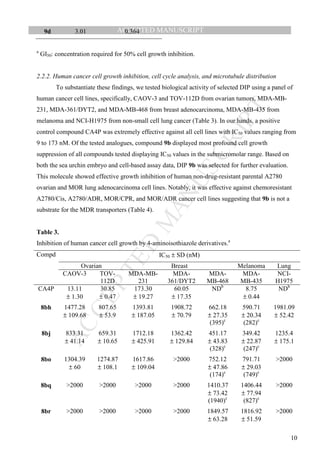
9d 3.01 0.364
a
GI50: concentration required for 50% cell growth inhibition.
2.2.2. Human cancer cell growth inhibition, cell cycle analysis, and microtubule distribution
To substantiate these findings, we tested biological activity of selected DIP using a panel of
human cancer cell lines, specifically, CAOV-3 and TOV-112D from ovarian tumors, MDA-MB-
231, MDA-361/DYT2, and MDA-MB-468 from breast adenocarcinoma, MDA-MB-435 from
melanoma and NCI-H1975 from non-small cell lung cancer (Table 3). In our hands, a positive
control compound CA4P was extremely effective against all cell lines with IC50 values ranging from
9 to 173 nM. Of the tested analogues, compound 9b displayed most profound cell growth
suppression of all compounds tested displaying IC50 values in the submicromolar range. Based on
both the sea urchin embryo and cell-based assay data, DIP 9b was selected for further evaluation.
This molecule showed effective growth inhibition of human non-drug-resistant parental A2780
ovarian and MOR lung adenocarcinoma cell lines. Notably, it was effective against chemoresistant
A2780/Cis, A2780/ADR, MOR/CPR, and MOR/ADR cancer cell lines suggesting that 9b is not a
substrate for the MDR transporters (Table 4).
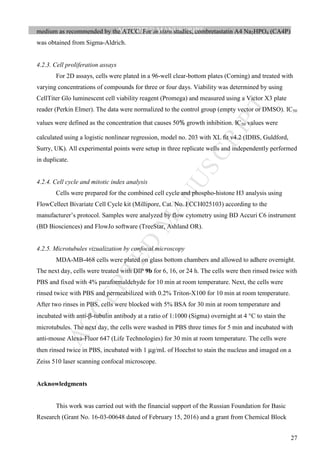
Table 3.
Inhibition of human cancer cell growth by 4-aminoisothiazole derivatives.a
Compd IC50 ± SD (nM)
Ovarian Breast Melanoma Lung
CAOV-3 TOV-
112D
MDA-MB-
231
MDA-
361/DYT2
MDA-
MB-468
MDA-
MB-435
NCI-
H1975
CA4P 13.11
± 1.30
30.85
± 0.47
173.30
± 19.27
60.05
± 17.35
NDb
8.75
± 0.44
NDb
8bh 1477.28
± 109.68
807.65
± 53.9
1393.81
± 187.05
1908.72
± 70.79
662.18
± 27.35
(395)c
590.71
± 20.34
(282)c
1981.09
± 52.42
8bj 833.31
± 41.14
659.31
± 10.65
1712.18
± 425.91
1362.42
± 129.84
451.17
± 43.83
(328)c
349.42
± 22.87
(247)c
1235.4
± 175.1
8bo 1304.39
± 60
1274.87
± 108.1
1617.86
± 109.04
>2000 752.12
± 47.86
(174)c
791.71
± 29.03
(749)c
>2000
8bq >2000 >2000 >2000 >2000 1410.37
± 73.42
(1940)c
1406.44
± 77.94
(827)c
>2000
8br >2000 >2000 >2000 >2000 1849.57
± 63.28
1816.92
± 51.59
>2000
M
ANUSCRIPT
ACCEPTED
ACCEPTED MANUSCRIPT
11
(2350)c
(440)c
9b 152.19
± 11.44
135.64
± 5.26
192.33
± 24.29
309.17
± 23.73
163.22
± 7.66
(117)c
80.72
± 1.75
(23.5)c
253.81
± 16.76
9d 1077.33
± 61.53
1153.74
± 34.51
1628.49
± 146.91
>2000 NDb
(291)c
627.54
± 26.28
(260)c
NDb
a
Indicated tumor cells were plated in 96-well culture plates for 24 h, treated for 96 h with 0.1%
DMSO or various concentrations (up to 10 µM) of compounds. Cell growth was measured by
CellTiter Glo assays. Dose–response curves were generated for determination of IC50 values for
each cell line. IC50 values represent the mean of three independent experiments.
b
ND: not determined.
c
NCI60 anticancer drug screen data obtained using SRB assay.
Table 4.
Antiproliferative effect of 9b in chemoresistant and chemosensitive cancer cell lines, IC50 ± SD,
nM.a
Ovarian adenocarcinoma Lung adenocarcinoma
Parental Resistant Parental Resistant
A2780 A2780/Cis A2780/ADR MOR MOR/CPR MOR/ADR
229 ± 2.70 187 ± 7.80 355 ± 30.15 702 ± 137.93 321 ± 26.03 63 ± 2.56
a
IC50 values were obtained using 3-day assay and represent the mean of three independent
experiments.
As microtubule-binding drugs have been described to impair cell-cycle progression, we first
determined the effects of compound 9b on the mitotic phase in NCI-H1975 and MDA-MB-468 lung
and breast cancer cell lines, respectively. The mitotic index was monitored by bivariate flow
cytometric analysis using an antibody to a known mitotic marker, phospho-histone H3, and a DNA
dye. A 3.5–5 fold increase in mitotic cells was observed after treatment with 9b for 24 h (Fig. 2).
Cell cycle distribution profile measuring DNA content of NCI-H1975 cells in the same experiments
showed statistically significant increase in G2/M phase cells from 20% to 30% after exposure to 9b
(Fig. 3). This arrest in G2/M phase was accompanied with a concomitant decrease in G1 and S
phase cells. In addition, compound 9b induced sub-G1 peak formation, indicative of cells
undergoing apoptosis. Whereas 9b induced marked mitotic block in MDA-MB-468 cells (Fig.2 ),
the proportion of cells within the total G2/M peak remained unchanged. As shown in Fig 3, MDA-
M
ANUSCRIPT
ACCEPTED
ACCEPTED MANUSCRIPT
12
MB-468 also produced a large increase in sub-G1 population that was associated with the reduction
of G1 and S phase populations. Considerable differences in the doubling time of NCI-H1975 vs
MDA-MB-468 (21 h vs 62 h, respectively [16,17]) as well as distinct mutational background of both
cell lines (MDA-MB-468 is Rb-negative line) could provide one potential explanation for the
observed cell line-specific outcome in the analysis. Overall, these results support the hypothesis that
compound 9b elicited its biological effects by inducing cell cycle arrest at the mitotic phase with
further initiation of apoptotic cell death.
Fluorescent microscopy using an anti-tubulin antibody showed a disintegration of
microtubule network with more intense staining at cell periphery and lesser cytoplasmic volume in
NCI-H1975 cells treated with 1µM of 9b for 16 or 24 h (Fig. 4). Collectively, our findings
demonstrated that antiproliferative effects observed with DIP 9b in human cancer cells could be
accounted for, at least in part, by the marked mitotic arrest and pronounced loss of microtubule
integrity.
Fig. 2. Effect of compound 9b on mitotic index. NCI-H1975 or MDA-MB-468 cells were treated
with 0.1% DMSO (Control) or with 1 µM 9b for 24 h. Mitotic index (M) was determined by flow
M
ANUSCRIPT
ACCEPTED
ACCEPTED MANUSCRIPT
13
cytometry as percentage of phospho-histone H3-positive cells (P-H3) in population using
FlowCellect Bivariate Cell Cycle kit (EMD Millipore). Results are representative of two
independent experiments run in triplicate.
Fig. 3. Cell cycle distribution of NCI-H1975 non-small cell lung cancer cells and MDA-MB-468
breast adenocarcinoma cells treated with 0.1% DMSO (Control) or with 1 µM 9b for 24 h. Cell
cycle analysis was performed by flow cytometry with FlowCellect Bivariate Cell Cycle kit (EMD
Millipore). Sub-G1, G1, S, and G2/M phases of the cell cycles were plotted as average percentage of
the total cell population with standard error. Results are representative of two independent
experiments run in duplicate with error bars representing standard error.
Fig. 4. Microtubule disruption with compound 9b in NCI-H1975 cells. Immunofluorescent confocal
microscopy staining for β-tubulin. Cells were treated with 0.1% DMSO or with 1µM 9b for 6, 16,
M
ANUSCRIPT
ACCEPTED
ACCEPTED MANUSCRIPT
14
and 24 h. Microtubules (red) were visualized with anti-β-tubulin antibody and Alexa Fluor 647
secondary antibody. Hoechst counterstain was performed to identify nuclei (blue). Representative
images are shown for each condition.
3. Conclusions
A series of 3,7-diaryl-6,7-dihydroisothiazolo [4,5-b]pyridin-5(4H)-ones 8 and 9 was
synthesized by multicomponent condensation of 3-aryl-5-isothiazolecarboxylic acid esters 4a–f with
aromatic aldehydes 7 and Meldrum's acid. A number of targeted compounds were found to affect
cell division through microtubule destabilizing mode of action in nanomolar concentrations as
evidenced from the phenotypic sea urchin embryo assay data. p-Methoxybenzene A-ring was
identified to be essential for the activity. Compound 9b with p-methoxybenzene A-ring and
thiophene B-ring showed the highest potency in both phenotypic sea urchin embryo and human
cancer cell cytotoxicity assays. Molecules 8bh, 8bi, 8bj, 8bo, 8bq, 8br, and 9d induced pronounced
growth inhibition of MDR cell lines. In the cell-based assays, compound 9b blocked cell cycle in
mitosis and disintegrated interphase microtubule network, suggesting its tubulin-targeting
microtubule destabilizing effect.
4. Experimental protocols
4.1. Chemistry. Materials and methods
Melting points were measured on a Boetius melting point apparatus and were uncorrected.
Reaction mixtures were stirred magnetically. 1
H NMR spectra were recorded on a Bruker DRX-500
(500.13 MHz) instrument. 13
C NMR spectra were recorded on a Bruker DRX-500 (125.8 MHz)
instrument. Chemical shifts are stated in parts per million and referenced to TMS and were assigned
as C, CH, CH2, and CH3 as determined using HSQC and HMBC 2D NMR experiments, where
necessary. Spin–spin coupling constants (J) were reported in hertz (Hz). An original software for
NMR spectra presentation in Supplementary data was designed at N. D. Zelinsky Institute of
Organic Chemistry (http://nmrix.ioc.ac.ru:8080).
Low resolution mass spectra (m/z) were recorded on a Finnigan MAT/INCOS 50 mass
spectrometer at 70 eV using direct probe injection. Elemental analysis was performed on the
automated PerkinElmer 2400 CHN microanalyzer. Flash chromatography was carried out on silica
gel (Acros, 0.035–0.070 mm, 60 Å). TLC was performed on Merck 60 F254 plates. Non-anhydrous
solvents and all reagents were purchased at the highest commercial quality and used as received.
The starting materials phenylacetonitriles 1a–f and benzaldehydes 7g–j, o–r were purchased from
M
ANUSCRIPT
ACCEPTED
ACCEPTED MANUSCRIPT
15
Acros Organics (Belgium). Benzaldehydes 7k–m were synthesized from essential oils of parsley
and dill seeds according to published procedure [8]. The starting methyl 3-aryl-5-
isothiazolecarboxylates 4a–f were obtained using a method described in the literature[6].
4.1.1. Synthesis of 3,4-dihydroxy-2,5-dimethoxybenzaldehyde (7n)
The mixture of apiolaldehyde 7m (21 g, 0.1 mol), PCl5 (62.5 g, 0.3 mol), and CHCl3 (10 mL)
was boiled at 98–100 °C for 5 h, then concentrated in rotary evaporator, diluted with water (100 mL)
and kept overnight. Water suspension was boiled for 3 h, the resulting dark solution cooled to 0–5
°C. The precipitate was filtered, washed several times with water, and dried to afford benzaldehyde
7n. Yield 87%; dark crimson solid; mp 124–127 °C.
4.1.2. General procedure for the synthesis of 3,7-diaryl-6,7-dihydro-4H-isothiazolo[4,5-b]pyridin-5-
ones (8, 9)
Methyl 3-aryl-5-isothiazolecarboxylates 4a–f (2 mmol) were refluxed in 15 ml of
concentrated HCl for 6 h. The resulting reaction mixture was concentrated in vacuo. Anhydrous
NaoAc (0.18 g, 2.2 mmol), Meldrum's acid (0.32 g, 2.2 mmol), the corresponding aldehyde 7 (2.2
mmol), and glacial AcOH (7 mL) were added, the resulting suspension was heated at reflux for 2 h
and concentrated. The residue was recrystallized from the aqueous EtOH (60%), washed with
aqueous EtOH and dried to afford analytically pure compounds 8 and 9 (35–65% overall yields from
4a–f).
4.1.3. Characterization of compounds 8 and 9 (Table 1)
4.1.3.1. 6,7-Dihydro-7-(7-methoxy-1,3-benzodioxol-5-yl)-3-phenyl-isothiazolo[4,5-b]pyridin-5(4H)-
one (8ak). Yellowish solid, mp 190–192 °C. 1
H NMR (DMSO-d6, 500 MHz): δ 2.81 (dd, J = 6.1
Hz, J = 15.6 Hz, 1H, CH2), 2.95 (dd, J = 10.0 Hz, J = 15.6 Hz, 1H, CH2), 3.82 (s, 3H, OCH3-7''),
4.63 (dd, J = 6.1 Hz, J = 10.0 Hz, 1H, CH), 5.99 (s, 2H, OCH2O), 6.61 (d, J = 1.6 Hz, 1H, H-4''),
6.70 (d, J = 1.6 Hz, 1H, H-6''), 7.49 (m, 3H, H-3',4',5'), 7.73 (d, J = 8.2 Hz, 2H, H-2',6'), 10.02 (s,
1H, NH). EIMS m/z 380 [M]+
(4), 178 (5), 161 (8), 147 (8), 135 (11), 121 (19), 120 (10), 107 (14),
104 (44), 103 (29), 89 (14), 77 (100), 63 (39). Anal. Calcd for C20H16N2O4S: C, 63.15; H, 4.24; N,
7.36. Found: C, 63.09; H, 4.22; N, 7.41.
4.1.3.2. 7-(4,7-Dimethoxy-1,3-benzodioxol-5-yl)-6,7-dihydro-3-phenyl-isothiazolo[4,5-b]pyridin-
5(4H)-one (8am). Yellowish solid, mp 184–185 °C. 1
H NMR (DMSO-d6, 500 MHz): δ 2.87 (m, 2H,
CH2), 3.73 (s, 3H, OCH3-4''), 3.88 (s, 3H, OCH3-7''), 4.80 (t, J = 7.4 Hz, 1H, CH), 6.03 (s, 2H,
M
ANUSCRIPT
ACCEPTED
ACCEPTED MANUSCRIPT
16
OCH2O), 6.48 (s, 1H, H-6''), 7.48 (m, 3H, H-3',4',5'), 7.72 (d, J = 8.2 Hz, 2H, H-2',6'), 10.00 (s, 1H,
NH). EIMS m/z 410 [M]+
(7), 229 (11), 182 (24), 167 (8), 161 (5), 147 (6), 135 (13), 121 (9), 109
(12), 104 (42), 103 (27), 95 (12), 93 (15), 77 (100), 63 (23). Anal. Calcd for C21H18N2O5S: C, 61.45;
H, 4.42; N, 6.83. Found: C, 61.53; H, 4.46; N, 6.74.
4.1.3.3. 7-(3,4-Dihydroxy-2,5-dimethoxyphenyl)-6,7-dihydro-3-phenyl-isothiazolo[4,5-b]pyridin-
5(4H)-one (8an). Yellowish solid, mp 253–255 °C (decomp.). 1
H NMR (DMSO-d6, 500 MHz): δ
2.77 (dd, J = 6.5 Hz, J = 15.7 Hz, 1H, CH2), 2.93 (dd, J = 9.8 Hz, J = 15.7 Hz, 1H, CH2), 3.66 (s,
3H, OCH3-2''), 3.72 (s, 3H, OCH3-5''), 4.77 (dd, J = 6.5 Hz, J = 9.8 Hz, 1H, CH), 6.35 (s, 1H, H-6''),
7.48 (m, 3H, H-3',4',5'), 7.72 (m, 2H, H-2',6'), 8.58 (br.s, 1H, OH-3''), 8.66 (br.s, 1H, OH-4''), 9.98
(s, 1H, NH). EIMS m/z 398 [M]+
(1), 229 (16), 170 (27), 155 (11), 149 (10), 135 (10), 121 (12), 109
(16), 104 (56), 103 (29), 95 (16), 77 (100). Anal. Calcd for C20H18N2O5S: C, 60.29; H, 4.55; N, 7.03.
Found: C, 60.20; H, 4.52; N, 7.12.
4.1.3.4. 6,7-Dihydro-7-(3-methoxyphenyl)-3-(4-methoxyphenyl)-isothiazolo[4,5-b]pyridin-5(4H)-
one (8bh). Yellowish solid, mp 168–170 °C. 1
H NMR (DMSO-d6, 500 MHz): δ 2.86 (dd, J = 6.4
Hz, J = 15.6 Hz, 1H, CH2), 2.93 (dd, J = 9.0 Hz, J = 15.6 Hz, 1H, CH2), 3.75 (s, 3H, OCH3-3''), 3.82
(s, 3H, OCH3-4'), 4.69 (dd, J = 6.4 Hz, J = 9.0 Hz, 1H, CH), 6.88 (dd, J = 2.5 Hz, J = 8.3 Hz, 1H, H-
4''), 6.92 (m, 2H, H-2'',6''), 7.05 (d, J = 8.8 Hz, 2H, H-3',5'), 7.30 (t, J = 7.9 Hz, 1H, H-5''), 7.68 (d, J
= 8.8 Hz, 2H, H-2',6'), 10.02 (s, 1H, NH). 13
C NMR (DMSO-d6) δ 169.8, 160.0, 159.7, 156.4, 147.5,
142.5, 133.7, 130.1, 129.2, 126.2, 119.3, 114.1, 113.2, 112.8, 55.3, 55.1, 38.2, 37.6. EIMS m/z 366
[M]+
(73), 326 (5), 218 (11), 202 (28), 190 (14), 177 (10), 174 (10), 173 (14), 164 (23), 161 (12),
147 (12), 134 (71), 133 (39), 121 (43), 118 (23), 108 (19), 103 (49), 90 (86), 77 (94), 63 (97). Anal.
Calcd for C20H18N2O3S: C, 65.55; H, 4.95; N, 7.64. Found: C, 65.47; H, 4.91; N, 7.71.
4.1.3.5. 7-(1,3-Benzodioxol-5-yl)-6,7-dihydro-3-(4-methoxyphenyl)-isothiazolo[4,5-b]pyridin-5(4H)-
one (8bi). Yellowish solid, mp 176–178 °C. 1
H NMR (DMSO-d6, 500 MHz): δ 2.80 (dd, J = 6.2 Hz,
J = 15.5 Hz, 1H, CH2), 2.90 (dd, J = 9.5 Hz, J = 15.5 Hz, 1H, CH2), 3.82 (s, 3H, OCH3-4'), 4.64 (dd,
J = 6.2 Hz, J = 9.5 Hz, 1H, CH), 6.01 (s, 1H, OCH2O), 6.02 (s, 1H, OCH2O), 6.81 (dd, J = 1.8 Hz, J
= 8.0 Hz, 1H, H-6''), 6.91 (d, J = 8.0 Hz, 1H, H-7''), 6.96 (d, J = 1.8 Hz, 1H, H-4''), 7.05 (d, J = 8.8
Hz, 2H, H-3',5'), 7.68 (d, J = 8.8 Hz, 2H, H-2',6'), 10.01 (s, 1H, NH). 13
C NMR (DMSO-d6) δ 169.9,
160.0, 156.4, 148.1, 147.7, 146.7, 134.8, 133.5, 129.1, 126.2, 120.5, 114.1, 108.5, 107.6, 101.2,
55.3, 38.4, 37.3. EIMS m/z 380 [M]+
(100), 365 (6), 337 (32), 322 (10), 259 (13), 246 (26), 217 (19),
190 (22), 178 (15), 161 (15), 147 (22), 134 (17), 120 (17), 90 (11), 89 (18), 77 (11), 63 (14). Anal.
Calcd for C20H16N2O4S: C, 63.15; H, 4.24; N, 7.36. Found: C, 63.07; H, 4.21; N, 7.42.
M
ANUSCRIPT
ACCEPTED
ACCEPTED MANUSCRIPT
17
4.1.3.6. 7-(2,3-Dihydro-1,4-benzodioxin-6-yl)-6,7-dihydro-3-(4-methoxyphenyl)-isothiazolo[4,5-
b]pyridin-5(4H)-one (8bj). Yellow solid, mp 197–199 °C. 1
H NMR (DMSO-d6, 500 MHz): δ 2.81
(dd, J = 6.5 Hz, J = 15.6 Hz, 1H, CH2), 2.86 (dd, J = 8.8 Hz, J = 15.6 Hz, 1H, CH2), 3.82 (s, 3H,
OCH3-4'), 4.23 (s, 4H, OCH2), 4.60 (dd, J = 6.5 Hz, J = 8.8 Hz, 1H, CH), 6.80 (dd, J = 2.1 Hz, J =
8.3 Hz, 1H, H-7''), 6.84 (d, J = 2.1 Hz, 1H, H-5''), 6.85 (d, J = 8.3 Hz, 1H, H-8''), 7.05 (d, J = 8.8 Hz,
2H, H-3',5'), 7.68 (d, J = 8.8 Hz, 2H, H-2',6'), 10.01 (s, 1H, NH). 13
C NMR (DMSO-d6) δ 169.8,
160.0, 156.4, 147.9, 143.5, 142.8, 134.0, 133.5, 129.1, 126.2, 119.9, 117.4, 115.8, 114.1, 64.1, 64.0,
55.3, 38.4, 36.8. EIMS m/z 394 [M]+
(100), 379 (6), 365 (12), 363 (15), 351 (24), 335 (10), 260 (21),
233 (14), 202 (13), 197 (19), 161 (13), 136 (22), 134 (16), 108 (13), 77 (12), 63 (8). Anal. Calcd for
C21H18N2O4S: C, 63.94; H, 4.60; N, 7.10. Found: C, 63.86; H, 4.56; N, 7.16.
4.1.3.7. 6,7-Dihydro-7-(7-methoxy-1,3-benzodioxol-5-yl)-3-(4-methoxyphenyl)-isothiazolo[4,5-
b]pyridin-5(4H)-one (8bk). Yellowish solid, mp 140–142 °C. 1
H NMR (DMSO-d6, 500 MHz): δ
2.78 (dd, J = 6.1 Hz, J = 15.5 Hz, 1H, CH2), 2.95 (dd, J = 10.1 Hz, J = 15.5 Hz, 1H, CH2), 3.82 (s,
6H, OCH3-4',7''), 4.61 (dd, J = 6.1 Hz, J = 10.1 Hz, 1H, CH), 5.99 (s, 2H, OCH2O), 6.61 (d, J = 1.5
Hz, 1H, H-4''), 6.70 (d, J = 1.5 Hz, 1H, H-6''), 7.05 (d, J = 8.8 Hz, 2H, H-3',5'), 7.68 (d, J = 8.8 Hz,
2H, H-2',6'), 10.02 (s, 1H, NH). EIMS m/z 410 [M]+
(100), 409 (23), 395 (7), 379 (26), 367 (18),
352 (16), 337 (14), 259 (21), 246 (23), 205 (36), 163 (10), 147 (10), 134 (19), 119 (10), 90 (10), 77
(19), 63 (13). Anal. Calcd for C21H18N2O5S: C, 61.45; H, 4.42; N, 6.83. Found: C, 61.39; H, 4.40; N,
6.79.
4.1.3.8. 7-(6,7-Dimethoxy-1,3-benzodioxol-5-yl)-6,7-dihydro-3-(4-methoxyphenyl)-isothiazolo[4,5-
b]pyridin-5(4H)-one (8bl). Yellowish solid, mp 187–188 °C. 1
H NMR (DMSO-d6, 500 MHz): δ
2.82 (m, 2H, CH2), 3.76 (s, 3H, OCH3-6''), 3.82 (s, 3H, OCH3-4'), 3.96 (s, 3H, OCH3-7''), 4.80 (t, J =
7.3 Hz, 1H, CH), 5.98 (s, 2H, OCH2O), 6.46 (s, 1H, H-4''), 7.05 (d, J = 8.8 Hz, 2H, H-3',5'), 7.67 (d,
J = 8.8 Hz, 2H, H-2',6'), 10.00 (s, 1H, NH). EIMS m/z 440 [M]+
(100), 425 (37), 409 (33), 367 (12),
352 (12), 276 (15), 275 (40), 259 (34), 247 (22), 220 (34), 182 (62), 167 (11), 134 (19), 77 (11).
Anal. Calcd for C22H20N2O6S: C, 59.99; H, 4.58; N, 6.36. Found: C, 60.10; H, 4.60; N, 6.27.
4.1.3.9. 7-(4,7-Dimethoxy-1,3-benzodioxol-5-yl)-6,7-dihydro-3-(4-methoxyphenyl)-isothiazolo[4,5-
b]pyridin-5(4H)-one (8bm). Yellow solid, mp 191–192 °C. 1
H NMR (DMSO-d6, 500 MHz): δ 2.86
(m, 2H, CH2), 3.73 (s, 3H, OCH3-4''), 3.82 (s, 3H, OCH3-4'), 3.88 (s, 3H, OCH3-7''), 4.78 (t, J = 7.1
Hz, 1H, CH), 6.03 (s, 2H, OCH2O), 6.48 (s, 1H, H-6''), 7.04 (d, J = 8.8 Hz, 2H, H-3',5'), 7.67 (d, J =
8.8 Hz, 2H, H-2',6'), 9.98 (s, 1H, NH). 13
C NMR (DMSO-d6) δ 169.9, 160.0, 156.1, 147.1, 138.8,
138.5, 136.1, 135.4, 133.5, 129.1, 126.2, 125.9, 114.1, 106.6, 101.9, 60.0, 56.8, 55.3, 37.0, 32.0.
M
ANUSCRIPT
ACCEPTED
ACCEPTED MANUSCRIPT
18
EIMS m/z 440 [M]+
(27), 439 (18), 409 (10), 259 (46), 220 (61), 182 (100), 167 (33), 161 (17), 149
(58), 135 (42), 134 (79), 133 (55), 121 (31), 109 (38), 108 (36), 103 (38), 90 (74), 77 (96), 63 (81).
Anal. Calcd for C22H20N2O6S: C, 59.99; H, 4.58; N, 6.36. Found: C, 60.08; H, 4.61; N, 6.29.
4.1.3.10. 7-(3,4-Dihydroxy-2,5-dimethoxyphenyl)-6,7-dihydro-3-(4-methoxyphenyl)-isothiazolo[4,5-
b]pyridin-5(4H)-one (8bn). White solid, mp 203–205 °C. 1
H NMR (DMSO-d6, 500 MHz): δ 2.74
(dd, J = 6.4 Hz, J = 15.6 Hz, 1H, CH2), 2.93 (dd, J = 10.1 Hz, J = 15.6 Hz, 1H, CH2), 3.66 (s, 3H,
OCH3-2''), 3.71 (s, 3H, OCH3-5''), 3.82 (s, 3H, OCH3-4'), 4.75 (dd, J = 6.4 Hz, J = 10.1 Hz, 1H,
CH), 6.34 (s, 1H, H-6''), 7.05 (d, J = 8.6 Hz, 2H, H-3',5'), 7.67 (d, J = 8.6 Hz, 2H, H-2',6'), 8.63
(br.s, 1H, OH-3''), 8.71 (br.s, 1H, OH-4''), 9.98 (s, 1H, NH). EIMS m/z 428 [M]+
(100), 413 (22),
397 (29), 355 (15), 263 (33), 259 (88), 214 (32), 170 (55), 155 (14), 149 (15), 134 (29), 109 (11), 77
(11). Anal. Calcd for C21H20N2O6S: C, 58.87; H, 4.70; N, 6.54. Found: C, 58.81; H, 4.67; N, 6.62.
4.1.3.11. 7-(3-Chlorophenyl)-6,7-dihydro-3-(4-methoxyphenyl)-isothiazolo[4,5-b]pyridin-5(4H)-one
(8bo). Yellowish solid, mp 189–191 °C. 1
H NMR (DMSO-d6, 500 MHz): δ 2.92 (d, J = 7.7 Hz, 2H,
CH2), 3.82 (s, 3H, OCH3-4'), 4.78 (t, J = 7.7 Hz, 1H, CH), 7.05 (d, J = 8.8 Hz, 2H, H-3',5'), 7.32 (dt,
J = 1.5 Hz, J = 7.5 Hz, 1H, H-6''), 7.38 (dt, J = 1.5 Hz, J = 7.5 Hz, 1H, H-4''), 7.42 (d, J = 7.5 Hz,
1H, H-5''), 7.43 (t, J = 1.5 Hz, 1H, H-2''), 7.69 (d, J = 8.8 Hz, 2H, H-2',6'), 10.06 (s, 1H, NH). 13
C
NMR (DMSO-d6) δ 169.6, 160.0, 156.5, 146.6, 143.5, 133.9, 133.5, 130.9, 129.2, 127.6, 127.3,
126.1, 126.0, 114.1, 55.3, 38.0, 37.1. EIMS m/z 372 [M+2]+
(36), 370 [M]+
(100), 355 (6), 341 (10),
327 (14), 202 (12), 170 (10), 168 (50), 146 (11), 134 (51), 133 (59), 103 (54), 102 (47), 101 (31), 90
(77), 89 (60), 77 (56), 75 (79), 63 (93). Anal. Calcd for C19H15ClN2O2S: C, 61.54; H, 4.08; N, 7.55.
Found: C, 61.67; H, 4.11; N, 7.44.
4.1.3.12. 7-(4-Chlorophenyl)-6,7-dihydro-3-(4-methoxyphenyl)-isothiazolo[4,5-b]pyridin-5(4H)-one
(8bp). White solid, mp 194–196 °C. 1
H NMR (DMSO-d6, 500 MHz): δ 2.90 (d, J = 7.5 Hz, 2H,
CH2), 3.82 (s, 3H, OCH3-4'), 4.77 (t, J = 7.5 Hz, 1H, CH), 7.05 (d, J = 8.8 Hz, 2H, H-3',5'), 7.38 (d,
J = 8.5 Hz, 2H, H-2'',6''), 7.45 (d, J = 8.5 Hz, 2H, H-3'',5''), 7.68 (d, J = 8.8 Hz, 2H, H-2',6'), 10.05
(s, 1H, NH). EIMS m/z 372 [M+2]+
(34), 370 [M]+
(100), 357 (2), 355 (5), 341 (9), 335 (11), 327
(19), 202 (22), 170 (17), 168 (52), 146 (12), 137 (14), 134 (40), 133 (48), 131 (11), 125 (13), 115
(10), 103 (38), 102 (33), 101 (24), 90 (50), 89 (43), 77 (40), 63 (61). Anal. Calcd for
C19H15ClN2O2S: C, 61.54; H, 4.08; N, 7.55. Found: C, 61.64; H, 4.10; N, 7.47.
4.1.3.13. 7-(3-Fluorophenyl)-6,7-dihydro-3-(4-methoxyphenyl)-isothiazolo[4,5-b]pyridin-5(4H)-one
(8bq). Yellowish solid, mp 175–177 °C. 1
H NMR (DMSO-d6, 500 MHz): δ 2.90 (dd, J = 6.7 Hz, J =
M
ANUSCRIPT
ACCEPTED
ACCEPTED MANUSCRIPT
19
15.6 Hz, 1H, CH2), 2.94 (dd, J = 8.4 Hz, J = 15.6 Hz, 1H, CH2), 3.82 (s, 3H, OCH3-4'), 4.79 (dd, J =
6.7 Hz, J = 8.4 Hz, 1H, CH), 7.05 (d, J = 8.8 Hz, 2H, H-3',5'), 7.15 (dt, J = 2.5 Hz, J = 9.8 Hz, 1H,
H-6''), 7.21 (m, 2H, H-2'',4''), 7.44 (dt, J = 8.1 Hz, J = 11.2 Hz, 1H, H-5''), 7.69 (d, J = 8.8 Hz, 2H,
H-2',6'), 10.07 (s, 1H, NH). 13
C NMR (DMSO-d6) δ 169.6, 163.4, 161.4, 160.0, 156.5, 146.7, 143.8,
143.7, 133.8, 131.1, 131.0, 129.2, 126.1, 123.4, 114.6, 114.4, 114.3, 114.1, 55.3, 38.0, 37.2. EIMS
m/z 354 [M]+
(96), 339 (4), 325 (7), 311 (21), 259 (18), 233 (15), 220 (34), 177 (28), 165 (28), 161
(26), 156 (14), 152 (100), 149 (13), 134 (88), 133 (57), 121 (38), 108 (49), 107 (41), 101 (42), 95
(21), 90 (38), 77 (33), 75 (30), 63 (36). Anal. Calcd for C19H15FN2O2S: C, 64.39; H, 4.27; N, 7.90.
Found: C, 64.47; H, 4.31; N, 7.80.
4.1.3.14. 7-(4-Fluorophenyl)-6,7-dihydro-3-(4-methoxyphenyl)-isothiazolo[4,5-b]pyridin-5(4H)-one
(8br). Yellowish solid, mp 206–208 °C. 1
H NMR (DMSO-d6, 500 MHz): δ 2.87 (dd, J = 6.6 Hz, J =
12.1 Hz, 1H, CH2), 2.91 (dd, J = 8.7 Hz, J = 12.1 Hz, 1H, CH2), 3.82 (s, 3H, OCH3-4'), 4.76 (dd, J =
6.6 Hz, J = 8.7 Hz, 1H, CH), 7.05 (d, J = 8.8 Hz, 2H, H-3',5'), 7.22 (t, J = 8.8 Hz, 2H, H-3'',5''), 7.40
(dd, J = 5.4 Hz, J = 8.8 Hz, 2H, H-2'',6''), 7.68 (d, J = 8.8 Hz, 2H, H-2',6'), 10.04 (s, 1H, NH). 13
C
NMR (DMSO-d6) δ 169.7, 162.5, 161.0, 160.0, 156.5, 147.4, 137.2, 133.7, 129.4, 129.3, 129.2,
126.2, 115.8, 115.7, 114.1, 55.3, 38.3, 36.8. EIMS m/z 354 [M]+
(74), 339 (6), 325 (10), 311 (35),
233 (16), 220 (43), 177 (24), 165 (21), 161 (26), 156 (21), 152 (100), 149 (25), 134 (71), 133 (50),
121 (39), 108 (44), 107 (37), 101 (34), 95 (19), 90 (34), 77 (22), 75 (31), 63 (38). Anal. Calcd for
C19H15FN2O2S: C, 64.39; H, 4.27; N, 7.90. Found: C, 64.45; H, 4.30; N, 7.83.
4.1.3.15. 7-(3-Chlorophenyl)-6,7-dihydro-3-(3,4-dimethoxyphenyl)-isothiazolo[4,5-b]pyridin-5(4H)-
one (8co). Yellowish solid, mp 205–206 °C. 1
H NMR (DMSO-d6, 500 MHz): δ 2.80 (dd, J = 6.1 Hz,
J = 15.6 Hz, 1H, CH2), 2.97 (dd, J = 10.2 Hz, J = 15.6 Hz, 1H, CH2), 3.74 (s, 6H, OCH3-3',4'), 4.65
(dd, J = 6.1 Hz, J = 10.2 Hz, 1H, CH), 6.85 (d, J = 8.2 Hz, 1H, H-5'), 6.94 (d, J = 8.2 Hz, 1H, H-6'),
7.02 (s, 1H, H-2'), 7.53 (m, 2H, H-4'',6''), 7.68 (m, 1H, H-5''), 7.72 (s, 1H, H-2''), 10.29 (s, 1H, NH);
13
C NMR (DMSO-d6, 150 MHz): δ 37.2, 38.2, 55.4, 55.5, 111.0, 111.9, 119.0, 126.3, 127.3, 128.9,
130.5, 133.0, 133.2, 133.8, 135.2, 148.1, 148.9, 149.0, 154.7, 170.0; EIMS m/z 402 [M+2]+
(33),
400 [M]+
(100), 385 (3), 371 (6), 357 (12), 341 (8), 327 (7), 202 (8), 170 (11), 168 (43), 146 (9), 134
(35), 133 (41), 103 (50), 102 (43), 101 (28), 90 (67), 89 (56), 77 (52), 75 (54), 63 (89). Anal. Calcd
for C20H17ClN2O3S: C, 59.92; H, 4.27; N, 6.99. Found: C, 60.03; H, 4.23; N, 6.87.
4.1.3.16. 3-(4-Chlorophenyl)-7-(7-methoxy-1,3-benzodioxol-5-yl)-6,7-dihydro-isothiazolo[4,5-
b]pyridin-5(4H)-one (8dk). White solid, mp 202–204 °C. 1
H NMR (DMSO-d6, 500 MHz): δ 2.80
(dd, J = 6.2 Hz, J = 15.5 Hz, 1H, CH2), 2.94 (dd, J = 10.0 Hz, J = 15.5 Hz, 1H, CH2), 3.82 (s, 3H,
M
ANUSCRIPT
ACCEPTED
ACCEPTED MANUSCRIPT
20
OCH3-7''), 4.64 (dd, J = 6.2 Hz, J = 10.0 Hz, 1H, CH), 5.99 (s, 2H, OCH2O), 6.61 (d, J = 1.3 Hz,
1H, H-4''), 6.69 (d, J = 1.3 Hz, 1H, H-6''), 7.56 (d, J = 8.5 Hz, 2H, H-2',6'), 7.74 (d, J = 8.5 Hz, 2H,
H-3',5'), 10.11 (s, 1H, NH). EIMS m/z 416 [M+2]+
(2), 414 [M]+
(6), 178 (51), 165 (16), 163 (23),
147 (11), 139 (20), 138 (37), 137 (44), 121 (25), 111 (40), 102 (68), 95 (18), 94 (10), 93 (19), 77
(92), 75 (100), 63 (77). Anal. Calcd for C20H15ClN2O4S: C, 57.90; H, 3.64; N, 6.75. Found: C,
57.96; H, 3.66; N, 6.84.
4.1.3.17. 3-(4-Chlorophenyl)-7-(4,7-dimethoxy-1,3-benzodioxol-5-yl)-6,7-dihydro-isothiazolo
[4,5-b]pyridin-5(4H)-one (8dm). White solid, mp 205–207 °C. 1
H NMR (DMSO-d6, 500 MHz): δ
2.86 (m, 2H, CH2), 3.73 (s, 3H, OCH3-4''), 3.88 (s, 3H, OCH3-7''), 4.80 (t, J = 7.3 Hz, 1H, CH), 6.03
(s, 2H, OCH2O), 6.48 (s, 1H, H-6''), 7.55 (d, J = 8.5 Hz, 2H, H-2',6'), 7.73 (d, J = 8.5 Hz, 2H, H-
3',5'), 10.11 (s, 1H, NH). EIMS m/z 446 [M+2]+
(18), 444 [M]+
(54), 413 (23), 371 (15), 265 (13),
263 (42), 247 (21), 223 (25), 222 (29), 182 (100), 178 (20), 167 (37), 163 (21), 149 (15), 148 (12),
147 (19), 135 (35), 123 (26), 122 (27), 121 (22), 111 (58), 102 (74), 95 (33), 94 (27), 93 (42), 77
(69). Anal. Calcd for C21H17ClN2O5S: C, 56.69; H, 3.85; N, 6.30. Found: C, 5.73; H, 3.89; N, 6.20.
4.1.3.18. 3-(3-Fluorophenyl)-6,7-dihydro-7-(4-methoxyphenyl)-isothiazolo[4,5-b]pyridin-5(4H)-one
(8eg). White solid, mp 169–170 °C. 1
H NMR (DMSO-d6, 500 MHz): δ 2.83 (dd, J = 6.4 Hz, J =
15.6 Hz, 1H, CH2), 2.90 (dd, J = 9.3 Hz, J = 15.6 Hz, 1H, CH2), 3.75 (s, 3H, OCH3-4''), 4.69 (dd, J
= 6.4 Hz, J = 9.3 Hz, 1H, CH), 6.94 (d, J = 8.7 Hz, 2H, H-3'',5''), 7.28 (d, J = 8.7 Hz, 2H, H-2'',6''),
7.31 (m, 1H, HAr), 7.50 (m, 1H, HAr), 7.56 (m, 2H, HAr), 10.20 (s, 1H, NH). EIMS m/z 354 [M]+
(15), 325 (6), 323 (14), 311 (18), 297 (11), 247 (15), 202 (20), 177 (16), 164 (15), 149 (69), 134
(28), 133 (27), 122 (47), 121 (100), 108 (25), 103 (16), 102 (2), 101 (8), 95 (61), 94 (45), 91 (42), 89
(44), 77 (80), 75 (68), 63 (76). Anal. Calcd for C19H15FN2O2S: C, 64.39; H, 4.27; N, 7.90. Found: C,
64.47; H, 4.31; N, 7.82.
4.1.3.19. 3-(3-Fluorophenyl)-6,7-dihydro-7-(3-methoxyphenyl)-isothiazolo[4,5-b]pyridin-5(4H)-one
(8eh). White solid, mp 153–155 °C. 1
H NMR (DMSO-d6, 500 MHz): δ 2.88 (dd, J = 6.5 Hz, J =
15.6 Hz, 1H, CH2), 2.93 (dd, J = 8.8 Hz, J = 15.6 Hz, 1H, CH2), 3.75 (s, 3H, OCH3-3''), 4.73 (dd, J
= 6.5 Hz, J = 8.8 Hz, 1H, CH), 6.90 (m, 3H, HAr), 7.31 (m, 2H, HAr), 7.53 (m, 3H, HAr), 10.21 (s,
1H, NH). EIMS m/z 354 [M]+
(44), 339 (2), 325 (10), 323 (12), 311 (17), 281 (20), 247 (27), 202
(19), 177 (15), 164 (17), 156 (13), 147 (20), 134 (41), 133 (27), 122 (63), 121 (100), 108 (21), 103
(30), 102 (37), 101 (15), 95 (78), 94 (50), 91 (50), 89 (52), 77 (86), 75 (77), 63 (75). Anal. Calcd for
C19H15FN2O2S: C, 64.39; H, 4.27; N, 7.90. Found: C, 64.42; H, 4.30; N, 7.85.
M
ANUSCRIPT
ACCEPTED
ACCEPTED MANUSCRIPT
21
4.1.3.20. 7-(1,3-Benzodioxol-5-yl)-3-(3-fluorophenyl)-6,7-dihydro-isothiazolo[4,5-b]pyridin-5(4H)-
one (8ei). Yellow solid, mp 197–199 °C. 1
H NMR (DMSO-d6, 500 MHz): δ 2.82 (dd, J = 6.3 Hz, J
= 15.5 Hz, 1H, CH2), 2.90 (dd, J = 9.3 Hz, J = 15.5 Hz, 1H, CH2), 4.67 (dd, J = 6.3 Hz, J = 9.3 Hz,
1H, CH), 6.01 (s, 1H, OCH2O), 6.02 (s, 1H, OCH2O), 6.81 (d, J = 8.0 Hz, 1H, H-6''), 6.90 (d, J =
8.0 Hz, 1H, H-7''), 6.95 (s, 1H, H-4''), 7.31 (t, J = 7.8 Hz, 1H, HAr), 7.50 (m, 1H, HAr), 7.55 (m, 2H,
HAr), 10.16 (s, 1H, NH). EIMS m/z 368 [M]+
(6), 247 (6), 217 (7), 178 (24), 177 (15), 161 (13), 147
(50), 134 (28), 122 (64), 121 (82), 120 (71), 102 (24), 95 (74), 94 (61), 89 (100), 77 (34), 76 (41), 75
(68), 63 (99). Anal. Calcd for C19H13FN2O3S: C, 61.95; H, 3.56; N, 7.60. Found: C, 61.90; H, 3.52;
N, 7.67.
4.1.3.21. 3-(3-Fluorophenyl)-6,7-dihydro-7-(7-methoxy-1,3-benzodioxol-5-yl)-isothiazolo[4,5-
b]pyridin-5(4H)-one (8ek). Yellowish solid, mp 180–182 °C. 1
H NMR (DMSO-d6, 500 MHz): δ
2.80 (dd, J = 6.2 Hz, J = 15.6 Hz, 1H, CH2), 2.95 (dd, J = 10.0 Hz, J = 15.6 Hz, 1H, CH2), 3.82 (s,
3H, OCH3-7''), 4.65 (dd, J = 6.2 Hz, J = 10.0 Hz, 1H, CH), 6.00 (s, 2H, OCH2O), 6.61 (d, J = 1.5
Hz, 1H, H-4''), 6.70 (d, J = 1.5 Hz, 1H, H-6''), 7.31 (m, 1H, HAr), 7.50 (m, 1H, HAr), 7.55 (m, 2H,
HAr), 10.19 (s, 1H, NH). EIMS m/z 398 [M]+
(100), 369 (10), 367 (26), 340 (17), 339 (15), 325 (17),
247 (22), 177 (17), 163 (25), 148 (17), 147 (17), 146 (17), 135 (21), 134 (21), 133 (21), 122 (55),
121 (53), 107 (24), 95 (62), 94 (25), 93 (15), 77 (53). Anal. Calcd for C20H15FN2O4S: C, 60.29; H,
3.79; N, 7.03. Found: C, 60.33; H, 3.81; N, 6.97.
4.1.3.22. 7-(4,7-Dimethoxy-1,3-benzodioxol-5-yl)-3-(3-fluorophenyl)-6,7-dihydro-isothiazolo[4,5-
b]pyridin-5(4H)-one (8em). Brown solid, mp 147–149 °C. 1
H NMR (DMSO-d6, 500 MHz): δ 2.87
(m, 2H, CH2), 3.73 (s, 3H, OCH3-4''), 3.88 (s, 3H, OCH3-7''), 4.81 (t, J = 7.3 Hz, 1H, CH), 6.03 (s,
2H, OCH2O), 6.48 (s, 1H, H-6''), 7.30 (m, 1H, HAr), 7.49 (m, 1H, HAr), 7.54 (m, 2H, HAr), 10.18 (s,
1H, NH). EIMS m/z 428 [M]+
(86), 427 (40), 397 (32), 355 (19), 247 (52), 229 (11), 214 (19), 182
(79), 177 (13), 167 (29), 163 (17), 149 (18), 148 (19), 147 (19), 135 (37), 123 (32), 122 (91), 121
(55), 109 (28), 95 (100), 94 (48), 93 (39), 77 (59). Anal. Calcd for C21H17FN2O5S: C, 58.87; H, 4.00;
N, 6.54. Found: C, 58.95; H, 4.03; N, 6.41.
4.1.3.23. 7-(3-Chlorophenyl)-3-(3-fluorophenyl)-6,7-dihydro-isothiazolo[4,5-b]pyridin-5(4H)-one
(8eo). Yellowish solid, mp 148–150 °C. 1
H NMR (DMSO-d6, 500 MHz): δ 2.93 (d, J = 7.4 Hz, 2H,
CH2), 4.82 (t, J = 7.4 Hz, 1H, CH), 7.32 (m, 2H, HAr), 7.41 (m, 3H, HAr), 7.54 (m, 3H, HAr), 10.25
(s, 1H, NH). EIMS m/z 360 [M+2] (0.6), 358 [M]+
(2), 202 (7), 170 (6), 168 (15), 133 (14), 122
(19), 121 (29), 102 (21), 101 (19), 95 (38), 94 (32), 89 (33), 75 (100), 71 (41), 70 (42), 69 (42).
Anal. Calcd for C18H12ClFN2OS: C, 60.25; H, 3.37; N, 7.81. Found: C, 60.33; H, 3.41; N, 7.74.
M
ANUSCRIPT
ACCEPTED
ACCEPTED MANUSCRIPT
22
4.1.3.24. 7-(4-Chlorophenyl)-3-(3-fluorophenyl)-6,7-dihydro-isothiazolo[4,5-b]pyridin-5(4H)-one
(8ep). Yellowish solid, mp 201–202 °C. 1
H NMR (DMSO-d6, 500 MHz): δ 2.91 (d, J = 7.6 Hz, 2H,
CH2), 4.80 (t, J = 7.6 Hz, 1H, CH), 7.31 (m, 1H, HAr), 7.37 (d, J = 8.5 Hz, 2H, H-2'',6''), 7.46 (d, J =
8.5 Hz, 2H, H-3'',5''), 7.50 (m, 1H, HAr), 7.54 (m, 2H, HAr), 10.24 (s, 1H, NH). EIMS m/z 360 [M+2]
(6), 358 [M]+
(18), 323 (25), 315 (25), 281 (22), 247 (31), 221 (15), 202 (55), 174 (33), 170 (37),
168 (100), 147 (42), 140 (51), 133 (67), 122 (64), 121 (64), 102 (56), 101 (56), 95 (61), 94 (46), 89
(77), 75 (96), 71 (54), 70 (53), 69 (49). Anal. Calcd for C18H12ClFN2OS: C, 60.25; H, 3.37; N, 7.81.
Found: C, 60.34; H, 3.39; N, 7.72.
4.1.3.25. 3,7-bis(3-Fluorophenyl)-6,7-dihydro-isothiazolo[4,5-b]pyridin-5(4H)-one (8eq).
Yellowish solid, mp 165–167 °C. 1
H NMR (DMSO-d6, 500 MHz): δ 2.93 (m, 2H, CH2), 4.82 (t, J =
7.6 Hz, 1H, CH), 7.18 (m, 3H, HAr), 7.32 (m, 1H, HAr), 7.44 (m, 1H, HAr), 7.51 (m, 1H, HAr), 7.56
(m, 2H, HAr), 10.25 (s, 1H, NH); EIMS m/z 342 [M]+
(34), 313 (15), 299 (42), 247 (29), 221 (15),
220 (26), 165 (21), 152 (100), 148 (18), 134 (20), 133 (47), 122 (58), 121 (79), 120 (34), 108 (51),
107 (61), 101 (61), 96 (44), 95 (92), 94 (48), 75 (97), 71 (75), 70 (76), 69 (69). Anal. Calcd for
C18H12F2N2OS: C, 63.15; H, 3.53; N, 8.18. Found: C, 53.26; H, 3.56; N, 8.07.
4.1.3.26. 3-(3-Fluorophenyl)-7-(4-fluorophenyl)-6,7-dihydro-isothiazolo[4,5-b]pyridin-5(4H)-one
(8er). White solid, mp 179-181 °C. 1
H NMR (DMSO-d6, 500 MHz): δ 2.90 (m, 2H, CH2), 4.79 (t, J
= 7.4 Hz, 1H, CH), 7.22 (t, J = 8.8 Hz, 2H, H-3'',5''), 7.31 (m, 1H, HAr), 7.40 (m, 2H, HAr), 7.51 (m,
1H, HAr), 7.56 (m, 2H, HAr), 10.23 (s, 1H, NH). EIMS m/z 342 [M]+
(2), 247 (10), 220 (18), 179
(12), 178 (15), 165 (18), 161 (16), 152 (100), 148 (15), 139 (15), 133 (44), 122 (63), 121 (98), 120
(40), 109 (33), 108 (55), 107 (65), 101 (56), 96 (41), 95 (82), 94 (56), 75 (96), 71 (51), 70 (6), 69
(66). Anal. Calcd for C18H12F2N2OS: C, 63.15; H, 3.53; N, 8.18. Found: C, 63.19; H, 3.54; N, 8.12.
4.1.3.27. 3-(4-Fluorophenyl)-6,7-dihydro-7-(4-methoxyphenyl)-isothiazolo[4,5-b]pyridin-5(4H)-one
(8fg). Yellowish solid, mp 216–217 °C. 1
H NMR (DMSO-d6, 500 MHz): δ 2.83 (dd, J = 6.4 Hz, J =
15.6 Hz, 1H, CH2), 2.89 (dd, J = 9.3 Hz, J = 15.6 Hz, 1H, CH2), 3.75 (s, 3H, OCH3-4''), 4.67 (dd, J
= 6.4 Hz, J = 9.3 Hz, 1H, CH), 6.94 (d, J = 8.7 Hz, 2H, H-3'',5''), 7.28 (d, J = 8.7 Hz, 2H, H-2'',6''),
7.32 (t, J = 8.8 Hz, 2H, H-3',5'), 7.76 (dd, J = 5.5 Hz, J = 8.8 Hz, 2H, H-2',6'), 10.09 (s, 1H, NH).
EIMS m/z 354 [M]+
(100), 339 (2), 325 (17), 323 (35), 311 (53), 297 (27), 281 (15), 268 (19), 247
(34), 232 (23), 218 (10), 202 (24), 177 (11), 164 (10), 149 (40), 121 (51), 119 (10), 95 (25), 91 (15),
77 (24), 63 (20). Anal. Calcd for C19H15FN2O2S: C, 64.39; H, 4.27; N, 7.90. Found: C, 64.43; H,
4.30; N, 7.82.
M
ANUSCRIPT
ACCEPTED
ACCEPTED MANUSCRIPT
23
4.1.3.28. 3-(4-Fluorophenyl)-6,7-dihydro-7-(3-methoxyphenyl)-isothiazolo[4,5-b]pyridin-5(4H)-one
(8fh). White solid, mp 141–143 °C. 1
H NMR (DMSO-d6, 500 MHz): δ 2.87 (dd, J = 6.6 Hz, J =
15.6 Hz, 1H, CH2), 2.92 (dd, J = 8.8 Hz, J = 15.6 Hz, 1H, CH2), 3.75 (s, 3H, OCH3-3''), 4.71 (dd, J
= 6.6 Hz, J = 8.8 Hz, 1H, CH), 6.90 (m, 3H, HAr), 7.31 (m, 3H, HAr), 7.76 (dd, J = 5.5 Hz, J = 8.8
Hz, 2H, H-2',6'), 10.10 (s, 1H, NH). EIMS m/z 354 [M]+
(41), 325 (5), 323 (5), 311 (12), 281 (1),
247 (17), 202 (18), 177 (13), 164 (14), 147 (16), 134 (35), 133 (18), 122 (59), 121 (100), 108 (14),
103 (22), 102 (26), 95 (77), 94 (48), 91 (44), 89 (42), 77 (72), 75 (67), 63 (70). Anal. Calcd for
C19H15FN2O2S: C, 64.39; H, 4.27; N, 7.90. Found: C, 64.40; H, 4.28; N, 7.87.
4.1.3.29. 7-(1,3-Benzodioxol-5-yl)-3-(4-fluorophenyl)-6,7-dihydro-isothiazolo[4,5-b]pyridin-5(4H)-
one (8fi). Yellow solid, mp 195–197 °C. 1
H NMR (DMSO-d6, 500 MHz): δ 2.81 (dd, J = 6.3 Hz, J =
15.5 Hz, 1H, CH2), 2.91 (dd, J = 9.5 Hz, J = 15.5 Hz, 1H, CH2), 4.66 (dd, J = 6.3Hz, J = 9.5 Hz, 1H,
CH), 6.02 (s, 2H, OCH2O), 6.81 (dd, J = 1.8 Hz, J = 8.0 Hz, 1H, H-6''), 6.91 (d, J = 8.0 Hz, 1H, H-
7''), 6.96 (d, J = 1.8 Hz, 1H, H-4''), 7.33 (t, J = 8.9 Hz, 2H, H-3',5'), 7.76 (dd, J = 5.5 Hz, J = 8.9 Hz,
2H, H-2',6'), 10.14 (s, 1H, NH). EIMS m/z 368 [M]+
(100), 339 (15), 325 (35), 247 (18), 246 (16),
178 (27), 177 (15), 161 (12), 148 (23), 147 (39), 146 (31), 134 (22), 133 (12), 122 (58), 121 (81),
120 (57), 102 (18), 95 (66), 94 (53), 89 (80). Anal. Calcd for C19H13FN2O3S: C, 61.95; H, 3.56; N,
7.60. Found: C, 62.00; H, 3.58; N, 7.54.
4.1.3.30. 3-(4-Fluorophenyl)-6,7-dihydro-7-(7-methoxy-1,3-benzodioxol-5-yl)-isothiazolo[4,5-
b]pyridin-5(4H)-one (8fk). Yellowish solid, mp 200–201 °C. 1
H NMR (DMSO-d6, 500 MHz): δ
2.80 (dd, J = 6.2 Hz, J = 15.5 Hz, 1H, CH2), 2.95 (dd, J = 10.0 Hz, J = 15.5 Hz, 1H, CH2), 3.82 (s,
3H, OCH3-7''), 4.64 (dd, J = 6.2 Hz, J = 10.0 Hz, 1H, CH), 6.00 (s, 2H, OCH2O), 6.61 (d, J = 1.5
Hz, 1H, H-4''), 6.70 (d, J = 1.5 Hz, 1H, H-6''), 7.33 (t, J = 8.9 Hz, 2H, H-3',5'), 7.76 (dd, J = 5.5 Hz,
J = 8.9 Hz, 2H, H-2',6'), 10.14 (s, 1H, NH). EIMS m/z 398 [M]+
(100), 369 (7), 367 (17), 355 (9),
340 (9), 339 (8), 325 (8), 122 (6), 121 (6), 95 (6). Anal. Calcd for C20H15FN2O4S: C, 60.29; H, 3.79;
N, 7.03. Found: C, 60.35; H, 3.82; N, 6.96.
4.1.3.31. 7-(4,7-Dimethoxy-1,3-benzodioxol-5-yl)-3-(4-fluorophenyl)-6,7-dihydro-isothiazolo[4,5-
b]pyridin-5(4H)-one (8fm). White solid, mp 166–168 °C. 1
H NMR (DMSO-d6, 500 MHz): δ 2.86
(m, 2H, CH2), 3.73 (s, 3H, OCH3-4''), 3.88 (s, 3H, OCH3-7''), 4.80 (t, J = 7.6 Hz, 1H, CH), 6.03 (s,
2H, OCH2O), 6.48 (s, 1H, H-6''), 7.32 (t, J = 8.8 Hz, 2H, H-3',5'), 7.75 (dd, J = 5.5 Hz, J = 8.8 Hz,
2H, H-2',6'), 10.10 (s, 1H, NH). EIMS m/z 428 [M]+
(38), 427 (16), 397 (15), 355 (10), 247 (41),
214 (24), 182 (69), 177 (15), 167 (25), 163 (16), 149 (17), 148 (17), 147 (16), 135 (32), 123 (30),
M
ANUSCRIPT
ACCEPTED
ACCEPTED MANUSCRIPT
24
122 (100), 121 (85), 109 (25), 95 (98), 94 (61), 93 (41), 77 (45), 63 (36). Anal. Calcd for
C21H17FN2O5S: C, 58.87; H, 4.00; N, 6.54. Found: C, 58.93; H, 4.03; N, 6.47.
4.1.3.32. 7-(3-Chlorophenyl)-3-(4-fluorophenyl)-6,7-dihydro-isothiazolo[4,5-b]pyridin-5(4H)-one
(8fo). Yellow solid, mp 167–169 °C. 1
H NMR (DMSO-d6, 500 MHz): δ 2.93 (d, J = 7.4 Hz, 2H,
CH2), 4.80 (t, J = 7.4 Hz, 1H, CH), 7.33 (m, 3H, HAr), 7.41 (m, 3H, HAr), 7.77 (dd, J = 5.5 Hz, J =
8.7 Hz, 2H, H-2',6'), 10.16 (s, 1H, NH). EIMS m/z 360 [M+2] (22), 358 [M]+
(65), 323 (10), 315
(18), 281 (19), 247 (26), 202 (26), 174 (17), 170 (16), 168 (46), 147 (18), 140 (22), 133 (33), 122
(41), 121 (57), 102 (35), 101 (30), 95 (56), 94 (46), 89 (52), 75 (100), 71 (10), 70 (48), 69 (45).
Anal. Calcd for C18H12ClFN2OS: C, 60.25; H, 3.37; N, 7.81. Found: C, 60.31; H, 3.40; N, 7.75.
4.1.3.33. 3,7-bis(4-Fluorophenyl)-6,7-dihydro-isothiazolo[4,5-b]pyridin-5(4H)-one (8fr). White
solid, mp 254–256 °C. 1
H NMR (DMSO-d6, 500 MHz): δ 2.90 (m, 2H, CH2), 4.78 (t, J = 7.1 Hz,
1H, CH), 7.22 (t, J = 8.8 Hz, 2H, H-3'',5''), 7.32 (t, J = 8.8 Hz, 2H, H-3',5'), 7.40 (dd, J = 5.5 Hz, J =
8.8 Hz, 2H, H-2'',6''), 7.76 (dd, J = 5.5 Hz, J = 8.8 Hz, 2H, H-2',6'), 10.14 (s, 1H, NH); EIMS m/z
342 [M]+
(41), 299 (36), 247 (5), 220 (19), 165 (13), 152 (89), 148 (15), 134 (11), 133 (23), 122
(43), 121 (100), 120 (22), 108 (27), 107 (35), 101 (38), 96 (34), 95 (67), 94 (57), 75 (80), 71 (25), 70
(39), 69 (38). Anal. Calcd for C18H12F2N2OS: C, 63.15; H, 3.53; N, 8.18. Found: C, 63.18; H, 3.56;
N, 8.11.
4.1.3.34. 6,7-Dihydro-3-(4-methoxyphenyl)-7-(3-thienyl)-isothiazolo[4,5-b]pyridin-5(4H)-one (9b).
Brown solid, mp 153–155 °C. 1
H NMR (DMSO-d6, 500 MHz): δ 2.87 (dd, J = 6.3 Hz, J = 15.6 Hz,
1H, CH2), 2.94 (dd, J = 8.6 Hz, J = 15.6 Hz, 1H, CH2), 3.82 (s, 3H, OCH3-4'), 4.81 (dd, J = 6.3 Hz,
J = 8.6 Hz, 1H, CH), 7.04 (d, J = 8.8 Hz, 2H, H-3',5'), 7.16 (dd, J = 1.3 Hz, J = 5.0 Hz, 1H, H-4''),
7.36 (d, J = 2.9 Hz, 1H, H-2''), 7.58 (dd, J = 2.9 Hz, J = 5.0 Hz, 1H, H-5''), 7.67 (d, J = 8.8 Hz, 2H,
H-2',6'), 10.00 (s, 1H, NH). 13
C NMR (DMSO-d6) δ 169.8, 160.0, 156.4, 147.4, 141.3, 133.3, 129.2,
127.4, 126.9, 126.2, 122.0, 114.1, 55.3, 37.8, 33.2. EIMS m/z 342 [M]+
(100), 341 (34), 299 (43),
233 (12), 209 (16), 208 (44), 149 (28), 140 (54), 134 (33), 121 (15), 109 (29), 108 (16), 96 (35), 90
(34), 77 (22), 63 (37). Anal. Calcd for C17H14N2O2S2: C, 59.63; H, 4.12; N, 8.18. Found: C, 59.71;
H, 4.16; N, 8.04.
4.1.3.35. 3-(4-Chlorophenyl)-6,7-dihydro-7-(3-thienyl)-isothiazolo[4,5-b]pyridin-5(4H)-one (9d).
Yellowish solid, mp 210–212 °C. 1
H NMR (DMSO-d6, 500 MHz): δ 2.88 (dd, J = 6.4 Hz, J = 15.6
Hz, 1H, CH2), 2.94 (dd, J = 8.4 Hz, J = 15.6 Hz, 1H, CH2), 4.84 (dd, J = 6.4 Hz, J = 8.4 Hz, 1H,
CH), 7.15 (dd, J = 1.2 Hz, J = 5.0 Hz, 1H, H-4''), 7.36 (d, J = 2.9 Hz, 1H, H-2''), 7.55 (d, J = 8.5 Hz,
M
ANUSCRIPT
ACCEPTED
ACCEPTED MANUSCRIPT
25
2H, H-3',5'), 7.58 (dd, J = 2.9 Hz, J = 5.0 Hz, 1H, H-5''), 7.73 (d, J = 8.5 Hz, 2H, H-2',6'), 10.12 (s,
1H, NH). 13
C NMR (DMSO-d6) δ 169.8, 155.3, 148.0, 141.2, 133.9, 133.7, 132.3, 129.6, 128.7,
127.5, 126.9, 122.1, 37.7, 33.2. EIMS m/z 348 [M+2] (34), 346 [M]+
(100), 345 (40), 305 (11), 303
(33), 140 (18), 137 (11), 102 (14), 96 (9), 75 (15), 69 (11). Anal. Calcd for C16H11ClN2OS2: C,
55.40; H, 3.20; N, 8.08. Found: C, 55.47; H, 3.23; N, 8.02.
4.1.3.36. 3-(3-Fluorophenyl)-6,7-dihydro-7-(3-thienyl)-isothiazolo[4,5-b]pyridin-5(4H)-one (9e).
Yellowish solid, mp 166–168 °C. 1
H NMR (DMSO-d6, 500 MHz): δ 2.90 (dd, J = 6.4 Hz, J = 15.6
Hz, 1H, CH2), 2.94 (dd, J = 8.4 Hz, J = 15.6 Hz, 1H, CH2), 4.85 (dd, J = 6.4 Hz, J = 8.4 Hz, 1H,
CH), 7.16 (dd, J = 1.2 Hz, J = 5.0 Hz, 1H, H-4''), 7.31 (m, 1H, HAr), 7.36 (d, J = 2.8 Hz, 1H, H-2''),
7.49 (m, 1H, HAr), 7.54 (m, 2H, HAr), 7.59 (dd, J = 2.8 Hz, J = 5.0 Hz, 1H, H-5''), 10.18 (s, 1H, NH).
13
C NMR (DMSO-d6) δ 169.8, 163.1, 161.2, 155.0, 148.1, 141.2, 135.5, 135.4, 133.7, 130.8, 130.7,
127.5, 126.9, 124.0, 122.1, 116.1, 116.0, 114.7, 114.5, 37.7, 33.2. EIMS m/z 330 [M]+
(1), 121 (17),
109 (16), 96 (24), 95 (28), 94 (16), 75 (22), 71 (29), 70 (31), 69 (36), 45 (100). Anal. Calcd for
C16H11FN2OS2: C, 58.16; H, 3.36; N, 8.48. Found: C, 58.26; H, 3.39; N, 8.40.
4.1.3.37. 3-(4-Fluorophenyl)-6,7-dihydro-7-(3-thienyl)-isothiazolo[4,5-b]pyridin-5(4H)-one (9f).
Yellowish solid, mp 206–208 °C. 1
H NMR (DMSO-d6, 500 MHz): δ 2.89 (dd, J = 6.4 Hz, J = 15.6
Hz, 1H, CH2), 2.93 (dd, J = 8.4 Hz, J = 15.6 Hz, 1H, CH2), 4.83 (dd, J = 6.4 Hz, J = 8.4 Hz, 1H,
CH), 7.15 (d, J = 5.0 Hz, 1H, H-4''), 7.31 (t, J = 8.9 Hz, 2H, H-3',5'), 7.36 (d, J = 2.8 Hz, 1H, H-2''),
7.58 (dd, J = 2.8 Hz, J = 5.0 Hz, 1H, H-5''), 7.75 (dd, J = 5.6 Hz, J = 8.9 Hz, 2H, H-2',6'), 10.08 (s,
1H, NH). 13
C NMR (DMSO-d6) δ 169.8, 163.6, 161.7, 155.5, 147.8, 141.3, 133.5, 130.1, 130.0,
127.5, 126.9, 122.0, 115.7, 115.5, 37.7, 33.2. EIMS m/z 330 [M]+
(22), 287 (11), 140 (26), 122 (22),
121 (41), 109 (16), 96 (23), 95 (38), 94 (27), 75 (23), 71 (24), 70 (30), 69 (35), 45 (100). Anal.
Calcd for C16H11FN2OS2: C, 58.16; H, 3.36; N, 8.48. Found: C, 58.21; H, 3.38; N, 8.42.
4.2. Biology. Materials and methods
4.2.1. Phenotypic sea urchin embryo assay [11]
Adult sea urchins, Paracentrotus lividus L. (Echinidae), were collected from the
Mediterranean Sea on the Cyprus coast and kept in an aerated seawater tank. Gametes were obtained
by intracoelomic injection of 0.5 M KCl. Eggs were washed with filtered seawater and fertilized by
adding drops of diluted sperm. Embryos were cultured at room temperature under gentle agitation
with a motor-driven plastic paddle (60 rpm) in filtered seawater. The embryos were observed with a
Biolam light microscope (LOMO, St. Petersburg, Russia). For treatment with the test compounds, 5
M
ANUSCRIPT
ACCEPTED
ACCEPTED MANUSCRIPT
26
mL aliquots of embryo suspension were transferred to six-well plates and incubated as a monolayer
at a concentration up to 2000 embryos/mL. Stock solutions of compounds were prepared in DMSO
at 10 mM concentration followed by a 10-fold dilution with 96% EtOH. This procedure enhanced
the solubility of the test compounds in the salt-containing medium (seawater), as evidenced by
microscopic examination of the samples. The maximal tolerated concentrations of DMSO and EtOH
in the in vivo assay were determined to be 0.05% and 1%, respectively. Higher concentrations of
either DMSO (≥0.1%) or EtOH (>1%) caused nonspecific alteration and retardation of the sea
urchin embryo development independent of the treatment stage. Combretastatin A-4 disodium
phosphate (CA4P, OXiGENE) served as a positive control. The antiproliferative activity was
assessed by exposing fertilized eggs (8–15 min after fertilization, 45–55 min before the first mitotic
cycle completion) to 2-fold decreasing concentrations of the compound. Cleavage alteration and
arrest were clearly detected at 2.5–5.5 h after fertilization, when control embryos reached 8-cell and
early blastula stages, respectively. The effects were estimated quantitatively as an effective threshold
concentration, resulting in cleavage alteration and embryo death before hatching or full mitotic
arrest. At these concentrations all tested microtubule destabilizers caused 100% cleavage alteration
and embryo death before hatching, whereas at 2-fold lower concentrations the compounds failed to
produce any effect. For microtubule-destabilizing activity, the compounds were tested on free-
swimming blastulae just after hatching (8–10 h after fertilization), which originated from the same
embryo culture. Embryo spinning was observed after 15 min to 20 h of treatment, depending on the
structure and concentration of the compound. Both spinning and lack of forward movement were
interpreted to be the result of the microtubule-destabilizing activity of a molecule. Video
illustrations are available at http://www.chemblock.com. Both sea urchin embryo assay and DTP
NCI60 cell line activity data are available free of charge via the Internet at http://www.zelinsky.ru.
Experiments with the sea urchin embryos fulfill the requirements of biological ethics. The artificial
spawning does not cause animal death, embryos develop outside the female organism, and both
postspawned adult sea urchins and the excess of intact embryos are returned to the sea, their natural
habitat.
4.2.2. Cell lines and reagents
Human cancer cell lines NCI-H1975, MDA-MB-468, MDA-MB-231, CAOV-3, TOV-112D
and MDA-MB-435 were purchased from the ATCC. MDA-361/DYT2, a tumorigenic subclone of
the human breast carcinoma MDA-MB-361 [18], A2780, A2780/Cis, A2780/ADR, MOR,
MOR/CPR, and MOR/ADR cell lines were purchased from Sigma-Aldrich. Cell lines were
authenticated annually by short-tandem repeat analysis (Promega STR profiling service) and
routinely tested for mycoplasma contamination (ATCC). Each cell line was cultured in its standard
M
ANUSCRIPT
ACCEPTED
ACCEPTED MANUSCRIPT
27
medium as recommended by the ATCC. For in vitro studies, combretastatin A4 Na2HPO4 (CA4P)
was obtained from Sigma-Aldrich.
4.2.3. Cell proliferation assays
For 2D assays, cells were plated in a 96-well clear-bottom plates (Corning) and treated with
varying concentrations of compounds for three or four days. Viability was determined by using
CellTiter Glo luminescent cell viability reagent (Promega) and measured using a Victor X3 plate
reader (Perkin Elmer). The data were normalized to the control group (empty vector or DMSO). IC50
values were defined as the concentration that causes 50 growth inhibition. IC50 values were
calculated using a logistic nonlinear regression, model no. 203 with XL fit v4.2 (IDBS, Guldford,
Surry, UK). All experimental points were setup in three replicate wells and independently performed
in duplicate.
4.2.4. Cell cycle and mitotic index analysis
Cells were prepared for the combined cell cycle and phospho-histone H3 analysis using
FlowCellect Bivariate Cell Cycle kit (Millipore, Cat. No. FCCH025103) according to the
manufacturer’s protocol. Samples were analyzed by flow cytometry using BD Accuri C6 instrument
(BD Biosciences) and FlowJo software (TreeStar, Ashland OR).
4.2.5. Microtubules vizualization by confocal microscopy
MDA-MB-468 cells were plated on glass bottom chambers and allowed to adhere overnight.
The next day, cells were treated with DIP 9b for 6, 16, or 24 h. The cells were then rinsed twice with
PBS and fixed with 4% paraformaldehyde for 10 min at room temperature. Next, the cells were
rinsed twice with PBS and permeabilized with 0.2% Triton-X100 for 10 min at room temperature.
After two rinses in PBS, cells were blocked with 5% BSA for 30 min at room temperature and
incubated with anti-β-tubulin antibody at a ratio of 1:1000 (Sigma) overnight at 4 °C to stain the
microtubules. The next day, the cells were washed in PBS three times for 5 min and incubated with
anti-mouse Alexa-Fluor 647 (Life Technologies) for 30 min at room temperature. The cells were
then rinsed twice in PBS, incubated with 1 µg/mL of Hoechst to stain the nucleus and imaged on a
Zeiss 510 laser scanning confocal microscope.
Acknowledgments
This work was carried out with the financial support of the Russian Foundation for Basic
Research (Grant No. 16-03-00648 dated of February 15, 2016) and a grant from Chemical Block
M
ANUSCRIPT
ACCEPTED
ACCEPTED MANUSCRIPT
28
Ltd. (http://www.chemblock.com/). The authors thank the National Cancer Institute (NCI)
(Bethesda, MD, USA) for screening compounds 8 and 9 by the Developmental Therapeutics
Program at NCI (Anti-cancer Screening Program; http://dtp.cancer.gov).
Appendix A. Supplementary data
Supplementary data associated with this article can be found in the online version, at
........................ These data include NMR-spectra of synthesized compounds.
Graphical abstract
References
[1] A.S. Kiselyov, M.M. Semenova, V.V. Semenov, Bioorg. Med. Chem. Lett. 19 (2009) 1195–
1198. DOI: 10.1016/j.bmcl.2008.12.078.
[2] V. Berdini, T.R. Early, M.A. O'Brien, A.J. Woodhead, P.G. Wyatt, PCT Int. Appl. (2006).
WO 2006008545.
[3] B.O. Buckman, J.B. Nicholas, K. Emayan, S.D. Seiwert, S. Yuan, PCT Int. Appl. (2014).
WO 2014113485.
[4] A.S. Kiselyov, M.N. Semenova, N.B. Chernyshova, A. Leitao, A.V. Samet, K.A. Kislyi,
M.M. Raihstat, T. Oprea, H. Lemcke, M. Lantow, D.G. Weiss, N.N. Ikizalp, S.A.
Kuznetsov, V.V. Semenov, Eur. J. Med. Chem. 45 (2010) 1683–1697.
DOI:10.1016/j.ejmech.2009.12.072.
[5] B.V. Lichitsky, A.N. Komogortsev, R.M. Belyi, A.A. Dudinov, M.M. Krayushkin, Russ.
Chem. Bull. 58 (2009) 1538–1541.
[6] J.R. Beck, R.P. Gajewski, R.E. Hackler, US Patent US 4346094, 1982.
[7] V.V. Semenov, V.A. Rusak, E.M. Chartov, M.I. Zaretsky, L.D. Konyushkin, S.I. Firgang,
A.O. Chizhov, V.V. Elkin, N.N. Latin, V.M. Bonashek, O.N. Stas'eva, Russ. Chem. Bull. 56
(2007) 2448–2455.
M
ANUSCRIPT
ACCEPTED
ACCEPTED MANUSCRIPT
29
[8] V.V. Semenov, A.S. Kiselyov, I.Y. Titov, I.K. Sagamanova, N.N. Ikizalp, N.B.
Chernysheva, D.V. Tsyganov, L.D. Konyushkin, S.I. Firgang, R.V. Semenov, I.B.
Karmanova, M.M. Raihstat, M.N. Semenova, J. Nat. Prod. 73 (2010) 1796–1802.
DOI: 10.1021/np1004278.
[9] H.V. Frost, Justus Liebigs Ann. Chem. 250 (1889) 156–166.
[10] K. Gewald, P. Bellmann, Lieb. Ann. Chem. (1979) 1534–1546.
[11] M.N. Semenova, A.S. Kiselyov, V.V. Semenov, BioTechniques 40 (2006) 765–774.
DOI: 10.2144/000112193.
[12] M.N. Semenova, A.S. Kiselyov, I.Y. Titov, M. Molodtsov, E. Grishchuck, I. Spiridonov,
V.V. Semenov, Chem. Biol. Drug. Des. 70 (2007) 485–490.
DOI: 10.1111/j.1747-0285.2007.00591.x.
[13] M.N. Semenova, A.S. Kiselyov, D.V. Tsyganov, L.D. Konyushkin, S.I. Firgang, R.V.
Semenov, O.R. Malyshev, M.M. Raihstat, F. Fuchs, A. Stielow, M. Lantow, A.A.
Philchenkov, M.P. Zavelevich, N.S. Zefirov, S.A. Kuznetsov, V.V. Semenov, J. Med. Chem.
54 (2011) 7138–7149. dx.doi.org/10.1021/jm200737s.
[14] https://dtp.cancer.gov/discovery_development/nci-60/cell_list.
[15] C.V. Do, A. Faouzi, C. Barette, A. Farce, M.-O. Fauvarque, E. Colomb, L. Catry, O.
Berthier-Vergnes, M. Haftek, R. Barret, Th. Lomberget, Bioorg. Med. Chem. Lett. 26 (2016)
174–180. DOI: 10.1016/j.bmcl.2015.11.010.
[16] S.J. Lee, H.J. Lee, D.H. Moon, Anticancer Res. 31 (2011) 2135–2140.
[17] https://dtp.cancer.gov/discovery_development/nci-60/cell_list.htm.
[18] D. Yang, C.T. Kuan, J. Payne, A. Kihara, A. Murray, L.M. Wang, M. Alimandi, J.H. Pierce,
I. Pastan, M.E. Lippman, Clin. Cancer Res. 4 (1998) 993–1004.
M
ANUSCRIPT
ACCEPTED
ACCEPTED MANUSCRIPT
Highlights
Synthesis of dihydroisothiazolopyridinones (DIP).
Antimitotic antitubulin activity of DIP in the sea urchin embryo model.
Cytotoxicity of DIP against human cancer cell lines.
Cell cycle arrest and cellular microtubule disruption.
Microtubule destabilizing mode of action of DIP.

Isothiazoles 2016

  • 1.
    Accepted Manuscript Synthesis andanti-mitotic activity of 6,7-dihydro-4H-isothiazolo[4,5-b]pyridin-5-ones: In vivo and cell-based studies Victor V. Semenov, Boris V. Lichitsky, Andrey N. Komogortsev, Arkady A. Dudinov, Mikhail M. Krayushkin, Leonid D. Konyushkin, Olga P. Atamanenko, Irina B. Karmanova, Yuri A. Strelenko, Boris Shor, Marina N. Semenova, Alex S. Kiselyov PII: S0223-5234(16)30811-X DOI: 10.1016/j.ejmech.2016.09.075 Reference: EJMECH 8941 To appear in: European Journal of Medicinal Chemistry Received Date: 7 May 2016 Revised Date: 26 June 2016 Accepted Date: 23 September 2016 Please cite this article as: V.V. Semenov, B.V. Lichitsky, A.N. Komogortsev, A.A. Dudinov, M.M. Krayushkin, L.D. Konyushkin, O.P. Atamanenko, I.B. Karmanova, Y.A. Strelenko, B. Shor, M.N. Semenova, A.S. Kiselyov, Synthesis and anti-mitotic activity of 6,7-dihydro-4H- isothiazolo[4,5-b]pyridin-5-ones: In vivo and cell-based studies, European Journal of Medicinal Chemistry (2016), doi: 10.1016/j.ejmech.2016.09.075. This is a PDF file of an unedited manuscript that has been accepted for publication. As a service to our customers we are providing this early version of the manuscript. The manuscript will undergo copyediting, typesetting, and review of the resulting proof before it is published in its final form. Please note that during the production process errors may be discovered which could affect the content, and all legal disclaimers that apply to the journal pertain.
  • 2.
  • 3.
    M ANUSCRIPT ACCEPTED ACCEPTED MANUSCRIPT 1 Synthesis andanti-mitotic activity of 6,7-dihydro-4H-isothiazolo[4,5-b]pyridin-5-ones: in vivo and cell-based studies Victor V. Semenov a, *, Boris V. Lichitsky a , Andrey N. Komogortsev a , Arkady A. Dudinov a , Mikhail M. Krayushkin a , Leonid D. Konyushkin a , Olga P. Atamanenko a , Irina B. Karmanova a , Yuri A. Strelenko a , Boris Shor b , Marina N. Semenova c,d , Alex S. Kiselyov e a N. D. Zelinsky Institute of Organic Chemistry, RAS, Leninsky Prospect, 47, 119991, Moscow, Russian Federation b Immune Pharmaceuticals LLC, 430 East 29th Street, Suite 940, New York, NY, 10016, USA c N. K. Kol’tsov Institute of Developmental Biology, RAS, Vavilov Street, 26, 119334, Moscow, Russian Federation d Chemical Block Ltd., 3 Kyriacou Matsi, 3723, Limassol, Cyprus e Life Sciences Center, Moscow Institute of Physics and Technology, Institutsky Per., 9, Dolgoprudny, Moscow Region, 141700, Russian Federation Corresponding author: Victor V. Semenov Address: N. D. Zelinsky Institute of Organic Chemistry, RAS, Leninsky Prospect, 47, 119991, Moscow, Russian Federation. Tel.: +7 916 620 9584; fax: +7 499 137 2966. E-mail: vs@zelinsky.ru E-mail addresses: Victor V. Semenov vs@zelinsky.ru Boris V. Lichitsky blich2006@mail.ru Andrey N. Komogortsev dna5@mail.ru Arkady A. Dudinov 1944ark@mail.ru Mikhail M. Krayushkin mkray@ioc.ac.ru Leonid D Konyushkin LeonidK@chemical-block.com Olga P. Atamanenko info@chemblock.com Irina B. Karmanova vs@chemblock.ru Yuri A. Strelenko strel@ioc.ac.ru Shor Boris boris.shor@immunepharma.com Marina N. Semenova ms@chemical-block.com Alex S. Kiselyov nikizalp@aol.com
  • 4.
    M ANUSCRIPT ACCEPTED ACCEPTED MANUSCRIPT 2 ABSTRACT A seriesof 3,7-diaryl-6,7-dihydroisothiazolo [4,5-b]pyridin-5(4H)-ones 8 and 9 was synthesized by multicomponent condensation of 3-aryl-5-isothiazolecarboxylic acid esters 4a–f with aromatic (or thienyl) aldehydes 7 and Meldrum's acid in an acidic medium. The targeted compounds were evaluated for their antimitotic microtubule destabilizing activity using in vivo phenotypic sea urchin embryo model and in vitro human cancer cell-based assays. Selected dihydroisothiazolopyridinones altered sea urchin egg cleavage in 2–10 nM concentrations together with significant cytotoxicity against cancer cells including chemoresistant cell lines (IC50 in submicromolar – low nanomolar concentration range). Both approaches confirmed antimitotic microtubule destabilizing mechanism of action of the izothiazole derivatives. Structure-activity relationship study determined the importance of p-methoxybenzene A-ring for the antiproliferative effect. The most potent compound 9b containing p-methoxybenzene A-ring and thiophene B-ring caused mitotic arrest and disintegration of cell microtubules. Keywords: Isothiazoles Dihydroisothiazolopyridinones Microtubule destabilization Sea urchin embryo Cytotoxicity Abbreviations: CA4P, combretastatin A-4 disodium phosphate DIP, 6,7-dihydro-4H-isothiazolo[4,5-b]pyridin-5-ones MDR, multi-drug resistance Pgp, P-glycoprotein SAR, structure-activity relationship
  • 5.
    M ANUSCRIPT ACCEPTED ACCEPTED MANUSCRIPT 3 1. Introduction Derivativesof 4-aminoisothiazole exhibit a diverse range of pharmacological and biological activities. In a few representative examples, 3-(hetero)aryl-4-aminothiazoles were described as potent ATP-competitive inhibitors of kinases including vascular endothelial growth factor receptors I and II [1] and cyclin-dependent kinases [2]. Lysophosphatic acid receptor antagonists based on this chemotype has been reported [3]. Heterobiaryl compounds containing 4-aminoisothiazole moiety (Fig. 1, I) showed potent antimitotic microtubule destabilizing activity [4]. Related derivatives containing cyclic amide group were introduced recently (Fig. 1, II) [5], however their biological activity was not described. It is reasonable to assume that proper substitution of rings A and B in II may yield novel potent tubulin/microtubule targeting agents [4]. In this work an optimized path towards 4-aminoisothiazole derivatives II has been devised. The targeted compounds were evaluated as microtubule destabilizing agents using in vivo phenotypic sea urchin embryo assay and in vitro cell-based approaches. N H N S O II R1 R2 R1= H, Cl R2= H, OMe, Hal NH N N O NH N S Py (OCH3)n I B A Fig. 1. Structures of 4-aminoisothiazole derivatives. 2. Results and discussion 2.1. Chemistry In order to develop a general approach to synthesis of the targeted 3,7-diaryl-6,7- dihydroisothiazolo [4,5-b]pyridin-5(4H)-ones (II), we turned our attention to the expedited preparation of the key 4-aminoisothiazoles 6a–f from the easily available benzonitriles 1a–f via the described reaction sequence [6]. It involved generation of oximes 2a–f from 1 followed by their interaction with TsCl and subsequent cyclization of tosylates 3a–f with thioacetic ester to arrive at 3-aryl-5-isothiazolecarboxylic acid esters 4a–f [6]. Reflux of 4a–f in concentrated HCl afforded intermediate acids 5a–f followed by their subsequent decarboxylation to result in 4- aminoisothiazoles 6a–f, generated in quantitative yields as respective HCl salts and used without further separation in the next step. A multicomponent condensation of 6a–f with aromatic aldehydes 7 and Meldrum's acid in a glacial AcOH/AcONa system afforded the desired 6,7-dihydro-4H-
  • 6.
    M ANUSCRIPT ACCEPTED ACCEPTED MANUSCRIPT 4 isothiazolo[4,5-b]pyridin-5-ones (DIP)8, 9 (35–65% overall yield starting from 4). Aldehydes 7k, 7l, 7m (myristicin-, dillapiol-, apiol-derivatives, respectively), and 7n were prepared using the essential oils isolated from dill and parsley seeds, as per conversion routes described earlier [7,8]. a 1a-f 4a-f2a-f N AX AX 3a-f N N OTs AX 5a-f N S NH2 O OH AX N S NH2 O H3CO AX HSCH2CO2CH3 b c X a: Í b: 4-OCH3 c: 3,4-(OCH3)2 d: 4-Cl e: 3-F f: 4-F d OO O O S O 6a-f 47-62 % 9b,d-f N S N H O R1 R2R3 R4 X A B 7g-r R1 R2 R3 R4 O B N S N H O S AX ff R1 R2, R3 R4 g: Í H OCH3 H h: H OCH3 H H i: H -OCH2O- H j: H -OCH2CH2O- H k: H OCH3 -OCH2O- l: OCH3 OCH3 -OCH2O- m: OCH3 -OCH2O- OCH3 n: OCH3 OH OH OCH3 o: H Cl H H p: H H Cl H q: H F H H r: H H F H 8a(k,m,n), 8b(h-r), 8co, 8d(k,m), 8e(g-i,k,m,o-r), 8f(g-i,k,m,o,r) e 35-65 % Na + N N O - N S NH3 + X A Cl - Scheme 1. Reagents and conditions: (a) NaOMe–i-AmylONO, abs. MeOH, 5 °C, 1 h [9]; (b) TsCl, DMF, 75 °C, 15 min [10]; (c) HSCH2CO2Me, MeOH, Et3N, r.t., 4 h [6]; (d) and (e) conc. HCl, reflux, 6 h; (f) NaOAc–AcOH, reflux, 2 h.
  • 7.
    M ANUSCRIPT ACCEPTED ACCEPTED MANUSCRIPT 5 2.2. Biologicalevaluation 2.2.1. Antimitotic activity in the sea urchin embryo model The resulting DIP 8 and 9 were evaluated in a phenotypic sea urchin embryo assay for their antimitotic microtubule destabilizing activity [11]. This assay system has been introduced and extensively validated by our team to identify compounds that selectively affect tubulin dynamics. We have consistently demonstrated excellent correlation between data generated using the in vivo sea urchin embryo assay, in vitro tubulin polymerization, and human tumor cell experiments for diverse chemical series [4,12,13]. Specifically, the assay includes monitoring of: i) cleavage alteration and/or arrest of fertilized eggs to assess antimitotic activity, and ii) motility of free- swimming blastulae exposed to a compound. Distinct swimming alterations, namely, settlement to the bottom of a well accompanied by a rapid spinning around animal-vegetal axis, suggest microtubule destabilizing mode of action of a tested molecule (video illustrations are available at http://www.chemblock.com). The results are presented in Table 1, with combretastatin A-4 disodium phosphate (CA4P) as a positive control. Table 1 Effects of 6,7-dihydro-4H-isothiazolo[4,5-b]pyridin-5-ones (DIP) on the sea urchin embryos and human cancer cell lines [14] (NCI60 anticancer drug screen). N S N H O R1 R2 3 7 6 Compd R1 R2 Sea urchin embryo effects, EC (µM)a NCI60 screen Cleavage alteration Cleavage arrest Embryo spinning Mean GI50, µMb Mean GI, %c CA4P 0.005 0.01 0.05 0.00171 8ak 4 >4 >4 4.6 8am >4 >4 >4 NDd NDd 8an >4 >4 >4 NDd NDd 8bh 0.01 0.05 0.1 1.549 O O OCH 3 O O OCH 3 OCH 3 OH OH OCH 3 OCH 3 OCH 3 OCH 3
  • 8.
    M ANUSCRIPT ACCEPTED ACCEPTED MANUSCRIPT 6 8bi 0.010.1 0.2 1.549 8bj 0.01 0.05 0.5 0.933 8bk > ≈ 4e > ≈ 4e > ≈ 4e NDd NDd 8bl 0.2 2 (TEf ) >5 26.9 8bm 0.05 0.2 1 NDd NDd 8bn 1 2 (reverse) >5 NDd NDd 8bo 0.01 0.1 0.1 1.738 8bp 0.1 0.2 1 15.7 8bq 0.01 0.05 0.2 4.898 8br 0.01 0.05 0.1 3.02 8co 2 >4 >4 14 8dk 2 >4 >4 17.8 8dm >4 >4 >4 7.66 8eg 2 >4 >4 5.3 8eh 0.5 1–4 (reverse) >4 9.4 8ei 1 4 >4 5.2 8ek 4 >4 >4 4.4 8em >4 >4 >4 NDd NDd OCH 3 O O OCH 3 O O OCH 3 OCH 3 O O OCH 3 O O OCH 3 H3CO OCH 3 OCH 3 OCH 3 O O OCH 3 OCH 3 OH OH OCH 3 OCH 3 Cl OCH 3 Cl OCH 3 F OCH 3 F Cl OCH 3 OCH 3 Cl Cl O O OCH 3 O O OCH 3 OCH 3 F F F F OCH 3 OCH 3 O O O O OCH 3 F O O OCH 3 OCH 3
  • 9.
    M ANUSCRIPT ACCEPTED ACCEPTED MANUSCRIPT 7 8eo 14 >4 NDd NDd 8ep >4 >4 >4 16.5 8eq 1 >4 >4 6.4 8er 1 4 (reverse, TEf ) >4 NDd NDd 8fg 2 >4 >4 6.2 8fh 1 4 (reverse, TEf ) >4 15.1 8fi 1 >4 >4 11.7 8fk >4 >4 >4 10.1 8fm >4 >4 >4 NDd NDd 8fo 1 4 >4 15.6 8fr 1 4 (reverse) >4 4.2 9b 0.002 0.005 0.1 0.302 9d 0.01 0.1 0.2 1.514 9e 0.05 0.5 2 7.8 9f 0.05 0.2 4 NDd NDd a The sea urchin embryo assay was conducted as described previously [11]. Fertilized eggs and hatched blastulae were exposed to 2-fold decreasing concentrations of compounds. Duplicate measurements showed no differences in effective threshold concentration (EC) values. b GI50: concentration required for 50% cell growth inhibition. c GI %: single dose inhibition of cell growth at 10 µM concentration of a compound. d ND: not determined. e Due to incomplete solubility of compound 8bk in DMSO, approximate EC values are presented. f TE: tuberculate eggs typical of microtubule destabilizing agents. F F Cl F F OCH 3 F F F F F F OCH 3 O O O O OCH 3 O O OCH 3 OCH 3 Cl F S S S SF F Cl OCH 3 F Cl F F
  • 10.
    M ANUSCRIPT ACCEPTED ACCEPTED MANUSCRIPT 8 As shownin Table 1, compounds 8bh, 8bi, 8bj, 8bm, 8bo, 8bp, 8bq, 8br, 9b, 9d, 9e, and 9f potently inhibited cell division, resulting in cleavage alteration, cleavage arrest and embryo spinning suggestive of their specific tubulin targeting and microtubule destabilizing activities [11]. Whereas DIP 8bl, 8er, and 8fh failed to induce embryo spinning, these molecules did trigger the formation of tuberculate-shaped arrested eggs specific for microtubule destabilizers [11]. We reasoned that compounds 8bl, 8er, and 8fh could be considered as less active microtubule destabilizing agents in the sea urchin embryo assay. Notably, compounds 8bn, 8co, 8dk, 8eh, 8ei, 8eo, 8fg, 8fi, and 8fo exhibited non-tubulin antiproliferative activity with morphogenetic abnormalities at post-hatching stages. These included developmental delay and inhibition of skeletal spicule growth resulting in the formation of aberrant pluteus larvae. Compounds 8fk and 8fm failed to affect cleavage up to 4 µM concentration. Both molecules did inhibit growth of skeletal spicules at the early pluteus stage (1 µM concentration). It should be noted that several molecules exhibited limited solubility in the seawater. Specifically, formation of microcrystals was observed using light microscope for compounds 8bi (at 1 µM), 8bh (at 2 µM) 8dk, 8eh, 8ep and 8fr (at 4 µM). DIP 8bk had marginal solubility in DMSO even at heating, therefore its effective concentrations could not be estimated accurately. The structure-activity relationship (SAR) study showed that antimitotic anti-tubulin effects of DIP 8 and 9 were associated with the substitution pattern in the A- and B-rings. As shown in the Table 1, DIP containing p-methoxy substituent in the A-ring 8bh, 8bi, 8bj, 8bo, 8bq, 8br, and 9b showed the highest activity (Table 1). Their effect strongly depended on the B-ring pharmacophore pattern, the most active compound being 3-thiophene derivative 9b. Specific modifications of the substitution pattern of the B-ring dramatically affected activities of the resulting molecules as well. The following order of decreasing anti-tubulin activity of molecules with benzene B-ring was observed: most active compounds m-OCH3 8bh = methylenedioxy 8bi = ethylenedioxy 8bj = m-Cl 8bo = m-F 8bq = p-F 8br > apiol-derived 8bm > p-Cl 8bp > dillapiol-derived 8bl > o,m-dimethoxy- m,p- dihydroxy 8bn. The last molecule was the only one with the p-methoxy substituted A-ring that exhibited non-tubulin antiproliferative effect. Introduction of four substituents into the B-ring led to less active molecules. Several modifications of the A-ring were found to decrease antiproliferative activity. Namely, introduction of additional methoxy group reduced activity (compare 8bo vs 8co). Similarly, removal of p-methoxy group from the A-ring of compound 8bn yielded inactive 8an. Compound 8ak with unsubstituted A-ring and myristicin-derived B-ring exhibited low activity. In a series of DIP featuring apiol-derived B-ring (8bm, 8dm, 8em, and 8fm), 8bm substituted with p-methoxy group in the A-ring was discovered to be the most potent molecule. Removal of p-methoxy group (8am) or its replacement with p-Cl (8dm), m-F (8em), or p-F (8fm) resulted in significant loss of
  • 11.
    M ANUSCRIPT ACCEPTED ACCEPTED MANUSCRIPT 9 activity. Considerabledecrease of antimitotic effect was also observed for the replacement of p- methoxy group in the A-ring with m-F or p-F moiety (compare 8bh vs 8eh and 8fh; 8bi vs 8ei and 8fi; 8bo vs 8eo and 8fo; 8bq vs 8eq; 8br vs 8er and 8fr). Compounds with m-Cl substituted B-ring (8co, 8eo, and 8fo) showed potential tubulin/microtubule-independent antiproliferative effect on the sea urchin embryos as well as developmental abnormalities after hatching. Noteworthy, all DIP that contained thiophene B-ring showed significant antimitotic microtubule destabilizing activity including molecules 9d, 9e, and 9f with p-Cl-, m-F-, and p-F-substituted A-rings, respectively. Their potency decreased in the following order of the A-ring substitution: m-OCH3 9b > m-F 9e = p-F 9f > p-Cl 9d. Interestingly, thiophene-based combretastatin analogues have been reported recently as anti-tubulin agents [15]. The sea urchin embryos were found to be more sensitive towards DIP, than cancer cells. A possible explanation for this observation is that, on average, it takes 20–24 h for the mitotic cycle of cultured cancer cells to complete, whereas the sea urchin embryo blastomeres divide every 35–40 min. This longitudinal difference may result in antitubulin agents to interact predominantly with interphase microtubules in cancer cells and to affect specifically microtubules of mitotic spindle in the sea urchin embryo. Nevertheless, the data of the sea urchin embryo assay correlated well with the NCI60 anticancer drug screen results (Table 1). The most potent compound 9b identified in the sea urchin embryo model exhibited the highest cytotoxicity in the panel of cancer cell lines as well. Tubulin/microtubule-targeting compounds 8bh, 8bi, 8bj, 8bo, 8bq, 8br, and 9d that markedly altered cleavage, inhibited growth of human cancer cells with GI50 in low micromolar concentrations. Identified active DIP 8bh, 8bj, 8bo, 8bq, 8br, and 9d inhibited growth of ovarian P- glycoprotein (Pgp)-overexpressing multi-drug resistant (MDR) cell line NCI/ADR-RES (Table 2), suggesting that these compounds were not Pgp substrates. Table 2. Growth inhibition of OVCAR-8 ovarian cancer cells and related multi-drug resistant NCI/ADR-RES cells by DIP 8bh, 8bi, 8bj, 8bo, 8bq, 8br, and 9d in NCI60 screen. Compd NCI60 screen, GI50 (µM)a OVCAR-8 NCI/ADR-RES 8bh 3.22 0.42 8bi 3.04 0.524 8bj 1.41 0.367 8bo 2.92 0.562 8bq 7.54 2.96 8br 4.01 2.11
  • 12.
    M ANUSCRIPT ACCEPTED ACCEPTED MANUSCRIPT 10 9d 3.010.364 a GI50: concentration required for 50% cell growth inhibition. 2.2.2. Human cancer cell growth inhibition, cell cycle analysis, and microtubule distribution To substantiate these findings, we tested biological activity of selected DIP using a panel of human cancer cell lines, specifically, CAOV-3 and TOV-112D from ovarian tumors, MDA-MB- 231, MDA-361/DYT2, and MDA-MB-468 from breast adenocarcinoma, MDA-MB-435 from melanoma and NCI-H1975 from non-small cell lung cancer (Table 3). In our hands, a positive control compound CA4P was extremely effective against all cell lines with IC50 values ranging from 9 to 173 nM. Of the tested analogues, compound 9b displayed most profound cell growth suppression of all compounds tested displaying IC50 values in the submicromolar range. Based on both the sea urchin embryo and cell-based assay data, DIP 9b was selected for further evaluation. This molecule showed effective growth inhibition of human non-drug-resistant parental A2780 ovarian and MOR lung adenocarcinoma cell lines. Notably, it was effective against chemoresistant A2780/Cis, A2780/ADR, MOR/CPR, and MOR/ADR cancer cell lines suggesting that 9b is not a substrate for the MDR transporters (Table 4). Table 3. Inhibition of human cancer cell growth by 4-aminoisothiazole derivatives.a Compd IC50 ± SD (nM) Ovarian Breast Melanoma Lung CAOV-3 TOV- 112D MDA-MB- 231 MDA- 361/DYT2 MDA- MB-468 MDA- MB-435 NCI- H1975 CA4P 13.11 ± 1.30 30.85 ± 0.47 173.30 ± 19.27 60.05 ± 17.35 NDb 8.75 ± 0.44 NDb 8bh 1477.28 ± 109.68 807.65 ± 53.9 1393.81 ± 187.05 1908.72 ± 70.79 662.18 ± 27.35 (395)c 590.71 ± 20.34 (282)c 1981.09 ± 52.42 8bj 833.31 ± 41.14 659.31 ± 10.65 1712.18 ± 425.91 1362.42 ± 129.84 451.17 ± 43.83 (328)c 349.42 ± 22.87 (247)c 1235.4 ± 175.1 8bo 1304.39 ± 60 1274.87 ± 108.1 1617.86 ± 109.04 >2000 752.12 ± 47.86 (174)c 791.71 ± 29.03 (749)c >2000 8bq >2000 >2000 >2000 >2000 1410.37 ± 73.42 (1940)c 1406.44 ± 77.94 (827)c >2000 8br >2000 >2000 >2000 >2000 1849.57 ± 63.28 1816.92 ± 51.59 >2000
  • 13.
    M ANUSCRIPT ACCEPTED ACCEPTED MANUSCRIPT 11 (2350)c (440)c 9b 152.19 ±11.44 135.64 ± 5.26 192.33 ± 24.29 309.17 ± 23.73 163.22 ± 7.66 (117)c 80.72 ± 1.75 (23.5)c 253.81 ± 16.76 9d 1077.33 ± 61.53 1153.74 ± 34.51 1628.49 ± 146.91 >2000 NDb (291)c 627.54 ± 26.28 (260)c NDb a Indicated tumor cells were plated in 96-well culture plates for 24 h, treated for 96 h with 0.1% DMSO or various concentrations (up to 10 µM) of compounds. Cell growth was measured by CellTiter Glo assays. Dose–response curves were generated for determination of IC50 values for each cell line. IC50 values represent the mean of three independent experiments. b ND: not determined. c NCI60 anticancer drug screen data obtained using SRB assay. Table 4. Antiproliferative effect of 9b in chemoresistant and chemosensitive cancer cell lines, IC50 ± SD, nM.a Ovarian adenocarcinoma Lung adenocarcinoma Parental Resistant Parental Resistant A2780 A2780/Cis A2780/ADR MOR MOR/CPR MOR/ADR 229 ± 2.70 187 ± 7.80 355 ± 30.15 702 ± 137.93 321 ± 26.03 63 ± 2.56 a IC50 values were obtained using 3-day assay and represent the mean of three independent experiments. As microtubule-binding drugs have been described to impair cell-cycle progression, we first determined the effects of compound 9b on the mitotic phase in NCI-H1975 and MDA-MB-468 lung and breast cancer cell lines, respectively. The mitotic index was monitored by bivariate flow cytometric analysis using an antibody to a known mitotic marker, phospho-histone H3, and a DNA dye. A 3.5–5 fold increase in mitotic cells was observed after treatment with 9b for 24 h (Fig. 2). Cell cycle distribution profile measuring DNA content of NCI-H1975 cells in the same experiments showed statistically significant increase in G2/M phase cells from 20% to 30% after exposure to 9b (Fig. 3). This arrest in G2/M phase was accompanied with a concomitant decrease in G1 and S phase cells. In addition, compound 9b induced sub-G1 peak formation, indicative of cells undergoing apoptosis. Whereas 9b induced marked mitotic block in MDA-MB-468 cells (Fig.2 ), the proportion of cells within the total G2/M peak remained unchanged. As shown in Fig 3, MDA-
  • 14.
    M ANUSCRIPT ACCEPTED ACCEPTED MANUSCRIPT 12 MB-468 alsoproduced a large increase in sub-G1 population that was associated with the reduction of G1 and S phase populations. Considerable differences in the doubling time of NCI-H1975 vs MDA-MB-468 (21 h vs 62 h, respectively [16,17]) as well as distinct mutational background of both cell lines (MDA-MB-468 is Rb-negative line) could provide one potential explanation for the observed cell line-specific outcome in the analysis. Overall, these results support the hypothesis that compound 9b elicited its biological effects by inducing cell cycle arrest at the mitotic phase with further initiation of apoptotic cell death. Fluorescent microscopy using an anti-tubulin antibody showed a disintegration of microtubule network with more intense staining at cell periphery and lesser cytoplasmic volume in NCI-H1975 cells treated with 1µM of 9b for 16 or 24 h (Fig. 4). Collectively, our findings demonstrated that antiproliferative effects observed with DIP 9b in human cancer cells could be accounted for, at least in part, by the marked mitotic arrest and pronounced loss of microtubule integrity. Fig. 2. Effect of compound 9b on mitotic index. NCI-H1975 or MDA-MB-468 cells were treated with 0.1% DMSO (Control) or with 1 µM 9b for 24 h. Mitotic index (M) was determined by flow
  • 15.
    M ANUSCRIPT ACCEPTED ACCEPTED MANUSCRIPT 13 cytometry aspercentage of phospho-histone H3-positive cells (P-H3) in population using FlowCellect Bivariate Cell Cycle kit (EMD Millipore). Results are representative of two independent experiments run in triplicate. Fig. 3. Cell cycle distribution of NCI-H1975 non-small cell lung cancer cells and MDA-MB-468 breast adenocarcinoma cells treated with 0.1% DMSO (Control) or with 1 µM 9b for 24 h. Cell cycle analysis was performed by flow cytometry with FlowCellect Bivariate Cell Cycle kit (EMD Millipore). Sub-G1, G1, S, and G2/M phases of the cell cycles were plotted as average percentage of the total cell population with standard error. Results are representative of two independent experiments run in duplicate with error bars representing standard error. Fig. 4. Microtubule disruption with compound 9b in NCI-H1975 cells. Immunofluorescent confocal microscopy staining for β-tubulin. Cells were treated with 0.1% DMSO or with 1µM 9b for 6, 16,
  • 16.
    M ANUSCRIPT ACCEPTED ACCEPTED MANUSCRIPT 14 and 24h. Microtubules (red) were visualized with anti-β-tubulin antibody and Alexa Fluor 647 secondary antibody. Hoechst counterstain was performed to identify nuclei (blue). Representative images are shown for each condition. 3. Conclusions A series of 3,7-diaryl-6,7-dihydroisothiazolo [4,5-b]pyridin-5(4H)-ones 8 and 9 was synthesized by multicomponent condensation of 3-aryl-5-isothiazolecarboxylic acid esters 4a–f with aromatic aldehydes 7 and Meldrum's acid. A number of targeted compounds were found to affect cell division through microtubule destabilizing mode of action in nanomolar concentrations as evidenced from the phenotypic sea urchin embryo assay data. p-Methoxybenzene A-ring was identified to be essential for the activity. Compound 9b with p-methoxybenzene A-ring and thiophene B-ring showed the highest potency in both phenotypic sea urchin embryo and human cancer cell cytotoxicity assays. Molecules 8bh, 8bi, 8bj, 8bo, 8bq, 8br, and 9d induced pronounced growth inhibition of MDR cell lines. In the cell-based assays, compound 9b blocked cell cycle in mitosis and disintegrated interphase microtubule network, suggesting its tubulin-targeting microtubule destabilizing effect. 4. Experimental protocols 4.1. Chemistry. Materials and methods Melting points were measured on a Boetius melting point apparatus and were uncorrected. Reaction mixtures were stirred magnetically. 1 H NMR spectra were recorded on a Bruker DRX-500 (500.13 MHz) instrument. 13 C NMR spectra were recorded on a Bruker DRX-500 (125.8 MHz) instrument. Chemical shifts are stated in parts per million and referenced to TMS and were assigned as C, CH, CH2, and CH3 as determined using HSQC and HMBC 2D NMR experiments, where necessary. Spin–spin coupling constants (J) were reported in hertz (Hz). An original software for NMR spectra presentation in Supplementary data was designed at N. D. Zelinsky Institute of Organic Chemistry (http://nmrix.ioc.ac.ru:8080). Low resolution mass spectra (m/z) were recorded on a Finnigan MAT/INCOS 50 mass spectrometer at 70 eV using direct probe injection. Elemental analysis was performed on the automated PerkinElmer 2400 CHN microanalyzer. Flash chromatography was carried out on silica gel (Acros, 0.035–0.070 mm, 60 Å). TLC was performed on Merck 60 F254 plates. Non-anhydrous solvents and all reagents were purchased at the highest commercial quality and used as received. The starting materials phenylacetonitriles 1a–f and benzaldehydes 7g–j, o–r were purchased from
  • 17.
    M ANUSCRIPT ACCEPTED ACCEPTED MANUSCRIPT 15 Acros Organics(Belgium). Benzaldehydes 7k–m were synthesized from essential oils of parsley and dill seeds according to published procedure [8]. The starting methyl 3-aryl-5- isothiazolecarboxylates 4a–f were obtained using a method described in the literature[6]. 4.1.1. Synthesis of 3,4-dihydroxy-2,5-dimethoxybenzaldehyde (7n) The mixture of apiolaldehyde 7m (21 g, 0.1 mol), PCl5 (62.5 g, 0.3 mol), and CHCl3 (10 mL) was boiled at 98–100 °C for 5 h, then concentrated in rotary evaporator, diluted with water (100 mL) and kept overnight. Water suspension was boiled for 3 h, the resulting dark solution cooled to 0–5 °C. The precipitate was filtered, washed several times with water, and dried to afford benzaldehyde 7n. Yield 87%; dark crimson solid; mp 124–127 °C. 4.1.2. General procedure for the synthesis of 3,7-diaryl-6,7-dihydro-4H-isothiazolo[4,5-b]pyridin-5- ones (8, 9) Methyl 3-aryl-5-isothiazolecarboxylates 4a–f (2 mmol) were refluxed in 15 ml of concentrated HCl for 6 h. The resulting reaction mixture was concentrated in vacuo. Anhydrous NaoAc (0.18 g, 2.2 mmol), Meldrum's acid (0.32 g, 2.2 mmol), the corresponding aldehyde 7 (2.2 mmol), and glacial AcOH (7 mL) were added, the resulting suspension was heated at reflux for 2 h and concentrated. The residue was recrystallized from the aqueous EtOH (60%), washed with aqueous EtOH and dried to afford analytically pure compounds 8 and 9 (35–65% overall yields from 4a–f). 4.1.3. Characterization of compounds 8 and 9 (Table 1) 4.1.3.1. 6,7-Dihydro-7-(7-methoxy-1,3-benzodioxol-5-yl)-3-phenyl-isothiazolo[4,5-b]pyridin-5(4H)- one (8ak). Yellowish solid, mp 190–192 °C. 1 H NMR (DMSO-d6, 500 MHz): δ 2.81 (dd, J = 6.1 Hz, J = 15.6 Hz, 1H, CH2), 2.95 (dd, J = 10.0 Hz, J = 15.6 Hz, 1H, CH2), 3.82 (s, 3H, OCH3-7''), 4.63 (dd, J = 6.1 Hz, J = 10.0 Hz, 1H, CH), 5.99 (s, 2H, OCH2O), 6.61 (d, J = 1.6 Hz, 1H, H-4''), 6.70 (d, J = 1.6 Hz, 1H, H-6''), 7.49 (m, 3H, H-3',4',5'), 7.73 (d, J = 8.2 Hz, 2H, H-2',6'), 10.02 (s, 1H, NH). EIMS m/z 380 [M]+ (4), 178 (5), 161 (8), 147 (8), 135 (11), 121 (19), 120 (10), 107 (14), 104 (44), 103 (29), 89 (14), 77 (100), 63 (39). Anal. Calcd for C20H16N2O4S: C, 63.15; H, 4.24; N, 7.36. Found: C, 63.09; H, 4.22; N, 7.41. 4.1.3.2. 7-(4,7-Dimethoxy-1,3-benzodioxol-5-yl)-6,7-dihydro-3-phenyl-isothiazolo[4,5-b]pyridin- 5(4H)-one (8am). Yellowish solid, mp 184–185 °C. 1 H NMR (DMSO-d6, 500 MHz): δ 2.87 (m, 2H, CH2), 3.73 (s, 3H, OCH3-4''), 3.88 (s, 3H, OCH3-7''), 4.80 (t, J = 7.4 Hz, 1H, CH), 6.03 (s, 2H,
  • 18.
    M ANUSCRIPT ACCEPTED ACCEPTED MANUSCRIPT 16 OCH2O), 6.48(s, 1H, H-6''), 7.48 (m, 3H, H-3',4',5'), 7.72 (d, J = 8.2 Hz, 2H, H-2',6'), 10.00 (s, 1H, NH). EIMS m/z 410 [M]+ (7), 229 (11), 182 (24), 167 (8), 161 (5), 147 (6), 135 (13), 121 (9), 109 (12), 104 (42), 103 (27), 95 (12), 93 (15), 77 (100), 63 (23). Anal. Calcd for C21H18N2O5S: C, 61.45; H, 4.42; N, 6.83. Found: C, 61.53; H, 4.46; N, 6.74. 4.1.3.3. 7-(3,4-Dihydroxy-2,5-dimethoxyphenyl)-6,7-dihydro-3-phenyl-isothiazolo[4,5-b]pyridin- 5(4H)-one (8an). Yellowish solid, mp 253–255 °C (decomp.). 1 H NMR (DMSO-d6, 500 MHz): δ 2.77 (dd, J = 6.5 Hz, J = 15.7 Hz, 1H, CH2), 2.93 (dd, J = 9.8 Hz, J = 15.7 Hz, 1H, CH2), 3.66 (s, 3H, OCH3-2''), 3.72 (s, 3H, OCH3-5''), 4.77 (dd, J = 6.5 Hz, J = 9.8 Hz, 1H, CH), 6.35 (s, 1H, H-6''), 7.48 (m, 3H, H-3',4',5'), 7.72 (m, 2H, H-2',6'), 8.58 (br.s, 1H, OH-3''), 8.66 (br.s, 1H, OH-4''), 9.98 (s, 1H, NH). EIMS m/z 398 [M]+ (1), 229 (16), 170 (27), 155 (11), 149 (10), 135 (10), 121 (12), 109 (16), 104 (56), 103 (29), 95 (16), 77 (100). Anal. Calcd for C20H18N2O5S: C, 60.29; H, 4.55; N, 7.03. Found: C, 60.20; H, 4.52; N, 7.12. 4.1.3.4. 6,7-Dihydro-7-(3-methoxyphenyl)-3-(4-methoxyphenyl)-isothiazolo[4,5-b]pyridin-5(4H)- one (8bh). Yellowish solid, mp 168–170 °C. 1 H NMR (DMSO-d6, 500 MHz): δ 2.86 (dd, J = 6.4 Hz, J = 15.6 Hz, 1H, CH2), 2.93 (dd, J = 9.0 Hz, J = 15.6 Hz, 1H, CH2), 3.75 (s, 3H, OCH3-3''), 3.82 (s, 3H, OCH3-4'), 4.69 (dd, J = 6.4 Hz, J = 9.0 Hz, 1H, CH), 6.88 (dd, J = 2.5 Hz, J = 8.3 Hz, 1H, H- 4''), 6.92 (m, 2H, H-2'',6''), 7.05 (d, J = 8.8 Hz, 2H, H-3',5'), 7.30 (t, J = 7.9 Hz, 1H, H-5''), 7.68 (d, J = 8.8 Hz, 2H, H-2',6'), 10.02 (s, 1H, NH). 13 C NMR (DMSO-d6) δ 169.8, 160.0, 159.7, 156.4, 147.5, 142.5, 133.7, 130.1, 129.2, 126.2, 119.3, 114.1, 113.2, 112.8, 55.3, 55.1, 38.2, 37.6. EIMS m/z 366 [M]+ (73), 326 (5), 218 (11), 202 (28), 190 (14), 177 (10), 174 (10), 173 (14), 164 (23), 161 (12), 147 (12), 134 (71), 133 (39), 121 (43), 118 (23), 108 (19), 103 (49), 90 (86), 77 (94), 63 (97). Anal. Calcd for C20H18N2O3S: C, 65.55; H, 4.95; N, 7.64. Found: C, 65.47; H, 4.91; N, 7.71. 4.1.3.5. 7-(1,3-Benzodioxol-5-yl)-6,7-dihydro-3-(4-methoxyphenyl)-isothiazolo[4,5-b]pyridin-5(4H)- one (8bi). Yellowish solid, mp 176–178 °C. 1 H NMR (DMSO-d6, 500 MHz): δ 2.80 (dd, J = 6.2 Hz, J = 15.5 Hz, 1H, CH2), 2.90 (dd, J = 9.5 Hz, J = 15.5 Hz, 1H, CH2), 3.82 (s, 3H, OCH3-4'), 4.64 (dd, J = 6.2 Hz, J = 9.5 Hz, 1H, CH), 6.01 (s, 1H, OCH2O), 6.02 (s, 1H, OCH2O), 6.81 (dd, J = 1.8 Hz, J = 8.0 Hz, 1H, H-6''), 6.91 (d, J = 8.0 Hz, 1H, H-7''), 6.96 (d, J = 1.8 Hz, 1H, H-4''), 7.05 (d, J = 8.8 Hz, 2H, H-3',5'), 7.68 (d, J = 8.8 Hz, 2H, H-2',6'), 10.01 (s, 1H, NH). 13 C NMR (DMSO-d6) δ 169.9, 160.0, 156.4, 148.1, 147.7, 146.7, 134.8, 133.5, 129.1, 126.2, 120.5, 114.1, 108.5, 107.6, 101.2, 55.3, 38.4, 37.3. EIMS m/z 380 [M]+ (100), 365 (6), 337 (32), 322 (10), 259 (13), 246 (26), 217 (19), 190 (22), 178 (15), 161 (15), 147 (22), 134 (17), 120 (17), 90 (11), 89 (18), 77 (11), 63 (14). Anal. Calcd for C20H16N2O4S: C, 63.15; H, 4.24; N, 7.36. Found: C, 63.07; H, 4.21; N, 7.42.
  • 19.
    M ANUSCRIPT ACCEPTED ACCEPTED MANUSCRIPT 17 4.1.3.6. 7-(2,3-Dihydro-1,4-benzodioxin-6-yl)-6,7-dihydro-3-(4-methoxyphenyl)-isothiazolo[4,5- b]pyridin-5(4H)-one(8bj). Yellow solid, mp 197–199 °C. 1 H NMR (DMSO-d6, 500 MHz): δ 2.81 (dd, J = 6.5 Hz, J = 15.6 Hz, 1H, CH2), 2.86 (dd, J = 8.8 Hz, J = 15.6 Hz, 1H, CH2), 3.82 (s, 3H, OCH3-4'), 4.23 (s, 4H, OCH2), 4.60 (dd, J = 6.5 Hz, J = 8.8 Hz, 1H, CH), 6.80 (dd, J = 2.1 Hz, J = 8.3 Hz, 1H, H-7''), 6.84 (d, J = 2.1 Hz, 1H, H-5''), 6.85 (d, J = 8.3 Hz, 1H, H-8''), 7.05 (d, J = 8.8 Hz, 2H, H-3',5'), 7.68 (d, J = 8.8 Hz, 2H, H-2',6'), 10.01 (s, 1H, NH). 13 C NMR (DMSO-d6) δ 169.8, 160.0, 156.4, 147.9, 143.5, 142.8, 134.0, 133.5, 129.1, 126.2, 119.9, 117.4, 115.8, 114.1, 64.1, 64.0, 55.3, 38.4, 36.8. EIMS m/z 394 [M]+ (100), 379 (6), 365 (12), 363 (15), 351 (24), 335 (10), 260 (21), 233 (14), 202 (13), 197 (19), 161 (13), 136 (22), 134 (16), 108 (13), 77 (12), 63 (8). Anal. Calcd for C21H18N2O4S: C, 63.94; H, 4.60; N, 7.10. Found: C, 63.86; H, 4.56; N, 7.16. 4.1.3.7. 6,7-Dihydro-7-(7-methoxy-1,3-benzodioxol-5-yl)-3-(4-methoxyphenyl)-isothiazolo[4,5- b]pyridin-5(4H)-one (8bk). Yellowish solid, mp 140–142 °C. 1 H NMR (DMSO-d6, 500 MHz): δ 2.78 (dd, J = 6.1 Hz, J = 15.5 Hz, 1H, CH2), 2.95 (dd, J = 10.1 Hz, J = 15.5 Hz, 1H, CH2), 3.82 (s, 6H, OCH3-4',7''), 4.61 (dd, J = 6.1 Hz, J = 10.1 Hz, 1H, CH), 5.99 (s, 2H, OCH2O), 6.61 (d, J = 1.5 Hz, 1H, H-4''), 6.70 (d, J = 1.5 Hz, 1H, H-6''), 7.05 (d, J = 8.8 Hz, 2H, H-3',5'), 7.68 (d, J = 8.8 Hz, 2H, H-2',6'), 10.02 (s, 1H, NH). EIMS m/z 410 [M]+ (100), 409 (23), 395 (7), 379 (26), 367 (18), 352 (16), 337 (14), 259 (21), 246 (23), 205 (36), 163 (10), 147 (10), 134 (19), 119 (10), 90 (10), 77 (19), 63 (13). Anal. Calcd for C21H18N2O5S: C, 61.45; H, 4.42; N, 6.83. Found: C, 61.39; H, 4.40; N, 6.79. 4.1.3.8. 7-(6,7-Dimethoxy-1,3-benzodioxol-5-yl)-6,7-dihydro-3-(4-methoxyphenyl)-isothiazolo[4,5- b]pyridin-5(4H)-one (8bl). Yellowish solid, mp 187–188 °C. 1 H NMR (DMSO-d6, 500 MHz): δ 2.82 (m, 2H, CH2), 3.76 (s, 3H, OCH3-6''), 3.82 (s, 3H, OCH3-4'), 3.96 (s, 3H, OCH3-7''), 4.80 (t, J = 7.3 Hz, 1H, CH), 5.98 (s, 2H, OCH2O), 6.46 (s, 1H, H-4''), 7.05 (d, J = 8.8 Hz, 2H, H-3',5'), 7.67 (d, J = 8.8 Hz, 2H, H-2',6'), 10.00 (s, 1H, NH). EIMS m/z 440 [M]+ (100), 425 (37), 409 (33), 367 (12), 352 (12), 276 (15), 275 (40), 259 (34), 247 (22), 220 (34), 182 (62), 167 (11), 134 (19), 77 (11). Anal. Calcd for C22H20N2O6S: C, 59.99; H, 4.58; N, 6.36. Found: C, 60.10; H, 4.60; N, 6.27. 4.1.3.9. 7-(4,7-Dimethoxy-1,3-benzodioxol-5-yl)-6,7-dihydro-3-(4-methoxyphenyl)-isothiazolo[4,5- b]pyridin-5(4H)-one (8bm). Yellow solid, mp 191–192 °C. 1 H NMR (DMSO-d6, 500 MHz): δ 2.86 (m, 2H, CH2), 3.73 (s, 3H, OCH3-4''), 3.82 (s, 3H, OCH3-4'), 3.88 (s, 3H, OCH3-7''), 4.78 (t, J = 7.1 Hz, 1H, CH), 6.03 (s, 2H, OCH2O), 6.48 (s, 1H, H-6''), 7.04 (d, J = 8.8 Hz, 2H, H-3',5'), 7.67 (d, J = 8.8 Hz, 2H, H-2',6'), 9.98 (s, 1H, NH). 13 C NMR (DMSO-d6) δ 169.9, 160.0, 156.1, 147.1, 138.8, 138.5, 136.1, 135.4, 133.5, 129.1, 126.2, 125.9, 114.1, 106.6, 101.9, 60.0, 56.8, 55.3, 37.0, 32.0.
  • 20.
    M ANUSCRIPT ACCEPTED ACCEPTED MANUSCRIPT 18 EIMS m/z440 [M]+ (27), 439 (18), 409 (10), 259 (46), 220 (61), 182 (100), 167 (33), 161 (17), 149 (58), 135 (42), 134 (79), 133 (55), 121 (31), 109 (38), 108 (36), 103 (38), 90 (74), 77 (96), 63 (81). Anal. Calcd for C22H20N2O6S: C, 59.99; H, 4.58; N, 6.36. Found: C, 60.08; H, 4.61; N, 6.29. 4.1.3.10. 7-(3,4-Dihydroxy-2,5-dimethoxyphenyl)-6,7-dihydro-3-(4-methoxyphenyl)-isothiazolo[4,5- b]pyridin-5(4H)-one (8bn). White solid, mp 203–205 °C. 1 H NMR (DMSO-d6, 500 MHz): δ 2.74 (dd, J = 6.4 Hz, J = 15.6 Hz, 1H, CH2), 2.93 (dd, J = 10.1 Hz, J = 15.6 Hz, 1H, CH2), 3.66 (s, 3H, OCH3-2''), 3.71 (s, 3H, OCH3-5''), 3.82 (s, 3H, OCH3-4'), 4.75 (dd, J = 6.4 Hz, J = 10.1 Hz, 1H, CH), 6.34 (s, 1H, H-6''), 7.05 (d, J = 8.6 Hz, 2H, H-3',5'), 7.67 (d, J = 8.6 Hz, 2H, H-2',6'), 8.63 (br.s, 1H, OH-3''), 8.71 (br.s, 1H, OH-4''), 9.98 (s, 1H, NH). EIMS m/z 428 [M]+ (100), 413 (22), 397 (29), 355 (15), 263 (33), 259 (88), 214 (32), 170 (55), 155 (14), 149 (15), 134 (29), 109 (11), 77 (11). Anal. Calcd for C21H20N2O6S: C, 58.87; H, 4.70; N, 6.54. Found: C, 58.81; H, 4.67; N, 6.62. 4.1.3.11. 7-(3-Chlorophenyl)-6,7-dihydro-3-(4-methoxyphenyl)-isothiazolo[4,5-b]pyridin-5(4H)-one (8bo). Yellowish solid, mp 189–191 °C. 1 H NMR (DMSO-d6, 500 MHz): δ 2.92 (d, J = 7.7 Hz, 2H, CH2), 3.82 (s, 3H, OCH3-4'), 4.78 (t, J = 7.7 Hz, 1H, CH), 7.05 (d, J = 8.8 Hz, 2H, H-3',5'), 7.32 (dt, J = 1.5 Hz, J = 7.5 Hz, 1H, H-6''), 7.38 (dt, J = 1.5 Hz, J = 7.5 Hz, 1H, H-4''), 7.42 (d, J = 7.5 Hz, 1H, H-5''), 7.43 (t, J = 1.5 Hz, 1H, H-2''), 7.69 (d, J = 8.8 Hz, 2H, H-2',6'), 10.06 (s, 1H, NH). 13 C NMR (DMSO-d6) δ 169.6, 160.0, 156.5, 146.6, 143.5, 133.9, 133.5, 130.9, 129.2, 127.6, 127.3, 126.1, 126.0, 114.1, 55.3, 38.0, 37.1. EIMS m/z 372 [M+2]+ (36), 370 [M]+ (100), 355 (6), 341 (10), 327 (14), 202 (12), 170 (10), 168 (50), 146 (11), 134 (51), 133 (59), 103 (54), 102 (47), 101 (31), 90 (77), 89 (60), 77 (56), 75 (79), 63 (93). Anal. Calcd for C19H15ClN2O2S: C, 61.54; H, 4.08; N, 7.55. Found: C, 61.67; H, 4.11; N, 7.44. 4.1.3.12. 7-(4-Chlorophenyl)-6,7-dihydro-3-(4-methoxyphenyl)-isothiazolo[4,5-b]pyridin-5(4H)-one (8bp). White solid, mp 194–196 °C. 1 H NMR (DMSO-d6, 500 MHz): δ 2.90 (d, J = 7.5 Hz, 2H, CH2), 3.82 (s, 3H, OCH3-4'), 4.77 (t, J = 7.5 Hz, 1H, CH), 7.05 (d, J = 8.8 Hz, 2H, H-3',5'), 7.38 (d, J = 8.5 Hz, 2H, H-2'',6''), 7.45 (d, J = 8.5 Hz, 2H, H-3'',5''), 7.68 (d, J = 8.8 Hz, 2H, H-2',6'), 10.05 (s, 1H, NH). EIMS m/z 372 [M+2]+ (34), 370 [M]+ (100), 357 (2), 355 (5), 341 (9), 335 (11), 327 (19), 202 (22), 170 (17), 168 (52), 146 (12), 137 (14), 134 (40), 133 (48), 131 (11), 125 (13), 115 (10), 103 (38), 102 (33), 101 (24), 90 (50), 89 (43), 77 (40), 63 (61). Anal. Calcd for C19H15ClN2O2S: C, 61.54; H, 4.08; N, 7.55. Found: C, 61.64; H, 4.10; N, 7.47. 4.1.3.13. 7-(3-Fluorophenyl)-6,7-dihydro-3-(4-methoxyphenyl)-isothiazolo[4,5-b]pyridin-5(4H)-one (8bq). Yellowish solid, mp 175–177 °C. 1 H NMR (DMSO-d6, 500 MHz): δ 2.90 (dd, J = 6.7 Hz, J =
  • 21.
    M ANUSCRIPT ACCEPTED ACCEPTED MANUSCRIPT 19 15.6 Hz,1H, CH2), 2.94 (dd, J = 8.4 Hz, J = 15.6 Hz, 1H, CH2), 3.82 (s, 3H, OCH3-4'), 4.79 (dd, J = 6.7 Hz, J = 8.4 Hz, 1H, CH), 7.05 (d, J = 8.8 Hz, 2H, H-3',5'), 7.15 (dt, J = 2.5 Hz, J = 9.8 Hz, 1H, H-6''), 7.21 (m, 2H, H-2'',4''), 7.44 (dt, J = 8.1 Hz, J = 11.2 Hz, 1H, H-5''), 7.69 (d, J = 8.8 Hz, 2H, H-2',6'), 10.07 (s, 1H, NH). 13 C NMR (DMSO-d6) δ 169.6, 163.4, 161.4, 160.0, 156.5, 146.7, 143.8, 143.7, 133.8, 131.1, 131.0, 129.2, 126.1, 123.4, 114.6, 114.4, 114.3, 114.1, 55.3, 38.0, 37.2. EIMS m/z 354 [M]+ (96), 339 (4), 325 (7), 311 (21), 259 (18), 233 (15), 220 (34), 177 (28), 165 (28), 161 (26), 156 (14), 152 (100), 149 (13), 134 (88), 133 (57), 121 (38), 108 (49), 107 (41), 101 (42), 95 (21), 90 (38), 77 (33), 75 (30), 63 (36). Anal. Calcd for C19H15FN2O2S: C, 64.39; H, 4.27; N, 7.90. Found: C, 64.47; H, 4.31; N, 7.80. 4.1.3.14. 7-(4-Fluorophenyl)-6,7-dihydro-3-(4-methoxyphenyl)-isothiazolo[4,5-b]pyridin-5(4H)-one (8br). Yellowish solid, mp 206–208 °C. 1 H NMR (DMSO-d6, 500 MHz): δ 2.87 (dd, J = 6.6 Hz, J = 12.1 Hz, 1H, CH2), 2.91 (dd, J = 8.7 Hz, J = 12.1 Hz, 1H, CH2), 3.82 (s, 3H, OCH3-4'), 4.76 (dd, J = 6.6 Hz, J = 8.7 Hz, 1H, CH), 7.05 (d, J = 8.8 Hz, 2H, H-3',5'), 7.22 (t, J = 8.8 Hz, 2H, H-3'',5''), 7.40 (dd, J = 5.4 Hz, J = 8.8 Hz, 2H, H-2'',6''), 7.68 (d, J = 8.8 Hz, 2H, H-2',6'), 10.04 (s, 1H, NH). 13 C NMR (DMSO-d6) δ 169.7, 162.5, 161.0, 160.0, 156.5, 147.4, 137.2, 133.7, 129.4, 129.3, 129.2, 126.2, 115.8, 115.7, 114.1, 55.3, 38.3, 36.8. EIMS m/z 354 [M]+ (74), 339 (6), 325 (10), 311 (35), 233 (16), 220 (43), 177 (24), 165 (21), 161 (26), 156 (21), 152 (100), 149 (25), 134 (71), 133 (50), 121 (39), 108 (44), 107 (37), 101 (34), 95 (19), 90 (34), 77 (22), 75 (31), 63 (38). Anal. Calcd for C19H15FN2O2S: C, 64.39; H, 4.27; N, 7.90. Found: C, 64.45; H, 4.30; N, 7.83. 4.1.3.15. 7-(3-Chlorophenyl)-6,7-dihydro-3-(3,4-dimethoxyphenyl)-isothiazolo[4,5-b]pyridin-5(4H)- one (8co). Yellowish solid, mp 205–206 °C. 1 H NMR (DMSO-d6, 500 MHz): δ 2.80 (dd, J = 6.1 Hz, J = 15.6 Hz, 1H, CH2), 2.97 (dd, J = 10.2 Hz, J = 15.6 Hz, 1H, CH2), 3.74 (s, 6H, OCH3-3',4'), 4.65 (dd, J = 6.1 Hz, J = 10.2 Hz, 1H, CH), 6.85 (d, J = 8.2 Hz, 1H, H-5'), 6.94 (d, J = 8.2 Hz, 1H, H-6'), 7.02 (s, 1H, H-2'), 7.53 (m, 2H, H-4'',6''), 7.68 (m, 1H, H-5''), 7.72 (s, 1H, H-2''), 10.29 (s, 1H, NH); 13 C NMR (DMSO-d6, 150 MHz): δ 37.2, 38.2, 55.4, 55.5, 111.0, 111.9, 119.0, 126.3, 127.3, 128.9, 130.5, 133.0, 133.2, 133.8, 135.2, 148.1, 148.9, 149.0, 154.7, 170.0; EIMS m/z 402 [M+2]+ (33), 400 [M]+ (100), 385 (3), 371 (6), 357 (12), 341 (8), 327 (7), 202 (8), 170 (11), 168 (43), 146 (9), 134 (35), 133 (41), 103 (50), 102 (43), 101 (28), 90 (67), 89 (56), 77 (52), 75 (54), 63 (89). Anal. Calcd for C20H17ClN2O3S: C, 59.92; H, 4.27; N, 6.99. Found: C, 60.03; H, 4.23; N, 6.87. 4.1.3.16. 3-(4-Chlorophenyl)-7-(7-methoxy-1,3-benzodioxol-5-yl)-6,7-dihydro-isothiazolo[4,5- b]pyridin-5(4H)-one (8dk). White solid, mp 202–204 °C. 1 H NMR (DMSO-d6, 500 MHz): δ 2.80 (dd, J = 6.2 Hz, J = 15.5 Hz, 1H, CH2), 2.94 (dd, J = 10.0 Hz, J = 15.5 Hz, 1H, CH2), 3.82 (s, 3H,
  • 22.
    M ANUSCRIPT ACCEPTED ACCEPTED MANUSCRIPT 20 OCH3-7''), 4.64(dd, J = 6.2 Hz, J = 10.0 Hz, 1H, CH), 5.99 (s, 2H, OCH2O), 6.61 (d, J = 1.3 Hz, 1H, H-4''), 6.69 (d, J = 1.3 Hz, 1H, H-6''), 7.56 (d, J = 8.5 Hz, 2H, H-2',6'), 7.74 (d, J = 8.5 Hz, 2H, H-3',5'), 10.11 (s, 1H, NH). EIMS m/z 416 [M+2]+ (2), 414 [M]+ (6), 178 (51), 165 (16), 163 (23), 147 (11), 139 (20), 138 (37), 137 (44), 121 (25), 111 (40), 102 (68), 95 (18), 94 (10), 93 (19), 77 (92), 75 (100), 63 (77). Anal. Calcd for C20H15ClN2O4S: C, 57.90; H, 3.64; N, 6.75. Found: C, 57.96; H, 3.66; N, 6.84. 4.1.3.17. 3-(4-Chlorophenyl)-7-(4,7-dimethoxy-1,3-benzodioxol-5-yl)-6,7-dihydro-isothiazolo [4,5-b]pyridin-5(4H)-one (8dm). White solid, mp 205–207 °C. 1 H NMR (DMSO-d6, 500 MHz): δ 2.86 (m, 2H, CH2), 3.73 (s, 3H, OCH3-4''), 3.88 (s, 3H, OCH3-7''), 4.80 (t, J = 7.3 Hz, 1H, CH), 6.03 (s, 2H, OCH2O), 6.48 (s, 1H, H-6''), 7.55 (d, J = 8.5 Hz, 2H, H-2',6'), 7.73 (d, J = 8.5 Hz, 2H, H- 3',5'), 10.11 (s, 1H, NH). EIMS m/z 446 [M+2]+ (18), 444 [M]+ (54), 413 (23), 371 (15), 265 (13), 263 (42), 247 (21), 223 (25), 222 (29), 182 (100), 178 (20), 167 (37), 163 (21), 149 (15), 148 (12), 147 (19), 135 (35), 123 (26), 122 (27), 121 (22), 111 (58), 102 (74), 95 (33), 94 (27), 93 (42), 77 (69). Anal. Calcd for C21H17ClN2O5S: C, 56.69; H, 3.85; N, 6.30. Found: C, 5.73; H, 3.89; N, 6.20. 4.1.3.18. 3-(3-Fluorophenyl)-6,7-dihydro-7-(4-methoxyphenyl)-isothiazolo[4,5-b]pyridin-5(4H)-one (8eg). White solid, mp 169–170 °C. 1 H NMR (DMSO-d6, 500 MHz): δ 2.83 (dd, J = 6.4 Hz, J = 15.6 Hz, 1H, CH2), 2.90 (dd, J = 9.3 Hz, J = 15.6 Hz, 1H, CH2), 3.75 (s, 3H, OCH3-4''), 4.69 (dd, J = 6.4 Hz, J = 9.3 Hz, 1H, CH), 6.94 (d, J = 8.7 Hz, 2H, H-3'',5''), 7.28 (d, J = 8.7 Hz, 2H, H-2'',6''), 7.31 (m, 1H, HAr), 7.50 (m, 1H, HAr), 7.56 (m, 2H, HAr), 10.20 (s, 1H, NH). EIMS m/z 354 [M]+ (15), 325 (6), 323 (14), 311 (18), 297 (11), 247 (15), 202 (20), 177 (16), 164 (15), 149 (69), 134 (28), 133 (27), 122 (47), 121 (100), 108 (25), 103 (16), 102 (2), 101 (8), 95 (61), 94 (45), 91 (42), 89 (44), 77 (80), 75 (68), 63 (76). Anal. Calcd for C19H15FN2O2S: C, 64.39; H, 4.27; N, 7.90. Found: C, 64.47; H, 4.31; N, 7.82. 4.1.3.19. 3-(3-Fluorophenyl)-6,7-dihydro-7-(3-methoxyphenyl)-isothiazolo[4,5-b]pyridin-5(4H)-one (8eh). White solid, mp 153–155 °C. 1 H NMR (DMSO-d6, 500 MHz): δ 2.88 (dd, J = 6.5 Hz, J = 15.6 Hz, 1H, CH2), 2.93 (dd, J = 8.8 Hz, J = 15.6 Hz, 1H, CH2), 3.75 (s, 3H, OCH3-3''), 4.73 (dd, J = 6.5 Hz, J = 8.8 Hz, 1H, CH), 6.90 (m, 3H, HAr), 7.31 (m, 2H, HAr), 7.53 (m, 3H, HAr), 10.21 (s, 1H, NH). EIMS m/z 354 [M]+ (44), 339 (2), 325 (10), 323 (12), 311 (17), 281 (20), 247 (27), 202 (19), 177 (15), 164 (17), 156 (13), 147 (20), 134 (41), 133 (27), 122 (63), 121 (100), 108 (21), 103 (30), 102 (37), 101 (15), 95 (78), 94 (50), 91 (50), 89 (52), 77 (86), 75 (77), 63 (75). Anal. Calcd for C19H15FN2O2S: C, 64.39; H, 4.27; N, 7.90. Found: C, 64.42; H, 4.30; N, 7.85.
  • 23.
    M ANUSCRIPT ACCEPTED ACCEPTED MANUSCRIPT 21 4.1.3.20. 7-(1,3-Benzodioxol-5-yl)-3-(3-fluorophenyl)-6,7-dihydro-isothiazolo[4,5-b]pyridin-5(4H)- one(8ei). Yellow solid, mp 197–199 °C. 1 H NMR (DMSO-d6, 500 MHz): δ 2.82 (dd, J = 6.3 Hz, J = 15.5 Hz, 1H, CH2), 2.90 (dd, J = 9.3 Hz, J = 15.5 Hz, 1H, CH2), 4.67 (dd, J = 6.3 Hz, J = 9.3 Hz, 1H, CH), 6.01 (s, 1H, OCH2O), 6.02 (s, 1H, OCH2O), 6.81 (d, J = 8.0 Hz, 1H, H-6''), 6.90 (d, J = 8.0 Hz, 1H, H-7''), 6.95 (s, 1H, H-4''), 7.31 (t, J = 7.8 Hz, 1H, HAr), 7.50 (m, 1H, HAr), 7.55 (m, 2H, HAr), 10.16 (s, 1H, NH). EIMS m/z 368 [M]+ (6), 247 (6), 217 (7), 178 (24), 177 (15), 161 (13), 147 (50), 134 (28), 122 (64), 121 (82), 120 (71), 102 (24), 95 (74), 94 (61), 89 (100), 77 (34), 76 (41), 75 (68), 63 (99). Anal. Calcd for C19H13FN2O3S: C, 61.95; H, 3.56; N, 7.60. Found: C, 61.90; H, 3.52; N, 7.67. 4.1.3.21. 3-(3-Fluorophenyl)-6,7-dihydro-7-(7-methoxy-1,3-benzodioxol-5-yl)-isothiazolo[4,5- b]pyridin-5(4H)-one (8ek). Yellowish solid, mp 180–182 °C. 1 H NMR (DMSO-d6, 500 MHz): δ 2.80 (dd, J = 6.2 Hz, J = 15.6 Hz, 1H, CH2), 2.95 (dd, J = 10.0 Hz, J = 15.6 Hz, 1H, CH2), 3.82 (s, 3H, OCH3-7''), 4.65 (dd, J = 6.2 Hz, J = 10.0 Hz, 1H, CH), 6.00 (s, 2H, OCH2O), 6.61 (d, J = 1.5 Hz, 1H, H-4''), 6.70 (d, J = 1.5 Hz, 1H, H-6''), 7.31 (m, 1H, HAr), 7.50 (m, 1H, HAr), 7.55 (m, 2H, HAr), 10.19 (s, 1H, NH). EIMS m/z 398 [M]+ (100), 369 (10), 367 (26), 340 (17), 339 (15), 325 (17), 247 (22), 177 (17), 163 (25), 148 (17), 147 (17), 146 (17), 135 (21), 134 (21), 133 (21), 122 (55), 121 (53), 107 (24), 95 (62), 94 (25), 93 (15), 77 (53). Anal. Calcd for C20H15FN2O4S: C, 60.29; H, 3.79; N, 7.03. Found: C, 60.33; H, 3.81; N, 6.97. 4.1.3.22. 7-(4,7-Dimethoxy-1,3-benzodioxol-5-yl)-3-(3-fluorophenyl)-6,7-dihydro-isothiazolo[4,5- b]pyridin-5(4H)-one (8em). Brown solid, mp 147–149 °C. 1 H NMR (DMSO-d6, 500 MHz): δ 2.87 (m, 2H, CH2), 3.73 (s, 3H, OCH3-4''), 3.88 (s, 3H, OCH3-7''), 4.81 (t, J = 7.3 Hz, 1H, CH), 6.03 (s, 2H, OCH2O), 6.48 (s, 1H, H-6''), 7.30 (m, 1H, HAr), 7.49 (m, 1H, HAr), 7.54 (m, 2H, HAr), 10.18 (s, 1H, NH). EIMS m/z 428 [M]+ (86), 427 (40), 397 (32), 355 (19), 247 (52), 229 (11), 214 (19), 182 (79), 177 (13), 167 (29), 163 (17), 149 (18), 148 (19), 147 (19), 135 (37), 123 (32), 122 (91), 121 (55), 109 (28), 95 (100), 94 (48), 93 (39), 77 (59). Anal. Calcd for C21H17FN2O5S: C, 58.87; H, 4.00; N, 6.54. Found: C, 58.95; H, 4.03; N, 6.41. 4.1.3.23. 7-(3-Chlorophenyl)-3-(3-fluorophenyl)-6,7-dihydro-isothiazolo[4,5-b]pyridin-5(4H)-one (8eo). Yellowish solid, mp 148–150 °C. 1 H NMR (DMSO-d6, 500 MHz): δ 2.93 (d, J = 7.4 Hz, 2H, CH2), 4.82 (t, J = 7.4 Hz, 1H, CH), 7.32 (m, 2H, HAr), 7.41 (m, 3H, HAr), 7.54 (m, 3H, HAr), 10.25 (s, 1H, NH). EIMS m/z 360 [M+2] (0.6), 358 [M]+ (2), 202 (7), 170 (6), 168 (15), 133 (14), 122 (19), 121 (29), 102 (21), 101 (19), 95 (38), 94 (32), 89 (33), 75 (100), 71 (41), 70 (42), 69 (42). Anal. Calcd for C18H12ClFN2OS: C, 60.25; H, 3.37; N, 7.81. Found: C, 60.33; H, 3.41; N, 7.74.
  • 24.
    M ANUSCRIPT ACCEPTED ACCEPTED MANUSCRIPT 22 4.1.3.24. 7-(4-Chlorophenyl)-3-(3-fluorophenyl)-6,7-dihydro-isothiazolo[4,5-b]pyridin-5(4H)-one (8ep).Yellowish solid, mp 201–202 °C. 1 H NMR (DMSO-d6, 500 MHz): δ 2.91 (d, J = 7.6 Hz, 2H, CH2), 4.80 (t, J = 7.6 Hz, 1H, CH), 7.31 (m, 1H, HAr), 7.37 (d, J = 8.5 Hz, 2H, H-2'',6''), 7.46 (d, J = 8.5 Hz, 2H, H-3'',5''), 7.50 (m, 1H, HAr), 7.54 (m, 2H, HAr), 10.24 (s, 1H, NH). EIMS m/z 360 [M+2] (6), 358 [M]+ (18), 323 (25), 315 (25), 281 (22), 247 (31), 221 (15), 202 (55), 174 (33), 170 (37), 168 (100), 147 (42), 140 (51), 133 (67), 122 (64), 121 (64), 102 (56), 101 (56), 95 (61), 94 (46), 89 (77), 75 (96), 71 (54), 70 (53), 69 (49). Anal. Calcd for C18H12ClFN2OS: C, 60.25; H, 3.37; N, 7.81. Found: C, 60.34; H, 3.39; N, 7.72. 4.1.3.25. 3,7-bis(3-Fluorophenyl)-6,7-dihydro-isothiazolo[4,5-b]pyridin-5(4H)-one (8eq). Yellowish solid, mp 165–167 °C. 1 H NMR (DMSO-d6, 500 MHz): δ 2.93 (m, 2H, CH2), 4.82 (t, J = 7.6 Hz, 1H, CH), 7.18 (m, 3H, HAr), 7.32 (m, 1H, HAr), 7.44 (m, 1H, HAr), 7.51 (m, 1H, HAr), 7.56 (m, 2H, HAr), 10.25 (s, 1H, NH); EIMS m/z 342 [M]+ (34), 313 (15), 299 (42), 247 (29), 221 (15), 220 (26), 165 (21), 152 (100), 148 (18), 134 (20), 133 (47), 122 (58), 121 (79), 120 (34), 108 (51), 107 (61), 101 (61), 96 (44), 95 (92), 94 (48), 75 (97), 71 (75), 70 (76), 69 (69). Anal. Calcd for C18H12F2N2OS: C, 63.15; H, 3.53; N, 8.18. Found: C, 53.26; H, 3.56; N, 8.07. 4.1.3.26. 3-(3-Fluorophenyl)-7-(4-fluorophenyl)-6,7-dihydro-isothiazolo[4,5-b]pyridin-5(4H)-one (8er). White solid, mp 179-181 °C. 1 H NMR (DMSO-d6, 500 MHz): δ 2.90 (m, 2H, CH2), 4.79 (t, J = 7.4 Hz, 1H, CH), 7.22 (t, J = 8.8 Hz, 2H, H-3'',5''), 7.31 (m, 1H, HAr), 7.40 (m, 2H, HAr), 7.51 (m, 1H, HAr), 7.56 (m, 2H, HAr), 10.23 (s, 1H, NH). EIMS m/z 342 [M]+ (2), 247 (10), 220 (18), 179 (12), 178 (15), 165 (18), 161 (16), 152 (100), 148 (15), 139 (15), 133 (44), 122 (63), 121 (98), 120 (40), 109 (33), 108 (55), 107 (65), 101 (56), 96 (41), 95 (82), 94 (56), 75 (96), 71 (51), 70 (6), 69 (66). Anal. Calcd for C18H12F2N2OS: C, 63.15; H, 3.53; N, 8.18. Found: C, 63.19; H, 3.54; N, 8.12. 4.1.3.27. 3-(4-Fluorophenyl)-6,7-dihydro-7-(4-methoxyphenyl)-isothiazolo[4,5-b]pyridin-5(4H)-one (8fg). Yellowish solid, mp 216–217 °C. 1 H NMR (DMSO-d6, 500 MHz): δ 2.83 (dd, J = 6.4 Hz, J = 15.6 Hz, 1H, CH2), 2.89 (dd, J = 9.3 Hz, J = 15.6 Hz, 1H, CH2), 3.75 (s, 3H, OCH3-4''), 4.67 (dd, J = 6.4 Hz, J = 9.3 Hz, 1H, CH), 6.94 (d, J = 8.7 Hz, 2H, H-3'',5''), 7.28 (d, J = 8.7 Hz, 2H, H-2'',6''), 7.32 (t, J = 8.8 Hz, 2H, H-3',5'), 7.76 (dd, J = 5.5 Hz, J = 8.8 Hz, 2H, H-2',6'), 10.09 (s, 1H, NH). EIMS m/z 354 [M]+ (100), 339 (2), 325 (17), 323 (35), 311 (53), 297 (27), 281 (15), 268 (19), 247 (34), 232 (23), 218 (10), 202 (24), 177 (11), 164 (10), 149 (40), 121 (51), 119 (10), 95 (25), 91 (15), 77 (24), 63 (20). Anal. Calcd for C19H15FN2O2S: C, 64.39; H, 4.27; N, 7.90. Found: C, 64.43; H, 4.30; N, 7.82.
  • 25.
    M ANUSCRIPT ACCEPTED ACCEPTED MANUSCRIPT 23 4.1.3.28. 3-(4-Fluorophenyl)-6,7-dihydro-7-(3-methoxyphenyl)-isothiazolo[4,5-b]pyridin-5(4H)-one (8fh).White solid, mp 141–143 °C. 1 H NMR (DMSO-d6, 500 MHz): δ 2.87 (dd, J = 6.6 Hz, J = 15.6 Hz, 1H, CH2), 2.92 (dd, J = 8.8 Hz, J = 15.6 Hz, 1H, CH2), 3.75 (s, 3H, OCH3-3''), 4.71 (dd, J = 6.6 Hz, J = 8.8 Hz, 1H, CH), 6.90 (m, 3H, HAr), 7.31 (m, 3H, HAr), 7.76 (dd, J = 5.5 Hz, J = 8.8 Hz, 2H, H-2',6'), 10.10 (s, 1H, NH). EIMS m/z 354 [M]+ (41), 325 (5), 323 (5), 311 (12), 281 (1), 247 (17), 202 (18), 177 (13), 164 (14), 147 (16), 134 (35), 133 (18), 122 (59), 121 (100), 108 (14), 103 (22), 102 (26), 95 (77), 94 (48), 91 (44), 89 (42), 77 (72), 75 (67), 63 (70). Anal. Calcd for C19H15FN2O2S: C, 64.39; H, 4.27; N, 7.90. Found: C, 64.40; H, 4.28; N, 7.87. 4.1.3.29. 7-(1,3-Benzodioxol-5-yl)-3-(4-fluorophenyl)-6,7-dihydro-isothiazolo[4,5-b]pyridin-5(4H)- one (8fi). Yellow solid, mp 195–197 °C. 1 H NMR (DMSO-d6, 500 MHz): δ 2.81 (dd, J = 6.3 Hz, J = 15.5 Hz, 1H, CH2), 2.91 (dd, J = 9.5 Hz, J = 15.5 Hz, 1H, CH2), 4.66 (dd, J = 6.3Hz, J = 9.5 Hz, 1H, CH), 6.02 (s, 2H, OCH2O), 6.81 (dd, J = 1.8 Hz, J = 8.0 Hz, 1H, H-6''), 6.91 (d, J = 8.0 Hz, 1H, H- 7''), 6.96 (d, J = 1.8 Hz, 1H, H-4''), 7.33 (t, J = 8.9 Hz, 2H, H-3',5'), 7.76 (dd, J = 5.5 Hz, J = 8.9 Hz, 2H, H-2',6'), 10.14 (s, 1H, NH). EIMS m/z 368 [M]+ (100), 339 (15), 325 (35), 247 (18), 246 (16), 178 (27), 177 (15), 161 (12), 148 (23), 147 (39), 146 (31), 134 (22), 133 (12), 122 (58), 121 (81), 120 (57), 102 (18), 95 (66), 94 (53), 89 (80). Anal. Calcd for C19H13FN2O3S: C, 61.95; H, 3.56; N, 7.60. Found: C, 62.00; H, 3.58; N, 7.54. 4.1.3.30. 3-(4-Fluorophenyl)-6,7-dihydro-7-(7-methoxy-1,3-benzodioxol-5-yl)-isothiazolo[4,5- b]pyridin-5(4H)-one (8fk). Yellowish solid, mp 200–201 °C. 1 H NMR (DMSO-d6, 500 MHz): δ 2.80 (dd, J = 6.2 Hz, J = 15.5 Hz, 1H, CH2), 2.95 (dd, J = 10.0 Hz, J = 15.5 Hz, 1H, CH2), 3.82 (s, 3H, OCH3-7''), 4.64 (dd, J = 6.2 Hz, J = 10.0 Hz, 1H, CH), 6.00 (s, 2H, OCH2O), 6.61 (d, J = 1.5 Hz, 1H, H-4''), 6.70 (d, J = 1.5 Hz, 1H, H-6''), 7.33 (t, J = 8.9 Hz, 2H, H-3',5'), 7.76 (dd, J = 5.5 Hz, J = 8.9 Hz, 2H, H-2',6'), 10.14 (s, 1H, NH). EIMS m/z 398 [M]+ (100), 369 (7), 367 (17), 355 (9), 340 (9), 339 (8), 325 (8), 122 (6), 121 (6), 95 (6). Anal. Calcd for C20H15FN2O4S: C, 60.29; H, 3.79; N, 7.03. Found: C, 60.35; H, 3.82; N, 6.96. 4.1.3.31. 7-(4,7-Dimethoxy-1,3-benzodioxol-5-yl)-3-(4-fluorophenyl)-6,7-dihydro-isothiazolo[4,5- b]pyridin-5(4H)-one (8fm). White solid, mp 166–168 °C. 1 H NMR (DMSO-d6, 500 MHz): δ 2.86 (m, 2H, CH2), 3.73 (s, 3H, OCH3-4''), 3.88 (s, 3H, OCH3-7''), 4.80 (t, J = 7.6 Hz, 1H, CH), 6.03 (s, 2H, OCH2O), 6.48 (s, 1H, H-6''), 7.32 (t, J = 8.8 Hz, 2H, H-3',5'), 7.75 (dd, J = 5.5 Hz, J = 8.8 Hz, 2H, H-2',6'), 10.10 (s, 1H, NH). EIMS m/z 428 [M]+ (38), 427 (16), 397 (15), 355 (10), 247 (41), 214 (24), 182 (69), 177 (15), 167 (25), 163 (16), 149 (17), 148 (17), 147 (16), 135 (32), 123 (30),
  • 26.
    M ANUSCRIPT ACCEPTED ACCEPTED MANUSCRIPT 24 122 (100),121 (85), 109 (25), 95 (98), 94 (61), 93 (41), 77 (45), 63 (36). Anal. Calcd for C21H17FN2O5S: C, 58.87; H, 4.00; N, 6.54. Found: C, 58.93; H, 4.03; N, 6.47. 4.1.3.32. 7-(3-Chlorophenyl)-3-(4-fluorophenyl)-6,7-dihydro-isothiazolo[4,5-b]pyridin-5(4H)-one (8fo). Yellow solid, mp 167–169 °C. 1 H NMR (DMSO-d6, 500 MHz): δ 2.93 (d, J = 7.4 Hz, 2H, CH2), 4.80 (t, J = 7.4 Hz, 1H, CH), 7.33 (m, 3H, HAr), 7.41 (m, 3H, HAr), 7.77 (dd, J = 5.5 Hz, J = 8.7 Hz, 2H, H-2',6'), 10.16 (s, 1H, NH). EIMS m/z 360 [M+2] (22), 358 [M]+ (65), 323 (10), 315 (18), 281 (19), 247 (26), 202 (26), 174 (17), 170 (16), 168 (46), 147 (18), 140 (22), 133 (33), 122 (41), 121 (57), 102 (35), 101 (30), 95 (56), 94 (46), 89 (52), 75 (100), 71 (10), 70 (48), 69 (45). Anal. Calcd for C18H12ClFN2OS: C, 60.25; H, 3.37; N, 7.81. Found: C, 60.31; H, 3.40; N, 7.75. 4.1.3.33. 3,7-bis(4-Fluorophenyl)-6,7-dihydro-isothiazolo[4,5-b]pyridin-5(4H)-one (8fr). White solid, mp 254–256 °C. 1 H NMR (DMSO-d6, 500 MHz): δ 2.90 (m, 2H, CH2), 4.78 (t, J = 7.1 Hz, 1H, CH), 7.22 (t, J = 8.8 Hz, 2H, H-3'',5''), 7.32 (t, J = 8.8 Hz, 2H, H-3',5'), 7.40 (dd, J = 5.5 Hz, J = 8.8 Hz, 2H, H-2'',6''), 7.76 (dd, J = 5.5 Hz, J = 8.8 Hz, 2H, H-2',6'), 10.14 (s, 1H, NH); EIMS m/z 342 [M]+ (41), 299 (36), 247 (5), 220 (19), 165 (13), 152 (89), 148 (15), 134 (11), 133 (23), 122 (43), 121 (100), 120 (22), 108 (27), 107 (35), 101 (38), 96 (34), 95 (67), 94 (57), 75 (80), 71 (25), 70 (39), 69 (38). Anal. Calcd for C18H12F2N2OS: C, 63.15; H, 3.53; N, 8.18. Found: C, 63.18; H, 3.56; N, 8.11. 4.1.3.34. 6,7-Dihydro-3-(4-methoxyphenyl)-7-(3-thienyl)-isothiazolo[4,5-b]pyridin-5(4H)-one (9b). Brown solid, mp 153–155 °C. 1 H NMR (DMSO-d6, 500 MHz): δ 2.87 (dd, J = 6.3 Hz, J = 15.6 Hz, 1H, CH2), 2.94 (dd, J = 8.6 Hz, J = 15.6 Hz, 1H, CH2), 3.82 (s, 3H, OCH3-4'), 4.81 (dd, J = 6.3 Hz, J = 8.6 Hz, 1H, CH), 7.04 (d, J = 8.8 Hz, 2H, H-3',5'), 7.16 (dd, J = 1.3 Hz, J = 5.0 Hz, 1H, H-4''), 7.36 (d, J = 2.9 Hz, 1H, H-2''), 7.58 (dd, J = 2.9 Hz, J = 5.0 Hz, 1H, H-5''), 7.67 (d, J = 8.8 Hz, 2H, H-2',6'), 10.00 (s, 1H, NH). 13 C NMR (DMSO-d6) δ 169.8, 160.0, 156.4, 147.4, 141.3, 133.3, 129.2, 127.4, 126.9, 126.2, 122.0, 114.1, 55.3, 37.8, 33.2. EIMS m/z 342 [M]+ (100), 341 (34), 299 (43), 233 (12), 209 (16), 208 (44), 149 (28), 140 (54), 134 (33), 121 (15), 109 (29), 108 (16), 96 (35), 90 (34), 77 (22), 63 (37). Anal. Calcd for C17H14N2O2S2: C, 59.63; H, 4.12; N, 8.18. Found: C, 59.71; H, 4.16; N, 8.04. 4.1.3.35. 3-(4-Chlorophenyl)-6,7-dihydro-7-(3-thienyl)-isothiazolo[4,5-b]pyridin-5(4H)-one (9d). Yellowish solid, mp 210–212 °C. 1 H NMR (DMSO-d6, 500 MHz): δ 2.88 (dd, J = 6.4 Hz, J = 15.6 Hz, 1H, CH2), 2.94 (dd, J = 8.4 Hz, J = 15.6 Hz, 1H, CH2), 4.84 (dd, J = 6.4 Hz, J = 8.4 Hz, 1H, CH), 7.15 (dd, J = 1.2 Hz, J = 5.0 Hz, 1H, H-4''), 7.36 (d, J = 2.9 Hz, 1H, H-2''), 7.55 (d, J = 8.5 Hz,
  • 27.
    M ANUSCRIPT ACCEPTED ACCEPTED MANUSCRIPT 25 2H, H-3',5'),7.58 (dd, J = 2.9 Hz, J = 5.0 Hz, 1H, H-5''), 7.73 (d, J = 8.5 Hz, 2H, H-2',6'), 10.12 (s, 1H, NH). 13 C NMR (DMSO-d6) δ 169.8, 155.3, 148.0, 141.2, 133.9, 133.7, 132.3, 129.6, 128.7, 127.5, 126.9, 122.1, 37.7, 33.2. EIMS m/z 348 [M+2] (34), 346 [M]+ (100), 345 (40), 305 (11), 303 (33), 140 (18), 137 (11), 102 (14), 96 (9), 75 (15), 69 (11). Anal. Calcd for C16H11ClN2OS2: C, 55.40; H, 3.20; N, 8.08. Found: C, 55.47; H, 3.23; N, 8.02. 4.1.3.36. 3-(3-Fluorophenyl)-6,7-dihydro-7-(3-thienyl)-isothiazolo[4,5-b]pyridin-5(4H)-one (9e). Yellowish solid, mp 166–168 °C. 1 H NMR (DMSO-d6, 500 MHz): δ 2.90 (dd, J = 6.4 Hz, J = 15.6 Hz, 1H, CH2), 2.94 (dd, J = 8.4 Hz, J = 15.6 Hz, 1H, CH2), 4.85 (dd, J = 6.4 Hz, J = 8.4 Hz, 1H, CH), 7.16 (dd, J = 1.2 Hz, J = 5.0 Hz, 1H, H-4''), 7.31 (m, 1H, HAr), 7.36 (d, J = 2.8 Hz, 1H, H-2''), 7.49 (m, 1H, HAr), 7.54 (m, 2H, HAr), 7.59 (dd, J = 2.8 Hz, J = 5.0 Hz, 1H, H-5''), 10.18 (s, 1H, NH). 13 C NMR (DMSO-d6) δ 169.8, 163.1, 161.2, 155.0, 148.1, 141.2, 135.5, 135.4, 133.7, 130.8, 130.7, 127.5, 126.9, 124.0, 122.1, 116.1, 116.0, 114.7, 114.5, 37.7, 33.2. EIMS m/z 330 [M]+ (1), 121 (17), 109 (16), 96 (24), 95 (28), 94 (16), 75 (22), 71 (29), 70 (31), 69 (36), 45 (100). Anal. Calcd for C16H11FN2OS2: C, 58.16; H, 3.36; N, 8.48. Found: C, 58.26; H, 3.39; N, 8.40. 4.1.3.37. 3-(4-Fluorophenyl)-6,7-dihydro-7-(3-thienyl)-isothiazolo[4,5-b]pyridin-5(4H)-one (9f). Yellowish solid, mp 206–208 °C. 1 H NMR (DMSO-d6, 500 MHz): δ 2.89 (dd, J = 6.4 Hz, J = 15.6 Hz, 1H, CH2), 2.93 (dd, J = 8.4 Hz, J = 15.6 Hz, 1H, CH2), 4.83 (dd, J = 6.4 Hz, J = 8.4 Hz, 1H, CH), 7.15 (d, J = 5.0 Hz, 1H, H-4''), 7.31 (t, J = 8.9 Hz, 2H, H-3',5'), 7.36 (d, J = 2.8 Hz, 1H, H-2''), 7.58 (dd, J = 2.8 Hz, J = 5.0 Hz, 1H, H-5''), 7.75 (dd, J = 5.6 Hz, J = 8.9 Hz, 2H, H-2',6'), 10.08 (s, 1H, NH). 13 C NMR (DMSO-d6) δ 169.8, 163.6, 161.7, 155.5, 147.8, 141.3, 133.5, 130.1, 130.0, 127.5, 126.9, 122.0, 115.7, 115.5, 37.7, 33.2. EIMS m/z 330 [M]+ (22), 287 (11), 140 (26), 122 (22), 121 (41), 109 (16), 96 (23), 95 (38), 94 (27), 75 (23), 71 (24), 70 (30), 69 (35), 45 (100). Anal. Calcd for C16H11FN2OS2: C, 58.16; H, 3.36; N, 8.48. Found: C, 58.21; H, 3.38; N, 8.42. 4.2. Biology. Materials and methods 4.2.1. Phenotypic sea urchin embryo assay [11] Adult sea urchins, Paracentrotus lividus L. (Echinidae), were collected from the Mediterranean Sea on the Cyprus coast and kept in an aerated seawater tank. Gametes were obtained by intracoelomic injection of 0.5 M KCl. Eggs were washed with filtered seawater and fertilized by adding drops of diluted sperm. Embryos were cultured at room temperature under gentle agitation with a motor-driven plastic paddle (60 rpm) in filtered seawater. The embryos were observed with a Biolam light microscope (LOMO, St. Petersburg, Russia). For treatment with the test compounds, 5
  • 28.
    M ANUSCRIPT ACCEPTED ACCEPTED MANUSCRIPT 26 mL aliquotsof embryo suspension were transferred to six-well plates and incubated as a monolayer at a concentration up to 2000 embryos/mL. Stock solutions of compounds were prepared in DMSO at 10 mM concentration followed by a 10-fold dilution with 96% EtOH. This procedure enhanced the solubility of the test compounds in the salt-containing medium (seawater), as evidenced by microscopic examination of the samples. The maximal tolerated concentrations of DMSO and EtOH in the in vivo assay were determined to be 0.05% and 1%, respectively. Higher concentrations of either DMSO (≥0.1%) or EtOH (>1%) caused nonspecific alteration and retardation of the sea urchin embryo development independent of the treatment stage. Combretastatin A-4 disodium phosphate (CA4P, OXiGENE) served as a positive control. The antiproliferative activity was assessed by exposing fertilized eggs (8–15 min after fertilization, 45–55 min before the first mitotic cycle completion) to 2-fold decreasing concentrations of the compound. Cleavage alteration and arrest were clearly detected at 2.5–5.5 h after fertilization, when control embryos reached 8-cell and early blastula stages, respectively. The effects were estimated quantitatively as an effective threshold concentration, resulting in cleavage alteration and embryo death before hatching or full mitotic arrest. At these concentrations all tested microtubule destabilizers caused 100% cleavage alteration and embryo death before hatching, whereas at 2-fold lower concentrations the compounds failed to produce any effect. For microtubule-destabilizing activity, the compounds were tested on free- swimming blastulae just after hatching (8–10 h after fertilization), which originated from the same embryo culture. Embryo spinning was observed after 15 min to 20 h of treatment, depending on the structure and concentration of the compound. Both spinning and lack of forward movement were interpreted to be the result of the microtubule-destabilizing activity of a molecule. Video illustrations are available at http://www.chemblock.com. Both sea urchin embryo assay and DTP NCI60 cell line activity data are available free of charge via the Internet at http://www.zelinsky.ru. Experiments with the sea urchin embryos fulfill the requirements of biological ethics. The artificial spawning does not cause animal death, embryos develop outside the female organism, and both postspawned adult sea urchins and the excess of intact embryos are returned to the sea, their natural habitat. 4.2.2. Cell lines and reagents Human cancer cell lines NCI-H1975, MDA-MB-468, MDA-MB-231, CAOV-3, TOV-112D and MDA-MB-435 were purchased from the ATCC. MDA-361/DYT2, a tumorigenic subclone of the human breast carcinoma MDA-MB-361 [18], A2780, A2780/Cis, A2780/ADR, MOR, MOR/CPR, and MOR/ADR cell lines were purchased from Sigma-Aldrich. Cell lines were authenticated annually by short-tandem repeat analysis (Promega STR profiling service) and routinely tested for mycoplasma contamination (ATCC). Each cell line was cultured in its standard
  • 29.
    M ANUSCRIPT ACCEPTED ACCEPTED MANUSCRIPT 27 medium asrecommended by the ATCC. For in vitro studies, combretastatin A4 Na2HPO4 (CA4P) was obtained from Sigma-Aldrich. 4.2.3. Cell proliferation assays For 2D assays, cells were plated in a 96-well clear-bottom plates (Corning) and treated with varying concentrations of compounds for three or four days. Viability was determined by using CellTiter Glo luminescent cell viability reagent (Promega) and measured using a Victor X3 plate reader (Perkin Elmer). The data were normalized to the control group (empty vector or DMSO). IC50 values were defined as the concentration that causes 50 growth inhibition. IC50 values were calculated using a logistic nonlinear regression, model no. 203 with XL fit v4.2 (IDBS, Guldford, Surry, UK). All experimental points were setup in three replicate wells and independently performed in duplicate. 4.2.4. Cell cycle and mitotic index analysis Cells were prepared for the combined cell cycle and phospho-histone H3 analysis using FlowCellect Bivariate Cell Cycle kit (Millipore, Cat. No. FCCH025103) according to the manufacturer’s protocol. Samples were analyzed by flow cytometry using BD Accuri C6 instrument (BD Biosciences) and FlowJo software (TreeStar, Ashland OR). 4.2.5. Microtubules vizualization by confocal microscopy MDA-MB-468 cells were plated on glass bottom chambers and allowed to adhere overnight. The next day, cells were treated with DIP 9b for 6, 16, or 24 h. The cells were then rinsed twice with PBS and fixed with 4% paraformaldehyde for 10 min at room temperature. Next, the cells were rinsed twice with PBS and permeabilized with 0.2% Triton-X100 for 10 min at room temperature. After two rinses in PBS, cells were blocked with 5% BSA for 30 min at room temperature and incubated with anti-β-tubulin antibody at a ratio of 1:1000 (Sigma) overnight at 4 °C to stain the microtubules. The next day, the cells were washed in PBS three times for 5 min and incubated with anti-mouse Alexa-Fluor 647 (Life Technologies) for 30 min at room temperature. The cells were then rinsed twice in PBS, incubated with 1 µg/mL of Hoechst to stain the nucleus and imaged on a Zeiss 510 laser scanning confocal microscope. Acknowledgments This work was carried out with the financial support of the Russian Foundation for Basic Research (Grant No. 16-03-00648 dated of February 15, 2016) and a grant from Chemical Block
  • 30.
    M ANUSCRIPT ACCEPTED ACCEPTED MANUSCRIPT 28 Ltd. (http://www.chemblock.com/).The authors thank the National Cancer Institute (NCI) (Bethesda, MD, USA) for screening compounds 8 and 9 by the Developmental Therapeutics Program at NCI (Anti-cancer Screening Program; http://dtp.cancer.gov). Appendix A. Supplementary data Supplementary data associated with this article can be found in the online version, at ........................ These data include NMR-spectra of synthesized compounds. Graphical abstract References [1] A.S. Kiselyov, M.M. Semenova, V.V. Semenov, Bioorg. Med. Chem. Lett. 19 (2009) 1195– 1198. DOI: 10.1016/j.bmcl.2008.12.078. [2] V. Berdini, T.R. Early, M.A. O'Brien, A.J. Woodhead, P.G. Wyatt, PCT Int. Appl. (2006). WO 2006008545. [3] B.O. Buckman, J.B. Nicholas, K. Emayan, S.D. Seiwert, S. Yuan, PCT Int. Appl. (2014). WO 2014113485. [4] A.S. Kiselyov, M.N. Semenova, N.B. Chernyshova, A. Leitao, A.V. Samet, K.A. Kislyi, M.M. Raihstat, T. Oprea, H. Lemcke, M. Lantow, D.G. Weiss, N.N. Ikizalp, S.A. Kuznetsov, V.V. Semenov, Eur. J. Med. Chem. 45 (2010) 1683–1697. DOI:10.1016/j.ejmech.2009.12.072. [5] B.V. Lichitsky, A.N. Komogortsev, R.M. Belyi, A.A. Dudinov, M.M. Krayushkin, Russ. Chem. Bull. 58 (2009) 1538–1541. [6] J.R. Beck, R.P. Gajewski, R.E. Hackler, US Patent US 4346094, 1982. [7] V.V. Semenov, V.A. Rusak, E.M. Chartov, M.I. Zaretsky, L.D. Konyushkin, S.I. Firgang, A.O. Chizhov, V.V. Elkin, N.N. Latin, V.M. Bonashek, O.N. Stas'eva, Russ. Chem. Bull. 56 (2007) 2448–2455.
  • 31.
    M ANUSCRIPT ACCEPTED ACCEPTED MANUSCRIPT 29 [8] V.V.Semenov, A.S. Kiselyov, I.Y. Titov, I.K. Sagamanova, N.N. Ikizalp, N.B. Chernysheva, D.V. Tsyganov, L.D. Konyushkin, S.I. Firgang, R.V. Semenov, I.B. Karmanova, M.M. Raihstat, M.N. Semenova, J. Nat. Prod. 73 (2010) 1796–1802. DOI: 10.1021/np1004278. [9] H.V. Frost, Justus Liebigs Ann. Chem. 250 (1889) 156–166. [10] K. Gewald, P. Bellmann, Lieb. Ann. Chem. (1979) 1534–1546. [11] M.N. Semenova, A.S. Kiselyov, V.V. Semenov, BioTechniques 40 (2006) 765–774. DOI: 10.2144/000112193. [12] M.N. Semenova, A.S. Kiselyov, I.Y. Titov, M. Molodtsov, E. Grishchuck, I. Spiridonov, V.V. Semenov, Chem. Biol. Drug. Des. 70 (2007) 485–490. DOI: 10.1111/j.1747-0285.2007.00591.x. [13] M.N. Semenova, A.S. Kiselyov, D.V. Tsyganov, L.D. Konyushkin, S.I. Firgang, R.V. Semenov, O.R. Malyshev, M.M. Raihstat, F. Fuchs, A. Stielow, M. Lantow, A.A. Philchenkov, M.P. Zavelevich, N.S. Zefirov, S.A. Kuznetsov, V.V. Semenov, J. Med. Chem. 54 (2011) 7138–7149. dx.doi.org/10.1021/jm200737s. [14] https://dtp.cancer.gov/discovery_development/nci-60/cell_list. [15] C.V. Do, A. Faouzi, C. Barette, A. Farce, M.-O. Fauvarque, E. Colomb, L. Catry, O. Berthier-Vergnes, M. Haftek, R. Barret, Th. Lomberget, Bioorg. Med. Chem. Lett. 26 (2016) 174–180. DOI: 10.1016/j.bmcl.2015.11.010. [16] S.J. Lee, H.J. Lee, D.H. Moon, Anticancer Res. 31 (2011) 2135–2140. [17] https://dtp.cancer.gov/discovery_development/nci-60/cell_list.htm. [18] D. Yang, C.T. Kuan, J. Payne, A. Kihara, A. Murray, L.M. Wang, M. Alimandi, J.H. Pierce, I. Pastan, M.E. Lippman, Clin. Cancer Res. 4 (1998) 993–1004.
  • 32.
    M ANUSCRIPT ACCEPTED ACCEPTED MANUSCRIPT Highlights Synthesis ofdihydroisothiazolopyridinones (DIP). Antimitotic antitubulin activity of DIP in the sea urchin embryo model. Cytotoxicity of DIP against human cancer cell lines. Cell cycle arrest and cellular microtubule disruption. Microtubule destabilizing mode of action of DIP.