September 10-13, 2012
Orlando, Florida
Case Study: Breakthroughs in Xcelsius Integration within Crystal
Reports at AETNA
Mohammed Imran Alam
ActiveHealth, sister company of Aetna, Inc
 Improving Healthcare Quality and Lowering Costs through
Evidence-Based Medicine
 The company’s patented CareEngine® System is developed by
physicians and provides tailored and actionable clinical analytics
and decision support to help improve patient health and
wellness.
 In May of 2005, ActiveHealth was acquired by Aetna, Inc.
ActiveHealth operates as a branded, standalone business.
 In 1998, Lonny Reisman, MD, founded ActiveHealth Management to help address
rising healthcare costs and improve outcomes through the use of clinical decision
support. Today, ActiveHealth Management creates evidence-based health
information technology solutions that deliver proven benefits in quality and costs.
In This Session …
 See how ActiveHealth leverages the OpenDocument method to
avoid performance slowdowns
 Hear how the company increased performance and flexibility
by using a List of Values (LOVs) created within the universe
 Learn how ActiveHealth used XML, CSV and Flash Variables
data connectivity options to overcome pitfalls with Crystal
Reports and Xceslsius® integration
 Get performance-enhancing options for report development
and data store usage
What We’ll Cover …
 OpenDocument method used for hierarchical drilldown
 Creating a LOVs (List of Values) using universe prompts
 Including “all” and “wildcard” searches in the LOVs
 Customizing parameters inside Crystal Reports Designer
 Integrating Xcelsius with Crystal Reports
 Tips and Tricks for improving design and performance
 Wrap-up
What We’ll Cover …
 OpenDocument method used for hierarchical drilldown
 Creating a LOVs (List of Values) using universe prompts
 Including “all” and “wildcard” searches in the LOVs
 Customizing parameters inside Crystal Reports Designer
 Integrating Xcelsius with Crystal Reports
 Tips and Tricks for improving design and performance
 Wrap-up
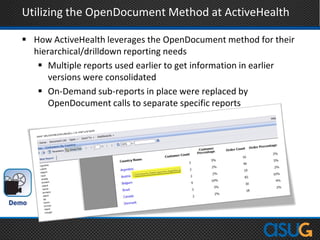
Utilizing the OpenDocument Method at ActiveHealth
 How ActiveHealth leverages the OpenDocument method for their
hierarchical/drilldown reporting needs
 Multiple reports used earlier to get information in earlier
versions were consolidated
 On-Demand sub-reports in place were replaced by
OpenDocument calls to separate specific reports
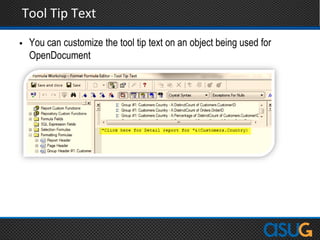
Tool Tip Text
 You can customize the tool tip text on an object being used for
OpenDocument
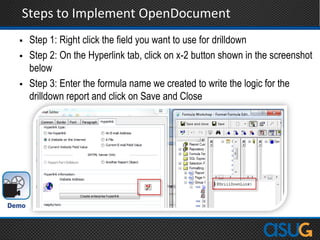
Steps to Implement OpenDocument
 Step 1: Right click the field you want to use for drilldown
 Step 2: On the Hyperlink tab, click on x-2 button shown in the screenshot
below
 Step 3: Enter the formula name we created to write the logic for the
drilldown report and click on Save and Close
Steps to Implement OpenDocument (cont.)
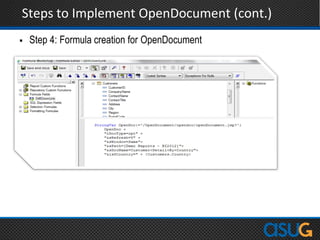
 Step 4: Formula creation for OpenDocument
Steps to Implement OpenDocument (cont.)
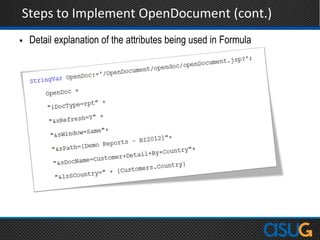
 Detail explanation of the attributes being used in Formula
Other Flavors of OpenDocument Utilization
 Calling the same report with other values of parameters
 Calling the source report with default values or changed values of
parameters
 Concept of hidden report(s) being called using the OpenDocument
method
Folder Security Setup
 Set up to drill to a report that is not visible to the user
 Create a folder that will have “No Access” security assigned to the group
or user
 Create a folder inside this folder that will host the reports that you want to
work only when they are called from some other report using the
OpenDocument method, but are not visible to the user
 This folder will have “View on Demand” rights to it and thus when it‟s
called from the OpenDocument method by any other reports, it will work
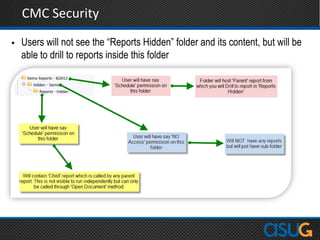
CMC Security
 Users will not see the “Reports Hidden” folder and its content, but will be
able to drill to reports inside this folder
What We’ll Cover …
 OpenDocument method used for hierarchical drilldown
 Creating a LOVs (List of Values) using universe prompts
 Including “all” and “wildcard” searches in the LOVs
 Customizing parameters inside Crystal Reports Designer
 Integrating Xcelsius with Crystal Reports
 Tips and Tricks for improving design and performance
 Wrap-up
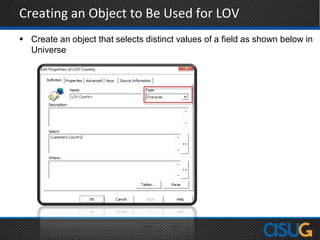
Creating an Object to Be Used for LOV
 Create an object that selects distinct values of a field as shown below in
Universe
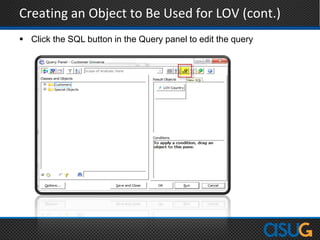
Creating an Object to Be Used for LOV (cont.)
 Click the SQL button in the Query panel to edit the query
What We’ll Cover …
 OpenDocument method used for hierarchical drilldown
 Creating a LOVs (List of Values) using universe prompts
 Including “all” and “wildcard” searches in the LOVs
 Customizing parameters inside Crystal Reports Designer
 Integrating Xcelsius with Crystal Reports
 Tips and Tricks for improving design and performance
 Wrap-up
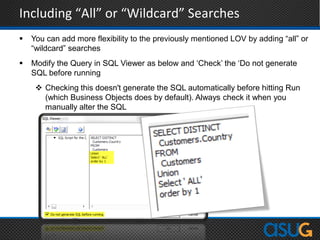
Including “All” or “Wildcard” Searches
 You can add more flexibility to the previously mentioned LOV by adding “all” or
“wildcard” searches
 Modify the Query in SQL Viewer as below and „Check‟ the „Do not generate
SQL before running
 Checking this doesn't generate the SQL automatically before hitting Run
(which Business Objects does by default). Always check it when you
manually alter the SQL
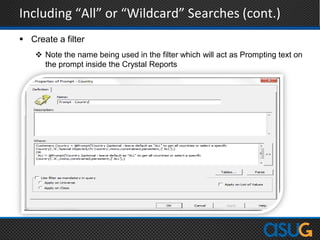
Including “All” or “Wildcard” Searches (cont.)
 Create a filter
 Note the name being used in the filter which will act as Prompting text on
the prompt inside the Crystal Reports
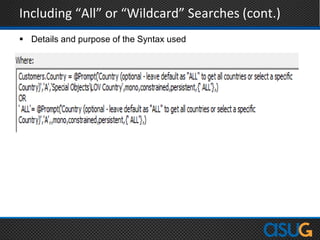
Including “All” or “Wildcard” Searches (cont.)
 Details and purpose of the Syntax used
What We’ll Cover …
 OpenDocument method used for hierarchical drilldown
 Creating a LOVs (List of Values) using universe prompts
 Including “all” and “wildcard” searches in the LOVs
 Customizing parameters inside Crystal Reports Designer
 Integrating Xcelsius with Crystal Reports
 Tips and Tricks for improving design and performance
 Wrap-up
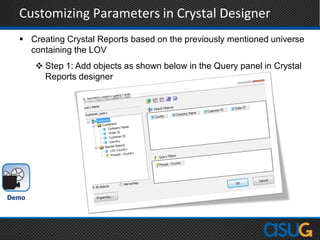
Customizing Parameters in Crystal Designer
 Creating Crystal Reports based on the previously mentioned universe
containing the LOV
 Step 1: Add objects as shown below in the Query panel in Crystal
Reports designer
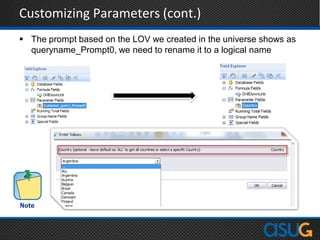
Customizing Parameters (cont.)
 The prompt based on the LOV we created in the universe shows as
queryname_Prompt0, we need to rename it to a logical name
What We’ll Cover …
 OpenDocument method used for hierarchical drilldown
 Creating a LOVs (List of Values) using universe prompts
 Including “all” and “wildcard” searches in the LOVs
 Customizing parameters inside Crystal Reports Designer
 Integrating Xcelsius with Crystal Reports
 Tips and Tricks for improving design and performance
 Wrap-up
Xcelsius Integration with Crystal Reports
 Integration of Xcelsius into Crystal Reports
 Using Flash Variables (CSV)
 Using XML Variables
 Using Crystal Data Consumer
 Using Cross Tab
What We’ll Cover …
 OpenDocument method used for hierarchical drilldown
 Creating a LOVs (List of Values) using universe prompts
 Including “all” and “wildcard” searches in the LOVs
 Customizing parameters inside Crystal Reports Designer
 Integrating Xcelsius with Crystal Reports
 Tips and Tricks for improving design and performance
 Wrap-up
Report Performance Tips
 Check the query being generated and make sure it‟s selecting data
that is being used by the report
 Filtering should always be pushed to the server
 For reports based against base tables, SQL expressions can be used in
filtering rather than Formula fields
 Proper indexing should be done
 Sub-reports should be considered as a design option only in worst case
scenarios
 If a report requires sub-reports to be in the “Details” section, you should
revisit the report design and see if it can be built using either universe,
stored procedure, or views on the database side
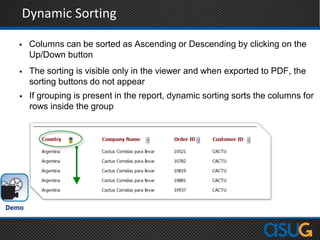
Dynamic Sorting
 Columns can be sorted as Ascending or Descending by clicking on the
Up/Down button
 The sorting is visible only in the viewer and when exported to PDF, the
sorting buttons do not appear
 If grouping is present in the report, dynamic sorting sorts the columns for
rows inside the group
Dynamic Sorting
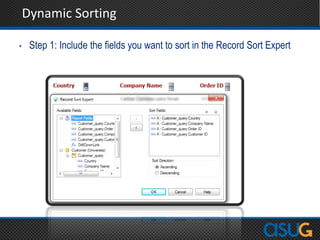
• Step 1: Include the fields you want to sort in the Record Sort Expert
Dynamic Sorting (cont.)
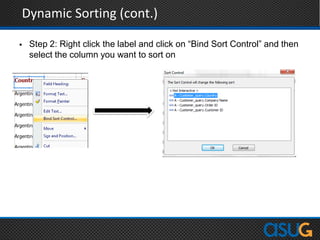
 Step 2: Right click the label and click on “Bind Sort Control” and then
select the column you want to sort on
Tips and Tricks
 Cutting down design time using Guidelines and Grid
 Customizing grid size for more control on design space
 Using horizontal/vertical guidelines to manage white space on
report effectively
 Utilizing wildcard(s) in Select Expert formula editor for
parameters to accept “All” to return all records (as explained
earlier in the slides)
 Settings you might want to select in “options” in Crystal
Designer
 Short section names, Guidelines, Grid in Design View; and Tool
Tips, Rulers, and Guidelines in Preview
 Snap to Grid, Control you could do using Grid Size in Inches
 Convert Database NULL values to default and its design impact
Tips and Tricks
 Using “Show SQL Query” query to analyze performance of the
report
 Use the query to run independently against database
 Validate the results from query to report
 Use Explain Plan to analyze the performance of query and if any
changes needed
 How to write effective “Conditional Suppression” formulae to
use on sections
 Create a Boolean formula based on different conditions you have
for suppressing or showing a section
 Utilize the Boolean variable you have created in the previous
formula in all of the needed sections to either suppress or show
What We’ll Cover …
 OpenDocument method used for hierarchical drilldown
 Creating a LOVs (List of Values) using universe prompts
 Including “all” and “wildcard” searches in the LOVs
 Customizing parameters inside Crystal Reports Designer
 Integrating Xcelsius with Crystal Reports
 Tips and Tricks for improving design and performance
 Wrap-up
Additional Resources
 Coy Yonce, “100 Things you should know about reporting using SAP
Crystal Reports,” SAP PRESS, 1st Edition; 1st Edition edition
(November 30, 2011)
 YouTube – SAP Channel: The Official SAP Channel
 Viewing Reports and Documents using URLs
 http://help.sap.com/businessobject/product_guides/boexir3/en/xi3-
1_url_reporting_opendocument_en.pdf
7 Key Points to Take Home
 Use the OpenDocument method where drill down or hyperlink
are required
 Utilize LOVs (List of Values)
 Use wildcards in prompts/parameters
 Take advantage of the tricks for customizing parameters inside
Crystal Reports Designer
 Use the different methods to integrate Xcelsius with Crystal
Reports
 Follow the performance and Central Management Console
content security tips given in this session
 Use dynamic sorting in reports
Your Turn!
How to contact me:
Mohammed Imran Alam
Malam@ActiveHealth.net
Blog: www.reportgurus.com/imran/
LinkedIn: http://www.linkedin.com/in/alamimran
Thank you for participating.
Please provide feedback on this session by
completing a short survey via the event
mobile application.
SESSION CODE: 0103
Learn more year-round at www.asug.com

CaseStudy-MohammedImranAlam-Xcelsius

  • 1.
    September 10-13, 2012 Orlando,Florida Case Study: Breakthroughs in Xcelsius Integration within Crystal Reports at AETNA Mohammed Imran Alam
  • 2.
    ActiveHealth, sister companyof Aetna, Inc  Improving Healthcare Quality and Lowering Costs through Evidence-Based Medicine  The company’s patented CareEngine® System is developed by physicians and provides tailored and actionable clinical analytics and decision support to help improve patient health and wellness.  In May of 2005, ActiveHealth was acquired by Aetna, Inc. ActiveHealth operates as a branded, standalone business.  In 1998, Lonny Reisman, MD, founded ActiveHealth Management to help address rising healthcare costs and improve outcomes through the use of clinical decision support. Today, ActiveHealth Management creates evidence-based health information technology solutions that deliver proven benefits in quality and costs.
  • 3.
    In This Session…  See how ActiveHealth leverages the OpenDocument method to avoid performance slowdowns  Hear how the company increased performance and flexibility by using a List of Values (LOVs) created within the universe  Learn how ActiveHealth used XML, CSV and Flash Variables data connectivity options to overcome pitfalls with Crystal Reports and Xceslsius® integration  Get performance-enhancing options for report development and data store usage
  • 4.
    What We’ll Cover…  OpenDocument method used for hierarchical drilldown  Creating a LOVs (List of Values) using universe prompts  Including “all” and “wildcard” searches in the LOVs  Customizing parameters inside Crystal Reports Designer  Integrating Xcelsius with Crystal Reports  Tips and Tricks for improving design and performance  Wrap-up
  • 5.
    What We’ll Cover…  OpenDocument method used for hierarchical drilldown  Creating a LOVs (List of Values) using universe prompts  Including “all” and “wildcard” searches in the LOVs  Customizing parameters inside Crystal Reports Designer  Integrating Xcelsius with Crystal Reports  Tips and Tricks for improving design and performance  Wrap-up
  • 6.
    Utilizing the OpenDocumentMethod at ActiveHealth  How ActiveHealth leverages the OpenDocument method for their hierarchical/drilldown reporting needs  Multiple reports used earlier to get information in earlier versions were consolidated  On-Demand sub-reports in place were replaced by OpenDocument calls to separate specific reports
  • 7.
    Tool Tip Text You can customize the tool tip text on an object being used for OpenDocument
  • 8.
    Steps to ImplementOpenDocument  Step 1: Right click the field you want to use for drilldown  Step 2: On the Hyperlink tab, click on x-2 button shown in the screenshot below  Step 3: Enter the formula name we created to write the logic for the drilldown report and click on Save and Close
  • 9.
    Steps to ImplementOpenDocument (cont.)  Step 4: Formula creation for OpenDocument
  • 10.
    Steps to ImplementOpenDocument (cont.)  Detail explanation of the attributes being used in Formula
  • 11.
    Other Flavors ofOpenDocument Utilization  Calling the same report with other values of parameters  Calling the source report with default values or changed values of parameters  Concept of hidden report(s) being called using the OpenDocument method
  • 12.
    Folder Security Setup Set up to drill to a report that is not visible to the user  Create a folder that will have “No Access” security assigned to the group or user  Create a folder inside this folder that will host the reports that you want to work only when they are called from some other report using the OpenDocument method, but are not visible to the user  This folder will have “View on Demand” rights to it and thus when it‟s called from the OpenDocument method by any other reports, it will work
  • 13.
    CMC Security  Userswill not see the “Reports Hidden” folder and its content, but will be able to drill to reports inside this folder
  • 14.
    What We’ll Cover…  OpenDocument method used for hierarchical drilldown  Creating a LOVs (List of Values) using universe prompts  Including “all” and “wildcard” searches in the LOVs  Customizing parameters inside Crystal Reports Designer  Integrating Xcelsius with Crystal Reports  Tips and Tricks for improving design and performance  Wrap-up
  • 15.
    Creating an Objectto Be Used for LOV  Create an object that selects distinct values of a field as shown below in Universe
  • 16.
    Creating an Objectto Be Used for LOV (cont.)  Click the SQL button in the Query panel to edit the query
  • 17.
    What We’ll Cover…  OpenDocument method used for hierarchical drilldown  Creating a LOVs (List of Values) using universe prompts  Including “all” and “wildcard” searches in the LOVs  Customizing parameters inside Crystal Reports Designer  Integrating Xcelsius with Crystal Reports  Tips and Tricks for improving design and performance  Wrap-up
  • 18.
    Including “All” or“Wildcard” Searches  You can add more flexibility to the previously mentioned LOV by adding “all” or “wildcard” searches  Modify the Query in SQL Viewer as below and „Check‟ the „Do not generate SQL before running  Checking this doesn't generate the SQL automatically before hitting Run (which Business Objects does by default). Always check it when you manually alter the SQL
  • 19.
    Including “All” or“Wildcard” Searches (cont.)  Create a filter  Note the name being used in the filter which will act as Prompting text on the prompt inside the Crystal Reports
  • 20.
    Including “All” or“Wildcard” Searches (cont.)  Details and purpose of the Syntax used
  • 21.
    What We’ll Cover…  OpenDocument method used for hierarchical drilldown  Creating a LOVs (List of Values) using universe prompts  Including “all” and “wildcard” searches in the LOVs  Customizing parameters inside Crystal Reports Designer  Integrating Xcelsius with Crystal Reports  Tips and Tricks for improving design and performance  Wrap-up
  • 22.
    Customizing Parameters inCrystal Designer  Creating Crystal Reports based on the previously mentioned universe containing the LOV  Step 1: Add objects as shown below in the Query panel in Crystal Reports designer
  • 23.
    Customizing Parameters (cont.) The prompt based on the LOV we created in the universe shows as queryname_Prompt0, we need to rename it to a logical name
  • 24.
    What We’ll Cover…  OpenDocument method used for hierarchical drilldown  Creating a LOVs (List of Values) using universe prompts  Including “all” and “wildcard” searches in the LOVs  Customizing parameters inside Crystal Reports Designer  Integrating Xcelsius with Crystal Reports  Tips and Tricks for improving design and performance  Wrap-up
  • 25.
    Xcelsius Integration withCrystal Reports  Integration of Xcelsius into Crystal Reports  Using Flash Variables (CSV)  Using XML Variables  Using Crystal Data Consumer  Using Cross Tab
  • 26.
    What We’ll Cover…  OpenDocument method used for hierarchical drilldown  Creating a LOVs (List of Values) using universe prompts  Including “all” and “wildcard” searches in the LOVs  Customizing parameters inside Crystal Reports Designer  Integrating Xcelsius with Crystal Reports  Tips and Tricks for improving design and performance  Wrap-up
  • 27.
    Report Performance Tips Check the query being generated and make sure it‟s selecting data that is being used by the report  Filtering should always be pushed to the server  For reports based against base tables, SQL expressions can be used in filtering rather than Formula fields  Proper indexing should be done  Sub-reports should be considered as a design option only in worst case scenarios  If a report requires sub-reports to be in the “Details” section, you should revisit the report design and see if it can be built using either universe, stored procedure, or views on the database side
  • 28.
    Dynamic Sorting  Columnscan be sorted as Ascending or Descending by clicking on the Up/Down button  The sorting is visible only in the viewer and when exported to PDF, the sorting buttons do not appear  If grouping is present in the report, dynamic sorting sorts the columns for rows inside the group
  • 29.
    Dynamic Sorting • Step1: Include the fields you want to sort in the Record Sort Expert
  • 30.
    Dynamic Sorting (cont.) Step 2: Right click the label and click on “Bind Sort Control” and then select the column you want to sort on
  • 31.
    Tips and Tricks Cutting down design time using Guidelines and Grid  Customizing grid size for more control on design space  Using horizontal/vertical guidelines to manage white space on report effectively  Utilizing wildcard(s) in Select Expert formula editor for parameters to accept “All” to return all records (as explained earlier in the slides)  Settings you might want to select in “options” in Crystal Designer  Short section names, Guidelines, Grid in Design View; and Tool Tips, Rulers, and Guidelines in Preview  Snap to Grid, Control you could do using Grid Size in Inches  Convert Database NULL values to default and its design impact
  • 32.
    Tips and Tricks Using “Show SQL Query” query to analyze performance of the report  Use the query to run independently against database  Validate the results from query to report  Use Explain Plan to analyze the performance of query and if any changes needed  How to write effective “Conditional Suppression” formulae to use on sections  Create a Boolean formula based on different conditions you have for suppressing or showing a section  Utilize the Boolean variable you have created in the previous formula in all of the needed sections to either suppress or show
  • 33.
    What We’ll Cover…  OpenDocument method used for hierarchical drilldown  Creating a LOVs (List of Values) using universe prompts  Including “all” and “wildcard” searches in the LOVs  Customizing parameters inside Crystal Reports Designer  Integrating Xcelsius with Crystal Reports  Tips and Tricks for improving design and performance  Wrap-up
  • 34.
    Additional Resources  CoyYonce, “100 Things you should know about reporting using SAP Crystal Reports,” SAP PRESS, 1st Edition; 1st Edition edition (November 30, 2011)  YouTube – SAP Channel: The Official SAP Channel  Viewing Reports and Documents using URLs  http://help.sap.com/businessobject/product_guides/boexir3/en/xi3- 1_url_reporting_opendocument_en.pdf
  • 35.
    7 Key Pointsto Take Home  Use the OpenDocument method where drill down or hyperlink are required  Utilize LOVs (List of Values)  Use wildcards in prompts/parameters  Take advantage of the tricks for customizing parameters inside Crystal Reports Designer  Use the different methods to integrate Xcelsius with Crystal Reports  Follow the performance and Central Management Console content security tips given in this session  Use dynamic sorting in reports
  • 36.
    Your Turn! How tocontact me: Mohammed Imran Alam Malam@ActiveHealth.net Blog: www.reportgurus.com/imran/ LinkedIn: http://www.linkedin.com/in/alamimran
  • 37.
    Thank you forparticipating. Please provide feedback on this session by completing a short survey via the event mobile application. SESSION CODE: 0103 Learn more year-round at www.asug.com