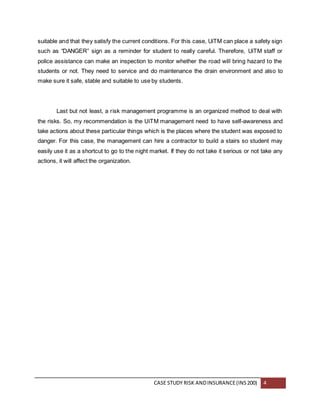
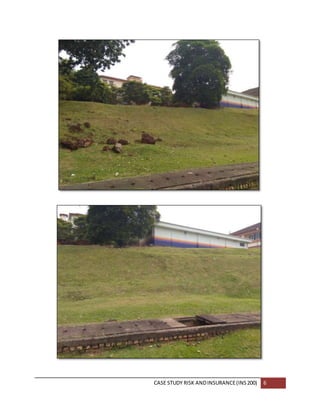
1) The document discusses a case study about a hazardous steep pathway near a university health unit that students use as a shortcut to a night market. It poses risks like slipping, falling into an uncovered drain, and injuries from large stones.
2) The case study analyzes the risk management process for this hazard. Key steps identified the risks, evaluated their likelihood and severity, and examined techniques like risk avoidance and loss reduction to handle the risks.
3) Recommendations include hiring a contractor to build a stable staircase and cover the drain, placing safety signs, and regular inspections to monitor hazards and ensure student safety. The management needs to take actions to address risks and protect students.
![CASE STUDY RISK ANDINSURANCE(INS200) 2
CASE STUDY INS 200 [HAZARDOUS PLACE]
Risk is the uncertainty pertaining to an outcome, risk is exposure to danger and risk is
the subject matter of insurance. A risk exists whenever the future is unknown, it can be said to
be present everywhere and in all things. It is present in the lives of individuals and in the world
of commerce and industry. It can be unexpected and unpredictable events. Hazard is a factor
that is likely to increase the probability of a loss occurring or the size of such a loss.
Risk management is a process of thinking systematically about all possible risks,
problem or disasters before they happen and setting up procedures that will avoid the risk or
minimize its impact or cope with its impact. It is one of the management functions that seek to
assess and address the causes and effects of uncertainty and risk on an organization. It is
basically setting up a process to identify the risk and setting up strategy to control or deal with it
and making a realistic evaluation of the true level of risk. An effective risk management
programme will reduce the overall impact of losses.
Here is the study about the hazardous place that I found in UiTM. That place is a steep
way from Unit Kesihatan UiTM Melaka that use by student as a shortcut to go to the night
market. Risk management demands on-going process. It can be divided into a series of
individual steps that need to be implemented in order to minimize the impact of risks.
Risk identification is the first step and it is known to be the most important process. It is
the process that able to learn of the areas in which it is exposed to risk. According to that case,
student may accidentally slip and sliding falls into the drain and also head banging that cause by
big stone around the area. Therefore, that steep way is not stable for people who using it. It can
cause injury that can affect them.
Step two is evaluating potential risks. Once the risks have been identified, it can help to
measure the severity (potential size of the loss) and frequency (the probability that is likely to
occur). In this case, it will cause low severity and high frequency. The victim who using that](https://image.slidesharecdn.com/ins200-200824055524/85/CASE-STUDY-RISK-AND-INSURANCE-2-320.jpg)