Case Study: Modelling Refinery Processes
Site-wide steady state Process Simulation provides in-depth
understanding of processes
Client: Milford Haven Refinery
Who are we?
Process engineering consultancy
Specialising in advanced modelling techniques, to give answers that
are more accurate, reliable and robust
Expertise in HYSYS, PRO/II, Dynsim
Decades of process and mechanical engineering experience
Combine cutting edge simulation with real world understanding, to
provide you with solutions that are effective and practical.
Core team of eight engineers, supported by a wide network of
associates.
Extensive simulation experience across a range of industries
Page  2
Our Client: Milford Haven Refining
Refinery 130,000 bpd, built 1973
Upgraded several times, recent upgrade +50%
Originally designed for North Sea Crude
Needed to increase production further by 10% and improve yields to
remain competitive
Relief and flare systems were reaching their limits
Page  3
Purpose for Modelling
Detailed steady state models developed to:
Optimise operations (evaluate impact of various crude types and
impact of crude tower operating conditions)
Support project work (sizing equipment, mass balancing)
Identify bottlenecks to throughput (column flooding, exchanger
pressure drop, pump-around limitations)
Aid understanding of process and choice of suitable crudes
Assist rating of dynamic simulation models (safety studies, flare
sizing)
Page  4
Steady State Simulation
Accurate, integrated models of key refinery units built from actual refinery
drawings and using plant data.
Crude Tower / Vacuum Tower and Preheat Train
Debutaniser, Virgin and Cat Naphtha Splitters
LPG Train (Depropaniser, Debutaniser)
Naphtha Reformer
Isomerisation
Kerosene Hydrotreater
Diesel Hydrotreater
Ancillary systems (Fuel Gas, Sour Water, Amine)
Page  5
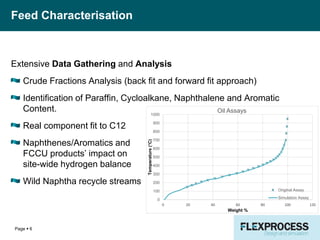
Feed Characterisation
Extensive Data Gathering and Analysis
Crude Fractions Analysis (back fit and forward fit approach)
Identification of Paraffin, Cycloalkane, Naphthalene and Aromatic
Content.
Real component fit to C12
Naphthenes/Aromatics and
FCCU products’ impact on
site-wide hydrogen balance
Wild Naphtha recycle streams
Page  6
0
100
200
300
400
500
600
700
800
900
1000
0 20 40 60 80 100 120
Temperature(°C)
Weight %
Oil Assays
Original Assay
Simulation Assay
Page  7
Building Models
Data Gathering
Model Building
Model Rating
Testing and
Reporting
 We visit our clients, and obtain all the data we need
 This includes searching through equipment libraries, reviewing
operational trends, and mechanical surveys of pipework and equipment
 Detailed input, including all columns, valves, pipe, and pumps
 Rigorous models of heat exchangers to accurately simulate heat
transfer, pressure drop, and the effects of fouling
 We ensure the model matches plant data, from feed through to
products.
 Site set points and specifications directly compared with models
 Once the models are ready, we can test anything the client needs
 We supply a comprehensive report of our work, along with a full
explanation of all of our recommendations
How we work with our clients
Matching Plant Data – The Traditional Approach
Page  8
Before modelling can commence, the client has to agree a reasonable
set of conditions to match:
Usually done as a point-in-time “snapshot”
Must wait until the whole refinery has been running at steady conditions
for a prolonged period
Can be unrepresentative of normal operation (e.g. operating at unusual
set point)
Susceptible to short term issues, such as ambient conditions, faulty
instruments, or fouling
Matching Plant Data – Our Approach
To avoid the shortcomings of using “snapshots” of data, we
combined this with our own software. This let us:
Page  9
Visualise large sets of
data
Examine months or years
of operation
Amend outliers in
snap-shot data
Identify most common set
points
Understand how units are
run before we began
Model Building
Page  10
We put every detail we could find
into the models
Column plate hydraulics
Heat exchanger layouts
Pipe isometrics
This allowed us to harness powerful
unit simulations that accurately
predict heat transfer, mass transfer,
and pressure drop.
Summary
Page  11
Accurate, Integrated Steady State Simulation Models developed for
key refinery operations
Models have multiple applications from Scheduling, Operations,
Projects and Process Safety
Significant man hour saving in having consistent process data for
troubleshooting and project work
Dynamic simulation models quickly developed from steady state
models
Extensive Site Survey resulting in new Library of Plant Information
Summary
Page  12
Consultancy.
Project Delivery.
Innovation.
Please get in touch to find out how we can help your
business today.
E: enquiries@flexprocess.co.uk W: flexprocess.co.uk
T: +44 1454 629 689

Case Study: Modelling Refinery Processes

  • 1.
    Case Study: ModellingRefinery Processes Site-wide steady state Process Simulation provides in-depth understanding of processes Client: Milford Haven Refinery
  • 2.
    Who are we? Processengineering consultancy Specialising in advanced modelling techniques, to give answers that are more accurate, reliable and robust Expertise in HYSYS, PRO/II, Dynsim Decades of process and mechanical engineering experience Combine cutting edge simulation with real world understanding, to provide you with solutions that are effective and practical. Core team of eight engineers, supported by a wide network of associates. Extensive simulation experience across a range of industries Page  2
  • 3.
    Our Client: MilfordHaven Refining Refinery 130,000 bpd, built 1973 Upgraded several times, recent upgrade +50% Originally designed for North Sea Crude Needed to increase production further by 10% and improve yields to remain competitive Relief and flare systems were reaching their limits Page  3
  • 4.
    Purpose for Modelling Detailedsteady state models developed to: Optimise operations (evaluate impact of various crude types and impact of crude tower operating conditions) Support project work (sizing equipment, mass balancing) Identify bottlenecks to throughput (column flooding, exchanger pressure drop, pump-around limitations) Aid understanding of process and choice of suitable crudes Assist rating of dynamic simulation models (safety studies, flare sizing) Page  4
  • 5.
    Steady State Simulation Accurate,integrated models of key refinery units built from actual refinery drawings and using plant data. Crude Tower / Vacuum Tower and Preheat Train Debutaniser, Virgin and Cat Naphtha Splitters LPG Train (Depropaniser, Debutaniser) Naphtha Reformer Isomerisation Kerosene Hydrotreater Diesel Hydrotreater Ancillary systems (Fuel Gas, Sour Water, Amine) Page  5
  • 6.
    Feed Characterisation Extensive DataGathering and Analysis Crude Fractions Analysis (back fit and forward fit approach) Identification of Paraffin, Cycloalkane, Naphthalene and Aromatic Content. Real component fit to C12 Naphthenes/Aromatics and FCCU products’ impact on site-wide hydrogen balance Wild Naphtha recycle streams Page  6 0 100 200 300 400 500 600 700 800 900 1000 0 20 40 60 80 100 120 Temperature(°C) Weight % Oil Assays Original Assay Simulation Assay
  • 7.
    Page  7 BuildingModels Data Gathering Model Building Model Rating Testing and Reporting  We visit our clients, and obtain all the data we need  This includes searching through equipment libraries, reviewing operational trends, and mechanical surveys of pipework and equipment  Detailed input, including all columns, valves, pipe, and pumps  Rigorous models of heat exchangers to accurately simulate heat transfer, pressure drop, and the effects of fouling  We ensure the model matches plant data, from feed through to products.  Site set points and specifications directly compared with models  Once the models are ready, we can test anything the client needs  We supply a comprehensive report of our work, along with a full explanation of all of our recommendations How we work with our clients
  • 8.
    Matching Plant Data– The Traditional Approach Page  8 Before modelling can commence, the client has to agree a reasonable set of conditions to match: Usually done as a point-in-time “snapshot” Must wait until the whole refinery has been running at steady conditions for a prolonged period Can be unrepresentative of normal operation (e.g. operating at unusual set point) Susceptible to short term issues, such as ambient conditions, faulty instruments, or fouling
  • 9.
    Matching Plant Data– Our Approach To avoid the shortcomings of using “snapshots” of data, we combined this with our own software. This let us: Page  9 Visualise large sets of data Examine months or years of operation Amend outliers in snap-shot data Identify most common set points Understand how units are run before we began
  • 10.
    Model Building Page 10 We put every detail we could find into the models Column plate hydraulics Heat exchanger layouts Pipe isometrics This allowed us to harness powerful unit simulations that accurately predict heat transfer, mass transfer, and pressure drop.
  • 11.
    Summary Page  11 Accurate,Integrated Steady State Simulation Models developed for key refinery operations Models have multiple applications from Scheduling, Operations, Projects and Process Safety Significant man hour saving in having consistent process data for troubleshooting and project work Dynamic simulation models quickly developed from steady state models Extensive Site Survey resulting in new Library of Plant Information
  • 12.
    Summary Page  12 Consultancy. ProjectDelivery. Innovation. Please get in touch to find out how we can help your business today. E: enquiries@flexprocess.co.uk W: flexprocess.co.uk T: +44 1454 629 689