2
Major national and international organisations engage Spireworks to drive innovation, digital transformation and
business change, in a values-driven and people-centric way. We deliver sustainable improvements, in increments
of just 4-6 weeks. By placing people at the centre of this work, we embed skills, evolve culture and build real
technology products for our clients, that are at once disruptive, cost-efficient and effective.
This is the story of one client who asked for our help.
Over an 18 month period, we delivered increments of change in five key areas - experimentation, agile delivery,
leadership, hiring, data integration/personalisation of service. We delivered a 30% saving in operational spend,
and our client’s Net Promoter Score (NPS) leaped from -29 to +40! Our work more than paid for itself, not only in
savings, but in increased revenue.
A major insurance company approached us to help drive a digital
transformation initiative. Having outsourced technology skills, and
paid a plethora of consultants for recommendations, they still lacked
the skills to rapidly innovate and deliver experiences that would
delight their customers.
4
A major US insurer was “not equipped to respond effectively to
perpetually changing consumer behavior. [They] needed an
efficient way to experiment with new ideas, learn fast and validate
concepts before embarking upon large, costly projects.”
Our client was fearful of a rapidly changing marketplace, where
their competitors were swiftly and frequently improving existing
services and products, and where disruptive forces across the
startup and technology worlds were heralding more radical
changes to the industry and to consumer behavior.
This company could no longer afford to waste time or resources
delivering projects that were not certain to add strategic value. So
they approached us for help.
5
Spireworks operates at the intersection of technology, business
leadership and psychology. We drive strategic change by placing culture
at the centre.
We combine principles and ideas from methods like Agile, Lean Startup,
Deliberately Developmental Organisations (DDOs) and adult
psychological development to build our clients’ skills in:
● Foundational Innovation: optimizing spend, increasing
productivity and disentangling complex and wasteful processes.
● Sustaining Innovation: experimenting with new ideas cheaply,
learning and failing fast and putting customers back at the centre.
● Disruptive Innovation: mastering experimentation, learning and
idea meritocracy to start driving, rather than chasing, market
forces.
6
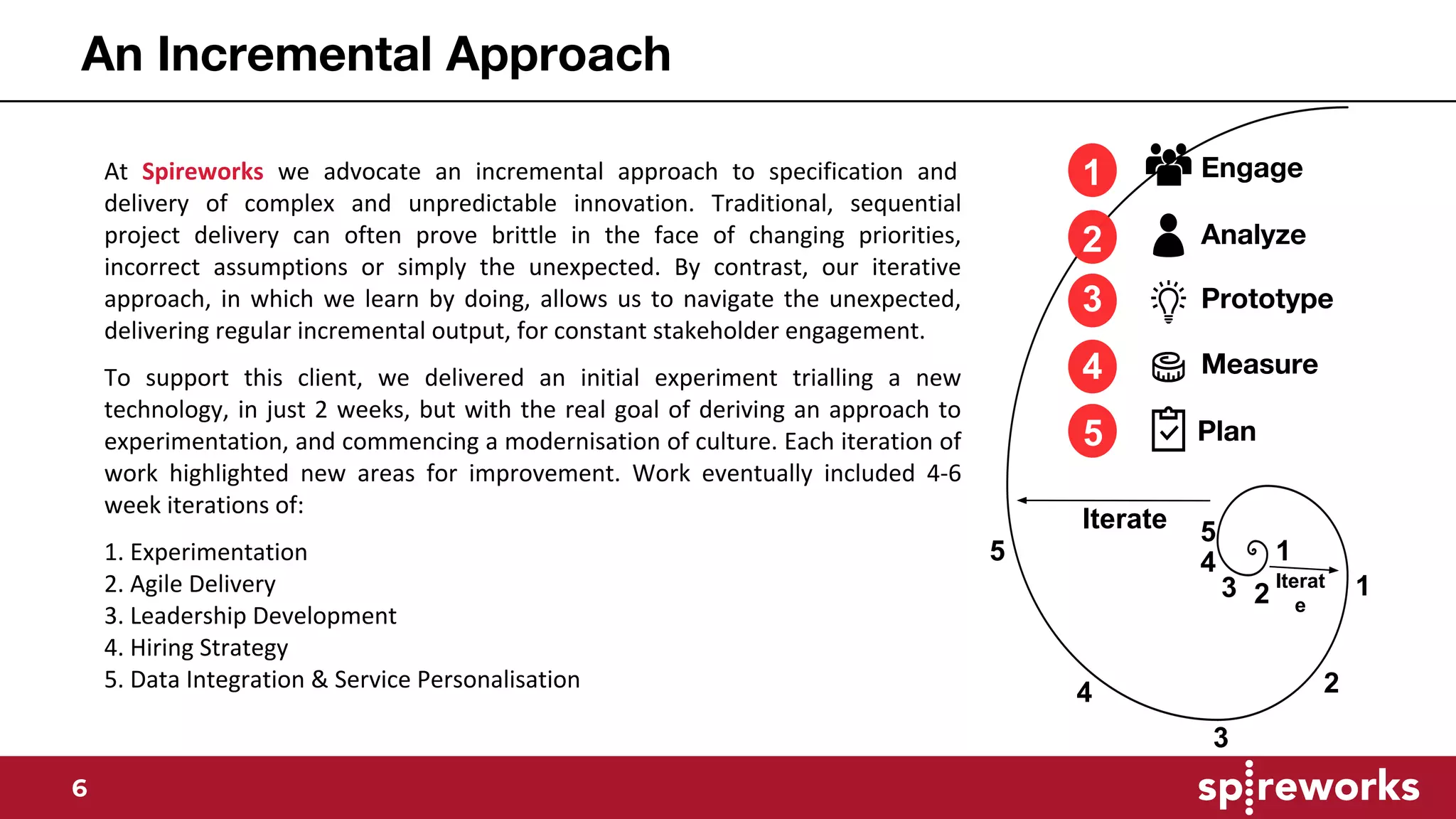
At Spireworks we advocate an incremental approach to specification and
delivery of complex and unpredictable innovation. Traditional, sequential
project delivery can often prove brittle in the face of changing priorities,
incorrect assumptions or simply the unexpected. By contrast, our iterative
approach, in which we learn by doing, allows us to navigate the unexpected,
delivering regular incremental output, for constant stakeholder engagement.
To support this client, we delivered an initial experiment trialling a new
technology, in just 2 weeks, but with the real goal of deriving an approach to
experimentation, and commencing a modernisation of culture. Each iteration of
work highlighted new areas for improvement. Work eventually included 4-6
week iterations of:
1. Experimentation
2. Agile Delivery
3. Leadership Development
4. Hiring Strategy
5. Data Integration & Service Personalisation
1
3
4
5
Iterate
Iterat
e
1
23
4
5
1
2
3
4
5
2
7
Our first intervention with this client sought to derive a workable
process to allow anyone to experiment with a new technology or
idea.
The ability to rapidly prototype desirable functionality, in a
Proof-of-Concept (PoC), while minimising disruption to existing
services, is fundamental for innovation and high risk change.
Instead of pumping money and time into an unvalidated idea, we
explore ideas in simple form with actual users. Feedback is used to
validate requirements, shape priorities and better target the
subsequent project lifecycle.
We always establish this process, tailored for each client, by
delivering an initial experiment alongside their team, dedicated and
co-located.
8
The Experimentation iteration inspired a module to make regular
updates and changes to digital interfaces more agile. We worked with
our client to transform existing processes from conventional project
delivery to agile rollout.
The objective of Agile is always to deliver twice as much in half the time
by reducing wasted effort. Our job was to highlight and remove this
wasted effort. We did so by:
● Engaging a dedicated client, Agile delivery team.
● Establishing a delivery and governance model with a buffer
between agile and conventional delivery.
● Facilitating workshop-style training, to provide the theory and
apply it in real-time to the planning of the first iteration of work.
● Directly coaching and supporting the new Agile team through
three successful iterations.
● Building a roadmap for rolling out of Agile delivery to the entire
digital organization.
9
Delivering according to Agile methods invariably destabilizes traditional
hierarchies and unnerves middle managers. Fear rears its ugly head and can
derail the most highly-qualified Agile teams.
At this stage, Spireworks introduced a leadership development iteration, led
by an organisational psychologist, who helps manager to adapt and become
the leaders they need to be for a business to succeed.
Attitudes, behaviours and mindsets must be probed and organisational
norms understood to define the shifts in attitude and behaviour necessary to
make innovation a success.
At this client, we combined individual coaching, with group work on team
dynamics, collaborative support and truth-telling, to help the organisations
leaders to adapt, lean on others, learn as they go, and become role models
for their entire organisation.
10
As managers learned to be leaders, they specifically requested an
iteration to improve hiring, specifically of younger technology
talent. Where technology is concerned, large organisations have
often outsourced the skills and knowledge required to innovate.
We work with clients to attract and retain the capabilities they
need for the future. With this client, our work included:
● Understanding the company narrative and purpose -
people are motivated by “why” not “what”.
● Developing appealing and interesting job profiles.
● Leveraging social media, online forums and other digital
spaces, to identify the best candidates, rather than
awaiting applications.
● Consistently and thoroughly collecting data on candidates.
● Reinventing the interview process, for speed,
communication and standardization, while innovating to
test for attitude, empathy and behaviour.
11
Customers demand that you know and speak to them
as individuals, but knowing your customer requires
that you integrate a perpetually evolving trail of digital
breadcrumbs, the volume and complexity of which is
exploding.
At Spireworks, our technologists use Big Data
technologies to build data solutions that drive
intelligence and insights on individual customers,
without the need for massive up front investment.
For this insurer, we developed a single view of
customer data, aggregating 2 sources of operational
data with 1 public data source, and rendering the
results to call centre staff to improve and speed up
their interactions with customers. The prototype was
built and in use in just 4 weeks.
12
Securing budget for innovation often requires detailed planning and justification. Business leaders often fall into the
trap of believing that detailed planning, years in advance, reduces risk - but the future cannot be predicted.
Traditional planning fails in the face of rapidly-changing technology, consumer-sentiment and societal upheaval. The
Spireworks method is incremental, and thereby demands a different approach to securing funding.
Underlying our work with
clients, we borrow from the
methods used at venture
capitalists to invest with new
startups. We establish an
approach to justify and
secure budget incrementally,
ensuring appropriate due
diligence and oversight,
while allowing the best ideas
to flourish. This is what we
did with our insurance client.
13
At the end of every iteration, Spireworks holds a “Retrospective” - a review, with the whole team of what we should
learn. The goal is to highlight key learnings that we should apply to subsequent iterations, facilitating and formalizing
continuous improvement. We include some of the key learnings recorded during this work. These lessons are broadly
applicable, across a variety of projects and industries.
● A team succeeds and fails together. Problems must be dealt with within the team, to build trust and resilience
amongst members, and to establish psychological safety. A team in which members trusts each other is
verifiably more effective.
● Pragmatic and incremental application of Agile principles is more effective than one who blindly applies theory.
We advocate that a team learn by doing, rather than attempting to apply a theoretical model to an
environment and context that may not be accepting, ready or even capable of absorbing it.
● The availability of team members is paramount to the team’s success, so dedication is necessary and
co-location is ideal. Cross-border, distributed teams can function, but we must be willing to accept
hybridization of the approach.
● Everyone needs a coach! Perhaps the most fundamental lesson derived from this work is the need to provide
support and guidance to the leaders of a self-organised and Agile team.
14
Achievements
● Financial: Working with us the team saved 30% of their $78 million annual budget.
● Customer feedback: In 18 months, the Net Promoter (NPS) increased from -29 to +40.
● Skills growth: The client hired a strong team of engineers and Human Resources have adopted the up-to-date
hiring strategy for application across the rest of the organization.
Failures
At Spireworks we celebrate our failures alongside our accolades, as it is in addressing our failures that we have most
opportunity to learn.
● The leadership team initially didn’t trust us. Agile delivery requires that teams are self-organised and autonomous.
This often leaves middle management suspicious, and as the harbingers of this change we were treated with
distrust. Our “learn as we go” model however, allowed us to introduce an independent leadership coach
de-personalising the change.
● Sustaining changes was hard after we left was hit and miss. We quickly introduced a coaching and consultative
approach to ongoing support, to ensure the longevity of the changes we initiated.
15
Spireworks straddles the divide between entrepreneurship and the
conservative enterprise. With a core group of innovation experts,
we bring together an agile network of skills, from digital
transformation and technology development, to organisational
science and 21st century business leadership. We drive the agility
and creativity businesses need to thrive in a disruptive world.
To support this particular client Spireworks engaged a network of
expertise and professionals with core skills including enterprise
architecture, organisational psychology, agile delivery and social
science.
Case study - innovation

Case study - innovation

  • 2.
    2 Major national andinternational organisations engage Spireworks to drive innovation, digital transformation and business change, in a values-driven and people-centric way. We deliver sustainable improvements, in increments of just 4-6 weeks. By placing people at the centre of this work, we embed skills, evolve culture and build real technology products for our clients, that are at once disruptive, cost-efficient and effective. This is the story of one client who asked for our help. Over an 18 month period, we delivered increments of change in five key areas - experimentation, agile delivery, leadership, hiring, data integration/personalisation of service. We delivered a 30% saving in operational spend, and our client’s Net Promoter Score (NPS) leaped from -29 to +40! Our work more than paid for itself, not only in savings, but in increased revenue. A major insurance company approached us to help drive a digital transformation initiative. Having outsourced technology skills, and paid a plethora of consultants for recommendations, they still lacked the skills to rapidly innovate and deliver experiences that would delight their customers.
  • 4.
    4 A major USinsurer was “not equipped to respond effectively to perpetually changing consumer behavior. [They] needed an efficient way to experiment with new ideas, learn fast and validate concepts before embarking upon large, costly projects.” Our client was fearful of a rapidly changing marketplace, where their competitors were swiftly and frequently improving existing services and products, and where disruptive forces across the startup and technology worlds were heralding more radical changes to the industry and to consumer behavior. This company could no longer afford to waste time or resources delivering projects that were not certain to add strategic value. So they approached us for help.
  • 5.
    5 Spireworks operates atthe intersection of technology, business leadership and psychology. We drive strategic change by placing culture at the centre. We combine principles and ideas from methods like Agile, Lean Startup, Deliberately Developmental Organisations (DDOs) and adult psychological development to build our clients’ skills in: ● Foundational Innovation: optimizing spend, increasing productivity and disentangling complex and wasteful processes. ● Sustaining Innovation: experimenting with new ideas cheaply, learning and failing fast and putting customers back at the centre. ● Disruptive Innovation: mastering experimentation, learning and idea meritocracy to start driving, rather than chasing, market forces.
  • 6.
    6 At Spireworks weadvocate an incremental approach to specification and delivery of complex and unpredictable innovation. Traditional, sequential project delivery can often prove brittle in the face of changing priorities, incorrect assumptions or simply the unexpected. By contrast, our iterative approach, in which we learn by doing, allows us to navigate the unexpected, delivering regular incremental output, for constant stakeholder engagement. To support this client, we delivered an initial experiment trialling a new technology, in just 2 weeks, but with the real goal of deriving an approach to experimentation, and commencing a modernisation of culture. Each iteration of work highlighted new areas for improvement. Work eventually included 4-6 week iterations of: 1. Experimentation 2. Agile Delivery 3. Leadership Development 4. Hiring Strategy 5. Data Integration & Service Personalisation 1 3 4 5 Iterate Iterat e 1 23 4 5 1 2 3 4 5 2
  • 7.
    7 Our first interventionwith this client sought to derive a workable process to allow anyone to experiment with a new technology or idea. The ability to rapidly prototype desirable functionality, in a Proof-of-Concept (PoC), while minimising disruption to existing services, is fundamental for innovation and high risk change. Instead of pumping money and time into an unvalidated idea, we explore ideas in simple form with actual users. Feedback is used to validate requirements, shape priorities and better target the subsequent project lifecycle. We always establish this process, tailored for each client, by delivering an initial experiment alongside their team, dedicated and co-located.
  • 8.
    8 The Experimentation iterationinspired a module to make regular updates and changes to digital interfaces more agile. We worked with our client to transform existing processes from conventional project delivery to agile rollout. The objective of Agile is always to deliver twice as much in half the time by reducing wasted effort. Our job was to highlight and remove this wasted effort. We did so by: ● Engaging a dedicated client, Agile delivery team. ● Establishing a delivery and governance model with a buffer between agile and conventional delivery. ● Facilitating workshop-style training, to provide the theory and apply it in real-time to the planning of the first iteration of work. ● Directly coaching and supporting the new Agile team through three successful iterations. ● Building a roadmap for rolling out of Agile delivery to the entire digital organization.
  • 9.
    9 Delivering according toAgile methods invariably destabilizes traditional hierarchies and unnerves middle managers. Fear rears its ugly head and can derail the most highly-qualified Agile teams. At this stage, Spireworks introduced a leadership development iteration, led by an organisational psychologist, who helps manager to adapt and become the leaders they need to be for a business to succeed. Attitudes, behaviours and mindsets must be probed and organisational norms understood to define the shifts in attitude and behaviour necessary to make innovation a success. At this client, we combined individual coaching, with group work on team dynamics, collaborative support and truth-telling, to help the organisations leaders to adapt, lean on others, learn as they go, and become role models for their entire organisation.
  • 10.
    10 As managers learnedto be leaders, they specifically requested an iteration to improve hiring, specifically of younger technology talent. Where technology is concerned, large organisations have often outsourced the skills and knowledge required to innovate. We work with clients to attract and retain the capabilities they need for the future. With this client, our work included: ● Understanding the company narrative and purpose - people are motivated by “why” not “what”. ● Developing appealing and interesting job profiles. ● Leveraging social media, online forums and other digital spaces, to identify the best candidates, rather than awaiting applications. ● Consistently and thoroughly collecting data on candidates. ● Reinventing the interview process, for speed, communication and standardization, while innovating to test for attitude, empathy and behaviour.
  • 11.
    11 Customers demand thatyou know and speak to them as individuals, but knowing your customer requires that you integrate a perpetually evolving trail of digital breadcrumbs, the volume and complexity of which is exploding. At Spireworks, our technologists use Big Data technologies to build data solutions that drive intelligence and insights on individual customers, without the need for massive up front investment. For this insurer, we developed a single view of customer data, aggregating 2 sources of operational data with 1 public data source, and rendering the results to call centre staff to improve and speed up their interactions with customers. The prototype was built and in use in just 4 weeks.
  • 12.
    12 Securing budget forinnovation often requires detailed planning and justification. Business leaders often fall into the trap of believing that detailed planning, years in advance, reduces risk - but the future cannot be predicted. Traditional planning fails in the face of rapidly-changing technology, consumer-sentiment and societal upheaval. The Spireworks method is incremental, and thereby demands a different approach to securing funding. Underlying our work with clients, we borrow from the methods used at venture capitalists to invest with new startups. We establish an approach to justify and secure budget incrementally, ensuring appropriate due diligence and oversight, while allowing the best ideas to flourish. This is what we did with our insurance client.
  • 13.
    13 At the endof every iteration, Spireworks holds a “Retrospective” - a review, with the whole team of what we should learn. The goal is to highlight key learnings that we should apply to subsequent iterations, facilitating and formalizing continuous improvement. We include some of the key learnings recorded during this work. These lessons are broadly applicable, across a variety of projects and industries. ● A team succeeds and fails together. Problems must be dealt with within the team, to build trust and resilience amongst members, and to establish psychological safety. A team in which members trusts each other is verifiably more effective. ● Pragmatic and incremental application of Agile principles is more effective than one who blindly applies theory. We advocate that a team learn by doing, rather than attempting to apply a theoretical model to an environment and context that may not be accepting, ready or even capable of absorbing it. ● The availability of team members is paramount to the team’s success, so dedication is necessary and co-location is ideal. Cross-border, distributed teams can function, but we must be willing to accept hybridization of the approach. ● Everyone needs a coach! Perhaps the most fundamental lesson derived from this work is the need to provide support and guidance to the leaders of a self-organised and Agile team.
  • 14.
    14 Achievements ● Financial: Workingwith us the team saved 30% of their $78 million annual budget. ● Customer feedback: In 18 months, the Net Promoter (NPS) increased from -29 to +40. ● Skills growth: The client hired a strong team of engineers and Human Resources have adopted the up-to-date hiring strategy for application across the rest of the organization. Failures At Spireworks we celebrate our failures alongside our accolades, as it is in addressing our failures that we have most opportunity to learn. ● The leadership team initially didn’t trust us. Agile delivery requires that teams are self-organised and autonomous. This often leaves middle management suspicious, and as the harbingers of this change we were treated with distrust. Our “learn as we go” model however, allowed us to introduce an independent leadership coach de-personalising the change. ● Sustaining changes was hard after we left was hit and miss. We quickly introduced a coaching and consultative approach to ongoing support, to ensure the longevity of the changes we initiated.
  • 15.
    15 Spireworks straddles thedivide between entrepreneurship and the conservative enterprise. With a core group of innovation experts, we bring together an agile network of skills, from digital transformation and technology development, to organisational science and 21st century business leadership. We drive the agility and creativity businesses need to thrive in a disruptive world. To support this particular client Spireworks engaged a network of expertise and professionals with core skills including enterprise architecture, organisational psychology, agile delivery and social science.