n° 001
Copyright © 2020, SDA Bocconi, Milano, Italy
No part of this publication may be copied, stored, transmitted, reproduced or distributed in any form or
medium whatsoever without the permission of the copyright owner.
ILLYCAFFÈ’S INTERNATIONAL GROWTH.
EVALUATING FOREIGN DEMAND FOR
ITALIAN SUPER-PREMIUM COFFEE
(SUMMARY)
Gabriella Lojacono
Nicola Misani
Marzia Sesini
SDA Bocconi School of Management
SDA Bocconi School of Management Illycaffè’s International Growth
n° 001
Copyright © 2020, SDA Bocconi, Milano, Italy 2
Gabriella Lojacono, Nicola Misani, & Marzia Sesini
Illycaffè’s International Growth.
Evaluating Foreign Demand for Italian Super-premium
coffee
Introduction
In 1933 Francesco Illy established Illy Caffè S.p.A. (Illycaffè) in Trieste, Italy.1
The com-
pany, a family-owned coffee roaster, had been part of Gruppo Illy S.p.A. since 2004. In 2019,
Illycaffè served more than 7,000,000 coffees every day, out of home, at home, at office, on
the go. It counted approximately 100,000 clients among the best bars, hotels, and restaurants
around the world. Its coffee was distributed through branches, subsidiaries, and local distrib-
utors in more than 140 countries, with a total of around 200 franchisees (Illy, 2019). The
company’s history started when Francesco began the revolution in the world of coffee roast-
ing, introducing Illetta, which was to become the first espresso machine. He had a simple
idea: to produce the best coffee in the world (Exhibit 1). His passion for coffee, quality,
culture, and innovation, were the distinctive features of the company and were still followed
by his descendants.
In the mid-sixties Ernesto Illy, Francesco’s son, who wanted to spread the culture of espresso
outside Italy, started the internalization of the company. At first, few subsidiaries were es-
tablished in Europe (e.g., The Netherland, France, and Spain). In the 80s, Illycaffè landed in
the United States, the first Italian roaster to export the culture of espresso across the ocean. It
was during the 90s that the real expansion happened, with the creation of a worldwide net-
work of distributors and subsidiaries.
At the beginning, international operations were managed by a very lean organizational struc-
ture formed by a small team of export managers coordinated by the commercial director re-
sponsible to build and maintain the network. The expansion was mainly geographical. Then
the export structure was radically modified to reflect the fact that the expansion needed to
come from a better exploitation of the potential of each country, rather than just being geo-
graphical. Foreign markets continued to have a dominant role: sales outside Italy represented
65% of Illycaffe’s total revenues in 2018.
With the acquisition of Euro Brand Foods, Illycaffè’s British distributor, in 2019, the com-
pany showed that it could dig deeper and deeper in their partners business, to drive sales in
each country and in each sales channel. Illycaffè was ready to move beyond simple organic
growth and use acquisitions. This also meant evolving from merely “spreading the culture of
espresso” to a broader approach based on high-quality coffee that could be prepared accord-
ing to the habits and culture of each different country.
1
The case is intended as a basis for class discussion rather than to illustrate either effective or ineffective handling of
management situations.
SDA Bocconi School of Management Illycaffè’s International Growth
n° 001
Copyright © 2020, SDA Bocconi, Milano, Italy 3
In 2019, the company’s CEO, Andrea Illy, the third generation of Illy’s running the company,
was looking at how Illycaffè’s market and distribution system choices developed over the
years and wondered where his company should competitively expand its business. The com-
pany had strong presence in all the developed markets. Was now Africa the path forward?
Coffee industry analysis
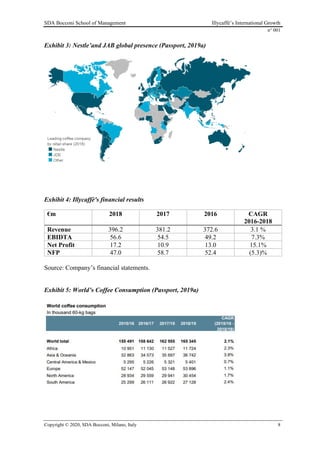
In 2019, coffee constituted the 65% of hot drink industry and 42% of the wider beverage
industry by retail value. It was a mature market, being the 4th
commodity used in the world,
after oil, steel, and wheat. The previous decade had seen a massive industry consolidation,
which started in 2012 with JAB’s2
first move into the global coffee market and the creation
of Jacobs Douwe Egberts (JDE) (Passport, 2019a).
Four main trends had been pushing the industry towards consolidation.
• The raise of pods in the retail coffee. It was the product category with the highest
growth rate in the industry (5%). Pods had the ability to lock in consumers easier than
any other format because they relied on a closed system. Unlike filter machines, pod
machines were designed to only make coffee with specific pods that were produced
for that system. This made it easier for a limited number of players to control the
market and pushed smaller players to try and partner up with major system producers.
That was the case with Nespresso and its branded pods, and the subsequent deal struck
with Illycaffè and JDE to make compatible pods. However, Nespresso and other
systems had to face the gradual loss of patent control, which was allowing many
unbranded pods to enter the market.
• The increasing overlapping of retail and food service. Major companies were
operating in both categories, blurring the line between the two. The American-style
coffee shop format had been very influential in shaping costumer preferences in the
ways they consumed and tasted coffee. This led retail coffee companies to work more
closely with food-service operators to extend their reach. An iconic example of this
was the planetary success of ready-to-drink cold brews, a product that was born first
in the coffee shop and then had been included in the retail coffee offer.
• The stasis of historical core market, such as instant and standard ground coffee.
The maturity of the instant and standard ground coffee markets in Europe and North
America had pushed many companies to look either into new categories and or
geographies, both organically and through major M&A activities to rapidly scale-up
operations. This was the case in 2018 of Lavazza acquisition of Mars’ coffee business
and of Coca-Cola of Costa Coffee, or JM Smucker introducing its 1850 premium line.
• JAB’s interest in the coffee arena. Although, the JAB group decided to enter the
coffee market only in 2012, it had been openly competing with Nestle’, the number
one player in the market, with the creation of JDE in 2015. JDE did not have the same
geographic extension as Nestle’ but it had an edge in some of the largest global coffee
markets, such as Germany, France, and Brazil. (Exhibits 2 and 3).
Coffee was a very dynamic but oligopolistic market with a global structure that could be
outlined with three major tiers: global leaders (i.e.: Nestle’, JAB and Starbucks) which had
2
JAB was a German privately held group focused on long term investments in companies with premium brands
operating in many segments such as consumer goods, luxury fashion, and fast food.
SDA Bocconi School of Management Illycaffè’s International Growth
n° 001
Copyright © 2020, SDA Bocconi, Milano, Italy 4
more than a third of the global coffee market and owned different brands in different
countries, usually in the middle-low quality range, with mainly massive distribution models,
and a great focus on low-cost instant coffee; second-tier international companies, with four
of them over 1.5 billion US$ in annual retail sales (i.e., Lavazza, JM Smucker, Kraft Heinz,
and Tchibo); and national companies with local and private labels. That of smaller companies
was a phenomenon coming from the West Coast in US, the Netherlands, and Australia: local
micro-roasters (e.g.: micro-brewers producing small volumes), with different provenience of
coffee beans, beautiful shops, and unique retail concepts (Passport, 2019a).
Coffee was one of the most consumed beverages worldwide, with roughly 42.6 liter per
person a year (i.e., 12.6 liters of Roast Coffee and 30 liters of Instant Coffee). Although
consumption per capita was less than that of tea (i.e., 85 liter per person a year), it was larger
in volume, considering that coffee powder per liter of beverage was greater than in tea. Out-
of-home consumption in coffee-shops or cafes had been a strong driver for coffee value sales
in recent years. In addition, the redefinition of coffee from commodified to the experience of
coffee had driven premiumization and sales.
According to Statista (2019), the global business turnover of the coffee industry was
€380,354m in 2019, with an expected annual growth of 5.8% (CAGR 2019-2023). Most
revenue was generated in the US (€71,661m in 2019). The largest segment was Roast Coffee
with a market volume of €268,807m in 2019. (Statista data, 2019). Worldwide, the largest
producers and exporters of coffee were Brazil (24%), Vietnam (15%), and Colombia (13%).
Whereas, main importers were the US (23%), Germany (14%), Italy (7.6%) and Japan
(6.3%). The most exported and consumed coffee was Arabica. Compared to its counterpart
Robusta, Arabica coffee was considered higher quality and less bitter, giving it a preferable
taste among consumers (OEC, 2019).
Every year, consumers drank around 500 billion cups of coffee, and of these, 14 billion were
Italian espresso (Coffee Statistics, 2019). Italy, known as the cradle of high-quality coffee,
accounted for 14% of total European consumption with a market size of € 2 billion. The
Italian coffee market itself was quite saturated with 16 players. The top 3 players (i.e.:
Lavazza, Nespresso Italiana, and Nestlé) made up for 55% of the market share. In 2018,
volume sales of coffee in the country decreased by 2%, however, sales rose by 3%, pointing
to an increasing trend of premiumization of espresso, presenting a favourable scenario for
high-quality Italian producers of coffee, such as Illycaffè (Passport, 2019).
Illycaffè: A brief overview
The company closed 2018 with a turnover of € 483 million, slowing down its expansion from
previous years (CAGR 3.4% 2017-2018).3
Illycaffè had seen a strong growth from 2009 to
2015, with revenue figures growing at 7.5% CAGR, and reaching € 437 million in 2015. In
addition to growth targets, Illycaffè had continued to rely on long-term sustainable expansion
in hand with continuous efficiency improvements (Exhibit 4).
The vision of the company was to offer its customers the best coffee culture and to be a leader
in the premium coffee market segment. The company derived its core value from ethics and
excellence, following the “Four C Model”: produce coffee that would warm the heart (Cuore)
3
All the following data and information on Illycaffè have been taken from Illy (2019).
SDA Bocconi School of Management Illycaffè’s International Growth
n° 001
Copyright © 2020, SDA Bocconi, Milano, Italy 5
of its customers (Cliente) to generate positive cash-flow (Cassa) to help Illycaffè grow (Cres-
cita) in the long run. These C’s were implemented through a customer centric approach, striv-
ing to provide the best product and service to the market.
The main customer targets of Illycaffè were Cosmopolitan Citizens and International Trav-
elers, Connoisseurs, Coffee Lovers and Gourmets, Art-and-Culture Enthusiasts, and people
with a taste for a polished lifestyle. Hence Illycaffè offered them an experience in accordance
with their lifestyle, focusing on consumers with a higher disposable income. This positioning
allowed the company to charge a 35% premium price compared to Lavazza, a direct compet-
itor in the international companies’ tier of the market.
Illycaffè’s excellence and know-how translated into multiple product lines; ground coffee
(which generates most revenues), whole grain, pods and capsules, ready-to-drink coffees, as
well as innovative machines and preparation systems. Illycaffè relied only on one blend, cre-
ated using nine different sources of 100% Arabica beans, primarily from Southern and Cen-
tral America, Africa, as well as India and China, which underwent a double premium quality
selection – at the source and before roasting. After roasting, the blend was aged in an exclu-
sive pressurized inert gas packaging.
In addition, the company run coffee culture dedicated training to growers, hospitality profes-
sionals and consumers through “Università del Caffè”, created in 1999 to spread the authentic
Italian coffee culture around the world. This institution had courses and publications on the
theory and practice of the coffee production and business, and more than 20 branches world-
wide (Italy, United Kingdom, France, Germany, United States, China, Brazil, India, Colom-
bia, Malaysia, South Africa, Indonesia, Thailand, Greece, Turkey, Mexico).
Illycaffè also run a chain of contemporary coffee shops (5 in America, 31 in Asia, 14 in
Europe, of which 8 in Italy, for a total of 50 shops) and bars (over 160 in 34 countries around
the globe) inspired by the tradition of Italian bars. They had three kinds of portioned systems
intended for three different environments: home, hotel/restaurant/cafe, and the office.
Excellence was also achieved through constant quality controls. Illycaffè conducted a total
of 125 quality controls with 4 dedicated laboratories. They also had a Double Quality Certi-
fication along with an environmental certification and a supply chain process one. Their pro-
duction included a multidisciplinary scientific approach in their research, and partnerships
with leading universities and some research centres, like Sensorylab or Aromalab.
Innovation and Illycaffè had been synonymous in the coffee industry since the company was
founded in 1933: 4 of the 8 fundamental innovations that have reformed the coffee industry
were born at Illycaffè:
• Pressurization, 1934: Conservation of coffee inside the jar, thanks to pressurization
with inert gas that locked in the aromas and kept them over a long time.
• High Pressure Espresso,1935: The Illetta, predecessor of the current professional
espresso machines.
• Ese pods, 1974: Paper pod containing a dose of pressed ground coffee.
• Iperespresso, 2006: A capsule that extracted the coffee in two phases, hyper infusion
and emulsion.
SDA Bocconi School of Management Illycaffè’s International Growth
n° 001
Copyright © 2020, SDA Bocconi, Milano, Italy 6
The internationalization of Illycaffè: Market and distribution
choices
The coffee industry was becoming increasingly global and consolidated. In 2018, the three
largest corporations controlled more than a third of the global industry retail value, meaning
that some small players were forced to exit the market through acquisitions or were kept from
entering new markets.
Historical markets, such as North America and Europe, had been stagnant. Emerging econo-
mies were becoming increasingly relevant to drive revenue growth. Asia Pacific, South
America, and Africa were the new markets that international and global players were looking
at. To this end, waves of M&A’s further increased the consolidation process. Lavazza, Italy’s
largest coffee player, decided to adapt to the industry trends and to boost its growth through
acquisitions to become too large to acquire.
The threats from the waves of acquisitions of smaller players were considerable and Illycaffè
was a potential target. Although Illycaffè had managed to mitigate the risk through alliances
and licensing agreements (i.e., the contract with JAB for the production and distribution of
Illycaffè-branded aluminum coffee capsules), the size and power of top players forced Illy-
caffè to look at ways to further enlarge its market, or else find it increasingly hard to compete
in a consolidated industry with few very large competitors (Passport, 2019a).
Illycaffè had been reluctant to pursue the aggressive M&A’s approach that other players were
adopting. Illycaffè had preferred to internationalize through export and partnerships with lo-
cal distributors in small markets, when possible. In the largest international markets, such as
China and Brazil, Illycaffè operated through fully owned subsidiaries. In the US, the world’s
largest coffee market, the company used retail partners to support the opening of its coffee
bars. However, Illycaffè decided to invest in the UK market in a time of political uncertainty
(i.e., Brexit) by acquiring both its historical local distributor Euro Food Brands, and the UK
chocolatier Prestat. The deal came as consumer demand for luxury chocolate was on the rise,
giving Illy an opportunity to distribute it via its sales network.
The internationalization efforts of Illycaffè had started in 1960s, through commercial subsid-
iaries in Europe, centred on the idea of exporting the Italian espresso. Thirty years later, the
company had strengthened its internationalization efforts by creating a wider network of dis-
tributors and subsidiaries, and by hiring export managers that were coordinated by commer-
cial directors. Given that almost two thirds of the sales were made abroad, this strategy had
shifted in recent years to intensify resources on creating more value in existing markets, ra-
ther than increasing geographical presence. In line with this approach, Illycaffè had further
adapted its marketing efforts towards creating a stronger culture for high-quality coffee, ra-
ther than simply espresso.
Illycaffè sold its products and services to consumers and trade customers in over 140 different
countries through B2B (Ho.Re.Ca., GDO, vending, etc.) and B2C channels (Illy shops, Es-
pressamente llly, Illy Cafè, and e-commerce). Branches, subsidiaries & local partners man-
aged distribution channels, partnerships and co-branding relationships with restaurants, ca-
fés, hotels and coffeehouses. with around 200 franchisees.
SDA Bocconi School of Management Illycaffè’s International Growth
n° 001
Copyright © 2020, SDA Bocconi, Milano, Italy 7
Exhibits
Exhibit 1: Illycaffè’s mission (Illycaffè, 2019)
Exhibit 2: % Share of the Top Five Players by Industry 2018 (Passport, 2019a)
0
20
40
60
80
Carbonates Energy
drinks
Beer Coffee Soft drinks
overall
Bottled
water
Juice Spirits Tea Wine
%
global
share
Note: Retail value RSP for hot and soft drinks categories, total volumes for alcoholic drinks
SDA Bocconi School of Management Illycaffè’s International Growth
n° 001
Copyright © 2020, SDA Bocconi, Milano, Italy 8
Exhibit 3: Nestle’and JAB global presence (Passport, 2019a)
Exhibit 4: Illycaffè's financial results
Source: Company’s financial statements.
Exhibit 5: World’s Coffee Consumption (Passport, 2019a)
€m 2018 2017 2016 CAGR
2016-2018
Revenue 396.2 381.2 372.6 3.1 %
EBIDTA 56.6 54.5 49.2 7.3%
Net Profit 17.2 10.9 13.0 15.1%
NFP 47.0 58.7 52.4 (5.3)%
SDA Bocconi School of Management Illycaffè’s International Growth
n° 001
Copyright © 2020, SDA Bocconi, Milano, Italy 9
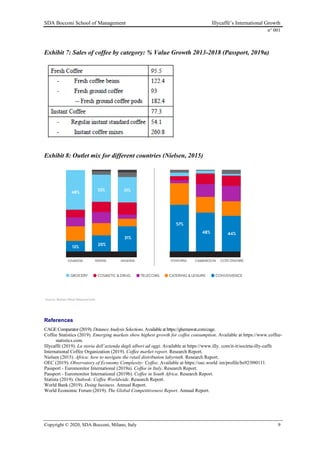
Exhibit 7: Sales of coffee by category: % Value Growth 2013-2018 (Passport, 2019a)
Exhibit 8: Outlet mix for different countries (Nielsen, 2015)
References
CAGE Comparator (2019). Distance AnalysisSelections. Available at https://ghemawat.com/cage.
Coffee Statistics (2019). Emerging markets show highest growth for coffee consumption. Available at https://www.coffee-
statistics.com.
Illycaffè (2019). La storia dell’azienda dagli albori ad oggi. Available at https://www.illy. com/it-it/societa-illy-caffe
International Coffee Organization (2019). Coffee market report. Research Report.
Nielsen (2015). Africa: how to navigate the retail distribution labyrinth. Research Report.
OEC (2019). Observatory of Economy Complexity: Coffee. Available at https://oec.world /en/profile/hs92/090111.
Passport - Euromonitor International (2019a). Coffee in Italy. Research Report.
Passport - Euromonitor International (2019b). Coffee in South Africa. Research Report.
Statista (2019). Outlook: Coffee Worldwide. Research Report.
World Bank (2019). Doing business. Annual Report.
World Economic Forum (2019). The Global Competitiveness Report. Annual Report.

Case Study IllyuCafe.pdf

  • 1.
    n° 001 Copyright ©2020, SDA Bocconi, Milano, Italy No part of this publication may be copied, stored, transmitted, reproduced or distributed in any form or medium whatsoever without the permission of the copyright owner. ILLYCAFFÈ’S INTERNATIONAL GROWTH. EVALUATING FOREIGN DEMAND FOR ITALIAN SUPER-PREMIUM COFFEE (SUMMARY) Gabriella Lojacono Nicola Misani Marzia Sesini SDA Bocconi School of Management
  • 2.
    SDA Bocconi Schoolof Management Illycaffè’s International Growth n° 001 Copyright © 2020, SDA Bocconi, Milano, Italy 2 Gabriella Lojacono, Nicola Misani, & Marzia Sesini Illycaffè’s International Growth. Evaluating Foreign Demand for Italian Super-premium coffee Introduction In 1933 Francesco Illy established Illy Caffè S.p.A. (Illycaffè) in Trieste, Italy.1 The com- pany, a family-owned coffee roaster, had been part of Gruppo Illy S.p.A. since 2004. In 2019, Illycaffè served more than 7,000,000 coffees every day, out of home, at home, at office, on the go. It counted approximately 100,000 clients among the best bars, hotels, and restaurants around the world. Its coffee was distributed through branches, subsidiaries, and local distrib- utors in more than 140 countries, with a total of around 200 franchisees (Illy, 2019). The company’s history started when Francesco began the revolution in the world of coffee roast- ing, introducing Illetta, which was to become the first espresso machine. He had a simple idea: to produce the best coffee in the world (Exhibit 1). His passion for coffee, quality, culture, and innovation, were the distinctive features of the company and were still followed by his descendants. In the mid-sixties Ernesto Illy, Francesco’s son, who wanted to spread the culture of espresso outside Italy, started the internalization of the company. At first, few subsidiaries were es- tablished in Europe (e.g., The Netherland, France, and Spain). In the 80s, Illycaffè landed in the United States, the first Italian roaster to export the culture of espresso across the ocean. It was during the 90s that the real expansion happened, with the creation of a worldwide net- work of distributors and subsidiaries. At the beginning, international operations were managed by a very lean organizational struc- ture formed by a small team of export managers coordinated by the commercial director re- sponsible to build and maintain the network. The expansion was mainly geographical. Then the export structure was radically modified to reflect the fact that the expansion needed to come from a better exploitation of the potential of each country, rather than just being geo- graphical. Foreign markets continued to have a dominant role: sales outside Italy represented 65% of Illycaffe’s total revenues in 2018. With the acquisition of Euro Brand Foods, Illycaffè’s British distributor, in 2019, the com- pany showed that it could dig deeper and deeper in their partners business, to drive sales in each country and in each sales channel. Illycaffè was ready to move beyond simple organic growth and use acquisitions. This also meant evolving from merely “spreading the culture of espresso” to a broader approach based on high-quality coffee that could be prepared accord- ing to the habits and culture of each different country. 1 The case is intended as a basis for class discussion rather than to illustrate either effective or ineffective handling of management situations.
  • 3.
    SDA Bocconi Schoolof Management Illycaffè’s International Growth n° 001 Copyright © 2020, SDA Bocconi, Milano, Italy 3 In 2019, the company’s CEO, Andrea Illy, the third generation of Illy’s running the company, was looking at how Illycaffè’s market and distribution system choices developed over the years and wondered where his company should competitively expand its business. The com- pany had strong presence in all the developed markets. Was now Africa the path forward? Coffee industry analysis In 2019, coffee constituted the 65% of hot drink industry and 42% of the wider beverage industry by retail value. It was a mature market, being the 4th commodity used in the world, after oil, steel, and wheat. The previous decade had seen a massive industry consolidation, which started in 2012 with JAB’s2 first move into the global coffee market and the creation of Jacobs Douwe Egberts (JDE) (Passport, 2019a). Four main trends had been pushing the industry towards consolidation. • The raise of pods in the retail coffee. It was the product category with the highest growth rate in the industry (5%). Pods had the ability to lock in consumers easier than any other format because they relied on a closed system. Unlike filter machines, pod machines were designed to only make coffee with specific pods that were produced for that system. This made it easier for a limited number of players to control the market and pushed smaller players to try and partner up with major system producers. That was the case with Nespresso and its branded pods, and the subsequent deal struck with Illycaffè and JDE to make compatible pods. However, Nespresso and other systems had to face the gradual loss of patent control, which was allowing many unbranded pods to enter the market. • The increasing overlapping of retail and food service. Major companies were operating in both categories, blurring the line between the two. The American-style coffee shop format had been very influential in shaping costumer preferences in the ways they consumed and tasted coffee. This led retail coffee companies to work more closely with food-service operators to extend their reach. An iconic example of this was the planetary success of ready-to-drink cold brews, a product that was born first in the coffee shop and then had been included in the retail coffee offer. • The stasis of historical core market, such as instant and standard ground coffee. The maturity of the instant and standard ground coffee markets in Europe and North America had pushed many companies to look either into new categories and or geographies, both organically and through major M&A activities to rapidly scale-up operations. This was the case in 2018 of Lavazza acquisition of Mars’ coffee business and of Coca-Cola of Costa Coffee, or JM Smucker introducing its 1850 premium line. • JAB’s interest in the coffee arena. Although, the JAB group decided to enter the coffee market only in 2012, it had been openly competing with Nestle’, the number one player in the market, with the creation of JDE in 2015. JDE did not have the same geographic extension as Nestle’ but it had an edge in some of the largest global coffee markets, such as Germany, France, and Brazil. (Exhibits 2 and 3). Coffee was a very dynamic but oligopolistic market with a global structure that could be outlined with three major tiers: global leaders (i.e.: Nestle’, JAB and Starbucks) which had 2 JAB was a German privately held group focused on long term investments in companies with premium brands operating in many segments such as consumer goods, luxury fashion, and fast food.
  • 4.
    SDA Bocconi Schoolof Management Illycaffè’s International Growth n° 001 Copyright © 2020, SDA Bocconi, Milano, Italy 4 more than a third of the global coffee market and owned different brands in different countries, usually in the middle-low quality range, with mainly massive distribution models, and a great focus on low-cost instant coffee; second-tier international companies, with four of them over 1.5 billion US$ in annual retail sales (i.e., Lavazza, JM Smucker, Kraft Heinz, and Tchibo); and national companies with local and private labels. That of smaller companies was a phenomenon coming from the West Coast in US, the Netherlands, and Australia: local micro-roasters (e.g.: micro-brewers producing small volumes), with different provenience of coffee beans, beautiful shops, and unique retail concepts (Passport, 2019a). Coffee was one of the most consumed beverages worldwide, with roughly 42.6 liter per person a year (i.e., 12.6 liters of Roast Coffee and 30 liters of Instant Coffee). Although consumption per capita was less than that of tea (i.e., 85 liter per person a year), it was larger in volume, considering that coffee powder per liter of beverage was greater than in tea. Out- of-home consumption in coffee-shops or cafes had been a strong driver for coffee value sales in recent years. In addition, the redefinition of coffee from commodified to the experience of coffee had driven premiumization and sales. According to Statista (2019), the global business turnover of the coffee industry was €380,354m in 2019, with an expected annual growth of 5.8% (CAGR 2019-2023). Most revenue was generated in the US (€71,661m in 2019). The largest segment was Roast Coffee with a market volume of €268,807m in 2019. (Statista data, 2019). Worldwide, the largest producers and exporters of coffee were Brazil (24%), Vietnam (15%), and Colombia (13%). Whereas, main importers were the US (23%), Germany (14%), Italy (7.6%) and Japan (6.3%). The most exported and consumed coffee was Arabica. Compared to its counterpart Robusta, Arabica coffee was considered higher quality and less bitter, giving it a preferable taste among consumers (OEC, 2019). Every year, consumers drank around 500 billion cups of coffee, and of these, 14 billion were Italian espresso (Coffee Statistics, 2019). Italy, known as the cradle of high-quality coffee, accounted for 14% of total European consumption with a market size of € 2 billion. The Italian coffee market itself was quite saturated with 16 players. The top 3 players (i.e.: Lavazza, Nespresso Italiana, and Nestlé) made up for 55% of the market share. In 2018, volume sales of coffee in the country decreased by 2%, however, sales rose by 3%, pointing to an increasing trend of premiumization of espresso, presenting a favourable scenario for high-quality Italian producers of coffee, such as Illycaffè (Passport, 2019). Illycaffè: A brief overview The company closed 2018 with a turnover of € 483 million, slowing down its expansion from previous years (CAGR 3.4% 2017-2018).3 Illycaffè had seen a strong growth from 2009 to 2015, with revenue figures growing at 7.5% CAGR, and reaching € 437 million in 2015. In addition to growth targets, Illycaffè had continued to rely on long-term sustainable expansion in hand with continuous efficiency improvements (Exhibit 4). The vision of the company was to offer its customers the best coffee culture and to be a leader in the premium coffee market segment. The company derived its core value from ethics and excellence, following the “Four C Model”: produce coffee that would warm the heart (Cuore) 3 All the following data and information on Illycaffè have been taken from Illy (2019).
  • 5.
    SDA Bocconi Schoolof Management Illycaffè’s International Growth n° 001 Copyright © 2020, SDA Bocconi, Milano, Italy 5 of its customers (Cliente) to generate positive cash-flow (Cassa) to help Illycaffè grow (Cres- cita) in the long run. These C’s were implemented through a customer centric approach, striv- ing to provide the best product and service to the market. The main customer targets of Illycaffè were Cosmopolitan Citizens and International Trav- elers, Connoisseurs, Coffee Lovers and Gourmets, Art-and-Culture Enthusiasts, and people with a taste for a polished lifestyle. Hence Illycaffè offered them an experience in accordance with their lifestyle, focusing on consumers with a higher disposable income. This positioning allowed the company to charge a 35% premium price compared to Lavazza, a direct compet- itor in the international companies’ tier of the market. Illycaffè’s excellence and know-how translated into multiple product lines; ground coffee (which generates most revenues), whole grain, pods and capsules, ready-to-drink coffees, as well as innovative machines and preparation systems. Illycaffè relied only on one blend, cre- ated using nine different sources of 100% Arabica beans, primarily from Southern and Cen- tral America, Africa, as well as India and China, which underwent a double premium quality selection – at the source and before roasting. After roasting, the blend was aged in an exclu- sive pressurized inert gas packaging. In addition, the company run coffee culture dedicated training to growers, hospitality profes- sionals and consumers through “Università del Caffè”, created in 1999 to spread the authentic Italian coffee culture around the world. This institution had courses and publications on the theory and practice of the coffee production and business, and more than 20 branches world- wide (Italy, United Kingdom, France, Germany, United States, China, Brazil, India, Colom- bia, Malaysia, South Africa, Indonesia, Thailand, Greece, Turkey, Mexico). Illycaffè also run a chain of contemporary coffee shops (5 in America, 31 in Asia, 14 in Europe, of which 8 in Italy, for a total of 50 shops) and bars (over 160 in 34 countries around the globe) inspired by the tradition of Italian bars. They had three kinds of portioned systems intended for three different environments: home, hotel/restaurant/cafe, and the office. Excellence was also achieved through constant quality controls. Illycaffè conducted a total of 125 quality controls with 4 dedicated laboratories. They also had a Double Quality Certi- fication along with an environmental certification and a supply chain process one. Their pro- duction included a multidisciplinary scientific approach in their research, and partnerships with leading universities and some research centres, like Sensorylab or Aromalab. Innovation and Illycaffè had been synonymous in the coffee industry since the company was founded in 1933: 4 of the 8 fundamental innovations that have reformed the coffee industry were born at Illycaffè: • Pressurization, 1934: Conservation of coffee inside the jar, thanks to pressurization with inert gas that locked in the aromas and kept them over a long time. • High Pressure Espresso,1935: The Illetta, predecessor of the current professional espresso machines. • Ese pods, 1974: Paper pod containing a dose of pressed ground coffee. • Iperespresso, 2006: A capsule that extracted the coffee in two phases, hyper infusion and emulsion.
  • 6.
    SDA Bocconi Schoolof Management Illycaffè’s International Growth n° 001 Copyright © 2020, SDA Bocconi, Milano, Italy 6 The internationalization of Illycaffè: Market and distribution choices The coffee industry was becoming increasingly global and consolidated. In 2018, the three largest corporations controlled more than a third of the global industry retail value, meaning that some small players were forced to exit the market through acquisitions or were kept from entering new markets. Historical markets, such as North America and Europe, had been stagnant. Emerging econo- mies were becoming increasingly relevant to drive revenue growth. Asia Pacific, South America, and Africa were the new markets that international and global players were looking at. To this end, waves of M&A’s further increased the consolidation process. Lavazza, Italy’s largest coffee player, decided to adapt to the industry trends and to boost its growth through acquisitions to become too large to acquire. The threats from the waves of acquisitions of smaller players were considerable and Illycaffè was a potential target. Although Illycaffè had managed to mitigate the risk through alliances and licensing agreements (i.e., the contract with JAB for the production and distribution of Illycaffè-branded aluminum coffee capsules), the size and power of top players forced Illy- caffè to look at ways to further enlarge its market, or else find it increasingly hard to compete in a consolidated industry with few very large competitors (Passport, 2019a). Illycaffè had been reluctant to pursue the aggressive M&A’s approach that other players were adopting. Illycaffè had preferred to internationalize through export and partnerships with lo- cal distributors in small markets, when possible. In the largest international markets, such as China and Brazil, Illycaffè operated through fully owned subsidiaries. In the US, the world’s largest coffee market, the company used retail partners to support the opening of its coffee bars. However, Illycaffè decided to invest in the UK market in a time of political uncertainty (i.e., Brexit) by acquiring both its historical local distributor Euro Food Brands, and the UK chocolatier Prestat. The deal came as consumer demand for luxury chocolate was on the rise, giving Illy an opportunity to distribute it via its sales network. The internationalization efforts of Illycaffè had started in 1960s, through commercial subsid- iaries in Europe, centred on the idea of exporting the Italian espresso. Thirty years later, the company had strengthened its internationalization efforts by creating a wider network of dis- tributors and subsidiaries, and by hiring export managers that were coordinated by commer- cial directors. Given that almost two thirds of the sales were made abroad, this strategy had shifted in recent years to intensify resources on creating more value in existing markets, ra- ther than increasing geographical presence. In line with this approach, Illycaffè had further adapted its marketing efforts towards creating a stronger culture for high-quality coffee, ra- ther than simply espresso. Illycaffè sold its products and services to consumers and trade customers in over 140 different countries through B2B (Ho.Re.Ca., GDO, vending, etc.) and B2C channels (Illy shops, Es- pressamente llly, Illy Cafè, and e-commerce). Branches, subsidiaries & local partners man- aged distribution channels, partnerships and co-branding relationships with restaurants, ca- fés, hotels and coffeehouses. with around 200 franchisees.
  • 7.
    SDA Bocconi Schoolof Management Illycaffè’s International Growth n° 001 Copyright © 2020, SDA Bocconi, Milano, Italy 7 Exhibits Exhibit 1: Illycaffè’s mission (Illycaffè, 2019) Exhibit 2: % Share of the Top Five Players by Industry 2018 (Passport, 2019a) 0 20 40 60 80 Carbonates Energy drinks Beer Coffee Soft drinks overall Bottled water Juice Spirits Tea Wine % global share Note: Retail value RSP for hot and soft drinks categories, total volumes for alcoholic drinks
  • 8.
    SDA Bocconi Schoolof Management Illycaffè’s International Growth n° 001 Copyright © 2020, SDA Bocconi, Milano, Italy 8 Exhibit 3: Nestle’and JAB global presence (Passport, 2019a) Exhibit 4: Illycaffè's financial results Source: Company’s financial statements. Exhibit 5: World’s Coffee Consumption (Passport, 2019a) €m 2018 2017 2016 CAGR 2016-2018 Revenue 396.2 381.2 372.6 3.1 % EBIDTA 56.6 54.5 49.2 7.3% Net Profit 17.2 10.9 13.0 15.1% NFP 47.0 58.7 52.4 (5.3)%
  • 9.
    SDA Bocconi Schoolof Management Illycaffè’s International Growth n° 001 Copyright © 2020, SDA Bocconi, Milano, Italy 9 Exhibit 7: Sales of coffee by category: % Value Growth 2013-2018 (Passport, 2019a) Exhibit 8: Outlet mix for different countries (Nielsen, 2015) References CAGE Comparator (2019). Distance AnalysisSelections. Available at https://ghemawat.com/cage. Coffee Statistics (2019). Emerging markets show highest growth for coffee consumption. Available at https://www.coffee- statistics.com. Illycaffè (2019). La storia dell’azienda dagli albori ad oggi. Available at https://www.illy. com/it-it/societa-illy-caffe International Coffee Organization (2019). Coffee market report. Research Report. Nielsen (2015). Africa: how to navigate the retail distribution labyrinth. Research Report. OEC (2019). Observatory of Economy Complexity: Coffee. Available at https://oec.world /en/profile/hs92/090111. Passport - Euromonitor International (2019a). Coffee in Italy. Research Report. Passport - Euromonitor International (2019b). Coffee in South Africa. Research Report. Statista (2019). Outlook: Coffee Worldwide. Research Report. World Bank (2019). Doing business. Annual Report. World Economic Forum (2019). The Global Competitiveness Report. Annual Report.