Assignment Cover Sheet
Students Names:
Gary O’ Shaughnessy
Patrick Keogh
Student Numbers
C12748445
C12403438
Module Title: Marketing
Assignment Title: Brand study: Nescafe Coffee
Word Count: 3,668
Due Date: 21/3/2013
Declaration
We declare that the project material, which we now submit, is our own work.
Any work that belongs to another person has been cited and acknowledged
within the work. I make this declaration in the knowledge that a breach of the
rules pertaining to plagiarism may carry serious consequences.
Signed:
Signed:
Contents Page
1
 Introduction
 Swot Analysis
 Strengths
 Weaknesses
 Opportunities
 Threats
 Environmental forces
 Macro and Micro environment
 Demographic forces
 Economic environment
 Natural forces
 Technological environment
 Politic Environments
 Cultural Environments
 Products
 Pricing
 Promotional
 Placement
 Brand Strategy
 Conclusion
 References
2
Brand study: Nescafe
Introduction
Nescafe is a sister company to the successful multi-national corporation which has
branched out into nearly every market there is, dominating all those it enters into.
Interbrand issued it in to the top 100 brands in 2012 where it was ranked 35th on the
list, success coming from its direct approach to the consumer, making it much more
interesting. Nescafe brand is owned by Nestle and is worth a staggering 13 billion
dollars. Some studies carried out have concluded that approximately 94 billion
Nescafe cups are sold around the world, which is around 3,000 cups every second.
Interbrand stated in its 2008 study, the brand “has benefited from the increase in
demand for premium coffees”, while stating in 2012 that, the brand “Nescafe brand is
instantly recognizable”(Interbrand top 100) enabling it to see off its competitors in
many markets. Nescafe has also educated its consumers of the health benefits of the
beverage giving the brand a healthy image. A financial times report claims that instant
coffee is losing space to ground coffee. What is shown in this study is focused mainly
on the brands efforts to increase consumer awareness and value. Nescafe is currently
in maturity of the brand life cycle as we can see that there is still growth taking place
even though the brand is already globally known. Nescafe has a lot of competition in
the market such as Bewley's, Café britt, Costa coffee, Delta coffees and Klember.
This competition makes it much harder to completely dominate the market but
Nescafe are making good progress to do so.
3
Swot Analysis
Strengths
Nestle has a broad geographic coverage, Nestle has a dominating role in the global
coffee industry and is the leader in instant coffee. The coffee industry is an important
sector of the organisation as it accounted for 21% of its total value in 2007. Due to the
fact that Nestle is a huge multi-national corporation it has the finance to develop and
grow even bigger if needed. It also has a developed brand portfolio in the hot drinks
sector as it has other brands such as Nesquik and Milo; this enables Nescafe to have a
good understanding of the market even before it tries to market its coffee range.
Nestle has the power to control the market, for example if Nestle wanted to increase
the price of the coffee in the market, it could reduce the amount of coffee it sends into
the market to increase the price as the market is dependent on its contribution. The
economies of scale and synergy available to Nestle gives it even more of an advantage
within the market to increase and dominate the market.
Weaknesses
Nescafe is reliant on a mass market; this can cause problems as they try to market
their products where there is a need for premium quality at an acceptable price. There
is a customer bias against most of Nescafe's products as the majority contain caffeine
which can create a bad image for the company as they try to create a healthy image. In
recent years Nescafe created a bad ethical image as they target young people with
their caffeine based drinks, this has questioned their ethical beliefs by the consumer.
Opportunities
There has been a rise in the demand for premium brands in the market which will
benefit Nestles sales as their brand is a premium brand. There is also a rise in the
demand for healthy products, as Nestle has quite a lot of revenue and market share it
4
can afford to promote their company more than its competitors. There have been
research studies carried out that have shown that Asia will be one of Nestles biggest
market as its growth rate and demand for its products have risen greatly over the last
10 years. This future market will only help Nestle create more revenue and continue
their progress in trying to dominate the coffee market as predictions show that the
European market may slump in the future.
Threats
There is a lot of competition in the coffee machine sector; this will affect sales for
their Espresso and Nescafe Dolce Gusto coffee systems as they come under threat
from cheaper models. The rise in cost for transportation will affect the profit margin
on their coffee. Due to the fact that coffee can only be grown in the right conditions
normally equatorial conditions, the coffee needs to be transported all over the world
from these remote locations. A lot of Nescafe's competitors are now moving into the
soft drinks sector, this gives them a bigger market to choose from and sell to with a
greater chance of making more profit than Nescafe can as they continue to stay in the
hot drinks sector.
Environmental forces: Macro/Micro
Macro
The macro environments are "forces that shape opportunities and pose threats to the
company"(kotler. page 184). There are a number of forces which can pose a threat to
a company.
• Demographic forces.
• Economic forces.
• Natural forces.
• Technological forces.
• Political forces.
• Cultural forces.
5
Micro
The microenvironments are "the actors close to the company that affect its ability to
serve its customers, the company, suppliers, marketing intermediaries, customer
markets, competitors and publics"(Kotler. page 179). The company must take into
account all the groups involved with the organisation. These are all interrelated and
are dependent on one another. If one group fails the whole process will be affected
and productivity and quality of service and product will be reduced. For example if
the marketers fail to identify trends or changes in the market and notify the other
groups they might not be able to satisfy the needs of the customer as they won’t be
able to create a service or product to satisfy their needs before a competitor does. The
suppliers are important to the organisation as they provide the materials needed to
produce the coffee and transport the product around the world. If there is good
communications and relations between the supplier and Nestcafe then customer value
can follow as the customer is satisfied creating long term sales and a customer for life.
Marketing intermediaries help Nestcafe promote, sell and distribute its product to the
buyer. Without promotion the company will not be able to make optimum sales as the
customer is not aware of its products. While having poor distribution systems they can
make the customer have a less favourable approach to the company and they won’t
want to do business again in the future. The company must study the customer closely
in order to create future sales; they must ensure that the quality of service from the
beginning is of a high standard. The company’s competitors are also important in
order to gain a greater market share. When a competitor makes a mistake Nestcafe
can show that they have better quality produce and service than anyone else. Nestle
would also have a number of different publics such as financial publics who have an
interest to see if they can pay back loans, media publics to see if there is any news
about then which they can write about, government publics to see if laws are
implemented and business is carried out correctly according to the law, citizen publics
who will react on certain actions carried out by the company and local publics who
are interested in the locality of the company.
6
Demographic forces
"Demography is the study of human populations in terms of size, density, age, gender,
race, occupation and other statistics"(Kotler. page 185). The demographic
environment would be very important to Nescafe as it shows who exactly makes up
the total market but also who is in the coffee market showing details about age
structure and diversity within the market. Nescafe's marketers would track their
market very closely as they will study trends and try to predict change in the market
so that they can come up with solutions for problems before they arise in the market
to ensure they act quicker than competitors, also known as being proactive. For
example before the majority of food Production Company’s introduced themselves
into the fairtrade sector of the market, Nescafe were already selling fairtrade produce.
They recognised that the market wanted coffee where everyone was paid on a fair
basis. So when a customer buys Nescafe coffee, they are satisfied with the level and
are ensured that the coffee they buy has been produced and sold fairly allowing the
customers to have a clear conscience.
Economic environment
This consists of the factors that affect spending patterns and purchasing power. The
marketers at Nescafe must pay a lot of attention to the market to identify purchasing
patterns to identify how the market actually buys their products and possible reactions
to future products. The marketers can classify the market into sub categories
depending on their purchasing power. They would identify what price they can charge
for their products and who they can aim the product at, known as target market, there
is no point aiming a premium priced product at lower class people within the market
as they wouldn't have the buying power to purchase it. An example of this would be
the Nespresso range. This range consists of premium priced quality coffee and coffee
machines that range from €100 to €500 with the pods/coffee selling at 69cent each.
They identified that this would be a premium product that not all of their market
would be able to afford, but to actually make sales they would position their product
in prestigious stores around the world due to the fact that the people who shop there
7
would expect to be charged a premium price, such stores as Brown Thomas and
Avoca.
Natural forces
"The natural environment involves the natural resources that are needed as inputs by
marketers or that are affected by marketing activities"(Kotler. page 201). This
basically means what can affect Nescafe from producing and selling their products to
the market due to the natural environment. " the environment consists of a large
number of non-controllable variables"(Dale Littler, page97) Nescafe's main raw
material is the coffee bean, these are difficult to grown as they only grow in certain
parts of the world normally tropical areas where there is a lot of rain, warm conditions
and no frost. The coffee needs to be grown at high altitude to prevent animals from
destroying the crops. Due to this the coffee can only be grown in regions like the
Minas Geras region in Brazil where the weather meets the requirements to grow the
crop. This can hinder the amount of coffee that is produced by Nescafe globally and
may reduce sales. The high cost of running the plants that produce the coffee can also
affect the production of the coffee. Many of the plants that produce the coffee are run
on non-renewable resources such as oil and coal. These cost quite a lot of money to
keep running and due to the implications that greenhouse gasses are causing to our
environment. According to top scientists, governments all over the world are charging
and sanctioning plants which are creating too much toxic gasses from their factories.
Nestle were fined in China for creating too much pollution in 2010. China in recent
years has been known for having incredibly bad conditions due to air pollution, as a
result factories are given quotas to the amount of CO2 gasses they can produce, if
they go over this they are fined.
Technological environment
Technology is changing every day it’s the most dramatic force that can shape an
organisation. Every year a company must update itself to keep up with the
competition; if the company fails to do so then they will fall behind. Technology
enables us to work incredibly faster than ever before; however technology costs a lot
of money to implement into the company and the cost of training the employees will
only make the costs go up. Nescafe is now able to get orders from anywhere around
8
the world, from this they can produce and transport their product anywhere in a
matter of days, this enables them to create sales much faster than ever before,
maximising profits and produce.
Political environment
The political environment consists of laws, rules, regulations, government agencies
and pressure groups which can limit the activities of a company. The Brazilian
government introduced new laws to protect the Amazon rainforest, Before these laws
were implemented Nestle had plans to cut down a section of the rainforest which had
perfect conditions to grow coffee, they were not allowed to do so as their plans were
rejected on the grounds that the region was now protected. This could have severe
consequences for the company as they wanted to gain a greater market share and
produce more sales and profit. Nescafe now had to come up with another plan after
spending so much time and money. These laws are a huge implications for Nestle as
they depend so much on regions that are now becoming rarer to find and harder to get
permission to do anything on them.
Cultural environment
People all over the world grow up in different was and demand different things than
others might from a different region. People's values, perceptions, preferences and
behaviours are all shaped by the location in which the live and grow up in. People
may view an organisation different to others in a different region depending how the
organisation affects them. For example the people in the western world believed that
farmers who work for Nestle produce the crops may have had a negative view of the
organisation before as they believed the farmers had to work in poor conditions with
minimal pay whereas the actual farmers liked working for them as they worked for a
fairtrade company which treated the employees in the correct way giving them fair
wages and conditions to work in. People in the western world automatically presume
that a growing county would have poor working conditions just because of its location
which is why Nestle now promote the fact that they are now a fairtrade company.
9
Products
Nestcafes range of coffee and coffee machines are extremely wide variety, they sell
within the market and they believe that they "solve problems for their customers" by
selling them quality products.(B.H.Elvy page 2) Currently they have 30 different
coffee types and there are over 50 different machine models to choose from. The
coffee that Nestcafe sells is of the highest class. They are produced in a way that
ensures that they get the most from the coffee bean which then gives the most critical
coffee drinker a pleasant experience. They package the coffee in a very presentable
way that allows the customer to easily identify and separate it from its competitors.
Their machine designs are sleek and look very modern to keep in touch with the
modern style of today. Their products are of a premium quality and cost slightly more
than their competitors due to the fact of the high quality design. The Nespresso range
is more premium than other products as they can only be bought online and in
selected stores whereas most of the competitors products can be bought in most stores
around the world so they are very convenient to purchase. Nescafe's products would
still be in the growth stage as they are still introducing its products into new markets
such as Asia which has been predicted that it become one of its biggest markets in the
next couple of years.
Pricing strategy
The way in which Nescafe price their products is key to their success in global
markets while maintaining quality “getting the right product, at the right place, at the
right price at the correct time"(Nick Ellis, page 16). Their marketing strategy also
includes various pricing strategies, by doing this they are able to maintain product
rates at a sustainable position which enables them to keep a good market share and
create an advantage over their competitors. It is vital that they continue to do this,
evaluate their position regularly to prevent a loss in market share. Their coffee is
affordable to the majority of people. They have also introduced re-sealable coffee
containers which can also be filled up again without purchasing another container,
this reduces the price of both production and transportation costs. Nestcafe like to
charge more for their products than their competitors to create a sense of superiority
10
over them. The customer is willing to pay more for something once their needs are
met and the brand fits in with their personality. How do Nescafe set prices for their
products? Nescafe have control of the markets when setting the prices for their
products which gives them a significantly high profit margin. This is also got to do
with the fact that they have the highest quality products, while also having the cut
price products, but still keeping the quality in mind. Seen as Nescafe’s products are
dairy products which people consume every day, there prices generally trend to
fluctuate. The prices that Nescafe set are fixed on a reasonable scale so that the
majority of the public can afford their products. Also seen as they are in control of the
market this is an easy task. Nescafe don’t have a price refund policy, if a product isn’t
up to scratch well Nescafe just replace the products
Promotional strategy
Nestcafe uses a number of promotional strategies in their advertising, sales
promotions, internet and direct marketing. The marketers at Nescafe try to create a
brand personality in the media and positioning so that the consumer can relate to the
brand through various different media "brand positioning is based on the assumption
that consumers have limited mind space for commercial messages and that the most
successful brands hence are the ones able to position themselves in the minds of
consumers by adapting the most congruent and consistent commercial message"(Tilde
Heding, page 14) they use billboards to show the brand and familiarise the consumer
with the colours and expectations of the actually coffee, they use TV to show the
various different personalities that the brand can satisfy. Nescafe has an aggressive
marketing strategy which they use globally. Each region has its own strategy to
effectively target the audience and generate sales from it. In its ads it focuses on the
coffee tradition and its historical value. It creates a brand personality that is sincere,
down-to-earth, warm and honest and excitement which is related to friendly, youth
and energy. Nescafe uses a number of techniques in different markets depending on
the needs of that specific market, for example in the UK, the target market is young
adult consumers aged between 20-35 of the middle upper class who have experience
the want for soft drinks and energy drinks already. A website was created 'Nescafe
live' where the consumer would give their ideas for possible products or services, they
used this as an opportunity to promote already existing products and get the customers
opinion on them which they could then implement changes to make them even better.
11
Advertising for Nescafe is important to create a positive feeling and attitude to the
consumer. Due to the fact that Nescafe is very good at advertising they use this as an
advantage over their competitors and make the consumer feel that the product suits
them and their requirements which has the same personality as theirs. Nescafe’s
promotion stretches over everything from Newspapers, magazines, TV, Billboards
and the internet, one would see that Nescafe’s products are promoted everywhere.
Nescafe’s budget is pre-planned at the start of each financial year. Their promotion
strategy is kept secret by the company. They don’t have any sponsors nor do they
have a brand ambassador. Nescafe’s percentage of the product which they put towards
promotion varies from year to year, usually there is 40% of the product which they
put towards promoting.
PLACEMENT
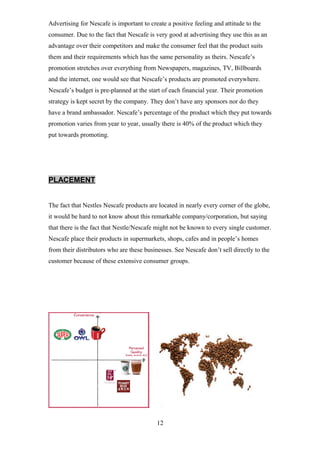
The fact that Nestles Nescafe products are located in nearly every corner of the globe,
it would be hard to not know about this remarkable company/corporation, but saying
that there is the fact that Nestle/Nescafe might not be known to every single customer.
Nescafe place their products in supermarkets, shops, cafes and in people’s homes
from their distributors who are these businesses. See Nescafe don’t sell directly to the
customer because of these extensive consumer groups.
12
Brand strategy
Given the position that Nescafe is in within the market place with global recognition,
strong brand quality and aggressive marketing strategy’s throughout the globe, it
would be fair to say that Nescafe tend to form their own brand strategy with extreme
effectiveness. They get to their targets with little competition as they are the ones in
control of the market. They generate sales accordingly, reach the audience intended
which in turn generates massive profits and growth for the company. Nescafe prove
that some variants are designed and marketed in certain ways to cater for the needs of
particular segments of which area of the market they wish to work in or control. It
hasn’t gone unnoticed that Nescafe as a brand is in an intermediary phase from being
an exclusive utilitarian consumption product. Their coffee has gone from strength to
strength from when it started, when it used to be just an instant coffee. Now it has
becoming more of a product about consumption with a massive rise in percentages to
create and sell different blends in different markets. Nescafe labels each product with
its own individual personality, which in turn adds value to the brand. Nescafe’s focus
is on the historical value with the coffee tradition in mind.
Conclusion
To conclude, following the research we carried out, Nestle combined with Nescafe is
indeed a very powerful company/corporation. They strive to be the best in the market
sparing no expense with research, promotion and the use of fairtrade products so that
they can deliver the highest quality products with the consumer in mind. They want to
keep their remarkable brand image intact which they have built up over the years
through hard work but also they want to control the market
13
References
http://www.ukessays.com/essays/marketing/about-nescafe.php
http://www.nescafe.com/sustainability_en_com.axcms
http://www.scribd.com/doc/21248912/nescafe-brand-study
14

Nestle study

  • 1.
    Assignment Cover Sheet StudentsNames: Gary O’ Shaughnessy Patrick Keogh Student Numbers C12748445 C12403438 Module Title: Marketing Assignment Title: Brand study: Nescafe Coffee Word Count: 3,668 Due Date: 21/3/2013 Declaration We declare that the project material, which we now submit, is our own work. Any work that belongs to another person has been cited and acknowledged within the work. I make this declaration in the knowledge that a breach of the rules pertaining to plagiarism may carry serious consequences. Signed: Signed: Contents Page 1
  • 2.
     Introduction  SwotAnalysis  Strengths  Weaknesses  Opportunities  Threats  Environmental forces  Macro and Micro environment  Demographic forces  Economic environment  Natural forces  Technological environment  Politic Environments  Cultural Environments  Products  Pricing  Promotional  Placement  Brand Strategy  Conclusion  References 2
  • 3.
    Brand study: Nescafe Introduction Nescafeis a sister company to the successful multi-national corporation which has branched out into nearly every market there is, dominating all those it enters into. Interbrand issued it in to the top 100 brands in 2012 where it was ranked 35th on the list, success coming from its direct approach to the consumer, making it much more interesting. Nescafe brand is owned by Nestle and is worth a staggering 13 billion dollars. Some studies carried out have concluded that approximately 94 billion Nescafe cups are sold around the world, which is around 3,000 cups every second. Interbrand stated in its 2008 study, the brand “has benefited from the increase in demand for premium coffees”, while stating in 2012 that, the brand “Nescafe brand is instantly recognizable”(Interbrand top 100) enabling it to see off its competitors in many markets. Nescafe has also educated its consumers of the health benefits of the beverage giving the brand a healthy image. A financial times report claims that instant coffee is losing space to ground coffee. What is shown in this study is focused mainly on the brands efforts to increase consumer awareness and value. Nescafe is currently in maturity of the brand life cycle as we can see that there is still growth taking place even though the brand is already globally known. Nescafe has a lot of competition in the market such as Bewley's, Café britt, Costa coffee, Delta coffees and Klember. This competition makes it much harder to completely dominate the market but Nescafe are making good progress to do so. 3
  • 4.
    Swot Analysis Strengths Nestle hasa broad geographic coverage, Nestle has a dominating role in the global coffee industry and is the leader in instant coffee. The coffee industry is an important sector of the organisation as it accounted for 21% of its total value in 2007. Due to the fact that Nestle is a huge multi-national corporation it has the finance to develop and grow even bigger if needed. It also has a developed brand portfolio in the hot drinks sector as it has other brands such as Nesquik and Milo; this enables Nescafe to have a good understanding of the market even before it tries to market its coffee range. Nestle has the power to control the market, for example if Nestle wanted to increase the price of the coffee in the market, it could reduce the amount of coffee it sends into the market to increase the price as the market is dependent on its contribution. The economies of scale and synergy available to Nestle gives it even more of an advantage within the market to increase and dominate the market. Weaknesses Nescafe is reliant on a mass market; this can cause problems as they try to market their products where there is a need for premium quality at an acceptable price. There is a customer bias against most of Nescafe's products as the majority contain caffeine which can create a bad image for the company as they try to create a healthy image. In recent years Nescafe created a bad ethical image as they target young people with their caffeine based drinks, this has questioned their ethical beliefs by the consumer. Opportunities There has been a rise in the demand for premium brands in the market which will benefit Nestles sales as their brand is a premium brand. There is also a rise in the demand for healthy products, as Nestle has quite a lot of revenue and market share it 4
  • 5.
    can afford topromote their company more than its competitors. There have been research studies carried out that have shown that Asia will be one of Nestles biggest market as its growth rate and demand for its products have risen greatly over the last 10 years. This future market will only help Nestle create more revenue and continue their progress in trying to dominate the coffee market as predictions show that the European market may slump in the future. Threats There is a lot of competition in the coffee machine sector; this will affect sales for their Espresso and Nescafe Dolce Gusto coffee systems as they come under threat from cheaper models. The rise in cost for transportation will affect the profit margin on their coffee. Due to the fact that coffee can only be grown in the right conditions normally equatorial conditions, the coffee needs to be transported all over the world from these remote locations. A lot of Nescafe's competitors are now moving into the soft drinks sector, this gives them a bigger market to choose from and sell to with a greater chance of making more profit than Nescafe can as they continue to stay in the hot drinks sector. Environmental forces: Macro/Micro Macro The macro environments are "forces that shape opportunities and pose threats to the company"(kotler. page 184). There are a number of forces which can pose a threat to a company. • Demographic forces. • Economic forces. • Natural forces. • Technological forces. • Political forces. • Cultural forces. 5
  • 6.
    Micro The microenvironments are"the actors close to the company that affect its ability to serve its customers, the company, suppliers, marketing intermediaries, customer markets, competitors and publics"(Kotler. page 179). The company must take into account all the groups involved with the organisation. These are all interrelated and are dependent on one another. If one group fails the whole process will be affected and productivity and quality of service and product will be reduced. For example if the marketers fail to identify trends or changes in the market and notify the other groups they might not be able to satisfy the needs of the customer as they won’t be able to create a service or product to satisfy their needs before a competitor does. The suppliers are important to the organisation as they provide the materials needed to produce the coffee and transport the product around the world. If there is good communications and relations between the supplier and Nestcafe then customer value can follow as the customer is satisfied creating long term sales and a customer for life. Marketing intermediaries help Nestcafe promote, sell and distribute its product to the buyer. Without promotion the company will not be able to make optimum sales as the customer is not aware of its products. While having poor distribution systems they can make the customer have a less favourable approach to the company and they won’t want to do business again in the future. The company must study the customer closely in order to create future sales; they must ensure that the quality of service from the beginning is of a high standard. The company’s competitors are also important in order to gain a greater market share. When a competitor makes a mistake Nestcafe can show that they have better quality produce and service than anyone else. Nestle would also have a number of different publics such as financial publics who have an interest to see if they can pay back loans, media publics to see if there is any news about then which they can write about, government publics to see if laws are implemented and business is carried out correctly according to the law, citizen publics who will react on certain actions carried out by the company and local publics who are interested in the locality of the company. 6
  • 7.
    Demographic forces "Demography isthe study of human populations in terms of size, density, age, gender, race, occupation and other statistics"(Kotler. page 185). The demographic environment would be very important to Nescafe as it shows who exactly makes up the total market but also who is in the coffee market showing details about age structure and diversity within the market. Nescafe's marketers would track their market very closely as they will study trends and try to predict change in the market so that they can come up with solutions for problems before they arise in the market to ensure they act quicker than competitors, also known as being proactive. For example before the majority of food Production Company’s introduced themselves into the fairtrade sector of the market, Nescafe were already selling fairtrade produce. They recognised that the market wanted coffee where everyone was paid on a fair basis. So when a customer buys Nescafe coffee, they are satisfied with the level and are ensured that the coffee they buy has been produced and sold fairly allowing the customers to have a clear conscience. Economic environment This consists of the factors that affect spending patterns and purchasing power. The marketers at Nescafe must pay a lot of attention to the market to identify purchasing patterns to identify how the market actually buys their products and possible reactions to future products. The marketers can classify the market into sub categories depending on their purchasing power. They would identify what price they can charge for their products and who they can aim the product at, known as target market, there is no point aiming a premium priced product at lower class people within the market as they wouldn't have the buying power to purchase it. An example of this would be the Nespresso range. This range consists of premium priced quality coffee and coffee machines that range from €100 to €500 with the pods/coffee selling at 69cent each. They identified that this would be a premium product that not all of their market would be able to afford, but to actually make sales they would position their product in prestigious stores around the world due to the fact that the people who shop there 7
  • 8.
    would expect tobe charged a premium price, such stores as Brown Thomas and Avoca. Natural forces "The natural environment involves the natural resources that are needed as inputs by marketers or that are affected by marketing activities"(Kotler. page 201). This basically means what can affect Nescafe from producing and selling their products to the market due to the natural environment. " the environment consists of a large number of non-controllable variables"(Dale Littler, page97) Nescafe's main raw material is the coffee bean, these are difficult to grown as they only grow in certain parts of the world normally tropical areas where there is a lot of rain, warm conditions and no frost. The coffee needs to be grown at high altitude to prevent animals from destroying the crops. Due to this the coffee can only be grown in regions like the Minas Geras region in Brazil where the weather meets the requirements to grow the crop. This can hinder the amount of coffee that is produced by Nescafe globally and may reduce sales. The high cost of running the plants that produce the coffee can also affect the production of the coffee. Many of the plants that produce the coffee are run on non-renewable resources such as oil and coal. These cost quite a lot of money to keep running and due to the implications that greenhouse gasses are causing to our environment. According to top scientists, governments all over the world are charging and sanctioning plants which are creating too much toxic gasses from their factories. Nestle were fined in China for creating too much pollution in 2010. China in recent years has been known for having incredibly bad conditions due to air pollution, as a result factories are given quotas to the amount of CO2 gasses they can produce, if they go over this they are fined. Technological environment Technology is changing every day it’s the most dramatic force that can shape an organisation. Every year a company must update itself to keep up with the competition; if the company fails to do so then they will fall behind. Technology enables us to work incredibly faster than ever before; however technology costs a lot of money to implement into the company and the cost of training the employees will only make the costs go up. Nescafe is now able to get orders from anywhere around 8
  • 9.
    the world, fromthis they can produce and transport their product anywhere in a matter of days, this enables them to create sales much faster than ever before, maximising profits and produce. Political environment The political environment consists of laws, rules, regulations, government agencies and pressure groups which can limit the activities of a company. The Brazilian government introduced new laws to protect the Amazon rainforest, Before these laws were implemented Nestle had plans to cut down a section of the rainforest which had perfect conditions to grow coffee, they were not allowed to do so as their plans were rejected on the grounds that the region was now protected. This could have severe consequences for the company as they wanted to gain a greater market share and produce more sales and profit. Nescafe now had to come up with another plan after spending so much time and money. These laws are a huge implications for Nestle as they depend so much on regions that are now becoming rarer to find and harder to get permission to do anything on them. Cultural environment People all over the world grow up in different was and demand different things than others might from a different region. People's values, perceptions, preferences and behaviours are all shaped by the location in which the live and grow up in. People may view an organisation different to others in a different region depending how the organisation affects them. For example the people in the western world believed that farmers who work for Nestle produce the crops may have had a negative view of the organisation before as they believed the farmers had to work in poor conditions with minimal pay whereas the actual farmers liked working for them as they worked for a fairtrade company which treated the employees in the correct way giving them fair wages and conditions to work in. People in the western world automatically presume that a growing county would have poor working conditions just because of its location which is why Nestle now promote the fact that they are now a fairtrade company. 9
  • 10.
    Products Nestcafes range ofcoffee and coffee machines are extremely wide variety, they sell within the market and they believe that they "solve problems for their customers" by selling them quality products.(B.H.Elvy page 2) Currently they have 30 different coffee types and there are over 50 different machine models to choose from. The coffee that Nestcafe sells is of the highest class. They are produced in a way that ensures that they get the most from the coffee bean which then gives the most critical coffee drinker a pleasant experience. They package the coffee in a very presentable way that allows the customer to easily identify and separate it from its competitors. Their machine designs are sleek and look very modern to keep in touch with the modern style of today. Their products are of a premium quality and cost slightly more than their competitors due to the fact of the high quality design. The Nespresso range is more premium than other products as they can only be bought online and in selected stores whereas most of the competitors products can be bought in most stores around the world so they are very convenient to purchase. Nescafe's products would still be in the growth stage as they are still introducing its products into new markets such as Asia which has been predicted that it become one of its biggest markets in the next couple of years. Pricing strategy The way in which Nescafe price their products is key to their success in global markets while maintaining quality “getting the right product, at the right place, at the right price at the correct time"(Nick Ellis, page 16). Their marketing strategy also includes various pricing strategies, by doing this they are able to maintain product rates at a sustainable position which enables them to keep a good market share and create an advantage over their competitors. It is vital that they continue to do this, evaluate their position regularly to prevent a loss in market share. Their coffee is affordable to the majority of people. They have also introduced re-sealable coffee containers which can also be filled up again without purchasing another container, this reduces the price of both production and transportation costs. Nestcafe like to charge more for their products than their competitors to create a sense of superiority 10
  • 11.
    over them. Thecustomer is willing to pay more for something once their needs are met and the brand fits in with their personality. How do Nescafe set prices for their products? Nescafe have control of the markets when setting the prices for their products which gives them a significantly high profit margin. This is also got to do with the fact that they have the highest quality products, while also having the cut price products, but still keeping the quality in mind. Seen as Nescafe’s products are dairy products which people consume every day, there prices generally trend to fluctuate. The prices that Nescafe set are fixed on a reasonable scale so that the majority of the public can afford their products. Also seen as they are in control of the market this is an easy task. Nescafe don’t have a price refund policy, if a product isn’t up to scratch well Nescafe just replace the products Promotional strategy Nestcafe uses a number of promotional strategies in their advertising, sales promotions, internet and direct marketing. The marketers at Nescafe try to create a brand personality in the media and positioning so that the consumer can relate to the brand through various different media "brand positioning is based on the assumption that consumers have limited mind space for commercial messages and that the most successful brands hence are the ones able to position themselves in the minds of consumers by adapting the most congruent and consistent commercial message"(Tilde Heding, page 14) they use billboards to show the brand and familiarise the consumer with the colours and expectations of the actually coffee, they use TV to show the various different personalities that the brand can satisfy. Nescafe has an aggressive marketing strategy which they use globally. Each region has its own strategy to effectively target the audience and generate sales from it. In its ads it focuses on the coffee tradition and its historical value. It creates a brand personality that is sincere, down-to-earth, warm and honest and excitement which is related to friendly, youth and energy. Nescafe uses a number of techniques in different markets depending on the needs of that specific market, for example in the UK, the target market is young adult consumers aged between 20-35 of the middle upper class who have experience the want for soft drinks and energy drinks already. A website was created 'Nescafe live' where the consumer would give their ideas for possible products or services, they used this as an opportunity to promote already existing products and get the customers opinion on them which they could then implement changes to make them even better. 11
  • 12.
    Advertising for Nescafeis important to create a positive feeling and attitude to the consumer. Due to the fact that Nescafe is very good at advertising they use this as an advantage over their competitors and make the consumer feel that the product suits them and their requirements which has the same personality as theirs. Nescafe’s promotion stretches over everything from Newspapers, magazines, TV, Billboards and the internet, one would see that Nescafe’s products are promoted everywhere. Nescafe’s budget is pre-planned at the start of each financial year. Their promotion strategy is kept secret by the company. They don’t have any sponsors nor do they have a brand ambassador. Nescafe’s percentage of the product which they put towards promotion varies from year to year, usually there is 40% of the product which they put towards promoting. PLACEMENT The fact that Nestles Nescafe products are located in nearly every corner of the globe, it would be hard to not know about this remarkable company/corporation, but saying that there is the fact that Nestle/Nescafe might not be known to every single customer. Nescafe place their products in supermarkets, shops, cafes and in people’s homes from their distributors who are these businesses. See Nescafe don’t sell directly to the customer because of these extensive consumer groups. 12
  • 13.
    Brand strategy Given theposition that Nescafe is in within the market place with global recognition, strong brand quality and aggressive marketing strategy’s throughout the globe, it would be fair to say that Nescafe tend to form their own brand strategy with extreme effectiveness. They get to their targets with little competition as they are the ones in control of the market. They generate sales accordingly, reach the audience intended which in turn generates massive profits and growth for the company. Nescafe prove that some variants are designed and marketed in certain ways to cater for the needs of particular segments of which area of the market they wish to work in or control. It hasn’t gone unnoticed that Nescafe as a brand is in an intermediary phase from being an exclusive utilitarian consumption product. Their coffee has gone from strength to strength from when it started, when it used to be just an instant coffee. Now it has becoming more of a product about consumption with a massive rise in percentages to create and sell different blends in different markets. Nescafe labels each product with its own individual personality, which in turn adds value to the brand. Nescafe’s focus is on the historical value with the coffee tradition in mind. Conclusion To conclude, following the research we carried out, Nestle combined with Nescafe is indeed a very powerful company/corporation. They strive to be the best in the market sparing no expense with research, promotion and the use of fairtrade products so that they can deliver the highest quality products with the consumer in mind. They want to keep their remarkable brand image intact which they have built up over the years through hard work but also they want to control the market 13
  • 14.