Shared services –
                      Case studies 2012


4548_AoC_Case studies_Phase2_AW.indd 1    2/16/12 5:17 PM
Contents
                        03     West Yorkshire Consortium of Colleges
                               Led by Calderdale College

                        09     Developing Soft Federation Services
                               Led by Epping Forest College

                        15     College Qualification Project
                               Led by North Herts College

                        21     Efficiency in Recruitment in Colleges (ERIC) National
                               Led by Plumpton College

                        27     BUSYNESS – Building a South Yorkshire Network to Enable Shared Services
                               Led by Rotherham College

                        33     Federation of Essex Colleges (FEDEC) Shared Services
                               Led by South Essex College

                        39     Shire Shared Services
                               Led by Worcester College of Technology

                        45     Wessex Colleges Federation
                               Led by Yeovil College


4548_AoC_Case studies_Phase2_AW.indd 2                                                                   2/16/12 5:17 PM
West Yorkshire
                Consortium of
                Colleges


                The Partners


4548_AoC_Case studies_Phase2_AW.indd 3   2/16/12 5:17 PM
Areas of Focus
       There is a strong                         The project took as its starting point a review of the
                                                 activities of West Yorkshire Consortium of Colleges
       (belief) that this will                   (WYCC), with a view to identifying collaborative ways
                                                 forward. This led to the development of two focus areas,
       create… efficiency in                      arising from an initial scoping exercise undertaken by
       the Leeds region                          external consultants. These are:
                                               • Joint exam procurement; and
                                               • The development of a strategic working relationship with
                                                 Leeds City Region Local Enterprise Partnership (LEP).


                                                 Rationale
                                                 WYCC was established 10 years ago as a sub-regional
                                                 network of Colleges.
                                                 This partnership has been retained, and its focus has
                                                 developed to working collectively with partners to
                                                 improve the skills and training offer in the Leeds City
                                                 Region in order to drive up the economy of the region.
                                                 The project has been used to develop models and
                                                 agreements which build upon the good practice and
                                                 shared working developed through WYCC in order to
                                                 respond efficiently and effectively to the needs of the
                                                 City Region.


                                                    Need to bring employers and
                                                    providers together

                                                 Vision
                                                 Specifically, the project aimed to identify:
                                               • Quick wins – through which the advantages of shared
                                                 service activities could be demonstrated; and
                                               • Strategic interventions – through which WYCC can work
                                                 with regional partners in delivering effective services to
                                                 learners and employers within its locality.

                                                 These collaborations aim to support WYCC members in
                                                 meeting current and future demands in terms of skill need
                                                 across the Leeds City Region and offer opportunities for
                                                 more cost-effective working.


   4   | Shared services – Case studies 2012


4548_AoC_Case studies_Phase2_AW.indd 4                                                                        2/16/12 5:17 PM
Objective                                      • Develop a business case that outlines the
                                                                            commercial rationale, collaborative model
                           This project assists the Colleges in West
                                                                            merits and high level plan to implement
                           Yorkshire to further develop their existing
                                                                            the next stages of the preferred
                           partnership and explore models of
                                                                            collaborative option(s).
                           formalisation of good practice to secure
                           efficiencies and service improvements for        This process led to the identification of
                           the Colleges and the Leeds City Region LEP.      two activity areas which were carried
                           From the point of view of LEP                    forward to Phase 2:
                           collaboration, it aims to develop practical
                                                                          1. A strategic, medium/long term approach,
                           and relevant solutions to improve the offer
                                                                             looking at the framework to intervene
                           and delivery of skills through framework
                                                                             in a number of areas, developing the
                           development. These options will then be
                                                                             existing WYCC structure to engage with
                           developed into delivery models which
                                                                             the emerging LEP network, with the aim
                           will scope the structure of the organisation
                           needed for delivery, examine the financial        of developing larger scale interventions.
                           implications and determine the legal and       2. Focusing on short term benefits on areas
                           governance issues.                                of commonality, starting with exam
                           The exam procurement strand builds                procurement.
                           on work that has been undertaken by
                                                                            Phase 2
                           the AoC Finance Directors’ network,
                           which includes participation by WYCC             LEP engagement: This has now become
                           member Colleges.                                 the primary focus for the project. All
                                                                            WYCC member Colleges have signed a
                           Activities                                       Partnership Agreement with the LEP’s
                                                                            Employment and Skills Board (ESB),
                           The project included two phases:                 as part of the Leeds City Region Skills
                           Phase 1                                          Network, with WYCC’s chair sitting
                                                                            on the ESB.
                           Phase 1 was contracted to external
                           consultants, who were asked to:                  The objectives of the agreement are to:
                      • Confirm the scope and outline of the              • drive up skills and employment levels
                           WYCC ambition for future potential               in Leeds City Region particularly in
                           collaborations;                                  those sectors critical to the growth of
                                                                            the economy;
                      • Test the feasibility of potential
                           collaborations against a number of factors     • increase employer and individuals’
                           including: governance, finance, corporate        engagement and investment in skills;
                           structure, competitive advantage and           • support individuals to gain sustainable
                           market penetration/growth, legal                 employment by improving employability,
                           implications, costs and benefits;                basic skills (especially maths, English and
                      • Confirm the range and nature of possible            ESOL) and enterprising attitudes; and
                           options for WYCC collaborations, both          • strengthen joint working between
                           now and for the future;                          employers, the LEP/ESB, skills
                      • Test the possible options and engage                networks, Colleges and other skills
                           WYCC and Colleges to confirm the                 providers to improve the effectiveness
                           preferred option(s); and                         of skills investment.


                                                                                                   Shared services – Case studies 2012 |   5

4548_AoC_Case studies_Phase2_AW.indd 5                                                                                            2/16/12 5:17 PM
A project officer has been recruited to
                           the project to assist in the developing
                                                                           great example of joint
                           sustainable working relationships               working that I hope
                           between the partner Colleges as well as
                           supporting emerging developments with           other LEPS will follow
                           the LEP. Activities have included building
                           relationships with employers, running
                           events to promote opportunities in              Geoff Russell, Chief Executive of the
                           growth areas, such as a “Green Jobs”            Skills Funding Agency
                           event and setting up sector focus groups.
                           Exam procurement: Work has been
                           undertaken on looking at joint awarding
                           bodies’ aggregation and price/service
                           negotiation, linked with national work          I am pleased to
                           being co-ordinated by AoC, and an Exam
                           Officers’ group has now been established        report that further
                           for the City Region.                            education Colleges
                           In addition, other areas of sharing are still
                           being explored by members of the group
                                                                           are already playing
                           including finance and human resources.          a role with local
                                                                           enterprise partnerships
                           Model
                           WYCC have a pre-existing collaborative
                                                                           in the north-east
                           model as a company limited by guarantee         and elsewhere. In
                           with each College Principal being a
                           company director. There is a company
                                                                           Yorkshire, the Leeds
                           secretary appointed by one of the               city region held its first
                           member Colleges and the accounts are
                           audited by external auditors each year.         skills conference with
                           There is a member of staff who works for        the West Yorkshire
                           the consortium to manage and oversee
                           its affairs, the Consortium Manager             Consortium of Colleges
                           reports directly to the WYCC board.
                           The formation of the Skills Network
                                                                           and it is now setting
                           has attracted positive recognition and          up its own skills
                           publicity from a number of key figures.
                                                                           network
                           The project is being used to examine
                           whether the existing structure can be
                           used more effectively in the interests          Mark Prisk, Minister of State,
                           of its member Colleges.                         Department for Business, Innovation
                                                                           and Skills


   6   | Shared services – Case studies 2012


4548_AoC_Case studies_Phase2_AW.indd 6                                                                             2/16/12 5:17 PM
Savings                                           Enablers
                           The partners project that the from late           The following factors have been
                           2012, annual savings will be made in              important in taking forward the project:
                           the following areas, although detailed
                                                                          • The existing long-term relationship
                           quantification is not available:
                                                                             between the Colleges as members
                      • Marketing £50,000;                                   of WYCC;
                      • Procurement £70,000; and                          • Initial analysis by an external consultant
                      • Efficiency gains in LEP £100,000.
                                                                             assisted WYCC members to focus on
                                                                             potential developments;
                                                                          • Having the resources to engage with
                           Outcomes and the Future                           strategic partners at a regional level is
                           The project has been used to position             enabling the co-ordination of the further
                           WYCC for future shared opportunities,             education offer in an effective manner; and
                           shared information and intelligence for
                                                                          • National level work on exam
                           the City Region, capturing the economic
                                                                             procurement has underpinned the
                           skills and related data and providing a
                                                                             local activities in this area of work.
                           shared strategic perspective to inform joint
                           planning and College-specific planning.
                           Further work is being undertaken on
                           collaboration with the LEP Employment
                           and Skills Board to strengthen the offer             …positive
                           on employer engagement activity,
                           through closer working arrangements
                                                                                relationships have
                           with other skills providers and                      developed (between
                           identifying good practice.
                                                                                ESB and Colleges)
                           WYCC is also establishing self-sustaining
                           Exam Officers’ Network to help drive
                           forward common approaches.


                               WYCC was
                               instrumental in
                               establishing the Skills
                               Network


                                                                                                     Shared services – Case studies 2012 |   7

4548_AoC_Case studies_Phase2_AW.indd 7                                                                                              2/16/12 5:17 PM
Critical Factors
                            Factor             Barrier                                      Solution                              Importance

                            Leadership & Leadership Teams need to own this agenda           Need to spend time with Principals    Medium
                            Governance for it to have impact                                and leadership teams to get buy in

                                               Establishing a common understanding          An incremental approach and time      High
                                               of the aims and benefits                     and resources are needed

                            Culture &          Managing expectations over the potential     Feeding in information on what has    Medium
                            Climate            for efficiency gains and savings             worked elsewhere, including use of
                                                                                            case studies and practical examples

                            Process            The complexities of examination              Need to find out about what others    High
                                               procurement, as there are important issues   are doing, and what had been
                                               of value for money and where resources       achieved. Activities need to be
                                               are expended                                 integrated with national work and
                                                                                            other local and regional networks


                           Summary
                           The project has assisted a pre-existing
                           partnership of Colleges to focus on                                 All being done with
                           key collaborative areas. The resources
                           available have made a significant impact
                                                                                               minimal central
                           on the extent to which the Colleges                                 resources
                           collectively engage with strategic
                           economic developments in the City
                           Region for mutual benefit.
                           At another level, the project has also
                           illustrated the difficulties of addressing
                           shared service development (in this case
                           over exam procurement) with a large                                 Need a co-ordinated
                           number of partners in a complex area.                               approach at all times
                           In this case, it is clear that not all wins
                           are quick.


   8   | Shared services – Case studies 2012


4548_AoC_Case studies_Phase2_AW.indd 8                                                                                                         2/16/12 5:17 PM
Developing Soft
                Federation Services


                The Partners

                This project is led by Epping Forest College with all
                partners involved in the project having a significant
                history of collaboration through ACER (the Association
                of Colleges in the Eastern Region). The responsibility
                for managing and facilitating this project was given to
                ACER who has considerable experience of facilitating
                collaboration among Colleges through a range of
                activities, including procurement.
                Partner Colleges involved in the project are of a relatively
                similar size and are geographically spread across the
                Eastern region. Therefore key meetings were held at
                different Colleges within the group on a monthly basis.


4548_AoC_Case studies_Phase2_AW.indd 9                                         2/16/12 5:17 PM
Areas of Focus
     [the project aims] to                        The project is a feasibility study focused on exploring
                                                  the potential for developing shared service models
     demonstrate that this                        within the following areas:
     [efficiency savings                         • Human Resources (HR);
                                                • Procurement;
     through sharing]                           • Finance;
     should be achievable                       • Payroll and recruitment;
     without jeopardising                       • Timetabling;

     individual                                 • Health & Safety; and

     organisational                             • Sharing expertise.

     independence                                 Rationale
                                                  In the current climate Colleges involved in the
                                                  partnership were keen to build on collaborative
                                                  activity undertaken in the Eastern Region and explore
                                                  opportunities for generating efficiency savings and drive
                                                  service improvement through sharing. Therefore the
                                                  project is essentially part of the evolution of collaborative
                                                  activity among Colleges. ACER are focused on driving
                                                  improvement and efficiency among its members and
                                                  this project provided the group with the opportunity to
                                                  undertake a feasibility study to explore the potential for
                                                  sharing a wide range of service areas in order to reduce
                                                  costs and improve service delivery, thereby enhancing
                                                  the resilience of partners.


                                                     [the project] builds on a successful
                                                     history of collaboration within the
                                                     Eastern Region
                                                  Vision
                                                  Project documentation outlines the following vision:
                                                     “That the project can achieve efficiency savings beyond the
                                                      scope of the individual Colleges participating. We hope to
                                                      demonstrate that the benefits transform services through a
                                                      higher quality customer experience from these functions...
                                                      that this should be achievable without jeopardising
                                                      individual organisational independence but also to
                                                      provide a platform for future partnership models that
                                                      can be adopted elsewhere in the sector”.

   10   | Shared services – Case studies 2012


4548_AoC_Case studies_Phase2_AW.indd 10                                                                            2/16/12 5:18 PM
Objectives                                          Communication
                           The project sought to identify the
                           feasibility of Colleges in the project group
                                                                               of the project needs
                           sharing the various service areas outlined          to be disseminated
                           above in order to achieve the following
                           objectives:                                         effectively, so that
                      • Achieving financial efficiencies not                   staff are aware of the
                           possible as individual Colleges;                    project and the possible
                      • Retaining organisational independence,
                           regardless of the chosen business model;
                                                                               benefits
                      • Providing organisational resilience;
                                                                          • Implementation and activity planning
                      • Delivering improved systems;                        – a series of workshops and meetings
                      • Freeing up time for the participating               to explore the ideas generated further,
                           Colleges to focus on teaching and                including an assessment of potential
                           learning outcomes; and                           collaborative models and share identified
                                                                            areas of good practice in service design,
                      • Develop a shared business model across
                                                                            delivery and process.
                           the six Colleges and to deliver a scalable
                           model based on shared services for back          Partners found the functions analysis
                           office functions.                                and benchmarking and comparative
                                                                            analysis processes particularly beneficial
                                                                            as it enabled them to gain a real
                           Activities                                       understanding of where they are as an
                           The project has incorporated the                 organisation, in terms of what they are
                           following activities.                            doing well and where improvements
                                                                            could be made, as well as providing
                      • Functions analysis – mapping,
                                                                            clear examples of good practice from
                           analysis and benchmarking of current
                                                                            across the partnership. This has enabled
                           responsibilities and processes involved in
                                                                            some partners to identify and act on
                           each service function within each College.
                                                                            “quick wins” by making relatively
                           This included analysis of staff resources,
                                                                            minor and inexpensive adjustments
                           IT processes, costs and utilisation, thereby
                                                                            to their processes.
                           enabling a transparent and accurate
                           assessment of each service function across         “the aims of this project was to share
                           each College;                                       business models...the toolkits are the
                      • Comparative analysis – comparison of                   backbone of the models, they look at
                           each College’s current approaches to each           where a College is now and how
                           service area;                                       they can improve their services”

                      • Identifying efficiencies – based on
                           the findings of the earlier activities this
                           involved collaborative activity to identify
                           service areas with the greatest potential to
                           generate efficiencies for partner Colleges
                           through the adoption of best practice
                           from other partners or the development
                           of shared services; and

                                                                                                    Shared services – Case studies 2012 |   11

4548_AoC_Case studies_Phase2_AW.indd 11                                                                                             2/16/12 5:18 PM
Shared Services Model                           Outcomes and the Future
                           There is no one definite business model         As mentioned above partners are
                           for taking forward shared services              looking to take forward different sharing
                           between partners. There is appetite to          activities over the short, medium and
                           take forward activity in some of the areas      longer term. Examples of this range of
                           scoped, with different partners interested      activity, include:
                           in taking forward different approaches in
                                                                         • partners are looking to share HR
                           different service areas. Therefore the ways
                                                                           procedures with a view to ensuring all
                           in which these are taken forward will
                                                                           are delivering these in accordance with
                           differ and will be dependent on partners
                                                                           the most efficient and effective practice;
                           having resources to do so. In some
                           case this will simply involve a partner       • one partner leading on developing a
                           College adopting the best College model         collaborative agreement on sharing
                           identified from across the partnership.         occupational health services;
                                                                         • pooled recruitment advertising budgets
                           Savings                                         have been agreed between a number
                           Project documentation suggests that             of partners;
                           approximately £500,000 of potential           • following the lead of one of the partners
                           savings have been identified across the         a College is planning to outsource its
                           areas of focus for this project, over three     procurement service;
                           years to 2014. Examples of potential
                           savings include an estimated saving of        • a number of Colleges are looking to
                           £240,000 over two years on the contract         jointly procure legal services;
                           value of recruitment advertising budgets      • two Colleges are looking to share payroll
                           through sharing between eight Colleges.         services; and
                           Other potential, but as yet unquantified,
                           savings could be generated through            • one College is re-tendering its outsourced
                           the range of activity that may be taken         absence management contract in March
                           forward by partner Colleges.                    2012 and has invited other Colleges to
                                                                           collaborate in this exercise.
                           Partners estimate that project costs were
                           recouped through savings generated by           A key outcome from the project to date
                           the end of 2011.                                has been the development of Shared
                                                                           Services Toolkits for HR, Finance and
                                                                           Procurement which are essentially “how
                               the approach has                            to guides” which include generic analysis
                                                                           tools for College looking to review
                               enabled a number of                         services in the context of developing
                               quick wins through                          a shared service. Though the project
                                                                           focused on specific Colleges in the region
                               knowledge and practice                      the decision was made to extend this
                                                                           to other Colleges in the region. To date
                               exchange between                            three toolkits have been shared with 21
                               partners                                    Colleges in the Eastern region and there
                                                                           are plans to share these more widely.


   12   | Shared services – Case studies 2012


4548_AoC_Case studies_Phase2_AW.indd 12                                                                                 2/16/12 5:18 PM
Enablers                                      commitment by the
                           Key factors in the project’s development      partners to meet the
                           have been:
                                                                         expectations placed
                      • Partnership dynamics – the Colleges
                           involved in the project are of a similar      upon them is crucial
                           size and are geographically spread across
                           the Eastern region. As a result issues
                           relating to competition and fear of the
                           motives of larger providers are not an
                                                                         roles and
                           issue for this project;                       responsibilities need
                      • Additionality of FE Efficiency                    to be clearly defined
                           Innovation Fund – this has provided the
                           project with the resources and capacity
                                                                         and assigned from the
                           to enable partners to fully explore the       outset
                           feasibility of sharing a range of services,
                           something they could not have done
                           without this support;
                      • History of collaboration – having
                           worked together through ACER for a
                           number of years there already was a
                           culture of trust between partners and
                           with ACER;
                      • Existing independent collaborative
                           infrastructure – the project benefitted
                           from an established and trusted
                           collaborative infrastructure with a
                           track record in facilitating collaborative
                           working across Colleges in the region.
                      • Preliminary work to ensure buy-in
                           – ACER undertook a considerable
                           amount of work up-front to ensure that
                           those participating in the project were
                           committed to exploring the potential
                           for shared services across a range of
                           College functions, thereby minimising
                           the likelihood of divergence over this
                           in the future.


                                                                                     Shared services – Case studies 2012 |   13

4548_AoC_Case studies_Phase2_AW.indd 13                                                                              2/16/12 5:18 PM
Critical Factors
                            Factor        Barrier                Solution                                                            Importance

                            Culture &     Differing priorities   Each College has their own individual priorities in terms of        High
                            Climate                              service areas. As a consequence the project provided partners
                                                                 with the flexibility to opt-in or out of activity around different
                                                                 service areas

                            Process       Timescales and         Process mapping and scoping the feasibility of shared service       High
                                          time commitments       options is a time consuming and complex process which
                                                                 requires considerable commitment from all partners. Fulfilling
                                                                 these time commitments can be challenging to partners.
                                                                 Consequently partners needed an independent dedicated
                                                                 resource to drive the project and a flexible approach. Planning
                                                                 delivery so that it avoids peak times of year or holiday periods
                                                                 is also important

                                          Staff reticence        Some staff below senior level posses some reservations              High
                                                                 over the shared services agenda. Raising awareness, staff
                                                                 engagement and communication are central to addressing
                                                                 this challenge


                           Summary
                           This project highlights the importance                               Colleges are of a
                           of a history of collaboration and a lack
                           of competition between partners. It                                  similar size and
                           also highlights the importance of an
                           established “independent broker” to
                                                                                                share a similar offer
                           drive the project while encouraging open                             with learners. They
                           debate and discussion. The processes
                           involved have enabled partners to gain
                                                                                                are geographically
                           the intelligence that will enable them                               diverse with no direct
                           to drive improvement and generate
                           efficiencies in their operations. As a result                        competition which
                           numerous plans for implementation are                                removes one of the
                           being developed across various service
                           areas and partner Colleges.                                          barriers of shared
                           Resources received through the                                       service projects
                           Innovation Fund have acted as a driver
                           of the project, enabling partners to
                           explore the feasibility of shared service
                           solutions in a range of service areas,
                           benchmark their approaches and also
                           to develop and strengthen relationships
                           between participants, resulting in a
                           variety of different potential collaborative
                           activity being taken forward.


   14   | Shared services – Case studies 2012


4548_AoC_Case studies_Phase2_AW.indd 14                                                                                                           2/16/12 5:18 PM
College Qualification
                Project


                The Partners


4548_AoC_Case studies_Phase2_AW.indd 15   2/16/12 5:18 PM
Areas of Focus
     collaborating                                                 The project aimed to develop new qualifications within
                                                                   the three pilot areas of:
     with College(s)                                            • Security (North Hertfordshire);
     right through                                              • Hospitality and Catering (Westminster Kingsway); and
     the qualifications                                          • Product Design (Walsall).

     development and                                               These are being developed by an awarding body, OCR,
     launch process                                                in partnership with Colleges that are subject leaders
                                                                   within these sectors.
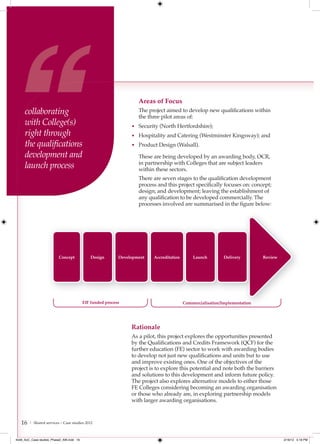
                                                                   There are seven stages to the qualification development
                                                                   process and this project specifically focuses on: concept;
                                                                   design; and development; leaving the establishment of
                                                                   any qualification to be developed commercially. The
                                                                   processes involved are summarised in the figure below:


                          Concept             Design       Development   Accreditation       Launch         Delivery        Review


                                          EIF funded process                             Commercialisation/Implementation


                                                                Rationale
                                                                As a pilot, this project explores the opportunities presented
                                                                by the Qualifications and Credits Framework (QCF) for the
                                                                further education (FE) sector to work with awarding bodies
                                                                to develop not just new qualifications and units but to use
                                                                and improve existing ones. One of the objectives of the
                                                                project is to explore this potential and note both the barriers
                                                                and solutions to this development and inform future policy.
                                                                The project also explores alternative models to either those
                                                                FE Colleges considering becoming an awarding organisation
                                                                or those who already are, in exploring partnership models
                                                                with larger awarding organisations.


   16   | Shared services – Case studies 2012


4548_AoC_Case studies_Phase2_AW.indd 16                                                                                              2/16/12 5:18 PM
(OCR) are…                                   Activities
                               assessment experts and                       The project is built on three strands,
                                                                            one of which (Walsall College) was
                               the Colleges involved                        included in the project shortly after bid
                                                                            submission. The projects are:
                               are the subject experts
                                                                            Security: North Hertfordshire is one of
                                                                            the founders of Bridging the Gap (BtG),
                                                                            an Olympics Legacy project that aims to
                           Vision                                           address the ongoing skills shortage in
                           The project aims to develop and pilot an         the security industry by guaranteeing
                           innovative way of working to produce a           an interview for paid security work at
                           qualifications offer for vocational learning     the Games to all participating full time
                           involving the leading Colleges within            students who are 18 years or older in
                           each sector subject area in partnership          July 2012.
                           with a well established awarding body.           The development of this strand was
                                                                            stopped, due to complications over
                           Objective                                        negotiations between BtG, OCR, and the
                                                                            Security Industry Authority (SIA). Major
                           The project identified “partnership
                                                                            complicating factors have been the issues
                           points” in the qualification development
                                                                            and challenges of operating within this
                           process where the FE sector can
                                                                            sector, primarily regarding malpractice,
                           contribute directly, with the aim of:
                                                                            and OCR subsequently concluded that
                      • keeping costs down with resultant                   the risk associated in validating potential
                           lower fees;                                      centres was too great.
                      • creating opportunities for re-investment            Hospitality and Catering: It was
                           in the sector by making payments to the          originally intended that a full
                           sector rather than other third parties; and      qualification (10 units) was to be
                                                                            developed within this strand and a
                      • developing better qualifications in the
                                                                            new learning programme, but this has
                           spirit of “by the sector, for the sector ”.      subsequently been limited to four units
                                                                            following discussions with the Sector
                                                                            Skills Council. The remaining units
                                                                            supported by the College for
                                                                            development are:
                                                                          • Sustainability at Levels 1 and 2; and
                                                                          • Procurement at Levels 1 and 2.

                                                                            These are expected to be developed in
                                                                            early 2012.
                                                                            Product Design: OCR have a history
                                                                            of previous involvement with Walsall
                                                                            College and its associated awarding
                                                                            organisation Accredited Skills for
                                                                            Industry (ASFI) through the collaborative
                                                                            development of a new qualification for


                                                                                                 Shared services – Case studies 2012 |   17

4548_AoC_Case studies_Phase2_AW.indd 17                                                                                          2/16/12 5:18 PM
product design. Whilst this partnership        Savings
                           was originally developed outside of
                                                                          The project focuses on income generation
                           the College Qualifications Project, this
                                                                          as well as savings in the form of engaging
                           was brought into the project due to
                                                                          the FE sector in the qualification
                           its close alignment with its aims and
                                                                          development process and rewarding their
                           objectives. This alignment is not just in
                                                                          efforts through direct payment or other
                           terms of the collaborative development
                                                                          financial incentives.
                           of a new qualification; but also the
                           joint working between a relatively             These benefits are expected to be realised
                           small local FE awarding organisation           later in the project.
                           with a national awarding organisation
                           leading to organisational synergy. This
                           is seen as having the potential for a new
                           partnership model with other FE sector
                           awarding organisations with potential
                           efficiency savings.                               (The project is)
                           The new qualification has now been                about ensuring…
                           fully designed and accredited and is
                           ready to use.
                                                                             qualifications are
                                                                             entirely fit for purpose
                           Model
                           There is no formal structure to the project.
                           Individual agreements are developed as
                           appropriate between the participating
                           Colleges and OCR for development of
                           the qualifications.


   18   | Shared services – Case studies 2012


4548_AoC_Case studies_Phase2_AW.indd 18                                                                                2/16/12 5:18 PM
Outcomes and the Future                        Enablers
                           As noted above, the position of each           The following factors have enabled
                           of the strands at present are:                 project development:
                      • Security: not developed due to OCR             • Recent encouragement by the
                           concerns over centre validation;               Department of Business Innovation and
                                                                          Skills for Colleges to become awarding
                      • Hospitality and Catering: it is envisaged
                                                                          bodies;
                           that the four units will be accredited by
                           Spring 2012; and                            • The shift from qualifications towards
                                                                          programmes of learning;
                      • Product Design: full qualification now
                           ready to use. This process has been         • The recognised need for industry
                           accelerated since development work had         engagement in developing the QCF;
                           already been undertaken, and Walsall
                                                                       • Restructuring of the role of Sector Skills
                           College has its own awarding body.
                                                                          Councils (SSCs) who will have less of a
                           Where there has been limited                   focus on qualifications development;
                           development, participating Colleges have    • The Colleges involved were recognised
                           reported an insight into working with          leaders within the sectors that were
                           industry and accreditation bodies.             targeted; and
                                                                       • The College that had an existing
                                                                          relationship with the awarding body, and
                               we will do more work                       which had a small awarding body itself,
                                                                          is furthest ahead in implementation.
                               with SIA after the
                               Olympics
                                                                             we are creating new
                                                                             opportunities


                                                                                               Shared services – Case studies 2012 |   19

4548_AoC_Case studies_Phase2_AW.indd 19                                                                                        2/16/12 5:18 PM
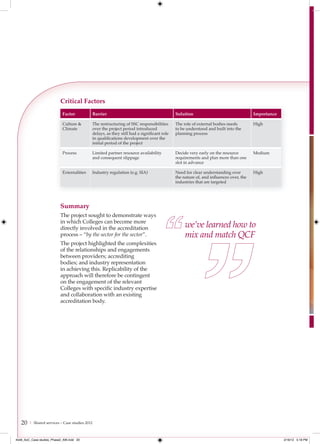
Critical Factors
                            Factor          Barrier                                        Solution                                 Importance

                            Culture &       The restructuring of SSC responsibilities      The role of external bodies needs        High
                            Climate         over the project period introduced             to be understood and built into the
                                            delays, as they still had a significant role   planning process
                                            in qualifications development over the
                                            initial period of the project

                            Process         Limited partner resource availability          Decide very early on the resource        Medium
                                            and consequent slippage                        requirements and plan more than one
                                                                                           slot in advance

                            Externalities   Industry regulation (e.g. SIA)                 Need for clear understanding over        High
                                                                                           the nature of, and influences over, the
                                                                                           industries that are targeted


                           Summary
                           The project sought to demonstrate ways
                           in which Colleges can become more
                           directly involved in the accreditation                               we’ve learned how to
                           process – “by the sector for the sector”.                            mix and match QCF
                           The project highlighted the complexities
                           of the relationships and engagements
                           between providers; accrediting
                           bodies; and industry representation
                           in achieving this. Replicability of the
                           approach will therefore be contingent
                           on the engagement of the relevant
                           Colleges with specific industry expertise
                           and collaboration with an existing
                           accreditation body.


   20   | Shared services – Case studies 2012


4548_AoC_Case studies_Phase2_AW.indd 20                                                                                                          2/16/12 5:18 PM
Efficiency in
                Recruitment in Colleges
                (ERIC) National


                The Partners

                Led by Plumpton College and delivered by FE Sussex (the
                consortium of Sussex Colleges), this project builds on a substantial
                history of collaboration between the Sussex based Colleges.


4548_AoC_Case studies_Phase2_AW.indd 21                                                2/16/12 5:18 PM
Areas of Focus
     a focused project                          This project is focused on developing shared software
                                                that will enable participating Colleges to manage the
     with a single                              recruitment of part-time or temporary teaching and
                                                support staff in accordance with their requirements,
     objective                                  thereby removing their reliance on recruitment
                                                agencies to carry out this function.

                                                Rationale
                                                Presently any Colleges using agencies to recruit
                                                temporary teaching staff are required to pay for a
                                                minimum of half a day of time, regardless of the length
                                                of teaching requirement, which may often be for 45
                                                minutes to 1 hour. Furthermore the agency retention fee
                                                for a member of staff required to teach for 1 hour can
                                                account for 77% of the fee paid. Consequently removing
                                                partner Colleges’ reliance on agencies can generate
                                                significant savings for these organisations. The software
                                                developed through the project will also place the onus on
                                                potential temporary staff to drive their own calendar of
                                                availability which Colleges can then check against their
                                                needs, thereby reducing the administrative burden on
                                                partners. The direct sourcing of temporary staff by partner
                                                Colleges will also serve to ensure the quality of teaching
                                                as will require staff to comply with the Quality Assurance
                                                arrangements of any particular College, something which
                                                is not guaranteed through agency based recruitment.


                                                   [ERIC] is about developing a more
                                                   responsive and efficient system
                                                   with reduced costs


   22   | Shared services – Case studies 2012


4548_AoC_Case studies_Phase2_AW.indd 22                                                                       2/16/12 5:18 PM
Vision                                          Activities
                           The project’s vision can be summarised as:      The project has been designed as a 2
                                                                           phase process involving the following
                                                                           stages before full implementation:
                               using new technology                     1. System scoping and design – establishing
                                                                           partners requirements; agreeing and
                               to transform part-                          establishing system requirements,
                               time recruitment                            content, parameters and processes;
                                                                           designing screen formats; and reviewing
                               practice...providing                        and refining all of the above in
                               sustained efficiency                         collaboration.

                               savings and value for                    2. System Pilot – piloting the system with
                                                                           four partner Colleges over 1 year to
                               money improvement                           ensure that it is entirely fit for purpose
                               by removing all fees                        before roll out across Sussex and the
                                                                           wider FE sector and beyond in the
                               paid to agency staffing                      academic year 2012-2013.
                               organisations.
                                                                           Shared Services Model
                           Once established partners plan to roll          The current proposed model is that
                           out the system nationally by offering it        of a not for profit company limited
                           to Colleges from across the FE sector.          by guarantee.

                           Objectives
                           Key project objectives can be summarised
                           as:
                      • Removing the use of expensive external
                           specialist agencies to supply part-time
                           staff;
                      • Establish a responsive solution for the
                           recruitment of part-time staff;
                      • Reduced expenditure, administration
                           time and procedures.


                                                                                                 Shared services – Case studies 2012 |   23

4548_AoC_Case studies_Phase2_AW.indd 23                                                                                          2/16/12 5:18 PM
Savings                                            Outcomes and the Future
                           The ERIC National Feasibility Report               All partners are committed to the project
                           outlines the following projected annual            and intend to implement the system
                           cost savings for the four pilot Colleges.          following its piloting and refinement.
                                                                              ERIC has clear potential to drive
                            College             Annual post-project savings   improvement while reducing costs and
                                                                              enabling the development of a pool of
                            A                                     £ 31,936
                                                                              part-time staff ready for deployment
                            B                                     £ 49,871    within any locality or sub-region in which
                                                                              Colleges sign up to the service.
                            C                                     £ 12,500
                                                                              Once finalised the system will be
                            D                                     £ 50,601    able to be rolled out nationally across
                                                                              the FE sector and possibly beyond, and
                            Total savings                         £ 144,959   project leads are developing plans to
                                                                              drive this process.
                           The baseline for calculating the projected
                           savings is the additional cost of using
                           recruitment agencies in the year 2010/11,
                           compared to direct recruitment by the
                           participating Colleges through the use
                           of ERIC in 2012/13. Therefore if the                 [ERIC] is specifically
                           shared service costs remain below this
                           benchmark, they have the potential to
                                                                                geared to enable sector
                           generate year on year savings.                       wide replication and
                           It should be noted that the distribution             implementation
                           of projected savings differs significantly
                           between partners depending on their
                           use of temporary staff.


   24   | Shared services – Case studies 2012


4548_AoC_Case studies_Phase2_AW.indd 24                                                                                    2/16/12 5:18 PM
there is interest in the                   funding has been
                               approach from beyond                       crucial to the project...
                               the [FE] sector                            enabled us to extend
                                                                          the scope of the project
                           Enablers                                       beyond the local
                           Key factors in the project’s development
                           have been:
                      • The nature of the shared service being
                           developed – is non-threatening to
                           any partners or their staff and as such
                           cultural and personal barriers have been       the project has had
                           considerably less of an issue than in other    to deal with a lot
                           shared service projects;
                      • Strategic commitment and regular
                                                                          less issues than
                           engagement of Principals and staff – this      other shared service
                           has ensured that the project has been
                           focused, driven and remained on target;
                                                                          projects...challenges
                      • Additionality of FE Efficiency
                                                                          have largely focused
                           Innovation Fund – has provided                 on design practicalities
                           additional resources and capacity to
                           enable partners to build on their existing     rather than other
                           collaborative activity and take this project   issues
                           forward to drive efficiencies and roll out
                           the project nationally;
                      • History of collaboration – as a
                           result of the long term relationship
                           between partners there is a strong culture
                           of trust and a degree of consensus in
                           terms of the direction of travel for the
                           institutions involved;
                      • Existing collaborative infrastructure
                           – the presence of FE Sussex provided an
                           existing collaborative organisation with a
                           track record of collectively working with
                           and on behalf of partner Colleges.


                                                                                        Shared services – Case studies 2012 |   25

4548_AoC_Case studies_Phase2_AW.indd 25                                                                                 2/16/12 5:18 PM
Critical Factors
                            Factor          Barrier         Solution                                                                Importance

                            Culture &       Strategic       Establish partner buy-in well in advance to enable cultural             Medium/
                            Climate         commitment      embedding of cooperation and commitment to the project                  High

                            Process         Timescales      Developing the system and ensuring that it is entirely fit for          Medium
                                                            purpose for all partners is a time intensive process. Sufficient time
                                                            and feedback processes must be incorporated within the process

                                            Systems         It is essential that a clear system specification is agreed before      High
                                            specification   commissioning software as post-design modifications are costly

                                            Intellectual    Intellectual property ownership cannot be taken for granted and         High
                                            property        must be written into procurement documentation and contracts

                            Externalities   Legal Costs     Considerable legal advice is required when developing any new           Medium/
                                                            shared service or system. Where possible this advice should be          High
                                                            shared across the sector


                           Summary
                           An innovative project that clearly has
                           the potential to be rolled out across the
                           FE sector and beyond, thereby changing
                           the practice and costs associated with
                           recruiting temporary and part-time staff.
                           This project illustrates the importance
                           of both a history of collaboration and an                          all partners have
                           existing collaborative infrastructure in
                           identifying and driving shared service
                                                                                              expressed their
                           opportunities. This is a project that poses                        intention to implement
                           no perceived threat to organisational
                           independence or sovereignty and as                                 [ERIC] fully
                           such it has encountered less personal
                           and cultural challenges and barriers
                           to implementation.


   26   | Shared services – Case studies 2012


4548_AoC_Case studies_Phase2_AW.indd 26                                                                                                          2/16/12 5:18 PM
BUSYNESS – Building a
                South Yorkshire Network
                to Enable Shared Services


                The Partners


                Partners involved in this project have a
                common history with South Yorkshire
                Colleges having collaborated together
                for over 15 years. Through such
                collaboration partners share regional
                bandwidth through a common ICT
                network (the Yorkshire and Humber
                Metropolitan Area Network) which
                this project is seeking to utilise.


4548_AoC_Case studies_Phase2_AW.indd 27                    2/16/12 5:18 PM
Areas of Focus
     [the project] represents                   This project is focused on ICT to support business
                                                continuity and disaster recovery.
     a cost saving for the                      BUSYNESS aims to develop the first Further Education
     sector and creates a                       led private cloud capable of delivering disaster
                                                recovery and business continuity services across
     collaborative approach                     a number of Colleges.
     which institutions                         Rationale
     both large and small                       The project builds and extends the scope of on an existing
     can benefit from                            project which had secured funding from the Learning
                                                and Skills Improvement Service to explore the potential
                                                for a consolidated disaster recovery service across South
                                                Yorkshire Colleges involved in this partnership.
                                                Overall the project seeks to ensure that partners have
                                                disaster recovery and back up services that are entirely
                                                fit for purpose and to reduce the financial investment
                                                required to develop and maintain these services through
                                                collaboration. By sharing cloud storage, licences and
                                                skills sets, maintenance and support it is anticipated that
                                                the approach will significantly reduce the costs for each
                                                member institution. Partners feel they are particularly
                                                well placed to develop the first approach of this kind
                                                within FE due to the prior existence of an existing shared
                                                infrastructure through the shared Metropolitan Area
                                                Network. The Network has been operational for over 10
                                                years and network managers and each partner College
                                                have collaboratively developed its capabilities and
                                                resilience over this period.
                                                This is an emerging technology, which partners see as
                                                a crucial step which could ultimately facilitate greater
                                                sharing of services, should partners wish to proceed
                                                further with this agenda.


                                                   The project will enable data to be
                                                   expediently stored and available
                                                   for retrieval anywhere within
                                                   South Yorkshire


   28   | Shared services – Case studies 2012


4548_AoC_Case studies_Phase2_AW.indd 28                                                                       2/16/12 5:18 PM
Vision                                            • improved disaster recovery and business
                                                                                continuity services for smaller Colleges;
                           Partners identify the project vision as:
                                                                             • enabling data to be available for retrieval
                              “Creating the first Further Education              anywhere within South Yorkshire.
                               private cloud delivering shared
                               disaster recovery and business
                               continuity services. Through building            Activities
                               knowledge and experience, there will             Partners initially sought to build on
                               be significant benefits for large and              existing collaborative agreements and
                               small Colleges having equality of                previous discussions driven through
                               access to disaster recovery services,            joint working on the Metropolitan Area
                               and will act as a unique exemplar to             Network, by jointly exploring and
                               other institutions in the collaborative          identifying how software licences and
                               use of cloud services. It will provide           hardware can be jointly procured across
                               a transferable footprint that AoC                several organisations and the likely
                               and partners can showcase to all                 barriers they would encounter. Following
                               Colleges and educational institutions            this process partners undertook a detailed
                               beyond the life of the project... [it will]      information gathering and process
                               enable data to be expediently stored             mapping exercise which identified
                               and available for retrieval anywhere             each College’s existing approaches to
                               within South Yorkshire, crucially                disaster recovery and business continuity.
                               paving the way for future innovations            Partners then mapped these approaches
                               in location independent learning and             against their requirements of the new
                               shared education initiatives using               system before holding initial discussions
                               cloud computing”.                                with market leading suppliers in the field
                                                                                of cloud computing and disaster recovery
                                                                                services in order to facilitate honest
                           Objectives                                           open and transparent discussions on the
                           Key project objectives, include:                     possibilities of developing the desired
                      • the design and re-engineering                           service and the likely cost implications.
                           of existing practices;                               Following these discussions partners
                                                                                undertook a procurement exercise to
                      • the creation of transferable skill sets                 purchase the necessary hardware and
                           at strategic and operational levels;                 this is now in place with connectivity
                      • less overall power requirements across                  established between two Colleges.
                           partners Colleges, contributing to                   Partners hope to begin piloting the
                           sustainability targets;                              system in February and March 2012.
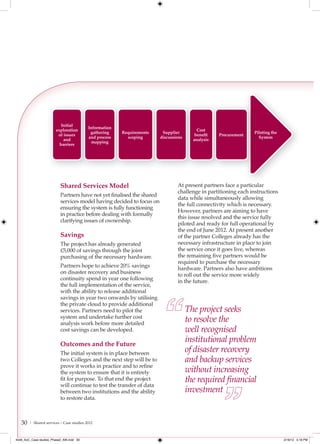
                                                                                This process is summarised in the
                      • lower cost for disaster recovery
                                                                                diagram on the next page.
                           and business continuity services
                           will be reduced;


                                                                                                     Shared services – Case studies 2012 |   29

4548_AoC_Case studies_Phase2_AW.indd 29                                                                                              2/16/12 5:18 PM
Initial
                                          Information
                        exploration                                                       Cost
                                           gathering    Requirements     Supplier                                Piloting the
                         of issues                                                       benefit    Procurement
                                          and process     scoping       discussions                                System
                            and                                                         analysis
                                            mapping
                          barriers


                           Shared Services Model                                At present partners face a particular
                                                                                challenge in partitioning each instructions
                           Partners have not yet finalised the shared
                                                                                data while simultaneously allowing
                           services model having decided to focus on
                                                                                the full connectivity which is necessary.
                           ensuring the system is fully functioning
                                                                                However, partners are aiming to have
                           in practice before dealing with formally
                                                                                this issue resolved and the service fully
                           clarifying issues of ownership.
                                                                                piloted and ready for full operational by
                                                                                the end of June 2012. At present another
                           Savings                                              of the partner Colleges already has the
                           The project has already generated                    necessary infrastructure in place to join
                           £5,000 of savings through the joint                  the service once it goes live, whereas
                           purchasing of the necessary hardware.                the remaining five partners would be
                                                                                required to purchase the necessary
                           Partners hope to achieve 20% savings                 hardware. Partners also have ambitions
                           on disaster recovery and business                    to roll out the service more widely
                           continuity spend in year one following               in the future.
                           the full implementation of the service,
                           with the ability to release additional
                           savings in year two onwards by utilising
                           the private cloud to provide additional
                           services. Partners need to pilot the                       The project seeks
                           system and undertake further cost
                           analysis work before more detailed
                                                                                      to resolve the
                           cost savings can be developed.                             well recognised
                           Outcomes and the Future
                                                                                      institutional problem
                           The initial system is in place between
                                                                                      of disaster recovery
                           two Colleges and the next step will be to                  and backup services
                           prove it works in practice and to refine
                           the system to ensure that it is entirely                   without increasing
                           fit for purpose. To that end the project                   the required financial
                           will continue to test the transfer of data
                           between two institutions and the ability                   investment
                           to restore data.


   30   | Shared services – Case studies 2012


4548_AoC_Case studies_Phase2_AW.indd 30                                                                                         2/16/12 5:18 PM
The project builds on                      there is a history
                               existing collaborative                     of collaboration in
                               agreements and                             developing systems for
                               identifies how shared                       the partnership
                               procurement of licences
                               and hardware across                        The project builds on
                               multiple organisations                     existing collaborative
                               can be addressed                           agreements and
                           Enablers
                                                                          identifies how shared
                           Key factors in the project’s development
                                                                          procurement of licences
                           have been:                                     and hardware across
                      • History of collaboration – as a result            multiple organisations
                           of the long term relationship between
                           partners there is a strong culture of trust    can be addressed
                           and a degree of consensus in terms of
                           the direction of travel for the institutions
                           involved. Partners also have specific          partners trust each
                           experience of working together around
                           shared ICT solutions;                          other, that’s very
                      • Existing collaborative infrastructure             important
                           – the presence of the Metropolitan Area
                           Network means that partners have an
                           existing shared infrastructure on which
                           the project can build;
                      • Evolution of the project – this project
                           sought to build on a pre-existing
                           direction of travel for collaboration
                           between the partners involved. As
                           a consequence partners had already
                           taken those important first steps in their
                           shared services journey before securing
                           AoC funding.


                                                                                      Shared services – Case studies 2012 |   31

4548_AoC_Case studies_Phase2_AW.indd 31                                                                               2/16/12 5:18 PM
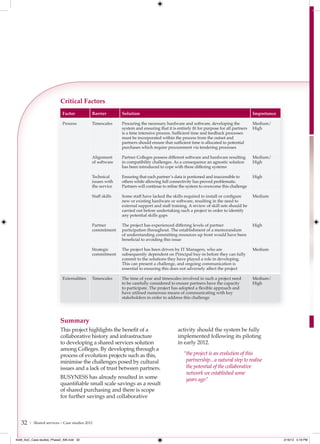
Critical Factors
                            Factor          Barrier        Solution                                                                   Importance

                            Process         Timescales     Procuring the necessary hardware and software, developing the              Medium/
                                                           system and ensuring that it is entirely fit for purpose for all partners   High
                                                           is a time intensive process. Sufficient time and feedback processes
                                                           must be incorporated within the process from the outset and
                                                           partners should ensure that sufficient time is allocated to potential
                                                           purchases which require procurement via tendering processes

                                            Alignment      Partner Colleges possess different software and hardware resulting         Medium/
                                            of software    in compatibility challenges. As a consequence an agnostic solution         High
                                                           has been introduced to cope with these differing systems

                                            Technical      Ensuring that each partner’s data is portioned and inaccessible to         High
                                            issues with    others while allowing full connectivity has proved problematic.
                                            the service    Partners will continue to refine the system to overcome this challenge

                                            Staff skills   Some staff have lacked the skills required to install or configure         Medium
                                                           new or existing hardware or software, resulting in the need to
                                                           external support and staff training. A review of skill sets should be
                                                           carried out before undertaking such a project in order to identify
                                                           any potential skills gaps

                                            Partner        The project has experienced differing levels of partner                    High
                                            commitment     participation throughout. The establishment of a memorandum
                                                           of understanding committing resources up front would have been
                                                           beneficial to avoiding this issue

                                            Strategic      The project has been driven by IT Managers, who are                        Medium
                                            commitment     subsequently dependent on Principal buy-in before they can fully
                                                           commit to the solutions they have played a role in developing.
                                                           This can present a challenge, and ongoing communication is
                                                           essential to ensuring this does not adversely affect the project

                            Externalities   Timescales     The time of year and timescales involved in such a project need            Medium/
                                                           to be carefully considered to ensure partners have the capacity            High
                                                           to participate. The project has adopted a flexible approach and
                                                           have utilised numerous means of communicating with key
                                                           stakeholders in order to address this challenge


                           Summary
                           This project highlights the benefit of a                        activity should the system be fully
                           collaborative history and infrastructure                        implemented following its piloting
                           to developing a shared services solution                        in early 2012.
                           among Colleges. By developing through a
                           process of evolution projects such as this,                        “the project is an evolution of this
                           minimise the challenges posed by cultural                           partnership... a natural step to realise
                           issues and a lack of trust between partners.                        the potential of the collaborative
                                                                                               network we established some
                           BUSYNESS has already resulted in some                               years ago”
                           quantifiable small scale savings as a result
                           of shared purchasing and there is scope
                           for further savings and collaborative


   32   | Shared services – Case studies 2012


4548_AoC_Case studies_Phase2_AW.indd 32                                                                                                            2/16/12 5:18 PM
Federation of Essex
                Colleges (FEDEC)
                Shared Services


                The Partners


4548_AoC_Case studies_Phase2_AW.indd 33   2/16/12 5:19 PM
Area of Focus
     The opportunity                              The project was broad-ranging, exploring the feasibility
                                                  of shared service options across a range of activities for
     of developing                                FEDEC members. While FEDEC has 12 members, the
                                                  initial focus for the work was to be on three Colleges,
     collaboration which                          South Essex, Colchester Institute and Writtle. Writtle
     produces excellence                          subsequently scaled down their involvement, although
                                                  Chelmsford has become more actively involved.
     and a distinctive                            The initial priorities were the functional areas of
     pattern of operation                         Finance and Payroll, Marketing, Human Resources
                                                  and Procurement. Information and Communications
     and provision, with                          Technology systems were included on the basis of their
                                                  capacity and potential to support development of these
     high value-added                             areas through shared services.
     and reputation.
                                                  Rationale
                                                  The project is designed to assess the optimal model for
                                                  providing Shared Services to FEDEC, with the potential
                                                  to offer these services to a broader market once it has
                                                  been successfully established.
                                                     “The extension of shared services … will be achieved best
                                                      through approaches which are concurrently systematic,
                                                      flexible and visionary”

                                                  Vision
                                                  The Project identified its broad aim as being to “assess
                                                  the optimal model for providing shared services to FEDEC”.
                                                  Full provision of a shared services function is intended
                                                  to come after a sequence of activities, as Colleges move
                                                  from exploration of feasibility to implementation, the
                                                  conversion of business plans into models and processes.

                                                  Objective
                                                  The objectives for the Project were:
                                                • To widen participation in shared services to a broader
                                                  market, with the intention of moving beyond education
                                                  providers and involving the NOVA Partnership (a
                                                  training provider partnership that includes South Essex
                                                  College); and
                                                • To achieve significant savings within a three year
                                                  horizon, estimated by the project manager to be of
                                                  the order of 30% on backroom services.


   34   | Shared services – Case studies 2012


4548_AoC_Case studies_Phase2_AW.indd 34                                                                          2/16/12 5:19 PM
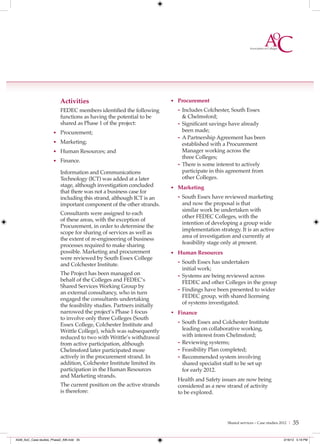
Activities                                    • Procurement
                           FEDEC members identified the following          - Includes Colchester, South Essex
                           functions as having the potential to be           & Chelmsford;
                           shared as Phase 1 of the project:               - Significant savings have already
                      • Procurement;                                         been made;
                                                                           - A Partnership Agreement has been
                      • Marketing;                                           established with a Procurement
                      • Human Resources; and                                 Manager working across the
                                                                             three Colleges;
                      • Finance.
                                                                           - There is some interest to actively
                           Information and Communications                    participate in this agreement from
                           Technology (ICT) was added at a later             other Colleges.
                           stage, although investigation concluded       • Marketing
                           that there was not a business case for
                           including this strand, although ICT is an       - South Essex have reviewed marketing
                           important component of the other strands.        and now the proposal is that
                                                                            similar work be undertaken with
                           Consultants were assigned to each
                                                                            other FEDEC Colleges, with the
                           of these areas, with the exception of
                                                                            intention of developing a group wide
                           Procurement, in order to determine the
                                                                            implementation strategy. It is an active
                           scope for sharing of services as well as
                                                                            area of investigation and currently at
                           the extent of re-engineering of business
                           processes required to make sharing               feasibility stage only at present.
                           possible. Marketing and procurement           • Human Resources
                           were reviewed by South Essex College
                           and Colchester Institute.                       - South Essex has undertaken
                                                                             initial work;
                           The Project has been managed on                 - Systems are being reviewed across
                           behalf of the Colleges and FEDEC’s                FEDEC and other Colleges in the group
                           Shared Services Working Group by
                           an external consultancy, who in turn
                                                                           - Findings have been presented to wider
                                                                             FEDEC group, with shared licensing
                           engaged the consultants undertaking
                                                                             of systems investigated.
                           the feasibility studies. Partners initially
                           narrowed the project’s Phase 1 focus          • Finance
                           to involve only three Colleges (South
                           Essex College, Colchester Institute and         - South Essex and Colchester Institute
                           Writtle College), which was subsequently          leading on collaborative working,
                           reduced to two with Writtle’s withdrawal          with interest from Chelmsford;
                           from active participation, although             - Reviewing systems;
                           Chelmsford later participated more              - Feasibility Plan completed;
                           actively in the procurement strand. In          - Recommended system involving
                           addition, Colchester Institute limited its        shared specialist staff to be set up
                           participation in the Human Resources              for early 2012.
                           and Marketing strands.
                                                                           Health and Safety issues are now being
                           The current position on the active strands      considered as a new strand of activity
                           is therefore:                                   to be explored.


                                                                                                 Shared services – Case studies 2012 |   35

4548_AoC_Case studies_Phase2_AW.indd 35                                                                                          2/16/12 5:19 PM
Model                                             …the approach to
                           The Project reviewed a number
                           of approaches, comprising:
                                                                             shared services can
                      • a corporate, stand alone central body
                                                                             begin to emphasise the
                           purchasing services and leasing or                potential for revenue
                           selling these to participating Colleges;
                                                                             generation, as has
                      • an inter-College approach, involving
                           shared specialist staff. Although a               happened significantly
                           shared set of activities, this would
                           possibly require one College to act
                                                                             in other areas of the UK
                           as the lead body;
                      • informal joint initiatives, for                   Outcomes and the Future
                           activities which were neither constant
                           nor recurring.                                    “The success of shared services change
                                                                              management will be measured by the
                           For some partners the ultimate goal is
                                                                              following outcomes: Disruption to the
                           a Shared Services Consortium within
                                                                              organisation… is kept to a minimum;
                           FEDEC, where participating Colleges are
                                                                              People… are guided through the
                           the shareholders and share cost, however,
                           there remains some distance to travel.             change to the shared services
                                                                              organisation; and The right kind
                                                                              of leadership (is) established”
                           Savings
                           The project has achieved significant           The priorities for Phase Two depend on
                           savings in South Essex College and             a set of decisions being made by FEDEC
                           Colchester Institute, at an early stage:       over development of the project. The
                                                                          priorities include:
                      • Procurement
                                                                        • Developing the Procurement strand;
                           - Savings were achieved immediately
                             through being able to reduce staff costs   • Developing business cases across the
                             by £40,000;                                  other strands of activity;
                           - Other savings through joint procurement    • Widening participation in the first
                             activities between most notably on           round of shared service areas;
                             energy costs, have already saved
                             £242,000, with an additional £495,000      • Identifying new areas for Feasibility
                             anticipated over the next year,              Studies;
                             primarily from print hardware, waste       • Development of a vision for FEDEC
                             management, and communications; and          which emphasises shared services but is
                      • Human Resources                                   also a message about excellence, branding
                                                                          and the future potential to create an
                           - Software solutions for Managed               “Essex System”; and
                             Recruitment are anticipated to achieve
                             £50,000 savings over the coming year.      • Incorporating new intelligence and
                                                                          legal opinion about VAT Liability and
                           More extensive savings are anticipated         the characteristics and advantages of
                           as other Colleges participate in the           Constitutional and Corporate Models.
                           procurement vehicle.


   36   | Shared services – Case studies 2012


4548_AoC_Case studies_Phase2_AW.indd 36                                                                               2/16/12 5:19 PM
Enablers                                      Flexibility (is)
                           The key enablers for the project have been:
                                                                         demonstrated through
                      • A pre-existing federation that provided
                           a basis for joint working;                    having different modes
                      • The involvement of external assistance in        of engagement for
                           project management and in undertaking         Colleges: allowing
                           feasibility studies, in order to provide
                           momentum to the project;                      Colleges to feel
                      • Active leadership by a small number              comfortable with rather
                           of Colleges who have taken clear and
                           unambiguous ownership over developing
                                                                         than constrained by
                           strands, notably in procurement;              participation
                      • The implementation of a systematic
                           approach, based on an initial assessment
                           of current practice and the capturing of
                           measurable outcomes in terms of cost and
                           savings; and
                      • A flexible approach that has allowed for
                           differing levels of participation across
                           FEDEC’s membership, so that those
                           most committed to development can
                           actively take interventions forward,
                           demonstrating the potential gains to
                           be achieved.


                                                                                     Shared services – Case studies 2012 |   37

4548_AoC_Case studies_Phase2_AW.indd 37                                                                              2/16/12 5:19 PM
Critical Factors

                            Factor              Barrier                               Solution                                       Importance

                            Leadership &        The time to get the concept of        Establish pilot and working groups well        Medium/
                            Governance          sharing across and bringing           in advance of project to enable cultural       High
                                                Colleges together. Also needs to      embedding of cooperation.
                                                acknowledge the scheduling of         Plan project meetings to include Governors
                                                Governors’ meetings

                                                The withdrawal of some Colleges       Attempt to build in systems that encourage     Medium
                                                from participation creates            continuing participation of stakeholders
                                                imbalance and temporary               even if this is at a lower level than
                                                loss of momentum                      originally anticipated

                            Culture &           Across the external consultants       Ensure that an effective communications        High
                            Climate             there were issues of access to key    plan is embedded within the project, so that
                                                College staff and also of awareness   stakeholders at all levels are aware of its
                                                by staff of the project aims.         processes and aims

                            Process             Time slippage                         When writing the project plan there is a       High
                                                                                      need to allow for catch-up time even if this
                                                                                      appears to be against the ethos of a smooth
                                                                                      and efficiently delivered project


                           Summary
                                                                                                 …a shared service
                           The project set itself an ambitious
                                                                                                 should not be rolled
                           set of objectives across a wide range                                 out with a ‘big bang’
                           of partners and activity areas. The
                           implementation of project activity is                                 approach, where
                           therefore incremental, as one would                                   the entire scope is
                           expect in a project of this scale.
                           The initial successes, notably in
                                                                                                 implemented at once,
                           procurement, have been achieved where                                 but rather is divided
                           a small number of Colleges have worked
                           closely together in an area of shared
                                                                                                 up into different
                           interest. This collaborative working                                  phases with different
                           can demonstrate benefits to a wider
                           stakeholder audience, and ultimately                                  capabilities and
                           increase participation and savings.                                   functions implemented
                                                                                                 at each phase


   38   | Shared services – Case studies 2012


4548_AoC_Case studies_Phase2_AW.indd 38                                                                                                           2/16/12 5:19 PM
Shire Shared Services


                The Partners


                While leaders from each of the Colleges regularly network there is a limited
                background of collaborative working across all partner organisations.


4548_AoC_Case studies_Phase2_AW.indd 39                                                        2/16/12 5:19 PM
Areas of Focus
     a gradual exploration                        The project is focused on the following three areas:

     of the integration of                      • The Virtual learning environment (VLE);
                                                • Continuous professional development (CPD);
     services in a phased                       • Procurement of goods and services.
     manner, allowing
     members to move on
     as confidence in the                             the areas chosen are relatively
     sharing of expertise                            easy to share
     and of services is
     increased                                       partners had different views on
                                                     what was interesting for them

                                                  Rationale
                                                  In order to drive improvement, respond to budget
                                                  pressures and protect as many front-line services as
                                                  possible the Shire Shared Services project sought to
                                                  enable partners to build on their linkages and explore
                                                  the potential for partners to move towards greater
                                                  collaboration and the sharing of back office functions
                                                  and expertise.

                                                  Vision
                                                  The creation of a membership organisation that promotes
                                                  openness, co-operation and sharing of costs and expertise
                                                  between member Colleges, and allows them to deliver
                                                  services at a lower cost than would have been possible by
                                                  them working independently. By bringing partner Colleges
                                                  closer together, it is hoped that Shire Shared Services will
                                                  become a champion for the values and benefits of further
                                                  education across Worcester and Herefordshire.


   40   | Shared services – Case studies 2012


4548_AoC_Case studies_Phase2_AW.indd 40                                                                          2/16/12 5:19 PM
driving improvement                       Activities
                               was the main thrust of                    Substantial discussions have been held
                                                                         regarding the nature of the services to
                               the project                               be shared. Some partners are reluctant
                                                                         to move towards a fully formal shared
                                                                         services model. Therefore an incremental
                                                                         approach has been adopted through
                           Objectives                                    which partners will initially adopt an
                           Partners have identified the following        informal approach with sharing activities
                           anticipated benefits for partner              initially focused on less threatening
                           institutions:                                 CPD, VLE and the procurement of some
                                                                         goods and services. Attitudes, barriers
                      • A membership organisation within which
                                                                         and opportunities for collaboration
                           to realise the efficiency gains inherent in
                                                                         and cost savings through shared CDP
                           sharing services;                             and VLE have been explored with all
                      • A shared vision and business case to             partners. Implementation activity is now
                           guide future activities;                      being taken forward within these two
                                                                         workstreams. Scoping activity is still
                      • Reduced expenditure in each of the
                                                                         being undertaken within the procurement
                           areas of focus;
                                                                         workstream, with activity focusing
                      • Reduced ‘time to market’ for VLE                 on determining savings that could be
                           developments.                                 generated through shared IT purchasing
                                                                         and other high value areas of expenditure.
                      • Sharing and development of best
                           practice in the areas of focus.
                                                                         Model
                                                                         Partners have agreed a more informal
                                                                         approach based on trust with VLE
                                                                         and CPD services to be delivered
                               it’s about sharing costs                  and exchanged between partners on
                               and expertise                             an in-kind basis. It is hoped that the
                                                                         adoption of such a flexible approach
                                                                         will represent an important first step
                                                                         in the implementation of a long term
                                                                         shared services journey among partners.


                                                                                              Shared services – Case studies 2012 |   41

4548_AoC_Case studies_Phase2_AW.indd 41                                                                                       2/16/12 5:19 PM
keen to develop a                Outcomes and the Future
                               structure that partners          The proposed approach has been
                                                                designed to enable partners to build
                               are able to dip in and           on current informal partnership
                                                                arrangements by initially moving
                               out of at will rather            towards a slightly more formal
                               than a more formal               ‘membership’ structure, through which
                                                                they will be able to trial the sharing of
                               process or structure             services in the three areas described
                                                                above. It is anticipated that this approach
                                                                will build mutual confidence in
                                                                collaborative working and the sharing
                                                                of services which in turn may lead to
                           Savings                              the gradual integration of services in a
                           The Business Case for the project    phased manner.
                           highlights the following potential
                           cost savings to July 2014:
                      • £60,000 saved per annum through            process has caused
                           joint purchasing;
                                                                   us to reflect on our
                      • £20,000 saved per annum through
                           joint development of VLEs;              strategic approach
                      • £15,000 saved per annum through            moving forward
                           reduced duplication of CPD.
                                                                In terms of implementation partners
                                                                are sharing 30 VLE courses from
                                                                January 2012 and three major shared
                               not just about the               CPD events are being run between
                                                                January 2012 and July 2012.
                               money...being able to            While partners are clearly committed to
                               trade skills will be very        the sharing of CPD and VLE activities,
                               valuable to our College          in particular, the future and extension of
                                                                sharing to further functions and through
                                                                more formal structures remains uncertain.


                                                                   get on pretty well and
                                                                   working together eased
                                                                   the process


   42   | Shared services – Case studies 2012


4548_AoC_Case studies_Phase2_AW.indd 42                                                                       2/16/12 5:19 PM
Enablers                                     external expertise is
                           Key factors in the project’s development
                           have been:
                                                                        essential to enable
                      • Additionality of FE Efficiency
                                                                        partners to more
                           Innovation Fund – the provision of           readily identify
                           funding to enable partners to “dip their
                           toe in the water” and explore the shared     benefits and move
                           services agenda.                             from generalisations to
                      • Flexible approach – the adoption of
                           a flexible, pragmatic and incremental
                                                                        practicalities
                           approach to sharing that has ensured
                           that partners concerned about sharing
                           through formal federal structures remain
                           engaged and committed to exploring the
                           potential of shared services.
                      • External support – The utilisation
                           of external support. In particular the use
                           of an ex-Principal of one the Colleges
                           who is independent of the partner
                           organisations but has the “personal
                           respect” of each Principal was identified
                           as particularly valuable.
                      • Existing relationships – The pre-existence
                           of an informal discussion network of
                           Principals of the participating College’s.


                                                                                    Shared services – Case studies 2012 |   43

4548_AoC_Case studies_Phase2_AW.indd 43                                                                             2/16/12 5:19 PM
Critical Factors

                            Factor              Barrier          Solution                                                         Importance

                            Leadership &        Lack of          It has been proposed that Governors should be provided with      High
                            Governance          Governor         guidance on how to challenge and drive this agenda
                                                involvement

                            Culture &           Trust issues     Some partners are nervous about the motivations of partners
                            Climate                              and the potential threat to their autonomy. Partners have
                                                                 sought to build trust and have adopted an incremental
                                                                 approach to sharing to address this

                            Process             Time             Smaller Colleges in particular have capacity issues. Utilising   High
                                                commitment       external consultants has been one way the group has sought to
                                                                 address this

                                                Number           It has been suggested that starting a shared services journey    Medium/
                                                of partners      should involve less partners                                     High
                                                involved

                            Externalities       Sector Climate   Some partners may be more focused on addressing funding          High
                                                                 cuts through other means. Need to ensure that the benefits and
                                                                 potential of this approach are communicated effectively


                           Summary
                           This project highlights the importance                             hopefully it will wet
                           of lead times in building relationships
                           and trust and the need for a flexible and
                                                                                              the appetite for further
                           pragmatic approach where partners may                              sharing in the future
                           share different priorities and desires.
                           As a number of partners are presently
                           reluctant to move towards a formal
                           shared services model, this project
                           and the shared services journey is
                           being taken forward on an incremental
                           basis with partners initially exploring
                           shared services through more informal
                           structures and processes.


   44   | Shared services – Case studies 2012


4548_AoC_Case studies_Phase2_AW.indd 44                                                                                                        2/16/12 5:19 PM
Wessex Colleges
                Federation


                The Partners


                These Colleges cover a relatively wide geographical area and while the Colleges involved in this
                partnership do not have a shared history of collaboration there are previous linkages which the project
                has sought to build on, with Principals from three of the Colleges having previously worked together.


4548_AoC_Case studies_Phase2_AW.indd 45                                                                              2/16/12 5:19 PM
Areas of Focus
     [the project is                              The project has focused on a wide range of activities.
                                                  This has included exploring and testing contractually
     about] Shared and                            based federation models for services across the
                                                  following five workstreams:
     coordinated strategic
                                                • New income streams – including exploring the
     thinking and                                 development of a single partnership approach to
     innovation across the                        marketing, Higher Education provision; international
                                                  students and engaging the top twenty commercial
     Wessex Colleges                              organisations in the region;
                                                • Learner facing activity – including exploring
                                                  opportunities for cost and efficiency improvements
                                                  through shared assessment, examinations, travel and
                                                  transport, libraries and teacher deployment;
                                                • Non-learner facing (back office) activity – including
                                                  HR, payroll and finance, MIS, IT support, training,
                                                  health & safety, catering, registration and legal;
                                                • Employability – increasing the employability
                                                  of students; and
                                                • Standards – raising standards of teaching and
                                                  learning across the region.


                                                  Rationale
                                                  The Wessex Colleges Federation project seeks to enhance
                                                  the resilience of all partner Colleges by exploring
                                                  a multifaceted approach to shared services which
                                                  simultaneously seeks to drive growth and open up new
                                                  opportunities while reducing inefficiencies and driving
                                                  improvement in existing services. Therefore, while
                                                  decreasing resources is a context common to all Colleges,
                                                  the need to realise efficiencies through reduced costs is
                                                  only one of the drivers of activity being taken forward
                                                  within this project, with partners seeking to explore the
                                                  potential for growth and development through the
                                                  greater critical mass that sharing offers.

                                                  Vision
                                                  The project Business Case outlines the following target
                                                  end state for the Wessex Federation project:
                                                • shared and coordinated strategic thinking and innovation
                                                  across the Colleges;
                                                • shared or jointly outsourced support services potentially
                                                  saving up to £1M a year;

   46   | Shared services – Case studies 2012


4548_AoC_Case studies_Phase2_AW.indd 46                                                                       2/16/12 5:19 PM
• a regional centre of excellence for             Activities
                           embedding the very highest standards of
                                                                        The project has incorporated the
                           teaching and learning whilst driving out
                                                                        following core activities:
                           all forms of ‘satisfactory’;
                                                                      • Exploratory meetings within each of
                      • Highly effective and cross College use
                                                                        the five partner Colleges, which involved
                           of emerging learning technologies;
                                                                        discussing and agreeing partner
                      • Development of ‘world class’ student            expectations and vision for the future,
                           employability based on comprehensive         core objectives and the scope of the project;
                           and insightful ‘destination’ data;
                                                                      • Functions and process mapping activity
                      • New and sustainable Wessex-wide                 focused on mapping and analysing
                           income streams from international            current approaches, processes and
                           students, higher education and the           resources for each of the five key areas of
                           targeting of the largest employers           focus described above;
                           across the region;
                                                                      • Planning and “mobilisation” workshops
                      • Joining up vital learner facing areas           to analyse evidence, discuss and identify
                           to achieve major quality and capacity        options and agree the way forward; and
                           improvements and in other cases
                                                                      • Development of a business case and
                           realising major savings; and
                                                                        prioritised actions and opportunities.
                      • Maximum use of self serve and
                           customer enabling to reduce or               Following agreement of the Outline
                           avoid unnecessary activity.                  Business Case partners are currently
                                                                        establishing a series of workstream
                                                                        blueprints which will outline the
                           Objectives
                                                                        way forward and are expected to be
                           The ultimate objectives of this project      completed by February 2012.
                           are to develop:
                      • High quality and employable students;           Shared Services Models
                      • New income and savings;                         Given the wide scope of services and
                                                                        activities being considered for sharing
                      • Energised staff who feel secure and
                                                                        within this project a single federal
                           excited about the future;                    structure between the five partners
                      • Senior staff who recognise the benefits         is likely to be too rigid an approach.
                           of mutual support, knowledge transfer        Consequently, partners require and are
                           and innovation;                              seeking to take forward a more agile
                                                                        and flexible federation which involves a
                      • A national and international reputation
                                                                        range of shared services models which
                           for high standards and innovation; and       have been tailored specifically to the
                      • Employers know they get a world                 requirements of partners for each service
                           class offer that helps them build            or activity. Such an approach will enable
                           business profitability.                      partners to opt into sharing the services
                                                                        and functions that they feel are most
                                                                        appropriate for their own circumstances.


                                                                                              Shared services – Case studies 2012 |   47

4548_AoC_Case studies_Phase2_AW.indd 47                                                                                       2/16/12 5:19 PM
While shared services models have been          It should be noted that a number of the
                           explored throughout the project these           cost savings are based on a uniform
                           will not be agreed until discussions are        10% saving on the total current cost of
                           held on the service blueprints that are         activities/services rather than specific
                           currently being produced.                       detailed financial modelling which
                           However, while the models to be utilised        partners will undertake in the future.
                           across the partnership are yet to be
                           agreed two of the partner Colleges are in
                           the process of moving towards a statutory
                                                                           Outcomes and the Future
                           soft federation through which they will         Partners have identified a series of
                           share their management team but retain          long term, medium term and immediate
                           their separate governing bodies. Partners       activities to take forward the shared
                           suggest that this has occurred as a result      services agenda. At present some
                           of discussions held and relationships           immediate activities focusing on the
                           developed through this project.                 exchange of best practice and sharing
                                                                           smaller scale contracts are being taken
                                                                           forward around HR, procurement and
                               The ultimate solution                       exams. In addition partners are also
                                                                           currently facilitating the sharing of the
                               will involve a range of                     expertise of their advanced practitioners
                                                                           in order to drive improvement in
                               elements of federation                      provision with activity also ongoing
                               tailored to the specific                     around the coordination of employer
                                                                           engagement activities and employability
                               requirements of each                        skills. However, detailed planning and
                               challenge                                   development activity is still ongoing
                                                                           around more complex medium and
                                                                           longer term activities. Therefore the full
                           Savings                                         scope of the outcomes from this project
                                                                           is still to be determined.
                           As described in the “activities” section
                           above, partners still have to finalise the
                           detail of the specific activities to be taken
                           forward and shared services solutions to
                           be implemented. Therefore full savings
                           projections have not yet been calculated.
                           However, project partners have provided
                                                                              activities around
                           the following projections:                         quality improvement,
                      • Savings to date – £260,000;                           sharing best practice,
                      • Total savings due by end of 2011/12                   employer engagement
                           – £550,000; and
                                                                              and HE are moving on
                      • Additional savings by the end of 2012/12
                           – £1,024,000.                                      at pace


   48   | Shared services – Case studies 2012


4548_AoC_Case studies_Phase2_AW.indd 48                                                                                 2/16/12 5:19 PM
Enablers                                      we have had full buy-in
                           Key factors in the project’s development
                           have been:
                                                                         and commitment from
                      • Strategic level buy-in – Principals have
                                                                         all Principals upfront
                           played an important role driving this
                           project with partners suggesting that their
                           initial buy-in and ongoing commitment         the geographical spread
                           has been a key enabler to the project’s
                           development;                                  of partners means that
                      • Geographic spread of partners                    competition is less of
                           – the fact that the Colleges are relatively   an issue than it would
                           geographically spread means there is less
                           direct competition between the Colleges       be elsewhere
                           in this partnership than can be present
                           among Colleges in closer proximity. This
                           has enabled partners to develop a culture
                           of trust more rapidly than may have
                                                                         AoC funding was
                           otherwise been the case;                      the catalyst for the
                      • Professional linkages – three of                 project...it wouldn’t
                           the Principals have experience of
                           working together in the same institution
                                                                         have happened
                           and this eases some of the personal           otherwise...it gave us
                           challenges that can often negatively
                           affect shared services projects;              the capacity to do it
                      • Additionality of FE Efficiency
                           Innovation Fund – partners see the
                           Fund as a real catalyst behind the            we are trying to
                           project, giving them the resources and a      be very ambitious
                           framework in which to explore sharing a
                           range of services. Consequently partners      but challenges come
                           suggest that it is unlikely that such         with that
                           activity have happened otherwise due
                           to the lack of any historical collaboration
                           between the partners. This funding
                           enabled the project to be driven by
                           a dedicated resource through a paid
                           external consultant which gave the
                           additional capacity and focused resource
                           that is essential to ensuring any project
                           maintains its momentum.


                                                                                      Shared services – Case studies 2012 |   49

4548_AoC_Case studies_Phase2_AW.indd 49                                                                               2/16/12 5:19 PM
Critical Factors
                            Factor              Barrier            Solution                                                            Importance

                            Culture &           Differing levels   Each College has their own individual priorities in terms           High
                            Climate             of priority        of the service areas they are looking to share as well as
                                                                   the important that they place on developing shared services.
                                                                   For example, some partners have recently generated
                                                                   significant back office savings and as such the need to drive
                                                                   this agenda is not as pressing as for those that have not already
                                                                   done this. As a consequence the project has provided partners
                                                                   with the flexibility to opt-in or out of activity around different
                                                                   service areas

                            Process             Timescales         Undertaking such a feasibility study and developing plans for       High
                                                and time           activity moving forward is an incredibly time consuming and
                                                commitments        complex process which requires considerable commitment
                                                                   and dedicated resources. Consequently partners needed an
                                                                   independent dedicated resource to drive the project and a
                                                                   flexible approach

                                                Scope of the       The wide scope of the project added significantly to the            Medium/
                                                project            workload and resource required to take the project forward.         High
                                                                   Consequently the scope of activity has been refined throughout
                                                                   the project

                            Externalities       Partner            Partners are tied into existing contracts which prevent them        Medium
                                                Commitments        from taking forward the optimal shared services solution.
                                                                   Partners have had to be flexible in their approach by refining
                                                                   the scope of the project and providing opportunities to opt in
                                                                   or out of planned activity


                           Summary
                           This project highlights the importance                            partners separate to the overall group.
                           of a dedicated resource to drive the                              The development of a soft federation
                           project and upfront commitment from                               between two of the partner Colleges is
                           the leaders of partner Colleges. It also                          the clearest example of this.
                           highlights the fact that working with
                           Colleges across a wider geography
                           can prove beneficial to exploring and
                           developing shared services as this can
                           minimise the barriers and challenges
                           caused by competition and subsequent
                           issues of trust.
                           The Innovation Fund intervention
                                                                                                       For further information:                 i
                           has acted as an important catalyst
                           for the project and has facilitated                                        The Shared Services Team
                           the development and strengthening                                          Association of Colleges
                           relationships between participants,                                        Email: sharedservices@aoc.co.uk
                           resulting in some spin-off collaborative                                   Visit ‘Shared Services’ under
                           activity that is being taken forward by                                    ‘Policy and Advice’ at www.aoc.
                                                                                                      co.uk/en/policy-and-advice/
                                                                                                      shared-services

   50   | Shared services – Case studies 2011


4548_AoC_Case studies_Phase2_AW.indd 50                                                                                                             2/16/12 5:19 PM
Contact us

                      National Office                   Regional Offices                       AoC East (ACER)
                      AoC National Office               AoC North West                        Suite 1
                      No. 1 and 2-5 Stedham Place      Suite 2 Peter’s Court                 Lancaster House
                      off New Oxford Street            Peter Street                          Meadow Lane
                      London WC1A 1HU                  Chorley                               St Ives
                                                       Lancashire PR7 2RP                    Cambridgeshire PE27 4LG
                      We are open                      Tel: 01257 279 791                    Tel: 01480 468 198
                      8.30am-5.30pm weekdays.          Fax: 01257 261 370                    Fax: 01480 468 601
                                                       Regional Director: Tony Watmough      Regional Director: Andrew
                      Please feel free to drop in if                                         Thomson
                      you are in London.               AoC North
                                                       Room 126 Regus House                  AoC South East (AOSEC)
                      Tel: 020 7034 9900               4 Admiral Way                         c/o Bracknell & Wokingham College
                      Fax: 020 7034 9950               Doxford International Business Park   Church Road
                                                       Sunderland SR3 3XW                    Bracknell
                                                       Tel: 0191 501 8035                    Berkshire RG12 1DJ
                                                       Regional Director: Alan Dixon         Tel: 0118 3782 523
                                                                                             Regional Director: Janet Edrich
                                                       AoC Yorkshire and the Humber
                                                       4 Crown Yard                          AoC South West
                                                       Southgate                             The Exchange
                                                       Elland HX5 0DQ                        Express Park
                                                       Tel: 01422 311 300                    Bristol Road
                                                       Fax: 01422 377 633                    Bridgwater
                                                       Regional Director: Caroline Rowley    Somerset TA6 4RR
                                                                                             Tel: 0845 130 2562
                                                       AoC West Midlands                     Fax: 01278 445 750
                                                       Wolverhampton Science Park            Regional Director: Ian Munro
                                                       Glaisher Drive
                                                       Wolverhampton WV10 9RU                AoC London
                                                       Tel: 01902 824 399                    Ground Floor
                                                       Fax: 01902 824 397                    2–5 Stedham Place
                                                       Regional Director: Steve Sawbridge    London WC1A 1HU
                                                                                             Tel: 020 7034 9900
                                                       AoC East Midlands (EMFEC)             Fax: 020 7034 9950
                                                       Robins Wood House                     Regional Director: Kate Anderson
                                                       Robins Wood Road
                                                       Aspley
                                                       Nottingham NG8 3NH
                                                       Tel: 0115 854 1628
                                                       Fax: 0115 854 1617
                                                       Regional Director: Paul Eeles


4548_AoC_Case studies_Phase2_AW.indd 51                                                                                         2/16/12 5:19 PM
Association of Colleges           Designed by Bentley Holland
                      2-5 Stedham Place                 www.bentleyholland.co.uk
                      London
                      WC1A 1HU                          With thanks to all project
                      Telephone: 020 7034 9900          partners who contributed to
                      Facsimile: 020 7034 9950          the development of these case
                      Email: sharedservices@aoc.co.uk   studies and Lesley Templeman
                                                        Project Manager – Shared Services
                      Or visit our web site             Efficiency Projects at the AoC.
                      www.aoc.co.uk/en/policy-and-
                      advice/shared-services


4548_AoC_Case studies_Phase2_AW.indd 52                                                     2/16/12 5:19 PM

Case Studies Phase 2

  • 1.
    Shared services – Case studies 2012 4548_AoC_Case studies_Phase2_AW.indd 1 2/16/12 5:17 PM
  • 2.
    Contents 03 West Yorkshire Consortium of Colleges Led by Calderdale College 09 Developing Soft Federation Services Led by Epping Forest College 15 College Qualification Project Led by North Herts College 21 Efficiency in Recruitment in Colleges (ERIC) National Led by Plumpton College 27 BUSYNESS – Building a South Yorkshire Network to Enable Shared Services Led by Rotherham College 33 Federation of Essex Colleges (FEDEC) Shared Services Led by South Essex College 39 Shire Shared Services Led by Worcester College of Technology 45 Wessex Colleges Federation Led by Yeovil College 4548_AoC_Case studies_Phase2_AW.indd 2 2/16/12 5:17 PM
  • 3.
    West Yorkshire Consortium of Colleges The Partners 4548_AoC_Case studies_Phase2_AW.indd 3 2/16/12 5:17 PM
  • 4.
    Areas of Focus There is a strong The project took as its starting point a review of the activities of West Yorkshire Consortium of Colleges (belief) that this will (WYCC), with a view to identifying collaborative ways forward. This led to the development of two focus areas, create… efficiency in arising from an initial scoping exercise undertaken by the Leeds region external consultants. These are: • Joint exam procurement; and • The development of a strategic working relationship with Leeds City Region Local Enterprise Partnership (LEP). Rationale WYCC was established 10 years ago as a sub-regional network of Colleges. This partnership has been retained, and its focus has developed to working collectively with partners to improve the skills and training offer in the Leeds City Region in order to drive up the economy of the region. The project has been used to develop models and agreements which build upon the good practice and shared working developed through WYCC in order to respond efficiently and effectively to the needs of the City Region. Need to bring employers and providers together Vision Specifically, the project aimed to identify: • Quick wins – through which the advantages of shared service activities could be demonstrated; and • Strategic interventions – through which WYCC can work with regional partners in delivering effective services to learners and employers within its locality. These collaborations aim to support WYCC members in meeting current and future demands in terms of skill need across the Leeds City Region and offer opportunities for more cost-effective working. 4 | Shared services – Case studies 2012 4548_AoC_Case studies_Phase2_AW.indd 4 2/16/12 5:17 PM
  • 5.
    Objective • Develop a business case that outlines the commercial rationale, collaborative model This project assists the Colleges in West merits and high level plan to implement Yorkshire to further develop their existing the next stages of the preferred partnership and explore models of collaborative option(s). formalisation of good practice to secure efficiencies and service improvements for This process led to the identification of the Colleges and the Leeds City Region LEP. two activity areas which were carried From the point of view of LEP forward to Phase 2: collaboration, it aims to develop practical 1. A strategic, medium/long term approach, and relevant solutions to improve the offer looking at the framework to intervene and delivery of skills through framework in a number of areas, developing the development. These options will then be existing WYCC structure to engage with developed into delivery models which the emerging LEP network, with the aim will scope the structure of the organisation needed for delivery, examine the financial of developing larger scale interventions. implications and determine the legal and 2. Focusing on short term benefits on areas governance issues. of commonality, starting with exam The exam procurement strand builds procurement. on work that has been undertaken by Phase 2 the AoC Finance Directors’ network, which includes participation by WYCC LEP engagement: This has now become member Colleges. the primary focus for the project. All WYCC member Colleges have signed a Activities Partnership Agreement with the LEP’s Employment and Skills Board (ESB), The project included two phases: as part of the Leeds City Region Skills Phase 1 Network, with WYCC’s chair sitting on the ESB. Phase 1 was contracted to external consultants, who were asked to: The objectives of the agreement are to: • Confirm the scope and outline of the • drive up skills and employment levels WYCC ambition for future potential in Leeds City Region particularly in collaborations; those sectors critical to the growth of the economy; • Test the feasibility of potential collaborations against a number of factors • increase employer and individuals’ including: governance, finance, corporate engagement and investment in skills; structure, competitive advantage and • support individuals to gain sustainable market penetration/growth, legal employment by improving employability, implications, costs and benefits; basic skills (especially maths, English and • Confirm the range and nature of possible ESOL) and enterprising attitudes; and options for WYCC collaborations, both • strengthen joint working between now and for the future; employers, the LEP/ESB, skills • Test the possible options and engage networks, Colleges and other skills WYCC and Colleges to confirm the providers to improve the effectiveness preferred option(s); and of skills investment. Shared services – Case studies 2012 | 5 4548_AoC_Case studies_Phase2_AW.indd 5 2/16/12 5:17 PM
  • 6.
    A project officerhas been recruited to the project to assist in the developing great example of joint sustainable working relationships working that I hope between the partner Colleges as well as supporting emerging developments with other LEPS will follow the LEP. Activities have included building relationships with employers, running events to promote opportunities in Geoff Russell, Chief Executive of the growth areas, such as a “Green Jobs” Skills Funding Agency event and setting up sector focus groups. Exam procurement: Work has been undertaken on looking at joint awarding bodies’ aggregation and price/service negotiation, linked with national work I am pleased to being co-ordinated by AoC, and an Exam Officers’ group has now been established report that further for the City Region. education Colleges In addition, other areas of sharing are still being explored by members of the group are already playing including finance and human resources. a role with local enterprise partnerships Model WYCC have a pre-existing collaborative in the north-east model as a company limited by guarantee and elsewhere. In with each College Principal being a company director. There is a company Yorkshire, the Leeds secretary appointed by one of the city region held its first member Colleges and the accounts are audited by external auditors each year. skills conference with There is a member of staff who works for the West Yorkshire the consortium to manage and oversee its affairs, the Consortium Manager Consortium of Colleges reports directly to the WYCC board. The formation of the Skills Network and it is now setting has attracted positive recognition and up its own skills publicity from a number of key figures. network The project is being used to examine whether the existing structure can be used more effectively in the interests Mark Prisk, Minister of State, of its member Colleges. Department for Business, Innovation and Skills 6 | Shared services – Case studies 2012 4548_AoC_Case studies_Phase2_AW.indd 6 2/16/12 5:17 PM
  • 7.
    Savings Enablers The partners project that the from late The following factors have been 2012, annual savings will be made in important in taking forward the project: the following areas, although detailed • The existing long-term relationship quantification is not available: between the Colleges as members • Marketing £50,000; of WYCC; • Procurement £70,000; and • Initial analysis by an external consultant • Efficiency gains in LEP £100,000. assisted WYCC members to focus on potential developments; • Having the resources to engage with Outcomes and the Future strategic partners at a regional level is The project has been used to position enabling the co-ordination of the further WYCC for future shared opportunities, education offer in an effective manner; and shared information and intelligence for • National level work on exam the City Region, capturing the economic procurement has underpinned the skills and related data and providing a local activities in this area of work. shared strategic perspective to inform joint planning and College-specific planning. Further work is being undertaken on collaboration with the LEP Employment and Skills Board to strengthen the offer …positive on employer engagement activity, through closer working arrangements relationships have with other skills providers and developed (between identifying good practice. ESB and Colleges) WYCC is also establishing self-sustaining Exam Officers’ Network to help drive forward common approaches. WYCC was instrumental in establishing the Skills Network Shared services – Case studies 2012 | 7 4548_AoC_Case studies_Phase2_AW.indd 7 2/16/12 5:17 PM
  • 8.
    Critical Factors Factor Barrier Solution Importance Leadership & Leadership Teams need to own this agenda Need to spend time with Principals Medium Governance for it to have impact and leadership teams to get buy in Establishing a common understanding An incremental approach and time High of the aims and benefits and resources are needed Culture & Managing expectations over the potential Feeding in information on what has Medium Climate for efficiency gains and savings worked elsewhere, including use of case studies and practical examples Process The complexities of examination Need to find out about what others High procurement, as there are important issues are doing, and what had been of value for money and where resources achieved. Activities need to be are expended integrated with national work and other local and regional networks Summary The project has assisted a pre-existing partnership of Colleges to focus on All being done with key collaborative areas. The resources available have made a significant impact minimal central on the extent to which the Colleges resources collectively engage with strategic economic developments in the City Region for mutual benefit. At another level, the project has also illustrated the difficulties of addressing shared service development (in this case over exam procurement) with a large Need a co-ordinated number of partners in a complex area. approach at all times In this case, it is clear that not all wins are quick. 8 | Shared services – Case studies 2012 4548_AoC_Case studies_Phase2_AW.indd 8 2/16/12 5:17 PM
  • 9.
    Developing Soft Federation Services The Partners This project is led by Epping Forest College with all partners involved in the project having a significant history of collaboration through ACER (the Association of Colleges in the Eastern Region). The responsibility for managing and facilitating this project was given to ACER who has considerable experience of facilitating collaboration among Colleges through a range of activities, including procurement. Partner Colleges involved in the project are of a relatively similar size and are geographically spread across the Eastern region. Therefore key meetings were held at different Colleges within the group on a monthly basis. 4548_AoC_Case studies_Phase2_AW.indd 9 2/16/12 5:17 PM
  • 10.
    Areas of Focus [the project aims] to The project is a feasibility study focused on exploring the potential for developing shared service models demonstrate that this within the following areas: [efficiency savings • Human Resources (HR); • Procurement; through sharing] • Finance; should be achievable • Payroll and recruitment; without jeopardising • Timetabling; individual • Health & Safety; and organisational • Sharing expertise. independence Rationale In the current climate Colleges involved in the partnership were keen to build on collaborative activity undertaken in the Eastern Region and explore opportunities for generating efficiency savings and drive service improvement through sharing. Therefore the project is essentially part of the evolution of collaborative activity among Colleges. ACER are focused on driving improvement and efficiency among its members and this project provided the group with the opportunity to undertake a feasibility study to explore the potential for sharing a wide range of service areas in order to reduce costs and improve service delivery, thereby enhancing the resilience of partners. [the project] builds on a successful history of collaboration within the Eastern Region Vision Project documentation outlines the following vision: “That the project can achieve efficiency savings beyond the scope of the individual Colleges participating. We hope to demonstrate that the benefits transform services through a higher quality customer experience from these functions... that this should be achievable without jeopardising individual organisational independence but also to provide a platform for future partnership models that can be adopted elsewhere in the sector”. 10 | Shared services – Case studies 2012 4548_AoC_Case studies_Phase2_AW.indd 10 2/16/12 5:18 PM
  • 11.
    Objectives Communication The project sought to identify the feasibility of Colleges in the project group of the project needs sharing the various service areas outlined to be disseminated above in order to achieve the following objectives: effectively, so that • Achieving financial efficiencies not staff are aware of the possible as individual Colleges; project and the possible • Retaining organisational independence, regardless of the chosen business model; benefits • Providing organisational resilience; • Implementation and activity planning • Delivering improved systems; – a series of workshops and meetings • Freeing up time for the participating to explore the ideas generated further, Colleges to focus on teaching and including an assessment of potential learning outcomes; and collaborative models and share identified areas of good practice in service design, • Develop a shared business model across delivery and process. the six Colleges and to deliver a scalable model based on shared services for back Partners found the functions analysis office functions. and benchmarking and comparative analysis processes particularly beneficial as it enabled them to gain a real Activities understanding of where they are as an The project has incorporated the organisation, in terms of what they are following activities. doing well and where improvements could be made, as well as providing • Functions analysis – mapping, clear examples of good practice from analysis and benchmarking of current across the partnership. This has enabled responsibilities and processes involved in some partners to identify and act on each service function within each College. “quick wins” by making relatively This included analysis of staff resources, minor and inexpensive adjustments IT processes, costs and utilisation, thereby to their processes. enabling a transparent and accurate assessment of each service function across “the aims of this project was to share each College; business models...the toolkits are the • Comparative analysis – comparison of backbone of the models, they look at each College’s current approaches to each where a College is now and how service area; they can improve their services” • Identifying efficiencies – based on the findings of the earlier activities this involved collaborative activity to identify service areas with the greatest potential to generate efficiencies for partner Colleges through the adoption of best practice from other partners or the development of shared services; and Shared services – Case studies 2012 | 11 4548_AoC_Case studies_Phase2_AW.indd 11 2/16/12 5:18 PM
  • 12.
    Shared Services Model Outcomes and the Future There is no one definite business model As mentioned above partners are for taking forward shared services looking to take forward different sharing between partners. There is appetite to activities over the short, medium and take forward activity in some of the areas longer term. Examples of this range of scoped, with different partners interested activity, include: in taking forward different approaches in • partners are looking to share HR different service areas. Therefore the ways procedures with a view to ensuring all in which these are taken forward will are delivering these in accordance with differ and will be dependent on partners the most efficient and effective practice; having resources to do so. In some case this will simply involve a partner • one partner leading on developing a College adopting the best College model collaborative agreement on sharing identified from across the partnership. occupational health services; • pooled recruitment advertising budgets Savings have been agreed between a number Project documentation suggests that of partners; approximately £500,000 of potential • following the lead of one of the partners savings have been identified across the a College is planning to outsource its areas of focus for this project, over three procurement service; years to 2014. Examples of potential savings include an estimated saving of • a number of Colleges are looking to £240,000 over two years on the contract jointly procure legal services; value of recruitment advertising budgets • two Colleges are looking to share payroll through sharing between eight Colleges. services; and Other potential, but as yet unquantified, savings could be generated through • one College is re-tendering its outsourced the range of activity that may be taken absence management contract in March forward by partner Colleges. 2012 and has invited other Colleges to collaborate in this exercise. Partners estimate that project costs were recouped through savings generated by A key outcome from the project to date the end of 2011. has been the development of Shared Services Toolkits for HR, Finance and Procurement which are essentially “how the approach has to guides” which include generic analysis tools for College looking to review enabled a number of services in the context of developing quick wins through a shared service. Though the project focused on specific Colleges in the region knowledge and practice the decision was made to extend this to other Colleges in the region. To date exchange between three toolkits have been shared with 21 partners Colleges in the Eastern region and there are plans to share these more widely. 12 | Shared services – Case studies 2012 4548_AoC_Case studies_Phase2_AW.indd 12 2/16/12 5:18 PM
  • 13.
    Enablers commitment by the Key factors in the project’s development partners to meet the have been: expectations placed • Partnership dynamics – the Colleges involved in the project are of a similar upon them is crucial size and are geographically spread across the Eastern region. As a result issues relating to competition and fear of the motives of larger providers are not an roles and issue for this project; responsibilities need • Additionality of FE Efficiency to be clearly defined Innovation Fund – this has provided the project with the resources and capacity and assigned from the to enable partners to fully explore the outset feasibility of sharing a range of services, something they could not have done without this support; • History of collaboration – having worked together through ACER for a number of years there already was a culture of trust between partners and with ACER; • Existing independent collaborative infrastructure – the project benefitted from an established and trusted collaborative infrastructure with a track record in facilitating collaborative working across Colleges in the region. • Preliminary work to ensure buy-in – ACER undertook a considerable amount of work up-front to ensure that those participating in the project were committed to exploring the potential for shared services across a range of College functions, thereby minimising the likelihood of divergence over this in the future. Shared services – Case studies 2012 | 13 4548_AoC_Case studies_Phase2_AW.indd 13 2/16/12 5:18 PM
  • 14.
    Critical Factors Factor Barrier Solution Importance Culture & Differing priorities Each College has their own individual priorities in terms of High Climate service areas. As a consequence the project provided partners with the flexibility to opt-in or out of activity around different service areas Process Timescales and Process mapping and scoping the feasibility of shared service High time commitments options is a time consuming and complex process which requires considerable commitment from all partners. Fulfilling these time commitments can be challenging to partners. Consequently partners needed an independent dedicated resource to drive the project and a flexible approach. Planning delivery so that it avoids peak times of year or holiday periods is also important Staff reticence Some staff below senior level posses some reservations High over the shared services agenda. Raising awareness, staff engagement and communication are central to addressing this challenge Summary This project highlights the importance Colleges are of a of a history of collaboration and a lack of competition between partners. It similar size and also highlights the importance of an established “independent broker” to share a similar offer drive the project while encouraging open with learners. They debate and discussion. The processes involved have enabled partners to gain are geographically the intelligence that will enable them diverse with no direct to drive improvement and generate efficiencies in their operations. As a result competition which numerous plans for implementation are removes one of the being developed across various service areas and partner Colleges. barriers of shared Resources received through the service projects Innovation Fund have acted as a driver of the project, enabling partners to explore the feasibility of shared service solutions in a range of service areas, benchmark their approaches and also to develop and strengthen relationships between participants, resulting in a variety of different potential collaborative activity being taken forward. 14 | Shared services – Case studies 2012 4548_AoC_Case studies_Phase2_AW.indd 14 2/16/12 5:18 PM
  • 15.
    College Qualification Project The Partners 4548_AoC_Case studies_Phase2_AW.indd 15 2/16/12 5:18 PM
  • 16.
    Areas of Focus collaborating The project aimed to develop new qualifications within the three pilot areas of: with College(s) • Security (North Hertfordshire); right through • Hospitality and Catering (Westminster Kingsway); and the qualifications • Product Design (Walsall). development and These are being developed by an awarding body, OCR, launch process in partnership with Colleges that are subject leaders within these sectors. There are seven stages to the qualification development process and this project specifically focuses on: concept; design; and development; leaving the establishment of any qualification to be developed commercially. The processes involved are summarised in the figure below: Concept Design Development Accreditation Launch Delivery Review EIF funded process Commercialisation/Implementation Rationale As a pilot, this project explores the opportunities presented by the Qualifications and Credits Framework (QCF) for the further education (FE) sector to work with awarding bodies to develop not just new qualifications and units but to use and improve existing ones. One of the objectives of the project is to explore this potential and note both the barriers and solutions to this development and inform future policy. The project also explores alternative models to either those FE Colleges considering becoming an awarding organisation or those who already are, in exploring partnership models with larger awarding organisations. 16 | Shared services – Case studies 2012 4548_AoC_Case studies_Phase2_AW.indd 16 2/16/12 5:18 PM
  • 17.
    (OCR) are… Activities assessment experts and The project is built on three strands, one of which (Walsall College) was the Colleges involved included in the project shortly after bid submission. The projects are: are the subject experts Security: North Hertfordshire is one of the founders of Bridging the Gap (BtG), an Olympics Legacy project that aims to Vision address the ongoing skills shortage in The project aims to develop and pilot an the security industry by guaranteeing innovative way of working to produce a an interview for paid security work at qualifications offer for vocational learning the Games to all participating full time involving the leading Colleges within students who are 18 years or older in each sector subject area in partnership July 2012. with a well established awarding body. The development of this strand was stopped, due to complications over Objective negotiations between BtG, OCR, and the Security Industry Authority (SIA). Major The project identified “partnership complicating factors have been the issues points” in the qualification development and challenges of operating within this process where the FE sector can sector, primarily regarding malpractice, contribute directly, with the aim of: and OCR subsequently concluded that • keeping costs down with resultant the risk associated in validating potential lower fees; centres was too great. • creating opportunities for re-investment Hospitality and Catering: It was in the sector by making payments to the originally intended that a full sector rather than other third parties; and qualification (10 units) was to be developed within this strand and a • developing better qualifications in the new learning programme, but this has spirit of “by the sector, for the sector ”. subsequently been limited to four units following discussions with the Sector Skills Council. The remaining units supported by the College for development are: • Sustainability at Levels 1 and 2; and • Procurement at Levels 1 and 2. These are expected to be developed in early 2012. Product Design: OCR have a history of previous involvement with Walsall College and its associated awarding organisation Accredited Skills for Industry (ASFI) through the collaborative development of a new qualification for Shared services – Case studies 2012 | 17 4548_AoC_Case studies_Phase2_AW.indd 17 2/16/12 5:18 PM
  • 18.
    product design. Whilstthis partnership Savings was originally developed outside of The project focuses on income generation the College Qualifications Project, this as well as savings in the form of engaging was brought into the project due to the FE sector in the qualification its close alignment with its aims and development process and rewarding their objectives. This alignment is not just in efforts through direct payment or other terms of the collaborative development financial incentives. of a new qualification; but also the joint working between a relatively These benefits are expected to be realised small local FE awarding organisation later in the project. with a national awarding organisation leading to organisational synergy. This is seen as having the potential for a new partnership model with other FE sector awarding organisations with potential efficiency savings. (The project is) The new qualification has now been about ensuring… fully designed and accredited and is ready to use. qualifications are entirely fit for purpose Model There is no formal structure to the project. Individual agreements are developed as appropriate between the participating Colleges and OCR for development of the qualifications. 18 | Shared services – Case studies 2012 4548_AoC_Case studies_Phase2_AW.indd 18 2/16/12 5:18 PM
  • 19.
    Outcomes and theFuture Enablers As noted above, the position of each The following factors have enabled of the strands at present are: project development: • Security: not developed due to OCR • Recent encouragement by the concerns over centre validation; Department of Business Innovation and Skills for Colleges to become awarding • Hospitality and Catering: it is envisaged bodies; that the four units will be accredited by Spring 2012; and • The shift from qualifications towards programmes of learning; • Product Design: full qualification now ready to use. This process has been • The recognised need for industry accelerated since development work had engagement in developing the QCF; already been undertaken, and Walsall • Restructuring of the role of Sector Skills College has its own awarding body. Councils (SSCs) who will have less of a Where there has been limited focus on qualifications development; development, participating Colleges have • The Colleges involved were recognised reported an insight into working with leaders within the sectors that were industry and accreditation bodies. targeted; and • The College that had an existing relationship with the awarding body, and we will do more work which had a small awarding body itself, is furthest ahead in implementation. with SIA after the Olympics we are creating new opportunities Shared services – Case studies 2012 | 19 4548_AoC_Case studies_Phase2_AW.indd 19 2/16/12 5:18 PM
  • 20.
    Critical Factors Factor Barrier Solution Importance Culture & The restructuring of SSC responsibilities The role of external bodies needs High Climate over the project period introduced to be understood and built into the delays, as they still had a significant role planning process in qualifications development over the initial period of the project Process Limited partner resource availability Decide very early on the resource Medium and consequent slippage requirements and plan more than one slot in advance Externalities Industry regulation (e.g. SIA) Need for clear understanding over High the nature of, and influences over, the industries that are targeted Summary The project sought to demonstrate ways in which Colleges can become more directly involved in the accreditation we’ve learned how to process – “by the sector for the sector”. mix and match QCF The project highlighted the complexities of the relationships and engagements between providers; accrediting bodies; and industry representation in achieving this. Replicability of the approach will therefore be contingent on the engagement of the relevant Colleges with specific industry expertise and collaboration with an existing accreditation body. 20 | Shared services – Case studies 2012 4548_AoC_Case studies_Phase2_AW.indd 20 2/16/12 5:18 PM
  • 21.
    Efficiency in Recruitment in Colleges (ERIC) National The Partners Led by Plumpton College and delivered by FE Sussex (the consortium of Sussex Colleges), this project builds on a substantial history of collaboration between the Sussex based Colleges. 4548_AoC_Case studies_Phase2_AW.indd 21 2/16/12 5:18 PM
  • 22.
    Areas of Focus a focused project This project is focused on developing shared software that will enable participating Colleges to manage the with a single recruitment of part-time or temporary teaching and support staff in accordance with their requirements, objective thereby removing their reliance on recruitment agencies to carry out this function. Rationale Presently any Colleges using agencies to recruit temporary teaching staff are required to pay for a minimum of half a day of time, regardless of the length of teaching requirement, which may often be for 45 minutes to 1 hour. Furthermore the agency retention fee for a member of staff required to teach for 1 hour can account for 77% of the fee paid. Consequently removing partner Colleges’ reliance on agencies can generate significant savings for these organisations. The software developed through the project will also place the onus on potential temporary staff to drive their own calendar of availability which Colleges can then check against their needs, thereby reducing the administrative burden on partners. The direct sourcing of temporary staff by partner Colleges will also serve to ensure the quality of teaching as will require staff to comply with the Quality Assurance arrangements of any particular College, something which is not guaranteed through agency based recruitment. [ERIC] is about developing a more responsive and efficient system with reduced costs 22 | Shared services – Case studies 2012 4548_AoC_Case studies_Phase2_AW.indd 22 2/16/12 5:18 PM
  • 23.
    Vision Activities The project’s vision can be summarised as: The project has been designed as a 2 phase process involving the following stages before full implementation: using new technology 1. System scoping and design – establishing partners requirements; agreeing and to transform part- establishing system requirements, time recruitment content, parameters and processes; designing screen formats; and reviewing practice...providing and refining all of the above in sustained efficiency collaboration. savings and value for 2. System Pilot – piloting the system with four partner Colleges over 1 year to money improvement ensure that it is entirely fit for purpose by removing all fees before roll out across Sussex and the wider FE sector and beyond in the paid to agency staffing academic year 2012-2013. organisations. Shared Services Model Once established partners plan to roll The current proposed model is that out the system nationally by offering it of a not for profit company limited to Colleges from across the FE sector. by guarantee. Objectives Key project objectives can be summarised as: • Removing the use of expensive external specialist agencies to supply part-time staff; • Establish a responsive solution for the recruitment of part-time staff; • Reduced expenditure, administration time and procedures. Shared services – Case studies 2012 | 23 4548_AoC_Case studies_Phase2_AW.indd 23 2/16/12 5:18 PM
  • 24.
    Savings Outcomes and the Future The ERIC National Feasibility Report All partners are committed to the project outlines the following projected annual and intend to implement the system cost savings for the four pilot Colleges. following its piloting and refinement. ERIC has clear potential to drive College Annual post-project savings improvement while reducing costs and enabling the development of a pool of A £ 31,936 part-time staff ready for deployment B £ 49,871 within any locality or sub-region in which Colleges sign up to the service. C £ 12,500 Once finalised the system will be D £ 50,601 able to be rolled out nationally across the FE sector and possibly beyond, and Total savings £ 144,959 project leads are developing plans to drive this process. The baseline for calculating the projected savings is the additional cost of using recruitment agencies in the year 2010/11, compared to direct recruitment by the participating Colleges through the use of ERIC in 2012/13. Therefore if the [ERIC] is specifically shared service costs remain below this benchmark, they have the potential to geared to enable sector generate year on year savings. wide replication and It should be noted that the distribution implementation of projected savings differs significantly between partners depending on their use of temporary staff. 24 | Shared services – Case studies 2012 4548_AoC_Case studies_Phase2_AW.indd 24 2/16/12 5:18 PM
  • 25.
    there is interestin the funding has been approach from beyond crucial to the project... the [FE] sector enabled us to extend the scope of the project Enablers beyond the local Key factors in the project’s development have been: • The nature of the shared service being developed – is non-threatening to any partners or their staff and as such cultural and personal barriers have been the project has had considerably less of an issue than in other to deal with a lot shared service projects; • Strategic commitment and regular less issues than engagement of Principals and staff – this other shared service has ensured that the project has been focused, driven and remained on target; projects...challenges • Additionality of FE Efficiency have largely focused Innovation Fund – has provided on design practicalities additional resources and capacity to enable partners to build on their existing rather than other collaborative activity and take this project issues forward to drive efficiencies and roll out the project nationally; • History of collaboration – as a result of the long term relationship between partners there is a strong culture of trust and a degree of consensus in terms of the direction of travel for the institutions involved; • Existing collaborative infrastructure – the presence of FE Sussex provided an existing collaborative organisation with a track record of collectively working with and on behalf of partner Colleges. Shared services – Case studies 2012 | 25 4548_AoC_Case studies_Phase2_AW.indd 25 2/16/12 5:18 PM
  • 26.
    Critical Factors Factor Barrier Solution Importance Culture & Strategic Establish partner buy-in well in advance to enable cultural Medium/ Climate commitment embedding of cooperation and commitment to the project High Process Timescales Developing the system and ensuring that it is entirely fit for Medium purpose for all partners is a time intensive process. Sufficient time and feedback processes must be incorporated within the process Systems It is essential that a clear system specification is agreed before High specification commissioning software as post-design modifications are costly Intellectual Intellectual property ownership cannot be taken for granted and High property must be written into procurement documentation and contracts Externalities Legal Costs Considerable legal advice is required when developing any new Medium/ shared service or system. Where possible this advice should be High shared across the sector Summary An innovative project that clearly has the potential to be rolled out across the FE sector and beyond, thereby changing the practice and costs associated with recruiting temporary and part-time staff. This project illustrates the importance of both a history of collaboration and an all partners have existing collaborative infrastructure in identifying and driving shared service expressed their opportunities. This is a project that poses intention to implement no perceived threat to organisational independence or sovereignty and as [ERIC] fully such it has encountered less personal and cultural challenges and barriers to implementation. 26 | Shared services – Case studies 2012 4548_AoC_Case studies_Phase2_AW.indd 26 2/16/12 5:18 PM
  • 27.
    BUSYNESS – Buildinga South Yorkshire Network to Enable Shared Services The Partners Partners involved in this project have a common history with South Yorkshire Colleges having collaborated together for over 15 years. Through such collaboration partners share regional bandwidth through a common ICT network (the Yorkshire and Humber Metropolitan Area Network) which this project is seeking to utilise. 4548_AoC_Case studies_Phase2_AW.indd 27 2/16/12 5:18 PM
  • 28.
    Areas of Focus [the project] represents This project is focused on ICT to support business continuity and disaster recovery. a cost saving for the BUSYNESS aims to develop the first Further Education sector and creates a led private cloud capable of delivering disaster recovery and business continuity services across collaborative approach a number of Colleges. which institutions Rationale both large and small The project builds and extends the scope of on an existing can benefit from project which had secured funding from the Learning and Skills Improvement Service to explore the potential for a consolidated disaster recovery service across South Yorkshire Colleges involved in this partnership. Overall the project seeks to ensure that partners have disaster recovery and back up services that are entirely fit for purpose and to reduce the financial investment required to develop and maintain these services through collaboration. By sharing cloud storage, licences and skills sets, maintenance and support it is anticipated that the approach will significantly reduce the costs for each member institution. Partners feel they are particularly well placed to develop the first approach of this kind within FE due to the prior existence of an existing shared infrastructure through the shared Metropolitan Area Network. The Network has been operational for over 10 years and network managers and each partner College have collaboratively developed its capabilities and resilience over this period. This is an emerging technology, which partners see as a crucial step which could ultimately facilitate greater sharing of services, should partners wish to proceed further with this agenda. The project will enable data to be expediently stored and available for retrieval anywhere within South Yorkshire 28 | Shared services – Case studies 2012 4548_AoC_Case studies_Phase2_AW.indd 28 2/16/12 5:18 PM
  • 29.
    Vision • improved disaster recovery and business continuity services for smaller Colleges; Partners identify the project vision as: • enabling data to be available for retrieval “Creating the first Further Education anywhere within South Yorkshire. private cloud delivering shared disaster recovery and business continuity services. Through building Activities knowledge and experience, there will Partners initially sought to build on be significant benefits for large and existing collaborative agreements and small Colleges having equality of previous discussions driven through access to disaster recovery services, joint working on the Metropolitan Area and will act as a unique exemplar to Network, by jointly exploring and other institutions in the collaborative identifying how software licences and use of cloud services. It will provide hardware can be jointly procured across a transferable footprint that AoC several organisations and the likely and partners can showcase to all barriers they would encounter. Following Colleges and educational institutions this process partners undertook a detailed beyond the life of the project... [it will] information gathering and process enable data to be expediently stored mapping exercise which identified and available for retrieval anywhere each College’s existing approaches to within South Yorkshire, crucially disaster recovery and business continuity. paving the way for future innovations Partners then mapped these approaches in location independent learning and against their requirements of the new shared education initiatives using system before holding initial discussions cloud computing”. with market leading suppliers in the field of cloud computing and disaster recovery services in order to facilitate honest Objectives open and transparent discussions on the Key project objectives, include: possibilities of developing the desired • the design and re-engineering service and the likely cost implications. of existing practices; Following these discussions partners undertook a procurement exercise to • the creation of transferable skill sets purchase the necessary hardware and at strategic and operational levels; this is now in place with connectivity • less overall power requirements across established between two Colleges. partners Colleges, contributing to Partners hope to begin piloting the sustainability targets; system in February and March 2012. This process is summarised in the • lower cost for disaster recovery diagram on the next page. and business continuity services will be reduced; Shared services – Case studies 2012 | 29 4548_AoC_Case studies_Phase2_AW.indd 29 2/16/12 5:18 PM
  • 30.
    Initial Information exploration Cost gathering Requirements Supplier Piloting the of issues benefit Procurement and process scoping discussions System and analysis mapping barriers Shared Services Model At present partners face a particular challenge in partitioning each instructions Partners have not yet finalised the shared data while simultaneously allowing services model having decided to focus on the full connectivity which is necessary. ensuring the system is fully functioning However, partners are aiming to have in practice before dealing with formally this issue resolved and the service fully clarifying issues of ownership. piloted and ready for full operational by the end of June 2012. At present another Savings of the partner Colleges already has the The project has already generated necessary infrastructure in place to join £5,000 of savings through the joint the service once it goes live, whereas purchasing of the necessary hardware. the remaining five partners would be required to purchase the necessary Partners hope to achieve 20% savings hardware. Partners also have ambitions on disaster recovery and business to roll out the service more widely continuity spend in year one following in the future. the full implementation of the service, with the ability to release additional savings in year two onwards by utilising the private cloud to provide additional services. Partners need to pilot the The project seeks system and undertake further cost analysis work before more detailed to resolve the cost savings can be developed. well recognised Outcomes and the Future institutional problem The initial system is in place between of disaster recovery two Colleges and the next step will be to and backup services prove it works in practice and to refine the system to ensure that it is entirely without increasing fit for purpose. To that end the project the required financial will continue to test the transfer of data between two institutions and the ability investment to restore data. 30 | Shared services – Case studies 2012 4548_AoC_Case studies_Phase2_AW.indd 30 2/16/12 5:18 PM
  • 31.
    The project buildson there is a history existing collaborative of collaboration in agreements and developing systems for identifies how shared the partnership procurement of licences and hardware across The project builds on multiple organisations existing collaborative can be addressed agreements and Enablers identifies how shared Key factors in the project’s development procurement of licences have been: and hardware across • History of collaboration – as a result multiple organisations of the long term relationship between partners there is a strong culture of trust can be addressed and a degree of consensus in terms of the direction of travel for the institutions involved. Partners also have specific partners trust each experience of working together around shared ICT solutions; other, that’s very • Existing collaborative infrastructure important – the presence of the Metropolitan Area Network means that partners have an existing shared infrastructure on which the project can build; • Evolution of the project – this project sought to build on a pre-existing direction of travel for collaboration between the partners involved. As a consequence partners had already taken those important first steps in their shared services journey before securing AoC funding. Shared services – Case studies 2012 | 31 4548_AoC_Case studies_Phase2_AW.indd 31 2/16/12 5:18 PM
  • 32.
    Critical Factors Factor Barrier Solution Importance Process Timescales Procuring the necessary hardware and software, developing the Medium/ system and ensuring that it is entirely fit for purpose for all partners High is a time intensive process. Sufficient time and feedback processes must be incorporated within the process from the outset and partners should ensure that sufficient time is allocated to potential purchases which require procurement via tendering processes Alignment Partner Colleges possess different software and hardware resulting Medium/ of software in compatibility challenges. As a consequence an agnostic solution High has been introduced to cope with these differing systems Technical Ensuring that each partner’s data is portioned and inaccessible to High issues with others while allowing full connectivity has proved problematic. the service Partners will continue to refine the system to overcome this challenge Staff skills Some staff have lacked the skills required to install or configure Medium new or existing hardware or software, resulting in the need to external support and staff training. A review of skill sets should be carried out before undertaking such a project in order to identify any potential skills gaps Partner The project has experienced differing levels of partner High commitment participation throughout. The establishment of a memorandum of understanding committing resources up front would have been beneficial to avoiding this issue Strategic The project has been driven by IT Managers, who are Medium commitment subsequently dependent on Principal buy-in before they can fully commit to the solutions they have played a role in developing. This can present a challenge, and ongoing communication is essential to ensuring this does not adversely affect the project Externalities Timescales The time of year and timescales involved in such a project need Medium/ to be carefully considered to ensure partners have the capacity High to participate. The project has adopted a flexible approach and have utilised numerous means of communicating with key stakeholders in order to address this challenge Summary This project highlights the benefit of a activity should the system be fully collaborative history and infrastructure implemented following its piloting to developing a shared services solution in early 2012. among Colleges. By developing through a process of evolution projects such as this, “the project is an evolution of this minimise the challenges posed by cultural partnership... a natural step to realise issues and a lack of trust between partners. the potential of the collaborative network we established some BUSYNESS has already resulted in some years ago” quantifiable small scale savings as a result of shared purchasing and there is scope for further savings and collaborative 32 | Shared services – Case studies 2012 4548_AoC_Case studies_Phase2_AW.indd 32 2/16/12 5:18 PM
  • 33.
    Federation of Essex Colleges (FEDEC) Shared Services The Partners 4548_AoC_Case studies_Phase2_AW.indd 33 2/16/12 5:19 PM
  • 34.
    Area of Focus The opportunity The project was broad-ranging, exploring the feasibility of shared service options across a range of activities for of developing FEDEC members. While FEDEC has 12 members, the initial focus for the work was to be on three Colleges, collaboration which South Essex, Colchester Institute and Writtle. Writtle produces excellence subsequently scaled down their involvement, although Chelmsford has become more actively involved. and a distinctive The initial priorities were the functional areas of pattern of operation Finance and Payroll, Marketing, Human Resources and Procurement. Information and Communications and provision, with Technology systems were included on the basis of their capacity and potential to support development of these high value-added areas through shared services. and reputation. Rationale The project is designed to assess the optimal model for providing Shared Services to FEDEC, with the potential to offer these services to a broader market once it has been successfully established. “The extension of shared services … will be achieved best through approaches which are concurrently systematic, flexible and visionary” Vision The Project identified its broad aim as being to “assess the optimal model for providing shared services to FEDEC”. Full provision of a shared services function is intended to come after a sequence of activities, as Colleges move from exploration of feasibility to implementation, the conversion of business plans into models and processes. Objective The objectives for the Project were: • To widen participation in shared services to a broader market, with the intention of moving beyond education providers and involving the NOVA Partnership (a training provider partnership that includes South Essex College); and • To achieve significant savings within a three year horizon, estimated by the project manager to be of the order of 30% on backroom services. 34 | Shared services – Case studies 2012 4548_AoC_Case studies_Phase2_AW.indd 34 2/16/12 5:19 PM
  • 35.
    Activities • Procurement FEDEC members identified the following - Includes Colchester, South Essex functions as having the potential to be & Chelmsford; shared as Phase 1 of the project: - Significant savings have already • Procurement; been made; - A Partnership Agreement has been • Marketing; established with a Procurement • Human Resources; and Manager working across the three Colleges; • Finance. - There is some interest to actively Information and Communications participate in this agreement from Technology (ICT) was added at a later other Colleges. stage, although investigation concluded • Marketing that there was not a business case for including this strand, although ICT is an - South Essex have reviewed marketing important component of the other strands. and now the proposal is that similar work be undertaken with Consultants were assigned to each other FEDEC Colleges, with the of these areas, with the exception of intention of developing a group wide Procurement, in order to determine the implementation strategy. It is an active scope for sharing of services as well as area of investigation and currently at the extent of re-engineering of business processes required to make sharing feasibility stage only at present. possible. Marketing and procurement • Human Resources were reviewed by South Essex College and Colchester Institute. - South Essex has undertaken initial work; The Project has been managed on - Systems are being reviewed across behalf of the Colleges and FEDEC’s FEDEC and other Colleges in the group Shared Services Working Group by an external consultancy, who in turn - Findings have been presented to wider FEDEC group, with shared licensing engaged the consultants undertaking of systems investigated. the feasibility studies. Partners initially narrowed the project’s Phase 1 focus • Finance to involve only three Colleges (South Essex College, Colchester Institute and - South Essex and Colchester Institute Writtle College), which was subsequently leading on collaborative working, reduced to two with Writtle’s withdrawal with interest from Chelmsford; from active participation, although - Reviewing systems; Chelmsford later participated more - Feasibility Plan completed; actively in the procurement strand. In - Recommended system involving addition, Colchester Institute limited its shared specialist staff to be set up participation in the Human Resources for early 2012. and Marketing strands. Health and Safety issues are now being The current position on the active strands considered as a new strand of activity is therefore: to be explored. Shared services – Case studies 2012 | 35 4548_AoC_Case studies_Phase2_AW.indd 35 2/16/12 5:19 PM
  • 36.
    Model …the approach to The Project reviewed a number of approaches, comprising: shared services can • a corporate, stand alone central body begin to emphasise the purchasing services and leasing or potential for revenue selling these to participating Colleges; generation, as has • an inter-College approach, involving shared specialist staff. Although a happened significantly shared set of activities, this would possibly require one College to act in other areas of the UK as the lead body; • informal joint initiatives, for Outcomes and the Future activities which were neither constant nor recurring. “The success of shared services change management will be measured by the For some partners the ultimate goal is following outcomes: Disruption to the a Shared Services Consortium within organisation… is kept to a minimum; FEDEC, where participating Colleges are People… are guided through the the shareholders and share cost, however, there remains some distance to travel. change to the shared services organisation; and The right kind of leadership (is) established” Savings The project has achieved significant The priorities for Phase Two depend on savings in South Essex College and a set of decisions being made by FEDEC Colchester Institute, at an early stage: over development of the project. The priorities include: • Procurement • Developing the Procurement strand; - Savings were achieved immediately through being able to reduce staff costs • Developing business cases across the by £40,000; other strands of activity; - Other savings through joint procurement • Widening participation in the first activities between most notably on round of shared service areas; energy costs, have already saved £242,000, with an additional £495,000 • Identifying new areas for Feasibility anticipated over the next year, Studies; primarily from print hardware, waste • Development of a vision for FEDEC management, and communications; and which emphasises shared services but is • Human Resources also a message about excellence, branding and the future potential to create an - Software solutions for Managed “Essex System”; and Recruitment are anticipated to achieve £50,000 savings over the coming year. • Incorporating new intelligence and legal opinion about VAT Liability and More extensive savings are anticipated the characteristics and advantages of as other Colleges participate in the Constitutional and Corporate Models. procurement vehicle. 36 | Shared services – Case studies 2012 4548_AoC_Case studies_Phase2_AW.indd 36 2/16/12 5:19 PM
  • 37.
    Enablers Flexibility (is) The key enablers for the project have been: demonstrated through • A pre-existing federation that provided a basis for joint working; having different modes • The involvement of external assistance in of engagement for project management and in undertaking Colleges: allowing feasibility studies, in order to provide momentum to the project; Colleges to feel • Active leadership by a small number comfortable with rather of Colleges who have taken clear and unambiguous ownership over developing than constrained by strands, notably in procurement; participation • The implementation of a systematic approach, based on an initial assessment of current practice and the capturing of measurable outcomes in terms of cost and savings; and • A flexible approach that has allowed for differing levels of participation across FEDEC’s membership, so that those most committed to development can actively take interventions forward, demonstrating the potential gains to be achieved. Shared services – Case studies 2012 | 37 4548_AoC_Case studies_Phase2_AW.indd 37 2/16/12 5:19 PM
  • 38.
    Critical Factors Factor Barrier Solution Importance Leadership & The time to get the concept of Establish pilot and working groups well Medium/ Governance sharing across and bringing in advance of project to enable cultural High Colleges together. Also needs to embedding of cooperation. acknowledge the scheduling of Plan project meetings to include Governors Governors’ meetings The withdrawal of some Colleges Attempt to build in systems that encourage Medium from participation creates continuing participation of stakeholders imbalance and temporary even if this is at a lower level than loss of momentum originally anticipated Culture & Across the external consultants Ensure that an effective communications High Climate there were issues of access to key plan is embedded within the project, so that College staff and also of awareness stakeholders at all levels are aware of its by staff of the project aims. processes and aims Process Time slippage When writing the project plan there is a High need to allow for catch-up time even if this appears to be against the ethos of a smooth and efficiently delivered project Summary …a shared service The project set itself an ambitious should not be rolled set of objectives across a wide range out with a ‘big bang’ of partners and activity areas. The implementation of project activity is approach, where therefore incremental, as one would the entire scope is expect in a project of this scale. The initial successes, notably in implemented at once, procurement, have been achieved where but rather is divided a small number of Colleges have worked closely together in an area of shared up into different interest. This collaborative working phases with different can demonstrate benefits to a wider stakeholder audience, and ultimately capabilities and increase participation and savings. functions implemented at each phase 38 | Shared services – Case studies 2012 4548_AoC_Case studies_Phase2_AW.indd 38 2/16/12 5:19 PM
  • 39.
    Shire Shared Services The Partners While leaders from each of the Colleges regularly network there is a limited background of collaborative working across all partner organisations. 4548_AoC_Case studies_Phase2_AW.indd 39 2/16/12 5:19 PM
  • 40.
    Areas of Focus a gradual exploration The project is focused on the following three areas: of the integration of • The Virtual learning environment (VLE); • Continuous professional development (CPD); services in a phased • Procurement of goods and services. manner, allowing members to move on as confidence in the the areas chosen are relatively sharing of expertise easy to share and of services is increased partners had different views on what was interesting for them Rationale In order to drive improvement, respond to budget pressures and protect as many front-line services as possible the Shire Shared Services project sought to enable partners to build on their linkages and explore the potential for partners to move towards greater collaboration and the sharing of back office functions and expertise. Vision The creation of a membership organisation that promotes openness, co-operation and sharing of costs and expertise between member Colleges, and allows them to deliver services at a lower cost than would have been possible by them working independently. By bringing partner Colleges closer together, it is hoped that Shire Shared Services will become a champion for the values and benefits of further education across Worcester and Herefordshire. 40 | Shared services – Case studies 2012 4548_AoC_Case studies_Phase2_AW.indd 40 2/16/12 5:19 PM
  • 41.
    driving improvement Activities was the main thrust of Substantial discussions have been held regarding the nature of the services to the project be shared. Some partners are reluctant to move towards a fully formal shared services model. Therefore an incremental approach has been adopted through Objectives which partners will initially adopt an Partners have identified the following informal approach with sharing activities anticipated benefits for partner initially focused on less threatening institutions: CPD, VLE and the procurement of some goods and services. Attitudes, barriers • A membership organisation within which and opportunities for collaboration to realise the efficiency gains inherent in and cost savings through shared CDP sharing services; and VLE have been explored with all • A shared vision and business case to partners. Implementation activity is now guide future activities; being taken forward within these two workstreams. Scoping activity is still • Reduced expenditure in each of the being undertaken within the procurement areas of focus; workstream, with activity focusing • Reduced ‘time to market’ for VLE on determining savings that could be developments. generated through shared IT purchasing and other high value areas of expenditure. • Sharing and development of best practice in the areas of focus. Model Partners have agreed a more informal approach based on trust with VLE and CPD services to be delivered it’s about sharing costs and exchanged between partners on and expertise an in-kind basis. It is hoped that the adoption of such a flexible approach will represent an important first step in the implementation of a long term shared services journey among partners. Shared services – Case studies 2012 | 41 4548_AoC_Case studies_Phase2_AW.indd 41 2/16/12 5:19 PM
  • 42.
    keen to developa Outcomes and the Future structure that partners The proposed approach has been designed to enable partners to build are able to dip in and on current informal partnership arrangements by initially moving out of at will rather towards a slightly more formal than a more formal ‘membership’ structure, through which they will be able to trial the sharing of process or structure services in the three areas described above. It is anticipated that this approach will build mutual confidence in collaborative working and the sharing of services which in turn may lead to Savings the gradual integration of services in a The Business Case for the project phased manner. highlights the following potential cost savings to July 2014: • £60,000 saved per annum through process has caused joint purchasing; us to reflect on our • £20,000 saved per annum through joint development of VLEs; strategic approach • £15,000 saved per annum through moving forward reduced duplication of CPD. In terms of implementation partners are sharing 30 VLE courses from January 2012 and three major shared not just about the CPD events are being run between January 2012 and July 2012. money...being able to While partners are clearly committed to trade skills will be very the sharing of CPD and VLE activities, valuable to our College in particular, the future and extension of sharing to further functions and through more formal structures remains uncertain. get on pretty well and working together eased the process 42 | Shared services – Case studies 2012 4548_AoC_Case studies_Phase2_AW.indd 42 2/16/12 5:19 PM
  • 43.
    Enablers external expertise is Key factors in the project’s development have been: essential to enable • Additionality of FE Efficiency partners to more Innovation Fund – the provision of readily identify funding to enable partners to “dip their toe in the water” and explore the shared benefits and move services agenda. from generalisations to • Flexible approach – the adoption of a flexible, pragmatic and incremental practicalities approach to sharing that has ensured that partners concerned about sharing through formal federal structures remain engaged and committed to exploring the potential of shared services. • External support – The utilisation of external support. In particular the use of an ex-Principal of one the Colleges who is independent of the partner organisations but has the “personal respect” of each Principal was identified as particularly valuable. • Existing relationships – The pre-existence of an informal discussion network of Principals of the participating College’s. Shared services – Case studies 2012 | 43 4548_AoC_Case studies_Phase2_AW.indd 43 2/16/12 5:19 PM
  • 44.
    Critical Factors Factor Barrier Solution Importance Leadership & Lack of It has been proposed that Governors should be provided with High Governance Governor guidance on how to challenge and drive this agenda involvement Culture & Trust issues Some partners are nervous about the motivations of partners Climate and the potential threat to their autonomy. Partners have sought to build trust and have adopted an incremental approach to sharing to address this Process Time Smaller Colleges in particular have capacity issues. Utilising High commitment external consultants has been one way the group has sought to address this Number It has been suggested that starting a shared services journey Medium/ of partners should involve less partners High involved Externalities Sector Climate Some partners may be more focused on addressing funding High cuts through other means. Need to ensure that the benefits and potential of this approach are communicated effectively Summary This project highlights the importance hopefully it will wet of lead times in building relationships and trust and the need for a flexible and the appetite for further pragmatic approach where partners may sharing in the future share different priorities and desires. As a number of partners are presently reluctant to move towards a formal shared services model, this project and the shared services journey is being taken forward on an incremental basis with partners initially exploring shared services through more informal structures and processes. 44 | Shared services – Case studies 2012 4548_AoC_Case studies_Phase2_AW.indd 44 2/16/12 5:19 PM
  • 45.
    Wessex Colleges Federation The Partners These Colleges cover a relatively wide geographical area and while the Colleges involved in this partnership do not have a shared history of collaboration there are previous linkages which the project has sought to build on, with Principals from three of the Colleges having previously worked together. 4548_AoC_Case studies_Phase2_AW.indd 45 2/16/12 5:19 PM
  • 46.
    Areas of Focus [the project is The project has focused on a wide range of activities. This has included exploring and testing contractually about] Shared and based federation models for services across the following five workstreams: coordinated strategic • New income streams – including exploring the thinking and development of a single partnership approach to innovation across the marketing, Higher Education provision; international students and engaging the top twenty commercial Wessex Colleges organisations in the region; • Learner facing activity – including exploring opportunities for cost and efficiency improvements through shared assessment, examinations, travel and transport, libraries and teacher deployment; • Non-learner facing (back office) activity – including HR, payroll and finance, MIS, IT support, training, health & safety, catering, registration and legal; • Employability – increasing the employability of students; and • Standards – raising standards of teaching and learning across the region. Rationale The Wessex Colleges Federation project seeks to enhance the resilience of all partner Colleges by exploring a multifaceted approach to shared services which simultaneously seeks to drive growth and open up new opportunities while reducing inefficiencies and driving improvement in existing services. Therefore, while decreasing resources is a context common to all Colleges, the need to realise efficiencies through reduced costs is only one of the drivers of activity being taken forward within this project, with partners seeking to explore the potential for growth and development through the greater critical mass that sharing offers. Vision The project Business Case outlines the following target end state for the Wessex Federation project: • shared and coordinated strategic thinking and innovation across the Colleges; • shared or jointly outsourced support services potentially saving up to £1M a year; 46 | Shared services – Case studies 2012 4548_AoC_Case studies_Phase2_AW.indd 46 2/16/12 5:19 PM
  • 47.
    • a regionalcentre of excellence for Activities embedding the very highest standards of The project has incorporated the teaching and learning whilst driving out following core activities: all forms of ‘satisfactory’; • Exploratory meetings within each of • Highly effective and cross College use the five partner Colleges, which involved of emerging learning technologies; discussing and agreeing partner • Development of ‘world class’ student expectations and vision for the future, employability based on comprehensive core objectives and the scope of the project; and insightful ‘destination’ data; • Functions and process mapping activity • New and sustainable Wessex-wide focused on mapping and analysing income streams from international current approaches, processes and students, higher education and the resources for each of the five key areas of targeting of the largest employers focus described above; across the region; • Planning and “mobilisation” workshops • Joining up vital learner facing areas to analyse evidence, discuss and identify to achieve major quality and capacity options and agree the way forward; and improvements and in other cases • Development of a business case and realising major savings; and prioritised actions and opportunities. • Maximum use of self serve and customer enabling to reduce or Following agreement of the Outline avoid unnecessary activity. Business Case partners are currently establishing a series of workstream blueprints which will outline the Objectives way forward and are expected to be The ultimate objectives of this project completed by February 2012. are to develop: • High quality and employable students; Shared Services Models • New income and savings; Given the wide scope of services and activities being considered for sharing • Energised staff who feel secure and within this project a single federal excited about the future; structure between the five partners • Senior staff who recognise the benefits is likely to be too rigid an approach. of mutual support, knowledge transfer Consequently, partners require and are and innovation; seeking to take forward a more agile and flexible federation which involves a • A national and international reputation range of shared services models which for high standards and innovation; and have been tailored specifically to the • Employers know they get a world requirements of partners for each service class offer that helps them build or activity. Such an approach will enable business profitability. partners to opt into sharing the services and functions that they feel are most appropriate for their own circumstances. Shared services – Case studies 2012 | 47 4548_AoC_Case studies_Phase2_AW.indd 47 2/16/12 5:19 PM
  • 48.
    While shared servicesmodels have been It should be noted that a number of the explored throughout the project these cost savings are based on a uniform will not be agreed until discussions are 10% saving on the total current cost of held on the service blueprints that are activities/services rather than specific currently being produced. detailed financial modelling which However, while the models to be utilised partners will undertake in the future. across the partnership are yet to be agreed two of the partner Colleges are in the process of moving towards a statutory Outcomes and the Future soft federation through which they will Partners have identified a series of share their management team but retain long term, medium term and immediate their separate governing bodies. Partners activities to take forward the shared suggest that this has occurred as a result services agenda. At present some of discussions held and relationships immediate activities focusing on the developed through this project. exchange of best practice and sharing smaller scale contracts are being taken forward around HR, procurement and The ultimate solution exams. In addition partners are also currently facilitating the sharing of the will involve a range of expertise of their advanced practitioners in order to drive improvement in elements of federation provision with activity also ongoing tailored to the specific around the coordination of employer engagement activities and employability requirements of each skills. However, detailed planning and challenge development activity is still ongoing around more complex medium and longer term activities. Therefore the full Savings scope of the outcomes from this project is still to be determined. As described in the “activities” section above, partners still have to finalise the detail of the specific activities to be taken forward and shared services solutions to be implemented. Therefore full savings projections have not yet been calculated. However, project partners have provided activities around the following projections: quality improvement, • Savings to date – £260,000; sharing best practice, • Total savings due by end of 2011/12 employer engagement – £550,000; and and HE are moving on • Additional savings by the end of 2012/12 – £1,024,000. at pace 48 | Shared services – Case studies 2012 4548_AoC_Case studies_Phase2_AW.indd 48 2/16/12 5:19 PM
  • 49.
    Enablers we have had full buy-in Key factors in the project’s development have been: and commitment from • Strategic level buy-in – Principals have all Principals upfront played an important role driving this project with partners suggesting that their initial buy-in and ongoing commitment the geographical spread has been a key enabler to the project’s development; of partners means that • Geographic spread of partners competition is less of – the fact that the Colleges are relatively an issue than it would geographically spread means there is less direct competition between the Colleges be elsewhere in this partnership than can be present among Colleges in closer proximity. This has enabled partners to develop a culture of trust more rapidly than may have AoC funding was otherwise been the case; the catalyst for the • Professional linkages – three of project...it wouldn’t the Principals have experience of working together in the same institution have happened and this eases some of the personal otherwise...it gave us challenges that can often negatively affect shared services projects; the capacity to do it • Additionality of FE Efficiency Innovation Fund – partners see the Fund as a real catalyst behind the we are trying to project, giving them the resources and a be very ambitious framework in which to explore sharing a range of services. Consequently partners but challenges come suggest that it is unlikely that such with that activity have happened otherwise due to the lack of any historical collaboration between the partners. This funding enabled the project to be driven by a dedicated resource through a paid external consultant which gave the additional capacity and focused resource that is essential to ensuring any project maintains its momentum. Shared services – Case studies 2012 | 49 4548_AoC_Case studies_Phase2_AW.indd 49 2/16/12 5:19 PM
  • 50.
    Critical Factors Factor Barrier Solution Importance Culture & Differing levels Each College has their own individual priorities in terms High Climate of priority of the service areas they are looking to share as well as the important that they place on developing shared services. For example, some partners have recently generated significant back office savings and as such the need to drive this agenda is not as pressing as for those that have not already done this. As a consequence the project has provided partners with the flexibility to opt-in or out of activity around different service areas Process Timescales Undertaking such a feasibility study and developing plans for High and time activity moving forward is an incredibly time consuming and commitments complex process which requires considerable commitment and dedicated resources. Consequently partners needed an independent dedicated resource to drive the project and a flexible approach Scope of the The wide scope of the project added significantly to the Medium/ project workload and resource required to take the project forward. High Consequently the scope of activity has been refined throughout the project Externalities Partner Partners are tied into existing contracts which prevent them Medium Commitments from taking forward the optimal shared services solution. Partners have had to be flexible in their approach by refining the scope of the project and providing opportunities to opt in or out of planned activity Summary This project highlights the importance partners separate to the overall group. of a dedicated resource to drive the The development of a soft federation project and upfront commitment from between two of the partner Colleges is the leaders of partner Colleges. It also the clearest example of this. highlights the fact that working with Colleges across a wider geography can prove beneficial to exploring and developing shared services as this can minimise the barriers and challenges caused by competition and subsequent issues of trust. The Innovation Fund intervention For further information: i has acted as an important catalyst for the project and has facilitated The Shared Services Team the development and strengthening Association of Colleges relationships between participants, Email: sharedservices@aoc.co.uk resulting in some spin-off collaborative Visit ‘Shared Services’ under activity that is being taken forward by ‘Policy and Advice’ at www.aoc. co.uk/en/policy-and-advice/ shared-services 50 | Shared services – Case studies 2011 4548_AoC_Case studies_Phase2_AW.indd 50 2/16/12 5:19 PM
  • 51.
    Contact us National Office Regional Offices AoC East (ACER) AoC National Office AoC North West Suite 1 No. 1 and 2-5 Stedham Place Suite 2 Peter’s Court Lancaster House off New Oxford Street Peter Street Meadow Lane London WC1A 1HU Chorley St Ives Lancashire PR7 2RP Cambridgeshire PE27 4LG We are open Tel: 01257 279 791 Tel: 01480 468 198 8.30am-5.30pm weekdays. Fax: 01257 261 370 Fax: 01480 468 601 Regional Director: Tony Watmough Regional Director: Andrew Please feel free to drop in if Thomson you are in London. AoC North Room 126 Regus House AoC South East (AOSEC) Tel: 020 7034 9900 4 Admiral Way c/o Bracknell & Wokingham College Fax: 020 7034 9950 Doxford International Business Park Church Road Sunderland SR3 3XW Bracknell Tel: 0191 501 8035 Berkshire RG12 1DJ Regional Director: Alan Dixon Tel: 0118 3782 523 Regional Director: Janet Edrich AoC Yorkshire and the Humber 4 Crown Yard AoC South West Southgate The Exchange Elland HX5 0DQ Express Park Tel: 01422 311 300 Bristol Road Fax: 01422 377 633 Bridgwater Regional Director: Caroline Rowley Somerset TA6 4RR Tel: 0845 130 2562 AoC West Midlands Fax: 01278 445 750 Wolverhampton Science Park Regional Director: Ian Munro Glaisher Drive Wolverhampton WV10 9RU AoC London Tel: 01902 824 399 Ground Floor Fax: 01902 824 397 2–5 Stedham Place Regional Director: Steve Sawbridge London WC1A 1HU Tel: 020 7034 9900 AoC East Midlands (EMFEC) Fax: 020 7034 9950 Robins Wood House Regional Director: Kate Anderson Robins Wood Road Aspley Nottingham NG8 3NH Tel: 0115 854 1628 Fax: 0115 854 1617 Regional Director: Paul Eeles 4548_AoC_Case studies_Phase2_AW.indd 51 2/16/12 5:19 PM
  • 52.
    Association of Colleges Designed by Bentley Holland 2-5 Stedham Place www.bentleyholland.co.uk London WC1A 1HU With thanks to all project Telephone: 020 7034 9900 partners who contributed to Facsimile: 020 7034 9950 the development of these case Email: sharedservices@aoc.co.uk studies and Lesley Templeman Project Manager – Shared Services Or visit our web site Efficiency Projects at the AoC. www.aoc.co.uk/en/policy-and- advice/shared-services 4548_AoC_Case studies_Phase2_AW.indd 52 2/16/12 5:19 PM