CASE PRESENTATION ON
SEVERE DEPRESSIVE EPISODE
PRESENTED TO,
Mr. Ravindra Vikhe Sir
Assistant Professor,
CEMH, INHS Asvini, Colaba
PRESENTED BY,
Seema Ankush Kondhalkar
PBDPN Student
CEMH, INHS Asvini, Colaba
Book Picture and Patient Picture of disorder
๏‚ด Depression
Depression is a mood disorder that causes a persistent feeling
of sadness of mood and loss of interest.
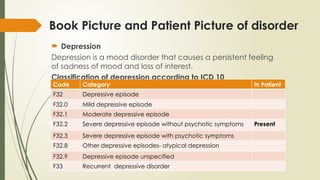
Classification of depression according to ICD 10
Code Category In Patient
F32 Depressive episode
F32.0 Mild depressive episode
F32.1 Moderate depressive episode
F32.2 Severe depressive episode without psychotic symptoms Present
F32.3 Severe depressive episode with psychotic symptoms
F32.8 Other depressive episodes- atypical depression
F32.9 Depressive episode unspecified
F33 Recurrent depressive disorder
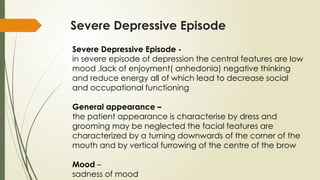
Severe Depressive Episode
Severe Depressive Episode -
in severe episode of depression the central features are low
mood ,lack of enjoyment( anhedonia) negative thinking
and reduce energy all of which lead to decrease social
and occupational functioning
General appearance โ€“
the patient appearance is characterise by dress and
grooming may be neglected the facial features are
characterized by a turning downwards of the corner of the
mouth and by vertical furrowing of the centre of the brow
Mood โ€“
sadness of mood
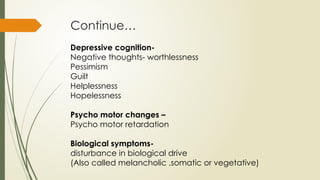
Continueโ€ฆ
Depressive cognition-
Negative thoughts- worthlessness
Pessimism
Guilt
Helplessness
Hopelessness
Psycho motor changes โ€“
Psycho motor retardation
Biological symptoms-
disturbance in biological drive
(Also called melancholic ,somatic or vegetative)
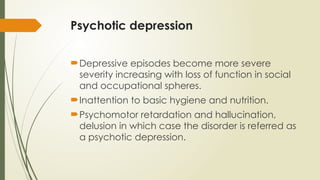
Psychotic depression
๏‚ดDepressive episodes become more severe
severity increasing with loss of function in social
and occupational spheres.
๏‚ดInattention to basic hygiene and nutrition.
๏‚ดPsychomotor retardation and hallucination,
delusion in which case the disorder is referred as
a psychotic depression.
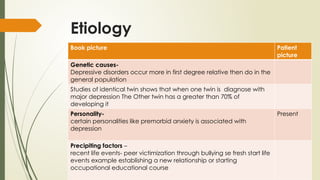
Etiology
Book picture Patient
picture
Genetic causes-
Depressive disorders occur more in first degree relative then do in the
general population
Studies of identical twin shows that when one twin is diagnose with
major depression The Other twin has a greater than 70% of
developing it
Personality-
certain personalities like premorbid anxiety is associated with
depression
Present
Precipiting factors โ€“
recent life events- peer victimization through bullying se fresh start life
events example establishing a new relationship or starting
occupational educational course
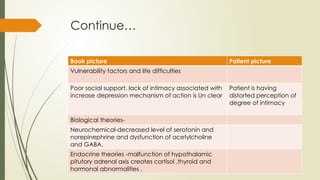
Continueโ€ฆ
Book picture Patient picture
Vulnerability factors and life difficulties
Poor social support, lack of intimacy associated with
increase depression mechanism of action is Un clear
Patient is having
distorted perception of
degree of intimacy
Biological theories-
Neurochemical-decreased level of serotonin and
norepinephrine and dysfunction of acetylcholine
and GABA.
Endocrine theories -malfunction of hypothalamic
pitutory adrenal axis creates cortisol ,thyroid and
hormonal abnormalities .
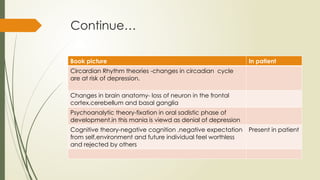
Continueโ€ฆ
Book picture In patient
Circardian Rhythm theories -changes in circadian cycle
are at risk of depression.
Changes in brain anatomy- loss of neuron in the frontal
cortex,cerebellum and basal ganglia
Psychoanalytic theory-fixation in oral sadistic phase of
development.in this mania is viewd as denial of depression
Cognitive theory-negative cognition ,negative expectation
from self,environment and future individual feel worthless
and rejected by others
Present in patient
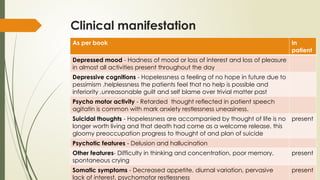
Clinical manifestation
As per book In
patient
Depressed mood - Hadness of mood or loss of interest and loss of pleasure
in almost all activities present throughout the day
Depressive cognitions - Hopelessness a feeling of no hope in future due to
pessimism ,helplessness the patients feel that no help is possible and
inferiority ,unreasonable guilt and self blame over trivial matter past
Psycho motor activity - Retarded thought reflected in patient speech
agitatin is common with mark anxiety restlessness uneasiness.
Suicidal thoughts - Hopelessness are accompanied by thought of life is no
longer worth living and that death had come as a welcome release. this
gloomy preoccupation progress to thought of and plan of suicide
present
Psychotic features - Delusion and hallucination
Other features- Difficulty in thinking and concentration, poor memory,
spontaneous crying
present
Somatic symptoms - Decreased appetite, diurnal variation, pervasive
lack of interest, psychomotor restlessness
present
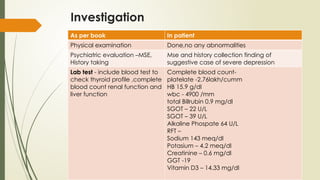
Investigation
As per book In patient
Physical examination Done,no any abnormalities
Psychiatric evaluation โ€“MSE,
History taking
Mse and history collection finding of
suggestive case of severe depression
Lab test - include blood test to
check thyroid profile ,complete
blood count renal function and
liver function
Complete blood count-
platelate -2.76lakh/cumm
HB 15.9 g/dl
wbc - 4900 /mm
total Billrubin 0.9 mg/dl
SGOT โ€“ 22 U/L
SGOT โ€“ 39 U/L
Alkaline Phospate 64 U/L
RFT โ€“
Sodium 143 meq/dl
Potasium โ€“ 4.2 meq/dl
Creatinine โ€“ 0.6 mg/dl
GGT -19
Vitamin D3 โ€“ 14.33 mg/dl
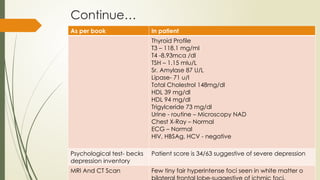
Continueโ€ฆ
As per book In patient
Thyroid Profile
T3 โ€“ 118.1 mg/ml
T4 -8.93mca /dl
TSH โ€“ 1.15 mIu/L
Sr. Amylase 87 U/L
Lipase- 71 u/l
Total Cholestrol 148mg/dl
HDL 39 mg/dl
HDL 94 mg/dl
Trigylceride 73 mg/dl
Urine - routine โ€“ Microscopy NAD
Chest X-Ray โ€“ Normal
ECG โ€“ Normal
HIV, HBSAg, HCV - negative
Psychological test- becks
depression inventory
Patient score is 34/63 suggestive of severe depression
MRI And CT Scan Few tiny fair hyperintense foci seen in white matter o
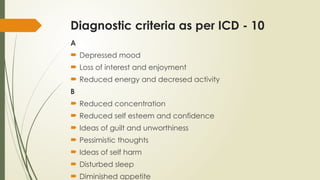
Diagnostic criteria as per ICD - 10
A
๏‚ด Depressed mood
๏‚ด Loss of interest and enjoyment
๏‚ด Reduced energy and decresed activity
B
๏‚ด Reduced concentration
๏‚ด Reduced self esteem and confidence
๏‚ด Ideas of guilt and unworthiness
๏‚ด Pessimistic thoughts
๏‚ด Ideas of self harm
๏‚ด Disturbed sleep
๏‚ด Diminished appetite
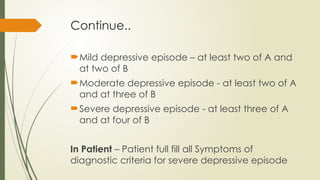
Continue..
๏‚ดMild depressive episode โ€“ at least two of A and
at two of B
๏‚ดModerate depressive episode - at least two of A
and at three of B
๏‚ดSevere depressive episode - at least three of A
and at four of B
In Patient โ€“ Patient full fill all Symptoms of
diagnostic criteria for severe depressive episode
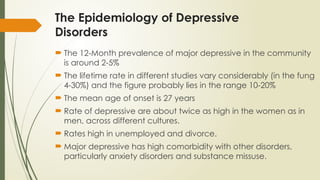
The Epidemiology of Depressive
Disorders
๏‚ด The 12-Month prevalence of major depressive in the community
is around 2-5%
๏‚ด The lifetime rate in different studies vary considerably (in the fung
4-30%) and the figure probably lies in the range 10-20%
๏‚ด The mean age of onset is 27 years
๏‚ด Rate of depressive are about twice as high in the women as in
men, across different cultures.
๏‚ด Rates high in unemployed and divorce.
๏‚ด Major depressive has high comorbidity with other disorders,
particularly anxiety disorders and substance missuse.
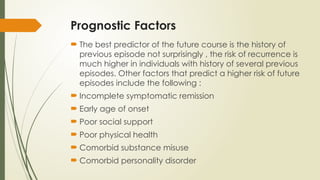
Prognostic Factors
๏‚ด The best predictor of the future course is the history of
previous episode not surprisingly , the risk of recurrence is
much higher in individuals with history of several previous
episodes. Other factors that predict a higher risk of future
episodes include the following :
๏‚ด Incomplete symptomatic remission
๏‚ด Early age of onset
๏‚ด Poor social support
๏‚ด Poor physical health
๏‚ด Comorbid substance misuse
๏‚ด Comorbid personality disorder
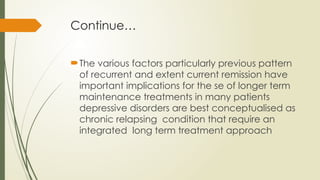
Continueโ€ฆ
๏‚ดThe various factors particularly previous pattern
of recurrent and extent current remission have
important implications for the se of longer term
maintenance treatments in many patients
depressive disorders are best conceptualised as
chronic relapsing condition that require an
integrated long term treatment approach
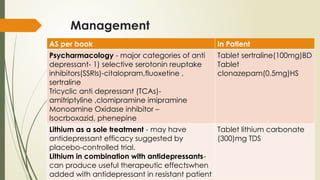
Management
AS per book In Patient
Psycharmacology - major categories of anti
depressant- 1) selective serotonin reuptake
inhibitors(SSRIs)-citalopram,fluoxetine ,
sertraline
Tricyclic anti depressant (TCAs)-
amitriptyline ,clomipramine imipramine
Monoamine Oxidase inhibitor โ€“
Isocrboxazid, phenepine
Tablet sertraline(100mg)BD
Tablet
clonazepam(0.5mg)HS
Lithium as a sole treatment - may have
antidepressant efficacy suggested by
placebo-controlled trial.
Lithium in combination with antidepressants-
can produce useful therapeutic effectswhen
added with antidepressant in resistant patient
Tablet lithium carbonate
(300)mg TDS
Continueโ€ฆ
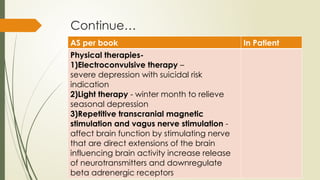
AS per book In Patient
Physical therapies-
1)Electroconvulsive therapy โ€“
severe depression with suicidal risk
indication
2)Light therapy - winter month to relieve
seasonal depression
3)Repetitive transcranial magnetic
stimulation and vagus nerve stimulation -
affect brain function by stimulating nerve
that are direct extensions of the brain
influencing brain activity increase release
of neurotransmitters and downregulate
beta adrenergic receptors
Continueโ€ฆ
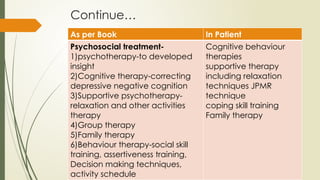
As per Book In Patient
Psychosocial treatment-
1)psychotherapy-to developed
insight
2)Cognitive therapy-correcting
depressive negative cognition
3)Supportive psychotherapy-
relaxation and other activities
therapy
4)Group therapy
5)Family therapy
6)Behaviour therapy-social skill
training, assertiveness training,
Decision making techniques,
activity schedule
Cognitive behaviour
therapies
supportive therapy
including relaxation
techniques JPMR
technique
coping skill training
Family therapy
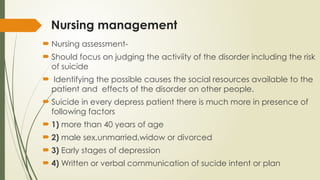
Nursing management
๏‚ด Nursing assessment-
๏‚ด Should focus on judging the activiity of the disorder including the risk
of suicide
๏‚ด Identifying the possible causes the social resources available to the
patient and effects of the disorder on other people.
๏‚ด Suicide in every depress patient there is much more in presence of
following factors
๏‚ด 1) more than 40 years of age
๏‚ด 2) male sex,unmarried,widow or divorced
๏‚ด 3) Early stages of depression
๏‚ด 4) Written or verbal communication of sucide intent or plan
Continueโ€ฆ
๏‚ด 5) Early stage of depression
๏‚ด 6) recovery from depression at the peak of depression
the patient is usally either too depressed or to redarded
to comit suicide
๏‚ด 7) period of three month from recovery the nurse should
inquire about patient work family life social activities
depressive delusion and patient act on them
Nursing diagnosis
๏‚ด High risk of self directed violence related to depressive
mood feeling of worthlessness helplessness as evidence
by previous attempt of violence suicidal plan
๏‚ด low self esteem related to learn helplessness ,negative
view of self as evidence by expression of worthlessness
๏‚ด disturbed thought process related to severe anxiety or
depress mood as evidence by impaired attentions span
๏‚ด impaired social interaction related to feeling of
worthlessness as evidence by remains feeling of
seclusion, avoid contacts with other
๏‚ด Altered sleep and rest related to depressed mood as
evidence by difficulty in falling asleep verbal complaints
of not well resting
Thank You!!!

CASE PRESENTATION ON DEPRESSION.pptx for nurses

  • 1.
    CASE PRESENTATION ON SEVEREDEPRESSIVE EPISODE PRESENTED TO, Mr. Ravindra Vikhe Sir Assistant Professor, CEMH, INHS Asvini, Colaba PRESENTED BY, Seema Ankush Kondhalkar PBDPN Student CEMH, INHS Asvini, Colaba
  • 2.
    Book Picture andPatient Picture of disorder ๏‚ด Depression Depression is a mood disorder that causes a persistent feeling of sadness of mood and loss of interest. Classification of depression according to ICD 10 Code Category In Patient F32 Depressive episode F32.0 Mild depressive episode F32.1 Moderate depressive episode F32.2 Severe depressive episode without psychotic symptoms Present F32.3 Severe depressive episode with psychotic symptoms F32.8 Other depressive episodes- atypical depression F32.9 Depressive episode unspecified F33 Recurrent depressive disorder
  • 3.
    Severe Depressive Episode SevereDepressive Episode - in severe episode of depression the central features are low mood ,lack of enjoyment( anhedonia) negative thinking and reduce energy all of which lead to decrease social and occupational functioning General appearance โ€“ the patient appearance is characterise by dress and grooming may be neglected the facial features are characterized by a turning downwards of the corner of the mouth and by vertical furrowing of the centre of the brow Mood โ€“ sadness of mood
  • 4.
    Continueโ€ฆ Depressive cognition- Negative thoughts-worthlessness Pessimism Guilt Helplessness Hopelessness Psycho motor changes โ€“ Psycho motor retardation Biological symptoms- disturbance in biological drive (Also called melancholic ,somatic or vegetative)
  • 5.
    Psychotic depression ๏‚ดDepressive episodesbecome more severe severity increasing with loss of function in social and occupational spheres. ๏‚ดInattention to basic hygiene and nutrition. ๏‚ดPsychomotor retardation and hallucination, delusion in which case the disorder is referred as a psychotic depression.
  • 6.
    Etiology Book picture Patient picture Geneticcauses- Depressive disorders occur more in first degree relative then do in the general population Studies of identical twin shows that when one twin is diagnose with major depression The Other twin has a greater than 70% of developing it Personality- certain personalities like premorbid anxiety is associated with depression Present Precipiting factors โ€“ recent life events- peer victimization through bullying se fresh start life events example establishing a new relationship or starting occupational educational course
  • 7.
    Continueโ€ฆ Book picture Patientpicture Vulnerability factors and life difficulties Poor social support, lack of intimacy associated with increase depression mechanism of action is Un clear Patient is having distorted perception of degree of intimacy Biological theories- Neurochemical-decreased level of serotonin and norepinephrine and dysfunction of acetylcholine and GABA. Endocrine theories -malfunction of hypothalamic pitutory adrenal axis creates cortisol ,thyroid and hormonal abnormalities .
  • 8.
    Continueโ€ฆ Book picture Inpatient Circardian Rhythm theories -changes in circadian cycle are at risk of depression. Changes in brain anatomy- loss of neuron in the frontal cortex,cerebellum and basal ganglia Psychoanalytic theory-fixation in oral sadistic phase of development.in this mania is viewd as denial of depression Cognitive theory-negative cognition ,negative expectation from self,environment and future individual feel worthless and rejected by others Present in patient
  • 9.
    Clinical manifestation As perbook In patient Depressed mood - Hadness of mood or loss of interest and loss of pleasure in almost all activities present throughout the day Depressive cognitions - Hopelessness a feeling of no hope in future due to pessimism ,helplessness the patients feel that no help is possible and inferiority ,unreasonable guilt and self blame over trivial matter past Psycho motor activity - Retarded thought reflected in patient speech agitatin is common with mark anxiety restlessness uneasiness. Suicidal thoughts - Hopelessness are accompanied by thought of life is no longer worth living and that death had come as a welcome release. this gloomy preoccupation progress to thought of and plan of suicide present Psychotic features - Delusion and hallucination Other features- Difficulty in thinking and concentration, poor memory, spontaneous crying present Somatic symptoms - Decreased appetite, diurnal variation, pervasive lack of interest, psychomotor restlessness present
  • 10.
    Investigation As per bookIn patient Physical examination Done,no any abnormalities Psychiatric evaluation โ€“MSE, History taking Mse and history collection finding of suggestive case of severe depression Lab test - include blood test to check thyroid profile ,complete blood count renal function and liver function Complete blood count- platelate -2.76lakh/cumm HB 15.9 g/dl wbc - 4900 /mm total Billrubin 0.9 mg/dl SGOT โ€“ 22 U/L SGOT โ€“ 39 U/L Alkaline Phospate 64 U/L RFT โ€“ Sodium 143 meq/dl Potasium โ€“ 4.2 meq/dl Creatinine โ€“ 0.6 mg/dl GGT -19 Vitamin D3 โ€“ 14.33 mg/dl
  • 11.
    Continueโ€ฆ As per bookIn patient Thyroid Profile T3 โ€“ 118.1 mg/ml T4 -8.93mca /dl TSH โ€“ 1.15 mIu/L Sr. Amylase 87 U/L Lipase- 71 u/l Total Cholestrol 148mg/dl HDL 39 mg/dl HDL 94 mg/dl Trigylceride 73 mg/dl Urine - routine โ€“ Microscopy NAD Chest X-Ray โ€“ Normal ECG โ€“ Normal HIV, HBSAg, HCV - negative Psychological test- becks depression inventory Patient score is 34/63 suggestive of severe depression MRI And CT Scan Few tiny fair hyperintense foci seen in white matter o
  • 12.
    Diagnostic criteria asper ICD - 10 A ๏‚ด Depressed mood ๏‚ด Loss of interest and enjoyment ๏‚ด Reduced energy and decresed activity B ๏‚ด Reduced concentration ๏‚ด Reduced self esteem and confidence ๏‚ด Ideas of guilt and unworthiness ๏‚ด Pessimistic thoughts ๏‚ด Ideas of self harm ๏‚ด Disturbed sleep ๏‚ด Diminished appetite
  • 13.
    Continue.. ๏‚ดMild depressive episodeโ€“ at least two of A and at two of B ๏‚ดModerate depressive episode - at least two of A and at three of B ๏‚ดSevere depressive episode - at least three of A and at four of B In Patient โ€“ Patient full fill all Symptoms of diagnostic criteria for severe depressive episode
  • 14.
    The Epidemiology ofDepressive Disorders ๏‚ด The 12-Month prevalence of major depressive in the community is around 2-5% ๏‚ด The lifetime rate in different studies vary considerably (in the fung 4-30%) and the figure probably lies in the range 10-20% ๏‚ด The mean age of onset is 27 years ๏‚ด Rate of depressive are about twice as high in the women as in men, across different cultures. ๏‚ด Rates high in unemployed and divorce. ๏‚ด Major depressive has high comorbidity with other disorders, particularly anxiety disorders and substance missuse.
  • 15.
    Prognostic Factors ๏‚ด Thebest predictor of the future course is the history of previous episode not surprisingly , the risk of recurrence is much higher in individuals with history of several previous episodes. Other factors that predict a higher risk of future episodes include the following : ๏‚ด Incomplete symptomatic remission ๏‚ด Early age of onset ๏‚ด Poor social support ๏‚ด Poor physical health ๏‚ด Comorbid substance misuse ๏‚ด Comorbid personality disorder
  • 16.
    Continueโ€ฆ ๏‚ดThe various factorsparticularly previous pattern of recurrent and extent current remission have important implications for the se of longer term maintenance treatments in many patients depressive disorders are best conceptualised as chronic relapsing condition that require an integrated long term treatment approach
  • 17.
    Management AS per bookIn Patient Psycharmacology - major categories of anti depressant- 1) selective serotonin reuptake inhibitors(SSRIs)-citalopram,fluoxetine , sertraline Tricyclic anti depressant (TCAs)- amitriptyline ,clomipramine imipramine Monoamine Oxidase inhibitor โ€“ Isocrboxazid, phenepine Tablet sertraline(100mg)BD Tablet clonazepam(0.5mg)HS Lithium as a sole treatment - may have antidepressant efficacy suggested by placebo-controlled trial. Lithium in combination with antidepressants- can produce useful therapeutic effectswhen added with antidepressant in resistant patient Tablet lithium carbonate (300)mg TDS
  • 18.
    Continueโ€ฆ AS per bookIn Patient Physical therapies- 1)Electroconvulsive therapy โ€“ severe depression with suicidal risk indication 2)Light therapy - winter month to relieve seasonal depression 3)Repetitive transcranial magnetic stimulation and vagus nerve stimulation - affect brain function by stimulating nerve that are direct extensions of the brain influencing brain activity increase release of neurotransmitters and downregulate beta adrenergic receptors
  • 19.
    Continueโ€ฆ As per BookIn Patient Psychosocial treatment- 1)psychotherapy-to developed insight 2)Cognitive therapy-correcting depressive negative cognition 3)Supportive psychotherapy- relaxation and other activities therapy 4)Group therapy 5)Family therapy 6)Behaviour therapy-social skill training, assertiveness training, Decision making techniques, activity schedule Cognitive behaviour therapies supportive therapy including relaxation techniques JPMR technique coping skill training Family therapy
  • 20.
    Nursing management ๏‚ด Nursingassessment- ๏‚ด Should focus on judging the activiity of the disorder including the risk of suicide ๏‚ด Identifying the possible causes the social resources available to the patient and effects of the disorder on other people. ๏‚ด Suicide in every depress patient there is much more in presence of following factors ๏‚ด 1) more than 40 years of age ๏‚ด 2) male sex,unmarried,widow or divorced ๏‚ด 3) Early stages of depression ๏‚ด 4) Written or verbal communication of sucide intent or plan
  • 21.
    Continueโ€ฆ ๏‚ด 5) Earlystage of depression ๏‚ด 6) recovery from depression at the peak of depression the patient is usally either too depressed or to redarded to comit suicide ๏‚ด 7) period of three month from recovery the nurse should inquire about patient work family life social activities depressive delusion and patient act on them
  • 22.
    Nursing diagnosis ๏‚ด Highrisk of self directed violence related to depressive mood feeling of worthlessness helplessness as evidence by previous attempt of violence suicidal plan ๏‚ด low self esteem related to learn helplessness ,negative view of self as evidence by expression of worthlessness ๏‚ด disturbed thought process related to severe anxiety or depress mood as evidence by impaired attentions span ๏‚ด impaired social interaction related to feeling of worthlessness as evidence by remains feeling of seclusion, avoid contacts with other ๏‚ด Altered sleep and rest related to depressed mood as evidence by difficulty in falling asleep verbal complaints of not well resting
  • 23.