By  Syed Suhail Ahmadssahmad@enterprisesteward.comEnterprise Steward LLChttp://www.enterprisesteward.comCase Management Reference Architecture
Definition-Case Management“Case Management is the management of long-lived collaborative processes that coordinate knowledge, content, correspondence and resources to progress a case to achieve a particular goal; where the path of execution cannot be predetermined in advance of execution; where human judgment is required to determine how the end goal can be achieved; and where the state of a case can be altered by external out-of-band events.”- Source: Case Management: Combining Knowledge With  Process http://www.bptrends.com/publicationfiles/07-09-WP-CaseMgt-CombiningKnowledgeProcess-White.doc-final.pdf“A Highly structured, but also collaborative, dynamic, and information intensive process that is driven by outside events and requires incremental and progressive response from the business domain handling the case.” – Source: Forrester
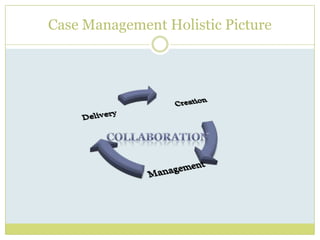
Case Management Holistic PictureCollaboration
Case Management ExamplesGovernment: Social Welfare Benefits Applications, Licensing and Permits Management, Unemployment Insurance,  Freedom of Information Enquiries, Regulatory Monitoring, Industrial Health and Safety Enforcement, Tax Processing etcLaw enforcement: Firearms Licensing, Investigations, Forensics ManagementHealthcare: Patient Care Management, Patient Medical Record Management , Member EnrollmentFinancial Services: Corporate Customer On-Boarding, Regulatory Compliance Management, Trade Settlement Exception Management, Mortgage Loan Origination, Wealth ManagementInsurance:  Claims Management, Underwriting, Policy ManagementTelecommunications: Customer Provisioning, Fault Reporting & Resolution, Billing Issue Resolution
Reference ArchitectureReference Architecture provides a framework for architectural decision to reduce the technical risk for individual projects and to assemble solution that comply with the future state architecture.Reference Architecture can be used to understand the rationale for selecting a technology or software product(s).Reference Architecture for a specific domain (e.g. case management, enterprise content management etc) is organized in terms of  sub-domains.  Each sub-domains are further broken down into capabilities.
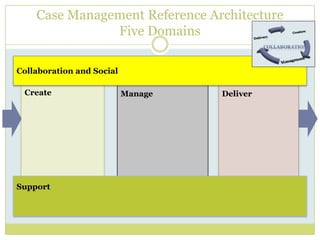
Case Management Reference ArchitectureFive Domains Collaboration and SocialDeliverManageCreateSupport
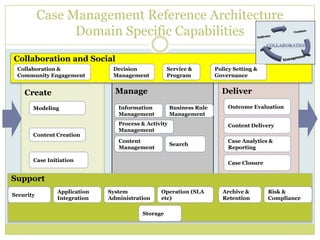
Case Management Reference Architecture Domain Specific CapabilitiesCollaboration and SocialCollaboration & Community EngagementService & ProgramPolicy Setting & GovernanceDecision ManagementDeliverManageCreateOutcome EvaluationModelingInformation ManagementBusiness Rule ManagementContent DeliveryProcess & Activity ManagementContent CreationContent ManagementSearchCase Analytics & ReportingCase InitiationCase ClosureSupportSecurityApplication IntegrationSystem AdministrationOperation (SLA etc)Archive & RetentionRisk & ComplianceStorage
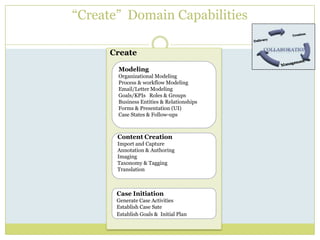
“Create”  Domain CapabilitiesCreateModelingOrganizational ModelingProcess & workflow ModelingEmail/Letter ModelingGoals/KPIs   Roles & GroupsBusiness Entities & RelationshipsForms & Presentation (UI)Case States & Follow-upsContent CreationImport and Capture Annotation & AuthoringImagingTaxonomy & Tagging TranslationCase InitiationGenerate Case Activities               Establish Case Sate                       Establish Goals &  Initial Plan
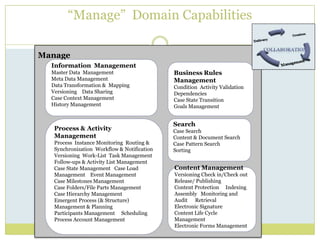
“Manage”  Domain CapabilitiesManageInformation  ManagementMaster Data  Management                      Meta Data ManagementData Transformation &  MappingVersioning    Data Sharing                        Case Context Management                  History Management Business Rules  ManagementCondition  Activity Validation  Dependencies  Case State Transition          Goals ManagementProcess & Activity ManagementProcess  Instance Monitoring  Routing & Synchronization  Workflow & Notification  Versioning  Work-List  Task Management Follow-ups & Activity List Management                    Case State Management   Case Load Management    Event ManagementCase Milestones ManagementCase Folders/File Parts ManagementCase Hierarchy Management              Emergent Process (& Structure) Management & Planning             Participants Management     Scheduling                     Process Account Management SearchCase Search                      Content & Document SearchCase Pattern Search SortingContent ManagementVersioning Check in/Check outRelease/ Publishing         Content Protection     Indexing Assembly   Monitoring and Audit      Retrieval        Electronic Signature       Content Life Cycle ManagementElectronic Forms Management
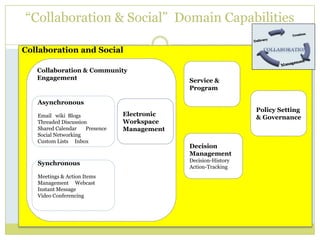
“Collaboration & Social”  Domain CapabilitiesCollaboration and SocialCollaboration & Community EngagementService & ProgramPolicy Setting & GovernanceAsynchronousEmail   wiki  BlogsThreaded DiscussionShared Calendar       Presence Social Networking              Custom Lists     InboxElectronic Workspace  ManagementDecision   ManagementDecision-History Action-Tracking SynchronousMeetings & Action Items Management     Webcast        Instant Message  Video Conferencing
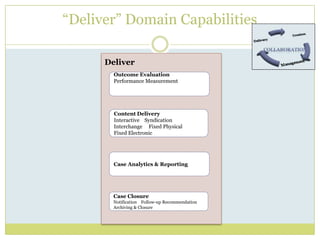
“Deliver” Domain CapabilitiesDeliverOutcome EvaluationPerformance MeasurementContent DeliveryInteractive   Syndication     Interchange     Fixed Physical        Fixed Electronic Case Analytics & ReportingCase ClosureNotification    Follow-up Recommendation Archiving & Closure
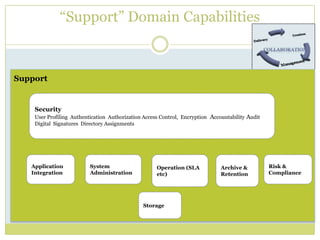
“Support” Domain CapabilitiesSupportSecurityUser Profiling  Authentication  Authorization Access Control,  Encryption  Accountability Audit Digital  Signatures  Directory Assignments Application IntegrationSystem AdministrationOperation (SLA etc)Archive & RetentionRisk & ComplianceStorage
Question?ssahmad@enterprisesteward.com

Case Management Reference Architecture

  • 1.
    By SyedSuhail Ahmadssahmad@enterprisesteward.comEnterprise Steward LLChttp://www.enterprisesteward.comCase Management Reference Architecture
  • 2.
    Definition-Case Management“Case Managementis the management of long-lived collaborative processes that coordinate knowledge, content, correspondence and resources to progress a case to achieve a particular goal; where the path of execution cannot be predetermined in advance of execution; where human judgment is required to determine how the end goal can be achieved; and where the state of a case can be altered by external out-of-band events.”- Source: Case Management: Combining Knowledge With Process http://www.bptrends.com/publicationfiles/07-09-WP-CaseMgt-CombiningKnowledgeProcess-White.doc-final.pdf“A Highly structured, but also collaborative, dynamic, and information intensive process that is driven by outside events and requires incremental and progressive response from the business domain handling the case.” – Source: Forrester
  • 3.
    Case Management HolisticPictureCollaboration
  • 4.
    Case Management ExamplesGovernment:Social Welfare Benefits Applications, Licensing and Permits Management, Unemployment Insurance, Freedom of Information Enquiries, Regulatory Monitoring, Industrial Health and Safety Enforcement, Tax Processing etcLaw enforcement: Firearms Licensing, Investigations, Forensics ManagementHealthcare: Patient Care Management, Patient Medical Record Management , Member EnrollmentFinancial Services: Corporate Customer On-Boarding, Regulatory Compliance Management, Trade Settlement Exception Management, Mortgage Loan Origination, Wealth ManagementInsurance: Claims Management, Underwriting, Policy ManagementTelecommunications: Customer Provisioning, Fault Reporting & Resolution, Billing Issue Resolution
  • 5.
    Reference ArchitectureReference Architectureprovides a framework for architectural decision to reduce the technical risk for individual projects and to assemble solution that comply with the future state architecture.Reference Architecture can be used to understand the rationale for selecting a technology or software product(s).Reference Architecture for a specific domain (e.g. case management, enterprise content management etc) is organized in terms of sub-domains. Each sub-domains are further broken down into capabilities.
  • 6.
    Case Management ReferenceArchitectureFive Domains Collaboration and SocialDeliverManageCreateSupport
  • 7.
    Case Management ReferenceArchitecture Domain Specific CapabilitiesCollaboration and SocialCollaboration & Community EngagementService & ProgramPolicy Setting & GovernanceDecision ManagementDeliverManageCreateOutcome EvaluationModelingInformation ManagementBusiness Rule ManagementContent DeliveryProcess & Activity ManagementContent CreationContent ManagementSearchCase Analytics & ReportingCase InitiationCase ClosureSupportSecurityApplication IntegrationSystem AdministrationOperation (SLA etc)Archive & RetentionRisk & ComplianceStorage
  • 8.
    “Create” DomainCapabilitiesCreateModelingOrganizational ModelingProcess & workflow ModelingEmail/Letter ModelingGoals/KPIs Roles & GroupsBusiness Entities & RelationshipsForms & Presentation (UI)Case States & Follow-upsContent CreationImport and Capture Annotation & AuthoringImagingTaxonomy & Tagging TranslationCase InitiationGenerate Case Activities Establish Case Sate Establish Goals & Initial Plan
  • 9.
    “Manage” DomainCapabilitiesManageInformation ManagementMaster Data Management Meta Data ManagementData Transformation & MappingVersioning Data Sharing Case Context Management History Management Business Rules ManagementCondition Activity Validation Dependencies Case State Transition Goals ManagementProcess & Activity ManagementProcess Instance Monitoring Routing & Synchronization Workflow & Notification Versioning Work-List Task Management Follow-ups & Activity List Management Case State Management Case Load Management Event ManagementCase Milestones ManagementCase Folders/File Parts ManagementCase Hierarchy Management Emergent Process (& Structure) Management & Planning Participants Management Scheduling Process Account Management SearchCase Search Content & Document SearchCase Pattern Search SortingContent ManagementVersioning Check in/Check outRelease/ Publishing Content Protection Indexing Assembly Monitoring and Audit Retrieval Electronic Signature Content Life Cycle ManagementElectronic Forms Management
  • 10.
    “Collaboration & Social” Domain CapabilitiesCollaboration and SocialCollaboration & Community EngagementService & ProgramPolicy Setting & GovernanceAsynchronousEmail wiki BlogsThreaded DiscussionShared Calendar Presence Social Networking Custom Lists InboxElectronic Workspace ManagementDecision ManagementDecision-History Action-Tracking SynchronousMeetings & Action Items Management Webcast Instant Message Video Conferencing
  • 11.
    “Deliver” Domain CapabilitiesDeliverOutcomeEvaluationPerformance MeasurementContent DeliveryInteractive Syndication Interchange Fixed Physical Fixed Electronic Case Analytics & ReportingCase ClosureNotification Follow-up Recommendation Archiving & Closure
  • 12.
    “Support” Domain CapabilitiesSupportSecurityUserProfiling Authentication Authorization Access Control, Encryption Accountability Audit Digital Signatures Directory Assignments Application IntegrationSystem AdministrationOperation (SLA etc)Archive & RetentionRisk & ComplianceStorage
  • 13.