CARVANA –
Predicting the
Purchase quality
in Car Auction
Objective
 The Automobile industry gains a profitable
income in the “Used Cars Segment” every year.
Carvana, a pioneer in this industry increased its
revenue to $5.39 billion driven largely by 8.1
percent increase in Used cars revenue.
 People who purchase used cars does it for cost
cutting. Anyone who has limited funds would
appreciate the need to save little cash.
 There are so many factors that get into buying a
used car such as – Range of Cost, Pre-purchase
Inspection, Ownership Validation, Vehicle
History Report and Age etc.
 We try to tackle this problem by analyzing
various factors behind the car and help the
company realize if a particular auction purchase
is a Good/Bad buy.
Outline
PREDICTION
OBJECTIVE
DATA SOURCE DATA
VISUALIZATION
DATA
PREPROCESSING
MODEL BUILDING
AND
IMPROVIZATION
RESULTS
The Dataset
The dataset was obtained from Kaggle.
The dataset was originally provided by
Carvana, a Technology business start-up
in Tempe, Arizona.
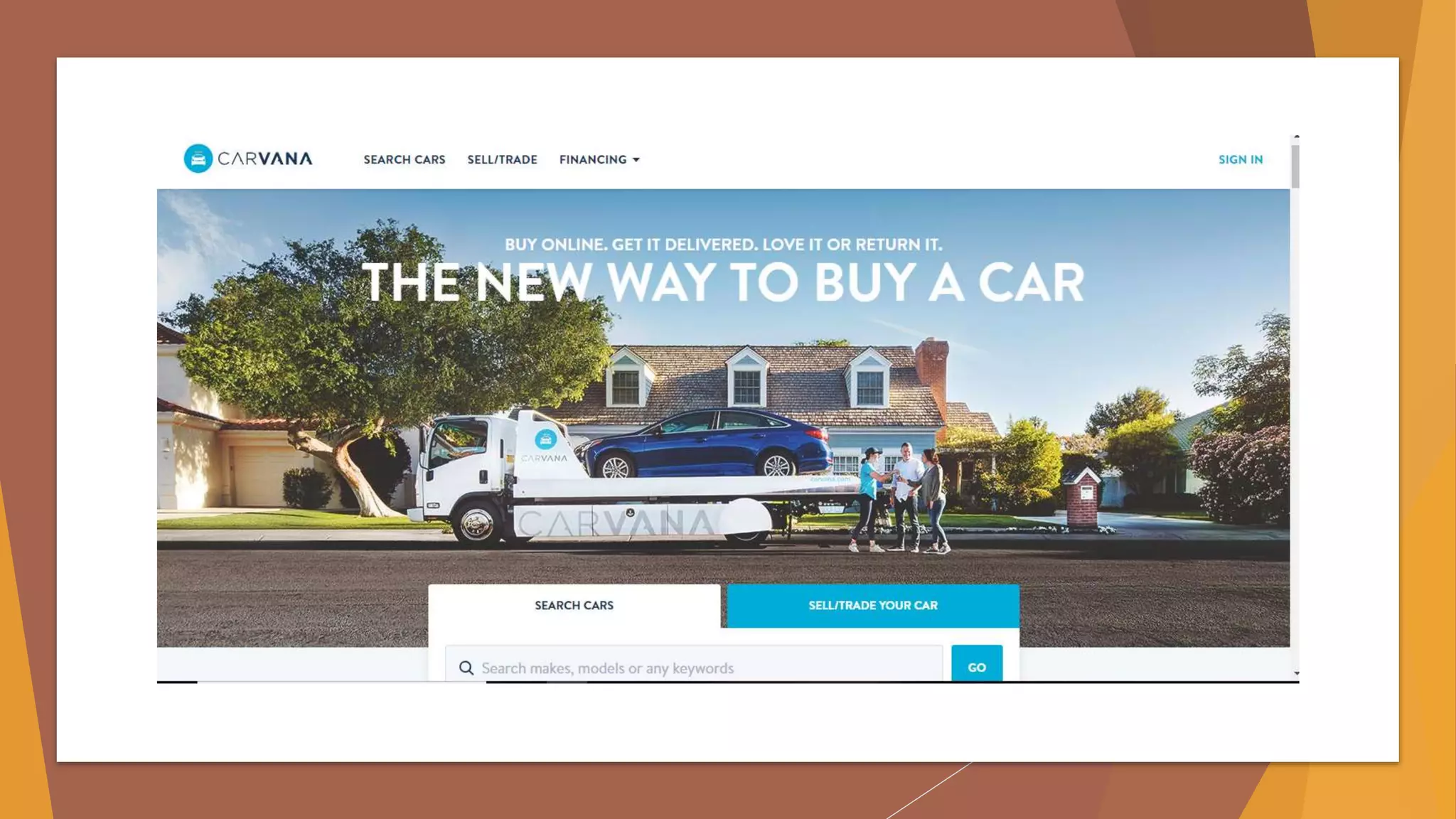
Carvana is an online used car dealer
that sells and buys back used car
through their website.
Carvana subsequently came with an
idea to organize a competition in
Kaggle, by providing the users their
Purchase database with several key
factors (i.e. car age, vehicle year,
make , model, trim, Auction Average
Price, Clean price etc.)
The key here is to analyze the 73k
transactions from Carvana and come up
with the prediction model that helps
them understand whether a particular
transaction is a Good/Bad buy.
DATASET
DESCRIPTION
 The dataset had a total of 34 attributes.
 ReId – This is a Reference Id for each transaction in the
dataset
 PurchDate – Date attribute that specifies the date of
Pruchase.
 Auction – The Auction was help by two groups ADESA and
MANHEIM. Other 3rd party dealers were also involved.
 VehYear – The Year to which a particular model belongs.
 VehicleAge – Number of years the vehicle is used.
 Make – The vehicle company i.e. MAZDA, DODGE, FORD
etc.
 Model – Subclass from each Make i.e. FORD FOCUS,
TOYOTA COROLLA etc.
 Trim – The class distinction in each mode i.e ST, SXT, EX,
SE etc.
 SubModel – This is the type of Model i.e. 4D SEDAN, 2D
COUPE, 4D SUV etc.
 Color – Color of the vehicle
 Transmission – AUTO or MANUAL
CONTD..
 WheelTypeID – ID of different types of Wheel
 WheelType – Type of wheel such as ALLOY, COVERS
etc.
 VEhOdo – Number of miles driven
 Nationality – Make’s Nationality
 Size – LARGE TRUCK, MEDIUM SUV etc.
 TopThreeAmericanName – The original parent
company that owns the Make ex- CHRYSLER,
GENERAL MOTORS
MMR refers to the Manheim Market report prices
 MMRAcquisitionAuctionAveragePrice – Acquisition
price for this vehicle in average condition during
purchase
 MMRAcquisitionAuctionCleanPrice - Acquisition price
for this vehicle in the above average condition
during purchase
 MMRAcquisitionRetailAveragePrice- Acquisition price
for this vehicle in retail market in average
condition
 MMRAcquisitonRetailCleanPrice- Acquisition price for
this vehicle in above average condition in the
retail market
CONTD..
 MMRCurrentAuctionAveragePrice – The current auction
price for this vehicle in average condition
 MMRCurrentAuctionCleanPrice – The current auction
price of this vehicle in above average condition
 MMRCurrentRetailAveragePrice - The current retail
price for this vehicle in average condition
 MMRCurrentRetailCleanPrice - – The current retail price
for this vehicle in above average condition
 PRIMEUNIT – Identify if the vehicle would have a higher
demand than the standard purchase
 AUCGUART – The guarantee level provided by the auction
for the vehicle
 BYRNO - The ID associated with each buyer
 VNZIP1 - The zip code where the car was purchased
 VNST – The state where the car was purchased
 VehBCost – The initial base price for the vehicle at
beginning of auction
 IsOnlineSale- Whether the car was sold online or not
 WarrantyCost- The cost of warranty for each vehicle
Dataset – Initial analysis
 The dataset initially had 34 attributes with the target attribute being – IsBadBuy
 The dataset had 19 numerical attributes and 15 categorical attributes and the
shape and column can be seen below.
CATEGORICAL:
((72983, 15),
Index(['PurchDate', 'Auction', 'Make', 'Model', 'Trim', 'SubModel', 'Color',
'Transmission', 'WheelType', 'Nationality', 'Size',
'TopThreeAmericanName', 'PRIMEUNIT', 'AUCGUART', 'VNST'],
dtype='object’))
CONTD…
NUMERIC:
((72983, 19),
Index(['RefId', 'IsBadBuy', 'VehYear', 'VehicleAge', 'WheelTypeID', 'VehOdo',
'MMRAcquisitionAuctionAveragePrice', 'MMRAcquisitionAuctionCleanPrice',
'MMRAcquisitionRetailAveragePrice', 'MMRAcquisitonRetailCleanPrice',
'MMRCurrentAuctionAveragePrice', 'MMRCurrentAuctionCleanPrice',
'MMRCurrentRetailAveragePrice', 'MMRCurrentRetailCleanPrice', 'BYRNO',
'VNZIP1', 'VehBCost', 'IsOnlineSale', 'WarrantyCost'],
dtype='object'))
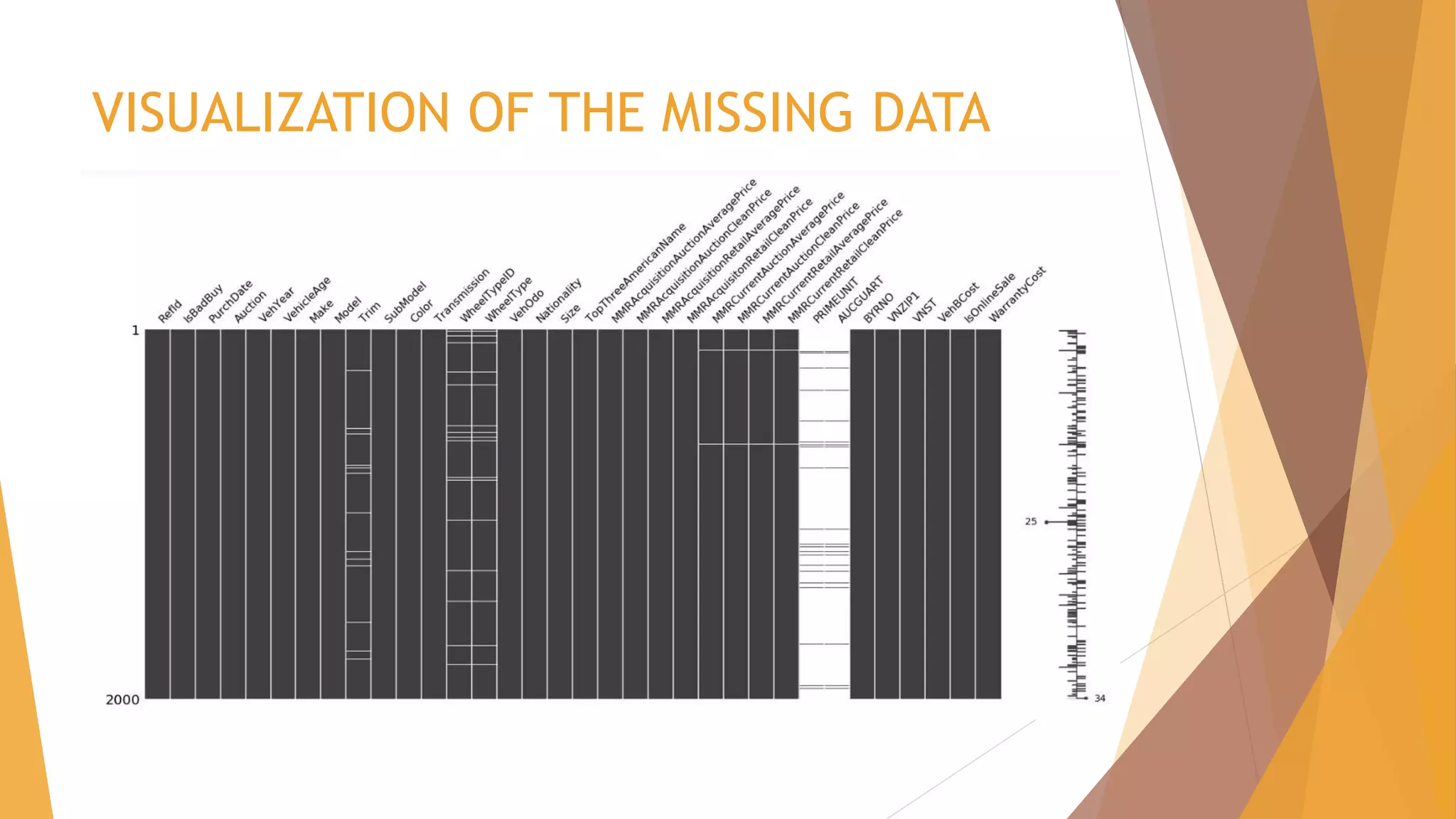
VISUALIZATION OF THE MISSING DATA
PROBLEMS FACED -
MISSING VALUES
 The Initial analysis showed that the
dataset had 19 Attributes with
missing values. The statistics for the
missing values are.
 Attributes PRIMEUNIT and ACGUART
had only less than 1% percent of
data and did not help enough with
model building and were removed in
the analysis.
ATTRIBUTE NAME
MISSING
VALUES
Trim 2360
SubModel 8
Color 8
Transmission 9
WheelTypeID 3169
WheelType 3174
Nationality 5
Size 5
TopThreeAmericanName 5
MMRAcquisitionAuctionAveragePrice 18
MMRAcquisitionAuctionCleanPrice 18
MMRAcquisitionRetailAveragePrice 18
MMRAcquisitonRetailCleanPrice 18
MMRCurrentAuctionAveragePrice 315
MMRCurrentAuctionCleanPrice 315
MMRCurrentRetailAveragePrice 315
MMRCurrentRetailCleanPrice 315
PRIMEUNIT 69564
AUCGUART 69564
NULLITY CORRELATION FOR MISSING
VALUES
PROBLEM FACED –
Class Imbalance
 The original dataset is highly
class imbalanced
 Only 10 percent of the
transaction were a BAD buy and
the rest were GOOD buy
CORRELATION MATRIX HEATMAP
DATA VISUALIZATION
Vehicle year for each make. Color shows the average age of vehicle
The number of Cars purchased by the Auction Company vs Make of Car Purchased
by Nationality
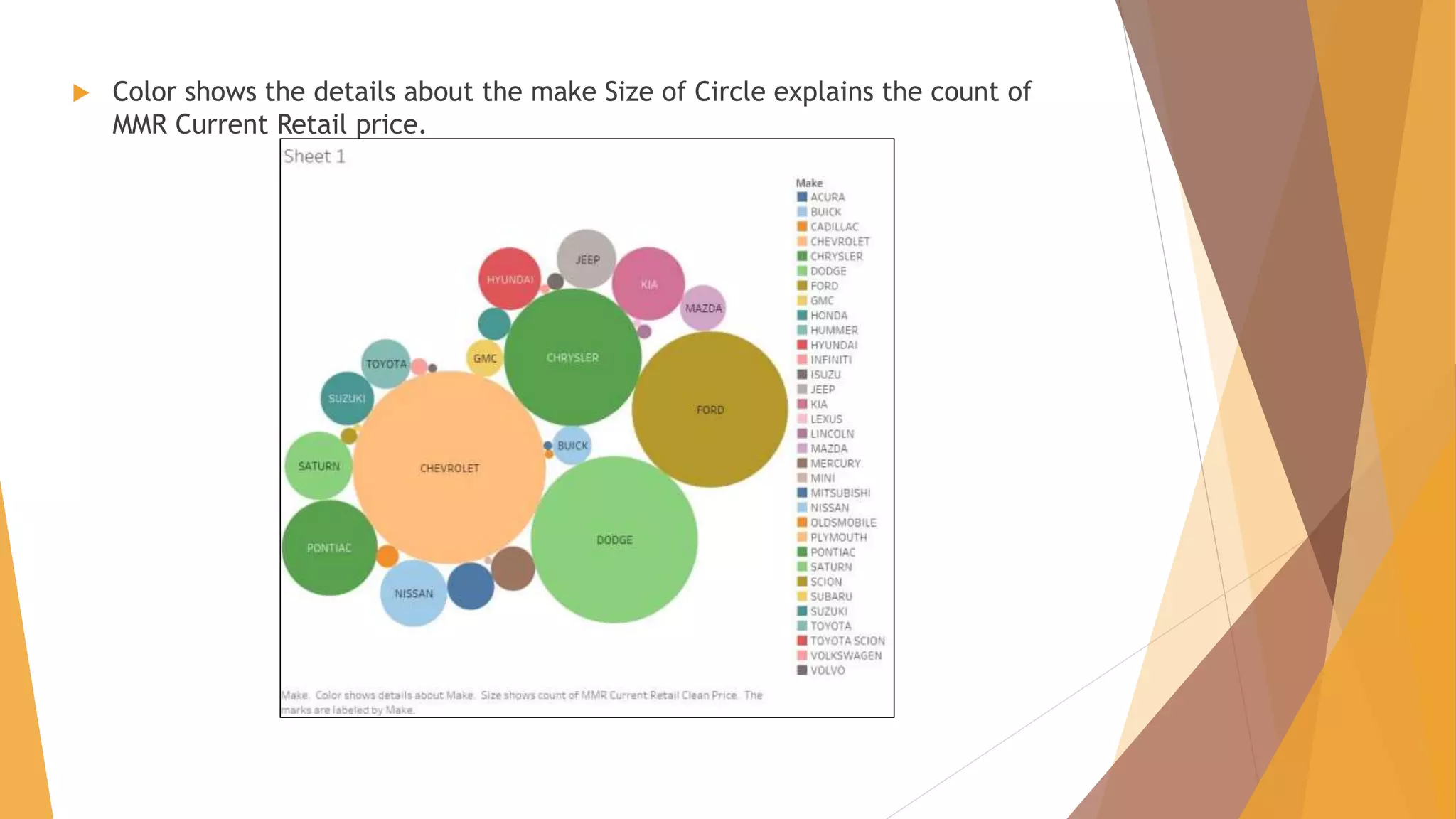
 Color shows the details about the make Size of Circle explains the count of
MMR Current Retail price.
 Color shows the average of current retail price in each
state
 In Second graph Color shows the Average Age of
vehicle in each state
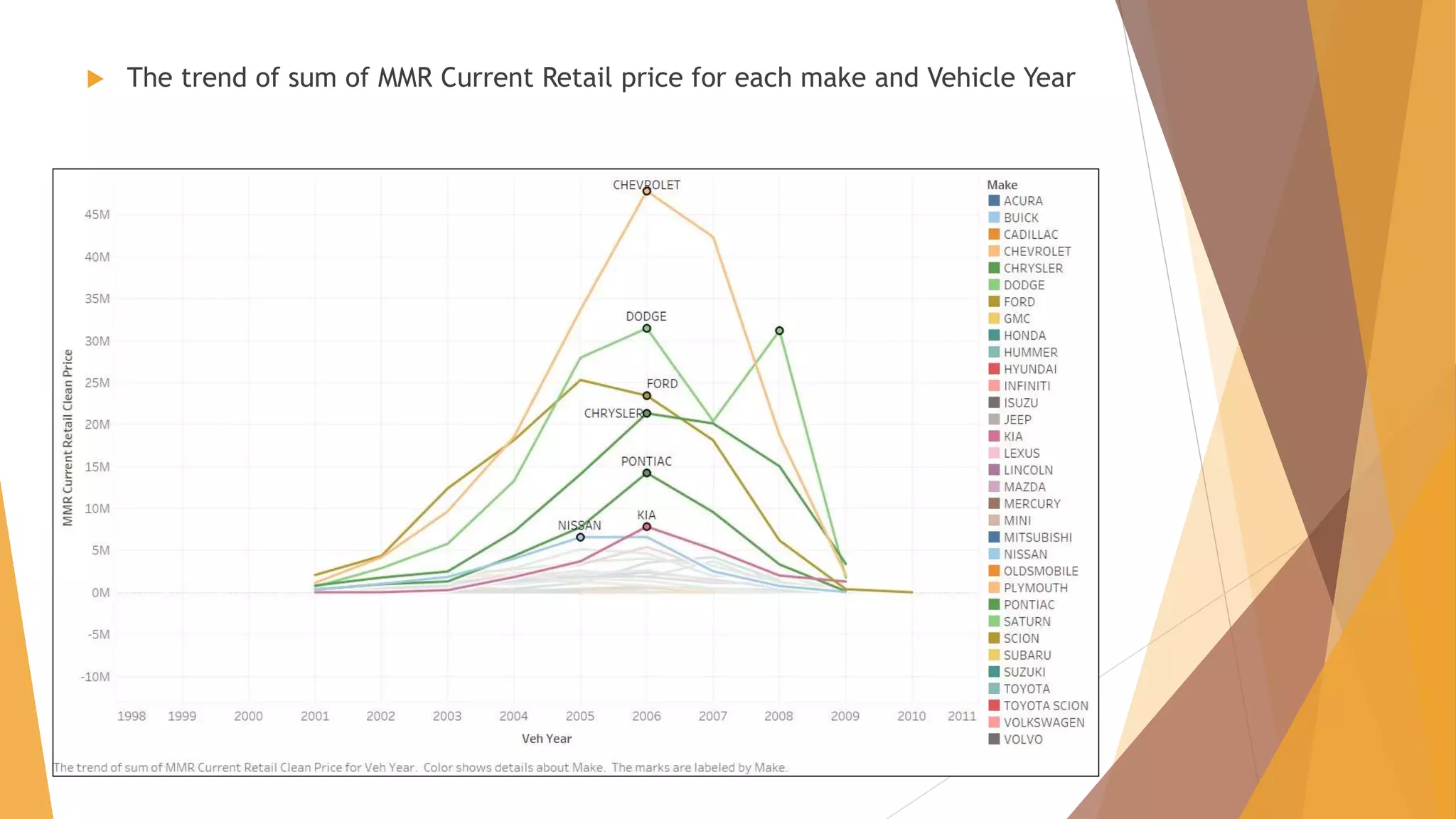
 The trend of sum of MMR Current Retail price for each make and Vehicle Year
DATA PREPROCESSING
REMOVING THE INSIGNIFICANT FEATURES
 The attributes PRIMEUNIT and AUCGUART had less than 1 percent of data and
were found inefficient in predicting the target variable.
 The preliminary data analysis showed that we had 15 Categorical variables.
Now after removing the above 2 features we are left with 13 Categorical
variables now.
 We used One-hot Encoder to create dummy values for the Categorical
variables.
CONTD..
 We also removed the numerical variables VNZIP1 and RefId.
 VNZIP1 was jus the zip codes of where the cars were sold. This is redundant
because, we can infer this from the variable VNST(state codes). RefId is just
a transaction ID which had no meaning.
REMOVING
OUTLIERS
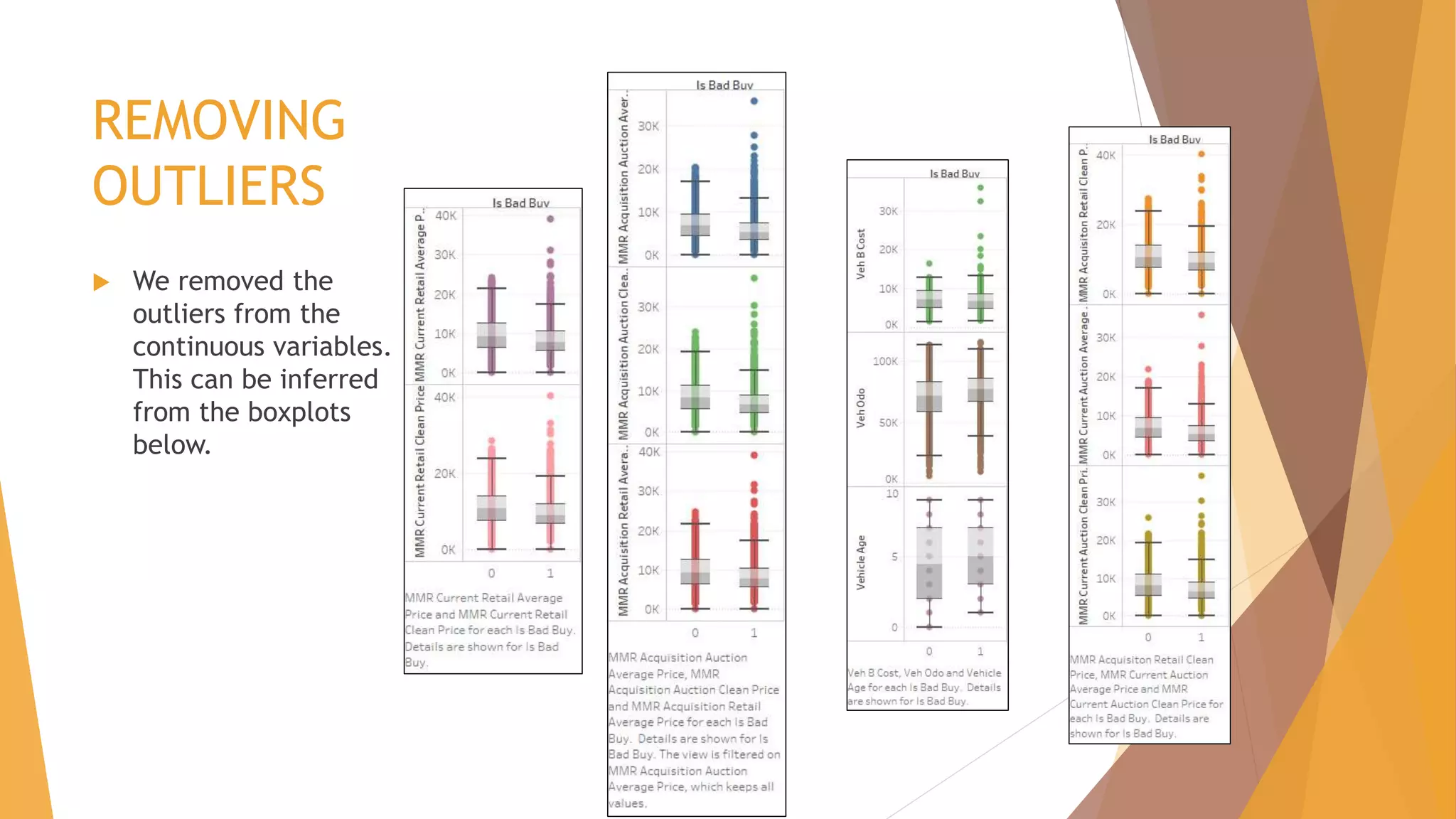
 We removed the
outliers from the
continuous variables.
This can be inferred
from the boxplots
below.
DISTRIBUTION PLOTS
We used distribution plots to check the normality of the continuous variables.
SMOTE FOR CLASS IMBALANCE
We used SMOTE technique to solve the class imbalance problem.
STANDARDIZATION
OF FEATURES
USING SCALING
 We used Standard
Scalar to perform
standardization so that
all the numerical
variables fall in the
same scale throughout
the dataset.
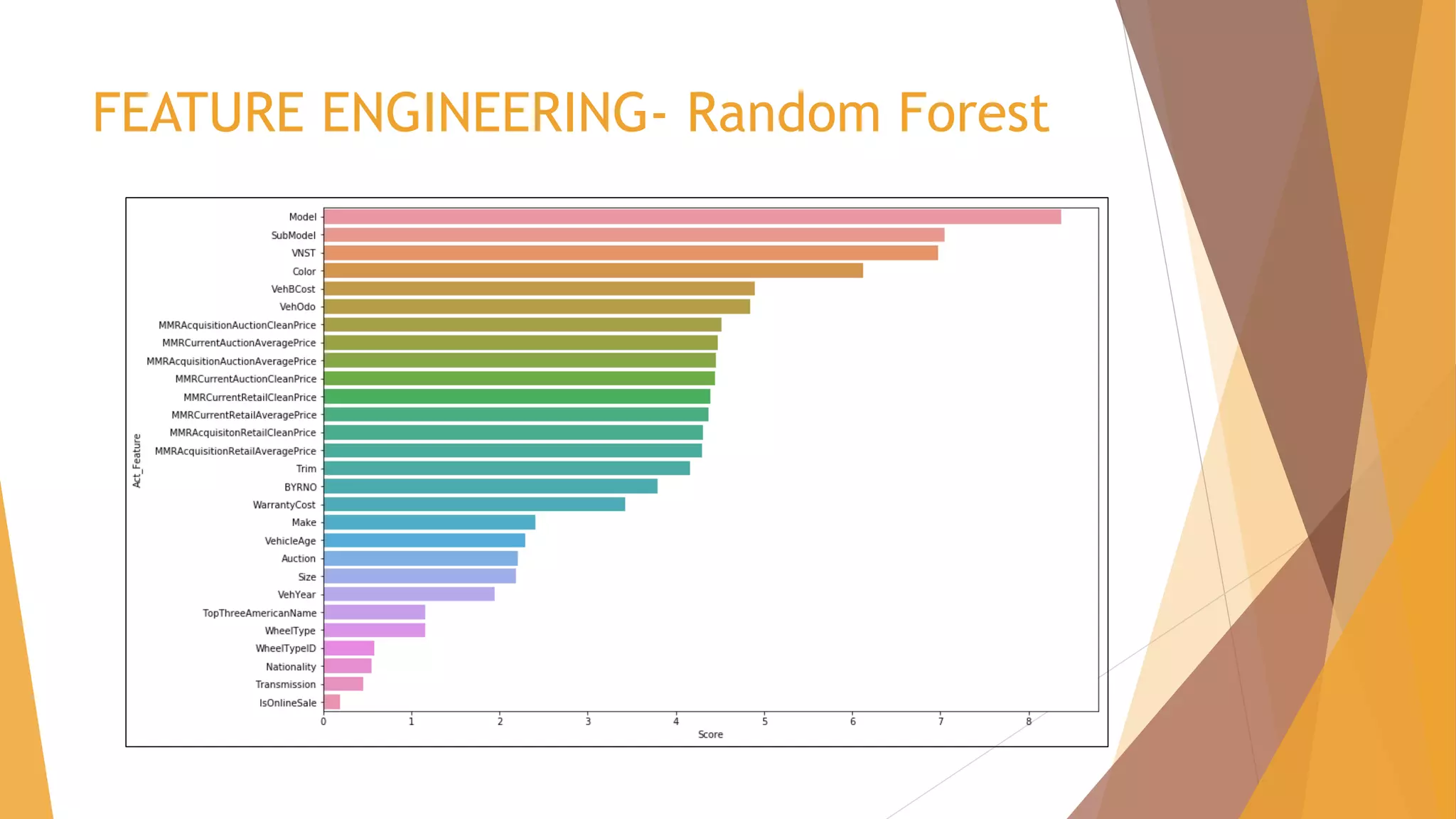
FEATURE ENGINEERING- Random Forest
MACHINE LEARNING
MODELS
Random
Forest
 Version:
 Original Data
 SMOTE+ RF
 Oversampling+ RF
 Under Sample+ RF
 Parameter Tuning:
 n_estimators
 Criterion
 max_depth
 max_feature
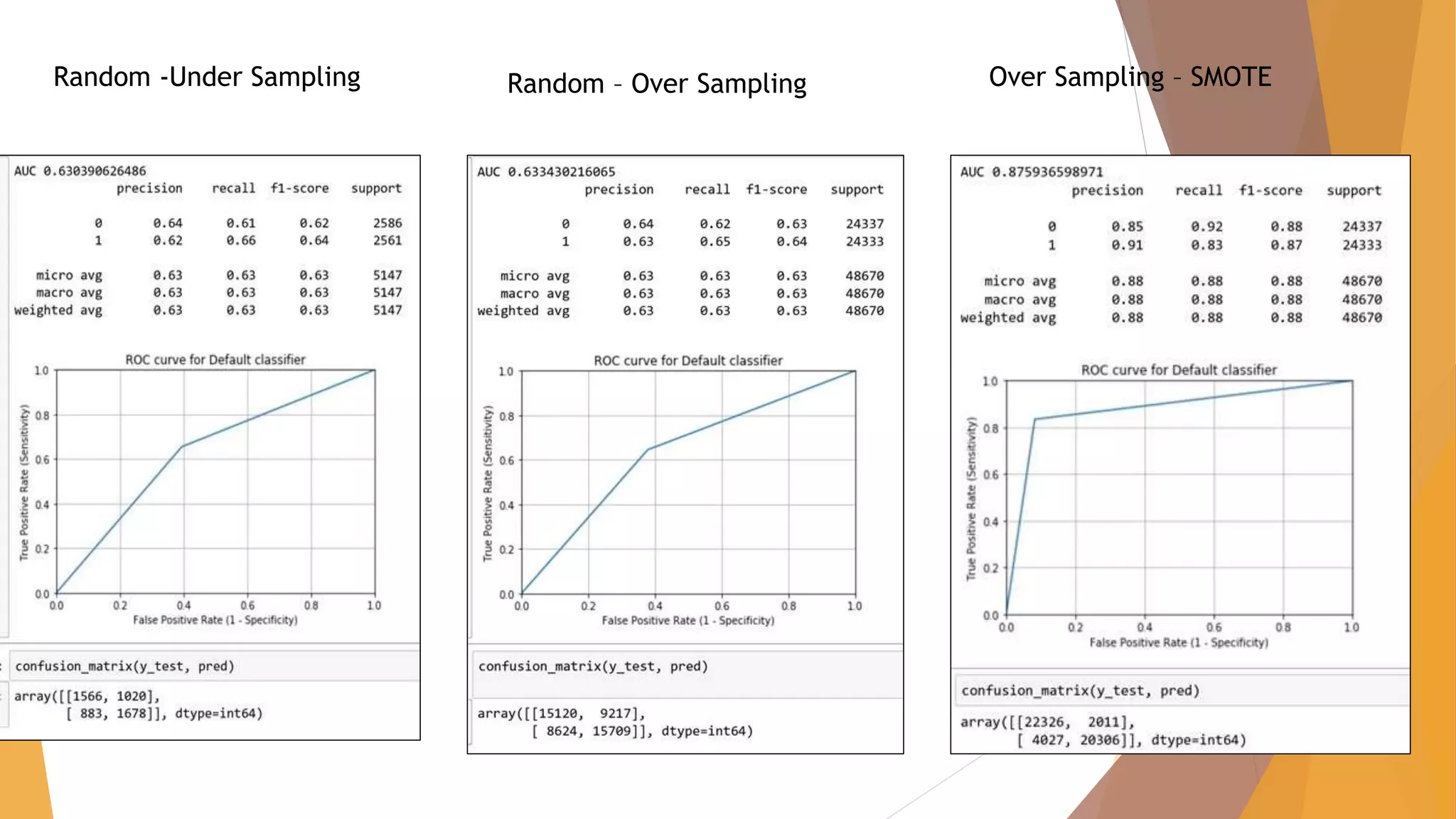
Random -Under Sampling Random – Over Sampling Over Sampling – SMOTE
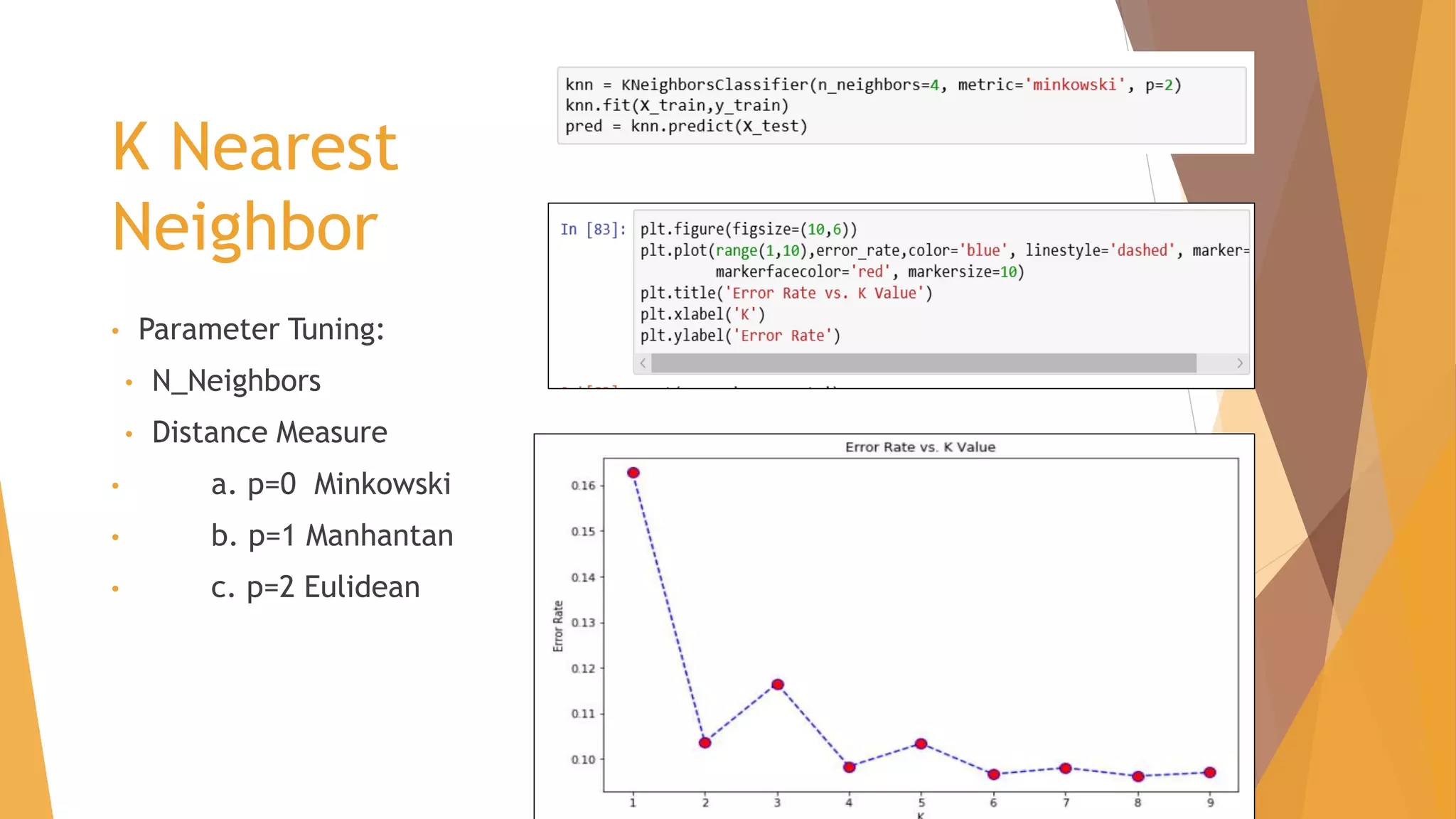
K Nearest
Neighbor
• Parameter Tuning:
• N_Neighbors
• Distance Measure
• a. p=0 Minkowski
• b. p=1 Manhantan
• c. p=2 Eulidean
KNN – Report
Training Score – 90.4
Testing Score – 90.5
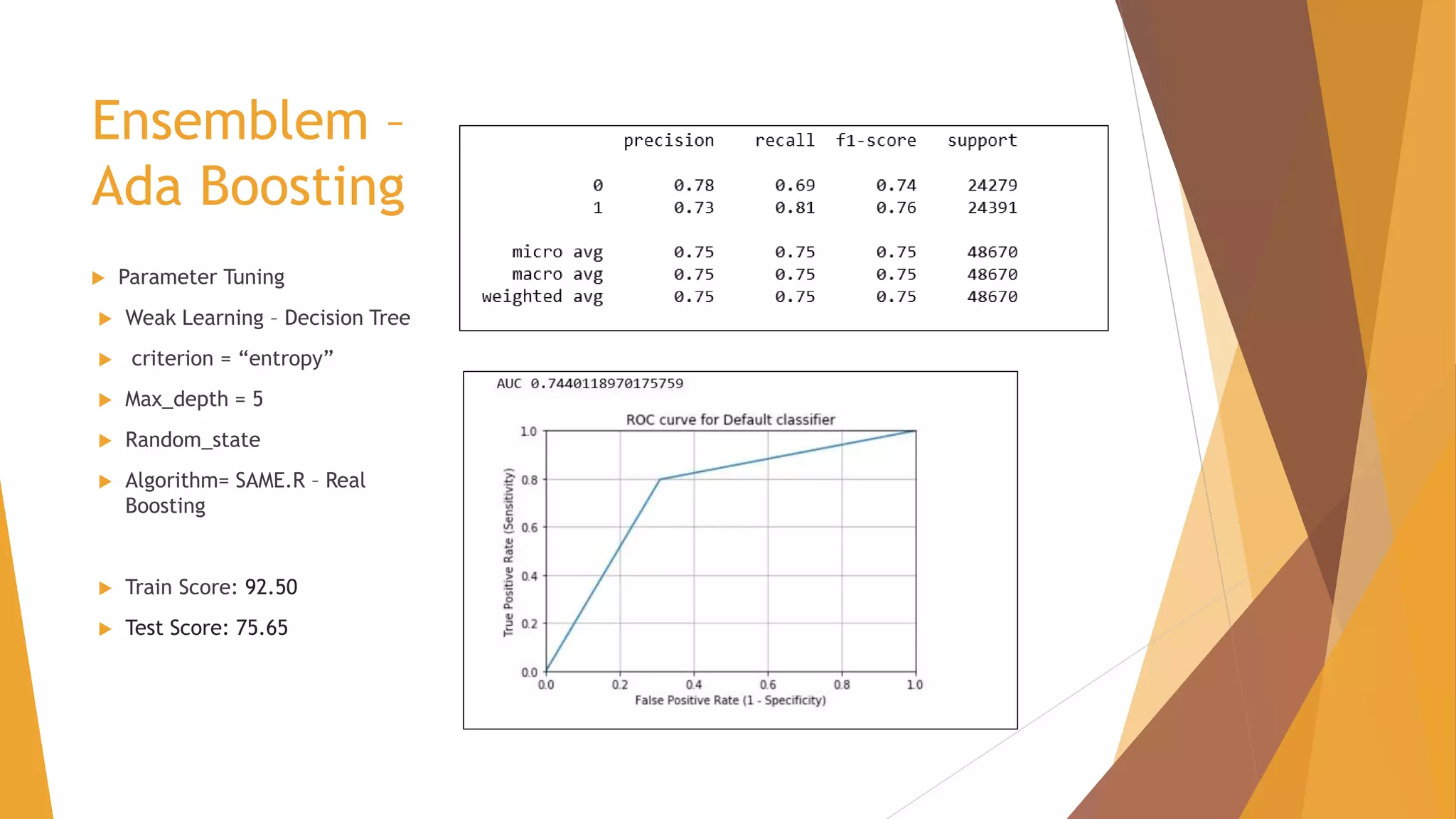
Ensemblem –
Ada Boosting
 Parameter Tuning
 Weak Learning – Decision Tree
 criterion = “entropy”
 Max_depth = 5
 Random_state
 Algorithm= SAME.R – Real
Boosting
 Train Score: 92.50
 Test Score: 75.65
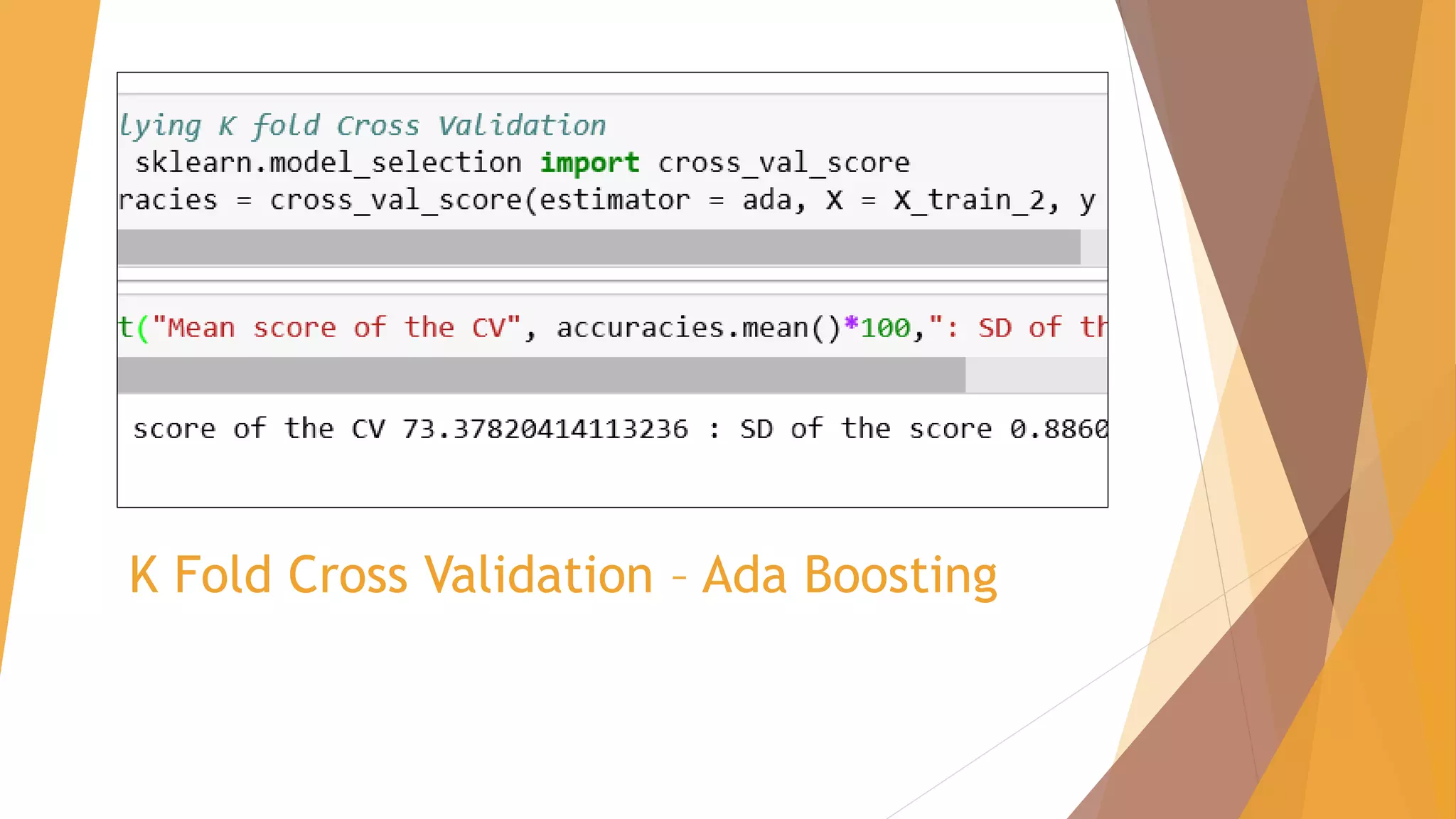
K Fold Cross Validation – Ada Boosting
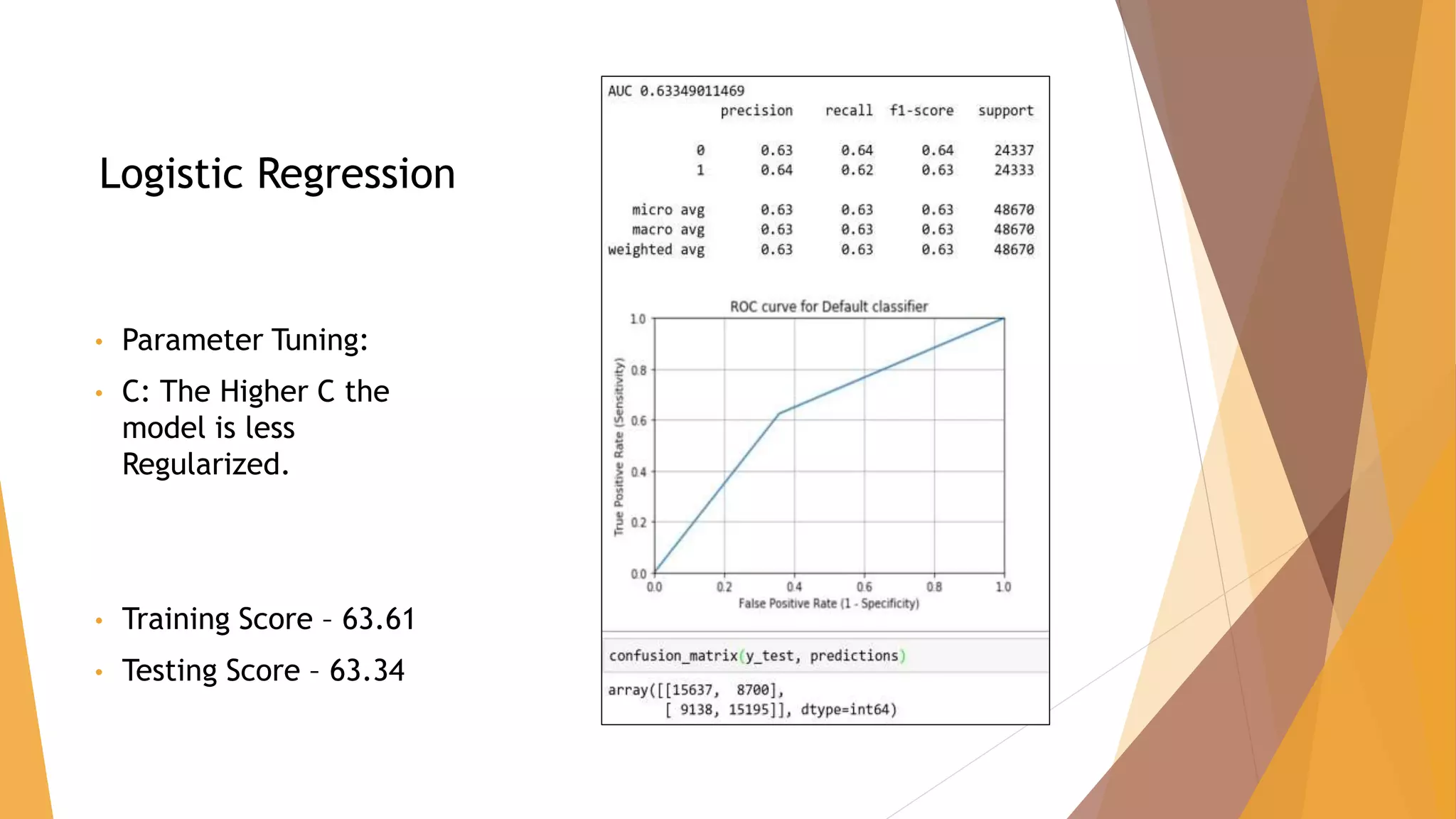
Logistic Regression
• Parameter Tuning:
• C: The Higher C the
model is less
Regularized.
• Training Score – 63.61
• Testing Score – 63.34
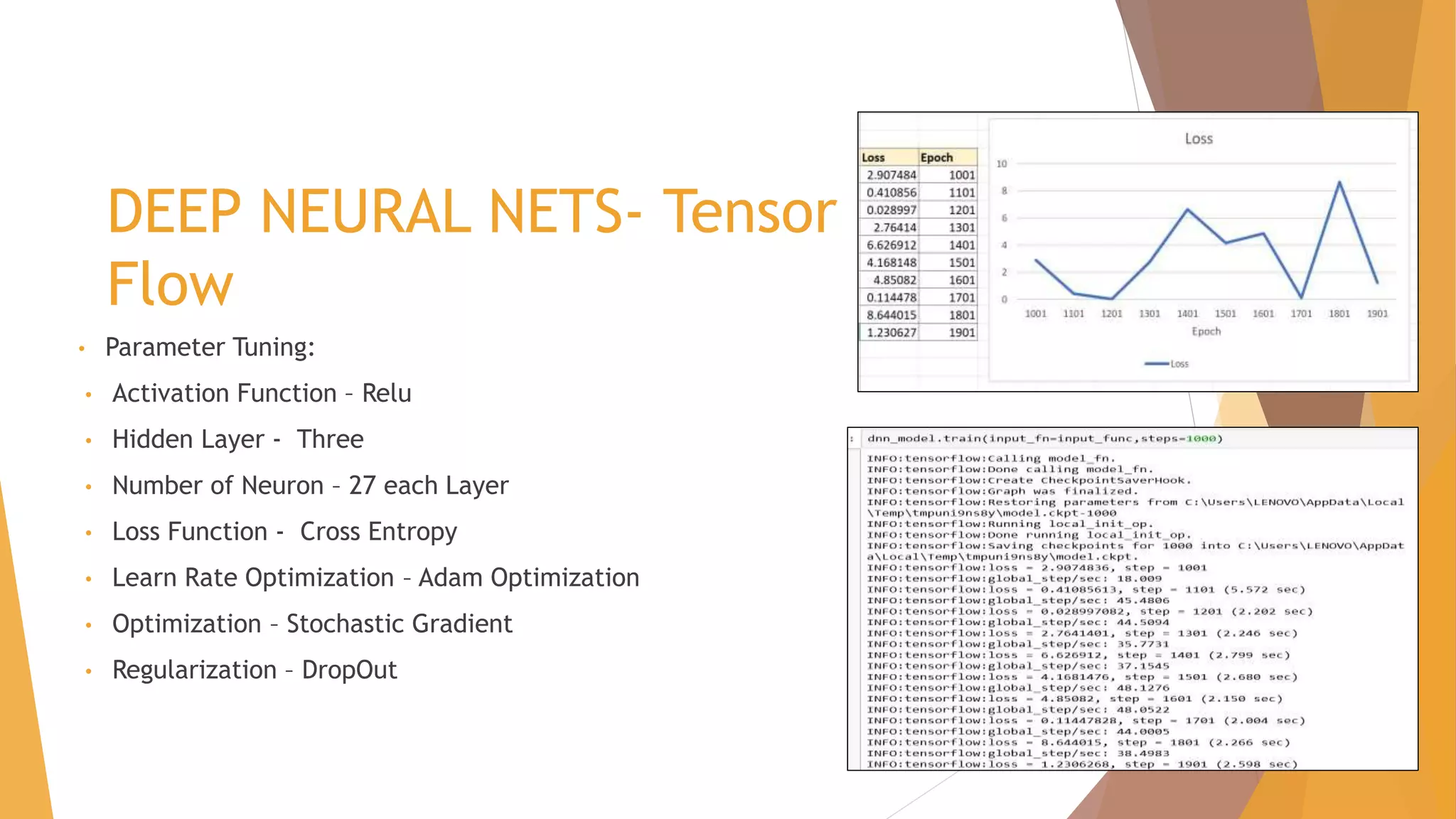
DEEP NEURAL NETS- Tensor
Flow
• Parameter Tuning:
• Activation Function – Relu
• Hidden Layer - Three
• Number of Neuron – 27 each Layer
• Loss Function - Cross Entropy
• Learn Rate Optimization – Adam Optimization
• Optimization – Stochastic Gradient
• Regularization – DropOut
DNN – Report
PCA – Principal
Component Analysis
 Parameter Tuning
 Number of Components --- Elbow plot
 Explained variance vs Number of components

PCA- COMPONENTS FEATURE VARIANCE
PCA+SMOTE+RF
CHALLENGES FACED – Algorithm
SVM
 Parameter Tuning
 C , gamma , Kernal.
 Grid Search
 C=[0.1,1,10,100]
 Gamma=[1,0.1,0.01,0.0001]
 Kernel- rbf.
 Time Execution – More than 12
hours , for 25 fits out of 75 fits
Challenges Faced – Data
 Data Imblance – Random Over Sampling, Random Under Sampling, SMOTE.
 Distribution of Continous Variable – Applied Log Transformation
 Over Fitting – K fold cross validation, HyperParameter Tuning.
 Dimensionality – PCA
SUMMARY
Model Train Score
Tesing
Score Precision Recal AUC
Knn+SMOTE 90.4 90.5 0.84 0.9 0.5
RF 75 50 0.65 0.45 0.5
RF+ UnderSample 65.3 63 0.63 0.63 0.63
RF+ OverSample 63.9 63.3 0.63 0.63 0.63
RF+Over Sampling
SMOTE 87.6 87.5 0.88 0.88 0.875
Ada Boosting 92.5 75.65 0.75 0.75 0.74
DNN 94.5 95.4 0.84 0.9 0.9
Logisti Regression 63.61 63.64 0.63 0.63 0.633
PCA+SMOTE+RF 76.5 76.5 0.76 0.8 0.76

CARVANA - Predicting the purchase quality in car

  • 1.
  • 2.
    Objective  The Automobileindustry gains a profitable income in the “Used Cars Segment” every year. Carvana, a pioneer in this industry increased its revenue to $5.39 billion driven largely by 8.1 percent increase in Used cars revenue.  People who purchase used cars does it for cost cutting. Anyone who has limited funds would appreciate the need to save little cash.  There are so many factors that get into buying a used car such as – Range of Cost, Pre-purchase Inspection, Ownership Validation, Vehicle History Report and Age etc.  We try to tackle this problem by analyzing various factors behind the car and help the company realize if a particular auction purchase is a Good/Bad buy.
  • 3.
  • 5.
    The Dataset The datasetwas obtained from Kaggle. The dataset was originally provided by Carvana, a Technology business start-up in Tempe, Arizona. Carvana is an online used car dealer that sells and buys back used car through their website. Carvana subsequently came with an idea to organize a competition in Kaggle, by providing the users their Purchase database with several key factors (i.e. car age, vehicle year, make , model, trim, Auction Average Price, Clean price etc.) The key here is to analyze the 73k transactions from Carvana and come up with the prediction model that helps them understand whether a particular transaction is a Good/Bad buy.
  • 6.
    DATASET DESCRIPTION  The datasethad a total of 34 attributes.  ReId – This is a Reference Id for each transaction in the dataset  PurchDate – Date attribute that specifies the date of Pruchase.  Auction – The Auction was help by two groups ADESA and MANHEIM. Other 3rd party dealers were also involved.  VehYear – The Year to which a particular model belongs.  VehicleAge – Number of years the vehicle is used.  Make – The vehicle company i.e. MAZDA, DODGE, FORD etc.  Model – Subclass from each Make i.e. FORD FOCUS, TOYOTA COROLLA etc.  Trim – The class distinction in each mode i.e ST, SXT, EX, SE etc.  SubModel – This is the type of Model i.e. 4D SEDAN, 2D COUPE, 4D SUV etc.  Color – Color of the vehicle  Transmission – AUTO or MANUAL
  • 7.
    CONTD..  WheelTypeID –ID of different types of Wheel  WheelType – Type of wheel such as ALLOY, COVERS etc.  VEhOdo – Number of miles driven  Nationality – Make’s Nationality  Size – LARGE TRUCK, MEDIUM SUV etc.  TopThreeAmericanName – The original parent company that owns the Make ex- CHRYSLER, GENERAL MOTORS MMR refers to the Manheim Market report prices  MMRAcquisitionAuctionAveragePrice – Acquisition price for this vehicle in average condition during purchase  MMRAcquisitionAuctionCleanPrice - Acquisition price for this vehicle in the above average condition during purchase  MMRAcquisitionRetailAveragePrice- Acquisition price for this vehicle in retail market in average condition  MMRAcquisitonRetailCleanPrice- Acquisition price for this vehicle in above average condition in the retail market
  • 8.
    CONTD..  MMRCurrentAuctionAveragePrice –The current auction price for this vehicle in average condition  MMRCurrentAuctionCleanPrice – The current auction price of this vehicle in above average condition  MMRCurrentRetailAveragePrice - The current retail price for this vehicle in average condition  MMRCurrentRetailCleanPrice - – The current retail price for this vehicle in above average condition  PRIMEUNIT – Identify if the vehicle would have a higher demand than the standard purchase  AUCGUART – The guarantee level provided by the auction for the vehicle  BYRNO - The ID associated with each buyer  VNZIP1 - The zip code where the car was purchased  VNST – The state where the car was purchased  VehBCost – The initial base price for the vehicle at beginning of auction  IsOnlineSale- Whether the car was sold online or not  WarrantyCost- The cost of warranty for each vehicle
  • 9.
    Dataset – Initialanalysis  The dataset initially had 34 attributes with the target attribute being – IsBadBuy  The dataset had 19 numerical attributes and 15 categorical attributes and the shape and column can be seen below. CATEGORICAL: ((72983, 15), Index(['PurchDate', 'Auction', 'Make', 'Model', 'Trim', 'SubModel', 'Color', 'Transmission', 'WheelType', 'Nationality', 'Size', 'TopThreeAmericanName', 'PRIMEUNIT', 'AUCGUART', 'VNST'], dtype='object’))
  • 10.
    CONTD… NUMERIC: ((72983, 19), Index(['RefId', 'IsBadBuy','VehYear', 'VehicleAge', 'WheelTypeID', 'VehOdo', 'MMRAcquisitionAuctionAveragePrice', 'MMRAcquisitionAuctionCleanPrice', 'MMRAcquisitionRetailAveragePrice', 'MMRAcquisitonRetailCleanPrice', 'MMRCurrentAuctionAveragePrice', 'MMRCurrentAuctionCleanPrice', 'MMRCurrentRetailAveragePrice', 'MMRCurrentRetailCleanPrice', 'BYRNO', 'VNZIP1', 'VehBCost', 'IsOnlineSale', 'WarrantyCost'], dtype='object'))
  • 11.
  • 12.
    PROBLEMS FACED - MISSINGVALUES  The Initial analysis showed that the dataset had 19 Attributes with missing values. The statistics for the missing values are.  Attributes PRIMEUNIT and ACGUART had only less than 1% percent of data and did not help enough with model building and were removed in the analysis. ATTRIBUTE NAME MISSING VALUES Trim 2360 SubModel 8 Color 8 Transmission 9 WheelTypeID 3169 WheelType 3174 Nationality 5 Size 5 TopThreeAmericanName 5 MMRAcquisitionAuctionAveragePrice 18 MMRAcquisitionAuctionCleanPrice 18 MMRAcquisitionRetailAveragePrice 18 MMRAcquisitonRetailCleanPrice 18 MMRCurrentAuctionAveragePrice 315 MMRCurrentAuctionCleanPrice 315 MMRCurrentRetailAveragePrice 315 MMRCurrentRetailCleanPrice 315 PRIMEUNIT 69564 AUCGUART 69564
  • 13.
  • 14.
    PROBLEM FACED – ClassImbalance  The original dataset is highly class imbalanced  Only 10 percent of the transaction were a BAD buy and the rest were GOOD buy
  • 15.
  • 16.
  • 17.
    Vehicle year foreach make. Color shows the average age of vehicle
  • 18.
    The number ofCars purchased by the Auction Company vs Make of Car Purchased by Nationality
  • 19.
     Color showsthe details about the make Size of Circle explains the count of MMR Current Retail price.
  • 20.
     Color showsthe average of current retail price in each state  In Second graph Color shows the Average Age of vehicle in each state
  • 21.
     The trendof sum of MMR Current Retail price for each make and Vehicle Year
  • 22.
  • 23.
    REMOVING THE INSIGNIFICANTFEATURES  The attributes PRIMEUNIT and AUCGUART had less than 1 percent of data and were found inefficient in predicting the target variable.  The preliminary data analysis showed that we had 15 Categorical variables. Now after removing the above 2 features we are left with 13 Categorical variables now.  We used One-hot Encoder to create dummy values for the Categorical variables.
  • 24.
    CONTD..  We alsoremoved the numerical variables VNZIP1 and RefId.  VNZIP1 was jus the zip codes of where the cars were sold. This is redundant because, we can infer this from the variable VNST(state codes). RefId is just a transaction ID which had no meaning.
  • 25.
    REMOVING OUTLIERS  We removedthe outliers from the continuous variables. This can be inferred from the boxplots below.
  • 26.
    DISTRIBUTION PLOTS We useddistribution plots to check the normality of the continuous variables.
  • 27.
    SMOTE FOR CLASSIMBALANCE We used SMOTE technique to solve the class imbalance problem.
  • 28.
    STANDARDIZATION OF FEATURES USING SCALING We used Standard Scalar to perform standardization so that all the numerical variables fall in the same scale throughout the dataset.
  • 29.
  • 30.
  • 31.
    Random Forest  Version:  OriginalData  SMOTE+ RF  Oversampling+ RF  Under Sample+ RF  Parameter Tuning:  n_estimators  Criterion  max_depth  max_feature
  • 32.
    Random -Under SamplingRandom – Over Sampling Over Sampling – SMOTE
  • 33.
    K Nearest Neighbor • ParameterTuning: • N_Neighbors • Distance Measure • a. p=0 Minkowski • b. p=1 Manhantan • c. p=2 Eulidean
  • 34.
    KNN – Report TrainingScore – 90.4 Testing Score – 90.5
  • 35.
    Ensemblem – Ada Boosting Parameter Tuning  Weak Learning – Decision Tree  criterion = “entropy”  Max_depth = 5  Random_state  Algorithm= SAME.R – Real Boosting  Train Score: 92.50  Test Score: 75.65
  • 36.
    K Fold CrossValidation – Ada Boosting
  • 37.
    Logistic Regression • ParameterTuning: • C: The Higher C the model is less Regularized. • Training Score – 63.61 • Testing Score – 63.34
  • 38.
    DEEP NEURAL NETS-Tensor Flow • Parameter Tuning: • Activation Function – Relu • Hidden Layer - Three • Number of Neuron – 27 each Layer • Loss Function - Cross Entropy • Learn Rate Optimization – Adam Optimization • Optimization – Stochastic Gradient • Regularization – DropOut
  • 39.
  • 40.
    PCA – Principal ComponentAnalysis  Parameter Tuning  Number of Components --- Elbow plot  Explained variance vs Number of components 
  • 41.
  • 42.
  • 43.
    CHALLENGES FACED –Algorithm SVM  Parameter Tuning  C , gamma , Kernal.  Grid Search  C=[0.1,1,10,100]  Gamma=[1,0.1,0.01,0.0001]  Kernel- rbf.  Time Execution – More than 12 hours , for 25 fits out of 75 fits
  • 44.
    Challenges Faced –Data  Data Imblance – Random Over Sampling, Random Under Sampling, SMOTE.  Distribution of Continous Variable – Applied Log Transformation  Over Fitting – K fold cross validation, HyperParameter Tuning.  Dimensionality – PCA
  • 45.
    SUMMARY Model Train Score Tesing ScorePrecision Recal AUC Knn+SMOTE 90.4 90.5 0.84 0.9 0.5 RF 75 50 0.65 0.45 0.5 RF+ UnderSample 65.3 63 0.63 0.63 0.63 RF+ OverSample 63.9 63.3 0.63 0.63 0.63 RF+Over Sampling SMOTE 87.6 87.5 0.88 0.88 0.875 Ada Boosting 92.5 75.65 0.75 0.75 0.74 DNN 94.5 95.4 0.84 0.9 0.9 Logisti Regression 63.61 63.64 0.63 0.63 0.633 PCA+SMOTE+RF 76.5 76.5 0.76 0.8 0.76