
MPLS: Key Factors to Consider
When Selecting Your MPLS Provider
Whitepaper


                                  EarthLink Business
                                  3000 Columbia House Blvd
                                      Vancouver, WA 98661
                                             360-693-9009
                                           1-866-636-3343


© 2006-20011 EarthLink Business                    Page 1
MPLS: Key Factors to Consider When Selecting Your MPLS Provider


EXECUTIVE SUMMARY

Multiprotocol Label Switching (MPLS), once the sole domain of major corporations and telecom carriers,
has gone mainstream and enterprises are increasingly developing strategies to migrate to MPLS-based
WAN services. The growing need for companies to reduce costs, increase productivity, support more
applications, and ramp up security is driving today's shift to MPLS.

MPLS enables companies to converge voice, video and data on a single network while its any-to-any
topology offers network managers the flexibility to divert traffic around link failures and network
congestion on the fly. MPLS traffic engineering and precise traffic routing allows businesses to pack more
data into their bandwidth on hand and reduces router-processing requirements. This cost-effective, fast
and highly scalable network technology supports prioritized network traffic, predictable application
performance, and built-in Quality of Service (QoS).

As carriers look to phase out legacy WAN services with MPLS technology, businesses who adopt MPLS
will not only be ahead of the curve financially, they will also be positioned to embrace growth. As with any
network technology, there are many factors to consider when selecting the right MPLS provider.


KEY PROVIDER CONSIDERATIONS

I. Class of Service

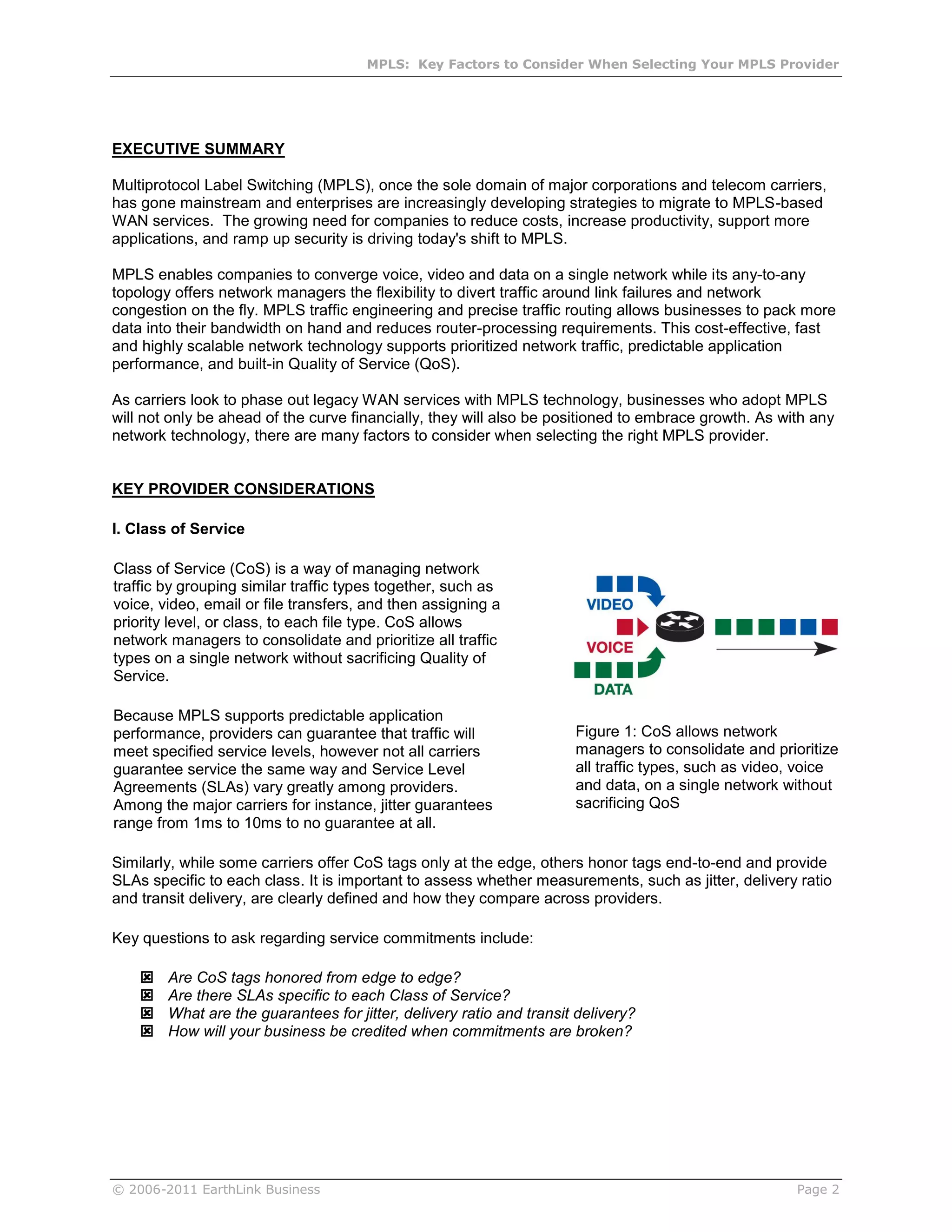
Class of Service (CoS) is a way of managing network
traffic by grouping similar traffic types together, such as
voice, video, email or file transfers, and then assigning a
priority level, or class, to each file type. CoS allows
network managers to consolidate and prioritize all traffic
types on a single network without sacrificing Quality of
Service.

Because MPLS supports predictable application
performance, providers can guarantee that traffic will                Figure 1: CoS allows network
meet specified service levels, however not all carriers               managers to consolidate and prioritize
guarantee service the same way and Service Level                      all traffic types, such as video, voice
Agreements (SLAs) vary greatly among providers.                       and data, on a single network without
Among the major carriers for instance, jitter guarantees              sacrificing QoS
range from 1ms to 10ms to no guarantee at all.

Similarly, while some carriers offer CoS tags only at the edge, others honor tags end-to-end and provide
SLAs specific to each class. It is important to assess whether measurements, such as jitter, delivery ratio
and transit delivery, are clearly defined and how they compare across providers.

Key questions to ask regarding service commitments include:

       Are CoS tags honored from edge to edge?
       Are there SLAs specific to each Class of Service?
       What are the guarantees for jitter, delivery ratio and transit delivery?
       How will your business be credited when commitments are broken?


© 2006-2011 EarthLink Business                                                                        Page 2
MPLS: Key Factors to Consider When Selecting Your MPLS Provider


II. The Network

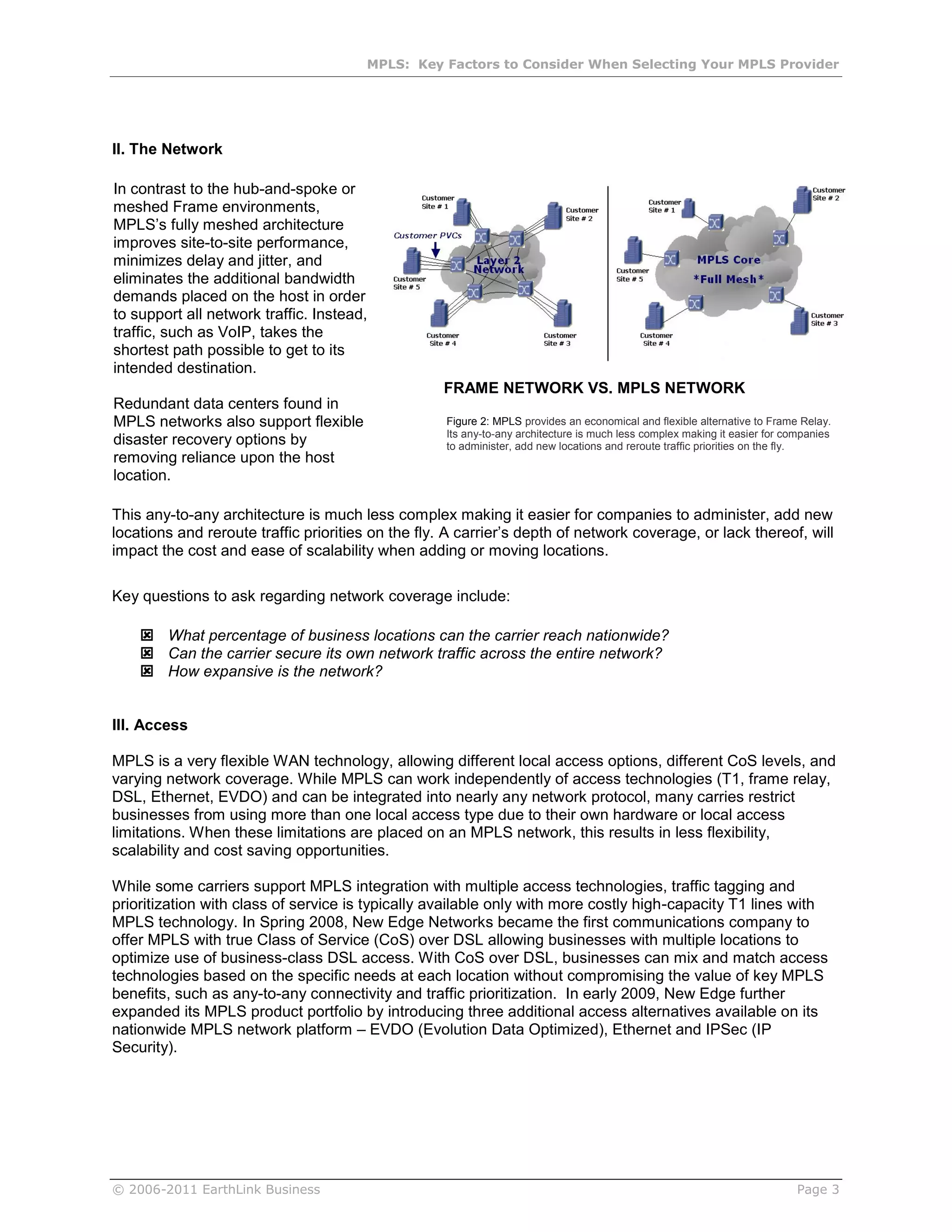
In contrast to the hub-and-spoke or
meshed Frame environments,
MPLS’s fully meshed architecture
improves site-to-site performance,
minimizes delay and jitter, and
eliminates the additional bandwidth
demands placed on the host in order
to support all network traffic. Instead,
traffic, such as VoIP, takes the
shortest path possible to get to its
intended destination.
                                                   FRAME NETWORK VS. MPLS NETWORK
Redundant data centers found in
MPLS networks also support flexible                 Figure 2: MPLS provides an economical and flexible alternative to Frame Relay.
                                                    Its any-to-any architecture is much less complex making it easier for companies
disaster recovery options by                        to administer, add new locations and reroute traffic priorities on the fly.
removing reliance upon the host
location.

This any-to-any architecture is much less complex making it easier for companies to administer, add new
locations and reroute traffic priorities on the fly. A carrier’s depth of network coverage, or lack thereof, will
impact the cost and ease of scalability when adding or moving locations.

Key questions to ask regarding network coverage include:

     What percentage of business locations can the carrier reach nationwide?
     Can the carrier secure its own network traffic across the entire network?
     How expansive is the network?


III. Access

MPLS is a very flexible WAN technology, allowing different local access options, different CoS levels, and
varying network coverage. While MPLS can work independently of access technologies (T1, frame relay,
DSL, Ethernet, EVDO) and can be integrated into nearly any network protocol, many carries restrict
businesses from using more than one local access type due to their own hardware or local access
limitations. When these limitations are placed on an MPLS network, this results in less flexibility,
scalability and cost saving opportunities.

While some carriers support MPLS integration with multiple access technologies, traffic tagging and
prioritization with class of service is typically available only with more costly high-capacity T1 lines with
MPLS technology. In Spring 2008, New Edge Networks became the first communications company to
offer MPLS with true Class of Service (CoS) over DSL allowing businesses with multiple locations to
optimize use of business-class DSL access. With CoS over DSL, businesses can mix and match access
technologies based on the specific needs at each location without compromising the value of key MPLS
benefits, such as any-to-any connectivity and traffic prioritization. In early 2009, New Edge further
expanded its MPLS product portfolio by introducing three additional access alternatives available on its
nationwide MPLS network platform – EVDO (Evolution Data Optimized), Ethernet and IPSec (IP
Security).


© 2006-2011 EarthLink Business                                                                                              Page 3
MPLS: Key Factors to Consider When Selecting Your MPLS Provider


    Access Options:

       T1
        A T1 is a digital transmission link with a signaling speed of 1.5 Mbps in both directions. Private T1
        lines are a proven technology and the backbone of business networks. With an MPLS T1 network
        from New Edge, businesses gain dependable bandwidth with a 4-hour mean time to repair
        (MTTR). Private T1s provide symmetrical 1.5 Mbps bandwidth which can be allocated to
        converge VoIP, video and other data.
         Ideal for mission critical locations
         Supports up to 5 Classes of Service (CoS)

       DSL
        Digital Subscriber Lines (DSL or xDSL) provide digital data transmission over the wires of a local
        telephone network. xDSL can be used at the same time and on the same line as regular
        telephone service, as it uses a higher frequency than regular telephone service. ADSL is
        asynchronous meaning it has higher download speeds than upload speeds. ADSL download
        speeds average 1.5Mbps down, which is comparable to T1 download speeds. MPLS over
        business-class DSL fills the traditional gaps in service level and price between DSL and T1
        connections, giving businesses a cost-effective option for securing the performance of their
        critical applications such as VoIP and video. Businesses also gain the flexibility to move to more
        robust T1 lines as their business needs change.
         Ideal access to create a cost-effective network
         Supports up to 5 Classes of Service (CoS)

       Ethernet
        Ethernet is an economical alternative to traditional high capacity services such as OC3 and DS3
        on a per Mbps basis and is also a cost-effective last-mile service. New Edge’s Ethernet
        broadband service works as a reliable backbone for large networks with substantial traffic
        demands. This highly scalable service is well suited to help businesses relieve network
        congestion brought on by VoIP traffic, video uploads and downloads, file transfers, and other
        network demands.
         Ideal for locations with substantial traffic demands
         Supports up to 5 Classes of Service (CoS)

       IPsec
        MPLS IPsec is a set of protocols enabling remote locations to have secure access to the core
        MPLS network over the Internet. IPsec allows businesses to procure Internet access from a local
        provider (typically in outlying areas where it is more economically feasible) and then connect to
        the corporate MPLS network. IPsec supports the 3DES encryption algorithm (168-bit), which is
        the finance industry standard for network layer encryption.
         Ideal for connecting outlying business locations using 3rd-party access

       Wireless EVDO
        Wireless EVDO is ideal for businesses with frequent moves or geographically dispersed locations
        where DSL is not available and T1 service is prohibitively expensive. EVDO supports seasonality
        in industries that manage through frequent store openings, moves and kiosk relocations, such as
        retail, construction, insurance and tax services. EVDO can be utilized as an interim solution when
        businesses encounter facility issues or long lead times with DSL or T1 installations. EVDO is also
        among the best back-up network alternatives for businesses in terms of level of redundancy.
        Unlike wireline technologies, this high-speed wireless access platform is inherently resistant to
        natural disasters and construction incidents.
         Ideal as a backup or for businesses with frequent moves

     Does the carrier support multiple local access options including Frame, Private Line, Ethernet,
      EVDO and xDSL on one MPLS network?
     Is MPLS class of service (CoS) available over DSL, and if so, how many classes?
     What is the Mean-Time to Repair (MTTR) a DSL line with the CoS option?

© 2006-2011 EarthLink Business                                                                        Page 4
MPLS: Key Factors to Consider When Selecting Your MPLS Provider


     Is CoS honored edge to edge or from core switch to core switch?


IV. Project Management and Network Monitoring

Information management is perhaps the most important part of an effective network management system.
The complexity of dynamic networks demands extensive documentation for successful management.
Online management tools can greatly reduce the load on an IT staff by performing a variety of tasks such
as monitoring router and firewall equipment, predicting network costs, providing utilization statistics,
reducing network outages, improving response and repair times, and automating trouble response and
resolution. It is important to understand the scope and cost of managed services offered by a provider up
front, and whether these services include tracking and monitoring of the entire network.

Key questions to ask regarding managed services include:

     Is there an additional charge for managed services (reporting, network monitoring, etc.)?
     Does the network come with a dedicated project management team and 24x7 support for the life
      of the contract
     Is there an additional charge for project management?
     Does the provider track and monitor the entire network?
     Does the provider offer premium installation services?
     Does the provider test application response during MPLS installation?


V. Routing Protocol

MPLS supports multiple IP routing protocols, such as static, BGP, OSPF and EIGRP, however many
providers place limits on their support to as few as two routing protocols. This limitation places the
burden on the customer to employ IT resources with the expertise to establish and maintain processes to
translate protocols. This additional process also adds to the network’s overhead and can negatively
impact network performance.

Key questions to ask regarding routing protocol include:

     Is the MPLS provider routing protocol agnostic?
     Will I have to translate routing protocols, such as EIGRP to BGP?
     How will routing protocol limitations impact network performance?


© 2006-2011 EarthLink Business                                                                     Page 5
MPLS: Key Factors to Consider When Selecting Your MPLS Provider


VI. Security

With MPLS networks, businesses benefit from the same (or better) privacy and security as provided by
Layer 2 networks, while gaining the flexibility and scalability of a fully meshed architecture. MPLS
networks hide their core infrastructure and protect against label spoofing, making them resistant to
attacks. Customer traffic is separated logically and physically within the carrier’s network. This added
security is achieved because the customer’s IP address is completely private.

Key questions to ask regarding network security include:

     Is the MPLS network part of a shared infrastructure that includes Internet access?
     If so, are separate provider edge routers used for Internet and VPN access?


CONCLUSION

MPLS offers enterprises many benefits including prioritized network traffic, predictable application
performance, and built-in Quality of Service (QoS). Because MPLS is highly scalable and less complex
than its predecessors, businesses gain more flexibility, less overhead and improved control over network
costs. As you consider adopting an MPLS-based WAN solution, it is important to understand the benefits
of MPLS in comparison to your existing network infrastructure as well as how service and support vary
across MPLS providers. From local access options to CoS to routing protocols, MPLS providers vary in
what they offer, what comes standard with their MPLS offering, and what restrictions they place on their
customers.


© 2006-2011 EarthLink Business                                                                       Page 6

Key Factors To Consider When Selecting Your Mpls Provider

  • 1.
    MPLS: Key Factorsto Consider When Selecting Your MPLS Provider Whitepaper EarthLink Business 3000 Columbia House Blvd Vancouver, WA 98661 360-693-9009 1-866-636-3343 © 2006-20011 EarthLink Business Page 1
  • 2.
    MPLS: Key Factorsto Consider When Selecting Your MPLS Provider EXECUTIVE SUMMARY Multiprotocol Label Switching (MPLS), once the sole domain of major corporations and telecom carriers, has gone mainstream and enterprises are increasingly developing strategies to migrate to MPLS-based WAN services. The growing need for companies to reduce costs, increase productivity, support more applications, and ramp up security is driving today's shift to MPLS. MPLS enables companies to converge voice, video and data on a single network while its any-to-any topology offers network managers the flexibility to divert traffic around link failures and network congestion on the fly. MPLS traffic engineering and precise traffic routing allows businesses to pack more data into their bandwidth on hand and reduces router-processing requirements. This cost-effective, fast and highly scalable network technology supports prioritized network traffic, predictable application performance, and built-in Quality of Service (QoS). As carriers look to phase out legacy WAN services with MPLS technology, businesses who adopt MPLS will not only be ahead of the curve financially, they will also be positioned to embrace growth. As with any network technology, there are many factors to consider when selecting the right MPLS provider. KEY PROVIDER CONSIDERATIONS I. Class of Service Class of Service (CoS) is a way of managing network traffic by grouping similar traffic types together, such as voice, video, email or file transfers, and then assigning a priority level, or class, to each file type. CoS allows network managers to consolidate and prioritize all traffic types on a single network without sacrificing Quality of Service. Because MPLS supports predictable application performance, providers can guarantee that traffic will Figure 1: CoS allows network meet specified service levels, however not all carriers managers to consolidate and prioritize guarantee service the same way and Service Level all traffic types, such as video, voice Agreements (SLAs) vary greatly among providers. and data, on a single network without Among the major carriers for instance, jitter guarantees sacrificing QoS range from 1ms to 10ms to no guarantee at all. Similarly, while some carriers offer CoS tags only at the edge, others honor tags end-to-end and provide SLAs specific to each class. It is important to assess whether measurements, such as jitter, delivery ratio and transit delivery, are clearly defined and how they compare across providers. Key questions to ask regarding service commitments include:  Are CoS tags honored from edge to edge?  Are there SLAs specific to each Class of Service?  What are the guarantees for jitter, delivery ratio and transit delivery?  How will your business be credited when commitments are broken? © 2006-2011 EarthLink Business Page 2
  • 3.
    MPLS: Key Factorsto Consider When Selecting Your MPLS Provider II. The Network In contrast to the hub-and-spoke or meshed Frame environments, MPLS’s fully meshed architecture improves site-to-site performance, minimizes delay and jitter, and eliminates the additional bandwidth demands placed on the host in order to support all network traffic. Instead, traffic, such as VoIP, takes the shortest path possible to get to its intended destination. FRAME NETWORK VS. MPLS NETWORK Redundant data centers found in MPLS networks also support flexible Figure 2: MPLS provides an economical and flexible alternative to Frame Relay. Its any-to-any architecture is much less complex making it easier for companies disaster recovery options by to administer, add new locations and reroute traffic priorities on the fly. removing reliance upon the host location. This any-to-any architecture is much less complex making it easier for companies to administer, add new locations and reroute traffic priorities on the fly. A carrier’s depth of network coverage, or lack thereof, will impact the cost and ease of scalability when adding or moving locations. Key questions to ask regarding network coverage include:  What percentage of business locations can the carrier reach nationwide?  Can the carrier secure its own network traffic across the entire network?  How expansive is the network? III. Access MPLS is a very flexible WAN technology, allowing different local access options, different CoS levels, and varying network coverage. While MPLS can work independently of access technologies (T1, frame relay, DSL, Ethernet, EVDO) and can be integrated into nearly any network protocol, many carries restrict businesses from using more than one local access type due to their own hardware or local access limitations. When these limitations are placed on an MPLS network, this results in less flexibility, scalability and cost saving opportunities. While some carriers support MPLS integration with multiple access technologies, traffic tagging and prioritization with class of service is typically available only with more costly high-capacity T1 lines with MPLS technology. In Spring 2008, New Edge Networks became the first communications company to offer MPLS with true Class of Service (CoS) over DSL allowing businesses with multiple locations to optimize use of business-class DSL access. With CoS over DSL, businesses can mix and match access technologies based on the specific needs at each location without compromising the value of key MPLS benefits, such as any-to-any connectivity and traffic prioritization. In early 2009, New Edge further expanded its MPLS product portfolio by introducing three additional access alternatives available on its nationwide MPLS network platform – EVDO (Evolution Data Optimized), Ethernet and IPSec (IP Security). © 2006-2011 EarthLink Business Page 3
  • 4.
    MPLS: Key Factorsto Consider When Selecting Your MPLS Provider Access Options:  T1 A T1 is a digital transmission link with a signaling speed of 1.5 Mbps in both directions. Private T1 lines are a proven technology and the backbone of business networks. With an MPLS T1 network from New Edge, businesses gain dependable bandwidth with a 4-hour mean time to repair (MTTR). Private T1s provide symmetrical 1.5 Mbps bandwidth which can be allocated to converge VoIP, video and other data.  Ideal for mission critical locations  Supports up to 5 Classes of Service (CoS)  DSL Digital Subscriber Lines (DSL or xDSL) provide digital data transmission over the wires of a local telephone network. xDSL can be used at the same time and on the same line as regular telephone service, as it uses a higher frequency than regular telephone service. ADSL is asynchronous meaning it has higher download speeds than upload speeds. ADSL download speeds average 1.5Mbps down, which is comparable to T1 download speeds. MPLS over business-class DSL fills the traditional gaps in service level and price between DSL and T1 connections, giving businesses a cost-effective option for securing the performance of their critical applications such as VoIP and video. Businesses also gain the flexibility to move to more robust T1 lines as their business needs change.  Ideal access to create a cost-effective network  Supports up to 5 Classes of Service (CoS)  Ethernet Ethernet is an economical alternative to traditional high capacity services such as OC3 and DS3 on a per Mbps basis and is also a cost-effective last-mile service. New Edge’s Ethernet broadband service works as a reliable backbone for large networks with substantial traffic demands. This highly scalable service is well suited to help businesses relieve network congestion brought on by VoIP traffic, video uploads and downloads, file transfers, and other network demands.  Ideal for locations with substantial traffic demands  Supports up to 5 Classes of Service (CoS)  IPsec MPLS IPsec is a set of protocols enabling remote locations to have secure access to the core MPLS network over the Internet. IPsec allows businesses to procure Internet access from a local provider (typically in outlying areas where it is more economically feasible) and then connect to the corporate MPLS network. IPsec supports the 3DES encryption algorithm (168-bit), which is the finance industry standard for network layer encryption.  Ideal for connecting outlying business locations using 3rd-party access  Wireless EVDO Wireless EVDO is ideal for businesses with frequent moves or geographically dispersed locations where DSL is not available and T1 service is prohibitively expensive. EVDO supports seasonality in industries that manage through frequent store openings, moves and kiosk relocations, such as retail, construction, insurance and tax services. EVDO can be utilized as an interim solution when businesses encounter facility issues or long lead times with DSL or T1 installations. EVDO is also among the best back-up network alternatives for businesses in terms of level of redundancy. Unlike wireline technologies, this high-speed wireless access platform is inherently resistant to natural disasters and construction incidents.  Ideal as a backup or for businesses with frequent moves  Does the carrier support multiple local access options including Frame, Private Line, Ethernet, EVDO and xDSL on one MPLS network?  Is MPLS class of service (CoS) available over DSL, and if so, how many classes?  What is the Mean-Time to Repair (MTTR) a DSL line with the CoS option? © 2006-2011 EarthLink Business Page 4
  • 5.
    MPLS: Key Factorsto Consider When Selecting Your MPLS Provider  Is CoS honored edge to edge or from core switch to core switch? IV. Project Management and Network Monitoring Information management is perhaps the most important part of an effective network management system. The complexity of dynamic networks demands extensive documentation for successful management. Online management tools can greatly reduce the load on an IT staff by performing a variety of tasks such as monitoring router and firewall equipment, predicting network costs, providing utilization statistics, reducing network outages, improving response and repair times, and automating trouble response and resolution. It is important to understand the scope and cost of managed services offered by a provider up front, and whether these services include tracking and monitoring of the entire network. Key questions to ask regarding managed services include:  Is there an additional charge for managed services (reporting, network monitoring, etc.)?  Does the network come with a dedicated project management team and 24x7 support for the life of the contract  Is there an additional charge for project management?  Does the provider track and monitor the entire network?  Does the provider offer premium installation services?  Does the provider test application response during MPLS installation? V. Routing Protocol MPLS supports multiple IP routing protocols, such as static, BGP, OSPF and EIGRP, however many providers place limits on their support to as few as two routing protocols. This limitation places the burden on the customer to employ IT resources with the expertise to establish and maintain processes to translate protocols. This additional process also adds to the network’s overhead and can negatively impact network performance. Key questions to ask regarding routing protocol include:  Is the MPLS provider routing protocol agnostic?  Will I have to translate routing protocols, such as EIGRP to BGP?  How will routing protocol limitations impact network performance? © 2006-2011 EarthLink Business Page 5
  • 6.
    MPLS: Key Factorsto Consider When Selecting Your MPLS Provider VI. Security With MPLS networks, businesses benefit from the same (or better) privacy and security as provided by Layer 2 networks, while gaining the flexibility and scalability of a fully meshed architecture. MPLS networks hide their core infrastructure and protect against label spoofing, making them resistant to attacks. Customer traffic is separated logically and physically within the carrier’s network. This added security is achieved because the customer’s IP address is completely private. Key questions to ask regarding network security include:  Is the MPLS network part of a shared infrastructure that includes Internet access?  If so, are separate provider edge routers used for Internet and VPN access? CONCLUSION MPLS offers enterprises many benefits including prioritized network traffic, predictable application performance, and built-in Quality of Service (QoS). Because MPLS is highly scalable and less complex than its predecessors, businesses gain more flexibility, less overhead and improved control over network costs. As you consider adopting an MPLS-based WAN solution, it is important to understand the benefits of MPLS in comparison to your existing network infrastructure as well as how service and support vary across MPLS providers. From local access options to CoS to routing protocols, MPLS providers vary in what they offer, what comes standard with their MPLS offering, and what restrictions they place on their customers. © 2006-2011 EarthLink Business Page 6