Answers for infrastructure and cities.
Unrestricted © Siemens AG 2013 All rights reserved.
IP/MPLS versus MPLS-TP
A brief comparison
A Smart Grid through Smart Communications
V 1
21 August 2013
Unrestricted © Siemens AG 2013 All rights reserved.
2013-08-21
Page 2
• Key Network Requirements 3
• Main Differences 6
• Typical Architecture 10
• Comparison in Detail 13
• Where to implement 22
• Cost comparison 26
IP/MPLS versus MPLS-TP
Table of content
IP/MPLS
MPLS-TP
Unrestricted © Siemens AG 2013 All rights reserved.
2013-08-21
Page 3
Key Requirements for the Utility Wide Area Network
Network Evolution with SDH, MPLS-TP or IP/MPLS
Total Cost of Ownership (TCO)
• Cheap Layer 2 Label Switches with centralized utility grade NMS versus complex and
expensive Layer 3 IP Routers
• Cost of training, certification, troubleshooting expertise and network care expenses for
transport engineers versus routing engineers
Long-term Product support
• Transport equipment vendors align their roadmaps following the packet centric Telco mass
market (Unified Mobile Backhauling). Maintenance Mode of legacy PDH/SDH
equipment announced or planned by many vendors and force Utilities to react with
packet based network strategy now !
Dominant future Traffic Type
• Amount of legacy TDM traffic versus Next Generation Ethernet and IP packet based
only services (IEC 104, VoIP, CCTV, Physical Access Control, IEC 61850 GOOSE and
Wide Area Profiles for Monitoring, Protection and Control, Enterprise traffic, AMI and
Distribution Automation data aggregation)
Unrestricted © Siemens AG 2013 All rights reserved.
2013-08-21
Page 4
Key Requirements for the Utility Wide Area Network
Network Evolution with SDH, MPLS-TP or IP/MPLS
Determinism
• Guarantee that mission critical traffic meets hard latency boundaries
• Symmetrical bidirectional forward and return paths mandated by certain use cases
(e.g. Teleprotection: < 10ms (for EHV fast tripping less than 5ms),
Differential Protection: very low jitter,
Power Quality: < 20ms,
SCADA: < 1s)
Resiliency
• High availability of the Network, Transport, and Service Layers (< 50 ms end-to-end
switchover time to backup path)
Security
• Securing versus Separation of the Control Plane
• Virtualization and Separation of Service Classes and complete network layers (VPN)
Unrestricted © Siemens AG 2013 All rights reserved.
2013-08-21
Page 5
Key Requirements for the Utility Wide Area Network
Network Evolution with SDH, MPLS-TP or IP/MPLS
Traffic Engineering
• Predefined end-to-end working and protection paths with guaranteed bandwidth reservation
for mission critical services (avoidance of congested and overbooked links during traffic
peaks)
Ease of Operations
• OAM features similar to SDH
• Complex Layer 3 Routing or simple Layer 2 Switching
• Comprehensive GUI based NMS for Network Management or CLI based per node practice
Flat Architecture
• Top down packet based clock distribution versus clock loops vulnerability issues and clock
planning complexity
• Distributed decentralized peer-to-peer cross connections versus static HW CC matrix
Unrestricted © Siemens AG 2013 All rights reserved.
2013-08-21
Page 6
• Key Network Requirements 3
• Main Differences 6
• Typical Architecture 10
• Comparison in Detail 13
• Where to implement 22
• Cost comparison 26
IP/MPLS versus MPLS-TP
Table of content
IP/MPLS
MPLS-TP
Unrestricted © Siemens AG 2013 All rights reserved.
2013-08-21
Page 7
IP/MPLS versus MPLS-TP
Main Differences
IP/MPLS („Routers MPLS“)
• IP/MPLS (IP transport over Multi Protocol Label Switching) is standardized by IETF.
First proposals made in 1996
• Is a proven label switching technology in the IP Core, to enable connection oriented
services with very fast packet forwarding speed for IP packet based networks. It is
located between Layer3 (IP) and Layer 2 (Ethernet), often referred to as Layer 2,5
• IP/MPLS devices provide the same legacy TDM interfaces as PDH/SDH
• Migration path from TDM (SDH) to IP/MPLS is a deeper technology cut for utilities as
IP/MPLS is based on complex and dynamic self-organizing IP Routers (L3 devices with
integrated data + control plane). Traffic routing is per default dynamic and operator
independent, but the operator sets the rules & limits. All LSP traffic paths (data plane) are
unidirectional per default.
• IP/MPLS implementations result in significantly higher costs and service efforts
compared to MPLS-TP
• Vendors like Alcatel Lucent, Cisco and Juniper promoting IP/MPLS as target
reference architecture for Telco carriers, ISP and Utilities
Unrestricted © Siemens AG 2013 All rights reserved.
2013-08-21
Page 8
IP/MPLS versus MPLS-TP
Main Differences
MPLS-TP („Optical Packet-based & Transport optimized MPLS“)
• MPLS-TP (Multi Protocol Label Switching –Transport Profile) is a joint standards framework
by IETF & ITU-T (cooperation formed 2008)
• MPLS-TP is a simplified version of IP/MPLS for pure packet-based transport
networks to reuse of the major MPLS constructs and historical SDH paradigms to make it
more suitable for use in the Layer1/2 optical packet-based transport world
• MPLS-TP uses a separated central NMS system to control all traffic paths (control plane),
in a deterministic operator defined style like in SDH networks
• All MPLS-TP LSP traffic paths (data plane) are bidirectional per default
• MPLS-TP integrates a dedicated transport OAM channel to control QoS of all trails, like in
SDH networks
• MPLS-TP devices provide also the same legacy TDM interfaces as PDH/SDH
• Vendors like ECI, ERICSSON and Huawei implement dual switching matrixes (SDH +
MPLS-TP) in their NG SDH systems to provide a smooth migration from SDH to the packet
transport world.
Unrestricted © Siemens AG 2013 All rights reserved.
2013-08-21
Page 9
Connection-Oriented
Packet-Switched
(CO-PS)
IP/MPLS
Connection-Oriented
Packet-Switched
(CO-PS)
IP/MPLS
Connection-Oriented
Circuit-Switched
(CO-CS)
SDH
Connection-Oriented
Circuit-Switched
(CO-CS)
SDH
MPLS-TP
The best of SDH and IP/MPLS
MPLS-TP fulfills the requirements for connection oriented packet switching
technology with full transport OAM
MPLS-TP adds packet-based behavior with deterministic
transport to SDH domain
MPLS-TP adds packet-based behavior with deterministic
transport to SDH domain
MPLS-TP adds SDH-like transport mechanisms to IP/MPLS
domain while preserving the main MPLS constructs
MPLS-TP adds SDH-like transport mechanisms to IP/MPLS
domain while preserving the main MPLS constructs
MPLS-TP allows true TDM and packet data convergence by bridging
the gap between the transport and IP routed services worlds
MPLS-TP allows true TDM and packet data convergence by bridging
the gap between the transport and IP routed services worlds
• Optimized for TDM voice
• Sophisticated OAM
• Fast Resiliency
• Scalability
• Strong Traffic Engineering and QoS
• Cost Efficiency
• Optimized for IP data core
• Fast packet forwarding speed
„Route at Edge and Switch in the Core“
• Statistical Multiplexing with VPN services
• Fine granular Bandwidth allocation
(CO
(CO-
-PS)
PS)
MPLS
MPLS-
-TP
TP
Best of
Best of
both worlds
both worlds
Unrestricted © Siemens AG 2013 All rights reserved.
2013-08-21
Page 10
• Key Network Requirements 3
• Main Differences 6
• Typical Architecture 10
• Comparison in Detail 13
• Where to implement 22
• Cost comparison 26
IP/MPLS versus MPLS-TP
Table of content
IP/MPLS
MPLS-TP
Unrestricted © Siemens AG 2013 All rights reserved.
2013-08-21
Page 11
P
LSR
CE1 CE2
IP.Net1
VoIP
Office LAN
RTU
IP.Net2
IP PABX
SCADA
VoIP
IP PABX
IP/MPLS
Typical Architecture
CE: Customer Edge IP Router
1. Routing Protocols (e.g. OSPF, IS-IS, BGP) establish reachability to destination IP networks
2. Label Distribution Protocol (LDP) establishes label to destination IP network mappings
3. Ingress PE router receives IP packet and TDM frame, performs IP/Layer3 and CES/PW functions
and forwards the packets using Label Push operation (adding of a label)
4. P router switches the packets using Label Swapping
5. Egress PE router removes the labels using Label Pop operation and delivers IP packet and TDM
frame to destination
LSP Label
PW
Label
PE / LER: Provider Edge / Label Edge Router
P / LSR: Provider (Core) / Label Switch Router
PDH/
SDH
PE1
LER PDH/
SDH
PE2
LER
Unrestricted © Siemens AG 2013 All rights reserved.
2013-08-21
Page 12
MPLS-TP
P
Client
Node1
MPLS-TP
Typical Architecture
Packet Transport Layer: MPLS-TP LSP (static, bidirectional, working + protect switched path)
Client Layer: Pseudowire (P-t-P encapsulated E1, STM-1/4, Ethernet, Serial, etc.) or IP packets
In-band OAM (data plane supervision, etc.)
Client Signal: E1, STM-1/4, Ethernet, Serial, etc.
Protect LSP
NMS
Control
Plane
LAN1
VoIP
Office LAN
RTU
LAN2
IP PABX
SCADA
VoIP
IP PABX
Client
Node2
LSP Label
PW
Label
Working LSP
PDH/
SDH
MPLS-TP
PE
PDH/
SDH
MPLS-TP
PE
Unrestricted © Siemens AG 2013 All rights reserved.
2013-08-21
Page 13
• Key Network Requirements 3
• Main Differences 6
• Typical Architecture 10
• Comparison in Detail 13
• Where to implement 22
• Cost comparison 26
IP/MPLS versus MPLS-TP
Table of content
IP/MPLS
MPLS-TP
Unrestricted © Siemens AG 2013 All rights reserved.
2013-08-21
Page 14
SDH versus MPLS-TP versus IP/MPLS
Comparison in Detail
Comparison
Comparison
Factor
Factor
SDH
SDH MPLS
MPLS-
-TP
TP IP/MPLS
IP/MPLS
CAPEX
CAPEX
Mature cost optimized
equipment
MPLS-TP devices can be
less sophisticated than
full IP/MPLS routers and
therefore cost less
Complex IP/MPLS
routers require more
processing power and
many dynamic routing
protocol stacks and
therefore cost more
OPEX
OPEX
Low
Learning curve is
saturated
MPLS-TP network
operations requires the
same sorts of regular
and standard skills as
any other transport
technology (like SDH)
IP/MPLS operations and
care needs high
expertise and is prone to
User/CLI errors.
Hence cost of the staff
is high and
troubleshooting is
time-consuming
Unrestricted © Siemens AG 2013 All rights reserved.
2013-08-21
Page 15
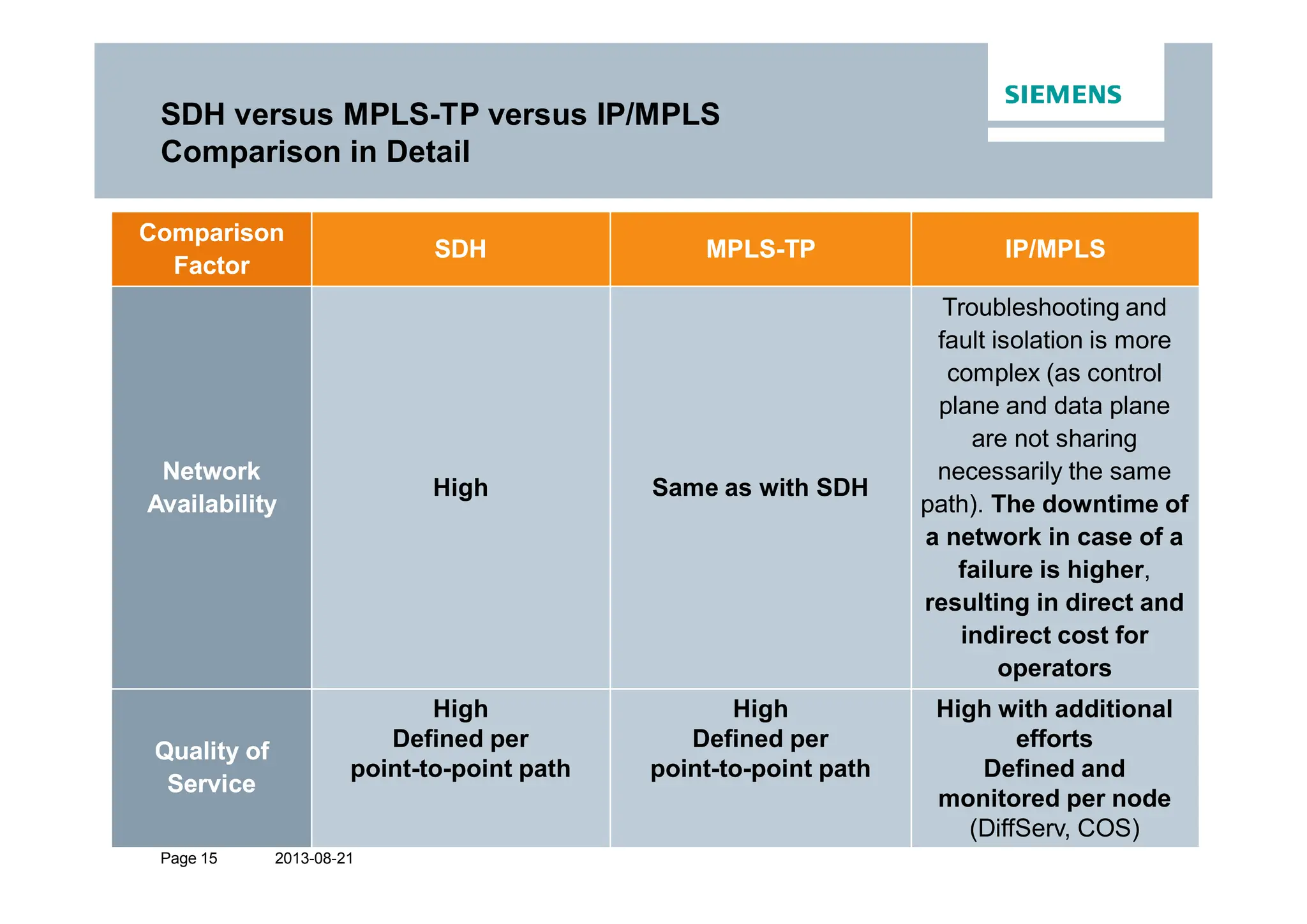
SDH versus MPLS-TP versus IP/MPLS
Comparison in Detail
Comparison
Comparison
Factor
Factor
SDH
SDH MPLS
MPLS-
-TP
TP IP/MPLS
IP/MPLS
Network
Network
Availability
Availability
High Same as with SDH
Troubleshooting and
fault isolation is more
complex (as control
plane and data plane
are not sharing
necessarily the same
path). The downtime of
a network in case of a
failure is higher,
resulting in direct and
indirect cost for
operators
Quality of
Quality of
Service
Service
High
Defined per
point-to-point path
High
Defined per
point-to-point path
High with additional
efforts
Defined and
monitored per node
(DiffServ, COS)
Unrestricted © Siemens AG 2013 All rights reserved.
2013-08-21
Page 16
SDH versus MPLS-TP versus IP/MPLS
Comparison in Detail
Comparison
Comparison
Factor
Factor
SDH
SDH MPLS
MPLS-
-TP
TP IP/MPLS
IP/MPLS
Mission
Mission
Critical
Critical
Awareness
Awareness
Teleprotection
and IEC 101 proven
Teleprotection
and IEC 101 ready
(Latency
per several nodes
<10 ms is feasible)
Teleprotection
and IEC 101 need
additional efforts
(Latency
per several nodes
<10 ms is feasible)
Legacy
Legacy
support
support
TDM
(E1, STM-1/4/16/64 native)
Serial Interfaces
(integrated or via external
PDH-MUX)
TDM
(E1, STM-1/4 using CES
or native in hybrid nodes)
Serial Interfaces
(integrated or via external
PDH-MUX)
TDM
(E1, STM-1/4 using CES)
Serial Interfaces
(integrated or via external
PDH-MUX)
Unrestricted © Siemens AG 2013 All rights reserved.
2013-08-21
Page 17
SDH versus MPLS-TP versus IP/MPLS
Comparison in Detail
Comparison
Comparison
Factor
Factor
SDH
SDH MPLS
MPLS-
-TP
TP IP/MPLS
IP/MPLS
Traffic Type
Traffic Type
Optimized for TDM
voice traffic
Ethernet and IP Packet
data must use Ethernet
over SDH (EoS)
Optimized for Ethernet
and IP traffic
TDM Traffic can use
Circuit Emulation or
native TDM transport
(in hybrid nodes)
or VoIP PABX
Optimized for Ethernet
and IP traffic
TDM Traffic must use
Circuit Emulation
or VoIP PABX
Communication
Communication
Model
Model
Connection-Oriented
Circuit-Switched
(CO-CS)
Connection-Oriented
Packet-Switched
(CO-PS)
Connection-Oriented
Packet-Switched
(CO-PS)
OSI Layers
OSI Layers
Layer 1 / 2
Layer 2 / 2.5
(most implementations
on Layer 2 NE‘s)
Layer 2.5
(most implementations
on Layer 3 NE‘s)
Unrestricted © Siemens AG 2013 All rights reserved.
2013-08-21
Page 18
SDH versus MPLS-TP versus IP/MPLS
Comparison in Detail
Comparison
Comparison
Factor
Factor
SDH
SDH MPLS
MPLS-
-TP
TP IP/MPLS
IP/MPLS
WAN
WAN
Technology
Technology
• STM-1/4/16/64
• Integrated / external
boosters for long
links is off-the-shelf
technology
• Optical 1 GigEth or
10 GigEth in most
implementations
(some vendors
implement also
MPLS-TP over SDH)
• Integrated boosters
only for SDH available /
external boosters or
separate DWDM plane
for long links needed
• Optical 1 GigEth or
10 GigEth in most
implementations
(< 70km standard
reach)
• Separate DWDM plane
for long links needed
Separation
Separation
of Data and
of Data and
Control Plane
Control Plane
• Data plane in each
node
• Control Plane in
central NMS
• Data plane in each
node
• Control Plane in
central NMS
• Integrated distributed
Control + Data Plane
in each node
Unrestricted © Siemens AG 2013 All rights reserved.
2013-08-21 A. Boess
Page 21
SDH versus MPLS-TP versus IP/MPLS
Comparison in Detail
Comparison
Comparison
Factor
Factor
SDH
SDH MPLS
MPLS-
-TP
TP IP/MPLS
IP/MPLS
OAM features
OAM features
SDH OAM header
enabling a rich set of
OAM features
MPLS-TP adds a
dedicated, In-band OAM
Generic Associated
Channel (G-ACh)
enabling a rich set of
OAM features (BFD,
AIS, CC, CV, LSP Ping,
LSP Traceroute, loss and
delay measurement, LDI
traversing data-plane
path)
Limited OAM features
(IP-based BFD, LSP
Ping, LSP Traceroute,
Trace Tree today)
Vendor
Vendor
Interoperability
Interoperability
of Data Plane
of Data Plane
Established Emerging Established
Unrestricted © Siemens AG 2013 All rights reserved.
2013-08-21
Page 22
• Key Network Requirements 3
• Main Differences 6
• Typical Architecture 10
• Comparison in Detail 13
• Where to implement 22
• Cost comparison 26
IP/MPLS versus MPLS-TP
Table of content
IP/MPLS
MPLS-TP
Unrestricted © Siemens AG 2013 All rights reserved.
2013-08-21
Page 23
Where to implement IP/MPLS or MPLS-TP
The Telco View
Ethernet MPLS-TP IP/MPLS
MPLS-TP IP/MPLS
IP/MPLS
Layer3 Network
Layer2 Network
IP/MPLS
Unrestricted © Siemens AG 2013 All rights reserved.
2013-08-21
Page 24
Where to implement MPLS-TP
The Utility View
Enterprise
Data
VoIP CCTV
IEC 104
RTU
Legacy
Teleprotection
IEC 101
RTU
IEC 61850
IED
PE
MPLS-TP
Ring Aggregation
MPLS-TP
Linear Aggregation
1GigEth
CE
P
PE
PE
CE
CE
1GigEth
P
CE
CE
PE
P
PE P
PDH/SDH
PDH/SDH
Access/Aggregation Network
Transmission Substations
End-to-End Applications
Integrated Operation, Administration and Maintenance
Core Network
Transmission Substations
PE P
P PE
PE
PE
10GigEth
Rings
CE
CE
IEC 101
RTU
AMI Data
Aggregation
3rd party NE
Alarms
Remote
Access
Primary Control Center
IP PABX
N x 1GigEth
CE
SCADA
NMS MDM
NMS
Secondary Control Center
IP PABX
N x 1GigEth
CE
SCADA
NMS MDM
NMS
Unrestricted © Siemens AG 2013 All rights reserved.
EANTC Network Topology
Unrestricted © Siemens AG 2013 All rights reserved.
2013-08-21
Page 26
• Key Network Requirements 3
• Main Differences 6
• Typical Architecture 10
• Comparison in Detail 13
• Where to implement 22
• Cost comparison 26
IP/MPLS versus MPLS-TP
Table of content
IP/MPLS
MPLS-TP
Unrestricted © Siemens AG 2013 All rights reserved.
2013-08-21
Page 27
Cost Comparison MPLS-TP versus IP/MPLS
Let’s talk about Money
• Network element cost
• Simple NE versus sophisticated one
• Number of people required to run the network
• Required expertise and training
• Troubleshooting time
• Centralized NMS versus distributed control plane
• CLI versus GUI based NMS
CAPEX
CAPEX
OPEX
OPEX
Control
Control
Unrestricted © Siemens AG 2013 All rights reserved.
2013-08-21
Page 28
Total Cost Comparison MPLS-TP versus IP/MPLS
Pure Packet Reference Network
• Traffic type: Pure Packet Services (Mix of FE, 1GE and 10GE)
• MPLS-TP Solution: Native Packet Transport Solution
• IP/MPLS Solution: IP/MPLS Switch/Router product line
Source: ACG Research , TCO Comparison for ECI Telecom’s
MPLS-TP Based Native Packet Transport Solution for a Mobile
Backhaul Network, 2012
Unrestricted © Siemens AG 2013 All rights reserved.
2013-08-21
Page 29
Total Cost Comparison MPLS-TP versus IP/MPLS
Five Year Cumulative TCO Analysis
55% lower Total Cost of Ownership
Five-Year Cumulative TCO Comparison of MPLS-TP
with IP/MPLS Solution for Pure Packet Traffic
Five-Year Cumulative TCO Comparison of MPLS-TP
with IP/MPLS Solution for Pure Packet Traffic
Source: ACG Research , TCO Comparison for ECI Telecom’s MPLS-TP Based
Native Packet Transport Solution for a Mobile Backhaul Network, 2012
MPLS-TP IP/MPLS
+55%
Unrestricted © Siemens AG 2013 All rights reserved.
2013-08-21
Page 34
Conclusion
IP/MPLS is suitable for:
• IP based core and usecases where any-to-any IP/Layer3 connectivity is mandatory required
MPLS-TP is suitable for:
• Cost efficient Network Elements specially for access and aggregation networks
• Where latency and resiliency mission critical Teleprotection services are present
• Hybrid MPLS-TP + SDH Nodes ensure even Zero Risk Utility Approach
• SDH like look & feel (central powerful NMS, strict QoS policy, deterministic traffic flows)
Conclusion:
• MPLS-TP is Simple to operate and manage
• MPLS-TP is Scalable for large networks
• MPLS-TP has Lower NE TCO and complexity
• MPLS-TP is Secure and deterministic
MPLS-TP = Transport-Optimized MPLS
Defines the feature list that is most relevant for utility grade transport networks
MPLS-TP benefits without the complications and cost of running Layer 3 IP-Routers
MPLS-TP = Transport-Optimized MPLS
Defines the feature list that is most relevant for utility grade transport networks
MPLS-TP benefits without the complications and cost of running Layer 3 IP-Routers

Comparison_IP-MPLS_versus_MPLS-TP for Telecom.pdf

  • 1.
    Answers for infrastructureand cities. Unrestricted © Siemens AG 2013 All rights reserved. IP/MPLS versus MPLS-TP A brief comparison A Smart Grid through Smart Communications V 1 21 August 2013
  • 2.
    Unrestricted © SiemensAG 2013 All rights reserved. 2013-08-21 Page 2 • Key Network Requirements 3 • Main Differences 6 • Typical Architecture 10 • Comparison in Detail 13 • Where to implement 22 • Cost comparison 26 IP/MPLS versus MPLS-TP Table of content IP/MPLS MPLS-TP
  • 3.
    Unrestricted © SiemensAG 2013 All rights reserved. 2013-08-21 Page 3 Key Requirements for the Utility Wide Area Network Network Evolution with SDH, MPLS-TP or IP/MPLS Total Cost of Ownership (TCO) • Cheap Layer 2 Label Switches with centralized utility grade NMS versus complex and expensive Layer 3 IP Routers • Cost of training, certification, troubleshooting expertise and network care expenses for transport engineers versus routing engineers Long-term Product support • Transport equipment vendors align their roadmaps following the packet centric Telco mass market (Unified Mobile Backhauling). Maintenance Mode of legacy PDH/SDH equipment announced or planned by many vendors and force Utilities to react with packet based network strategy now ! Dominant future Traffic Type • Amount of legacy TDM traffic versus Next Generation Ethernet and IP packet based only services (IEC 104, VoIP, CCTV, Physical Access Control, IEC 61850 GOOSE and Wide Area Profiles for Monitoring, Protection and Control, Enterprise traffic, AMI and Distribution Automation data aggregation)
  • 4.
    Unrestricted © SiemensAG 2013 All rights reserved. 2013-08-21 Page 4 Key Requirements for the Utility Wide Area Network Network Evolution with SDH, MPLS-TP or IP/MPLS Determinism • Guarantee that mission critical traffic meets hard latency boundaries • Symmetrical bidirectional forward and return paths mandated by certain use cases (e.g. Teleprotection: < 10ms (for EHV fast tripping less than 5ms), Differential Protection: very low jitter, Power Quality: < 20ms, SCADA: < 1s) Resiliency • High availability of the Network, Transport, and Service Layers (< 50 ms end-to-end switchover time to backup path) Security • Securing versus Separation of the Control Plane • Virtualization and Separation of Service Classes and complete network layers (VPN)
  • 5.
    Unrestricted © SiemensAG 2013 All rights reserved. 2013-08-21 Page 5 Key Requirements for the Utility Wide Area Network Network Evolution with SDH, MPLS-TP or IP/MPLS Traffic Engineering • Predefined end-to-end working and protection paths with guaranteed bandwidth reservation for mission critical services (avoidance of congested and overbooked links during traffic peaks) Ease of Operations • OAM features similar to SDH • Complex Layer 3 Routing or simple Layer 2 Switching • Comprehensive GUI based NMS for Network Management or CLI based per node practice Flat Architecture • Top down packet based clock distribution versus clock loops vulnerability issues and clock planning complexity • Distributed decentralized peer-to-peer cross connections versus static HW CC matrix
  • 6.
    Unrestricted © SiemensAG 2013 All rights reserved. 2013-08-21 Page 6 • Key Network Requirements 3 • Main Differences 6 • Typical Architecture 10 • Comparison in Detail 13 • Where to implement 22 • Cost comparison 26 IP/MPLS versus MPLS-TP Table of content IP/MPLS MPLS-TP
  • 7.
    Unrestricted © SiemensAG 2013 All rights reserved. 2013-08-21 Page 7 IP/MPLS versus MPLS-TP Main Differences IP/MPLS („Routers MPLS“) • IP/MPLS (IP transport over Multi Protocol Label Switching) is standardized by IETF. First proposals made in 1996 • Is a proven label switching technology in the IP Core, to enable connection oriented services with very fast packet forwarding speed for IP packet based networks. It is located between Layer3 (IP) and Layer 2 (Ethernet), often referred to as Layer 2,5 • IP/MPLS devices provide the same legacy TDM interfaces as PDH/SDH • Migration path from TDM (SDH) to IP/MPLS is a deeper technology cut for utilities as IP/MPLS is based on complex and dynamic self-organizing IP Routers (L3 devices with integrated data + control plane). Traffic routing is per default dynamic and operator independent, but the operator sets the rules & limits. All LSP traffic paths (data plane) are unidirectional per default. • IP/MPLS implementations result in significantly higher costs and service efforts compared to MPLS-TP • Vendors like Alcatel Lucent, Cisco and Juniper promoting IP/MPLS as target reference architecture for Telco carriers, ISP and Utilities
  • 8.
    Unrestricted © SiemensAG 2013 All rights reserved. 2013-08-21 Page 8 IP/MPLS versus MPLS-TP Main Differences MPLS-TP („Optical Packet-based & Transport optimized MPLS“) • MPLS-TP (Multi Protocol Label Switching –Transport Profile) is a joint standards framework by IETF & ITU-T (cooperation formed 2008) • MPLS-TP is a simplified version of IP/MPLS for pure packet-based transport networks to reuse of the major MPLS constructs and historical SDH paradigms to make it more suitable for use in the Layer1/2 optical packet-based transport world • MPLS-TP uses a separated central NMS system to control all traffic paths (control plane), in a deterministic operator defined style like in SDH networks • All MPLS-TP LSP traffic paths (data plane) are bidirectional per default • MPLS-TP integrates a dedicated transport OAM channel to control QoS of all trails, like in SDH networks • MPLS-TP devices provide also the same legacy TDM interfaces as PDH/SDH • Vendors like ECI, ERICSSON and Huawei implement dual switching matrixes (SDH + MPLS-TP) in their NG SDH systems to provide a smooth migration from SDH to the packet transport world.
  • 9.
    Unrestricted © SiemensAG 2013 All rights reserved. 2013-08-21 Page 9 Connection-Oriented Packet-Switched (CO-PS) IP/MPLS Connection-Oriented Packet-Switched (CO-PS) IP/MPLS Connection-Oriented Circuit-Switched (CO-CS) SDH Connection-Oriented Circuit-Switched (CO-CS) SDH MPLS-TP The best of SDH and IP/MPLS MPLS-TP fulfills the requirements for connection oriented packet switching technology with full transport OAM MPLS-TP adds packet-based behavior with deterministic transport to SDH domain MPLS-TP adds packet-based behavior with deterministic transport to SDH domain MPLS-TP adds SDH-like transport mechanisms to IP/MPLS domain while preserving the main MPLS constructs MPLS-TP adds SDH-like transport mechanisms to IP/MPLS domain while preserving the main MPLS constructs MPLS-TP allows true TDM and packet data convergence by bridging the gap between the transport and IP routed services worlds MPLS-TP allows true TDM and packet data convergence by bridging the gap between the transport and IP routed services worlds • Optimized for TDM voice • Sophisticated OAM • Fast Resiliency • Scalability • Strong Traffic Engineering and QoS • Cost Efficiency • Optimized for IP data core • Fast packet forwarding speed „Route at Edge and Switch in the Core“ • Statistical Multiplexing with VPN services • Fine granular Bandwidth allocation (CO (CO- -PS) PS) MPLS MPLS- -TP TP Best of Best of both worlds both worlds
  • 10.
    Unrestricted © SiemensAG 2013 All rights reserved. 2013-08-21 Page 10 • Key Network Requirements 3 • Main Differences 6 • Typical Architecture 10 • Comparison in Detail 13 • Where to implement 22 • Cost comparison 26 IP/MPLS versus MPLS-TP Table of content IP/MPLS MPLS-TP
  • 11.
    Unrestricted © SiemensAG 2013 All rights reserved. 2013-08-21 Page 11 P LSR CE1 CE2 IP.Net1 VoIP Office LAN RTU IP.Net2 IP PABX SCADA VoIP IP PABX IP/MPLS Typical Architecture CE: Customer Edge IP Router 1. Routing Protocols (e.g. OSPF, IS-IS, BGP) establish reachability to destination IP networks 2. Label Distribution Protocol (LDP) establishes label to destination IP network mappings 3. Ingress PE router receives IP packet and TDM frame, performs IP/Layer3 and CES/PW functions and forwards the packets using Label Push operation (adding of a label) 4. P router switches the packets using Label Swapping 5. Egress PE router removes the labels using Label Pop operation and delivers IP packet and TDM frame to destination LSP Label PW Label PE / LER: Provider Edge / Label Edge Router P / LSR: Provider (Core) / Label Switch Router PDH/ SDH PE1 LER PDH/ SDH PE2 LER
  • 12.
    Unrestricted © SiemensAG 2013 All rights reserved. 2013-08-21 Page 12 MPLS-TP P Client Node1 MPLS-TP Typical Architecture Packet Transport Layer: MPLS-TP LSP (static, bidirectional, working + protect switched path) Client Layer: Pseudowire (P-t-P encapsulated E1, STM-1/4, Ethernet, Serial, etc.) or IP packets In-band OAM (data plane supervision, etc.) Client Signal: E1, STM-1/4, Ethernet, Serial, etc. Protect LSP NMS Control Plane LAN1 VoIP Office LAN RTU LAN2 IP PABX SCADA VoIP IP PABX Client Node2 LSP Label PW Label Working LSP PDH/ SDH MPLS-TP PE PDH/ SDH MPLS-TP PE
  • 13.
    Unrestricted © SiemensAG 2013 All rights reserved. 2013-08-21 Page 13 • Key Network Requirements 3 • Main Differences 6 • Typical Architecture 10 • Comparison in Detail 13 • Where to implement 22 • Cost comparison 26 IP/MPLS versus MPLS-TP Table of content IP/MPLS MPLS-TP
  • 14.
    Unrestricted © SiemensAG 2013 All rights reserved. 2013-08-21 Page 14 SDH versus MPLS-TP versus IP/MPLS Comparison in Detail Comparison Comparison Factor Factor SDH SDH MPLS MPLS- -TP TP IP/MPLS IP/MPLS CAPEX CAPEX Mature cost optimized equipment MPLS-TP devices can be less sophisticated than full IP/MPLS routers and therefore cost less Complex IP/MPLS routers require more processing power and many dynamic routing protocol stacks and therefore cost more OPEX OPEX Low Learning curve is saturated MPLS-TP network operations requires the same sorts of regular and standard skills as any other transport technology (like SDH) IP/MPLS operations and care needs high expertise and is prone to User/CLI errors. Hence cost of the staff is high and troubleshooting is time-consuming
  • 15.
    Unrestricted © SiemensAG 2013 All rights reserved. 2013-08-21 Page 15 SDH versus MPLS-TP versus IP/MPLS Comparison in Detail Comparison Comparison Factor Factor SDH SDH MPLS MPLS- -TP TP IP/MPLS IP/MPLS Network Network Availability Availability High Same as with SDH Troubleshooting and fault isolation is more complex (as control plane and data plane are not sharing necessarily the same path). The downtime of a network in case of a failure is higher, resulting in direct and indirect cost for operators Quality of Quality of Service Service High Defined per point-to-point path High Defined per point-to-point path High with additional efforts Defined and monitored per node (DiffServ, COS)
  • 16.
    Unrestricted © SiemensAG 2013 All rights reserved. 2013-08-21 Page 16 SDH versus MPLS-TP versus IP/MPLS Comparison in Detail Comparison Comparison Factor Factor SDH SDH MPLS MPLS- -TP TP IP/MPLS IP/MPLS Mission Mission Critical Critical Awareness Awareness Teleprotection and IEC 101 proven Teleprotection and IEC 101 ready (Latency per several nodes <10 ms is feasible) Teleprotection and IEC 101 need additional efforts (Latency per several nodes <10 ms is feasible) Legacy Legacy support support TDM (E1, STM-1/4/16/64 native) Serial Interfaces (integrated or via external PDH-MUX) TDM (E1, STM-1/4 using CES or native in hybrid nodes) Serial Interfaces (integrated or via external PDH-MUX) TDM (E1, STM-1/4 using CES) Serial Interfaces (integrated or via external PDH-MUX)
  • 17.
    Unrestricted © SiemensAG 2013 All rights reserved. 2013-08-21 Page 17 SDH versus MPLS-TP versus IP/MPLS Comparison in Detail Comparison Comparison Factor Factor SDH SDH MPLS MPLS- -TP TP IP/MPLS IP/MPLS Traffic Type Traffic Type Optimized for TDM voice traffic Ethernet and IP Packet data must use Ethernet over SDH (EoS) Optimized for Ethernet and IP traffic TDM Traffic can use Circuit Emulation or native TDM transport (in hybrid nodes) or VoIP PABX Optimized for Ethernet and IP traffic TDM Traffic must use Circuit Emulation or VoIP PABX Communication Communication Model Model Connection-Oriented Circuit-Switched (CO-CS) Connection-Oriented Packet-Switched (CO-PS) Connection-Oriented Packet-Switched (CO-PS) OSI Layers OSI Layers Layer 1 / 2 Layer 2 / 2.5 (most implementations on Layer 2 NE‘s) Layer 2.5 (most implementations on Layer 3 NE‘s)
  • 18.
    Unrestricted © SiemensAG 2013 All rights reserved. 2013-08-21 Page 18 SDH versus MPLS-TP versus IP/MPLS Comparison in Detail Comparison Comparison Factor Factor SDH SDH MPLS MPLS- -TP TP IP/MPLS IP/MPLS WAN WAN Technology Technology • STM-1/4/16/64 • Integrated / external boosters for long links is off-the-shelf technology • Optical 1 GigEth or 10 GigEth in most implementations (some vendors implement also MPLS-TP over SDH) • Integrated boosters only for SDH available / external boosters or separate DWDM plane for long links needed • Optical 1 GigEth or 10 GigEth in most implementations (< 70km standard reach) • Separate DWDM plane for long links needed Separation Separation of Data and of Data and Control Plane Control Plane • Data plane in each node • Control Plane in central NMS • Data plane in each node • Control Plane in central NMS • Integrated distributed Control + Data Plane in each node
  • 19.
    Unrestricted © SiemensAG 2013 All rights reserved. 2013-08-21 A. Boess Page 21 SDH versus MPLS-TP versus IP/MPLS Comparison in Detail Comparison Comparison Factor Factor SDH SDH MPLS MPLS- -TP TP IP/MPLS IP/MPLS OAM features OAM features SDH OAM header enabling a rich set of OAM features MPLS-TP adds a dedicated, In-band OAM Generic Associated Channel (G-ACh) enabling a rich set of OAM features (BFD, AIS, CC, CV, LSP Ping, LSP Traceroute, loss and delay measurement, LDI traversing data-plane path) Limited OAM features (IP-based BFD, LSP Ping, LSP Traceroute, Trace Tree today) Vendor Vendor Interoperability Interoperability of Data Plane of Data Plane Established Emerging Established
  • 20.
    Unrestricted © SiemensAG 2013 All rights reserved. 2013-08-21 Page 22 • Key Network Requirements 3 • Main Differences 6 • Typical Architecture 10 • Comparison in Detail 13 • Where to implement 22 • Cost comparison 26 IP/MPLS versus MPLS-TP Table of content IP/MPLS MPLS-TP
  • 21.
    Unrestricted © SiemensAG 2013 All rights reserved. 2013-08-21 Page 23 Where to implement IP/MPLS or MPLS-TP The Telco View Ethernet MPLS-TP IP/MPLS MPLS-TP IP/MPLS IP/MPLS Layer3 Network Layer2 Network IP/MPLS
  • 22.
    Unrestricted © SiemensAG 2013 All rights reserved. 2013-08-21 Page 24 Where to implement MPLS-TP The Utility View Enterprise Data VoIP CCTV IEC 104 RTU Legacy Teleprotection IEC 101 RTU IEC 61850 IED PE MPLS-TP Ring Aggregation MPLS-TP Linear Aggregation 1GigEth CE P PE PE CE CE 1GigEth P CE CE PE P PE P PDH/SDH PDH/SDH Access/Aggregation Network Transmission Substations End-to-End Applications Integrated Operation, Administration and Maintenance Core Network Transmission Substations PE P P PE PE PE 10GigEth Rings CE CE IEC 101 RTU AMI Data Aggregation 3rd party NE Alarms Remote Access Primary Control Center IP PABX N x 1GigEth CE SCADA NMS MDM NMS Secondary Control Center IP PABX N x 1GigEth CE SCADA NMS MDM NMS
  • 23.
    Unrestricted © SiemensAG 2013 All rights reserved. EANTC Network Topology
  • 24.
    Unrestricted © SiemensAG 2013 All rights reserved. 2013-08-21 Page 26 • Key Network Requirements 3 • Main Differences 6 • Typical Architecture 10 • Comparison in Detail 13 • Where to implement 22 • Cost comparison 26 IP/MPLS versus MPLS-TP Table of content IP/MPLS MPLS-TP
  • 25.
    Unrestricted © SiemensAG 2013 All rights reserved. 2013-08-21 Page 27 Cost Comparison MPLS-TP versus IP/MPLS Let’s talk about Money Let’s talk about Money • Network element cost • Simple NE versus sophisticated one • Number of people required to run the network • Required expertise and training • Troubleshooting time • Centralized NMS versus distributed control plane • CLI versus GUI based NMS CAPEX CAPEX OPEX OPEX Control Control
  • 26.
    Unrestricted © SiemensAG 2013 All rights reserved. 2013-08-21 Page 28 Total Cost Comparison MPLS-TP versus IP/MPLS Pure Packet Reference Network • Traffic type: Pure Packet Services (Mix of FE, 1GE and 10GE) • MPLS-TP Solution: Native Packet Transport Solution • IP/MPLS Solution: IP/MPLS Switch/Router product line Source: ACG Research , TCO Comparison for ECI Telecom’s MPLS-TP Based Native Packet Transport Solution for a Mobile Backhaul Network, 2012
  • 27.
    Unrestricted © SiemensAG 2013 All rights reserved. 2013-08-21 Page 29 Total Cost Comparison MPLS-TP versus IP/MPLS Five Year Cumulative TCO Analysis 55% lower Total Cost of Ownership 55% lower Total Cost of Ownership Five-Year Cumulative TCO Comparison of MPLS-TP with IP/MPLS Solution for Pure Packet Traffic Five-Year Cumulative TCO Comparison of MPLS-TP with IP/MPLS Solution for Pure Packet Traffic Source: ACG Research , TCO Comparison for ECI Telecom’s MPLS-TP Based Native Packet Transport Solution for a Mobile Backhaul Network, 2012 MPLS-TP IP/MPLS +55%
  • 28.
    Unrestricted © SiemensAG 2013 All rights reserved. 2013-08-21 Page 34 Conclusion IP/MPLS is suitable for: • IP based core and usecases where any-to-any IP/Layer3 connectivity is mandatory required MPLS-TP is suitable for: • Cost efficient Network Elements specially for access and aggregation networks • Where latency and resiliency mission critical Teleprotection services are present • Hybrid MPLS-TP + SDH Nodes ensure even Zero Risk Utility Approach • SDH like look & feel (central powerful NMS, strict QoS policy, deterministic traffic flows) Conclusion: • MPLS-TP is Simple to operate and manage • MPLS-TP is Scalable for large networks • MPLS-TP has Lower NE TCO and complexity • MPLS-TP is Secure and deterministic MPLS-TP = Transport-Optimized MPLS Defines the feature list that is most relevant for utility grade transport networks MPLS-TP benefits without the complications and cost of running Layer 3 IP-Routers MPLS-TP = Transport-Optimized MPLS Defines the feature list that is most relevant for utility grade transport networks MPLS-TP benefits without the complications and cost of running Layer 3 IP-Routers