

ECI Proprietary
RISK FREE
TRANSITION
TO PACKET
Gennady Sheiner
ECI Proprietary 2
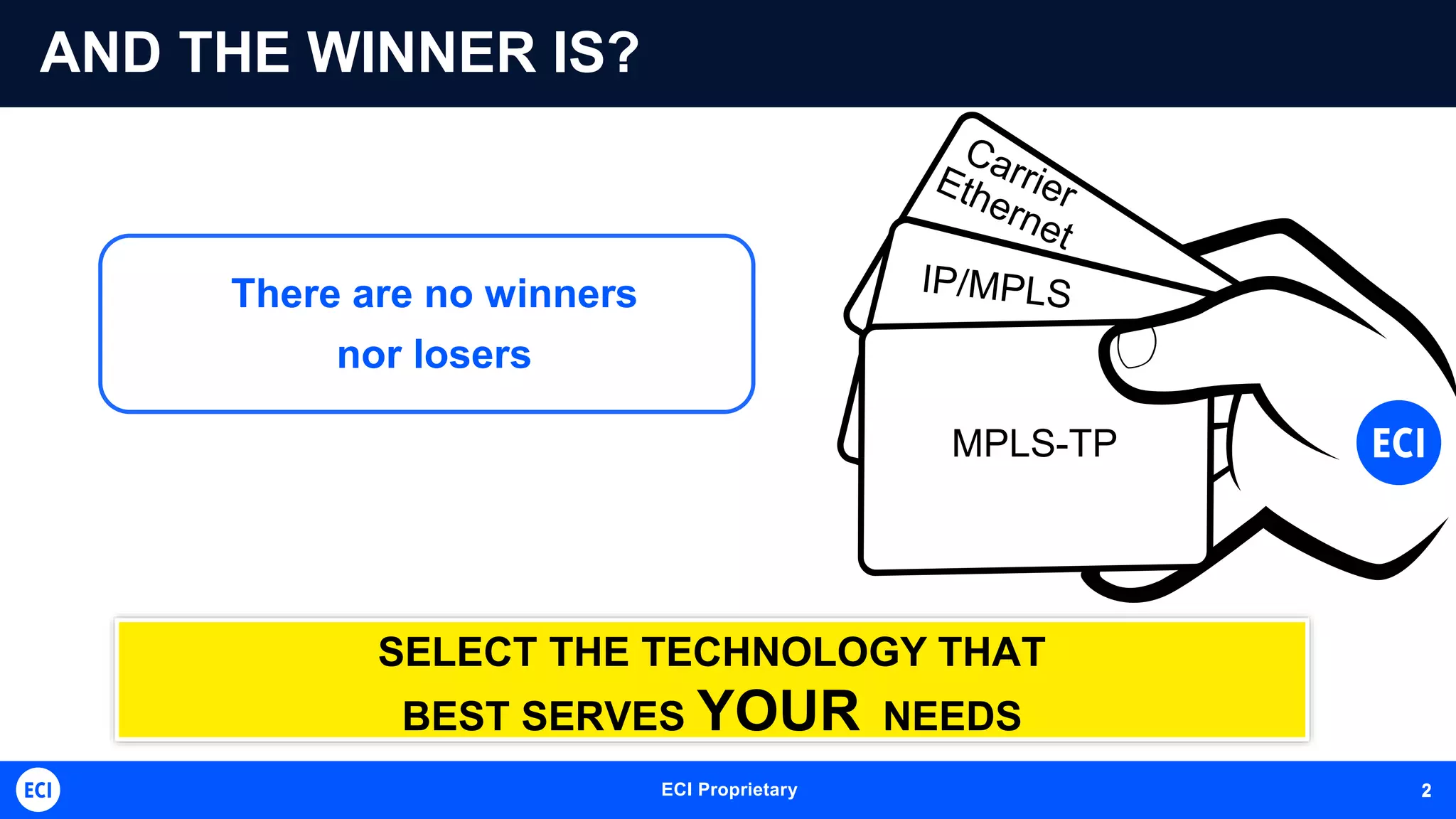
AND THE WINNER IS?
SELECT THE TECHNOLOGY THAT
BEST SERVES YOUR NEEDS
MPLS-TP
2
There are no winners
nor losers
ECI Proprietary 3
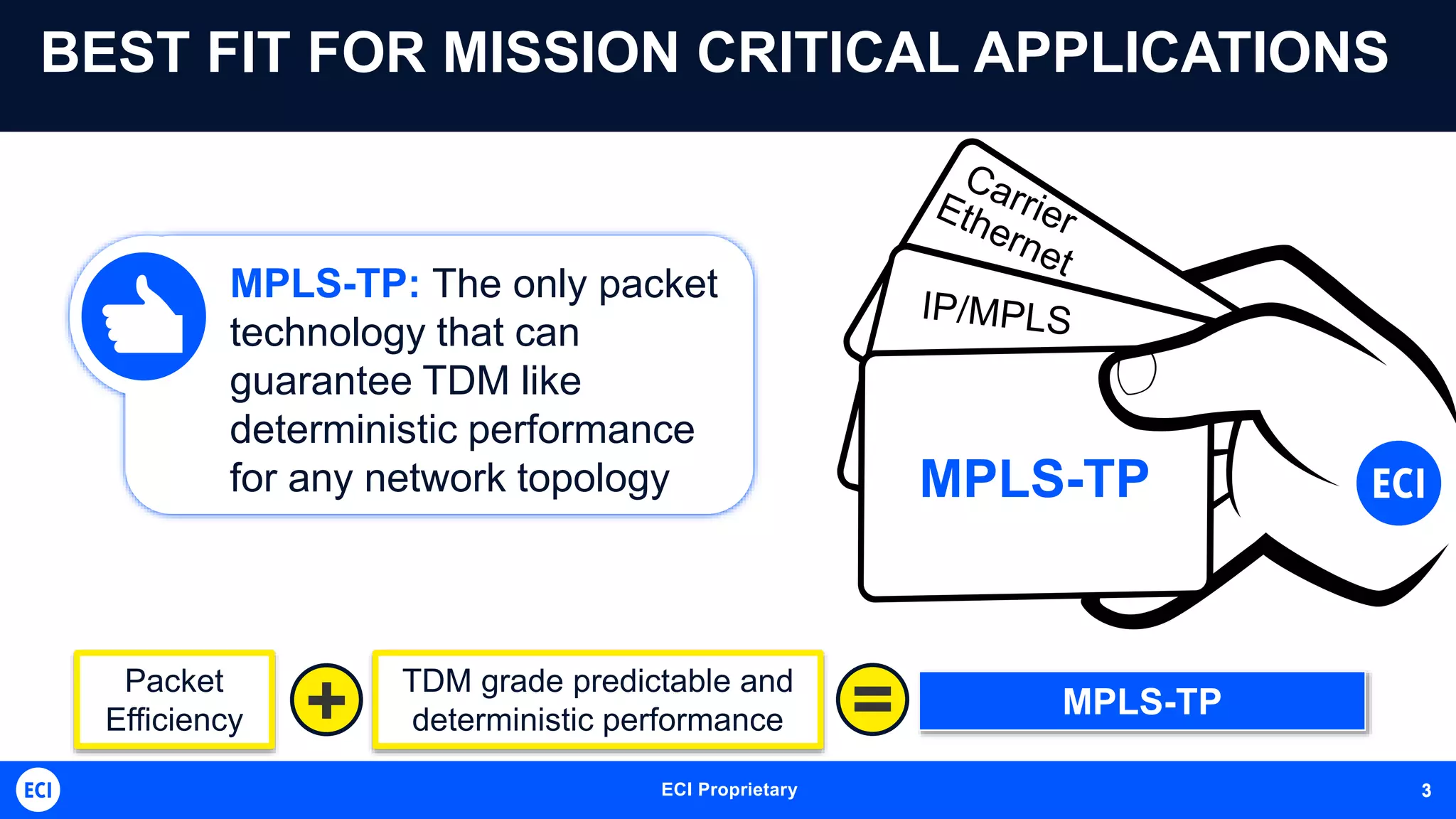
BEST FIT FOR MISSION CRITICAL APPLICATIONS
MPLS-TP: The only packet
technology that can
guarantee TDM like
deterministic performance
for any network topology
Packet
Efficiency
TDM grade predictable and
deterministic performance+ MPLS-TP=
MPLS-TP
3
How
ECI Proprietary 4
MPLS-TP VALUE FOR UTILITIES NETWORKS
 Strictly connection oriented
 Transport like protection
 Transport like OAM
 Transport like operation
 Critical for low latency, low jitter
and accurate timing
 Must have for mission critical
applications like Teleprotection
and synchronization
Importance
Risk Free Transition to Packet
4
ECI Proprietary 5
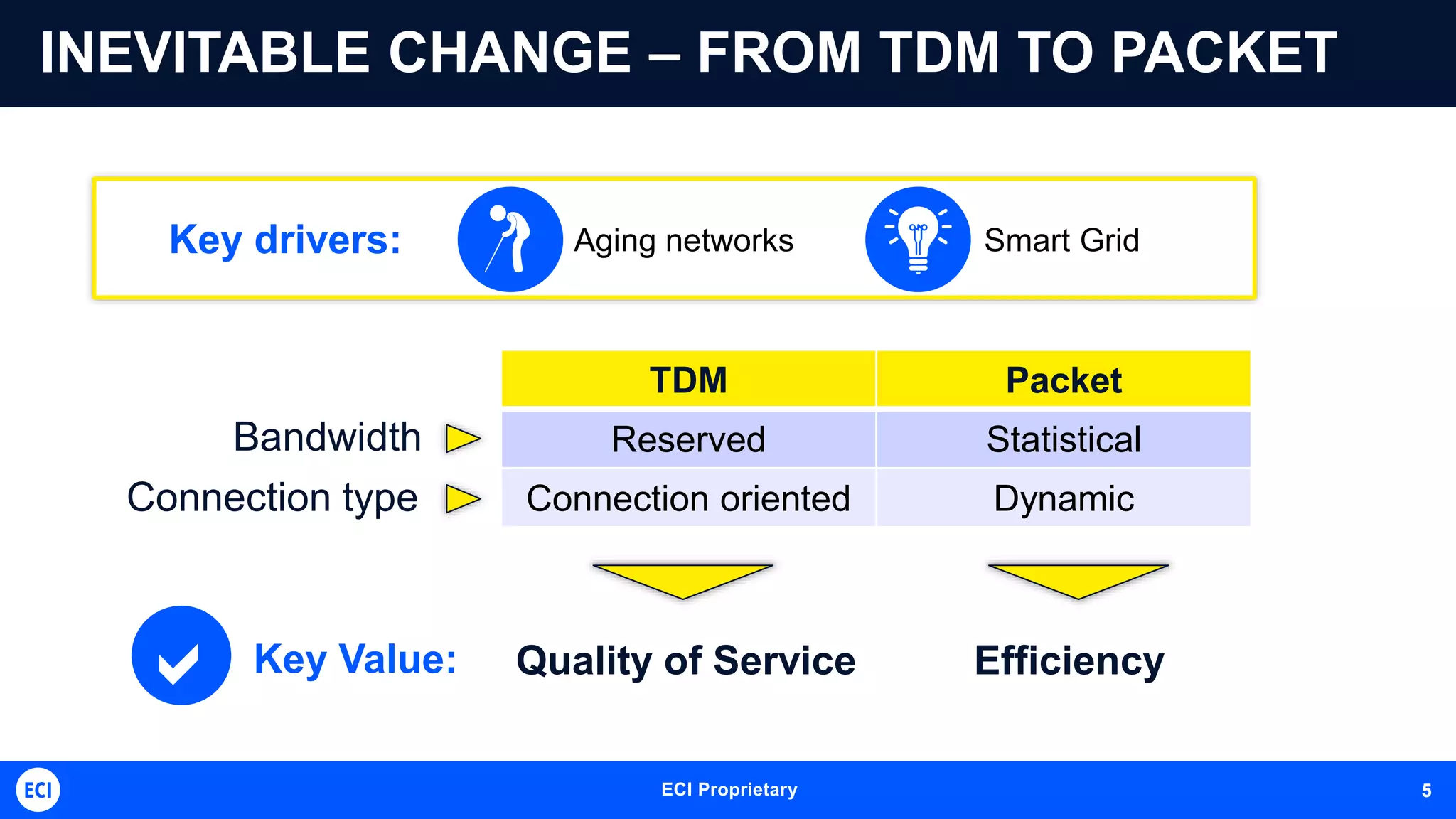
INEVITABLE CHANGE – FROM TDM TO PACKET
Key drivers:
Quality of Service EfficiencyKey Value:
Smart GridAging networks
TDM Packet
Reserved Statistical
Connection oriented Dynamic
Bandwidth
Connection type
5
ECI Proprietary 6
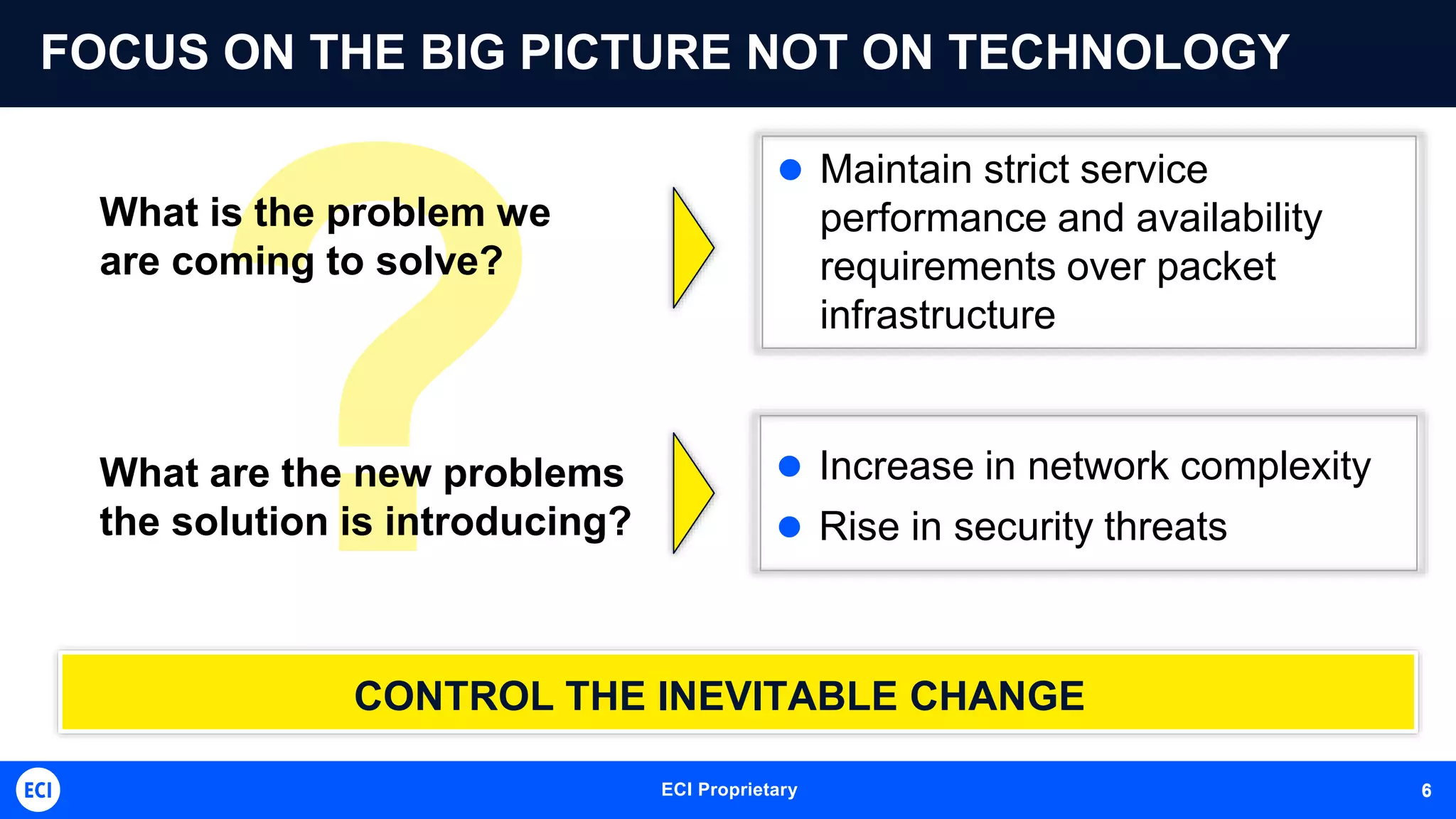
FOCUS ON THE BIG PICTURE NOT ON TECHNOLOGY
What is the problem we
are coming to solve?
CONTROL THE INEVITABLE CHANGE
 Maintain strict service
performance and availability
requirements over packet
infrastructure
 Increase in network complexity
 Rise in security threats
What are the new problems
the solution is introducing?
6
ECI Proprietary 7
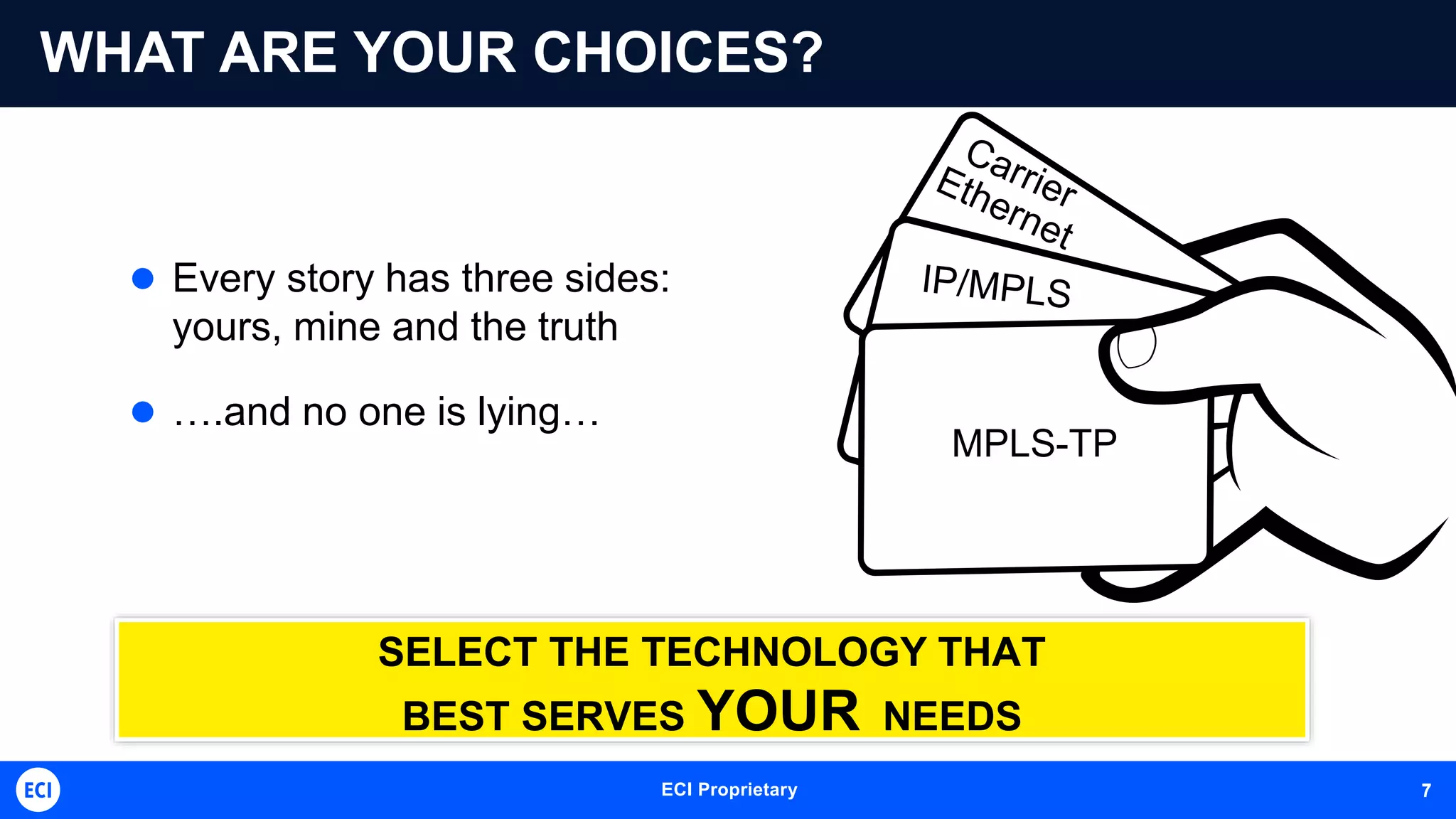
WHAT ARE YOUR CHOICES?
 Every story has three sides:
yours, mine and the truth
 ….and no one is lying…
SELECT THE TECHNOLOGY THAT
BEST SERVES YOUR NEEDS
MPLS-TP
7
8ECI Proprietary 8
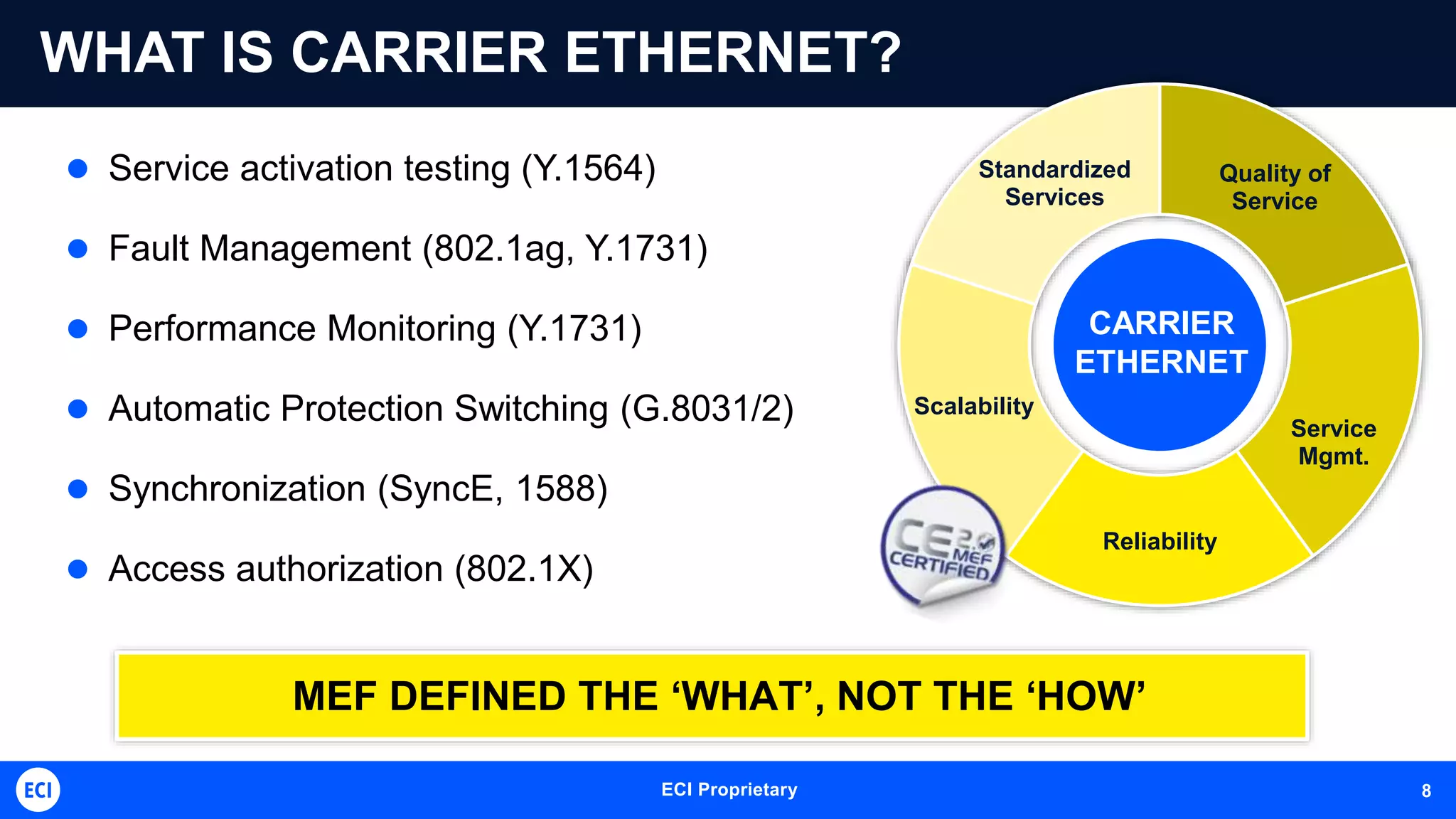
WHAT IS CARRIER ETHERNET?
 Service activation testing (Y.1564)
 Fault Management (802.1ag, Y.1731)
 Performance Monitoring (Y.1731)
 Automatic Protection Switching (G.8031/2)
 Synchronization (SyncE, 1588)
 Access authorization (802.1X)
MEF DEFINED THE ‘WHAT’, NOT THE ‘HOW’
Quality of
Service
Service
Mgmt.
Reliability
Scalability
Standardized
Services
CARRIER
ETHERNET
ECI Proprietary 9
MPLS
MULTI-PROTOCOL LABEL SWITCHING
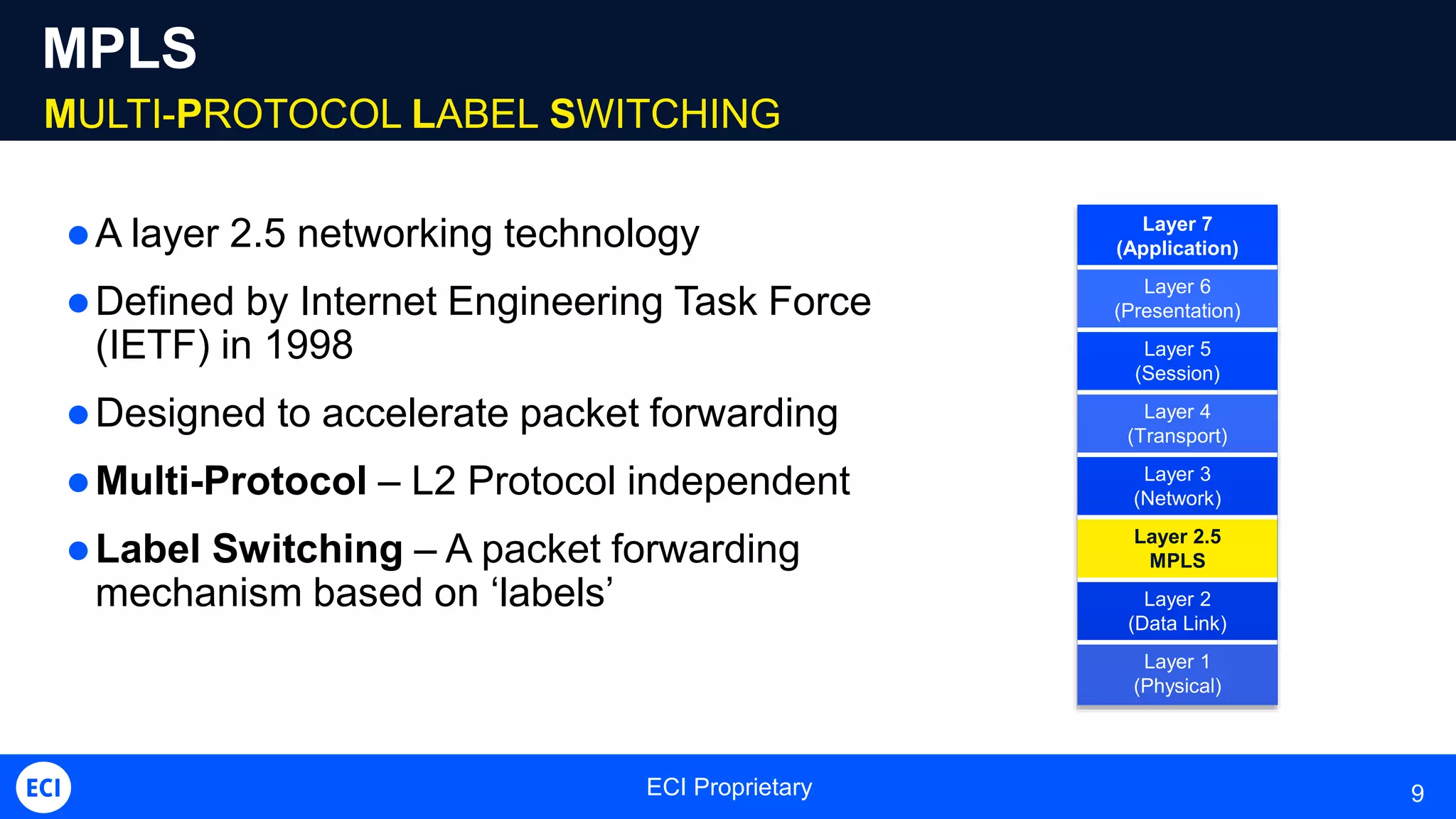
A layer 2.5 networking technology
Defined by Internet Engineering Task Force
(IETF) in 1998
Designed to accelerate packet forwarding
Multi-Protocol – L2 Protocol independent
Label Switching – A packet forwarding
mechanism based on ‘labels’
Layer 7
(Application)
Layer 6
(Presentation)
Layer 5
(Session)
Layer 4
(Transport)
Layer 3
(Network)
Layer 2.5
MPLS
Layer 2
(Data Link)
Layer 1
(Physical)
ECI Proprietary 10
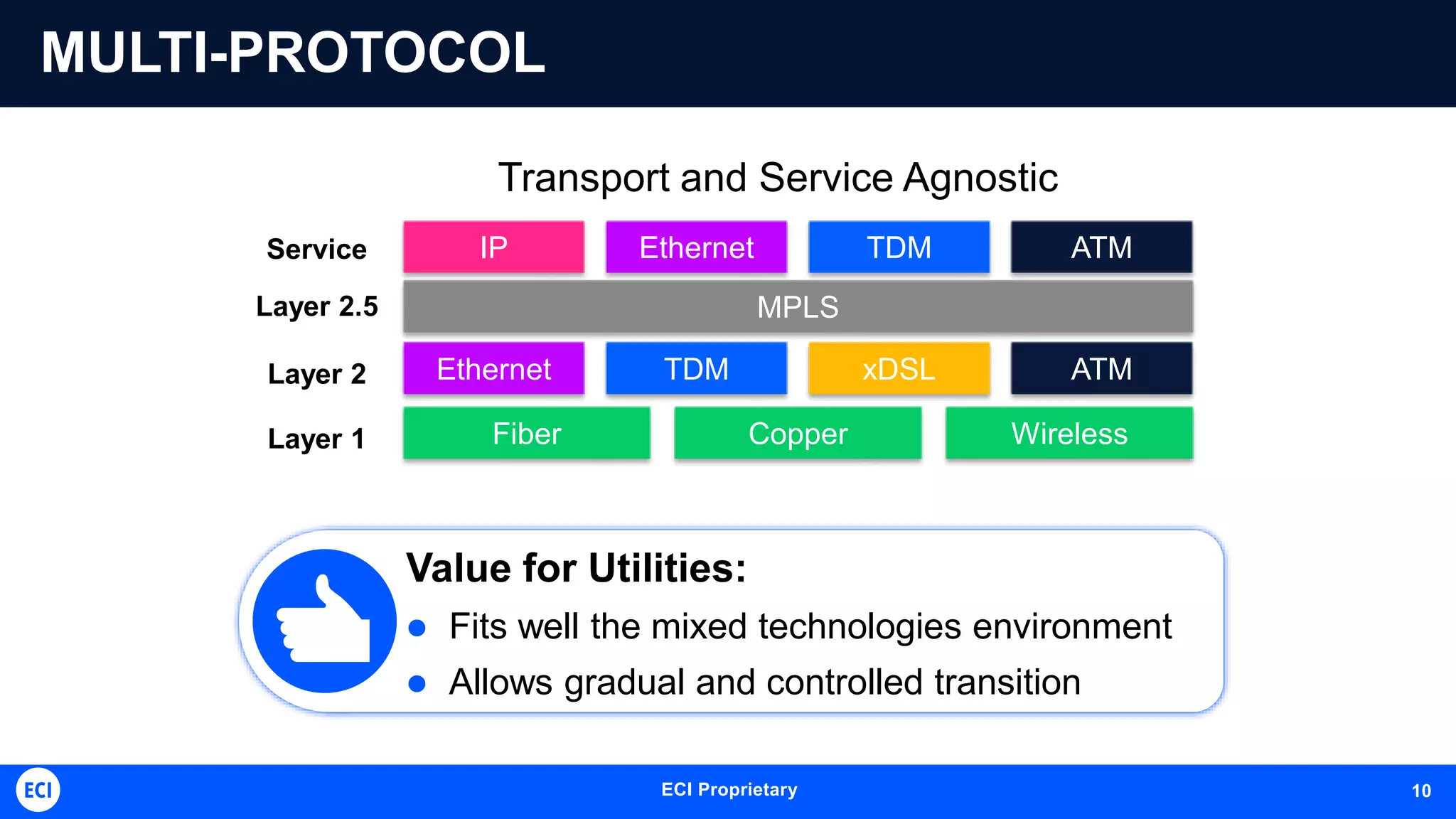
MULTI-PROTOCOL
Transport and Service Agnostic
Value for Utilities:
 Fits well the mixed technologies environment
 Allows gradual and controlled transition
MPLS
Ethernet TDM xDSL ATM
Fiber Copper Wireless
EthernetIP TDM ATM
Layer 1
Layer 2
Layer 2.5
Service
ECI Proprietary 11
LABEL SWITCHING
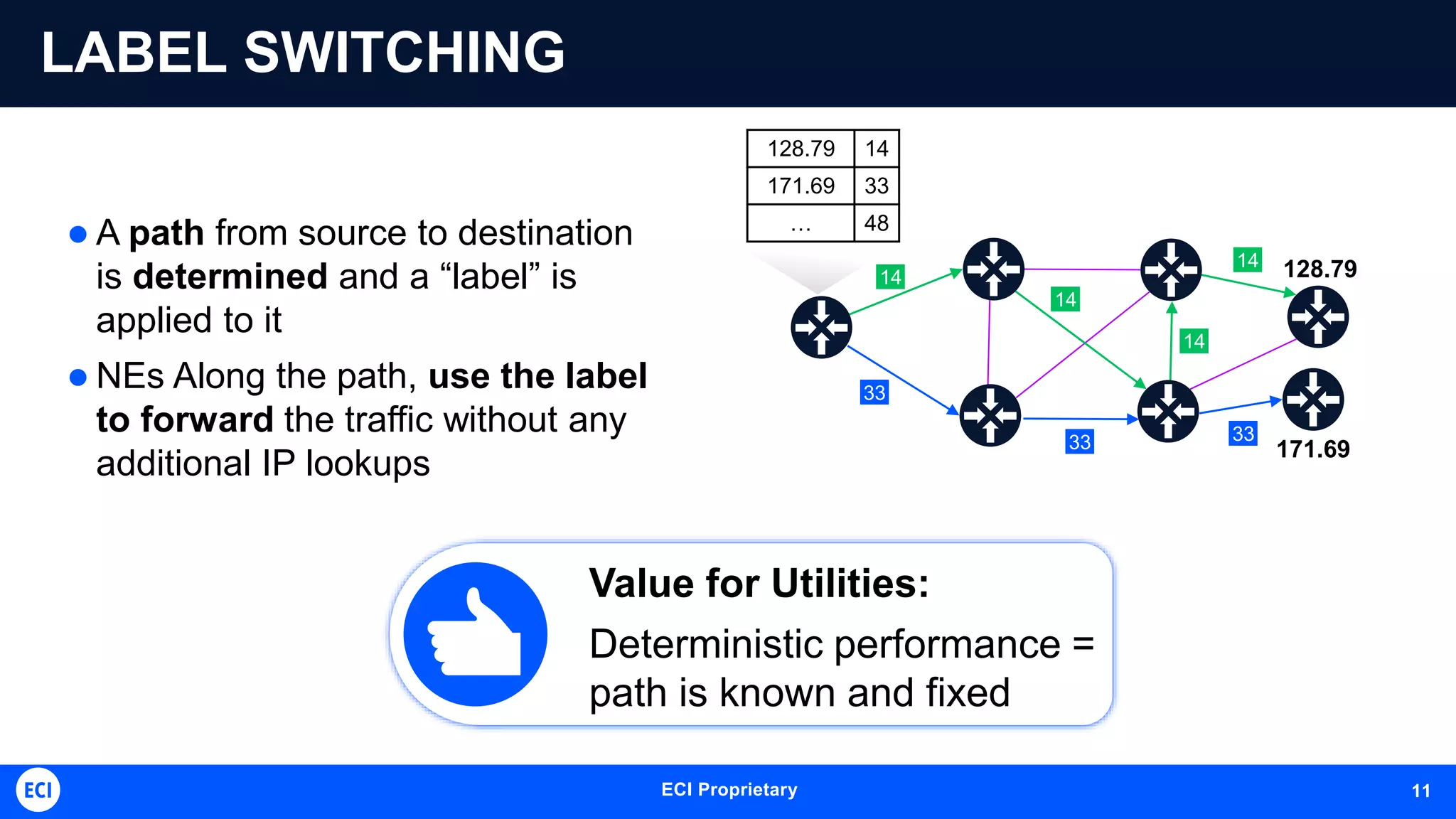
 A path from source to destination
is determined and a “label” is
applied to it
 NEs Along the path, use the label
to forward the traffic without any
additional IP lookups
Value for Utilities:
Deterministic performance =
path is known and fixed
128.79 14
171.69 33
… 48
128.79
171.69
33
33 33
14
14
14
14
ECI Proprietary 12
MPLS-TP OBJECTIVES
 “To enable MPLS to be deployed in a
transport network and operated in a similar
manner to existing transport technologies
(SDH/SONET/OTN)”
 “To enable MPLS to support packet transport
services with a similar degree of
predictability, reliability, and OAM to that
found in existing transport networks”
Defined jointly by IETF and ITU-T
(MPLS Transport Profile Framework)
12
ECI Proprietary 13
MPLS-TP
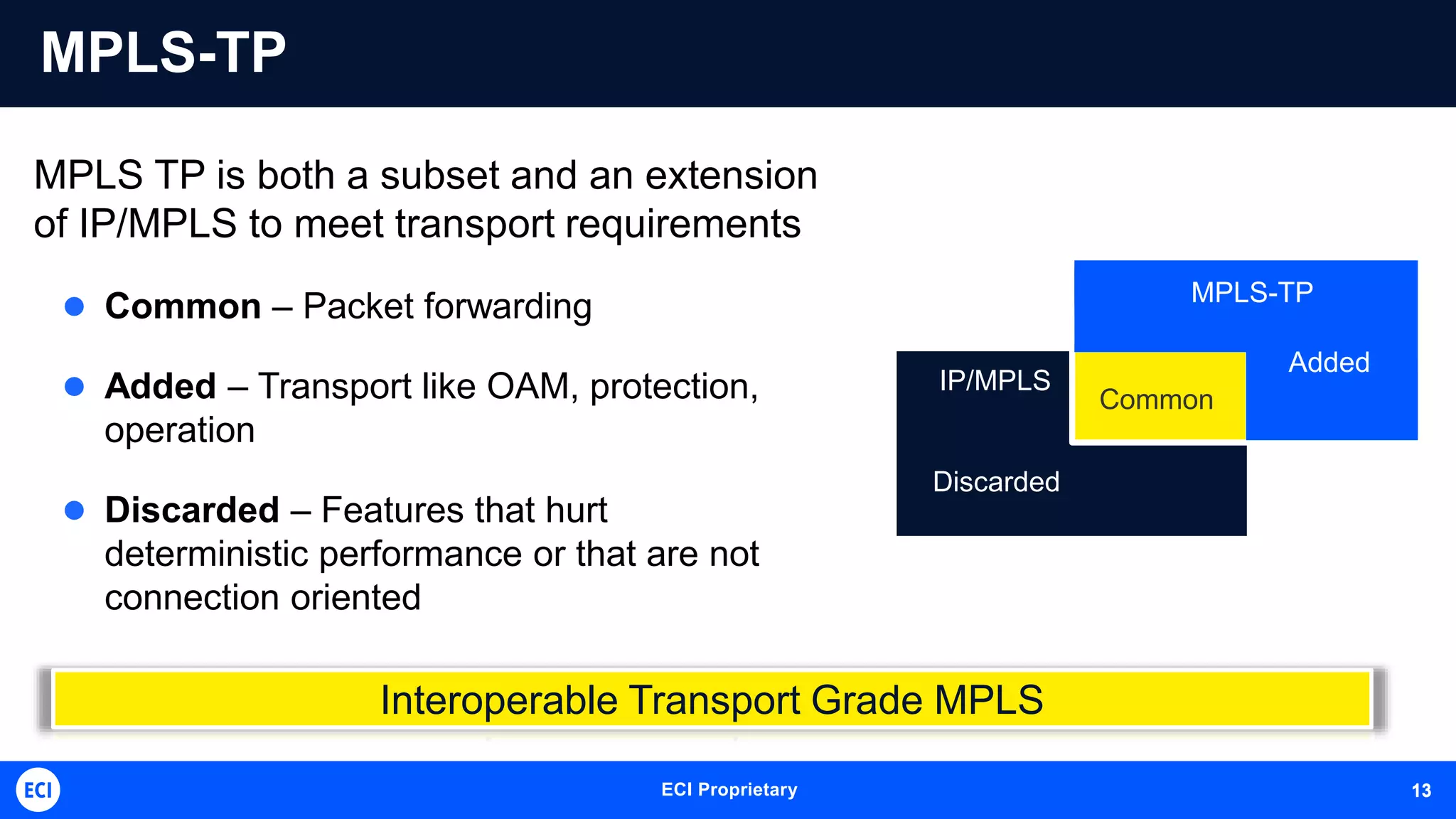
MPLS TP is both a subset and an extension
of IP/MPLS to meet transport requirements
 Common – Packet forwarding
 Added – Transport like OAM, protection,
operation
 Discarded – Features that hurt
deterministic performance or that are not
connection oriented
Interoperable Transport Grade MPLS
Discarded
IP/MPLS
Common
Added
MPLS-TP
13
ECI Proprietary 14
SUMMARY OF MPLS-TP ADVANTAGES
IP/MPLS
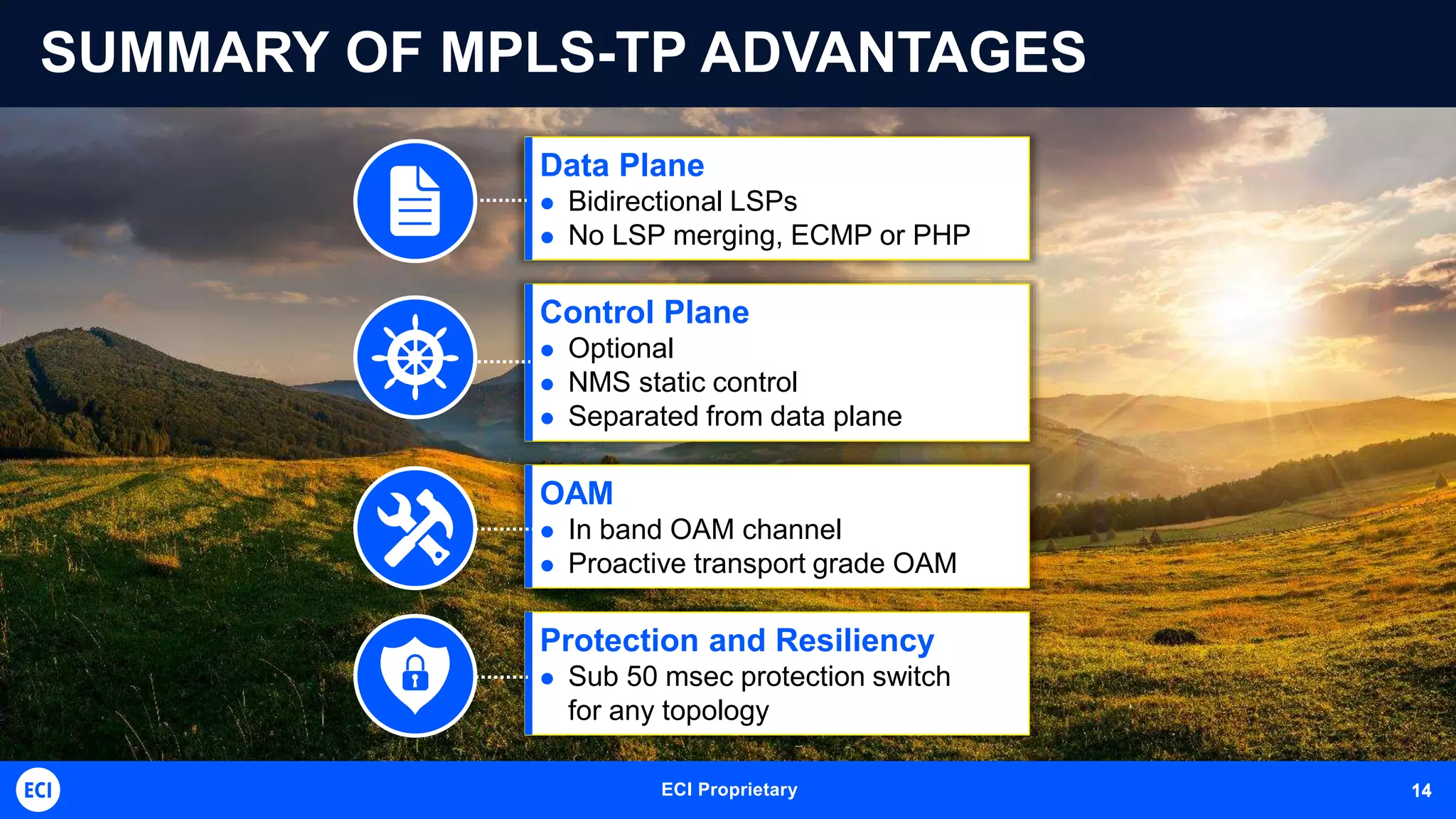
Data Plane
 Bidirectional LSPs
 No LSP merging, ECMP or PHP
Control Plane
 Optional
 NMS static control
 Separated from data plane
OAM
 In band OAM channel
 Proactive transport grade OAM
Protection and Resiliency
 Sub 50 msec protection switch
for any topology
14
ECI Proprietary 15
TELEPROTECTION EXAMPLE
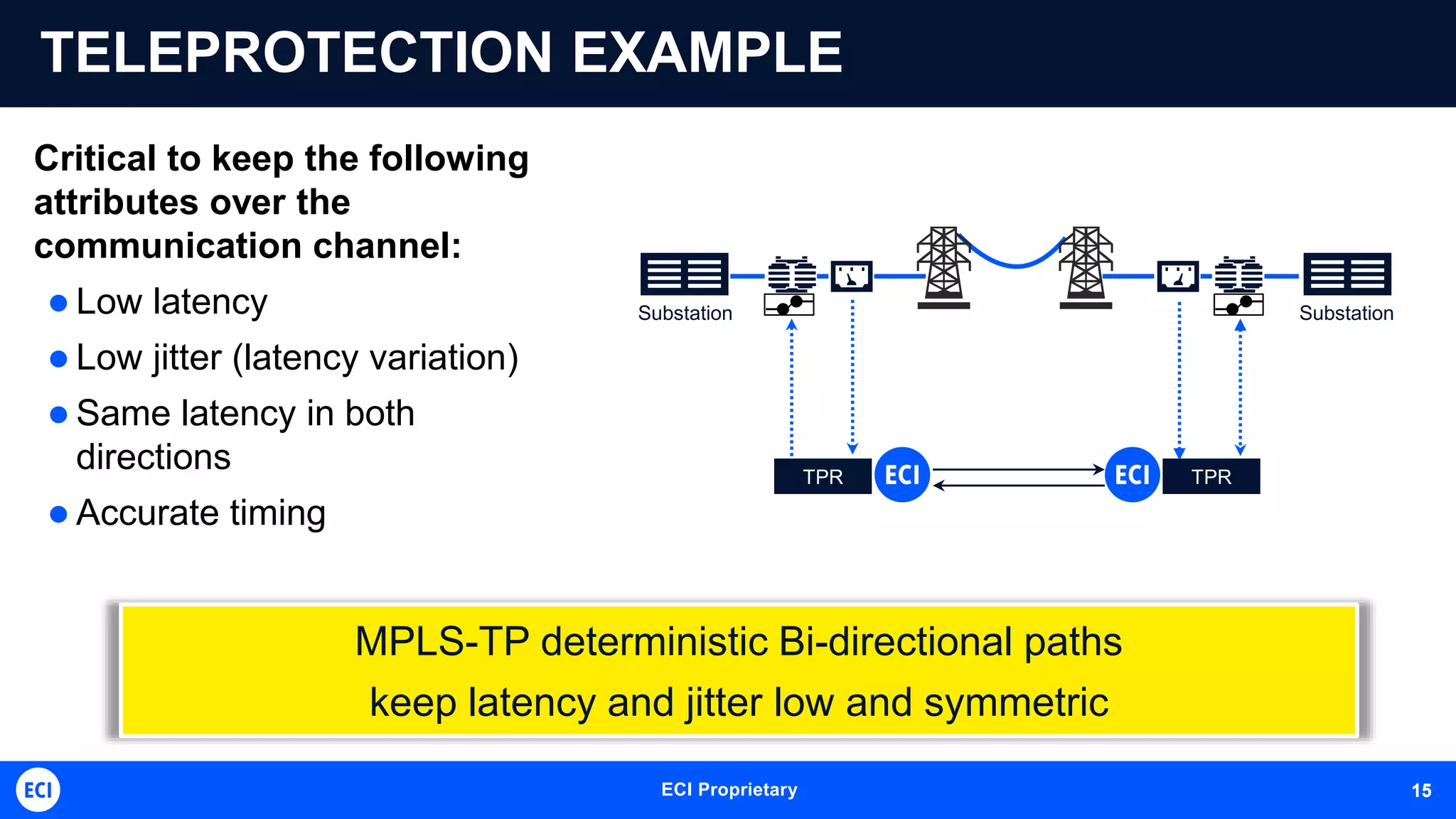
Critical to keep the following
attributes over the
communication channel:
 Low latency
 Low jitter (latency variation)
 Same latency in both
directions
 Accurate timing
MPLS-TP deterministic Bi-directional paths
keep latency and jitter low and symmetric
Substation
TPR
Substation
TPR
15
ECI Proprietary 16
COMMON AGREEMENT ON IP/MPLS TRANSPORT GAPS
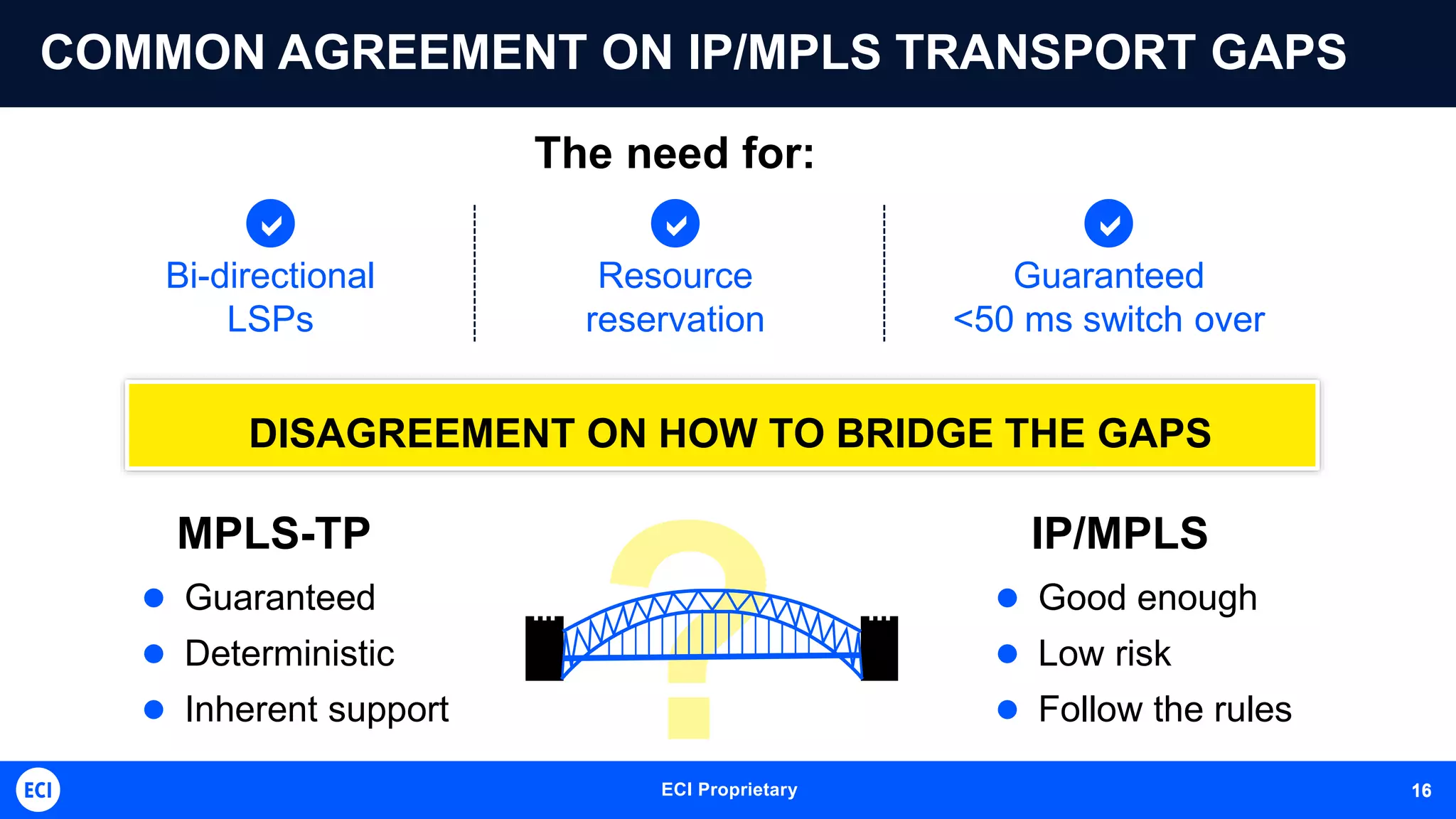
The need for:
DISAGREEMENT ON HOW TO BRIDGE THE GAPS
 Guaranteed
 Deterministic
 Inherent support
 Good enough
 Low risk
 Follow the rules
Bi-directional
LSPs
Resource
reservation
Guaranteed
<50 ms switch over
  
? 16
MPLS-TP IP/MPLS
ECI Proprietary 17
WHAT CAN GO WRONG?
 Failing to follow the strict design rules
 Changes in network topology
 Human error
 Inherent increase in security vulnerability
ARE YOU WILLING TO TAKE THE RISK?
17
ECI Proprietary 18
TAKING RISKS
Two reasons worth the risk:
 Fun, adrenalin
 Great savings (time, money)
MINIMIZING RISKS IS ALWAYS A GOOD HABIT
18
ECI Proprietary 19
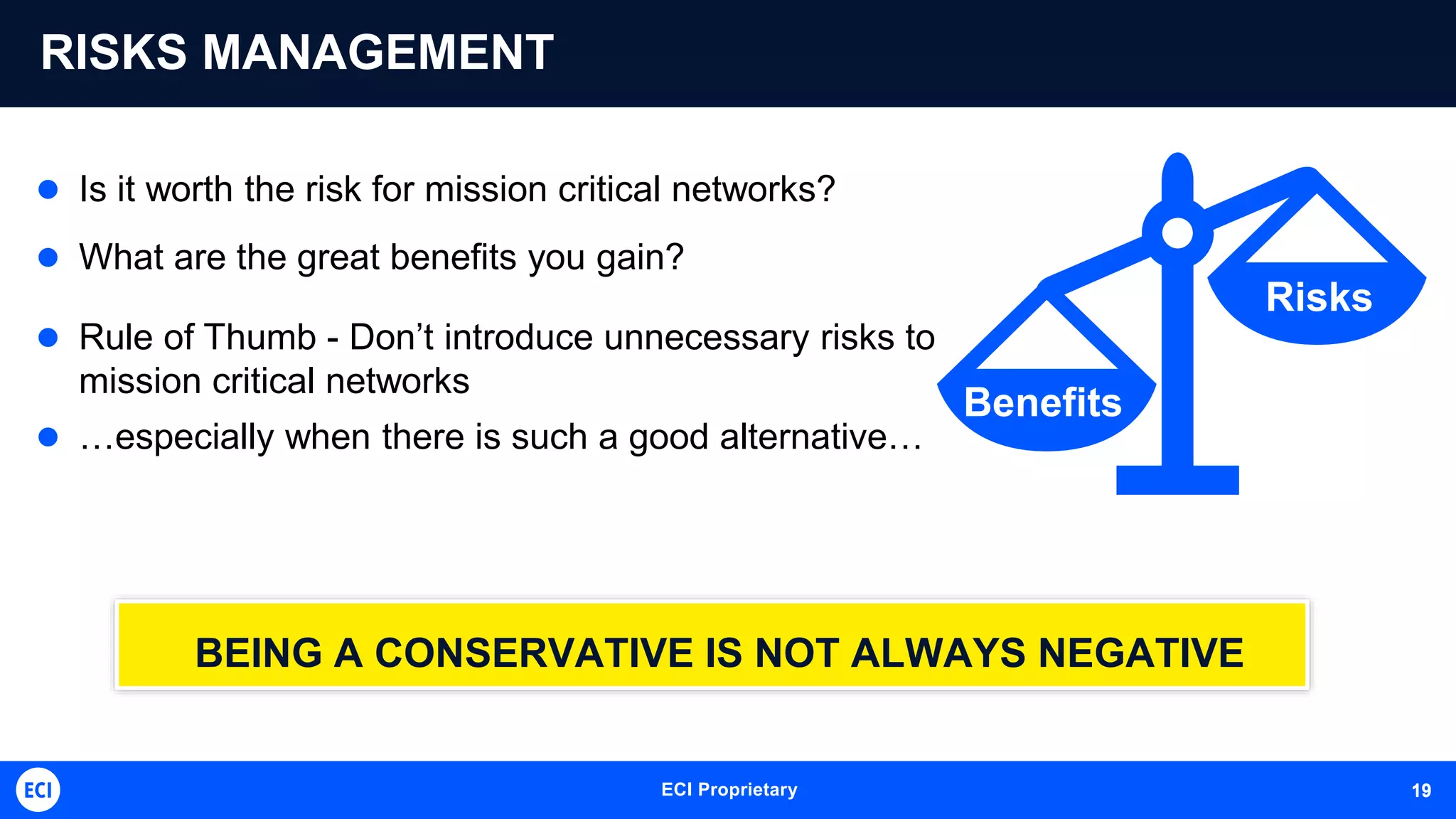
RISKS MANAGEMENT
 Is it worth the risk for mission critical networks?
 What are the great benefits you gain?
 Rule of Thumb - Don’t introduce unnecessary risks to
mission critical networks
 …especially when there is such a good alternative…
BEING A CONSERVATIVE IS NOT ALWAYS NEGATIVE
Benefits
Risks
19
ECI Proprietary 20
MURPHY’S LAWS
 Anything that can go wrong will go wrong.
 If there is a possibility of several things going wrong, the one that
will cause the most damage will be the one to go wrong
 A falling object will always land where it can do the most damage.
MURPHY WAS AN OPTIMIST
20
ECI Proprietary 21
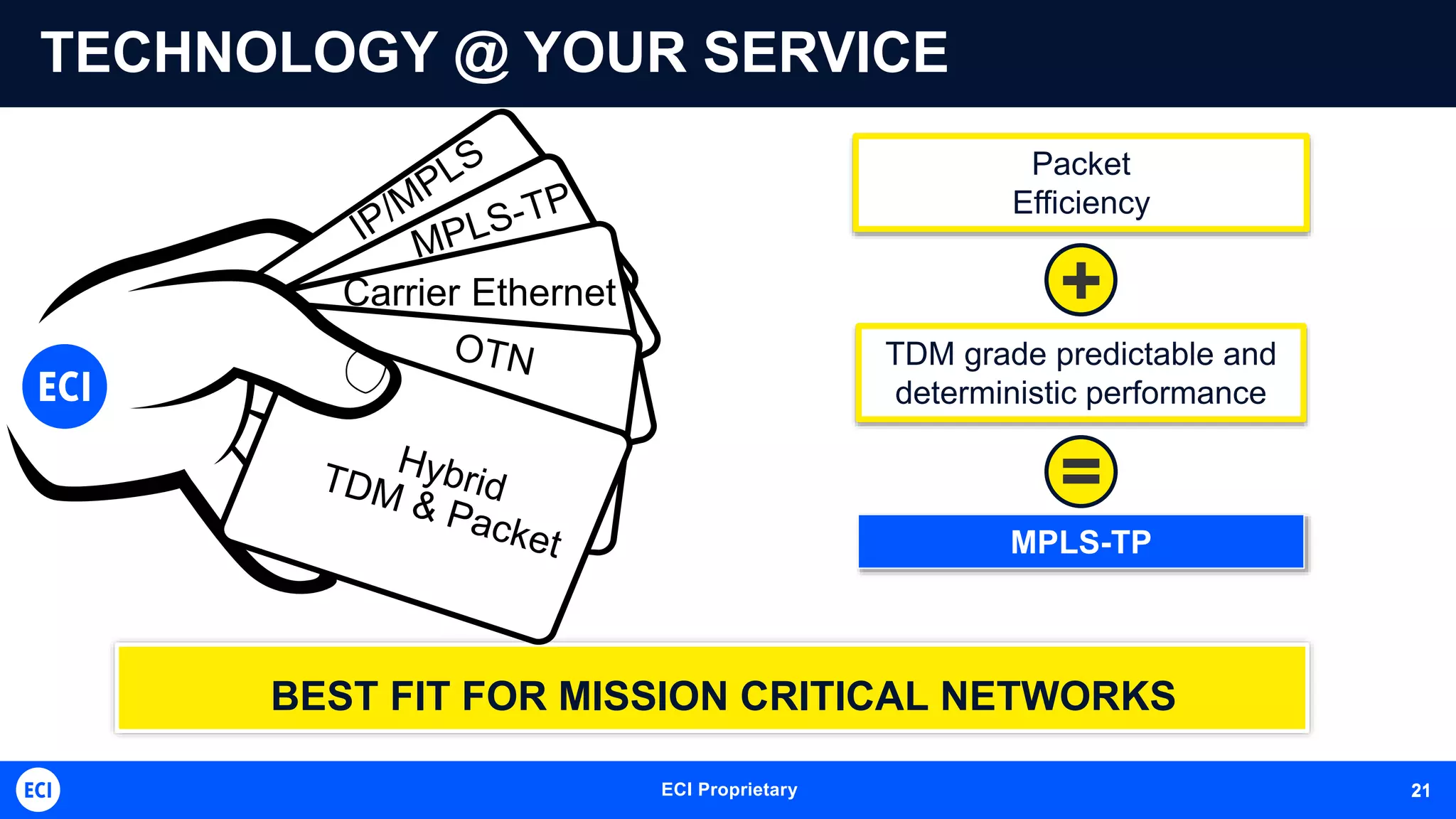
TECHNOLOGY @ YOUR SERVICE
BEST FIT FOR MISSION CRITICAL NETWORKS
Carrier Ethernet
Packet
Efficiency
TDM grade predictable and
deterministic performance
+
MPLS-TP
=
21
ECI ProprietaryECI Proprietary 22
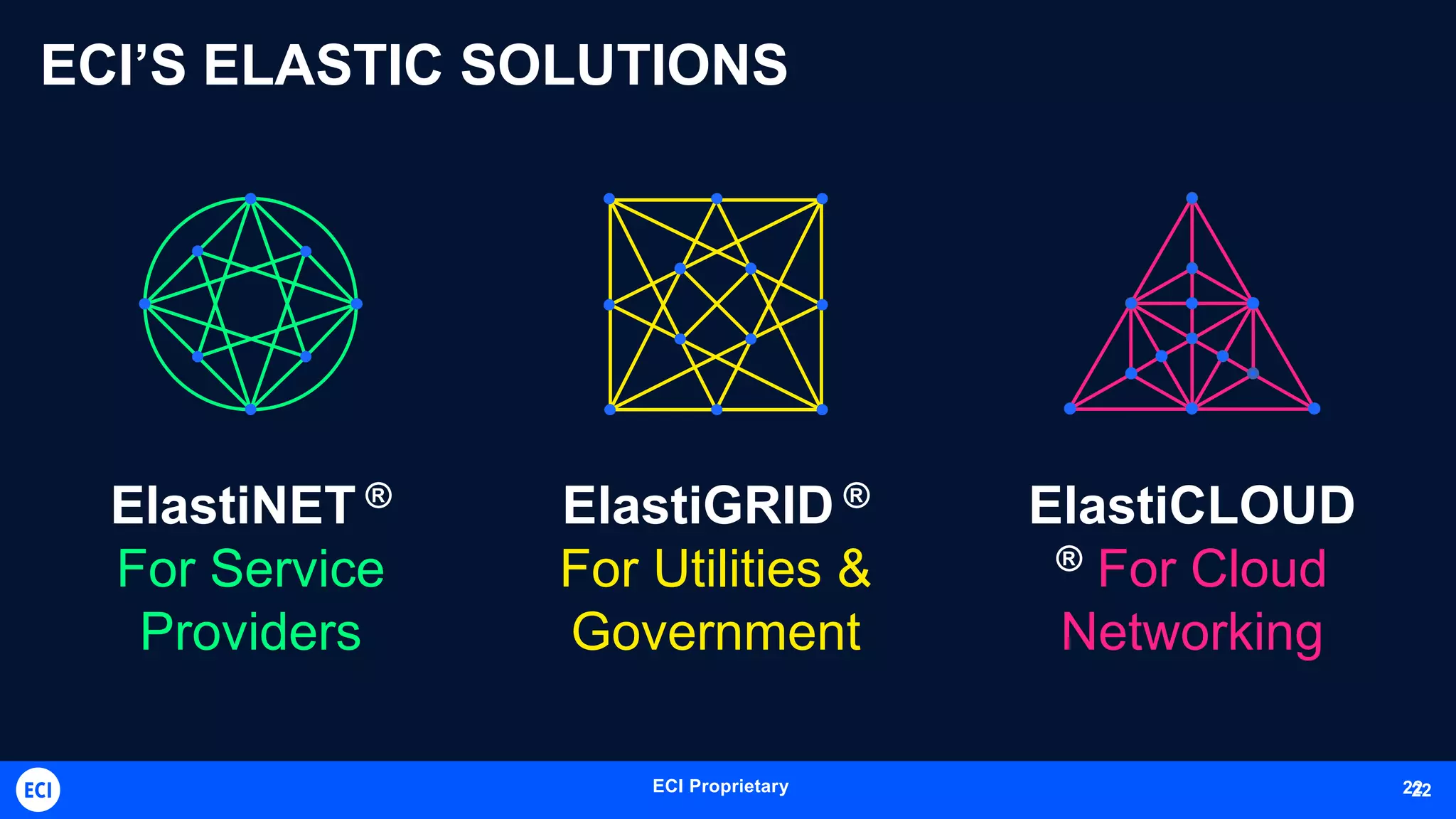
ECI’S ELASTIC SOLUTIONS
ElastiGRID ®
For Utilities &
Government
ElastiCLOUD
® For Cloud
Networking
ElastiNET ®
For Service
Providers
22
ECI Proprietary 23
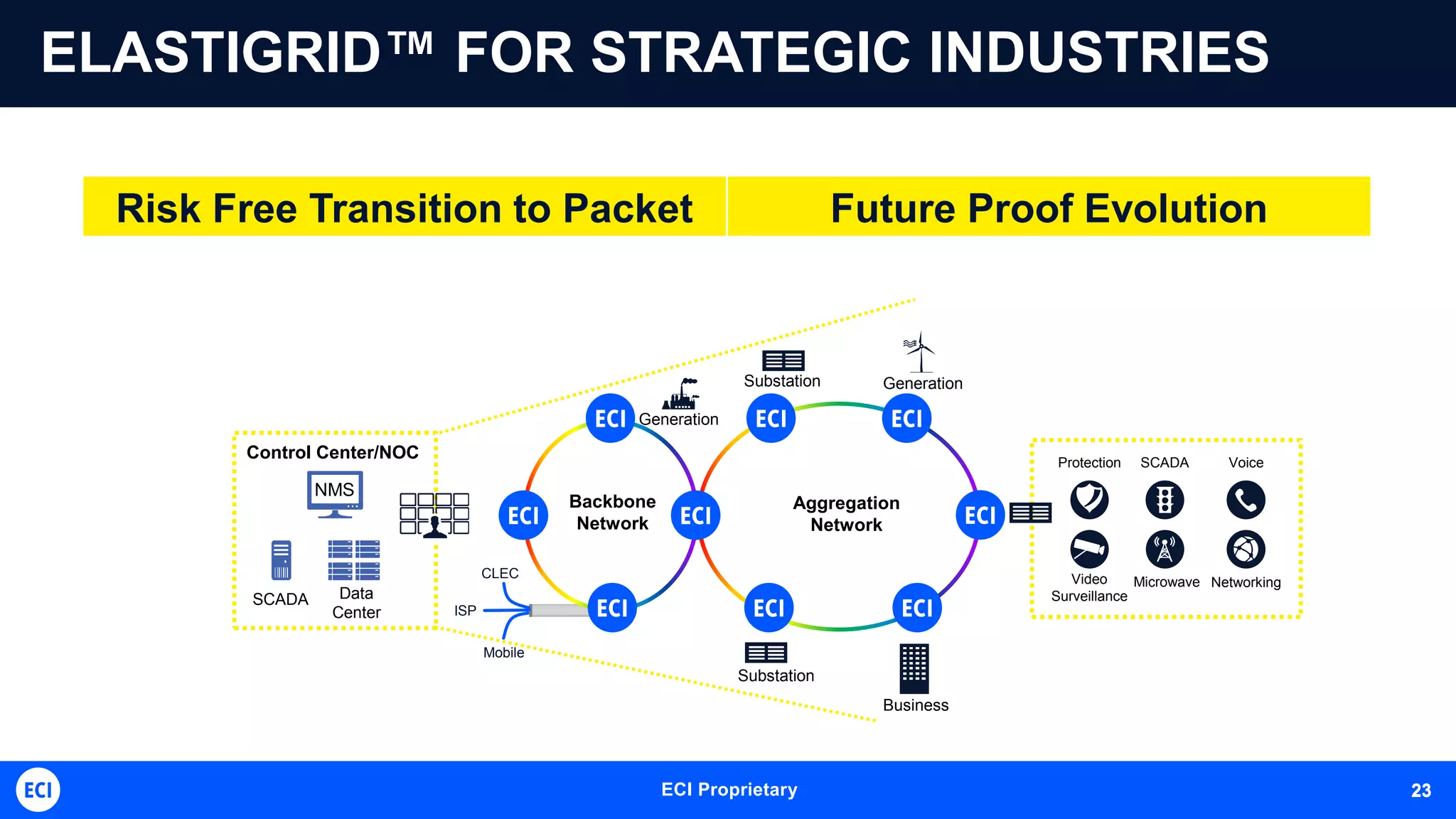
ELASTIGRID™ FOR STRATEGIC INDUSTRIES
23
Risk Free Transition to Packet Future Proof Evolution
ISP
CLEC
Mobile
Backbone
Network
Aggregation
Network
Substation Generation
NMS
SCADA Data
Center
Control Center/NOC Protection SCADA Voice
Video
Surveillance
Microwave Networking
Substation
Generation
Business
ECI Proprietary 24
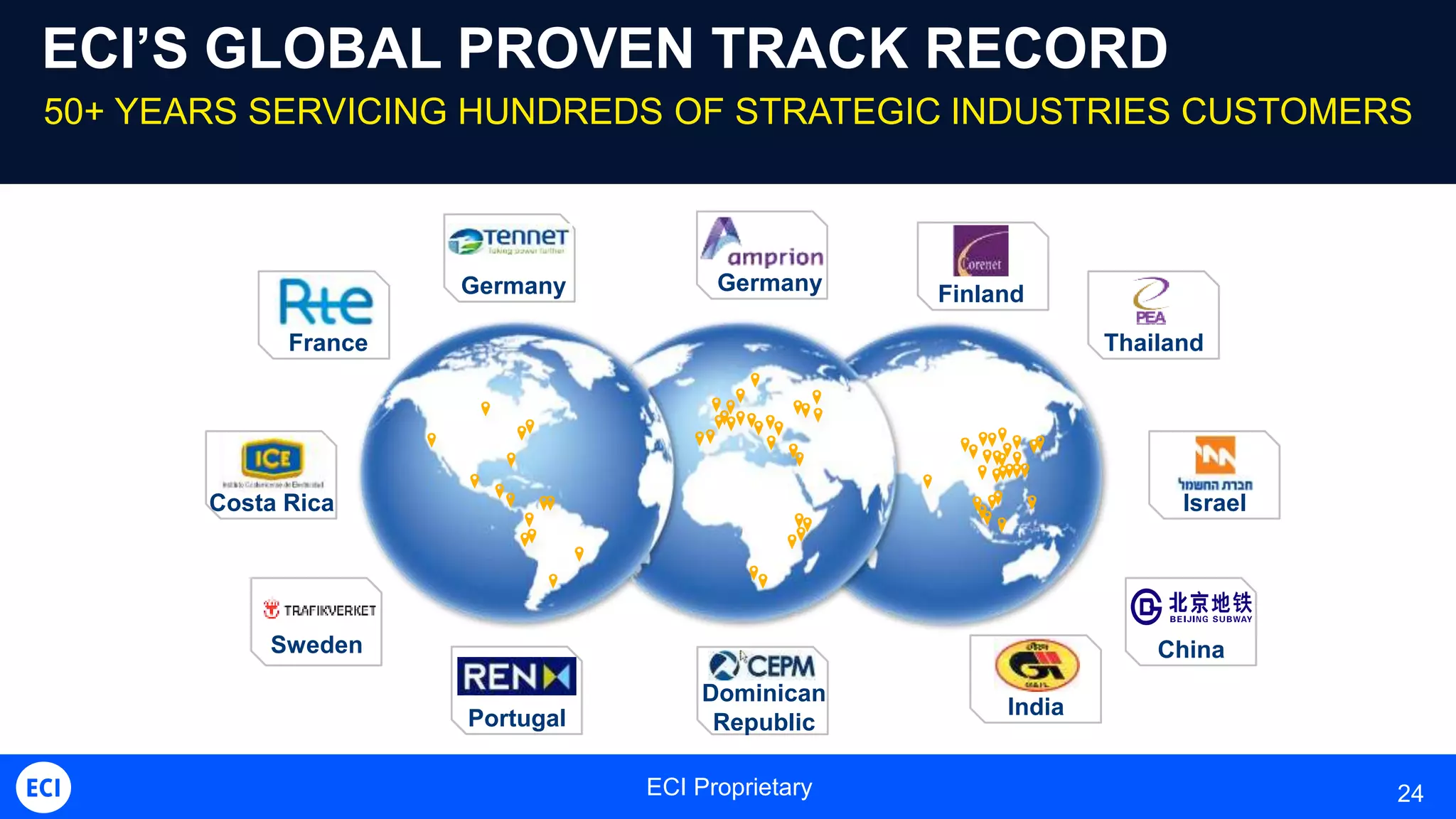
HERE COMES THE CLOUDECI’S GLOBAL PROVEN TRACK RECORD
50+ YEARS SERVICING HUNDREDS OF STRATEGIC INDUSTRIES CUSTOMERS
France
Portugal
GermanyGermany
Dominican
Republic
Costa Rica
Finland
China
India
Sweden
Israel
Thailand
ECI Proprietary 25
YOU HAVE ENOUGH ON YOUR MIND
SLEEP EASY WITH MPLS-TP
25
ECI Proprietary
THANK YOU!
Come Visit Us at Booth #8

ECI Risk Free Transition to Packet-UTC LATAM-April 2016

  • 1.
  • 2.
    ECI Proprietary 2 ANDTHE WINNER IS? SELECT THE TECHNOLOGY THAT BEST SERVES YOUR NEEDS MPLS-TP 2 There are no winners nor losers
  • 3.
    ECI Proprietary 3 BESTFIT FOR MISSION CRITICAL APPLICATIONS MPLS-TP: The only packet technology that can guarantee TDM like deterministic performance for any network topology Packet Efficiency TDM grade predictable and deterministic performance+ MPLS-TP= MPLS-TP 3
  • 4.
    How ECI Proprietary 4 MPLS-TPVALUE FOR UTILITIES NETWORKS  Strictly connection oriented  Transport like protection  Transport like OAM  Transport like operation  Critical for low latency, low jitter and accurate timing  Must have for mission critical applications like Teleprotection and synchronization Importance Risk Free Transition to Packet 4
  • 5.
    ECI Proprietary 5 INEVITABLECHANGE – FROM TDM TO PACKET Key drivers: Quality of Service EfficiencyKey Value: Smart GridAging networks TDM Packet Reserved Statistical Connection oriented Dynamic Bandwidth Connection type 5
  • 6.
    ECI Proprietary 6 FOCUSON THE BIG PICTURE NOT ON TECHNOLOGY What is the problem we are coming to solve? CONTROL THE INEVITABLE CHANGE  Maintain strict service performance and availability requirements over packet infrastructure  Increase in network complexity  Rise in security threats What are the new problems the solution is introducing? 6
  • 7.
    ECI Proprietary 7 WHATARE YOUR CHOICES?  Every story has three sides: yours, mine and the truth  ….and no one is lying… SELECT THE TECHNOLOGY THAT BEST SERVES YOUR NEEDS MPLS-TP 7
  • 8.
    8ECI Proprietary 8 WHATIS CARRIER ETHERNET?  Service activation testing (Y.1564)  Fault Management (802.1ag, Y.1731)  Performance Monitoring (Y.1731)  Automatic Protection Switching (G.8031/2)  Synchronization (SyncE, 1588)  Access authorization (802.1X) MEF DEFINED THE ‘WHAT’, NOT THE ‘HOW’ Quality of Service Service Mgmt. Reliability Scalability Standardized Services CARRIER ETHERNET
  • 9.
    ECI Proprietary 9 MPLS MULTI-PROTOCOLLABEL SWITCHING A layer 2.5 networking technology Defined by Internet Engineering Task Force (IETF) in 1998 Designed to accelerate packet forwarding Multi-Protocol – L2 Protocol independent Label Switching – A packet forwarding mechanism based on ‘labels’ Layer 7 (Application) Layer 6 (Presentation) Layer 5 (Session) Layer 4 (Transport) Layer 3 (Network) Layer 2.5 MPLS Layer 2 (Data Link) Layer 1 (Physical)
  • 10.
    ECI Proprietary 10 MULTI-PROTOCOL Transportand Service Agnostic Value for Utilities:  Fits well the mixed technologies environment  Allows gradual and controlled transition MPLS Ethernet TDM xDSL ATM Fiber Copper Wireless EthernetIP TDM ATM Layer 1 Layer 2 Layer 2.5 Service
  • 11.
    ECI Proprietary 11 LABELSWITCHING  A path from source to destination is determined and a “label” is applied to it  NEs Along the path, use the label to forward the traffic without any additional IP lookups Value for Utilities: Deterministic performance = path is known and fixed 128.79 14 171.69 33 … 48 128.79 171.69 33 33 33 14 14 14 14
  • 12.
    ECI Proprietary 12 MPLS-TPOBJECTIVES  “To enable MPLS to be deployed in a transport network and operated in a similar manner to existing transport technologies (SDH/SONET/OTN)”  “To enable MPLS to support packet transport services with a similar degree of predictability, reliability, and OAM to that found in existing transport networks” Defined jointly by IETF and ITU-T (MPLS Transport Profile Framework) 12
  • 13.
    ECI Proprietary 13 MPLS-TP MPLSTP is both a subset and an extension of IP/MPLS to meet transport requirements  Common – Packet forwarding  Added – Transport like OAM, protection, operation  Discarded – Features that hurt deterministic performance or that are not connection oriented Interoperable Transport Grade MPLS Discarded IP/MPLS Common Added MPLS-TP 13
  • 14.
    ECI Proprietary 14 SUMMARYOF MPLS-TP ADVANTAGES IP/MPLS Data Plane  Bidirectional LSPs  No LSP merging, ECMP or PHP Control Plane  Optional  NMS static control  Separated from data plane OAM  In band OAM channel  Proactive transport grade OAM Protection and Resiliency  Sub 50 msec protection switch for any topology 14
  • 15.
    ECI Proprietary 15 TELEPROTECTIONEXAMPLE Critical to keep the following attributes over the communication channel:  Low latency  Low jitter (latency variation)  Same latency in both directions  Accurate timing MPLS-TP deterministic Bi-directional paths keep latency and jitter low and symmetric Substation TPR Substation TPR 15
  • 16.
    ECI Proprietary 16 COMMONAGREEMENT ON IP/MPLS TRANSPORT GAPS The need for: DISAGREEMENT ON HOW TO BRIDGE THE GAPS  Guaranteed  Deterministic  Inherent support  Good enough  Low risk  Follow the rules Bi-directional LSPs Resource reservation Guaranteed <50 ms switch over    ? 16 MPLS-TP IP/MPLS
  • 17.
    ECI Proprietary 17 WHATCAN GO WRONG?  Failing to follow the strict design rules  Changes in network topology  Human error  Inherent increase in security vulnerability ARE YOU WILLING TO TAKE THE RISK? 17
  • 18.
    ECI Proprietary 18 TAKINGRISKS Two reasons worth the risk:  Fun, adrenalin  Great savings (time, money) MINIMIZING RISKS IS ALWAYS A GOOD HABIT 18
  • 19.
    ECI Proprietary 19 RISKSMANAGEMENT  Is it worth the risk for mission critical networks?  What are the great benefits you gain?  Rule of Thumb - Don’t introduce unnecessary risks to mission critical networks  …especially when there is such a good alternative… BEING A CONSERVATIVE IS NOT ALWAYS NEGATIVE Benefits Risks 19
  • 20.
    ECI Proprietary 20 MURPHY’SLAWS  Anything that can go wrong will go wrong.  If there is a possibility of several things going wrong, the one that will cause the most damage will be the one to go wrong  A falling object will always land where it can do the most damage. MURPHY WAS AN OPTIMIST 20
  • 21.
    ECI Proprietary 21 TECHNOLOGY@ YOUR SERVICE BEST FIT FOR MISSION CRITICAL NETWORKS Carrier Ethernet Packet Efficiency TDM grade predictable and deterministic performance + MPLS-TP = 21
  • 22.
    ECI ProprietaryECI Proprietary22 ECI’S ELASTIC SOLUTIONS ElastiGRID ® For Utilities & Government ElastiCLOUD ® For Cloud Networking ElastiNET ® For Service Providers 22
  • 23.
    ECI Proprietary 23 ELASTIGRID™FOR STRATEGIC INDUSTRIES 23 Risk Free Transition to Packet Future Proof Evolution ISP CLEC Mobile Backbone Network Aggregation Network Substation Generation NMS SCADA Data Center Control Center/NOC Protection SCADA Voice Video Surveillance Microwave Networking Substation Generation Business
  • 24.
    ECI Proprietary 24 HERECOMES THE CLOUDECI’S GLOBAL PROVEN TRACK RECORD 50+ YEARS SERVICING HUNDREDS OF STRATEGIC INDUSTRIES CUSTOMERS France Portugal GermanyGermany Dominican Republic Costa Rica Finland China India Sweden Israel Thailand
  • 25.
    ECI Proprietary 25 YOUHAVE ENOUGH ON YOUR MIND SLEEP EASY WITH MPLS-TP 25
  • 26.
    ECI Proprietary THANK YOU! ComeVisit Us at Booth #8