Produced in partnership with
Leveraging the Cloud to Enhance
an Enterprise Imaging Strategy
E
nterprise imaging strategies are front and center in healthcare IT these days. The increasing
sophistication of imaging technology has resulted in substantial increases in imaging data.
The upside of this increase is that clinicians have more imaging information available to aid in
diagnosis and treatment. The downside is that the vast increase in imaging data is putting pressure
on provider data centers everywhere.
“As we’ve seen with multi-slice CTs, 3D reconstructions and the rest, the growth has been
exponential,” said Rick Perez, administrative director of radiology at Winthrop-University Hospital
in Mineola, New York. “Growth is good, but the busier the hospital is, and the more images we take,
the more storage capacity we need to have. The storage requirements are unbelievable.”
Danny Asaoka, executive director of information services for Long Beach Memorial Medical Center,
in Long Beach, Calif., has experienced similar pressures at the three facilities he oversees.
“We’ve seen a lot of growth,” said Asaoka. “As the result of advances in technology and growth
in our affiliates, we’ve watched our diagnostic imaging nearly double, in terms of numbers of
studies, over the past three years.”
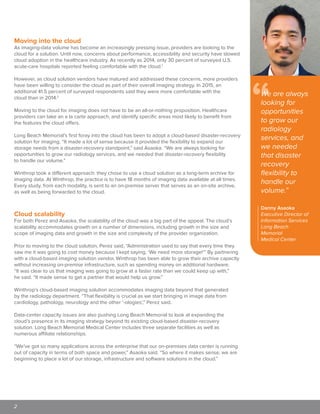
“We are always
looking for
opportunities
to grow our
radiology
services, and
we needed
that disaster
recovery
flexibility to
handle our
volume.”
Danny Asaoka
Executive Director of
Information Services
Long Beach
Memorial
Medical Center
2
Moving into the cloud
As imaging-data volume has become an increasingly pressing issue, providers are looking to the
cloud for a solution. Until now, concerns about performance, accessibility and security have slowed
cloud adoption in the healthcare industry. As recently as 2014, only 30 percent of surveyed U.S.
acute-care hospitals reported feeling comfortable with the cloud.1
However, as cloud solution vendors have matured and addressed these concerns, more providers
have been willing to consider the cloud as part of their overall imaging strategy. In 2015, an
additional 41.5 percent of surveyed respondents said they were more comfortable with the
cloud than in 2014.2
Moving to the cloud for imaging does not have to be an all-or-nothing proposition. Healthcare
providers can take an a la carte approach, and identify specific areas most likely to benefit from
the features the cloud offers.
Long Beach Memorial’s first foray into the cloud has been to adopt a cloud-based disaster-recovery
solution for imaging. “It made a lot of sense because it provided the flexibility to expand our
storage needs from a disaster-recovery standpoint,” said Asaoka. “We are always looking for
opportunities to grow our radiology services, and we needed that disaster-recovery flexibility
to handle our volume.”
Winthrop took a different approach: they chose to use a cloud solution as a long-term archive for
imaging data. At Winthrop, the practice is to have 18 months of imaging data available at all times.
Every study, from each modality, is sent to an on-premise server that serves as an on-site archive,
as well as being forwarded to the cloud.
Cloud scalability
For both Perez and Asaoka, the scalability of the cloud was a big part of the appeal. The cloud’s
scalability accommodates growth on a number of dimensions, including growth in the size and
scope of imaging data and growth in the size and complexity of the provider organization.
Prior to moving to the cloud solution, Perez said, “Administration used to say that every time they
saw me it was going to cost money because I kept saying, ‘We need more storage!’” By partnering
with a cloud-based imaging solution vendor, Winthrop has been able to grow their archive capacity
without increasing on-premise infrastructure, such as spending money on additional hardware.
“It was clear to us that imaging was going to grow at a faster rate than we could keep up with,”
he said. “It made sense to get a partner that would help us grow.”
Winthrop’s cloud-based imaging solution accommodates imaging data beyond that generated
by the radiology department. “That flexibility is crucial as we start bringing in image data from
cardiology, pathology, neurology and the other ‘-ologies’,” Perez said.
Data-center capacity issues are also pushing Long Beach Memorial to look at expanding the
cloud’s presence in its imaging strategy beyond its existing cloud-based disaster-recovery
solution. Long Beach Memorial Medical Center includes three separate facilities as well as
numerous affiliate relationships.
“We’ve got so many applications across the enterprise that our on-premises data center is running
out of capacity in terms of both space and power,” Asaoka said. “So where it makes sense, we are
beginning to place a lot of our storage, infrastructure and software solutions in the cloud.”
3
Cloud accessibility
Cloud solutions also make imaging data more accessible, both inside and outside of the
provider organization. Today, many imaging solutions have limited accessibility due to proprietary
file formats, viewers and other limiting configurations. Many providers still have on-premise imaging
solutions that include specific workstations designated as image-reading stations to support the
reading experience for radiologists and to allow them to render a diagnosis.
Asaoka anticipates the day when Long Beach Memorial will support a cloud-based solution that
would allow more flexibility in where imaging studies could be read. “A big benefit of moving to
the cloud would be that the radiologist would have more flexibility and access to studies than ever
before. You could have the same quality experience anywhere you have access to the internet.
That’s a big plus, and a big radiologist satisfier,” he said.
Winthrop-University Hospital’s participation in a regional health information organization (RHIO) is
one reason Perez is especially interested in the accessibility that cloud-based imaging solutions
can offer to providers across the spectrum. “The best thing for the patient is to have that imaging
data available regardless of which hospital the patient is in, for example, in a trauma situation,”
he said. “By providing access to not just imaging, but the lab work and all of the rest of the patient
information, you support the clinical staff’s ability to provide the best possible medical care.”
Security in the cloud
Many providers hesitate to move patient data into the cloud because of security concerns.
Though “not all cloud providers are alike,” according to Lee Kim, director of Privacy and Security
for HIMSS North America, healthcare organizations that conduct due diligence before committing
to a cloud-based solution provider can end up with even more security resources than before
the cloud-based solution provider got involved.
“If you’re working with a really large cloud-services company that has billions of dollars to spend
on security, and they are watching the network 24/7 for network anomalies, that’s probably more
secure than having protected patient data stored locally in the hospital, where you’re constrained
by the number of staff, the number of security professionals on site and the tools that are available
to them,” said Kim.
Asaoka pointed out that before Long Beach Memorial moved disaster recovery to the cloud, the
organization “already had the understanding that a lot of the vulnerabilities take place at the user
end.” Long Beach Memorial recently implemented two-factor authentication for all access outside
of the internal network. “We wanted to make sure we had user-side protections in place before
we put data in the cloud that could be accessed through the internet from anywhere,” he said.
“That is totally separate from what our cloud solutions vendor is responsible for.”
“It was clear to
us that imaging
was going
to grow at
a faster rate
than we could
keep up with.
It made sense
to get a
partner that
would help
us grow.”
Rick Perez
Administrative
Director of Radiology
Winthrop-University
Hospital
Produced by | www.himssmedia.com | © 2016
About Carestream Health
Carestream is a worldwide provider of dental and medical imaging systems and IT solutions;
As the workflow leader in imaging IT, Vue for Enterprise Imaging Platform is successfully implemented in more than 4,800
customer sites globally, encompassing large Ministry of Health national projects, regional health systems, community-
based hospital groups, and national private physician groups. The platform manages 170 million procedures per year
and archives over 11 petabytes of clinical data. For more information about the company’s broad portfolio of products,
solutions and services, please contact your Carestream representative or call 888-777-2072, or visit www.carestream.com/
collaboration.
Cloud cost-effectiveness
Moving data-center functionality, applications (Software as a Service) or storage to the cloud allows
healthcare providers to focus resources on patient care, rather than data-center management.
“A cloud-based imaging solution offers cost savings in the long term,” said Asaoka. “From a
resource perspective, we’re not having to manage the hardware on-premises. Large cloud
solution providers have economies of scale to offer.”
At Winthrop, Perez appreciates the predictability of cloud-based imaging data storage costs.
Pricing for cloud storage is often tiered by the data volume, so it is easy to estimate data storage
costs based on volume increases. Per-unit costs usually decrease as volumes increase.
“When we add another site, or if we know that we’re going to increase volume because
we’re doing more studies or we’re opening up a new center, we can predict what those
costs are going to be,” he said.
The cloud’s future in imaging
Because of all the benefits the cloud offers – scalability, accessibility, security and cost-
effectiveness, more healthcare providers are looking at the cloud as a legitimate alternative
to on-premise solutions for imaging challenges. “At Long Beach Memorial we have seen that
cloud-based solutions have become more secure and more sophisticated,” said Asaoka.
“The quality of services has improved to the point that it mimics the experience you would
have with an on-premises solution, with the same features and functionality. Now whenever
we have a new application that we are purchasing, we always ask if there is a cloud-based
solution we can explore.”
Winthrop is currently exploring the possibility of pushing the application layer of their picture
archiving and communication system (PACS) into the cloud as well. “I think the cloud is part of
all of our futures,” said Perez. ”We are relying on the cloud more and more. With today’s cloud,
we know that the imaging data is there, we know that it’s safe and we know that we can retrieve
it when we need it. And, we have our cloud-based imaging solution vendor as a partner for all
of that. That helps you sleep a little bit better at night.”
“At Long Beach
Memorial we
have seen that
cloud-based
solutions have
become
more secure
and more
sophisticated.”
Danny Asaoka
1 IDC. (2016, Feb 1). 40% of U.S. Healthcare Providers Report IT Budgets are Growing, According to IDC Health Insights. Retrieved from http://www.idc.com/
2 Ibid.

Whitepaper: Leveraging the Cloud to Enhance an Enterprise Imaging Strategy

  • 1.
    Produced in partnershipwith Leveraging the Cloud to Enhance an Enterprise Imaging Strategy E nterprise imaging strategies are front and center in healthcare IT these days. The increasing sophistication of imaging technology has resulted in substantial increases in imaging data. The upside of this increase is that clinicians have more imaging information available to aid in diagnosis and treatment. The downside is that the vast increase in imaging data is putting pressure on provider data centers everywhere. “As we’ve seen with multi-slice CTs, 3D reconstructions and the rest, the growth has been exponential,” said Rick Perez, administrative director of radiology at Winthrop-University Hospital in Mineola, New York. “Growth is good, but the busier the hospital is, and the more images we take, the more storage capacity we need to have. The storage requirements are unbelievable.” Danny Asaoka, executive director of information services for Long Beach Memorial Medical Center, in Long Beach, Calif., has experienced similar pressures at the three facilities he oversees. “We’ve seen a lot of growth,” said Asaoka. “As the result of advances in technology and growth in our affiliates, we’ve watched our diagnostic imaging nearly double, in terms of numbers of studies, over the past three years.”
  • 2.
    “We are always lookingfor opportunities to grow our radiology services, and we needed that disaster recovery flexibility to handle our volume.” Danny Asaoka Executive Director of Information Services Long Beach Memorial Medical Center 2 Moving into the cloud As imaging-data volume has become an increasingly pressing issue, providers are looking to the cloud for a solution. Until now, concerns about performance, accessibility and security have slowed cloud adoption in the healthcare industry. As recently as 2014, only 30 percent of surveyed U.S. acute-care hospitals reported feeling comfortable with the cloud.1 However, as cloud solution vendors have matured and addressed these concerns, more providers have been willing to consider the cloud as part of their overall imaging strategy. In 2015, an additional 41.5 percent of surveyed respondents said they were more comfortable with the cloud than in 2014.2 Moving to the cloud for imaging does not have to be an all-or-nothing proposition. Healthcare providers can take an a la carte approach, and identify specific areas most likely to benefit from the features the cloud offers. Long Beach Memorial’s first foray into the cloud has been to adopt a cloud-based disaster-recovery solution for imaging. “It made a lot of sense because it provided the flexibility to expand our storage needs from a disaster-recovery standpoint,” said Asaoka. “We are always looking for opportunities to grow our radiology services, and we needed that disaster-recovery flexibility to handle our volume.” Winthrop took a different approach: they chose to use a cloud solution as a long-term archive for imaging data. At Winthrop, the practice is to have 18 months of imaging data available at all times. Every study, from each modality, is sent to an on-premise server that serves as an on-site archive, as well as being forwarded to the cloud. Cloud scalability For both Perez and Asaoka, the scalability of the cloud was a big part of the appeal. The cloud’s scalability accommodates growth on a number of dimensions, including growth in the size and scope of imaging data and growth in the size and complexity of the provider organization. Prior to moving to the cloud solution, Perez said, “Administration used to say that every time they saw me it was going to cost money because I kept saying, ‘We need more storage!’” By partnering with a cloud-based imaging solution vendor, Winthrop has been able to grow their archive capacity without increasing on-premise infrastructure, such as spending money on additional hardware. “It was clear to us that imaging was going to grow at a faster rate than we could keep up with,” he said. “It made sense to get a partner that would help us grow.” Winthrop’s cloud-based imaging solution accommodates imaging data beyond that generated by the radiology department. “That flexibility is crucial as we start bringing in image data from cardiology, pathology, neurology and the other ‘-ologies’,” Perez said. Data-center capacity issues are also pushing Long Beach Memorial to look at expanding the cloud’s presence in its imaging strategy beyond its existing cloud-based disaster-recovery solution. Long Beach Memorial Medical Center includes three separate facilities as well as numerous affiliate relationships. “We’ve got so many applications across the enterprise that our on-premises data center is running out of capacity in terms of both space and power,” Asaoka said. “So where it makes sense, we are beginning to place a lot of our storage, infrastructure and software solutions in the cloud.”
  • 3.
    3 Cloud accessibility Cloud solutionsalso make imaging data more accessible, both inside and outside of the provider organization. Today, many imaging solutions have limited accessibility due to proprietary file formats, viewers and other limiting configurations. Many providers still have on-premise imaging solutions that include specific workstations designated as image-reading stations to support the reading experience for radiologists and to allow them to render a diagnosis. Asaoka anticipates the day when Long Beach Memorial will support a cloud-based solution that would allow more flexibility in where imaging studies could be read. “A big benefit of moving to the cloud would be that the radiologist would have more flexibility and access to studies than ever before. You could have the same quality experience anywhere you have access to the internet. That’s a big plus, and a big radiologist satisfier,” he said. Winthrop-University Hospital’s participation in a regional health information organization (RHIO) is one reason Perez is especially interested in the accessibility that cloud-based imaging solutions can offer to providers across the spectrum. “The best thing for the patient is to have that imaging data available regardless of which hospital the patient is in, for example, in a trauma situation,” he said. “By providing access to not just imaging, but the lab work and all of the rest of the patient information, you support the clinical staff’s ability to provide the best possible medical care.” Security in the cloud Many providers hesitate to move patient data into the cloud because of security concerns. Though “not all cloud providers are alike,” according to Lee Kim, director of Privacy and Security for HIMSS North America, healthcare organizations that conduct due diligence before committing to a cloud-based solution provider can end up with even more security resources than before the cloud-based solution provider got involved. “If you’re working with a really large cloud-services company that has billions of dollars to spend on security, and they are watching the network 24/7 for network anomalies, that’s probably more secure than having protected patient data stored locally in the hospital, where you’re constrained by the number of staff, the number of security professionals on site and the tools that are available to them,” said Kim. Asaoka pointed out that before Long Beach Memorial moved disaster recovery to the cloud, the organization “already had the understanding that a lot of the vulnerabilities take place at the user end.” Long Beach Memorial recently implemented two-factor authentication for all access outside of the internal network. “We wanted to make sure we had user-side protections in place before we put data in the cloud that could be accessed through the internet from anywhere,” he said. “That is totally separate from what our cloud solutions vendor is responsible for.” “It was clear to us that imaging was going to grow at a faster rate than we could keep up with. It made sense to get a partner that would help us grow.” Rick Perez Administrative Director of Radiology Winthrop-University Hospital
  • 4.
    Produced by |www.himssmedia.com | © 2016 About Carestream Health Carestream is a worldwide provider of dental and medical imaging systems and IT solutions; As the workflow leader in imaging IT, Vue for Enterprise Imaging Platform is successfully implemented in more than 4,800 customer sites globally, encompassing large Ministry of Health national projects, regional health systems, community- based hospital groups, and national private physician groups. The platform manages 170 million procedures per year and archives over 11 petabytes of clinical data. For more information about the company’s broad portfolio of products, solutions and services, please contact your Carestream representative or call 888-777-2072, or visit www.carestream.com/ collaboration. Cloud cost-effectiveness Moving data-center functionality, applications (Software as a Service) or storage to the cloud allows healthcare providers to focus resources on patient care, rather than data-center management. “A cloud-based imaging solution offers cost savings in the long term,” said Asaoka. “From a resource perspective, we’re not having to manage the hardware on-premises. Large cloud solution providers have economies of scale to offer.” At Winthrop, Perez appreciates the predictability of cloud-based imaging data storage costs. Pricing for cloud storage is often tiered by the data volume, so it is easy to estimate data storage costs based on volume increases. Per-unit costs usually decrease as volumes increase. “When we add another site, or if we know that we’re going to increase volume because we’re doing more studies or we’re opening up a new center, we can predict what those costs are going to be,” he said. The cloud’s future in imaging Because of all the benefits the cloud offers – scalability, accessibility, security and cost- effectiveness, more healthcare providers are looking at the cloud as a legitimate alternative to on-premise solutions for imaging challenges. “At Long Beach Memorial we have seen that cloud-based solutions have become more secure and more sophisticated,” said Asaoka. “The quality of services has improved to the point that it mimics the experience you would have with an on-premises solution, with the same features and functionality. Now whenever we have a new application that we are purchasing, we always ask if there is a cloud-based solution we can explore.” Winthrop is currently exploring the possibility of pushing the application layer of their picture archiving and communication system (PACS) into the cloud as well. “I think the cloud is part of all of our futures,” said Perez. ”We are relying on the cloud more and more. With today’s cloud, we know that the imaging data is there, we know that it’s safe and we know that we can retrieve it when we need it. And, we have our cloud-based imaging solution vendor as a partner for all of that. That helps you sleep a little bit better at night.” “At Long Beach Memorial we have seen that cloud-based solutions have become more secure and more sophisticated.” Danny Asaoka 1 IDC. (2016, Feb 1). 40% of U.S. Healthcare Providers Report IT Budgets are Growing, According to IDC Health Insights. Retrieved from http://www.idc.com/ 2 Ibid.