Careers in
System Administration
Fran Fabrizio
UAB Computer and Information Sciences
Talk Outline
 A Day in the Life…
 What is a Sysadmin?
 What does a sysadmin do on a daily basis?
 Other kinds of sysadmins
 Does This Sound Interesting?
 Benefits of Being a Sysadmin
 Compatibility
 Traits of Successful Sysadmins
 Preparing to Be a Sysadmin
 Required Skills
 Ideas for College
A Day in the Life…
 What is a sysadmin?
 What types of things do they do?
 The different types of sysadmins
What is a Sysadmin?
 Google’s answer to define:sysadmin
 This is the person or people that takes care of a UNIX system
This person has full access to all system resources.
 Employee responsible for a company's computer network, also
sometimes called a network administrator. A sysadmin's duties
may include configuring the company's firewall, acquiring and
installing hardware, setting up email addresses and keeping the
printers working.
 A job position of engineers involved in computer systems.
They are the people responsible for running the system, or
running some aspect of it.
What is a Sysadmin?
 My informal definition…
 “A person who is responsible for creating and
maintaining an IT environment (or some aspect
of it) to support users’ needs.”
 How it relates to other areas of IT / CS?
 Draw picture
How I Became a Sysadmin
(An extremely concise history of my past 14 years)
 Left TJ and went to Wash U. wanting to be a
doctor
 Organic Chemistry happened. I didn’t want to be
a doctor any more. I was good with computers, so
I tried computer science
 I was a programmer for 6 years, first at a local St.
Louis company, then at WebMD
 I had to find a job in Birmingham. This one was
mistakenly listed as a programmer job. I learned
otherwise at the interview. They still hired me!
 (More practical advice coming later…)
What I Do
 Higher Education Sysadmin
 Department of Computer and Information
Sciences
 University of Alabama at Birmingham
 IT staff consists of myself and 3-4 student
workers
Scope
 20 faculty and staff
 250 students
 My organization is responsible for
something like 400-500 systems
 ~ $1.5 - 2 million in IT
A Brief Tour
 Slide Show
The Mythical Typical Day
 Each day is completely different from the last
 Everchanging activities
 reactive, “helpdesk response”
 proactive, strategic project development
 physical labor
 Teaching
 Working with vendors
 doing the “soft” stuff - administrative, PR, recruitment,
professional development (like this talk)
Job Responsibilities
 The entire IT cycle
 Research
 Vendor negotiations
 Procurement
 Receiving
 Installation
 Configuration
 Maintenance
 Decommission
Job Responsibilities
 End User Support
 Answering helpdesk requests
 Setting up laptops and desktops
 Handling department guests
 Academic Support
 Setting up servers and software for academic activities
 Research Support
 Maintaining specialized research equipment and services
 Infrastructure Support
 Core production servers - email, web, etc…
 Centralized storage and account management
 Network infrastructure
Job Responsibilities
 Other activities
 Managing the student staff
 Maintaining vendor relationships
 Coordinating with other areas of campus IT
 Public relations - giving tours, attending events,
creating department advertising
 Grant writing
 User training
Job Responsibilities
 Even more activities
 Producing documentation
 Teaching classes, seminars and workshops
 Annual budget
 Strategic planning
 Training and development
Recent Tasks
 Provide IT support to Alabama High School
Programming Contest including development of
program to automate submissions
 Install security cameras
 Upgrade cluster software
 Troubleshoot error conditions on server hardware
 Create system for automating subversion access
and wikis for new accounts
 Wrote a grant proposal for student technology fees
Recent Tasks
 Develop system to automate lab machine installs
based on location and role
 Troubleshoot lost DHCP packets
 Prepare workstations for summer research
students
 Migrate users to new email system
 Install interactive monitors and remote lab PC
control software and create training docs
Other Types of Sysadmins
 Corporate
 Network
 Database
 Security
 Domain-Specific
Domain-Specific Admins
 Bioinformatics
 Computer Forensics
 Computational Chemists
 High Performance Computing
 Most physical sciences have become
extremely computation-oriented. They need
people who understand IT -and- their world.
Does This Sound Interesting?
 Debunking some Myths
 Benefits of the job
 Compatibility
Myths of Sysadmins
 They’re in front of a computer all day.
 They don’t interact with people much.
 They never get to program.
 It’s not a very creative job.
Why I Like My Job
 Challenging
 Hard problems
 Never the same day twice
 Great if you are easily bored
 Always learning something new
 IT reinvents itself every few years
 Freedom
 Autonomy, independence
Why I Like My Job
 Academic Environment
 Relaxed / casual, respectful, supportive
 Feeling of Enabling People
 Pay and Benefits
 High salaries
 Get to travel a lot
 Public sector advantages
A Quick Look at the Industry
(this slide is for the parents!)
 The IT job outlook is phenomenally good
right now
 The outsourcing myth - debunked!
 Explosion in need - 43% job growth
 Job happiness - IT dominates these rankings
 Competitive salaries - Top 5 of all degrees.
Start > $50k.
Is Sysadmin Right for Me?
 I like to always be doing something
different.
 I am spontaneous and adapt well to sudden
changes and new situations.
 I multitask well and don’t mind
interruptions.
 I don’t fear the unknown.
Is Sysadmin Right for Me?
 I welcome challenging problems.
 I enjoy installing and debugging computer
hardware and software.
 I get along with all sorts of personalities
easily.
 I work well under pressure.
 I like puzzles.
Is Sysadmin Right for Me?
 I’d rather know a little about a lot than a lot
about a little
 I don’t mind unpredictable work schedules
and being on call
 I like to take things apart and figure out how
they work
Preparing to be a Sysadmin
 Required Skills
 Traits of Successful Sysadmins
 Maximizing College
Required Skills
 “Hard” skills
 Must be an expert hardware and software tinkerer
 Comfortable in multiple Oses
 Install and configure server and client software
 Know how networks work and how computers
communicate
 Script programming
 Leveraging the Internet for information
 One of the biggest mistakes I see young admins make!
Required Skills
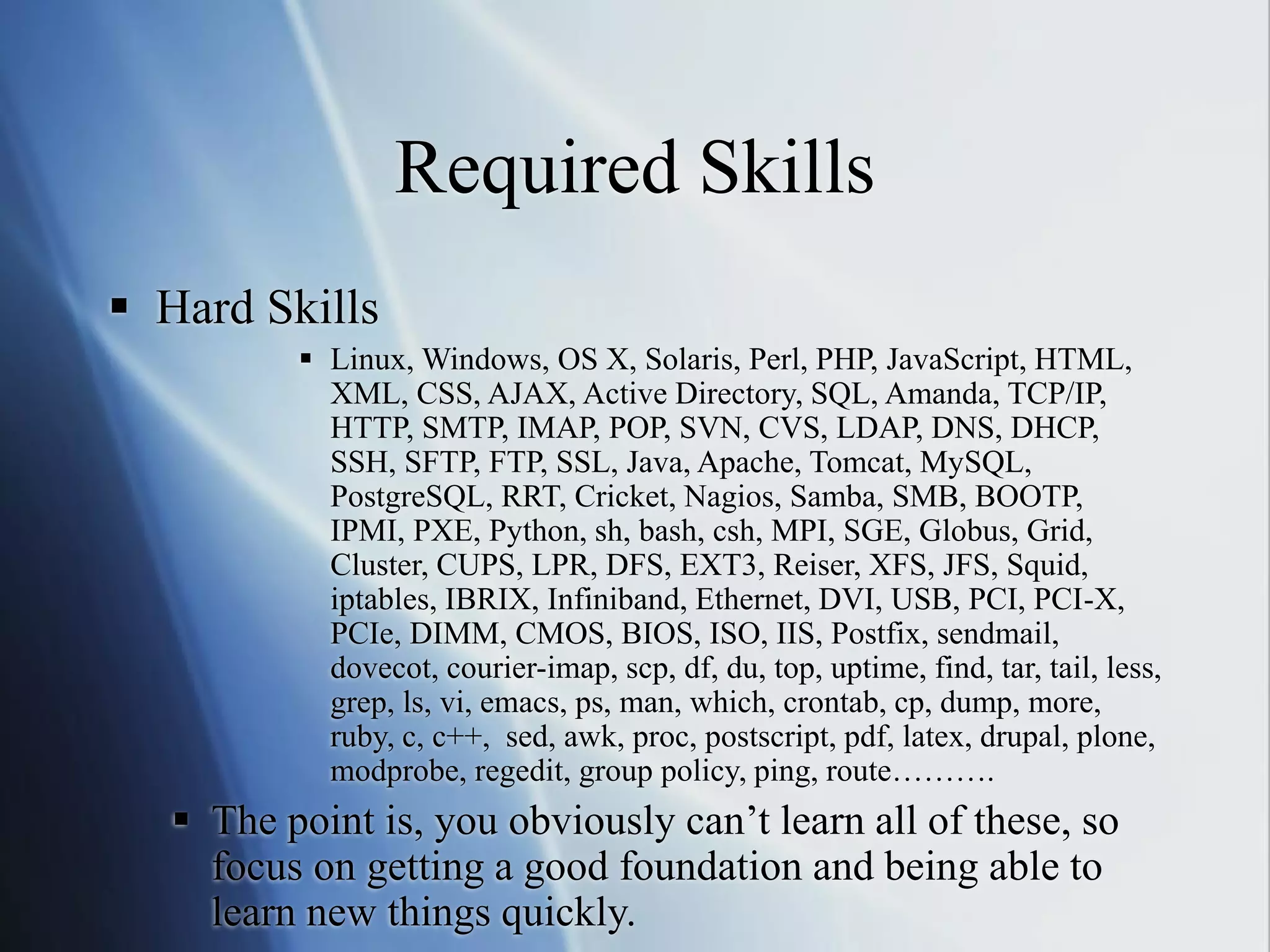
 Hard Skills
 Linux, Windows, OS X, Solaris, Perl, PHP, JavaScript, HTML,
XML, CSS, AJAX, Active Directory, SQL, Amanda, TCP/IP,
HTTP, SMTP, IMAP, POP, SVN, CVS, LDAP, DNS, DHCP,
SSH, SFTP, FTP, SSL, Java, Apache, Tomcat, MySQL,
PostgreSQL, RRT, Cricket, Nagios, Samba, SMB, BOOTP,
IPMI, PXE, Python, sh, bash, csh, MPI, SGE, Globus, Grid,
Cluster, CUPS, LPR, DFS, EXT3, Reiser, XFS, JFS, Squid,
iptables, IBRIX, Infiniband, Ethernet, DVI, USB, PCI, PCI-X,
PCIe, DIMM, CMOS, BIOS, ISO, IIS, Postfix, sendmail,
dovecot, courier-imap, scp, df, du, top, uptime, find, tar, tail, less,
grep, ls, vi, emacs, ps, man, which, crontab, cp, dump, more,
ruby, c, c++, sed, awk, proc, postscript, pdf, latex, drupal, plone,
modprobe, regedit, group policy, ping, route……….
 The point is, you obviously can’t learn all of these, so
focus on getting a good foundation and being able to
learn new things quickly.
Required Skills
 Soft Skills
 Be an excellent communicator
 Written
 Verbal
 Communicating technical information clearly and concisely is
extremely hard!
 Adaptability
 The landscape is constantly changing. Stay ahead of the curve
by keeping track of current development, maintaining current
training, and trying new things.
Required Skills
 Soft Skills
 Tolerance, Patience and Compassion
 End users can be difficult and unreasonable
 Put yourself in their shoes
 Self-Motivating
 Often, the only time you hear from users is when there’s
something wrong. The best ones remember to praise you when
things go right, but don’t rely on it for motivation
 Creativity
 Ability to think outside the box and come up with creative
solutions to problems
Successful Sysadmins…
 Generalize.
 They become a Jack-of-all-Trades. They don’t get
trapped in a specific technology or product.
 Are expert problem solvers.
 They understand how to attack the unknown in
manageable, measured steps.
 Are very good at time management.
 They manage information and workflow effectively.
Successful Sysadmins…
 Think ahead.
 Put monitoring systems in place before the
problem exists. Identify bottlenecks and
weaknesses and address them.
 Solve a problem once.
 Build a permanent solution, not a one-time hack
job. “Higher Order Administration”
 Are often outgoing, social people
How To Prepare
 Most college programs don’t do a good job
of preparing people to be sysadmins
 Which department? Computer Science?
Computer Engineering? MIS?
 My choice, and why
Maximizing College
Opportunities
 While at college, try to work at student labs and
helpdesk jobs and get IT internships and co-ops.
 Good classes to take:
 Technical writing
 Networking
 computer architecture
 operating system theory
 scripting languages
 web applications/services
 distributed computing
 computer security
The End
 Thank you!
 Questions?
 Contact me at fran@cis.uab.edu

Careers in System Administration (2007)

  • 1.
    Careers in System Administration FranFabrizio UAB Computer and Information Sciences
  • 2.
    Talk Outline  ADay in the Life…  What is a Sysadmin?  What does a sysadmin do on a daily basis?  Other kinds of sysadmins  Does This Sound Interesting?  Benefits of Being a Sysadmin  Compatibility  Traits of Successful Sysadmins  Preparing to Be a Sysadmin  Required Skills  Ideas for College
  • 3.
    A Day inthe Life…  What is a sysadmin?  What types of things do they do?  The different types of sysadmins
  • 4.
    What is aSysadmin?  Google’s answer to define:sysadmin  This is the person or people that takes care of a UNIX system This person has full access to all system resources.  Employee responsible for a company's computer network, also sometimes called a network administrator. A sysadmin's duties may include configuring the company's firewall, acquiring and installing hardware, setting up email addresses and keeping the printers working.  A job position of engineers involved in computer systems. They are the people responsible for running the system, or running some aspect of it.
  • 5.
    What is aSysadmin?  My informal definition…  “A person who is responsible for creating and maintaining an IT environment (or some aspect of it) to support users’ needs.”  How it relates to other areas of IT / CS?  Draw picture
  • 6.
    How I Becamea Sysadmin (An extremely concise history of my past 14 years)  Left TJ and went to Wash U. wanting to be a doctor  Organic Chemistry happened. I didn’t want to be a doctor any more. I was good with computers, so I tried computer science  I was a programmer for 6 years, first at a local St. Louis company, then at WebMD  I had to find a job in Birmingham. This one was mistakenly listed as a programmer job. I learned otherwise at the interview. They still hired me!  (More practical advice coming later…)
  • 7.
    What I Do Higher Education Sysadmin  Department of Computer and Information Sciences  University of Alabama at Birmingham  IT staff consists of myself and 3-4 student workers
  • 8.
    Scope  20 facultyand staff  250 students  My organization is responsible for something like 400-500 systems  ~ $1.5 - 2 million in IT
  • 9.
    A Brief Tour Slide Show
  • 10.
    The Mythical TypicalDay  Each day is completely different from the last  Everchanging activities  reactive, “helpdesk response”  proactive, strategic project development  physical labor  Teaching  Working with vendors  doing the “soft” stuff - administrative, PR, recruitment, professional development (like this talk)
  • 11.
    Job Responsibilities  Theentire IT cycle  Research  Vendor negotiations  Procurement  Receiving  Installation  Configuration  Maintenance  Decommission
  • 12.
    Job Responsibilities  EndUser Support  Answering helpdesk requests  Setting up laptops and desktops  Handling department guests  Academic Support  Setting up servers and software for academic activities  Research Support  Maintaining specialized research equipment and services  Infrastructure Support  Core production servers - email, web, etc…  Centralized storage and account management  Network infrastructure
  • 13.
    Job Responsibilities  Otheractivities  Managing the student staff  Maintaining vendor relationships  Coordinating with other areas of campus IT  Public relations - giving tours, attending events, creating department advertising  Grant writing  User training
  • 14.
    Job Responsibilities  Evenmore activities  Producing documentation  Teaching classes, seminars and workshops  Annual budget  Strategic planning  Training and development
  • 15.
    Recent Tasks  ProvideIT support to Alabama High School Programming Contest including development of program to automate submissions  Install security cameras  Upgrade cluster software  Troubleshoot error conditions on server hardware  Create system for automating subversion access and wikis for new accounts  Wrote a grant proposal for student technology fees
  • 16.
    Recent Tasks  Developsystem to automate lab machine installs based on location and role  Troubleshoot lost DHCP packets  Prepare workstations for summer research students  Migrate users to new email system  Install interactive monitors and remote lab PC control software and create training docs
  • 17.
    Other Types ofSysadmins  Corporate  Network  Database  Security  Domain-Specific
  • 18.
    Domain-Specific Admins  Bioinformatics Computer Forensics  Computational Chemists  High Performance Computing  Most physical sciences have become extremely computation-oriented. They need people who understand IT -and- their world.
  • 19.
    Does This SoundInteresting?  Debunking some Myths  Benefits of the job  Compatibility
  • 20.
    Myths of Sysadmins They’re in front of a computer all day.  They don’t interact with people much.  They never get to program.  It’s not a very creative job.
  • 21.
    Why I LikeMy Job  Challenging  Hard problems  Never the same day twice  Great if you are easily bored  Always learning something new  IT reinvents itself every few years  Freedom  Autonomy, independence
  • 22.
    Why I LikeMy Job  Academic Environment  Relaxed / casual, respectful, supportive  Feeling of Enabling People  Pay and Benefits  High salaries  Get to travel a lot  Public sector advantages
  • 23.
    A Quick Lookat the Industry (this slide is for the parents!)  The IT job outlook is phenomenally good right now  The outsourcing myth - debunked!  Explosion in need - 43% job growth  Job happiness - IT dominates these rankings  Competitive salaries - Top 5 of all degrees. Start > $50k.
  • 24.
    Is Sysadmin Rightfor Me?  I like to always be doing something different.  I am spontaneous and adapt well to sudden changes and new situations.  I multitask well and don’t mind interruptions.  I don’t fear the unknown.
  • 25.
    Is Sysadmin Rightfor Me?  I welcome challenging problems.  I enjoy installing and debugging computer hardware and software.  I get along with all sorts of personalities easily.  I work well under pressure.  I like puzzles.
  • 26.
    Is Sysadmin Rightfor Me?  I’d rather know a little about a lot than a lot about a little  I don’t mind unpredictable work schedules and being on call  I like to take things apart and figure out how they work
  • 27.
    Preparing to bea Sysadmin  Required Skills  Traits of Successful Sysadmins  Maximizing College
  • 28.
    Required Skills  “Hard”skills  Must be an expert hardware and software tinkerer  Comfortable in multiple Oses  Install and configure server and client software  Know how networks work and how computers communicate  Script programming  Leveraging the Internet for information  One of the biggest mistakes I see young admins make!
  • 29.
    Required Skills  HardSkills  Linux, Windows, OS X, Solaris, Perl, PHP, JavaScript, HTML, XML, CSS, AJAX, Active Directory, SQL, Amanda, TCP/IP, HTTP, SMTP, IMAP, POP, SVN, CVS, LDAP, DNS, DHCP, SSH, SFTP, FTP, SSL, Java, Apache, Tomcat, MySQL, PostgreSQL, RRT, Cricket, Nagios, Samba, SMB, BOOTP, IPMI, PXE, Python, sh, bash, csh, MPI, SGE, Globus, Grid, Cluster, CUPS, LPR, DFS, EXT3, Reiser, XFS, JFS, Squid, iptables, IBRIX, Infiniband, Ethernet, DVI, USB, PCI, PCI-X, PCIe, DIMM, CMOS, BIOS, ISO, IIS, Postfix, sendmail, dovecot, courier-imap, scp, df, du, top, uptime, find, tar, tail, less, grep, ls, vi, emacs, ps, man, which, crontab, cp, dump, more, ruby, c, c++, sed, awk, proc, postscript, pdf, latex, drupal, plone, modprobe, regedit, group policy, ping, route……….  The point is, you obviously can’t learn all of these, so focus on getting a good foundation and being able to learn new things quickly.
  • 30.
    Required Skills  SoftSkills  Be an excellent communicator  Written  Verbal  Communicating technical information clearly and concisely is extremely hard!  Adaptability  The landscape is constantly changing. Stay ahead of the curve by keeping track of current development, maintaining current training, and trying new things.
  • 31.
    Required Skills  SoftSkills  Tolerance, Patience and Compassion  End users can be difficult and unreasonable  Put yourself in their shoes  Self-Motivating  Often, the only time you hear from users is when there’s something wrong. The best ones remember to praise you when things go right, but don’t rely on it for motivation  Creativity  Ability to think outside the box and come up with creative solutions to problems
  • 32.
    Successful Sysadmins…  Generalize. They become a Jack-of-all-Trades. They don’t get trapped in a specific technology or product.  Are expert problem solvers.  They understand how to attack the unknown in manageable, measured steps.  Are very good at time management.  They manage information and workflow effectively.
  • 33.
    Successful Sysadmins…  Thinkahead.  Put monitoring systems in place before the problem exists. Identify bottlenecks and weaknesses and address them.  Solve a problem once.  Build a permanent solution, not a one-time hack job. “Higher Order Administration”  Are often outgoing, social people
  • 34.
    How To Prepare Most college programs don’t do a good job of preparing people to be sysadmins  Which department? Computer Science? Computer Engineering? MIS?  My choice, and why
  • 35.
    Maximizing College Opportunities  Whileat college, try to work at student labs and helpdesk jobs and get IT internships and co-ops.  Good classes to take:  Technical writing  Networking  computer architecture  operating system theory  scripting languages  web applications/services  distributed computing  computer security
  • 36.
    The End  Thankyou!  Questions?  Contact me at fran@cis.uab.edu